INTERVIEWS
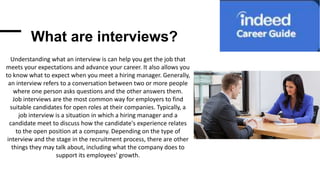
What are interviews?
Understanding what an interview is can help you get the job that
meets your expectations and advance your career. It also allows you
to know what to expect when you meet a hiring manager. Generally,
an interview refers to a conversation between two or more people
where one person asks questions and the other answers them.
Job interviews are the most common way for employers to find
suitable candidates for open roles at their companies. Typically, a
job interview is a situation in which a hiring manager and a
candidate meet to discuss how the candidate's experience relates
to the open position at a company. Depending on the type of
interview and the stage in the recruitment process, there are other
things they may talk about, including what the company does to
support its employees' growth.
Types of interviews
Personal interview
A personal interview is a 1-on-
1 meeting, usually between a
hiring manager and a
candidate. This is the most
common type of interview,
which allows the employer to
fully focus on an individual
candidate's strengths, skills
and expertise. You can expect
this type of interview if you're
applying for a senior role or a
position that requires you to
work with little to no
supervision.
Group interview
During a group interview, multiple
candidates meet with a hiring
manager, who gives them a topic to
discuss. Group interviews are a
great way for the interviewer to
assess the candidates'
conversational abilities and
interpersonal skills. For example,
they may pay attention to how likely
a candidate is to allow others to
share their opinion or how easily
they can influence others. This is a
common type of interview for sales
roles.
Panel interview
A panel interview, also known as a
committee interview, involves
multiple senior employees of a
company interviewing a candidate.
Typically, candidates make a
presentation first. The interviewers
then ask them questions about the
topic to test the candidate's
expertise in the field. Interviews of
this type are usually more
demanding and require you to
spend more time preparing for
them, which is why they're usually
for mid- to high-level roles at a
company.
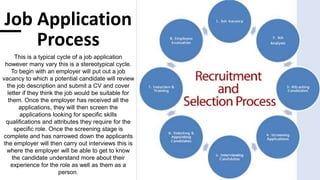
Job Application
Process
This is a typical cycle of a job application
however many vary this is a stereotypical cycle.
To begin with an employer will put out a job
vacancy to which a potential candidate will review
the job description and submit a CV and cover
letter if they think the job would be suitable for
them. Once the employer has received all the
applications, they will then screen the
applications looking for specific skills
qualifications and attributes they require for the
specific role. Once the screening stage is
complete and has narrowed down the applicants
the employer will then carry out interviews this is
where the employer will be able to get to know
the candidate understand more about their
experience for the role as well as them as a
person.
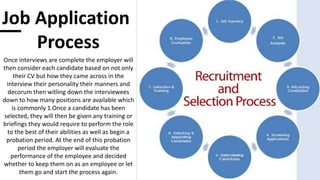
Job Application
Process
Once interviews are complete the employer will
then consider each candidate based on not only
their CV but how they came across in the
interview their personality their manners and
decorum then witling down the interviewees
down to how many positions are available which
is commonly 1.Once a candidate has been
selected, they will then be given any training or
briefings they would require to perform the role
to the best of their abilities as well as begin a
probation period. At the end of this probation
period the employer will evaluate the
performance of the employee and decided
whether to keep them on as an employee or let
them go and start the process again.
What should I wear to an interview?
For a job interview it is best to
attend smartly dressed. For
example, wearing neutral or
muted solid colours or with
little to no design. Clothes
should be modest, neat and
ironed. Although the image
shows a dress or shirt and
trousers for women a suit
would also be an ideal option
to wear. Neutral-coloured
closed toe shoes usually high
heels for women are usually
encouraged however smart
dress shoes depending on the
outfit would also be suitable.
What should I bring to an interview?
A good attitude and a
genuine smile
Copies of my CV
Pen and paper or
a notebook
Pre-written questions for
your interviewers
A list of references
A portfolio or
work samples
A bag, briefcase or portfolio that
neatly contains all your items
Directions and
contact information
Emergency items (such as
tissues, umbrella, etc.)
Conducting myself during an interview
What is interview etiquette?
Interview etiquette is the behaviour, language and empathy that you deploy during a job interview. It's useful to use
such etiquette throughout the interview process, as this encourages the interviewer to view you as a kind and
trustworthy person. If your counterpart views you positively, they're more likely to recommend that their manager hire
you, allowing you to secure a new job more quickly. If you follow this advice each time you interview for a job, you can
progress your career to a more senior level in a shorter period, boosting your earning potential as a result.
How to conduct yourself in an interview
1. Prepare in advance- Research common interview questions, prepare questions to ask employer
2. Act professionally-Formal clothing and good manners
3. Use positive body language-Maintaining eye contact and confidence
4. Use clear and detailed sentences-Use simple yet formal vocabulary
5. Direct the conversation towards your attributes- show how your skills and experience suit the role
6. Express gratitude-Thank the employer for the opportunity and their time
Interview Top Tips
1. Do your research ahead of the interview
2. Look the part
3. Make eye contact with the interviewer
4. Do a practice interview beforehand
5. Let your personality shine

Interviews.pptx

  • 1.
  • 2.
    What are interviews? Understandingwhat an interview is can help you get the job that meets your expectations and advance your career. It also allows you to know what to expect when you meet a hiring manager. Generally, an interview refers to a conversation between two or more people where one person asks questions and the other answers them. Job interviews are the most common way for employers to find suitable candidates for open roles at their companies. Typically, a job interview is a situation in which a hiring manager and a candidate meet to discuss how the candidate's experience relates to the open position at a company. Depending on the type of interview and the stage in the recruitment process, there are other things they may talk about, including what the company does to support its employees' growth.
  • 3.
    Types of interviews Personalinterview A personal interview is a 1-on- 1 meeting, usually between a hiring manager and a candidate. This is the most common type of interview, which allows the employer to fully focus on an individual candidate's strengths, skills and expertise. You can expect this type of interview if you're applying for a senior role or a position that requires you to work with little to no supervision. Group interview During a group interview, multiple candidates meet with a hiring manager, who gives them a topic to discuss. Group interviews are a great way for the interviewer to assess the candidates' conversational abilities and interpersonal skills. For example, they may pay attention to how likely a candidate is to allow others to share their opinion or how easily they can influence others. This is a common type of interview for sales roles. Panel interview A panel interview, also known as a committee interview, involves multiple senior employees of a company interviewing a candidate. Typically, candidates make a presentation first. The interviewers then ask them questions about the topic to test the candidate's expertise in the field. Interviews of this type are usually more demanding and require you to spend more time preparing for them, which is why they're usually for mid- to high-level roles at a company.
  • 4.
    Job Application Process This isa typical cycle of a job application however many vary this is a stereotypical cycle. To begin with an employer will put out a job vacancy to which a potential candidate will review the job description and submit a CV and cover letter if they think the job would be suitable for them. Once the employer has received all the applications, they will then screen the applications looking for specific skills qualifications and attributes they require for the specific role. Once the screening stage is complete and has narrowed down the applicants the employer will then carry out interviews this is where the employer will be able to get to know the candidate understand more about their experience for the role as well as them as a person.
  • 5.
    Job Application Process Once interviewsare complete the employer will then consider each candidate based on not only their CV but how they came across in the interview their personality their manners and decorum then witling down the interviewees down to how many positions are available which is commonly 1.Once a candidate has been selected, they will then be given any training or briefings they would require to perform the role to the best of their abilities as well as begin a probation period. At the end of this probation period the employer will evaluate the performance of the employee and decided whether to keep them on as an employee or let them go and start the process again.
  • 6.
    What should Iwear to an interview? For a job interview it is best to attend smartly dressed. For example, wearing neutral or muted solid colours or with little to no design. Clothes should be modest, neat and ironed. Although the image shows a dress or shirt and trousers for women a suit would also be an ideal option to wear. Neutral-coloured closed toe shoes usually high heels for women are usually encouraged however smart dress shoes depending on the outfit would also be suitable.
  • 7.
    What should Ibring to an interview? A good attitude and a genuine smile Copies of my CV Pen and paper or a notebook Pre-written questions for your interviewers A list of references A portfolio or work samples A bag, briefcase or portfolio that neatly contains all your items Directions and contact information Emergency items (such as tissues, umbrella, etc.)
  • 8.
    Conducting myself duringan interview What is interview etiquette? Interview etiquette is the behaviour, language and empathy that you deploy during a job interview. It's useful to use such etiquette throughout the interview process, as this encourages the interviewer to view you as a kind and trustworthy person. If your counterpart views you positively, they're more likely to recommend that their manager hire you, allowing you to secure a new job more quickly. If you follow this advice each time you interview for a job, you can progress your career to a more senior level in a shorter period, boosting your earning potential as a result. How to conduct yourself in an interview 1. Prepare in advance- Research common interview questions, prepare questions to ask employer 2. Act professionally-Formal clothing and good manners 3. Use positive body language-Maintaining eye contact and confidence 4. Use clear and detailed sentences-Use simple yet formal vocabulary 5. Direct the conversation towards your attributes- show how your skills and experience suit the role 6. Express gratitude-Thank the employer for the opportunity and their time
  • 9.
    Interview Top Tips 1.Do your research ahead of the interview 2. Look the part 3. Make eye contact with the interviewer 4. Do a practice interview beforehand 5. Let your personality shine