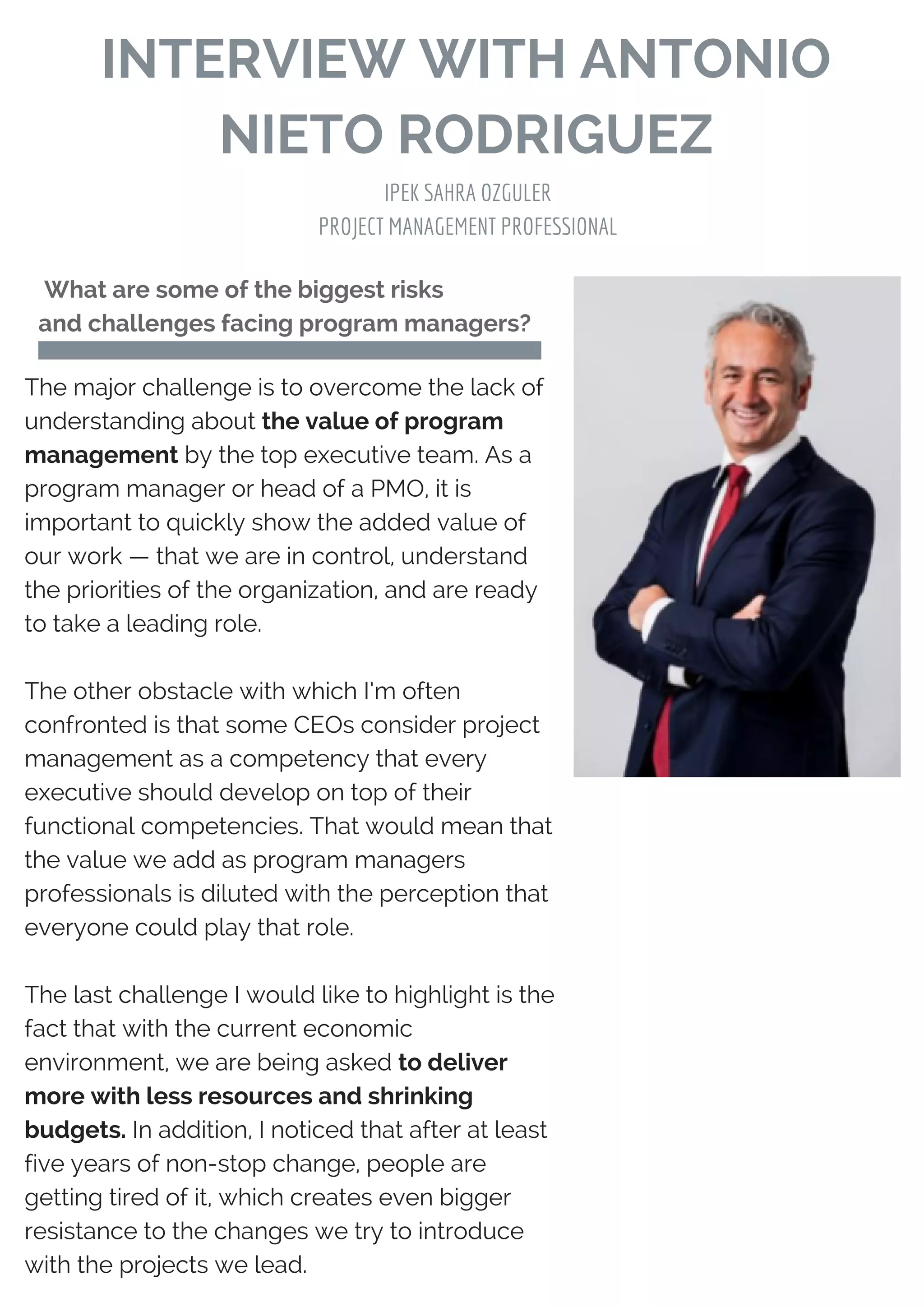
INTERVIEW WITH ANTONIO
NIETO RODRIGUEZ
IPEK SAHRA OZGULER
PROJECT MANAGEMENT PROFESSIONAL
What are some of the biggest risks
and challenges facing program managers?
The major challenge is to overcome the lack of
understanding about the value of program
management by the top executive team. As a
program manager or head of a PMO, it is
important to quickly show the added value of
our work — that we are in control, understand
the priorities of the organization, and are ready
to take a leading role.
The other obstacle with which I’m often
confronted is that some CEOs consider project
management as a competency that every
executive should develop on top of their
functional competencies. That would mean that
the value we add as program managers
professionals is diluted with the perception that
everyone could play that role.
The last challenge I would like to highlight is the
fact that with the current economic
environment, we are being asked to deliver
more with less resources and shrinking
budgets. In addition, I noticed that after at least
five years of non-stop change, people are
getting tired of it, which creates even bigger
resistance to the changes we try to introduce
with the projects we lead.
How do you think new global trends will
affect the project management profession?
According to the International Monetary
Fund, by 2050 only three of the top world
economies will be in the West – the U.S.,
Germany, and the U.K. This means that
western organizations will need to partner
with each other, and with companies in other
regions, particularly Asia.
Collaboration between global teams made
up of different national, organizational, and
professional cultures is already a reality
today, but most probably it will intensify in
the future. In addition, the Internet, social
media, and mobile connectivity will keep
disrupting our current notions of the
‘workplace’ and the ‘organization’.
Networked organizations, virtual and
transversal teams are becoming the new
norm. Thus, “collaboration” and “networking”
will become even more important skills than
they are today.
The good news is that we, project
management professionals, understand and
have acquired those skills as part of our
day-to-day project management challenges.
As PMI’s Talent Triangle illustrates, project
managers will also need to develop
business . expertise and leadership skills. To
keep being relevant, it is critical to invest in
yourself; keep learning and building
knowledge on top of your project
management skill set.
How can project and program managers
more effectively influence and
communicate with their executive
teams?
It’s important to identify and cultivate
solid working relationships with executive
sponsors in the C-suite and elsewhere.
In fact, PMI’s Pulse of the Profession®
research indicates that having actively
engaged executive sponsors is the top
driver of project success.
Share your vision about your project and
how it will address some of the key
priorities of the organizaton.
Understand their personal interests and
goals, and communicate how your
project links to them.
Last, talk to them in their own language,
not in project management terms. For
example, if you are talking to the Sales
director about your project, use terms like
market share, product pipeline, product
features, sales trends, competition,
growth,.... I guarantee you will have his or
her attention.
4PMWORLDJOURNAL
Having managed programs in such diverse sectors as finance and
pharma, have you observed any trends or practices that are common
to all industries?
Finance and pharma, like any other highly regulated industry, dedicate
a very large amount of their project portfolio to compliance and risk
management initiatives, leaving little resources for innovation and
growth projects.
Therefore, one of the key common practices in these industries is to
establish a company-wide project selection and prioritization process
endorsed and sponsored by the entire executive team. If well done, this
process will provide clarity and the right balance between compliance
and growth.
Having managed programs in such diverse sectors as finance
and pharma, have you observed any trends or practices that are
common to all industries?
The first priority is to get executive buy-in and make the PMO a partner in
strategy. Next, it’s essential to find the right people. If possible, hire
internally and recruit from multiple departments like sales, marketing
operations and IT to broaden the team skill set. When implementing new
processes, look for internal best practices and allow for some local
flexibility. The PMO’s role should be more consultative than administrative
or regulatory, adapting practices from A Guide to the Project Management
Body of Knowledge (PMBOK® Guide) — Fifth Edition to individual
initiatives within an organization’s process and culture. By capitalizing on
the major contributors to project success and avoiding the leading causes
of project failure, project success should be a predictable and repeatable
event, instead of a hit-and-miss occurrence.
PMI’s Pulse of the Profession® research identifies a number of key factors
affecting project outcomes. For example, 47% of unsuccessful projects fail
to meet goals due to poor requirements management. To address this, it’s
critical for PMOs to implement standardized requirements management
processes in collaboration with stakeholders.
What are the most important factors to consider when creating a PMO?
47 %
Figure 1: Unsuccessful Projects
What additional skills are most necessary for project
professionals seeking to transition to program
management?
Program managers need to have a good business sense
and contextual understanding of the projects, so they’re
able to visualize and understand how those projects
collectively contribute to the achievement of the
organization’s strategic priorities.
It’s also essential to have good communication and
interpersonal skills to build rapport with project teams,
executives and other key stakeholders
What additional skills are most necessary for
project professionals seeking to transition to
program management?
I found it very rewarding to be able to change industries
in midcareer based on the merits of my project portfolio,
PMO and project management skills. Although I had
minimal experience in the pharmaceutical field, I was
chosen to establish and lead the Global Project
Management Office at GSK Vaccines out of a pool of
200 candidates. I believe this is an example for all
project and program managers, which I know
sometimes have doubts whether they made the right
career decision. It validates how our skill set has
become a core competency for any organization.
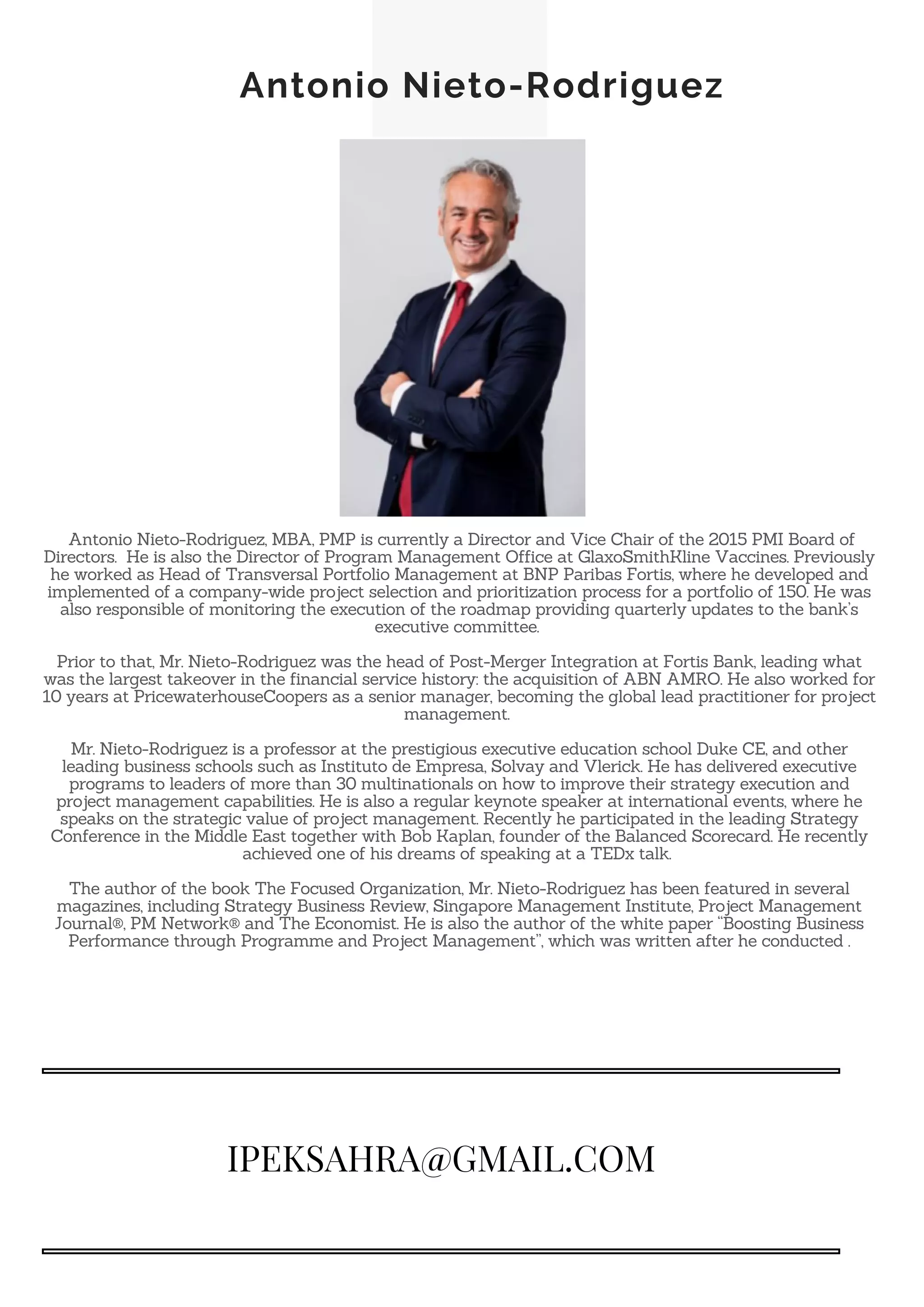
Antonio Nieto-Rodriguez
Antonio Nieto-Rodriguez, MBA, PMP is currently a Director and Vice Chair of the 2015 PMI Board of
Directors. He is also the Director of Program Management Office at GlaxoSmithKline Vaccines. Previously
he worked as Head of Transversal Portfolio Management at BNP Paribas Fortis, where he developed and
implemented of a company-wide project selection and prioritization process for a portfolio of 150. He was
also responsible of monitoring the execution of the roadmap providing quarterly updates to the bank’s
executive committee.
Prior to that, Mr. Nieto-Rodriguez was the head of Post-Merger Integration at Fortis Bank, leading what
was the largest takeover in the financial service history: the acquisition of ABN AMRO. He also worked for
10 years at PricewaterhouseCoopers as a senior manager, becoming the global lead practitioner for project
management.
Mr. Nieto-Rodriguez is a professor at the prestigious executive education school Duke CE, and other
leading business schools such as Instituto de Empresa, Solvay and Vlerick. He has delivered executive
programs to leaders of more than 30 multinationals on how to improve their strategy execution and
project management capabilities. He is also a regular keynote speaker at international events, where he
speaks on the strategic value of project management. Recently he participated in the leading Strategy
Conference in the Middle East together with Bob Kaplan, founder of the Balanced Scorecard. He recently
achieved one of his dreams of speaking at a TEDx talk.
The author of the book The Focused Organization, Mr. Nieto-Rodriguez has been featured in several
magazines, including Strategy Business Review, Singapore Management Institute, Project Management
Journal®, PM Network® and The Economist. He is also the author of the white paper “Boosting Business
Performance through Programme and Project Management”, which was written after he conducted .
IPEKSAHRA@GMAIL.COM

INTERVIEW WITH ANTONIO NIETO RODRIGUEZ

  • 1.
    INTERVIEW WITH ANTONIO NIETORODRIGUEZ IPEK SAHRA OZGULER PROJECT MANAGEMENT PROFESSIONAL What are some of the biggest risks and challenges facing program managers? The major challenge is to overcome the lack of understanding about the value of program management by the top executive team. As a program manager or head of a PMO, it is important to quickly show the added value of our work — that we are in control, understand the priorities of the organization, and are ready to take a leading role. The other obstacle with which I’m often confronted is that some CEOs consider project management as a competency that every executive should develop on top of their functional competencies. That would mean that the value we add as program managers professionals is diluted with the perception that everyone could play that role. The last challenge I would like to highlight is the fact that with the current economic environment, we are being asked to deliver more with less resources and shrinking budgets. In addition, I noticed that after at least five years of non-stop change, people are getting tired of it, which creates even bigger resistance to the changes we try to introduce with the projects we lead.
  • 2.
    How do youthink new global trends will affect the project management profession? According to the International Monetary Fund, by 2050 only three of the top world economies will be in the West – the U.S., Germany, and the U.K. This means that western organizations will need to partner with each other, and with companies in other regions, particularly Asia. Collaboration between global teams made up of different national, organizational, and professional cultures is already a reality today, but most probably it will intensify in the future. In addition, the Internet, social media, and mobile connectivity will keep disrupting our current notions of the ‘workplace’ and the ‘organization’. Networked organizations, virtual and transversal teams are becoming the new norm. Thus, “collaboration” and “networking” will become even more important skills than they are today. The good news is that we, project management professionals, understand and have acquired those skills as part of our day-to-day project management challenges. As PMI’s Talent Triangle illustrates, project managers will also need to develop business . expertise and leadership skills. To keep being relevant, it is critical to invest in yourself; keep learning and building knowledge on top of your project management skill set.
  • 3.
    How can projectand program managers more effectively influence and communicate with their executive teams? It’s important to identify and cultivate solid working relationships with executive sponsors in the C-suite and elsewhere. In fact, PMI’s Pulse of the Profession® research indicates that having actively engaged executive sponsors is the top driver of project success. Share your vision about your project and how it will address some of the key priorities of the organizaton. Understand their personal interests and goals, and communicate how your project links to them. Last, talk to them in their own language, not in project management terms. For example, if you are talking to the Sales director about your project, use terms like market share, product pipeline, product features, sales trends, competition, growth,.... I guarantee you will have his or her attention.
  • 4.
    4PMWORLDJOURNAL Having managed programsin such diverse sectors as finance and pharma, have you observed any trends or practices that are common to all industries? Finance and pharma, like any other highly regulated industry, dedicate a very large amount of their project portfolio to compliance and risk management initiatives, leaving little resources for innovation and growth projects. Therefore, one of the key common practices in these industries is to establish a company-wide project selection and prioritization process endorsed and sponsored by the entire executive team. If well done, this process will provide clarity and the right balance between compliance and growth. Having managed programs in such diverse sectors as finance and pharma, have you observed any trends or practices that are common to all industries?
  • 5.
    The first priorityis to get executive buy-in and make the PMO a partner in strategy. Next, it’s essential to find the right people. If possible, hire internally and recruit from multiple departments like sales, marketing operations and IT to broaden the team skill set. When implementing new processes, look for internal best practices and allow for some local flexibility. The PMO’s role should be more consultative than administrative or regulatory, adapting practices from A Guide to the Project Management Body of Knowledge (PMBOK® Guide) — Fifth Edition to individual initiatives within an organization’s process and culture. By capitalizing on the major contributors to project success and avoiding the leading causes of project failure, project success should be a predictable and repeatable event, instead of a hit-and-miss occurrence. PMI’s Pulse of the Profession® research identifies a number of key factors affecting project outcomes. For example, 47% of unsuccessful projects fail to meet goals due to poor requirements management. To address this, it’s critical for PMOs to implement standardized requirements management processes in collaboration with stakeholders. What are the most important factors to consider when creating a PMO? 47 % Figure 1: Unsuccessful Projects
  • 6.
    What additional skillsare most necessary for project professionals seeking to transition to program management? Program managers need to have a good business sense and contextual understanding of the projects, so they’re able to visualize and understand how those projects collectively contribute to the achievement of the organization’s strategic priorities. It’s also essential to have good communication and interpersonal skills to build rapport with project teams, executives and other key stakeholders What additional skills are most necessary for project professionals seeking to transition to program management? I found it very rewarding to be able to change industries in midcareer based on the merits of my project portfolio, PMO and project management skills. Although I had minimal experience in the pharmaceutical field, I was chosen to establish and lead the Global Project Management Office at GSK Vaccines out of a pool of 200 candidates. I believe this is an example for all project and program managers, which I know sometimes have doubts whether they made the right career decision. It validates how our skill set has become a core competency for any organization.
  • 7.
    Antonio Nieto-Rodriguez Antonio Nieto-Rodriguez,MBA, PMP is currently a Director and Vice Chair of the 2015 PMI Board of Directors. He is also the Director of Program Management Office at GlaxoSmithKline Vaccines. Previously he worked as Head of Transversal Portfolio Management at BNP Paribas Fortis, where he developed and implemented of a company-wide project selection and prioritization process for a portfolio of 150. He was also responsible of monitoring the execution of the roadmap providing quarterly updates to the bank’s executive committee. Prior to that, Mr. Nieto-Rodriguez was the head of Post-Merger Integration at Fortis Bank, leading what was the largest takeover in the financial service history: the acquisition of ABN AMRO. He also worked for 10 years at PricewaterhouseCoopers as a senior manager, becoming the global lead practitioner for project management. Mr. Nieto-Rodriguez is a professor at the prestigious executive education school Duke CE, and other leading business schools such as Instituto de Empresa, Solvay and Vlerick. He has delivered executive programs to leaders of more than 30 multinationals on how to improve their strategy execution and project management capabilities. He is also a regular keynote speaker at international events, where he speaks on the strategic value of project management. Recently he participated in the leading Strategy Conference in the Middle East together with Bob Kaplan, founder of the Balanced Scorecard. He recently achieved one of his dreams of speaking at a TEDx talk. The author of the book The Focused Organization, Mr. Nieto-Rodriguez has been featured in several magazines, including Strategy Business Review, Singapore Management Institute, Project Management Journal®, PM Network® and The Economist. He is also the author of the white paper “Boosting Business Performance through Programme and Project Management”, which was written after he conducted . IPEKSAHRA@GMAIL.COM