INTERSUBJECTIVIT
Y
Is a philosophical concept that
explore the mutual recognition of
each other as a person.
It is the condition of man, a subject,
among other men, who are also
subject.
WHAT IS INTERSUBJECTIVITY?
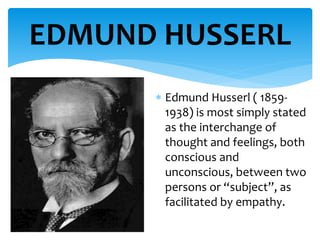
 Edmund Husserl ( 1859-
1938) is most simply stated
as the interchange of
thought and feelings, both
conscious and
unconscious, between two
persons or “subject”, as
facilitated by empathy.
EDMUND HUSSERL
SOCIAL- refer to the life of a group
bound together by common
experiences and reaction.
INTERHUMAN- refers to life
between and among persons; it
refers to the “interpersonal”, that is
a life of dialogue.
SOCIAL VS. INTERHUMAN
It is a deep and genuine relationship
between persons.
It happens when two person truly
acknowledge each other’s presence
and treat each other as equals
DIALOGUE
I-Thou relationship
VS.
I-IT relationship
Refers to the world of experience
and sensation where there are
objects.
An individual treats other things,
people etc. As Object to be used
and experienced.
I-IT RELATIONSHIP
Refers to the world of encounter
and relationships where there are
persons.
It is a concrete encounter without
any qualification of one another.
I-THOU RELATIONSHIP
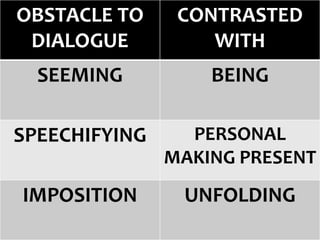
OBSTACLE TO
DIALOGUE
CONTRASTED
WITH
SEEMING BEING
SPEECHIFYING PERSONAL
MAKING PRESENT
IMPOSITION UNFOLDING
SEEMING- is a way of approaching
the other governed by the image
one desires to impress others.
BEING- proceeds not from an
image, but from what really is.
SEEMING VS. BEING
“ Acceptance is
the road to all
change “
- Bryant McGill
SPEECHIFYING- is hearing without
listening to what one says.
PERSONAL MAKING PRESENT- is a
process of fully opening oneself to
the other.
SPEECHIFYING VS. PERSONAL
MAKING PRESENT
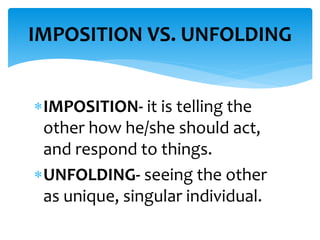
IMPOSITION- it is telling the
other how he/she should act,
and respond to things.
UNFOLDING- seeing the other
as unique, singular individual.
IMPOSITION VS. UNFOLDING
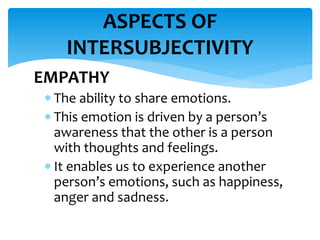
EMPATHY
 The ability to share emotions.
 This emotion is driven by a person’s
awareness that the other is a person
with thoughts and feelings.
 It enables us to experience another
person’s emotions, such as happiness,
anger and sadness.
ASPECTS OF
INTERSUBJECTIVITY
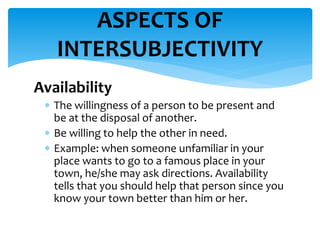
Availability
 The willingness of a person to be present and
be at the disposal of another.
 Be willing to help the other in need.
 Example: when someone unfamiliar in your
place wants to go to a famous place in your
town, he/she may ask directions. Availability
tells that you should help that person since you
know your town better than him or her.
ASPECTS OF
INTERSUBJECTIVITY
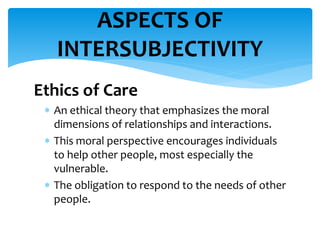
Ethics of Care
 An ethical theory that emphasizes the moral
dimensions of relationships and interactions.
 This moral perspective encourages individuals
to help other people, most especially the
vulnerable.
 The obligation to respond to the needs of other
people.
ASPECTS OF
INTERSUBJECTIVITY
Even though not all human
beings are blessed with
complete physical structure,
there are people who are still
successful despite their
conditions. These people are:
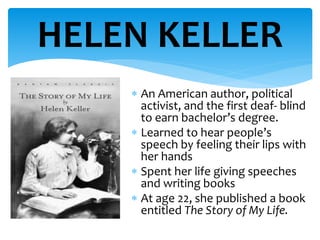
 An American author, political
activist, and the first deaf- blind
to earn bachelor’s degree.
 Learned to hear people’s
speech by feeling their lips with
her hands
 Spent her life giving speeches
and writing books
 At age 22, she published a book
entitled The Story of My Life.
HELEN KELLER
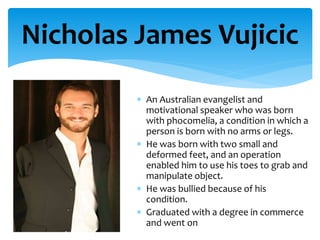
 An Australian evangelist and
motivational speaker who was born
with phocomelia, a condition in which a
person is born with no arms or legs.
 He was born with two small and
deformed feet, and an operation
enabled him to use his toes to grab and
manipulate object.
 He was bullied because of his
condition.
 Graduated with a degree in commerce
and went on
Nicholas James Vujicic
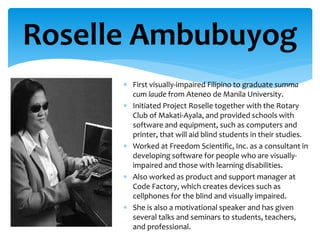
Roselle Ambubuyog
 First visually-impaired Filipino to graduate summa
cum laude from Ateneo de Manila University.
 Initiated Project Roselle together with the Rotary
Club of Makati-Ayala, and provided schools with
software and equipment, such as computers and
printer, that will aid blind students in their studies.
 Worked at Freedom Scientific, Inc. as a consultant in
developing software for people who are visually-
impaired and those with learning disabilities.
 Also worked as product and support manager at
Code Factory, which creates devices such as
cellphones for the blind and visually impaired.
 She is also a motivational speaker and has given
several talks and seminars to students, teachers,
and professional.
THANK YOU!!!

INTERSUBJECTIVITY.pptx

  • 1.
  • 2.
    Is a philosophicalconcept that explore the mutual recognition of each other as a person. It is the condition of man, a subject, among other men, who are also subject. WHAT IS INTERSUBJECTIVITY?
  • 3.
     Edmund Husserl( 1859- 1938) is most simply stated as the interchange of thought and feelings, both conscious and unconscious, between two persons or “subject”, as facilitated by empathy. EDMUND HUSSERL
  • 4.
    SOCIAL- refer tothe life of a group bound together by common experiences and reaction. INTERHUMAN- refers to life between and among persons; it refers to the “interpersonal”, that is a life of dialogue. SOCIAL VS. INTERHUMAN
  • 5.
    It is adeep and genuine relationship between persons. It happens when two person truly acknowledge each other’s presence and treat each other as equals DIALOGUE
  • 6.
  • 7.
    Refers to theworld of experience and sensation where there are objects. An individual treats other things, people etc. As Object to be used and experienced. I-IT RELATIONSHIP
  • 8.
    Refers to theworld of encounter and relationships where there are persons. It is a concrete encounter without any qualification of one another. I-THOU RELATIONSHIP
  • 9.
    OBSTACLE TO DIALOGUE CONTRASTED WITH SEEMING BEING SPEECHIFYINGPERSONAL MAKING PRESENT IMPOSITION UNFOLDING
  • 10.
    SEEMING- is away of approaching the other governed by the image one desires to impress others. BEING- proceeds not from an image, but from what really is. SEEMING VS. BEING
  • 11.
    “ Acceptance is theroad to all change “ - Bryant McGill
  • 12.
    SPEECHIFYING- is hearingwithout listening to what one says. PERSONAL MAKING PRESENT- is a process of fully opening oneself to the other. SPEECHIFYING VS. PERSONAL MAKING PRESENT
  • 13.
    IMPOSITION- it istelling the other how he/she should act, and respond to things. UNFOLDING- seeing the other as unique, singular individual. IMPOSITION VS. UNFOLDING
  • 14.
    EMPATHY  The abilityto share emotions.  This emotion is driven by a person’s awareness that the other is a person with thoughts and feelings.  It enables us to experience another person’s emotions, such as happiness, anger and sadness. ASPECTS OF INTERSUBJECTIVITY
  • 15.
    Availability  The willingnessof a person to be present and be at the disposal of another.  Be willing to help the other in need.  Example: when someone unfamiliar in your place wants to go to a famous place in your town, he/she may ask directions. Availability tells that you should help that person since you know your town better than him or her. ASPECTS OF INTERSUBJECTIVITY
  • 16.
    Ethics of Care An ethical theory that emphasizes the moral dimensions of relationships and interactions.  This moral perspective encourages individuals to help other people, most especially the vulnerable.  The obligation to respond to the needs of other people. ASPECTS OF INTERSUBJECTIVITY
  • 17.
    Even though notall human beings are blessed with complete physical structure, there are people who are still successful despite their conditions. These people are:
  • 18.
     An Americanauthor, political activist, and the first deaf- blind to earn bachelor’s degree.  Learned to hear people’s speech by feeling their lips with her hands  Spent her life giving speeches and writing books  At age 22, she published a book entitled The Story of My Life. HELEN KELLER
  • 19.
     An Australianevangelist and motivational speaker who was born with phocomelia, a condition in which a person is born with no arms or legs.  He was born with two small and deformed feet, and an operation enabled him to use his toes to grab and manipulate object.  He was bullied because of his condition.  Graduated with a degree in commerce and went on Nicholas James Vujicic
  • 20.
    Roselle Ambubuyog  Firstvisually-impaired Filipino to graduate summa cum laude from Ateneo de Manila University.  Initiated Project Roselle together with the Rotary Club of Makati-Ayala, and provided schools with software and equipment, such as computers and printer, that will aid blind students in their studies.  Worked at Freedom Scientific, Inc. as a consultant in developing software for people who are visually- impaired and those with learning disabilities.  Also worked as product and support manager at Code Factory, which creates devices such as cellphones for the blind and visually impaired.  She is also a motivational speaker and has given several talks and seminars to students, teachers, and professional.
  • 21.