FREEDOM EXIST
NOT WITHOUT LAW,
BUT WITHIN IT,
GUIDING OUR CHOICES
TOWARDS JUSTICE
@ T.VERNELICIOUS
GUESS
THE
LOGO
FREEDOM OFTHE
HUMAN PERSON
CHAPTER 5 : INTRODUCTIONTOTHE PHILOSOPHYTOTHE HUMAN PERSON
Objectives:
What is Human Freedom?
3 kinds of Freedom.
2 elements that defines Freedom.
How to exercise Freedom responsibly.
WHAT IS FREEDOM?
• Intrinsic and Essential Property of the Human
Person
• By nature human is free.
• Capacity to act/not to act as one chooses
without any external compulsion or restraint.
• Sets human being apart from other animals.
• Animals act out of instinct.
WHAT IS FREEDOM?
Freedom is the very being of the human person (as being-
for-itself), and "to be free" does not mean "to obtain what
one has wished" but rather "by oneself to determine
oneself to wish" (Sartre, 1965). This means that a person
cannot escape from freedom. He cannot choose not to be
free because not choosing is even a choice. Not doing
anything is actually choosing to do something, and that is
doing nothing.
WHAT IS FREEDOM?
• Freedom entails responsibilities.
i. ex. Requires a degree of control
• A person become more or less free-more or less
human-depending on how she uses her freedom.
• A person denied of her freedom (ex. slaves,
prisoner, etc.) is dehumanized- he/she becomes
less human.
WHAT IS FREEDOM?
• Is the freedom of the human person limited?
For Sartre, the limitation of freedom is a
product of our being conscious of things; it is
our choice of limitation.
WHAT IS FREEDOM?
The limitation that you think does not limit freedom itself.
Why? It is because you are still the one who chooses that
limitation. In other words, you decide to limit yourself with
those factors and that very fact means that you are free to
choose in any way.You think that those factors can hinder you
from going there. Even so, you still cannot deny that you choose
to think that way.
WHAT IS FREEDOM?
Most often, we stop thinking and creating possibilities,
so we immediately say that we are not free.
Why do people say that poverty is not a hindrance to
success? And why do people blame poverty for being
unsuccessful? There are unlimited choices for the
person to think, but what limits is the thought of
limiting our actions
The only thing that the person cannot be free is not being
free. Not choosing is still choosing. This sounds paradoxical.
In that case, is it acceptable to do whatever one wants?
Well, whatever you do, you are free. Does this mean that
one can take an enemy's life? This question sounds alarming,
especially when the justification is that the said enemy is a
criminal. In this case, is the person still free to do the act?
There is no denial of freedom here. However, being free
also means being responsible.We should never forget the
concept of responsibility when talking about freedom.
When people talk about freedom, what is being emphasized
is how a person is free. However, for Sartre, when there is
freedom, there is responsibility.
Sartre defines responsibility as the "consciousness (of)
being the incontestable author of an event or an object
(Sartre, 1993).When a person is free, the person is also
responsible.Whatever the person chooses, he/she is the
author of the choice.
“To understand the
concept of responsibility is
to recognize freedom”
“Man chooses his own self, we mean that every one of us
does likewise; but we also mean that he also chooses all
men in making this choice." Everyone wants to choose the
good, not evil, which cannot be good without being good
for all.This means therefore that the person consequently
carries the load of the world. Sartre says,
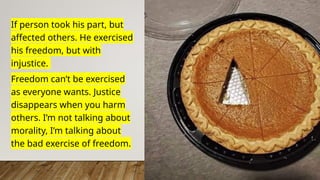
If person took his part, but
affected others. He exercised
his freedom, but with
injustice.
Freedom can’t be exercised
as everyone wants. Justice
disappears when you harm
others. I’m not talking about
morality, I’m talking about
the bad exercise of freedom.
3 KINDS OF FREEDOM
1. PHYSICAL
2. PSYCHOLOGICAL
3. MORAL
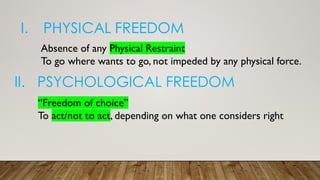
Absence of any Physical Restraint
To go where wants to go, not impeded by any physical force.
II. PSYCHOLOGICAL FREEDOM
“Freedom of choice”
To act/not to act, depending on what one considers right
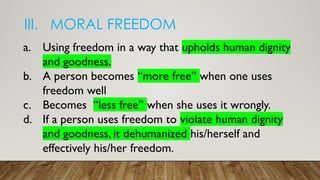
III. MORAL FREEDOM
a. Using freedom in a way that upholds human dignity
and goodness.
b. A person becomes “more free” when one uses
freedom well
c. Becomes “less free” when she uses it wrongly.
d. If a person uses freedom to violate human dignity
and goodness, it dehumanized his/herself and
effectively his/her freedom.
TWO ELEMENTS OF FREEDOM
Voluntariness
refers to the ability of a person to act out of
her own free will and self-determination
this means that a person's action is from
her own decision not from external
influences voluntary acts are free acts that
are always based on one’s values.
TWO ELEMENTS OF FREEDOM
Responsibility
refers to a person's accountability for her
actions and their consequences actions
always have a certain consequence as a
free being.
HOW TO EXERCISE FREEDOM RESPONSIBLY
1. Human freedom is not absolute- as such it should
be exercised with control and recognition of its
reasonable limits.
Sacrifice of certain self-interests and the
acceptance of certain realities that are
beyond one's control
HOW TO EXERCISE FREEDOM RESPONSIBLY
One should always recognize and uphold not
only one's individual freedom but also of
others
Freedom should be exercised with due
regard for the welfare of other
HOW TO EXERCISE FREEDOM RESPONSIBLY
2 Human freedom should be exercised with
regard for knowledge and truth-
Determine the proper information before
choosing.
Cultivate prudence in making sound
choices.
Why did freedom choose to love you?
To choose you –because even freedom
has its limits, and apparently, you're it.
@T. VERNELICIOUS
GROUP ACTIVITY| Read and understand carefully the tasks below. Follow the tasks
mindfully. Use a4 bond paper following ½ inch each side.
A.
1. Set your goal in life(as a group).You may choose your goal as a student, as a child, or
just as a human person.
2. List down five (5) concrete actions that will help you reach your chosen goal.
3. For each concrete action, list down all possible consequences. The more list of
consequences, the better.
4. In at least one paragraph, explain how you will face all the challenges of the
consequences.
B.
1.Choose one person whom you think is successful in life amidst a difficult challenge.
2.Ask permission to interview the person and record your interview (provide a picture
if necessary). Inquire what the successful person has done to overcome the challenges
and achieve his/her goal.
3.Write your report in a dialogue format.
4. Next to the written dialogue, write your reflection based on the interview in relation
to the freedom of the human person.

FREEDOM INTRODUCTION TO PHILOSOPHY GRADE 11

  • 1.
    FREEDOM EXIST NOT WITHOUTLAW, BUT WITHIN IT, GUIDING OUR CHOICES TOWARDS JUSTICE @ T.VERNELICIOUS
  • 2.
  • 3.
    FREEDOM OFTHE HUMAN PERSON CHAPTER5 : INTRODUCTIONTOTHE PHILOSOPHYTOTHE HUMAN PERSON
  • 4.
    Objectives: What is HumanFreedom? 3 kinds of Freedom. 2 elements that defines Freedom. How to exercise Freedom responsibly.
  • 5.
    WHAT IS FREEDOM? •Intrinsic and Essential Property of the Human Person • By nature human is free. • Capacity to act/not to act as one chooses without any external compulsion or restraint. • Sets human being apart from other animals. • Animals act out of instinct.
  • 6.
    WHAT IS FREEDOM? Freedomis the very being of the human person (as being- for-itself), and "to be free" does not mean "to obtain what one has wished" but rather "by oneself to determine oneself to wish" (Sartre, 1965). This means that a person cannot escape from freedom. He cannot choose not to be free because not choosing is even a choice. Not doing anything is actually choosing to do something, and that is doing nothing.
  • 7.
    WHAT IS FREEDOM? •Freedom entails responsibilities. i. ex. Requires a degree of control • A person become more or less free-more or less human-depending on how she uses her freedom. • A person denied of her freedom (ex. slaves, prisoner, etc.) is dehumanized- he/she becomes less human.
  • 8.
    WHAT IS FREEDOM? •Is the freedom of the human person limited? For Sartre, the limitation of freedom is a product of our being conscious of things; it is our choice of limitation.
  • 9.
    WHAT IS FREEDOM? Thelimitation that you think does not limit freedom itself. Why? It is because you are still the one who chooses that limitation. In other words, you decide to limit yourself with those factors and that very fact means that you are free to choose in any way.You think that those factors can hinder you from going there. Even so, you still cannot deny that you choose to think that way.
  • 10.
    WHAT IS FREEDOM? Mostoften, we stop thinking and creating possibilities, so we immediately say that we are not free. Why do people say that poverty is not a hindrance to success? And why do people blame poverty for being unsuccessful? There are unlimited choices for the person to think, but what limits is the thought of limiting our actions
  • 11.
    The only thingthat the person cannot be free is not being free. Not choosing is still choosing. This sounds paradoxical. In that case, is it acceptable to do whatever one wants? Well, whatever you do, you are free. Does this mean that one can take an enemy's life? This question sounds alarming, especially when the justification is that the said enemy is a criminal. In this case, is the person still free to do the act? There is no denial of freedom here. However, being free also means being responsible.We should never forget the concept of responsibility when talking about freedom.
  • 12.
    When people talkabout freedom, what is being emphasized is how a person is free. However, for Sartre, when there is freedom, there is responsibility. Sartre defines responsibility as the "consciousness (of) being the incontestable author of an event or an object (Sartre, 1993).When a person is free, the person is also responsible.Whatever the person chooses, he/she is the author of the choice.
  • 13.
    “To understand the conceptof responsibility is to recognize freedom” “Man chooses his own self, we mean that every one of us does likewise; but we also mean that he also chooses all men in making this choice." Everyone wants to choose the good, not evil, which cannot be good without being good for all.This means therefore that the person consequently carries the load of the world. Sartre says,
  • 14.
    If person tookhis part, but affected others. He exercised his freedom, but with injustice. Freedom can’t be exercised as everyone wants. Justice disappears when you harm others. I’m not talking about morality, I’m talking about the bad exercise of freedom.
  • 15.
    3 KINDS OFFREEDOM 1. PHYSICAL 2. PSYCHOLOGICAL 3. MORAL
  • 16.
    Absence of anyPhysical Restraint To go where wants to go, not impeded by any physical force. II. PSYCHOLOGICAL FREEDOM “Freedom of choice” To act/not to act, depending on what one considers right
  • 17.
    III. MORAL FREEDOM a.Using freedom in a way that upholds human dignity and goodness. b. A person becomes “more free” when one uses freedom well c. Becomes “less free” when she uses it wrongly. d. If a person uses freedom to violate human dignity and goodness, it dehumanized his/herself and effectively his/her freedom.
  • 18.
    TWO ELEMENTS OFFREEDOM Voluntariness refers to the ability of a person to act out of her own free will and self-determination this means that a person's action is from her own decision not from external influences voluntary acts are free acts that are always based on one’s values.
  • 19.
    TWO ELEMENTS OFFREEDOM Responsibility refers to a person's accountability for her actions and their consequences actions always have a certain consequence as a free being.
  • 20.
    HOW TO EXERCISEFREEDOM RESPONSIBLY 1. Human freedom is not absolute- as such it should be exercised with control and recognition of its reasonable limits. Sacrifice of certain self-interests and the acceptance of certain realities that are beyond one's control
  • 21.
    HOW TO EXERCISEFREEDOM RESPONSIBLY One should always recognize and uphold not only one's individual freedom but also of others Freedom should be exercised with due regard for the welfare of other
  • 22.
    HOW TO EXERCISEFREEDOM RESPONSIBLY 2 Human freedom should be exercised with regard for knowledge and truth- Determine the proper information before choosing. Cultivate prudence in making sound choices.
  • 23.
    Why did freedomchoose to love you? To choose you –because even freedom has its limits, and apparently, you're it. @T. VERNELICIOUS
  • 24.
    GROUP ACTIVITY| Readand understand carefully the tasks below. Follow the tasks mindfully. Use a4 bond paper following ½ inch each side. A. 1. Set your goal in life(as a group).You may choose your goal as a student, as a child, or just as a human person. 2. List down five (5) concrete actions that will help you reach your chosen goal. 3. For each concrete action, list down all possible consequences. The more list of consequences, the better. 4. In at least one paragraph, explain how you will face all the challenges of the consequences. B. 1.Choose one person whom you think is successful in life amidst a difficult challenge. 2.Ask permission to interview the person and record your interview (provide a picture if necessary). Inquire what the successful person has done to overcome the challenges and achieve his/her goal. 3.Write your report in a dialogue format. 4. Next to the written dialogue, write your reflection based on the interview in relation to the freedom of the human person.