How
communications, development
and volunteer management
are part of one big happy family
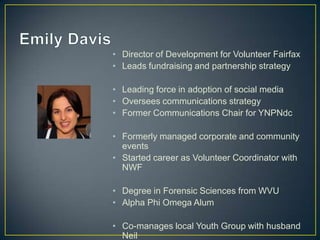
• Director of Development for Volunteer Fairfax
• Leads fundraising and partnership strategy
• Leading force in adoption of social media
• Oversees communications strategy
• Former Communications Chair for YNPNdc
• Formerly managed corporate and community
events
• Started career as Volunteer Coordinator with
NWF
• Degree in Forensic Sciences from WVU
• Alpha Phi Omega Alum
• Co-manages local Youth Group with husband
Neil
• Conveying information
• Messaging
• Verbal and non-verbal
• Digital and physical
• Creates relationships
• Beneficial to all sides
• Identified audience
• Have to convey your need
• Need a story to tell
• Images and other support help
• May be online, may be in person
• Want to create a long term relationship / on going
volunteer
• Beneficial to all sides
• Identified audience – ask should be to a specific
person(s)
• Again, we’re telling a story
• Need a narrative of the need / the good being achieved
• Images / faith in the story teller
• Online and in person asks
• Seeking long term partnerships
• Beneficial to all sides
• Identified audience / prospecting
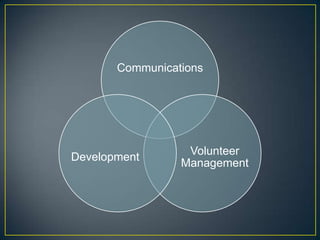
Communications
Volunteer
Management
Development
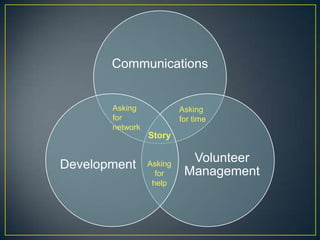
Communications
Volunteer
Management
Development
Story
Asking
for
network
Asking
for
help
Asking
for time
• Inviting our audience to engage
• To learn more about us
• To take action that makes sense for
them
• Memorable
• I’ll remember what I feel
• Move me and I will share with others
• Simple stories is best
• Employ ear worms
• Here are some example of nonprofit communications.
• Are they memorable? Do they make you feel
something?
• You Don’t Have to be Perfect
www.youtube.com/watch?v=bSYUjE-FRRc
• Let’s F Cancer www.letsfcancer.com/
• 1st World Problems www.youtube.com/watch?v=fxyhfiCO_XQ
• Follow the Frog www.youtube.com/watch?v=3iIkOi3srLo
• Take a Chance on Me www.youtube.com/watch?v=g1mV1kl0XvA
• Remember, these aren’t necessarily “perfect” - think
about how they do (or don’t affect you).
1. Define your call to action
2. Define your audience
3. Determine what kind of story you
need
4. Find story leads and conduct
interviews
5. Tie it all together
• Emily Davis
• www.linkedin.com/in/emilygibbsdavis/
• @eglouise

Intersections of the Ask

  • 1.
    How communications, development and volunteermanagement are part of one big happy family
  • 2.
    • Director ofDevelopment for Volunteer Fairfax • Leads fundraising and partnership strategy • Leading force in adoption of social media • Oversees communications strategy • Former Communications Chair for YNPNdc • Formerly managed corporate and community events • Started career as Volunteer Coordinator with NWF • Degree in Forensic Sciences from WVU • Alpha Phi Omega Alum • Co-manages local Youth Group with husband Neil
  • 3.
    • Conveying information •Messaging • Verbal and non-verbal • Digital and physical • Creates relationships • Beneficial to all sides • Identified audience
  • 4.
    • Have toconvey your need • Need a story to tell • Images and other support help • May be online, may be in person • Want to create a long term relationship / on going volunteer • Beneficial to all sides • Identified audience – ask should be to a specific person(s)
  • 5.
    • Again, we’retelling a story • Need a narrative of the need / the good being achieved • Images / faith in the story teller • Online and in person asks • Seeking long term partnerships • Beneficial to all sides • Identified audience / prospecting
  • 6.
  • 7.
  • 8.
    • Inviting ouraudience to engage • To learn more about us • To take action that makes sense for them
  • 9.
    • Memorable • I’llremember what I feel • Move me and I will share with others • Simple stories is best • Employ ear worms
  • 10.
    • Here aresome example of nonprofit communications. • Are they memorable? Do they make you feel something? • You Don’t Have to be Perfect www.youtube.com/watch?v=bSYUjE-FRRc • Let’s F Cancer www.letsfcancer.com/ • 1st World Problems www.youtube.com/watch?v=fxyhfiCO_XQ • Follow the Frog www.youtube.com/watch?v=3iIkOi3srLo • Take a Chance on Me www.youtube.com/watch?v=g1mV1kl0XvA • Remember, these aren’t necessarily “perfect” - think about how they do (or don’t affect you).
  • 11.
    1. Define yourcall to action 2. Define your audience 3. Determine what kind of story you need 4. Find story leads and conduct interviews 5. Tie it all together
  • 12.
    • Emily Davis •www.linkedin.com/in/emilygibbsdavis/ • @eglouise