SEMINAR ON COMPLEX GEOMETRY 
PROF. DANIEL HUYBRECHTS, HEINRICH HARTMANN 
In this seminar we want to go through the basic theory of complex man-ifolds 
as presented in the book [2]. 
In order to stimulate active participation, we will organize the seminar as a 
reading class. This means that everyone should read the announced material 
each time. We will pick out some particularly interesting topics which are 
presented by a speaker. This means the remaining material should be read 
with more care. At the meeting we will reserve half an hour for a discussion, 
where we can answer questions about the reading material. Sometimes we 
may also provide some exercises, which we will then solve in a common 
effort. In the remaining hour we will have the talk. 
In the program below, the section ”Scope” refers to the material that we 
want to learn/read this week. The section ”Talk” lists the topics which are 
to be presented by the speaker. All references will refer to [2]. 
I. Local Theory 
1. Holomorphic Functions of Several Variables. 
Scope: p.1-9. Comparison of function theory in one variable to function 
theory of several variables. 
Talk: Recall the definition of a holomorphic function in several variables. 
Use the Cauchy integral formula to prove that they admit a power series ex-pansion. 
Prove Hartogs theorem and the Weierstrass preparation theorem. 
2. Local Theory of Holomorphic Functions. 
Scope: p.10-17. Inverse and implicit function theorems. Basic properties 
of the local ring R = OCn,0. 
Talk: Define the sheaf of holomorphic functions. Prove that R is a unique 
factorization domain (UFD), and that it is noetherian. For the latter we will 
use the Weierstrass division theorem (do not prove it). Furthermore give a 
proof of corollary. 1.1.19: If f vanishes on Z(g), g irreducible, then g|f. 
II. Complex manifolds and holomorphic vector bundles 
3. Complex Manifolds. 
Scope: p.52-63. Definition of complex manifolds and holomorphic maps 
between them. Siegel’s theorem. Examples of complex manifolds. 
Talk: Prove Siegel’s theorem (2.1.9). Show how to obtain charts for an 
affine hypersurface f−1(0) ⊂ Cn from the implicit function theorem. Explain 
the ideal sheaf associated to a submanifold/subvariety, and the associated 
structure sequence. 
Date: January 8, 2010. 
1
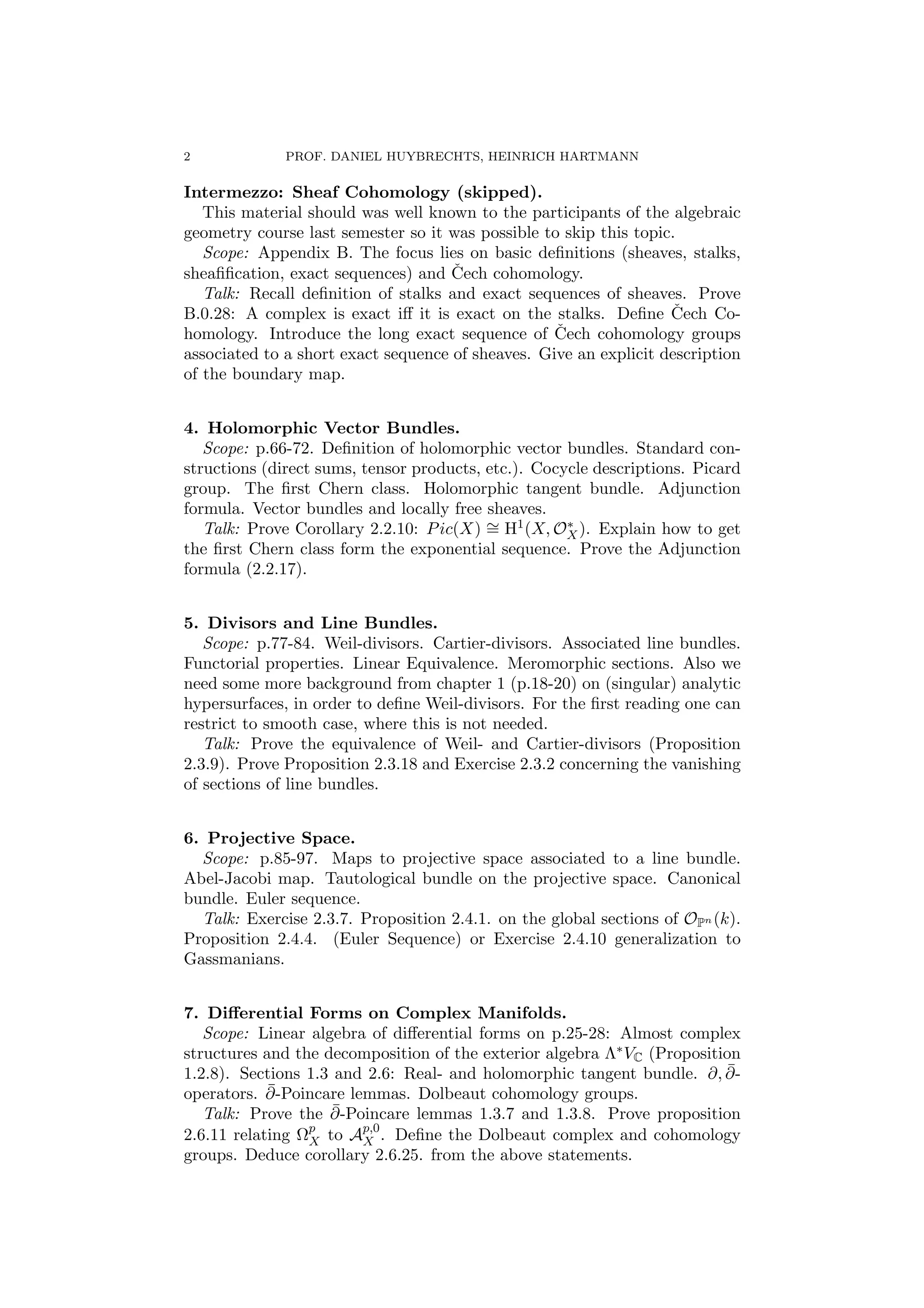
2 PROF. DANIEL HUYBRECHTS, HEINRICH HARTMANN 
Intermezzo: Sheaf Cohomology (skipped). 
This material should was well known to the participants of the algebraic 
geometry course last semester so it was possible to skip this topic. 
Scope: Appendix B. The focus lies on basic definitions (sheaves, stalks, 
sheafification, exact sequences) and ˇ Cech cohomology. 
Talk: Recall definition of stalks and exact sequences of sheaves. Prove 
B.0.28: A complex is exact iff it is exact on the stalks. Define ˇ Cech Co-homology. 
Introduce the long exact sequence of ˇ Cech cohomology groups 
associated to a short exact sequence of sheaves. Give an explicit description 
of the boundary map. 
4. Holomorphic Vector Bundles. 
Scope: p.66-72. Definition of holomorphic vector bundles. Standard con-structions 
(direct sums, tensor products, etc.). Cocycle descriptions. Picard 
group. The first Chern class. Holomorphic tangent bundle. Adjunction 
formula. Vector bundles and locally free sheaves. 
Talk: Prove Corollary 2.2.10: Pic(X) ∼= 
H1(X,O 
X). Explain how to get 
the first Chern class form the exponential sequence. Prove the Adjunction 
formula (2.2.17). 
5. Divisors and Line Bundles. 
Scope: p.77-84. Weil-divisors. Cartier-divisors. Associated line bundles. 
Functorial properties. Linear Equivalence. Meromorphic sections. Also we 
need some more background from chapter 1 (p.18-20) on (singular) analytic 
hypersurfaces, in order to define Weil-divisors. For the first reading one can 
restrict to smooth case, where this is not needed. 
Talk: Prove the equivalence of Weil- and Cartier-divisors (Proposition 
2.3.9). Prove Proposition 2.3.18 and Exercise 2.3.2 concerning the vanishing 
of sections of line bundles. 
6. Projective Space. 
Scope: p.85-97. Maps to projective space associated to a line bundle. 
Abel-Jacobi map. Tautological bundle on the projective space. Canonical 
bundle. Euler sequence. 
Talk: Exercise 2.3.7. Proposition 2.4.1. on the global sections of OPn(k). 
Proposition 2.4.4. (Euler Sequence) or Exercise 2.4.10 generalization to 
Gassmanians. 
7. Differential Forms on Complex Manifolds. 
Scope: Linear algebra of differential forms on p.25-28: Almost complex 
structures and the decomposition of the exterior algebra VC (Proposition 
1.2.8). Sections 1.3 and 2.6: Real- and holomorphic tangent bundle. @, ¯@- 
operators. ¯@-Poincare lemmas. Dolbeaut cohomology groups. 
Talk: Prove the ¯@-Poincare lemmas 1.3.7 and 1.3.8. Prove proposition 
X to Ap,0 
X . Define the Dolbeaut complex and cohomology 
2.6.11 relating 
p 
groups. Deduce corollary 2.6.25. from the above statements.
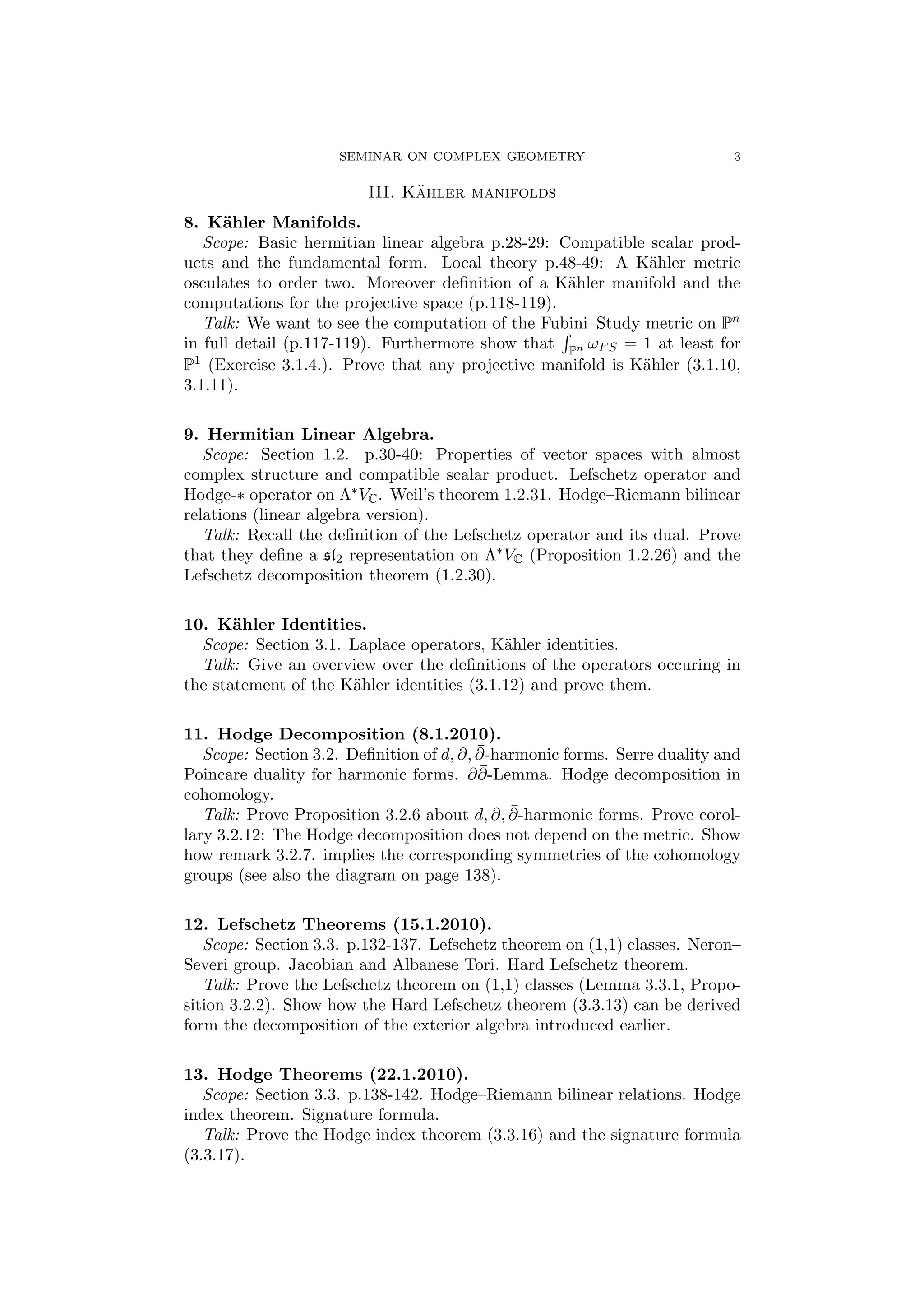
SEMINAR ON COMPLEX GEOMETRY 3 
III. K¨ahler manifolds 
8. K¨ahler Manifolds. 
Scope: Basic hermitian linear algebra p.28-29: Compatible scalar prod-ucts 
and the fundamental form. Local theory p.48-49: A K¨ahler metric 
osculates to order two. Moreover definition of a K¨ahler manifold and the 
computations for the projective space (p.118-119). 
Talk: We want to see the computation of the Fubini–Study metric on Pn 
in full detail (p.117-119). Furthermore show that RPn !FS = 1 at least for 
P1 (Exercise 3.1.4.). Prove that any projective manifold is K¨ahler (3.1.10, 
3.1.11). 
9. Hermitian Linear Algebra. 
Scope: Section 1.2. p.30-40: Properties of vector spaces with almost 
complex structure and compatible scalar product. Lefschetz operator and 
Hodge-∗ operator on VC. Weil’s theorem 1.2.31. Hodge–Riemann bilinear 
relations (linear algebra version). 
Talk: Recall the definition of the Lefschetz operator and its dual. Prove 
that they define a sl2 representation on VC (Proposition 1.2.26) and the 
Lefschetz decomposition theorem (1.2.30). 
10. K¨ahler Identities. 
Scope: Section 3.1. Laplace operators, K¨ahler identities. 
Talk: Give an overview over the definitions of the operators occuring in 
the statement of the K¨ahler identities (3.1.12) and prove them. 
11. Hodge Decomposition (8.1.2010). 
Scope: Section 3.2. Definition of d, @, ¯@-harmonic forms. Serre duality and 
Poincare duality for harmonic forms. @ ¯@-Lemma. Hodge decomposition in 
cohomology. 
Talk: Prove Proposition 3.2.6 about d, @, ¯@-harmonic forms. Prove corol-lary 
3.2.12: The Hodge decomposition does not depend on the metric. Show 
how remark 3.2.7. implies the corresponding symmetries of the cohomology 
groups (see also the diagram on page 138). 
12. Lefschetz Theorems (15.1.2010). 
Scope: Section 3.3. p.132-137. Lefschetz theorem on (1,1) classes. Neron– 
Severi group. Jacobian and Albanese Tori. Hard Lefschetz theorem. 
Talk: Prove the Lefschetz theorem on (1,1) classes (Lemma 3.3.1, Propo-sition 
3.2.2). Show how the Hard Lefschetz theorem (3.3.13) can be derived 
form the decomposition of the exterior algebra introduced earlier. 
13. Hodge Theorems (22.1.2010). 
Scope: Section 3.3. p.138-142. Hodge–Riemann bilinear relations. Hodge 
index theorem. Signature formula. 
Talk: Prove the Hodge index theorem (3.3.16) and the signature formula 
(3.3.17).
4 PROF. DANIEL HUYBRECHTS, HEINRICH HARTMANN 
IV. Curves 
In this last part of the seminar we want to apply the theory developed so 
far to the one-dimensional case. This allows us to see more explicitly how 
those techniques work. Moreover we will deduce the Riemann–Roch and the 
Serre duality theorem for vector bundles on curves. These have analogues 
for higher dimensional manifolds, which are more complicated to prove. 
We will use the book [1], Chapter VII, as reference. You will notice, that 
we did not cover much of the chapters I-VI of this book. Nevertheless it 
should be possible to read this chapter directly. The main theorems that 
will be quoted are the finite-dimensionality of the cohomology of coherent 
sheaves, and the vanishing of the cohomology on Stein spaces. 
We have already met the finite-dimensionality in the case of the coherent 
sheaves 
i 
X. The general case is very similar. Also the vanishing was shown 
in talk 7 in the case of X = Cn. 
14. Riemann–Roch Theorem (29.1.2010). 
Scope: Paragraphs 1-3 of Chapter VII in [1]. The first paragraph recalls 
the basic facts about divisors and locally free sheaves (line bundles) in the 
case of curves. Please read it carefully, to get used to the (slightly different) 
language used in this book. 
Further contents: Existence of global meromorphic sections, Euler–Poincare 
characteristic, vanishing of H2, Riemann–Roch. 
Talk: Present paragraphs 2-3 culminating in the proof of the Riemann– 
Roch theorem for divisors. If time permits you can also mention its gener-alization 
to arbitrary vector bundles in the appendix to paragraph 4. 
15. Serre Duality (5.2.2010). 
Scope: Paragraphs 4-6 of Chapter VII in [1]. In the paragraphs 4 and 5 it 
is proven that every vector bundle has a sub-bundle of the form O(D) and 
that H1(X,M) = 0 for a curve X and its sheaf of meromorphic functions 
M. Both statements should be well known in the algebraic context. We 
will not have time to present them in the talk. 
Talk: Present the proof of Serre duality 
H0(X,
X(D))) = H1(X,O(−D)) 
in paragraph 6. We have already seen a version of this for the sheaves 
i on 
a general manifold (using Hodge ∗-operator and harmonic representatives). 
This proof is more explicit/geometric and uses residues of differential forms. 
It goes as follows: 
We use a special “resolution” of the sheaf O(D) to write H1(X,O(D)) 
as quotient of two infinite–dimensional vector spaces of “sums of germs” 
of local sections R/(R(D) +M(X)). Any meromorphic differential form ! 
determines a residue map !∗ : R7→ C, which is shown to induce a linear 
form on H1(X,O(D)) = R/(R(D) +M(X)). The last step is to show that 
the restriction to meromorphic differential forms ! ∈ 
X(−D) gives an 
isomorphism H0(X,
X(−D)) → H1(X,O(D)).
SEMINAR ON COMPLEX GEOMETRY 5 
References 
[1] H. Grauert and R. Remmert, Theory of Stein spaces, Classics in Mathematics, 
Springer 2004 
[2] D. Huybrechts, Complex Geometry, Springer 2004

Seminar on Complex Geometry

  • 1.
    SEMINAR ON COMPLEXGEOMETRY PROF. DANIEL HUYBRECHTS, HEINRICH HARTMANN In this seminar we want to go through the basic theory of complex man-ifolds as presented in the book [2]. In order to stimulate active participation, we will organize the seminar as a reading class. This means that everyone should read the announced material each time. We will pick out some particularly interesting topics which are presented by a speaker. This means the remaining material should be read with more care. At the meeting we will reserve half an hour for a discussion, where we can answer questions about the reading material. Sometimes we may also provide some exercises, which we will then solve in a common effort. In the remaining hour we will have the talk. In the program below, the section ”Scope” refers to the material that we want to learn/read this week. The section ”Talk” lists the topics which are to be presented by the speaker. All references will refer to [2]. I. Local Theory 1. Holomorphic Functions of Several Variables. Scope: p.1-9. Comparison of function theory in one variable to function theory of several variables. Talk: Recall the definition of a holomorphic function in several variables. Use the Cauchy integral formula to prove that they admit a power series ex-pansion. Prove Hartogs theorem and the Weierstrass preparation theorem. 2. Local Theory of Holomorphic Functions. Scope: p.10-17. Inverse and implicit function theorems. Basic properties of the local ring R = OCn,0. Talk: Define the sheaf of holomorphic functions. Prove that R is a unique factorization domain (UFD), and that it is noetherian. For the latter we will use the Weierstrass division theorem (do not prove it). Furthermore give a proof of corollary. 1.1.19: If f vanishes on Z(g), g irreducible, then g|f. II. Complex manifolds and holomorphic vector bundles 3. Complex Manifolds. Scope: p.52-63. Definition of complex manifolds and holomorphic maps between them. Siegel’s theorem. Examples of complex manifolds. Talk: Prove Siegel’s theorem (2.1.9). Show how to obtain charts for an affine hypersurface f−1(0) ⊂ Cn from the implicit function theorem. Explain the ideal sheaf associated to a submanifold/subvariety, and the associated structure sequence. Date: January 8, 2010. 1
  • 2.
    2 PROF. DANIELHUYBRECHTS, HEINRICH HARTMANN Intermezzo: Sheaf Cohomology (skipped). This material should was well known to the participants of the algebraic geometry course last semester so it was possible to skip this topic. Scope: Appendix B. The focus lies on basic definitions (sheaves, stalks, sheafification, exact sequences) and ˇ Cech cohomology. Talk: Recall definition of stalks and exact sequences of sheaves. Prove B.0.28: A complex is exact iff it is exact on the stalks. Define ˇ Cech Co-homology. Introduce the long exact sequence of ˇ Cech cohomology groups associated to a short exact sequence of sheaves. Give an explicit description of the boundary map. 4. Holomorphic Vector Bundles. Scope: p.66-72. Definition of holomorphic vector bundles. Standard con-structions (direct sums, tensor products, etc.). Cocycle descriptions. Picard group. The first Chern class. Holomorphic tangent bundle. Adjunction formula. Vector bundles and locally free sheaves. Talk: Prove Corollary 2.2.10: Pic(X) ∼= H1(X,O X). Explain how to get the first Chern class form the exponential sequence. Prove the Adjunction formula (2.2.17). 5. Divisors and Line Bundles. Scope: p.77-84. Weil-divisors. Cartier-divisors. Associated line bundles. Functorial properties. Linear Equivalence. Meromorphic sections. Also we need some more background from chapter 1 (p.18-20) on (singular) analytic hypersurfaces, in order to define Weil-divisors. For the first reading one can restrict to smooth case, where this is not needed. Talk: Prove the equivalence of Weil- and Cartier-divisors (Proposition 2.3.9). Prove Proposition 2.3.18 and Exercise 2.3.2 concerning the vanishing of sections of line bundles. 6. Projective Space. Scope: p.85-97. Maps to projective space associated to a line bundle. Abel-Jacobi map. Tautological bundle on the projective space. Canonical bundle. Euler sequence. Talk: Exercise 2.3.7. Proposition 2.4.1. on the global sections of OPn(k). Proposition 2.4.4. (Euler Sequence) or Exercise 2.4.10 generalization to Gassmanians. 7. Differential Forms on Complex Manifolds. Scope: Linear algebra of differential forms on p.25-28: Almost complex structures and the decomposition of the exterior algebra VC (Proposition 1.2.8). Sections 1.3 and 2.6: Real- and holomorphic tangent bundle. @, ¯@- operators. ¯@-Poincare lemmas. Dolbeaut cohomology groups. Talk: Prove the ¯@-Poincare lemmas 1.3.7 and 1.3.8. Prove proposition X to Ap,0 X . Define the Dolbeaut complex and cohomology 2.6.11 relating p groups. Deduce corollary 2.6.25. from the above statements.
  • 3.
    SEMINAR ON COMPLEXGEOMETRY 3 III. K¨ahler manifolds 8. K¨ahler Manifolds. Scope: Basic hermitian linear algebra p.28-29: Compatible scalar prod-ucts and the fundamental form. Local theory p.48-49: A K¨ahler metric osculates to order two. Moreover definition of a K¨ahler manifold and the computations for the projective space (p.118-119). Talk: We want to see the computation of the Fubini–Study metric on Pn in full detail (p.117-119). Furthermore show that RPn !FS = 1 at least for P1 (Exercise 3.1.4.). Prove that any projective manifold is K¨ahler (3.1.10, 3.1.11). 9. Hermitian Linear Algebra. Scope: Section 1.2. p.30-40: Properties of vector spaces with almost complex structure and compatible scalar product. Lefschetz operator and Hodge-∗ operator on VC. Weil’s theorem 1.2.31. Hodge–Riemann bilinear relations (linear algebra version). Talk: Recall the definition of the Lefschetz operator and its dual. Prove that they define a sl2 representation on VC (Proposition 1.2.26) and the Lefschetz decomposition theorem (1.2.30). 10. K¨ahler Identities. Scope: Section 3.1. Laplace operators, K¨ahler identities. Talk: Give an overview over the definitions of the operators occuring in the statement of the K¨ahler identities (3.1.12) and prove them. 11. Hodge Decomposition (8.1.2010). Scope: Section 3.2. Definition of d, @, ¯@-harmonic forms. Serre duality and Poincare duality for harmonic forms. @ ¯@-Lemma. Hodge decomposition in cohomology. Talk: Prove Proposition 3.2.6 about d, @, ¯@-harmonic forms. Prove corol-lary 3.2.12: The Hodge decomposition does not depend on the metric. Show how remark 3.2.7. implies the corresponding symmetries of the cohomology groups (see also the diagram on page 138). 12. Lefschetz Theorems (15.1.2010). Scope: Section 3.3. p.132-137. Lefschetz theorem on (1,1) classes. Neron– Severi group. Jacobian and Albanese Tori. Hard Lefschetz theorem. Talk: Prove the Lefschetz theorem on (1,1) classes (Lemma 3.3.1, Propo-sition 3.2.2). Show how the Hard Lefschetz theorem (3.3.13) can be derived form the decomposition of the exterior algebra introduced earlier. 13. Hodge Theorems (22.1.2010). Scope: Section 3.3. p.138-142. Hodge–Riemann bilinear relations. Hodge index theorem. Signature formula. Talk: Prove the Hodge index theorem (3.3.16) and the signature formula (3.3.17).
  • 4.
    4 PROF. DANIELHUYBRECHTS, HEINRICH HARTMANN IV. Curves In this last part of the seminar we want to apply the theory developed so far to the one-dimensional case. This allows us to see more explicitly how those techniques work. Moreover we will deduce the Riemann–Roch and the Serre duality theorem for vector bundles on curves. These have analogues for higher dimensional manifolds, which are more complicated to prove. We will use the book [1], Chapter VII, as reference. You will notice, that we did not cover much of the chapters I-VI of this book. Nevertheless it should be possible to read this chapter directly. The main theorems that will be quoted are the finite-dimensionality of the cohomology of coherent sheaves, and the vanishing of the cohomology on Stein spaces. We have already met the finite-dimensionality in the case of the coherent sheaves i X. The general case is very similar. Also the vanishing was shown in talk 7 in the case of X = Cn. 14. Riemann–Roch Theorem (29.1.2010). Scope: Paragraphs 1-3 of Chapter VII in [1]. The first paragraph recalls the basic facts about divisors and locally free sheaves (line bundles) in the case of curves. Please read it carefully, to get used to the (slightly different) language used in this book. Further contents: Existence of global meromorphic sections, Euler–Poincare characteristic, vanishing of H2, Riemann–Roch. Talk: Present paragraphs 2-3 culminating in the proof of the Riemann– Roch theorem for divisors. If time permits you can also mention its gener-alization to arbitrary vector bundles in the appendix to paragraph 4. 15. Serre Duality (5.2.2010). Scope: Paragraphs 4-6 of Chapter VII in [1]. In the paragraphs 4 and 5 it is proven that every vector bundle has a sub-bundle of the form O(D) and that H1(X,M) = 0 for a curve X and its sheaf of meromorphic functions M. Both statements should be well known in the algebraic context. We will not have time to present them in the talk. Talk: Present the proof of Serre duality H0(X, X(D))) = H1(X,O(−D)) in paragraph 6. We have already seen a version of this for the sheaves i on a general manifold (using Hodge ∗-operator and harmonic representatives). This proof is more explicit/geometric and uses residues of differential forms. It goes as follows: We use a special “resolution” of the sheaf O(D) to write H1(X,O(D)) as quotient of two infinite–dimensional vector spaces of “sums of germs” of local sections R/(R(D) +M(X)). Any meromorphic differential form ! determines a residue map !∗ : R7→ C, which is shown to induce a linear form on H1(X,O(D)) = R/(R(D) +M(X)). The last step is to show that the restriction to meromorphic differential forms ! ∈ X(−D) gives an isomorphism H0(X, X(−D)) → H1(X,O(D)).
  • 5.
    SEMINAR ON COMPLEXGEOMETRY 5 References [1] H. Grauert and R. Remmert, Theory of Stein spaces, Classics in Mathematics, Springer 2004 [2] D. Huybrechts, Complex Geometry, Springer 2004