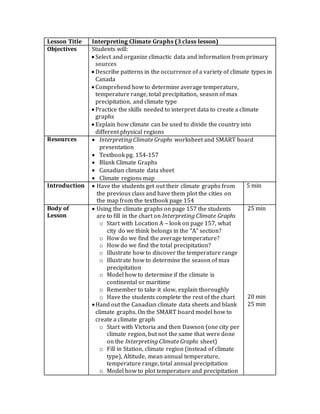
Lesson Title Interpreting Climate Graphs (3 class lesson)
Objectives Students will:
 Select and organize climactic data and information from primary
sources
 Describe patterns in the occurrence of a variety of climate types in
Canada
 Comprehend how to determine average temperature,
temperature range, total precipitation, season of max
precipitation, and climate type
 Practice the skills needed to interpret data to create a climate
graphs
 Explain how climate can be used to divide the country into
different physical regions
Resources  Interpreting Climate Graphs worksheet and SMART board
presentation
 Textbook pg. 154-157
 Blank Climate Graphs
 Canadian climate data sheet
 Climate regions map
Introduction  Have the students get out their climate graphs from
the previous class and have them plot the cities on
the map from the textbook page 154
5 min
Body of
Lesson
 Using the climate graphs on page 157 the students
are to fill in the chart on Interpreting Climate Graphs
o Start with Location A – look on page 157, what
city do we think belongs in the “A” section?
o How do we find the average temperature?
o How do we find the total precipitation?
o Illustrate how to discover the temperature range
o Illustrate how to determine the season of max
precipitation
o Model how to determine if the climate is
continental or maritime
o Remember to take it slow, explain thoroughly
o Have the students complete the rest of the chart
Hand out the Canadian climate data sheets and blank
climate graphs. On the SMART board model how to
create a climate graph
o Start with Victoria and then Dawson (one city per
climate region, but not the same that were done
on the Interpreting Climate Graphs sheet)
o Fill in Station, climate region (instead of climate
type), Altitude, mean annual temperature,
temperature range, total annual precipitation
o Model how to plot temperature and precipitation
25 min
20 min
25 min
on the map
o Perhaps do another on the board with the
students who need to see it done again
Students will complete the rest of the climate graphs;
one city per climate region
Climate Graph Summary worksheet
o Students place on the map each climate station
from the climate graphing activity
o Students colour the climate regions into the
corresponding locations on the map
o On the reverse side of the sheet, students are to
input the information for each section (climate
region, average temperature, etc.) based on the
information they discovered making the climate
graphs
o Colour in each climate region section with the
corresponding colour from the front side of the
work sheet (ex. If they coloured in the Pacific
Maritime climate region red on their map, they
colour in that corresponding section red on the
chart
50 min
20 min
Closure  Why do we make climate graphs?
 How are they a more efficient way to gather climate
data than simply just looking at numbers on a sheet
 How do they help us see patterns in the climate?
 What can we learn quickly just by looking at a climate
graph?
 Discussion
5 min
Assessment Climate Regions map
Interpreting Climate Graphs worksheet
Climate Graphs (one per each climate region)

Interpreting Climate Graphs

  • 1.
    Lesson Title InterpretingClimate Graphs (3 class lesson) Objectives Students will:  Select and organize climactic data and information from primary sources  Describe patterns in the occurrence of a variety of climate types in Canada  Comprehend how to determine average temperature, temperature range, total precipitation, season of max precipitation, and climate type  Practice the skills needed to interpret data to create a climate graphs  Explain how climate can be used to divide the country into different physical regions Resources  Interpreting Climate Graphs worksheet and SMART board presentation  Textbook pg. 154-157  Blank Climate Graphs  Canadian climate data sheet  Climate regions map Introduction  Have the students get out their climate graphs from the previous class and have them plot the cities on the map from the textbook page 154 5 min Body of Lesson  Using the climate graphs on page 157 the students are to fill in the chart on Interpreting Climate Graphs o Start with Location A – look on page 157, what city do we think belongs in the “A” section? o How do we find the average temperature? o How do we find the total precipitation? o Illustrate how to discover the temperature range o Illustrate how to determine the season of max precipitation o Model how to determine if the climate is continental or maritime o Remember to take it slow, explain thoroughly o Have the students complete the rest of the chart Hand out the Canadian climate data sheets and blank climate graphs. On the SMART board model how to create a climate graph o Start with Victoria and then Dawson (one city per climate region, but not the same that were done on the Interpreting Climate Graphs sheet) o Fill in Station, climate region (instead of climate type), Altitude, mean annual temperature, temperature range, total annual precipitation o Model how to plot temperature and precipitation 25 min 20 min 25 min
  • 2.
    on the map oPerhaps do another on the board with the students who need to see it done again Students will complete the rest of the climate graphs; one city per climate region Climate Graph Summary worksheet o Students place on the map each climate station from the climate graphing activity o Students colour the climate regions into the corresponding locations on the map o On the reverse side of the sheet, students are to input the information for each section (climate region, average temperature, etc.) based on the information they discovered making the climate graphs o Colour in each climate region section with the corresponding colour from the front side of the work sheet (ex. If they coloured in the Pacific Maritime climate region red on their map, they colour in that corresponding section red on the chart 50 min 20 min Closure  Why do we make climate graphs?  How are they a more efficient way to gather climate data than simply just looking at numbers on a sheet  How do they help us see patterns in the climate?  What can we learn quickly just by looking at a climate graph?  Discussion 5 min Assessment Climate Regions map Interpreting Climate Graphs worksheet Climate Graphs (one per each climate region)