Introduction
to ANTLR 4
The latest and last (sic!) revision
Oliver Zeigermann
Code Generation Cambridge 2013
Outline
● Introduction to parsing with ANTLR4
● Use case: Interpreter
● Use case: Code Generator
● The tiniest bit of theory: Adaptive LL(*)
● Comparing ANTLR4
ANTLR 4: Management Summary
● Parser generator
● Language tool
● Design goals
○ ease-of-use over performance
○ simplicity over complexity
● Eats all context free grammars
○ with a small caveat
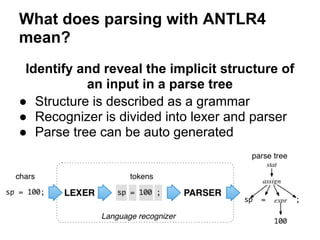
What does parsing with ANTLR4
mean?
Identify and reveal the implicit structure of
an input in a parse tree
● Structure is described as a grammar
● Recognizer is divided into lexer and parser
● Parse tree can be auto generated
Practical example #1: An expression
interpreter
Build an interpreter from scratch
● complete and working
● parses numerical expressions
● does the calculation
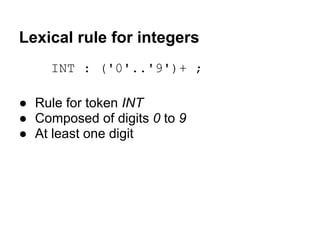
Lexical rule for integers
INT : ('0'..'9')+ ;
● Rule for token INT
● Composed of digits 0 to 9
● At least one digit
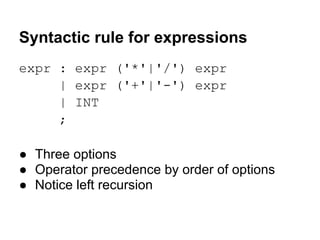
Syntactic rule for expressions
expr : expr ('*'|'/') expr
| expr ('+'|'-') expr
| INT
;
● Three options
● Operator precedence by order of options
● Notice left recursion
grammar Expressions;
start : expr ;
expr : left=expr op=('*'|'/') right=expr #opExpr
| left=expr op=('+'|'-') right=expr #opExpr
| atom=INT #atomExpr
;
INT : ('0'..'9')+ ;
WS : [ trn]+ -> skip ;
Doing something based on input
Options for separation of actions from
grammars in ANTLR4
1. Listeners (SAX style)
2. Visitors (DOM style)
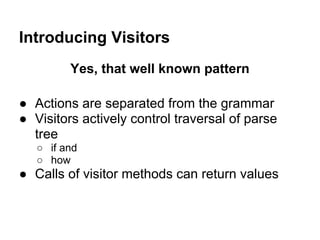
Introducing Visitors
Yes, that well known pattern
● Actions are separated from the grammar
● Visitors actively control traversal of parse
tree
○ if and
○ how
● Calls of visitor methods can return values
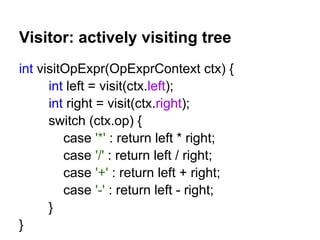
Visitor: actively visiting tree
int visitOpExpr(OpExprContext ctx) {
int left = visit(ctx.left);
int right = visit(ctx.right);
switch (ctx.op) {
case '*' : return left * right;
case '/' : return left / right;
case '+' : return left + right;
case '-' : return left - right;
}
}
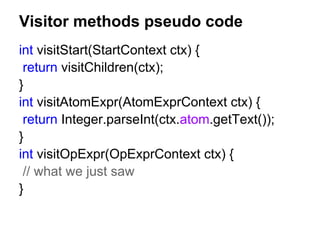
Visitor methods pseudo code
int visitStart(StartContext ctx) {
return visitChildren(ctx);
}
int visitAtomExpr(AtomExprContext ctx) {
return Integer.parseInt(ctx.atom.getText());
}
int visitOpExpr(OpExprContext ctx) {
// what we just saw
}
Live Demo
Practical example #2: Code
generation from Java
Generate interface declarations for existing
class definitions
● Adapted from ANTLR4 book
● Like a large scale refactoring or code
generation
● Keep method signature exactly as it is
● Good news
○ You can use an existing Java grammar
○ You just have to figure out what is/are the rule(s) you
are interested in: methodDeclaration
Doing something based on input
Options for separation of actions from
grammars
1. Listeners (SAX style)
2. Visitors (DOM style)
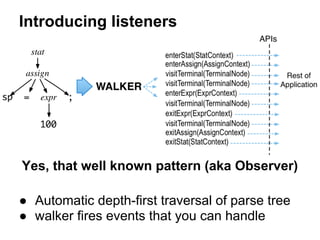
Introducing listeners
Yes, that well known pattern (aka Observer)
● Automatic depth-first traversal of parse tree
● walker fires events that you can handle
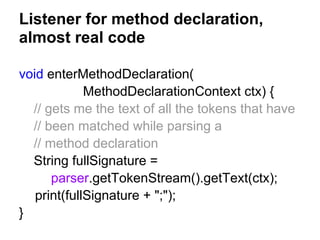
Listener for method declaration,
almost real code
void enterMethodDeclaration(
MethodDeclarationContext ctx) {
// gets me the text of all the tokens that have
// been matched while parsing a
// method declaration
String fullSignature =
parser.getTokenStream().getText(ctx);
print(fullSignature + ";");
}
(plus minor glue code)
That's it!
Live Demo
ANTLR4 Adaptive LL(*) or ALL(*)
● Generates recursive descent parser
○ like what you would build by hand
● does dynamic grammar analysis while
parsing
○ saves results like a JIT does
● allows for direct left recursion
○ indirect left recursion not supported
● parsing time typically near-linear
Comparing to ANTLR3
top-down SLL(*) parser with optional
backtracking and memoization
● ANTLR4
○ can handler a larger set of grammars
○ supports lexer modes
● ANTLR3
○ relies on embedded actions
○ has tree parser and transformer
○ can't handle left recursive grammars
Comparision Summary
● PEG / packrat
○ can't do left recursion
○ similar to ANTLR3 with backtracking
○ error recovery or reporting hard
● GLR
○ bottom-up like yacc
○ can do all grammars
○ debugging on the declarative specification only
● GLL
○ top-down like ANTLR
○ can do all grammars
Comparing to PEG / packrat
top-down parsing with backtracking and
memoization
● Sometimes scanner-less
● also can not do left recursion
● Uses the first option that matches
● Error recovery and proper error reporting
very hard
● ANTLR4 much more efficient
Comparing to GLR
a generalized LR parser
● does breadth-first search when there is a
conflict in the LR table
● can deliver all possible derivation on
ambiguous input
● debugging on the declarative specification
○ no need to debug state machine
● can do indirect left recursion
Comparing to GLL
a generalized LL parser
● mapping to recursive descent parser not
obvious (not possible?)
● can do indirect left recursion
Wrap-Up
● ANTLR 4 is easy to use
● You can use listeners or visitors for actions
● ANTLR 4 helps you solve practical
problems
Why is ANTLR4 called "Honey
Badger"?
● The amimal "Honey Badger" is the most
fearless animal of all
● ANTLR4 named after it
○ http://www.youtube.com/watch?v=4r7wHMg5Yjg
● It takes any grammar you give it. “It just
doesn’t give a damn.”
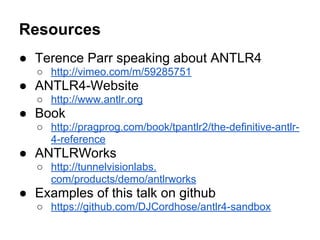
Resources
● Terence Parr speaking about ANTLR4
○ http://vimeo.com/m/59285751
● ANTLR4-Website
○ http://www.antlr.org
● Book
○ http://pragprog.com/book/tpantlr2/the-definitive-antlr-
4-reference
● ANTLRWorks
○ http://tunnelvisionlabs.
com/products/demo/antlrworks
● Examples of this talk on github
○ https://github.com/DJCordhose/antlr4-sandbox
Questions / Discussion
Oliver Zeigermann
zeigermann.eu
Java example and some illustrations provided as a courtesy of Terence Parr

Code Generation Cambridge 2013 Introduction to Parsing with ANTLR4

  • 1.
    Introduction to ANTLR 4 Thelatest and last (sic!) revision Oliver Zeigermann Code Generation Cambridge 2013
  • 2.
    Outline ● Introduction toparsing with ANTLR4 ● Use case: Interpreter ● Use case: Code Generator ● The tiniest bit of theory: Adaptive LL(*) ● Comparing ANTLR4
  • 3.
    ANTLR 4: ManagementSummary ● Parser generator ● Language tool ● Design goals ○ ease-of-use over performance ○ simplicity over complexity ● Eats all context free grammars ○ with a small caveat
  • 4.
    What does parsingwith ANTLR4 mean? Identify and reveal the implicit structure of an input in a parse tree ● Structure is described as a grammar ● Recognizer is divided into lexer and parser ● Parse tree can be auto generated
  • 5.
    Practical example #1:An expression interpreter Build an interpreter from scratch ● complete and working ● parses numerical expressions ● does the calculation
  • 6.
    Lexical rule forintegers INT : ('0'..'9')+ ; ● Rule for token INT ● Composed of digits 0 to 9 ● At least one digit
  • 7.
    Syntactic rule forexpressions expr : expr ('*'|'/') expr | expr ('+'|'-') expr | INT ; ● Three options ● Operator precedence by order of options ● Notice left recursion
  • 8.
    grammar Expressions; start :expr ; expr : left=expr op=('*'|'/') right=expr #opExpr | left=expr op=('+'|'-') right=expr #opExpr | atom=INT #atomExpr ; INT : ('0'..'9')+ ; WS : [ trn]+ -> skip ;
  • 9.
    Doing something basedon input Options for separation of actions from grammars in ANTLR4 1. Listeners (SAX style) 2. Visitors (DOM style)
  • 10.
    Introducing Visitors Yes, thatwell known pattern ● Actions are separated from the grammar ● Visitors actively control traversal of parse tree ○ if and ○ how ● Calls of visitor methods can return values
  • 11.
    Visitor: actively visitingtree int visitOpExpr(OpExprContext ctx) { int left = visit(ctx.left); int right = visit(ctx.right); switch (ctx.op) { case '*' : return left * right; case '/' : return left / right; case '+' : return left + right; case '-' : return left - right; } }
  • 12.
    Visitor methods pseudocode int visitStart(StartContext ctx) { return visitChildren(ctx); } int visitAtomExpr(AtomExprContext ctx) { return Integer.parseInt(ctx.atom.getText()); } int visitOpExpr(OpExprContext ctx) { // what we just saw }
  • 13.
  • 14.
    Practical example #2:Code generation from Java Generate interface declarations for existing class definitions ● Adapted from ANTLR4 book ● Like a large scale refactoring or code generation ● Keep method signature exactly as it is ● Good news ○ You can use an existing Java grammar ○ You just have to figure out what is/are the rule(s) you are interested in: methodDeclaration
  • 15.
    Doing something basedon input Options for separation of actions from grammars 1. Listeners (SAX style) 2. Visitors (DOM style)
  • 16.
    Introducing listeners Yes, thatwell known pattern (aka Observer) ● Automatic depth-first traversal of parse tree ● walker fires events that you can handle
  • 17.
    Listener for methoddeclaration, almost real code void enterMethodDeclaration( MethodDeclarationContext ctx) { // gets me the text of all the tokens that have // been matched while parsing a // method declaration String fullSignature = parser.getTokenStream().getText(ctx); print(fullSignature + ";"); }
  • 18.
    (plus minor gluecode) That's it!
  • 19.
  • 20.
    ANTLR4 Adaptive LL(*)or ALL(*) ● Generates recursive descent parser ○ like what you would build by hand ● does dynamic grammar analysis while parsing ○ saves results like a JIT does ● allows for direct left recursion ○ indirect left recursion not supported ● parsing time typically near-linear
  • 21.
    Comparing to ANTLR3 top-downSLL(*) parser with optional backtracking and memoization ● ANTLR4 ○ can handler a larger set of grammars ○ supports lexer modes ● ANTLR3 ○ relies on embedded actions ○ has tree parser and transformer ○ can't handle left recursive grammars
  • 22.
    Comparision Summary ● PEG/ packrat ○ can't do left recursion ○ similar to ANTLR3 with backtracking ○ error recovery or reporting hard ● GLR ○ bottom-up like yacc ○ can do all grammars ○ debugging on the declarative specification only ● GLL ○ top-down like ANTLR ○ can do all grammars
  • 23.
    Comparing to PEG/ packrat top-down parsing with backtracking and memoization ● Sometimes scanner-less ● also can not do left recursion ● Uses the first option that matches ● Error recovery and proper error reporting very hard ● ANTLR4 much more efficient
  • 24.
    Comparing to GLR ageneralized LR parser ● does breadth-first search when there is a conflict in the LR table ● can deliver all possible derivation on ambiguous input ● debugging on the declarative specification ○ no need to debug state machine ● can do indirect left recursion
  • 25.
    Comparing to GLL ageneralized LL parser ● mapping to recursive descent parser not obvious (not possible?) ● can do indirect left recursion
  • 26.
    Wrap-Up ● ANTLR 4is easy to use ● You can use listeners or visitors for actions ● ANTLR 4 helps you solve practical problems
  • 27.
    Why is ANTLR4called "Honey Badger"? ● The amimal "Honey Badger" is the most fearless animal of all ● ANTLR4 named after it ○ http://www.youtube.com/watch?v=4r7wHMg5Yjg ● It takes any grammar you give it. “It just doesn’t give a damn.”
  • 28.
    Resources ● Terence Parrspeaking about ANTLR4 ○ http://vimeo.com/m/59285751 ● ANTLR4-Website ○ http://www.antlr.org ● Book ○ http://pragprog.com/book/tpantlr2/the-definitive-antlr- 4-reference ● ANTLRWorks ○ http://tunnelvisionlabs. com/products/demo/antlrworks ● Examples of this talk on github ○ https://github.com/DJCordhose/antlr4-sandbox
  • 29.
    Questions / Discussion OliverZeigermann zeigermann.eu Java example and some illustrations provided as a courtesy of Terence Parr