Internet Studies:
     The Foundations of a Transformative Field

                               Bill Dutton
                      Oxford Internet Institute (OII)
                          University of Oxford
                              www.ox.ac.uk


Presentation for Students and Faculty, Lisbon University Institute,
Lisbon, Portugal, 10 April 2013.
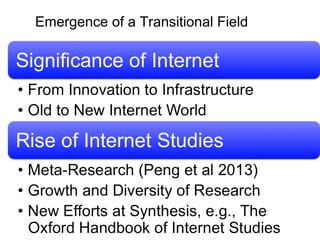
Emergence of a Transitional Field
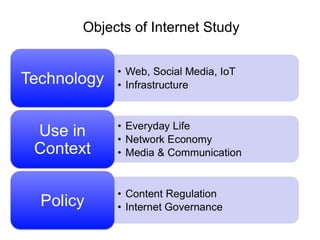
Objects of Internet Study
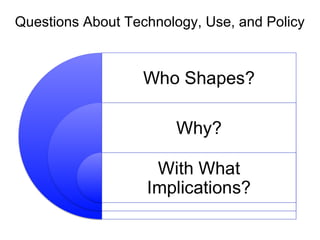
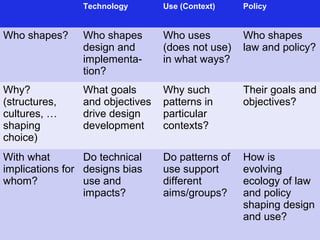
Questions About Technology, Use, and Policy
Technology       Use (Context)    Policy


Who shapes?     Who shapes       Who uses         Who shapes
                design and       (does not use)   law and policy?
                implementa-      in what ways?
                tion?
Why?            What goals       Why such         Their goals and
(structures,    and objectives   patterns in      objectives?
cultures, …     drive design     particular
shaping         development      contexts?
choice)
With what        Do technical    Do patterns of   How is
implications for designs bias    use support      evolving
whom?            use and         different        ecology of law
                 impacts?        aims/groups?     and policy
                                                  shaping design
                                                  and use?
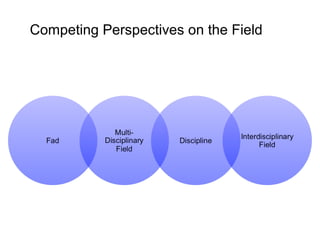
Competing Perspectives on the Field
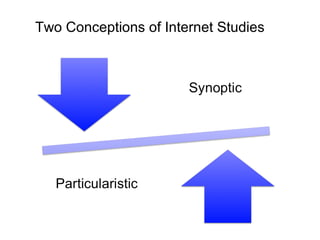
Two Conceptions of Internet Studies
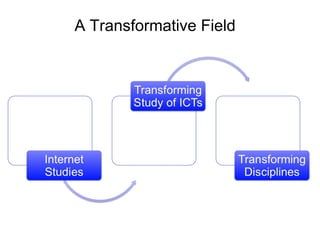
A Transformative Field
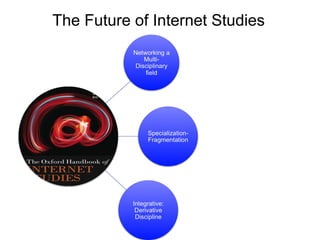
The Future of Internet Studies
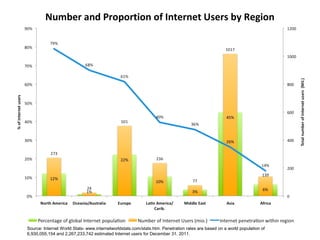
Number and Proportion of Internet Users by Region


Source: Internet World Stats- www.internetworldstats.com/stats.htm. Penetration rates are based on a world population of
6,930,055,154 and 2,267,233,742 estimated Internet users for December 31, 2011.
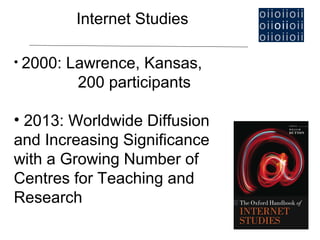
Internet Studies

• 2000:   Lawrence, Kansas,
           200 participants

• 2013: Worldwide Diffusion
and Increasing Significance
with a Growing Number of
Centres for Teaching and
Research
Internet Studies

• Dutton, W. H. (2013), ‘Internet Studies’ in
Dutton, W. H. (ed.), The Oxford Handbook of
Internet Studies. Oxford University Press
http://papers.ssrn.com/sol3/papers.cfm?
abstract_id=2231188

• Peng, T. Q., Zhu, J. J. H., Zhang, L., & Zhong,
Z. J. (2012). “Mapping the Landscape of Internet
Research: Text Mining of Social Science Journal
Articles 2000–2009,” New Media & Society.
DOI: 10.1177/1461444812462846.

Internet studies 13

  • 1.
    Internet Studies: The Foundations of a Transformative Field Bill Dutton Oxford Internet Institute (OII) University of Oxford www.ox.ac.uk Presentation for Students and Faculty, Lisbon University Institute, Lisbon, Portugal, 10 April 2013.
  • 2.
    Emergence of aTransitional Field
  • 3.
  • 4.
  • 5.
    Technology Use (Context) Policy Who shapes? Who shapes Who uses Who shapes design and (does not use) law and policy? implementa- in what ways? tion? Why? What goals Why such Their goals and (structures, and objectives patterns in objectives? cultures, … drive design particular shaping development contexts? choice) With what Do technical Do patterns of How is implications for designs bias use support evolving whom? use and different ecology of law impacts? aims/groups? and policy shaping design and use?
  • 6.
  • 7.
    Two Conceptions ofInternet Studies
  • 8.
  • 9.
    The Future ofInternet Studies
  • 10.
    Number and Proportionof Internet Users by Region Source: Internet World Stats- www.internetworldstats.com/stats.htm. Penetration rates are based on a world population of 6,930,055,154 and 2,267,233,742 estimated Internet users for December 31, 2011.
  • 11.
    Internet Studies • 2000: Lawrence, Kansas, 200 participants • 2013: Worldwide Diffusion and Increasing Significance with a Growing Number of Centres for Teaching and Research
  • 12.
    Internet Studies • Dutton,W. H. (2013), ‘Internet Studies’ in Dutton, W. H. (ed.), The Oxford Handbook of Internet Studies. Oxford University Press http://papers.ssrn.com/sol3/papers.cfm? abstract_id=2231188 • Peng, T. Q., Zhu, J. J. H., Zhang, L., & Zhong, Z. J. (2012). “Mapping the Landscape of Internet Research: Text Mining of Social Science Journal Articles 2000–2009,” New Media & Society. DOI: 10.1177/1461444812462846.