By Michelle SchroederInternet Filtering in South Korea
BackgroundSouth Korea was established in 1948Openly approving North Korean government is illegal and a lot of internet filtering pertains to thisThousands of South Koreans since South Korea has been established have been arrested under the anti-communist National Security LawInvestigations and arrests are still happening today even though South Korea and North Korea are trying to get along.
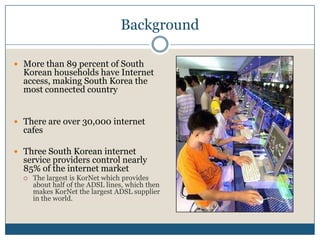
BackgroundMore than 89 percent of South Korean households have Internet access, making South Korea the most connected countryThere are over 30,000 internet cafesThree South Korean internet service providers control nearly 85% of the internet marketThe largest is KorNet which provides about half of the ADSL lines, which then makes KorNet the largest ADSL supplier in the world.
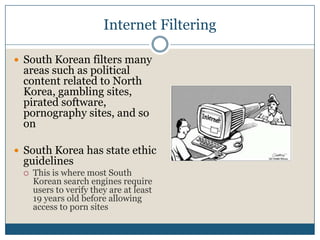
Internet FilteringSouth Korean filters many areas such as political content related to North Korea, gambling sites, pirated software, pornography sites, and so onSouth Korea has state ethic guidelinesThis is where most South Korean search engines require users to verify they are at least 19 years old before allowing access to porn sites
Legal and Regulatory FrameworksThe NSL is the primary regulation governing Internet speech in South KoreaNSL was designed to prevent communist ideology and pro-North Korean sentimentThis statute provides up to  years of imprisonmentISPs are responsible for policing content on their networksThere is a government list of around 120,000 sites in which the ISPs are required to filter
Legal and Regulatory FrameworksInternet access facilities such as Internet Cafes and public libraries are required to install internet filtering softwareThe Youth Protection Act of 1997 made ISPs officially responsible for policing the internetUnder this act, homosexual content is considered “harmful and obscene”In 2003 this homosexual content provision was removed because of outcries
ONI Testing ResultsThe testing revealed that South Korea filters content related to North Korea, a handful of sites dedicated to gambling, and two sites devoted to pirated softwareONI’s test suggested that there is little blocking of sensitive content in South KoreaONI’s testing registered no blocks on pornography sites and homosexual contentMinor’s access is restricted though by requiring age identification
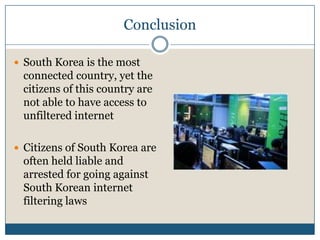
ConclusionSouth Korea is the most connected country, yet the citizens of this country are not able to have access to unfiltered internetCitizens of South Korea are often held liable and arrested for going against South Korean internet filtering laws

Internet Filtering In South Korea

  • 1.
    By Michelle SchroederInternetFiltering in South Korea
  • 2.
    BackgroundSouth Korea wasestablished in 1948Openly approving North Korean government is illegal and a lot of internet filtering pertains to thisThousands of South Koreans since South Korea has been established have been arrested under the anti-communist National Security LawInvestigations and arrests are still happening today even though South Korea and North Korea are trying to get along.
  • 3.
    BackgroundMore than 89percent of South Korean households have Internet access, making South Korea the most connected countryThere are over 30,000 internet cafesThree South Korean internet service providers control nearly 85% of the internet marketThe largest is KorNet which provides about half of the ADSL lines, which then makes KorNet the largest ADSL supplier in the world.
  • 4.
    Internet FilteringSouth Koreanfilters many areas such as political content related to North Korea, gambling sites, pirated software, pornography sites, and so onSouth Korea has state ethic guidelinesThis is where most South Korean search engines require users to verify they are at least 19 years old before allowing access to porn sites
  • 5.
    Legal and RegulatoryFrameworksThe NSL is the primary regulation governing Internet speech in South KoreaNSL was designed to prevent communist ideology and pro-North Korean sentimentThis statute provides up to years of imprisonmentISPs are responsible for policing content on their networksThere is a government list of around 120,000 sites in which the ISPs are required to filter
  • 6.
    Legal and RegulatoryFrameworksInternet access facilities such as Internet Cafes and public libraries are required to install internet filtering softwareThe Youth Protection Act of 1997 made ISPs officially responsible for policing the internetUnder this act, homosexual content is considered “harmful and obscene”In 2003 this homosexual content provision was removed because of outcries
  • 7.
    ONI Testing ResultsThetesting revealed that South Korea filters content related to North Korea, a handful of sites dedicated to gambling, and two sites devoted to pirated softwareONI’s test suggested that there is little blocking of sensitive content in South KoreaONI’s testing registered no blocks on pornography sites and homosexual contentMinor’s access is restricted though by requiring age identification
  • 8.
    ConclusionSouth Korea isthe most connected country, yet the citizens of this country are not able to have access to unfiltered internetCitizens of South Korea are often held liable and arrested for going against South Korean internet filtering laws