Legally known as Cybercrime Prevention Act of 2012 or
Republic Act No. 10175 is a Philippine Republic Act signed
by President Aquino on September 12, 2012.
It aims to address legal issues concerning online
interactions .
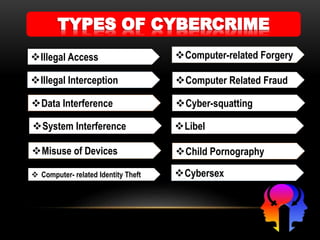
Illegal Access
Illegal Interception
Data Interference
Child Pornography
Cybersex Computer- related Identity Theft
System Interference Libel
Misuse of Devices
Cyber-squatting
Computer-related Forgery
Computer Related Fraud
CYBER - refers to a computer or a computer network, the electronic
medium in which online communication takes place.
ACCESS - refers to the instruction, communication with, storing data in,
retrieving data from, or otherwise making use of any resources of a
computer system or communication network.
COMPUTER DATA - refers to any representation of facts, information,
or concepts in a form suitable for processing in a computer system
including a program suitable to cause a computer system to perform a
function and includes electronic documents and/or electronic data
messages whether stored in local computer systems or online.
COMPUTER PROGRAM - refers to a set of instructions executed by
the computer to achieve intended results.
WITHOUT RIGHT - refers to either: (i) conduct undertaken without or in
excess of authority; or (ii) conduct not covered by established legal
defenses, excuses, court orders, justifications, or relevant principles under
the law.
DEN- refers to a comfortable room not used for formal entertaining.
COMPUTER DATA - refers to any representation of facts, information, or
concepts in a form suitable for processing in a computer system including
a program suitable to cause a computer system to perform a function and
includes electronic documents and/or electronic data messages whether
stored in local computer systems or online.
 The willful engagement, maintenance, control, or
operation, directly or indirectly, of any lascivious
exhibition of sexual organs or sexual activity, with
the aid of a computer system, for favor or
consideration.
PENALTY
Imprisonment up to six years up to 12 years
or a fine of at least Two hundred thousand pesos
(P200,000.00) but not exceeding One million pesos
(P1,000,000.00)
or BOTH.
OPERATION OF CYBERSEX DENS IN
THE PHILIPPINES
In cybersex dens, clients pay to have cybersex workers
perform sexually explicit acts over the internet.
Operators usually maintain a website, where potential
clients can look at the profiles of the cybersex workers.
After the client has chosen a profile, he enters a private
chat room with the worker. The client then types out his
instructions, ranging from mundane acts like eating or
just talking, to more lascivious acts such as
stripteasing or simulated sex. The client pays on a per-
minute basis, via credit card or online remittance.
OPERATION OF CYBERSEX DENS IN
THE PHILIPPINES
The workers are usually forced to do such work, and
may even be confined or detained, but there have also
been instances where the workers do it voluntarily.
A study conducted in the cities of Angeles and
Olongapo revealed that three parties are usually
involved in the management of such operation: the
financier, the website administrator, and the operator.
OPERATION OF CYBERSEX DENS IN
THE PHILIPPINES
THE FINANCIER, usually a male foreigner, funds
and directs the operation.
THE WEBSITE ADMINISTRATOR, on the
other hand, is in charge of maintaining the website and
also tends to be a male foreigner. The website
administrator, on the other hand, is in charge of
maintaining the website and also tends to be a male
foreigner.
THE OPERATOR is in charge of recruitment and
managing day to day operations, and is usually a Filipino.
PENALTY
Imprisonment up to six years up to 12 years
or a fine of at least Two hundred thousand pesos
(P200,000.00) but not exceeding One million pesos
(P1,000,000.00)
or BOTH.
PENALTY
Prior to the enactment of the Cybercrime Prevention
Act in 2012, there was no law penalizing the operation of
cybersex dens.
If the worker is a minor, the case would fall under
R.A. 7610 or the Special Protection of Children Against
Abuse, Exploitation, and Discrimination Act. This law
penalizes child trafficking, child prostitution, obscene
publications and indecent shows. The penalty for offenders
is prison mayor in its medium period (8 years and 1 day to
10 years).
Moreover, R.A. 9975 or the Anti-Child Pornography Act of 2009 also
prohibits the selling and distribution of child pornography, and the
maintenance of a venue, such as dens, houses, or establishments fronting
as legitimate businesses, for the commission of the prohibited acts under
this law.
The question of what law to apply,
however, arises when the cybersex worker is an
adult. The Revised Penal Code (RPC) provisions
penalizing prostitution, as well as other laws on
prostitution, cannot apply as there is no actual
sexual intercourse between the client and the
worker. Under the RPC, prostitution is defined
as engaging in sexual intercourse for money or
profit.
The closest provision in the RPC that
applies then is the prohibition on obscene
exhibitions and indecent shows under Article
201 (2) (b). However, this does not address the
unique situation of cybersex dens. Cybersex
transactions are usually conducted privately –
the acts are conducted one-on-one. The RPC
provision assumes an audience, since it applies
to theatres or any other place of indecent or
immoral scenes and acts, whether live or in
film, which serve no other purpose but to
satisfy the market for lust or pornography.
On the other hand, R.A. 9208, the Anti-
Trafficking in Persons Act of 2003, as well as R.A.
10364, the Expanded Anti-Trafficking in Persons Act
of 2012, which amended R.A. 9208, is more
applicable, but may not cover all situations.
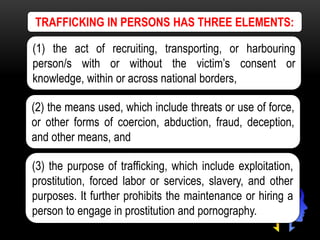
TRAFFICKING IN PERSONS HAS THREE ELEMENTS:
(1) the act of recruiting, transporting, or harbouring
person/s with or without the victim’s consent or
knowledge, within or across national borders,
(3) the purpose of trafficking, which include exploitation,
prostitution, forced labor or services, slavery, and other
purposes. It further prohibits the maintenance or hiring a
person to engage in prostitution and pornography.
(2) the means used, which include threats or use of force,
or other forms of coercion, abduction, fraud, deception,
and other means, and
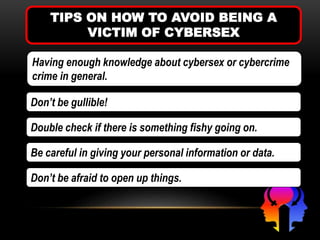
TIPS ON HOW TO AVOID BEING A
VICTIM OF CYBERSEX
Having enough knowledge about cybersex or cybercrime
crime in general.
Don’t be gullible!
Double check if there is something fishy going on.
Be careful in giving your personal information or data.
Don’t be afraid to open up things.
THANK YOU! 

Cybersex law

  • 1.
    Legally known asCybercrime Prevention Act of 2012 or Republic Act No. 10175 is a Philippine Republic Act signed by President Aquino on September 12, 2012. It aims to address legal issues concerning online interactions .
  • 2.
    Illegal Access Illegal Interception DataInterference Child Pornography Cybersex Computer- related Identity Theft System Interference Libel Misuse of Devices Cyber-squatting Computer-related Forgery Computer Related Fraud
  • 3.
    CYBER - refersto a computer or a computer network, the electronic medium in which online communication takes place. ACCESS - refers to the instruction, communication with, storing data in, retrieving data from, or otherwise making use of any resources of a computer system or communication network. COMPUTER DATA - refers to any representation of facts, information, or concepts in a form suitable for processing in a computer system including a program suitable to cause a computer system to perform a function and includes electronic documents and/or electronic data messages whether stored in local computer systems or online. COMPUTER PROGRAM - refers to a set of instructions executed by the computer to achieve intended results.
  • 4.
    WITHOUT RIGHT -refers to either: (i) conduct undertaken without or in excess of authority; or (ii) conduct not covered by established legal defenses, excuses, court orders, justifications, or relevant principles under the law. DEN- refers to a comfortable room not used for formal entertaining. COMPUTER DATA - refers to any representation of facts, information, or concepts in a form suitable for processing in a computer system including a program suitable to cause a computer system to perform a function and includes electronic documents and/or electronic data messages whether stored in local computer systems or online.
  • 5.
     The willfulengagement, maintenance, control, or operation, directly or indirectly, of any lascivious exhibition of sexual organs or sexual activity, with the aid of a computer system, for favor or consideration.
  • 6.
    PENALTY Imprisonment up tosix years up to 12 years or a fine of at least Two hundred thousand pesos (P200,000.00) but not exceeding One million pesos (P1,000,000.00) or BOTH.
  • 8.
    OPERATION OF CYBERSEXDENS IN THE PHILIPPINES In cybersex dens, clients pay to have cybersex workers perform sexually explicit acts over the internet. Operators usually maintain a website, where potential clients can look at the profiles of the cybersex workers. After the client has chosen a profile, he enters a private chat room with the worker. The client then types out his instructions, ranging from mundane acts like eating or just talking, to more lascivious acts such as stripteasing or simulated sex. The client pays on a per- minute basis, via credit card or online remittance.
  • 9.
    OPERATION OF CYBERSEXDENS IN THE PHILIPPINES The workers are usually forced to do such work, and may even be confined or detained, but there have also been instances where the workers do it voluntarily. A study conducted in the cities of Angeles and Olongapo revealed that three parties are usually involved in the management of such operation: the financier, the website administrator, and the operator.
  • 10.
    OPERATION OF CYBERSEXDENS IN THE PHILIPPINES THE FINANCIER, usually a male foreigner, funds and directs the operation. THE WEBSITE ADMINISTRATOR, on the other hand, is in charge of maintaining the website and also tends to be a male foreigner. The website administrator, on the other hand, is in charge of maintaining the website and also tends to be a male foreigner. THE OPERATOR is in charge of recruitment and managing day to day operations, and is usually a Filipino.
  • 11.
    PENALTY Imprisonment up tosix years up to 12 years or a fine of at least Two hundred thousand pesos (P200,000.00) but not exceeding One million pesos (P1,000,000.00) or BOTH.
  • 12.
    PENALTY Prior to theenactment of the Cybercrime Prevention Act in 2012, there was no law penalizing the operation of cybersex dens. If the worker is a minor, the case would fall under R.A. 7610 or the Special Protection of Children Against Abuse, Exploitation, and Discrimination Act. This law penalizes child trafficking, child prostitution, obscene publications and indecent shows. The penalty for offenders is prison mayor in its medium period (8 years and 1 day to 10 years).
  • 13.
    Moreover, R.A. 9975or the Anti-Child Pornography Act of 2009 also prohibits the selling and distribution of child pornography, and the maintenance of a venue, such as dens, houses, or establishments fronting as legitimate businesses, for the commission of the prohibited acts under this law.
  • 14.
    The question ofwhat law to apply, however, arises when the cybersex worker is an adult. The Revised Penal Code (RPC) provisions penalizing prostitution, as well as other laws on prostitution, cannot apply as there is no actual sexual intercourse between the client and the worker. Under the RPC, prostitution is defined as engaging in sexual intercourse for money or profit.
  • 15.
    The closest provisionin the RPC that applies then is the prohibition on obscene exhibitions and indecent shows under Article 201 (2) (b). However, this does not address the unique situation of cybersex dens. Cybersex transactions are usually conducted privately – the acts are conducted one-on-one. The RPC provision assumes an audience, since it applies to theatres or any other place of indecent or immoral scenes and acts, whether live or in film, which serve no other purpose but to satisfy the market for lust or pornography.
  • 16.
    On the otherhand, R.A. 9208, the Anti- Trafficking in Persons Act of 2003, as well as R.A. 10364, the Expanded Anti-Trafficking in Persons Act of 2012, which amended R.A. 9208, is more applicable, but may not cover all situations.
  • 17.
    TRAFFICKING IN PERSONSHAS THREE ELEMENTS: (1) the act of recruiting, transporting, or harbouring person/s with or without the victim’s consent or knowledge, within or across national borders, (3) the purpose of trafficking, which include exploitation, prostitution, forced labor or services, slavery, and other purposes. It further prohibits the maintenance or hiring a person to engage in prostitution and pornography. (2) the means used, which include threats or use of force, or other forms of coercion, abduction, fraud, deception, and other means, and
  • 18.
    TIPS ON HOWTO AVOID BEING A VICTIM OF CYBERSEX Having enough knowledge about cybersex or cybercrime crime in general. Don’t be gullible! Double check if there is something fishy going on. Be careful in giving your personal information or data. Don’t be afraid to open up things.
  • 19.