Chapter 11: Management of
Transaction Exposure
Case Study: Blades, Inc.
Team Members :
Timmy 0521812
Jimmy 0521807
Sheby 0521827
2017/04/17
International Financial Management
Agenda
• Case Study overview
• Problem solutions
• Q&A
Blades, Inc.
• Blades’ product : Speedos
• Decides to expand its international trade
relationship by exporting to UK Jogs, Ltd.
• Continues to export to Thailand and
import materials from Thailand
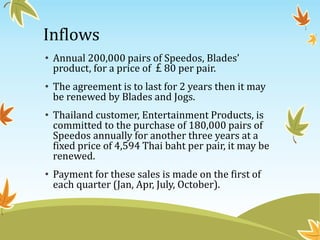
Inflows
• Annual 200,000 pairs of Speedos, Blades’
product, for a price of £80 per pair.
• The agreement is to last for 2 years then it may
be renewed by Blades and Jogs.
• Thailand customer, Entertainment Products, is
committed to the purchase of 180,000 pairs of
Speedos annually for another three years at a
fixed price of 4,594 Thai baht per pair, it may be
renewed.
• Payment for these sales is made on the first of
each quarter (Jan, Apr, July, October).
Outflow
• Imports materials to manufacture 72,000
pairs of Speedos annually from Thailand.
• Cost 3,000 baht per pair of Speedos
• Payment terms within 60 days of delivery,
the delivery day is first day of each
quarter but Blades decided to pay earlier
because it thinks that the earlier payment
will be beneficial
Given Information
Thailand UK US
Current
Spot Rate
0.023 1.5
90 days
forward
rate
0.0215 1.49
Put option
Premium
N/A 0.02
Put Option
Exercise
Price
N/A 1.47
Call Option
Premium
N/A 0.015
CallOption
Exercise
Price
N/A 1.48
90-day
borrowing
rate
4% 2% 2.30%
90-day
lending
rate
3.50% 1.80% 2.10%
Probability
British Pound Spot
Rate in 90 days
Thai Baht Spot
Rate in 90 days
5% 1.45 0.02
20% 1.47 0.0213
30% 1.48 0.0217
25% 1.49 0.022
15% 1.5 0.023
5% 1.52 0.0235
No options are available for
Thailand, but British call and
put options are available for
£31,250 per option.
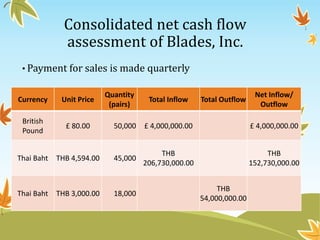
Consolidated net cash flow
assessment of Blades, Inc.
Currency Unit Price
Quantity
(pairs)
Total Inflow Total Outflow
Net Inflow/
Outflow
British
Pound
£ 80.00 50,000 £ 4,000,000.00 £ 4,000,000.00
Thai Baht THB 4,594.00 45,000
THB
206,730,000.00
THB
152,730,000.00
Thai Baht THB 3,000.00 18,000
THB
54,000,000.00
• Payment for sales is made quarterly
Q1. Compare hedging alternatives of Thai baht vs.
unhedged. Do you think Blades should hedge or remain
unhedged? If should, which hedge is the most
appropriate?
Money market hedge is better for Blades because it gives
highest dollar value for baht inflow.
Unhedged = $3,344,023.35
Q2. Compare hedging alternatives of British Pound vs.
unhedged. Do you think Blades should hedge or remain
unhedged? If should, which hedge is the most
appropriate?
Money market hedge is better for Blades
because it give highest dollar value for British Pounds
inflow
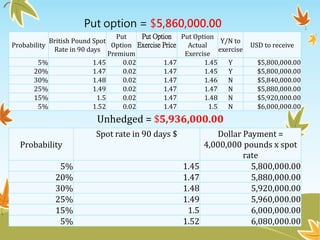
Put option = $5,860,000.00
Unhedged = $5,936,000.00
Probability
Spot rate in 90 days $ Dollar Payment =
4,000,000 pounds x spot
rate
5% 1.45 5,800,000.00
20% 1.47 5,880,000.00
30% 1.48 5,920,000.00
25% 1.49 5,960,000.00
15% 1.5 6,000,000.00
5% 1.52 6,080,000.00
Probability
British Pound Spot
Rate in 90 days
Put
Option
Premium
Put Option
Exercise Price
Put Option
Actual
Exercise
Y/N to
exercise
USD to receive
5% 1.45 0.02 1.47 1.45 Y $5,800,000.00
20% 1.47 0.02 1.47 1.45 Y $5,800,000.00
30% 1.48 0.02 1.47 1.46 N $5,840,000.00
25% 1.49 0.02 1.47 1.47 N $5,880,000.00
15% 1.5 0.02 1.47 1.48 N $5,920,000.00
5% 1.52 0.02 1.47 1.5 N $6,000,000.00
Q.3: Is it easier for Blades to hedge its inflows or its
outflows denominated in foreign currencies? Why ?
Blades is easier to hedge its inflows in foreign currency
than its outflows because inflows are only affected by the
future exchange rate; while outflows are affected by
future exchange rate and the amount of payables.
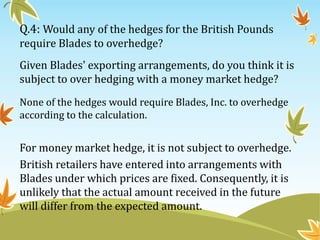
Q.4: Would any of the hedges for the British Pounds
require Blades to overhedge?
Given Blades' exporting arrangements, do you think it is
subject to over hedging with a money market hedge?
None of the hedges would require Blades, Inc. to overhedge
according to the calculation.
For money market hedge, it is not subject to overhedge.
British retailers have entered into arrangements with
Blades under which prices are fixed. Consequently, it is
unlikely that the actual amount received in the future
will differ from the expected amount.
Q.5: Could Blades modify the timing of the Thai
imports in order to reduce the transaction exposure?
What is the trade-off?
Yes, Blades could import more of the sufficient material
for next quarter to reduce the transaction exposure to
Thai baht.
However, by practicing so there will be other costs
should be considered such as higher inventory cost.
Q.6: Could Blades modify its payment practices for
the Thai imports in order to reduce its transaction
exposure? What is the trade-off?
Blades could modify its payment practice to reduce
transaction exposure.
However, once modified, Thai baht revenue and cost
would have different payment time and could not cover
each other. Blades would need to practice hedge
techniques more often.
International Financial Blades Inc Case Study

International Financial Blades Inc Case Study

  • 1.
    Chapter 11: Managementof Transaction Exposure Case Study: Blades, Inc. Team Members : Timmy 0521812 Jimmy 0521807 Sheby 0521827 2017/04/17 International Financial Management
  • 2.
    Agenda • Case Studyoverview • Problem solutions • Q&A
  • 3.
    Blades, Inc. • Blades’product : Speedos • Decides to expand its international trade relationship by exporting to UK Jogs, Ltd. • Continues to export to Thailand and import materials from Thailand
  • 4.
    Inflows • Annual 200,000pairs of Speedos, Blades’ product, for a price of £80 per pair. • The agreement is to last for 2 years then it may be renewed by Blades and Jogs. • Thailand customer, Entertainment Products, is committed to the purchase of 180,000 pairs of Speedos annually for another three years at a fixed price of 4,594 Thai baht per pair, it may be renewed. • Payment for these sales is made on the first of each quarter (Jan, Apr, July, October).
  • 5.
    Outflow • Imports materialsto manufacture 72,000 pairs of Speedos annually from Thailand. • Cost 3,000 baht per pair of Speedos • Payment terms within 60 days of delivery, the delivery day is first day of each quarter but Blades decided to pay earlier because it thinks that the earlier payment will be beneficial
  • 6.
    Given Information Thailand UKUS Current Spot Rate 0.023 1.5 90 days forward rate 0.0215 1.49 Put option Premium N/A 0.02 Put Option Exercise Price N/A 1.47 Call Option Premium N/A 0.015 CallOption Exercise Price N/A 1.48 90-day borrowing rate 4% 2% 2.30% 90-day lending rate 3.50% 1.80% 2.10% Probability British Pound Spot Rate in 90 days Thai Baht Spot Rate in 90 days 5% 1.45 0.02 20% 1.47 0.0213 30% 1.48 0.0217 25% 1.49 0.022 15% 1.5 0.023 5% 1.52 0.0235 No options are available for Thailand, but British call and put options are available for £31,250 per option.
  • 7.
    Consolidated net cashflow assessment of Blades, Inc. Currency Unit Price Quantity (pairs) Total Inflow Total Outflow Net Inflow/ Outflow British Pound £ 80.00 50,000 £ 4,000,000.00 £ 4,000,000.00 Thai Baht THB 4,594.00 45,000 THB 206,730,000.00 THB 152,730,000.00 Thai Baht THB 3,000.00 18,000 THB 54,000,000.00 • Payment for sales is made quarterly
  • 8.
    Q1. Compare hedgingalternatives of Thai baht vs. unhedged. Do you think Blades should hedge or remain unhedged? If should, which hedge is the most appropriate? Money market hedge is better for Blades because it gives highest dollar value for baht inflow. Unhedged = $3,344,023.35
  • 9.
    Q2. Compare hedgingalternatives of British Pound vs. unhedged. Do you think Blades should hedge or remain unhedged? If should, which hedge is the most appropriate? Money market hedge is better for Blades because it give highest dollar value for British Pounds inflow
  • 10.
    Put option =$5,860,000.00 Unhedged = $5,936,000.00 Probability Spot rate in 90 days $ Dollar Payment = 4,000,000 pounds x spot rate 5% 1.45 5,800,000.00 20% 1.47 5,880,000.00 30% 1.48 5,920,000.00 25% 1.49 5,960,000.00 15% 1.5 6,000,000.00 5% 1.52 6,080,000.00 Probability British Pound Spot Rate in 90 days Put Option Premium Put Option Exercise Price Put Option Actual Exercise Y/N to exercise USD to receive 5% 1.45 0.02 1.47 1.45 Y $5,800,000.00 20% 1.47 0.02 1.47 1.45 Y $5,800,000.00 30% 1.48 0.02 1.47 1.46 N $5,840,000.00 25% 1.49 0.02 1.47 1.47 N $5,880,000.00 15% 1.5 0.02 1.47 1.48 N $5,920,000.00 5% 1.52 0.02 1.47 1.5 N $6,000,000.00
  • 11.
    Q.3: Is iteasier for Blades to hedge its inflows or its outflows denominated in foreign currencies? Why ? Blades is easier to hedge its inflows in foreign currency than its outflows because inflows are only affected by the future exchange rate; while outflows are affected by future exchange rate and the amount of payables.
  • 12.
    Q.4: Would anyof the hedges for the British Pounds require Blades to overhedge? Given Blades' exporting arrangements, do you think it is subject to over hedging with a money market hedge? None of the hedges would require Blades, Inc. to overhedge according to the calculation. For money market hedge, it is not subject to overhedge. British retailers have entered into arrangements with Blades under which prices are fixed. Consequently, it is unlikely that the actual amount received in the future will differ from the expected amount.
  • 13.
    Q.5: Could Bladesmodify the timing of the Thai imports in order to reduce the transaction exposure? What is the trade-off? Yes, Blades could import more of the sufficient material for next quarter to reduce the transaction exposure to Thai baht. However, by practicing so there will be other costs should be considered such as higher inventory cost.
  • 14.
    Q.6: Could Bladesmodify its payment practices for the Thai imports in order to reduce its transaction exposure? What is the trade-off? Blades could modify its payment practice to reduce transaction exposure. However, once modified, Thai baht revenue and cost would have different payment time and could not cover each other. Blades would need to practice hedge techniques more often.