Global Production,
Outsourcing, and
Logistics
Opening Case
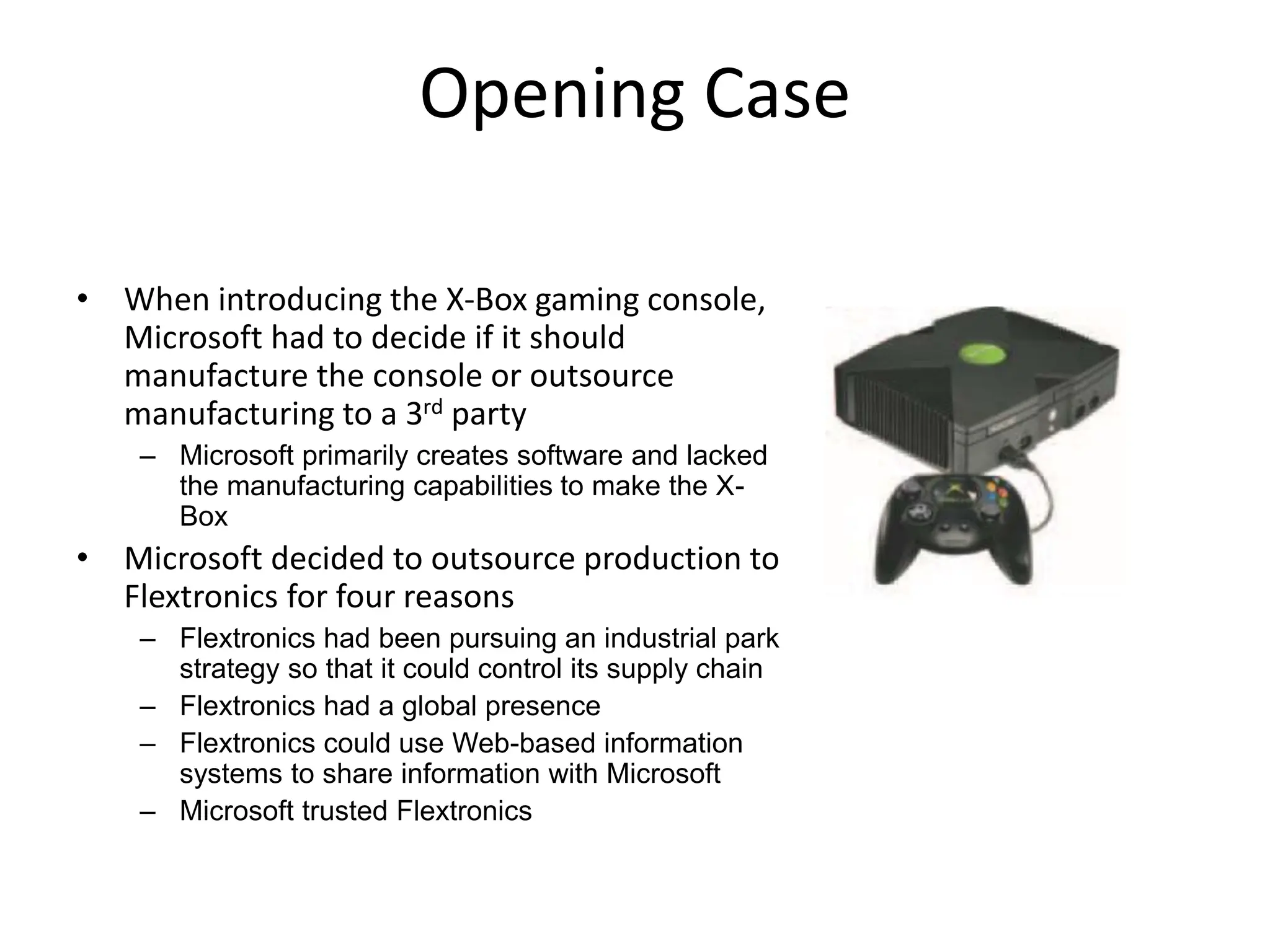
• When introducing the X-Box gaming console,
Microsoft had to decide if it should
manufacture the console or outsource
manufacturing to a 3rd party
– Microsoft primarily creates software and lacked
the manufacturing capabilities to make the X-
Box
• Microsoft decided to outsource production to
Flextronics for four reasons
– Flextronics had been pursuing an industrial park
strategy so that it could control its supply chain
– Flextronics had a global presence
– Flextronics could use Web-based information
systems to share information with Microsoft
– Microsoft trusted Flextronics
Introduction
• As trade barriers fall and global markets develop, firms
must confront a set of interrelated issues
– Where in the world should production activities be
located
– What should be the long-term strategic role of
foreign production sites?
– Should the firm own foreign production activities
or is it better to outsource to vendors?
– How should a globally dispersed supply chain be
managed?
– Should the firm manage global logistics itself, or
should it outsource the management to
enterprises that specialize in this activity?
Strategy, Production,
and Logistics
• Production is the activities involved in creating a product
– Can be both service and manufacturing activities
• Logistics is the activity that controls the transmission of
physical materials through the value chain
• Production and logistics are closely linked since a firm’s
ability to perform its production activities efficiently
depends on a timely supply of high quality material
inputs
Strategy, Production,
and Logistics
• Production and logistics functions have a
number of important strategic objectives
– Lower costs
– Increase product quality by eliminating defective products from both the
supply chain and the manufacturing process
• These objectives are interrelated
– Increasing productivity because time is not wasted producing poor-
quality products that cannot be sold, leading to a direct reduction in unit
costs
– Lowering rework and scrap costs associated with defective products
– Reducing the warranty costs and time associated with fixing defective
products
Relationship Between
Quality and Costs
Total Quality Management
• The total quality management (TQM) philosophy
was developed by a number of American
consultants such as W. Edwards Deming, Josephy
Juran, and A. V. Feigenbaum
• Deming identified a number of steps that should
be included in any TQM program
– Management should embrace the philosophy that mistakes,
defects, and poor quality materials are not acceptable
– Supervisors should work more with employees and provide them
with the tools they need to do the job
– Management should create an environment in which employees will
not fear reporting problems
– Work standards should not only be defined as numbers or quotas,
but should include some notion of quality
Six Sigma
• Six Sigma is the modern successor to TQM
– It is a statistically based philosophy that aims
to reduce defects, boost productivity, eliminate
waste, and cut costs throughout a company
• Production process operating at Six Sigma are
99.99966 percent accurate
– Only 3.4 defects per million units
Strategy, Production,
and Logistics
• In addition to lowering costs and improving quality,
two other objectives have particular importance
– Production and logistic functions must be able
to accommodate demands for local
responsiveness
– Production and logistics must be able to
respond quickly to shifts in customer demand
Where to Produce
• For the firm contemplating international production
a number of factors must be considered
– Country factors
– Technological factors
– Product factors
Country Factors
• Optimum economic, political, and cultural conditions
• Externalities
– Skilled labor pools
– Supporting industries
• Formal and informal trade barriers
• Exchange rate
Technological Factors
• Fixed costs
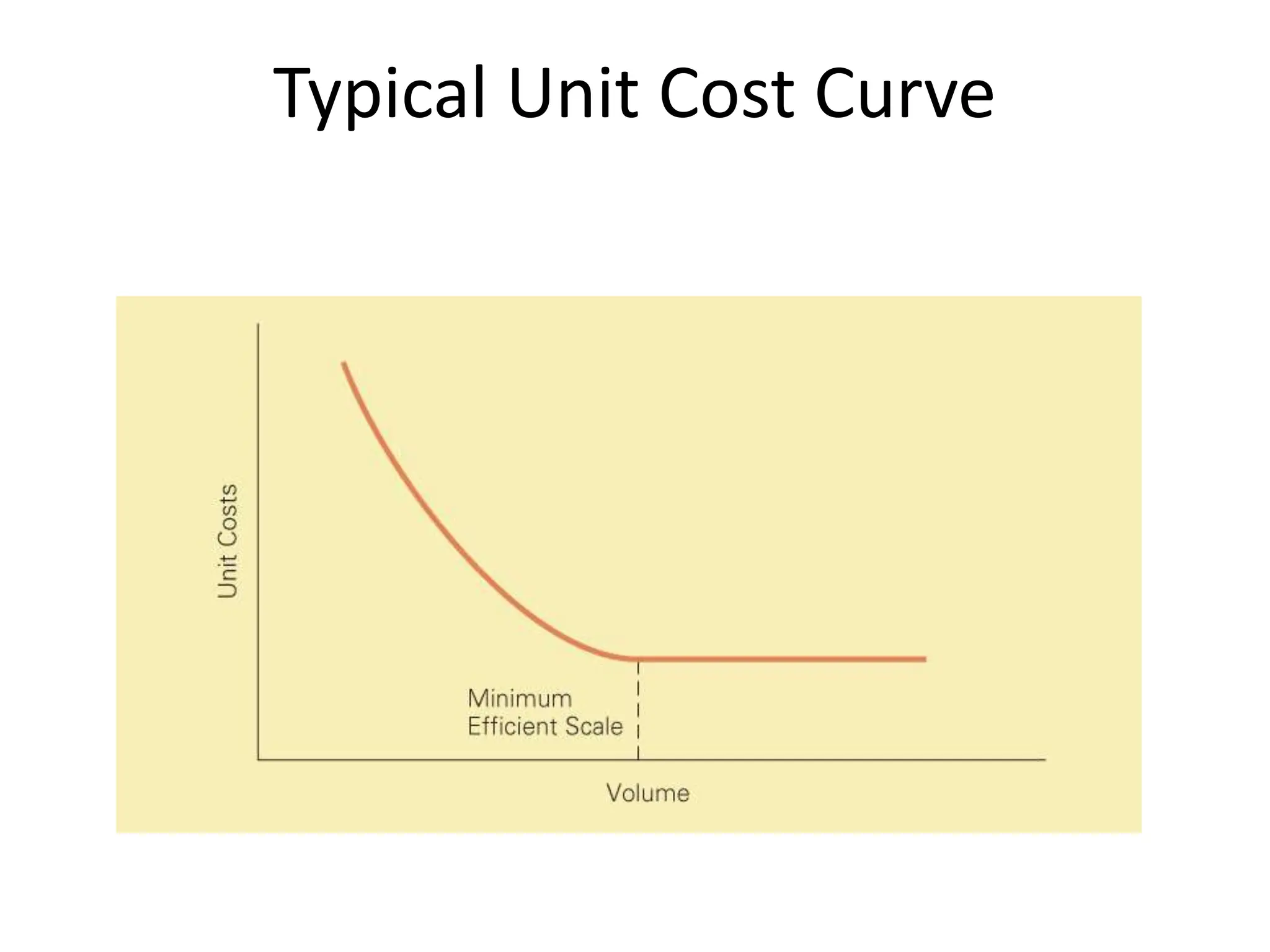
• Minimum efficient scale
• Flexible manufacturing
– Reduce setup times for complex equipment
– Increase machine utilization
– Improve quality control
• Flexible machine cells to perform a variety of
operations
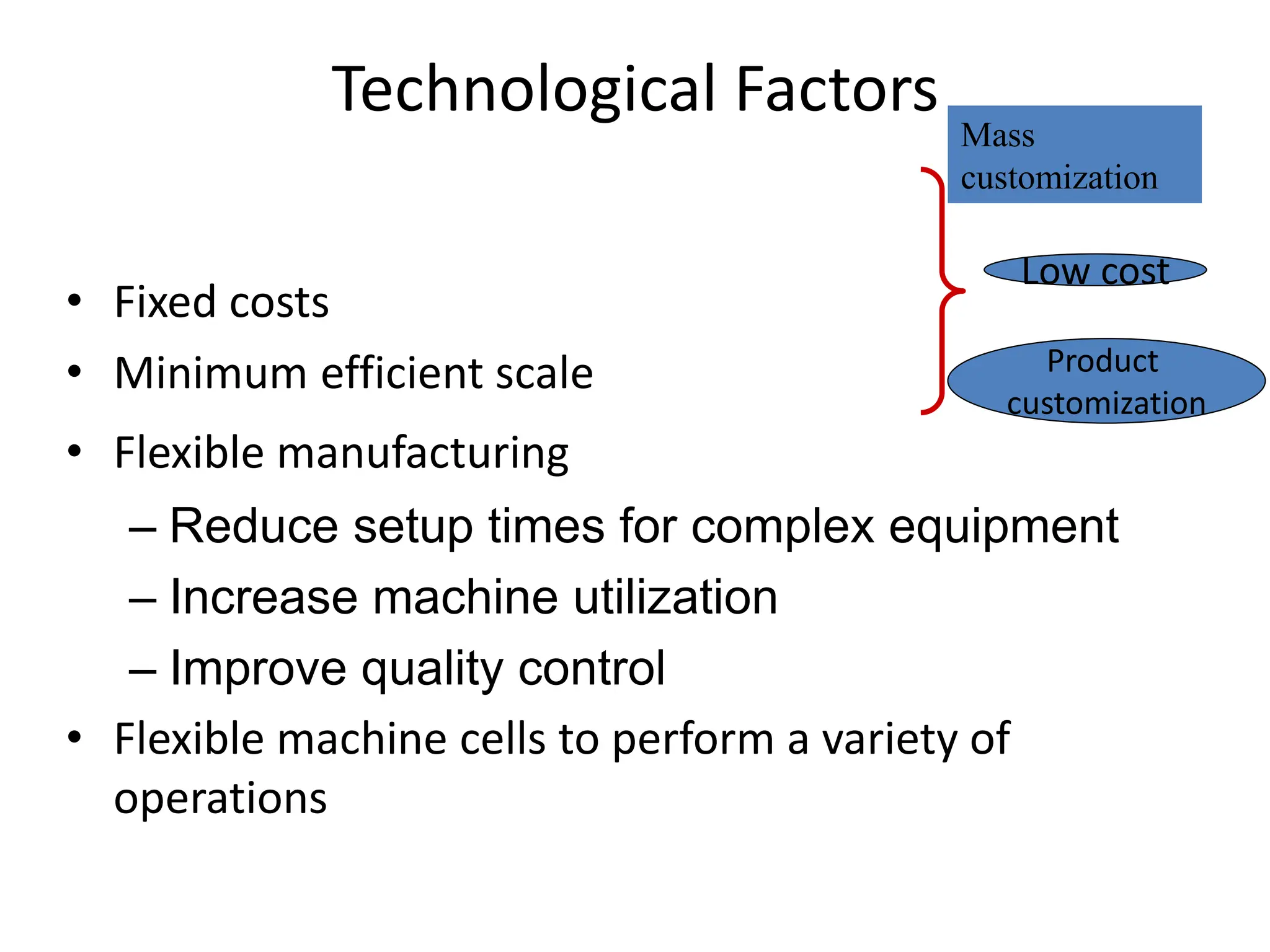
Mass
customization
Low cost
Product
customization
Typical Unit Cost Curve
Manufacturing Location
• Arguments for concentrating production to a
few locations include
– Fixed costs are substantial
– Minimum efficient scale is high
– Flexible manufacturing technologies available
• Arguments to manufacture in all major markets
the firm operates in include
– Fixed costs are low
– Minimum efficient scale is low
– Flexible manufacturing technologies unavailable
– Trade barriers and transportation costs remain major impediments
Product Factors and
Location Strategies
• Two product features affect location decisions:
– Value to weight ratio
– Product serves universal needs
• Two basic strategies
– Concentrating in a centralized location and
serving the world market
– Decentralizing them in various regional or
national locations close to major markets when
opposite conditions exist
Centralized Location
• Factor costs have substantial impact
• Low trade barriers
• Externalities favor certain location
• Stable exchange rates
• High fixed costs, high minimum efficient scale
relative to global demand or flexible manufacturing
technology
• Product’s value-to-weight ratio is high
• Product serves universal needs
Decentralized Location
• Factor costs do not have substantial impact
• High trade barriers
• Location externalities not important
• Exchange rates volatile
• Low fixed costs, low minimum efficient scale
• Flexible manufacturing technology unavailable
• Product’s value-to-weight ratio is low
• Significant differences in consumer tastes and
preferences exist between nations
Location Strategy and
Production
Strategic Role of
Foreign Factories
• Initially, established where labor costs low
• Later, important centers for design and final
assembly
• Upward migration caused by pressures to:
– Improve cost structure
– Customize product to meet customer demand
– An increasing abundance of advanced factors
of production
Make or Buy Decisions
• Should a firm make or buy the component parts that
go into their final product?
• Advantages of making own components:
– Lower costs if most efficient producer
– Facilitating specialized investments
– Proprietary product technology protection
– Improved scheduling
Advantages of
Buy Versus Make
• Strategic flexibility in sourcing components
• Lower firm’s cost structure
• Offsets
• Strategic alliances with suppliers give benefits of
vertical integration without the associated
organizational problems
Managing a
Global Supply Chain
• Objective of materials management in managing a
firm’s global supply chain
– Maintain lowest possible cost
– In a way that best serves the customer’s
needs
• Role of just-in time inventory
– Economize on inventory holding costs
– Speeds inventory turnover
– Drawback: no buffer stock
Role of Information Technology
and the Internet
• Firms increasingly use electronic data interchange (EDI)
to coordinate the flow of materials into manufacturing,
through manufacturing, and out to customers
• EDI systems require computer links between a firm, its
suppliers, and its shippers; these electronic links are then
used
– To place orders with suppliers
– To register parts leaving a supplier
– To track them as they travel toward a manufacturing
plant
– To register their arrival
Role of Information Technology
and the Internet
• EDI systems have resulted in
– Suppliers, shippers, and the purchasing firm communicate with each other
with no time delay
– Increased flexibility and responsiveness of the whole global supply system
– Paperwork between suppliers, shippers, and the purchasing firm is
eliminated
• Web-based systems are rapidly transforming the
management of globally dispersed supply chains,
allowing even small firms to achieve a much
better balance between supply and demand
• Because the number of firms adopting these
systems has increased, those that don’t may find
themselves at a significant competitive
disadvantage

International Business- Global production slides

  • 1.
  • 2.
    Opening Case • Whenintroducing the X-Box gaming console, Microsoft had to decide if it should manufacture the console or outsource manufacturing to a 3rd party – Microsoft primarily creates software and lacked the manufacturing capabilities to make the X- Box • Microsoft decided to outsource production to Flextronics for four reasons – Flextronics had been pursuing an industrial park strategy so that it could control its supply chain – Flextronics had a global presence – Flextronics could use Web-based information systems to share information with Microsoft – Microsoft trusted Flextronics
  • 3.
    Introduction • As tradebarriers fall and global markets develop, firms must confront a set of interrelated issues – Where in the world should production activities be located – What should be the long-term strategic role of foreign production sites? – Should the firm own foreign production activities or is it better to outsource to vendors? – How should a globally dispersed supply chain be managed? – Should the firm manage global logistics itself, or should it outsource the management to enterprises that specialize in this activity?
  • 4.
    Strategy, Production, and Logistics •Production is the activities involved in creating a product – Can be both service and manufacturing activities • Logistics is the activity that controls the transmission of physical materials through the value chain • Production and logistics are closely linked since a firm’s ability to perform its production activities efficiently depends on a timely supply of high quality material inputs
  • 5.
    Strategy, Production, and Logistics •Production and logistics functions have a number of important strategic objectives – Lower costs – Increase product quality by eliminating defective products from both the supply chain and the manufacturing process • These objectives are interrelated – Increasing productivity because time is not wasted producing poor- quality products that cannot be sold, leading to a direct reduction in unit costs – Lowering rework and scrap costs associated with defective products – Reducing the warranty costs and time associated with fixing defective products
  • 6.
  • 7.
    Total Quality Management •The total quality management (TQM) philosophy was developed by a number of American consultants such as W. Edwards Deming, Josephy Juran, and A. V. Feigenbaum • Deming identified a number of steps that should be included in any TQM program – Management should embrace the philosophy that mistakes, defects, and poor quality materials are not acceptable – Supervisors should work more with employees and provide them with the tools they need to do the job – Management should create an environment in which employees will not fear reporting problems – Work standards should not only be defined as numbers or quotas, but should include some notion of quality
  • 8.
    Six Sigma • SixSigma is the modern successor to TQM – It is a statistically based philosophy that aims to reduce defects, boost productivity, eliminate waste, and cut costs throughout a company • Production process operating at Six Sigma are 99.99966 percent accurate – Only 3.4 defects per million units
  • 9.
    Strategy, Production, and Logistics •In addition to lowering costs and improving quality, two other objectives have particular importance – Production and logistic functions must be able to accommodate demands for local responsiveness – Production and logistics must be able to respond quickly to shifts in customer demand
  • 10.
    Where to Produce •For the firm contemplating international production a number of factors must be considered – Country factors – Technological factors – Product factors
  • 11.
    Country Factors • Optimumeconomic, political, and cultural conditions • Externalities – Skilled labor pools – Supporting industries • Formal and informal trade barriers • Exchange rate
  • 12.
    Technological Factors • Fixedcosts • Minimum efficient scale • Flexible manufacturing – Reduce setup times for complex equipment – Increase machine utilization – Improve quality control • Flexible machine cells to perform a variety of operations Mass customization Low cost Product customization
  • 13.
  • 14.
    Manufacturing Location • Argumentsfor concentrating production to a few locations include – Fixed costs are substantial – Minimum efficient scale is high – Flexible manufacturing technologies available • Arguments to manufacture in all major markets the firm operates in include – Fixed costs are low – Minimum efficient scale is low – Flexible manufacturing technologies unavailable – Trade barriers and transportation costs remain major impediments
  • 15.
    Product Factors and LocationStrategies • Two product features affect location decisions: – Value to weight ratio – Product serves universal needs • Two basic strategies – Concentrating in a centralized location and serving the world market – Decentralizing them in various regional or national locations close to major markets when opposite conditions exist
  • 16.
    Centralized Location • Factorcosts have substantial impact • Low trade barriers • Externalities favor certain location • Stable exchange rates • High fixed costs, high minimum efficient scale relative to global demand or flexible manufacturing technology • Product’s value-to-weight ratio is high • Product serves universal needs
  • 17.
    Decentralized Location • Factorcosts do not have substantial impact • High trade barriers • Location externalities not important • Exchange rates volatile • Low fixed costs, low minimum efficient scale • Flexible manufacturing technology unavailable • Product’s value-to-weight ratio is low • Significant differences in consumer tastes and preferences exist between nations
  • 18.
  • 19.
    Strategic Role of ForeignFactories • Initially, established where labor costs low • Later, important centers for design and final assembly • Upward migration caused by pressures to: – Improve cost structure – Customize product to meet customer demand – An increasing abundance of advanced factors of production
  • 20.
    Make or BuyDecisions • Should a firm make or buy the component parts that go into their final product? • Advantages of making own components: – Lower costs if most efficient producer – Facilitating specialized investments – Proprietary product technology protection – Improved scheduling
  • 21.
    Advantages of Buy VersusMake • Strategic flexibility in sourcing components • Lower firm’s cost structure • Offsets • Strategic alliances with suppliers give benefits of vertical integration without the associated organizational problems
  • 22.
    Managing a Global SupplyChain • Objective of materials management in managing a firm’s global supply chain – Maintain lowest possible cost – In a way that best serves the customer’s needs • Role of just-in time inventory – Economize on inventory holding costs – Speeds inventory turnover – Drawback: no buffer stock
  • 23.
    Role of InformationTechnology and the Internet • Firms increasingly use electronic data interchange (EDI) to coordinate the flow of materials into manufacturing, through manufacturing, and out to customers • EDI systems require computer links between a firm, its suppliers, and its shippers; these electronic links are then used – To place orders with suppliers – To register parts leaving a supplier – To track them as they travel toward a manufacturing plant – To register their arrival
  • 24.
    Role of InformationTechnology and the Internet • EDI systems have resulted in – Suppliers, shippers, and the purchasing firm communicate with each other with no time delay – Increased flexibility and responsiveness of the whole global supply system – Paperwork between suppliers, shippers, and the purchasing firm is eliminated • Web-based systems are rapidly transforming the management of globally dispersed supply chains, allowing even small firms to achieve a much better balance between supply and demand • Because the number of firms adopting these systems has increased, those that don’t may find themselves at a significant competitive disadvantage