Production and Logistics Management
(OPS4111)
Course text books/reference books
1. Operations Management William Stevensen
2. Supply Chain Management: Strategy, Planning, and
Operations by Sunil Chopra and Peter Meindl, 2024 7th
edition, Pearson
3. Logistics Management D. K. Agrawal
•DOMINOS
•Standardization – Menu is limited, toppings and ingredients are pre-prepared,
•reducing kitchen time.
•Hub-and-Spoke Store Location –Multiple locations
•Technology Process Discipline
Concept of Production and Operations
What is Production?
• Conversion
• Value addition
• Utilization of Resources – Man, Machine,
Material, Money, technology
What is Operations?
• Operations management is the execution of
backend business functions
• It involves overseeing manufacturing,
inventory, quality control and distribution
• It is the management of systems or processes
that create goods and /or provide services
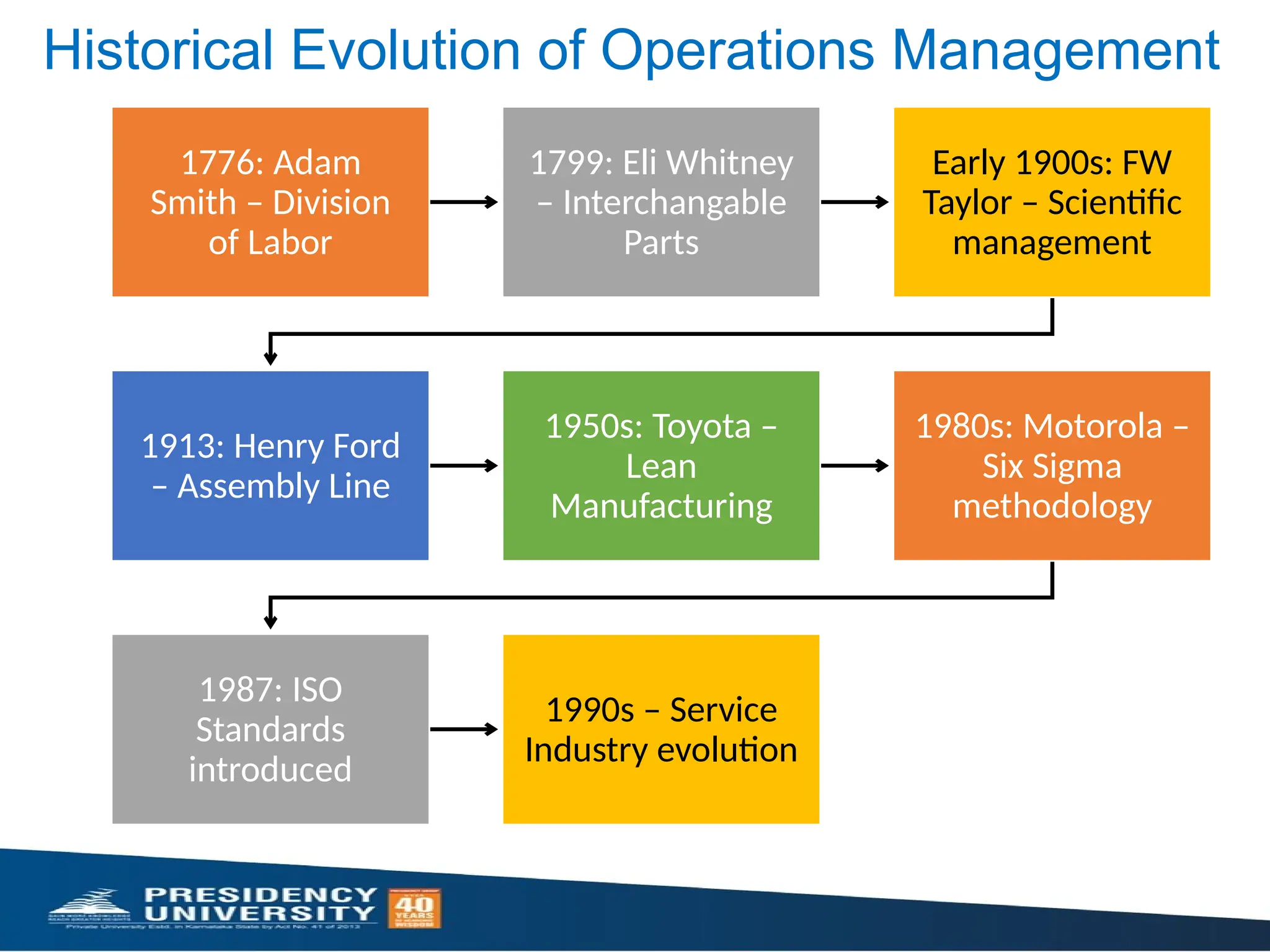
Historical Evolution of Operations Management
1776: Adam
Smith – Division
of Labor
1799: Eli Whitney
– Interchangable
Parts
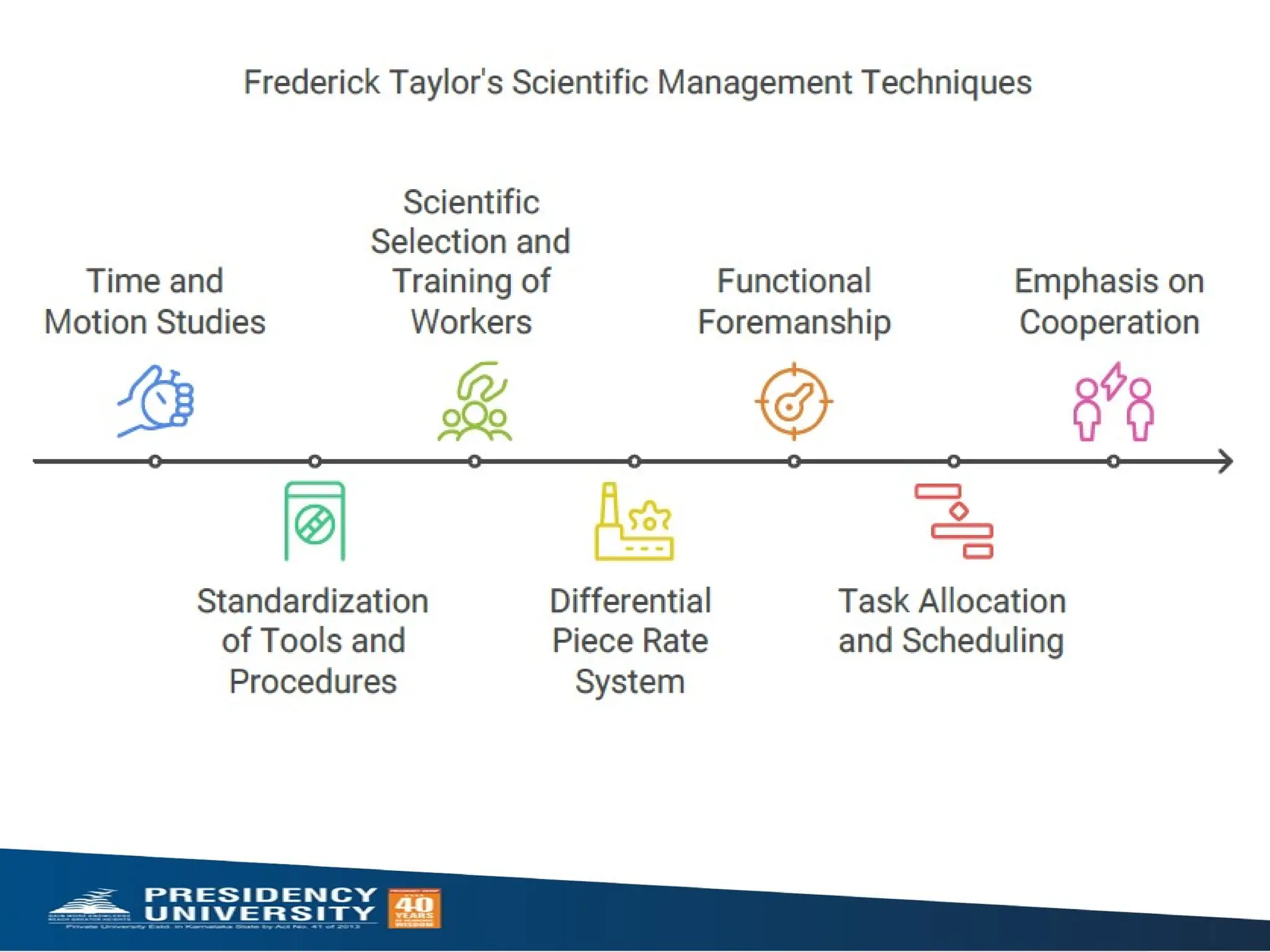
Early 1900s: FW
Taylor – Scientific
management
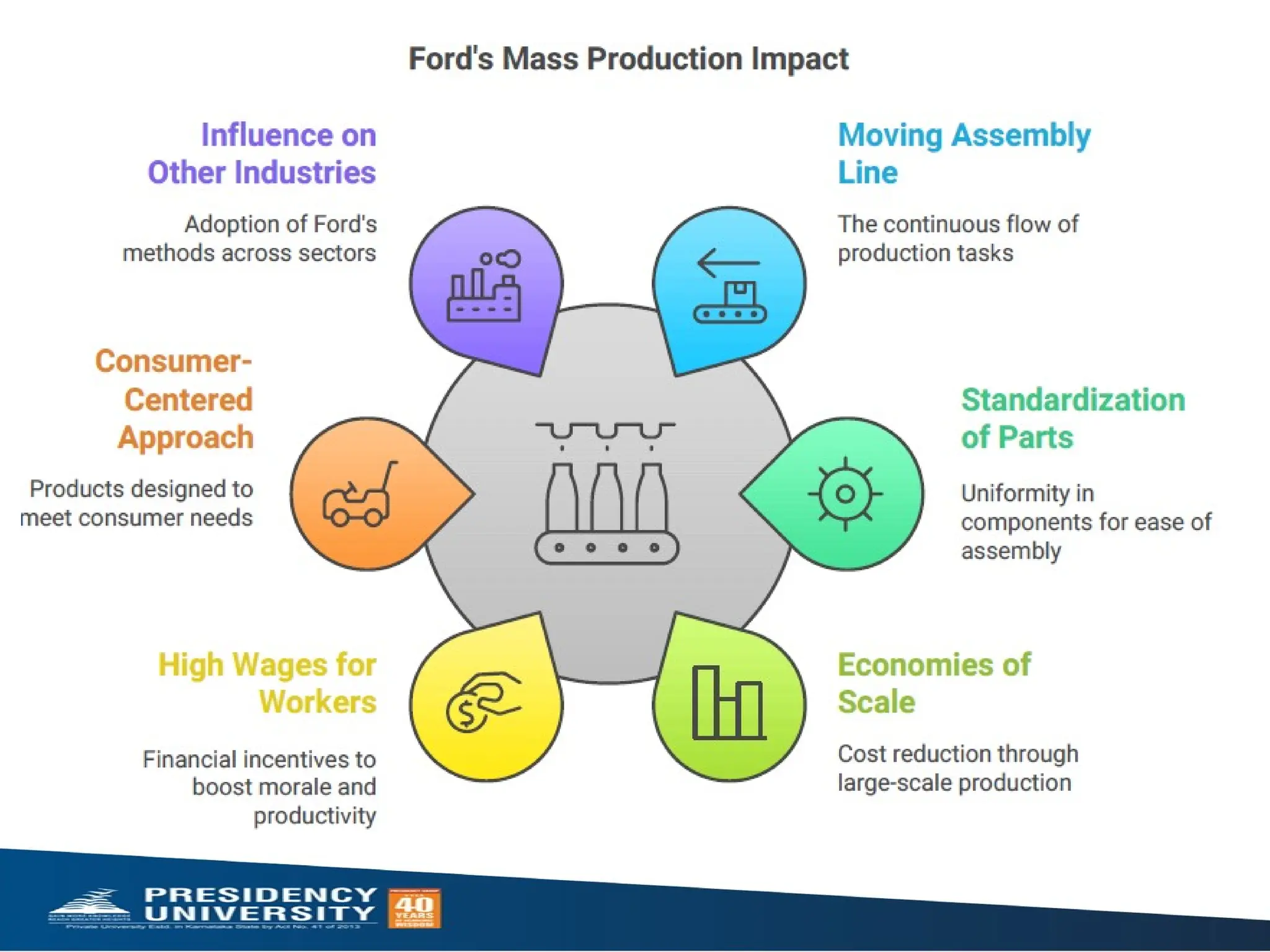
1913: Henry Ford
– Assembly Line
1950s: Toyota –
Lean
Manufacturing
1980s: Motorola –
Six Sigma
methodology
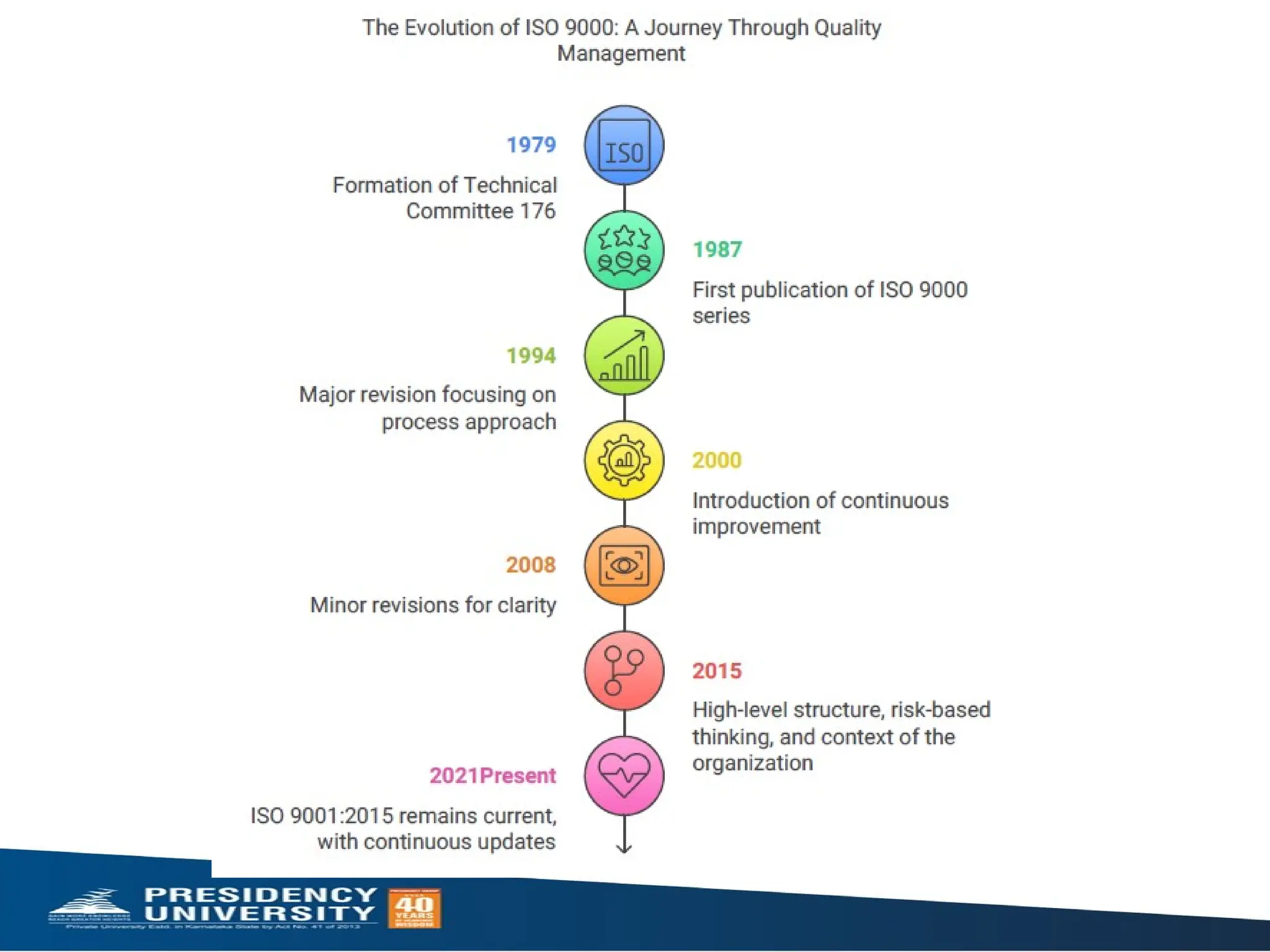
1987: ISO
Standards
introduced
1990s – Service
Industry evolution
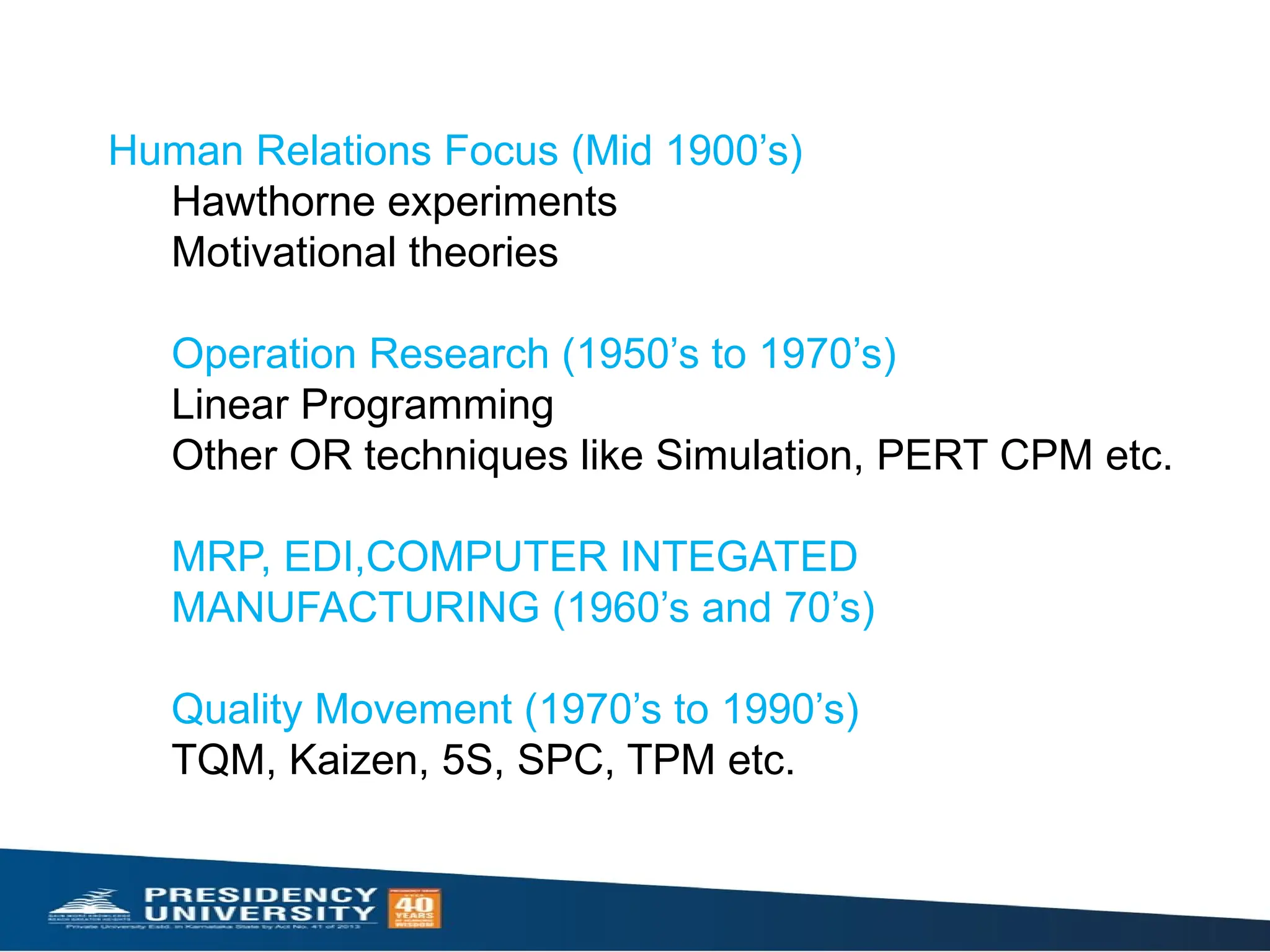
Human Relations Focus (Mid 1900’s)
Hawthorne experiments
Motivational theories
Operation Research (1950’s to 1970’s)
Linear Programming
Other OR techniques like Simulation, PERT CPM etc.
MRP, EDI,COMPUTER INTEGATED
MANUFACTURING (1960’s and 70’s)
Quality Movement (1970’s to 1990’s)
TQM, Kaizen, 5S, SPC, TPM etc.
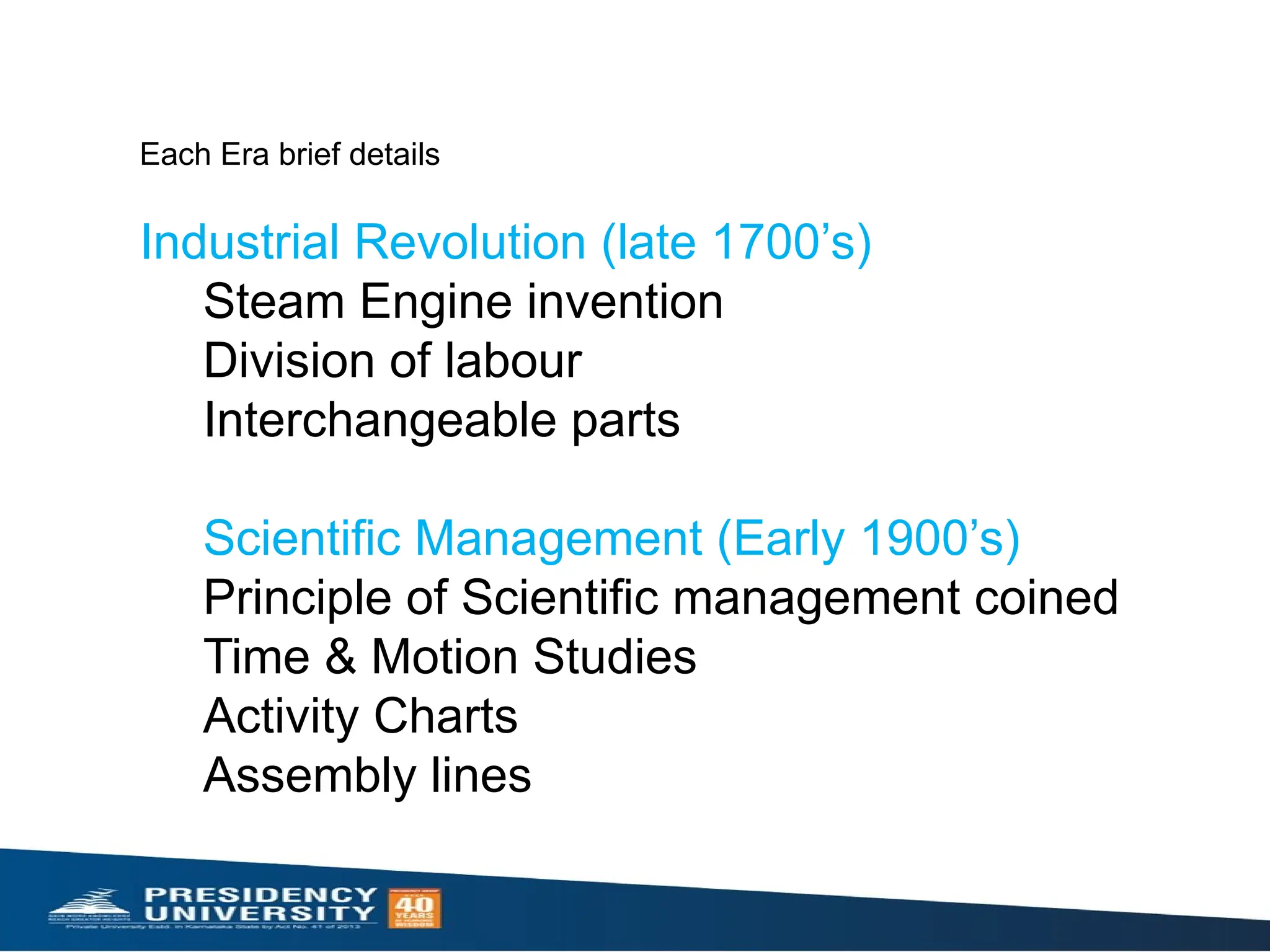
Each Era brief details
Industrial Revolution (late 1700’s)
Steam Engine invention
Division of labour
Interchangeable parts
Scientific Management (Early 1900’s)
Principle of Scientific management coined
Time & Motion Studies
Activity Charts
Assembly lines
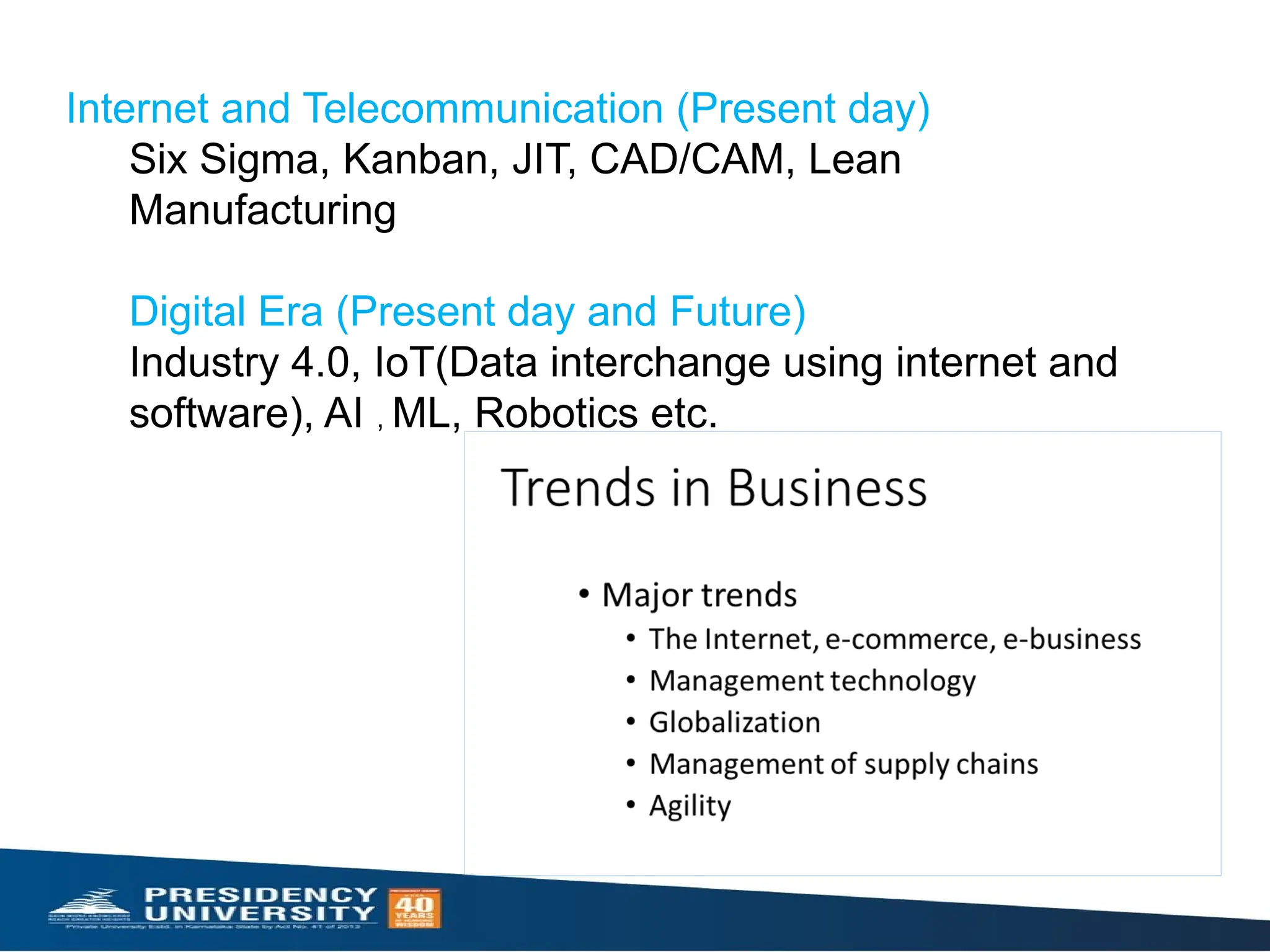
Internet and Telecommunication (Present day)
Six Sigma, Kanban, JIT, CAD/CAM, Lean
Manufacturing
Digital Era (Present day and Future)
Industry 4.0, IoT(Data interchange using internet and
software), AI , ML, Robotics etc.
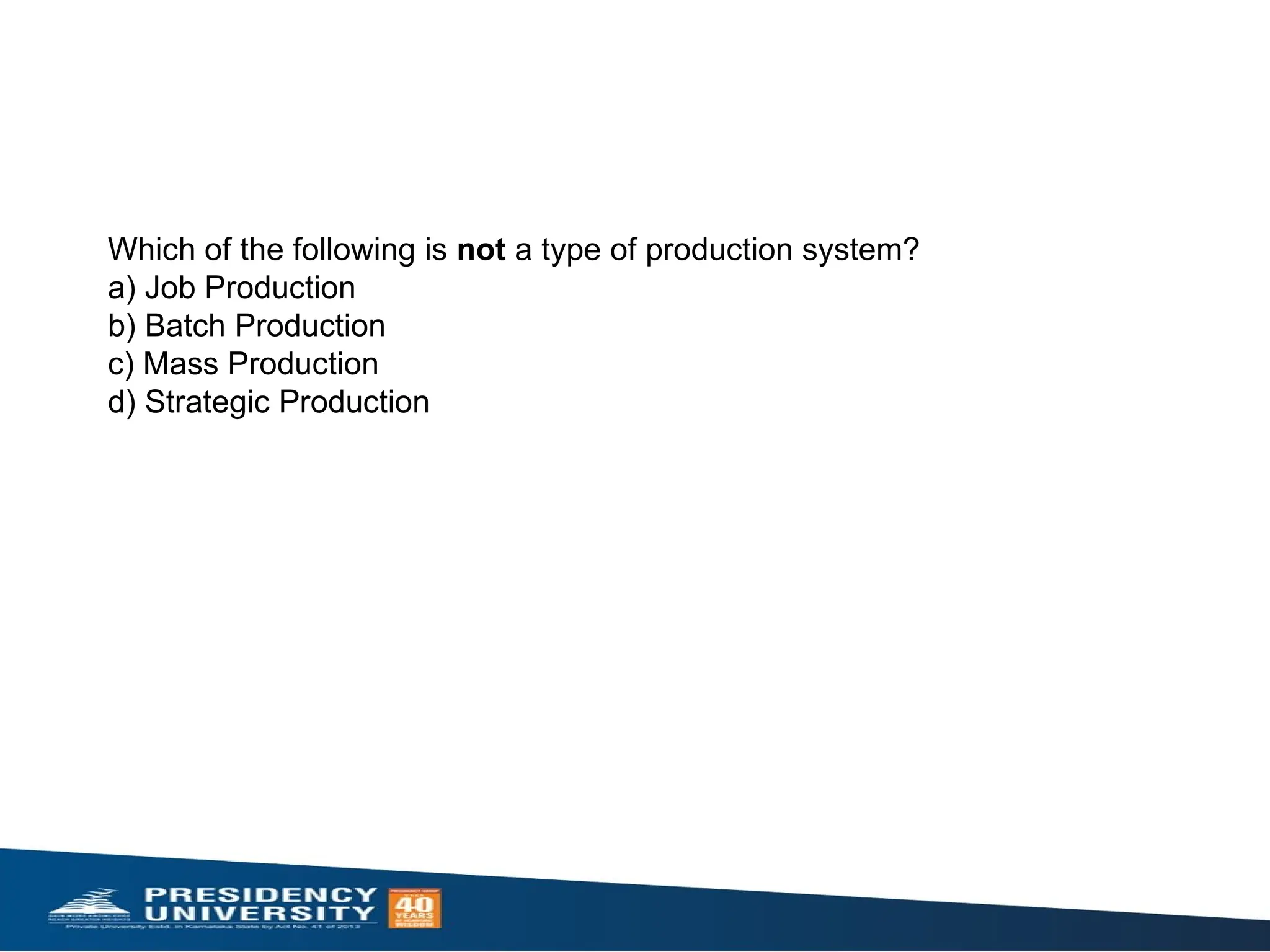
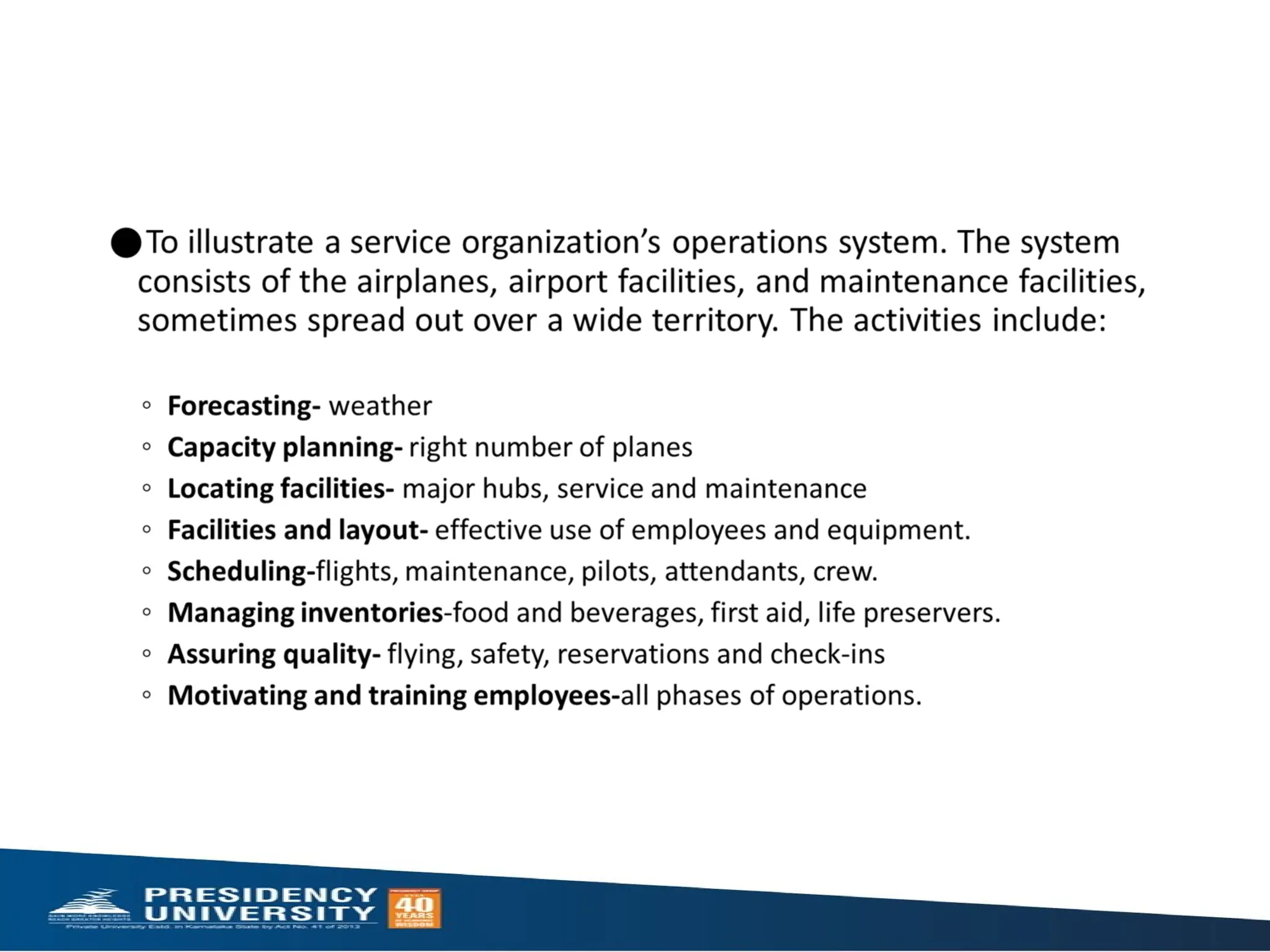
Which of the following is not a type of production system?
a) Job Production
b) Batch Production
c) Mass Production
d) Strategic Production
The concept of “Just-in-Time (JIT)” originated in:
a) USA
b) Japan
c) Germany
d) India
The main goal of Operations Management
is:
a) Reducing cost only
b) Maximizing customer value while
minimizing resources
c) Hiring more workers
d) Increasing advertising
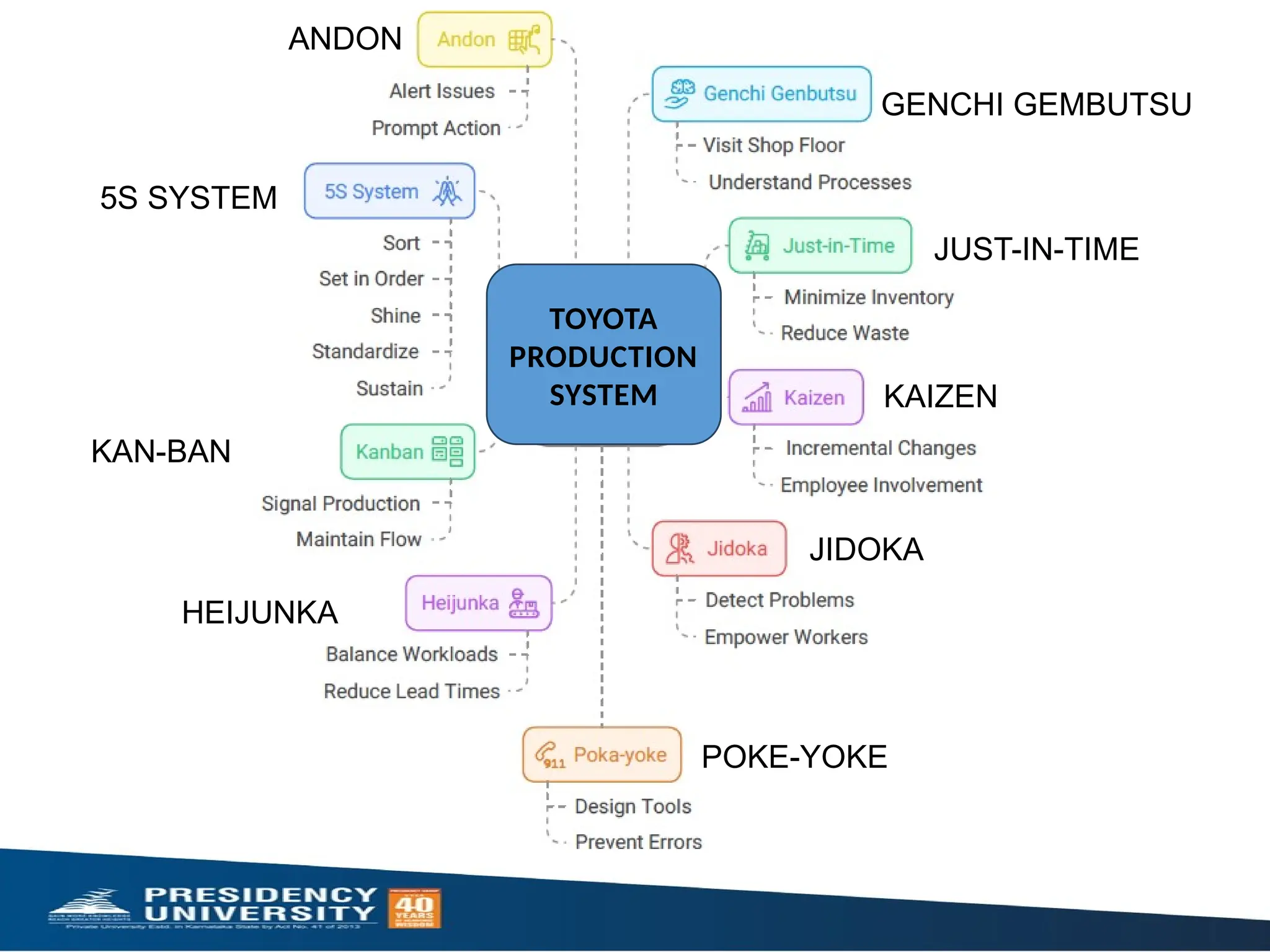
ANDON
GENCHI GEMBUTSU
JUST-IN-TIME
KAIZEN
JIDOKA
POKE-YOKE
5S SYSTEM
KAN-BAN
HEIJUNKA
TOYOTA
PRODUCTION
SYSTEM
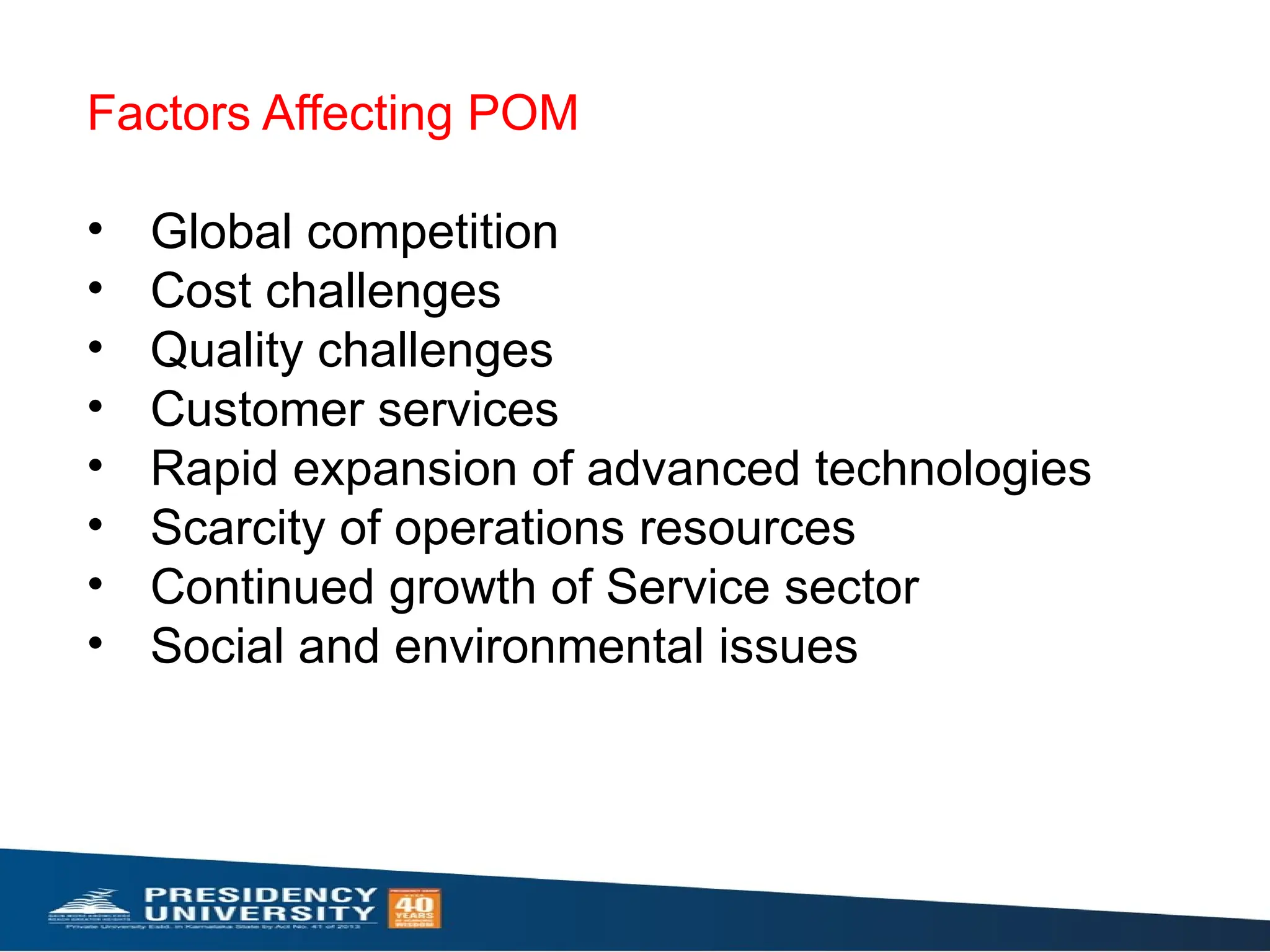
Factors Affecting POM
• Global competition
• Cost challenges
• Quality challenges
• Customer services
• Rapid expansion of advanced technologies
• Scarcity of operations resources
• Continued growth of Service sector
• Social and environmental issues
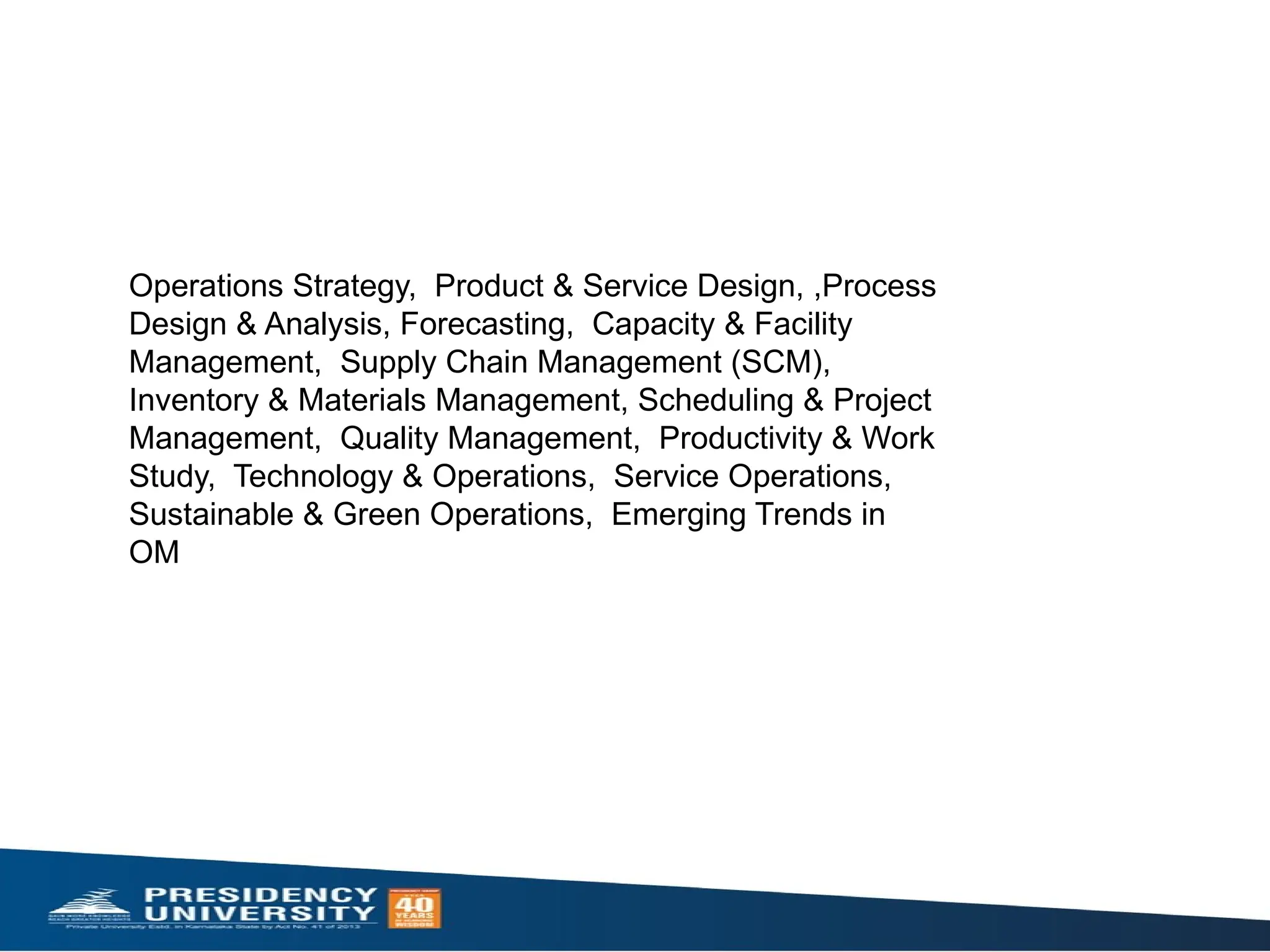
Operations Strategy, Product & Service Design, ,Process
Design & Analysis, Forecasting, Capacity & Facility
Management, Supply Chain Management (SCM),
Inventory & Materials Management, Scheduling & Project
Management, Quality Management, Productivity & Work
Study, Technology & Operations, Service Operations,
Sustainable & Green Operations, Emerging Trends in
OM
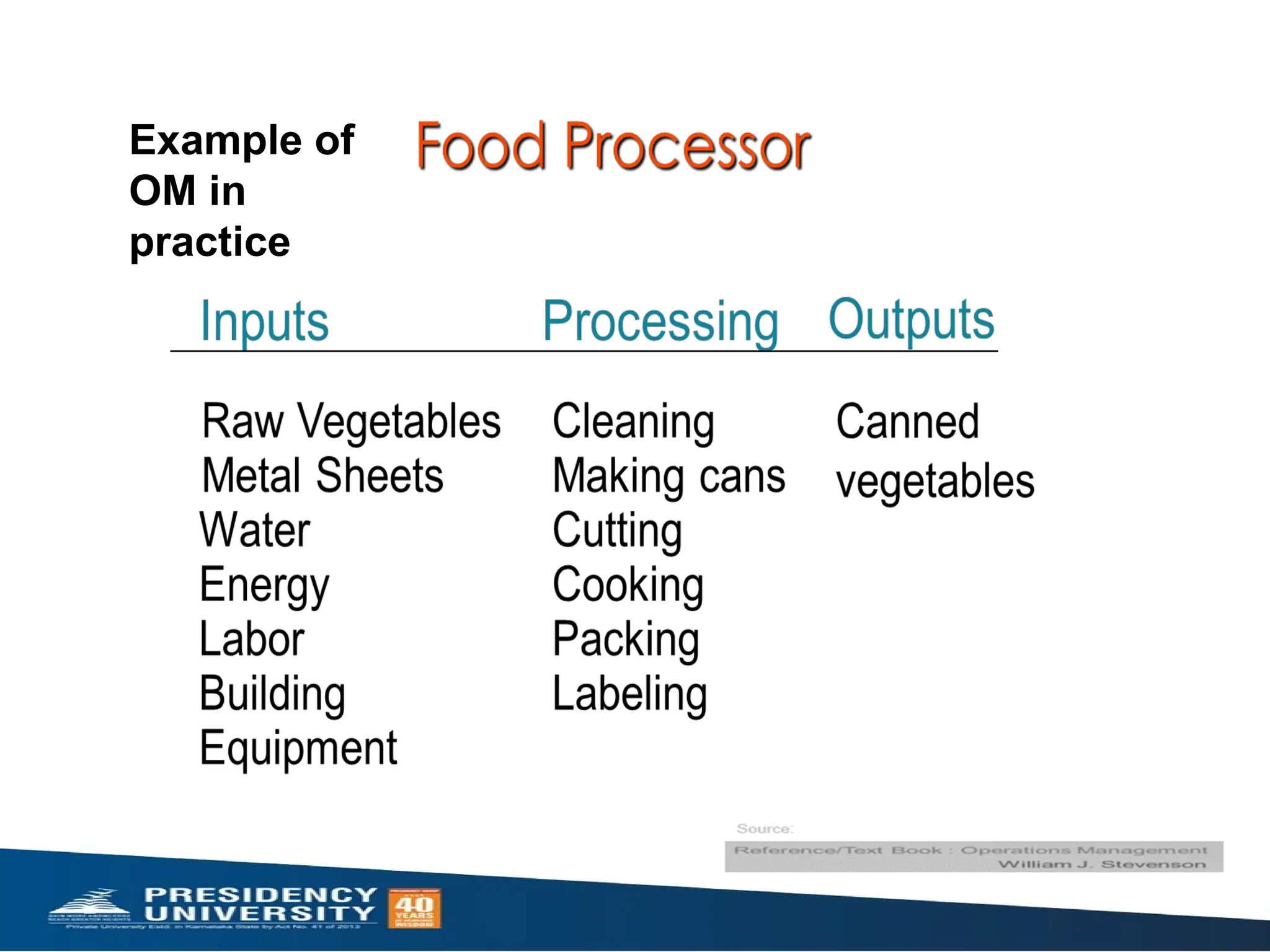
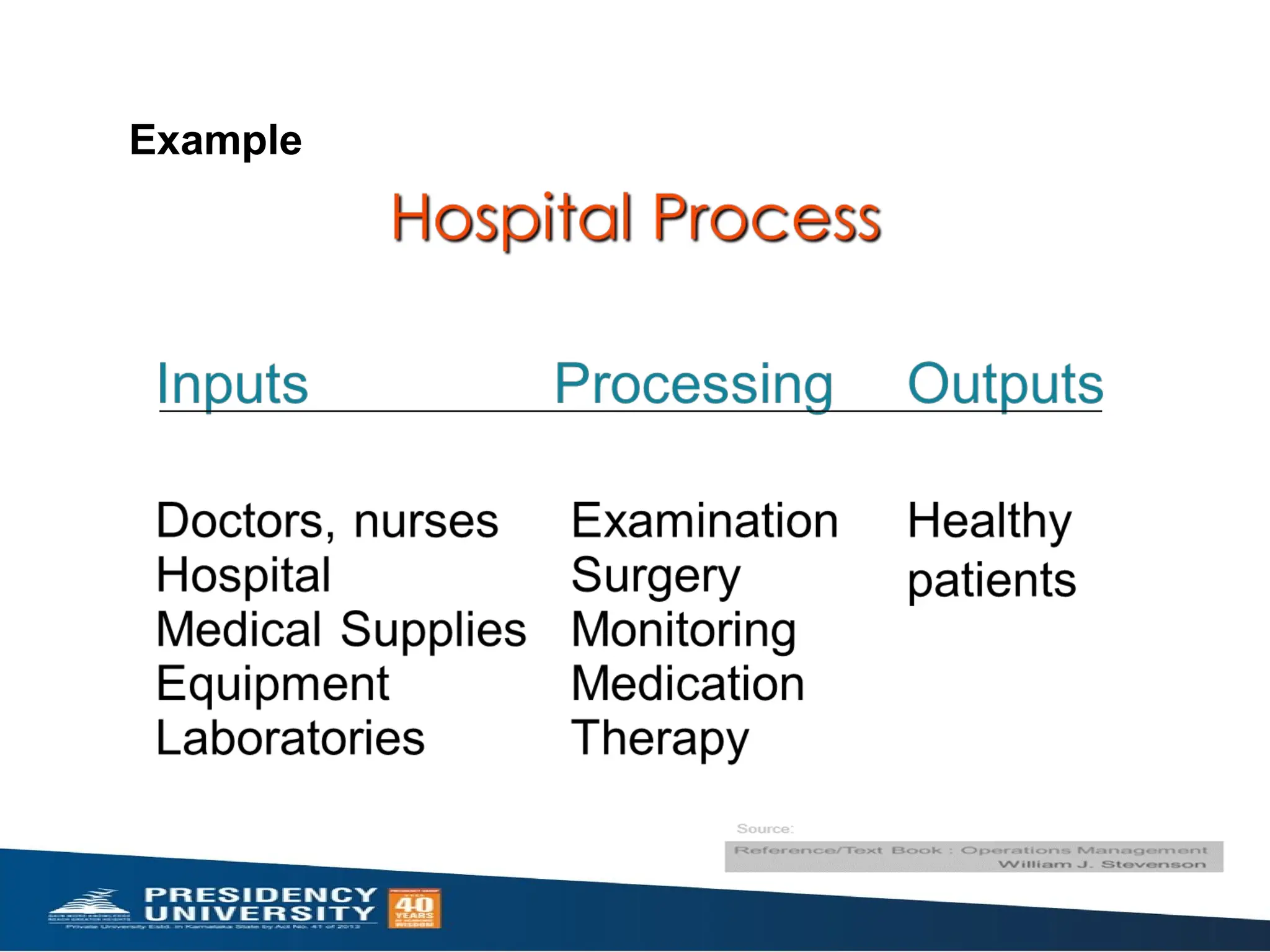
Example of
OM in
practice
Example
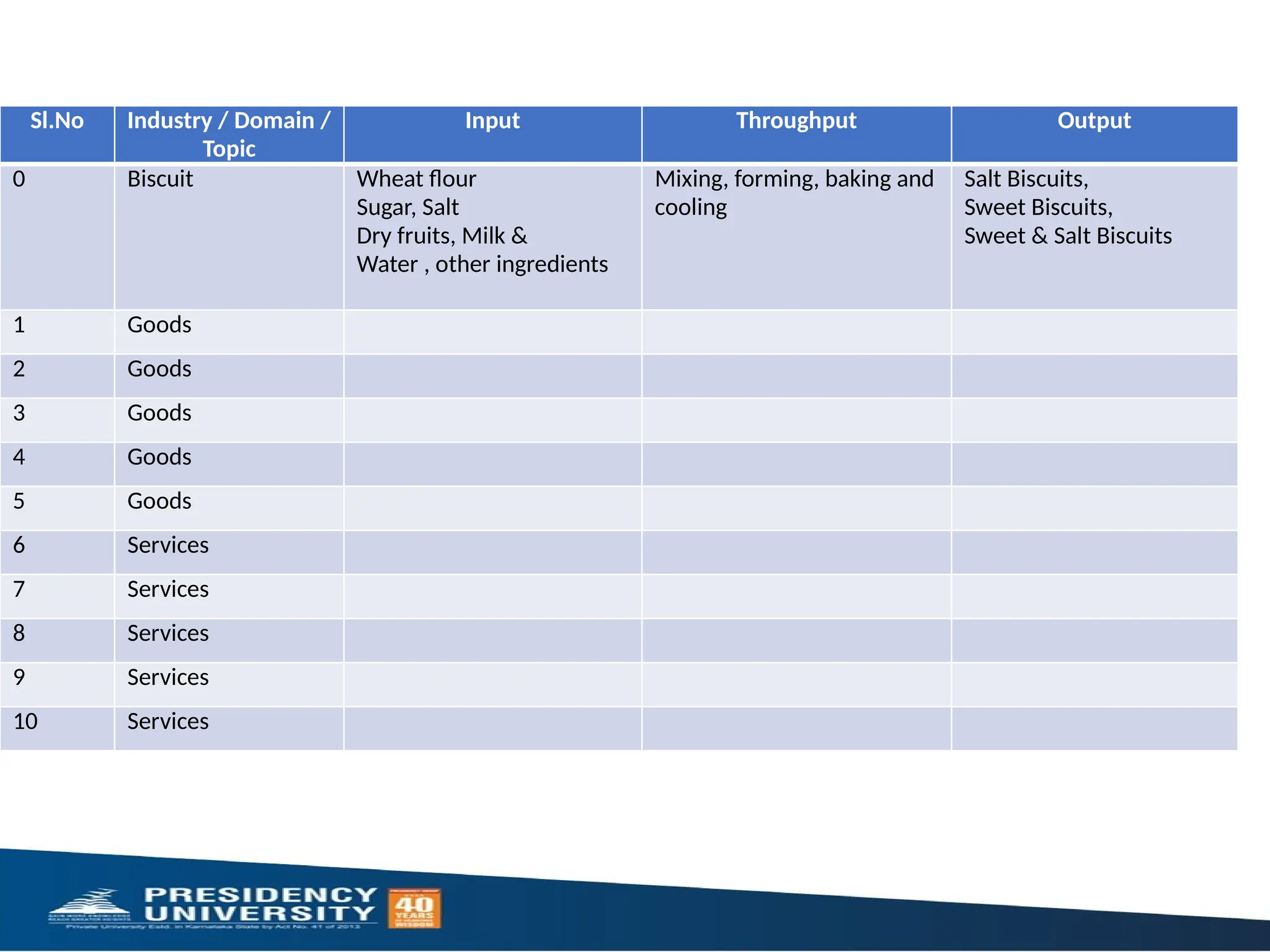
Sl.No Industry / Domain /
Topic
Input Throughput Output
0 Biscuit Wheat flour
Sugar, Salt
Dry fruits, Milk &
Water , other ingredients
Mixing, forming, baking and
cooling
Salt Biscuits,
Sweet Biscuits,
Sweet & Salt Biscuits
1 Goods
2 Goods
3 Goods
4 Goods
5 Goods
6 Services
7 Services
8 Services
9 Services
10 Services
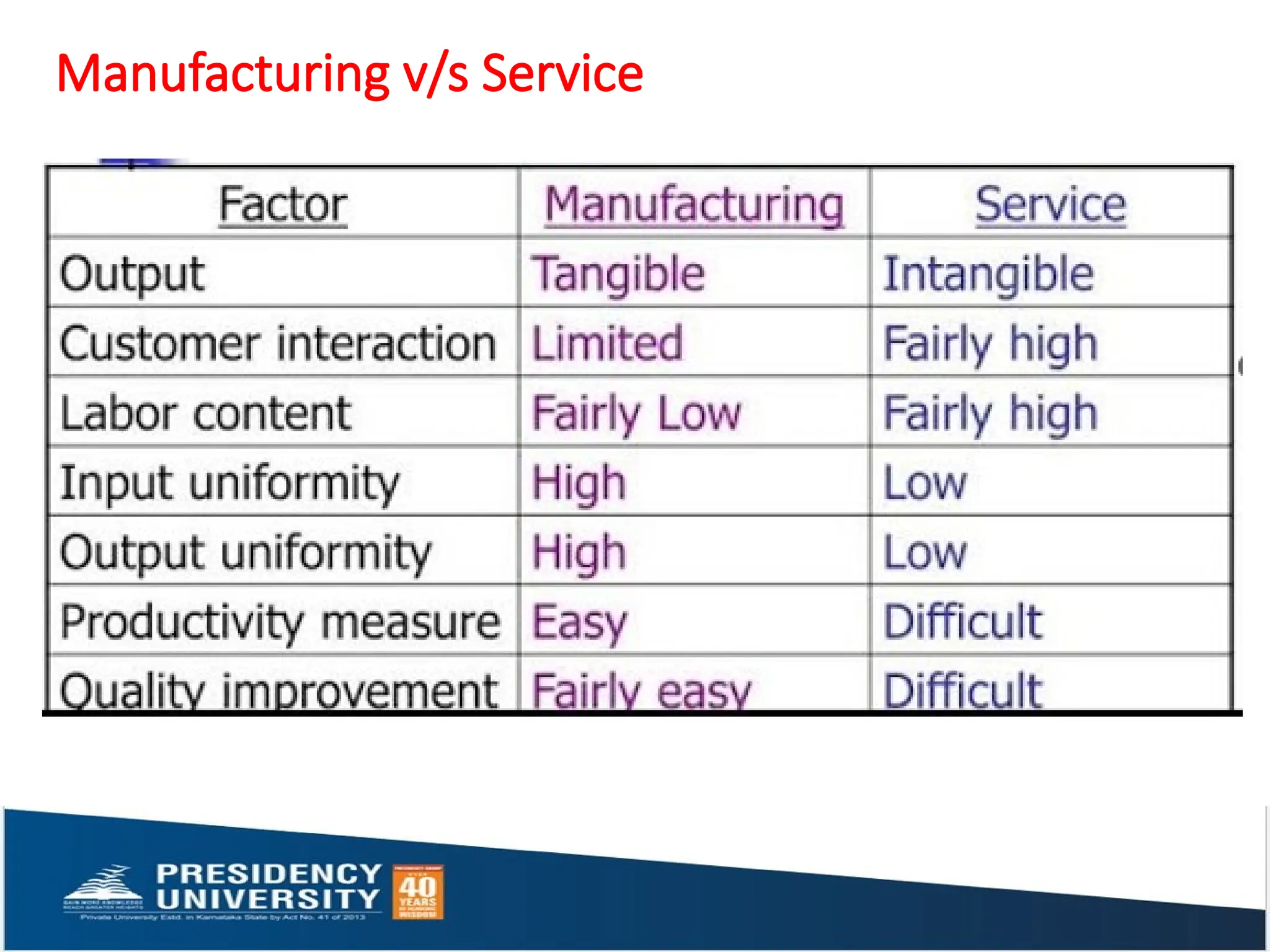
Manufacturing v/s Service
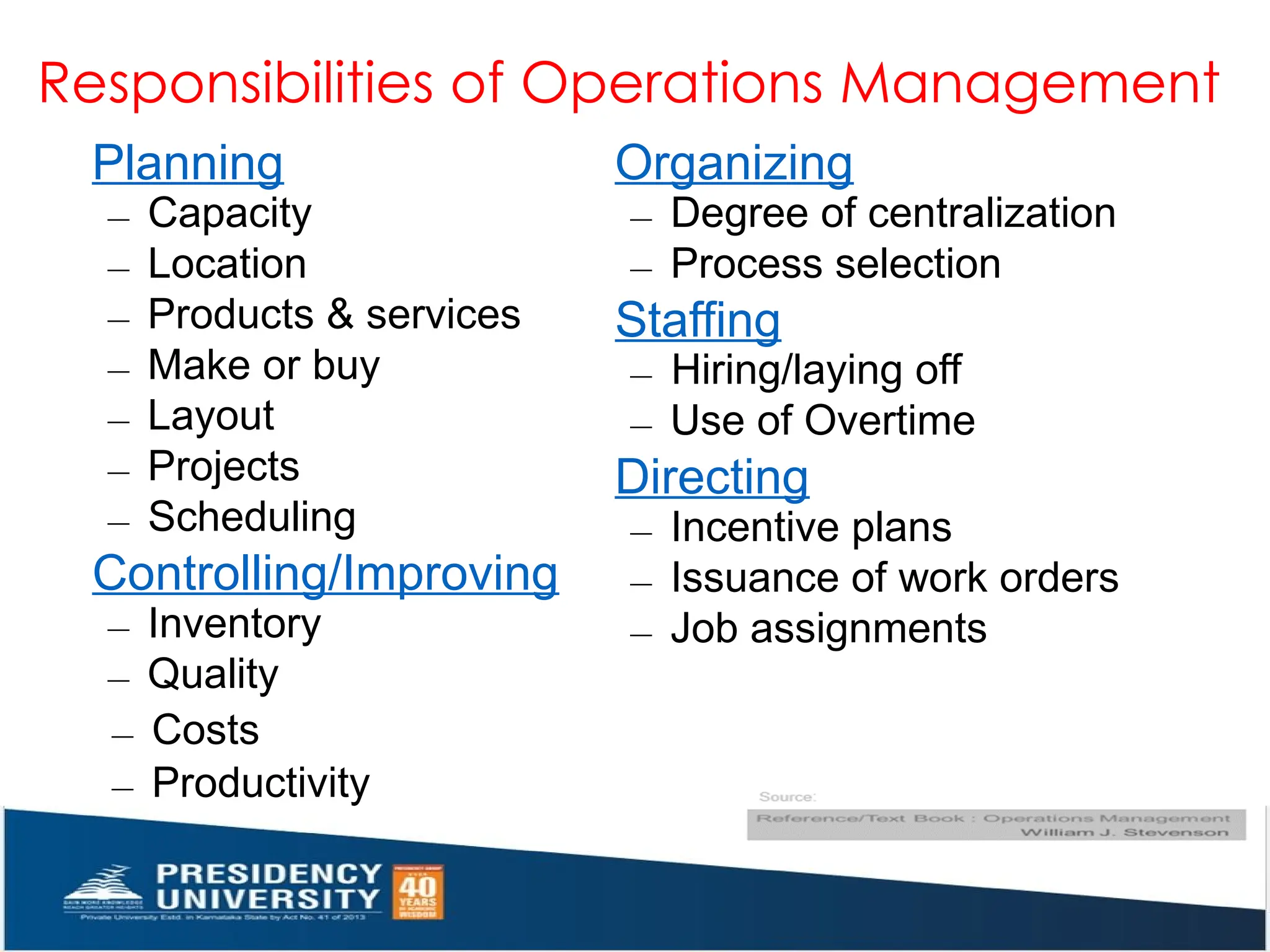
Responsibilities of Operations Management
Products & services
Planning
– Capacity
– Location
–
– Make or buy
– Layout
– Projects
– Scheduling
Controlling/Improving
– Inventory
– Quality
Organizing
– Degree of centralization
– Process selection
Staffing
– Hiring/laying off
– Use of Overtime
Directing
– Incentive plans
– Issuance of work orders
– Job assignments
– Costs
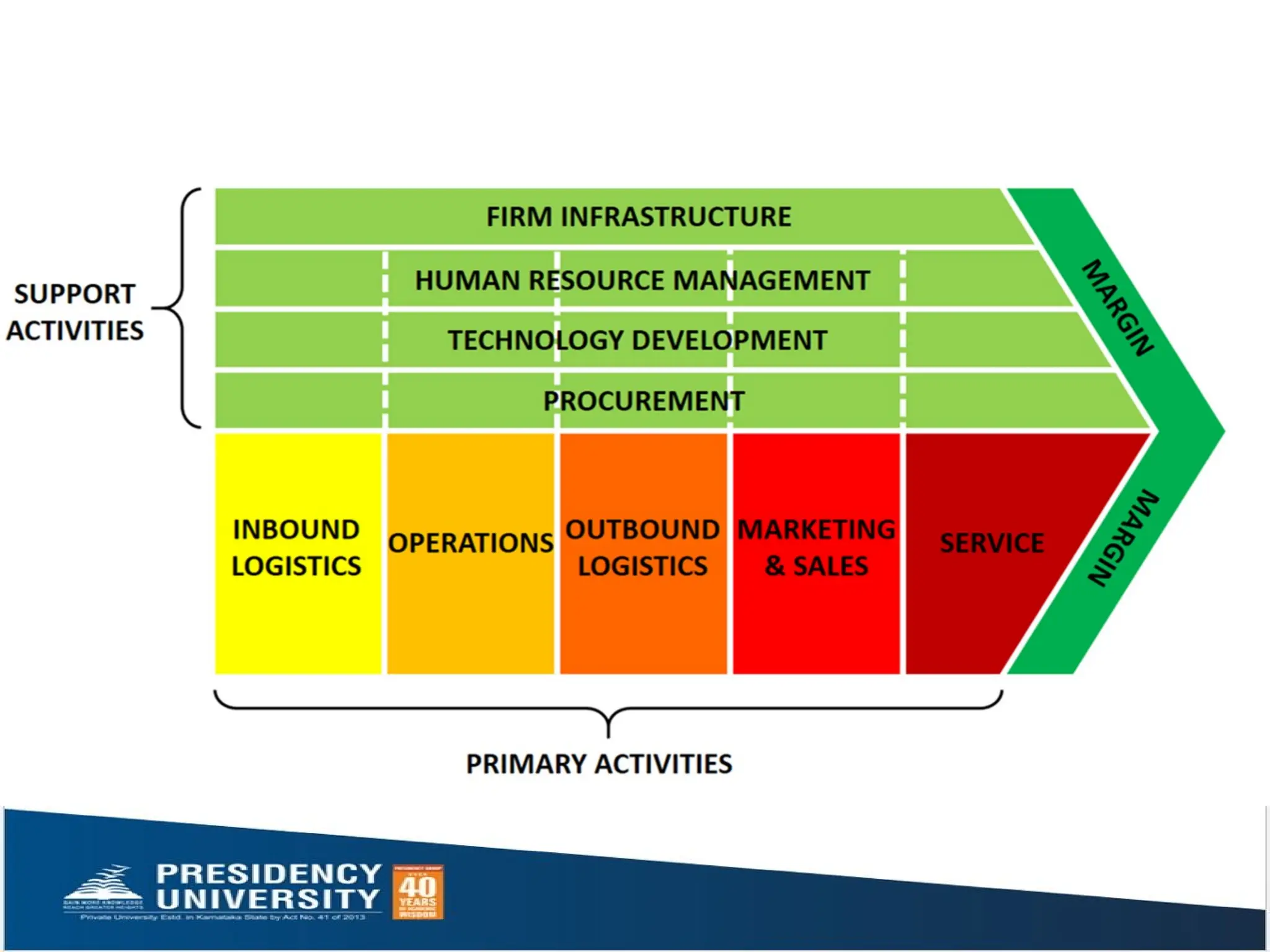
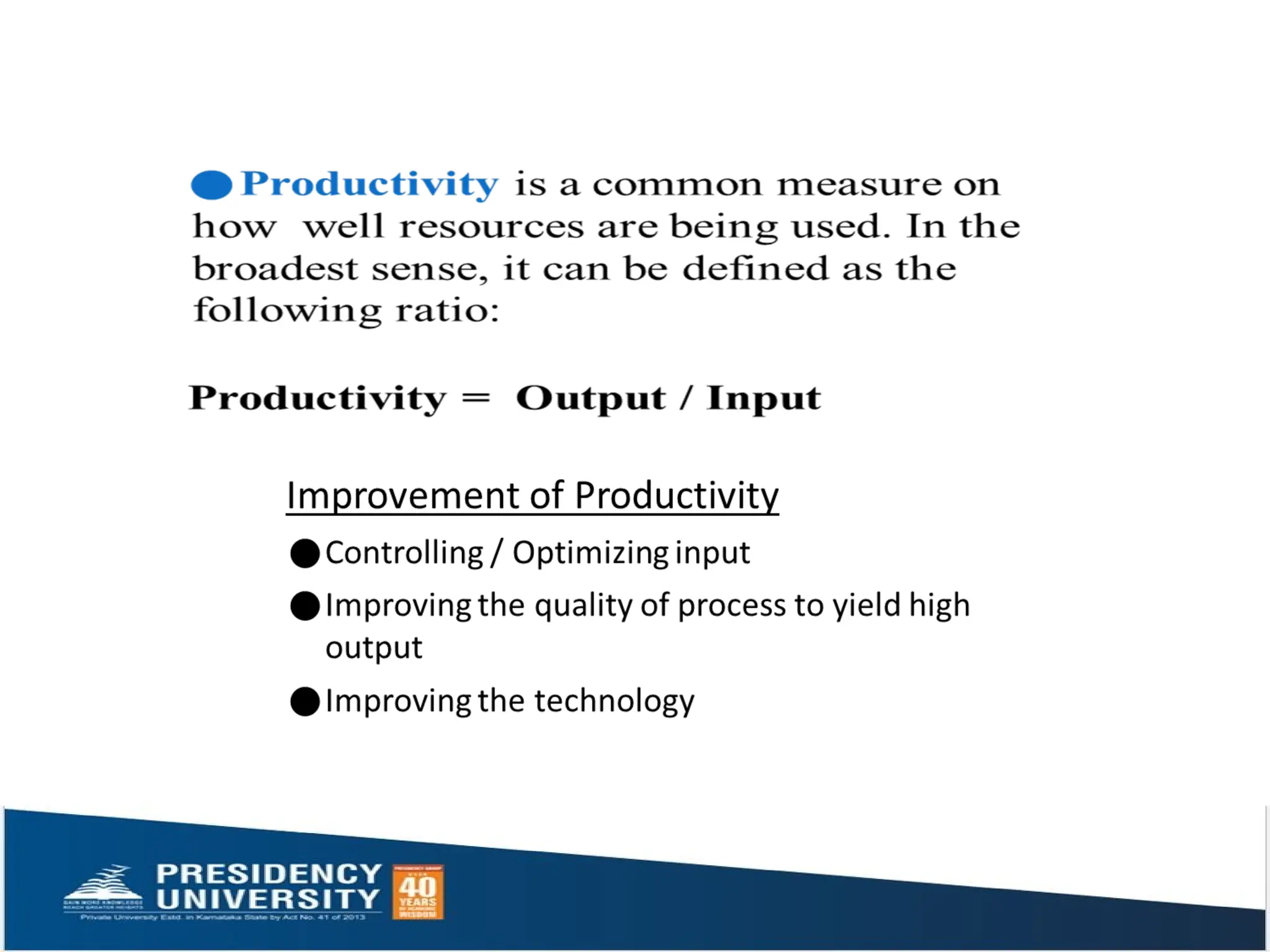
– Productivity
Anecdotes
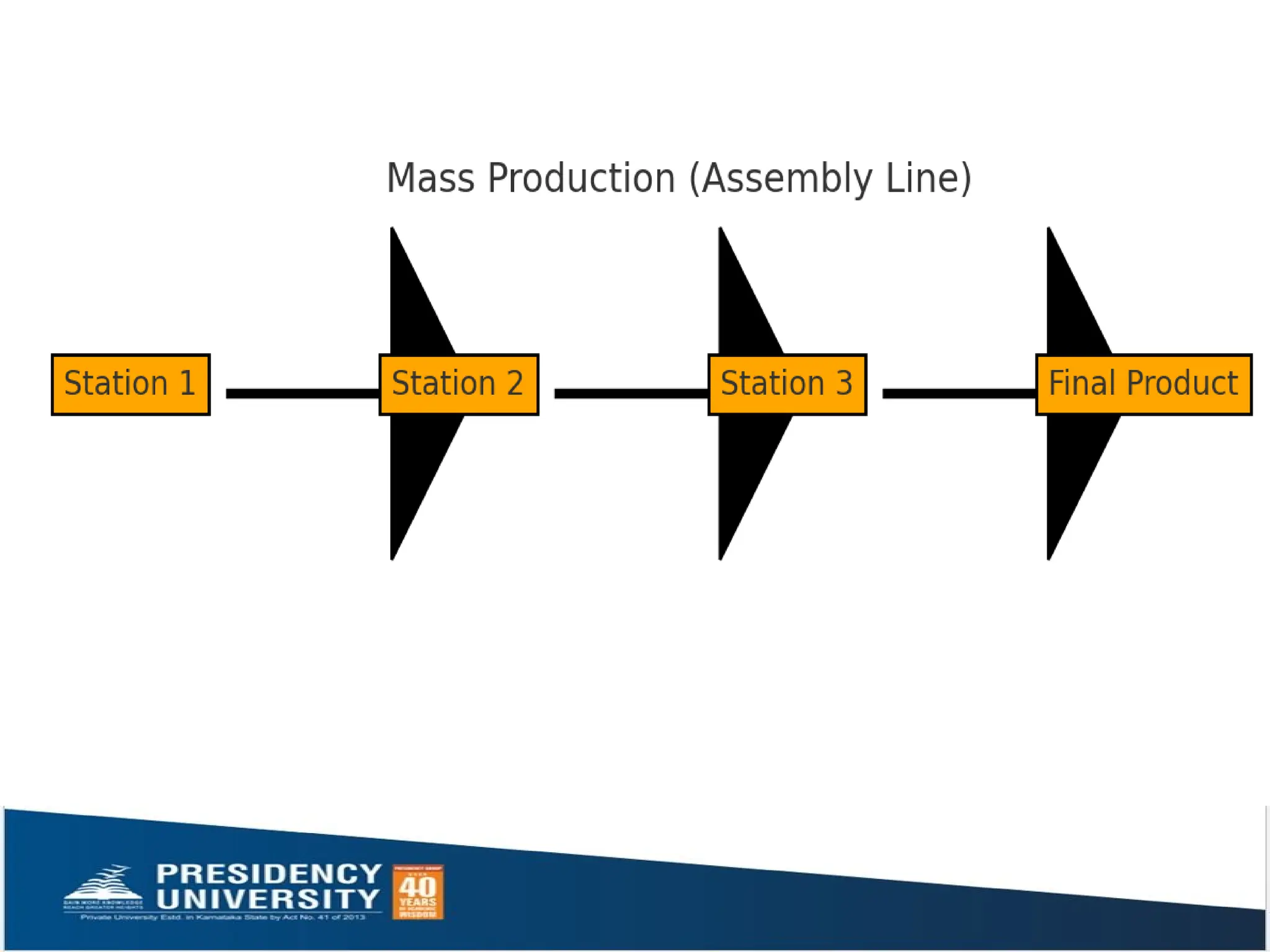
Henry Ford’s Assembly Line (Mass Production)
• Ford observed a slaughterhouse in Chicago, where animals were
processed on a moving line.
• Inspired, he applied the reverse idea to cars: adding parts step by step
on a moving conveyor.
• Outcome: Time to assemble a car dropped from 12 hours to 90 minutes,
making cars affordable for the middle class.
Southwest Airlines’ 10-Minute Turnaround (Scheduling)
Most airlines took 1 hour to clean, refuel, and board.
Southwest designed a system to turn planes around in 10–15 minutes.
This efficiency gave them more daily flights, lower costs, and competitive
advantage.
Types of Production Systems affect Plant Layouts
• Mass production
• Batch production
• Job based production
• Assembly Line production
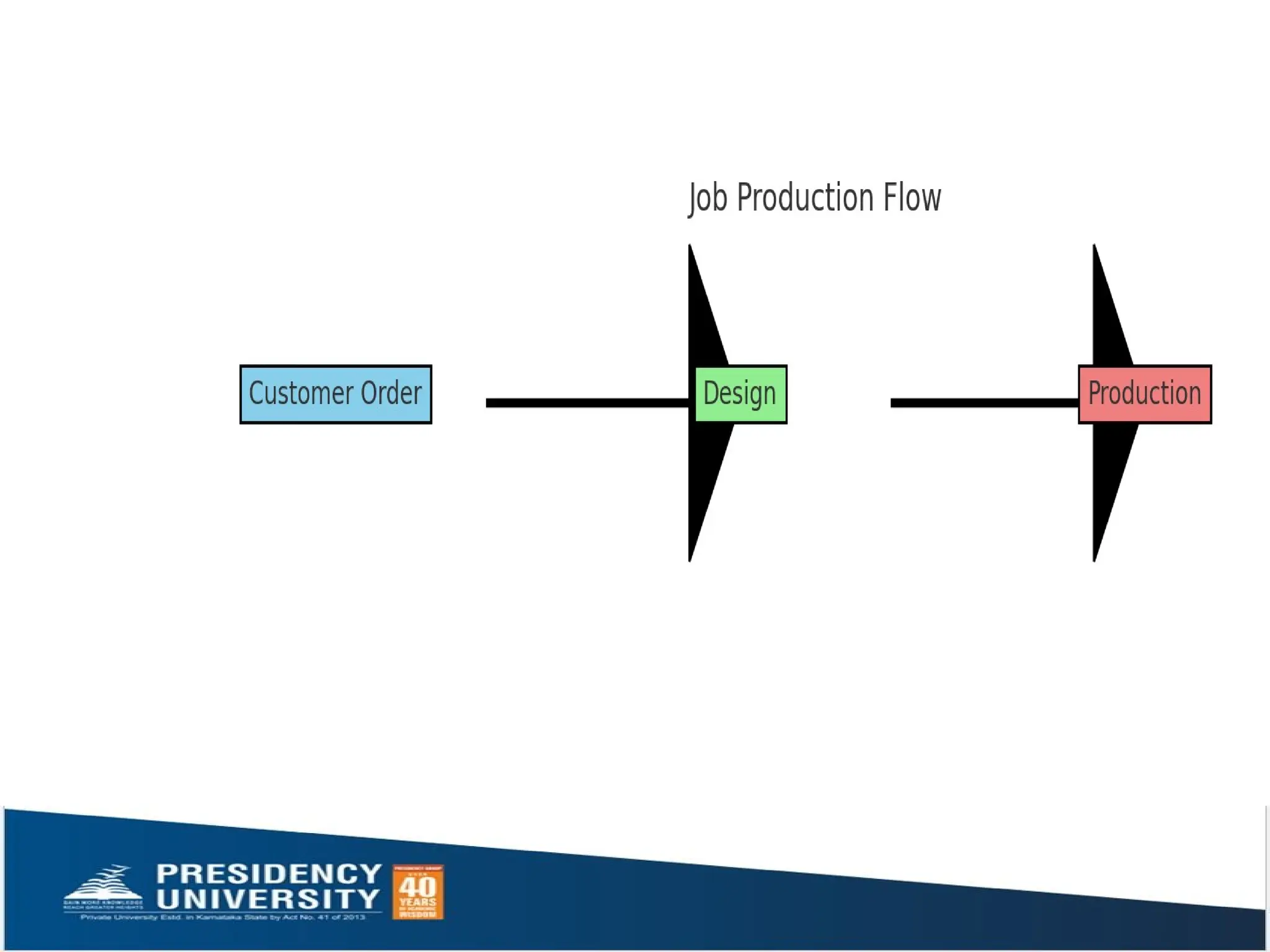
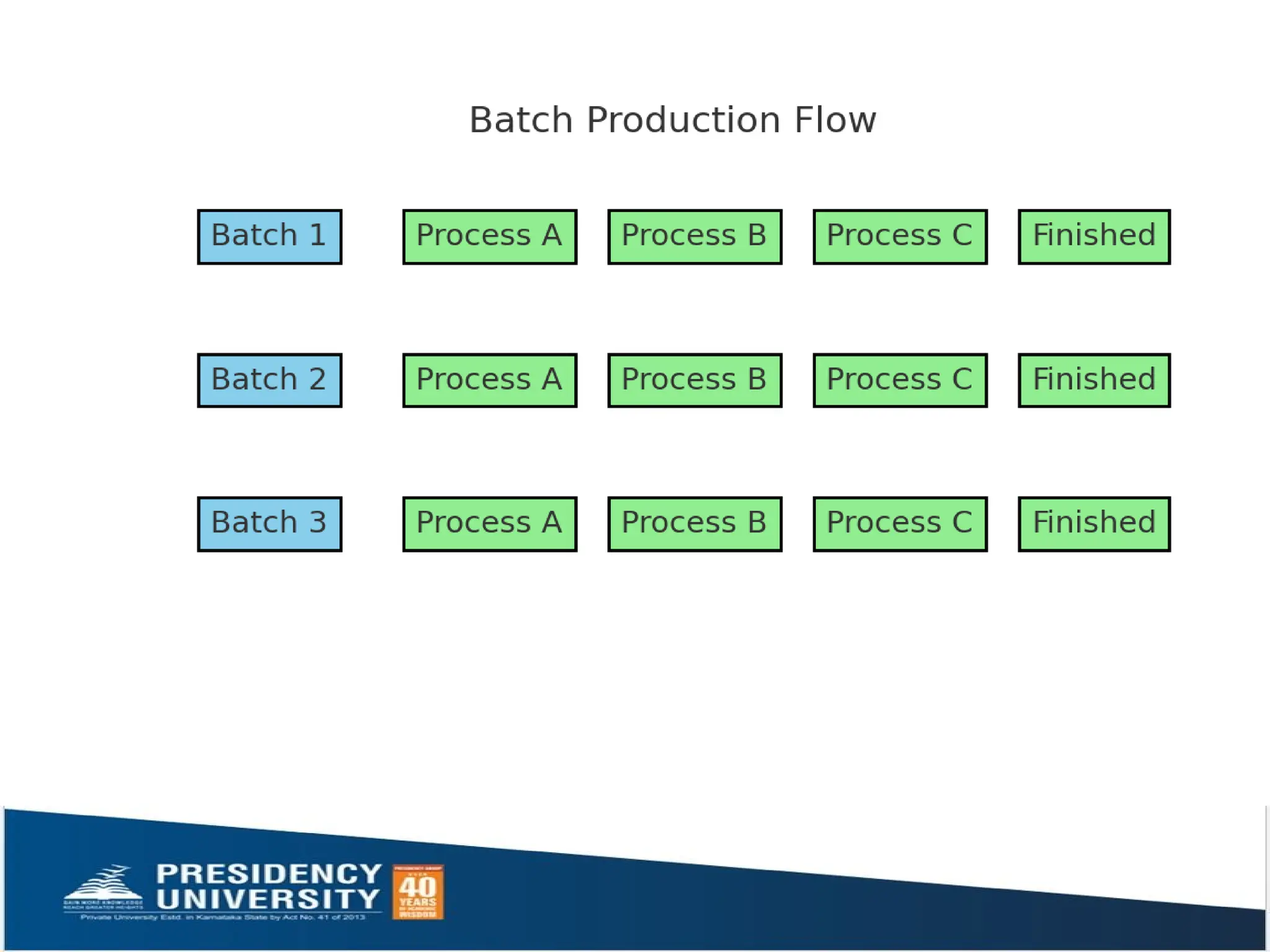
Job Production – Customized, one-off (e.g., tailored suits, shipbuilding).
Batch Production – Groups of items produced together (e.g., bakery, pharmaceuticals).
Mass Production – Standardized, large scale (e.g., automobile assembly).
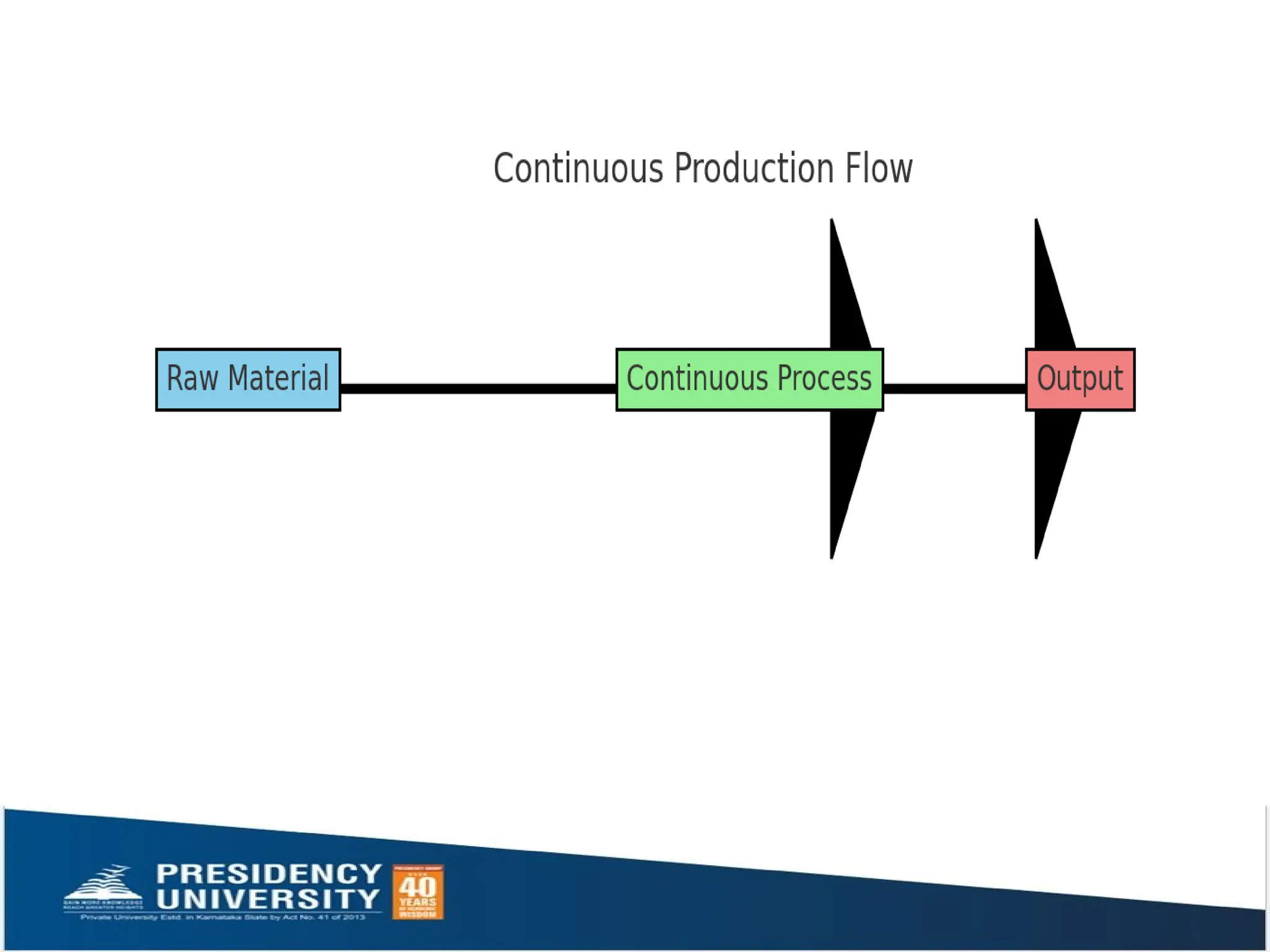
Continuous Production – Non-stop, 24/7, automated (e.g., oil refinery, chemical plants).
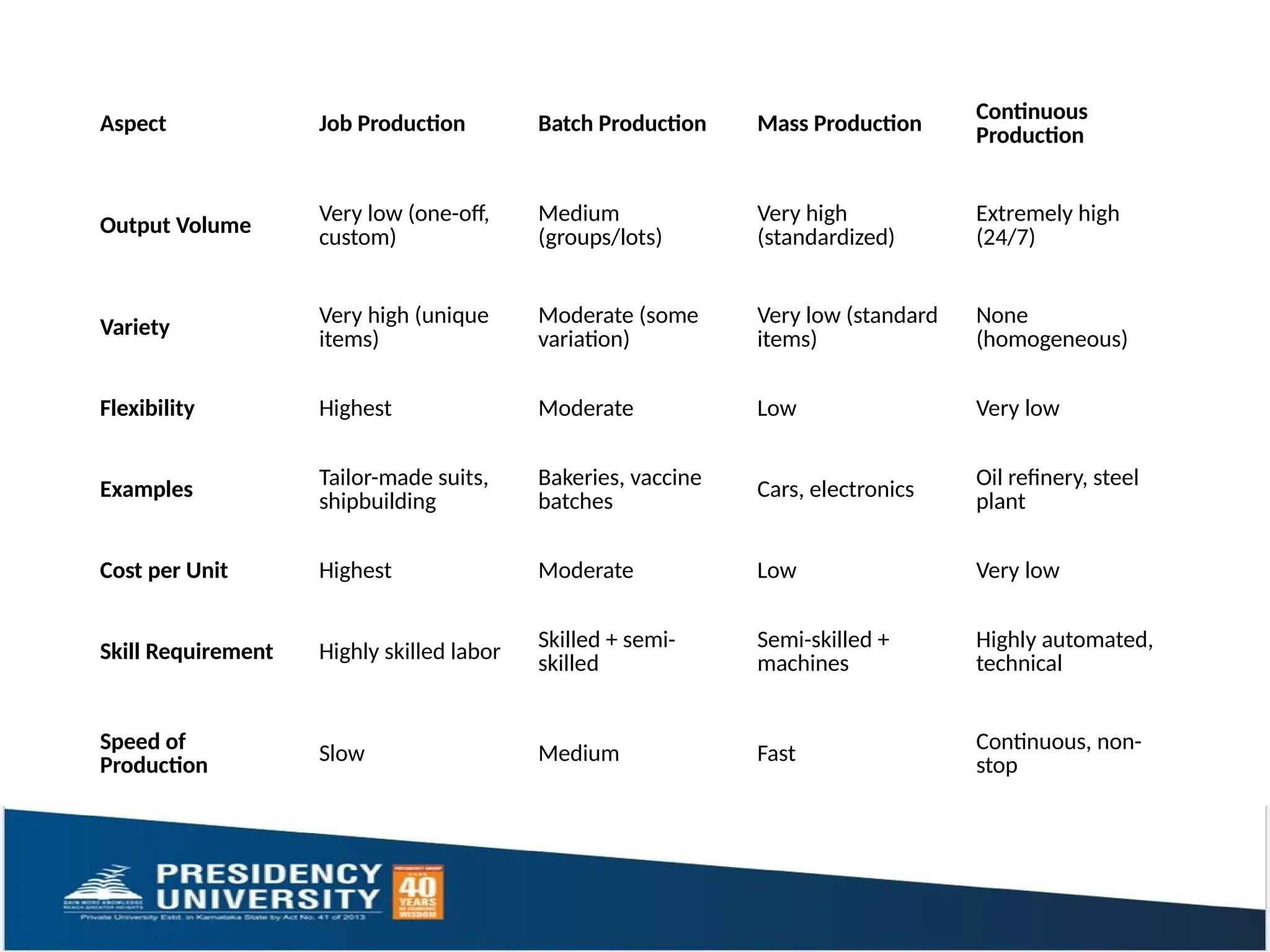
Aspect Job Production Batch Production Mass Production
Continuous
Production
Output Volume
Very low (one-off,
custom)
Medium
(groups/lots)
Very high
(standardized)
Extremely high
(24/7)
Variety
Very high (unique
items)
Moderate (some
variation)
Very low (standard
items)
None
(homogeneous)
Flexibility Highest Moderate Low Very low
Examples Tailor-made suits,
shipbuilding
Bakeries, vaccine
batches
Cars, electronics Oil refinery, steel
plant
Cost per Unit Highest Moderate Low Very low
Skill Requirement Highly skilled labor Skilled + semi-
skilled
Semi-skilled +
machines
Highly automated,
technical
Speed of
Production Slow Medium Fast Continuous, non-
stop
Operations Strategy
How well company execute its business strategy using
Products, Process, Methods, Resource, Quality, Cost, Lead
time, Schedule
Strategic- Product design, location, Technology
Tactical- Employment, Equipment selection, Layout
Operational- Schedule, inventory
Amazon fulfilment centres to deliver fast
Operations Strategy
• Set of decisions that an organization makes for
production and delivery of goods
• Its in line with the overall company’s business
strategy
• Its for achieving long term goals to be successful
and competitive in the market place
Elements of Operations Strategy
• Product Assembly Strategy
• Inventory Strategy
• Supply Chain Optimization
• Quality Strategy
• Facilities Management
• Forecasting for Planning
• Scheduling of Resources
• Use of Technology
Operations Strategy Formulation
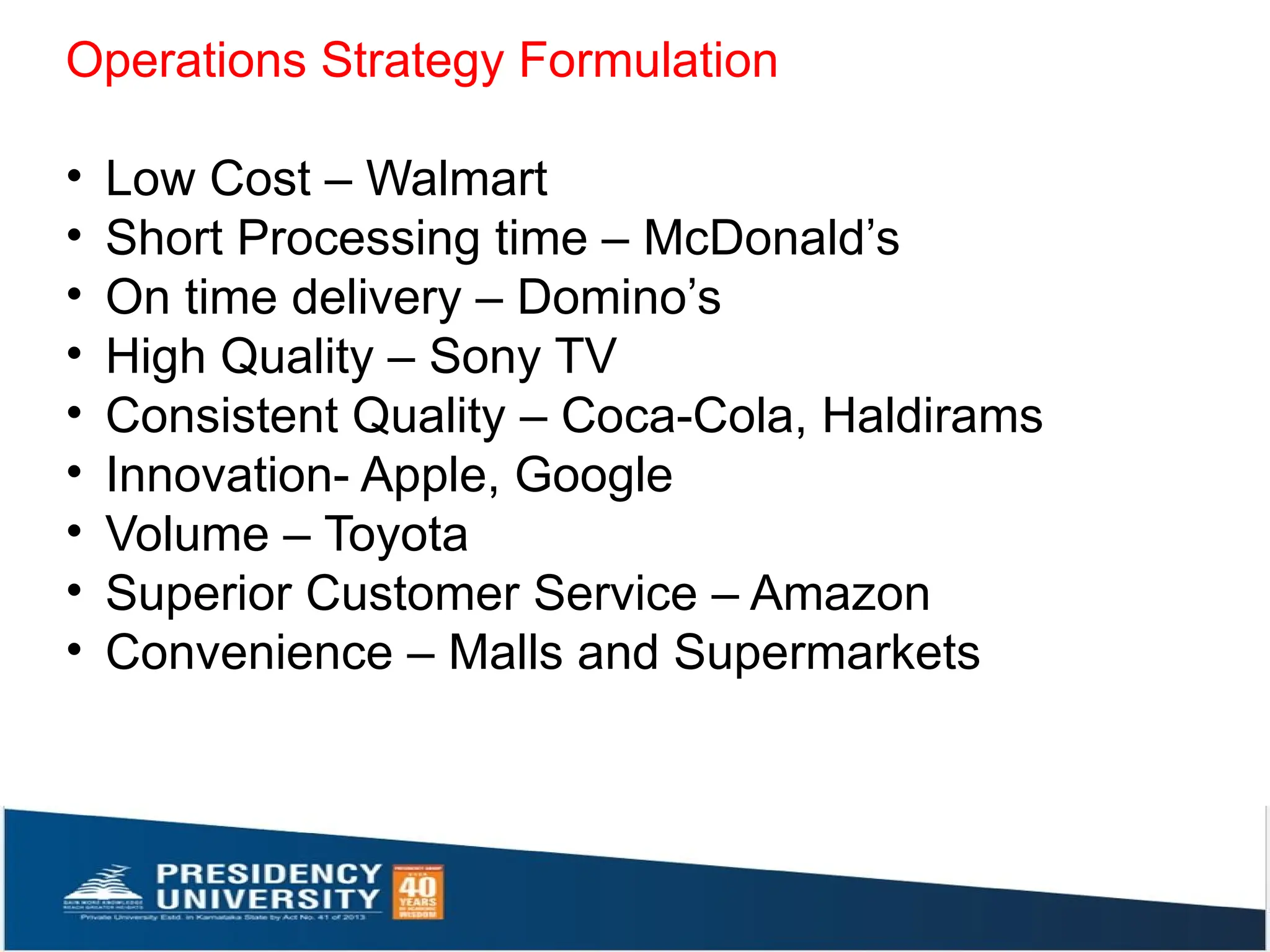
• Low Cost – Walmart
• Short Processing time – McDonald’s
• On time delivery – Domino’s
• High Quality – Sony TV
• Consistent Quality – Coca-Cola, Haldirams
• Innovation- Apple, Google
• Volume – Toyota
• Superior Customer Service – Amazon
• Convenience – Malls and Supermarkets
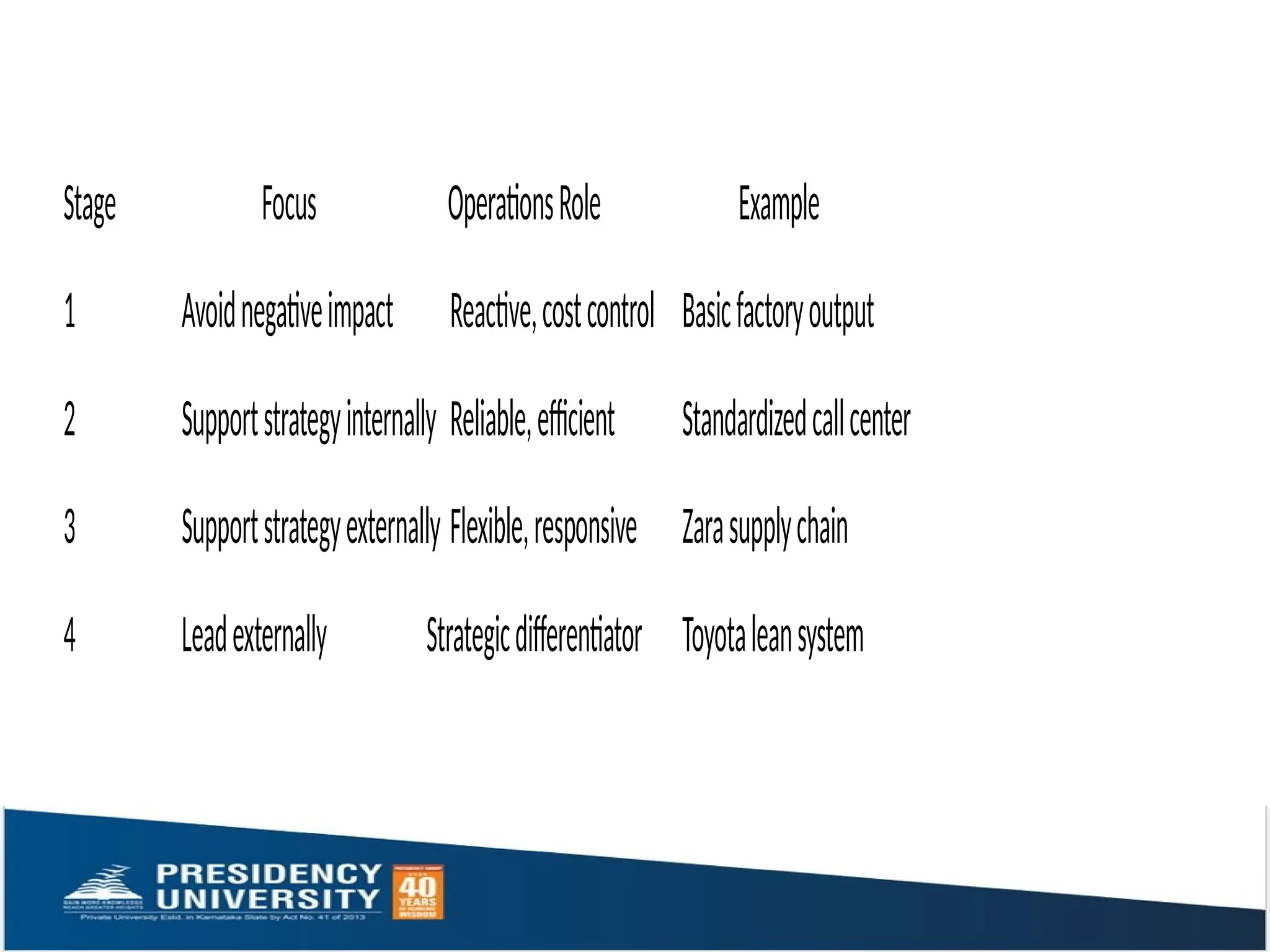
Stage Focus OperationsRole Example
1 Avoidnegativeimpact Reactive,costcontrol Basicfactoryoutput
2 Supportstrategyinternally Reliable,efficient Standardizedcallcenter
3 Supportstrategyexternally Flexible,responsive Zarasupplychain
4 Leadexternally Strategicdifferentiator Toyotaleansystem
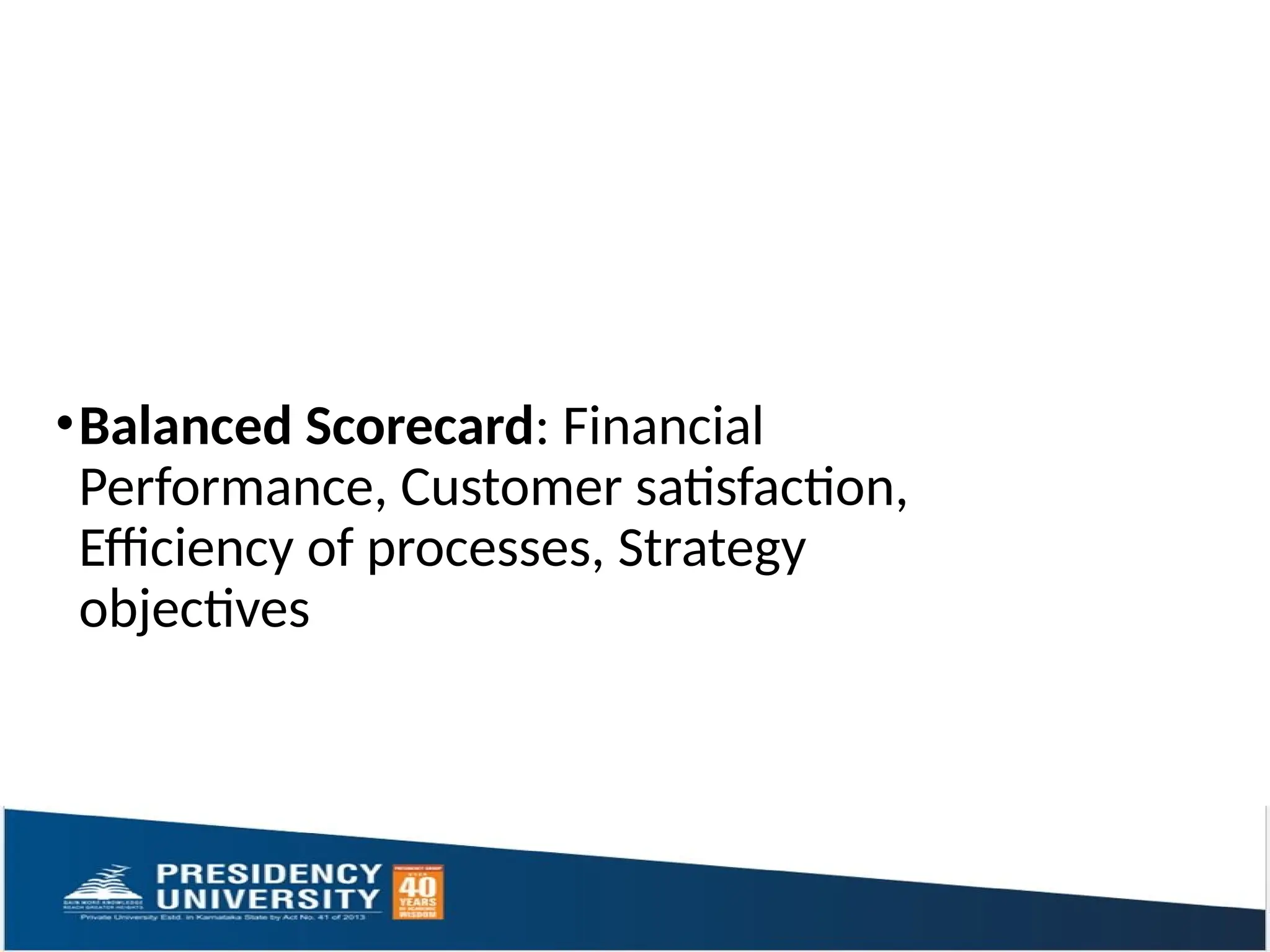
•Balanced Scorecard: Financial
Performance, Customer satisfaction,
Efficiency of processes, Strategy
objectives
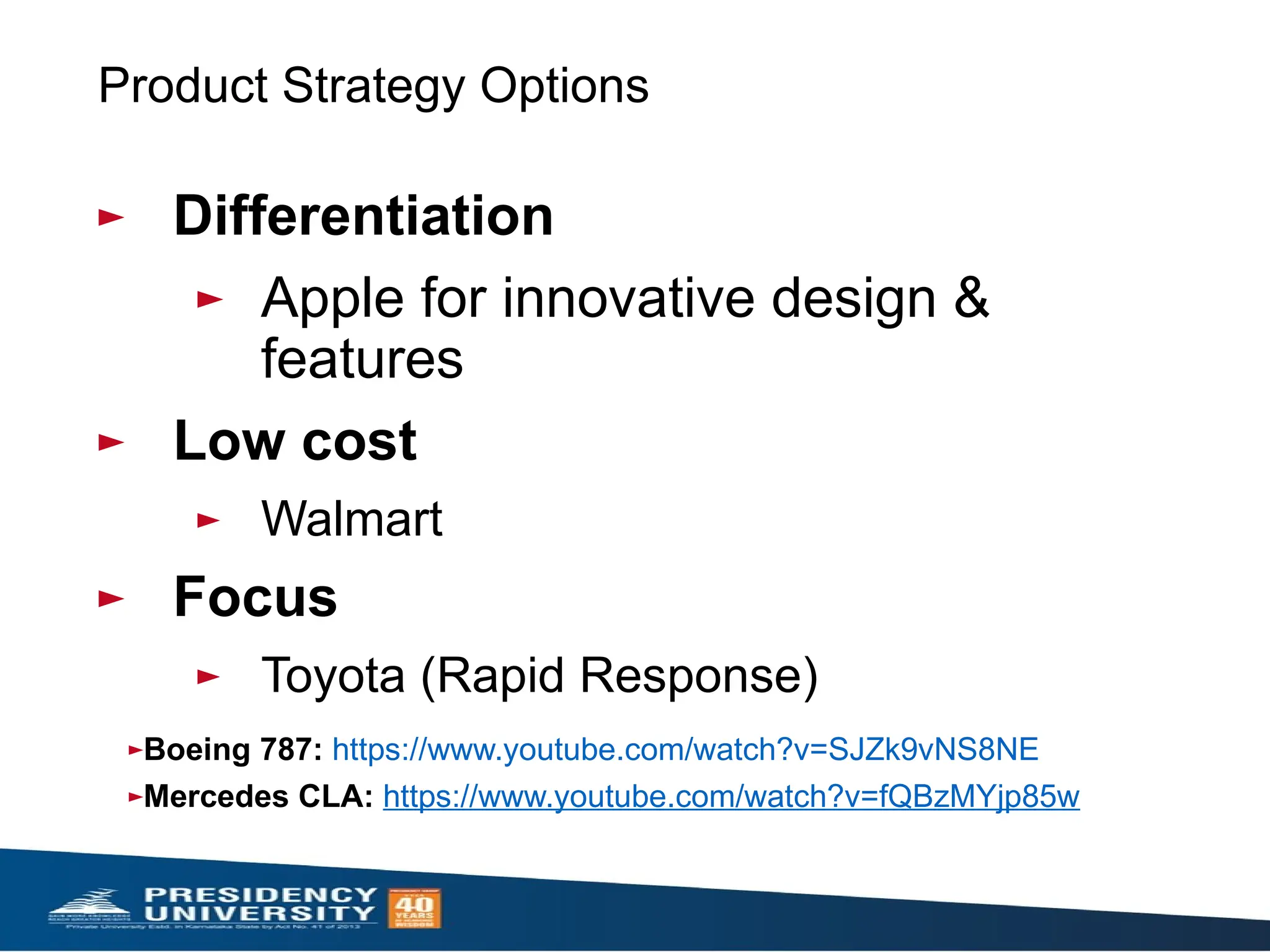
Product Strategy Options
► Differentiation
► Apple for innovative design &
features
► Low cost
► Walmart
► Focus
► Toyota (Rapid Response)
►Boeing 787: https://www.youtube.com/watch?v=SJZk9vNS8NE
►Mercedes CLA: https://www.youtube.com/watch?v=fQBzMYjp85w
Boeing – sales and supply chain are worldwide​
Benetton (fashion brand & clothing line in Italy) –
moves inventory to stores around the world faster than its
competition by building flexibility into design, production,
and distribution​
Sony (multinational conglomerate company) – purchases
components from suppliers in Thailand, Malaysia, and
around the world​
Bombardier – supply chain sourcing components for its
streetcar building: gear box & motor (Germany), brake
systems (USA & France) ​
• Robust design – strong against environment ​
• Modular design – component/part commonality ​
• Computer-aided design (CAD)​
• Computer-aided manufacturing (CAM)​
• Cloud computing​
• Value analysis​
• Sustainability and Life Cycle Assessment (LCA)​
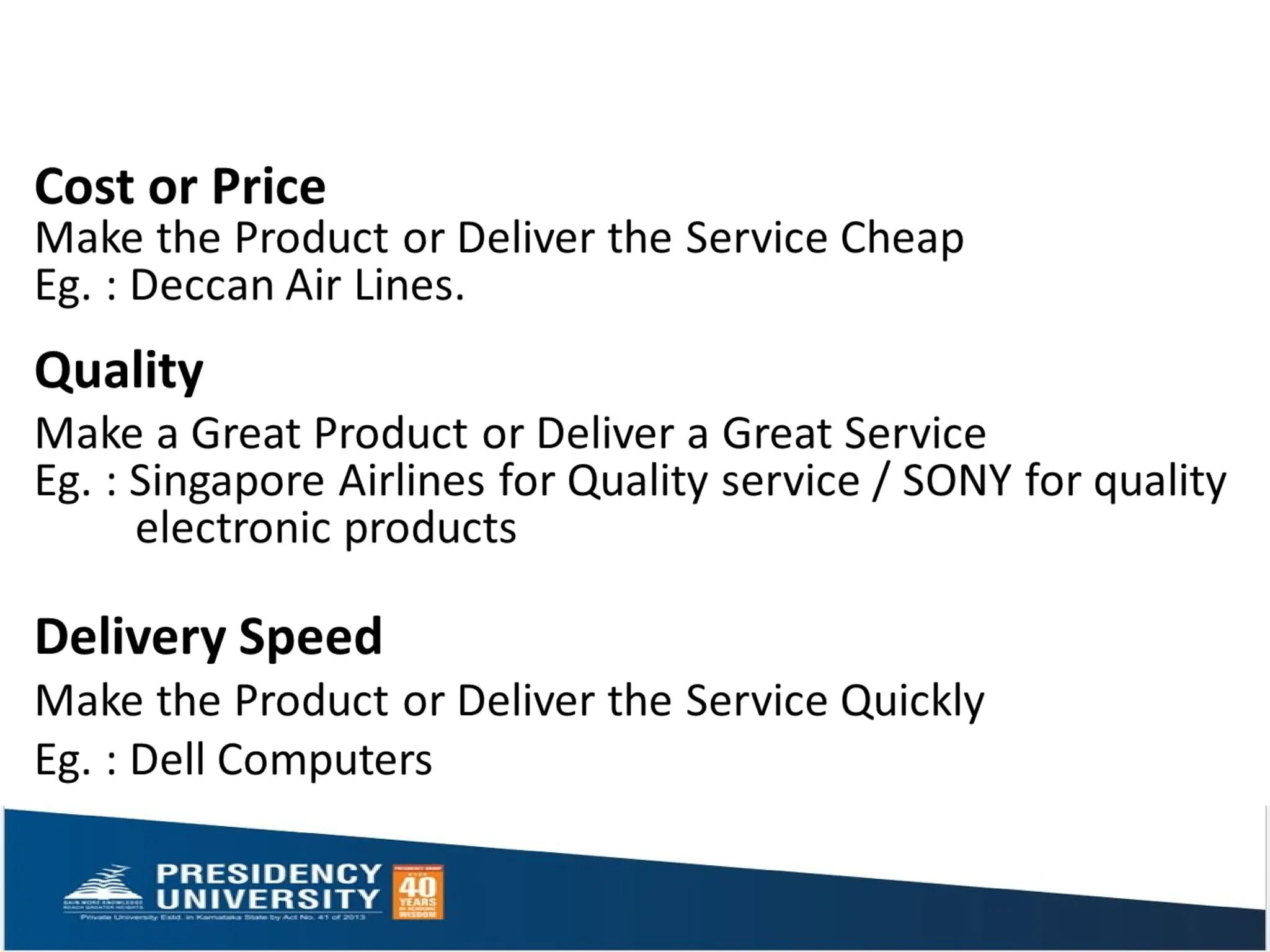
Competitive Priorities
Cost/Price: Southwest Airlines
Differentiation /Quality :Sony
Differentiation Newness: Apple
Differentiation Location: ATMs
Time/Responsiveness: Dominos
Flexibility: Burger King have it your way
Innovation: 3M
Sustainability: Green Cars
Customer Service: Amazon
What might be the competitive
advantage for
Southwest Airlines
Apple
Facebook
Research and explain the
logic behind the statement
“GE discovered that 75
percent of its
manufacturing costs are
determined by design.”
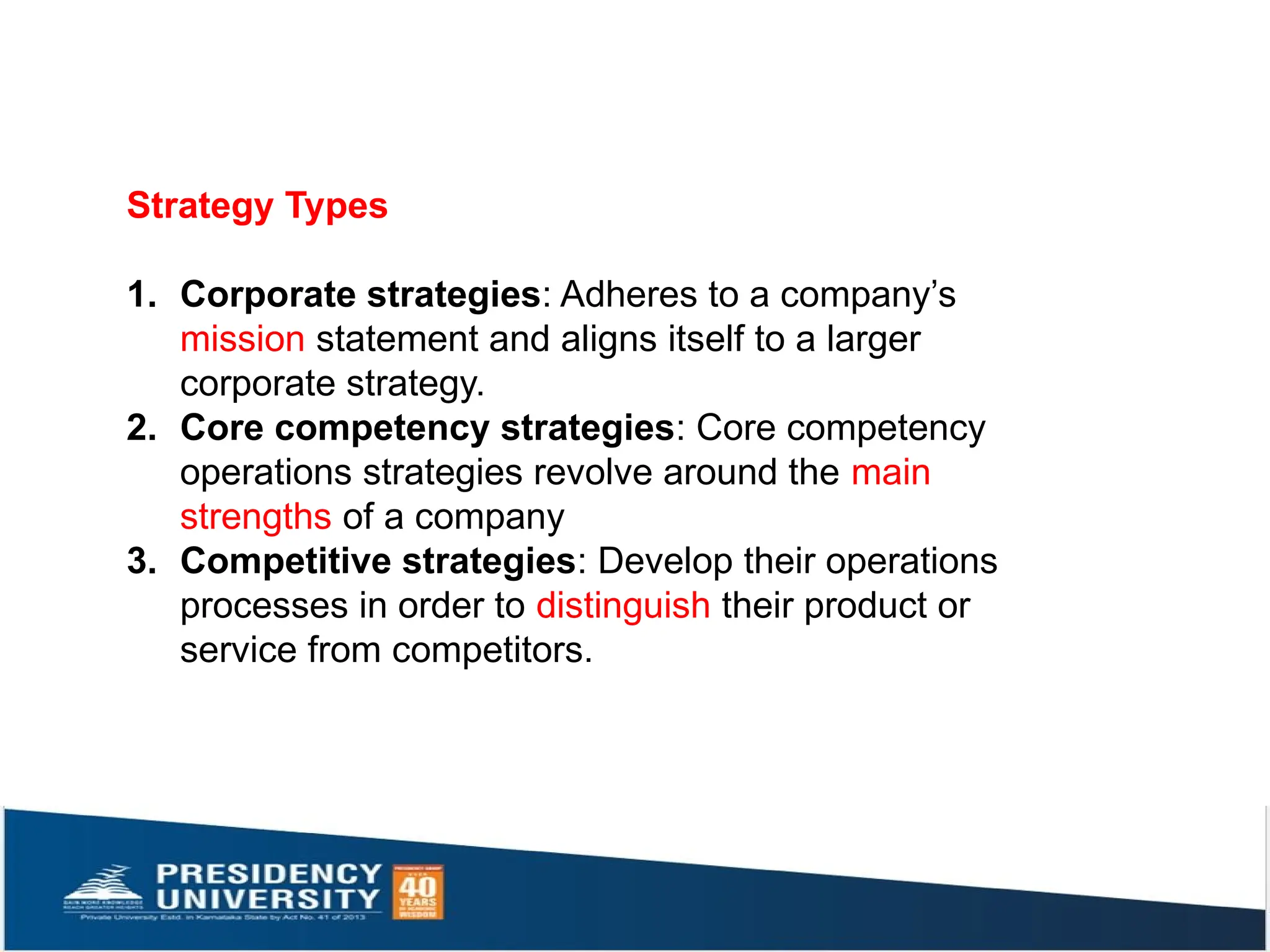
Strategy Types
1. Corporate strategies: Adheres to a company’s
mission statement and aligns itself to a larger
corporate strategy.
2. Core competency strategies: Core competency
operations strategies revolve around the main
strengths of a company
3. Competitive strategies: Develop their operations
processes in order to distinguish their product or
service from competitors.
4. Product or service strategies: Revolves around
the quality control of existing products or services as
well as the development of new products and
services.
5. Customer-driven strategies: Make operations
decisions based on the customer experience to fulfill
customer expectations.
Specific production strategies
based on the market and product type
1. Make-to-Stock (MTS): Producing goods in advance of
anticipated demand, stocking them, and selling them from
inventory.
2. Make-to-Order (MTO): Producing goods only after a
customer places an order.
3. Postponement: Delaying product customization or final
assembly until closer to the time of customer purchase to
offer personalization.
Caselet - Nalco-ceramics has been suffering losses in recent
months. They are concerned about losing huge orders that are
forthcoming. In order to receive the order , Nalco-ceramics
wants to introduce certain changes in their product and service
design. What major factors should they consider in designing
their strategy.
Major factors of strategy formulation
· Cost
· Quality
· Time-to-market
· Competitive advantage
· Customer satisfaction
List the major activities before Nalco-ceramics to enhance
their Product and Service Performance.
· Translate customer wants and needs into product and
service requirements
· Refine existing products and services
· Develop new products and services
· Formulate quality goals
· Formulate cost targets
· Construct and test prototypes
· Document specifications
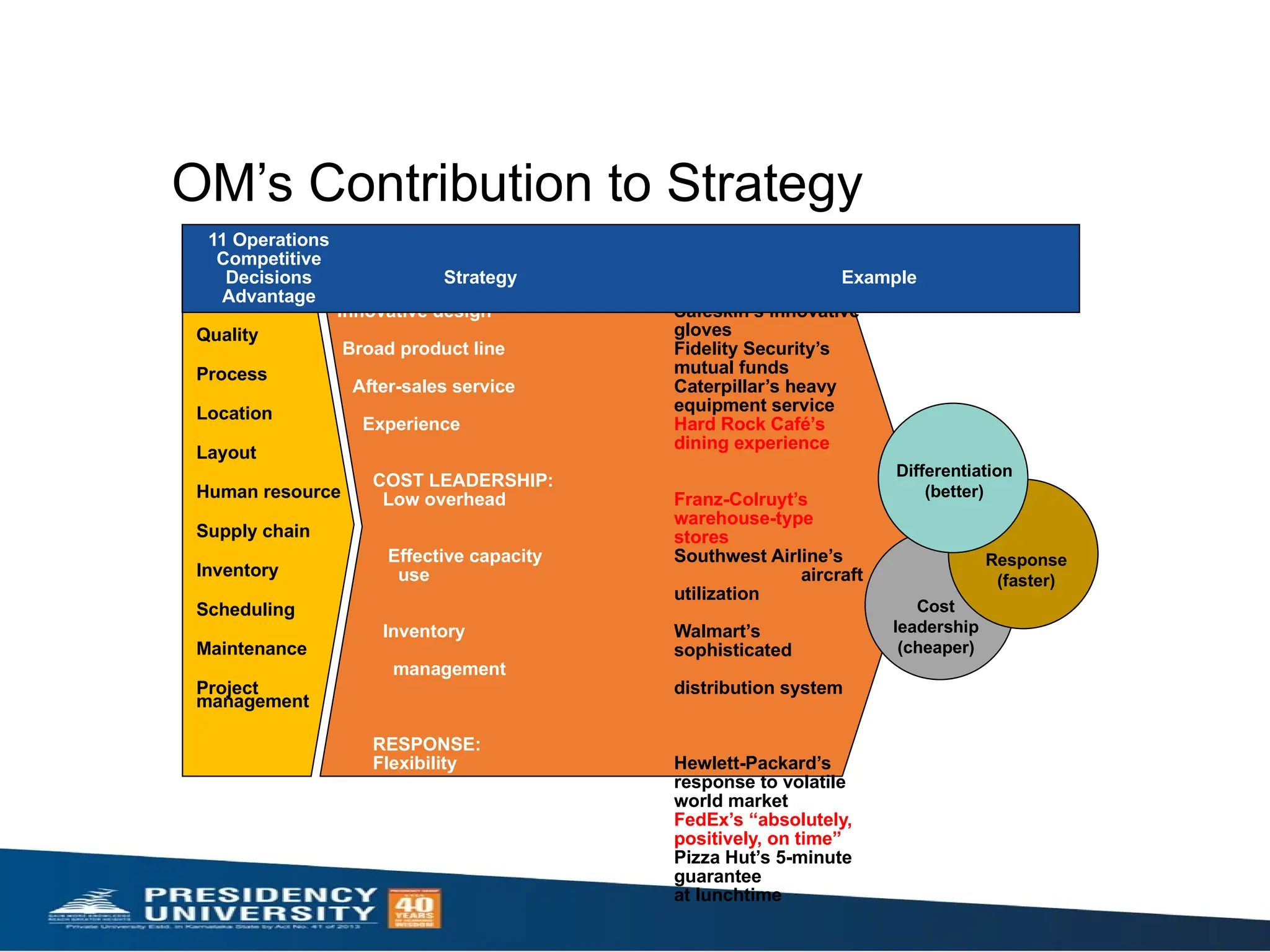
OM’s Contribution to Strategy
Product
Quality
Process
Location
Layout
Human resource
Supply chain
Inventory
Scheduling
Maintenance
Project
management
DIFFERENTIATION:
Innovative design Safeskin’s innovative
gloves
Broad product line Fidelity Security’s
mutual funds
After-sales service Caterpillar’s heavy
equipment service
Experience Hard Rock Café’s
dining experience
COST LEADERSHIP:
Low overhead Franz-Colruyt’s
warehouse-type
stores
Effective capacity Southwest Airline’s
use aircraft
utilization
Inventory Walmart’s
sophisticated
management
distribution system
RESPONSE:
Flexibility Hewlett-Packard’s
response to volatile
world market
Reliability FedEx’s “absolutely,
positively, on time”
Quickness Pizza Hut’s 5-minute
guarantee
at lunchtime
11 Operations
Competitive
Decisions Strategy Example
Advantage
Response
(faster)
Cost
leadership
(cheaper)
Differentiation
(better)
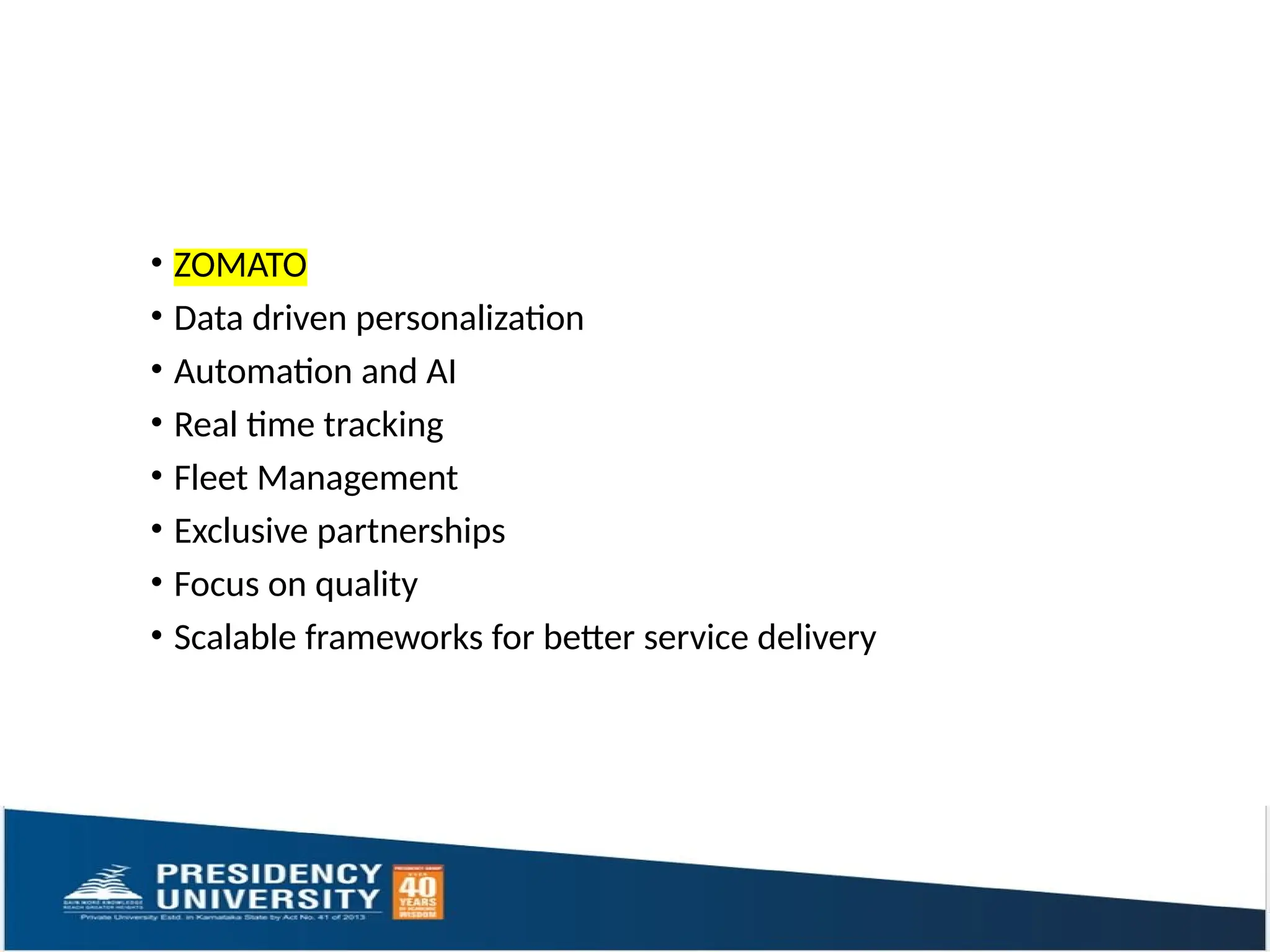
• ZOMATO
• Data driven personalization
• Automation and AI
• Real time tracking
• Fleet Management
• Exclusive partnerships
• Focus on quality
• Scalable frameworks for better service delivery
Strategy Deployment
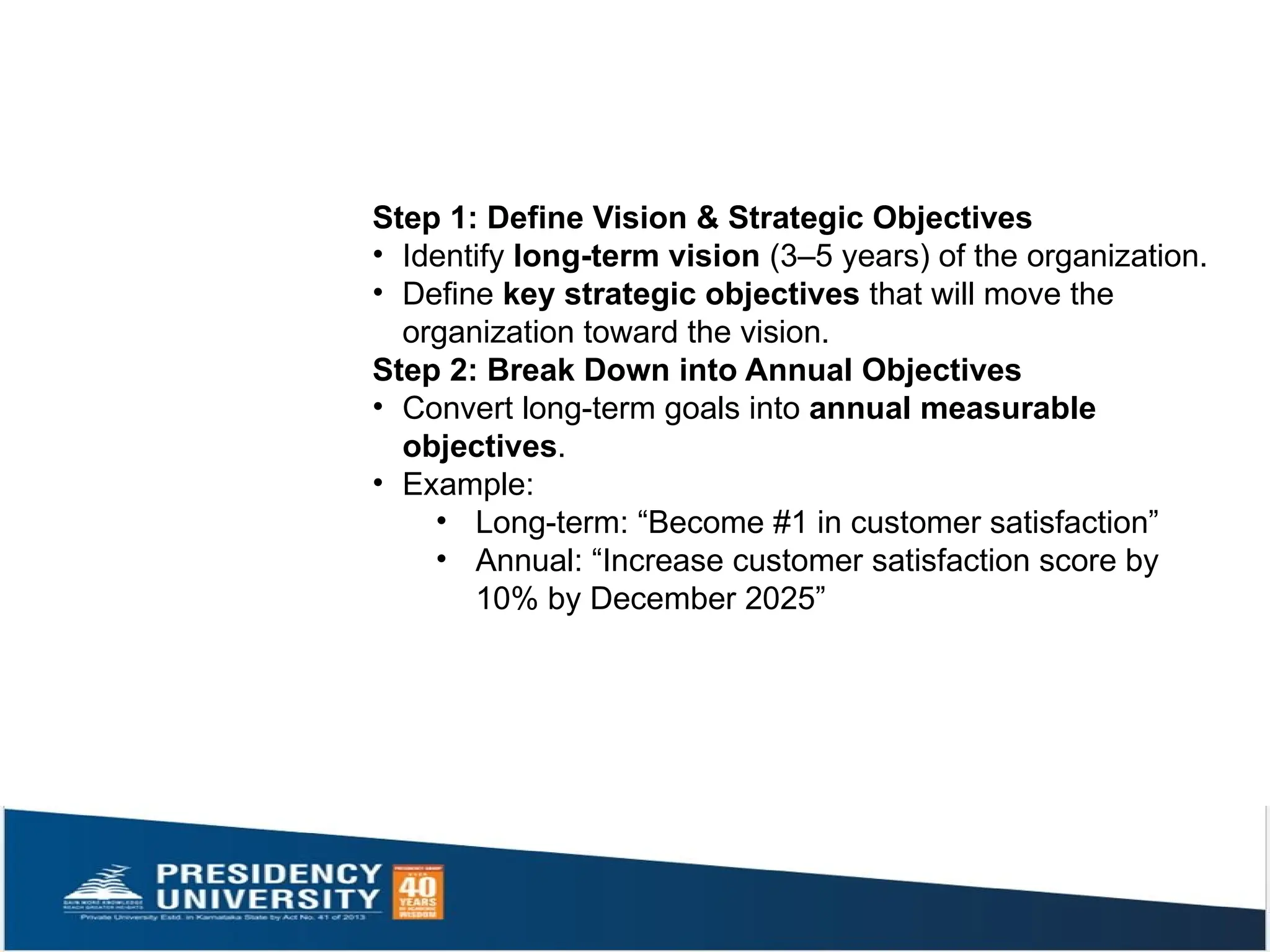
Step 1: Define Vision & Strategic Objectives
• Identify long-term vision (3–5 years) of the organization.
• Define key strategic objectives that will move the
organization toward the vision.
Step 2: Break Down into Annual Objectives
• Convert long-term goals into annual measurable
objectives.
• Example:
• Long-term: “Become #1 in customer satisfaction”
• Annual: “Increase customer satisfaction score by
10% by December 2025”
Step 3: Deploy Objectives Across the Organization
(Catchball Process)
• Top-down: Management defines objectives.
• Bottom-up: Employees provide feedback (catchball),
suggest how to achieve objectives.
• Promotes alignment, buy-in, and realistic targets.
Step 4: Develop Action Plans
• For each objective, define specific projects, KPIs, and
responsible owners.
• Example: “Improve customer service training program by
Q2”
Step 5: Implement & Execute
• Assign responsibilities, monitor progress, and adjust as
needed.
• Teams focus on daily/weekly tasks that contribute to
strategic objectives
Step 6: Monthly/Quarterly Review
• Use a PDCA cycle (Plan–Do–Check–Act) to review
progress.
• Identify gaps and correct deviations early.
Step 7: Annual Review & Next Cycle
• At the end of the year, review objectives, lessons
learned, and set the next year’s priorities.
• Continuous improvement is key.
Tools Used in Hoshin Kanri
• X Matrix: Visual representation of objectives, KPIs,
initiatives, and owners.
• Catchball: Iterative communication between levels to
finalize objectives.
• PDCA (Plan–Do–Check–Act): Ensures continuous
improvement.
• KPI dashboards: Track metrics and progress toward
objectives.
MAIN TYPES OF OM
Manufacturing : Focuses on the efficient production of tangible
goods from processing of raw materials through fabrication
assembly
Service : The delivery of intangible services, such as
healthcare, education, or customer support through the
interaction between the service provider and the customer.
Logistics : The movement and storage of goods through
warehousing, transportation, and distribution networks.
Project : The specific tasks, initiatives, or undertakings from
inception to completion, often with defined goals, timelines,
and resources. Time bound activity.
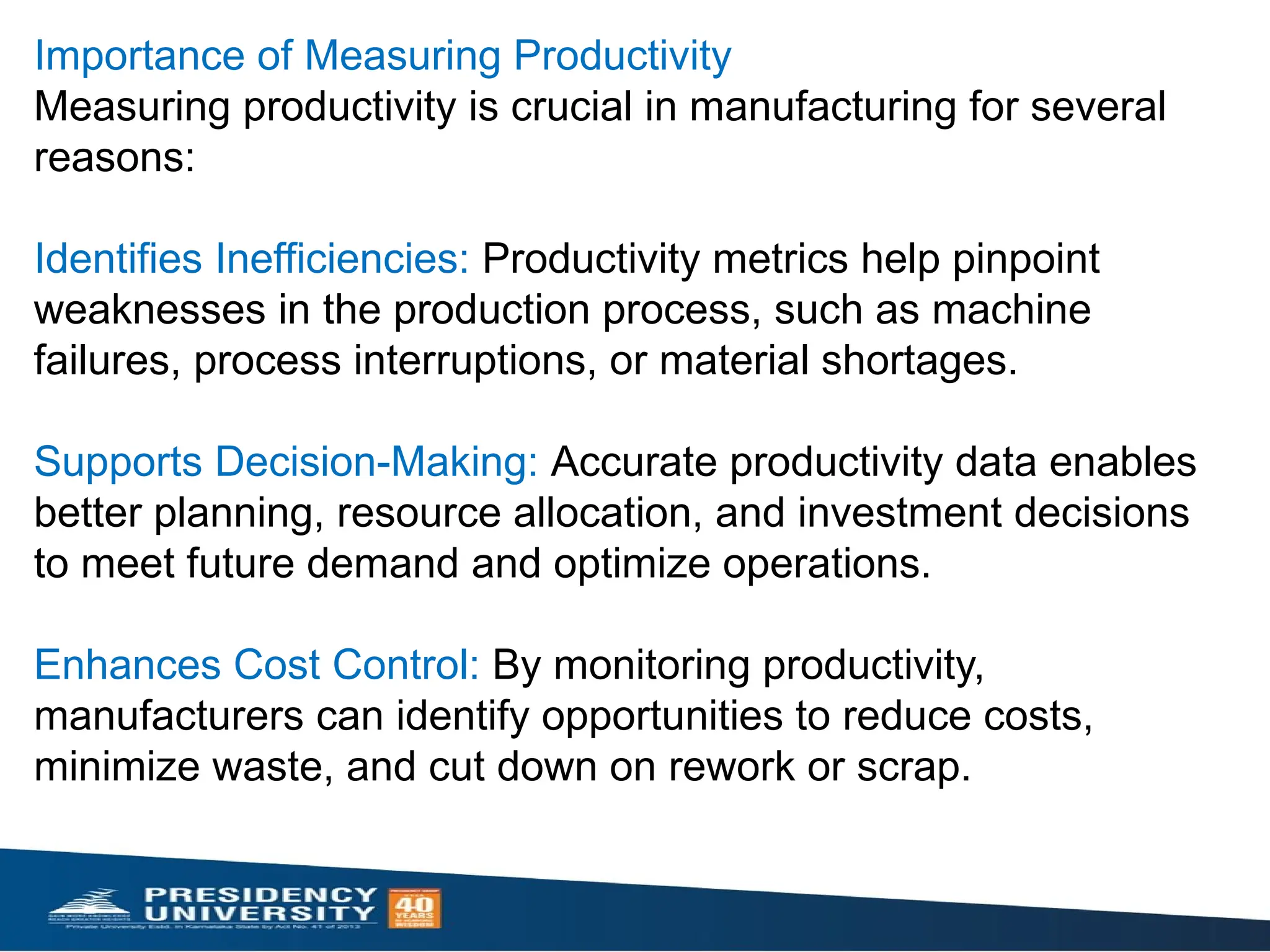
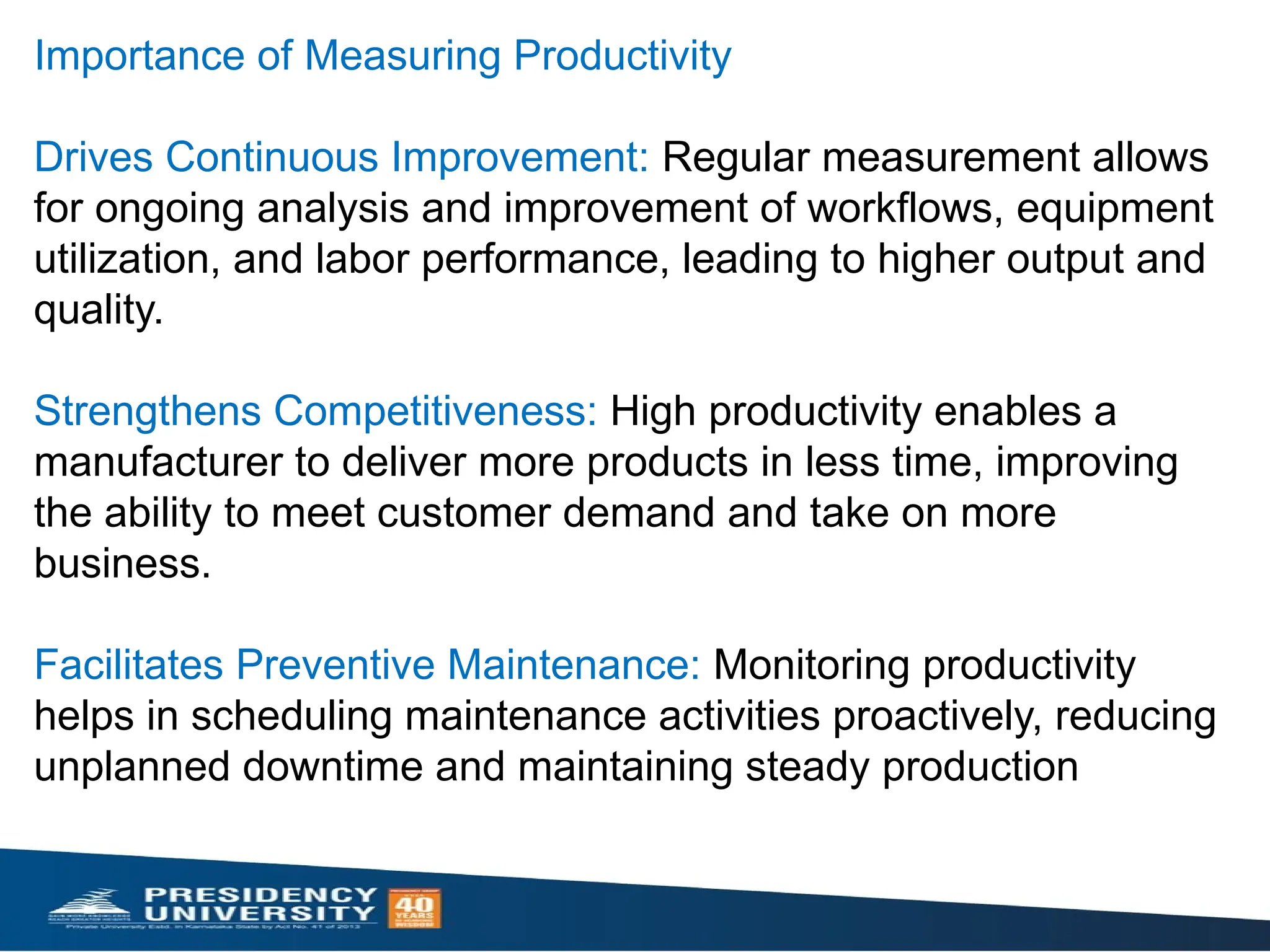
Importance of Measuring Productivity
Measuring productivity is crucial in manufacturing for several
reasons:
Identifies Inefficiencies: Productivity metrics help pinpoint
weaknesses in the production process, such as machine
failures, process interruptions, or material shortages.
Supports Decision-Making: Accurate productivity data enables
better planning, resource allocation, and investment decisions
to meet future demand and optimize operations.
Enhances Cost Control: By monitoring productivity,
manufacturers can identify opportunities to reduce costs,
minimize waste, and cut down on rework or scrap.
Importance of Measuring Productivity
Drives Continuous Improvement: Regular measurement allows
for ongoing analysis and improvement of workflows, equipment
utilization, and labor performance, leading to higher output and
quality.
Strengthens Competitiveness: High productivity enables a
manufacturer to deliver more products in less time, improving
the ability to meet customer demand and take on more
business.
Facilitates Preventive Maintenance: Monitoring productivity
helps in scheduling maintenance activities proactively, reducing
unplanned downtime and maintaining steady production
Productivity Measurement
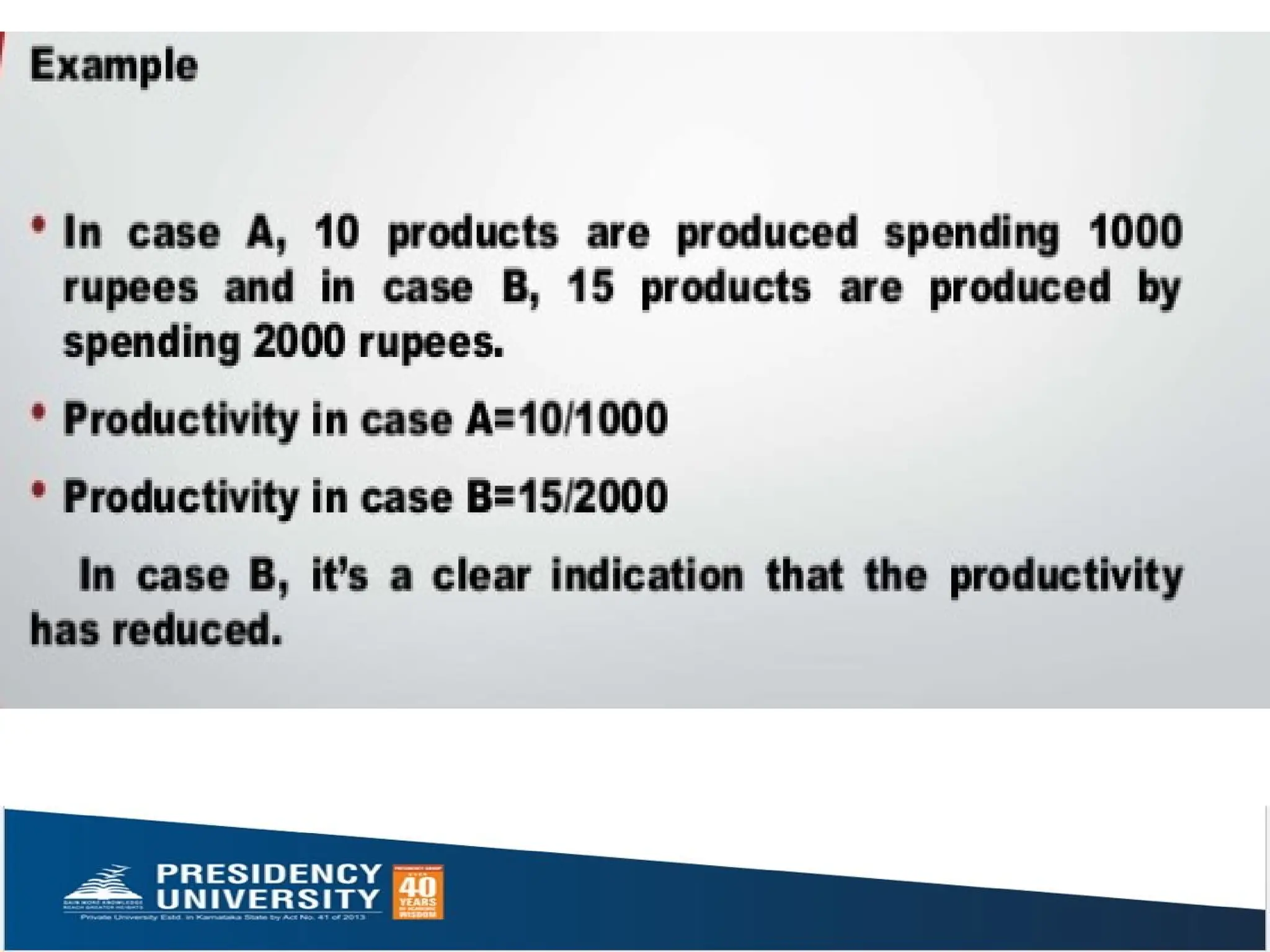
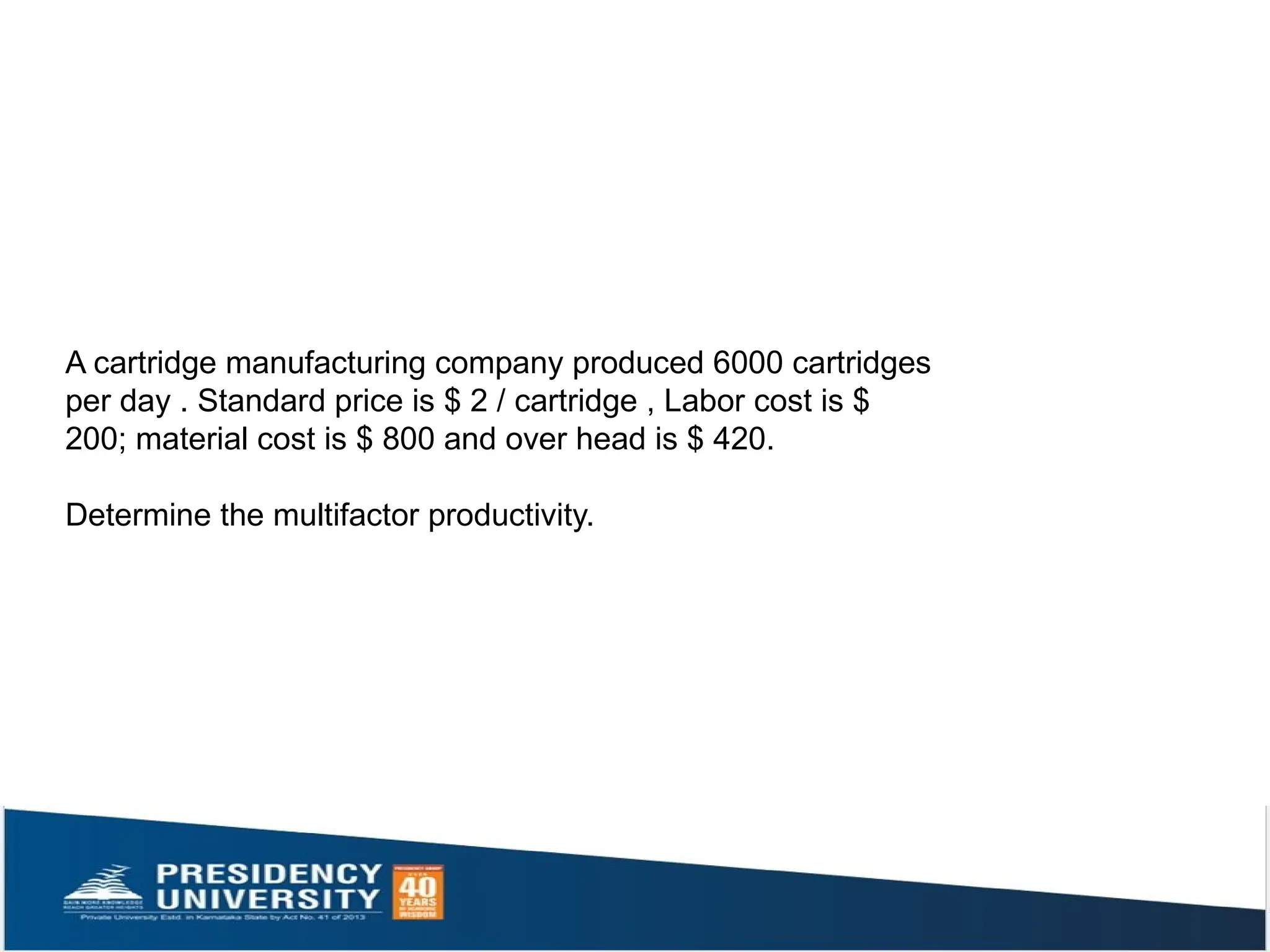
A cartridge manufacturing company produced 6000 cartridges
per day . Standard price is $ 2 / cartridge , Labor cost is $
200; material cost is $ 800 and over head is $ 420.
Determine the multifactor productivity.
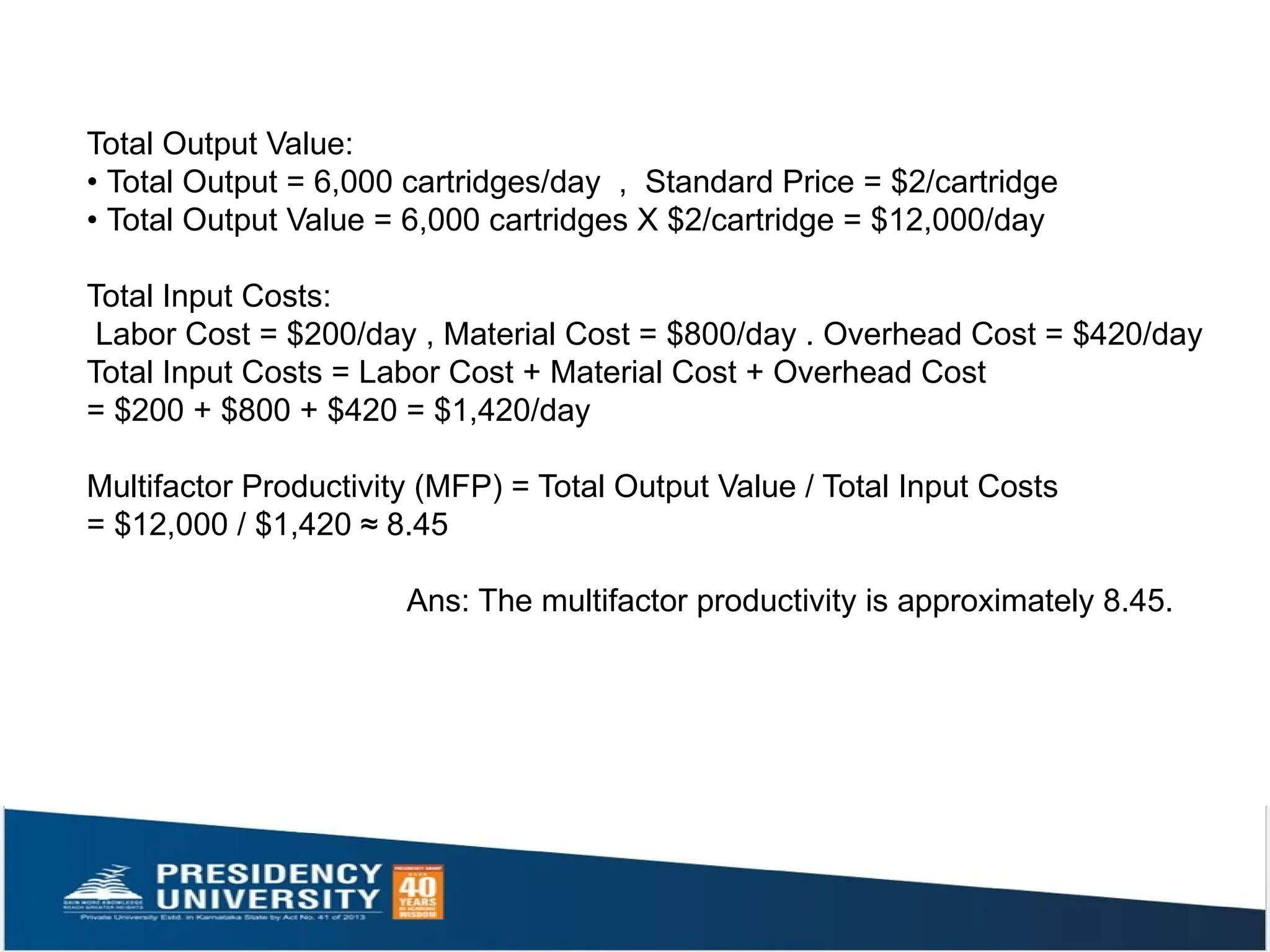
Total Output Value:
• Total Output = 6,000 cartridges/day , Standard Price = $2/cartridge
• Total Output Value = 6,000 cartridges X $2/cartridge = $12,000/day
Total Input Costs:
Labor Cost = $200/day , Material Cost = $800/day . Overhead Cost = $420/day
Total Input Costs = Labor Cost + Material Cost + Overhead Cost
= $200 + $800 + $420 = $1,420/day
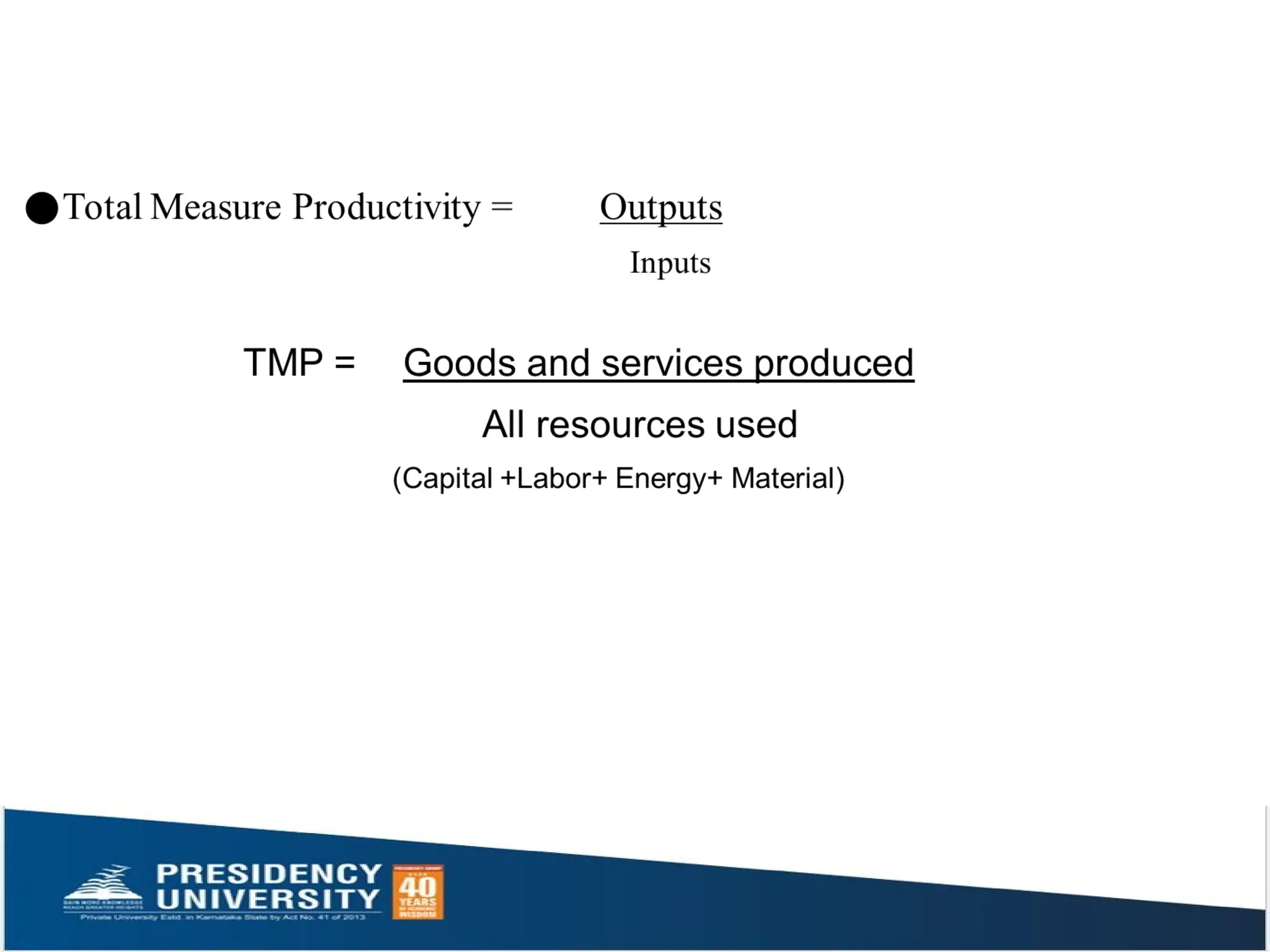
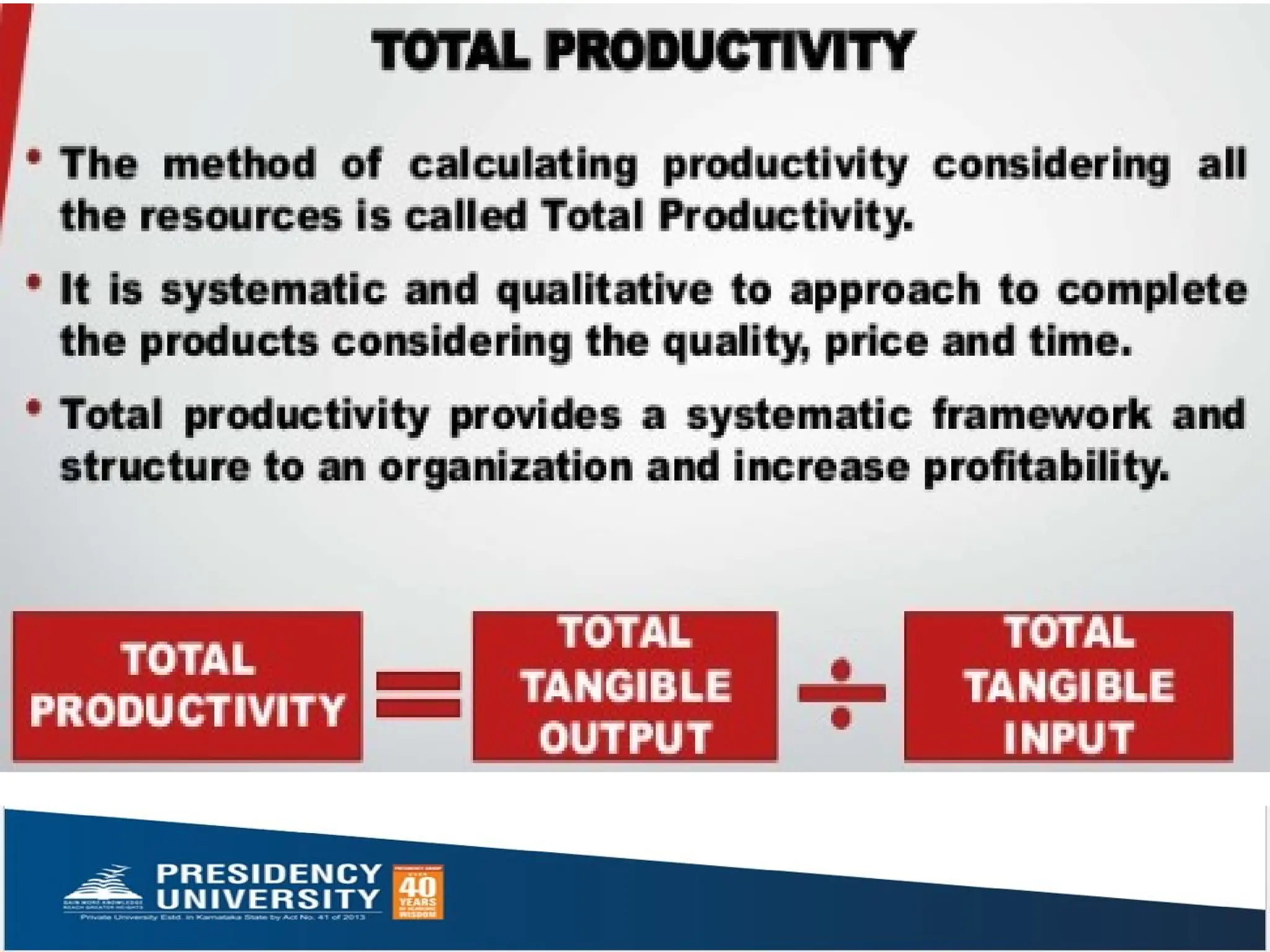
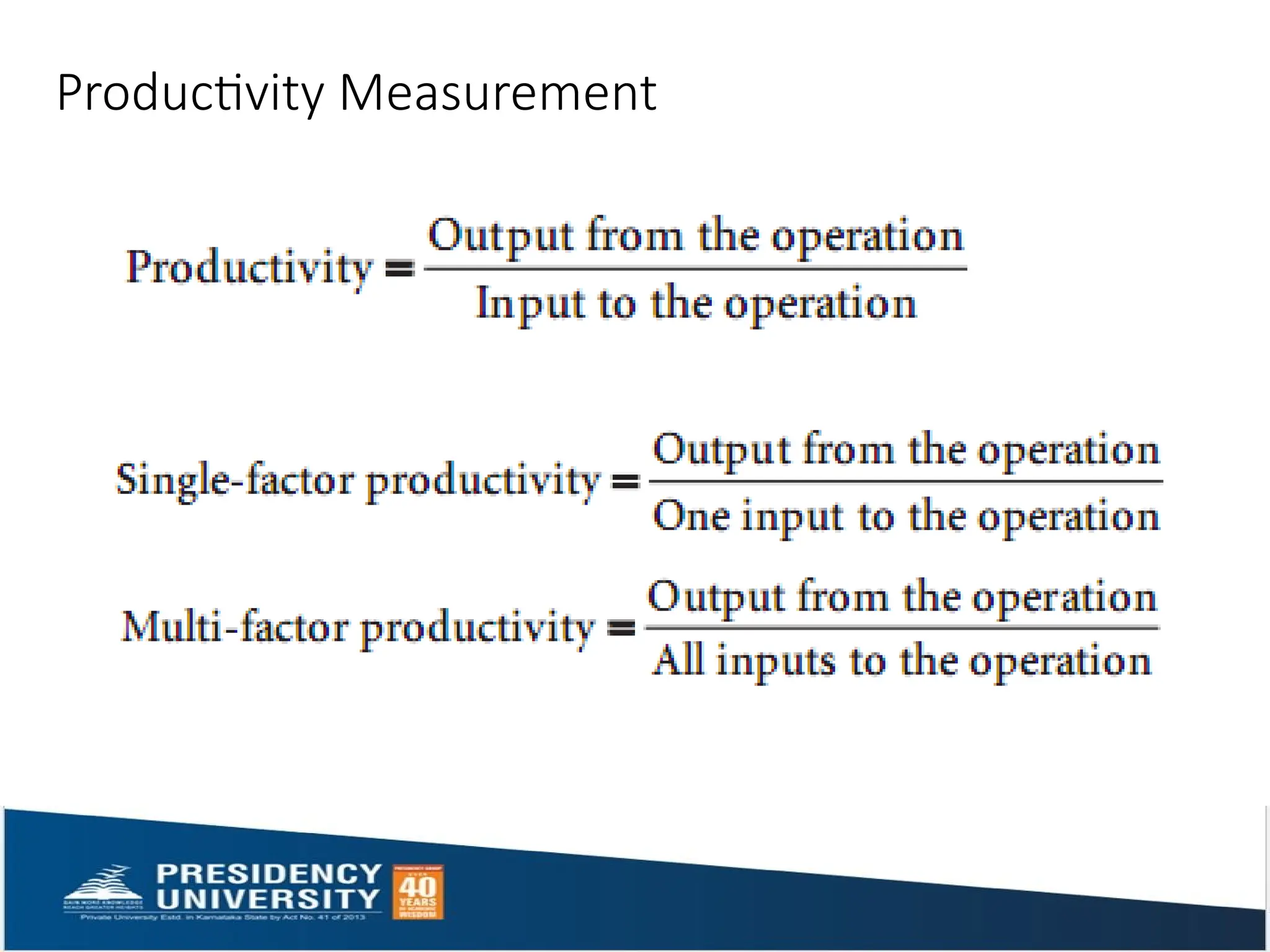
Multifactor Productivity (MFP) = Total Output Value / Total Input Costs
= $12,000 / $1,420 ≈ 8.45
Ans: The multifactor productivity is approximately 8.45.
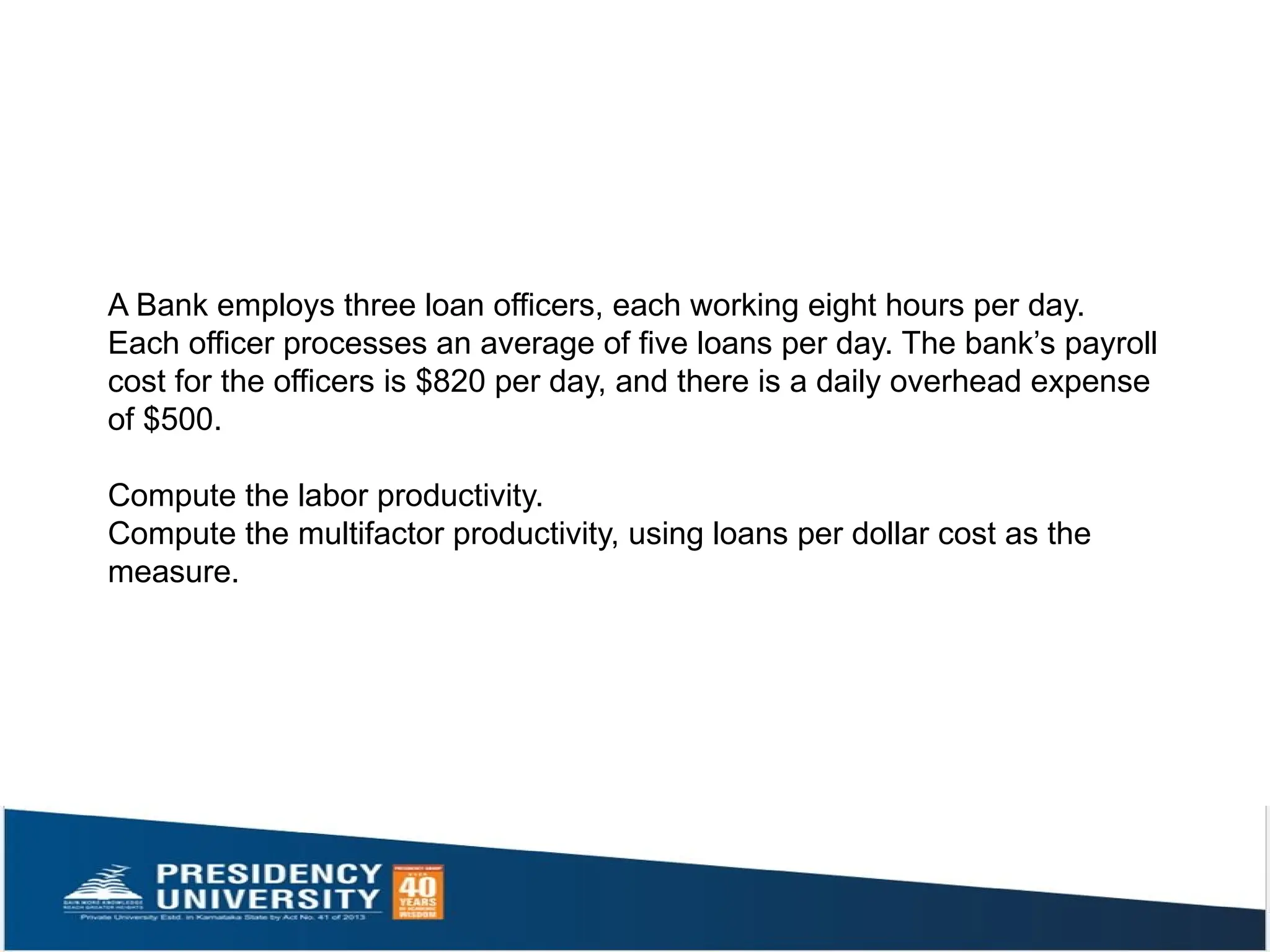
A Bank employs three loan officers, each working eight hours per day.
Each officer processes an average of five loans per day. The bank’s payroll
cost for the officers is $820 per day, and there is a daily overhead expense
of $500.
Compute the labor productivity.
Compute the multifactor productivity, using loans per dollar cost as the
measure.
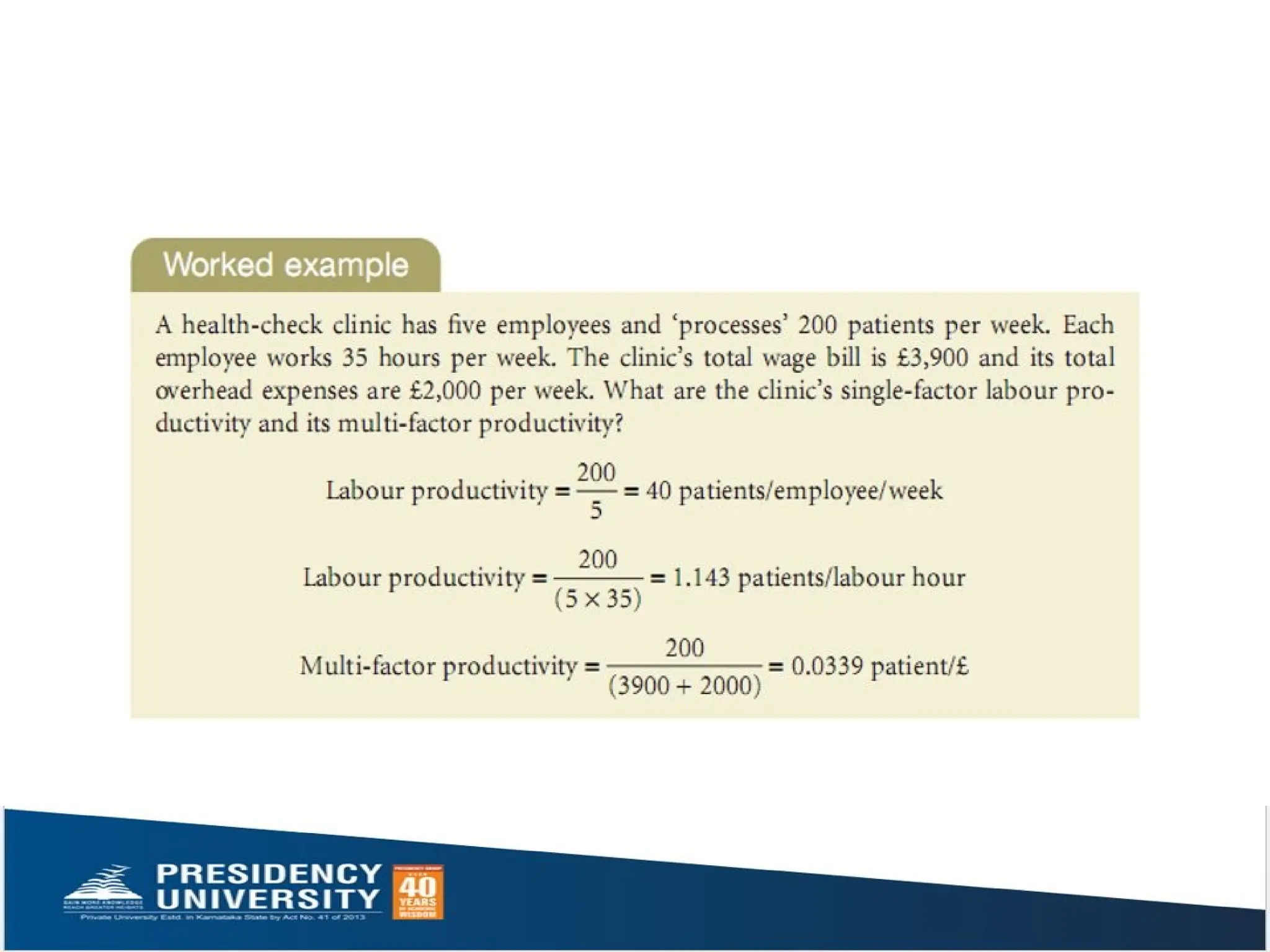
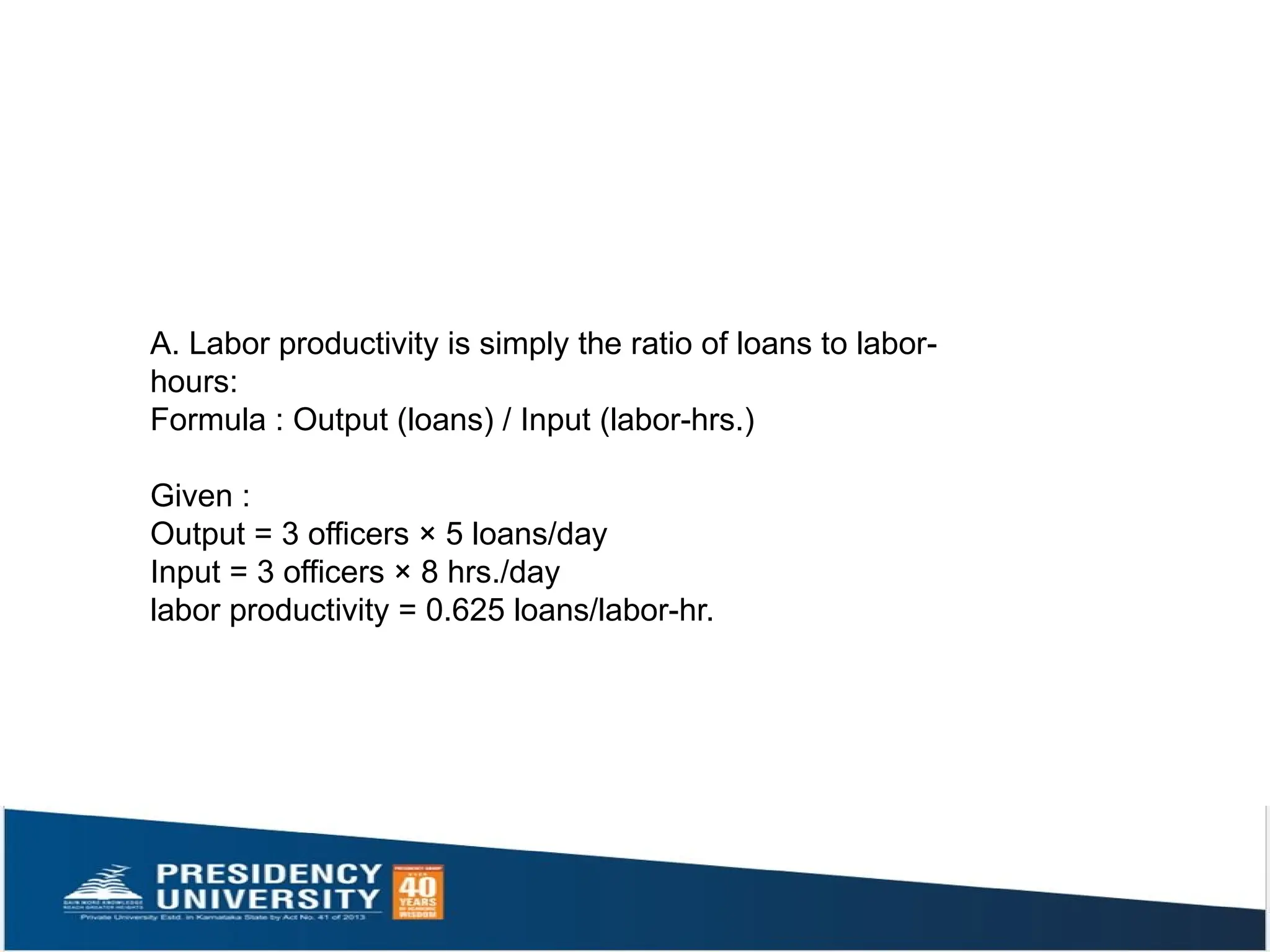
A. Labor productivity is simply the ratio of loans to labor-
hours:
Formula : Output (loans) / Input (labor-hrs.)
Given :
Output = 3 officers × 5 loans/day
Input = 3 officers × 8 hrs./day
labor productivity = 0.625 loans/labor-hr.
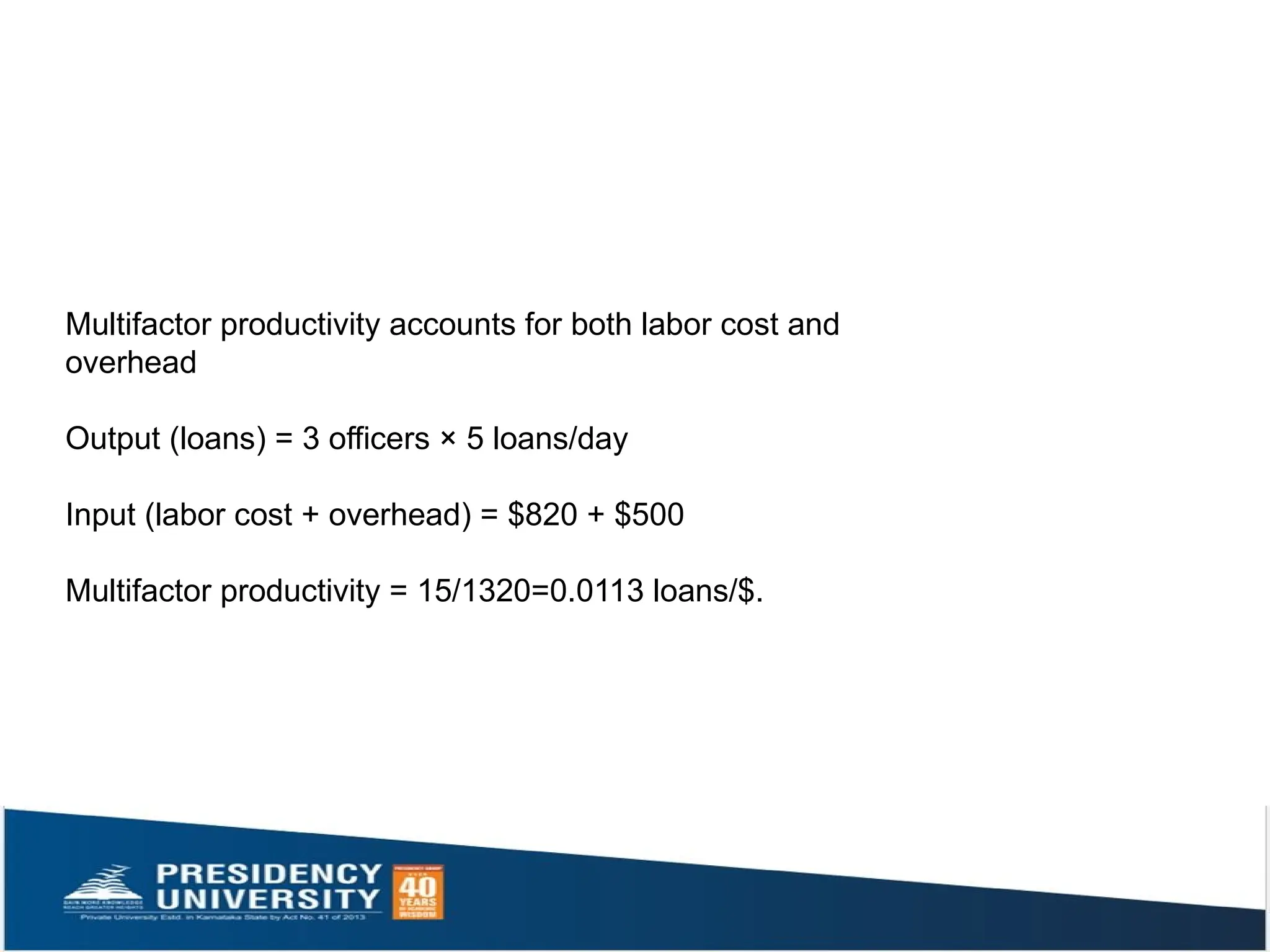
Multifactor productivity accounts for both labor cost and
overhead
Output (loans) = 3 officers × 5 loans/day
Input (labor cost + overhead) = $820 + $500
Multifactor productivity = 15/1320=0.0113 loans/$.
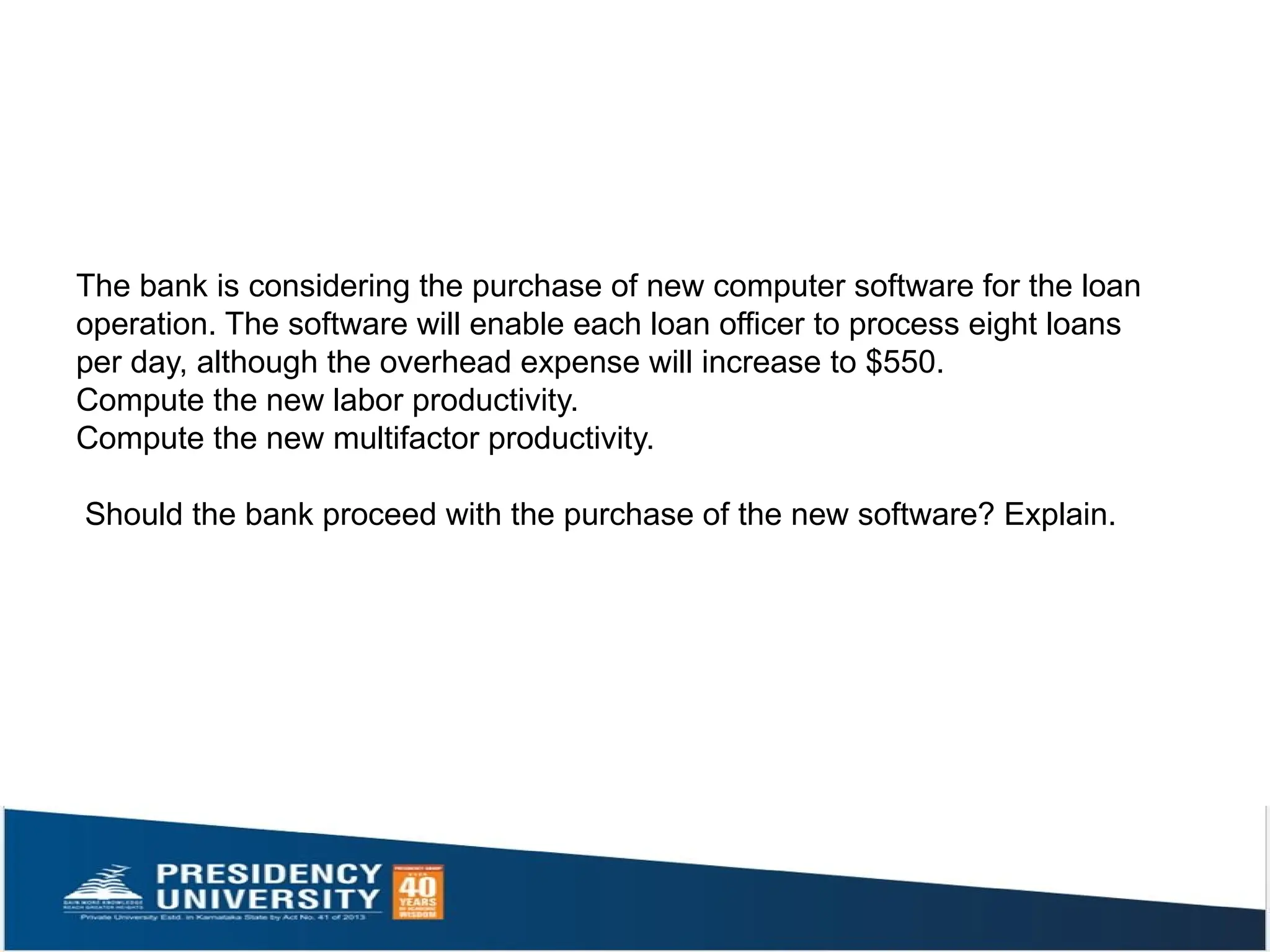
The bank is considering the purchase of new computer software for the loan
operation. The software will enable each loan officer to process eight loans
per day, although the overhead expense will increase to $550.
Compute the new labor productivity.
Compute the new multifactor productivity.
Should the bank proceed with the purchase of the new software? Explain.
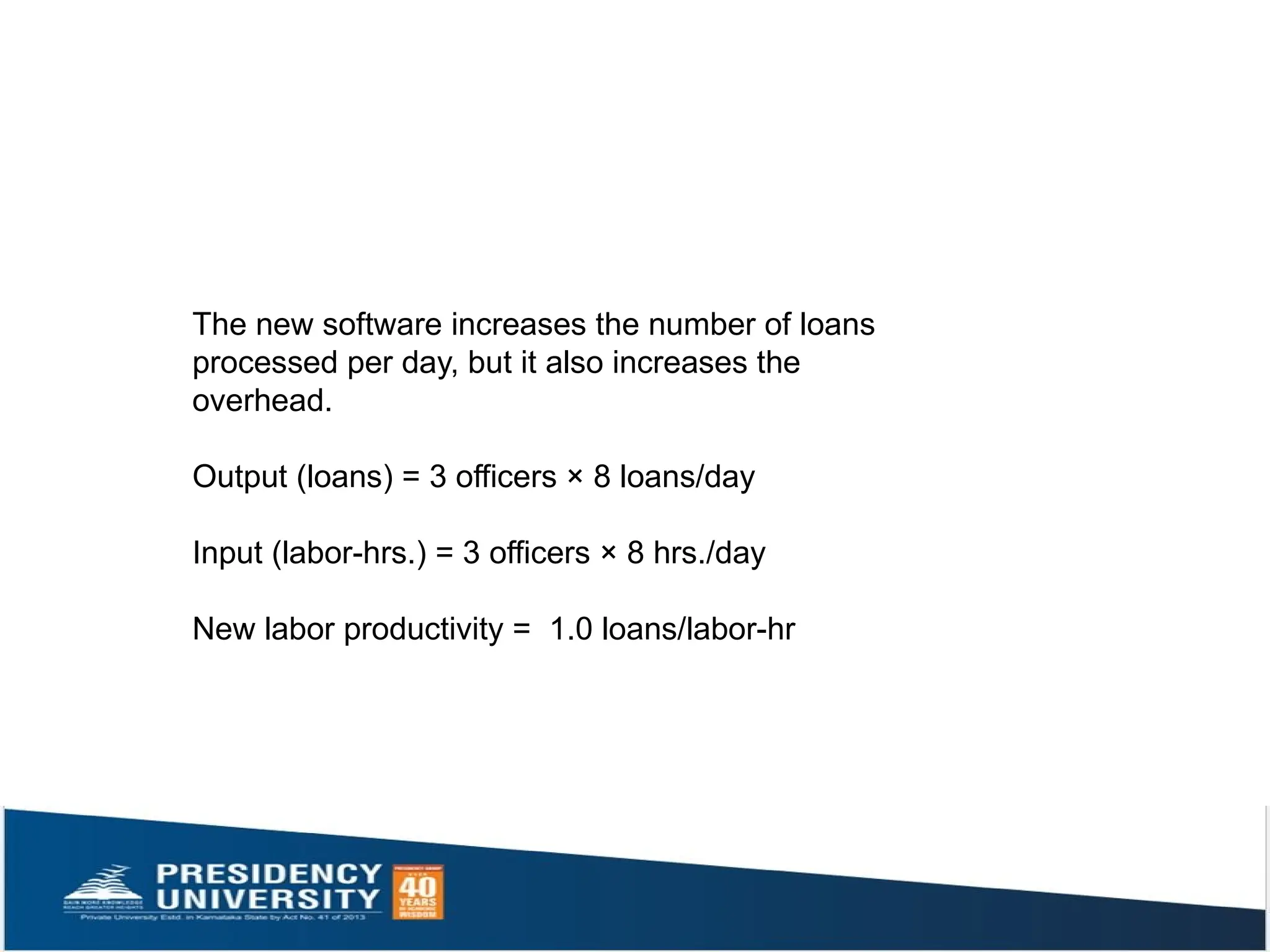
The new software increases the number of loans
processed per day, but it also increases the
overhead.
Output (loans) = 3 officers × 8 loans/day
Input (labor-hrs.) = 3 officers × 8 hrs./day
New labor productivity = 1.0 loans/labor-hr
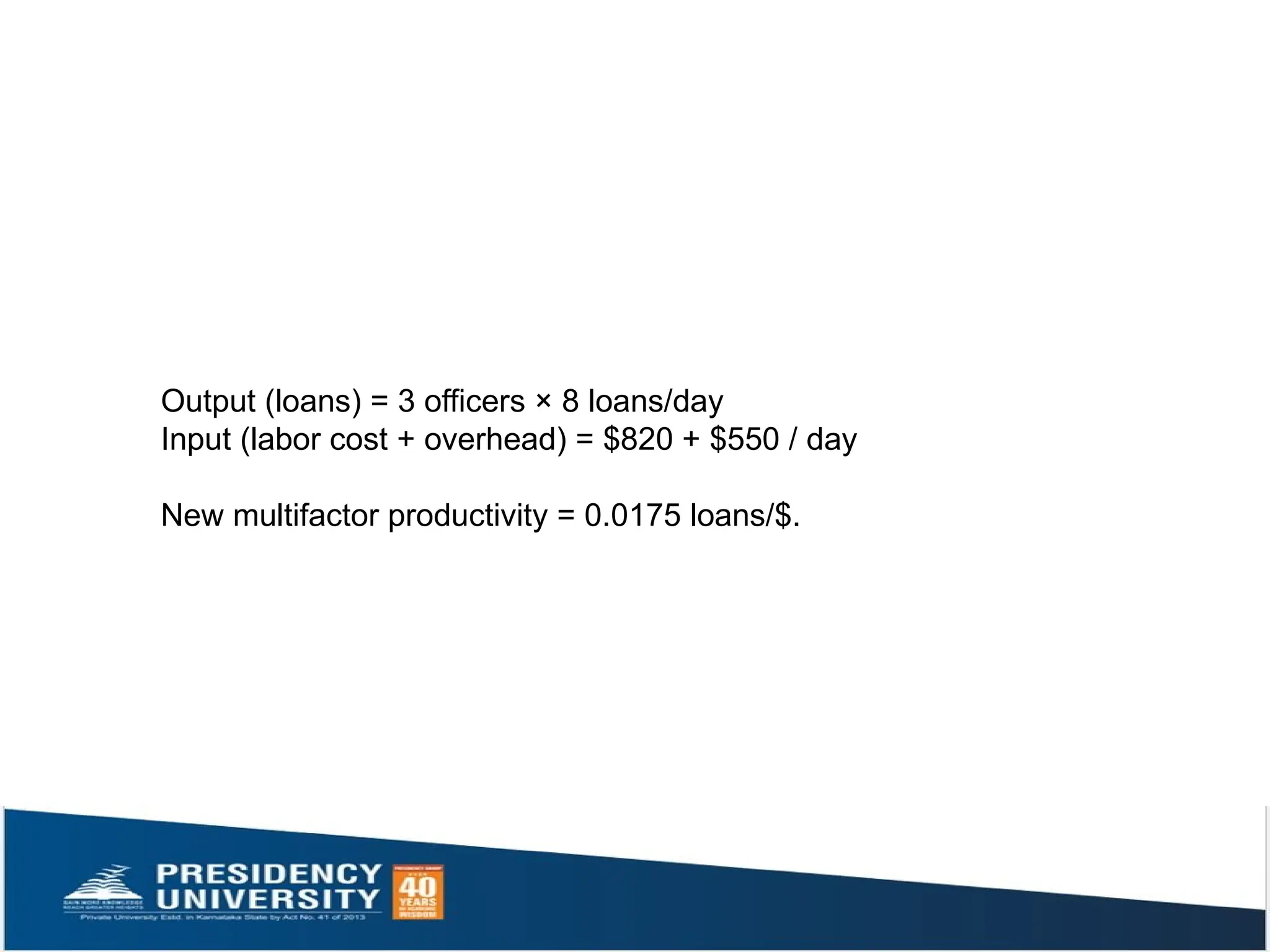
Output (loans) = 3 officers × 8 loans/day
Input (labor cost + overhead) = $820 + $550 / day
New multifactor productivity = 0.0175 loans/$.
Purchasing the new software would increase the labor
productivity by
( [1.0−0.625] / 0.625) x 100 = 60 %
It would increase the multifactor productivity (= [0.0175 −
0.0113]/0.0113) = 55 %
It is certainly worth the added overhead.
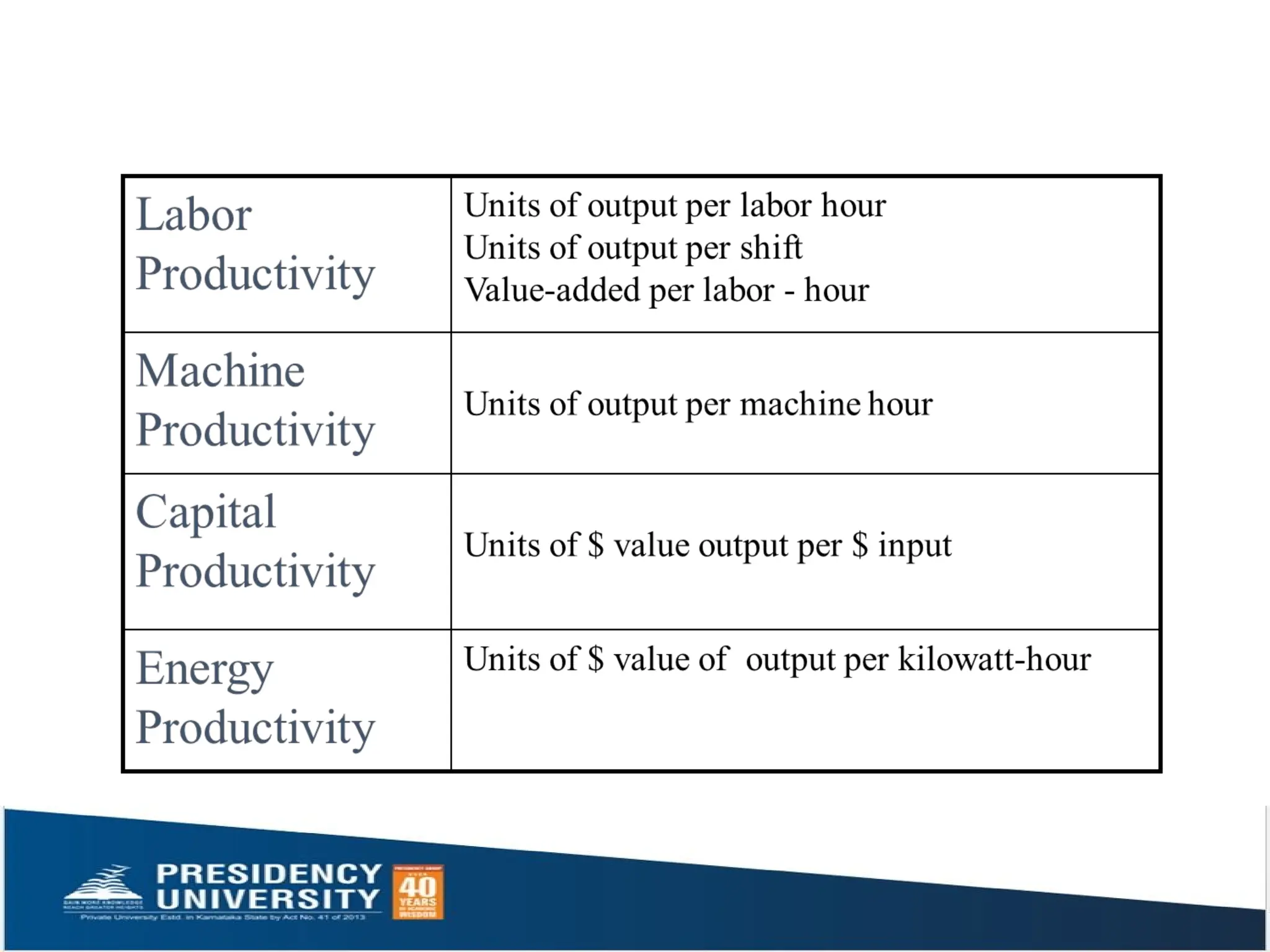
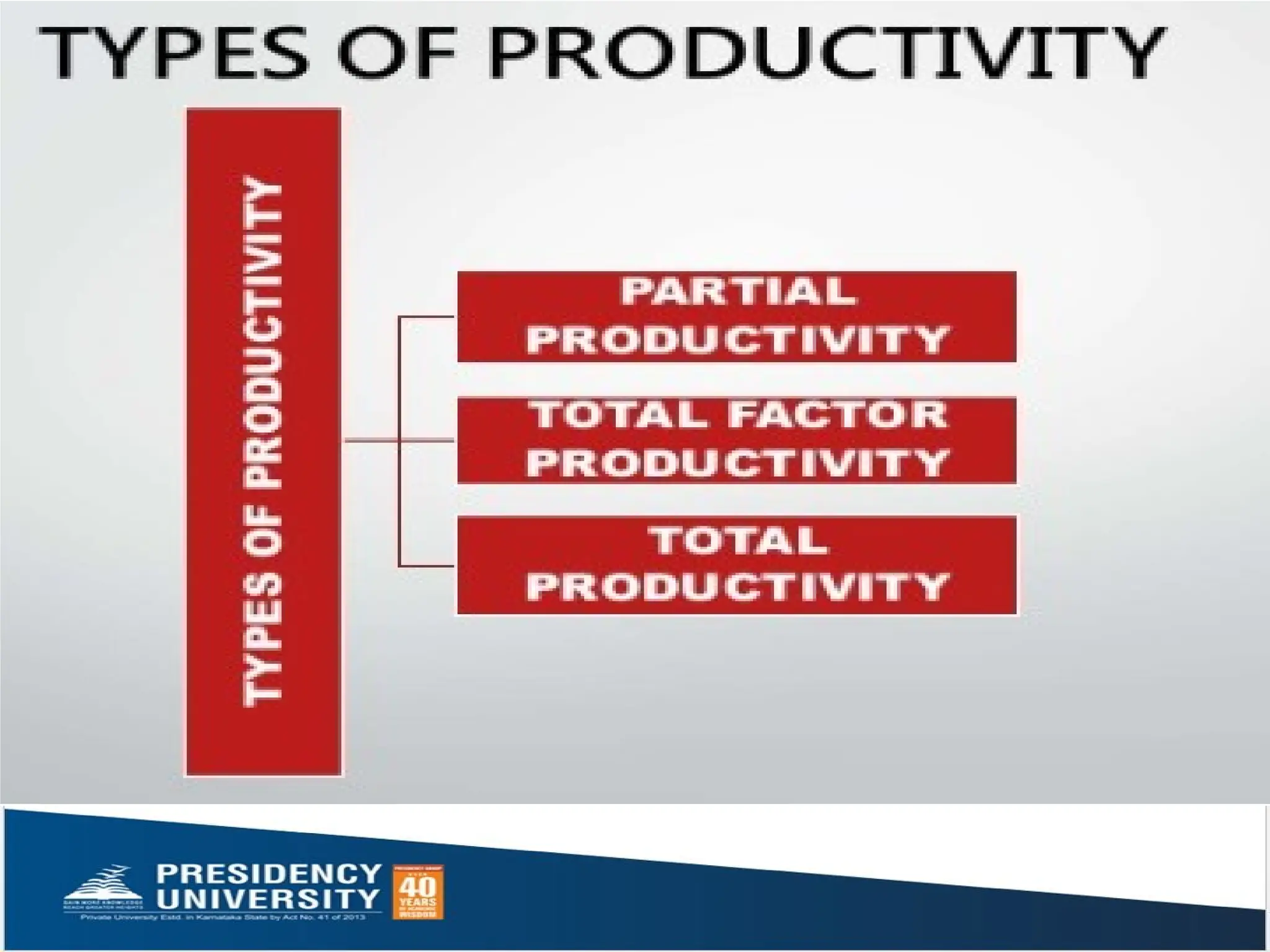
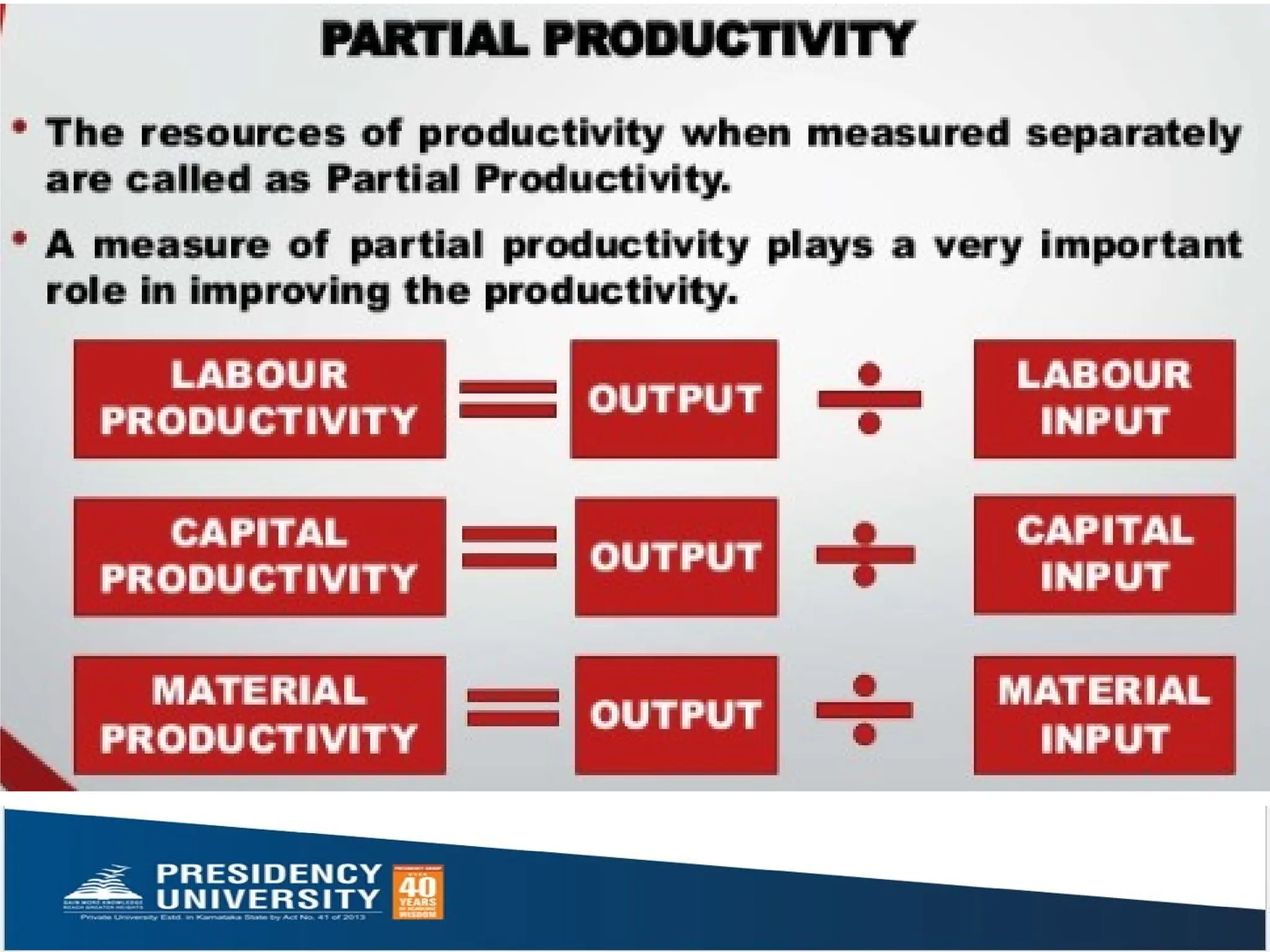
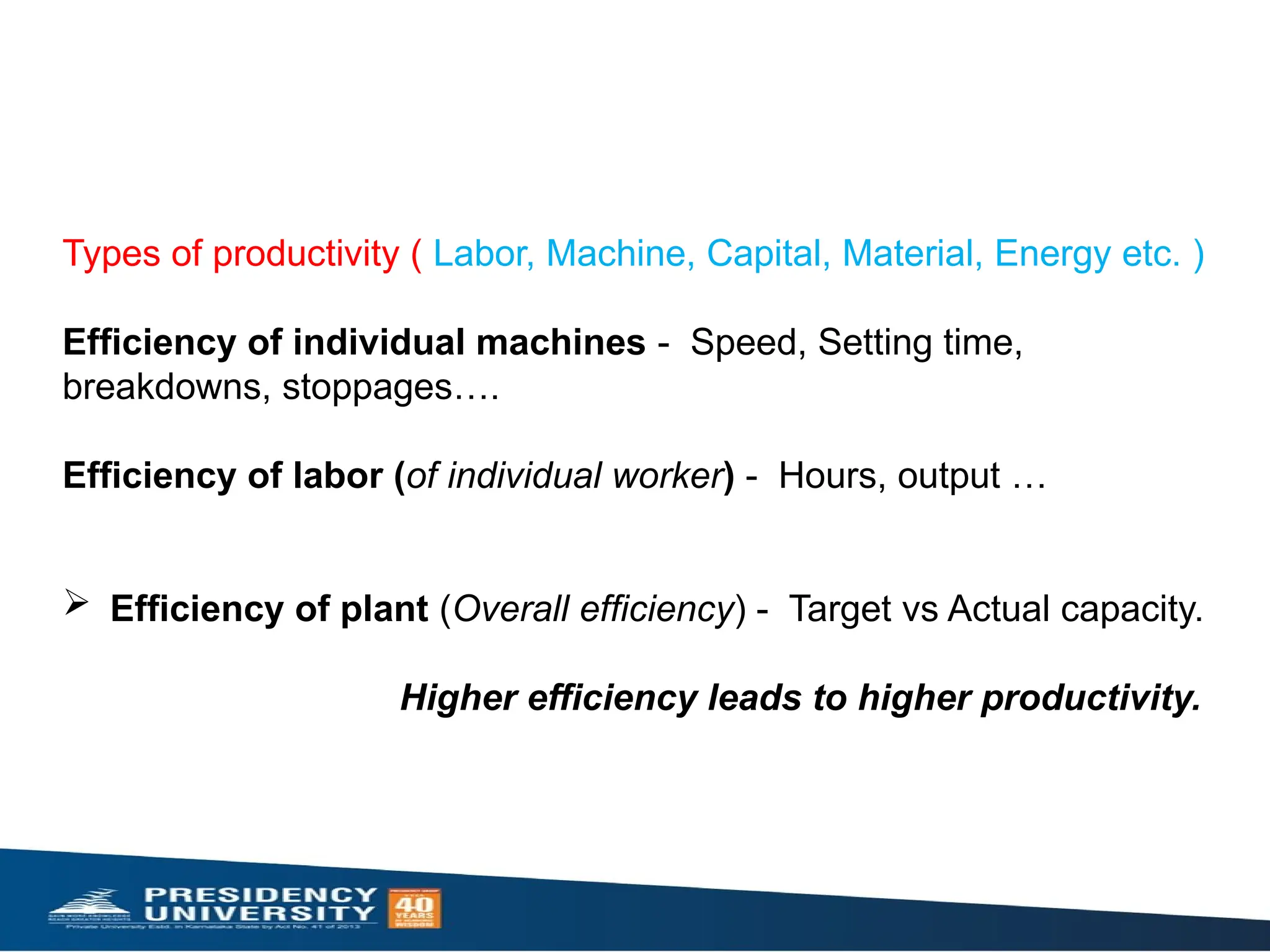
Types of productivity ( Labor, Machine, Capital, Material, Energy etc. )
Efficiency of individual machines - Speed, Setting time,
breakdowns, stoppages….
Efficiency of labor (of individual worker) - Hours, output …
 Efficiency of plant (Overall efficiency) - Target vs Actual capacity.
Higher efficiency leads to higher productivity.
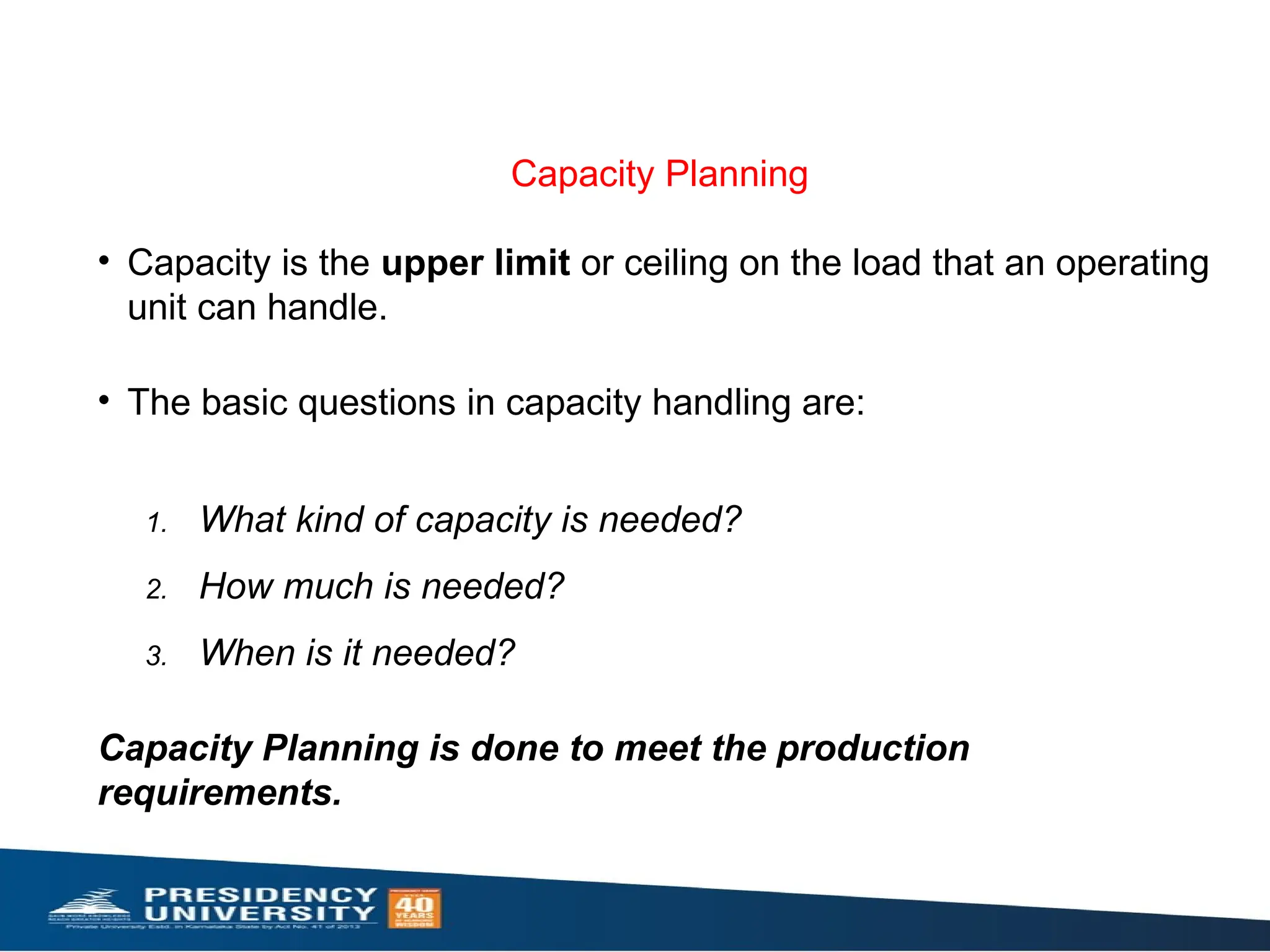
Capacity Planning
• Capacity is the upper limit or ceiling on the load that an operating
unit can handle.
• The basic questions in capacity handling are:
1. What kind of capacity is needed?
2. How much is needed?
3. When is it needed?
Capacity Planning is done to meet the production
requirements.
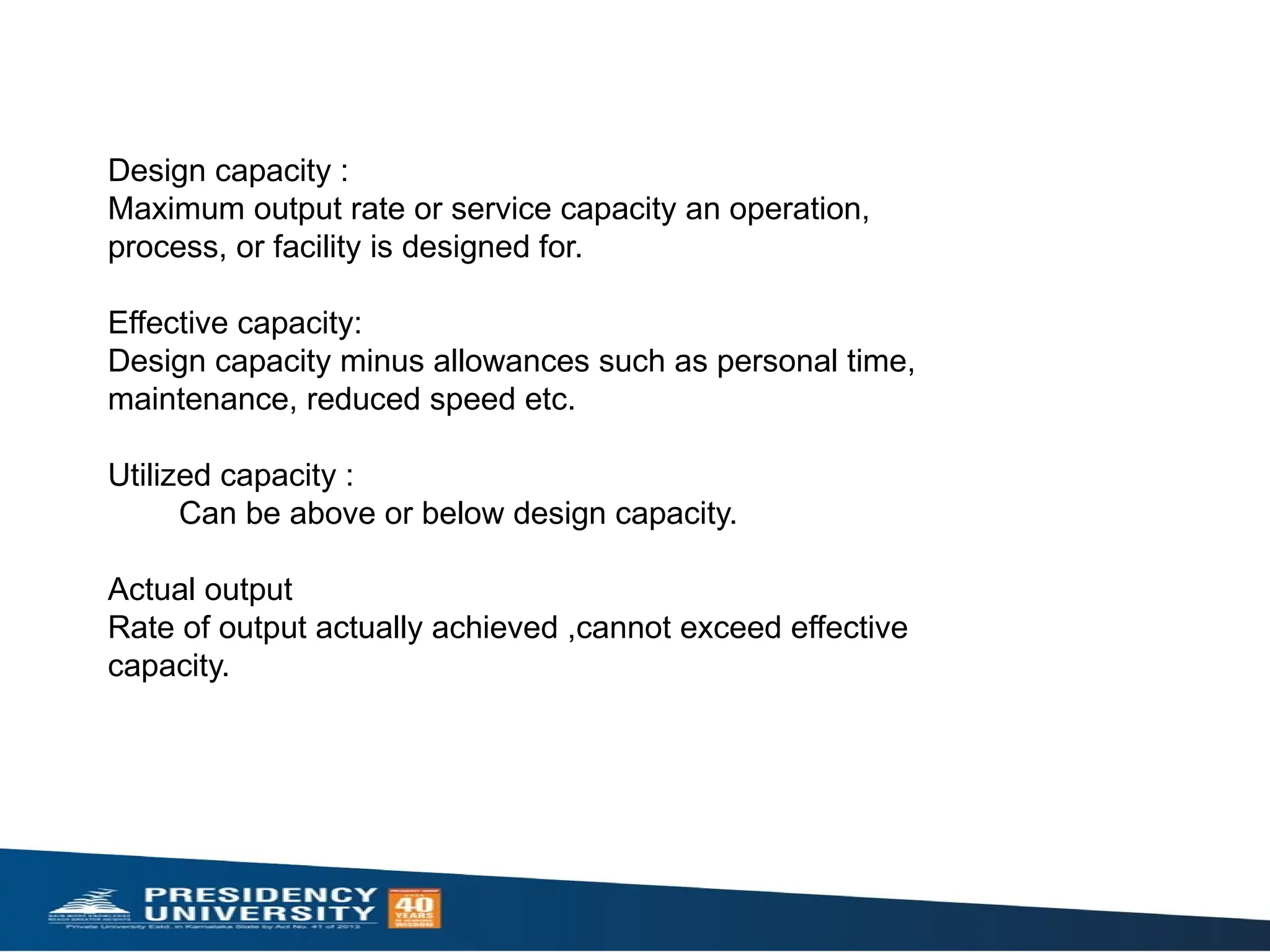
Design capacity :
Maximum output rate or service capacity an operation,
process, or facility is designed for.
Effective capacity:
Design capacity minus allowances such as personal time,
maintenance, reduced speed etc.
Utilized capacity :
Can be above or below design capacity.
Actual output
Rate of output actually achieved ,cannot exceed effective
capacity.
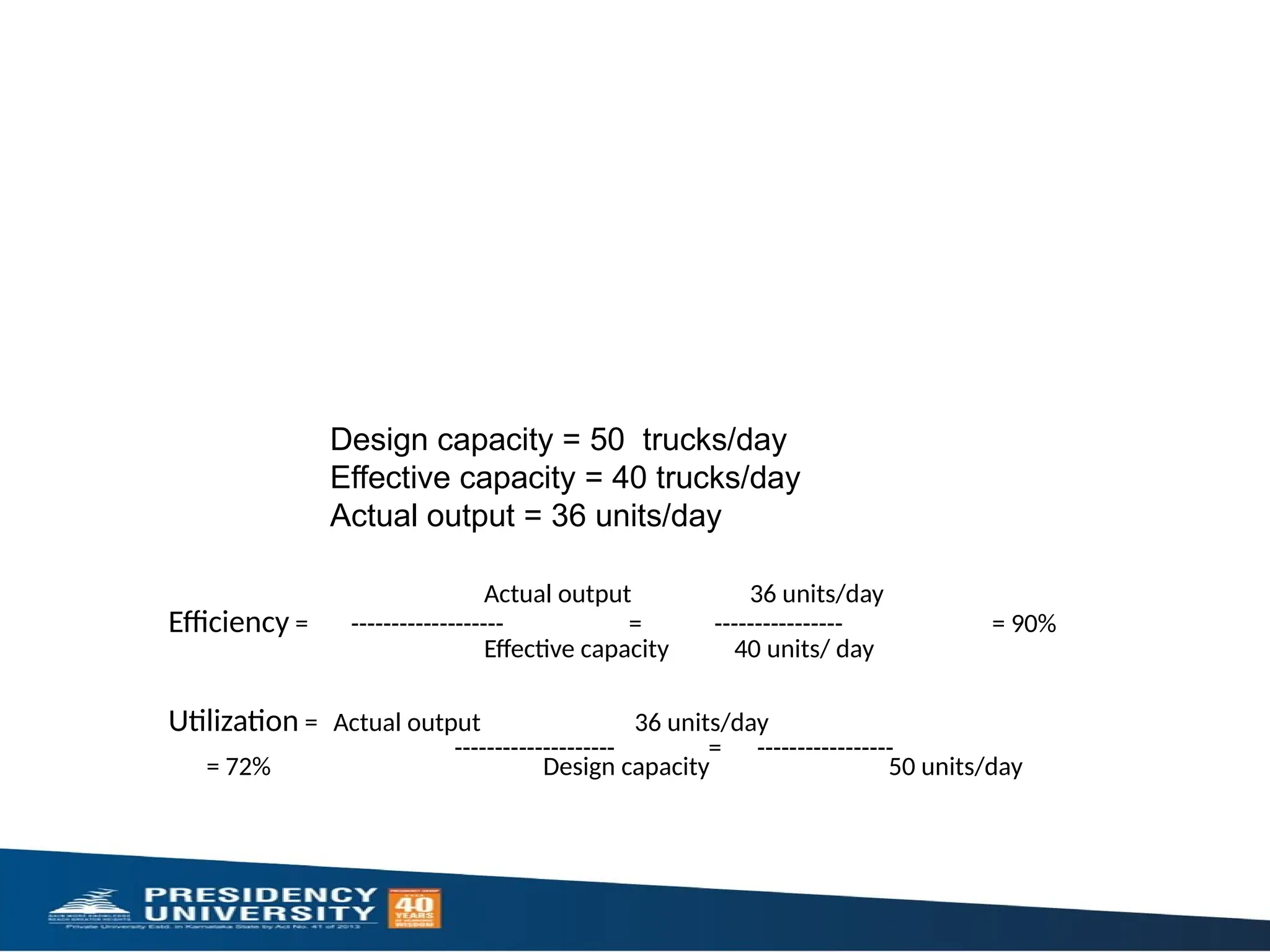
Design capacity = 50 trucks/day
Effective capacity = 40 trucks/day
Actual output = 36 units/day
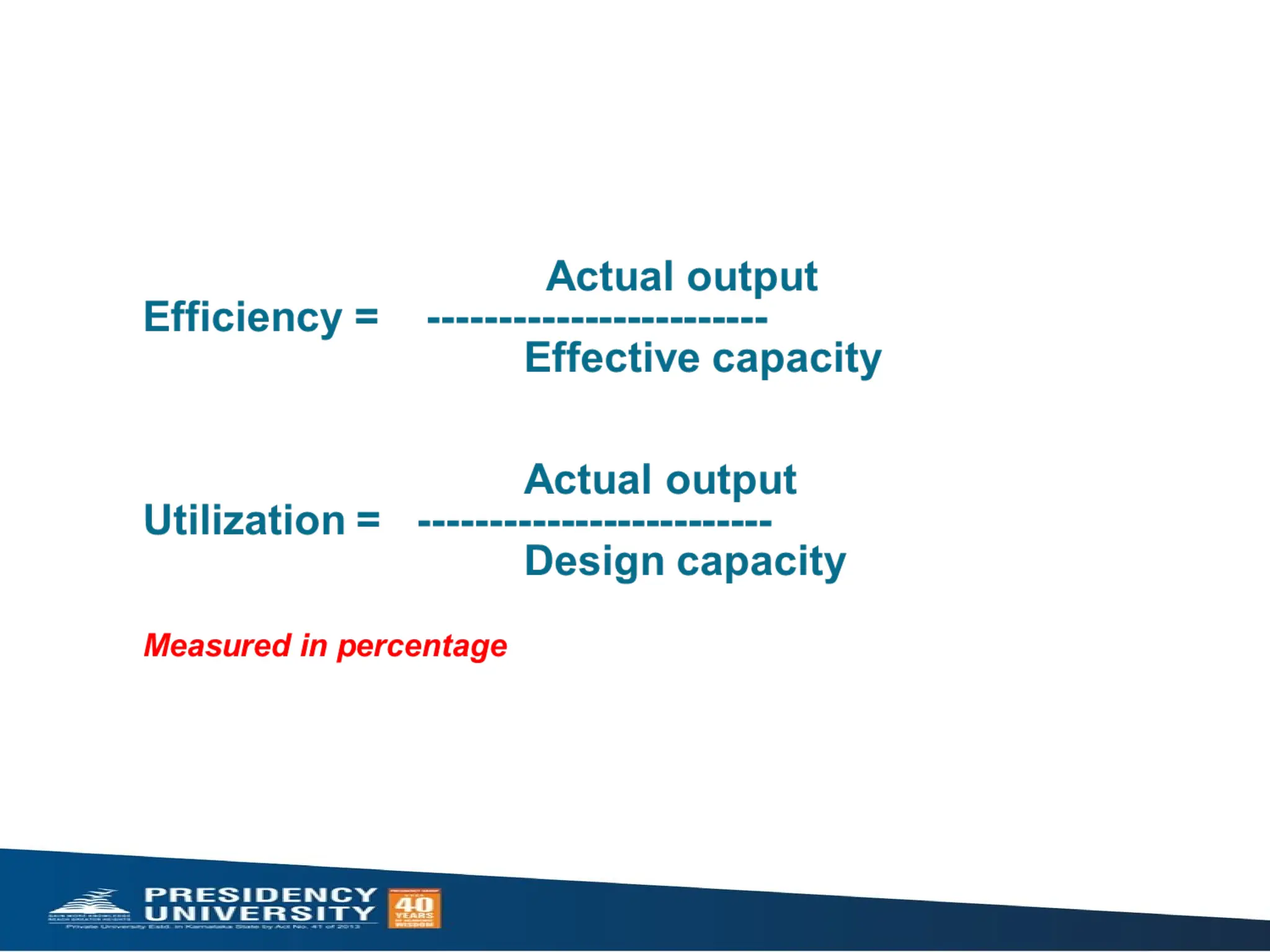
Actual output 36 units/day
Efficiency = ------------------- = ---------------- = 90%
Effective capacity 40 units/ day
Utilization = Actual output 36 units/day
-------------------- = -----------------
= 72% Design capacity 50 units/day
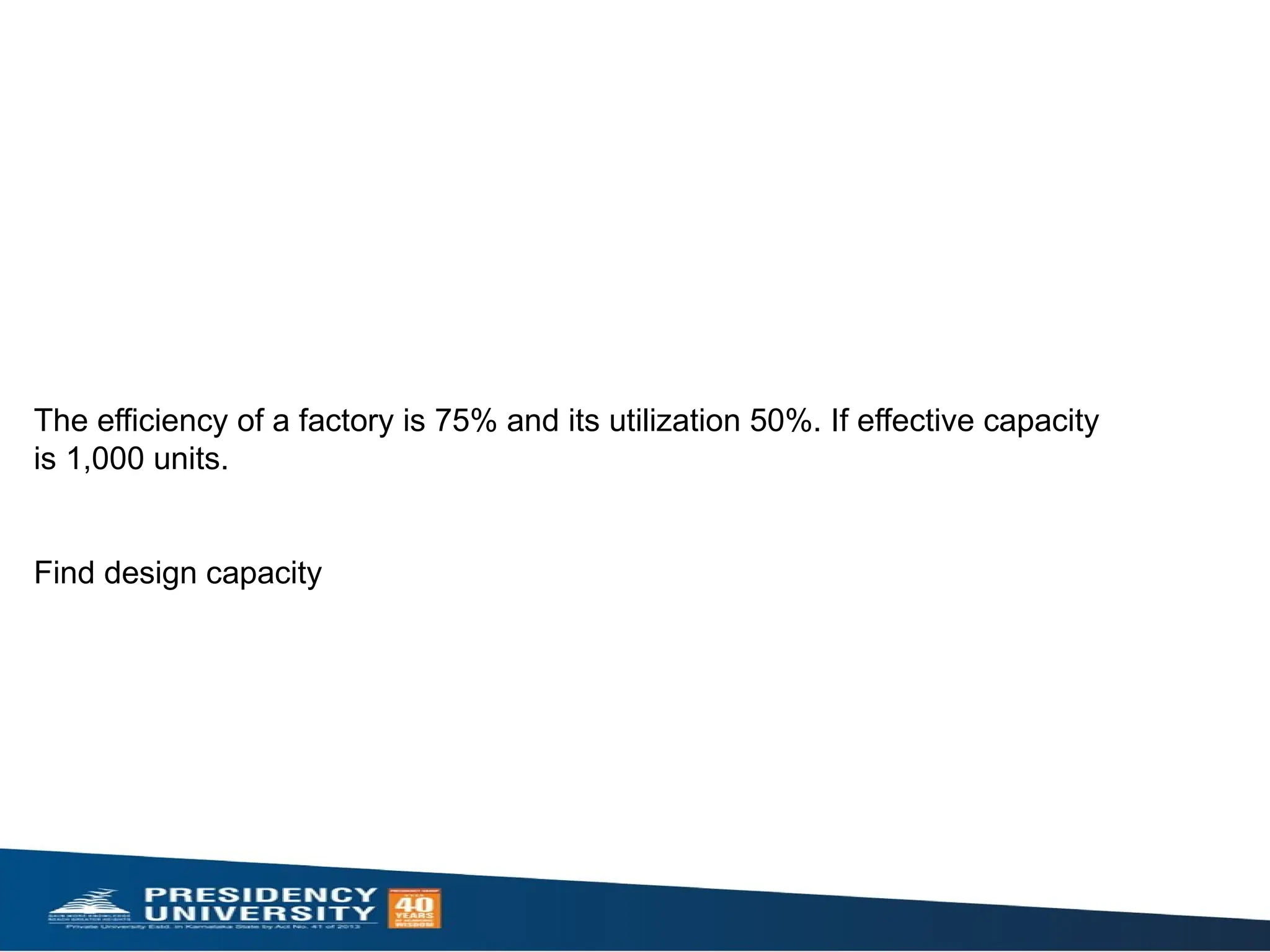
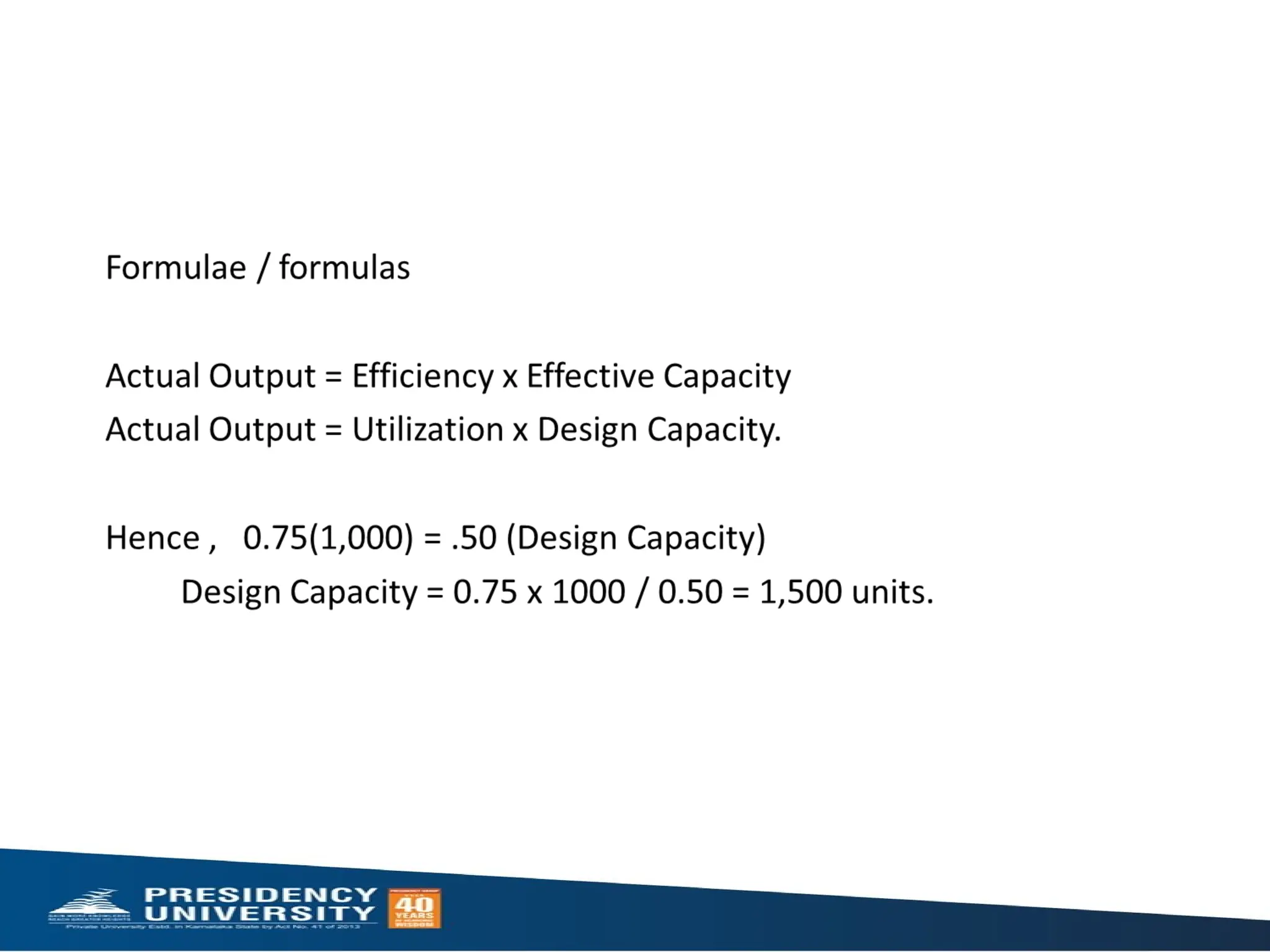
The efficiency of a factory is 75% and its utilization 50%. If effective capacity
is 1,000 units.
Find design capacity
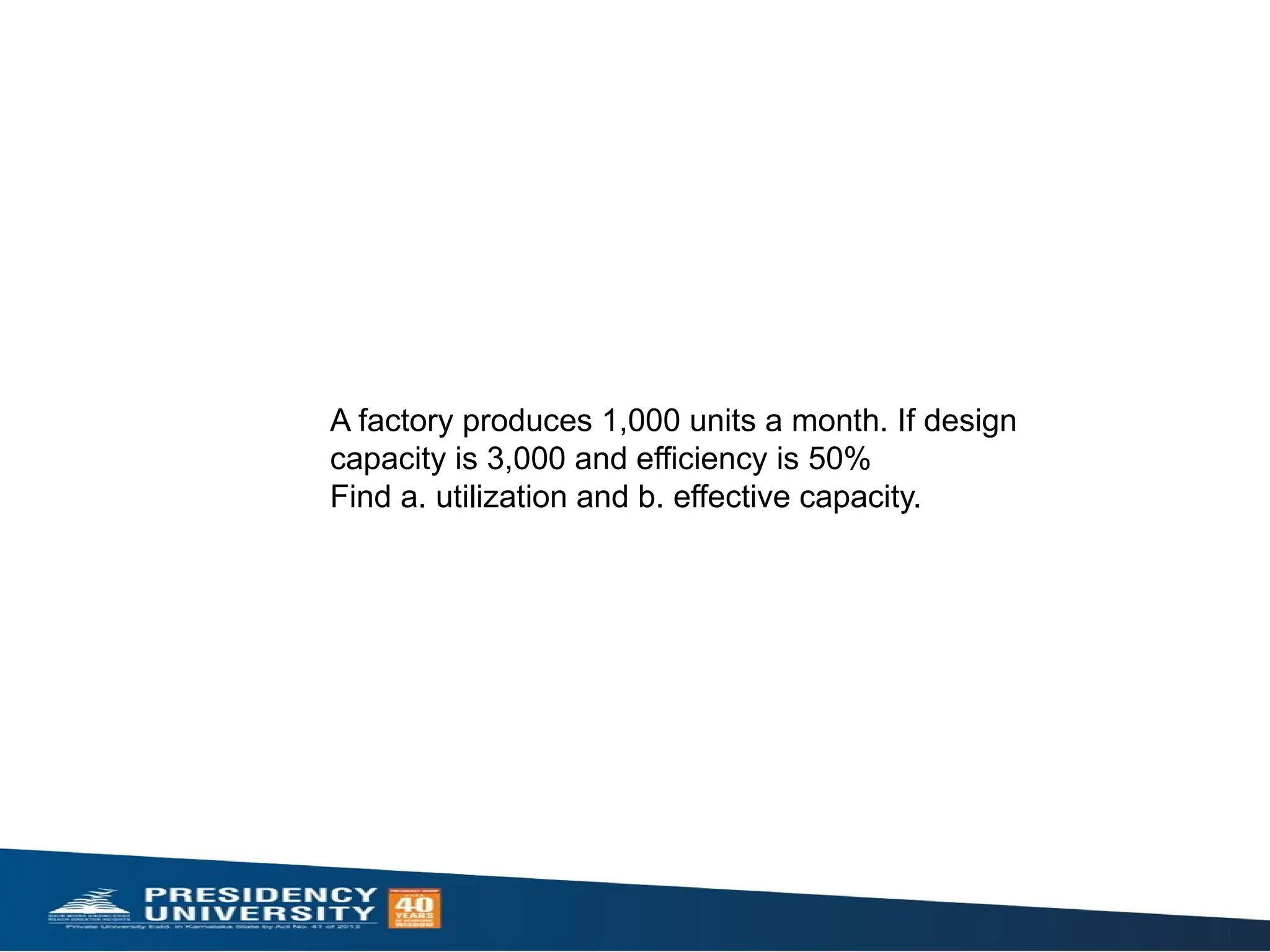
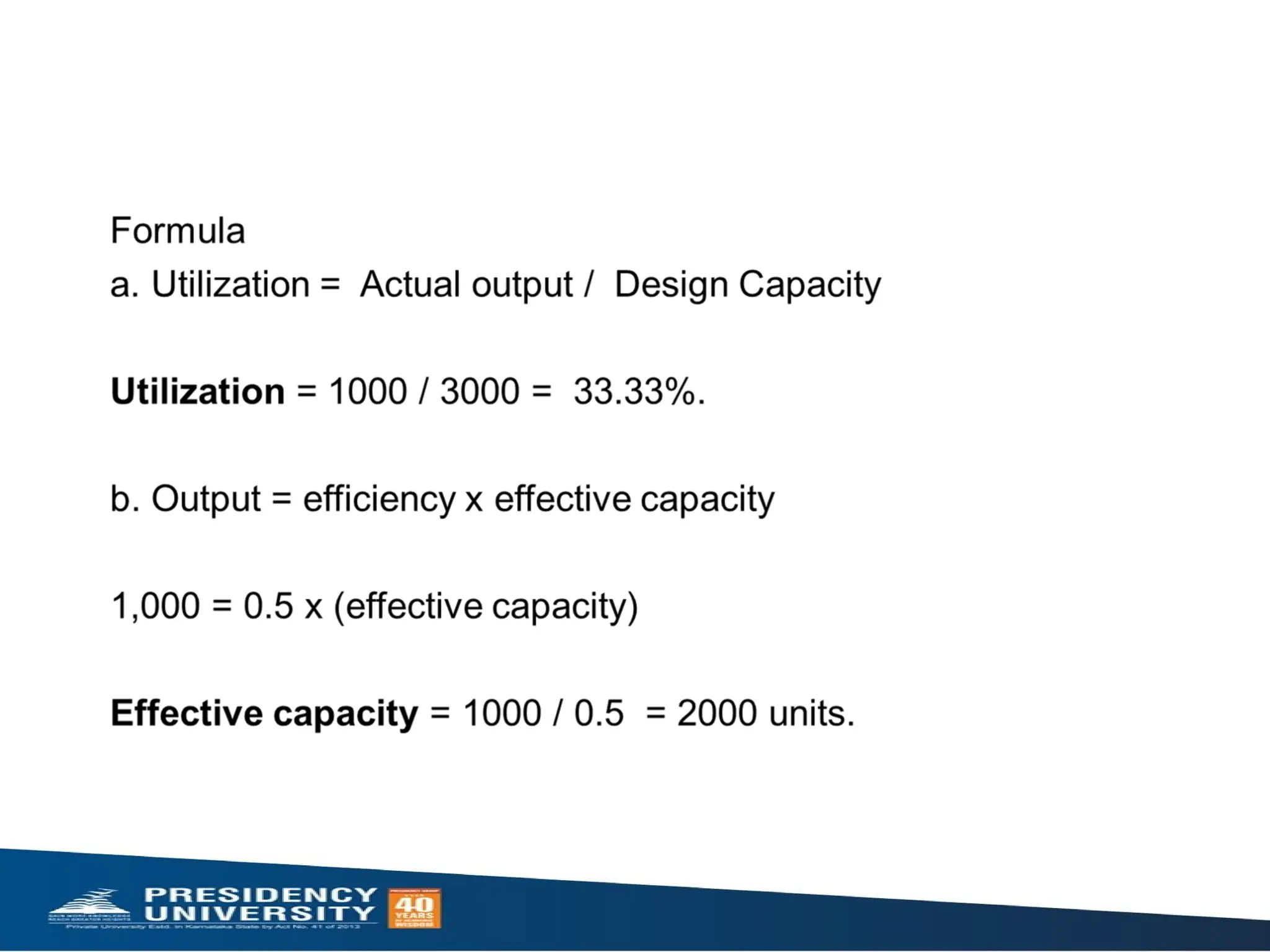
A factory produces 1,000 units a month. If design
capacity is 3,000 and efficiency is 50%
Find a. utilization and b. effective capacity.
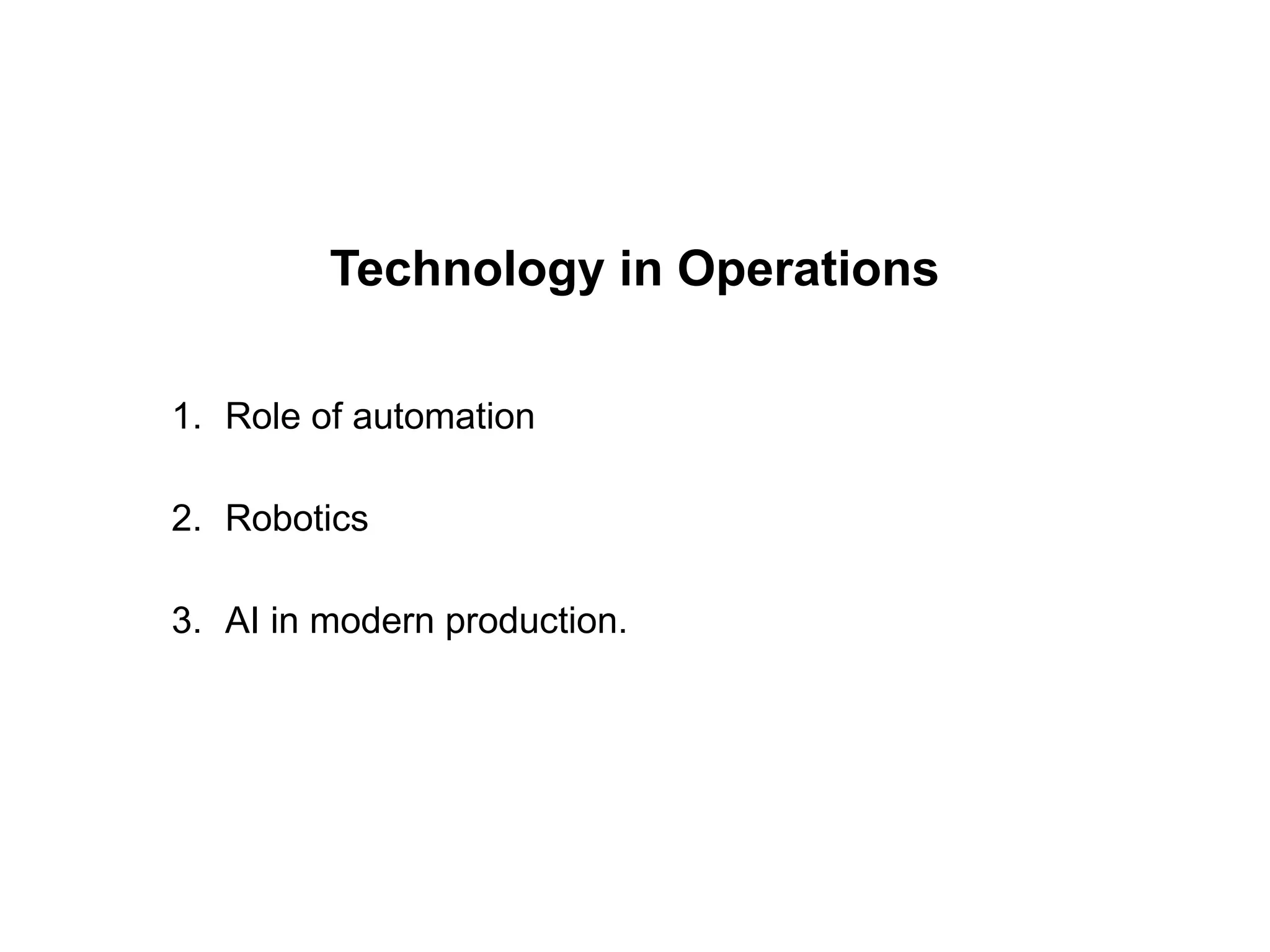
Technology in Operations
1. Role of automation
2. Robotics
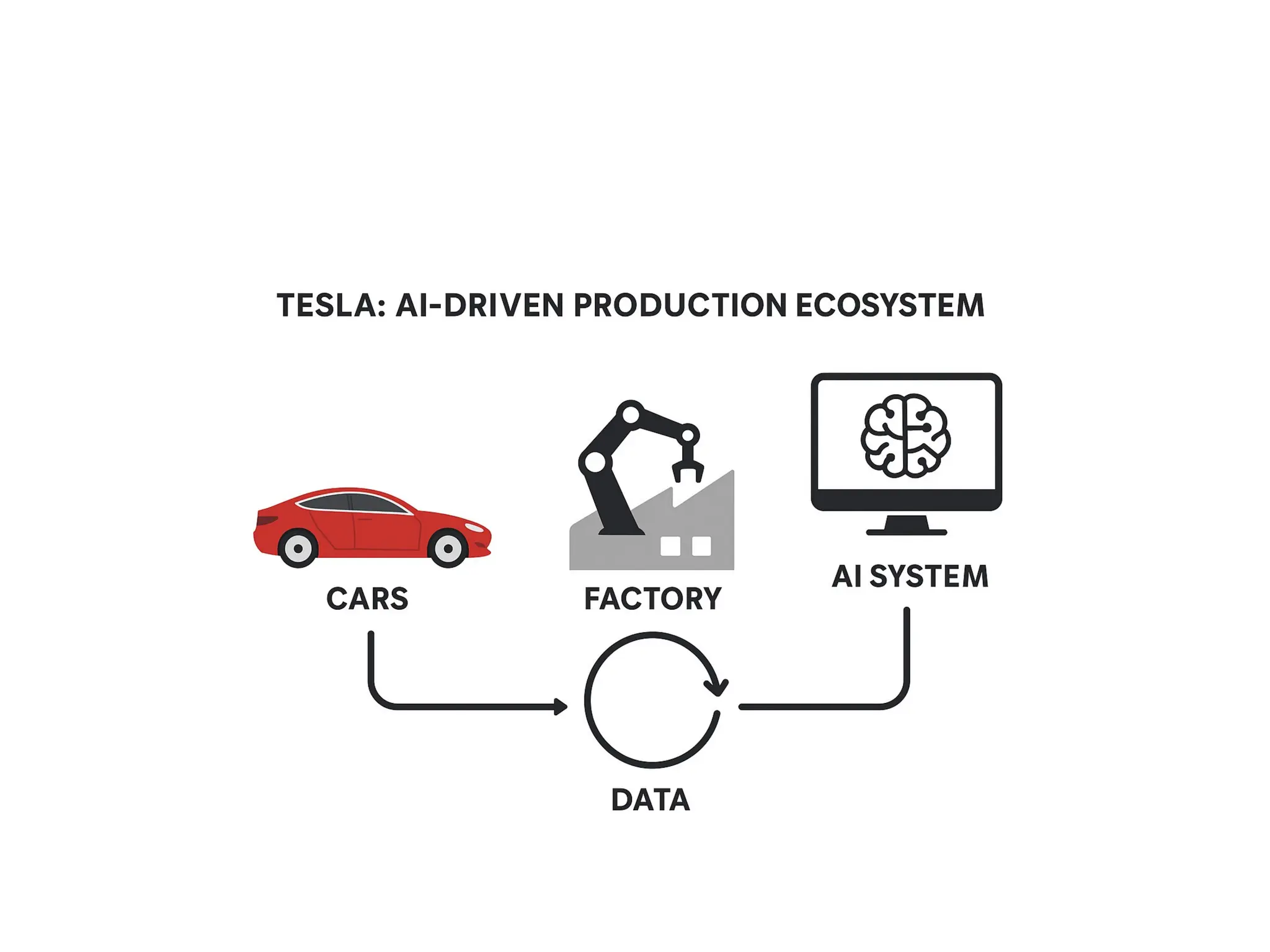
3. AI in modern production.
•https://www.youtube.com/watch?v=U2AGLeJBFNg
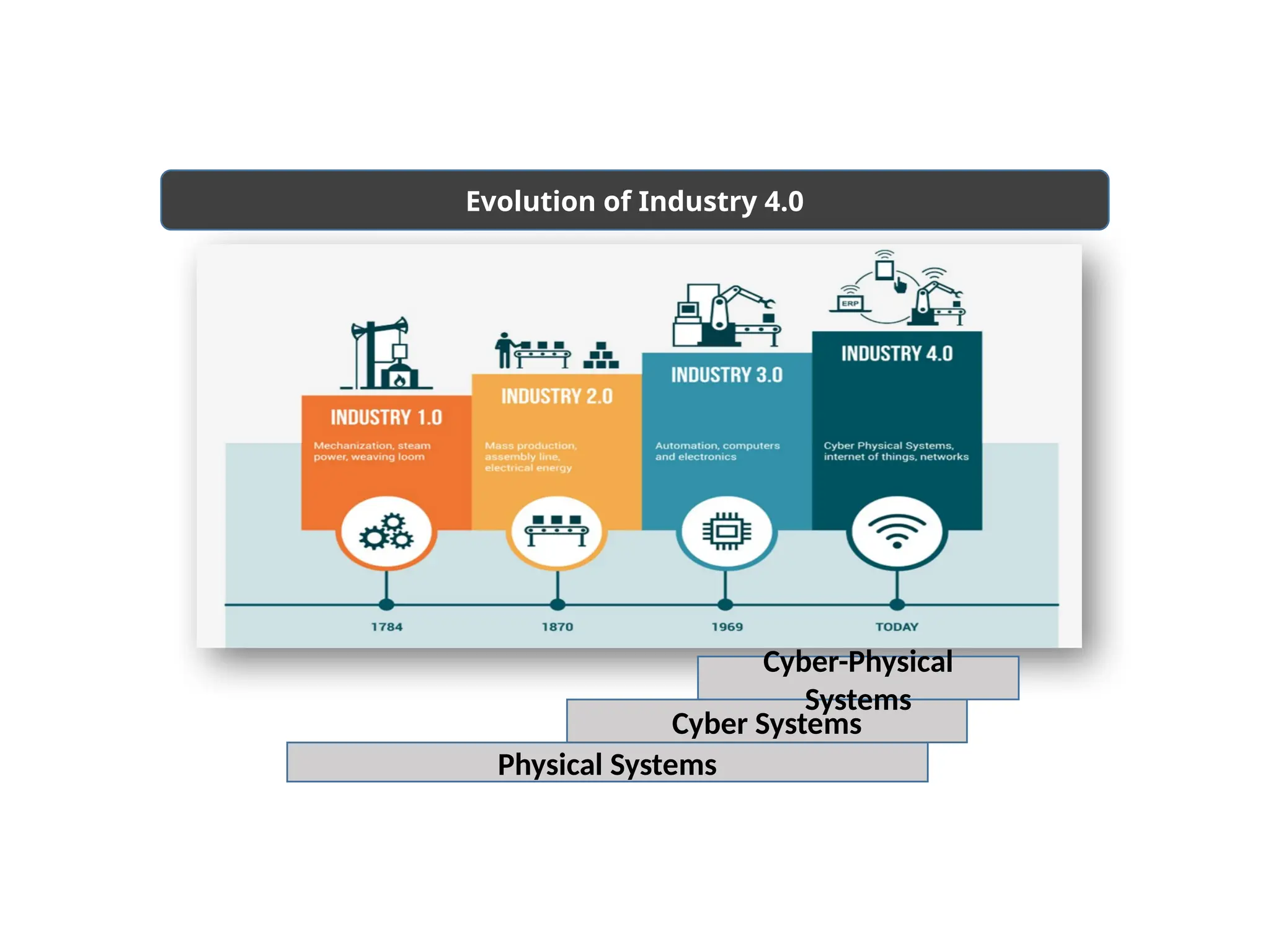
Evolution of Industry 4.0
Physical Systems
Cyber Systems
Cyber-Physical
Systems
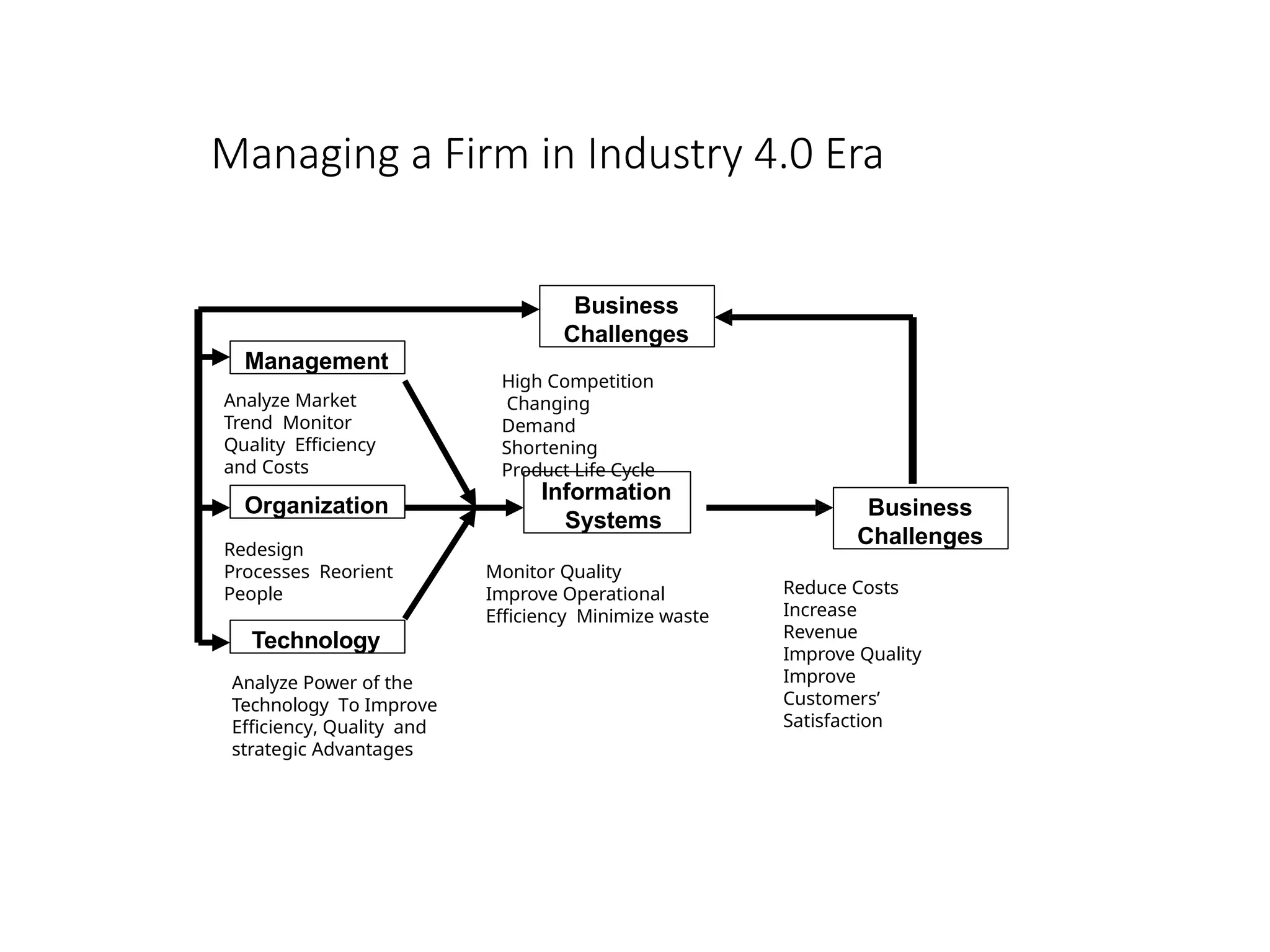
Managing a Firm in Industry 4.0 Era
Management
Organization
Technology
Business
Challenges
Information
Systems
Business
Challenges
Reduce Costs
Increase
Revenue
Improve Quality
Improve
Customers’
Satisfaction
Monitor Quality
Improve Operational
Efficiency Minimize waste
High Competition
Changing
Demand
Shortening
Product Life Cycle
Analyze Market
Trend Monitor
Quality Efficiency
and Costs
Redesign
Processes Reorient
People
Analyze Power of the
Technology To Improve
Efficiency, Quality and
strategic Advantages
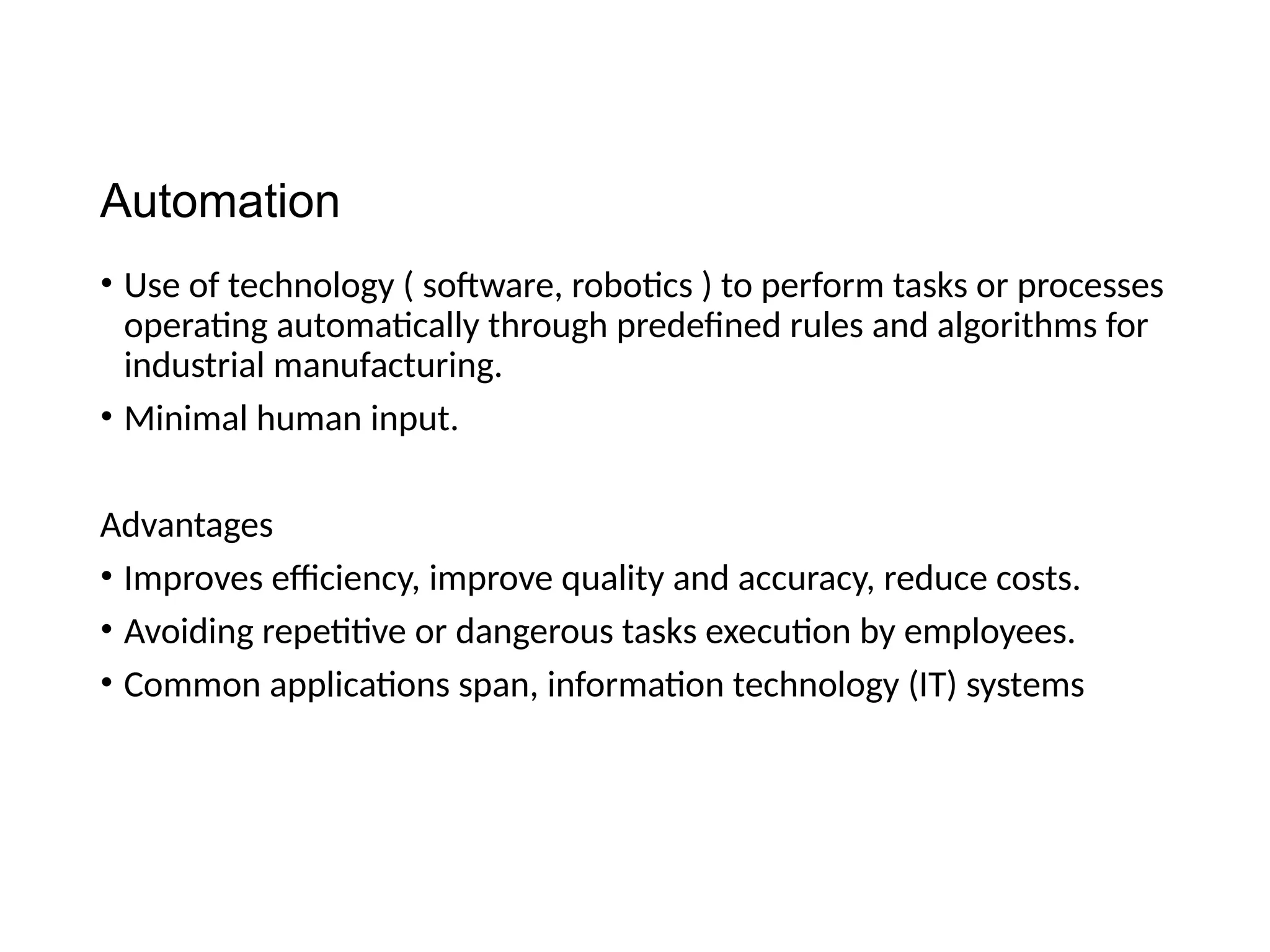
Automation
• Use of technology ( software, robotics ) to perform tasks or processes
operating automatically through predefined rules and algorithms for
industrial manufacturing.
• Minimal human input.
Advantages
• Improves efficiency, improve quality and accuracy, reduce costs.
• Avoiding repetitive or dangerous tasks execution by employees.
• Common applications span, information technology (IT) systems
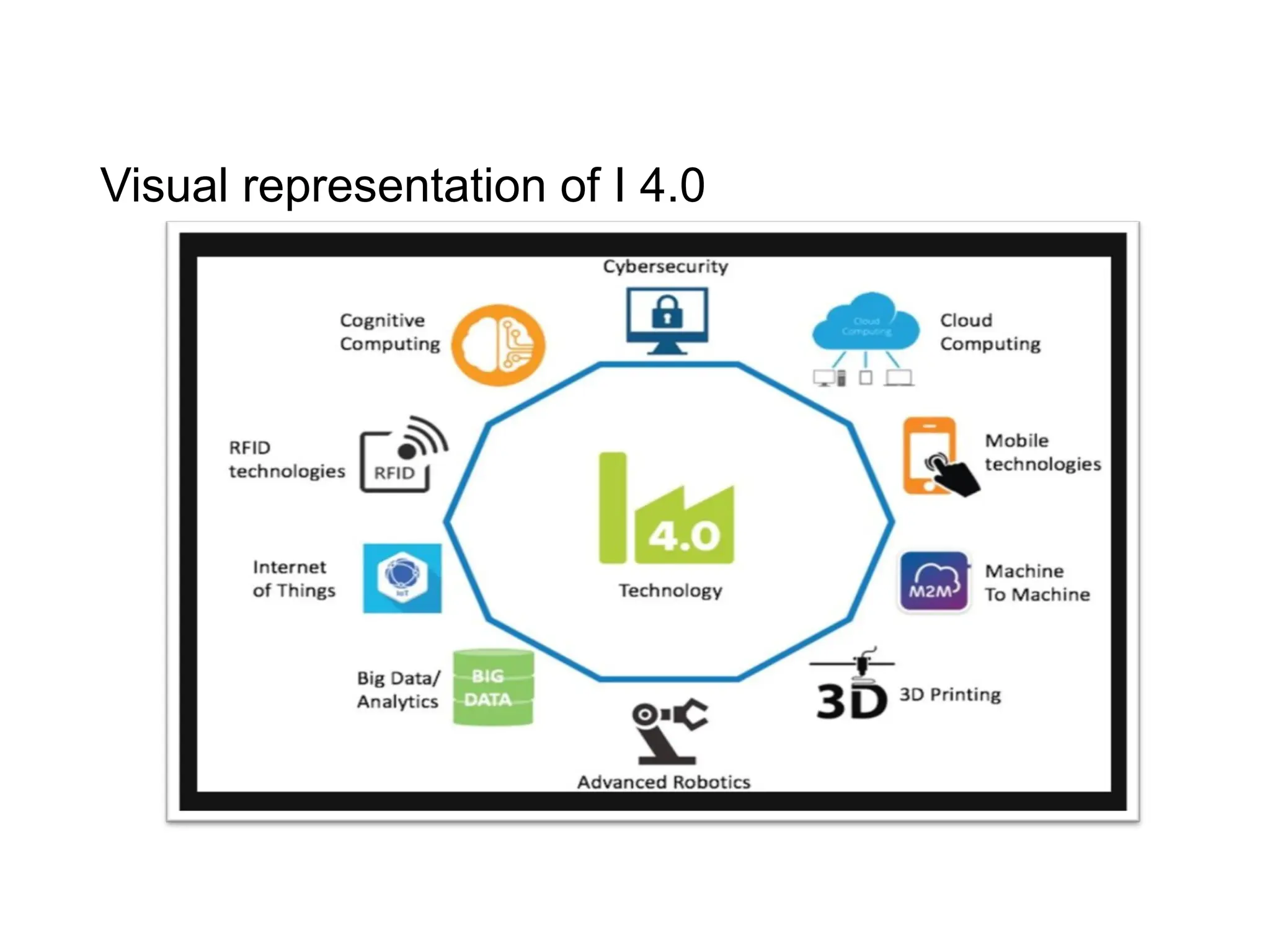
Visual representation of I 4.0
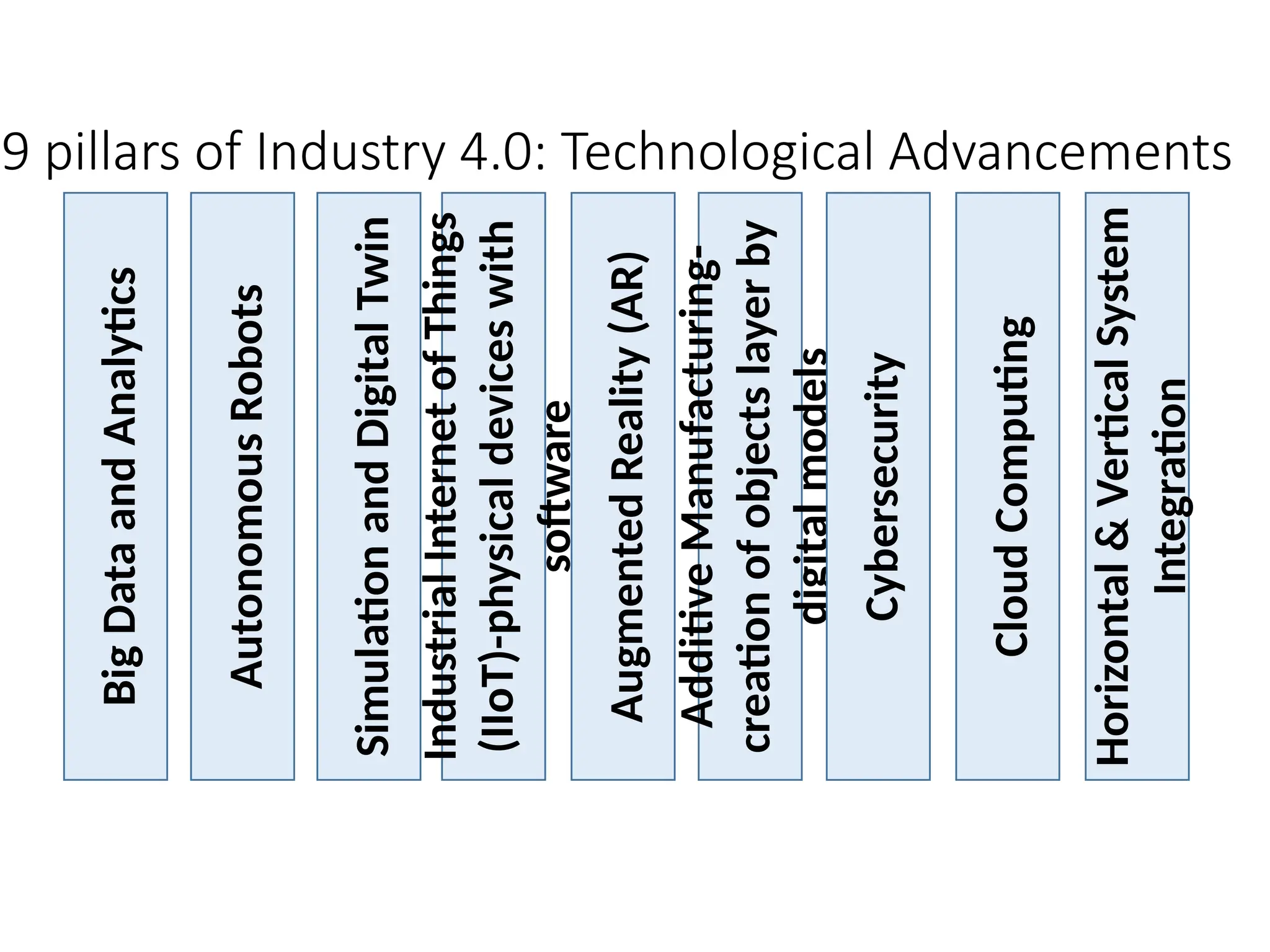
9 pillars of Industry 4.0: Technological Advancements
Big
Data
and
Analytics
Autonomous
Robots
Simulation
and
Digital
Twin
Industrial
Internet
of
Things
(IIoT)-physical
devices
with
software
Augmented
Reality
(AR)
Additive
Manufacturing-
creation
of
objects
layer
by
digital
models
Cybersecurity
Cloud
Computing
Horizontal
&
Vertical
System
Integration
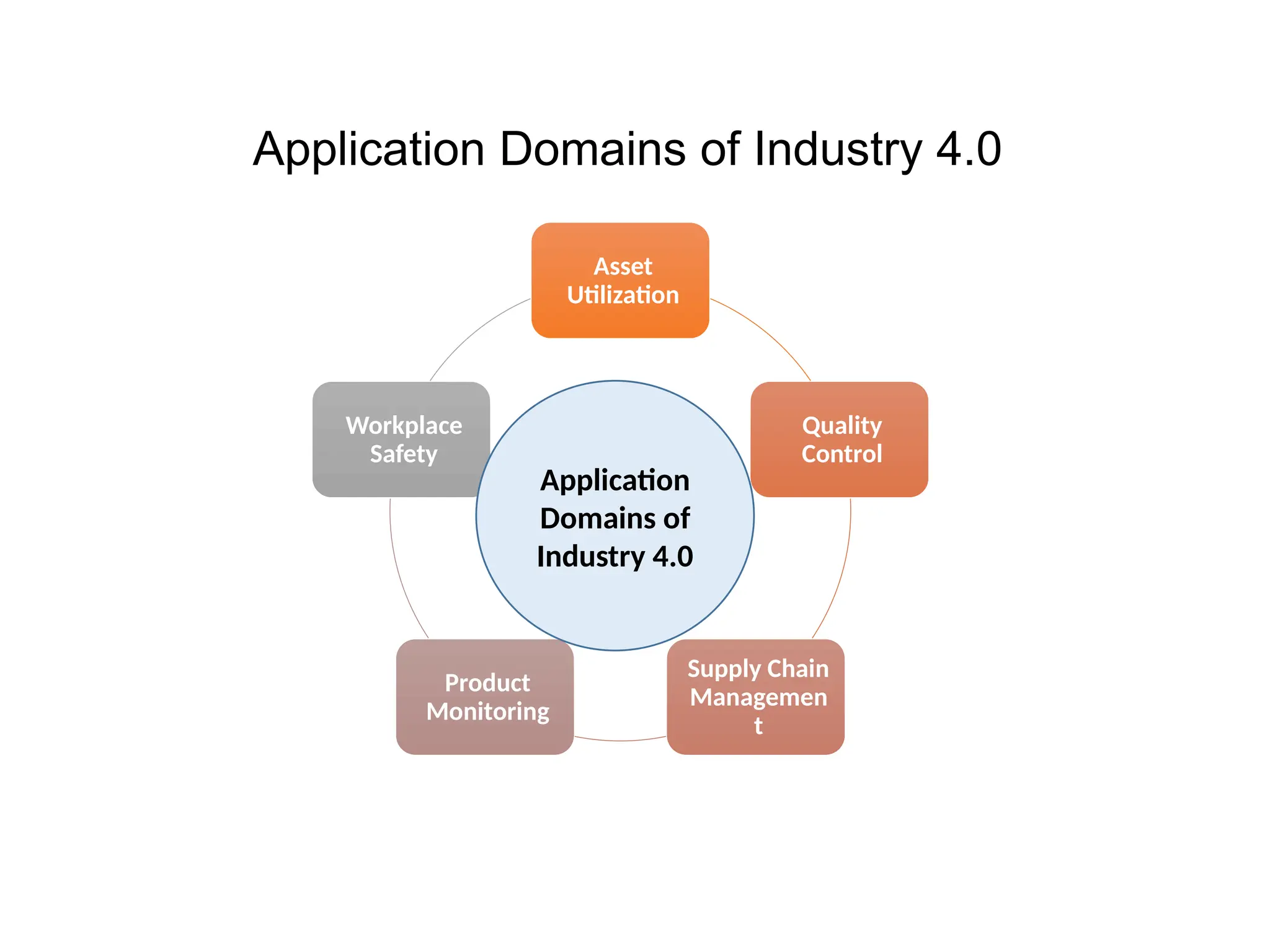
Asset
Utilization
Quality
Control
Supply Chain
Managemen
t
Product
Monitoring
Workplace
Safety
Application
Domains of
Industry 4.0
Application Domains of Industry 4.0
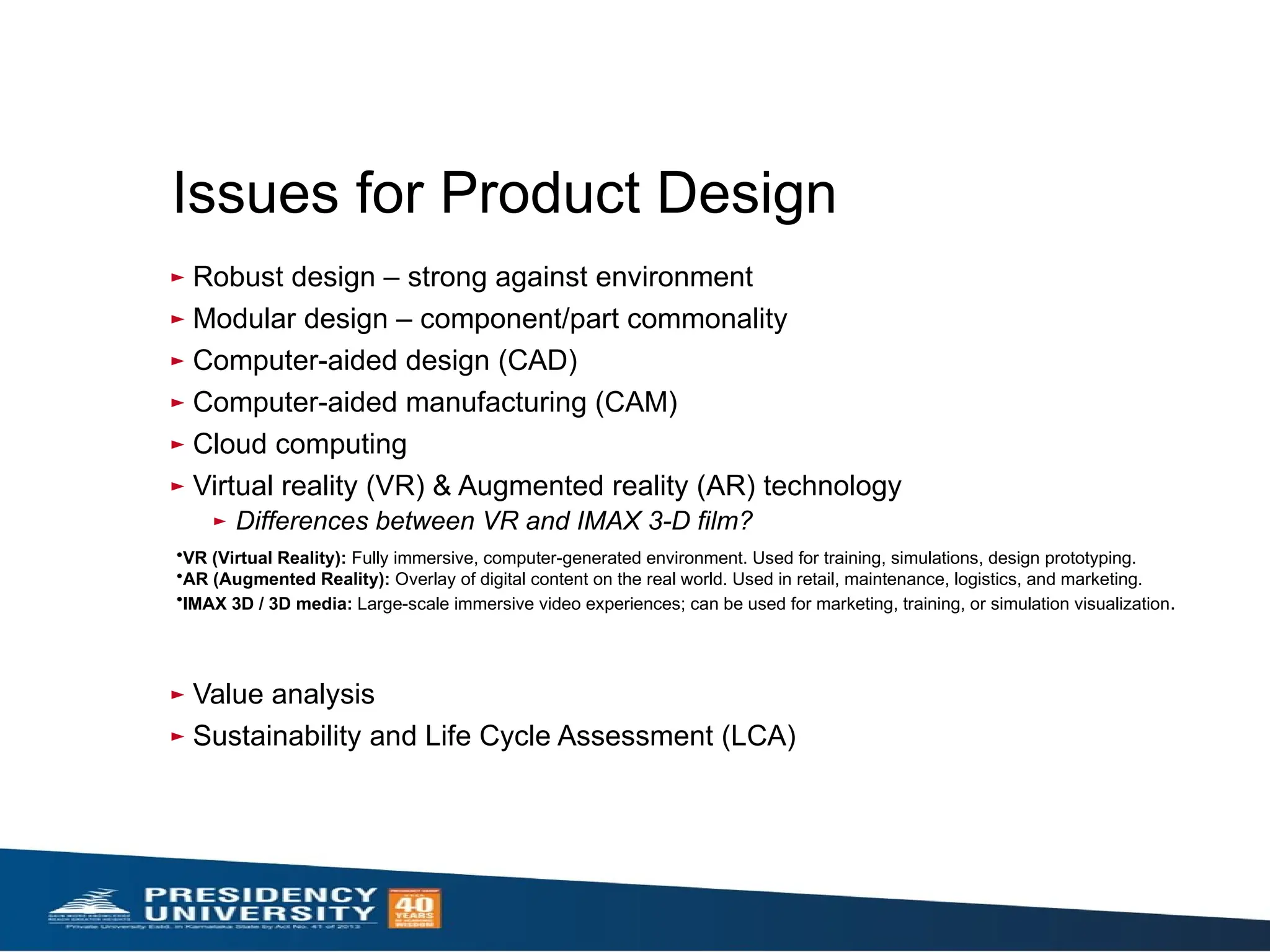
Issues for Product Design
► Robust design – strong against environment
► Modular design – component/part commonality
► Computer-aided design (CAD)
► Computer-aided manufacturing (CAM)
► Cloud computing
► Virtual reality (VR) & Augmented reality (AR) technology
► Differences between VR and IMAX 3-D film?
► Value analysis
► Sustainability and Life Cycle Assessment (LCA)
•VR (Virtual Reality): Fully immersive, computer-generated environment. Used for training, simulations, design prototyping.
•AR (Augmented Reality): Overlay of digital content on the real world. Used in retail, maintenance, logistics, and marketing.
•IMAX 3D / 3D media: Large-scale immersive video experiences; can be used for marketing, training, or simulation visualization.
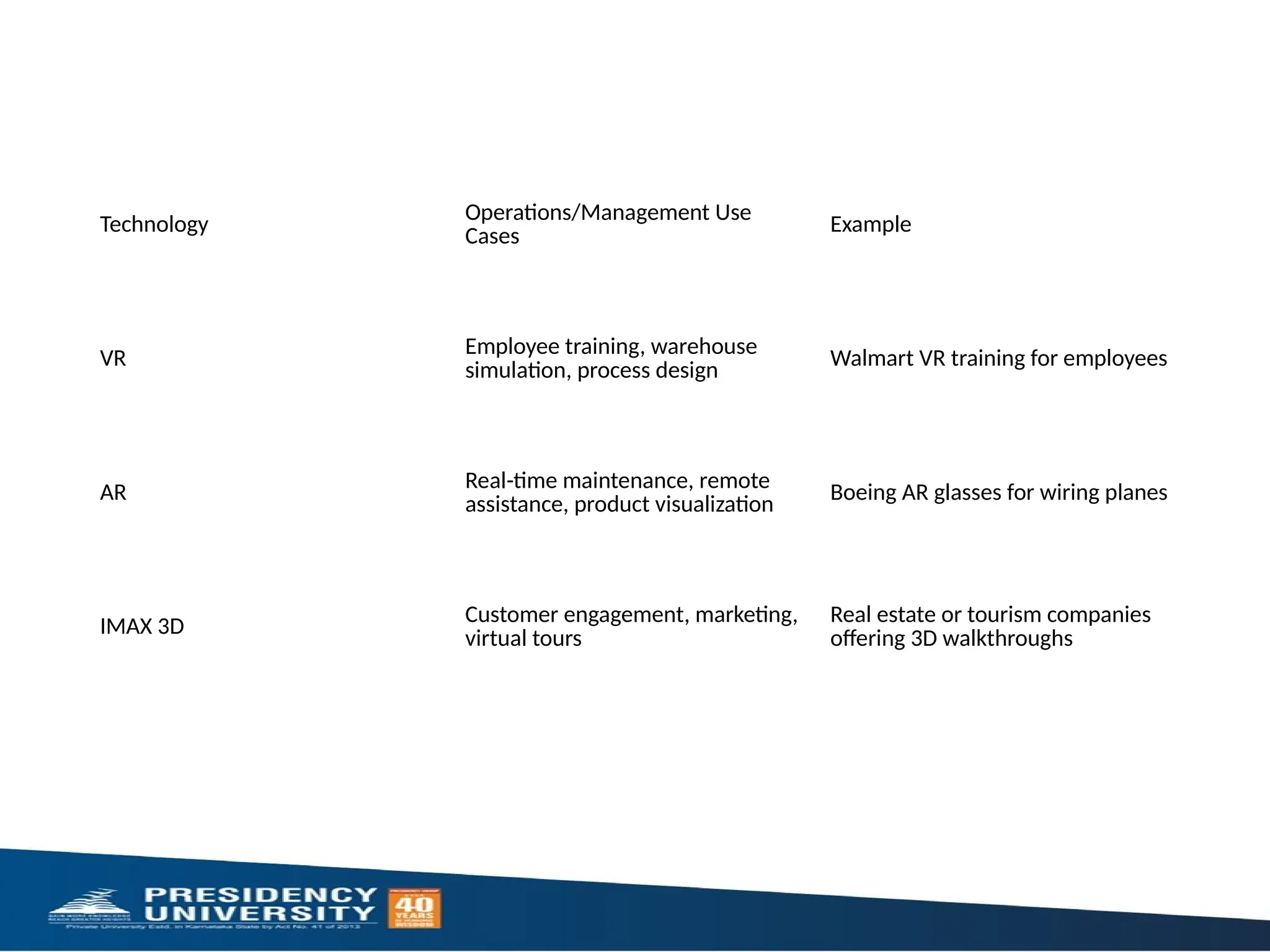
Technology Operations/Management Use
Cases Example
VR Employee training, warehouse
simulation, process design
Walmart VR training for employees
AR Real-time maintenance, remote
assistance, product visualization Boeing AR glasses for wiring planes
IMAX 3D Customer engagement, marketing,
virtual tours
Real estate or tourism companies
offering 3D walkthroughs
Robust Design
► Product is designed so that small variations in
production or assembly do not adversely affect
the product.
► Typically results in lower cost and higher quality
through less waste or scrap.
Modular Design
► Products designed in easily segmented components.
► Component commonality.
► Adds flexibility to both production and marketing.
► Easier (less) transportation (costs).
► Improved ability to satisfy customer requirements.
Manufacturability Engineering
Designing products in such a way that they are easy to manufacture.
► Benefits:
1. Reduced complexity of the product
2. Robust design; faster product development
3. Additional standardization of components
4. Improvement of functional aspects of the product
5. Improved job design and job safety
6. Improved maintainability (serviceability) of the
product
7. Reduction of environmental impact
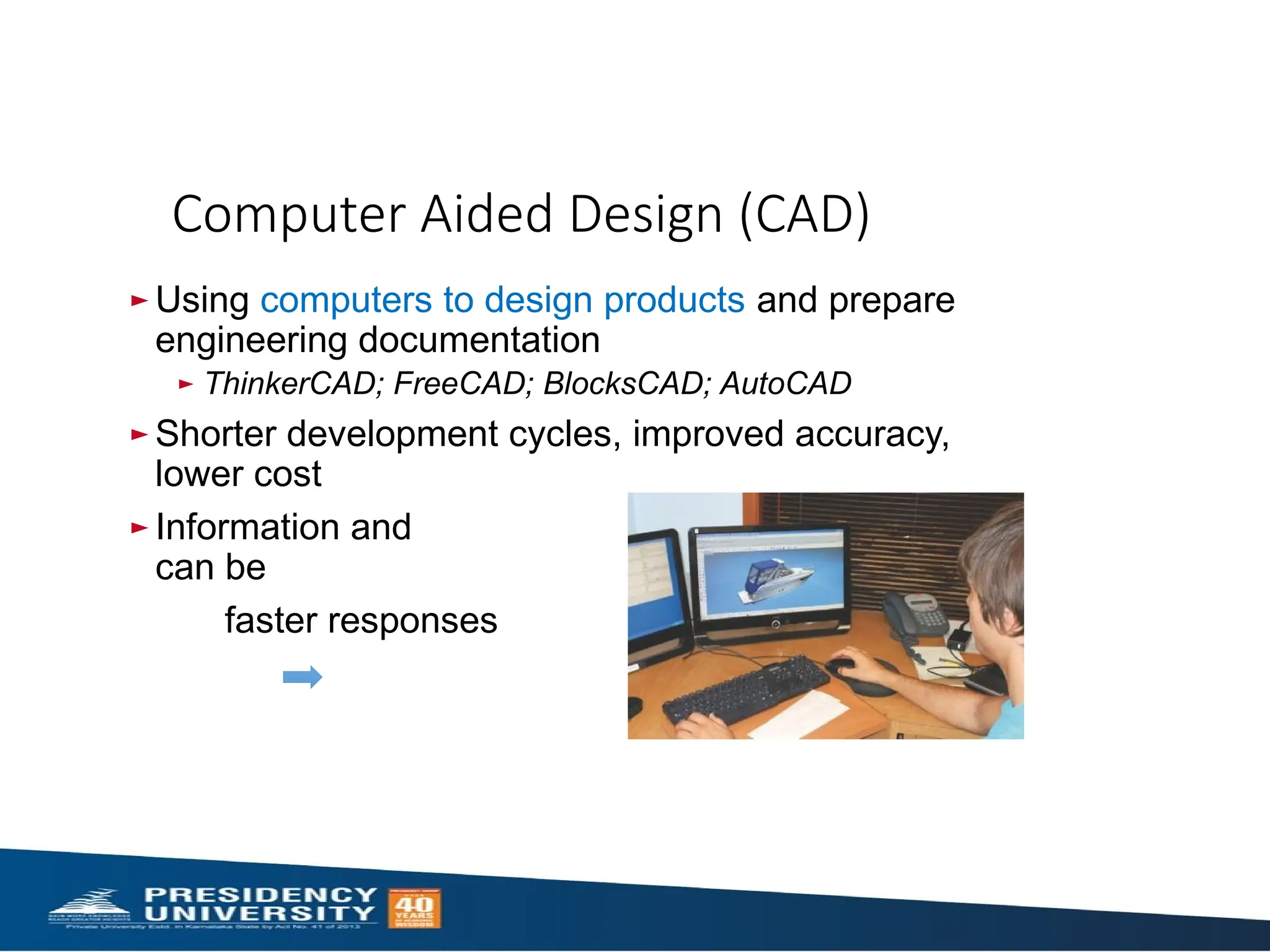
► Using computers to design products and prepare
engineering documentation
► ThinkerCAD; FreeCAD; BlocksCAD; AutoCAD
► Shorter development cycles, improved accuracy,
lower cost
► Information and designs
can be deployed worldwide
faster responses
Computer Aided Design (CAD)
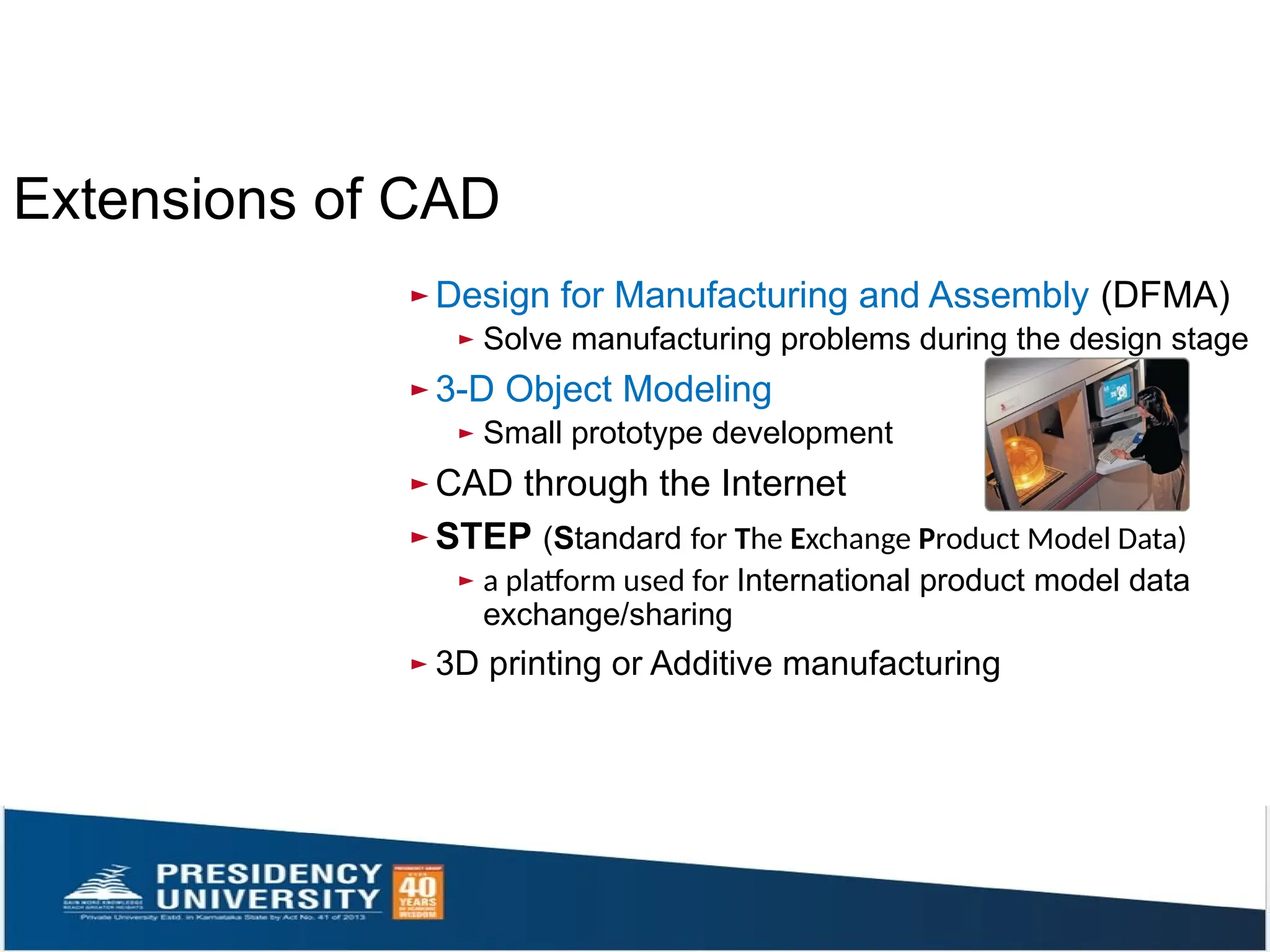
► Design for Manufacturing and Assembly (DFMA)
► Solve manufacturing problems during the design stage
► 3-D Object Modeling
► Small prototype development
► CAD through the Internet
► STEP (Standard for The Exchange Product Model Data)
► a platform used for International product model data
exchange/sharing
► 3D printing or Additive manufacturing
Extensions of CAD
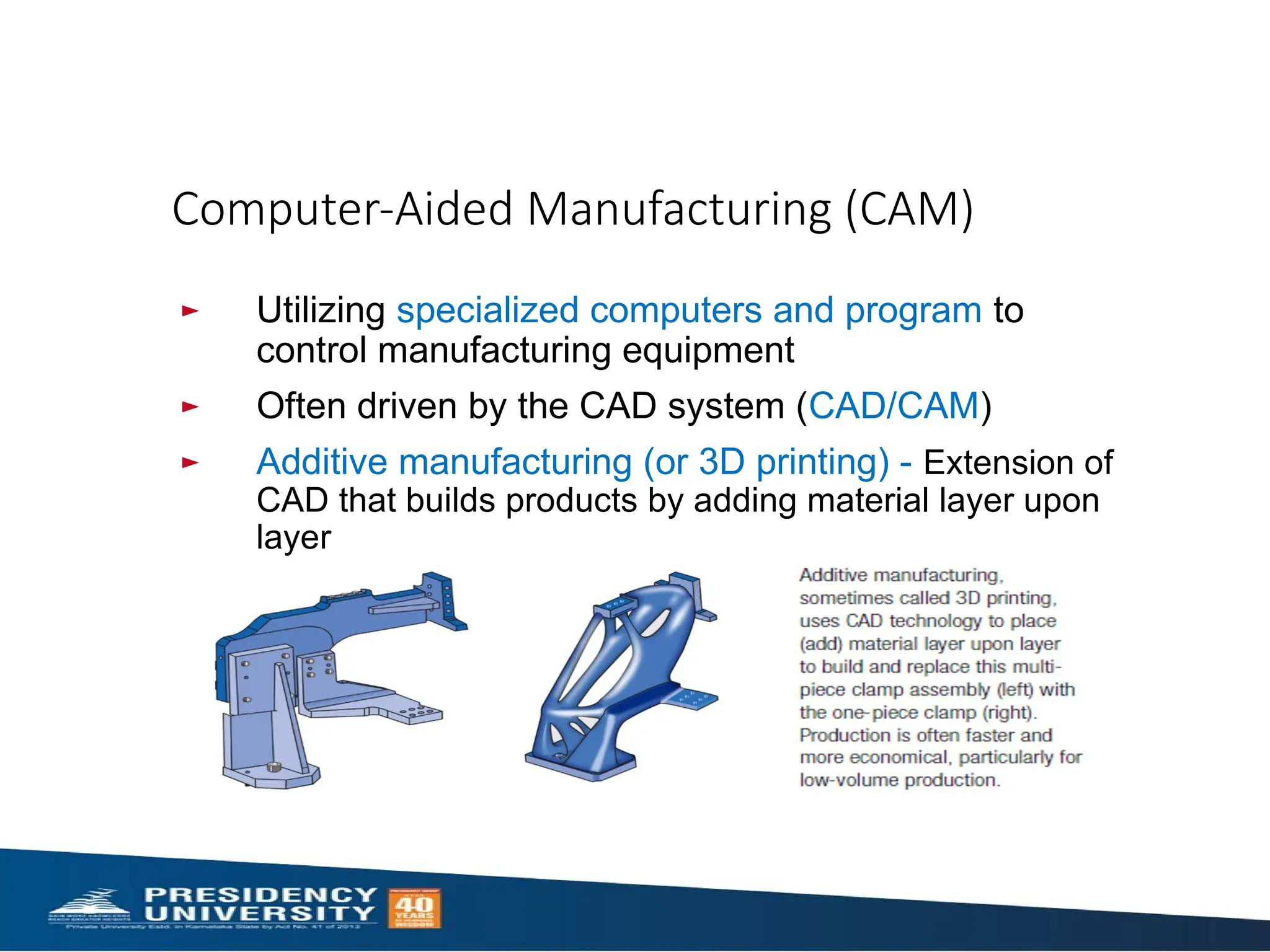
Computer-Aided Manufacturing (CAM)
► Utilizing specialized computers and program to
control manufacturing equipment
► Often driven by the CAD system (CAD/CAM)
► Additive manufacturing (or 3D printing) - Extension of
CAD that builds products by adding material layer upon
layer
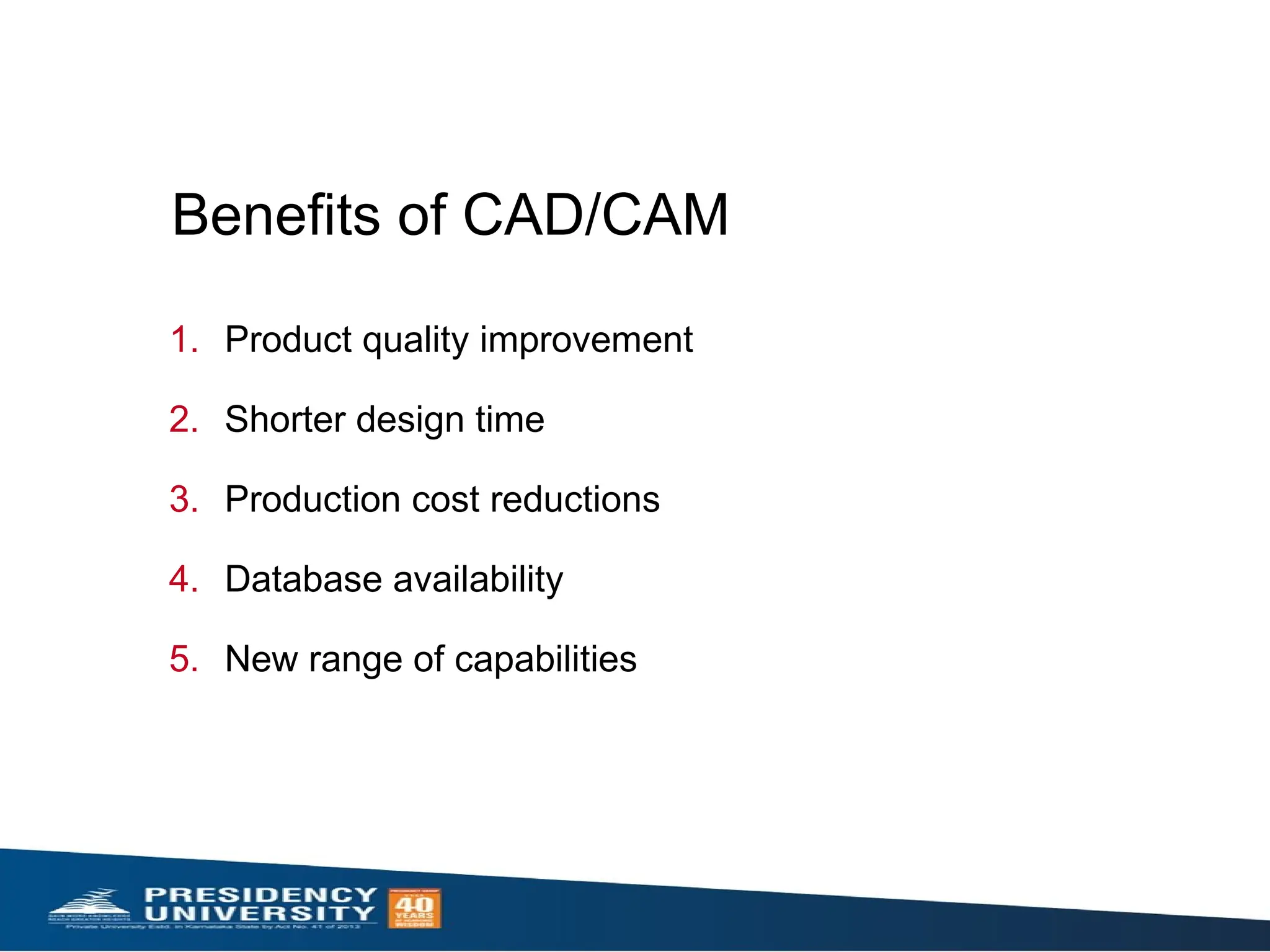
1. Product quality improvement
2. Shorter design time
3. Production cost reductions
4. Database availability
5. New range of capabilities
Benefits of CAD/CAM
INDUSTRIAL INTERNET OF THINGS
Interconnected industrial sensors, devices, and machines to
collect data, analyze it with AI and machine learning, and
then automate tasks to optimize industrial processes.
This technology is driven by Industry 4.0.
Enables Smart Factories to improve efficiency, productivity,
and safety through self-optimizing systems, predictive
maintenance, and real-time monitoring.
Enabled by technologies –
Cybersecurity
Cloud computing-Data in cloud
Edge computing-Data near to data source
Mobile technologies
Machine-to-machine
3D printing
1. Cyber Physical Systems (CPS): the basic technology
platform for IOT and IIoT to connect physical
machines ,previously disconnected
CPS integrates the dynamics of the physical process
with those of software and communication, providing
abstractions and modeling, design and analysis
techniques.
2. Cloud Computing : IT services and resources can be
uploaded to and retrieved from the Internet as opposed to
a direct connection to a server.
Files can be kept on cloud-based storage systems rather
than on local storage devices
. Edge computing – A distributed computing paradigm
bringing computer data storage closer to the location
where it is needed. In contrast to cloud computing ,
edge computing refers to decentralized data
processing at the edge of the network. Transform
productivity, products and services in the industrial
world.
4. Big data analytics: Big data analytics is the process
of examining large and varied data sets
5. Artificial Intelligence and Machine learning :
AI is a field within computer science in which intelligent
machines are created that work and react like humans.
Machine learning is a core part of AI, allowing software to
more accurately predict outcomes without explicitly being
programmed.
It is also possible to combine artificial intelligence with edge
computing in order to provide industrial edge intelligence
solutions. Use-cases : Condition monitoring ( predictive
maintenance) process optimization.
Federated learning (collaborative learning) is a machine
learning technique in a setting where multiple entities (often
called clients) collaboratively train a model while keeping
their data decentralized.
6. Deep Learning- A subset of machine learning and AI that
uses multilayered artificial networks for making predictions
from data
7. Design Thinking
ROBOTICS
It is the interdisciplinary study and practice
of the design, construction, operation, and
use of robots.
Robotics is the design and construction of
the physical structures of robots, while in
computer science, robotics focuses on
robotic automation algorithms.
Robotics develop machines that can learn,
reason, and solve problems, mimicking
human cognitive processes through
artificial intelligence. ( Intelligent
Machines )
1. Design & Construction: Creating the physical
structure and components of a robot, including its
movable frame and actuators for movement.
2. Programming: Robots are programmed to follow
specific instructions to perform tasks, whether simple or
complex.
3. Sensing: Robots utilize various sensors to perceive
and interact with their environment, gathering data
about their surroundings.
4. USES
Automation: The primary goal is to automate tasks, which
can be beneficial in various applications.
Manufacturing - Robots handle repetitive or dangerous
tasks on assembly lines.
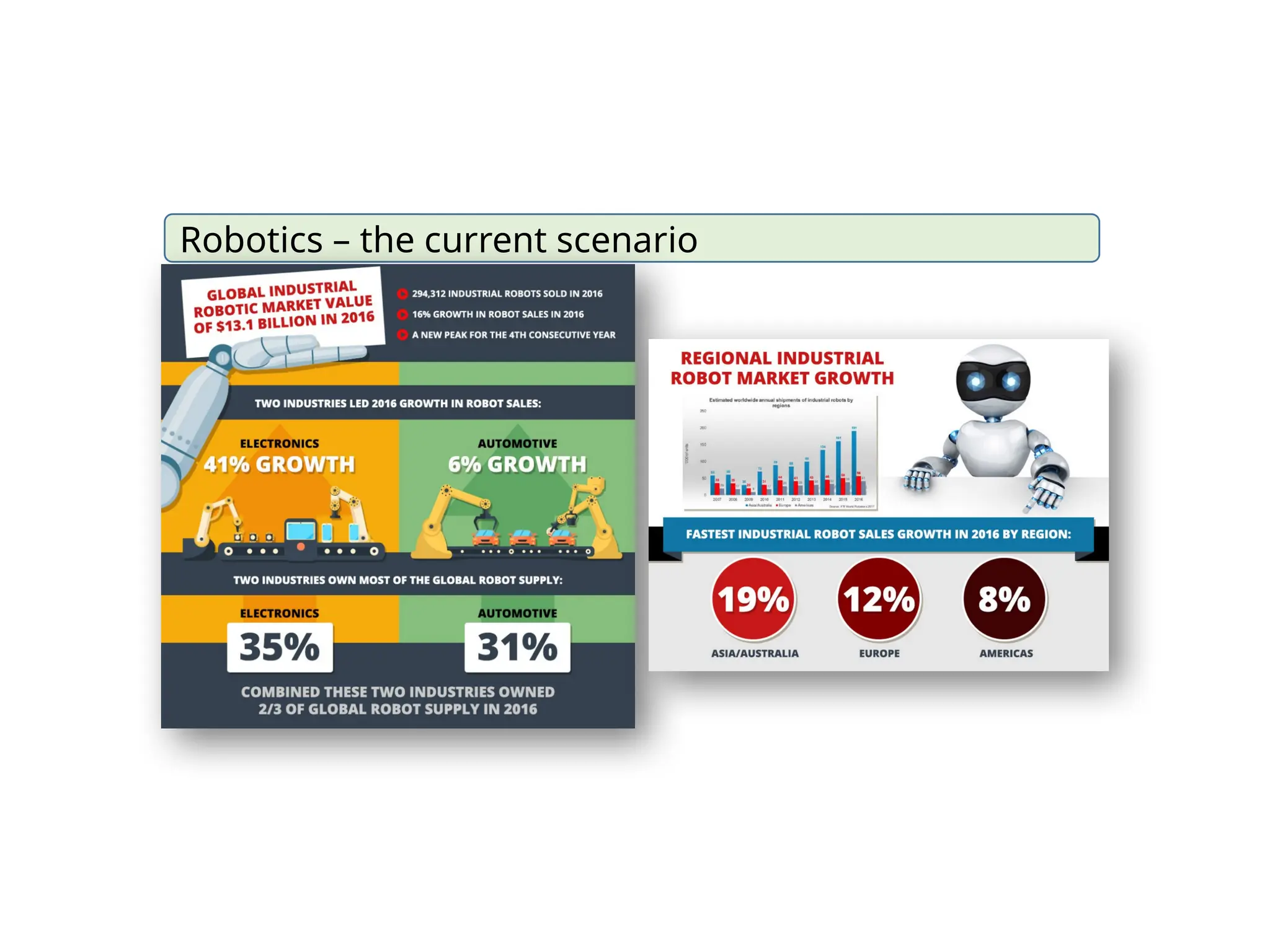
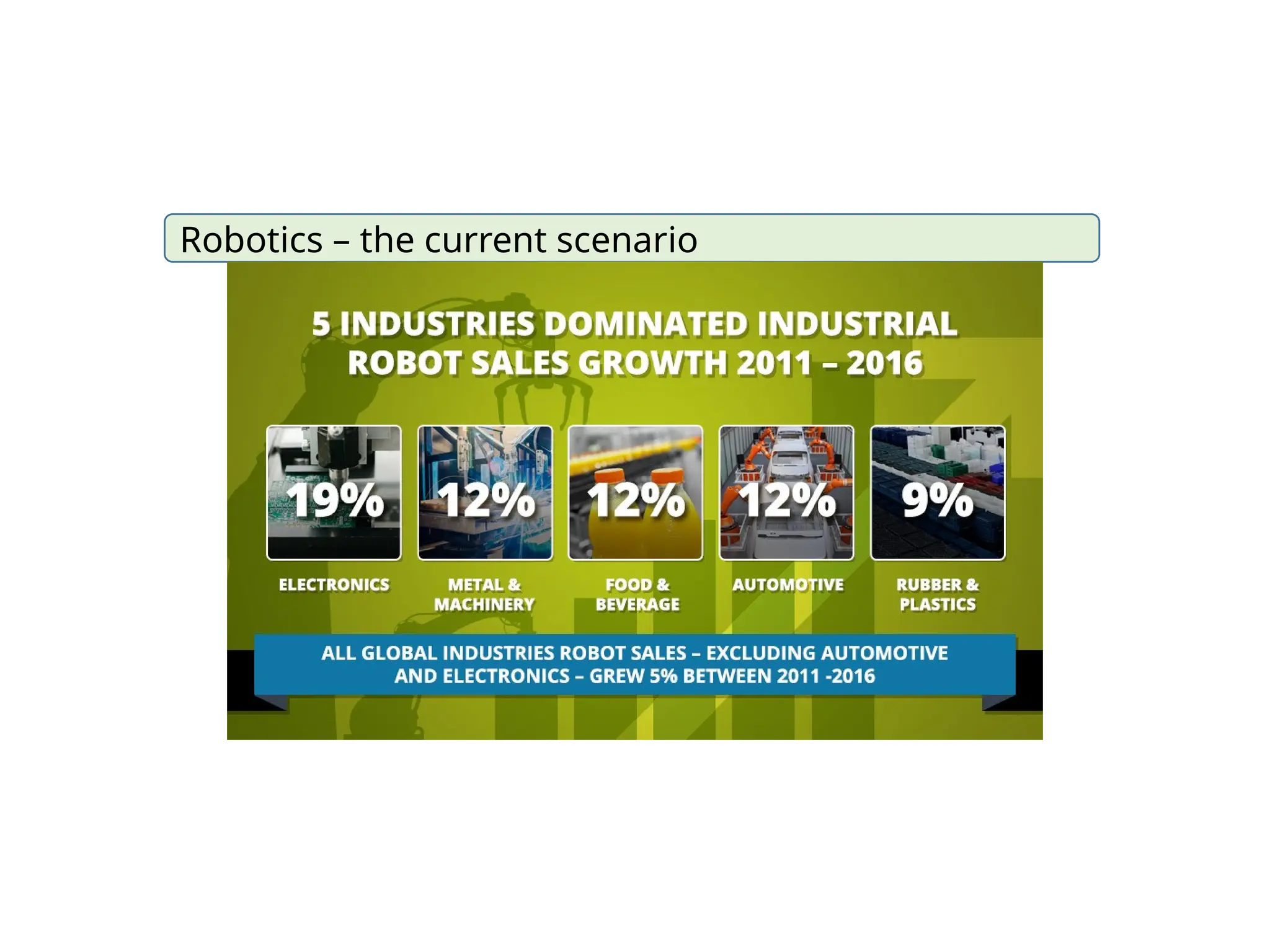
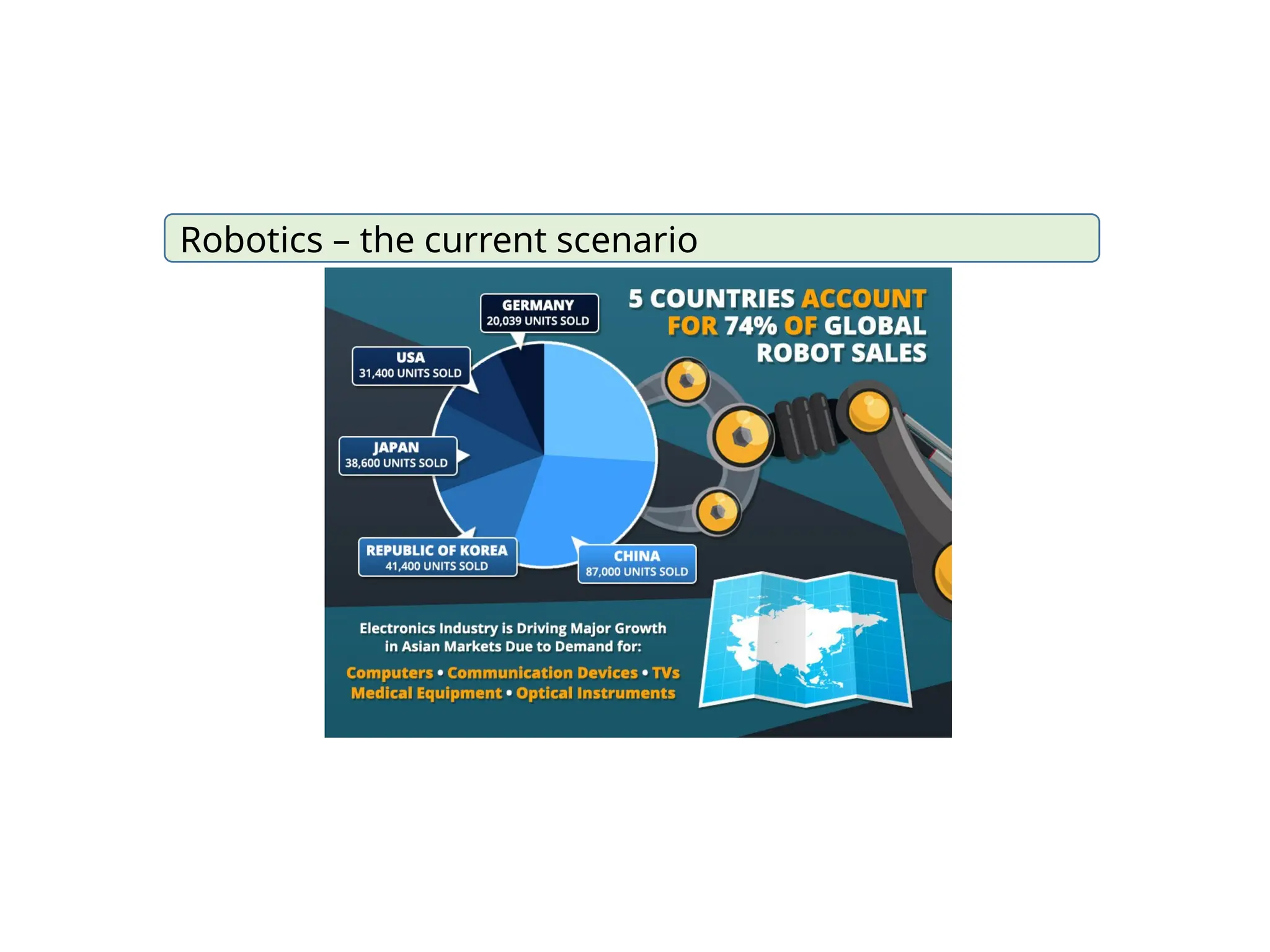
Robotics – the current scenario
Robotic process automation (RPA) is a software technology that makes
it easy to build, deploy, and manage software robots that emulate
humans actions interacting with digital systems and software.
Robotic Process Automation (RPA)
Example: Finance & Accounting (Invoice Processing), Human Resources
(Hiring & Onboarding), Retail (Inventory Management), Payroll, and
Customer Support.
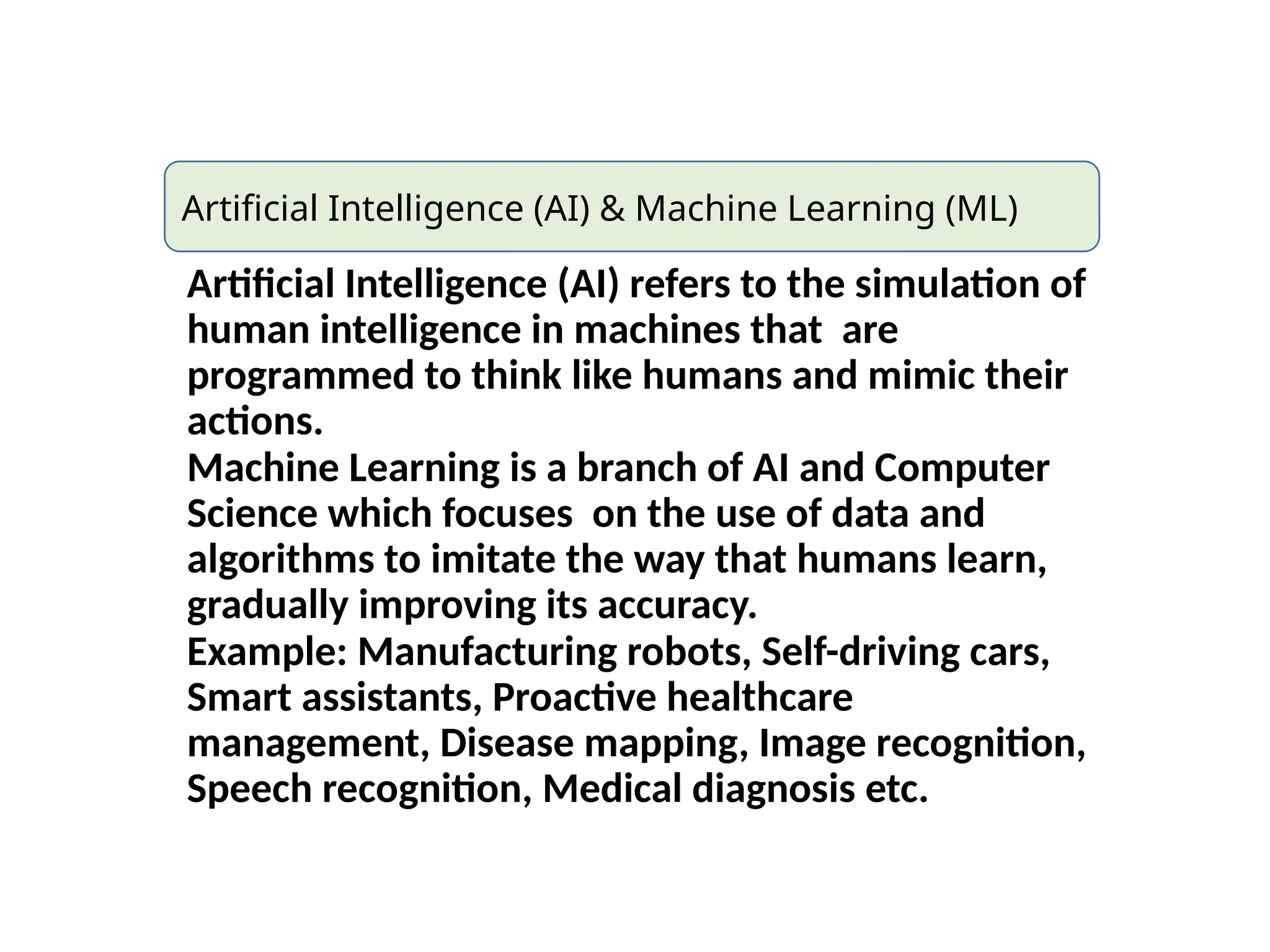
Artificial Intelligence (AI) & Machine Learning (ML)
Artificial Intelligence (AI) refers to the simulation of
human intelligence in machines that are
programmed to think like humans and mimic their
actions.
Machine Learning is a branch of AI and Computer
Science which focuses on the use of data and
algorithms to imitate the way that humans learn,
gradually improving its accuracy.
Example: Manufacturing robots, Self-driving cars,
Smart assistants, Proactive healthcare
management, Disease mapping, Image recognition,
Speech recognition, Medical diagnosis etc.
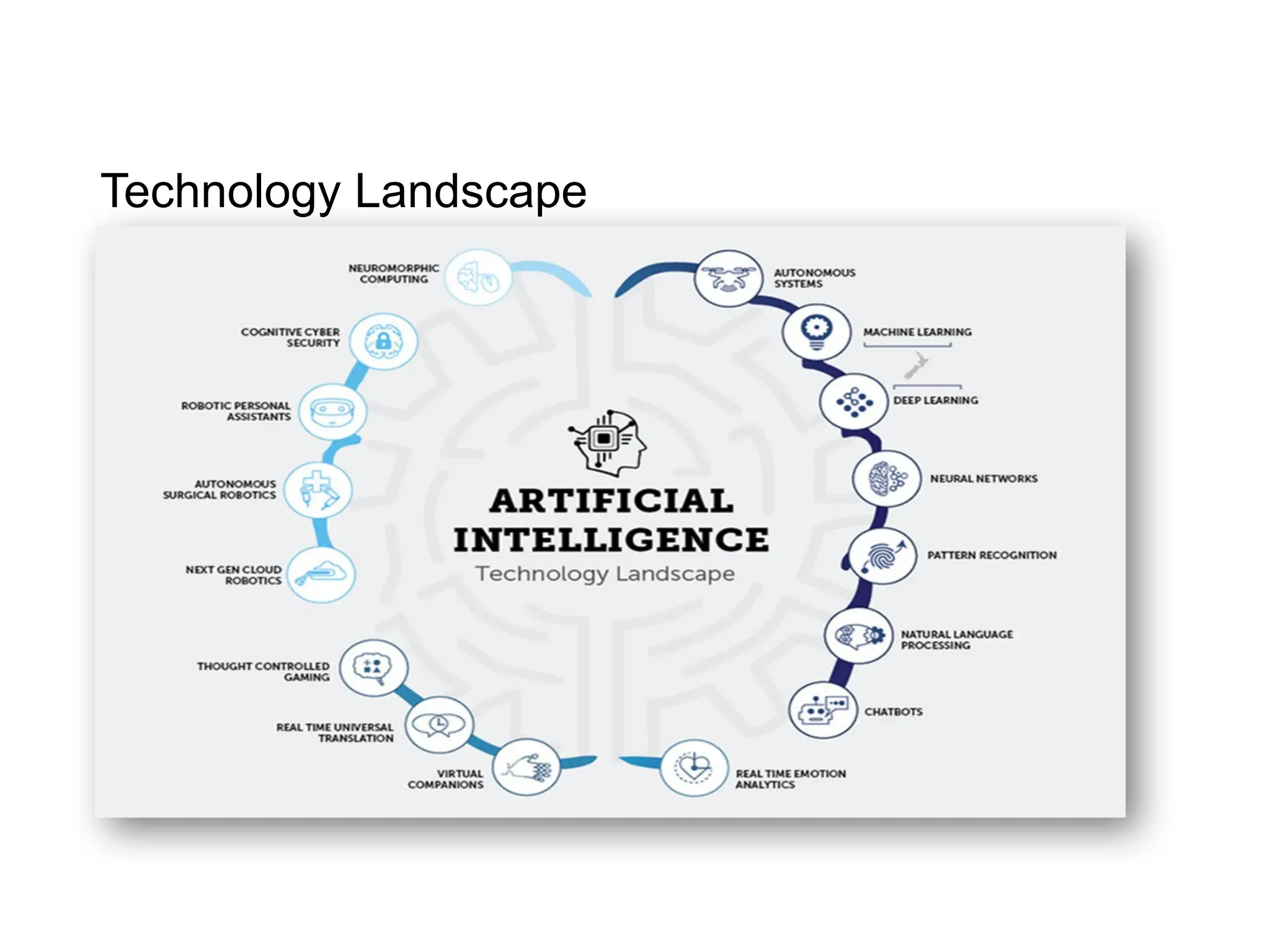
Technology Landscape
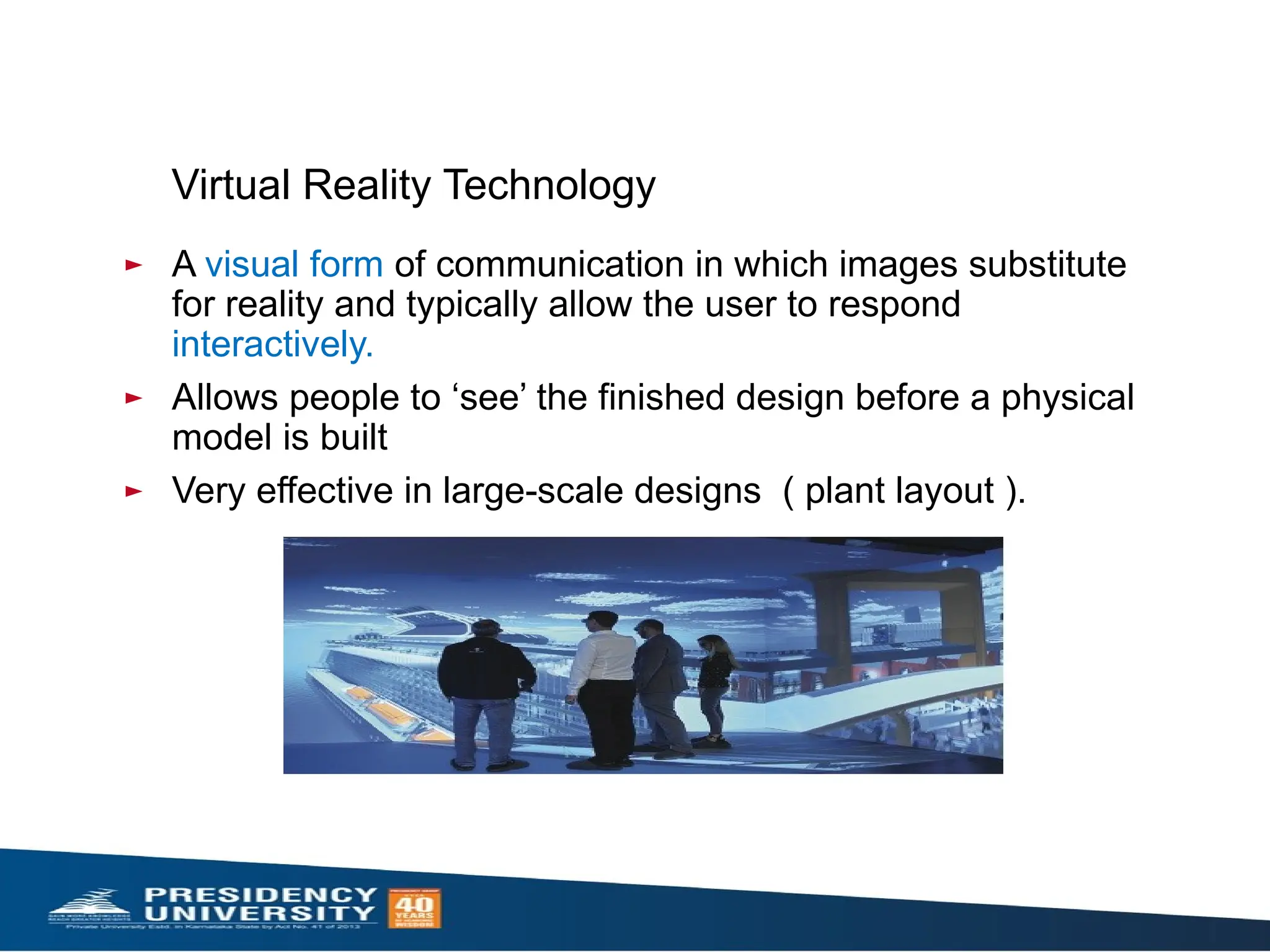
Virtual Reality Technology
► A visual form of communication in which images substitute
for reality and typically allow the user to respond
interactively.
► Allows people to ‘see’ the finished design before a physical
model is built
► Very effective in large-scale designs ( plant layout ).
Augmented Reality
► The integration of digital information with the user's
environment in real time.
► Digital information or images superimposed on an
existing image.
► Useful in product design, assembly and maintenance
operations, tool or specification information

c974d243-94de-4a4a-8bc5-3ca9ba383d83.ppt

  • 1.
    Production and LogisticsManagement (OPS4111) Course text books/reference books 1. Operations Management William Stevensen 2. Supply Chain Management: Strategy, Planning, and Operations by Sunil Chopra and Peter Meindl, 2024 7th edition, Pearson 3. Logistics Management D. K. Agrawal
  • 3.
    •DOMINOS •Standardization – Menuis limited, toppings and ingredients are pre-prepared, •reducing kitchen time. •Hub-and-Spoke Store Location –Multiple locations •Technology Process Discipline
  • 4.
    Concept of Productionand Operations What is Production? • Conversion • Value addition • Utilization of Resources – Man, Machine, Material, Money, technology What is Operations? • Operations management is the execution of backend business functions • It involves overseeing manufacturing, inventory, quality control and distribution • It is the management of systems or processes that create goods and /or provide services
  • 5.
    Historical Evolution ofOperations Management 1776: Adam Smith – Division of Labor 1799: Eli Whitney – Interchangable Parts Early 1900s: FW Taylor – Scientific management 1913: Henry Ford – Assembly Line 1950s: Toyota – Lean Manufacturing 1980s: Motorola – Six Sigma methodology 1987: ISO Standards introduced 1990s – Service Industry evolution
  • 7.
    Human Relations Focus(Mid 1900’s) Hawthorne experiments Motivational theories Operation Research (1950’s to 1970’s) Linear Programming Other OR techniques like Simulation, PERT CPM etc. MRP, EDI,COMPUTER INTEGATED MANUFACTURING (1960’s and 70’s) Quality Movement (1970’s to 1990’s) TQM, Kaizen, 5S, SPC, TPM etc.
  • 8.
    Each Era briefdetails Industrial Revolution (late 1700’s) Steam Engine invention Division of labour Interchangeable parts Scientific Management (Early 1900’s) Principle of Scientific management coined Time & Motion Studies Activity Charts Assembly lines
  • 9.
    Internet and Telecommunication(Present day) Six Sigma, Kanban, JIT, CAD/CAM, Lean Manufacturing Digital Era (Present day and Future) Industry 4.0, IoT(Data interchange using internet and software), AI , ML, Robotics etc.
  • 12.
    Which of thefollowing is not a type of production system? a) Job Production b) Batch Production c) Mass Production d) Strategic Production
  • 13.
    The concept of“Just-in-Time (JIT)” originated in: a) USA b) Japan c) Germany d) India
  • 14.
    The main goalof Operations Management is: a) Reducing cost only b) Maximizing customer value while minimizing resources c) Hiring more workers d) Increasing advertising
  • 15.
  • 19.
    Factors Affecting POM •Global competition • Cost challenges • Quality challenges • Customer services • Rapid expansion of advanced technologies • Scarcity of operations resources • Continued growth of Service sector • Social and environmental issues
  • 22.
    Operations Strategy, Product& Service Design, ,Process Design & Analysis, Forecasting, Capacity & Facility Management, Supply Chain Management (SCM), Inventory & Materials Management, Scheduling & Project Management, Quality Management, Productivity & Work Study, Technology & Operations, Service Operations, Sustainable & Green Operations, Emerging Trends in OM
  • 24.
  • 25.
  • 26.
    Sl.No Industry /Domain / Topic Input Throughput Output 0 Biscuit Wheat flour Sugar, Salt Dry fruits, Milk & Water , other ingredients Mixing, forming, baking and cooling Salt Biscuits, Sweet Biscuits, Sweet & Salt Biscuits 1 Goods 2 Goods 3 Goods 4 Goods 5 Goods 6 Services 7 Services 8 Services 9 Services 10 Services
  • 27.
  • 28.
    Responsibilities of OperationsManagement Products & services Planning – Capacity – Location – – Make or buy – Layout – Projects – Scheduling Controlling/Improving – Inventory – Quality Organizing – Degree of centralization – Process selection Staffing – Hiring/laying off – Use of Overtime Directing – Incentive plans – Issuance of work orders – Job assignments – Costs – Productivity
  • 29.
    Anecdotes Henry Ford’s AssemblyLine (Mass Production) • Ford observed a slaughterhouse in Chicago, where animals were processed on a moving line. • Inspired, he applied the reverse idea to cars: adding parts step by step on a moving conveyor. • Outcome: Time to assemble a car dropped from 12 hours to 90 minutes, making cars affordable for the middle class. Southwest Airlines’ 10-Minute Turnaround (Scheduling) Most airlines took 1 hour to clean, refuel, and board. Southwest designed a system to turn planes around in 10–15 minutes. This efficiency gave them more daily flights, lower costs, and competitive advantage.
  • 30.
    Types of ProductionSystems affect Plant Layouts • Mass production • Batch production • Job based production • Assembly Line production
  • 31.
    Job Production –Customized, one-off (e.g., tailored suits, shipbuilding). Batch Production – Groups of items produced together (e.g., bakery, pharmaceuticals). Mass Production – Standardized, large scale (e.g., automobile assembly). Continuous Production – Non-stop, 24/7, automated (e.g., oil refinery, chemical plants).
  • 36.
    Aspect Job ProductionBatch Production Mass Production Continuous Production Output Volume Very low (one-off, custom) Medium (groups/lots) Very high (standardized) Extremely high (24/7) Variety Very high (unique items) Moderate (some variation) Very low (standard items) None (homogeneous) Flexibility Highest Moderate Low Very low Examples Tailor-made suits, shipbuilding Bakeries, vaccine batches Cars, electronics Oil refinery, steel plant Cost per Unit Highest Moderate Low Very low Skill Requirement Highly skilled labor Skilled + semi- skilled Semi-skilled + machines Highly automated, technical Speed of Production Slow Medium Fast Continuous, non- stop
  • 37.
    Operations Strategy How wellcompany execute its business strategy using Products, Process, Methods, Resource, Quality, Cost, Lead time, Schedule Strategic- Product design, location, Technology Tactical- Employment, Equipment selection, Layout Operational- Schedule, inventory Amazon fulfilment centres to deliver fast
  • 38.
    Operations Strategy • Setof decisions that an organization makes for production and delivery of goods • Its in line with the overall company’s business strategy • Its for achieving long term goals to be successful and competitive in the market place
  • 39.
    Elements of OperationsStrategy • Product Assembly Strategy • Inventory Strategy • Supply Chain Optimization • Quality Strategy • Facilities Management • Forecasting for Planning • Scheduling of Resources • Use of Technology
  • 40.
    Operations Strategy Formulation •Low Cost – Walmart • Short Processing time – McDonald’s • On time delivery – Domino’s • High Quality – Sony TV • Consistent Quality – Coca-Cola, Haldirams • Innovation- Apple, Google • Volume – Toyota • Superior Customer Service – Amazon • Convenience – Malls and Supermarkets
  • 41.
    Stage Focus OperationsRoleExample 1 Avoidnegativeimpact Reactive,costcontrol Basicfactoryoutput 2 Supportstrategyinternally Reliable,efficient Standardizedcallcenter 3 Supportstrategyexternally Flexible,responsive Zarasupplychain 4 Leadexternally Strategicdifferentiator Toyotaleansystem
  • 42.
    •Balanced Scorecard: Financial Performance,Customer satisfaction, Efficiency of processes, Strategy objectives
  • 43.
    Product Strategy Options ►Differentiation ► Apple for innovative design & features ► Low cost ► Walmart ► Focus ► Toyota (Rapid Response) ►Boeing 787: https://www.youtube.com/watch?v=SJZk9vNS8NE ►Mercedes CLA: https://www.youtube.com/watch?v=fQBzMYjp85w
  • 44.
    Boeing – salesand supply chain are worldwide​ Benetton (fashion brand & clothing line in Italy) – moves inventory to stores around the world faster than its competition by building flexibility into design, production, and distribution​ Sony (multinational conglomerate company) – purchases components from suppliers in Thailand, Malaysia, and around the world​ Bombardier – supply chain sourcing components for its streetcar building: gear box & motor (Germany), brake systems (USA & France) ​
  • 45.
    • Robust design– strong against environment ​ • Modular design – component/part commonality ​ • Computer-aided design (CAD)​ • Computer-aided manufacturing (CAM)​ • Cloud computing​ • Value analysis​ • Sustainability and Life Cycle Assessment (LCA)​
  • 46.
    Competitive Priorities Cost/Price: SouthwestAirlines Differentiation /Quality :Sony Differentiation Newness: Apple Differentiation Location: ATMs Time/Responsiveness: Dominos Flexibility: Burger King have it your way Innovation: 3M Sustainability: Green Cars Customer Service: Amazon
  • 47.
    What might bethe competitive advantage for Southwest Airlines Apple Facebook
  • 48.
    Research and explainthe logic behind the statement “GE discovered that 75 percent of its manufacturing costs are determined by design.”
  • 51.
    Strategy Types 1. Corporatestrategies: Adheres to a company’s mission statement and aligns itself to a larger corporate strategy. 2. Core competency strategies: Core competency operations strategies revolve around the main strengths of a company 3. Competitive strategies: Develop their operations processes in order to distinguish their product or service from competitors.
  • 52.
    4. Product orservice strategies: Revolves around the quality control of existing products or services as well as the development of new products and services. 5. Customer-driven strategies: Make operations decisions based on the customer experience to fulfill customer expectations.
  • 53.
    Specific production strategies basedon the market and product type 1. Make-to-Stock (MTS): Producing goods in advance of anticipated demand, stocking them, and selling them from inventory. 2. Make-to-Order (MTO): Producing goods only after a customer places an order. 3. Postponement: Delaying product customization or final assembly until closer to the time of customer purchase to offer personalization.
  • 54.
    Caselet - Nalco-ceramicshas been suffering losses in recent months. They are concerned about losing huge orders that are forthcoming. In order to receive the order , Nalco-ceramics wants to introduce certain changes in their product and service design. What major factors should they consider in designing their strategy. Major factors of strategy formulation · Cost · Quality · Time-to-market · Competitive advantage · Customer satisfaction
  • 55.
    List the majoractivities before Nalco-ceramics to enhance their Product and Service Performance. · Translate customer wants and needs into product and service requirements · Refine existing products and services · Develop new products and services · Formulate quality goals · Formulate cost targets · Construct and test prototypes · Document specifications
  • 56.
    OM’s Contribution toStrategy Product Quality Process Location Layout Human resource Supply chain Inventory Scheduling Maintenance Project management DIFFERENTIATION: Innovative design Safeskin’s innovative gloves Broad product line Fidelity Security’s mutual funds After-sales service Caterpillar’s heavy equipment service Experience Hard Rock Café’s dining experience COST LEADERSHIP: Low overhead Franz-Colruyt’s warehouse-type stores Effective capacity Southwest Airline’s use aircraft utilization Inventory Walmart’s sophisticated management distribution system RESPONSE: Flexibility Hewlett-Packard’s response to volatile world market Reliability FedEx’s “absolutely, positively, on time” Quickness Pizza Hut’s 5-minute guarantee at lunchtime 11 Operations Competitive Decisions Strategy Example Advantage Response (faster) Cost leadership (cheaper) Differentiation (better)
  • 57.
    • ZOMATO • Datadriven personalization • Automation and AI • Real time tracking • Fleet Management • Exclusive partnerships • Focus on quality • Scalable frameworks for better service delivery
  • 58.
  • 59.
    Step 1: DefineVision & Strategic Objectives • Identify long-term vision (3–5 years) of the organization. • Define key strategic objectives that will move the organization toward the vision. Step 2: Break Down into Annual Objectives • Convert long-term goals into annual measurable objectives. • Example: • Long-term: “Become #1 in customer satisfaction” • Annual: “Increase customer satisfaction score by 10% by December 2025”
  • 60.
    Step 3: DeployObjectives Across the Organization (Catchball Process) • Top-down: Management defines objectives. • Bottom-up: Employees provide feedback (catchball), suggest how to achieve objectives. • Promotes alignment, buy-in, and realistic targets. Step 4: Develop Action Plans • For each objective, define specific projects, KPIs, and responsible owners. • Example: “Improve customer service training program by Q2” Step 5: Implement & Execute • Assign responsibilities, monitor progress, and adjust as needed. • Teams focus on daily/weekly tasks that contribute to strategic objectives
  • 61.
    Step 6: Monthly/QuarterlyReview • Use a PDCA cycle (Plan–Do–Check–Act) to review progress. • Identify gaps and correct deviations early. Step 7: Annual Review & Next Cycle • At the end of the year, review objectives, lessons learned, and set the next year’s priorities. • Continuous improvement is key.
  • 62.
    Tools Used inHoshin Kanri • X Matrix: Visual representation of objectives, KPIs, initiatives, and owners. • Catchball: Iterative communication between levels to finalize objectives. • PDCA (Plan–Do–Check–Act): Ensures continuous improvement. • KPI dashboards: Track metrics and progress toward objectives.
  • 63.
    MAIN TYPES OFOM Manufacturing : Focuses on the efficient production of tangible goods from processing of raw materials through fabrication assembly Service : The delivery of intangible services, such as healthcare, education, or customer support through the interaction between the service provider and the customer. Logistics : The movement and storage of goods through warehousing, transportation, and distribution networks. Project : The specific tasks, initiatives, or undertakings from inception to completion, often with defined goals, timelines, and resources. Time bound activity.
  • 67.
    Importance of MeasuringProductivity Measuring productivity is crucial in manufacturing for several reasons: Identifies Inefficiencies: Productivity metrics help pinpoint weaknesses in the production process, such as machine failures, process interruptions, or material shortages. Supports Decision-Making: Accurate productivity data enables better planning, resource allocation, and investment decisions to meet future demand and optimize operations. Enhances Cost Control: By monitoring productivity, manufacturers can identify opportunities to reduce costs, minimize waste, and cut down on rework or scrap.
  • 68.
    Importance of MeasuringProductivity Drives Continuous Improvement: Regular measurement allows for ongoing analysis and improvement of workflows, equipment utilization, and labor performance, leading to higher output and quality. Strengthens Competitiveness: High productivity enables a manufacturer to deliver more products in less time, improving the ability to meet customer demand and take on more business. Facilitates Preventive Maintenance: Monitoring productivity helps in scheduling maintenance activities proactively, reducing unplanned downtime and maintaining steady production
  • 74.
  • 76.
    A cartridge manufacturingcompany produced 6000 cartridges per day . Standard price is $ 2 / cartridge , Labor cost is $ 200; material cost is $ 800 and over head is $ 420. Determine the multifactor productivity.
  • 77.
    Total Output Value: •Total Output = 6,000 cartridges/day , Standard Price = $2/cartridge • Total Output Value = 6,000 cartridges X $2/cartridge = $12,000/day Total Input Costs: Labor Cost = $200/day , Material Cost = $800/day . Overhead Cost = $420/day Total Input Costs = Labor Cost + Material Cost + Overhead Cost = $200 + $800 + $420 = $1,420/day Multifactor Productivity (MFP) = Total Output Value / Total Input Costs = $12,000 / $1,420 ≈ 8.45 Ans: The multifactor productivity is approximately 8.45.
  • 78.
    A Bank employsthree loan officers, each working eight hours per day. Each officer processes an average of five loans per day. The bank’s payroll cost for the officers is $820 per day, and there is a daily overhead expense of $500. Compute the labor productivity. Compute the multifactor productivity, using loans per dollar cost as the measure.
  • 79.
    A. Labor productivityis simply the ratio of loans to labor- hours: Formula : Output (loans) / Input (labor-hrs.) Given : Output = 3 officers × 5 loans/day Input = 3 officers × 8 hrs./day labor productivity = 0.625 loans/labor-hr.
  • 80.
    Multifactor productivity accountsfor both labor cost and overhead Output (loans) = 3 officers × 5 loans/day Input (labor cost + overhead) = $820 + $500 Multifactor productivity = 15/1320=0.0113 loans/$.
  • 81.
    The bank isconsidering the purchase of new computer software for the loan operation. The software will enable each loan officer to process eight loans per day, although the overhead expense will increase to $550. Compute the new labor productivity. Compute the new multifactor productivity. Should the bank proceed with the purchase of the new software? Explain.
  • 82.
    The new softwareincreases the number of loans processed per day, but it also increases the overhead. Output (loans) = 3 officers × 8 loans/day Input (labor-hrs.) = 3 officers × 8 hrs./day New labor productivity = 1.0 loans/labor-hr
  • 83.
    Output (loans) =3 officers × 8 loans/day Input (labor cost + overhead) = $820 + $550 / day New multifactor productivity = 0.0175 loans/$.
  • 84.
    Purchasing the newsoftware would increase the labor productivity by ( [1.0−0.625] / 0.625) x 100 = 60 % It would increase the multifactor productivity (= [0.0175 − 0.0113]/0.0113) = 55 % It is certainly worth the added overhead.
  • 85.
    Types of productivity( Labor, Machine, Capital, Material, Energy etc. ) Efficiency of individual machines - Speed, Setting time, breakdowns, stoppages…. Efficiency of labor (of individual worker) - Hours, output …  Efficiency of plant (Overall efficiency) - Target vs Actual capacity. Higher efficiency leads to higher productivity.
  • 86.
    Capacity Planning • Capacityis the upper limit or ceiling on the load that an operating unit can handle. • The basic questions in capacity handling are: 1. What kind of capacity is needed? 2. How much is needed? 3. When is it needed? Capacity Planning is done to meet the production requirements.
  • 87.
    Design capacity : Maximumoutput rate or service capacity an operation, process, or facility is designed for. Effective capacity: Design capacity minus allowances such as personal time, maintenance, reduced speed etc. Utilized capacity : Can be above or below design capacity. Actual output Rate of output actually achieved ,cannot exceed effective capacity.
  • 89.
    Design capacity =50 trucks/day Effective capacity = 40 trucks/day Actual output = 36 units/day Actual output 36 units/day Efficiency = ------------------- = ---------------- = 90% Effective capacity 40 units/ day Utilization = Actual output 36 units/day -------------------- = ----------------- = 72% Design capacity 50 units/day
  • 90.
    The efficiency ofa factory is 75% and its utilization 50%. If effective capacity is 1,000 units. Find design capacity
  • 92.
    A factory produces1,000 units a month. If design capacity is 3,000 and efficiency is 50% Find a. utilization and b. effective capacity.
  • 95.
    Technology in Operations 1.Role of automation 2. Robotics 3. AI in modern production.
  • 96.
  • 97.
    Evolution of Industry4.0 Physical Systems Cyber Systems Cyber-Physical Systems
  • 98.
    Managing a Firmin Industry 4.0 Era Management Organization Technology Business Challenges Information Systems Business Challenges Reduce Costs Increase Revenue Improve Quality Improve Customers’ Satisfaction Monitor Quality Improve Operational Efficiency Minimize waste High Competition Changing Demand Shortening Product Life Cycle Analyze Market Trend Monitor Quality Efficiency and Costs Redesign Processes Reorient People Analyze Power of the Technology To Improve Efficiency, Quality and strategic Advantages
  • 100.
    Automation • Use oftechnology ( software, robotics ) to perform tasks or processes operating automatically through predefined rules and algorithms for industrial manufacturing. • Minimal human input. Advantages • Improves efficiency, improve quality and accuracy, reduce costs. • Avoiding repetitive or dangerous tasks execution by employees. • Common applications span, information technology (IT) systems
  • 101.
  • 102.
    9 pillars ofIndustry 4.0: Technological Advancements Big Data and Analytics Autonomous Robots Simulation and Digital Twin Industrial Internet of Things (IIoT)-physical devices with software Augmented Reality (AR) Additive Manufacturing- creation of objects layer by digital models Cybersecurity Cloud Computing Horizontal & Vertical System Integration
  • 103.
  • 104.
    Issues for ProductDesign ► Robust design – strong against environment ► Modular design – component/part commonality ► Computer-aided design (CAD) ► Computer-aided manufacturing (CAM) ► Cloud computing ► Virtual reality (VR) & Augmented reality (AR) technology ► Differences between VR and IMAX 3-D film? ► Value analysis ► Sustainability and Life Cycle Assessment (LCA) •VR (Virtual Reality): Fully immersive, computer-generated environment. Used for training, simulations, design prototyping. •AR (Augmented Reality): Overlay of digital content on the real world. Used in retail, maintenance, logistics, and marketing. •IMAX 3D / 3D media: Large-scale immersive video experiences; can be used for marketing, training, or simulation visualization.
  • 105.
    Technology Operations/Management Use CasesExample VR Employee training, warehouse simulation, process design Walmart VR training for employees AR Real-time maintenance, remote assistance, product visualization Boeing AR glasses for wiring planes IMAX 3D Customer engagement, marketing, virtual tours Real estate or tourism companies offering 3D walkthroughs
  • 106.
    Robust Design ► Productis designed so that small variations in production or assembly do not adversely affect the product. ► Typically results in lower cost and higher quality through less waste or scrap.
  • 107.
    Modular Design ► Productsdesigned in easily segmented components. ► Component commonality. ► Adds flexibility to both production and marketing. ► Easier (less) transportation (costs). ► Improved ability to satisfy customer requirements.
  • 108.
    Manufacturability Engineering Designing productsin such a way that they are easy to manufacture. ► Benefits: 1. Reduced complexity of the product 2. Robust design; faster product development 3. Additional standardization of components 4. Improvement of functional aspects of the product 5. Improved job design and job safety 6. Improved maintainability (serviceability) of the product 7. Reduction of environmental impact
  • 109.
    ► Using computersto design products and prepare engineering documentation ► ThinkerCAD; FreeCAD; BlocksCAD; AutoCAD ► Shorter development cycles, improved accuracy, lower cost ► Information and designs can be deployed worldwide faster responses Computer Aided Design (CAD)
  • 110.
    ► Design forManufacturing and Assembly (DFMA) ► Solve manufacturing problems during the design stage ► 3-D Object Modeling ► Small prototype development ► CAD through the Internet ► STEP (Standard for The Exchange Product Model Data) ► a platform used for International product model data exchange/sharing ► 3D printing or Additive manufacturing Extensions of CAD
  • 111.
    Computer-Aided Manufacturing (CAM) ►Utilizing specialized computers and program to control manufacturing equipment ► Often driven by the CAD system (CAD/CAM) ► Additive manufacturing (or 3D printing) - Extension of CAD that builds products by adding material layer upon layer
  • 112.
    1. Product qualityimprovement 2. Shorter design time 3. Production cost reductions 4. Database availability 5. New range of capabilities Benefits of CAD/CAM
  • 113.
    INDUSTRIAL INTERNET OFTHINGS Interconnected industrial sensors, devices, and machines to collect data, analyze it with AI and machine learning, and then automate tasks to optimize industrial processes. This technology is driven by Industry 4.0. Enables Smart Factories to improve efficiency, productivity, and safety through self-optimizing systems, predictive maintenance, and real-time monitoring.
  • 114.
    Enabled by technologies– Cybersecurity Cloud computing-Data in cloud Edge computing-Data near to data source Mobile technologies Machine-to-machine 3D printing
  • 115.
    1. Cyber PhysicalSystems (CPS): the basic technology platform for IOT and IIoT to connect physical machines ,previously disconnected CPS integrates the dynamics of the physical process with those of software and communication, providing abstractions and modeling, design and analysis techniques. 2. Cloud Computing : IT services and resources can be uploaded to and retrieved from the Internet as opposed to a direct connection to a server. Files can be kept on cloud-based storage systems rather than on local storage devices
  • 116.
    . Edge computing– A distributed computing paradigm bringing computer data storage closer to the location where it is needed. In contrast to cloud computing , edge computing refers to decentralized data processing at the edge of the network. Transform productivity, products and services in the industrial world. 4. Big data analytics: Big data analytics is the process of examining large and varied data sets
  • 117.
    5. Artificial Intelligenceand Machine learning : AI is a field within computer science in which intelligent machines are created that work and react like humans. Machine learning is a core part of AI, allowing software to more accurately predict outcomes without explicitly being programmed. It is also possible to combine artificial intelligence with edge computing in order to provide industrial edge intelligence solutions. Use-cases : Condition monitoring ( predictive maintenance) process optimization. Federated learning (collaborative learning) is a machine learning technique in a setting where multiple entities (often called clients) collaboratively train a model while keeping their data decentralized. 6. Deep Learning- A subset of machine learning and AI that uses multilayered artificial networks for making predictions from data 7. Design Thinking
  • 118.
    ROBOTICS It is theinterdisciplinary study and practice of the design, construction, operation, and use of robots. Robotics is the design and construction of the physical structures of robots, while in computer science, robotics focuses on robotic automation algorithms. Robotics develop machines that can learn, reason, and solve problems, mimicking human cognitive processes through artificial intelligence. ( Intelligent Machines )
  • 119.
    1. Design &Construction: Creating the physical structure and components of a robot, including its movable frame and actuators for movement. 2. Programming: Robots are programmed to follow specific instructions to perform tasks, whether simple or complex. 3. Sensing: Robots utilize various sensors to perceive and interact with their environment, gathering data about their surroundings. 4. USES Automation: The primary goal is to automate tasks, which can be beneficial in various applications. Manufacturing - Robots handle repetitive or dangerous tasks on assembly lines.
  • 120.
    Robotics – thecurrent scenario
  • 121.
    Robotics – thecurrent scenario
  • 122.
    Robotics – thecurrent scenario
  • 123.
    Robotic process automation(RPA) is a software technology that makes it easy to build, deploy, and manage software robots that emulate humans actions interacting with digital systems and software. Robotic Process Automation (RPA) Example: Finance & Accounting (Invoice Processing), Human Resources (Hiring & Onboarding), Retail (Inventory Management), Payroll, and Customer Support.
  • 124.
    Artificial Intelligence (AI)& Machine Learning (ML) Artificial Intelligence (AI) refers to the simulation of human intelligence in machines that are programmed to think like humans and mimic their actions. Machine Learning is a branch of AI and Computer Science which focuses on the use of data and algorithms to imitate the way that humans learn, gradually improving its accuracy. Example: Manufacturing robots, Self-driving cars, Smart assistants, Proactive healthcare management, Disease mapping, Image recognition, Speech recognition, Medical diagnosis etc.
  • 125.
  • 126.
    Virtual Reality Technology ►A visual form of communication in which images substitute for reality and typically allow the user to respond interactively. ► Allows people to ‘see’ the finished design before a physical model is built ► Very effective in large-scale designs ( plant layout ).
  • 127.
    Augmented Reality ► Theintegration of digital information with the user's environment in real time. ► Digital information or images superimposed on an existing image. ► Useful in product design, assembly and maintenance operations, tool or specification information

Editor's Notes

  • #99 https://www.datocms-assets.com/38028/1667758371-industry4point0-768x512-300x200.png
  • #104 https://www.polestarllp.com/what-is-industry-40-and-its-nine-technology-pillars
  • #105 https://www.researchgate.net/publication/323501114_How_Data_Will_Transform_Industrial_Processes_Crowdsensing_Crowdsourcing_and_Big_Data_as_Pillars_of_Industry_40
  • #125 https://www.predictiveanalyticstoday.com/what-is-robotic-process-automation/
  • #126 AI: https://www.aitimejournal.com/@nisha.arya.ahmed/what-is-artificial-intelligence-ai ML: