INTERNAL
SCANNING:
ORGANIZATIONAL
ANALYSIS
RESOURCE-BASED APPROACH
BUSINESS MODEL
VALUE-CHAIN ANALYSIS
SCANNING FUNCTIONAL RESOURCES AND CAPABILITIY
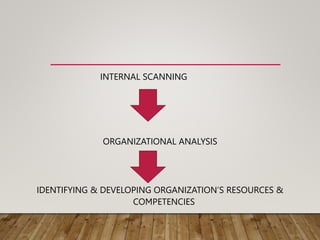
INTERNAL SCANNING
ORGANIZATIONAL ANALYSIS
IDENTIFYING & DEVELOPING ORGANIZATION’S RESOURCES &
COMPETENCIES
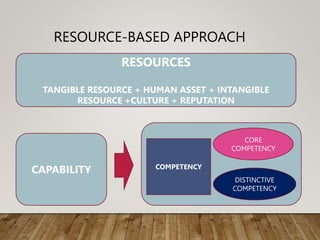
RESOURCE-BASED APPROACH
RESOURCES
TANGIBLE RESOURCE + HUMAN ASSET + INTANGIBLE
RESOURCE +CULTURE + REPUTATION
CAPABILITY
CORE
COMPETENCY
DISTINCTIVE
COMPETENCY
COMPETENCY
RESOURCE-BASED APPROACH
VRIO FRAMEWORK [BARNEY]
 VALUE
 RARENESS
 IMITABILITY
 ORGANIZATION
RESOURCE-BASED APPROACH
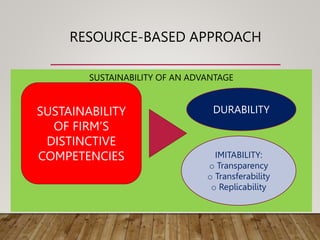
SUSTAINABILITY OF AN ADVANTAGE
SUSTAINABILITY
OF FIRM’S
DISTINCTIVE
COMPETENCIES
DURABILITY
IMITABILITY:
o Transparency
o Transferability
o Replicability
RESOURCE-BASED APPROACH
KNOWLEDGE
EXPLICIT
KNOWLEDGE
TACIT
KNOWLEDGE
BUSINESS MODELS
Business model is a company’s method for making money in the
current business environment.
Business model is usually composed of five elements:
 Who is serves
 What it provides
 How it makes money
 How it differentiates and sustains competitive advantage
 How it provides its product/service.
BUSINESS MODELS
1. Traditional model (Provide a good/service that can be sold).
2. Customer solutions model
3. Profit pyramid model
4. Multi-component system/installed base model
5. Advertising model
6. Switchboard model
7. Time model
8. Efficiency model
9. Blockbuster model
10. Profit multiplier model
11. Entrepreneurial model
12. De Facto industry standard model
VALUE-CHAIN ANALYSIS
A value chain is a linked set of value-creating
activities that begin with basic raw materials
coming from suppliers, moving on to a series
of value-added activities involved in producing
and marketing a product or service, and
ending with distributors getting the final
goods into the hands of the ultimate customer.
VALUE-CHAIN ANALYSIS
RAW
MATERIALS
PRIMARY
MANUFACT
URING
FABRICATION
DISTRIBUTOR
RETAILER
INDUSTRY VALUE-CHAIN ANALYSIS
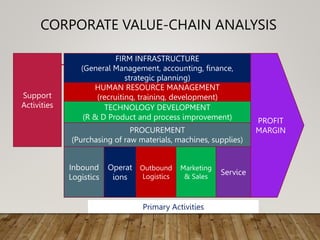
CORPORATE VALUE-CHAIN ANALYSIS
FIRM INFRASTRUCTURE
(General Management, accounting, finance,
strategic planning)
HUMAN RESOURCE MANAGEMENT
(recruiting, training, development)
TECHNOLOGY DEVELOPMENT
(R & D Product and process improvement)
PROCUREMENT
(Purchasing of raw materials, machines, supplies)
Inbound
Logistics
Operat
ions
Outbound
Logistics
Marketing
& Sales
Service
PROFIT
MARGIN
Primary Activities
Support
Activities
SCANNING FUNCTIONAL
RESOURCES & CAPABILITIES
Basic Organizational Structures
 Simple structure
 Functional structure
 Divisional structure
 Strategic business units (SBUs)
 Conglomerate structure
SCANNING FUNCTIONAL
RESOURCES & CAPABILITIES
Corporate Culture: The Company Way
Corporate culture is the collection of
beliefs, expectations, and values learned
and shared by a corporation’s members
and transmitted from one generation of
employees to an other.
STRATEGIC FUNCTIONAL ISSUES
Strategic Marketing Issues:
 Market Position and Segmentation
 Marketing Mix
 Product Life Cycle
 Brand and Corporate Reputation
STRATEGIC FUNCTIONAL ISSUES
Strategic Financial Issues:
 Financial Leverage
 Capital Budgeting
STRATEGIC FUNCTIONAL ISSUES
Strategic Research & Development (R&D)
Issues:
 R&D Intensity, Technological
Competence, and Technology Transfer
 R&D Mix
STRATEGIC FUNCTIONAL ISSUES
Strategic Operations Issues:
 Operating Leverage
 Experience Curve
 Flexible Manufacturing for Mass
Customization
STRATEGIC FUNCTIONAL ISSUES
Strategic Human Resources (HR) Issues:
 Increasing Use of Teams
 Union Relations and Temporary/Part-Time
Workers
 Quality of Work Life & Human Diversity
EXERCISES (DISCUSSION
QUESTIONS)
1. What is the relevance of the resource-based view of the firm to
strategic management in a global environment?
2. How can value-chain analysis help identify a company’s strengths
and weaknesses?
3. In what ways can a corporation’s structure and culture be
internal strengths or weaknesses?
4. What are the pros and cons of management’s using the
experience curve to determine strategy?
5. How might a firm’s management decide whether it should
continue to invest in current known technology or in new, but
untested technology? What factors might encourage or
discourage such a shift?

INTERNAL SCANNING (1).pptx