Intermediate German  Blending Project
Intermediate GRM Course Description This German course builds on your previous German course work and assumes that you have basic skills in German. This course focuses on intermediate-level development of all language skills (reading, writing, speaking, and listening). Reading, viewing, and discussion of a broad range of cultural materials from the German-speaking world will also be included.  Course Goals By the end of the course sequence (201 and 202), you should be able to:  Understand sentences and frequently used expressions related to areas of most immediate relevance (e.g. very basic personal and family information, shopping, local geography, employment) Communicate in simple and routine tasks requiring a simple and direct exchange of information on familiar and routine matters Describe in simple terms aspects of your background, immediate environment and matters in areas of immediate need
Course Structure Basic Structure Textbook-based; textbook organized into 12 chapters thematically organized by German-speaking cities   Traditional 4 x 50 minutes f2f; 30 students; textbook activities and communication activities in class; interactive workbook as homework Blended (split one traditional section) 2 x 50 minutes f2f; 15 students; some textbook and communicative activities in and some outside of class in pairs/groups or individually; interactive workbook as homework
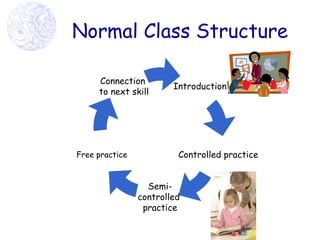
Normal Class Structure Controlled practice Semi- controlled  practice Free practice Connection  to next skill Introduction
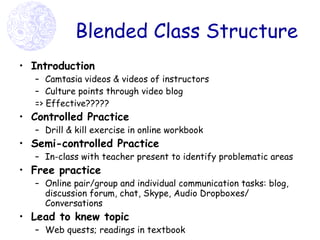
Blended Class Structure Introduction Camtasia videos & videos of instructors Culture points through video blog => Effective?????  Controlled Practice Drill & kill exercise in online workbook Semi-controlled Practice In-class with teacher present to identify problematic areas  Free practice Online pair/group and individual communication tasks: blog, discussion forum, chat, Skype, Audio Dropboxes/ Conversations Lead to knew topic Web quests; readings in textbook
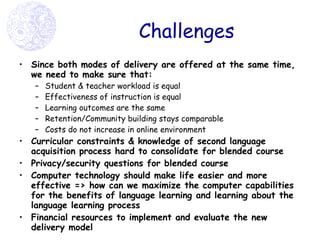
Challenges Since both modes of delivery are offered at the same time, we need to make sure that:  Student & teacher workload is equal Effectiveness of instruction is equal Learning outcomes are the same Retention/Community building stays comparable Costs do not increase in online environment  Curricular constraints & knowledge of second language acquisition process hard to consolidate for blended course Privacy/security questions for blended course Computer technology should make life easier and more effective => how can we maximize the computer capabilities for the benefits of language learning and learning about the language learning process Financial resources to implement and evaluate the new delivery model
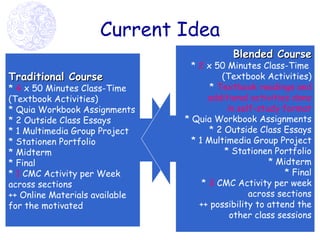
Current Idea Traditional Course *  4  x 50 Minutes Class-Time  (Textbook Activities) * Quia Workbook Assignments * 2 Outside Class Essays * 1 Multimedia Group Project * Stationen Portfolio * Midterm * Final *  1  CMC Activity per Week across sections ++ Online Materials available  for the motivated Blended Course *  2  x 50 Minutes Class-Time  (Textbook Activities) *  Textbook readings and additional activities done in self-study format * Quia Workbook Assignments * 2 Outside Class Essays * 1 Multimedia Group Project * Stationen Portfolio * Midterm * Final *  3  CMC Activity per week across sections ++ possibility to attend the other class sessions
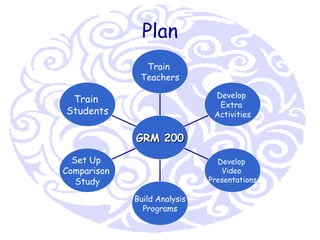
Plan Train  Students Set Up  Comparison  Study Build Analysis Programs Develop  Video  Presentations Develop  Extra  Activities Train  Teachers GRM 200
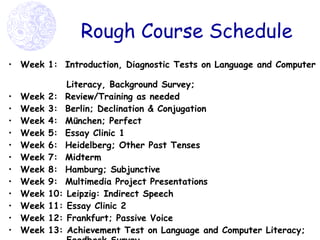
Rough Course Schedule Week 1:  Introduction, Diagnostic Tests on Language and Computer    Literacy, Background Survey;  Week 2:  Review/Training as needed Week 3:  Berlin; Declination & Conjugation Week 4:  M ü nchen; Perfect  Week 5:  Essay Clinic 1 Week 6:  Heidelberg; Other Past Tenses Week 7:  Midterm Week 8:  Hamburg; Subjunctive Week 9:  Multimedia Project Presentations Week 10: Leipzig: Indirect Speech Week 11: Essay Clinic 2 Week 12: Frankfurt; Passive Voice Week 13: Achievement Test on Language and Computer Literacy;    Feedback Survey Week 14: Review  Week 15: Final
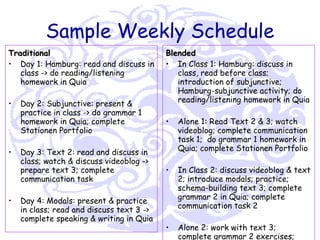
Sample Weekly Schedule Traditional Day 1: Hamburg: read and discuss in class -> do reading/listening homework in Quia Day 2: Subjunctive: present & practice in class -> do grammar 1 homework in Quia; complete Stationen Portfolio  Day 3: Text 2: read and discuss in class; watch & discuss videoblog -> prepare text 3; complete communication task Day 4: Modals: present & practice in class; read and discuss text 3 -> complete speaking & writing in Quia Blended In Class 1: Hamburg: discuss in class, read before class; introduction of subjunctive; Hamburg-subjunctive activity; do reading/listening homework in Quia Alone 1: Read Text 2 & 3; watch videoblog; complete communication task 1;  do grammar 1 homework in Quia; complete Stationen Portfolio In Class 2: discuss videoblog & text 2; introduce modals; practice; schema-building text 3; complete grammar 2 in Quia; complete communication task 2 Alone 2: work with text 3; complete grammar 2 exercises; complete communication task 3; complete speaking & writing in Quia
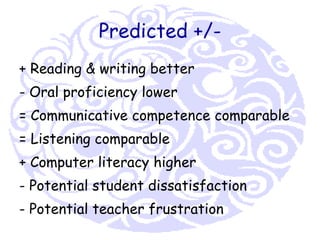
Predicted +/- + Reading & writing better - Oral proficiency lower = Communicative competence comparable = Listening comparable + Computer literacy higher - Potential student dissatisfaction - Potential teacher frustration

Intermediate German Blending Project

  • 1.
    Intermediate German Blending Project
  • 2.
    Intermediate GRM CourseDescription This German course builds on your previous German course work and assumes that you have basic skills in German. This course focuses on intermediate-level development of all language skills (reading, writing, speaking, and listening). Reading, viewing, and discussion of a broad range of cultural materials from the German-speaking world will also be included. Course Goals By the end of the course sequence (201 and 202), you should be able to: Understand sentences and frequently used expressions related to areas of most immediate relevance (e.g. very basic personal and family information, shopping, local geography, employment) Communicate in simple and routine tasks requiring a simple and direct exchange of information on familiar and routine matters Describe in simple terms aspects of your background, immediate environment and matters in areas of immediate need
  • 3.
    Course Structure BasicStructure Textbook-based; textbook organized into 12 chapters thematically organized by German-speaking cities Traditional 4 x 50 minutes f2f; 30 students; textbook activities and communication activities in class; interactive workbook as homework Blended (split one traditional section) 2 x 50 minutes f2f; 15 students; some textbook and communicative activities in and some outside of class in pairs/groups or individually; interactive workbook as homework
  • 4.
    Normal Class StructureControlled practice Semi- controlled practice Free practice Connection to next skill Introduction
  • 5.
    Blended Class StructureIntroduction Camtasia videos & videos of instructors Culture points through video blog => Effective????? Controlled Practice Drill & kill exercise in online workbook Semi-controlled Practice In-class with teacher present to identify problematic areas Free practice Online pair/group and individual communication tasks: blog, discussion forum, chat, Skype, Audio Dropboxes/ Conversations Lead to knew topic Web quests; readings in textbook
  • 6.
    Challenges Since bothmodes of delivery are offered at the same time, we need to make sure that: Student & teacher workload is equal Effectiveness of instruction is equal Learning outcomes are the same Retention/Community building stays comparable Costs do not increase in online environment Curricular constraints & knowledge of second language acquisition process hard to consolidate for blended course Privacy/security questions for blended course Computer technology should make life easier and more effective => how can we maximize the computer capabilities for the benefits of language learning and learning about the language learning process Financial resources to implement and evaluate the new delivery model
  • 7.
    Current Idea TraditionalCourse * 4 x 50 Minutes Class-Time (Textbook Activities) * Quia Workbook Assignments * 2 Outside Class Essays * 1 Multimedia Group Project * Stationen Portfolio * Midterm * Final * 1 CMC Activity per Week across sections ++ Online Materials available for the motivated Blended Course * 2 x 50 Minutes Class-Time (Textbook Activities) * Textbook readings and additional activities done in self-study format * Quia Workbook Assignments * 2 Outside Class Essays * 1 Multimedia Group Project * Stationen Portfolio * Midterm * Final * 3 CMC Activity per week across sections ++ possibility to attend the other class sessions
  • 8.
    Plan Train Students Set Up Comparison Study Build Analysis Programs Develop Video Presentations Develop Extra Activities Train Teachers GRM 200
  • 9.
    Rough Course ScheduleWeek 1: Introduction, Diagnostic Tests on Language and Computer Literacy, Background Survey; Week 2: Review/Training as needed Week 3: Berlin; Declination & Conjugation Week 4: M ü nchen; Perfect Week 5: Essay Clinic 1 Week 6: Heidelberg; Other Past Tenses Week 7: Midterm Week 8: Hamburg; Subjunctive Week 9: Multimedia Project Presentations Week 10: Leipzig: Indirect Speech Week 11: Essay Clinic 2 Week 12: Frankfurt; Passive Voice Week 13: Achievement Test on Language and Computer Literacy; Feedback Survey Week 14: Review Week 15: Final
  • 10.
    Sample Weekly ScheduleTraditional Day 1: Hamburg: read and discuss in class -> do reading/listening homework in Quia Day 2: Subjunctive: present & practice in class -> do grammar 1 homework in Quia; complete Stationen Portfolio Day 3: Text 2: read and discuss in class; watch & discuss videoblog -> prepare text 3; complete communication task Day 4: Modals: present & practice in class; read and discuss text 3 -> complete speaking & writing in Quia Blended In Class 1: Hamburg: discuss in class, read before class; introduction of subjunctive; Hamburg-subjunctive activity; do reading/listening homework in Quia Alone 1: Read Text 2 & 3; watch videoblog; complete communication task 1; do grammar 1 homework in Quia; complete Stationen Portfolio In Class 2: discuss videoblog & text 2; introduce modals; practice; schema-building text 3; complete grammar 2 in Quia; complete communication task 2 Alone 2: work with text 3; complete grammar 2 exercises; complete communication task 3; complete speaking & writing in Quia
  • 11.
    Predicted +/- +Reading & writing better - Oral proficiency lower = Communicative competence comparable = Listening comparable + Computer literacy higher - Potential student dissatisfaction - Potential teacher frustration