22-1
Prepared by
Prepared by
CobyHarmon
Coby Harmon
University of California, Santa Barbara
University of California, Santa Barbara
Intermediat
Intermediat
e
e
Accounting
Accounting
Intermediat
Intermediat
e
e
Accounting
Accounting
Prepared by
Prepared by
Coby Harmon
Coby Harmon
University of California, Santa Barbara
University of California, Santa Barbara
Westmont College
Westmont College
INTERMEDIATE
ACCOUNTING
F I F T E E N T H E D I T I O N
Prepared by
Coby Harmon
University of California, Santa Barbara
Westmont College
ki
kie
eso
so
w
we
eygandt
ygandt
warfi
warfie
eld
ld
team for success
team for success
2.
22-2
PREVIEW OF CHAPTER
PREVIEWOF CHAPTER
Intermediate Accounting
15th Edition
Kieso Weygandt Warfield
22
22
Changes in
accounting
principle
Changes in
accounting
estimate
Change in
reporting entity
Correction of
errors
Accounting Literature:
APB Opinion 20
FAS 154 (2005, Current GAAP)
(Now listed as ASC Topic 250)
Definition
-
Limited
Coverage
Extended
3.
22-3
5. Describe theaccounting for changes in
estimates.
6. Identify changes in a reporting entity.
7. Describe the accounting for correction of
errors.
8. Identify economic motives for changing
accounting methods.
9. Analyze the effect of errors.
After studying this chapter, you should be able to:
LEARNING OBJECTIVES
LEARNING OBJECTIVES
1. Identify the types of accounting changes.
2. Describe the accounting for changes in
accounting principles.
3. Understand how to account for
retrospective accounting changes.
4. Understand how to account for
impracticable changes.
Accounting Changes
Accounting Changes
and Error Analysis
and Error Analysis
22
22
4.
22-4
Types of AccountingChanges:
1. Change in Accounting Principle (Policy).
2. Changes in Accounting Estimate.
3. Change in Reporting Entity.
Correction of errors are not considered an accounting change.
Accounting Alternatives:
Diminish the comparability and consistency of financial
information.
Obscure useful historical trend data and financial ratios.
Accounting Changes
LO 1
5.
22-5
5. Describe theaccounting for changes in
estimates.
6. Identify changes in a reporting entity.
7. Describe the accounting for correction of
errors.
8. Identify economic motives for changing
accounting methods.
9. Analyze the effect of errors.
After studying this chapter, you should be able to:
LEARNING OBJECTIVES
LEARNING OBJECTIVES
1. Identify the types of accounting changes.
2. Describe the accounting for changes in
accounting principles.
3. Understand how to account for
retrospective accounting changes.
4. Understand how to account for
impracticable changes.
Accounting Changes
Accounting Changes
and Error Analysis
and Error Analysis
22
22
6.
22-6
Average costto FIFO.
Completed-contract to percentage-of-completion method.
Change from one accepted accounting policy to another.
Examples include:
Changes in Accounting Principle
Adoption of a new principle in recognition of events that have
occurred for the first time or that were previously immaterial is not
an accounting change.
Example: implementing a credit sales policy when one had not
previously existed.
LO 2
7.
22-7
Three possible approachesfor reporting changes:
1) Currently (affecting this year’s income only).
2) Retrospectively (affecting RE directly and restating prior
years’ financials).
3) Prospectively (affecting this year and future years).
FASB requires use of the retrospective approach for a change in principle.
Rationale - Users can then better compare results from one period to the next.
LO 2
Changes in Accounting Principle
Retrospectively
8.
22-8
5. Describe theaccounting for changes in
estimates.
6. Identify changes in a reporting entity.
7. Describe the accounting for correction of
errors.
8. Identify economic motives for changing
accounting methods.
9. Analyze the effect of errors.
After studying this chapter, you should be able to:
LEARNING OBJECTIVES
LEARNING OBJECTIVES
1. Identify the types of accounting changes.
2. Describe the accounting for changes in
accounting principles.
3. Understand how to account for
retrospective accounting changes.
4. Understand how to account for
impracticable changes.
Accounting Changes
Accounting Changes
and Error Analysis
and Error Analysis
22
22
9.
22-9
Retrospective Accounting ChangeApproach
Two requirements:
1) Prior years’ financials are restated
Financial statements are adjusted for each prior period
presented to the same basis as the new accounting
principle.
2) RE and other balance sheet account(s) are adjusted
Journal entry adjusts the opening balance of retained
earnings plus carrying amounts of effected assets and
liabilities as of the beginning of the first year presented.
Changes in Accounting Principle
LO 3
10.
22-10
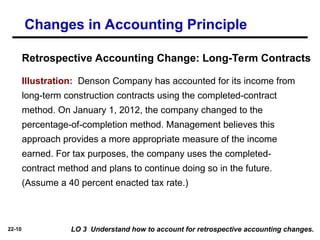
Illustration: Denson Companyhas accounted for its income from
long-term construction contracts using the completed-contract
method. On January 1, 2012, the company changed to the
percentage-of-completion method. Management believes this
approach provides a more appropriate measure of the income
earned. For tax purposes, the company uses the completed-
contract method and plans to continue doing so in the future.
(Assume a 40 percent enacted tax rate.)
LO 3 Understand how to account for retrospective accounting changes.
Retrospective Accounting Change: Long-Term Contracts
Changes in Accounting Principle
11.
22-11 LO 3Understand how to account for retrospective accounting changes.
Income statements for 2010–2012 under each method:
Last Slide
Viewed
Changes in Accounting Principle
(Old Method)
(New Method)
Historically
Historically
reported
reported
Restated
Restated
Calculate
Calculate
cumulative
cumulative
effect of
effect of
change on
change on
prior years
prior years
12.
22-12
Data for RetrospectiveChange
Illustration 22-2
Construction in Process (pre-tax) 220,000
Deferred Tax Liability
88,000
Retained Earnings (after tax)
132,000
LO 3 Understand how to account for retrospective accounting changes.
Journal entry
beginning of
2012
Last Slide
Viewed
Changes in Accounting Principle
(2010)
13.
22-13
Disclosing a Changein Principle in the Notes (example
on next slide):
LO 3 Understand how to account for retrospective accounting changes.
1. Nature of the change in accounting policy;
2. The method of applying the change, and:
a. A description of the prior period information that has been
retrospectively adjusted, if any.
b. The effect of the change on income from continuing operations,
net income (or other appropriate captions of changes in net assets
or performance indicators), any other affected line item.
c. The cumulative effect of the change on retained earnings or other
components of equity or net assets in the balance sheet as of the
beginning of the earliest period presented.
Changes in Accounting Principle
22-15
Adjustment on theRetained Earnings Statement
(Depends on how many years you present;
first let’s consider two years: 2012 and one prior year):
LO 3 Understand how to account for retrospective accounting changes.
Before Change
Go to
Slide
22-12
Go to
Slide
22-11
Back into this number
(if change was not made)
(see Slide 22-12)
(if old method was used)
(if old method was used)
1
1
2
2
3
3
Changes in Accounting Principle
Assume a Retained earnings balance of $1,360,000 at the beginning of 2010.
16.
22-16
LO 3 Understandhow to account for retrospective accounting changes.
Illustration 22-5
After Change
Adjustment on the Retained Earnings Statement (showing
two years, adjustment on the earliest year presented):
Go to
Slide
22-11
(if showing two years
in RE statement)
Changes in Accounting Principle
17.
22-17
LO 3 Understandhow to account for retrospective accounting changes.
Illustration 22-5
Adjustment on the Retained Earnings Statement (showing
one year, adjusting the beginning balance of RE):
Go to
Slide
22-11
(if showing one year
in RE statement)
Changes in Accounting Principle
$1,696,000
(old method: CC)
(old method: CC)
132,000
18.
22-18
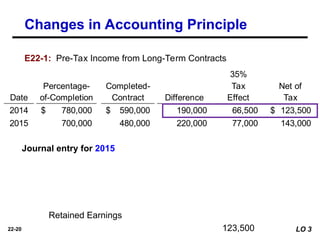
E22-1 (Change inPrinciple—Long-Term Contracts): Pam Erickson
Construction Company changed from the completed-contract to the
percentage-of-completion method of accounting for long-term
construction contracts during 2015. For tax purposes, the company
employs the completed-contract method and will continue this
approach in the future. (Hint: Adjust all tax consequences through the
Deferred Tax Liability account.)
Changes in Accounting Principle
LO 3
19.
22-19
Instructions: (assume atax rate of 35%)
(b) What entry(ies) are necessary to adjust the accounting
records for the change in accounting principle?
(a) What is the amount of net income and retained earnings that
would be reported in 2015? Assume beginning retained earnings for
2014 to be $100,000.
Changes in Accounting Principle
LO 3
E22-1 (Change in Principle—Long-Term Contracts):
20.
22-20
35%
Percentage- Completed- TaxNet of
Date of-Completion Contract Difference Effect Tax
2014 780,000
$ 590,000
$ 190,000 66,500 123,500
$
2015 700,000 480,000 220,000 77,000 143,000
E22-1: Pre-Tax Income from Long-Term Contracts
Changes in Accounting Principle
LO 3
Journal entry for 2015
Construction in Process 190,000
Deferred Tax Liability
66,500
Retained Earnings
123,500
21.
22-21
Restated Previous
2015 20142014
Pre-tax income 700,000
$ 780,000
$ 590,000
$
Income tax (35%) 245,000 273,000 206,500
Net income 455,000
$ 507,000
$ 383,500
$
Beg. Retained earnings 483,500
$ 100,000
$ 100,000
$
Accounting change 123,500
Beg. R/Es restated 607,000
$ 100,000 100,000
Net income 455,000 507,000 383,500
End. Retained earnings 1,062,000
$ 607,000
$ 483,500
$
Income
Statement
Statement
of Retained
Earnings
E22-1: Comparative Statements for two years:
Changes in Accounting Principle
LO 3
22.
22-22
Direct Effects- FASB takes the position that
companies should retrospectively apply the direct
effects of a change in accounting principle.
Example: Change from LIFO to FIFO directly affects
inventory and deferred taxes
Indirect Effect is any change to current or future cash
flows of a company that result from making a change in
accounting principle that is applied retrospectively.
Example: Executive bonus based on net income
Direct and Indirect Effects of Changes
Changes in Accounting Principle
LO 3
23.
22-23
5. Describe theaccounting for changes in
estimates.
6. Identify changes in a reporting entity.
7. Describe the accounting for correction of
errors.
8. Identify economic motives for changing
accounting methods.
9. Analyze the effect of errors.
After studying this chapter, you should be able to:
LEARNING OBJECTIVES
LEARNING OBJECTIVES
1. Identify the types of accounting changes.
2. Describe the accounting for changes in
accounting principles.
3. Understand how to account for
retrospective accounting changes.
4. Understand how to account for
impracticable changes.
Accounting Changes
Accounting Changes
and Error Analysis
and Error Analysis
22
22
24.
22-24
Impracticability
Companies should notuse retrospective application if one of the
following conditions exists:
1. Company cannot determine the effects of the retrospective
application.
2. Retrospective application requires assumptions about
management’s intent in a prior period (hindsight).
3. Retrospective application requires significant estimates that
the company cannot develop.
If any of the above conditions exists, the company prospectively applies the
new accounting principle.
Changes in Accounting Principle
LO 4
25.
22-25 LO 4Understand how to account for impracticable changes.
Example: A change from the FIFO inventory valuation
method to the LIFO inventory valuation method. It is
virtually impossible reconstruct the old LIFO layers of
inventory over an extended period of time and thus, to
calculate the cumulative effect of the change in principle
LIFO procedures are applied prospectively from the earliest date
practicable (date of the change in this example)
No adjustment of RE is made
It is impracticable to restate prior financials
Changes in Accounting Principle
Impracticability
26.
22-26
5. Describe theaccounting for changes in
estimates.
6. Identify changes in a reporting entity.
7. Describe the accounting for correction of
errors.
8. Identify economic motives for changing
accounting methods.
9. Analyze the effect of errors.
After studying this chapter, you should be able to:
LEARNING OBJECTIVES
LEARNING OBJECTIVES
1. Identify the types of accounting changes.
2. Describe the accounting for changes in
accounting principles.
3. Understand how to account for
retrospective accounting changes.
4. Understand how to account for
impracticable changes.
Accounting Changes
Accounting Changes
and Error Analysis
and Error Analysis
22
22
27.
22-27
Changes in AccountingEstimate
Examples of Estimates
1. Uncollectible receivables (bad debts).
2. Inventory obsolescence.
3. Useful lives and salvage values of assets.
4. Liabilities for warranty costs.
5. Change in depreciation methods.
LO 5
28.
22-28
Prospective Reporting
Changes inaccounting estimates are reported
prospectively. Account for changes in estimates in
1. The period of change if the change affects that period
only, or
2. The period of change and future periods if the change
affects both.
FASB views changes in estimates as normal recurring
corrections and adjustments and prohibits retrospective
treatment.
Changes in Accounting Estimate
LO 5
29.
22-29
Illustration: Arcadia HighSchool purchased equipment for
$510,000 which was estimated to have a useful life of 10 years
with a salvage value of $10,000 at the end of that time.
Depreciation has been recorded for 7 years on a straight-line
basis. In 2014 (year 8), it is determined that the total estimated life
should be 15 years with a salvage value of $5,000 at the end of
that time.
Required:
What is the journal entry to correct
prior years’ depreciation expense?
Calculate depreciation expense for 2014.
Prospective
Method;
No Entry
Required
Changes in Accounting Estimate
LO 5
30.
22-30
Equipment $510,000
Fixed Assets:
Accumulateddepreciation 350,000
Net book value (NBV) $160,000
Balance Sheet (Dec. 31, 2013)
After 7
years
Equipment cost $510,000
Salvage value - 10,000
Depreciable base 500,000
Useful life (original) 10 years
Annual depreciation $ 50,000 x 7 years = $350,000
First, establish NBV
at date of change in
estimate.
Changes in Accounting Estimate
LO 5
31.
22-31
Net book value$160,000
Salvage value (if any) 5,000
Depreciable base 155,000
Useful life 8 years
Annual depreciation $ 19,375
Second, calculate
Second, calculate
depreciation expense
depreciation expense
for 2014.
for 2014.
Depreciation expense 19,375
Accumulated depreciation
19,375
Journal entry for 2014
Changes in Accounting Estimate
LO 5
Advance slide in presentation
mode to reveal answers.
32.
22-32
Disclosures
Companies need notdisclose changes in accounting estimate
made as part of normal operations, such as bad debt
allowances or inventory obsolescence, unless such changes are
material.
However, for a change in estimate that affects several periods
(such as a change in the service lives of depreciable assets),
companies should disclose the effect on income from continuing
operations and related per-share amounts of the current period.
Changes in Accounting Estimate
LO 5
33.
22-33
5. Describe theaccounting for changes in
estimates.
6. Identify changes in a reporting entity.
7. Describe the accounting for correction of
errors.
8. Identify economic motives for changing
accounting methods.
9. Analyze the effect of errors.
After studying this chapter, you should be able to:
LEARNING OBJECTIVES
LEARNING OBJECTIVES
1. Identify the types of accounting changes.
2. Describe the accounting for changes in
accounting principles.
3. Understand how to account for
retrospective accounting changes.
4. Understand how to account for
impracticable changes.
Accounting Changes
Accounting Changes
and Error Analysis
and Error Analysis
22
22
34.
22-34
Change in ReportingEntity
Examples of a change in reporting entity are:
1. Presenting consolidated statements in place of statements of
individual companies.
2. Changing specific subsidiaries that constitute the group of
companies for which the entity presents consolidated financial
statements.
3. Changing the companies included in combined financial
statements.
4. Changing the cost, equity, or consolidation method of
accounting for subsidiaries and investments.
Reported by changing the financial statements of all prior periods
presented (retrospective method).
LO 6
35.
22-35
5. Describe theaccounting for changes in
estimates.
6. Identify changes in a reporting entity.
7. Describe the accounting for correction of
errors.
8. Identify economic motives for changing
accounting methods.
9. Analyze the effect of errors.
After studying this chapter, you should be able to:
LEARNING OBJECTIVES
LEARNING OBJECTIVES
1. Identify the types of accounting changes.
2. Describe the accounting for changes in
accounting principles.
3. Understand how to account for
retrospective accounting changes.
4. Understand how to account for
impracticable changes.
Accounting Changes
Accounting Changes
and Error Analysis
and Error Analysis
22
22
36.
22-36
Accounting Errors
Types ofAccounting Errors:
1. A change from an accounting principle that is not generally
accepted to an accounting policy that is acceptable.
2. Mathematical mistakes.
3. Changes in estimates that occur because a company did
not prepare the estimates in good faith.
4. Failure to accrue or defer certain expenses or revenues.
5. Misuse of facts.
6. Incorrect classification of a cost as an expense instead of
an asset, and vice versa.
LO 7
37.
22-37
All materialerrors must be corrected.
Record corrections of errors from prior periods as an
adjustment to the beginning balance of retained earnings
in the current period.
Such corrections are called prior period adjustments.
For comparative statements, a company should restate the
prior statements affected, to correct for the error
(restatement method).
LO 7
Accounting Errors
38.
22-38
Illustration: In 2015the bookkeeper for Selectro Company
discovered an error. In 2014 the company failed to record
$20,000 of depreciation expense on a newly constructed building.
This building is the only depreciable asset Selectro owns. The
company correctly included the depreciation expense in its tax
return and correctly reported its income taxes payable.
LO 7
Example of Error Correction
This bookkeeper will be looking for a new job soon!
39.
22-39
Selectro’s income statementfor 2014 with and without the error.
Illustration 22-19
LO 7
Example of Error Correction
What are the entries that Selectro should have made and did make
for recording depreciation expense and income taxes?
40.
22-40
Entries that Selectroshould have made and did make for recording
depreciation expense and income taxes.
Illustration 22-20
Example of Error Correction
Illustration 22-19
22-43
Retained Earnings 12,000
Correcting
Entryin
2015
Reversal
LO 7
Example of Error Correction
Prepare the proper correcting entry in 2015, that should be made
by Selectro.
Illustration 22-20
Deferred Tax Liability 8,000
44.
22-44
Retained Earnings 12,000
Correcting
Entryin
2015
LO 7
Example of Error Correction
Prepare the proper correcting entry in 2015, that should be made
by Selectro.
Illustration 22-20
Accumulated Depreciation—Buildings
20,000
Deferred Tax Liability 8,000
45.
22-45
Illustration: Selectro Companyhas a beginning retained earnings
balance at January 1, 2015, of $350,000. The company reports net
income of $400,000 in 2015.
Illustration 22-21
LO 7
Example of Error Correction
Single-Period Statements
46.
22-46
Comparative Statements
Company should
1.Make adjustments to correct the amounts for all affected
accounts reported in the statements for all periods
reported.
2. Restate the data to the correct basis for each year
presented.
3. Show any catch-up adjustment as a prior period
adjustment to retained earnings for the earliest period it
reported.
LO 7
Accounting Errors
47.
22-47
Woods, Inc.
Statement ofRetained Earnings
For the Year Ended December 31, 2014
Balance, January 1 1,050,000
$
Net income 360,000
Dividends (300,000)
Balance, December 31 1,110,000
$
Before issuing the report for the year ended December 31, 2014, you discover
a $62,500 error that caused the 2013 inventory to be overstated (overstated
inventory caused COGS to be lower and thus net income to be higher in
2013). Would this discovery have any impact on the reporting of the
Statement of Retained Earnings for 2014? Assume a 20% tax rate.
LO 7
Accounting Error Illustration
48.
22-48 LO 7
AccountingError Illustration
Woods, Inc.
Statement of Retained Earnings
For the Year Ended December 31, 2014
Balance, January 1 1,050,000
$
Prior period adjustment, net of tax (50,000)
Balance, January 1, as restated 1,000,000
Net income 360,000
Dividends (300,000)
Balance, December 31 1,060,000
$
Advance slide in presentation
mode to reveal answers.
Entry at December 31, 2014 (assuming books have not been closed for 2014):
Retained Earnings 50,000
Deferred Tax Liability 12,500
Inventory 62,500
49.
22-49
Illustration 22-23
LO 7
Summaryof Changes and Errors
Changes in accounting principle are appropriate only when a company
demonstrates that the newly adopted generally accepted accounting
principle is preferable to the existing one. (“Preferable” means the change
constitutes an improvement in financial reporting, not on the basis of
the income tax effect alone).
22-51 LO 7Describe the accounting for correction of errors.
1. Change from FIFO to average cost inventory
method.
2. Change due to overstatement of inventory.
3. Change from sum-of-the-years'-digits to straight-
line method of depreciation.
4. Change from presenting unconsolidated to
consolidated financial statements.
5. Change from LIFO to FIFO inventory method.
6. Change in the rate used to compute warranty costs.
7. Change from an unacceptable accounting principle
to an acceptable accounting principle.
8. Change in a patent's amortization period.
9. Change from completed-contract to percentage-of-
completion method on construction contracts.
10. Change in a plant asset's salvage value.
E22-8 How would these changes be accounted for?
Retrospectively
Retrospectively
Restatement
Restatement
Prospectively
Prospectively
Retrospectively
Retrospectively
Retrospectively
Retrospectively
Prospectively
Prospectively
Restatement
Restatement
Prospectively
Prospectively
Retrospectively
Retrospectively
Prospectively
Prospectively
Summary of Changes and Errors
52.
22-52 LO 7Describe the accounting for correction of errors.
E22-2 Change in Principle: Inventory Methods
Whitman Company began operations on January 1, 2010, and uses the
average cost method of pricing inventory. Management is contemplating a
change in inventory methods for 2013. The following information is
available for the years 2010–2012.
Net Income Computed Using
Net Income Computed Using
Average Cost Method
Average Cost Method FIFO Method
FIFO Method LIFO Method
LIFO Method
2010
2010 $16,000
$16,000 $19,000
$19,000 $12,000
$12,000
2011
2011 18,000
18,000 21,000
21,000 14,000
14,000
2012
2012 20,000
20,000 25,000
25,000 17,000
17,000
Summary of Changes and Errors
53.
22-53 LO 7Describe the accounting for correction of errors.
E22-2 Change in Principle: Inventory Methods
(a) Prepare the journal entry necessary to record a change from
the average cost method to the FIFO method in 2013.
Net Income Computed Using
Net Income Computed Using
Average Cost Method
Average Cost Method FIFO Method
FIFO Method LIFO Method
LIFO Method
2010
2010 $16,000
$16,000 $19,000
$19,000 $12,000
$12,000
2011
2011 18,000
18,000 21,000
21,000 14,000
14,000
2012
2012 20,000
20,000 25,000
25,000 17,000
17,000
Inventory 11,000*
Retained Earnings 11,000
*($19,000 + $21,000 + $25,000) – ($16,000 + $18,000 + $20,000)
Summary of Changes and Errors
54.
22-54 LO 7Describe the accounting for correction of errors.
E22-2 Change in Principle: Inventory Methods
(b) Determine net income to be reported for 2010, 2011, and
2012, after giving effect to the change in accounting principle
Net Income Computed Using
Net Income Computed Using
Average Cost Method
Average Cost Method FIFO Method
FIFO Method LIFO Method
LIFO Method
2010
2010 $16,000
$16,000 $19,000
$19,000 $12,000
$12,000
2011
2011 18,000
18,000 21,000
21,000 14,000
14,000
2012
2012 20,000
20,000 25,000
25,000 17,000
17,000
Net Income (FIFO) 2010 $19,000
2011 21,000
2012 25,000
Summary of Changes and Errors
55.
22-55 LO 7Describe the accounting for correction of errors.
E22-2 Change in Principle: Inventory Methods
(c) Assume Whitman Company used the LIFO method instead
of the average cost method during the years 2010–2012. In
2013, Whitman changed to the FIFO method. Prepare the journal
entry necessary to record the change in principle
Net Income Computed Using
Net Income Computed Using
Average Cost Method
Average Cost Method FIFO Method
FIFO Method LIFO Method
LIFO Method
2010
2010 $16,000
$16,000 $19,000
$19,000 $12,000
$12,000
2011
2011 18,000
18,000 21,000
21,000 14,000
14,000
2012
2012 20,000
20,000 25,000
25,000 17,000
17,000
Inventory 22,000*
Retained Earnings 22,000
*($19,000 + $21,000 + $25,000) – ($12,000 + $14,000 + $17,000)
Summary of Changes and Errors
56.
22-56
5. Describe theaccounting for changes in
estimates.
6. Identify changes in a reporting entity.
7. Describe the accounting for correction of
errors.
8. Identify economic motives for changing
accounting methods.
9. Analyze the effect of errors.
After studying this chapter, you should be able to:
LEARNING OBJECTIVES
LEARNING OBJECTIVES
1. Identify the types of accounting changes.
2. Describe the accounting for changes in
accounting principles.
3. Understand how to account for
retrospective accounting changes.
4. Understand how to account for
impracticable changes.
Accounting Changes
Accounting Changes
and Error Analysis
and Error Analysis
22
22
57.
22-57
LO 10 Makethe computations and prepare the entries necessary to
record a change from or to the equity method of accounting.
Change From The Equity Method
Not covered on the Final Exam
APPENDIX
APPENDIX 22A CHANGING FROM OR TO THE EQUITY METHOD
58.
22-58
RELEVANT FACTS -Similarities
The accounting for changes in estimates is similar between GAAP and
IFRS.
Under GAAP and IFRS, if determining the effect of a change in
accounting policy is considered impracticable, then a company should
report the effect of the change in the period in which it believes it
practicable to do so, which may be the current period. (But…see next
slide for differences.)
LO 11 Compare the procedures for accounting changes
and error analysis under GAAP and IFRS.
59.
22-59
RELEVANT FACTS -Differences
Under IFRS, the impracticality exception applies both to changes in
accounting principles and to the correction of errors. Under GAAP, this
exception applies only to changes in accounting principle.
IFRS (IAS 8) does not specifically address the accounting and reporting
for indirect effects of changes in accounting principles. GAAP has
detailed guidance on the accounting and reporting of indirect effects.
A change to or from LIFO would not occur under IFRS because LIFO is
not a permissible inventory valuation method under IFRS.
LO 11
60.
22-60
Which of thefollowing is not classified as an accounting change by
IFRS?
a. Change in accounting policy.
b. Change in accounting estimate.
c. Errors in financial statements.
d. None of the above.
IFRS SELF-TEST QUESTION
LO 11
61.
22-61
IFRS requires companiesto use which method for reporting changes
in accounting policies?
a. Cumulative effect approach.
b. Retrospective approach.
c. Prospective approach.
d. Averaging approach.
IFRS SELF-TEST QUESTION
LO 11
62.
22-62
Under IFRS, theimpracticality exception applies to
a. Changes involving LIFO.
b. Changes in accounting policy only.
c. Corrections of errors only.
d. Both changes in accounting policy and correction of errors.
IFRS SELF-TEST QUESTION
LO 11