17-1
17-2
PREVIEW OF CHAPTER 17
Intermediate Accounting
16th Edition
Kieso ● Weygandt ● Warfield
17-3
Different motivations for investing:
 To earn a high rate of return.
 To secure certain operating or financing arrangements
with another company.
INVESTMENT IN DEBT SECURITIES
LO 1
17-4
Companies account for investments based on
 the type of security (debt or equity) and
 their intent with respect to the investment.
ILLUSTRATION 17-1
Summary of Investment Accounting Approaches
LO 1
INVESTMENT IN DEBT SECURITIES
17-5
Debt securities represent a creditor relationship:
 U.S. government
securities
 Municipal securities
 Corporate bonds
 Convertible debt
 Commercial paper
Type
 Held-to-maturity
 Trading
 Available-for-sale
Accounting Category
LO 1
Debt Investment Classifications
17-6
ILLUSTRATION 17-2
Accounting for Debt
Securities by Category
Amortized cost is the acquisition cost adjusted for
the amortization of discount or premium, if
appropriate.
LO 1
Debt Investment Classifications
17-7
Classify a debt security as held-to-maturity only if it has both
1) the positive intent and
2) the ability to hold securities to maturity.
Accounted for at amortized cost, not fair value.
LO 1
Held-to-Maturity Securities (Amortized Cost)
Amortize premium or discount
using the effective-interest
method unless the straight-line
method yields a similar result.
INVESTMENT IN DEBT SECURITIES
17-8
Illustration: Z-Smith Company purchased $100,000 of 8 percent
bonds of Bush Corporation on January 1, 2016, at a discount,
paying $92,278. The bonds mature January 1, 2021 and yield
10%; interest is payable each July 1 and January 1. Z-Smith
records the investment as follows:
January 1, 2016
Debt Investments 92,278
Cash 92,278
Held-to-Maturity Securities (Amortized Cost)
LO 1
17-9 LO 1
ILLUSTRATION 17-3
Schedule of Interest Revenue and
Bond Discount Amortization—
Effective-Interest Method
17-10
ILLUSTRATION 17-3
Cash 4,000
Debt Investments 614
Interest Revenue 4,614
LO 1
Illustration: Z-Smith Company records the receipt of the first
semiannual interest payment on July 1, 2016, as follows:
17-11
ILLUSTRATION 17-3
Illustration: Z-Smith is on a calendar-year basis, it accrues
interest and amortizes the discount at December 31, 2016, as
follows:
Interest Receivable 4,000
Debt Investments 645
Interest Revenue 4,645
LO 1
17-12
Reporting of Held-to-Maturity Securities
LO 1
Held-to-Maturity Securities (Amortized Cost)
ILLUSTRATION 17-4
Reporting of Held-to-Maturity
Securities
17-13
Companies report available-for-sale securities at
 fair value, with
 unrealized holding gains and losses reported as other
comprehensive income, a separate component of
stockholder’s equity, until realized.
Any discount or premium is amortized.
Available-for-Sale Securities
LO 1
INVESTMENT IN DEBT SECURITIES
17-14
Illustration (Single Security): Graffeo Corporation purchases
$100,000, 10 percent, five-year bonds on January 1, 2016, with
interest payable on July 1 and January 1. The bonds sell for
$108,111, which results in a bond premium of $8,111 and an
effective interest rate of 8 percent. Graffeo records the purchase of
the bonds on January 1, 2016, as follows.
Debt Investments 108,111
Cash 108,111
Available-for-Sale Securities Debt
Securities
LO 1
17-15 LO 1
ILLUSTRATION 17-6
Schedule of Interest Revenue and
Bond Premium Amortization—
Effective-Interest Method
17-16
Illustration (Single Security): The entry to record interest revenue
on July 1, 2016, is as follows.
Cash 5,000
Debt Investments 676
Interest Revenue 4,324
LO 1
ILLUSTRATION 17-6
17-17
Available-for-Sale Securities Debt
Securities
Illustration (Single Security): At December 31, 2016, Graffeo
makes the following entry to recognize interest revenue.
Interest Receivable 5,000
Debt Investments 703
Interest Revenue 4,297
Interest
Revenue for
2016 = $8,621
ILLUSTRATION 17-6
LO 1
17-18
Illustration (Portfolio of Securities): Herringshaw Corporation
has two debt securities classified as available-for-sale. The
following illustration identifies the amortized cost, fair value, and the
amount of the unrealized gain or loss.
Available-for-Sale Securities Debt
Securities
LO 1
ILLUSTRATION 17-7
Computation of Fair Value Adjustment—Available-for-Sale Securities (2017)
17-19
Prepare the adjusting entry Herringshaw would make on December
31, 2017 to record the loss.
Unrealized Holding Gain or Loss—Equity 9,537
Fair Value Adjustment 9,537
Available-for-Sale Securities Debt
Securities
LO 1
ILLUSTRATION 17-7
17-20
Sale of Available-for-Sale Securities
If company sells bonds before maturity date:
 It must make entries to remove from the Debt Investments
account the amortized cost of bonds sold.
 Any realized gain or loss on sale is reported in the “Other”
section of the income statement.
Available-for-Sale Securities Debt
Securities
LO 1
17-21
Illustration: Herringshaw Corporation sold the Watson bonds (from
Illustration 17-7) on July 1, 2018, for $90,000, at which time it had
an amortized cost of $94,214.
Cash 90,000
Loss on Sale of Investments 4,214
Debt Investments 94,214
Sale of Available-for-Sale Securities
LO 1
ILLUSTRATION 17-8
Computation of Loss on Sale of Bonds
17-22
Companies report trading securities at
 fair value, with
 unrealized holding gains and losses reported as part of
net income.
Any discount or premium is amortized.
A holding gain or loss is the net change in the fair value of
a security from one period to another, exclusive of
dividend or interest revenue recognized but not
received.
Trading Securities (Fair Value Through Net
Income)
LO 1
INVESTMENT IN DEBT SECURITIES
17-23
Illustration: On December 31, 2017, Koopmans Publishing
Corporation determined its trading securities portfolio to be as
follows:
Trading Securities Debt
Securities
ILLUSTRATION 17-11
Computation of Fair Value Adjustment—Trading
Securities Portfolio (2017)
LO 1
17-24
Illustration: At December 31, Koopmans Publishing makes an
adjusting entry:
Fair Value Adjustment 3,750
Unrealized Holding Gain or Loss—Income 3,750
ILLUSTRATION 17-11
Trading Securities Debt
Securities
LO 1
17-25
Illustration: (Trading Securities) Hendricks Corporation
purchased trading investment bonds for $50,000 at par. At
December 31, Hendricks received annual interest of $2,000, and
the fair value of the bonds was $47,400.
Instructions:
a) Prepare the journal entry for the purchase of the
investment.
b) Prepare the journal entry for the interest received.
c) Prepare the journal entry for the fair value adjustment.
Trading Securities Debt
Securities
LO 1
17-26
Illustration: (Trading Securities) Hendricks Corporation
purchased trading investment bonds for $50,000 at par. At
December 31, Hendricks received annual interest of $2,000, and
the fair value of the bonds was $47,400. Prepare the journal
entry for the purchase of the investment.
Trading Securities Debt
Securities
Debt Investments 50,000
Cash
50,000
LO 1
17-27
Illustration: (Trading Securities) Hendricks Corporation
purchased trading investment bonds for $50,000 at par. At
December 31, Hendricks received annual interest of $2,000, and
the fair value of the bonds was $47,400. Prepare the journal
entry for the interest received.
Trading Securities Debt
Securities
Cash 2,000
Interest Revenue
2,000
LO 1
17-28
Illustration: (Trading Securities) Hendricks Corporation
purchased trading investment bonds for $50,000 at par. At
December 31, Hendricks received annual interest of $2,000, and
the fair value of the bonds was $47,400. Prepare the journal
entry for the fair value adjustment.
Trading Securities Debt
Securities
Unrealized Holding Loss – Income 2,600
Fair Value Adjustment
2,600
LO 1
17-29
INVESTMENTS IN EQUITY SECURITIES
Represent ownership of capital stock.
Cost includes:
 price of the security, plus
 broker’s commissions and fees related to purchase.
The degree to which one corporation (investor) acquires an
interest in the common stock of another corporation (investee)
generally determines the accounting treatment for the
investment subsequent to acquisition.
LO 2
17-30
0 ------------------20% ---------------- 50% ---------------- 100%
Investor has
passive
interest
Investor has
significant
influence
Investor has
controlling
interest
Investment
valued using
Fair Value
Method
Investment
valued using
Equity
Method
Investment valued on
parent’s books using Cost
Method or Equity Method
(investment eliminated in
Consolidation)
Ownership Percentages
LO 2
INVESTMENTS IN EQUITY SECURITIES
17-31
ILLUSTRATION 17-13
Accounting and Reporting for Equity Securities by Category
LO 2
INVESTMENTS IN EQUITY SECURITIES
17-32
Holdings of Less Than 20%
Upon acquisition, companies record equity securities at cost.
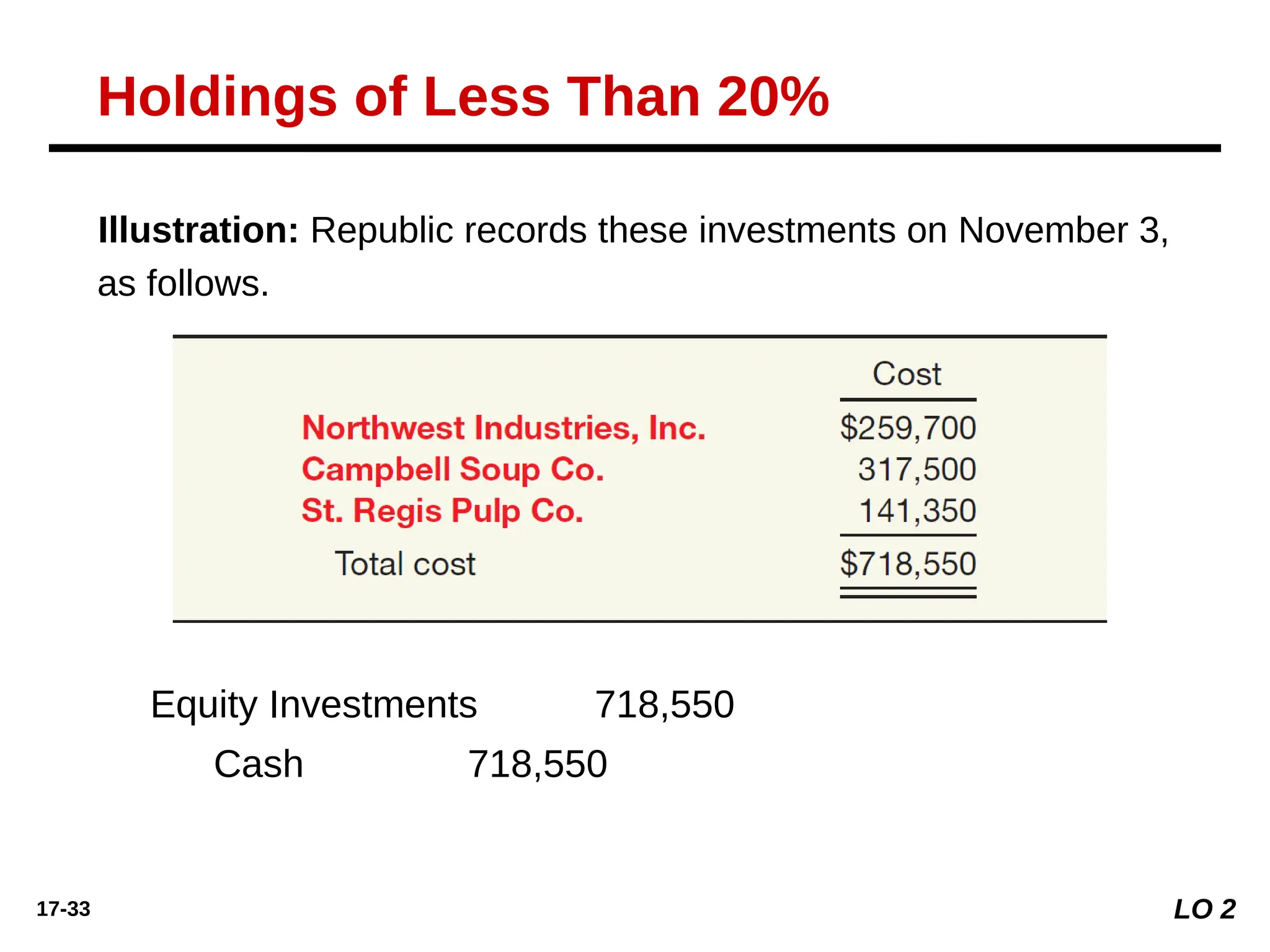
Illustration: On November 3, 2017, Republic Corporation
purchased common stock of three companies, each investment
representing less than a 20 percent interest.
LO 2
17-33
Illustration: Republic records these investments on November 3,
as follows.
Equity Investments 718,550
Cash 718,550
LO 2
Holdings of Less Than 20%
17-34
Illustration: On December 6, 2017, Republic receives a cash
dividend of $4,200 from Campbell Soup Co.
LO 2
Holdings of Less Than 20%
Cash 4,200
Dividend Revenue 4,200
17-35
Illustration: Republic’s available-for-sale equity security portfolio
on December 31, 2017:
ILLUSTRATION 17-14
Computation of Fair Value Adjustment—Equity Security Portfolio (2017)
LO 2
Holdings of Less Than 20%
17-36
Unrealized Holding Gain or Loss—Income 35,550
Fair Value Adjustment 35,550
ILLUSTRATION 17-14
Illustration: Prepare the entry Republic would make on December 31,
2017, to record the net unrealized gains and losses.
LO 2
Holdings of Less Than 20%
17-37
Illustration: On January 23, 2018, Republic sold all of its
Northwest Industries, Inc. common stock receiving net proceeds
of $287,220. Prepare the entry to record the sale.
Cash 287,220
Equity Investments 259,700
Gain on Sale of Investments 27,520
ILLUSTRATION 17-15
Computation of Gain on
Sale of Stock
LO 2
Holdings of Less Than 20%
17-38
An investment (direct or indirect) of 20 percent or more of the
voting stock of an investee should lead to a presumption that in
the absence of evidence to the contrary, an investor has the
ability to exercise significant influence over an investee.
In instances of “significant influence,” the investor must account
for the investment using the equity method.
INVESTMENTS IN EQUITY SECURITIES
Holding Between 20% and 50% (Equity
Method)
LO 3
17-39
Holdings Between 20% and 50%
Comparison of Equity Method to Fair Value
Record the investment at cost and subsequently adjust the
amount each period for
 the investor’s proportionate share of the earnings (losses)
and
 dividends received by the investor.
If investor’s share of investee’s losses exceeds the carrying amount of the
investment, the investor ordinarily should discontinue applying the equity
method and not recognize additional losses.
LO 3
17-40
Controlling Interest - When one corporation acquires a voting
interest of more than 50 percent in another corporation
 Investor corporation is referred to as the parent.
 Investee corporation is referred to as the subsidiary.
 Investment in the subsidiary is reported on the parent’s
balance sheet as a long-term investment.
 Parent generally prepares consolidated financial
statements.
LO 3
INVESTMENTS IN EQUITY SECURITIES
Holding of More Than 50% (Consolidation)
17-41
DEFINING DERIVATIVES
Financial instruments that derive their value from values of
other assets (e.g., stocks, bonds, or commodities).
Three different types of derivatives:
1. Financial forwards or financial futures.
2. Options.
3. Swaps.
ACCOUNTING FOR DIRIVATIVE INSTRUMENTS
LO 5 Describe the uses of and accounting for derivatives.
APPENDIX 17A
17-42
WHO USES DERIVATIVES, AND WHY?
Producers and Consumers
 Commodity prices are volatile.
 They depend on weather, crop production, and general
economic conditions.
 To plan effectively, it makes good sense to lock in specific
future revenues or costs in order to run their businesses
successfully.
ACCOUNTING FOR DIRIVATIVE INSTRUMENTS
LO 5
APPENDIX 17A
17-43
WHO USES DERIVATIVES, AND WHY?
Speculators and Arbitrageurs
 The speculator who may be in the market for only a few
hours, will then sell the forward contract to another
speculator or to a company.
 Arbitrageurs attempt to exploit inefficiencies in markets.
They seek to lock in profits by simultaneously entering into
transactions in two or more markets.
ACCOUNTING FOR DIRIVATIVE INSTRUMENTS
LO 5
APPENDIX 17A
17-44
BASIC PRINCIPLES IN ACCOUNTING FOR
DERIVATIVES
1. Recognize derivatives in the financial statements as
assets and liabilities.
2. Report derivatives at fair value.
3. Recognize gains and losses resulting from speculation
in derivatives immediately in income.
4. Report gains and losses resulting from hedge
transactions differently, depending on the type of hedge.
ACCOUNTING FOR DIRIVATIVE INSTRUMENTS
LO 5
APPENDIX 17A
17-45
Example of Derivative Financial Instrument-
Speculation
Illustration: Assume that a company purchases a call option
contract from Baird Investment Co. on January 2, 2017, when
Laredo shares are trading at $100 per share. The contract gives it
the option to purchase 1,000 shares (referred to as the notional
amount) of Laredo stock at an option price of $100 per share. The
option expires on April 30, 2017. The company purchases the call
option for $400 and makes the following entry on January 2, 2017.
Call Option 400
Cash 400
Option
Premium
ACCOUNTING FOR DIRIVATIVE INSTRUMENTS
LO 5
APPENDIX 17A
17-46
Example of Derivative Financial Instrument-
Speculation
The option premium consists of two amounts.
ILLUSTRATION 17A-1
Option Premium Formula
Intrinsic value is the difference between the market price and the
preset strike price at any point in time. It represents the amount realized
by the option holder, if exercising the option immediately. On January 2,
2017, the intrinsic value is zero because the market price equals the
preset strike price.
ACCOUNTING FOR DIRIVATIVE INSTRUMENTS
LO 5
APPENDIX 17A
17-47
Example of Derivative Financial Instrument-
Speculation
The option premium consists of two amounts.
Time value refers to the option’s value over and above its intrinsic
value. Time value reflects the possibility that the option has a fair value
greater than zero. How? Because there is some expectation that the
price of Laredo shares will increase above the strike price during the
option term. As indicated, the time value for the option is $400.
ACCOUNTING FOR DIRIVATIVE INSTRUMENTS
LO 5
APPENDIX 17A
ILLUSTRATION 17A-1
Option Premium Formula
17-48
All of the following are key similarities between GAAP and IFRS with
respect to accounting for investments except:
a. IFRS and GAAP require the same accounting for equity
securities.
b. IFRS and GAAP apply the equity method to significant influence
equity investments.
c. IFRS and GAAP have a fair value option for financial
instruments.
d. the accounting for impairment of investments is similar,
although IFRS allows recovery of impairment losses.
IFRS SELF-TEST QUESTION
LO 9
17-49
Which of the following statements is correct?
a. IFRS permits the fair value option for the equity method of
accounting. (b)
b. GAAP permits recovery of impairment losses. (c)
c. Under IFRS, non-trading equity investments are accounted for
at amortized cost. (d)
d. IFRS and GAAP both have a trading investment classification.
IFRS SELF-TEST QUESTION
LO 9
17-50
IFRS requires companies to measure their financial assets at fair
value except when based on:
a. whether the equity method of accounting is used.
b. whether the financial asset is a debt investment.
c. whether the financial asset is an equity investment.
d. whether an investment is classified as trading.
IFRS SELF-TEST QUESTION
LO 9

Intermediate accounting chapter 17 Investments.pptx

  • 1.
  • 2.
    17-2 PREVIEW OF CHAPTER17 Intermediate Accounting 16th Edition Kieso ● Weygandt ● Warfield
  • 3.
    17-3 Different motivations forinvesting:  To earn a high rate of return.  To secure certain operating or financing arrangements with another company. INVESTMENT IN DEBT SECURITIES LO 1
  • 4.
    17-4 Companies account forinvestments based on  the type of security (debt or equity) and  their intent with respect to the investment. ILLUSTRATION 17-1 Summary of Investment Accounting Approaches LO 1 INVESTMENT IN DEBT SECURITIES
  • 5.
    17-5 Debt securities representa creditor relationship:  U.S. government securities  Municipal securities  Corporate bonds  Convertible debt  Commercial paper Type  Held-to-maturity  Trading  Available-for-sale Accounting Category LO 1 Debt Investment Classifications
  • 6.
    17-6 ILLUSTRATION 17-2 Accounting forDebt Securities by Category Amortized cost is the acquisition cost adjusted for the amortization of discount or premium, if appropriate. LO 1 Debt Investment Classifications
  • 7.
    17-7 Classify a debtsecurity as held-to-maturity only if it has both 1) the positive intent and 2) the ability to hold securities to maturity. Accounted for at amortized cost, not fair value. LO 1 Held-to-Maturity Securities (Amortized Cost) Amortize premium or discount using the effective-interest method unless the straight-line method yields a similar result. INVESTMENT IN DEBT SECURITIES
  • 8.
    17-8 Illustration: Z-Smith Companypurchased $100,000 of 8 percent bonds of Bush Corporation on January 1, 2016, at a discount, paying $92,278. The bonds mature January 1, 2021 and yield 10%; interest is payable each July 1 and January 1. Z-Smith records the investment as follows: January 1, 2016 Debt Investments 92,278 Cash 92,278 Held-to-Maturity Securities (Amortized Cost) LO 1
  • 9.
    17-9 LO 1 ILLUSTRATION17-3 Schedule of Interest Revenue and Bond Discount Amortization— Effective-Interest Method
  • 10.
    17-10 ILLUSTRATION 17-3 Cash 4,000 DebtInvestments 614 Interest Revenue 4,614 LO 1 Illustration: Z-Smith Company records the receipt of the first semiannual interest payment on July 1, 2016, as follows:
  • 11.
    17-11 ILLUSTRATION 17-3 Illustration: Z-Smithis on a calendar-year basis, it accrues interest and amortizes the discount at December 31, 2016, as follows: Interest Receivable 4,000 Debt Investments 645 Interest Revenue 4,645 LO 1
  • 12.
    17-12 Reporting of Held-to-MaturitySecurities LO 1 Held-to-Maturity Securities (Amortized Cost) ILLUSTRATION 17-4 Reporting of Held-to-Maturity Securities
  • 13.
    17-13 Companies report available-for-salesecurities at  fair value, with  unrealized holding gains and losses reported as other comprehensive income, a separate component of stockholder’s equity, until realized. Any discount or premium is amortized. Available-for-Sale Securities LO 1 INVESTMENT IN DEBT SECURITIES
  • 14.
    17-14 Illustration (Single Security):Graffeo Corporation purchases $100,000, 10 percent, five-year bonds on January 1, 2016, with interest payable on July 1 and January 1. The bonds sell for $108,111, which results in a bond premium of $8,111 and an effective interest rate of 8 percent. Graffeo records the purchase of the bonds on January 1, 2016, as follows. Debt Investments 108,111 Cash 108,111 Available-for-Sale Securities Debt Securities LO 1
  • 15.
    17-15 LO 1 ILLUSTRATION17-6 Schedule of Interest Revenue and Bond Premium Amortization— Effective-Interest Method
  • 16.
    17-16 Illustration (Single Security):The entry to record interest revenue on July 1, 2016, is as follows. Cash 5,000 Debt Investments 676 Interest Revenue 4,324 LO 1 ILLUSTRATION 17-6
  • 17.
    17-17 Available-for-Sale Securities Debt Securities Illustration(Single Security): At December 31, 2016, Graffeo makes the following entry to recognize interest revenue. Interest Receivable 5,000 Debt Investments 703 Interest Revenue 4,297 Interest Revenue for 2016 = $8,621 ILLUSTRATION 17-6 LO 1
  • 18.
    17-18 Illustration (Portfolio ofSecurities): Herringshaw Corporation has two debt securities classified as available-for-sale. The following illustration identifies the amortized cost, fair value, and the amount of the unrealized gain or loss. Available-for-Sale Securities Debt Securities LO 1 ILLUSTRATION 17-7 Computation of Fair Value Adjustment—Available-for-Sale Securities (2017)
  • 19.
    17-19 Prepare the adjustingentry Herringshaw would make on December 31, 2017 to record the loss. Unrealized Holding Gain or Loss—Equity 9,537 Fair Value Adjustment 9,537 Available-for-Sale Securities Debt Securities LO 1 ILLUSTRATION 17-7
  • 20.
    17-20 Sale of Available-for-SaleSecurities If company sells bonds before maturity date:  It must make entries to remove from the Debt Investments account the amortized cost of bonds sold.  Any realized gain or loss on sale is reported in the “Other” section of the income statement. Available-for-Sale Securities Debt Securities LO 1
  • 21.
    17-21 Illustration: Herringshaw Corporationsold the Watson bonds (from Illustration 17-7) on July 1, 2018, for $90,000, at which time it had an amortized cost of $94,214. Cash 90,000 Loss on Sale of Investments 4,214 Debt Investments 94,214 Sale of Available-for-Sale Securities LO 1 ILLUSTRATION 17-8 Computation of Loss on Sale of Bonds
  • 22.
    17-22 Companies report tradingsecurities at  fair value, with  unrealized holding gains and losses reported as part of net income. Any discount or premium is amortized. A holding gain or loss is the net change in the fair value of a security from one period to another, exclusive of dividend or interest revenue recognized but not received. Trading Securities (Fair Value Through Net Income) LO 1 INVESTMENT IN DEBT SECURITIES
  • 23.
    17-23 Illustration: On December31, 2017, Koopmans Publishing Corporation determined its trading securities portfolio to be as follows: Trading Securities Debt Securities ILLUSTRATION 17-11 Computation of Fair Value Adjustment—Trading Securities Portfolio (2017) LO 1
  • 24.
    17-24 Illustration: At December31, Koopmans Publishing makes an adjusting entry: Fair Value Adjustment 3,750 Unrealized Holding Gain or Loss—Income 3,750 ILLUSTRATION 17-11 Trading Securities Debt Securities LO 1
  • 25.
    17-25 Illustration: (Trading Securities)Hendricks Corporation purchased trading investment bonds for $50,000 at par. At December 31, Hendricks received annual interest of $2,000, and the fair value of the bonds was $47,400. Instructions: a) Prepare the journal entry for the purchase of the investment. b) Prepare the journal entry for the interest received. c) Prepare the journal entry for the fair value adjustment. Trading Securities Debt Securities LO 1
  • 26.
    17-26 Illustration: (Trading Securities)Hendricks Corporation purchased trading investment bonds for $50,000 at par. At December 31, Hendricks received annual interest of $2,000, and the fair value of the bonds was $47,400. Prepare the journal entry for the purchase of the investment. Trading Securities Debt Securities Debt Investments 50,000 Cash 50,000 LO 1
  • 27.
    17-27 Illustration: (Trading Securities)Hendricks Corporation purchased trading investment bonds for $50,000 at par. At December 31, Hendricks received annual interest of $2,000, and the fair value of the bonds was $47,400. Prepare the journal entry for the interest received. Trading Securities Debt Securities Cash 2,000 Interest Revenue 2,000 LO 1
  • 28.
    17-28 Illustration: (Trading Securities)Hendricks Corporation purchased trading investment bonds for $50,000 at par. At December 31, Hendricks received annual interest of $2,000, and the fair value of the bonds was $47,400. Prepare the journal entry for the fair value adjustment. Trading Securities Debt Securities Unrealized Holding Loss – Income 2,600 Fair Value Adjustment 2,600 LO 1
  • 29.
    17-29 INVESTMENTS IN EQUITYSECURITIES Represent ownership of capital stock. Cost includes:  price of the security, plus  broker’s commissions and fees related to purchase. The degree to which one corporation (investor) acquires an interest in the common stock of another corporation (investee) generally determines the accounting treatment for the investment subsequent to acquisition. LO 2
  • 30.
    17-30 0 ------------------20% ----------------50% ---------------- 100% Investor has passive interest Investor has significant influence Investor has controlling interest Investment valued using Fair Value Method Investment valued using Equity Method Investment valued on parent’s books using Cost Method or Equity Method (investment eliminated in Consolidation) Ownership Percentages LO 2 INVESTMENTS IN EQUITY SECURITIES
  • 31.
    17-31 ILLUSTRATION 17-13 Accounting andReporting for Equity Securities by Category LO 2 INVESTMENTS IN EQUITY SECURITIES
  • 32.
    17-32 Holdings of LessThan 20% Upon acquisition, companies record equity securities at cost. Illustration: On November 3, 2017, Republic Corporation purchased common stock of three companies, each investment representing less than a 20 percent interest. LO 2
  • 33.
    17-33 Illustration: Republic recordsthese investments on November 3, as follows. Equity Investments 718,550 Cash 718,550 LO 2 Holdings of Less Than 20%
  • 34.
    17-34 Illustration: On December6, 2017, Republic receives a cash dividend of $4,200 from Campbell Soup Co. LO 2 Holdings of Less Than 20% Cash 4,200 Dividend Revenue 4,200
  • 35.
    17-35 Illustration: Republic’s available-for-saleequity security portfolio on December 31, 2017: ILLUSTRATION 17-14 Computation of Fair Value Adjustment—Equity Security Portfolio (2017) LO 2 Holdings of Less Than 20%
  • 36.
    17-36 Unrealized Holding Gainor Loss—Income 35,550 Fair Value Adjustment 35,550 ILLUSTRATION 17-14 Illustration: Prepare the entry Republic would make on December 31, 2017, to record the net unrealized gains and losses. LO 2 Holdings of Less Than 20%
  • 37.
    17-37 Illustration: On January23, 2018, Republic sold all of its Northwest Industries, Inc. common stock receiving net proceeds of $287,220. Prepare the entry to record the sale. Cash 287,220 Equity Investments 259,700 Gain on Sale of Investments 27,520 ILLUSTRATION 17-15 Computation of Gain on Sale of Stock LO 2 Holdings of Less Than 20%
  • 38.
    17-38 An investment (director indirect) of 20 percent or more of the voting stock of an investee should lead to a presumption that in the absence of evidence to the contrary, an investor has the ability to exercise significant influence over an investee. In instances of “significant influence,” the investor must account for the investment using the equity method. INVESTMENTS IN EQUITY SECURITIES Holding Between 20% and 50% (Equity Method) LO 3
  • 39.
    17-39 Holdings Between 20%and 50% Comparison of Equity Method to Fair Value Record the investment at cost and subsequently adjust the amount each period for  the investor’s proportionate share of the earnings (losses) and  dividends received by the investor. If investor’s share of investee’s losses exceeds the carrying amount of the investment, the investor ordinarily should discontinue applying the equity method and not recognize additional losses. LO 3
  • 40.
    17-40 Controlling Interest -When one corporation acquires a voting interest of more than 50 percent in another corporation  Investor corporation is referred to as the parent.  Investee corporation is referred to as the subsidiary.  Investment in the subsidiary is reported on the parent’s balance sheet as a long-term investment.  Parent generally prepares consolidated financial statements. LO 3 INVESTMENTS IN EQUITY SECURITIES Holding of More Than 50% (Consolidation)
  • 41.
    17-41 DEFINING DERIVATIVES Financial instrumentsthat derive their value from values of other assets (e.g., stocks, bonds, or commodities). Three different types of derivatives: 1. Financial forwards or financial futures. 2. Options. 3. Swaps. ACCOUNTING FOR DIRIVATIVE INSTRUMENTS LO 5 Describe the uses of and accounting for derivatives. APPENDIX 17A
  • 42.
    17-42 WHO USES DERIVATIVES,AND WHY? Producers and Consumers  Commodity prices are volatile.  They depend on weather, crop production, and general economic conditions.  To plan effectively, it makes good sense to lock in specific future revenues or costs in order to run their businesses successfully. ACCOUNTING FOR DIRIVATIVE INSTRUMENTS LO 5 APPENDIX 17A
  • 43.
    17-43 WHO USES DERIVATIVES,AND WHY? Speculators and Arbitrageurs  The speculator who may be in the market for only a few hours, will then sell the forward contract to another speculator or to a company.  Arbitrageurs attempt to exploit inefficiencies in markets. They seek to lock in profits by simultaneously entering into transactions in two or more markets. ACCOUNTING FOR DIRIVATIVE INSTRUMENTS LO 5 APPENDIX 17A
  • 44.
    17-44 BASIC PRINCIPLES INACCOUNTING FOR DERIVATIVES 1. Recognize derivatives in the financial statements as assets and liabilities. 2. Report derivatives at fair value. 3. Recognize gains and losses resulting from speculation in derivatives immediately in income. 4. Report gains and losses resulting from hedge transactions differently, depending on the type of hedge. ACCOUNTING FOR DIRIVATIVE INSTRUMENTS LO 5 APPENDIX 17A
  • 45.
    17-45 Example of DerivativeFinancial Instrument- Speculation Illustration: Assume that a company purchases a call option contract from Baird Investment Co. on January 2, 2017, when Laredo shares are trading at $100 per share. The contract gives it the option to purchase 1,000 shares (referred to as the notional amount) of Laredo stock at an option price of $100 per share. The option expires on April 30, 2017. The company purchases the call option for $400 and makes the following entry on January 2, 2017. Call Option 400 Cash 400 Option Premium ACCOUNTING FOR DIRIVATIVE INSTRUMENTS LO 5 APPENDIX 17A
  • 46.
    17-46 Example of DerivativeFinancial Instrument- Speculation The option premium consists of two amounts. ILLUSTRATION 17A-1 Option Premium Formula Intrinsic value is the difference between the market price and the preset strike price at any point in time. It represents the amount realized by the option holder, if exercising the option immediately. On January 2, 2017, the intrinsic value is zero because the market price equals the preset strike price. ACCOUNTING FOR DIRIVATIVE INSTRUMENTS LO 5 APPENDIX 17A
  • 47.
    17-47 Example of DerivativeFinancial Instrument- Speculation The option premium consists of two amounts. Time value refers to the option’s value over and above its intrinsic value. Time value reflects the possibility that the option has a fair value greater than zero. How? Because there is some expectation that the price of Laredo shares will increase above the strike price during the option term. As indicated, the time value for the option is $400. ACCOUNTING FOR DIRIVATIVE INSTRUMENTS LO 5 APPENDIX 17A ILLUSTRATION 17A-1 Option Premium Formula
  • 48.
    17-48 All of thefollowing are key similarities between GAAP and IFRS with respect to accounting for investments except: a. IFRS and GAAP require the same accounting for equity securities. b. IFRS and GAAP apply the equity method to significant influence equity investments. c. IFRS and GAAP have a fair value option for financial instruments. d. the accounting for impairment of investments is similar, although IFRS allows recovery of impairment losses. IFRS SELF-TEST QUESTION LO 9
  • 49.
    17-49 Which of thefollowing statements is correct? a. IFRS permits the fair value option for the equity method of accounting. (b) b. GAAP permits recovery of impairment losses. (c) c. Under IFRS, non-trading equity investments are accounted for at amortized cost. (d) d. IFRS and GAAP both have a trading investment classification. IFRS SELF-TEST QUESTION LO 9
  • 50.
    17-50 IFRS requires companiesto measure their financial assets at fair value except when based on: a. whether the equity method of accounting is used. b. whether the financial asset is a debt investment. c. whether the financial asset is an equity investment. d. whether an investment is classified as trading. IFRS SELF-TEST QUESTION LO 9