Assignment Instructions
Week 2
During weeks 1 and 2 you have explored how parenting
expectations, experiences and styles are influenced by many
factors. The learning resources suggest several ways to provide
parenting information and related family supports. For
Assignment 1 due Week 2 you will use this information to
create an enticing flyer for a parenting class that is designed to
help prepare new parents. Your flyer should include:
1. The purpose of the parenting class – including why it is
important
2. At least 5 distinct topics that will be addressed in the class
noting why each is important. Be sure to cite resources to back
this up.
3. Be creative – how would you entice parents or parents to be
to come?
Flyer length minimum 500 words, 2 academic references used,
MS word or RTF format only.
Possible grade
Student grade
The paper addresses the issues specified by the assignment - 5
parenting topics described.
20
The author shows insight and sophistication in thinking and
writing
30
Two academic references were used with corresponding
citations in the body of the paper
20
Paper was well organized and easy to follow. Paper was the
required length. Cover page, paper body, citations and
Reference list were in the American Psychological Association
format.
20
Few to no spelling, grammar, punctuation or other writing
structure errors
10
TOTAL
100
HELPFUL CLASS REQUIRED READING
https://edge.apus.edu/access/content/group/education-
common/Universal/CHFD/331/elf/lesson-1/elf_index.html
https://edge.apus.edu/access/content/group/education-
common/Universal/CHFD/331/elf/lesson-2/elf_index.html
READING 2.pdf
PARENTING: SCIENCE AND PRACTICE, 12: 212–221, 2012
ISSN: 1529-5192 print / 1532-7922 online
DOI: 10.1080/15295192.2012.683359
Cultural Approaches to Parenting
Marc H. Bornstein
SYNOPSIS
This article first introduces some main ideas behind culture and
parenting and next addresses
philosophical rationales and methodological considerations
central to cultural approaches to
parenting, including a brief account of a cross-cultural study of
parenting. It then focuses
on universals, specifics, and distinctions between form
(behavior) and function (meaning)

in parenting as embedded in culture. The article concludes by
pointing to social policy
implications as well as future directions prompted by a cultural
approach to parenting.
INTRODUCTION
Every culture is characterized, and distinguished from other
cultures, by deeply rooted
and widely acknowledged ideas about how one needs to feel,
think, and act as a
functioning member of the culture. Cross-cultural study affirms
that groups of people
possess different beliefs and engage in different behaviors that
may be normative in
their culture but are not necessarily normative in another
culture. Cultural groups thus
embody particular characteristics that are deemed essential or
advantageous to their
members. These beliefs and behaviors tend to persist over time
and constitute the val-
ued competencies that are communicated to new members of the
group. Central to a
concept of culture, therefore, is the expectation that different
cultural groups possess
distinct beliefs and behave in unique ways with respect to their
parenting. Cultural
variations in parenting beliefs and behaviors are impressive,
whether observed among
different, say ethnic, groups in one society or across societies in
different parts of the
world. This article addresses the rapidly increasing research
interest in cultural dif-
ferences in parenting. It first takes up philosophical
underpinnings, rationales, and
methodological considerations central to cultural approaches to
parenting, describes
a cross-cultural study of parenting, and then addresses some
core issues in cultural
approaches to parenting, namely, universals, specifics, and the
form-versus-function
distinction. It concludes with an overview of social policy
implications and future
directions of cultural approaches to parenting.
THE CULTURE–PARENTING NEXUS
Culture isusefully conceived of as theset ofdistinctive patterns
ofbeliefs and behaviors
that are shared by a group of people and that serve to regulate
their daily living. These
beliefsandbehaviorsshapehowparentscarefortheiroffspring.Thus,
havingexperienced
This article not subject to US copyright law.
CULTURAL APPROACHES TO PARENTING 213
unique patterns of caregiving is a principal reason that
individuals in different cultures
are who they are and often differ so from one another. Culture
helps to construct
parentsandparenting,andcultureismaintainedandtransmittedbyinf
luencingparental
cognitions that in turn are thought to shape parenting practices
(Bornstein & Lansford,
2010; Harkness et al., 2007). Children’s experiences with their
parents within a cultural
context consequently scaffold them to become culturally
competent members of their
society. For example, European American and Puerto Rican
mothers of toddlers believe
in the differential value of individual autonomy versus
connected interdependence,
a contrast that in turn relates to mothers’ actual caregiving
(Harwood, Schoelmerich,
Schulze,&Gonzalez,
1999):WhereEuropeanAmericanmothersusesuggestions (rather
thancommands)andotherindirectmeansofstructuringtheirchildren
’sbehavior,Puerto
Rican mothers use more direct means of structuring, such as
commands, physical
positioning and restraints, and direct attempts to recruit their
children’s attention.
Parents normally organize and distribute their caregiving
faithful to indigenous cul-
tural belief systems and behavior patterns. Indeed, culturally
constructed beliefs can
be so powerful that parents are known to act on them, setting
aside what their senses
might tell them about their own children. For example, parents
in most societies speak
tobabiesandrightlysee themascomprehending interactivepartners
longbefore infants
produce language, whereas parents in some societies think that
it is nonsensical to talk
to infants before children themselves are capable of speech
(Ochs, 1988).
Cultural cognitionsandpractices instantiate themes
thatcommunicateconsistentcul-
tural messages (Quinn & Holland, 1987). For example, in the
United States personal
choice is firmly rooted in principles of liberty and freedom, is
closely bound up with
howindividualsconceiveof themselvesandmakesenseof their
lives, and isapersistent
and significant construct in the literature on parenting (Tamis-
LeMonda & McFadden,
2010). Moreover, culture-specific patterns of childrearing can
be expected to adapt to
eachsociety’sspecificsettingandneeds.Forexample,younginfantsa
mongthenomadic
hunter-gatherer Aka are more likely to be held and fed in close
proximity to their care-
givers than are infants from Ngandu farming communities who
are more likely to be
left by themselves, even though these two traditional groups
live close to one another in
central Africa (Hewlett, Lamb, Shannon, Leyendecker, &
Schölmerich, 1998). Aka par-
ents are reasoned to maintain closer proximity to infants
because the group moves in
search of food more frequently than do Ngandu.
Generational, social, and media images—culture—of caregiving
and childhood play
formative roles in generating parenting cognitions and guiding
parenting practices
(Bornstein & Lansford, 2010). Parenting thus embeds cultural
models and meanings
into basic psychological processes which maintain or transform
the culture (Bornstein,
2009). Reciprocally, culture expresses and perpetuates itself
through parenting. Parents
bring certain cultural proclivities to interactions with their
children, and parents inter-
pret even similar characteristics in children within their
culture’s frame of reference;
parents then encourage or discourage characteristics as
appropriate or detrimental to
adequate functioning within the group.
CULTURAL STUDY AS A PRIMARY APPROACH IN
PARENTING SCIENCE
The move toward a culturally richer understanding of parenting
has given rise to a set
of important questions about parenting (Bornstein, 2001). What
is normative parenting
214 BORNSTEIN
and to what extent does it vary with culture? What are the
historical, economic, social,
or other sources of cultural variation in parenting norms? How
does culture embed into
parenting cognitions and practices and manifest and maintain
itself through parenting?
There is definite need and significance for a cultural approach
to parenting science.
Descriptively it is invaluable for revealing the full range of
human parenting. The study
of parenting across cultures also furnishes a check against an
ethnocentric world view
of parenting. Acceptance of findings from any one culture as
“normative” of parent-
ing is too narrow in scope, and ready generalizations from them
to parents at large are
blindingly uncritical. Comparison across cultures is also
valuable because it augments
anunderstandingof theprocesses
throughwhichbiologicalvariables fusewithenviron-
mental variables and experiences. Parenting needs to be
considered in its socio-cultural
context, and cultural study provides the variability necessary to
expose process.
Cultural Methods in Parenting Science
Some culture research in parenting compares group means on
variables of inter-
est, like parenting cognitions and practices or their child
outcomes, using analyses of
variance statistics. Other research looks at how culture
moderates patterns of associa-
tions between variables across cultural groups. Both approaches
require indicators that
are clearly defined and measured in consistent ways. Cultural
science, in addition to
requirements of any good science, also brings with it unique
issues and requirements
(translation, sampling, and measurement equivalence, for
example), and risks associ-
ated with this research are enhanced when it is conducted
without full awareness and
sensitivity to these specific concerns. For example, studies that
compare cultural groups
often require the collection of data in different languages, and
the instruments used in
such comparisons must be rendered equally valid across cultural
groups (Peña, 2007).
Furthermore, with any test of between-group differences, there
is a chance that mea-
sures are not equivalent in the groups. Equivalences at many
levels are important, and
steps need to be taken to promote not only cross-linguistic
appropriateness but also
cross-cultural validity of instruments to achieve at least
“adapted equivalence” (van de
Vijver&Leung,1997). Indeed, failure todosocreatesproblems in
interpretationof find-
ings that are as serious as lack of reliability and validity
(Vandenberg & Lance, 2000).
If test measurement invariance is not tested and ensured,
additional empirical and/or
conceptual justification that the measures used have the same
meaning in different
cultural groups is required.
Cultural comparisons of parenting usually involve quasi-
experimental designs, in
which samples are not randomly selected either from the world
population or from
national populations or (obviously) assigned to cultures.

Interpreting findings is much
more challenging in such designs than in experiments that are
based on random assign-
ment of participants. A major challenge that confronts cultural
comparisons concerns
how to isolate source(s) of potential effects and identify the
presumed active cultural
ingredient(s) thatproduceddifferences.Samples
indifferentculturescandifferonmany
personologicalor sociodemographic characteristics
thatmayconfoundparentingdiffer-
ences. For example, parents in different cultural groups may
vary in modal patterns
of personality, acculturation level, education, or socioeconomic
status (Bornstein et al.,
2007; Bornstein et al., 2012a). Various procedures are available
to untangle rival expla-
nations for cultural comparisons, such as the inclusion of
covariates in the research
design to confirm or disconfirm specific alternative
interpretations. By ruling out com-
plementary accounts, it is possible to draw conclusions that are
more firmly situated in
CULTURAL APPROACHES TO PARENTING 215
culture. For example, culture influences teaching and
expectations of children in moth-
ersofAustralianversusLebanesedescentall living inAustraliaapart
fromchildgender,
parity, and socioeconomic class (Goodnow, Cashmore, Cotton,
& Knight, 1984).
Other methodological questions threaten the validity of cultural
comparisons
(Matsumoto&vandeVijver, 2011).Forexample,
itmatterswhoisdoing thestudy, their
culture, their assumptions in asking certain questions, and so
forth. Whether collaborat-
ing scientists are “on the ground” in the culture and undertake
adequate preliminary
study to generate meaningful questions are also pertinent.
Similarity and Difference in Parenting across Cultures
The “story” of the cultural investigation of parenting is largely
one of similarities,
differences, and their meaning. In an illustrative study, we
analyzed and compared
natural mother-infant interactions in Argentina, Belgium, Israel,
Italy, and the United
States (Bornstein et al., 2012b). Differences exist among the
locales we recruited from
in terms of history, beliefs, languages, and childrearing values.
However, the samples
were more alike than not in terms of modernity, urbanity,
economics, politics, living
standards, even ecology and climate. Thus, they created the
possibility of identifying
culture-uniqueand-general
conclusionsaboutchildrearing.Motherswereprimiparous,
at least 18 years of age, and from intact families; infants were
firstborn, term, healthy,
and 5 months old. Our aims were to observe mothers and their
infants under eco-
logically valid, natural, and unobtrusive conditions, and so we
studied their usual
routines in the familiar confines of their own homes. We
videorecorded mother–baby
dyads and then used mutually exclusive and exhaustive coding
systems to compre-
hensively characterize frequency and duration of six maternal
caregiving behavioral
domains (nurture, physical, social, didactic, material, and
language) and five corre-
sponding infantdevelopmentaldomains (physical, social,
exploration,vocalization,and
distress communication).
One question we asked concerned cultural similarities and
differences in base rates
of parenting in the six caregiving domains. We standardized
maternal behavior fre-
quency in terms of rate of occurrence per hour, pooled,
normalized, and disaggregated
the data by country, finally analyzing country means for parallel
comparisons for dif-
ferent domains. Mothers differed in every domain assessed.
Moreover, mothers in no
one country surpassed mothers in all others in their base rates
of parenting across
domains.Thefact thatmaternalbehaviorsvarysignificantlyacross
thesemodern, indus-
trialized, and comparable places underscores the role of cultural
influence on everyday
human experiences, even from the start of life. Of course, even
greater variation is often
revealed in starker contrasts. For example, mothers in rural
Thailand do not know that
their newborns can see, and so during the day swaddle infants in
fabric hammocks that
allow babies only a slit view of ceiling or sky (Kotchabhakdi,
Winichagoon, Smitasiri,
Dhanamitta, & Valyasevi, 1987). Awareness of alternative
modes of development also
enhances understanding of the nature of variation across
cultures; cross-cultural com-
parisons show how. For example, U.S. mothers are often
thought of as being highly
verbal, but U.S. mothers actually fell at the bottom of our five-
culture comparison.
A second question we asked concerned relations between
parent-provided experi-
ences and behavioral development in young infants (Bornstein
et al., 2012b). Across
cultures, mothers and infants showed a noteworthy degree of
attunement and speci-
ficity. Mothers who encouraged their infants’ physical
development more had more
216 BORNSTEIN
physically developed infants as opposed to other outcomes;
mothers who engaged
infantsmoresociallyhadinfantswhopaidmoreattentiontothem;mot
herswhoencour-
aged their infants more didactically had infants who explored
more properties, objects,
and events in the environment, as did babies whose mothers
outfitted their environ-
ments in richerways.That is,mothersand infantsarenotonly in
tunewithoneanother,
but their correspondences tend to be domain specific. Thus,
specific correspondences
in mother–infant interaction patterns were widespread and
similar in different cultural
groups.
This kind of study continues the story of cultural approaches to
parenting in terms of
their traditional dual foci on similarities and differences.
Mothers in different cultures
differ in their mean levels of different domains of parenting
infants, but mothers and
infants in different cultures are similar in terms of mutual
attunement of caregiving
on the part of mothers and development in corresponding
domains in infants. A shift
in focus to the meaning of those similarities and differences
advances the culture and
parenting narrative.
CULTURAL UNIVERSALS, SPECIFICS, AND FORM–
FUNCTION
RELATIONS IN PARENTING
Culture-Common and Culture-Specific Parenting
The cultural approach to parenting has as one main goal to
evaluate and com-
pare culture-common and culture-specific modes of parenting.
Evolutionary thinking
appeals to the species-common genome, and the biological
heritage of some psycho-
logical processes presupposes their universality (Norenzayan &
Heine, 2005) as do
shared historical and economic forces (Harris, 2001). At the
same time, cultural psychol-
ogy explores variation in core psychological processes by
investigating the competing
influences of divergent physical and social environments
(Bornstein, 2010; van de
Vijver & Leung, 1997). Psychological constructs, structures,
functions, and processes
like parenting can be universal and simultaneously reflect
cultural moderation of their
quantitative level or qualitative expression. Language illustrates
this essential duality.
An evolutionary model posits a language instinct from the
perspective of an inborn
and universal acquisition device, but diversity of environmental
input plays a strong
role in the acquisition of any specific language (Pinker, 2007).
Some demands on par-
ents are universal. For example, parents in all societies must
nurture and protect their
young (Bornstein, 2006). Other demands vary greatly across
cultural groups. For exam-
ple, parents in some societies play with babies and see them as
interactive partners,
whereas parents in other societies think that it is senseless for
parents to play with
infants (Bornstein, 2007).
Culture-specific influencesonparentingbegin
longbeforechildrenareborn,andthey
shape fundamental decisions about which behaviors parents
should promote in their
children and how parents should interact with their children
(Bornstein, 1991; Whiting,
1963). Thus, caregiving varies among cultures in terms of
opinions about the full range
ofcaregivingandchilddevelopment,
includingthesignificanceofspecificcompetencies
for children’s successful adjustment, the ages expected for
children to reach develop-
mental milestones, when and how to care for children, and the
like. For example, the
UnitedStatesandJapanarebothchild-
centeredmodernsocietieswithequivalentlyhigh
CULTURAL APPROACHES TO PARENTING 217
standards of living and so forth, but U.S. American and
Japanese parents value differ-
ent childrearing goals which they express in different ways
(Bornstein, 1989; Bornstein
et al., 2012a; Morelli & Rothbaum, 2007). American mothers
try to promote auton-
omy, assertiveness, verbal competence, and self-actualization in
their children, whereas
Japanese mothers try to promote emotional maturity, self-
control, social courtesy, and
interdependence in theirs.
Many parenting cognitions and practices are likely to be similar
across cultures;
indeed, similarities may reflect universals (in the sense of being
common) even if they
vary in form and the degree to which they are shaped by
experience and influenced
by culture. Such patterns of parenting might reflect inherent
attributes of caregiving,
historical convergences in parenting, or they could be a by-
product of information
dissemination via forces of globalization or mass media or
migration that present par-
ents today with increasingly similar socialization models,
issues, and challenges. In the
end, all peoples must help children meet similar developmental
tasks, and all peo-
ples (presumably) wish physical health, social adjustment,
educational achievement,
and economic security for their children, and so they parent in
some manifestly sim-
ilar ways. Furthermore, the mechanisms through which parents
likely affect children
are universal. For example, social learning theorists have
identified the pervasive roles
that conditioning and modeling play as children acquire
associations that subsequently
form the basis for their culturally constructed selves. By
watching or listening to oth-
ers who are already embedded in the culture, children come to
think and act like them.
Attachment theorists propose that children everywhere develop
internal working mod-
els of social relationships through interactions with their
primary caregivers and that
these models shape children’s future social relationships with
others throughout the
balance of the life course (Sroufe & Fleeson, 1986). With so
much emphasis on identifi-
cation of differences among peoples, it is easy to forget that
nearly all parents regardless
of culture seek to lead happy, healthy, fulfilled parenthoods and
to rear happy, healthy,
fulfilled children.
Form and Function in Cultural Approaches to Parenting
These general considerations of universals and specifics lead to
a logic model that
contrasts form with function in parenting. By form, I mean a
parenting cognition or
practice as instantiated; by function, I mean the purpose or
construal or meaning
attached to the form. A proper understanding of the function of
parenting cognitions
and practices requires situating them in their cultural context
(Bornstein, 1995). When
a particular parenting cognition or practice serves the same
function and connotes the
same meaning in different cultures, it likely constitutes a
universal. For example, care-
givers in (almost) all cultures routinely adjust their speech to
very young children
making it simpler and more redundant, presumably to support
early language acqui-
sition; child-directed speech constitutes a universal that adults
find difficult to suppress
(Papoušek&Bornstein,
1992).Thesameparentingcognitionorpractice canalsoassume
different functions in different cultural contexts. Particular
parental practices, such as
harsh initiation rites, deemed less harmful to children in some
cultures may be judged
abusive in others. Conversely, different parenting cognitions
and practices may serve
the same function in different cultural contexts. For example, an
authoritative parent-
ing style (high warmth, high control) leads to positive outcomes
in European American
school children, whereas an authoritarian parenting style (low
warmth, high control)
218 BORNSTEIN
leads to positive outcomes in African American and Hong Kong
Chinese school chil-
dren (Leung, Lau, & Lam, 1998). When different parenting
cognitions or practices serve
different functions in different settings, it is evidence for
cultural specificity. Many dif-
ferent parenting practices appear to be adaptive but differently
for different cultural
groups (Ogbu, 1993). Thus, cultural study informs not only
about quantitative aspects
but also about qualitative meaning of parents’ beliefs and
behaviors.
SOCIAL POLICY AND FUTURE DIRECTIONS IN
CULTURAL
APPROACHES TO PARENTING
It is imperative to learn more about parenting and culture so
that scientists, educators,
and practitioners can effectively enhance parent and child
development and strengthen
families in diverse social groups. Insofar as some systematic
universal relations obtain
betweenhowpeopleparentandhowchildrendevelop,
thepossibilityexists for identify-
ing some “best practices” in how to promote positive parenting
and child development.
Differences attached to the cultural meanings of particular
behaviors can cause prob-
lems, however. For example, immigrant children may have
parents who expect them to
behave in one way that is encouraged at home (e.g., averting
eye contact to show defer-
ence and respect) but then find themselves in a context where
adults of the mainstream
culture attach a different (often negative) meaning to the same
behavior (e.g., appearing
disinterested and unengaged with a teacher at school).
Other possible future directions for a cultural parenting science
would consti-
tute a long agendum. Some will be procedural. Many studies
rely on self-reports,
and many survey parenting at only one point in time.
Observations of actual prac-
tices constitute a vital complementary data base (Bornstein,
Cote, & Venuti, 2001),
and a developmental perspective offers insights into temporal
processes of encul-
turation, parents tracking differential ontogenetic trajectories,
and highlights inter-
generational similarities and differences in parents and children
from different cul-
tures (Bornstein et al., 2010). Parenting modifies social and
cognitive aspects of the
developing individual and so the design of the brain. For
example, assistance con-
stitutes an important feature of family relationships for
adolescents but has distinc-
tive values in Latino and European heritage cultures. Youth in
both ethnic groups
show similar behavioral levels of helping but, via functional
magnetic resonance
imaging (fMRI), different patterns of neural activity within the
mesolimbic reward
system: Latinos show more activity when contributing to
family, and European
Americans show more activity when gaining cash for
themselves (Telzer, Masten,
Berkman, Lieberman, & Fuligni, 2010). A future behavioral
neuroscience of parent-
ing will profitably include cultural variation (Barrett &
Fleming, 2011; Bornstein,
2012).
Parenting is thought to differ in mothers and fathers (and for
girls and boys), but
mostparentingresearchstill focusesonmothers. Inmanycultures,
childrenspend large
amounts of time with caregivers other than parents, and all
contribute to the caregiving
environment of the child. How caregiving is distributed amongst
different stakeholders
across cultures is not well understood, and future cultural
research in parenting will
benefit from an enlarged family systems perspective (Bornstein
& Sawyer, 2006).
Thinking about parent–child relationships often highlights
parents as agents of
socialization; however, caregiving is a two-way street. Parent
and child activities are
CULTURAL APPROACHES TO PARENTING 219
characterized by intricate patterns of sensitive mutual
understandings and unfolding
synchronous transactions (Bornstein, 2006, 2009). Moreover,
children’s appraisals of
their parents affect parenting and child adjustment. Future
research needs to attend to
child effects, cultural normativeness, and construals of
parenting as well as how culture
moderates each. Parenting styles that are congruent with
cultural norms appear to be
effective in transmitting values from parents to children,
perhaps because parenting
practices that approach the cultural norm result in a childrearing
environment that is
more positive, consistent, and predictable and in one that
facilitates children’s accurate
perceptions of parents; children of parents who behave in
culturally normative ways
arealso likely toencounter similarvalues insettingsoutside the
family (e.g., in religious
institutions, in the community) that reinforce their parenting
experiences.
CONCLUSIONS
Research on dynamic relations between culture and parenting is
increasingly focused
on which aspects of culture moderate parenting cognitions and
practices and how they
do so, as well as on when and why links between parenting
cognitions and practices
and children’s development are culturally general versus
culturally specific. These new
directions will move the field toward a deeper understanding,
not just of which simi-
larities obtain and which differences can be identified, but also
of why, in whom, and
under which conditions.
The cultural study of parenting is beneficially understood in a
framework of nec-
essary versus desirable demands. A necessary demand is that
parents and children
communicate with one another. Normal interaction and
children’s healthy mental and
socioemotional development depend on it. Not unexpectedly,
communication appears
to be a universal aspect of parenting and child development. A
desirable demand is that
parents and children communicate in certain ways adapted and
faithful to their cul-
tural context. Cultural studies tell us about parents’ and
children’s mutual adjustments
in terms of universally necessary and contextually desirable
demands. Assumptions
about the specificity and generality of parenting, and relations
between parents and
children,areadvantageously tested throughcultural
researchbecauseneitherparenting
nor children’s development occurs in a vacuum: Both emerge
and grow in a medium of
culture. Variations in what is normative in different cultures
help us to question our
assumptions about what is universal and informs our
understanding of how parent–
childrelationshipsunfold
inwaysbothculturallyuniversalandspecific.Thatadmirable
goal notwithstanding, methodological challenges unique to this
line of research loom
large.
It has been said that only two kinds of information are
transmitted across genera-
tions: genes and culture. Parents are the final common pathway
of both. We can ask,
however, Which is the more meaningful and enduring? The
biological view is that we are
“gene machines,” created to pass on our genes. A child, even a
grandchild, may resem-
ble a parent in facial features or in a talent for music. However,
as each generation
passes the contribution of any parent’s genes is halved and it is
pooled with those
of many other parents. It does not take long to reach negligible
proportions. Genes
may be immortal, but the unique collection of genes which is
any one parent crum-
bles away (Dawkins, 1976). Rather, what parents do, and how
they prepare the next
220 BORNSTEIN
generation in their cultures, can live on, intact, long after their
genes dissolve in the
common pool.
AFFILIATION AND ADDRESS
MarcH.Bornstein,ChildandFamilyResearch,EuniceKennedyShriv
erNational Institute
of Child Health and Human Development, Suite 8030, 6705
Rockledge Drive, Bethesda
MD 20892-7971, USA. E-mail: [email protected]
ACKNOWLEDGEMENTS
Research supported by the Intramural Research Program of the
NIH, NICHD. I thank
P. Horn and C. Padilla.
REFERENCES
Barrett, J.,&Fleming,A.S.
(2011).Allmothersarenotcreatedequal:Neuralandpsychobiologica
lperspectives
on mothering and the importance of individual differences.
Journal of Child Psychology and Psychiatry, 52,
368–397.
Bornstein, M. H. (1989). Cross-cultural developmental
comparisons: The case of Japanese–American infant
and mother activities and interactions. What we know, what we
need to know, and why we need to know.
Developmental Review, 9, 171–204.
Bornstein, M. H. (Ed.). (1991). Cultural approaches to
parenting. Hillsdale, NJ: Erlbaum.
Bornstein, M. H. (1995). Form and function: Implications for
studies of culture and human development.
Culture and Psychology, 1, 123–137.
Bornstein, M. H. (2001). Some questions for a science of
“culture and parenting” (... but certainly not all).
International Society for the Study of Behavioral Development
Newsletter, 1, 1–4.
Bornstein, M. H. (2006). Parenting science and practice. In W.
Damon (Series Ed.) and K. A. Renninger & I.
E. Sigel (Vol. Eds.), Handbook of child psychology: Vol. 4.
Child psychology in practice (6th ed., pp. 893–949).
New York, NY: Wiley.
Bornstein, M. H. (2007). On the significance of social
relationships in the development of children’s ear-
liest symbolic play: An ecological perspective. In A. Gönçü &
S. Gaskins (Eds.), Play and development
(pp. 101–129). Mahwah, NJ: Erlbaum.
Bornstein, M. H. (2009). Towarda model of
culture←→parent←→child transactions. In A. Sameroff (Ed.),
The
transactional model of development (pp. 139–161). Washington,
D.C.: American Psychological Association.
Bornstein, M. H. (Ed.). (2010). The handbook of cultural
developmental science. New York, NY: Taylor & Francis.
Bornstein, M. H. (2012). Mother-infant attunement: A
multilevel approach via body, brain, and behavior. In
M.Legerstee,D.Haley,&M.H.Bornstein(Eds.),Thedeveloping
infantmind: Integratingbiologyandexperience
(pp. xx–xx). New York: Guilford.
Bornstein, M. H., Cote, L. R., Haynes, O. M., Suwalsky, J. T.
D., & Bakeman, R. (2012a). Modalities of infant-
mother interaction in Japanese, Japanese American Immigrant,
and European American dyads. Child
Development, 83(6).
Bornstein, M. H., Cote, L. R., & Venuti, P. (2001). Parenting
beliefs and behaviors in northern and southern
groups of Italian mothers of young infants. Journal of Family
Psychology, 15, 663–675.
Bornstein, M. H., & Lansford, J. E. (2010). Parenting. In M. H.
Bornstein (Ed.), The handbook of cross-cultural
developmental science (pp. 259–277). New York, NY: Taylor &
Francis.
Bornstein, M. H., Park, Y., Haynes, O. M., & Suwalsky, J. T. D.
with Azuma, H., Bali, S., Berti, E., De
Houwer, A., de Zingman Galperin, C., Kabiru, M., Kwak, K.,
Maital, M., de Moura de Siedel, M. L.,
Nsamenang, A. B., Pêcheux, M.-G., Ruel, J., Toda, S., Venuti,
P., & Vyt, A. (2012b). Infancy and Parenting in
11 Cultures: Argentina, Belgium, Brazil, Cameroon, France,
Israel, Italy, Japan, Kenya, South Korea, and the United
States. Unpublished manuscript, Eunice Kennedy Shriver
National Institute of Child Health and Human
Development.
CULTURAL APPROACHES TO PARENTING 221
Bornstein, M. H., & Sawyer, J. (2006). Family systems. In K.
McCartney & D. Phillips (Eds.), Blackwell handbook
of early childhood development (pp. 381–398). Malden, MA:
Blackwell Publishing.
Bornstein, M. H., Suwalsky, J. T. D., Putnick, D. L., Gini, M.,
Venuti, P., de Falco, S., . . . Zingman de Galperín,
C. (2010). Developmental continuity and stability of emotional
availability in the family: Two ages and
two genders in child-mother dyads from two regions in three
countries. International Journal of Behavioral
Development, 34, 385–397.
Dawkins, R. (1976). The selfish gene. Oxford, UK: Oxford
University Press.
Goodnow, J. J., Cashmore, J. A., Cotton, S., & Knight, R.
(1984). Mothers’ developmental timetables in two
cultural groups. International Journal of Psychology, 19, 193–
205.
Harkness, S., Super, C. M., Moscardino, U., Rha, J., Blom, M.,
Huitrón, B., . . . Palacios, J. (2007). Cultural
models and developmental agendas: Implications for arousal
and self-regulation in early infancy. Journal
of Developmental Processes, 2, 5–39.
Harris, M. (2001). The rise of anthropological theory: A history
of theories of culture. New York: Altamira Press.
Harwood,R.L.,Schoelmerich,A.,Schulze,P.A.,&Gonzalez,Z.
(1999).Culturaldifferences inmaternalbeliefs
and behaviors. Child Development, 70, 1005–1016.
Hewlett, B. S., Lamb, M. E., Shannon, D., Leyendecker, B., &
Schölmerich, A. (1998). Culture and early infancy
among central African foragers and farmers. Developmental
Psychology, 34, 653–661.
Kotchabhakdi, N. J., Winichagoon, P., Smitasiri, S.,
Dhanamitta, S., & Valyasevi, A. (1987). The integration of
psychosocial components in nutrition education in northeastern
Thai villages. Asia-Pacific Journal of Public
Health, 1, 16–25.
Leung, K., Lau, S., & Lam, W. (1998). Parenting styles and
academic achievement: A cross-cultural study.
Merrill-Palmer Quarterly, 44, 157–172.
Matsumoto, D., & van de Vijver, F. J. R. (Eds.). (2011). Cross-
cultural research methods in psychology. New York,
NY: Cambridge University Press.
Morelli, G. A., & Rothbaum, F. (2007). Situating the child in
context: Attachment relationships and self-
regulation in different cultures. In S. Kitayama & D. Cohen
(Eds.), Handbook of cultural psychology (pp.
500–527). New York, NY: Guilford Press.
Norenzayan, A., & Heine, S. J. (2005). Psychological universals
across cultures: What are they and how do we
know? Psychological Bulletin, 131, 763–784.
Ochs, E. (1988). Culture and language development. Cambridge,
UK: Cambridge University Press.
Ogbu, J. U. (1993). Differences in cultural frame of reference.
International Journal of Behavioral Development, 16,
483–506.
Papoušek, H., & Bornstein, M. H. (1992). Didactic interactions:
Intuitive parental support of vocal and ver-
bal development in human infants. In H. Papoušek, U. Jürgens,
& M. Papoušek (Eds.), Nonverbal vocal
communication (pp. 209–229). Cambridge, UK: Cambridge
University Press.
Peña, E. D. (2007). Lost in translation: Methodological
considerations in cross-cultural research. Child
Development, 78, 1255–1264.
Pinker, S. (2007). The stuff of thought. New York: Viking.
Quinn, N., & Holland, D. (1987). Culture and cognition. In D.
Holland & N. Quinn (Eds.), Cultural models in
language and thought (pp. 1–40). New York, NY: Cambridge
University.
Sroufe, L. A., & Fleeson, J. (1986). Attachment and the
construction of relationships. In W. Hartup & Z. Rubin
(Eds.), Relationships and development (pp. 51–71). Hillsdale,
NJ: Erlbaum.
Tamis-Lemonda, C. S., & McFadden, K. E. (2010). The United
States of America. In M. H. Bornstein (Ed.),
Handbook of cultural developmental sciences (pp. 299–322).
New York, NY: Psychology Press.
Telzer, E. H., Masten, C. L., Berkman, E. T., Lieberman, M. D.,
& Fuligni, A. J. (2010). Gaining while giving:
An fMRI study of the rewards of family assistance among White
and Latino youth. Social Neuroscience, 5,
508–518.
Vandenberg, R. J., & Lance, C. H. (2000). A review and
synthesis of the measurement invariance literature:
Suggestions, practices, and recommendations for organizational
research. Organizational Research Methods,
3, 4–69.
van de Vijver, F., & Leung, K. (1997). Methods and data
analysis for cross-cultural research. Thousand Oaks, CA:
SAGE.
Whiting, B. B. (Ed.). (1963). Six cultures: Studies of child
rearing. New York, NY: Wiley.
Copyright of Parenting: Science & Practice is the property of
Taylor & Francis Ltd and its content may not be
copied or emailed to multiple sites or posted to a listserv
without the copyright holder's express written
permission. However, users may print, download, or email
articles for individual use.
READING.pdf
Factors influencing parenting in early childhood: a
prospective longitudinal study focusing on changecch_1037
198..207
A. Waylen* and S. Stewart-Brown†
*Department of Oral and Dental Science, Bristol Dental School,
University of Bristol, Bristol, and
†Health Sciences Research Institute, Warwick Medical School,
University of Warwick, Coventry, UK
Accepted for publication 7 August 2009
Keywords
ALSPAC, causal factors,
longitudinal analysis,
parent–child relationship
Correspondence:
Andrea Waylen PhD,
Department of Oral and
Dental Science, Bristol
Dental School, Lower
Maudlin Street, Bristol
BS1 2LY, UK
E-mail:
[email protected]
Abstract
Background Parenting influences child outcomes but does not
occur in a vacuum. It is influenced
by socio-economic resources, parental health, and child
characteristics. Our aim was to investigate
the relative importance of these influences by exploring the
relationship between changing
parental health and socio-economic circumstances and changes
in parenting.
Methods Data collected from the Avon Longitudinal Study of
Parents and Children were used to
develop an eight-item parenting measure at 8 and 33 months.
The measure covered warmth,
support, rejection, and control and proved valid and reliable.
Regression analysis examined changes
in financial circumstance, housing tenure, marital status, social
support, maternal health and
depression, and their influence on parenting score. The final
model controlled for maternal age,
education, and baseline depression.
Results Most mothers reported warm, supportive parenting at
both times. Maternal depression was
the only variable for which both positive and negative change
was associated with changes in
parenting score. Less depression was associated with better
parenting scores and more depression
with worse parenting scores. Improvements in social support
and maternal general health were both
associated with improved parenting scores, but for neither of
these variables was deterioration asso-
ciated with deterioration in parenting scores. Worsening
financial circumstances predicted deteriora-
tion in parenting score, but improvements were not predictive of
improvements in parenting.
Conclusions Programmes aiming to improve parental health and
social support are likely to return
greater dividends with regard to improving parenting than
programmes that aim to reduce family
poverty.
Introduction
Parenting is important for a variety of child outcomes. Warm,
supportive parenting is associated with positive cognitive,
behavioural, emotional, and physical child outcomes (Bradley &
Caldwell 1995; Atzaba-Poria & Pike 2005; Barber et al. 2005;
Dallaire & Weinraub 2005; Seaman et al. 2005; Waylen et al.
2008) whereas harsh, abusive, and/or emotionally neglectful
parenting is associated with emotional, behavioural, mental,
and physical health problems in childhood and adulthood
(Repetti et al. 2002). Parenting accounts for 20–50% of the
vari-
ance in some child outcomes (Elder et al. 1984), but child out-
comes and aspects of parenting are influenced by economic and
social factors and parental health. Economic hardship in par-
ticular is associated with deteriorating parent–child relation-
ships and increased behavioural problems (McLoyd 1998;
National Institute of Child Health and Human Development
Early Child Care Research Network 2005).
Parenting is also influenced by the parent’s life history,
culture, and neighbourhood (Bronfenbrenner 1979; Holden &
Miller 1999; Sellstrom et al. 2000), marital conflict (Bronstein
et al. 1993; Cummings et al. 2006), poor parental health (Frank
Child: care, health and development
Original Article doi:10.1111/j.1365-2214.2009.01037.x
© 2009 The Authors
Journal compilation © 2009 Blackwell Publishing Ltd198
1989; Armistead et al. 1995; Bugental & Happaney 2004) and
child characteristics, e.g. developmental age and temperament
(Bronfenbrenner 1979; Bradley & Corwyn 2002).
Epidemiological studies are important in defining possible
causal factors, but rarely prove causality, particularly where
out-
comes are influenced by multiple risk factors and potentially
complex causal chains. However, if it can be shown that, e.g.
increasing economic hardship is followed by deterioration in
parenting and vice versa, it is reasonable to conclude that eco-
nomic hardship plays a causal role and that alleviating child
poverty would lead to improvements in parenting. Data
collected from the Avon Longitudinal Study of Parents and
Children (ALSPAC) cohort provided an opportunity to identify
families exposed to changes in various socio-demographic
factors in early childhood and to examine the extent and direc-
tion of associated changes in parenting over time.
Methods
Participants
The ALSPAC (see http://www.alspac.bris.ac.uk) (Golding et al.
2001) is a geographically representative, population-based
study investigating social, environmental, biological, and
genetic influences on the health and development of children.
All pregnant women in the former Avon Health Authority (UK)
with an expected delivery date between April 1991 and Decem-
ber 1992 were invited to take part. The final cohort consisted of
14 541 pregnancies. Since enrolment, self-report information
has been collected from the mothers both ante- and post-natally
on an annual basis. In addition, mothers continue to complete a
bi-annual questionnaire about the study child’s health, behav-
iour, and development. Mothers consented to join the study at
recruitment and they consent to return each questionnaire. All
aspects of the study conform to the ethical regulations of both
the ALSPAC Law and Ethics Committee and local research and
ethics committees.
In this study we used parenting data collected at 8 and 33
months. At each of these timepoints, parenting and socio-
demographic data were gathered on all families participating in
the study and relevant items were asked in exactly the same
way.
Data were available for 11 314 study children (78%) at 8
months
and for 9687 study children (67%) at 33 months.
Statistical analyses
All analyses were undertaken using Intercalated STATA 9.0
(1985). Correlational analyses measured the strength of associa-
tions between variables. Factor analysis was used to investigate
the feasibility of aggregating items to develop a parenting
measure. c2- and t-tests were used to examine differences in
circumstance and parenting at 8 months between those who
dropped out of the study and those who continued to parti-
cipate. The strength of evidence for changes in parenting asso-
ciated with socio-demographic and health variables was
examined using c2-tests. Finally, to examine whether and how
parenting changed over time and how any changes related to
changing social and health factors, univariate and multivariate
regression analyses were undertaken. The final models were
adjusted for maternal age, education, and parenting score and
maternal depression score at baseline. To account for multiple
testing, we used a conservative P-value of 0.008 (Bonferroni’s
a = 0.05/6 = 0.008).
Development of the parenting measure
The ALSPAC Study has collected data on a variety of behav-
ioural and developmental variables. We were interested in those
measuring warmth and support, rejection and control in early
parent–child relationships. Various items relating to parenting
quality were identified in data collected during the first 3 years
of life (see Appendix 1). From this list we identified eight
mater-
nal self-report items administered in exactly the same way at
both 8 and 33 months, which were unambiguous in their inter-
pretation (see Table 1).
Parental warmth and support was measured according to
reported levels of enjoyment, confidence, pleasure, and fulfil-
ment with respect to caring for the child (items 1–4) and rejec-
tion and control was measured according to maternal report of
preferring not to have had the child at that time, dislike of the
child’s crying and surrounding mess and lack of time for herself
(items 5–8). Scores for items 1–4 were reverse coded so that,
for
all items, a score of 4 represented warm, supportive parenting.
Scores for all items were added together (range = 8–32); higher
scores indicated more supportive parenting. We were unable to
include other items listed in Appendix 1, e.g. measures of disci-
pline and time spent teaching the child because relevant ques-
tions were either asked only once, asked in a slightly different
way each time or did not reflect unequivocally positive or nega-
tive parenting.
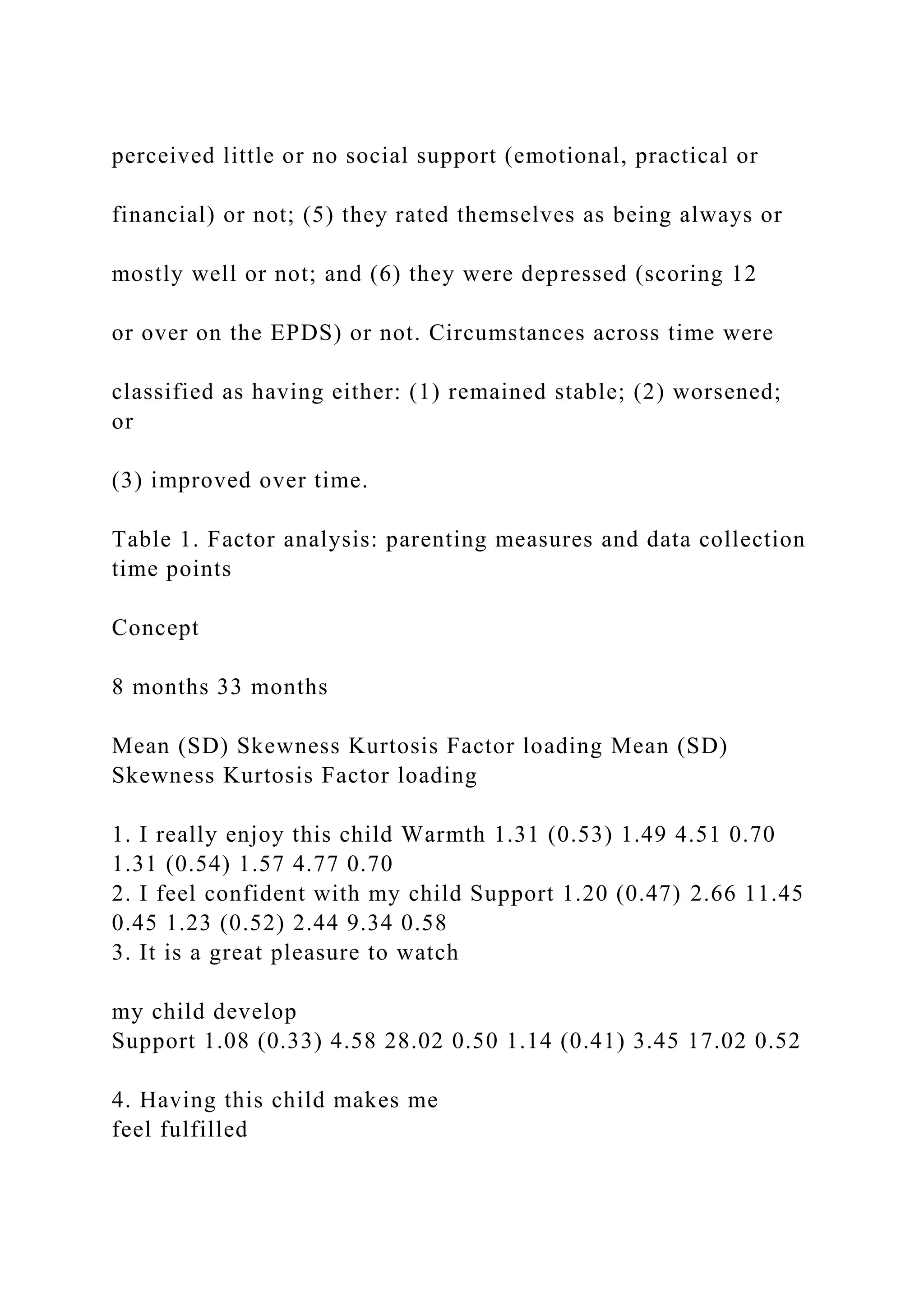
Factor analysis of the eight items indicated a single factor
solution explaining 34% and 33% of the variance at 8 and 33
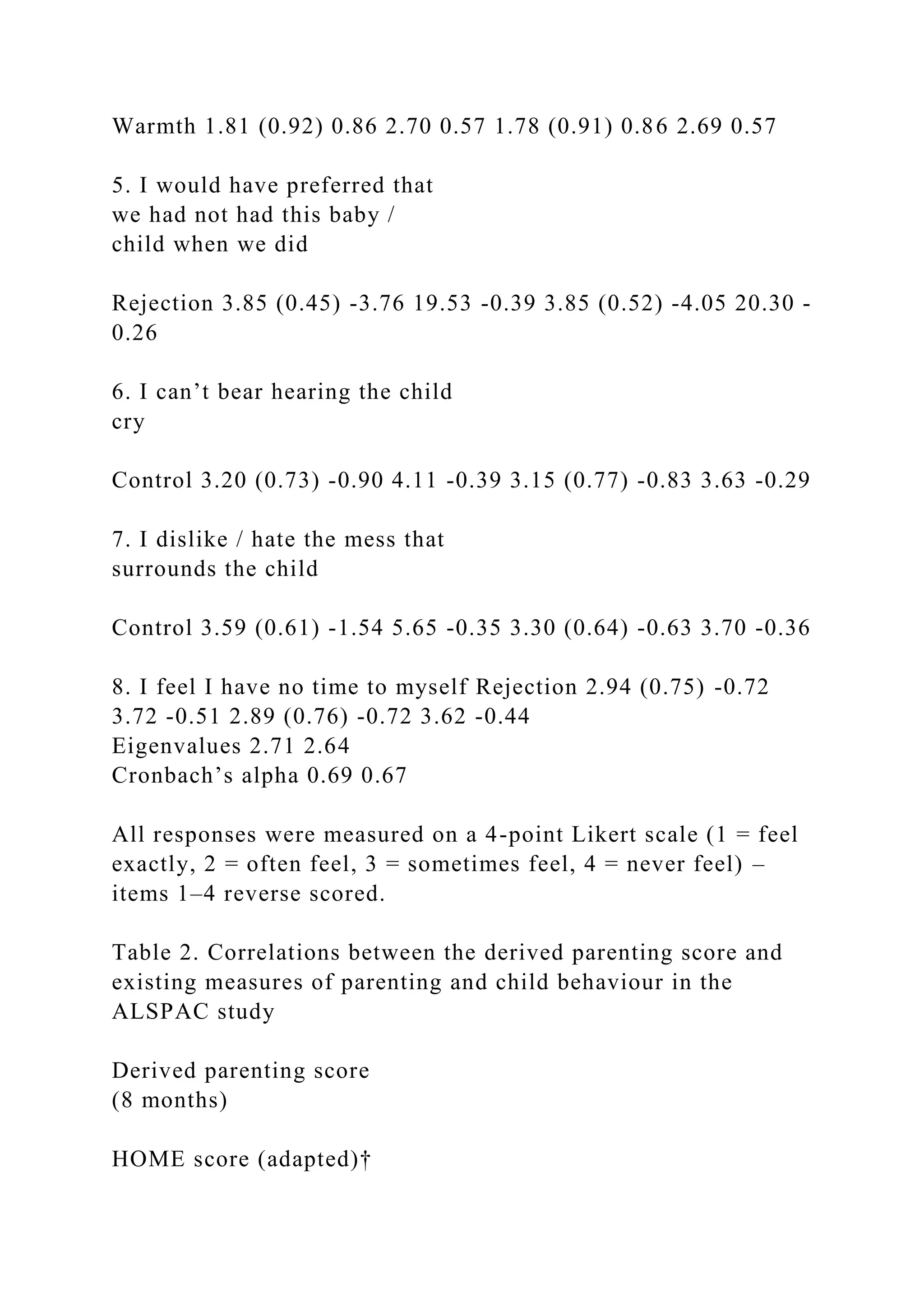
months, respectively. Factor loadings are shown in Table 1. In
Table 2 we report correlations between scores on the derived
parenting variable at 8 and 33 months with another parenting
measure collected on the cohort [HOME Inventory (Bradley &
Changes in parenting over time 199
© 2009 The Authors
Journal compilation © 2009 Blackwell Publishing Ltd, Child:
care, health and development, 36, 2, 198–207
Caldwell 1995)] and the Strengths and Difficulties Question-
naire (SDQ) (Goodman 2001) at 47 and 81 months.
The results of univariate linear regression analysis showed
that the derived parenting measure predicted SDQ scores at
both 47 and 81 months (P < 0.001) and remained predictive
(P < 0.001) after adjusting for confounding variables (Appen-
dices 2a & b). Negative coefficients indicate that, as parenting
score increased, child emotional and behavioural problems were
reduced: a point increase in parenting score predicted a reduc-
tion in SDQ score of 0.4–0.5 after adjustment for confounders.
To assess change over time, scores for the derived parenting
variable at 8 months were subtracted from scores at 33 months
giving a normally distributed change score ranging from -17 to
+17. A negative score (higher at 8 than 33 months) indicates
deterioration in parenting over time and vice versa.
Identification of factors predicting parenting
Correlations were obtained between parenting scores and
various socio-demographic and parental variables available for
the cohort children and indicated as relevant in the literature.
Key predictors of parenting score were maternal age and edu-
cation. Ethnic group was not a significant predictor possibly
because there were several ethnic categories with very small
membership. Amongst the range of potentially changeable
factors, financial circumstances, housing tenure, marital status,
social support (emotional, financial, and practical support from
partner, family, friends, or the state), and maternal general
health and depression [as measured by the Edinburgh Post-
Natal Depression Scale – EPDS (Matthey et al. 2001)]
correlated
with parenting scores (P < 0.001). Each of these variables was
dichotomized: (1) mothers either found it difficult to afford
three or more from a list of five items or not; (2) they owned
their own homes or not; (3) they were married or not; (4) they
perceived little or no social support (emotional, practical or
financial) or not; (5) they rated themselves as being always or
mostly well or not; and (6) they were depressed (scoring 12
or over on the EPDS) or not. Circumstances across time were
classified as having either: (1) remained stable; (2) worsened;
or
(3) improved over time.
Table 1. Factor analysis: parenting measures and data collection
time points
Concept
8 months 33 months
Mean (SD) Skewness Kurtosis Factor loading Mean (SD)
Skewness Kurtosis Factor loading
1. I really enjoy this child Warmth 1.31 (0.53) 1.49 4.51 0.70
1.31 (0.54) 1.57 4.77 0.70
2. I feel confident with my child Support 1.20 (0.47) 2.66 11.45
0.45 1.23 (0.52) 2.44 9.34 0.58
3. It is a great pleasure to watch
my child develop
Support 1.08 (0.33) 4.58 28.02 0.50 1.14 (0.41) 3.45 17.02 0.52
4. Having this child makes me
feel fulfilled
Warmth 1.81 (0.92) 0.86 2.70 0.57 1.78 (0.91) 0.86 2.69 0.57
5. I would have preferred that
we had not had this baby /
child when we did
Rejection 3.85 (0.45) -3.76 19.53 -0.39 3.85 (0.52) -4.05 20.30 -
0.26
6. I can’t bear hearing the child
cry
Control 3.20 (0.73) -0.90 4.11 -0.39 3.15 (0.77) -0.83 3.63 -0.29
7. I dislike / hate the mess that
surrounds the child
Control 3.59 (0.61) -1.54 5.65 -0.35 3.30 (0.64) -0.63 3.70 -0.36
8. I feel I have no time to myself Rejection 2.94 (0.75) -0.72
3.72 -0.51 2.89 (0.76) -0.72 3.62 -0.44
Eigenvalues 2.71 2.64
Cronbach’s alpha 0.69 0.67
All responses were measured on a 4-point Likert scale (1 = feel
exactly, 2 = often feel, 3 = sometimes feel, 4 = never feel) –
items 1–4 reverse scored.
Table 2. Correlations between the derived parenting score and
existing measures of parenting and child behaviour in the
ALSPAC study
Derived parenting score
(8 months)
HOME score (adapted)†
(6 months)
SDQ
(47 months)
SDQ
(81 months)
Derived parenting score (8 months) – 0.10 0.20 0.19
Derived parenting score (33 months) 0.54 0.12 0.32 0.27
†Adapted from Bradley and Corwyn (2005).
6 items: (1) does the child have cuddly toys? (2) does the child
have push and pull toys? (3) does the child have co-ordination
toys? (4) does the child have books?
(5) do you try to teach the child? (6) Do you talk to the child
while you work in the home?
200 A. Waylen and S. Stwart-Brown
© 2009 The Authors
Journal compilation © 2009 Blackwell Publishing Ltd, Child:
care, health and development, 36, 2, 198–207
Maternal depression was moderately associated with general
health and social support at both 8 and 33 months. Associations
between depression and financial circumstance were somewhat
weaker (all P < 0.001) (see Appendix 3).
Results
Attrition analysis
At 8 months, mothers who would drop out of the study by 33
months were more likely than those who remained to have
financial difficulties [10.4% (N = 233) vs. 8.0% (N = 725),
respectively; (c2 = 12.83, P < 0.001)]; be unmarried [6.8% (N
= 153) vs. 5.0% (N = 451); (c2 = 9.92, P = 0.002)] and be living
in rented accommodation [36.9% (N = 824) vs. 19.4%
(N = 1750); (c2 = 300.18, P < 0.001)]; to perceive little or no
social support for themselves [7.1% (N = 140) vs. 4.0% (N =
337); (c2 = 37.35, P < 0.001)]; and to be depressed [14.6% (N
= 326) vs. 10.5% (N = 939); (c2 = 27.88, P < 0.001)]. Mothers
who dropped out of the study had a slightly lower parenting
score at 8 months [28.1 vs. 28.3; (N = 11 068); (t = 2.95, P <
0.001)] than those who remained. There were no differences in
the general health of remaining mothers compared with those
who dropped out: 94.1% (N = 2138) compared with 94.6% (N
= 8563) rated themselves as always or mostly well (c2 = 5.11, P
= 0.164). Results reported here concern families with data at
both 8 and 33 months.
Changes in circumstance over time
Between 8 and 33 months, marital status changed for 3% (N =
252) of mothers: 2% (163) were no longer in a marital rela-
tionship by 33 months whereas 1% (89) entered a relationship.
Depression status changed for 15% (1360) of mothers: 9.8%
(895) became depressed by 33 months whereas 5.1% (465)
recovered from depression. General health worsened over time
for 4% (358) of mothers and improved for 4% (344). Finan-
cial circumstances changed for 10% (930) of families between
8 and 33 months: circumstances worsened for 5.4% (492) and
improved for 4.8% (438). Housing tenure changed for 7% of
families: 3.1% (286) changed from owning their home to
renting whereas 3.6% (329) changed from tenants to owners.
Around 4% of mothers experienced changing social support
over the period: 1.8% (151) had less support by the end
compared with 2.5% (218) who reported increased levels of
support.
Changes in parenting as a function of changes
in circumstance
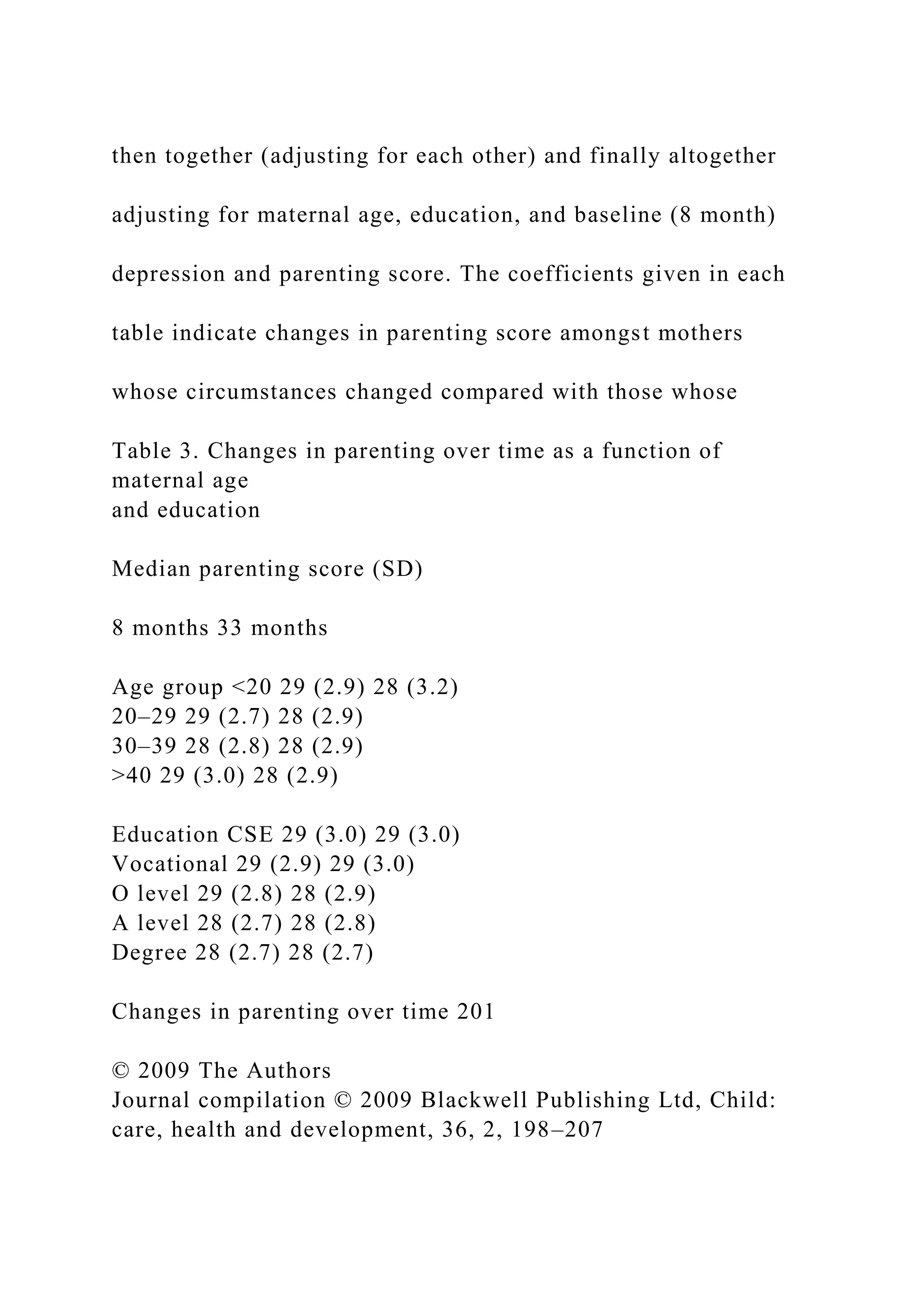
Mean parenting scores were relatively stable over time and dif-
ferences by maternal age and educational level were small
(Table 3).
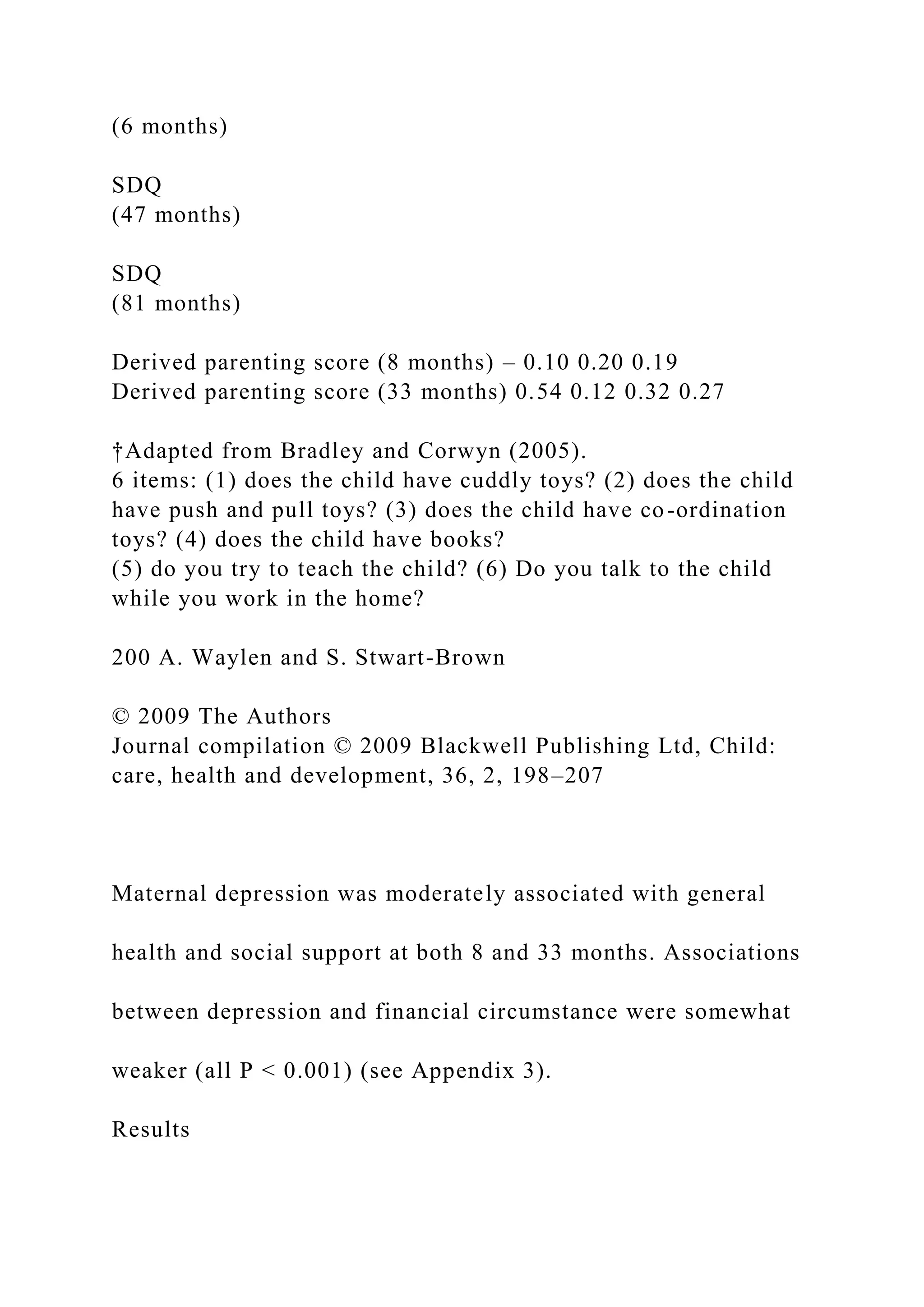
Table 4 shows the proportion of families for whom parenting
score decreased, remained stable, or improved between 8 and 33
months as socio-economic circumstances changed. c2-statistics
and P-values are given in the table. Overall, parenting scores
did
not vary with changes in financial circumstances and changes in
neither housing tenure nor marital status significantly predicted
changes in parenting.
Changes in social support influenced parenting but the level
of statistical significance failed to reach our conservative value
of 0.008. Changes in mother’s general health and depression
score had an influence with parenting score decreasing for the
majority of families when maternal health worsened. When
maternal general health or depression improved, parenting
score improved for most families.
Multi-variable modelling of changes in parenting
over time
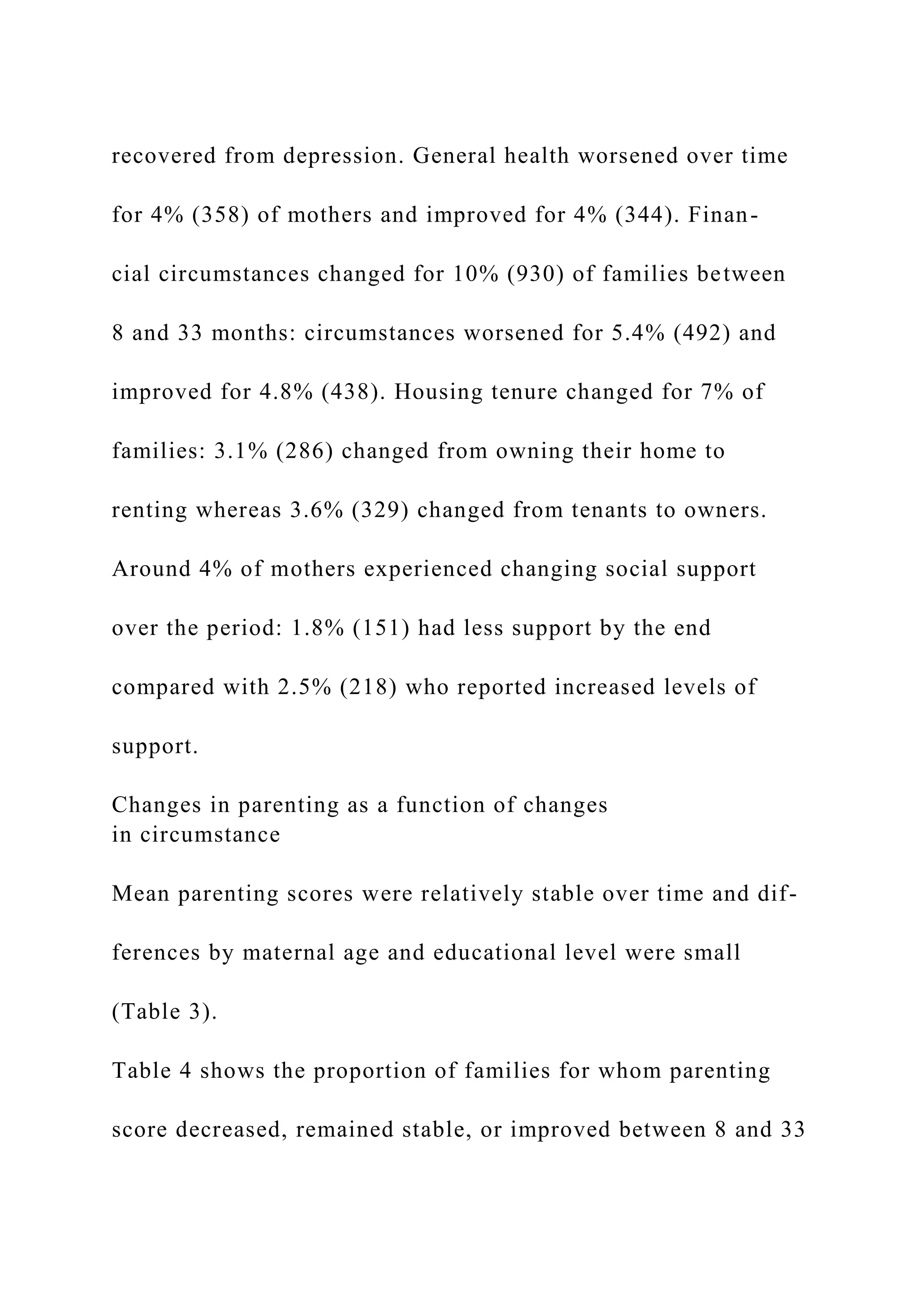
Table 5 shows the results of analyses predicting change in
parenting score over time using the original (non-categorized)
parenting score. Changes in financial circumstance, social
support, and maternal general health and depression were
entered into the model independently (univariate analysis) and
then together (adjusting for each other) and finally altogether
adjusting for maternal age, education, and baseline (8 month)
depression and parenting score. The coefficients given in each
table indicate changes in parenting score amongst mothers
whose circumstances changed compared with those whose
Table 3. Changes in parenting over time as a function of
maternal age
and education
Median parenting score (SD)
8 months 33 months
Age group <20 29 (2.9) 28 (3.2)
20–29 29 (2.7) 28 (2.9)
30–39 28 (2.8) 28 (2.9)
>40 29 (3.0) 28 (2.9)
Education CSE 29 (3.0) 29 (3.0)
Vocational 29 (2.9) 29 (3.0)
O level 29 (2.8) 28 (2.9)
A level 28 (2.7) 28 (2.8)
Degree 28 (2.7) 28 (2.7)
Changes in parenting over time 201
© 2009 The Authors
Journal compilation © 2009 Blackwell Publishing Ltd, Child:
care, health and development, 36, 2, 198–207
Ta
b
le
4
.
P
ro
p
o
rt
io
n
o
f
m
o
th
er
s
fo
r
w
h
o
m
p
ar
en
ti
n
g
sc
o
re
ch
an
ge
s
as
a
fu
n
ct
io
n
o
f
ch
an
ge
s
in
ci
rc
u
m
st
an
ce
P
a
re
n
ti
n
g
sc
o
re
F
in
a
n
ci
a
l
d
if
fi
cu
lt
ie
s
H
o
u
si
n
g
te
n
u
re
M
a
ri
ta
l
st
a
tu
s
S
o
ci
a
l
su
p
p
o
rt
P
h
y
si
ca
l
h
e
a
lt
h
D
e
p
re
ss
io
n
W
o
rs
e
n
S
ta
b
le
Im
p
ro
v
e
W
o
rs
e
n
S
ta
b
le
Im
p
ro
v
e
W
o
rs
e
n
S
ta
b
le
Im
p
ro
v
e
W
o
rs
e
n
S
ta
b
le
Im
p
ro
v
e
W
o
rs
e
n
S
ta
b
le
Im
p
ro
v
e
W
o
rs
e
n
S
ta
b
le
Im
p
ro
v
e
D
e
cr
e
as
e
s
5
4
.9
1
3
.9
3
1
.2
5
0
.4
1
9
.8
2
9
.9
5
0
.8
1
7
.2
3
2
.0
5
7
.9
1
3
.5
2
8
.6
5
9
.8
1
3
.1
2
7
.1
6
4
.1
1
3
.9
2
2
.0
R
e
m
ai
n
s
S
ta
b
le
4
6
.6
1
8
.7
3
4
.8
4
6
.7
1
8
.4
3
4
.9
4
6
.4
1
8
.8
3
4
.9
4
6
.2
1
9
.0
3
4
.9
4
6
.7
1
8
.9
3
4
.4
4
5
.8
1
9
.2
3
5
.0
In
cr
e
as
e
s
4
2
.7
1
9
.6
3
7
.7
4
7
.1
1
8
.2
3
4
.7
5
3
.3
1
8
.7
2
8
.0
4
2
.5
1
6
.2
4
1
.3
3
6
.9
1
3
.1
5
0
.0
3
1
.6
1
4
.9
5
3
.5
c2
2
.7
3
,P
<
0
.5
9
8
3
.0
2
,P
=
0
.5
5
5
2
.7
7
,P
=
0
.5
9
8
1
0
.5
1
,P
<
0
.0
3
3
5
8
.1
7
,P
<
0
.0
0
1
1
7
7
.0
7
,P
<
0
.0
0
1
Ta
b
le
5
.
P
re
d
ic
to
rs
o
f
ch
an
ge
in
p
ar
en
ti
n
g
sc
o
re
b
et
w
ee
n
8
an
d
3
3
m
o
n
th
s
(S
E
)
C
h
a
n
g
e
in
ci
rc
u
m
st
a
n
ce
si
n
ce
ch
il
d
w
a
s
8
m
o
n
th
s
o
ld
O
v
e
ra
ll
p
a
re
n
ti
n
g
sc
o
re
(u
n
iv
a
ri
a
te
)
O
v
e
ra
ll
p
a
re
n
ti
n
g
sc
o
re
(m
u
lt
i-
v
a
ri
a
te
,
a
d
ju
st
in
g
fo
r
e
a
ch
v
a
ri
a
b
le
in
tu
rn
)
O
v
e
ra
ll
p
a
re
n
ti
n
g
sc
o
re
(m
u
lt
i-
v
a
ri
a
te
,
a
ls
o
a
d
ju
st
e
d
fo
r
p
a
re
n
ti
n
g
a
n
d
d
e
p
re
ss
io
n
a
t
8
m
,m
a
te
rn
a
l
a
g
e
a
n
d
e
d
u
ca
ti
o
n
)
C
o
e
ff
.(
9
5
%
C
I)
S
E
P
C
o
e
ff
.(
9
5
%
C
I)
S
E
P
C
o
e
ff
.(
9
5
%
C
I)
S
E
P
Fi
n
an
ci
al
ci
rc
u
m
st
an
ce
s
d
e
te
ri
o
ra
te
-0
.1
3
(-
0
.0
6
to
-0
.2
0
)
0
.0
4
<0
.0
0
1
-0
.1
3
(-
0
.0
4
to
-0
.2
1
)
0
.0
4
0
.0
0
4
-0
.1
4
(-
0
.0
5
to
-0
.2
2
)
0
.0
4
0
.0
0
2
Fi
n
an
ci
al
ci
rc
u
m
st
an
ce
s
im
p
ro
ve
0
.0
5
(-
0
.1
3
to
0
.1
2
)
0
.0
4
0
.2
1
3
0
.0
4
(-
0
.1
3
to
0
.1
0
)
0
.0
4
0
.2
9
9
0
.0
2
(-
0
.1
1
to
0
.0
6
)
0
.0
4
0
.5
6
5
S
o
ci
al
su
p
p
o
rt
d
e
te
ri
o
ra
te
s
-0
.0
1
(-
0
.1
2
to
0
.1
0
)
0
.0
6
0
.8
7
2
-0
.0
1
(-
0
.1
3
to
0
.1
1
)
0
.0
6
0
.8
6
4
-0
.0
2
(-
0
.1
0
to
0
.1
3
)
0
.0
6
0
.7
3
3
S
o
ci
al
su
p
p
o
rt
im
p
ro
ve
s
0
.1
7
(0
.0
4
to
0
.3
1
)
0
.0
7
0
.0
1
1
0
.1
4
(-
0
.0
1
to
0
.2
8
)
0
.0
7
0
.0
5
8
0
.1
6
(0
.0
2
to
0
.3
0
)
0
.0
7
0
.0
2
7
P
h
ys
ic
al
h
e
al
th
d
e
te
ri
o
ra
te
s
-0
.0
4
(-
0
.1
2
to
0
.0
4
)
0
.0
4
0
.3
4
0
-0
.0
1
(-
0
.1
0
to
0
.0
8
)
0
.0
5
0
.7
5
3
0
.0
3
(-
0
.0
6
to
0
.1
2
)
0
.0
5
0
.5
4
8
P
h
ys
ic
al
h
e
al
th
im
p
ro
ve
s
0
.1
9
(0
.1
1
to
0
.2
7
)
0
.0
4
<0
.0
0
1
0
.1
1
(0
.0
2
to
0
.2
0
)
0
.0
5
0
.0
2
0
0
.1
1
(0
.0
2
to
0
.2
0
)
0
.0
5
0
.0
2
4
D
e
p
re
ss
io
n
sc
o
re
s
d
e
te
ri
o
ra
te
-0
.1
0
(-
0
.1
7
to
-0
.0
3
)
0
.0
4
0
.0
0
7
-0
.1
2
(-
0
.2
1
to
-0
.0
4
)
0
.0
4
0
.0
0
4
-0
.1
4
(-
0
.2
3
to
-0
.0
4
)
0
.0
5
0
.0
0
4
D
e
p
re
ss
io
n
sc
o
re
s
im
p
ro
ve
0
.2
3
(0
.1
8
to
0
.2
9
)
0
.0
3
<0
.0
0
1
0
.1
9
(0
.1
3
to
0
.2
5
)
0
.0
3
<0
.0
0
1
0
.2
0
(0
.1
3
to
0
.2
6
)
0
.0
3
<0
.0
0
1
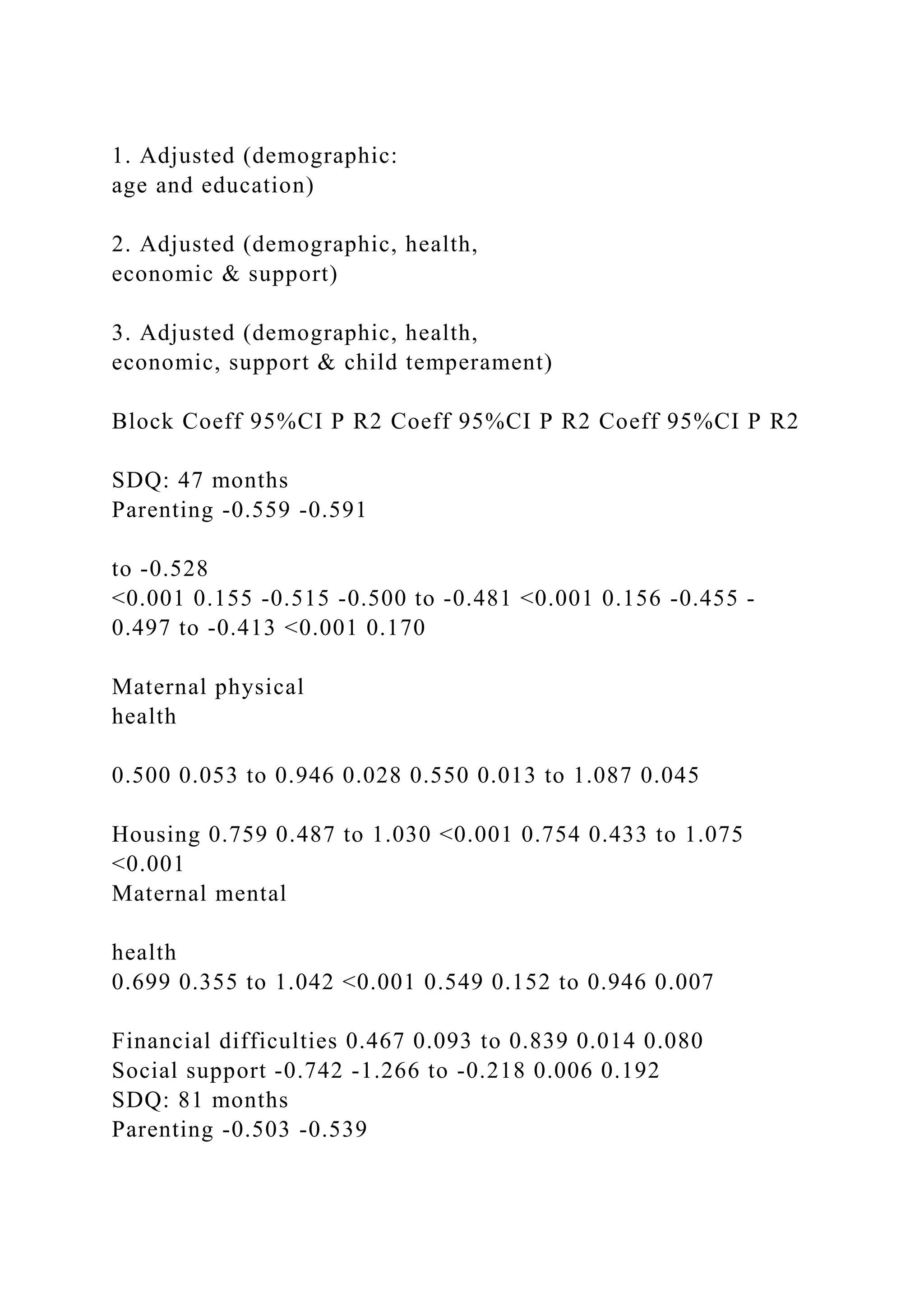
202 A. Waylen and S. Stwart-Brown
© 2009 The Authors
Journal compilation © 2009 Blackwell Publishing Ltd, Child:
care, health and development, 36, 2, 198–207
financial status, health, or support remained stable between 8
and 33 months. Negative coefficients indicate a reduction in
parenting score and positive coefficients indicate an increase.
In the final, fully adjusted model, parenting score reduced by
0.14 [95% CI (-0.06–0.20); P < 0.001] when financial circum-
stances deteriorated, but improving financial circumstances did
not predict an improvement in parenting score (P = 0.213).
Increased social support predicted improvement in parenting
score by 0.16 [95% CI (0.02–0.30; P = 0.027)] but reduced
social
support was not predictive (P = 0.733). Improvements and dete-
riorations in depression score predicted changes in parenting
as expected: an improvement in (lessening of ) depression
increased parenting score by 0.20 [95% CI (0.18–0.29); P <
0.001] and worsening depression reduced the parenting score
by -0.14 [95% CI (-0.23–0.04); P = 0.004]. Parenting score
increased by 0.11 [95% CI (0.02–0.20); P = 0.02] when general
health improved, but there was no effect on parenting score
when general health worsened (P = 0.548).
Discussion
On average, parenting scores varied with maternal age and edu-
cation to a small extent and changed very little over the period
of time examined in this study. Mothers mainly reported warm,
supportive parenting at both time points, a finding consistent
with earlier research showing stability of positive parenting in
early childhood (Dallaire & Weinraub 2005). Where changes in
parenting occur, they represented a reduction in score over
time. This may reflect the age and stage of the child (Holden &
Miller 1999; Verhoeven et al. 2007): as children get older they
may be perceived as being less easy to look after.
Within the context of these relatively small changes, results
suggest that the most important, potentially remediable deter-
minant of parenting is maternal health, particularly depression.
Change in maternal depression score was the only variable to
independently influence parenting in both a positive and nega-
tive direction and the extent of change predicted by lessening
depression was greater than that observed for any other vari-
able. We adjusted for baseline depression despite the potential
for over-adjustment to ensure we were not over-stating the
influence of depression on parenting given that depressed
mothers might be more inclined to report things from more a
negative perspective.
In contrast to the findings with maternal depression, changes
in other variables only predicted change in parenting in one
direction. Notably, improvements in financial circumstances
had no influence on parenting. For social support and general
health, deterioration in scores had no influence on parenting.
Limitations of the study
This study was based on prospective, longitudinal data from a
large birth cohort. Over a 2-year period, parenting data were
collected from mothers who were heterogeneous regarding: age,
ethnic group, marital, and socio-economic status. During this
period the children underwent developmental change and some
families dropped out of the study. Mothers who dropped out
were more likely to have experienced adverse socio-
demographic conditions than those who remained. They also
had lower parenting scores at 8 months than those who contin-
ued to participate. This attrition from the most deprived pro-
portion of the cohort reduced variation amongst participants
thus reducing the chances of significant effects. Our negative
finding with regard to the effect of improving financial circum-
stances might be attributable to such losses. We cannot rule out
the possibility that improving financial circumstances might
improve parenting in families with the most financial problems
and least favourable parenting. However, suboptimal parenting
was relatively common amongst the families remaining in the
study making the population attributable risk for suboptimal
parenting high.
This study is limited in its reliance on maternal self-report
data and is at risk of bias towards socially desirable responding
and shared method variance whereby depressed mothers might
report from more a negative perspective. However, whilst
subject to these limitations, self-report data are a reasonable
proxy measure with predictive validity for child outcomes (Case
et al. 2005). They also allow reporting of feelings, attitudes,
and
behaviours which may not be directly observable (Verhoeven
et al. 2007). Shared method variance is an issue faced by all
questionnaire studies. Its effect can be mitigated to some extent
by multi-variable analysis in which reported results are adjusted
for all other variables including maternal depression.
The parenting measure we created was limited to items
included in the questionnaires. As is often the case with cohort
studies, these items do not correspond to those that would be
asked in contemporary studies benefiting from recent research.
However, secondary analysis of existing data sets presents
important advantages in terms of time and money. Obvious
gaps in our measure include methods of discipline and aspects
of the relationship with father. Whilst discipline questions were
asked of the ALSPAC families, their format changed over time
as
did questions relating to other developmentally sensitive aspects
of parenting. Relevant parenting questions were asked of fathers
but data was either unavailable or had been collected at
different
time periods. It was also impossible to establish that the same
partner answered questionnaires at different ages.
Changes in parenting over time 203
© 2009 The Authors
Journal compilation © 2009 Blackwell Publishing Ltd, Child:
care, health and development, 36, 2, 198–207
Given these constraints, the measure we derived performed
well, correlating with an independent and well-validated
measure of parenting [HOME Inventory (Bradley & Caldwell
1995)]. The HOME Inventory focuses on aspects of parenting
relating to cognitive development as opposed to relationship
quality and so the modest correlation we observed was appro-
priate. More impressively, our measure predicted behavioural
outcomes in later childhood accounting for 10% of the variance
in SDQ scores (Goodman 2001) with the 33-month measure
being more predictive than the 8-month measure. This finding
suggests that, despite limitations, our measure captured aspects
of parenting relevant to child outcomes and early years policy.
Worsening parental health (Frank 1989; Armistead et al.
1995) has been associated with disrupted parenting and our
findings regarding depression are consistent with these earlier
studies. Our results are also consistent with studies showing
that
financial deprivation is associated with deterioration in parent-
ing (Conger et al. 1992, 1993; McLoyd 1998; National Institute
of Child Health and Human Development Early Child Care
Research Network 2005). Amongst families whose financial cir-
cumstances improved, some may have returned to a predepri-
vation level of parenting. However, other mothers are likely to
have been parenting as well as they were able. The lack of
overall
change in parenting in the group whose financial circumstances
improved suggests that failure to improve amongst the latter
outweighed any improvement amongst the former.
Implications
Much social policy relating to early childhood is predicated on
the assumption that reducing childhood poverty will improve
child outcomes. In our study, this assumption did not hold true
for outcomes determined by parenting. Our findings do not
indicate that policies to reduce childhood poverty have no
value. There are many reasons why such policies are beneficial
to families. However, whilst the conclusions drawn would be
strengthened by further studies in other cohorts and by exam-
ining parenting at different child ages, results suggest that alle-
viating poverty is unlikely to improve parenting. In contrast,
policy and practice to improve the mental and physical health of
parents is relatively sparse, yet if the results of this study hold
true these should be at the forefront of programmes to improve
parenting.
Conclusions
Policies to promote and support the mental and physical health
of parents are likely to have a beneficial impact on parenting
and
on child outcomes which parenting influences. The gain in
parenting from such policies is likely to be much greater than
the gain achieved by policies to reduce childhood poverty.
Acknowledgements
This study was funded by a grant from the Joseph Rowntree
Foundation awarded to Andrea Waylen and Sarah Stewart-
Brown. A full report on the study is available at http://
www.jrf.org.uk/bookshop/details.asp?pubID=967.
We are grateful to the mothers who took part and to the
midwives for their cooperation and help. The ALSPAC study
team comprises interviewers, computer technicians, laboratory
technicians, administrators, researchers, volunteers, and man-
agers. The ALSPAC study is part of the WHO-initiated
European Longitudinal Study of Pregnancy and Childhood.
Thanks are also due to Jane Barlow for her comments on this
manuscript.
References
Armistead, L., Klein, K. & Forehand, R. (1995) Parental
physical
illness and child functioning. Clinical Psychology Review, 15,
409–422.
Atzaba-Poria, N. & Pike, A. (2005) Why do ethnic minority
(Indian)
children living in Britain display more internalizing problems
than
their English peers? The role of social support and parental
style as
mediators. International Journal of Behavioral Development, 29,
532–540.
Barber, B. K., Stolz, H. E. & Olsen, J. A. (2005) Parental
support,
psychological control, and behavioural control: assessing
relevance
Key messages
• For most families in this cohort, parenting remained stable
over time.
• Amongst families where parenting changed, change was
predicted by changes in health and socio-economic
circumstance.
• Moving families out of poverty, whilst a highly desirable
goal from a variety of perspectives, is unlikely, of itself, to
achieve improvements in parenting.
• Our findings suggest that policies and programmes to
improve parental health, particularly depression, will
return greater dividends than poverty reduction alone in
terms of improved parenting.
204 A. Waylen and S. Stwart-Brown
© 2009 The Authors
Journal compilation © 2009 Blackwell Publishing Ltd, Child:
care, health and development, 36, 2, 198–207
across time, culture, and method. Monographs of the Society for
Research in Child Development, 70, VII-+.
Bradley, R. & Caldwell, B. M. (1995) Caregiving and the
regulation of
child growth and development: describing proximal aspects of
the
caregiving system. Developmental Review, 15, 38–85.
Bradley, R. H. & Corwyn, R. F. (2002) Socioeconomic status
and
child development. Annual Review of Psychology, 53, 371–399.
Bradley, R. H. & Corwyn, R. F. (2005) Caring for children
around the
world: a view from HOME. International Journal of Behavioral
Development, 29, 468–478.
Bronfenbrenner, U. (1979) The Ecology of Human
Development:
Experiments by Nature and Design. Harvard University Press,
Cambridge, MA.
Bronstein, P., Clauson, J., Stoll, M. F. & Abrams, C. L. (1993)
Parenting behavior and children’s social, psychological, and
academic adjustment in diverse family structures. Family
Relations,
42, 268–276.
Bugental, D. B. & Happaney, K. (2004) Predicting infant
maltreatment in low-income families: the interactive effects of
maternal attributions and child status at birth. Developmental
Psychology, 40, 234–243.
Case, A., Fertig, A. & Paxson, C. (2005) The lasting impact of
childhood health and circumstance. Journal of Health
Economics,
24, 365–389.
Conger, R. D., Conger, K., Elder, G., Lorenz, F., Simmons, S.
&
Whitbeck, L. (1992) A family process model of economic
hardship
and adjustment of early adolescent boys. Child Development,
63,
526–541.
Conger, R. D., Conger, K., Elder, G., Lorenz, F., Simmons, R.
&
Whitbeck, L. (1993) Family economic stress and adjustment
of early adolescent girls. Developmental Psychology, 29,
206–219.
Cummings, E. M., Schermerhorn, A. C., Davies, P. T., Goeke-
Morey,
M. C. & Cummings, J. S. (2006) Interparental discord and child
adjustment: prospective investigations of emotional security as
an
explanatory mechanism. Child Development, 77, 132–152.
Dallaire, D. H. & Weinraub, M. (2005) The stability of
parenting
behaviors over the first 6 years of life. Early Childhood
Research
Quarterly, 20, 201–219.
Elder, G. H., Liker, J. K. & Cross, C. E. (1984) Parent child-
behavior
in the great-depression – life course and intergenerational
influences. Life-Span Development and Behavior, 6, 109–158.
Frank, A. O. (1989) The family and disability – some
reflections on
culture – discussion paper. Journal of the Royal Society of
Medicine,
82, 666–668.
Golding, J., Pembrey, M. & Jones, R. (2001) ALSPAC – the
Avon
Longitudinal Study of Parents and Children. I. Study
methodology.
Paediatric and Perinatal Epidemiology, 15, 74–87.
Goodman, R. (2001) Psychometric properties of the strengths
and
difficulties questionnaire. Journal of the American Academy of
Child
Psychiatry, 40, 1337–1345.
Holden, G. W. & Miller, P. C. (1999) Enduring and different: a
meta-analysis of the similarity in parents’ child rearing.
Psychological Bulletin, 125, 223–254.
Matthey, S., Barnett, B., Kavanagh, D. J. & Howie, P. (2001)
Validation of the Edinburgh postnatal depression Scale for men,
and comparison of item endorsement with their partners. Journal
of Affective Disorders, 64, 175–184.
McLoyd, V. (1998) Socioeconomic disadvantage and child
development. American Psychologist, 53, 185–204.
National Institute of Child Health and Human Development
Early
Child Care Research Network (2005) Duration and
developmental
timing of poverty and children’s cognitive and social
development
from birth through third grade. Child Development, 76, 795–
810.
Repetti, R. L., Taylor, S. E. & Seeman, T. E. (2002) Risky
families:
family social environments and the mental and physical health
of
offspring. Psychological Bulletin, 128, 330–366.
Seaman, P., Turner, K., Hill, M., Stafford, A. & Walker, M.
(2005)
Parenting and Children’s Resilience in Disadvantaged
Communities.
National Children’s Bureau, London.
Sellstrom, E., Bremberg, S., Garling, A. & Hornquist, J. O.
(2000) Risk
of childhood injury: predictors of mothers’ perceptions.
Scandinavian Journal of Public Health, 28, 188–193.
Stata 9.0. StataCorp, Texas (1985) STATA 9.0. Statacorp,
College
Station, TX.
Verhoeven, M., Junger, M., Van Aken, C., Dekovic, M. & Van
Aken,
M. (2007) A short-term longitudinal study of the development
of
self-reported parenting during toddlerhood. Parenting: Science
and
Practice, 7, 367–394.
Waylen, A., Stallard, N. & Stewart-Brown, S. (2008) Parenting
and
health in mid-childhood: a longitudinal study. European Journal
of
Public Health, 18, 300–305.
Changes in parenting over time 205
© 2009 The Authors
Journal compilation © 2009 Blackwell Publishing Ltd, Child:
care, health and development, 36, 2, 198–207
Appendix 1: Complete list of items considered for inclusion in
the derived parenting variable
Respondent Pregnancy Time point (months) Reason for
rejecting
1. Talking, to even a very young baby, is important† Mother ✓
8 Timing of items
2. Cuddling a baby is very important† Mother ✓ 8 Timing
3. I really enjoy this child‡ Mother 8 33 Included
4. I feel confident with my child‡ Mother 8 33 Included
5. It is a great pleasure to watch my child develop‡ Mother
Partner
8
8
33
21
Included
Timing
6. Having this child makes me feel fulfilled‡ Mother 8 33
Included
7. I try to teach the child§ Mother 8 33 Difficult to interpret
impact
8. I would have preferred that we had not had this baby /
child when we did‡
Mother
Partner
8
8
33
21
Included
Timing
9. I can’t bear hearing the child cry‡ Mother
Partner
8
8
33
21
Included
Timing
10. I dislike / hate the mess that surrounds the child‡ Mother
Partner
8
8
33
21
Included
Timing
11. I feel I have no time to myself‡ Mother 8 33 Included
12. I ignore the child’s tantrums¶ Mother 18 30 Timing
13. I send the child to his room during tantrums¶ Mother 18 30
Timing
14. I shout at the child during tantrums¶ Mother 18 42 Timing
15. I smack the child during tantrums¶ Mother 18 42 Timing
†Agree, probably agree, probably disagree, disagree.
‡Feel exactly, often feel, sometimes feel, never feel.
§No – child is too young, no – no time, yes, sometimes, yes,
often.
¶Often, sometimes, never.
Appendix 2a: Derived parenting measure (8 months) and SDQ
scores at 47 and 81 months
1. Adjusted (demographic:
age and education)
2. Adjusted (demographic, health,
economic & support)
3. Adjusted (demographic, health,
economic, support & child temperament)
Block Coeff 95%CI P R2 Coeff 95%CI P R2 Coeff 95%CI P R2
SDQ: 47 months
Parenting -0.559 -0.591
to -0.528
<0.001 0.155 -0.515 -0.500 to -0.481 <0.001 0.156 -0.455 -
0.497 to -0.413 <0.001 0.170
Maternal physical
health
0.500 0.053 to 0.946 0.028 0.550 0.013 to 1.087 0.045
Housing 0.759 0.487 to 1.030 <0.001 0.754 0.433 to 1.075
<0.001
Maternal mental
health
0.699 0.355 to 1.042 <0.001 0.549 0.152 to 0.946 0.007
Financial difficulties 0.467 0.093 to 0.839 0.014 0.080
Social support -0.742 -1.266 to -0.218 0.006 0.192
SDQ: 81 months
Parenting -0.503 -0.539
to -0.468
<0.001 0.105 -0.450 -0.489 to -0.411 <0.001 0.113 -0.440 -
0.488 to -0.393 <0.001 0.122
Maternal physical
health
0.887 0.390 to 1.385 <0.001 0.748 0.151 to 1.345 0.014
Housing 0.491 0.180 to 0.803 0.002 0.447 0.077 to 0.818 0.018
Maternal mental health 0.874 0.485 to 1.262 <0.001 0.670 0.219
to 1.121 0.004
Financial difficulties 0.792 0.371 to 1.214 <0.001 0.720 0.212
to 1.227 0.005
Social support -0.946 0.180 to 0.803 0.002 0.108
Negative coefficients indicate that, as the parenting score
increased, there was a reduction in child emotional and
behavioural problems.
206 A. Waylen and S. Stwart-Brown
© 2009 The Authors
Journal compilation © 2009 Blackwell Publishing Ltd, Child:
care, health and development, 36, 2, 198–207
Appendix 2b: Derived parenting measure (33 months) and SDQ
scores at 47 and 81 months
Block
1. Adjusted (demographic: age
and education)
2. Adjusted (demographic, health,
economic & support)
3. Adjusted (demographic, health,
economic, support & child temperament)
Coeff 95%CI P R2 Coeff 95%CI P R2 Coeff 95%CI P R2
SDQ: 47 months
Parenting -0.559 -0.591
to -0.528
<0.001 0.155 -0.499 -0.535 to -0.462 <0.001 0.153 -0.448 -
0.492 to -0.404 <0.001 0.175
Maternal physical
health
0.703 0.252 to 1.155 0.002 0.697 0.155 to 1.239 0.012
Housing 0.772 0.487 to 1.056 <0.001 0.727 0.389 to 1.064
<0.001
Maternal mental
health
0.652 0.350 to 0.954 <0.001 0.571 0.220 to 0.922 0.001
Financial difficulties 0.477 0.084 to 0.870 0.017 0.300
Social support -1.084 -1.681 to -0.487 <0.001 -0.842 -1.538 to -
146 0.018
SDQ: 81 months
Parenting -0.503 -0.539
to -0.468
<0.001 0.105 -0.449 -0.489 to -0.408 <0.001 0.112 -0.441 -
0.491 to -0.392 <0.001 0.127
Maternal physical
health
0.583 0.069 to 1.097 0.026 0.281
Housing 0.448 0.122 to 0.774 0.007 0.239
Maternal mental
health
0.895 0.555 to 1.234 <0.001 0.882 0.493 to 1.271 <0.001
Financial difficulties 0.129 0.067
Social support -1.149 -1.822 to -0.476 0.001 -1.166 -1.960 to -
0.373 0.004
Negative coefficients indicate that, as the parenting score
increased, there was a reduction in child emotional and
behavioural problems.
Appendix 3: Correlations between depression and socio-
demographic factors at 8 and 33 months
8 months 33 months
Spearman’s rho P Spearman’s rho P
Physical health 0.37 <0.001 0.39 <0.001
Social support -0.40 <0.001 -0.32 <0.001
Financial circumstance 0.25 <0.001 0.23 <0.001
Changes in parenting over time 207
© 2009 The Authors
Journal compilation © 2009 Blackwell Publishing Ltd, Child:
care, health and development, 36, 2, 198–207
This document is a scanned copy of a printed document. No
warranty is given about the accuracy of the copy.
Users should refer to the original published version of the
material.
WEEK 2
READING.pdf
PARENTING: SCIENCE AND PRACTICE, 12: 254–260, 2012
Copyright © Taylor & Francis Group, LLC
ISSN: 1529-5192 print / 1532-7922 online
DOI: 10.1080/15295192.2012.683368
Understanding Multilevel Dynamics
in the Development of Parenting
Jennifer Jenkins
SYNOPSIS
Parenting is best understood from within a framework of
person/context influence and
interaction. Four themes from the articles are discussed. First, a
multilevel perspective
allows us to integrate across two nested structures: the
biological and cognitive systems
nested within individuals and the way in which individuals are
nested within complex
social environments. Second, the biological and cognitive
pathways that underlie behav-
ioral continuities across the life course are discussed. Third,
intergenerational influences
involve both mediating and moderating mechanisms. Fourth,
one of the most significant
challenges in human studies of parenting is to isolate the roles
of individuals in rela-
tionship formation. Within-family studies provide an important
mechanism to achieve this.
INTRODUCTION
The articles in this Special Issue speak to the issue of the
person-by-context transac-
tions that are the basis of human development (Sameroff &
Mackenzie, 2003). Multiple
perspectivesare represented in thepapers.Sometreatparentingas
theoutcomeof inter-
est (Bornstein, 2012), and others look at the influence of
parenting on child functioning
(Pollak, 2012). Findings on the transgenerational effects of
early experience on subse-
quent generations show us that studying influences on parents
or parents’ influences
on offspring merely tells us about different points on the same
trajectory. Experiences
in childhood influence the ways that parents relate to their
offspring. The following
commentary raises four themes that cross papers: themultilevel
structure of experience,
cognitive and biological embedding, intergenerational
continuities, and designs in the
study of parenting.
A MULTILEVEL FRAMEWORK
Themoststrikingaspectof thesepapers is their
spanfromthebiologicalpathwaysto the
macro influences that affect parenting. A multilevel perspective
is necessary to account
for nested influences. Biological and cognitive systems are
nested within individuals,
with individuals nested within complex social environments.
With respect to macro level influences, Bornstein (2012) shows
that culture has a
profound impact on parenting. He notes that mothers who
encourage physical devel-
opment have babies who are more physically developed.
Mothers who were didactic
in their teaching had children who were more focused on the
properties of objects. He
MULTILEVEL DYNAMICS OF PARENTING 255
concludes that parents prepare children for the specific
environment in which they live.
A multilevel model of parenting that incorporates ecological
influences shows us that
the meaning of parental behavior, and thus its effect on
children, must be interpreted
from within the culture that gave rise to it. Pleck (2012) shows
similarly that father
involvement is a complex integration of factors related to the
immediate and macro
social context in which the father operates.
Between the micro-environment and the individual, we have
similarly embedded
influences operating. Jensen Peña and Champagne (2012) and
Pollak (2012) describe the
way in which experiences with parents influence the
development of biological systems
in offspring affecting neuroendocrine pathways and brain
structures. McGuire, Segal,
and Hershberger (2012) demonstrate the bi-directional processes
involved in this multi-
level framework.Theyshowthatgeneticallybased, childeffects,
influence theparenting
that children receive.
Of importance here is that in the complex environments of
humans, processes at
many different levels of the environment and the organism, are
operating simulta-
neously, with the following implications. First, effect sizes for
any one risk-outcome
relationship, or for the contingencies that operate across
different components of the
system, tend to be small in magnitude. This is not a statement
about the unimpor-
tance of small effects, but rather of the need to build models of
development that focus
on the ways in which small effects combine. Second, bi-
directional influences operate
across levels of this multilevel process. We see from the present
papers that environ-
ments become embedded in the biology, cognition, and
relationship propensities of the
individual and that individuals use these embedded propensities
in constructing their
environment. Third, compensatory or protective effects have
been identified within the
proximal environment. For instance, children are protected from
the development of
internalizingpsychopathologybyhavingasiblingwithwhomtheyare
closeevenwhen
theyareexposed tonegative lifeevents (Gass,
Jenkins,&Dunn,2007).Doweseesimilar
compensatory processes within the biological pathways? Can
structural brain changes
in the orbitofrontal cortex, described by Pollak, be moderated
by an unimpaired neu-
roendocrinesystemsuchthat thesocialbehaviorunder
investigationappearsunaffected
by abuse exposure? As we gain an understanding of the
biological pathways related to
environmental risk, we need to consider the possibility of
compensatory effects in the
prediction of behavior.
BIOLOGICAL AND COGNITIVE EMBEDDING OF
EXPERIENCE
One of the very exciting elements of this Special Issue is that
investigators have
traced pathways from environmental experience to biological
and cognitive processes
in the child. Jensen Peña and Champagne (2012) describe
several mechanisms for the
embedding of experience into biology. In the rat model poor
mothering has been
defined by low licking of pups. One effect of this is seen in the
stress response sys-
tem, which becomes hyperactive. Another pathway influences
oxytocin and estrogen.
Rats that have received low licking show reduced estrogen
receptor alpha protein and
decreased oxytocin receptor levels, with oxytocin and estrogen
known to be impor-
tant for later parenting. Similarly they show that the receipt of
low licking in the rat
pups, results in epigenetic changes. Such changes alter DNA
expression without alter-
ing thegenesequence.DNAmethylation isoneof theseepigenetic
changes. JensenPeña
256 JENKINS
and Champagne (2012) show that rats that experience low
licking and grooming by
their mothers have reduced expression of hippocampal
glucocorticoid receptors and
increased DNAmethylation within theglucocorticoid promoter
region. This means that
the effect of a stressful environment has been to “silence” the
gene. The elegant desig-
nation of these pathways illustrates the way in which
environmental influences become
embedded into the functioning of the organism. Pollak (2012)
presents data across mul-
tiple brain systems showing effects of abusive environments.
Effects are evident in
volumeof theorbital frontalcortexaswellas thecerebellum,
theneuroendocrinesystem
(including both oxytocin and the arginine vasopressin [AVP]
system) as well as neural
responses to the processing of anger. Perceptual and attentional
biases develop such
that abused children identify anger more rapidly, they attend to
it more, they have trou-
ble disengaging from angry faces, and, as a consequence of
privileging anger within the
cognitive system, other aspects of cognition become less
efficient. Like Bornstein (2012),
Pollak (2012) shows us that the organism changes to be able to
meet the demands of the
specific environment to which it is exposed. Research programs
that cross the bound-
aries of physiology and cognition (Haley, Grunau, Weinberg,
Keidar, & Oberlander,
2010; Pollak, 2012) allow us to gain a more holistic
understanding of the way in which
the whole organism is affected by a stressful environment.
Processes of biological embedding raise the issue of stability in
behavior. Once an
environmental effect has become embedded in the biology or
cognition of the individ-
ual, we tend to think of the effect as resistant to environmental
influence. Evidence for
plasticity and reversals in animal work (Barrett & Fleming,
2011; McEwen & Magarinos,
2004) suggests that plasticity in biological systems is
considerable. With respect to cog-
nitive, emotional and behavioral stabilities in the human work,
we see stabilities in
personality (Costa & McCrae, 1988) and psychopathology
(Broidy et al., 2003; Colman,
Ploubidis, Wadsworth, Jones, & Croudace, 2007), but we also
see enormous variation
(Rutter, 1996), with surprising turning points in the lives of
individuals as they are
faced with new opportunities (Crosnoe & Elder, 2002). Sroufe
(1997) described a path-
ways model suggesting that the probability of particular
outcomes changes the further
along a particular pathway one travels. We can see this in the
treatment literature
for conduct disorder in children. When children are a little way
along this path dur-
ing the preschool period, a short burst of training parents to
react in specific ways to
children’s aversive behavior reduces the child’s aggression
(Baker-Henningham, Scott,
Jones, & Walker, 2012). By the time aggressive children are
adolescent, with problems
in evidence for years, they need treatment that is more
intensive, operating across
manyenvironments(family,peers,
schools,neighborhoods,andindividuals;Henggeler,
2011).
Cascade models (Dodge et al., 2009) may be helpful in thinking
about where con-
tinuities within complex systems reside. These models can
capture the variety of
environmental, biological and cognitive influences that feed
into a behavior as well
as indirect effects (an environmental influence affects a
biological system which in
turn influences a behavioral system). It would be wonderful to
combine the design of
large-scale longitudinal studiesofbehaviorwith
themoredetailedandmechanisticneu-
roendocrine, psychophysiological, and functional magnetic
resonance imaging (fMRI)
designs. This would allow us to examine whether the embedding
in cognition and biol-
ogy described by Pollak (2012), Jensen Peña and Champagne
(2012), and others (Barrett
& Fleming, 2011) represents stages in a cascade model such that
behavioral trajectories
show enhanced continuities as a function of these biological
organizations.
MULTILEVEL DYNAMICS OF PARENTING 257
INTERGENERATIONAL INFLUENCES ON PARENTING
Conger in humans and Champagne in rats focus on mechanisms
that explain inter-
generational continuity. Conger, Schofield, and Neppl (2012)
show that continuity in
harsh parenting is partly a function of the partners that one
chooses. People who have
been harshly parented in childhood are more likely to partner
with those who parent
harshly, which in turn increases the parent’s own risk of harsh
parenting. This is sim-
ilar to the finding for selection effects in antisocial behavior.
Antisocial adolescents are
more likely to befriend (Dishion & Tipsord, 2011) and partner
with other people who
are antisocial (Krueger, Moffitt, Caspi, Bleske, & Silva, 1998),
which partly explains
the risk of ongoing antisocial behavior in the next generation
(Jenkins, Shapka, &
Sorenson,2006).Againwemustrememberthatmanyprocessescontri
bute tomateselec-
tion (luckily!), with harsh parenting in childhood representing
one small component
of this.
Oneof theubiquitousfindings
intherelationbetweenriskyenvironmentsandbehav-
ioraloutcomes is the importanceofmoderating
factors.Congeretal. (2012) showusthat
the negative effects on subsequent parenting of experiencing
harsh parenting in child-
hood are potentiated by choosing a partner who parents harshly.
These “moderation”
effects show that an environmental risk is only a risk under
certain conditions (Jenkins,
2008).Luckily for thespecies,whenonecomponentof
theenvironment isnegative, chil-
drenandadults findameans of compensation, pulling
fromtheenvironment what they
need to flourish.
Mostversionsofmoderationhavebeenseenasvariantsonthediathesis
stressmodel.
The premise underlying this model is that individuals are
differentially susceptible
to environmental stress. A more recent reworking of this idea is
the differential sus-
ceptibility argument (Ellis, Boyce, Belsky, Bakermans-
Kranenburg, & van IJzendoorn,
2011). The premise is that a subset of individuals is more
susceptible to environmen-
tal influence than another subset of individuals (orchids vs.
dandelions). Their greater
susceptibility based on physiological reactivity is reactive to
both good and bad envi-
ronmental events (Bakermans-
Kranenburg&vanIJzendoorn,2011).Thus,withinavery
nurturant environment wewould expect to see thesevery reactive
children doing better
than their non-reactive counterparts.
THE IMPORTANCE OF MULTISIBLING AND
MULTIPERSON
DESIGNS IN THE STUDY OF PARENTING AND
FAMILY RELATIONSHIPS
The largest challenge in human studies to understanding the role
of parenting on
development is that individuals contribute to the quality of
relationships that subse-
quently affect them. Most studies of parenting, using a between-
family design, cannot
distinguish the effect of each individual within the dyad from
the relationship that
emerges between the members of the dyad. Why is this issue
important in parenting
research? One of the conclusions from this Special Issue is that
adversity in childhood
leads to more negative parenting. Although this is clearly true
when we consider only
the statistical mean, the consideration of within family variance
enables a more nuanced
conclusion. On the basis of McGuire’s work, even though she
does not measure
258 JENKINS
environmental influences directly (e.g., adverse childhood
experience), two aspects of
her data lead us to the conclusion that parenting is strongly
influenced by the character-
istics of children. First, she shows that parenting is influenced
by the genetic similarity
of children.ThusMZtwins receiveparenting that is
considerablymoresimilar than that
received by DZ twins, which is, in turn, more similar than that
received by unrelated
siblings (of similar age). The second observation is that
children are not parented very
similarly in absolute terms. Even when siblings are 100%
similar genetically, parents
still treat these twinsquitedifferently.Whenweextendthese
findings tosiblingdesigns
in which the environmental adversity is directly measured, we
do see that as risk
exposure to the parent increases (e.g., poverty, adverse
childhood experiences, marital
conflict) so too does the within-family variance in parenting
(Atzaba-Poria & Pike, 2008;
Jenkins, Rasbash, & O’Connor, 2003). This means that parents
with adversity in their
backgrounds are highly negative with one of their children, but
not another. When
we examine the factors that explain why one sibling elicits more
positivity and less
negativity than another, factors such as child temperament play
a role (Jenkins et al.,
2003).Thisdifferentialbehavioronthepartofparents,
indicativeofdifferential resource
allocation, may be based on parental expectations of fitness
(Beaulieu & Bugental, 2008;
Schlomer, Del Giudice, & Ellis, 2011).
The social relations model (Kenny, Kashy, & Cook, 2006)
allows us to examine the
extent to which individuals are the same in their behavior across
multiple relation-
ship partners. This model can be usefully integrated into
parenting research to more
effectively distinguish the individual influences of parent and
child on the dyadic rela-
tionship. Through the use of round-robin data (everyone in the
family interacts with
everyone else) and through cross-classified multilevel models,
it allows us to examine
the extent to which an individual is the same in their behavior
across multiple rela-
tionship partners (as well as model factors that explain such
differences). One study
has isolated these influences for the interactional behavior of
parents and children and
found that about 20% of the variation in negativity and 29% of
the variation in positiv-
ity was attributable to the individual, with about 35% of this
individual effect being
explained by genetic influence (Rasbash, Jenkins, O’Connor,
Tackett, & Reiss, 2011).
Thus, parents and children do show some consistency in
relational behavior as they
interact with different family members, but not a huge amount.
Most of the action (55%
of the variation in negativity and 49% in positivity) is within
the unique combination
of the two people in the dyad. Thus, some dyads tolerate one
another well, whereas
other dyads do not manage the accommodations necessary for a
well-attuned relation-
ship.Thestrongerdyadversus individualeffect suggests
thatamajor focus inparenting
should be on the processes by which parents and children
flexibly accommodate to one
another’s idiosyncrasies (Grusec, 2011).
In summary, this exciting series of articles shows us that a
multilevel framework,
from biology to macrosystems, in which we can model both
reciprocal and contingent
processes, is necessary to understand the complexity in the
development of parenting.
AFFILIATION AND ADDRESS
Jennifer Jenkins, Human Development and Applied Psychology,
University of Toronto,
252 Bloor St. W., Toronto, ON M5S 1V6 Canada. E-mail:
[email protected]
MULTILEVEL DYNAMICS OF PARENTING 259
ACKNOWLEDGEMENTS
Jennifer Jenkins is grateful to the Canadian Institutes for Health
Research, The Atkinson
Charitable Foundation and the Social Sciences and Humanities
Research Council for
support.
REFERENCES
Atzaba-Poria, N., & Pike, A. (2008). Correlates of parental
differential treatment: Parental and contextual
factors during middle childhood. Child Development, 79(1),
217–232.
Baker-Henningham, H., Scott, S., Jones, K., & Walker, S.
(2012). Reducing child conduct problems and pro-
moting social skills in a middle-income country: Cluster
randomized controlled trial. British Journal of
Psychiatry, April 12. [Epub ahead of print].
Bakermans-Kranenburg, M. J., & van IJzendoorn, M. H. (2011).
Differential susceptibility to rearing envi-
ronment depending on dopamine-related genes: New evidence
and a meta-analysis. Development and
Psychopathology, 23(1), 39–52.
Barrett, J., & Fleming, A. S. (2011). Annual research review:
All mothers are not created equal: Neural and
psychobiological perspectives on mothering and the importance
of individual differences. Journal of Child
Psychology and Psychiatry, 52(4), 368–397.
Beaulieu, D. A., & Bugental, D. (2008). Contingent parental
investment: An evolutionary framework for
understanding early interaction between mothers and children.
Evolution and Human Behavior, 29(4),
249–255.
Bornstein, M. H. (2012) Cultural Approaches to Parenting.
Parenting: Science and Practice, 12, 212–221.
Broidy, L. M., Nagin, D. S., Tremblay, R. E., Bates, J. E.,
Brame, B., Dodge, K. A., . . . Vitaro, F. (2003).
Developmental trajectories of childhood disruptive behaviors
and adolescent delinquency. Developmental
Psychology, 39, 222–245.
Colman, I., Ploubidis,G.B.,Wadsworth,M.E. J.,
Jones,P.B.,&Croudace,T. J. (2007).A longitudinal typology
of symptoms of depression and anxiety over the life course.
Biological Psychiatry, 62(11), 1265–1271.
Conger, R. D., Schofield, T. J., and Neppl, T. K. (2012).
Intergenerational continuity and discontinuity in harsh
parenting. Parenting: Science and Practice, 12, 222–231.
Costa,P.T.,&McCrae,R.R. (1988).Personality inadulthood:Asix-
year longitudinal studyof self reportsand
spouse ratings on the NEO Personality Inventory. Journal of
Personality and Social Psychology, 54, 853–863.
Crosnoe, R., & Elder, G. H. (2002). Successful adaptation in the
later years: A life course approach to aging.
Social Psychology Quarterly, 65(4), 309–328.
Dishion, T. J., & Tipsord, J. M. (2011). Peer contagion in child
and adolescent social and emotional develop-
ment. Annual Review of Psychology, 62, 189–214.
Dodge, K. A., Malone, P. S., Lansford, J. E., Miller, S., Pettit,
G. S., & Bates, J. E. (2009). A dynamic cascade
model of the development of substance-use onset: I.
Introduction. Monographs of the Society for Research in
Child Development, 74(3), 1–31.
Ellis, B. J., Boyce, W. T., Belsky, J., Bakermans-Kranenburg,
M. J., & van IJzendoorn, M. H. (2011).
Differential susceptibility to the environment: An evolutionary
neurodevelopmental theory. Development
and Psychopathology, 23(1), 7–28.
Gass, K., Jenkins, J., & Dunn, J. (2007). Are sibling
relationships protective? A longitudinal study. Journal of
Child Psychology and Psychiatry and Allied Disciplines, 48(2),
167–175.
Grusec, J. (2011). Socialization processes in the family: Social
and emotional development. Annual Review of
Psychology, 62, 243–269.
Haley, D. W., Grunau, R. E., Weinberg, J., Keidar, A. A., &
Oberlander, T. F. (2010). Physiological correlates of
memory recall in infancy: Vagal tone, cortisol, and imitation in
preterm and full-term infants at 6 months.
Infant Behavior & Development, 33(2), 219–234.
Henggeler, S. W. (2011). Efficacy studies to large-scale
transport: The development and validation of
multisystemic therapy programs. Annual Review of Clinical
Psychology, 7, 351–381.
Jenkins, J. M. (2008). Psychosocial adversity. In M. Rutter, D.
Bishop, D. Pine, S. Scott, J. Stevenson, E. Taylor,
& A. Thapar (Eds.), Rutter’s child and adolescent psychiatry
(5th ed.). New York, NY: Blackwell.
Jenkins, J. M., Rasbash, J., & O’Connor, T. G. (2003). The role
of the shared family context in differential
parenting. Developmental Psychology, 39(1), 99–113.
260 JENKINS
Jenkins, J. M., Shapka, J., & Sorenson, A. (2006). Teenage
mothers’ anger over twelve years: Partner conflict,
partner transitions and children’s anger. Journal of Child
Psychology & Psychiatry, 47, 775–782.
Jensen Peña, C. L., & Champagne, F. A. (2012) Epigenetic and
neurodevelopmental perspectives on variation
in parenting behavior. Parenting: Science and Practice, 12, 202–
211.
Kenny, D. A., Kashy, D. A., & Cook, W. L. (Eds.). (2006).
Dyadic data analysis. New York: Guilford Press.
Krueger,R.F.,Moffitt,T.,Caspi,A.,Bleske,A.,&Silva,P.A.
(1998).Assortativematingforantisocialbehavior:
Developmental and methodological implications. Behavior
Genetics, 28, 173–186.
McEwen, B. S., & Magarinos, A. M. (2004). Does Stress
Damage the Brain? Arlington, VA: American Psychiatric
Publishing, Inc.
McGuire, S., Segal, N. L., & Hershberger, S. (2012). Parenting
as phenotype: A behavioral genetic approach to
understanding parenting. Parenting: Science and Practice, 12,
192-201.
Pleck, J. H. (2012)Integrating Fathering in Parenting Research,
Parenting: Science and Practice, 12, 243–253.
Pollak, S. D. (2012). The emergence of human emotion: New
approaches to the old nature-nurture debate.
Parenting: Science and Practice, 12, 232–242.
Rasbash, J., Jenkins, J., O’Connor, T. G., Tackett, J., & Reiss,
D. (2011). A social relations model of observed
family negativity and positivity using a genetically informative
sample. Journal of Personality and Social
Psychology, 100(3), 474–491.
Rutter, M. (1996). Transitions and turning points in
developmental psychopathology: As applied to the age
span between childhood and mid-adulthood. International
Journal of Behavioral Development, 19(3), 603–626.
Sameroff, A. J., & Mackenzie, M. (2003). Research strategies
for capturing transactional models of develop-
ment: The limit of the possible. Development &
Psychopathology, 15, 613–640.
Schlomer, G. L., Del Giudice, M., & Ellis, B. J. (2011). Parent-
offspring conflict theory: An evolutionary
framework for understanding conflict within human families.
Psychological Review, 118, 496–521.
Sroufe, L. A. (1997). Psychopathology as an outcome of
development. Development and Psychopathology, 9,
251–268.
Copyright of Parenting: Science & Practice is the property of
Taylor & Francis Ltd and its content may not be
copied or emailed to multiple sites or posted to a listserv
without the copyright holder's express written
permission. However, users may print, download, or email
articles for individual use.
READING 3.pdf
PARENTING: SCIENCE AND PRACTICE, 12: 134–143, 2012
Copyright © Taylor & Francis Group, LLC
ISSN: 1529-5192 print / 1532-7922 online
DOI: 10.1080/15295192.2012.683339
The Ethical and Social Significance of Parenting:
A Philosophical Approach
Amy Mullin
SYNOPSIS
This article develops an account of the emotional dimension of
minimally decent parenting,
with reference to the capability approach to thinking about
need. It outlines social interests
at stake in ensuring children’s healthy emotional development,
and evaluates public policy
implications of its account of children’s emotional needs.
Proposals to license parents are
rejected in favor of increased public education around the needs
of children and the demands of
parenting, increased public recognition of the need for social
supports for parenting, and more
diffused social responsibility for detecting problematic
parenting.
INTRODUCTION
Relationshipsbetweenparentsandchildrenaresomeof
themostsignificant inour lives,
forbothchildrenandparentsalike.
Intheabsenceofgoodrelationships,children’sphys-
ical, intellectual,moral,andemotionaldevelopment
iscompromised.Asaresult, society
as a whole has a stake in supporting good relationships—and
detecting and responding
to bad ones. Yet how should we think about what constitutes a
good relationship, and
what makes for a bad one? Should we think only about the
interests of the children?
Or should we focus as much on social interests in ensuring that
the next generation is
rearedtobeproductivemembersofsociety?Ifwefocusonsocial
interestsandchildren’s
interests
ingoodrelationshipsbetweenparentsandchildren,areweneglecting
parental
interests? Finally, how are we to conceive of children’s
interests, and can we recognize
what they are without knowing what those children will come to
value as they mature?
IDENTIFYING SOCIAL PARENTS
To think about relationships between parents and young
dependent children, we also
need to be clear about what we mean by parents, when we are
thinking about the roles
adults play in children’s lives. Surely we are interested in those
who rear a child, rather
than merely biological parents who do not go on to have a
continuing relationship. But
should we include stepparents, grandparents, a custodial
parent’s life partner, live-in
nannies? I argue that if we are interested in the relationships
that make a difference to
a child’s overall development, then we need to attend to all
adults who have significant
long-term overall responsibility for a child’s physical,
intellectual, moral, and emotional
development. Sometimes a grandparent or other relative,
especially one who lives near
a child, will play such a role, very often a stepparent (when
involved with a parent
THE ETHICAL AND SOCIAL SIGNIFICANCE OF
PARENTING 135
who has sole or joint custody of a child) will play such a role,
and sometimes a paid
caregiver, who is in a long-term relationship with a child and is
given, explicitly or
implicitly, significant responsibility for a child’s overall
development, will play such
a role. I label such adults a child’s social parents. Children may
then, it is clear, have
more than two social parents (and sadly, they may occasionally
have none if their legal
parents or guardians do not take up their responsibility).
My research focus is on the ethical and social significance of
relationships between
dependent children and their social parents. For the remainder
of this article, when
I speak of parents I am using this as shorthand for a reference to
social parents.
My approach is that of a philosopher informed by empirical
work, primarily in social
psychology and sociology. My methods involve conceptual
analysis (how should we
think about which needs are basic, what do we mean when we
speak about trust) and
theattempttoclarify theassumptions involvedinargumentsabout
theethicalandsocial
significance of the close personal relationships involved in
parenting.
BASIC NEEDS: A CAPABILITY APPROACH
I am guided in my philosophizing by the capability approach to
thinking about need,
according to which a certain threshold of capability should be
made available to every
member of a society to prevent people from falling below what
is required to live a
life with dignity in the context of their community. To establish
either personal or social
responsibility torespondtoneedsforcare,wemustgiveanaccountof
thenatureofbasic
need that is as open as possible to widespread agreement (and
so abstracts as much as
possible from particular and contestable accounts of the nature
of the good life).
Nussbaum’s (2005) approach to thinking about the basic
capabilities necessary to liv-
ing a life with dignity is the one that I adopt, although I remove
from her account those
capabilities that have been criticized (Engster, 2005, p. 52) as
reflecting her particular
vision of the good life. This removal is in keeping with her
proffering of the list of capa-
bilitiesasopen toongoingrevision (Nussbaum,2005,p.
78).Themost importanthuman
capabilities, required to live a variety of types of life deemed
good, are the capabilities
forbodilyhealth, survival, and integrity; foremotional
responsiveness andtheability to
connect to others emotionally in a variety of social interactions
including relationships
suchas loveandfriendship; for theexerciseof senses, the
imagination,andthought, and
for some measure of control over one’s environment, material
and political (pp. 76–78).
Some people may choose not to exercise some of their
capabilities (for instance those
that eventually choose a relatively solitary life), but most of us
can agree that being pre-
vented from doing so, either by others exercising their power
over us, or by inadequate
provision of resources (for bodily survival and health, or for the
development of our
capabilities) is a serious wrong and a denial of basic human
needs.
EVALUATING RELATIONSHIPS BETWEEN PARENTS AND
CHILDREN
With this account of the nature of basic needs in hand, we can
proceed to evaluate rela-
tionships between parents and children. However, when we do
so we must focus not
only on how these relationships meet or fail to meet children’s
basic needs but also on
their significance for and function in parents’ lives and how
they serve or fail to serve
social interests in children’s development and well-being. In
this article I emphasize the
136 MULLIN
first and third of these grounds for evaluation, but first, because
it is often neglected or
de-emphasized, I discuss the role played by relationships
between social parents and
children in parents’ lives.
Evaluating Relationships: Parental Interests
There are significant parental interests involved in the
development and mainte-
nance of positive relationships with children. One of the basic
capabilities identified
by Nussbaum (2005) was the ability to be emotionally
responsive and connect to oth-
ers emotionally in a variety of social interactions including
relationships such as love
and friendship. Although not all people will choose to exercise
that capability in rela-
tionships with children, those who do have significant long-term
responsibility for
children’s development will most often attempt to fulfill that
responsibility in the con-
text of emotionally close relationships. Parents’ relationships
with their children are
typically very important to the social parents themselves, and
disruptions to these rela-
tionships can be very upsetting, whether because of changes in
legal custody as a result
of divorce, or because of a custodial parent moving away from
extended relatives, or
the severing of a relationship between a long-term caregiver and
a child. Indeed, paid
caregivershavereportedprovidinguncompensatedcare
forachild(suchasextrahours)
becauseof threats thatotherwise
therelationshipwillbeended(Nelson,1990).Weknow
that the loss of a relationship with a child (because of death or
the above mentioned rea-
sons for the termination or significant alteration of the
relationship) can have profound
emotional effects, and we also know that many social parents
consider their relation-
ships with their children to be an important source of meaning
in their lives and to
profoundly affect their own self-understanding. Given this
significance, whenever we
attempt to analyze the social and ethical significance of
relationships between parents
and young dependent children, we need to focus on more than
the best interests of the
child and social interests in children’s development and well-
being.
Evaluating Relationships: Children’s Interests
Having discussed parental interests in relationships with
children, I turn now to chil-
dren’s interests. Children’s relationships with their social
parents are crucial to their
overall development, including their physical and intellectual
development, but here
I will focus on the role played by these relationships in their
emotional development,
with reference to Grusec and Davidov’s (2010) analysis of the
five primary domains of
these relationships. Children’s emotional development is clearly
tied to many of their
basic needs, as identified by the capability account, including
most obviously the ability
to connect to others emotionally in a variety of social
interactions but also the ability to
exercise some control over one’s environment, and bodily
health.
The five domains of relationships between parents and children
are: (1) Protection
and security; (2) Reciprocation of the behaviour of others; (3)
Control and develop-
ing autonomy; (4) Guided Learning and (5) Identification with
and belonging to social
groups. The first domain of protection and security is important
to children’s emotional
development because consistent and comforting responses to
distress help children feel
safe. Feeling safe in turn allows a child to learn to trust others,
and to develop the abil-
ity to regulate negative emotions, and capacity for empathy.
Insufficient or inconsistent
responsiveness is linkedtoan inability
tocontrolnegativeemotions (Gunnar, 2000), and
THE ETHICAL AND SOCIAL SIGNIFICANCE OF
PARENTING 137
a failure to learn to trust appropriately (Crittenden, 1995). The
second domain involves
a child’s interest in reciprocity and in warm and mutually
responsive relationships.
When children’s interests in reciprocity and mutually positive
relationships are nur-
tured, Grusec and Davidov (2010) show they are more likely to
develop a conscience,
to understand themselves and others and to be accepted by
others in their social inter-
actions (p. 301). The third domain is that of control and
developing autonomy. When
parents maintain control, they shape their children’s behavior
and let them know what
to expect while also allowing them to develop the ability to
guide actions in accor-
dancewithwhat
thechildrenthemselvescareabout.Thefourthdomaininvolvesguide
d
learning of cognitive, physical, vocational, social and emotional
skills, in which a par-
ent adapts the learning to the child’s stage of development. The
fifth domain involves
children’s identification with and belonging to social groups,
and affects the extent to
which they develop to become engaged members of their
communities, and who they
consider to be members of their communities.
Successful relationships in these domains allow children to
develop emotional com-
petence so that they can recognize different kinds of emotional
responses and the
situations that call for them, the kinds of emotions both others
and one’s self are feeling,
andso that theyacquire theabilities
toexpressandregulateemotions.Research insocial
psychology ties emotional competence to social acceptance,
empathetic responses to
others, cooperation,andreciprocity
(Denham,Hideko,&Wyatt,2007).Failures torecog-
nize,express,andregulateone’semotionsdecreaseachild’sability
toacquirepersonally
meaningful goals, and to control his or her behavior to accord
with personally mean-
ingful goals. They compromise the basic capability to develop
positive and rewarding
relationshipswithothers,andtocooperatewithothers,becauseof the
inability tounder-
stand others, and because of the inability to regulate one’s
emotional responses in the
presence of others.
Evaluating Relationships: Social Interests
We can therefore see that relationships between social parents
and children are vital
to meeting children’s emotional needs and that there is strong
reason for society as a
whole to take an interest in children’s emotional development.
There are two important
grounds for society as a whole to have a stake in these
relationships. First, all members
of a society have a responsibility to try to protect its most
vulnerable members (Goodin,
1985) and see that they receive the care they need. Second, if
societies are to be main-
tained, then we must recognize that rearing children to be able
to function productively
is socially necessary and socially valuable work. Indeed, if
children are not reared to
take an interest in the social good (including having concern for
the most vulnerable
members of society), then social continuity is seriously
threatened, and social interests
in rearing the next generation of children will fail to be well-
realized. We already have
evidence that familypolicy regimes (especially support
forpaidparental leaveandpub-
licly subsidizedchildcare)haveasignificantpositive
impactonchildren’swell-being,as
Engster and Stensöta’s (2011) research makes clear. These
forms of support for parent-
ing are positively correlated with lower infant mortality, higher
education attainment,
and lower child poverty. Clearly such outcomes benefit society
as a whole, and yet such
public supports will be unsustainable if children are not reared
to care about the public
good. As a result, we can see that all members of a society have
a stake in children’s
rearing being done well.
138 MULLIN
Social Support for Children’s Relationships with Their Parents
This support may be provided in a variety of ways, through tax
breaks, welfare pay-
ments, or other forms of compensation that allow parents to be
able to devote adequate
time to meeting the needs of young children, or through
supports available to all par-
entswhoneedthem, in the formofpubliclysubsidizeddaycare,
access tosocialworkers
who can provide help in times of crisis, or development of skills
for stressed or inexpe-
rienced parents. It also means that all of the capable members of
a society bear some
responsibility for detecting when children are not being reared
in a manner that meets
their basic needs and enables them to develop their ability to
contribute to their society
as they mature. There are similar grounds for diffused social
responsibility for ensur-
ing that there are interventions available to remedy this
situation, either by supporting
parents or by removing children from situations in which they
are maltreated.
Moreover, when we think of what makes for a socially
productive citizen, it is impor-
tant that we not equate social productivity with economic
productivity. Citizens can
make social contributions through political activities, through
volunteerism in the com-
munity, through the making of socially valued artworks, by
developing new ideas, by
meeting the needs of vulnerable others for care, and by
engaging in paid labor and pay-
ing taxes. When we think about the role played by relationships
between parents and
children in rearing socially productive future citizens, we need
to be sure to avoid a
narrowly economic understanding of productivity.
Minimally Decent Parenting
My focus on the extent to which relationships between parents
and children meet or
fail to meet parents’ and children’s basic needs should have
made it clear that I view an
approach that focuses on minimally decent parenting, as
opposed to optimal parenting,
to be most philosophically defensible. An account of basic
needs founded on capability
theory can avoid the kinds of questions we must ask if we were
to develop an account
of optimal parenting, in that a theory about optimal parenting
requires a theory about
whatmakes for thebest life,whereas the
formerrequiresonlyanaccountofaminimally
decent life, and hence is more likely to secure consensus.
As a result, I do not attempt here to speculate about optimal
parenting. One’s ideas
about what constitutes optimal parenting will vary not only with
one’s beliefs about
what makes for the best sorts of lives, but also with one’s views
about the relative
importance of individual success or happiness as opposed to
socially valuable contri-
butions made by individuals. Thus, for instance, if we think that
the best parents are
thosewhohavechildrenwhobecomethehappiestadults, andfurther
thatchildrenwho
are encouraged to develop healthy habits and close personal
relationships are happiest,
then we will have a different understanding of optimal parenting
than if we think the
best parents are those whose children make socially valuable
contributions as adults,
and that those children strongly encouraged to devote
themselves to public service and
acquire socially valuable skills will make the most significant
contributions.
We are more likely to approach consensus if we attempt to
develop an account of
bad parenting—parenting that fails to meet children’s basic
needs. Moreover, many
of children’s basic needs can be met by others instead of or in
addition to their par-
ents, including needs for food, clothing, shelter, basic education
and health care, but
emotional needs can only be met by a limited number of
intimate caregivers, those I
have termed social parents. Therefore, in my account of the
nature of bad parenting
THE ETHICAL AND SOCIAL SIGNIFICANCE OF
PARENTING 139
(and the social responses it mandates) I focus on the emotional
dimension of children’s
relationships with their parents.
Trust and Minimally Decent Parenting
Regardless of the specific society in which they mature, and
regardless also of the
type of life they ultimately choose, all children need to be able
to trust appropriately.
I define trust as a state of holding another (person or group) to
be implicitly committed
to a social norm one endorses, and also holding the one trusted
to be competent to act
in accordance with the specific norm (Mullin, 2005). Very often
trust does not involve
explicitor consciouslyheldbeliefs.
Instead,expectationsaroundthebehaviorofanother
may only come to light when those expectations are
disappointed, leaving to a sense
of disappointment and betrayal. The social norms may concern
what we expect one
neighbor to do for another, or what we think best friends or
teammates should do for
each other, or they may concern expectations around civility or
hospitality.
For children to develop with the capacity to function in society
in a manner that
allows them to contribute in a variety of ways, they need to
develop in ways that allow
them, in turn, to be trustworthy. I have previously argued that
the ability to trust relates
to the firstdomainofparentingrelationships
(feelingsafe).Wecansee thatonecanonly
betrustworthy(orkeepone’scommitments,
includingthosemadeimplicitlyrather than
explicitly) if capable of guiding one’s behavior to accord with
goals (domain 3), inter-
ested in relationships of reciprocity with others (domain 2),
with sufficient social and
emotional skills to identify the roles others play in one’s life
(domain 4) and capable of
identifying the shared commitments of members of social
groups (domain 5).
The ability of its members to trust appropriately and to be
trustworthy are neces-
sary for any society to function and for its members to
accomplish their objectives in
both the more private and more public realms. As Baier (1986,
1994) has convincingly
argued, somedegreeof trust (both in thosewithwhomone
interactsdirectlyand inpro-
fessional, regulatory, and government organizations) is required
for business dealings,
for the acquisition and trade of property and goods, for shared
use of sidewalks, roads,
and highways, and in health and educational contexts. In
addition, trust is necessary
between parents and children, spouses, and friends if in
personal life individuals are to
be able to share goals, achieve intimacy, and support one
another in times of need.
To be able to trust one another appropriately (or trust in
situations where trust
appears merited), we need to be able to identify the types of
competence that are called
for (inaparent,mechanic,policeofficer,
fellowcitizen)andthesocialnorms(aboutwhat
friends can be expected to do for one another, or about what we
owe to fellow members
ofa teamorgroupofcolleagues) thatgovern theparticular social
interaction (whether it
is an isolated incident or an ongoing relationship). When an
individual or social group
can appropriately be judged or assumed to be competent, and
when that individual or
group can be appropriately judged or assumed to share one’s
commitment to a partic-
ular social norm, and to recognize that the norm is applicable to
the circumstances at
hand, then that person or group is appropriately trusted. Trust
was appropriate even if
the trust turns out to be misplaced in the particular
circumstances, so long as there was
no good reason to think it would be misplaced.
Given the central importance of the abilities to trust and be
trustworthy to almost
all forms of social interaction (from interactions between
drivers and pedestrians to
140 MULLIN
interactions between members of a family), society as a whole
has a vital interest
in ensuring that relationships between parents and children
develop these impor-
tant abilities. Those relationships that fail to do so may
reasonably be considered bad
relationships—in need either of support and repair, or limitation
or termination.
Emotional Harm: Abuse and Neglect
Relationships that fail to nurture these capacities are
emotionally damaging, and can
be understood to fall into the categories of either abuse or
neglect. It might appear that
abuse requires the intention to damage, but abuse may occur in
theabsence of the inten-
tion to hurt, so long as the abuser is confused about what will
damage the child. What is
required for abuse is active engagement with a child in a
manner that harms him or her,
whether the goal of the engagement is harm, or the harm is
incidental to the reasons for
engagement,or theharmful impact ismistaken
forapositiveorneutral impact.Neglect,
by contrast, is a failure to engage sufficiently with a child for
whom one has significant
ongoing responsibility.
Once we recognize the tremendous social significance of
children developing to be
both capable of trusting and being appropriately trusted, we can
see that all the mem-
bers of a society have a stake in children’s emotional
development, and in avoiding or
ending emotional abuse and emotional neglect. All of a
society’s members, therefore,
have not only other-regarding reasons to be concerned about
how children are treated
or emotionally maltreated by their parents (out of concern for
the harm and suffering of
vulnerable children) but also self-regarding reasons. The self-
regarding reasons reflect
the extent to which the fall-out from children’s emotional
maltreatment affects all of a
society’s members, particularly those still alive and present
when those children grow
up and have more opportunities to interact with those outside
their families, whether
in schools where they may be disruptive, in health care contexts
where they may have
significantneeds,or in thecriminal justice system,where theymay
landbecauseof their
inability to adhere to social norms.
Strategies for Minimizing Harm to Children: Parent Licensing
Some philosophers and theorists who share my recognition of
the strength of our
dually motivated social interest in avoiding abusive or
neglectful parenting have used
it as an argument for developing a society wide system of
licensing for parents. The
version that I will discuss is that of Vopat (2007), because I
consider his the most
philosophically compelling account. In his view, society should
license all parents or
prospective parents. He argues that provisional licenses should
be given to those who
are under 18 or lack a high school education and that society
should deny licenses to
those who fail a drug test, lack a stable residence and source of
income (either from
employmentorsocialassistance),or fail abackgroundcheck
investigatingpreviouscon-
victions for domestic violence, violence against a minor, or the
previous need for a child
in their custody to have received protection from them. Vopat
(2007) also advocates that
all parents take a parenting education course and all be required
to sign a promise that
they will not abuse or neglect their children.
I agree with some of Vopat’s (2007) assumptions (that society
as a whole has a legit-
imate interest in the well-being of children and that state
intervention in situations of
THE ETHICAL AND SOCIAL SIGNIFICANCE OF
PARENTING 141
child abuse and neglect is warranted), but there are also many
aspects of his approach
that I find problematic. I agree we should encourage education
about the needs of
children and the skills required to care for them, but I do not
think parent education
should be restricted to parents and prospective parents, because
all capable members of
society share the responsibility to understand children’s needs
and attend to situations
when they are not being met. As my focus on social parents
indicates, others beyond
children’s legal parents form social parenting relationships with
them, and all adults
whocome intocontact withchildren arepotential sources
ofbothharm anddetectionof
harm. Thus his advocacy of a parenting education course for
prospective parents seems
too narrow. Instead all of us should be taught how to recognize
child maltreatment and
learn what children need for their healthy physical, intellectual,
and emotional develop-
ment. I also find his requirement that parents have a high school
education too strong,
and think it would inappropriately discriminate against parents
in many parts of the
world unable to achieve such an education, as well as parents
with cognitive disabilities
who could understand and meet their children’s emotional needs
(even if they might
need assistance in meeting some of their children’s other
needs).
Asking parents to sign a form indicating that they will not abuse
or harm their chil-
dren would underscore the importance of providing good
treatment to children, but
does not seem likely to decrease instances of abuse and neglect.
I also fear it may
wrongly suggest that state intervention is based on parents’
violation of their signed
commitment, rather than on social interests in children’s well-
being and development.
The stable residence requirement is too strong because children
can have their needs
met even without stable housing if parents have other strengths
and social support.
Even the more persuasive sounding grounds for denial of
license (such as failing a drug
test or previous history of familial violence or failure to meet
children’s needs) strike
me as ground for close monitoring of a child’s situation. This is
because we do not have
sufficient evidence that occasional use of illegal drugs
interferes with parenting to the
degreethatabuseorneglectshouldbefound,andbecauseof
thepossibility thatparental
skill and commitment may improve after previous problems
with violence or abuse or
neglect. One must also worry generally about the availability
and quality of alternative
parenting for children whose parents would be denied licenses.
Strategies for Minimizing Harm to Children: Education,
Support, and Detection
Parent licensing(withitsprospectivedenialof
thepossibilityofparenting,rather than
a retrospective denial based on findings of abuse and neglect)
may not be the best form
of social intervention, but the ideas that lie behind it—of the
tremendous significance
of parenting, and of the legitimate social interest in protecting
children—are worthy
of increased public attention. Instead of calling for licensing, I
support (1) the call for
increased public education around the needs of children and the
demands of parenting,
(2) increased public recognition of the need for social supports
for parenting and of the
important social contribution made by good parents, and (3) the
need for more diffused
social responsibility for detecting problematic parenting or
parenting in need of social
support (whether financial, psychological, or educational).
Because I regard the first item as fairly straightforward, and
have devoted substan-
tial space in this article to the second, I expand here on the third
item, regarding the
needformorediffusedsocial responsibility
fordetectingparentingthatconstitutesemo-
tional abuse or emotional neglect. It is my view that all capable
persons who have good
142 MULLIN
grounds to suspect child abuse or child neglect (including,
crucially, forms of abuse
and neglect that are emotional rather than physical), should
have a recognized social
responsibility to report their suspicion, along with information
about the grounds of
their suspicion. We need to be wary of gender and ethnic bias in
the suspicion of child
abuse and child neglect. Greater public education around
children’s needs, including
their emotional needs, could help to decrease biased reporting
(as could public educa-
tion around the ways in which a variety of childrearing
practices may meet children’s
emotionalneeds). Inaddition,amoreflexiblesocial
response,onthepartofchildservice
professionals, that mandates a variety of possible types of
investigation (when alle-
gations are serious and believable, or when there are many
reports of more moderate
grounds for concern), could help to ensure both that people who
detect possible abuse
and neglect would feel comfortable reporting it and that a range
of responses (including
increased forms of support for parents in crisis) could be
explored.
Any program of increased public education around the needs of
children, and any
increase in the social recognition of a responsibility to
intervene in situations of abuse
and neglect, must be grounded on broad consensus around the
general contours of chil-
dren’s basic needs, including their most basic emotional needs.
Such consensus is much
less likely to be found (and perhaps less likely to be desirable)
when it comes to theo-
ries about what makes for the best sorts of lives or what
constitutes optimal parenting.
Only on the basis of fairly broad agreement about children’s
basic needs, and about the
impact of thwarted emotional development on children’s well-
being and future social
productivity, are we likely to enact social policies that
encourage support for minimally
decent parenting, and detection of emotional abuse and neglect.
FUTURE DIRECTIONS FOR RESEARCH
I conclude with a few words about future directions for a
philosophically informed
investigation of the ethical and social significance of parenting.
As I have suggested,
to date there has been too little emphasis on the role that
relationships between chil-
dren and parents play in parents’ lives, and of the contributions
that children make to
these relationships. A fuller account of the ethical significance
of these relationships will
require further investigation into what we should deem to be
children’s responsibilities
withinthem.
Inaddition,currentworkexploringthebiologicalaspectsofparenting
may
inform our understanding of the most appropriate assessment of
the ethical dimension
of parenting in different circumstances, including decidedly
suboptimal circumstances,
rather than in the more resource rich environments I have been
assuming. More under-
standing of the biological bases of parenting behavior might
also lead us to greater
understanding of when social intervention or optional forms of
social support may
be called for, to support minimally decent parenting. Finally,
philosophical reflection
on some of this research may help us understand the extent to
which interventions in
children’s lives may be required to support their future ability
to parent well.
AFFILIATION AND ADDRESS
Amy Mullin, University of Toronto, Office of the Dean,
University of Toronto
Mississauga, 3359 Mississauga Rd. N., Mississauga, ON, L5L
1C6 Canada. E-mail:
[email protected]
THE ETHICAL AND SOCIAL SIGNIFICANCE OF
PARENTING 143
ACKNOWLEDGEMENTS
ManythankstoProfessorsFleming,Grusec,andHaleyfororganizing
averystimulating
workshop on the social and biological determinants of parenting
and for their helpful
comments on this article.
REFERENCES
Baier, A. C. (1986). Trust and antitrust. Ethics, 96, 231–260.
Baier, A. C. (1994). Sustaining trust. In Moral prejudices:
Essays on ethics. Cambridge, MA: Harvard University
Press.
Crittenden, P. (1995). Attachment and risk for psychopathology:
The early years. Journal of Developmental and
Behavioral Pediatrics, 16(3), 12–16.
Denham, S. A., Hideko, H. B., & Wyatt, T. (2007). The
socialization of emotional competence. In J. E. Grusec,
& P.D. Hastings (Eds.), Handbook of socialization: Theory and
research (pp. 614–664). New York: The Guilford
Press.
Engster, D. (2005). Rethinking care theory: The practice of
caring and the obligation to care. Hypatia, 20, 50–74.
Engster, D., & Stensöta, H. O. (2011). Do family policy regimes
matter for children’s well-being? Social Politics,
18(1), 82–124.
Goodin, R. E. (1985). Protecting the vulnerable: A reanalysis of
our social responsibilities. Chicago, IL: University of
Chicago Press.
Grusec, J. E., & Davidov, M. (2010). Integrating different
perspectives on socialization theory and research: A
domain-specific approach. Child Development, 81(3), 687–709.
Gunnar, M. R. (2000). Early adversity and the development of
stress reactivity and regulation. In C. A. Nelson
(Ed.), The effects of early adversity on neurobehavioral
development (pp. 163–200). The Minnesota Symposia on
Child Development. London, UK: Erlbaum.
Mullin, A. (2005). Trust, social norms and motherhood. Journal
of Social Philosophy, 36(3), 316–330.
Nelson, M. (1990). Mothering others’ children: The experiences
of family day care providers. In E. K. Abel &
M. K. Nelson (Eds.), Circles of care: Work and identity in
women’s lives. Albany, NY: SUNY Press.
Nussbaum, M. (2005). Frontiers of justice: Disability,
nationality, species membership. Cambridge, MA: Harvard
University Press.
Vopat, M. (2007). Parent licensing and the protection of
children. In S. Brennan & R. Noggle (Eds.), Taking
Responsibility for Children. Waterloo, Canada: Wilfrid Laurier
Press.
Copyright of Parenting: Science & Practice is the property of
Taylor & Francis Ltd and its content may not be
copied or emailed to multiple sites or posted to a listserv
without the copyright holder's express written
permission. However, users may print, download, or email
articles for individual use.
Parenting_as_Relati
onship_A_F.pdf
Reproduced with permission of the copyright owner. Further
reproduction prohibited without permission.
Parenting as Relationship: A Framework for Assessment and
Practice
Tuttle, Amy R;Knudson-Martin, Carmen;Kim, Lana
Family Process; Mar 2012; 51, 1; ProQuest Central
pg. 73
Reproduced with permission of the copyright owner. Further
reproduction prohibited without permission.
Reproduced with permission of the copyright owner. Further
reproduction prohibited without permission.
Reproduced with permission of the copyright owner. Further
reproduction prohibited without permission.
Reproduced with permission of the copyright owner. Further
reproduction prohibited without permission.
Reproduced with permission of the copyright owner. Further
reproduction prohibited without permission.
Reproduced with permission of the copyright owner. Further
reproduction prohibited without permission.
Reproduced with permission of the copyright owner. Further
reproduction prohibited without permission.
Reproduced with permission of the copyright owner. Further
reproduction prohibited without permission.
Reproduced with permission of the copyright owner. Further
reproduction prohibited without permission.
Reproduced with permission of the copyright owner. Further
reproduction prohibited without permission.
Reproduced with permission of the copyright owner. Further
reproduction prohibited without permission.
Reproduced with permission of the copyright owner. Further
reproduction prohibited without permission.
Reproduced with permission of the copyright owner. Further
reproduction prohibited without permission.
Reproduced with permission of the copyright owner. Further
reproduction prohibited without permission.
Reproduced with permission of the copyright owner. Further
reproduction prohibited without permission.
Reproduced with permission of the copyright owner. Further
reproduction prohibited without permission.
Assignment Instructions
Week 2
During weeks 1 and
2 you have explored how parenting expectations, experiences
and styles are
influenced by many factors. The learning resources suggest
several ways to provide parenting
information and related family
supports. For Assignment 1 due Week 2 you will use this
information
to create an enticing flyer for a parenting class that is designed
to help prepare new parents. Your
flyer should include:
1.
The purpose of the parenting class
–
including why it is importan
t
2.
At least 5 distinct topics that will be addressed in the class
noting why each is important.
Be sure to cite resources to back this up.
3.
Be creative
–
how would you entice parents or parents to be to come?
Flyer length minimum 500
words, 2 academic refere
nces used, MS word or RTF format only.
Possible
grade
Student
grade
The paper addresses the issues specified by the assignment
-
5 parenting
topics described.
20
The author shows insight and sophistication in thinking and
writing
30
Two
academic
references were used with corresponding citations in the
body of the paper
20
Paper was well organized and easy to follow. Paper was the
required
length. Cover page, paper body, citations and Reference list
were in the
American Psychological As
sociation format.
20
Few to no spelling, grammar, punctuation or other writing
structure errors
10
TOTAL
100
HELPFUL CLASS REQUIRED READING
https://edge.apus.edu/access/content/group/education
-
common/Universal/CHFD/331/elf/lesson
-
1/elf_index.html
READING 3.pdf
Parenting_as_Relati
onship_A_F.pdf
READING 2.pdf
READING.pdf
WEEK 2
READING.pdf
https://edge.apus.edu/access/content/group/education
-
common/Universal/CHFD/33
1/elf/lesson
-
2/elf_index.html
Assignment Instructions
Week 2
During weeks 1 and 2 you have explored how parenting
expectations, experiences and styles are
influenced by many factors. The learning resources suggest
several ways to provide parenting
information and related family supports. For Assignment 1 due
Week 2 you will use this information
to create an enticing flyer for a parenting class that is designed
to help prepare new parents. Your
flyer should include:
1. The purpose of the parenting class – including why it is
important
2. At least 5 distinct topics that will be addressed in the class
noting why each is important.
Be sure to cite resources to back this up.
3. Be creative – how would you entice parents or parents to be
to come?
Flyer length minimum 500 words, 2 academic references used,
MS word or RTF format only.
Possible
grade
Student
grade
The paper addresses the issues specified by the assignment - 5
parenting
topics described.
20
The author shows insight and sophistication in thinking and
writing 30
Two academic references were used with corresponding
citations in the
body of the paper
20
Paper was well organized and easy to follow. Paper was the
required
length. Cover page, paper body, citations and Reference list
were in the
American Psychological Association format.
20
Few to no spelling, grammar, punctuation or other writing
structure errors 10
TOTAL 100
HELPFUL CLASS REQUIRED READING
https://edge.apus.edu/access/content/group/education-
common/Universal/CHFD/331/elf/lesson-
1/elf_index.html
READING 3.pdfParenting_as_Relati
onship_A_F.pdf
READING 2.pdfREADING.pdfWEEK 2
READING.pdf
https://edge.apus.edu/access/content/group/education-
common/Universal/CHFD/331/elf/lesson-
2/elf_index.html
Assignment Instructions Week 2During weeks 1 and 2 you have ex.docx

Assignment Instructions Week 2During weeks 1 and 2 you have ex.docx

  • 1.
    Assignment Instructions Week 2 Duringweeks 1 and 2 you have explored how parenting expectations, experiences and styles are influenced by many factors. The learning resources suggest several ways to provide parenting information and related family supports. For Assignment 1 due Week 2 you will use this information to create an enticing flyer for a parenting class that is designed to help prepare new parents. Your flyer should include: 1. The purpose of the parenting class – including why it is important 2. At least 5 distinct topics that will be addressed in the class noting why each is important. Be sure to cite resources to back this up. 3. Be creative – how would you entice parents or parents to be to come? Flyer length minimum 500 words, 2 academic references used, MS word or RTF format only. Possible grade Student grade The paper addresses the issues specified by the assignment - 5 parenting topics described. 20 The author shows insight and sophistication in thinking and writing 30 Two academic references were used with corresponding citations in the body of the paper 20 Paper was well organized and easy to follow. Paper was the
  • 2.
    required length. Coverpage, paper body, citations and Reference list were in the American Psychological Association format. 20 Few to no spelling, grammar, punctuation or other writing structure errors 10 TOTAL 100 HELPFUL CLASS REQUIRED READING https://edge.apus.edu/access/content/group/education- common/Universal/CHFD/331/elf/lesson-1/elf_index.html https://edge.apus.edu/access/content/group/education- common/Universal/CHFD/331/elf/lesson-2/elf_index.html READING 2.pdf PARENTING: SCIENCE AND PRACTICE, 12: 212–221, 2012 ISSN: 1529-5192 print / 1532-7922 online DOI: 10.1080/15295192.2012.683359 Cultural Approaches to Parenting Marc H. Bornstein
  • 3.
    SYNOPSIS This article firstintroduces some main ideas behind culture and parenting and next addresses philosophical rationales and methodological considerations central to cultural approaches to parenting, including a brief account of a cross-cultural study of parenting. It then focuses on universals, specifics, and distinctions between form (behavior) and function (meaning) in parenting as embedded in culture. The article concludes by pointing to social policy implications as well as future directions prompted by a cultural approach to parenting. INTRODUCTION Every culture is characterized, and distinguished from other cultures, by deeply rooted and widely acknowledged ideas about how one needs to feel, think, and act as a functioning member of the culture. Cross-cultural study affirms that groups of people possess different beliefs and engage in different behaviors that may be normative in their culture but are not necessarily normative in another culture. Cultural groups thus embody particular characteristics that are deemed essential or advantageous to their members. These beliefs and behaviors tend to persist over time and constitute the val- ued competencies that are communicated to new members of the group. Central to a concept of culture, therefore, is the expectation that different cultural groups possess
  • 4.
    distinct beliefs andbehave in unique ways with respect to their parenting. Cultural variations in parenting beliefs and behaviors are impressive, whether observed among different, say ethnic, groups in one society or across societies in different parts of the world. This article addresses the rapidly increasing research interest in cultural dif- ferences in parenting. It first takes up philosophical underpinnings, rationales, and methodological considerations central to cultural approaches to parenting, describes a cross-cultural study of parenting, and then addresses some core issues in cultural approaches to parenting, namely, universals, specifics, and the form-versus-function distinction. It concludes with an overview of social policy implications and future directions of cultural approaches to parenting. THE CULTURE–PARENTING NEXUS Culture isusefully conceived of as theset ofdistinctive patterns ofbeliefs and behaviors that are shared by a group of people and that serve to regulate their daily living. These beliefsandbehaviorsshapehowparentscarefortheiroffspring.Thus, havingexperienced This article not subject to US copyright law. CULTURAL APPROACHES TO PARENTING 213 unique patterns of caregiving is a principal reason that
  • 5.
    individuals in differentcultures are who they are and often differ so from one another. Culture helps to construct parentsandparenting,andcultureismaintainedandtransmittedbyinf luencingparental cognitions that in turn are thought to shape parenting practices (Bornstein & Lansford, 2010; Harkness et al., 2007). Children’s experiences with their parents within a cultural context consequently scaffold them to become culturally competent members of their society. For example, European American and Puerto Rican mothers of toddlers believe in the differential value of individual autonomy versus connected interdependence, a contrast that in turn relates to mothers’ actual caregiving (Harwood, Schoelmerich, Schulze,&Gonzalez, 1999):WhereEuropeanAmericanmothersusesuggestions (rather thancommands)andotherindirectmeansofstructuringtheirchildren ’sbehavior,Puerto Rican mothers use more direct means of structuring, such as commands, physical positioning and restraints, and direct attempts to recruit their children’s attention. Parents normally organize and distribute their caregiving faithful to indigenous cul- tural belief systems and behavior patterns. Indeed, culturally constructed beliefs can be so powerful that parents are known to act on them, setting aside what their senses might tell them about their own children. For example, parents in most societies speak tobabiesandrightlysee themascomprehending interactivepartners longbefore infants
  • 6.
    produce language, whereasparents in some societies think that it is nonsensical to talk to infants before children themselves are capable of speech (Ochs, 1988). Cultural cognitionsandpractices instantiate themes thatcommunicateconsistentcul- tural messages (Quinn & Holland, 1987). For example, in the United States personal choice is firmly rooted in principles of liberty and freedom, is closely bound up with howindividualsconceiveof themselvesandmakesenseof their lives, and isapersistent and significant construct in the literature on parenting (Tamis- LeMonda & McFadden, 2010). Moreover, culture-specific patterns of childrearing can be expected to adapt to eachsociety’sspecificsettingandneeds.Forexample,younginfantsa mongthenomadic hunter-gatherer Aka are more likely to be held and fed in close proximity to their care- givers than are infants from Ngandu farming communities who are more likely to be left by themselves, even though these two traditional groups live close to one another in central Africa (Hewlett, Lamb, Shannon, Leyendecker, & Schölmerich, 1998). Aka par- ents are reasoned to maintain closer proximity to infants because the group moves in search of food more frequently than do Ngandu. Generational, social, and media images—culture—of caregiving and childhood play formative roles in generating parenting cognitions and guiding parenting practices (Bornstein & Lansford, 2010). Parenting thus embeds cultural
  • 7.
    models and meanings intobasic psychological processes which maintain or transform the culture (Bornstein, 2009). Reciprocally, culture expresses and perpetuates itself through parenting. Parents bring certain cultural proclivities to interactions with their children, and parents inter- pret even similar characteristics in children within their culture’s frame of reference; parents then encourage or discourage characteristics as appropriate or detrimental to adequate functioning within the group. CULTURAL STUDY AS A PRIMARY APPROACH IN PARENTING SCIENCE The move toward a culturally richer understanding of parenting has given rise to a set of important questions about parenting (Bornstein, 2001). What is normative parenting 214 BORNSTEIN and to what extent does it vary with culture? What are the historical, economic, social, or other sources of cultural variation in parenting norms? How does culture embed into parenting cognitions and practices and manifest and maintain itself through parenting? There is definite need and significance for a cultural approach to parenting science. Descriptively it is invaluable for revealing the full range of human parenting. The study
  • 8.
    of parenting acrosscultures also furnishes a check against an ethnocentric world view of parenting. Acceptance of findings from any one culture as “normative” of parent- ing is too narrow in scope, and ready generalizations from them to parents at large are blindingly uncritical. Comparison across cultures is also valuable because it augments anunderstandingof theprocesses throughwhichbiologicalvariables fusewithenviron- mental variables and experiences. Parenting needs to be considered in its socio-cultural context, and cultural study provides the variability necessary to expose process. Cultural Methods in Parenting Science Some culture research in parenting compares group means on variables of inter- est, like parenting cognitions and practices or their child outcomes, using analyses of variance statistics. Other research looks at how culture moderates patterns of associa- tions between variables across cultural groups. Both approaches require indicators that are clearly defined and measured in consistent ways. Cultural science, in addition to requirements of any good science, also brings with it unique issues and requirements (translation, sampling, and measurement equivalence, for example), and risks associ- ated with this research are enhanced when it is conducted without full awareness and sensitivity to these specific concerns. For example, studies that compare cultural groups often require the collection of data in different languages, and
  • 9.
    the instruments usedin such comparisons must be rendered equally valid across cultural groups (Peña, 2007). Furthermore, with any test of between-group differences, there is a chance that mea- sures are not equivalent in the groups. Equivalences at many levels are important, and steps need to be taken to promote not only cross-linguistic appropriateness but also cross-cultural validity of instruments to achieve at least “adapted equivalence” (van de Vijver&Leung,1997). Indeed, failure todosocreatesproblems in interpretationof find- ings that are as serious as lack of reliability and validity (Vandenberg & Lance, 2000). If test measurement invariance is not tested and ensured, additional empirical and/or conceptual justification that the measures used have the same meaning in different cultural groups is required. Cultural comparisons of parenting usually involve quasi- experimental designs, in which samples are not randomly selected either from the world population or from national populations or (obviously) assigned to cultures. Interpreting findings is much more challenging in such designs than in experiments that are based on random assign- ment of participants. A major challenge that confronts cultural comparisons concerns how to isolate source(s) of potential effects and identify the presumed active cultural ingredient(s) thatproduceddifferences.Samples indifferentculturescandifferonmany personologicalor sociodemographic characteristics
  • 10.
    thatmayconfoundparentingdiffer- ences. For example,parents in different cultural groups may vary in modal patterns of personality, acculturation level, education, or socioeconomic status (Bornstein et al., 2007; Bornstein et al., 2012a). Various procedures are available to untangle rival expla- nations for cultural comparisons, such as the inclusion of covariates in the research design to confirm or disconfirm specific alternative interpretations. By ruling out com- plementary accounts, it is possible to draw conclusions that are more firmly situated in CULTURAL APPROACHES TO PARENTING 215 culture. For example, culture influences teaching and expectations of children in moth- ersofAustralianversusLebanesedescentall living inAustraliaapart fromchildgender, parity, and socioeconomic class (Goodnow, Cashmore, Cotton, & Knight, 1984). Other methodological questions threaten the validity of cultural comparisons (Matsumoto&vandeVijver, 2011).Forexample, itmatterswhoisdoing thestudy, their culture, their assumptions in asking certain questions, and so forth. Whether collaborat- ing scientists are “on the ground” in the culture and undertake adequate preliminary study to generate meaningful questions are also pertinent. Similarity and Difference in Parenting across Cultures
  • 11.
    The “story” ofthe cultural investigation of parenting is largely one of similarities, differences, and their meaning. In an illustrative study, we analyzed and compared natural mother-infant interactions in Argentina, Belgium, Israel, Italy, and the United States (Bornstein et al., 2012b). Differences exist among the locales we recruited from in terms of history, beliefs, languages, and childrearing values. However, the samples were more alike than not in terms of modernity, urbanity, economics, politics, living standards, even ecology and climate. Thus, they created the possibility of identifying culture-uniqueand-general conclusionsaboutchildrearing.Motherswereprimiparous, at least 18 years of age, and from intact families; infants were firstborn, term, healthy, and 5 months old. Our aims were to observe mothers and their infants under eco- logically valid, natural, and unobtrusive conditions, and so we studied their usual routines in the familiar confines of their own homes. We videorecorded mother–baby dyads and then used mutually exclusive and exhaustive coding systems to compre- hensively characterize frequency and duration of six maternal caregiving behavioral domains (nurture, physical, social, didactic, material, and language) and five corre- sponding infantdevelopmentaldomains (physical, social, exploration,vocalization,and distress communication). One question we asked concerned cultural similarities and differences in base rates
  • 12.
    of parenting inthe six caregiving domains. We standardized maternal behavior fre- quency in terms of rate of occurrence per hour, pooled, normalized, and disaggregated the data by country, finally analyzing country means for parallel comparisons for dif- ferent domains. Mothers differed in every domain assessed. Moreover, mothers in no one country surpassed mothers in all others in their base rates of parenting across domains.Thefact thatmaternalbehaviorsvarysignificantlyacross thesemodern, indus- trialized, and comparable places underscores the role of cultural influence on everyday human experiences, even from the start of life. Of course, even greater variation is often revealed in starker contrasts. For example, mothers in rural Thailand do not know that their newborns can see, and so during the day swaddle infants in fabric hammocks that allow babies only a slit view of ceiling or sky (Kotchabhakdi, Winichagoon, Smitasiri, Dhanamitta, & Valyasevi, 1987). Awareness of alternative modes of development also enhances understanding of the nature of variation across cultures; cross-cultural com- parisons show how. For example, U.S. mothers are often thought of as being highly verbal, but U.S. mothers actually fell at the bottom of our five- culture comparison. A second question we asked concerned relations between parent-provided experi- ences and behavioral development in young infants (Bornstein et al., 2012b). Across
  • 13.
    cultures, mothers andinfants showed a noteworthy degree of attunement and speci- ficity. Mothers who encouraged their infants’ physical development more had more 216 BORNSTEIN physically developed infants as opposed to other outcomes; mothers who engaged infantsmoresociallyhadinfantswhopaidmoreattentiontothem;mot herswhoencour- aged their infants more didactically had infants who explored more properties, objects, and events in the environment, as did babies whose mothers outfitted their environ- ments in richerways.That is,mothersand infantsarenotonly in tunewithoneanother, but their correspondences tend to be domain specific. Thus, specific correspondences in mother–infant interaction patterns were widespread and similar in different cultural groups. This kind of study continues the story of cultural approaches to parenting in terms of their traditional dual foci on similarities and differences. Mothers in different cultures differ in their mean levels of different domains of parenting infants, but mothers and infants in different cultures are similar in terms of mutual attunement of caregiving on the part of mothers and development in corresponding domains in infants. A shift in focus to the meaning of those similarities and differences
  • 14.
    advances the cultureand parenting narrative. CULTURAL UNIVERSALS, SPECIFICS, AND FORM– FUNCTION RELATIONS IN PARENTING Culture-Common and Culture-Specific Parenting The cultural approach to parenting has as one main goal to evaluate and com- pare culture-common and culture-specific modes of parenting. Evolutionary thinking appeals to the species-common genome, and the biological heritage of some psycho- logical processes presupposes their universality (Norenzayan & Heine, 2005) as do shared historical and economic forces (Harris, 2001). At the same time, cultural psychol- ogy explores variation in core psychological processes by investigating the competing influences of divergent physical and social environments (Bornstein, 2010; van de Vijver & Leung, 1997). Psychological constructs, structures, functions, and processes like parenting can be universal and simultaneously reflect cultural moderation of their quantitative level or qualitative expression. Language illustrates this essential duality. An evolutionary model posits a language instinct from the perspective of an inborn and universal acquisition device, but diversity of environmental input plays a strong role in the acquisition of any specific language (Pinker, 2007). Some demands on par- ents are universal. For example, parents in all societies must
  • 15.
    nurture and protecttheir young (Bornstein, 2006). Other demands vary greatly across cultural groups. For exam- ple, parents in some societies play with babies and see them as interactive partners, whereas parents in other societies think that it is senseless for parents to play with infants (Bornstein, 2007). Culture-specific influencesonparentingbegin longbeforechildrenareborn,andthey shape fundamental decisions about which behaviors parents should promote in their children and how parents should interact with their children (Bornstein, 1991; Whiting, 1963). Thus, caregiving varies among cultures in terms of opinions about the full range ofcaregivingandchilddevelopment, includingthesignificanceofspecificcompetencies for children’s successful adjustment, the ages expected for children to reach develop- mental milestones, when and how to care for children, and the like. For example, the UnitedStatesandJapanarebothchild- centeredmodernsocietieswithequivalentlyhigh CULTURAL APPROACHES TO PARENTING 217 standards of living and so forth, but U.S. American and Japanese parents value differ- ent childrearing goals which they express in different ways (Bornstein, 1989; Bornstein et al., 2012a; Morelli & Rothbaum, 2007). American mothers try to promote auton-
  • 16.
    omy, assertiveness, verbalcompetence, and self-actualization in their children, whereas Japanese mothers try to promote emotional maturity, self- control, social courtesy, and interdependence in theirs. Many parenting cognitions and practices are likely to be similar across cultures; indeed, similarities may reflect universals (in the sense of being common) even if they vary in form and the degree to which they are shaped by experience and influenced by culture. Such patterns of parenting might reflect inherent attributes of caregiving, historical convergences in parenting, or they could be a by- product of information dissemination via forces of globalization or mass media or migration that present par- ents today with increasingly similar socialization models, issues, and challenges. In the end, all peoples must help children meet similar developmental tasks, and all peo- ples (presumably) wish physical health, social adjustment, educational achievement, and economic security for their children, and so they parent in some manifestly sim- ilar ways. Furthermore, the mechanisms through which parents likely affect children are universal. For example, social learning theorists have identified the pervasive roles that conditioning and modeling play as children acquire associations that subsequently form the basis for their culturally constructed selves. By watching or listening to oth- ers who are already embedded in the culture, children come to think and act like them.
  • 17.
    Attachment theorists proposethat children everywhere develop internal working mod- els of social relationships through interactions with their primary caregivers and that these models shape children’s future social relationships with others throughout the balance of the life course (Sroufe & Fleeson, 1986). With so much emphasis on identifi- cation of differences among peoples, it is easy to forget that nearly all parents regardless of culture seek to lead happy, healthy, fulfilled parenthoods and to rear happy, healthy, fulfilled children. Form and Function in Cultural Approaches to Parenting These general considerations of universals and specifics lead to a logic model that contrasts form with function in parenting. By form, I mean a parenting cognition or practice as instantiated; by function, I mean the purpose or construal or meaning attached to the form. A proper understanding of the function of parenting cognitions and practices requires situating them in their cultural context (Bornstein, 1995). When a particular parenting cognition or practice serves the same function and connotes the same meaning in different cultures, it likely constitutes a universal. For example, care- givers in (almost) all cultures routinely adjust their speech to very young children making it simpler and more redundant, presumably to support early language acqui- sition; child-directed speech constitutes a universal that adults find difficult to suppress
  • 18.
    (Papoušek&Bornstein, 1992).Thesameparentingcognitionorpractice canalsoassume different functionsin different cultural contexts. Particular parental practices, such as harsh initiation rites, deemed less harmful to children in some cultures may be judged abusive in others. Conversely, different parenting cognitions and practices may serve the same function in different cultural contexts. For example, an authoritative parent- ing style (high warmth, high control) leads to positive outcomes in European American school children, whereas an authoritarian parenting style (low warmth, high control) 218 BORNSTEIN leads to positive outcomes in African American and Hong Kong Chinese school chil- dren (Leung, Lau, & Lam, 1998). When different parenting cognitions or practices serve different functions in different settings, it is evidence for cultural specificity. Many dif- ferent parenting practices appear to be adaptive but differently for different cultural groups (Ogbu, 1993). Thus, cultural study informs not only about quantitative aspects but also about qualitative meaning of parents’ beliefs and behaviors. SOCIAL POLICY AND FUTURE DIRECTIONS IN CULTURAL APPROACHES TO PARENTING
  • 19.
    It is imperativeto learn more about parenting and culture so that scientists, educators, and practitioners can effectively enhance parent and child development and strengthen families in diverse social groups. Insofar as some systematic universal relations obtain betweenhowpeopleparentandhowchildrendevelop, thepossibilityexists for identify- ing some “best practices” in how to promote positive parenting and child development. Differences attached to the cultural meanings of particular behaviors can cause prob- lems, however. For example, immigrant children may have parents who expect them to behave in one way that is encouraged at home (e.g., averting eye contact to show defer- ence and respect) but then find themselves in a context where adults of the mainstream culture attach a different (often negative) meaning to the same behavior (e.g., appearing disinterested and unengaged with a teacher at school). Other possible future directions for a cultural parenting science would consti- tute a long agendum. Some will be procedural. Many studies rely on self-reports, and many survey parenting at only one point in time. Observations of actual prac- tices constitute a vital complementary data base (Bornstein, Cote, & Venuti, 2001), and a developmental perspective offers insights into temporal processes of encul- turation, parents tracking differential ontogenetic trajectories, and highlights inter- generational similarities and differences in parents and children from different cul-
  • 20.
    tures (Bornstein etal., 2010). Parenting modifies social and cognitive aspects of the developing individual and so the design of the brain. For example, assistance con- stitutes an important feature of family relationships for adolescents but has distinc- tive values in Latino and European heritage cultures. Youth in both ethnic groups show similar behavioral levels of helping but, via functional magnetic resonance imaging (fMRI), different patterns of neural activity within the mesolimbic reward system: Latinos show more activity when contributing to family, and European Americans show more activity when gaining cash for themselves (Telzer, Masten, Berkman, Lieberman, & Fuligni, 2010). A future behavioral neuroscience of parent- ing will profitably include cultural variation (Barrett & Fleming, 2011; Bornstein, 2012). Parenting is thought to differ in mothers and fathers (and for girls and boys), but mostparentingresearchstill focusesonmothers. Inmanycultures, childrenspend large amounts of time with caregivers other than parents, and all contribute to the caregiving environment of the child. How caregiving is distributed amongst different stakeholders across cultures is not well understood, and future cultural research in parenting will benefit from an enlarged family systems perspective (Bornstein & Sawyer, 2006). Thinking about parent–child relationships often highlights parents as agents of
  • 21.
    socialization; however, caregivingis a two-way street. Parent and child activities are CULTURAL APPROACHES TO PARENTING 219 characterized by intricate patterns of sensitive mutual understandings and unfolding synchronous transactions (Bornstein, 2006, 2009). Moreover, children’s appraisals of their parents affect parenting and child adjustment. Future research needs to attend to child effects, cultural normativeness, and construals of parenting as well as how culture moderates each. Parenting styles that are congruent with cultural norms appear to be effective in transmitting values from parents to children, perhaps because parenting practices that approach the cultural norm result in a childrearing environment that is more positive, consistent, and predictable and in one that facilitates children’s accurate perceptions of parents; children of parents who behave in culturally normative ways arealso likely toencounter similarvalues insettingsoutside the family (e.g., in religious institutions, in the community) that reinforce their parenting experiences. CONCLUSIONS Research on dynamic relations between culture and parenting is increasingly focused on which aspects of culture moderate parenting cognitions and
  • 22.
    practices and howthey do so, as well as on when and why links between parenting cognitions and practices and children’s development are culturally general versus culturally specific. These new directions will move the field toward a deeper understanding, not just of which simi- larities obtain and which differences can be identified, but also of why, in whom, and under which conditions. The cultural study of parenting is beneficially understood in a framework of nec- essary versus desirable demands. A necessary demand is that parents and children communicate with one another. Normal interaction and children’s healthy mental and socioemotional development depend on it. Not unexpectedly, communication appears to be a universal aspect of parenting and child development. A desirable demand is that parents and children communicate in certain ways adapted and faithful to their cul- tural context. Cultural studies tell us about parents’ and children’s mutual adjustments in terms of universally necessary and contextually desirable demands. Assumptions about the specificity and generality of parenting, and relations between parents and children,areadvantageously tested throughcultural researchbecauseneitherparenting nor children’s development occurs in a vacuum: Both emerge and grow in a medium of culture. Variations in what is normative in different cultures help us to question our assumptions about what is universal and informs our
  • 23.
    understanding of howparent– childrelationshipsunfold inwaysbothculturallyuniversalandspecific.Thatadmirable goal notwithstanding, methodological challenges unique to this line of research loom large. It has been said that only two kinds of information are transmitted across genera- tions: genes and culture. Parents are the final common pathway of both. We can ask, however, Which is the more meaningful and enduring? The biological view is that we are “gene machines,” created to pass on our genes. A child, even a grandchild, may resem- ble a parent in facial features or in a talent for music. However, as each generation passes the contribution of any parent’s genes is halved and it is pooled with those of many other parents. It does not take long to reach negligible proportions. Genes may be immortal, but the unique collection of genes which is any one parent crum- bles away (Dawkins, 1976). Rather, what parents do, and how they prepare the next 220 BORNSTEIN generation in their cultures, can live on, intact, long after their genes dissolve in the common pool. AFFILIATION AND ADDRESS
  • 24.
    MarcH.Bornstein,ChildandFamilyResearch,EuniceKennedyShriv erNational Institute of ChildHealth and Human Development, Suite 8030, 6705 Rockledge Drive, Bethesda MD 20892-7971, USA. E-mail: [email protected] ACKNOWLEDGEMENTS Research supported by the Intramural Research Program of the NIH, NICHD. I thank P. Horn and C. Padilla. REFERENCES Barrett, J.,&Fleming,A.S. (2011).Allmothersarenotcreatedequal:Neuralandpsychobiologica lperspectives on mothering and the importance of individual differences. Journal of Child Psychology and Psychiatry, 52, 368–397. Bornstein, M. H. (1989). Cross-cultural developmental comparisons: The case of Japanese–American infant and mother activities and interactions. What we know, what we need to know, and why we need to know. Developmental Review, 9, 171–204. Bornstein, M. H. (Ed.). (1991). Cultural approaches to parenting. Hillsdale, NJ: Erlbaum. Bornstein, M. H. (1995). Form and function: Implications for studies of culture and human development. Culture and Psychology, 1, 123–137. Bornstein, M. H. (2001). Some questions for a science of “culture and parenting” (... but certainly not all). International Society for the Study of Behavioral Development
  • 25.
    Newsletter, 1, 1–4. Bornstein,M. H. (2006). Parenting science and practice. In W. Damon (Series Ed.) and K. A. Renninger & I. E. Sigel (Vol. Eds.), Handbook of child psychology: Vol. 4. Child psychology in practice (6th ed., pp. 893–949). New York, NY: Wiley. Bornstein, M. H. (2007). On the significance of social relationships in the development of children’s ear- liest symbolic play: An ecological perspective. In A. Gönçü & S. Gaskins (Eds.), Play and development (pp. 101–129). Mahwah, NJ: Erlbaum. Bornstein, M. H. (2009). Towarda model of culture←→parent←→child transactions. In A. Sameroff (Ed.), The transactional model of development (pp. 139–161). Washington, D.C.: American Psychological Association. Bornstein, M. H. (Ed.). (2010). The handbook of cultural developmental science. New York, NY: Taylor & Francis. Bornstein, M. H. (2012). Mother-infant attunement: A multilevel approach via body, brain, and behavior. In M.Legerstee,D.Haley,&M.H.Bornstein(Eds.),Thedeveloping infantmind: Integratingbiologyandexperience (pp. xx–xx). New York: Guilford. Bornstein, M. H., Cote, L. R., Haynes, O. M., Suwalsky, J. T. D., & Bakeman, R. (2012a). Modalities of infant- mother interaction in Japanese, Japanese American Immigrant, and European American dyads. Child Development, 83(6). Bornstein, M. H., Cote, L. R., & Venuti, P. (2001). Parenting
  • 26.
    beliefs and behaviorsin northern and southern groups of Italian mothers of young infants. Journal of Family Psychology, 15, 663–675. Bornstein, M. H., & Lansford, J. E. (2010). Parenting. In M. H. Bornstein (Ed.), The handbook of cross-cultural developmental science (pp. 259–277). New York, NY: Taylor & Francis. Bornstein, M. H., Park, Y., Haynes, O. M., & Suwalsky, J. T. D. with Azuma, H., Bali, S., Berti, E., De Houwer, A., de Zingman Galperin, C., Kabiru, M., Kwak, K., Maital, M., de Moura de Siedel, M. L., Nsamenang, A. B., Pêcheux, M.-G., Ruel, J., Toda, S., Venuti, P., & Vyt, A. (2012b). Infancy and Parenting in 11 Cultures: Argentina, Belgium, Brazil, Cameroon, France, Israel, Italy, Japan, Kenya, South Korea, and the United States. Unpublished manuscript, Eunice Kennedy Shriver National Institute of Child Health and Human Development. CULTURAL APPROACHES TO PARENTING 221 Bornstein, M. H., & Sawyer, J. (2006). Family systems. In K. McCartney & D. Phillips (Eds.), Blackwell handbook of early childhood development (pp. 381–398). Malden, MA: Blackwell Publishing. Bornstein, M. H., Suwalsky, J. T. D., Putnick, D. L., Gini, M., Venuti, P., de Falco, S., . . . Zingman de Galperín, C. (2010). Developmental continuity and stability of emotional availability in the family: Two ages and two genders in child-mother dyads from two regions in three countries. International Journal of Behavioral
  • 27.
    Development, 34, 385–397. Dawkins,R. (1976). The selfish gene. Oxford, UK: Oxford University Press. Goodnow, J. J., Cashmore, J. A., Cotton, S., & Knight, R. (1984). Mothers’ developmental timetables in two cultural groups. International Journal of Psychology, 19, 193– 205. Harkness, S., Super, C. M., Moscardino, U., Rha, J., Blom, M., Huitrón, B., . . . Palacios, J. (2007). Cultural models and developmental agendas: Implications for arousal and self-regulation in early infancy. Journal of Developmental Processes, 2, 5–39. Harris, M. (2001). The rise of anthropological theory: A history of theories of culture. New York: Altamira Press. Harwood,R.L.,Schoelmerich,A.,Schulze,P.A.,&Gonzalez,Z. (1999).Culturaldifferences inmaternalbeliefs and behaviors. Child Development, 70, 1005–1016. Hewlett, B. S., Lamb, M. E., Shannon, D., Leyendecker, B., & Schölmerich, A. (1998). Culture and early infancy among central African foragers and farmers. Developmental Psychology, 34, 653–661. Kotchabhakdi, N. J., Winichagoon, P., Smitasiri, S., Dhanamitta, S., & Valyasevi, A. (1987). The integration of psychosocial components in nutrition education in northeastern Thai villages. Asia-Pacific Journal of Public Health, 1, 16–25. Leung, K., Lau, S., & Lam, W. (1998). Parenting styles and academic achievement: A cross-cultural study.
  • 28.
    Merrill-Palmer Quarterly, 44,157–172. Matsumoto, D., & van de Vijver, F. J. R. (Eds.). (2011). Cross- cultural research methods in psychology. New York, NY: Cambridge University Press. Morelli, G. A., & Rothbaum, F. (2007). Situating the child in context: Attachment relationships and self- regulation in different cultures. In S. Kitayama & D. Cohen (Eds.), Handbook of cultural psychology (pp. 500–527). New York, NY: Guilford Press. Norenzayan, A., & Heine, S. J. (2005). Psychological universals across cultures: What are they and how do we know? Psychological Bulletin, 131, 763–784. Ochs, E. (1988). Culture and language development. Cambridge, UK: Cambridge University Press. Ogbu, J. U. (1993). Differences in cultural frame of reference. International Journal of Behavioral Development, 16, 483–506. Papoušek, H., & Bornstein, M. H. (1992). Didactic interactions: Intuitive parental support of vocal and ver- bal development in human infants. In H. Papoušek, U. Jürgens, & M. Papoušek (Eds.), Nonverbal vocal communication (pp. 209–229). Cambridge, UK: Cambridge University Press. Peña, E. D. (2007). Lost in translation: Methodological considerations in cross-cultural research. Child Development, 78, 1255–1264. Pinker, S. (2007). The stuff of thought. New York: Viking. Quinn, N., & Holland, D. (1987). Culture and cognition. In D.
  • 29.
    Holland & N.Quinn (Eds.), Cultural models in language and thought (pp. 1–40). New York, NY: Cambridge University. Sroufe, L. A., & Fleeson, J. (1986). Attachment and the construction of relationships. In W. Hartup & Z. Rubin (Eds.), Relationships and development (pp. 51–71). Hillsdale, NJ: Erlbaum. Tamis-Lemonda, C. S., & McFadden, K. E. (2010). The United States of America. In M. H. Bornstein (Ed.), Handbook of cultural developmental sciences (pp. 299–322). New York, NY: Psychology Press. Telzer, E. H., Masten, C. L., Berkman, E. T., Lieberman, M. D., & Fuligni, A. J. (2010). Gaining while giving: An fMRI study of the rewards of family assistance among White and Latino youth. Social Neuroscience, 5, 508–518. Vandenberg, R. J., & Lance, C. H. (2000). A review and synthesis of the measurement invariance literature: Suggestions, practices, and recommendations for organizational research. Organizational Research Methods, 3, 4–69. van de Vijver, F., & Leung, K. (1997). Methods and data analysis for cross-cultural research. Thousand Oaks, CA: SAGE. Whiting, B. B. (Ed.). (1963). Six cultures: Studies of child rearing. New York, NY: Wiley.
  • 30.
    Copyright of Parenting:Science & Practice is the property of Taylor & Francis Ltd and its content may not be copied or emailed to multiple sites or posted to a listserv without the copyright holder's express written permission. However, users may print, download, or email articles for individual use. READING.pdf Factors influencing parenting in early childhood: a prospective longitudinal study focusing on changecch_1037 198..207 A. Waylen* and S. Stewart-Brown† *Department of Oral and Dental Science, Bristol Dental School, University of Bristol, Bristol, and †Health Sciences Research Institute, Warwick Medical School, University of Warwick, Coventry, UK Accepted for publication 7 August 2009 Keywords ALSPAC, causal factors, longitudinal analysis, parent–child relationship Correspondence: Andrea Waylen PhD, Department of Oral and Dental Science, Bristol Dental School, Lower Maudlin Street, Bristol
  • 31.
    BS1 2LY, UK E-mail: [emailprotected] Abstract Background Parenting influences child outcomes but does not occur in a vacuum. It is influenced by socio-economic resources, parental health, and child characteristics. Our aim was to investigate the relative importance of these influences by exploring the relationship between changing parental health and socio-economic circumstances and changes in parenting. Methods Data collected from the Avon Longitudinal Study of Parents and Children were used to develop an eight-item parenting measure at 8 and 33 months. The measure covered warmth, support, rejection, and control and proved valid and reliable. Regression analysis examined changes in financial circumstance, housing tenure, marital status, social support, maternal health and depression, and their influence on parenting score. The final model controlled for maternal age, education, and baseline depression. Results Most mothers reported warm, supportive parenting at both times. Maternal depression was
  • 32.
    the only variablefor which both positive and negative change was associated with changes in parenting score. Less depression was associated with better parenting scores and more depression with worse parenting scores. Improvements in social support and maternal general health were both associated with improved parenting scores, but for neither of these variables was deterioration asso- ciated with deterioration in parenting scores. Worsening financial circumstances predicted deteriora- tion in parenting score, but improvements were not predictive of improvements in parenting. Conclusions Programmes aiming to improve parental health and social support are likely to return greater dividends with regard to improving parenting than programmes that aim to reduce family poverty. Introduction Parenting is important for a variety of child outcomes. Warm, supportive parenting is associated with positive cognitive, behavioural, emotional, and physical child outcomes (Bradley & Caldwell 1995; Atzaba-Poria & Pike 2005; Barber et al. 2005;
  • 33.
    Dallaire & Weinraub2005; Seaman et al. 2005; Waylen et al. 2008) whereas harsh, abusive, and/or emotionally neglectful parenting is associated with emotional, behavioural, mental, and physical health problems in childhood and adulthood (Repetti et al. 2002). Parenting accounts for 20–50% of the vari- ance in some child outcomes (Elder et al. 1984), but child out- comes and aspects of parenting are influenced by economic and social factors and parental health. Economic hardship in par- ticular is associated with deteriorating parent–child relation- ships and increased behavioural problems (McLoyd 1998; National Institute of Child Health and Human Development Early Child Care Research Network 2005). Parenting is also influenced by the parent’s life history, culture, and neighbourhood (Bronfenbrenner 1979; Holden & Miller 1999; Sellstrom et al. 2000), marital conflict (Bronstein et al. 1993; Cummings et al. 2006), poor parental health (Frank Child: care, health and development Original Article doi:10.1111/j.1365-2214.2009.01037.x
  • 34.
    © 2009 TheAuthors Journal compilation © 2009 Blackwell Publishing Ltd198 1989; Armistead et al. 1995; Bugental & Happaney 2004) and child characteristics, e.g. developmental age and temperament (Bronfenbrenner 1979; Bradley & Corwyn 2002). Epidemiological studies are important in defining possible causal factors, but rarely prove causality, particularly where out- comes are influenced by multiple risk factors and potentially complex causal chains. However, if it can be shown that, e.g. increasing economic hardship is followed by deterioration in parenting and vice versa, it is reasonable to conclude that eco- nomic hardship plays a causal role and that alleviating child poverty would lead to improvements in parenting. Data collected from the Avon Longitudinal Study of Parents and Children (ALSPAC) cohort provided an opportunity to identify families exposed to changes in various socio-demographic factors in early childhood and to examine the extent and direc-
  • 35.
    tion of associatedchanges in parenting over time. Methods Participants The ALSPAC (see http://www.alspac.bris.ac.uk) (Golding et al. 2001) is a geographically representative, population-based study investigating social, environmental, biological, and genetic influences on the health and development of children. All pregnant women in the former Avon Health Authority (UK) with an expected delivery date between April 1991 and Decem- ber 1992 were invited to take part. The final cohort consisted of 14 541 pregnancies. Since enrolment, self-report information has been collected from the mothers both ante- and post-natally on an annual basis. In addition, mothers continue to complete a bi-annual questionnaire about the study child’s health, behav- iour, and development. Mothers consented to join the study at recruitment and they consent to return each questionnaire. All aspects of the study conform to the ethical regulations of both the ALSPAC Law and Ethics Committee and local research and
  • 36.
    ethics committees. In thisstudy we used parenting data collected at 8 and 33 months. At each of these timepoints, parenting and socio- demographic data were gathered on all families participating in the study and relevant items were asked in exactly the same way. Data were available for 11 314 study children (78%) at 8 months and for 9687 study children (67%) at 33 months. Statistical analyses All analyses were undertaken using Intercalated STATA 9.0 (1985). Correlational analyses measured the strength of associa- tions between variables. Factor analysis was used to investigate the feasibility of aggregating items to develop a parenting measure. c2- and t-tests were used to examine differences in circumstance and parenting at 8 months between those who dropped out of the study and those who continued to parti- cipate. The strength of evidence for changes in parenting asso- ciated with socio-demographic and health variables was examined using c2-tests. Finally, to examine whether and how
  • 37.
    parenting changed overtime and how any changes related to changing social and health factors, univariate and multivariate regression analyses were undertaken. The final models were adjusted for maternal age, education, and parenting score and maternal depression score at baseline. To account for multiple testing, we used a conservative P-value of 0.008 (Bonferroni’s a = 0.05/6 = 0.008). Development of the parenting measure The ALSPAC Study has collected data on a variety of behav- ioural and developmental variables. We were interested in those measuring warmth and support, rejection and control in early parent–child relationships. Various items relating to parenting quality were identified in data collected during the first 3 years of life (see Appendix 1). From this list we identified eight mater- nal self-report items administered in exactly the same way at both 8 and 33 months, which were unambiguous in their inter- pretation (see Table 1). Parental warmth and support was measured according to
  • 38.
    reported levels ofenjoyment, confidence, pleasure, and fulfil- ment with respect to caring for the child (items 1–4) and rejec- tion and control was measured according to maternal report of preferring not to have had the child at that time, dislike of the child’s crying and surrounding mess and lack of time for herself (items 5–8). Scores for items 1–4 were reverse coded so that, for all items, a score of 4 represented warm, supportive parenting. Scores for all items were added together (range = 8–32); higher scores indicated more supportive parenting. We were unable to include other items listed in Appendix 1, e.g. measures of disci- pline and time spent teaching the child because relevant ques- tions were either asked only once, asked in a slightly different way each time or did not reflect unequivocally positive or nega- tive parenting. Factor analysis of the eight items indicated a single factor solution explaining 34% and 33% of the variance at 8 and 33 months, respectively. Factor loadings are shown in Table 1. In Table 2 we report correlations between scores on the derived
  • 39.
    parenting variable at8 and 33 months with another parenting measure collected on the cohort [HOME Inventory (Bradley & Changes in parenting over time 199 © 2009 The Authors Journal compilation © 2009 Blackwell Publishing Ltd, Child: care, health and development, 36, 2, 198–207 Caldwell 1995)] and the Strengths and Difficulties Question- naire (SDQ) (Goodman 2001) at 47 and 81 months. The results of univariate linear regression analysis showed that the derived parenting measure predicted SDQ scores at both 47 and 81 months (P < 0.001) and remained predictive (P < 0.001) after adjusting for confounding variables (Appen- dices 2a & b). Negative coefficients indicate that, as parenting score increased, child emotional and behavioural problems were reduced: a point increase in parenting score predicted a reduc- tion in SDQ score of 0.4–0.5 after adjustment for confounders. To assess change over time, scores for the derived parenting variable at 8 months were subtracted from scores at 33 months giving a normally distributed change score ranging from -17 to
  • 40.
    +17. A negativescore (higher at 8 than 33 months) indicates deterioration in parenting over time and vice versa. Identification of factors predicting parenting Correlations were obtained between parenting scores and various socio-demographic and parental variables available for the cohort children and indicated as relevant in the literature. Key predictors of parenting score were maternal age and edu- cation. Ethnic group was not a significant predictor possibly because there were several ethnic categories with very small membership. Amongst the range of potentially changeable factors, financial circumstances, housing tenure, marital status, social support (emotional, financial, and practical support from partner, family, friends, or the state), and maternal general health and depression [as measured by the Edinburgh Post- Natal Depression Scale – EPDS (Matthey et al. 2001)] correlated with parenting scores (P < 0.001). Each of these variables was dichotomized: (1) mothers either found it difficult to afford three or more from a list of five items or not; (2) they owned their own homes or not; (3) they were married or not; (4) they
  • 41.
    perceived little orno social support (emotional, practical or financial) or not; (5) they rated themselves as being always or mostly well or not; and (6) they were depressed (scoring 12 or over on the EPDS) or not. Circumstances across time were classified as having either: (1) remained stable; (2) worsened; or (3) improved over time. Table 1. Factor analysis: parenting measures and data collection time points Concept 8 months 33 months Mean (SD) Skewness Kurtosis Factor loading Mean (SD) Skewness Kurtosis Factor loading 1. I really enjoy this child Warmth 1.31 (0.53) 1.49 4.51 0.70 1.31 (0.54) 1.57 4.77 0.70 2. I feel confident with my child Support 1.20 (0.47) 2.66 11.45 0.45 1.23 (0.52) 2.44 9.34 0.58 3. It is a great pleasure to watch my child develop Support 1.08 (0.33) 4.58 28.02 0.50 1.14 (0.41) 3.45 17.02 0.52 4. Having this child makes me feel fulfilled
  • 42.
    Warmth 1.81 (0.92)0.86 2.70 0.57 1.78 (0.91) 0.86 2.69 0.57 5. I would have preferred that we had not had this baby / child when we did Rejection 3.85 (0.45) -3.76 19.53 -0.39 3.85 (0.52) -4.05 20.30 - 0.26 6. I can’t bear hearing the child cry Control 3.20 (0.73) -0.90 4.11 -0.39 3.15 (0.77) -0.83 3.63 -0.29 7. I dislike / hate the mess that surrounds the child Control 3.59 (0.61) -1.54 5.65 -0.35 3.30 (0.64) -0.63 3.70 -0.36 8. I feel I have no time to myself Rejection 2.94 (0.75) -0.72 3.72 -0.51 2.89 (0.76) -0.72 3.62 -0.44 Eigenvalues 2.71 2.64 Cronbach’s alpha 0.69 0.67 All responses were measured on a 4-point Likert scale (1 = feel exactly, 2 = often feel, 3 = sometimes feel, 4 = never feel) – items 1–4 reverse scored. Table 2. Correlations between the derived parenting score and existing measures of parenting and child behaviour in the ALSPAC study Derived parenting score (8 months) HOME score (adapted)†
  • 43.
    (6 months) SDQ (47 months) SDQ (81months) Derived parenting score (8 months) – 0.10 0.20 0.19 Derived parenting score (33 months) 0.54 0.12 0.32 0.27 †Adapted from Bradley and Corwyn (2005). 6 items: (1) does the child have cuddly toys? (2) does the child have push and pull toys? (3) does the child have co-ordination toys? (4) does the child have books? (5) do you try to teach the child? (6) Do you talk to the child while you work in the home? 200 A. Waylen and S. Stwart-Brown © 2009 The Authors Journal compilation © 2009 Blackwell Publishing Ltd, Child: care, health and development, 36, 2, 198–207 Maternal depression was moderately associated with general health and social support at both 8 and 33 months. Associations between depression and financial circumstance were somewhat weaker (all P < 0.001) (see Appendix 3). Results
  • 44.
    Attrition analysis At 8months, mothers who would drop out of the study by 33 months were more likely than those who remained to have financial difficulties [10.4% (N = 233) vs. 8.0% (N = 725), respectively; (c2 = 12.83, P < 0.001)]; be unmarried [6.8% (N = 153) vs. 5.0% (N = 451); (c2 = 9.92, P = 0.002)] and be living in rented accommodation [36.9% (N = 824) vs. 19.4% (N = 1750); (c2 = 300.18, P < 0.001)]; to perceive little or no social support for themselves [7.1% (N = 140) vs. 4.0% (N = 337); (c2 = 37.35, P < 0.001)]; and to be depressed [14.6% (N = 326) vs. 10.5% (N = 939); (c2 = 27.88, P < 0.001)]. Mothers who dropped out of the study had a slightly lower parenting score at 8 months [28.1 vs. 28.3; (N = 11 068); (t = 2.95, P < 0.001)] than those who remained. There were no differences in the general health of remaining mothers compared with those who dropped out: 94.1% (N = 2138) compared with 94.6% (N = 8563) rated themselves as always or mostly well (c2 = 5.11, P = 0.164). Results reported here concern families with data at both 8 and 33 months. Changes in circumstance over time Between 8 and 33 months, marital status changed for 3% (N = 252) of mothers: 2% (163) were no longer in a marital rela- tionship by 33 months whereas 1% (89) entered a relationship. Depression status changed for 15% (1360) of mothers: 9.8% (895) became depressed by 33 months whereas 5.1% (465)
  • 45.
    recovered from depression.General health worsened over time for 4% (358) of mothers and improved for 4% (344). Finan- cial circumstances changed for 10% (930) of families between 8 and 33 months: circumstances worsened for 5.4% (492) and improved for 4.8% (438). Housing tenure changed for 7% of families: 3.1% (286) changed from owning their home to renting whereas 3.6% (329) changed from tenants to owners. Around 4% of mothers experienced changing social support over the period: 1.8% (151) had less support by the end compared with 2.5% (218) who reported increased levels of support. Changes in parenting as a function of changes in circumstance Mean parenting scores were relatively stable over time and dif- ferences by maternal age and educational level were small (Table 3). Table 4 shows the proportion of families for whom parenting score decreased, remained stable, or improved between 8 and 33
  • 46.
    months as socio-economiccircumstances changed. c2-statistics and P-values are given in the table. Overall, parenting scores did not vary with changes in financial circumstances and changes in neither housing tenure nor marital status significantly predicted changes in parenting. Changes in social support influenced parenting but the level of statistical significance failed to reach our conservative value of 0.008. Changes in mother’s general health and depression score had an influence with parenting score decreasing for the majority of families when maternal health worsened. When maternal general health or depression improved, parenting score improved for most families. Multi-variable modelling of changes in parenting over time Table 5 shows the results of analyses predicting change in parenting score over time using the original (non-categorized) parenting score. Changes in financial circumstance, social support, and maternal general health and depression were entered into the model independently (univariate analysis) and
  • 47.
    then together (adjustingfor each other) and finally altogether adjusting for maternal age, education, and baseline (8 month) depression and parenting score. The coefficients given in each table indicate changes in parenting score amongst mothers whose circumstances changed compared with those whose Table 3. Changes in parenting over time as a function of maternal age and education Median parenting score (SD) 8 months 33 months Age group <20 29 (2.9) 28 (3.2) 20–29 29 (2.7) 28 (2.9) 30–39 28 (2.8) 28 (2.9) >40 29 (3.0) 28 (2.9) Education CSE 29 (3.0) 29 (3.0) Vocational 29 (2.9) 29 (3.0) O level 29 (2.8) 28 (2.9) A level 28 (2.7) 28 (2.8) Degree 28 (2.7) 28 (2.7) Changes in parenting over time 201 © 2009 The Authors Journal compilation © 2009 Blackwell Publishing Ltd, Child: care, health and development, 36, 2, 198–207
  • 48.
  • 49.
  • 50.
  • 51.
  • 52.
  • 53.
  • 54.
  • 55.
  • 56.
  • 57.
  • 58.
  • 59.
  • 60.
  • 61.
  • 62.
  • 63.
  • 64.
  • 65.
  • 66.
  • 67.
  • 68.
  • 69.
  • 70.
  • 71.
  • 72.
  • 73.
  • 74.
  • 75.
  • 76.
  • 77.
  • 78.
  • 79.
  • 80.
  • 81.
  • 82.
  • 83.
  • 84.
  • 85.
  • 86.
  • 87.
  • 88.
  • 89.
  • 90.
  • 91.
  • 92.
  • 93.
  • 94.
  • 95.
  • 96.
  • 97.
  • 98.
  • 99.
  • 100.
  • 101.
  • 102.
    0 .0 3 <0 .0 0 1 202 A. Waylenand S. Stwart-Brown © 2009 The Authors Journal compilation © 2009 Blackwell Publishing Ltd, Child: care, health and development, 36, 2, 198–207 financial status, health, or support remained stable between 8 and 33 months. Negative coefficients indicate a reduction in parenting score and positive coefficients indicate an increase. In the final, fully adjusted model, parenting score reduced by 0.14 [95% CI (-0.06–0.20); P < 0.001] when financial circum- stances deteriorated, but improving financial circumstances did not predict an improvement in parenting score (P = 0.213). Increased social support predicted improvement in parenting score by 0.16 [95% CI (0.02–0.30; P = 0.027)] but reduced social support was not predictive (P = 0.733). Improvements and dete-
  • 103.
    riorations in depressionscore predicted changes in parenting as expected: an improvement in (lessening of ) depression increased parenting score by 0.20 [95% CI (0.18–0.29); P < 0.001] and worsening depression reduced the parenting score by -0.14 [95% CI (-0.23–0.04); P = 0.004]. Parenting score increased by 0.11 [95% CI (0.02–0.20); P = 0.02] when general health improved, but there was no effect on parenting score when general health worsened (P = 0.548). Discussion On average, parenting scores varied with maternal age and edu- cation to a small extent and changed very little over the period of time examined in this study. Mothers mainly reported warm, supportive parenting at both time points, a finding consistent with earlier research showing stability of positive parenting in early childhood (Dallaire & Weinraub 2005). Where changes in parenting occur, they represented a reduction in score over time. This may reflect the age and stage of the child (Holden & Miller 1999; Verhoeven et al. 2007): as children get older they may be perceived as being less easy to look after. Within the context of these relatively small changes, results
  • 104.
    suggest that themost important, potentially remediable deter- minant of parenting is maternal health, particularly depression. Change in maternal depression score was the only variable to independently influence parenting in both a positive and nega- tive direction and the extent of change predicted by lessening depression was greater than that observed for any other vari- able. We adjusted for baseline depression despite the potential for over-adjustment to ensure we were not over-stating the influence of depression on parenting given that depressed mothers might be more inclined to report things from more a negative perspective. In contrast to the findings with maternal depression, changes in other variables only predicted change in parenting in one direction. Notably, improvements in financial circumstances had no influence on parenting. For social support and general health, deterioration in scores had no influence on parenting. Limitations of the study This study was based on prospective, longitudinal data from a
  • 105.
    large birth cohort.Over a 2-year period, parenting data were collected from mothers who were heterogeneous regarding: age, ethnic group, marital, and socio-economic status. During this period the children underwent developmental change and some families dropped out of the study. Mothers who dropped out were more likely to have experienced adverse socio- demographic conditions than those who remained. They also had lower parenting scores at 8 months than those who contin- ued to participate. This attrition from the most deprived pro- portion of the cohort reduced variation amongst participants thus reducing the chances of significant effects. Our negative finding with regard to the effect of improving financial circum- stances might be attributable to such losses. We cannot rule out the possibility that improving financial circumstances might improve parenting in families with the most financial problems and least favourable parenting. However, suboptimal parenting was relatively common amongst the families remaining in the study making the population attributable risk for suboptimal
  • 106.
    parenting high. This studyis limited in its reliance on maternal self-report data and is at risk of bias towards socially desirable responding and shared method variance whereby depressed mothers might report from more a negative perspective. However, whilst subject to these limitations, self-report data are a reasonable proxy measure with predictive validity for child outcomes (Case et al. 2005). They also allow reporting of feelings, attitudes, and behaviours which may not be directly observable (Verhoeven et al. 2007). Shared method variance is an issue faced by all questionnaire studies. Its effect can be mitigated to some extent by multi-variable analysis in which reported results are adjusted for all other variables including maternal depression. The parenting measure we created was limited to items included in the questionnaires. As is often the case with cohort studies, these items do not correspond to those that would be asked in contemporary studies benefiting from recent research.
  • 107.
    However, secondary analysisof existing data sets presents important advantages in terms of time and money. Obvious gaps in our measure include methods of discipline and aspects of the relationship with father. Whilst discipline questions were asked of the ALSPAC families, their format changed over time as did questions relating to other developmentally sensitive aspects of parenting. Relevant parenting questions were asked of fathers but data was either unavailable or had been collected at different time periods. It was also impossible to establish that the same partner answered questionnaires at different ages. Changes in parenting over time 203 © 2009 The Authors Journal compilation © 2009 Blackwell Publishing Ltd, Child: care, health and development, 36, 2, 198–207 Given these constraints, the measure we derived performed well, correlating with an independent and well-validated measure of parenting [HOME Inventory (Bradley & Caldwell
  • 108.
    1995)]. The HOMEInventory focuses on aspects of parenting relating to cognitive development as opposed to relationship quality and so the modest correlation we observed was appro- priate. More impressively, our measure predicted behavioural outcomes in later childhood accounting for 10% of the variance in SDQ scores (Goodman 2001) with the 33-month measure being more predictive than the 8-month measure. This finding suggests that, despite limitations, our measure captured aspects of parenting relevant to child outcomes and early years policy. Worsening parental health (Frank 1989; Armistead et al. 1995) has been associated with disrupted parenting and our findings regarding depression are consistent with these earlier studies. Our results are also consistent with studies showing that financial deprivation is associated with deterioration in parent- ing (Conger et al. 1992, 1993; McLoyd 1998; National Institute of Child Health and Human Development Early Child Care Research Network 2005). Amongst families whose financial cir- cumstances improved, some may have returned to a predepri-
  • 109.
    vation level ofparenting. However, other mothers are likely to have been parenting as well as they were able. The lack of overall change in parenting in the group whose financial circumstances improved suggests that failure to improve amongst the latter outweighed any improvement amongst the former. Implications Much social policy relating to early childhood is predicated on the assumption that reducing childhood poverty will improve child outcomes. In our study, this assumption did not hold true for outcomes determined by parenting. Our findings do not indicate that policies to reduce childhood poverty have no value. There are many reasons why such policies are beneficial to families. However, whilst the conclusions drawn would be strengthened by further studies in other cohorts and by exam- ining parenting at different child ages, results suggest that alle- viating poverty is unlikely to improve parenting. In contrast, policy and practice to improve the mental and physical health of
  • 110.
    parents is relativelysparse, yet if the results of this study hold true these should be at the forefront of programmes to improve parenting. Conclusions Policies to promote and support the mental and physical health of parents are likely to have a beneficial impact on parenting and on child outcomes which parenting influences. The gain in parenting from such policies is likely to be much greater than the gain achieved by policies to reduce childhood poverty. Acknowledgements This study was funded by a grant from the Joseph Rowntree Foundation awarded to Andrea Waylen and Sarah Stewart- Brown. A full report on the study is available at http:// www.jrf.org.uk/bookshop/details.asp?pubID=967. We are grateful to the mothers who took part and to the midwives for their cooperation and help. The ALSPAC study team comprises interviewers, computer technicians, laboratory technicians, administrators, researchers, volunteers, and man-
  • 111.
    agers. The ALSPACstudy is part of the WHO-initiated European Longitudinal Study of Pregnancy and Childhood. Thanks are also due to Jane Barlow for her comments on this manuscript. References Armistead, L., Klein, K. & Forehand, R. (1995) Parental physical illness and child functioning. Clinical Psychology Review, 15, 409–422. Atzaba-Poria, N. & Pike, A. (2005) Why do ethnic minority (Indian) children living in Britain display more internalizing problems than their English peers? The role of social support and parental style as mediators. International Journal of Behavioral Development, 29, 532–540. Barber, B. K., Stolz, H. E. & Olsen, J. A. (2005) Parental support, psychological control, and behavioural control: assessing relevance
  • 112.
    Key messages • Formost families in this cohort, parenting remained stable over time. • Amongst families where parenting changed, change was predicted by changes in health and socio-economic circumstance. • Moving families out of poverty, whilst a highly desirable goal from a variety of perspectives, is unlikely, of itself, to achieve improvements in parenting. • Our findings suggest that policies and programmes to improve parental health, particularly depression, will return greater dividends than poverty reduction alone in terms of improved parenting. 204 A. Waylen and S. Stwart-Brown © 2009 The Authors Journal compilation © 2009 Blackwell Publishing Ltd, Child: care, health and development, 36, 2, 198–207 across time, culture, and method. Monographs of the Society for
  • 113.
    Research in ChildDevelopment, 70, VII-+. Bradley, R. & Caldwell, B. M. (1995) Caregiving and the regulation of child growth and development: describing proximal aspects of the caregiving system. Developmental Review, 15, 38–85. Bradley, R. H. & Corwyn, R. F. (2002) Socioeconomic status and child development. Annual Review of Psychology, 53, 371–399. Bradley, R. H. & Corwyn, R. F. (2005) Caring for children around the world: a view from HOME. International Journal of Behavioral Development, 29, 468–478. Bronfenbrenner, U. (1979) The Ecology of Human Development: Experiments by Nature and Design. Harvard University Press, Cambridge, MA. Bronstein, P., Clauson, J., Stoll, M. F. & Abrams, C. L. (1993) Parenting behavior and children’s social, psychological, and academic adjustment in diverse family structures. Family Relations,
  • 114.
    42, 268–276. Bugental, D.B. & Happaney, K. (2004) Predicting infant maltreatment in low-income families: the interactive effects of maternal attributions and child status at birth. Developmental Psychology, 40, 234–243. Case, A., Fertig, A. & Paxson, C. (2005) The lasting impact of childhood health and circumstance. Journal of Health Economics, 24, 365–389. Conger, R. D., Conger, K., Elder, G., Lorenz, F., Simmons, S. & Whitbeck, L. (1992) A family process model of economic hardship and adjustment of early adolescent boys. Child Development, 63, 526–541. Conger, R. D., Conger, K., Elder, G., Lorenz, F., Simmons, R. & Whitbeck, L. (1993) Family economic stress and adjustment of early adolescent girls. Developmental Psychology, 29, 206–219.
  • 115.
    Cummings, E. M.,Schermerhorn, A. C., Davies, P. T., Goeke- Morey, M. C. & Cummings, J. S. (2006) Interparental discord and child adjustment: prospective investigations of emotional security as an explanatory mechanism. Child Development, 77, 132–152. Dallaire, D. H. & Weinraub, M. (2005) The stability of parenting behaviors over the first 6 years of life. Early Childhood Research Quarterly, 20, 201–219. Elder, G. H., Liker, J. K. & Cross, C. E. (1984) Parent child- behavior in the great-depression – life course and intergenerational influences. Life-Span Development and Behavior, 6, 109–158. Frank, A. O. (1989) The family and disability – some reflections on culture – discussion paper. Journal of the Royal Society of Medicine, 82, 666–668. Golding, J., Pembrey, M. & Jones, R. (2001) ALSPAC – the Avon
  • 116.
    Longitudinal Study ofParents and Children. I. Study methodology. Paediatric and Perinatal Epidemiology, 15, 74–87. Goodman, R. (2001) Psychometric properties of the strengths and difficulties questionnaire. Journal of the American Academy of Child Psychiatry, 40, 1337–1345. Holden, G. W. & Miller, P. C. (1999) Enduring and different: a meta-analysis of the similarity in parents’ child rearing. Psychological Bulletin, 125, 223–254. Matthey, S., Barnett, B., Kavanagh, D. J. & Howie, P. (2001) Validation of the Edinburgh postnatal depression Scale for men, and comparison of item endorsement with their partners. Journal of Affective Disorders, 64, 175–184. McLoyd, V. (1998) Socioeconomic disadvantage and child development. American Psychologist, 53, 185–204. National Institute of Child Health and Human Development Early Child Care Research Network (2005) Duration and
  • 117.
    developmental timing of povertyand children’s cognitive and social development from birth through third grade. Child Development, 76, 795– 810. Repetti, R. L., Taylor, S. E. & Seeman, T. E. (2002) Risky families: family social environments and the mental and physical health of offspring. Psychological Bulletin, 128, 330–366. Seaman, P., Turner, K., Hill, M., Stafford, A. & Walker, M. (2005) Parenting and Children’s Resilience in Disadvantaged Communities. National Children’s Bureau, London. Sellstrom, E., Bremberg, S., Garling, A. & Hornquist, J. O. (2000) Risk of childhood injury: predictors of mothers’ perceptions. Scandinavian Journal of Public Health, 28, 188–193. Stata 9.0. StataCorp, Texas (1985) STATA 9.0. Statacorp, College Station, TX.
  • 118.
    Verhoeven, M., Junger,M., Van Aken, C., Dekovic, M. & Van Aken, M. (2007) A short-term longitudinal study of the development of self-reported parenting during toddlerhood. Parenting: Science and Practice, 7, 367–394. Waylen, A., Stallard, N. & Stewart-Brown, S. (2008) Parenting and health in mid-childhood: a longitudinal study. European Journal of Public Health, 18, 300–305. Changes in parenting over time 205 © 2009 The Authors Journal compilation © 2009 Blackwell Publishing Ltd, Child: care, health and development, 36, 2, 198–207 Appendix 1: Complete list of items considered for inclusion in the derived parenting variable Respondent Pregnancy Time point (months) Reason for rejecting 1. Talking, to even a very young baby, is important† Mother ✓ 8 Timing of items 2. Cuddling a baby is very important† Mother ✓ 8 Timing
  • 119.
    3. I reallyenjoy this child‡ Mother 8 33 Included 4. I feel confident with my child‡ Mother 8 33 Included 5. It is a great pleasure to watch my child develop‡ Mother Partner 8 8 33 21 Included Timing 6. Having this child makes me feel fulfilled‡ Mother 8 33 Included 7. I try to teach the child§ Mother 8 33 Difficult to interpret impact 8. I would have preferred that we had not had this baby / child when we did‡ Mother Partner 8 8 33 21 Included Timing 9. I can’t bear hearing the child cry‡ Mother Partner
  • 120.
    8 8 33 21 Included Timing 10. I dislike/ hate the mess that surrounds the child‡ Mother Partner 8 8 33 21 Included Timing 11. I feel I have no time to myself‡ Mother 8 33 Included 12. I ignore the child’s tantrums¶ Mother 18 30 Timing 13. I send the child to his room during tantrums¶ Mother 18 30 Timing 14. I shout at the child during tantrums¶ Mother 18 42 Timing 15. I smack the child during tantrums¶ Mother 18 42 Timing †Agree, probably agree, probably disagree, disagree. ‡Feel exactly, often feel, sometimes feel, never feel. §No – child is too young, no – no time, yes, sometimes, yes, often. ¶Often, sometimes, never. Appendix 2a: Derived parenting measure (8 months) and SDQ scores at 47 and 81 months
  • 121.
    1. Adjusted (demographic: ageand education) 2. Adjusted (demographic, health, economic & support) 3. Adjusted (demographic, health, economic, support & child temperament) Block Coeff 95%CI P R2 Coeff 95%CI P R2 Coeff 95%CI P R2 SDQ: 47 months Parenting -0.559 -0.591 to -0.528 <0.001 0.155 -0.515 -0.500 to -0.481 <0.001 0.156 -0.455 - 0.497 to -0.413 <0.001 0.170 Maternal physical health 0.500 0.053 to 0.946 0.028 0.550 0.013 to 1.087 0.045 Housing 0.759 0.487 to 1.030 <0.001 0.754 0.433 to 1.075 <0.001 Maternal mental health 0.699 0.355 to 1.042 <0.001 0.549 0.152 to 0.946 0.007 Financial difficulties 0.467 0.093 to 0.839 0.014 0.080 Social support -0.742 -1.266 to -0.218 0.006 0.192 SDQ: 81 months Parenting -0.503 -0.539
  • 122.
    to -0.468 <0.001 0.105-0.450 -0.489 to -0.411 <0.001 0.113 -0.440 - 0.488 to -0.393 <0.001 0.122 Maternal physical health 0.887 0.390 to 1.385 <0.001 0.748 0.151 to 1.345 0.014 Housing 0.491 0.180 to 0.803 0.002 0.447 0.077 to 0.818 0.018 Maternal mental health 0.874 0.485 to 1.262 <0.001 0.670 0.219 to 1.121 0.004 Financial difficulties 0.792 0.371 to 1.214 <0.001 0.720 0.212 to 1.227 0.005 Social support -0.946 0.180 to 0.803 0.002 0.108 Negative coefficients indicate that, as the parenting score increased, there was a reduction in child emotional and behavioural problems. 206 A. Waylen and S. Stwart-Brown © 2009 The Authors Journal compilation © 2009 Blackwell Publishing Ltd, Child: care, health and development, 36, 2, 198–207 Appendix 2b: Derived parenting measure (33 months) and SDQ scores at 47 and 81 months Block 1. Adjusted (demographic: age and education) 2. Adjusted (demographic, health,
  • 123.
    economic & support) 3.Adjusted (demographic, health, economic, support & child temperament) Coeff 95%CI P R2 Coeff 95%CI P R2 Coeff 95%CI P R2 SDQ: 47 months Parenting -0.559 -0.591 to -0.528 <0.001 0.155 -0.499 -0.535 to -0.462 <0.001 0.153 -0.448 - 0.492 to -0.404 <0.001 0.175 Maternal physical health 0.703 0.252 to 1.155 0.002 0.697 0.155 to 1.239 0.012 Housing 0.772 0.487 to 1.056 <0.001 0.727 0.389 to 1.064 <0.001 Maternal mental health 0.652 0.350 to 0.954 <0.001 0.571 0.220 to 0.922 0.001 Financial difficulties 0.477 0.084 to 0.870 0.017 0.300 Social support -1.084 -1.681 to -0.487 <0.001 -0.842 -1.538 to - 146 0.018 SDQ: 81 months Parenting -0.503 -0.539 to -0.468 <0.001 0.105 -0.449 -0.489 to -0.408 <0.001 0.112 -0.441 - 0.491 to -0.392 <0.001 0.127
  • 124.
    Maternal physical health 0.583 0.069to 1.097 0.026 0.281 Housing 0.448 0.122 to 0.774 0.007 0.239 Maternal mental health 0.895 0.555 to 1.234 <0.001 0.882 0.493 to 1.271 <0.001 Financial difficulties 0.129 0.067 Social support -1.149 -1.822 to -0.476 0.001 -1.166 -1.960 to - 0.373 0.004 Negative coefficients indicate that, as the parenting score increased, there was a reduction in child emotional and behavioural problems. Appendix 3: Correlations between depression and socio- demographic factors at 8 and 33 months 8 months 33 months Spearman’s rho P Spearman’s rho P Physical health 0.37 <0.001 0.39 <0.001 Social support -0.40 <0.001 -0.32 <0.001 Financial circumstance 0.25 <0.001 0.23 <0.001 Changes in parenting over time 207 © 2009 The Authors Journal compilation © 2009 Blackwell Publishing Ltd, Child: care, health and development, 36, 2, 198–207
  • 125.
    This document isa scanned copy of a printed document. No warranty is given about the accuracy of the copy. Users should refer to the original published version of the material. WEEK 2 READING.pdf PARENTING: SCIENCE AND PRACTICE, 12: 254–260, 2012 Copyright © Taylor & Francis Group, LLC ISSN: 1529-5192 print / 1532-7922 online DOI: 10.1080/15295192.2012.683368 Understanding Multilevel Dynamics in the Development of Parenting Jennifer Jenkins SYNOPSIS Parenting is best understood from within a framework of person/context influence and interaction. Four themes from the articles are discussed. First, a multilevel perspective allows us to integrate across two nested structures: the biological and cognitive systems nested within individuals and the way in which individuals are nested within complex social environments. Second, the biological and cognitive pathways that underlie behav- ioral continuities across the life course are discussed. Third, intergenerational influences
  • 126.
    involve both mediatingand moderating mechanisms. Fourth, one of the most significant challenges in human studies of parenting is to isolate the roles of individuals in rela- tionship formation. Within-family studies provide an important mechanism to achieve this. INTRODUCTION The articles in this Special Issue speak to the issue of the person-by-context transac- tions that are the basis of human development (Sameroff & Mackenzie, 2003). Multiple perspectivesare represented in thepapers.Sometreatparentingas theoutcomeof inter- est (Bornstein, 2012), and others look at the influence of parenting on child functioning (Pollak, 2012). Findings on the transgenerational effects of early experience on subse- quent generations show us that studying influences on parents or parents’ influences on offspring merely tells us about different points on the same trajectory. Experiences in childhood influence the ways that parents relate to their offspring. The following commentary raises four themes that cross papers: themultilevel structure of experience, cognitive and biological embedding, intergenerational continuities, and designs in the study of parenting. A MULTILEVEL FRAMEWORK Themoststrikingaspectof thesepapers is their spanfromthebiologicalpathwaysto the macro influences that affect parenting. A multilevel perspective
  • 127.
    is necessary toaccount for nested influences. Biological and cognitive systems are nested within individuals, with individuals nested within complex social environments. With respect to macro level influences, Bornstein (2012) shows that culture has a profound impact on parenting. He notes that mothers who encourage physical devel- opment have babies who are more physically developed. Mothers who were didactic in their teaching had children who were more focused on the properties of objects. He MULTILEVEL DYNAMICS OF PARENTING 255 concludes that parents prepare children for the specific environment in which they live. A multilevel model of parenting that incorporates ecological influences shows us that the meaning of parental behavior, and thus its effect on children, must be interpreted from within the culture that gave rise to it. Pleck (2012) shows similarly that father involvement is a complex integration of factors related to the immediate and macro social context in which the father operates. Between the micro-environment and the individual, we have similarly embedded influences operating. Jensen Peña and Champagne (2012) and Pollak (2012) describe the way in which experiences with parents influence the development of biological systems
  • 128.
    in offspring affectingneuroendocrine pathways and brain structures. McGuire, Segal, and Hershberger (2012) demonstrate the bi-directional processes involved in this multi- level framework.Theyshowthatgeneticallybased, childeffects, influence theparenting that children receive. Of importance here is that in the complex environments of humans, processes at many different levels of the environment and the organism, are operating simulta- neously, with the following implications. First, effect sizes for any one risk-outcome relationship, or for the contingencies that operate across different components of the system, tend to be small in magnitude. This is not a statement about the unimpor- tance of small effects, but rather of the need to build models of development that focus on the ways in which small effects combine. Second, bi- directional influences operate across levels of this multilevel process. We see from the present papers that environ- ments become embedded in the biology, cognition, and relationship propensities of the individual and that individuals use these embedded propensities in constructing their environment. Third, compensatory or protective effects have been identified within the proximal environment. For instance, children are protected from the development of internalizingpsychopathologybyhavingasiblingwithwhomtheyare closeevenwhen theyareexposed tonegative lifeevents (Gass, Jenkins,&Dunn,2007).Doweseesimilar
  • 129.
    compensatory processes withinthe biological pathways? Can structural brain changes in the orbitofrontal cortex, described by Pollak, be moderated by an unimpaired neu- roendocrinesystemsuchthat thesocialbehaviorunder investigationappearsunaffected by abuse exposure? As we gain an understanding of the biological pathways related to environmental risk, we need to consider the possibility of compensatory effects in the prediction of behavior. BIOLOGICAL AND COGNITIVE EMBEDDING OF EXPERIENCE One of the very exciting elements of this Special Issue is that investigators have traced pathways from environmental experience to biological and cognitive processes in the child. Jensen Peña and Champagne (2012) describe several mechanisms for the embedding of experience into biology. In the rat model poor mothering has been defined by low licking of pups. One effect of this is seen in the stress response sys- tem, which becomes hyperactive. Another pathway influences oxytocin and estrogen. Rats that have received low licking show reduced estrogen receptor alpha protein and decreased oxytocin receptor levels, with oxytocin and estrogen known to be impor- tant for later parenting. Similarly they show that the receipt of low licking in the rat pups, results in epigenetic changes. Such changes alter DNA expression without alter- ing thegenesequence.DNAmethylation isoneof theseepigenetic
  • 130.
    changes. JensenPeña 256 JENKINS andChampagne (2012) show that rats that experience low licking and grooming by their mothers have reduced expression of hippocampal glucocorticoid receptors and increased DNAmethylation within theglucocorticoid promoter region. This means that the effect of a stressful environment has been to “silence” the gene. The elegant desig- nation of these pathways illustrates the way in which environmental influences become embedded into the functioning of the organism. Pollak (2012) presents data across mul- tiple brain systems showing effects of abusive environments. Effects are evident in volumeof theorbital frontalcortexaswellas thecerebellum, theneuroendocrinesystem (including both oxytocin and the arginine vasopressin [AVP] system) as well as neural responses to the processing of anger. Perceptual and attentional biases develop such that abused children identify anger more rapidly, they attend to it more, they have trou- ble disengaging from angry faces, and, as a consequence of privileging anger within the cognitive system, other aspects of cognition become less efficient. Like Bornstein (2012), Pollak (2012) shows us that the organism changes to be able to meet the demands of the specific environment to which it is exposed. Research programs that cross the bound-
  • 131.
    aries of physiologyand cognition (Haley, Grunau, Weinberg, Keidar, & Oberlander, 2010; Pollak, 2012) allow us to gain a more holistic understanding of the way in which the whole organism is affected by a stressful environment. Processes of biological embedding raise the issue of stability in behavior. Once an environmental effect has become embedded in the biology or cognition of the individ- ual, we tend to think of the effect as resistant to environmental influence. Evidence for plasticity and reversals in animal work (Barrett & Fleming, 2011; McEwen & Magarinos, 2004) suggests that plasticity in biological systems is considerable. With respect to cog- nitive, emotional and behavioral stabilities in the human work, we see stabilities in personality (Costa & McCrae, 1988) and psychopathology (Broidy et al., 2003; Colman, Ploubidis, Wadsworth, Jones, & Croudace, 2007), but we also see enormous variation (Rutter, 1996), with surprising turning points in the lives of individuals as they are faced with new opportunities (Crosnoe & Elder, 2002). Sroufe (1997) described a path- ways model suggesting that the probability of particular outcomes changes the further along a particular pathway one travels. We can see this in the treatment literature for conduct disorder in children. When children are a little way along this path dur- ing the preschool period, a short burst of training parents to react in specific ways to children’s aversive behavior reduces the child’s aggression (Baker-Henningham, Scott,
  • 132.
    Jones, & Walker,2012). By the time aggressive children are adolescent, with problems in evidence for years, they need treatment that is more intensive, operating across manyenvironments(family,peers, schools,neighborhoods,andindividuals;Henggeler, 2011). Cascade models (Dodge et al., 2009) may be helpful in thinking about where con- tinuities within complex systems reside. These models can capture the variety of environmental, biological and cognitive influences that feed into a behavior as well as indirect effects (an environmental influence affects a biological system which in turn influences a behavioral system). It would be wonderful to combine the design of large-scale longitudinal studiesofbehaviorwith themoredetailedandmechanisticneu- roendocrine, psychophysiological, and functional magnetic resonance imaging (fMRI) designs. This would allow us to examine whether the embedding in cognition and biol- ogy described by Pollak (2012), Jensen Peña and Champagne (2012), and others (Barrett & Fleming, 2011) represents stages in a cascade model such that behavioral trajectories show enhanced continuities as a function of these biological organizations. MULTILEVEL DYNAMICS OF PARENTING 257 INTERGENERATIONAL INFLUENCES ON PARENTING
  • 133.
    Conger in humansand Champagne in rats focus on mechanisms that explain inter- generational continuity. Conger, Schofield, and Neppl (2012) show that continuity in harsh parenting is partly a function of the partners that one chooses. People who have been harshly parented in childhood are more likely to partner with those who parent harshly, which in turn increases the parent’s own risk of harsh parenting. This is sim- ilar to the finding for selection effects in antisocial behavior. Antisocial adolescents are more likely to befriend (Dishion & Tipsord, 2011) and partner with other people who are antisocial (Krueger, Moffitt, Caspi, Bleske, & Silva, 1998), which partly explains the risk of ongoing antisocial behavior in the next generation (Jenkins, Shapka, & Sorenson,2006).Againwemustrememberthatmanyprocessescontri bute tomateselec- tion (luckily!), with harsh parenting in childhood representing one small component of this. Oneof theubiquitousfindings intherelationbetweenriskyenvironmentsandbehav- ioraloutcomes is the importanceofmoderating factors.Congeretal. (2012) showusthat the negative effects on subsequent parenting of experiencing harsh parenting in child- hood are potentiated by choosing a partner who parents harshly. These “moderation” effects show that an environmental risk is only a risk under certain conditions (Jenkins, 2008).Luckily for thespecies,whenonecomponentof
  • 134.
    theenvironment isnegative, chil- drenandadultsfindameans of compensation, pulling fromtheenvironment what they need to flourish. Mostversionsofmoderationhavebeenseenasvariantsonthediathesis stressmodel. The premise underlying this model is that individuals are differentially susceptible to environmental stress. A more recent reworking of this idea is the differential sus- ceptibility argument (Ellis, Boyce, Belsky, Bakermans- Kranenburg, & van IJzendoorn, 2011). The premise is that a subset of individuals is more susceptible to environmen- tal influence than another subset of individuals (orchids vs. dandelions). Their greater susceptibility based on physiological reactivity is reactive to both good and bad envi- ronmental events (Bakermans- Kranenburg&vanIJzendoorn,2011).Thus,withinavery nurturant environment wewould expect to see thesevery reactive children doing better than their non-reactive counterparts. THE IMPORTANCE OF MULTISIBLING AND MULTIPERSON DESIGNS IN THE STUDY OF PARENTING AND FAMILY RELATIONSHIPS The largest challenge in human studies to understanding the role of parenting on development is that individuals contribute to the quality of relationships that subse- quently affect them. Most studies of parenting, using a between-
  • 135.
    family design, cannot distinguishthe effect of each individual within the dyad from the relationship that emerges between the members of the dyad. Why is this issue important in parenting research? One of the conclusions from this Special Issue is that adversity in childhood leads to more negative parenting. Although this is clearly true when we consider only the statistical mean, the consideration of within family variance enables a more nuanced conclusion. On the basis of McGuire’s work, even though she does not measure 258 JENKINS environmental influences directly (e.g., adverse childhood experience), two aspects of her data lead us to the conclusion that parenting is strongly influenced by the character- istics of children. First, she shows that parenting is influenced by the genetic similarity of children.ThusMZtwins receiveparenting that is considerablymoresimilar than that received by DZ twins, which is, in turn, more similar than that received by unrelated siblings (of similar age). The second observation is that children are not parented very similarly in absolute terms. Even when siblings are 100% similar genetically, parents still treat these twinsquitedifferently.Whenweextendthese findings tosiblingdesigns in which the environmental adversity is directly measured, we do see that as risk
  • 136.
    exposure to theparent increases (e.g., poverty, adverse childhood experiences, marital conflict) so too does the within-family variance in parenting (Atzaba-Poria & Pike, 2008; Jenkins, Rasbash, & O’Connor, 2003). This means that parents with adversity in their backgrounds are highly negative with one of their children, but not another. When we examine the factors that explain why one sibling elicits more positivity and less negativity than another, factors such as child temperament play a role (Jenkins et al., 2003).Thisdifferentialbehavioronthepartofparents, indicativeofdifferential resource allocation, may be based on parental expectations of fitness (Beaulieu & Bugental, 2008; Schlomer, Del Giudice, & Ellis, 2011). The social relations model (Kenny, Kashy, & Cook, 2006) allows us to examine the extent to which individuals are the same in their behavior across multiple relation- ship partners. This model can be usefully integrated into parenting research to more effectively distinguish the individual influences of parent and child on the dyadic rela- tionship. Through the use of round-robin data (everyone in the family interacts with everyone else) and through cross-classified multilevel models, it allows us to examine the extent to which an individual is the same in their behavior across multiple rela- tionship partners (as well as model factors that explain such differences). One study has isolated these influences for the interactional behavior of parents and children and
  • 137.
    found that about20% of the variation in negativity and 29% of the variation in positiv- ity was attributable to the individual, with about 35% of this individual effect being explained by genetic influence (Rasbash, Jenkins, O’Connor, Tackett, & Reiss, 2011). Thus, parents and children do show some consistency in relational behavior as they interact with different family members, but not a huge amount. Most of the action (55% of the variation in negativity and 49% in positivity) is within the unique combination of the two people in the dyad. Thus, some dyads tolerate one another well, whereas other dyads do not manage the accommodations necessary for a well-attuned relation- ship.Thestrongerdyadversus individualeffect suggests thatamajor focus inparenting should be on the processes by which parents and children flexibly accommodate to one another’s idiosyncrasies (Grusec, 2011). In summary, this exciting series of articles shows us that a multilevel framework, from biology to macrosystems, in which we can model both reciprocal and contingent processes, is necessary to understand the complexity in the development of parenting. AFFILIATION AND ADDRESS Jennifer Jenkins, Human Development and Applied Psychology, University of Toronto, 252 Bloor St. W., Toronto, ON M5S 1V6 Canada. E-mail: [email protected]
  • 138.
    MULTILEVEL DYNAMICS OFPARENTING 259 ACKNOWLEDGEMENTS Jennifer Jenkins is grateful to the Canadian Institutes for Health Research, The Atkinson Charitable Foundation and the Social Sciences and Humanities Research Council for support. REFERENCES Atzaba-Poria, N., & Pike, A. (2008). Correlates of parental differential treatment: Parental and contextual factors during middle childhood. Child Development, 79(1), 217–232. Baker-Henningham, H., Scott, S., Jones, K., & Walker, S. (2012). Reducing child conduct problems and pro- moting social skills in a middle-income country: Cluster randomized controlled trial. British Journal of Psychiatry, April 12. [Epub ahead of print]. Bakermans-Kranenburg, M. J., & van IJzendoorn, M. H. (2011). Differential susceptibility to rearing envi- ronment depending on dopamine-related genes: New evidence and a meta-analysis. Development and Psychopathology, 23(1), 39–52. Barrett, J., & Fleming, A. S. (2011). Annual research review: All mothers are not created equal: Neural and psychobiological perspectives on mothering and the importance of individual differences. Journal of Child Psychology and Psychiatry, 52(4), 368–397.
  • 139.
    Beaulieu, D. A.,& Bugental, D. (2008). Contingent parental investment: An evolutionary framework for understanding early interaction between mothers and children. Evolution and Human Behavior, 29(4), 249–255. Bornstein, M. H. (2012) Cultural Approaches to Parenting. Parenting: Science and Practice, 12, 212–221. Broidy, L. M., Nagin, D. S., Tremblay, R. E., Bates, J. E., Brame, B., Dodge, K. A., . . . Vitaro, F. (2003). Developmental trajectories of childhood disruptive behaviors and adolescent delinquency. Developmental Psychology, 39, 222–245. Colman, I., Ploubidis,G.B.,Wadsworth,M.E. J., Jones,P.B.,&Croudace,T. J. (2007).A longitudinal typology of symptoms of depression and anxiety over the life course. Biological Psychiatry, 62(11), 1265–1271. Conger, R. D., Schofield, T. J., and Neppl, T. K. (2012). Intergenerational continuity and discontinuity in harsh parenting. Parenting: Science and Practice, 12, 222–231. Costa,P.T.,&McCrae,R.R. (1988).Personality inadulthood:Asix- year longitudinal studyof self reportsand spouse ratings on the NEO Personality Inventory. Journal of Personality and Social Psychology, 54, 853–863. Crosnoe, R., & Elder, G. H. (2002). Successful adaptation in the later years: A life course approach to aging. Social Psychology Quarterly, 65(4), 309–328. Dishion, T. J., & Tipsord, J. M. (2011). Peer contagion in child and adolescent social and emotional develop-
  • 140.
    ment. Annual Reviewof Psychology, 62, 189–214. Dodge, K. A., Malone, P. S., Lansford, J. E., Miller, S., Pettit, G. S., & Bates, J. E. (2009). A dynamic cascade model of the development of substance-use onset: I. Introduction. Monographs of the Society for Research in Child Development, 74(3), 1–31. Ellis, B. J., Boyce, W. T., Belsky, J., Bakermans-Kranenburg, M. J., & van IJzendoorn, M. H. (2011). Differential susceptibility to the environment: An evolutionary neurodevelopmental theory. Development and Psychopathology, 23(1), 7–28. Gass, K., Jenkins, J., & Dunn, J. (2007). Are sibling relationships protective? A longitudinal study. Journal of Child Psychology and Psychiatry and Allied Disciplines, 48(2), 167–175. Grusec, J. (2011). Socialization processes in the family: Social and emotional development. Annual Review of Psychology, 62, 243–269. Haley, D. W., Grunau, R. E., Weinberg, J., Keidar, A. A., & Oberlander, T. F. (2010). Physiological correlates of memory recall in infancy: Vagal tone, cortisol, and imitation in preterm and full-term infants at 6 months. Infant Behavior & Development, 33(2), 219–234. Henggeler, S. W. (2011). Efficacy studies to large-scale transport: The development and validation of multisystemic therapy programs. Annual Review of Clinical Psychology, 7, 351–381. Jenkins, J. M. (2008). Psychosocial adversity. In M. Rutter, D. Bishop, D. Pine, S. Scott, J. Stevenson, E. Taylor,
  • 141.
    & A. Thapar(Eds.), Rutter’s child and adolescent psychiatry (5th ed.). New York, NY: Blackwell. Jenkins, J. M., Rasbash, J., & O’Connor, T. G. (2003). The role of the shared family context in differential parenting. Developmental Psychology, 39(1), 99–113. 260 JENKINS Jenkins, J. M., Shapka, J., & Sorenson, A. (2006). Teenage mothers’ anger over twelve years: Partner conflict, partner transitions and children’s anger. Journal of Child Psychology & Psychiatry, 47, 775–782. Jensen Peña, C. L., & Champagne, F. A. (2012) Epigenetic and neurodevelopmental perspectives on variation in parenting behavior. Parenting: Science and Practice, 12, 202– 211. Kenny, D. A., Kashy, D. A., & Cook, W. L. (Eds.). (2006). Dyadic data analysis. New York: Guilford Press. Krueger,R.F.,Moffitt,T.,Caspi,A.,Bleske,A.,&Silva,P.A. (1998).Assortativematingforantisocialbehavior: Developmental and methodological implications. Behavior Genetics, 28, 173–186. McEwen, B. S., & Magarinos, A. M. (2004). Does Stress Damage the Brain? Arlington, VA: American Psychiatric Publishing, Inc. McGuire, S., Segal, N. L., & Hershberger, S. (2012). Parenting as phenotype: A behavioral genetic approach to understanding parenting. Parenting: Science and Practice, 12,
  • 142.
    192-201. Pleck, J. H.(2012)Integrating Fathering in Parenting Research, Parenting: Science and Practice, 12, 243–253. Pollak, S. D. (2012). The emergence of human emotion: New approaches to the old nature-nurture debate. Parenting: Science and Practice, 12, 232–242. Rasbash, J., Jenkins, J., O’Connor, T. G., Tackett, J., & Reiss, D. (2011). A social relations model of observed family negativity and positivity using a genetically informative sample. Journal of Personality and Social Psychology, 100(3), 474–491. Rutter, M. (1996). Transitions and turning points in developmental psychopathology: As applied to the age span between childhood and mid-adulthood. International Journal of Behavioral Development, 19(3), 603–626. Sameroff, A. J., & Mackenzie, M. (2003). Research strategies for capturing transactional models of develop- ment: The limit of the possible. Development & Psychopathology, 15, 613–640. Schlomer, G. L., Del Giudice, M., & Ellis, B. J. (2011). Parent- offspring conflict theory: An evolutionary framework for understanding conflict within human families. Psychological Review, 118, 496–521. Sroufe, L. A. (1997). Psychopathology as an outcome of development. Development and Psychopathology, 9, 251–268. Copyright of Parenting: Science & Practice is the property of
  • 143.
    Taylor & FrancisLtd and its content may not be copied or emailed to multiple sites or posted to a listserv without the copyright holder's express written permission. However, users may print, download, or email articles for individual use. READING 3.pdf PARENTING: SCIENCE AND PRACTICE, 12: 134–143, 2012 Copyright © Taylor & Francis Group, LLC ISSN: 1529-5192 print / 1532-7922 online DOI: 10.1080/15295192.2012.683339 The Ethical and Social Significance of Parenting: A Philosophical Approach Amy Mullin SYNOPSIS This article develops an account of the emotional dimension of minimally decent parenting, with reference to the capability approach to thinking about need. It outlines social interests at stake in ensuring children’s healthy emotional development, and evaluates public policy implications of its account of children’s emotional needs. Proposals to license parents are rejected in favor of increased public education around the needs of children and the demands of parenting, increased public recognition of the need for social supports for parenting, and more diffused social responsibility for detecting problematic
  • 144.
    parenting. INTRODUCTION Relationshipsbetweenparentsandchildrenaresomeof themostsignificant inour lives, forbothchildrenandparentsalike. Intheabsenceofgoodrelationships,children’sphys- ical,intellectual,moral,andemotionaldevelopment iscompromised.Asaresult, society as a whole has a stake in supporting good relationships—and detecting and responding to bad ones. Yet how should we think about what constitutes a good relationship, and what makes for a bad one? Should we think only about the interests of the children? Or should we focus as much on social interests in ensuring that the next generation is rearedtobeproductivemembersofsociety?Ifwefocusonsocial interestsandchildren’s interests ingoodrelationshipsbetweenparentsandchildren,areweneglecting parental interests? Finally, how are we to conceive of children’s interests, and can we recognize what they are without knowing what those children will come to value as they mature? IDENTIFYING SOCIAL PARENTS To think about relationships between parents and young dependent children, we also need to be clear about what we mean by parents, when we are thinking about the roles adults play in children’s lives. Surely we are interested in those who rear a child, rather
  • 145.
    than merely biologicalparents who do not go on to have a continuing relationship. But should we include stepparents, grandparents, a custodial parent’s life partner, live-in nannies? I argue that if we are interested in the relationships that make a difference to a child’s overall development, then we need to attend to all adults who have significant long-term overall responsibility for a child’s physical, intellectual, moral, and emotional development. Sometimes a grandparent or other relative, especially one who lives near a child, will play such a role, very often a stepparent (when involved with a parent THE ETHICAL AND SOCIAL SIGNIFICANCE OF PARENTING 135 who has sole or joint custody of a child) will play such a role, and sometimes a paid caregiver, who is in a long-term relationship with a child and is given, explicitly or implicitly, significant responsibility for a child’s overall development, will play such a role. I label such adults a child’s social parents. Children may then, it is clear, have more than two social parents (and sadly, they may occasionally have none if their legal parents or guardians do not take up their responsibility). My research focus is on the ethical and social significance of relationships between dependent children and their social parents. For the remainder of this article, when
  • 146.
    I speak ofparents I am using this as shorthand for a reference to social parents. My approach is that of a philosopher informed by empirical work, primarily in social psychology and sociology. My methods involve conceptual analysis (how should we think about which needs are basic, what do we mean when we speak about trust) and theattempttoclarify theassumptions involvedinargumentsabout theethicalandsocial significance of the close personal relationships involved in parenting. BASIC NEEDS: A CAPABILITY APPROACH I am guided in my philosophizing by the capability approach to thinking about need, according to which a certain threshold of capability should be made available to every member of a society to prevent people from falling below what is required to live a life with dignity in the context of their community. To establish either personal or social responsibility torespondtoneedsforcare,wemustgiveanaccountof thenatureofbasic need that is as open as possible to widespread agreement (and so abstracts as much as possible from particular and contestable accounts of the nature of the good life). Nussbaum’s (2005) approach to thinking about the basic capabilities necessary to liv- ing a life with dignity is the one that I adopt, although I remove from her account those capabilities that have been criticized (Engster, 2005, p. 52) as reflecting her particular
  • 147.
    vision of thegood life. This removal is in keeping with her proffering of the list of capa- bilitiesasopen toongoingrevision (Nussbaum,2005,p. 78).Themost importanthuman capabilities, required to live a variety of types of life deemed good, are the capabilities forbodilyhealth, survival, and integrity; foremotional responsiveness andtheability to connect to others emotionally in a variety of social interactions including relationships suchas loveandfriendship; for theexerciseof senses, the imagination,andthought, and for some measure of control over one’s environment, material and political (pp. 76–78). Some people may choose not to exercise some of their capabilities (for instance those that eventually choose a relatively solitary life), but most of us can agree that being pre- vented from doing so, either by others exercising their power over us, or by inadequate provision of resources (for bodily survival and health, or for the development of our capabilities) is a serious wrong and a denial of basic human needs. EVALUATING RELATIONSHIPS BETWEEN PARENTS AND CHILDREN With this account of the nature of basic needs in hand, we can proceed to evaluate rela- tionships between parents and children. However, when we do so we must focus not only on how these relationships meet or fail to meet children’s basic needs but also on their significance for and function in parents’ lives and how they serve or fail to serve
  • 148.
    social interests inchildren’s development and well-being. In this article I emphasize the 136 MULLIN first and third of these grounds for evaluation, but first, because it is often neglected or de-emphasized, I discuss the role played by relationships between social parents and children in parents’ lives. Evaluating Relationships: Parental Interests There are significant parental interests involved in the development and mainte- nance of positive relationships with children. One of the basic capabilities identified by Nussbaum (2005) was the ability to be emotionally responsive and connect to oth- ers emotionally in a variety of social interactions including relationships such as love and friendship. Although not all people will choose to exercise that capability in rela- tionships with children, those who do have significant long-term responsibility for children’s development will most often attempt to fulfill that responsibility in the con- text of emotionally close relationships. Parents’ relationships with their children are typically very important to the social parents themselves, and disruptions to these rela- tionships can be very upsetting, whether because of changes in legal custody as a result of divorce, or because of a custodial parent moving away from
  • 149.
    extended relatives, or thesevering of a relationship between a long-term caregiver and a child. Indeed, paid caregivershavereportedprovidinguncompensatedcare forachild(suchasextrahours) becauseof threats thatotherwise therelationshipwillbeended(Nelson,1990).Weknow that the loss of a relationship with a child (because of death or the above mentioned rea- sons for the termination or significant alteration of the relationship) can have profound emotional effects, and we also know that many social parents consider their relation- ships with their children to be an important source of meaning in their lives and to profoundly affect their own self-understanding. Given this significance, whenever we attempt to analyze the social and ethical significance of relationships between parents and young dependent children, we need to focus on more than the best interests of the child and social interests in children’s development and well- being. Evaluating Relationships: Children’s Interests Having discussed parental interests in relationships with children, I turn now to chil- dren’s interests. Children’s relationships with their social parents are crucial to their overall development, including their physical and intellectual development, but here I will focus on the role played by these relationships in their emotional development, with reference to Grusec and Davidov’s (2010) analysis of the five primary domains of
  • 150.
    these relationships. Children’semotional development is clearly tied to many of their basic needs, as identified by the capability account, including most obviously the ability to connect to others emotionally in a variety of social interactions but also the ability to exercise some control over one’s environment, and bodily health. The five domains of relationships between parents and children are: (1) Protection and security; (2) Reciprocation of the behaviour of others; (3) Control and develop- ing autonomy; (4) Guided Learning and (5) Identification with and belonging to social groups. The first domain of protection and security is important to children’s emotional development because consistent and comforting responses to distress help children feel safe. Feeling safe in turn allows a child to learn to trust others, and to develop the abil- ity to regulate negative emotions, and capacity for empathy. Insufficient or inconsistent responsiveness is linkedtoan inability tocontrolnegativeemotions (Gunnar, 2000), and THE ETHICAL AND SOCIAL SIGNIFICANCE OF PARENTING 137 a failure to learn to trust appropriately (Crittenden, 1995). The second domain involves a child’s interest in reciprocity and in warm and mutually responsive relationships. When children’s interests in reciprocity and mutually positive
  • 151.
    relationships are nur- tured,Grusec and Davidov (2010) show they are more likely to develop a conscience, to understand themselves and others and to be accepted by others in their social inter- actions (p. 301). The third domain is that of control and developing autonomy. When parents maintain control, they shape their children’s behavior and let them know what to expect while also allowing them to develop the ability to guide actions in accor- dancewithwhat thechildrenthemselvescareabout.Thefourthdomaininvolvesguide d learning of cognitive, physical, vocational, social and emotional skills, in which a par- ent adapts the learning to the child’s stage of development. The fifth domain involves children’s identification with and belonging to social groups, and affects the extent to which they develop to become engaged members of their communities, and who they consider to be members of their communities. Successful relationships in these domains allow children to develop emotional com- petence so that they can recognize different kinds of emotional responses and the situations that call for them, the kinds of emotions both others and one’s self are feeling, andso that theyacquire theabilities toexpressandregulateemotions.Research insocial psychology ties emotional competence to social acceptance, empathetic responses to others, cooperation,andreciprocity (Denham,Hideko,&Wyatt,2007).Failures torecog-
  • 152.
    nize,express,andregulateone’semotionsdecreaseachild’sability toacquirepersonally meaningful goals, andto control his or her behavior to accord with personally mean- ingful goals. They compromise the basic capability to develop positive and rewarding relationshipswithothers,andtocooperatewithothers,becauseof the inability tounder- stand others, and because of the inability to regulate one’s emotional responses in the presence of others. Evaluating Relationships: Social Interests We can therefore see that relationships between social parents and children are vital to meeting children’s emotional needs and that there is strong reason for society as a whole to take an interest in children’s emotional development. There are two important grounds for society as a whole to have a stake in these relationships. First, all members of a society have a responsibility to try to protect its most vulnerable members (Goodin, 1985) and see that they receive the care they need. Second, if societies are to be main- tained, then we must recognize that rearing children to be able to function productively is socially necessary and socially valuable work. Indeed, if children are not reared to take an interest in the social good (including having concern for the most vulnerable members of society), then social continuity is seriously threatened, and social interests in rearing the next generation of children will fail to be well- realized. We already have
  • 153.
    evidence that familypolicyregimes (especially support forpaidparental leaveandpub- licly subsidizedchildcare)haveasignificantpositive impactonchildren’swell-being,as Engster and Stensöta’s (2011) research makes clear. These forms of support for parent- ing are positively correlated with lower infant mortality, higher education attainment, and lower child poverty. Clearly such outcomes benefit society as a whole, and yet such public supports will be unsustainable if children are not reared to care about the public good. As a result, we can see that all members of a society have a stake in children’s rearing being done well. 138 MULLIN Social Support for Children’s Relationships with Their Parents This support may be provided in a variety of ways, through tax breaks, welfare pay- ments, or other forms of compensation that allow parents to be able to devote adequate time to meeting the needs of young children, or through supports available to all par- entswhoneedthem, in the formofpubliclysubsidizeddaycare, access tosocialworkers who can provide help in times of crisis, or development of skills for stressed or inexpe- rienced parents. It also means that all of the capable members of a society bear some responsibility for detecting when children are not being reared in a manner that meets
  • 154.
    their basic needsand enables them to develop their ability to contribute to their society as they mature. There are similar grounds for diffused social responsibility for ensur- ing that there are interventions available to remedy this situation, either by supporting parents or by removing children from situations in which they are maltreated. Moreover, when we think of what makes for a socially productive citizen, it is impor- tant that we not equate social productivity with economic productivity. Citizens can make social contributions through political activities, through volunteerism in the com- munity, through the making of socially valued artworks, by developing new ideas, by meeting the needs of vulnerable others for care, and by engaging in paid labor and pay- ing taxes. When we think about the role played by relationships between parents and children in rearing socially productive future citizens, we need to be sure to avoid a narrowly economic understanding of productivity. Minimally Decent Parenting My focus on the extent to which relationships between parents and children meet or fail to meet parents’ and children’s basic needs should have made it clear that I view an approach that focuses on minimally decent parenting, as opposed to optimal parenting, to be most philosophically defensible. An account of basic needs founded on capability theory can avoid the kinds of questions we must ask if we were
  • 155.
    to develop anaccount of optimal parenting, in that a theory about optimal parenting requires a theory about whatmakes for thebest life,whereas the formerrequiresonlyanaccountofaminimally decent life, and hence is more likely to secure consensus. As a result, I do not attempt here to speculate about optimal parenting. One’s ideas about what constitutes optimal parenting will vary not only with one’s beliefs about what makes for the best sorts of lives, but also with one’s views about the relative importance of individual success or happiness as opposed to socially valuable contri- butions made by individuals. Thus, for instance, if we think that the best parents are thosewhohavechildrenwhobecomethehappiestadults, andfurther thatchildrenwho are encouraged to develop healthy habits and close personal relationships are happiest, then we will have a different understanding of optimal parenting than if we think the best parents are those whose children make socially valuable contributions as adults, and that those children strongly encouraged to devote themselves to public service and acquire socially valuable skills will make the most significant contributions. We are more likely to approach consensus if we attempt to develop an account of bad parenting—parenting that fails to meet children’s basic needs. Moreover, many of children’s basic needs can be met by others instead of or in addition to their par-
  • 156.
    ents, including needsfor food, clothing, shelter, basic education and health care, but emotional needs can only be met by a limited number of intimate caregivers, those I have termed social parents. Therefore, in my account of the nature of bad parenting THE ETHICAL AND SOCIAL SIGNIFICANCE OF PARENTING 139 (and the social responses it mandates) I focus on the emotional dimension of children’s relationships with their parents. Trust and Minimally Decent Parenting Regardless of the specific society in which they mature, and regardless also of the type of life they ultimately choose, all children need to be able to trust appropriately. I define trust as a state of holding another (person or group) to be implicitly committed to a social norm one endorses, and also holding the one trusted to be competent to act in accordance with the specific norm (Mullin, 2005). Very often trust does not involve explicitor consciouslyheldbeliefs. Instead,expectationsaroundthebehaviorofanother may only come to light when those expectations are disappointed, leaving to a sense of disappointment and betrayal. The social norms may concern what we expect one neighbor to do for another, or what we think best friends or teammates should do for
  • 157.
    each other, orthey may concern expectations around civility or hospitality. For children to develop with the capacity to function in society in a manner that allows them to contribute in a variety of ways, they need to develop in ways that allow them, in turn, to be trustworthy. I have previously argued that the ability to trust relates to the firstdomainofparentingrelationships (feelingsafe).Wecansee thatonecanonly betrustworthy(orkeepone’scommitments, includingthosemadeimplicitlyrather than explicitly) if capable of guiding one’s behavior to accord with goals (domain 3), inter- ested in relationships of reciprocity with others (domain 2), with sufficient social and emotional skills to identify the roles others play in one’s life (domain 4) and capable of identifying the shared commitments of members of social groups (domain 5). The ability of its members to trust appropriately and to be trustworthy are neces- sary for any society to function and for its members to accomplish their objectives in both the more private and more public realms. As Baier (1986, 1994) has convincingly argued, somedegreeof trust (both in thosewithwhomone interactsdirectlyand inpro- fessional, regulatory, and government organizations) is required for business dealings, for the acquisition and trade of property and goods, for shared use of sidewalks, roads, and highways, and in health and educational contexts. In addition, trust is necessary
  • 158.
    between parents andchildren, spouses, and friends if in personal life individuals are to be able to share goals, achieve intimacy, and support one another in times of need. To be able to trust one another appropriately (or trust in situations where trust appears merited), we need to be able to identify the types of competence that are called for (inaparent,mechanic,policeofficer, fellowcitizen)andthesocialnorms(aboutwhat friends can be expected to do for one another, or about what we owe to fellow members ofa teamorgroupofcolleagues) thatgovern theparticular social interaction (whether it is an isolated incident or an ongoing relationship). When an individual or social group can appropriately be judged or assumed to be competent, and when that individual or group can be appropriately judged or assumed to share one’s commitment to a partic- ular social norm, and to recognize that the norm is applicable to the circumstances at hand, then that person or group is appropriately trusted. Trust was appropriate even if the trust turns out to be misplaced in the particular circumstances, so long as there was no good reason to think it would be misplaced. Given the central importance of the abilities to trust and be trustworthy to almost all forms of social interaction (from interactions between drivers and pedestrians to
  • 159.
    140 MULLIN interactions betweenmembers of a family), society as a whole has a vital interest in ensuring that relationships between parents and children develop these impor- tant abilities. Those relationships that fail to do so may reasonably be considered bad relationships—in need either of support and repair, or limitation or termination. Emotional Harm: Abuse and Neglect Relationships that fail to nurture these capacities are emotionally damaging, and can be understood to fall into the categories of either abuse or neglect. It might appear that abuse requires the intention to damage, but abuse may occur in theabsence of the inten- tion to hurt, so long as the abuser is confused about what will damage the child. What is required for abuse is active engagement with a child in a manner that harms him or her, whether the goal of the engagement is harm, or the harm is incidental to the reasons for engagement,or theharmful impact ismistaken forapositiveorneutral impact.Neglect, by contrast, is a failure to engage sufficiently with a child for whom one has significant ongoing responsibility. Once we recognize the tremendous social significance of children developing to be both capable of trusting and being appropriately trusted, we can see that all the mem- bers of a society have a stake in children’s emotional
  • 160.
    development, and inavoiding or ending emotional abuse and emotional neglect. All of a society’s members, therefore, have not only other-regarding reasons to be concerned about how children are treated or emotionally maltreated by their parents (out of concern for the harm and suffering of vulnerable children) but also self-regarding reasons. The self- regarding reasons reflect the extent to which the fall-out from children’s emotional maltreatment affects all of a society’s members, particularly those still alive and present when those children grow up and have more opportunities to interact with those outside their families, whether in schools where they may be disruptive, in health care contexts where they may have significantneeds,or in thecriminal justice system,where theymay landbecauseof their inability to adhere to social norms. Strategies for Minimizing Harm to Children: Parent Licensing Some philosophers and theorists who share my recognition of the strength of our dually motivated social interest in avoiding abusive or neglectful parenting have used it as an argument for developing a society wide system of licensing for parents. The version that I will discuss is that of Vopat (2007), because I consider his the most philosophically compelling account. In his view, society should license all parents or prospective parents. He argues that provisional licenses should be given to those who are under 18 or lack a high school education and that society
  • 161.
    should deny licensesto those who fail a drug test, lack a stable residence and source of income (either from employmentorsocialassistance),or fail abackgroundcheck investigatingpreviouscon- victions for domestic violence, violence against a minor, or the previous need for a child in their custody to have received protection from them. Vopat (2007) also advocates that all parents take a parenting education course and all be required to sign a promise that they will not abuse or neglect their children. I agree with some of Vopat’s (2007) assumptions (that society as a whole has a legit- imate interest in the well-being of children and that state intervention in situations of THE ETHICAL AND SOCIAL SIGNIFICANCE OF PARENTING 141 child abuse and neglect is warranted), but there are also many aspects of his approach that I find problematic. I agree we should encourage education about the needs of children and the skills required to care for them, but I do not think parent education should be restricted to parents and prospective parents, because all capable members of society share the responsibility to understand children’s needs and attend to situations when they are not being met. As my focus on social parents indicates, others beyond children’s legal parents form social parenting relationships with
  • 162.
    them, and alladults whocome intocontact withchildren arepotential sources ofbothharm anddetectionof harm. Thus his advocacy of a parenting education course for prospective parents seems too narrow. Instead all of us should be taught how to recognize child maltreatment and learn what children need for their healthy physical, intellectual, and emotional develop- ment. I also find his requirement that parents have a high school education too strong, and think it would inappropriately discriminate against parents in many parts of the world unable to achieve such an education, as well as parents with cognitive disabilities who could understand and meet their children’s emotional needs (even if they might need assistance in meeting some of their children’s other needs). Asking parents to sign a form indicating that they will not abuse or harm their chil- dren would underscore the importance of providing good treatment to children, but does not seem likely to decrease instances of abuse and neglect. I also fear it may wrongly suggest that state intervention is based on parents’ violation of their signed commitment, rather than on social interests in children’s well- being and development. The stable residence requirement is too strong because children can have their needs met even without stable housing if parents have other strengths and social support. Even the more persuasive sounding grounds for denial of
  • 163.
    license (such asfailing a drug test or previous history of familial violence or failure to meet children’s needs) strike me as ground for close monitoring of a child’s situation. This is because we do not have sufficient evidence that occasional use of illegal drugs interferes with parenting to the degreethatabuseorneglectshouldbefound,andbecauseof thepossibility thatparental skill and commitment may improve after previous problems with violence or abuse or neglect. One must also worry generally about the availability and quality of alternative parenting for children whose parents would be denied licenses. Strategies for Minimizing Harm to Children: Education, Support, and Detection Parent licensing(withitsprospectivedenialof thepossibilityofparenting,rather than a retrospective denial based on findings of abuse and neglect) may not be the best form of social intervention, but the ideas that lie behind it—of the tremendous significance of parenting, and of the legitimate social interest in protecting children—are worthy of increased public attention. Instead of calling for licensing, I support (1) the call for increased public education around the needs of children and the demands of parenting, (2) increased public recognition of the need for social supports for parenting and of the important social contribution made by good parents, and (3) the need for more diffused social responsibility for detecting problematic parenting or parenting in need of social
  • 164.
    support (whether financial,psychological, or educational). Because I regard the first item as fairly straightforward, and have devoted substan- tial space in this article to the second, I expand here on the third item, regarding the needformorediffusedsocial responsibility fordetectingparentingthatconstitutesemo- tional abuse or emotional neglect. It is my view that all capable persons who have good 142 MULLIN grounds to suspect child abuse or child neglect (including, crucially, forms of abuse and neglect that are emotional rather than physical), should have a recognized social responsibility to report their suspicion, along with information about the grounds of their suspicion. We need to be wary of gender and ethnic bias in the suspicion of child abuse and child neglect. Greater public education around children’s needs, including their emotional needs, could help to decrease biased reporting (as could public educa- tion around the ways in which a variety of childrearing practices may meet children’s emotionalneeds). Inaddition,amoreflexiblesocial response,onthepartofchildservice professionals, that mandates a variety of possible types of investigation (when alle- gations are serious and believable, or when there are many reports of more moderate grounds for concern), could help to ensure both that people who
  • 165.
    detect possible abuse andneglect would feel comfortable reporting it and that a range of responses (including increased forms of support for parents in crisis) could be explored. Any program of increased public education around the needs of children, and any increase in the social recognition of a responsibility to intervene in situations of abuse and neglect, must be grounded on broad consensus around the general contours of chil- dren’s basic needs, including their most basic emotional needs. Such consensus is much less likely to be found (and perhaps less likely to be desirable) when it comes to theo- ries about what makes for the best sorts of lives or what constitutes optimal parenting. Only on the basis of fairly broad agreement about children’s basic needs, and about the impact of thwarted emotional development on children’s well- being and future social productivity, are we likely to enact social policies that encourage support for minimally decent parenting, and detection of emotional abuse and neglect. FUTURE DIRECTIONS FOR RESEARCH I conclude with a few words about future directions for a philosophically informed investigation of the ethical and social significance of parenting. As I have suggested, to date there has been too little emphasis on the role that relationships between chil- dren and parents play in parents’ lives, and of the contributions that children make to
  • 166.
    these relationships. Afuller account of the ethical significance of these relationships will require further investigation into what we should deem to be children’s responsibilities withinthem. Inaddition,currentworkexploringthebiologicalaspectsofparenting may inform our understanding of the most appropriate assessment of the ethical dimension of parenting in different circumstances, including decidedly suboptimal circumstances, rather than in the more resource rich environments I have been assuming. More under- standing of the biological bases of parenting behavior might also lead us to greater understanding of when social intervention or optional forms of social support may be called for, to support minimally decent parenting. Finally, philosophical reflection on some of this research may help us understand the extent to which interventions in children’s lives may be required to support their future ability to parent well. AFFILIATION AND ADDRESS Amy Mullin, University of Toronto, Office of the Dean, University of Toronto Mississauga, 3359 Mississauga Rd. N., Mississauga, ON, L5L 1C6 Canada. E-mail: [email protected] THE ETHICAL AND SOCIAL SIGNIFICANCE OF PARENTING 143
  • 167.
    ACKNOWLEDGEMENTS ManythankstoProfessorsFleming,Grusec,andHaleyfororganizing averystimulating workshop on thesocial and biological determinants of parenting and for their helpful comments on this article. REFERENCES Baier, A. C. (1986). Trust and antitrust. Ethics, 96, 231–260. Baier, A. C. (1994). Sustaining trust. In Moral prejudices: Essays on ethics. Cambridge, MA: Harvard University Press. Crittenden, P. (1995). Attachment and risk for psychopathology: The early years. Journal of Developmental and Behavioral Pediatrics, 16(3), 12–16. Denham, S. A., Hideko, H. B., & Wyatt, T. (2007). The socialization of emotional competence. In J. E. Grusec, & P.D. Hastings (Eds.), Handbook of socialization: Theory and research (pp. 614–664). New York: The Guilford Press. Engster, D. (2005). Rethinking care theory: The practice of caring and the obligation to care. Hypatia, 20, 50–74. Engster, D., & Stensöta, H. O. (2011). Do family policy regimes matter for children’s well-being? Social Politics, 18(1), 82–124. Goodin, R. E. (1985). Protecting the vulnerable: A reanalysis of our social responsibilities. Chicago, IL: University of
  • 168.
    Chicago Press. Grusec, J.E., & Davidov, M. (2010). Integrating different perspectives on socialization theory and research: A domain-specific approach. Child Development, 81(3), 687–709. Gunnar, M. R. (2000). Early adversity and the development of stress reactivity and regulation. In C. A. Nelson (Ed.), The effects of early adversity on neurobehavioral development (pp. 163–200). The Minnesota Symposia on Child Development. London, UK: Erlbaum. Mullin, A. (2005). Trust, social norms and motherhood. Journal of Social Philosophy, 36(3), 316–330. Nelson, M. (1990). Mothering others’ children: The experiences of family day care providers. In E. K. Abel & M. K. Nelson (Eds.), Circles of care: Work and identity in women’s lives. Albany, NY: SUNY Press. Nussbaum, M. (2005). Frontiers of justice: Disability, nationality, species membership. Cambridge, MA: Harvard University Press. Vopat, M. (2007). Parent licensing and the protection of children. In S. Brennan & R. Noggle (Eds.), Taking Responsibility for Children. Waterloo, Canada: Wilfrid Laurier Press. Copyright of Parenting: Science & Practice is the property of Taylor & Francis Ltd and its content may not be copied or emailed to multiple sites or posted to a listserv without the copyright holder's express written
  • 169.
    permission. However, usersmay print, download, or email articles for individual use. Parenting_as_Relati onship_A_F.pdf Reproduced with permission of the copyright owner. Further reproduction prohibited without permission. Parenting as Relationship: A Framework for Assessment and Practice Tuttle, Amy R;Knudson-Martin, Carmen;Kim, Lana Family Process; Mar 2012; 51, 1; ProQuest Central pg. 73 Reproduced with permission of the copyright owner. Further reproduction prohibited without permission. Reproduced with permission of the copyright owner. Further reproduction prohibited without permission. Reproduced with permission of the copyright owner. Further reproduction prohibited without permission. Reproduced with permission of the copyright owner. Further reproduction prohibited without permission.
  • 170.
    Reproduced with permissionof the copyright owner. Further reproduction prohibited without permission. Reproduced with permission of the copyright owner. Further reproduction prohibited without permission. Reproduced with permission of the copyright owner. Further reproduction prohibited without permission. Reproduced with permission of the copyright owner. Further reproduction prohibited without permission. Reproduced with permission of the copyright owner. Further reproduction prohibited without permission. Reproduced with permission of the copyright owner. Further reproduction prohibited without permission. Reproduced with permission of the copyright owner. Further reproduction prohibited without permission.
  • 171.
    Reproduced with permissionof the copyright owner. Further reproduction prohibited without permission. Reproduced with permission of the copyright owner. Further reproduction prohibited without permission. Reproduced with permission of the copyright owner. Further reproduction prohibited without permission. Reproduced with permission of the copyright owner. Further reproduction prohibited without permission. Reproduced with permission of the copyright owner. Further reproduction prohibited without permission. Assignment Instructions Week 2 During weeks 1 and 2 you have explored how parenting expectations, experiences and styles are influenced by many factors. The learning resources suggest
  • 172.
    several ways toprovide parenting information and related family supports. For Assignment 1 due Week 2 you will use this information to create an enticing flyer for a parenting class that is designed to help prepare new parents. Your flyer should include: 1. The purpose of the parenting class – including why it is importan t 2. At least 5 distinct topics that will be addressed in the class noting why each is important. Be sure to cite resources to back this up. 3. Be creative – how would you entice parents or parents to be to come? Flyer length minimum 500 words, 2 academic refere nces used, MS word or RTF format only.
  • 173.
    Possible grade Student grade The paper addressesthe issues specified by the assignment - 5 parenting topics described. 20 The author shows insight and sophistication in thinking and writing 30 Two academic references were used with corresponding citations in the body of the paper 20 Paper was well organized and easy to follow. Paper was the required length. Cover page, paper body, citations and Reference list
  • 174.
    were in the AmericanPsychological As sociation format. 20 Few to no spelling, grammar, punctuation or other writing structure errors 10 TOTAL 100 HELPFUL CLASS REQUIRED READING https://edge.apus.edu/access/content/group/education - common/Universal/CHFD/331/elf/lesson - 1/elf_index.html READING 3.pdf Parenting_as_Relati onship_A_F.pdf READING 2.pdf READING.pdf WEEK 2 READING.pdf
  • 175.
    https://edge.apus.edu/access/content/group/education - common/Universal/CHFD/33 1/elf/lesson - 2/elf_index.html Assignment Instructions Week 2 Duringweeks 1 and 2 you have explored how parenting expectations, experiences and styles are influenced by many factors. The learning resources suggest several ways to provide parenting information and related family supports. For Assignment 1 due Week 2 you will use this information to create an enticing flyer for a parenting class that is designed to help prepare new parents. Your flyer should include: 1. The purpose of the parenting class – including why it is important 2. At least 5 distinct topics that will be addressed in the class noting why each is important. Be sure to cite resources to back this up. 3. Be creative – how would you entice parents or parents to be to come? Flyer length minimum 500 words, 2 academic references used, MS word or RTF format only. Possible grade Student grade The paper addresses the issues specified by the assignment - 5 parenting
  • 176.
    topics described. 20 The authorshows insight and sophistication in thinking and writing 30 Two academic references were used with corresponding citations in the body of the paper 20 Paper was well organized and easy to follow. Paper was the required length. Cover page, paper body, citations and Reference list were in the American Psychological Association format. 20 Few to no spelling, grammar, punctuation or other writing structure errors 10 TOTAL 100 HELPFUL CLASS REQUIRED READING https://edge.apus.edu/access/content/group/education- common/Universal/CHFD/331/elf/lesson- 1/elf_index.html READING 3.pdfParenting_as_Relati onship_A_F.pdf READING 2.pdfREADING.pdfWEEK 2 READING.pdf https://edge.apus.edu/access/content/group/education- common/Universal/CHFD/331/elf/lesson- 2/elf_index.html