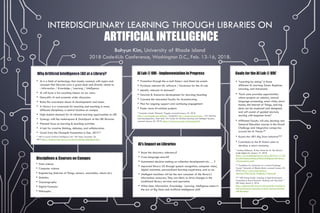
INTERDISCIPLINARY LEARNING THROUGH LIBRARIES ON
ARTIFICIAL INTELLIGENCE
Bohyun Kim, University of Rhode island
2018 Code4Lib Conference, Washington D.C., Feb. 13-16, 2018.
Goals for the AI Lab @ URI*
• “Learning-by-doing” in three
different AI Learning Zones: Beginner,
Learning, and Advanced.
• “Each zone provides opportunities
where projects on robotics, natural
language processing, smart cities, smart
homes, the Internet of Things, and big
data can be explored and designed;
and will consist of guided tutorials,
starting with beginner level.”
• Affiliated Faculty will also develop new
General Education courses in the Grand
Challenge and Integrative categories
around the AI Theme.**
• Boosts the URI’s Big Data Initiative***
• Contribute to the RI State’s plan to
develop a smart economy.
* Lindsay McKenzie, “A New Home for AI: The Library,”
Inside Higher Ed, January 17, 2018,
https://www.insidehighered.com/news/2018/01/17/rho
de-island-hopes-putting-artificial-intelligence-lab-library-
will-expand-ais-reach.
** “Guidelines for Submission of a Grand Challenge
Course,” University of Rhode Island, accessed January 22,
2018, https://web.uri.edu/general-
education/files/Grand_Challenge_Criteria.pdf
*** “URI Hiring Faculty, Investing in High Performance
Computing to Boost Research, Teaching with ‘Big Data,’”
URI Today, March 3, 2016,
https://today.uri.edu/news/uri-hiring-faculty-investing-in-
high-performance-computing-to-boost-research-teaching-
with-big-data/.
Disciplines & Courses on Campus
• Data science
• Computer science
• Engineering (Internet of Things, sensors, wearables, robots etc.)
• Statistics
• Oceanography
• Digital Forensics
• Philosophy
AI’s Impact on Libraries
• Boost the discovery relevancy?
• Cross-language search?
• Automated decision-making on collection development etc. … ?
• Improved library UX through speech recognition, computer vision,
digital assistants, personalized learning experience, and so on.
• Intelligent machines will be the new consumer of the library’s
information resources; They are likely to drive changes in the
traditional library services and operation.
• What does Information, Knowledge, Learning, Intelligence mean in
the era of Big Data and Artificial Intelligence (AI)?
AI Lab @ URI - Implementation in Progress
• Promotion through the e-mail listserv and Meet-Up events
• Purchase relevant ML software / hardware for the AI Lab
• Identify relevant AI datasets*
• Tutorials & Scenarios development for learning/teaching
• Convene the interested faculty for brainstorming
• Plan for ongoing support and continuing engagement
• Foster more AI-related projects
* Examples include “Datasets,” Kaggle, accessed January 22, 2018,
https://www.kaggle.com/datasets ; ImageNet, http://image-net.org/index ; “UCI Machine
Learning Repository: Data Sets,” UCI Center for Machine Learning and Intelligent Systems,
accessed January 22, 2018, https://archive.ics.uci.edu/ml/datasets.html.
Why Artificial Intelligence (AI) at a Library?
• AI is a field of technology that closely connects with topics and
concepts that libraries care a great deal and directly relate to.
: Information / Knowledge / Learning / Intelligence
• AI will have a far-reaching impact on our users.
• Demystify AI and promote wider discussion.
• Raise the awareness about AI developments and issues.
• A Library is a crossroads for learning and teaching in many
different disciplines; a central location on campus.
• High student demand for AI-related learning opportunities at URI
• Synergy with the makerspace & DataSpark at the URI libraries
• Planned focus on learning & teaching activities
• A hub for creative thinking, debates, and collaboration
• Grant from the Champlin Foundation in Dec. 2017.*
* “URI to Launch Artificial Intelligence Lab,” URI Today, December 20,
2017,https://today.uri.edu/news/uri-to-launch-artificial-intelligence-lab/.

Interdisciplinary Learning through Libraries on Artificial Intelligence

  • 1.
    INTERDISCIPLINARY LEARNING THROUGHLIBRARIES ON ARTIFICIAL INTELLIGENCE Bohyun Kim, University of Rhode island 2018 Code4Lib Conference, Washington D.C., Feb. 13-16, 2018. Goals for the AI Lab @ URI* • “Learning-by-doing” in three different AI Learning Zones: Beginner, Learning, and Advanced. • “Each zone provides opportunities where projects on robotics, natural language processing, smart cities, smart homes, the Internet of Things, and big data can be explored and designed; and will consist of guided tutorials, starting with beginner level.” • Affiliated Faculty will also develop new General Education courses in the Grand Challenge and Integrative categories around the AI Theme.** • Boosts the URI’s Big Data Initiative*** • Contribute to the RI State’s plan to develop a smart economy. * Lindsay McKenzie, “A New Home for AI: The Library,” Inside Higher Ed, January 17, 2018, https://www.insidehighered.com/news/2018/01/17/rho de-island-hopes-putting-artificial-intelligence-lab-library- will-expand-ais-reach. ** “Guidelines for Submission of a Grand Challenge Course,” University of Rhode Island, accessed January 22, 2018, https://web.uri.edu/general- education/files/Grand_Challenge_Criteria.pdf *** “URI Hiring Faculty, Investing in High Performance Computing to Boost Research, Teaching with ‘Big Data,’” URI Today, March 3, 2016, https://today.uri.edu/news/uri-hiring-faculty-investing-in- high-performance-computing-to-boost-research-teaching- with-big-data/. Disciplines & Courses on Campus • Data science • Computer science • Engineering (Internet of Things, sensors, wearables, robots etc.) • Statistics • Oceanography • Digital Forensics • Philosophy AI’s Impact on Libraries • Boost the discovery relevancy? • Cross-language search? • Automated decision-making on collection development etc. … ? • Improved library UX through speech recognition, computer vision, digital assistants, personalized learning experience, and so on. • Intelligent machines will be the new consumer of the library’s information resources; They are likely to drive changes in the traditional library services and operation. • What does Information, Knowledge, Learning, Intelligence mean in the era of Big Data and Artificial Intelligence (AI)? AI Lab @ URI - Implementation in Progress • Promotion through the e-mail listserv and Meet-Up events • Purchase relevant ML software / hardware for the AI Lab • Identify relevant AI datasets* • Tutorials & Scenarios development for learning/teaching • Convene the interested faculty for brainstorming • Plan for ongoing support and continuing engagement • Foster more AI-related projects * Examples include “Datasets,” Kaggle, accessed January 22, 2018, https://www.kaggle.com/datasets ; ImageNet, http://image-net.org/index ; “UCI Machine Learning Repository: Data Sets,” UCI Center for Machine Learning and Intelligent Systems, accessed January 22, 2018, https://archive.ics.uci.edu/ml/datasets.html. Why Artificial Intelligence (AI) at a Library? • AI is a field of technology that closely connects with topics and concepts that libraries care a great deal and directly relate to. : Information / Knowledge / Learning / Intelligence • AI will have a far-reaching impact on our users. • Demystify AI and promote wider discussion. • Raise the awareness about AI developments and issues. • A Library is a crossroads for learning and teaching in many different disciplines; a central location on campus. • High student demand for AI-related learning opportunities at URI • Synergy with the makerspace & DataSpark at the URI libraries • Planned focus on learning & teaching activities • A hub for creative thinking, debates, and collaboration • Grant from the Champlin Foundation in Dec. 2017.* * “URI to Launch Artificial Intelligence Lab,” URI Today, December 20, 2017,https://today.uri.edu/news/uri-to-launch-artificial-intelligence-lab/.