Interactive DSML Design
Andriy Levytskyy | MDD Consultant
Luminis Software Development B.V.

Practical Product Lines 2010
November 17 & 18
Venlo
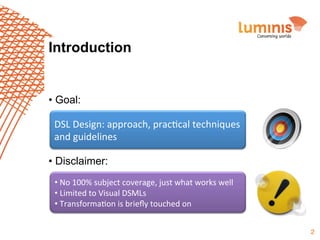
Introduction

•  Goal:
DSL	
  Design:	
  approach,	
  pracBcal	
  techniques	
  
and	
  guidelines	
  
•  Disclaimer:
• 	
  No	
  100%	
  subject	
  coverage,	
  just	
  what	
  works	
  well	
  
• 	
  Limited	
  to	
  Visual	
  DSMLs	
  	
  
• 	
  TransformaBon	
  is	
  briefly	
  touched	
  on	
  
2
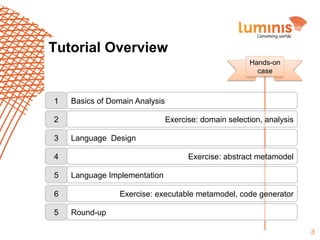
Tutorial Overview
Hands-on
case

1

Basics of Domain Analysis

2
3

Exercise: domain selection, analysis
Language Design

4
5

Exercise: abstract metamodel
Language Implementation

6
5

Exercise: executable metamodel, code generator
Round-up
3
Introducing each other
Name:
Company:
Function:
Domain:
Specialization:
Experience with MDD:
Expectations:

4
•  Paradigm
•  Basic Techniques
•  Guidelines
•  Added value

BASICS OF DOMAIN
ANALYSIS
5
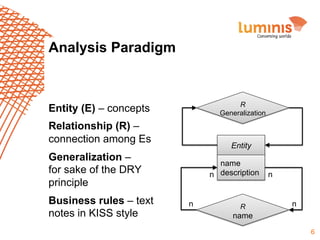
Analysis Paradigm

R
Generalization

Entity (E) – concepts
Relationship (R) –
connection among Es

Entity

Generalization –
for sake of the DRY
principle
Business rules – text
notes in KISS style

name
n description

n

R

n

n

name
6
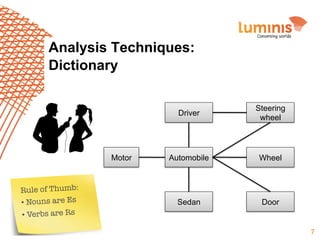
Analysis Techniques:
Dictionary
Driver

Motor

Rule of Thumb:
•  Nouns are Es
•  Verbs are Rs


Steering
wheel

Automobile

Wheel

Sedan

Door

7
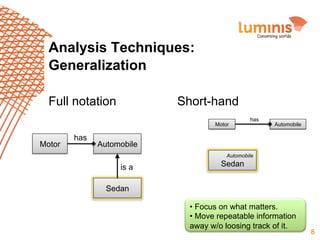
Analysis Techniques:
Generalization
Full notation

Short-hand
Motor

Motor

has

has

Automobile

Automobile
Automobile

is a

Sedan

Sedan
•  Focus on what matters.
•  Move repeatable information
away w/o loosing track of it.

8
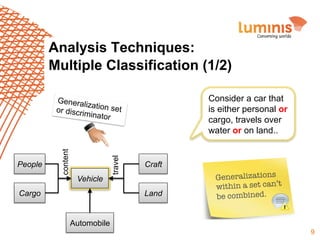
Analysis Techniques:
Multiple Classification (1/2)
Consider a car that
is either personal or
cargo, travels over
water or on land..

Vehicle

Cargo

travel

People

content

General
i za
or discrim tion set
inator

Craft

Land

Generalizations
within a set can’t
be combined.

Automobile
9
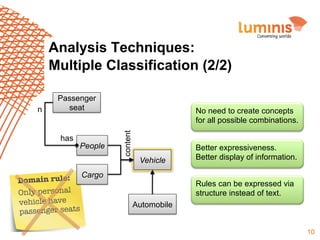
Analysis Techniques:
Multiple Classification (2/2)

has

People

Cargo
omain rule:
D
Only personal
vehicle have
passenger seats

No need to create concepts
for all possible combinations.
content

n

Passenger
seat

Vehicle

Better expressiveness.
Better display of information.
Rules can be expressed via
structure instead of text.

Automobile
10
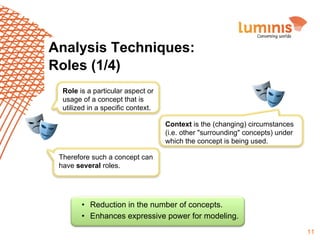
Analysis Techniques:
Roles (1/4)
Role is a particular aspect or
usage of a concept that is
utilized in a specific context.
Context is the (changing) circumstances
(i.e. other "surrounding" concepts) under
which the concept is being used.
Therefore such a concept can
have several roles.

•  Reduction in the number of concepts.
•  Enhances expressive power for modeling.
11
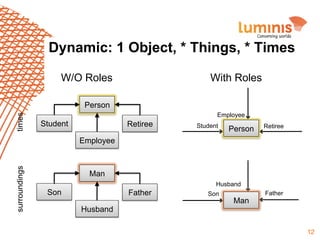
Dynamic: 1 Object, * Things, * Times
W/O Roles

With Roles

times

Person
Employee

Student

Retiree

Student

Person

Retiree

surroundings

Employee

Man
Husband

Son

Father
Husband

Son

Man

Father

12
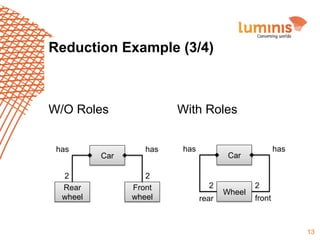
Reduction Example (3/4)

W/O Roles
has
2
Rear
wheel

Car

With Roles
has
2
Front
wheel

has

has

Car

2
rear

Wheel

2
front

13
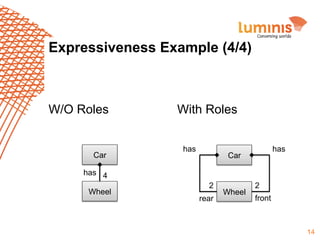
Expressiveness Example (4/4)

W/O Roles

Car

With Roles
has

has

Car

has 4
Wheel

2
rear

Wheel

2
front

14
Analysis Guidelines & Tips
•  When stuck ask domain expert for more information
•  Apply Law of preservation to extracted information
•  Define depth and scope of domain around needs of end users
•  Avoid working on domain model from the time/process perspective
•  Expose all information visually as entities <= facilitates discussion
•  Use multiple classification over role if:
•  Classifications are exclusive
•  Roles need to be more prominent.
•  Entities have no properties nor attributes (except for Name)
•  Resist tendency of putting info in business rules/comments
•  Use Wikipedia for generic vocabularies/classifications
•  Avoid large diagrams
•  Iterate analysis-modeling-review until the model:
•  Consistent, adequate, has no gaps, “feels” right
15
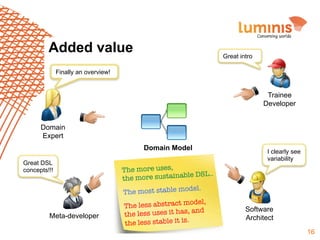
Added value

Great intro

Finally an overview!

Trainee
Developer
Domain
Expert
Domain Model
Great DSL
concepts!!!

Meta-developer

The more uses, "
le DSL..
the more sustainab
el.
The most stable mod
odel,
The less abstract m
and
the less uses it has,
the less stable it is.


I clearly see
variability

Software
Architect
16
•  Choose a domain
•  Extract concepts
•  Organize concepts
•  Review

EXERCISE: DOMAIN ANALYSIS

17
•  What is language?
•  Paradigm
•  Guidelines

LANGUAGE DESIGN

18
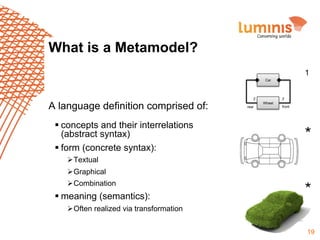
What is a Metamodel?
1
Car

A language definition comprised of:
§ concepts and their interrelations
(abstract syntax)
§ form (concrete syntax):

2
rear

2
Wheel

front

*

Ø Textual
Ø Graphical
Ø Combination

§ meaning (semantics):

*

Ø Often realized via transformation
19
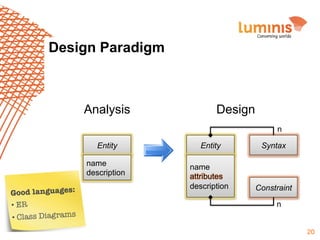
Design Paradigm

Analysis

Design
n

Entity

Syntax

name
description
Good languages:
•  ER
•  Class Diagrams

Entity
name
attributes
description

Constraint
n
20
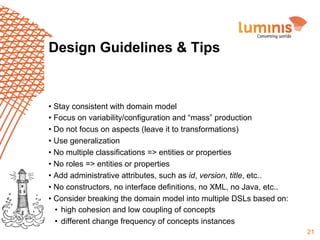
Design Guidelines & Tips

•  Stay consistent with domain model
•  Focus on variability/configuration and “mass” production
•  Do not focus on aspects (leave it to transformations)
•  Use generalization
•  No multiple classifications => entities or properties
•  No roles => entities or properties
•  Add administrative attributes, such as id, version, title, etc..
•  No constructors, no interface definitions, no XML, no Java, etc..
•  Consider breaking the domain model into multiple DSLs based on:
•  high cohesion and low coupling of concepts
•  different change frequency of concepts instances
21
•  Translate domain model to DSL design(s)
•  Choose additional semantic domain, e.g. HTML
•  How your concepts are related to the semantic domain?

EXERCISE: DSL DESIGN

22
•  Tool Selection
•  AToM3 Introduction

LANGUAGE
IMPLEMENTATION
23
Tool Selection

Selection guidelines:
•  No meaningful guidelines exist
•  My advice: Choose tools that are as close to design paradigm as
possible (raise level of abstraction)
Skipped Candidates:
✘Eclipse based tools
✘Tools from industry heavyweights (IBM, Microsoft, Borland)
✘Popular DSL tools
(Would not fit into the allocated time or will spend time clicking/typing
in many dialogue windows)
24
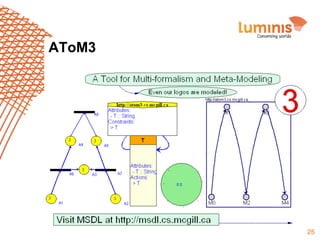
AToM3

25
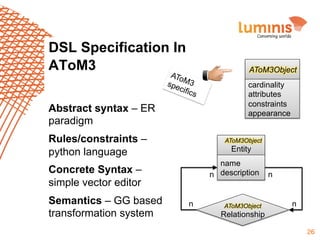
DSL Specification In
AToM3

AToM3Object
cardinality
attributes
constraints
appearance

Abstract syntax – ER
paradigm
Rules/constraints –
python language

AToM3Object

Entity
name
n description

Concrete Syntax –
simple vector editor
Semantics – GG based
transformation system

n

AToM3Object

n

n

Relationship
26
•  Translate DSL design to AToM3 metamodel
•  Making a simple generator (e.g. for HTML)
•  Test-drive of the DSL

EXERCISE:
DSL IMPLEMENTATION
27
•  DSLs: Familiar and Different
•  A few bad practices
•  References
•  Any questions?

ROUND-UP

28
DSLs are Familiar..

•  DSL development is a software development process
•  DSL is a very special, but still a software system
•  Status quo: DSL development still done at PSM (i.e. coding/3GLs)
•  With all consequences
•  All best practices from SE apply here as well:
•  Good analysis
•  Modeling to raise abstraction
•  Modeling architectures (e.g. MDA’s CIM/PIM/PSM), etc..
29
.. And Yet Different

•  Clients do not know domain concepts <= agile
•  Metamodels are more domain-driven <= good domain analysis
•  No one wants a vendor lock <= CIM/PIM/PSM/
•  DSLs are very specific systems <= automate DSL development
Best SE pract
ices
are even mor
e
important wit
h
DSLs!

30
A Few Bad Practices

•  Lack of domain understanding
•  Too generic/too specific
•  Letting the tool dictate language analysis design
•  Failing to consider the language’s real-life usage
•  Top/down and bottom/up confusion => inflexible MDD
•  and more (see [3])…

31
References

[1] Eric Evans. Domain-Driven Design: Tacking Complexity In the
Heart of Software. Addison-Wesley Longman Publishing Co., Inc.,
Boston, MA, USA, 2003.
[2] Martin Fowler and Kendall Scott. UML Distilled: A Brief Guide to
the Standard Object Modeling Language. Addison-Wesley
Longman Publishing Co., Inc., Boston, MA, USA, 3rd edition, 2003.
[3] Steven Kelly and Risto Pohjonen. Worst Practices for DomainSpecific Modeling. IEEE Software, vol. 26, no. 4, pp. 22-29, July/
Aug. 2009. doi:10.1109/MS.2009.109
[4] Steven Kelly and Juha-Pekka Tolvanen, Domain-Specific
Modeling, enabling full code generation, Wiley-Blackwell, 2008.
32
http://lsd.luminis.eu
andriy.levytskyy@luminis.eu
http://nl.linkedin.com/in/andriylevytskyy
http://lsd.luminis.eu/tag/mdd/
http://twitter.com/levytsky

33

Interactive DSML Design

  • 1.
    Interactive DSML Design AndriyLevytskyy | MDD Consultant Luminis Software Development B.V. Practical Product Lines 2010 November 17 & 18 Venlo
  • 2.
    Introduction •  Goal: DSL  Design:  approach,  pracBcal  techniques   and  guidelines   •  Disclaimer: •   No  100%  subject  coverage,  just  what  works  well   •   Limited  to  Visual  DSMLs     •   TransformaBon  is  briefly  touched  on   2
  • 3.
    Tutorial Overview Hands-on case 1 Basics ofDomain Analysis 2 3 Exercise: domain selection, analysis Language Design 4 5 Exercise: abstract metamodel Language Implementation 6 5 Exercise: executable metamodel, code generator Round-up 3
  • 4.
  • 5.
    •  Paradigm •  BasicTechniques •  Guidelines •  Added value BASICS OF DOMAIN ANALYSIS 5
  • 6.
    Analysis Paradigm R Generalization Entity (E)– concepts Relationship (R) – connection among Es Entity Generalization – for sake of the DRY principle Business rules – text notes in KISS style name n description n R n n name 6
  • 7.
    Analysis Techniques: Dictionary Driver Motor Rule ofThumb: •  Nouns are Es •  Verbs are Rs Steering wheel Automobile Wheel Sedan Door 7
  • 8.
    Analysis Techniques: Generalization Full notation Short-hand Motor Motor has has Automobile Automobile Automobile isa Sedan Sedan •  Focus on what matters. •  Move repeatable information away w/o loosing track of it. 8
  • 9.
    Analysis Techniques: Multiple Classification(1/2) Consider a car that is either personal or cargo, travels over water or on land.. Vehicle Cargo travel People content General i za or discrim tion set inator Craft Land Generalizations within a set can’t be combined. Automobile 9
  • 10.
    Analysis Techniques: Multiple Classification(2/2) has People Cargo omain rule: D Only personal vehicle have passenger seats No need to create concepts for all possible combinations. content n Passenger seat Vehicle Better expressiveness. Better display of information. Rules can be expressed via structure instead of text. Automobile 10
  • 11.
    Analysis Techniques: Roles (1/4) Roleis a particular aspect or usage of a concept that is utilized in a specific context. Context is the (changing) circumstances (i.e. other "surrounding" concepts) under which the concept is being used. Therefore such a concept can have several roles. •  Reduction in the number of concepts. •  Enhances expressive power for modeling. 11
  • 12.
    Dynamic: 1 Object,* Things, * Times W/O Roles With Roles times Person Employee Student Retiree Student Person Retiree surroundings Employee Man Husband Son Father Husband Son Man Father 12
  • 13.
    Reduction Example (3/4) W/ORoles has 2 Rear wheel Car With Roles has 2 Front wheel has has Car 2 rear Wheel 2 front 13
  • 14.
    Expressiveness Example (4/4) W/ORoles Car With Roles has has Car has 4 Wheel 2 rear Wheel 2 front 14
  • 15.
    Analysis Guidelines &Tips •  When stuck ask domain expert for more information •  Apply Law of preservation to extracted information •  Define depth and scope of domain around needs of end users •  Avoid working on domain model from the time/process perspective •  Expose all information visually as entities <= facilitates discussion •  Use multiple classification over role if: •  Classifications are exclusive •  Roles need to be more prominent. •  Entities have no properties nor attributes (except for Name) •  Resist tendency of putting info in business rules/comments •  Use Wikipedia for generic vocabularies/classifications •  Avoid large diagrams •  Iterate analysis-modeling-review until the model: •  Consistent, adequate, has no gaps, “feels” right 15
  • 16.
    Added value Great intro Finallyan overview! Trainee Developer Domain Expert Domain Model Great DSL concepts!!! Meta-developer The more uses, " le DSL.. the more sustainab el. The most stable mod odel, The less abstract m and the less uses it has, the less stable it is. I clearly see variability Software Architect 16
  • 17.
    •  Choose adomain •  Extract concepts •  Organize concepts •  Review EXERCISE: DOMAIN ANALYSIS 17
  • 18.
    •  What islanguage? •  Paradigm •  Guidelines LANGUAGE DESIGN 18
  • 19.
    What is aMetamodel? 1 Car A language definition comprised of: § concepts and their interrelations (abstract syntax) § form (concrete syntax): 2 rear 2 Wheel front * Ø Textual Ø Graphical Ø Combination § meaning (semantics): * Ø Often realized via transformation 19
  • 20.
    Design Paradigm Analysis Design n Entity Syntax name description Good languages: • ER •  Class Diagrams Entity name attributes description Constraint n 20
  • 21.
    Design Guidelines &Tips •  Stay consistent with domain model •  Focus on variability/configuration and “mass” production •  Do not focus on aspects (leave it to transformations) •  Use generalization •  No multiple classifications => entities or properties •  No roles => entities or properties •  Add administrative attributes, such as id, version, title, etc.. •  No constructors, no interface definitions, no XML, no Java, etc.. •  Consider breaking the domain model into multiple DSLs based on: •  high cohesion and low coupling of concepts •  different change frequency of concepts instances 21
  • 22.
    •  Translate domainmodel to DSL design(s) •  Choose additional semantic domain, e.g. HTML •  How your concepts are related to the semantic domain? EXERCISE: DSL DESIGN 22
  • 23.
    •  Tool Selection • AToM3 Introduction LANGUAGE IMPLEMENTATION 23
  • 24.
    Tool Selection Selection guidelines: • No meaningful guidelines exist •  My advice: Choose tools that are as close to design paradigm as possible (raise level of abstraction) Skipped Candidates: ✘Eclipse based tools ✘Tools from industry heavyweights (IBM, Microsoft, Borland) ✘Popular DSL tools (Would not fit into the allocated time or will spend time clicking/typing in many dialogue windows) 24
  • 25.
  • 26.
    DSL Specification In AToM3 AToM3Object cardinality attributes constraints appearance Abstractsyntax – ER paradigm Rules/constraints – python language AToM3Object Entity name n description Concrete Syntax – simple vector editor Semantics – GG based transformation system n AToM3Object n n Relationship 26
  • 27.
    •  Translate DSLdesign to AToM3 metamodel •  Making a simple generator (e.g. for HTML) •  Test-drive of the DSL EXERCISE: DSL IMPLEMENTATION 27
  • 28.
    •  DSLs: Familiarand Different •  A few bad practices •  References •  Any questions? ROUND-UP 28
  • 29.
    DSLs are Familiar.. • DSL development is a software development process •  DSL is a very special, but still a software system •  Status quo: DSL development still done at PSM (i.e. coding/3GLs) •  With all consequences •  All best practices from SE apply here as well: •  Good analysis •  Modeling to raise abstraction •  Modeling architectures (e.g. MDA’s CIM/PIM/PSM), etc.. 29
  • 30.
    .. And YetDifferent •  Clients do not know domain concepts <= agile •  Metamodels are more domain-driven <= good domain analysis •  No one wants a vendor lock <= CIM/PIM/PSM/ •  DSLs are very specific systems <= automate DSL development Best SE pract ices are even mor e important wit h DSLs! 30
  • 31.
    A Few BadPractices •  Lack of domain understanding •  Too generic/too specific •  Letting the tool dictate language analysis design •  Failing to consider the language’s real-life usage •  Top/down and bottom/up confusion => inflexible MDD •  and more (see [3])… 31
  • 32.
    References [1] Eric Evans.Domain-Driven Design: Tacking Complexity In the Heart of Software. Addison-Wesley Longman Publishing Co., Inc., Boston, MA, USA, 2003. [2] Martin Fowler and Kendall Scott. UML Distilled: A Brief Guide to the Standard Object Modeling Language. Addison-Wesley Longman Publishing Co., Inc., Boston, MA, USA, 3rd edition, 2003. [3] Steven Kelly and Risto Pohjonen. Worst Practices for DomainSpecific Modeling. IEEE Software, vol. 26, no. 4, pp. 22-29, July/ Aug. 2009. doi:10.1109/MS.2009.109 [4] Steven Kelly and Juha-Pekka Tolvanen, Domain-Specific Modeling, enabling full code generation, Wiley-Blackwell, 2008. 32
  • 33.