COMP23420 Semester 2 week 3:
      Domain to Design

   John Sargeant (johns@cs.man.ac.uk)


Please remember to switch off all electronic
         devices when in lectures.
John’s lectures

• Week 3: Domain to design
• Week 4: GRASP design principles (1) featuring
  coupling and cohesion
• Week 5: GRASP design principles (2) featuring
  inheritance
• Week 6: Testing concepts and approaches
• Week 7: Unit testing using JUnit
Overview

•   A note on terminology
•   Process sale example
•   Domain modelling - reminder
•   Design class notation
•   Domain to design
Terminology
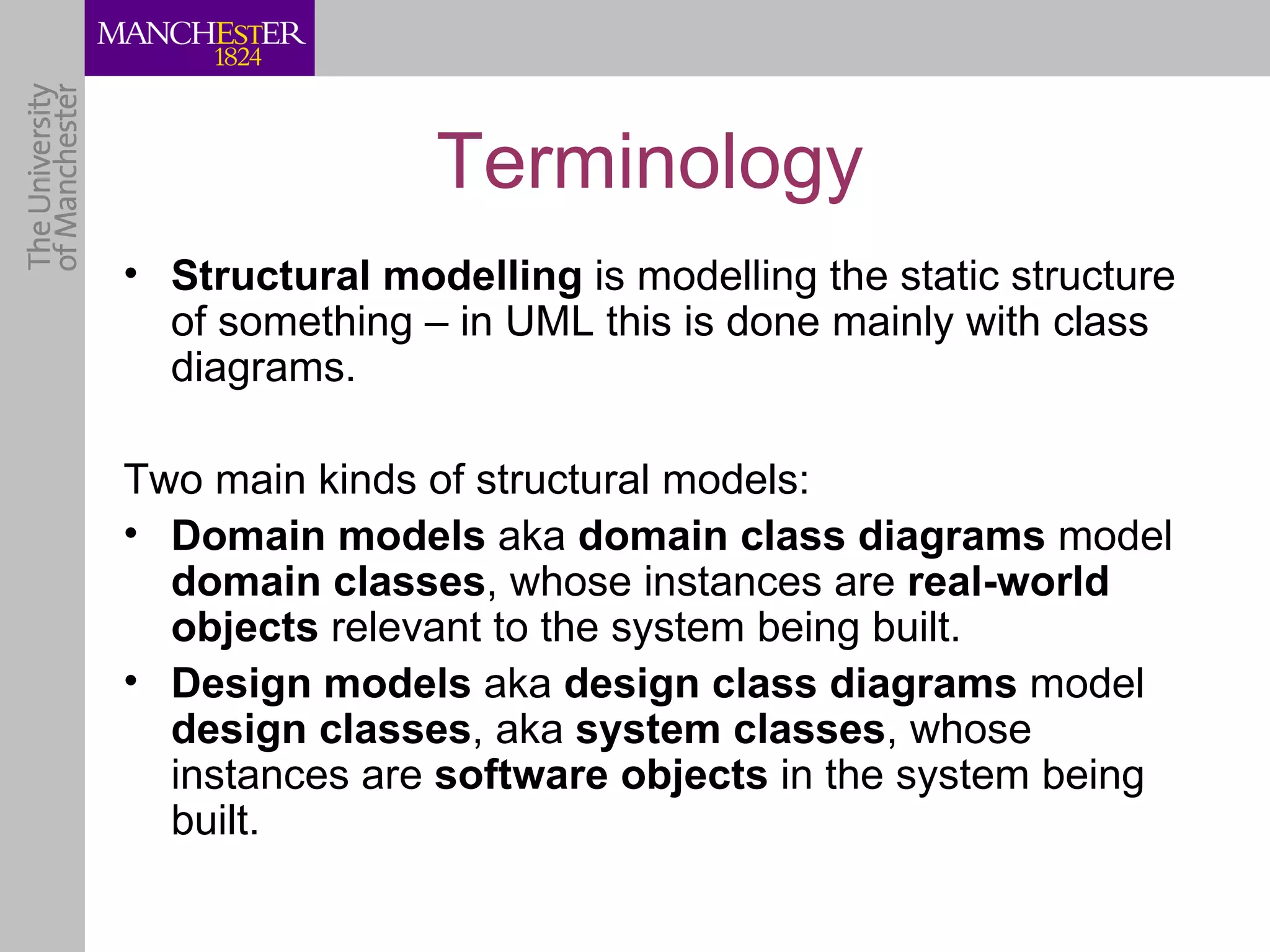
• Structural modelling is modelling the static structure
  of something – in UML this is done mainly with class
  diagrams.

Two main kinds of structural models:
• Domain models aka domain class diagrams model
  domain classes, whose instances are real-world
  objects relevant to the system being built.
• Design models aka design class diagrams model
  design classes, aka system classes, whose
  instances are software objects in the system being
  built.
Key ideas
• Domain class diagrams show “real world” domain
  classes, not software classes, but…
• domain classes often inspire software classes
• But: the mapping is not 1-1 – some domain classes
  will not lead to design classes,
• You may discover more domain classes in the
  process of design….
• which means you may need to go back to the
  stakeholders to clarify requirements…
• which means you may need to revise the UCs etc.
Pure fabrication
A Pure fabrication is a design class which does not
  correspond to anything in the domain, e.g.
• Collections
• Interfaces to external systems, e.g. database
  connectors
• Factories – classes whose sole job is to create
  objects of other classes.
• UI components
• Indirections to, and abstractions of, other classes.
Over time, the PFs usually outnumber the domain-
  inspired classes.
Example: process sale, cash
    only, use case (brief format)
A customer brings a basket containing items to the
  cash desk. The cashier enters details of the items
  into the cash till using the barcodes on the items,
  and the cash till calculates the total amount due. The
  customer offers an amount of money at least as
  much as required, and the cash till indicates the
  amount of change required. The cashier gives the
  change and a receipt printed by the cash till to the
  customer.
The details of the transaction are recorded in a
  database.
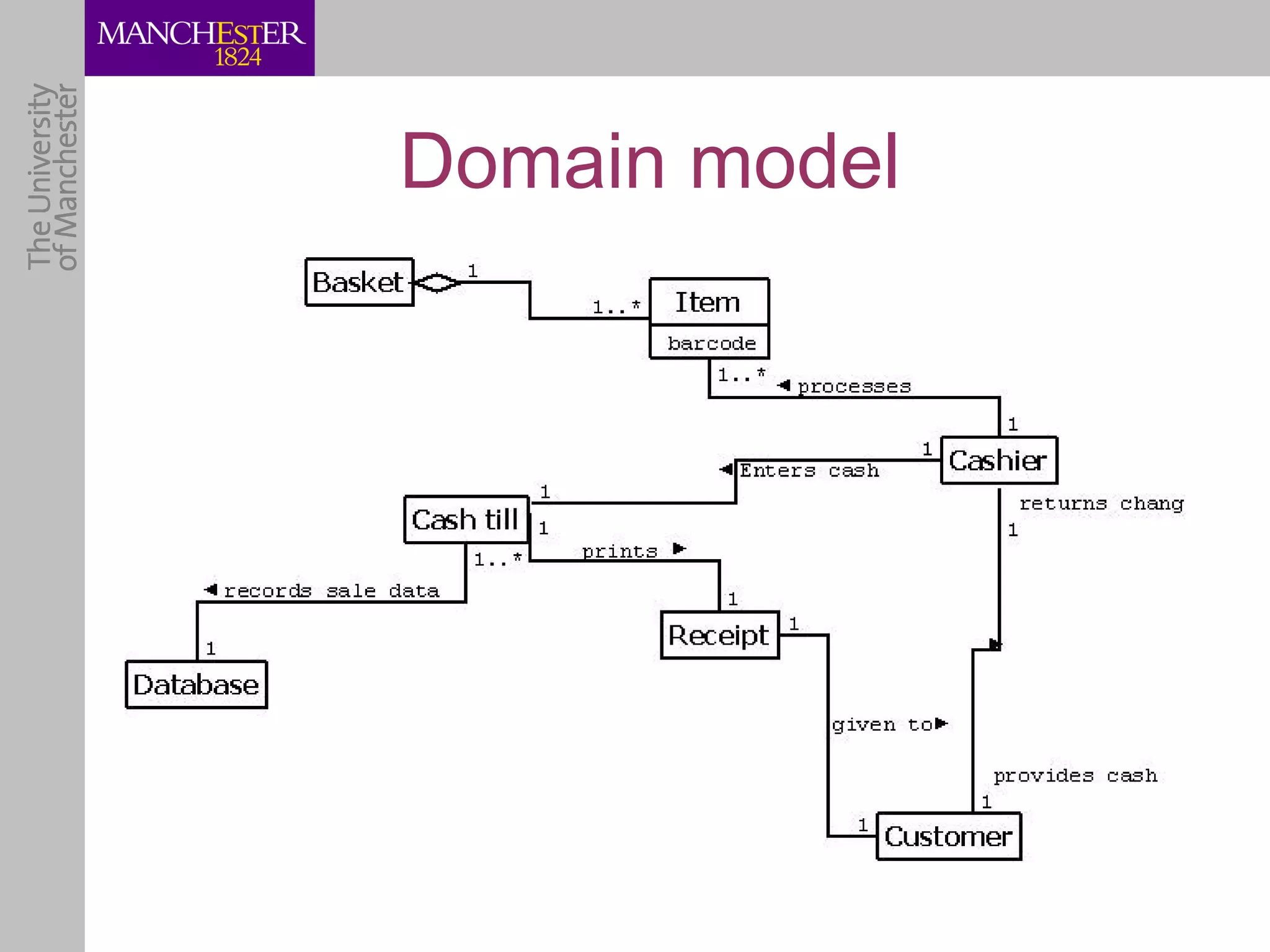
Domain model
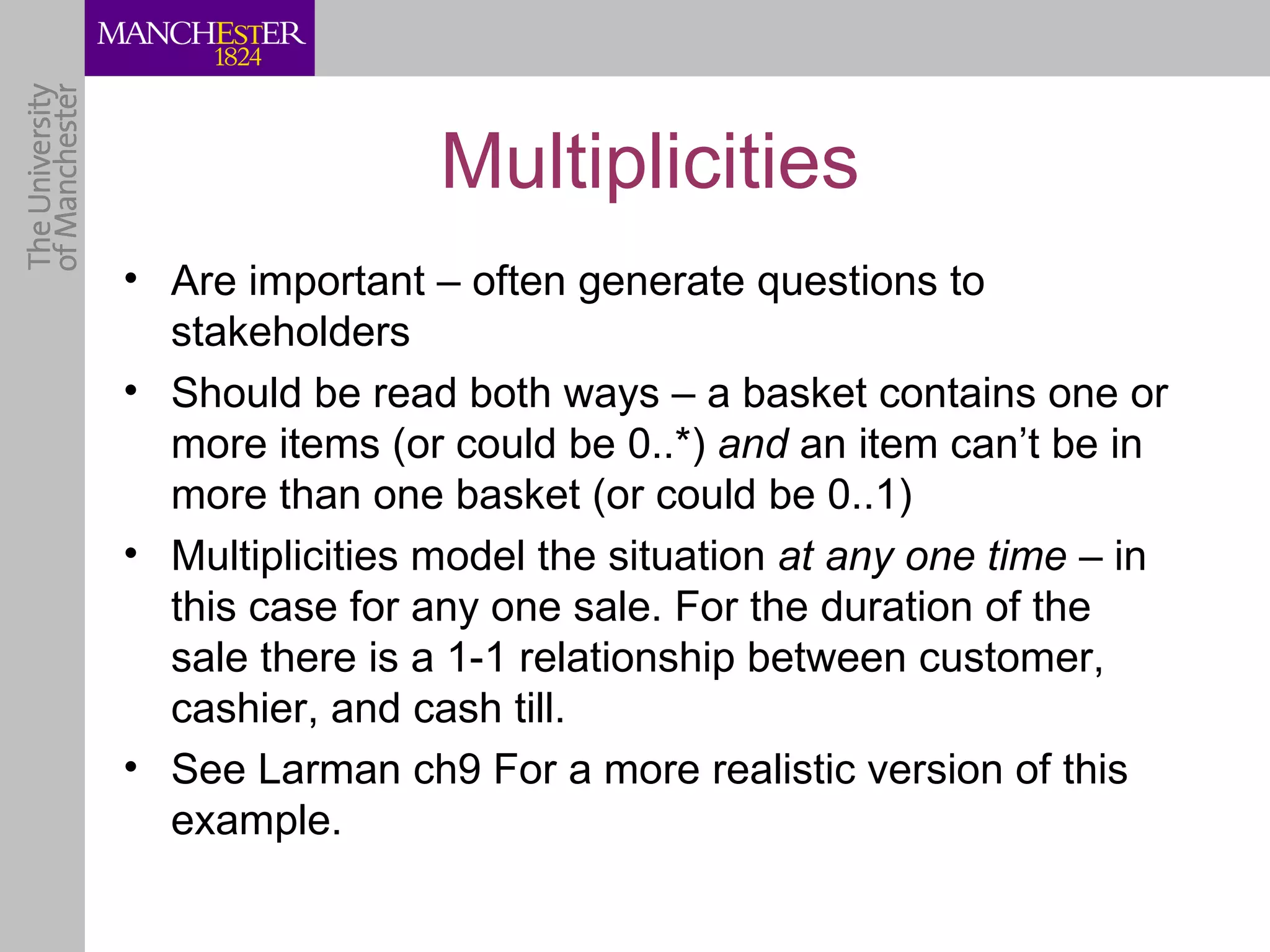
Guidelines
• Show relationships between classes, not details of
  classes (key attributes only)
• Keep it simple – don’t try to include everything (no
  “right answer”), e.g. I omitted cash desk and money.
• Try to make it as informative as possible
• Use stakeholder’s terminology - “mapmaker principle”
• Names and multiplicities of associations are
  important
• Note use of diamond for “contains”. You must use
  the notation correctly in the exam.
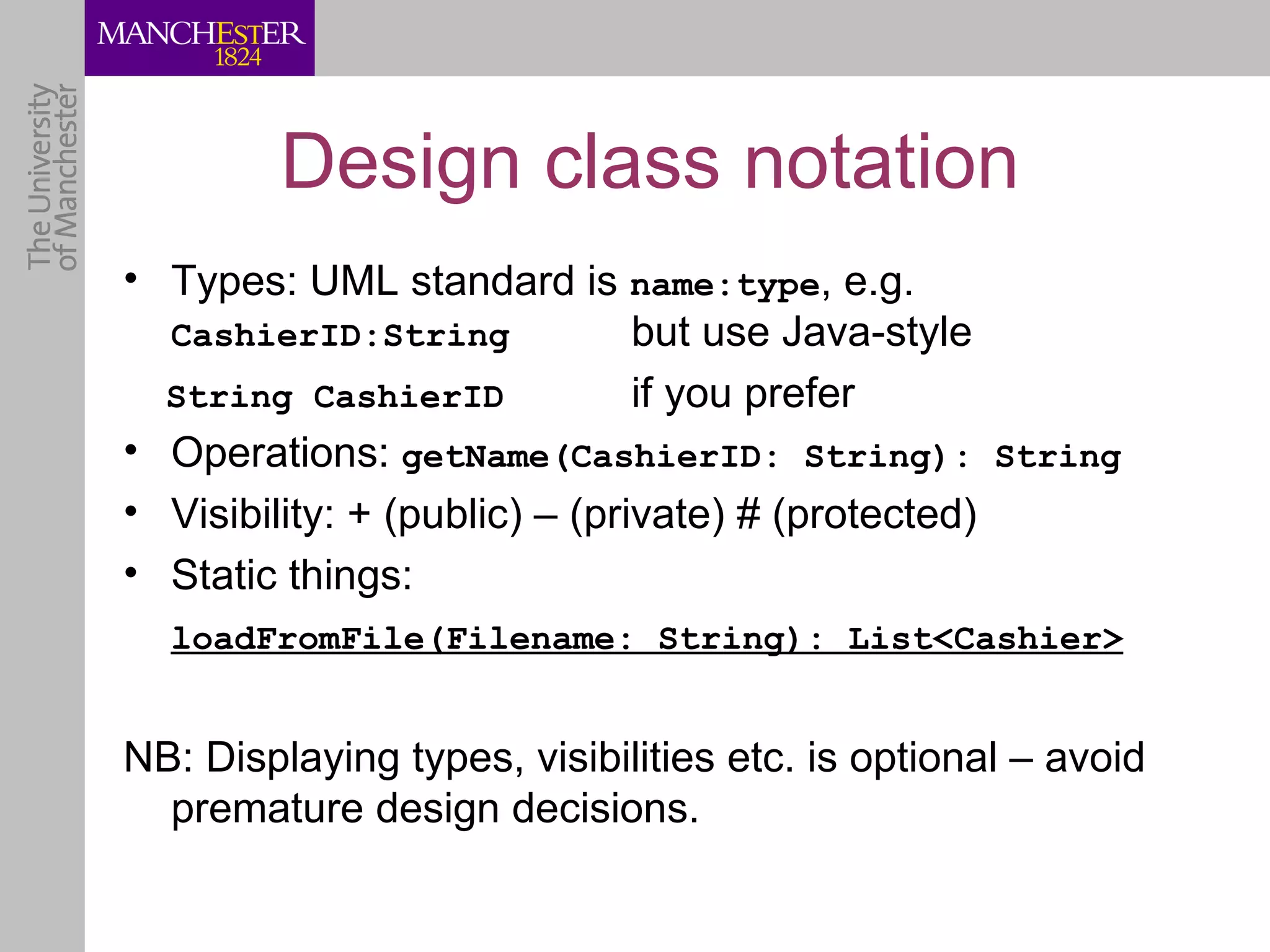
Multiplicities
• Are important – often generate questions to
  stakeholders
• Should be read both ways – a basket contains one or
  more items (or could be 0..*) and an item can’t be in
  more than one basket (or could be 0..1)
• Multiplicities model the situation at any one time – in
  this case for any one sale. For the duration of the
  sale there is a 1-1 relationship between customer,
  cashier, and cash till.
• See Larman ch9 For a more realistic version of this
  example.
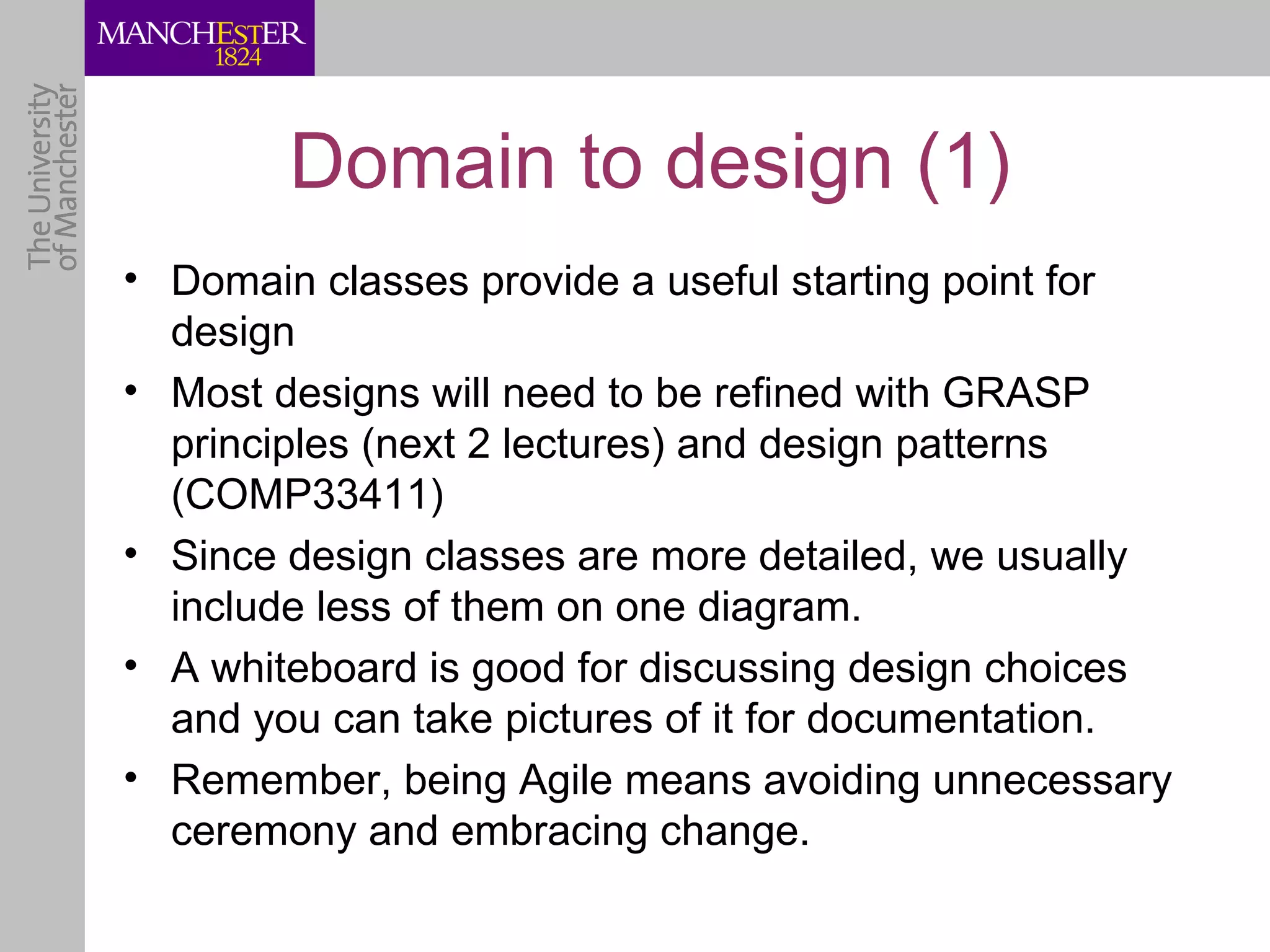
Design class notation
• Types: UML standard is name:type, e.g.
  CashierID:String             but use Java-style
  String CashierID             if you prefer
• Operations: getName(CashierID: String): String
• Visibility: + (public) – (private) # (protected)
• Static things:
  loadFromFile(Filename: String): List<Cashier>


NB: Displaying types, visibilities etc. is optional – avoid
  premature design decisions.
Domain to design (1)
• Domain classes provide a useful starting point for
  design
• Most designs will need to be refined with GRASP
  principles (next 2 lectures) and design patterns
  (COMP33411)
• Since design classes are more detailed, we usually
  include less of them on one diagram.
• A whiteboard is good for discussing design choices
  and you can take pictures of it for documentation.
• Remember, being Agile means avoiding unnecessary
  ceremony and embracing change.
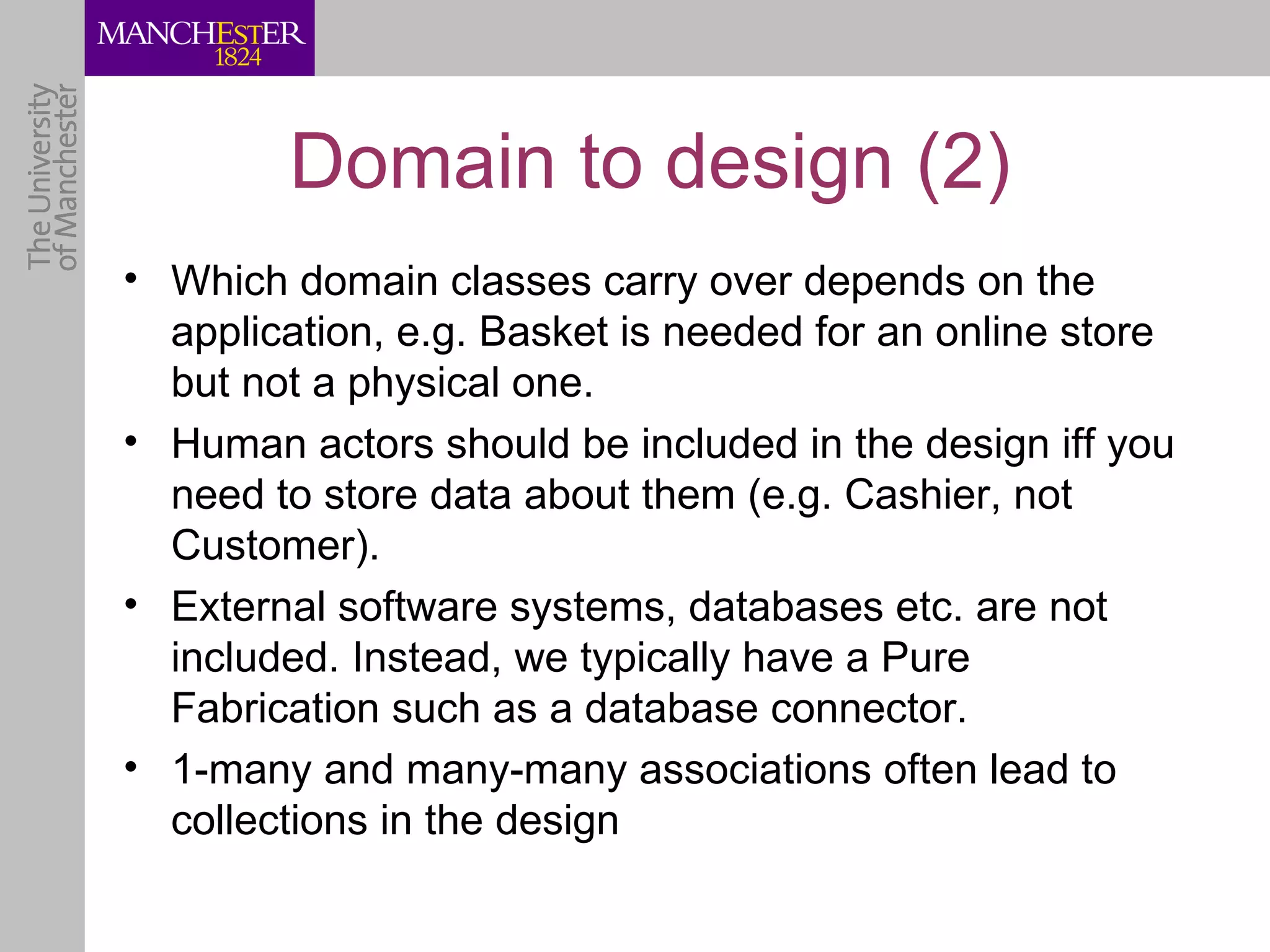
Domain to design (2)
• Which domain classes carry over depends on the
  application, e.g. Basket is needed for an online store
  but not a physical one.
• Human actors should be included in the design iff you
  need to store data about them (e.g. Cashier, not
  Customer).
• External software systems, databases etc. are not
  included. Instead, we typically have a Pure
  Fabrication such as a database connector.
• 1-many and many-many associations often lead to
  collections in the design
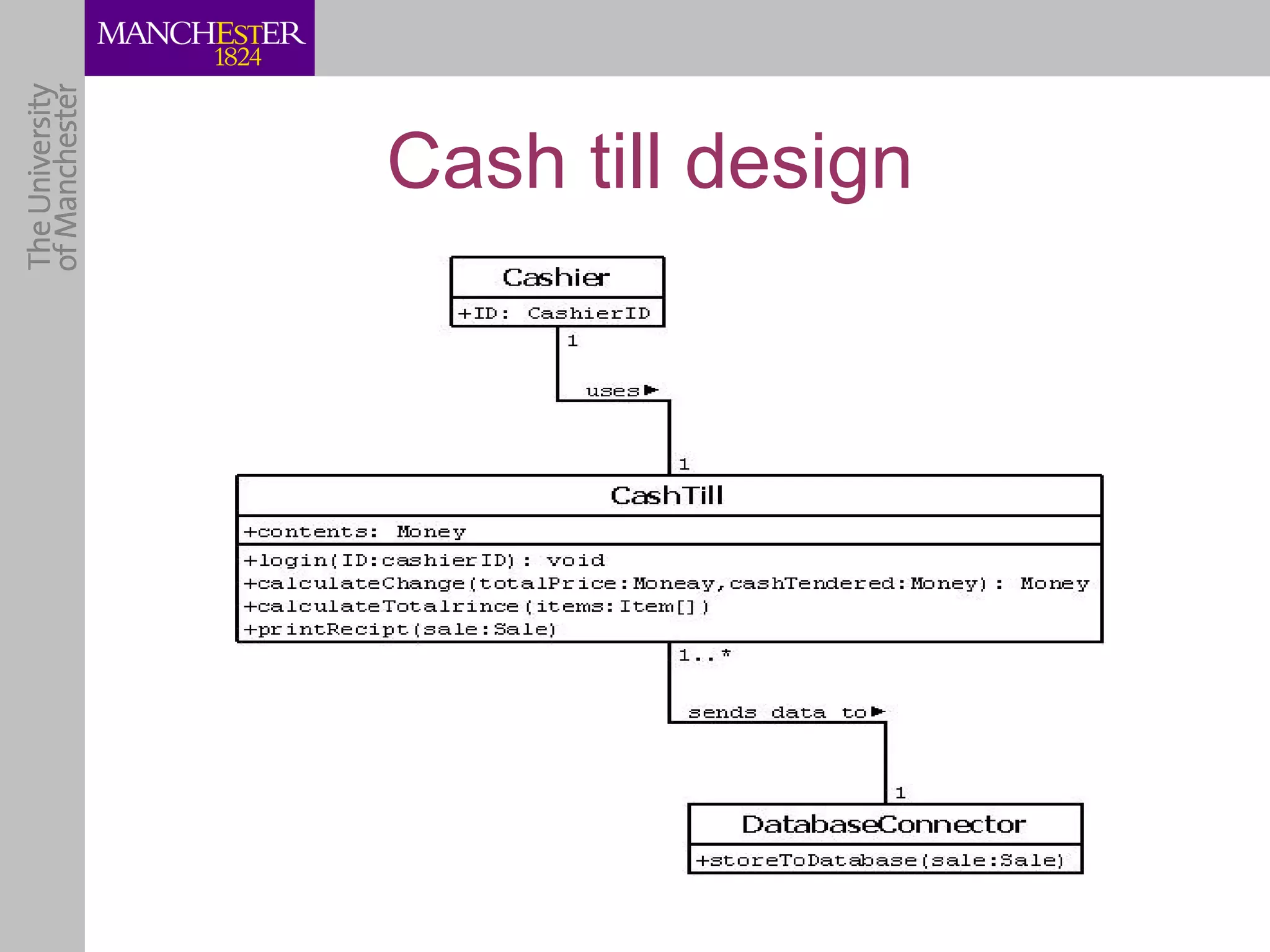
Cash till design
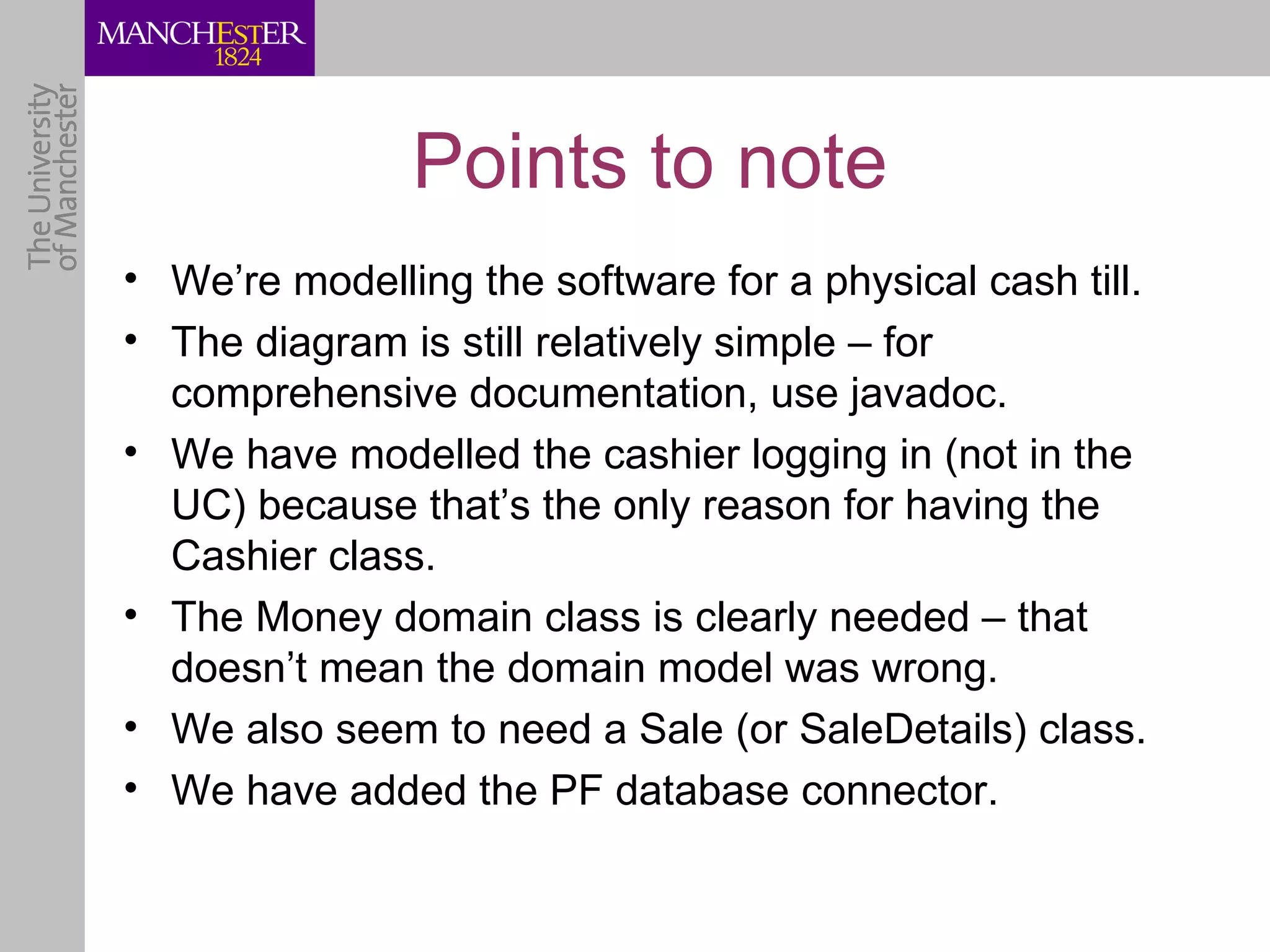
Points to note
• We’re modelling the software for a physical cash till.
• The diagram is still relatively simple – for
  comprehensive documentation, use javadoc.
• We have modelled the cashier logging in (not in the
  UC) because that’s the only reason for having the
  Cashier class.
• The Money domain class is clearly needed – that
  doesn’t mean the domain model was wrong.
• We also seem to need a Sale (or SaleDetails) class.
• We have added the PF database connector.
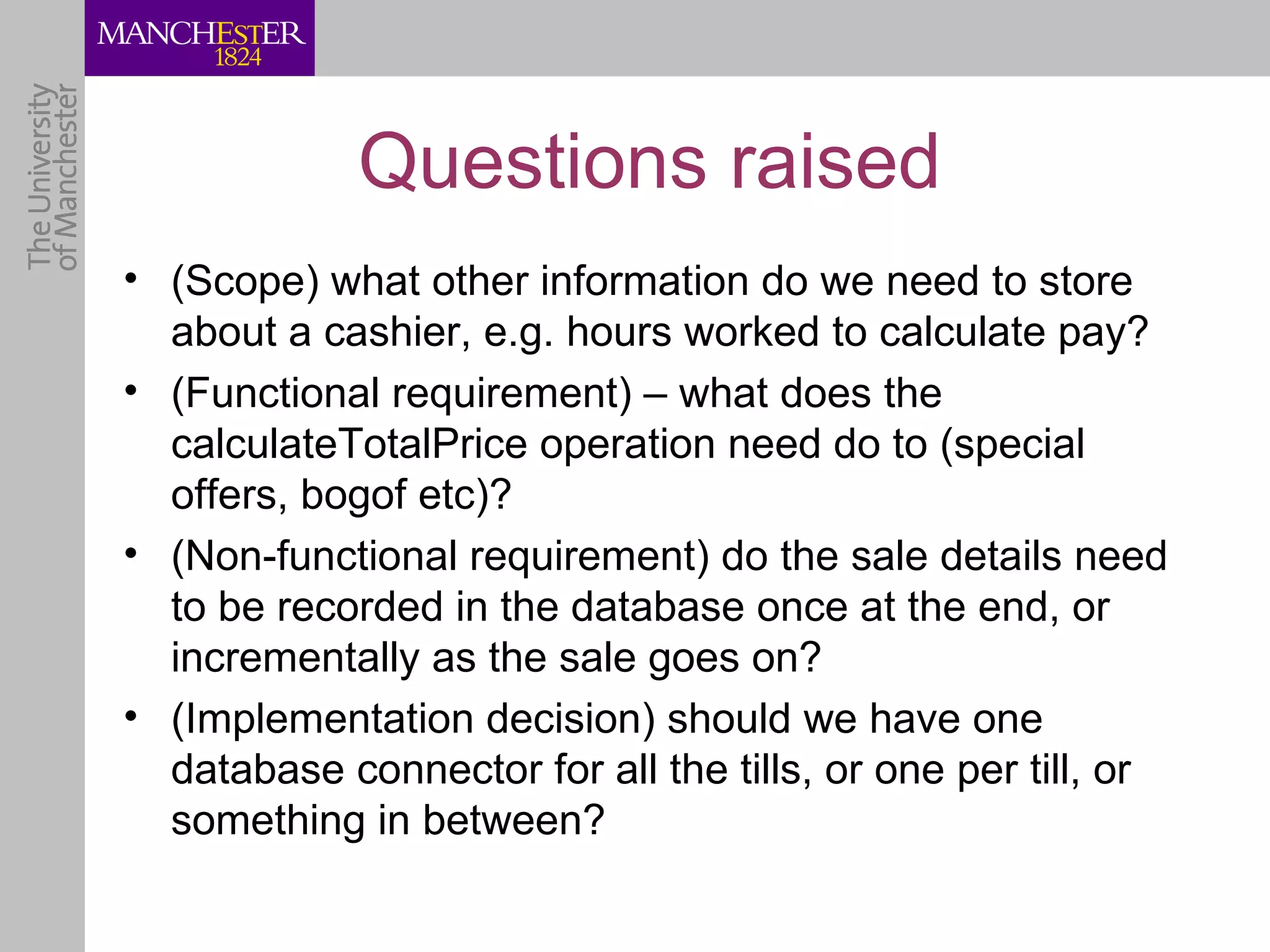
Questions raised
• (Scope) what other information do we need to store
  about a cashier, e.g. hours worked to calculate pay?
• (Functional requirement) – what does the
  calculateTotalPrice operation need do to (special
  offers, bogof etc)?
• (Non-functional requirement) do the sale details need
  to be recorded in the database once at the end, or
  incrementally as the sale goes on?
• (Implementation decision) should we have one
  database connector for all the tills, or one per till, or
  something in between?
Summary
• A domain model provides a good starting point for a
  design.
• Doman classes often inspire design classes, but it is
  definitely not a 1-1 mapping and it can even happen
  the other way round.
• Design classes are more detailed than domain
  classes, but it’s important not to clutter them.
• An initial design model is likely to generate questions
  about requirements, not just design decisions.
• Be Agile – avoid modelling for the sake of it.

Week3 to-design

  • 1.
    COMP23420 Semester 2week 3: Domain to Design John Sargeant (johns@cs.man.ac.uk) Please remember to switch off all electronic devices when in lectures.
  • 2.
    John’s lectures • Week3: Domain to design • Week 4: GRASP design principles (1) featuring coupling and cohesion • Week 5: GRASP design principles (2) featuring inheritance • Week 6: Testing concepts and approaches • Week 7: Unit testing using JUnit
  • 3.
    Overview • A note on terminology • Process sale example • Domain modelling - reminder • Design class notation • Domain to design
  • 4.
    Terminology • Structural modellingis modelling the static structure of something – in UML this is done mainly with class diagrams. Two main kinds of structural models: • Domain models aka domain class diagrams model domain classes, whose instances are real-world objects relevant to the system being built. • Design models aka design class diagrams model design classes, aka system classes, whose instances are software objects in the system being built.
  • 5.
    Key ideas • Domainclass diagrams show “real world” domain classes, not software classes, but… • domain classes often inspire software classes • But: the mapping is not 1-1 – some domain classes will not lead to design classes, • You may discover more domain classes in the process of design…. • which means you may need to go back to the stakeholders to clarify requirements… • which means you may need to revise the UCs etc.
  • 6.
    Pure fabrication A Purefabrication is a design class which does not correspond to anything in the domain, e.g. • Collections • Interfaces to external systems, e.g. database connectors • Factories – classes whose sole job is to create objects of other classes. • UI components • Indirections to, and abstractions of, other classes. Over time, the PFs usually outnumber the domain- inspired classes.
  • 7.
    Example: process sale,cash only, use case (brief format) A customer brings a basket containing items to the cash desk. The cashier enters details of the items into the cash till using the barcodes on the items, and the cash till calculates the total amount due. The customer offers an amount of money at least as much as required, and the cash till indicates the amount of change required. The cashier gives the change and a receipt printed by the cash till to the customer. The details of the transaction are recorded in a database.
  • 8.
  • 9.
    Guidelines • Show relationshipsbetween classes, not details of classes (key attributes only) • Keep it simple – don’t try to include everything (no “right answer”), e.g. I omitted cash desk and money. • Try to make it as informative as possible • Use stakeholder’s terminology - “mapmaker principle” • Names and multiplicities of associations are important • Note use of diamond for “contains”. You must use the notation correctly in the exam.
  • 10.
    Multiplicities • Are important– often generate questions to stakeholders • Should be read both ways – a basket contains one or more items (or could be 0..*) and an item can’t be in more than one basket (or could be 0..1) • Multiplicities model the situation at any one time – in this case for any one sale. For the duration of the sale there is a 1-1 relationship between customer, cashier, and cash till. • See Larman ch9 For a more realistic version of this example.
  • 11.
    Design class notation •Types: UML standard is name:type, e.g. CashierID:String but use Java-style String CashierID if you prefer • Operations: getName(CashierID: String): String • Visibility: + (public) – (private) # (protected) • Static things: loadFromFile(Filename: String): List<Cashier> NB: Displaying types, visibilities etc. is optional – avoid premature design decisions.
  • 12.
    Domain to design(1) • Domain classes provide a useful starting point for design • Most designs will need to be refined with GRASP principles (next 2 lectures) and design patterns (COMP33411) • Since design classes are more detailed, we usually include less of them on one diagram. • A whiteboard is good for discussing design choices and you can take pictures of it for documentation. • Remember, being Agile means avoiding unnecessary ceremony and embracing change.
  • 13.
    Domain to design(2) • Which domain classes carry over depends on the application, e.g. Basket is needed for an online store but not a physical one. • Human actors should be included in the design iff you need to store data about them (e.g. Cashier, not Customer). • External software systems, databases etc. are not included. Instead, we typically have a Pure Fabrication such as a database connector. • 1-many and many-many associations often lead to collections in the design
  • 14.
  • 15.
    Points to note •We’re modelling the software for a physical cash till. • The diagram is still relatively simple – for comprehensive documentation, use javadoc. • We have modelled the cashier logging in (not in the UC) because that’s the only reason for having the Cashier class. • The Money domain class is clearly needed – that doesn’t mean the domain model was wrong. • We also seem to need a Sale (or SaleDetails) class. • We have added the PF database connector.
  • 16.
    Questions raised • (Scope)what other information do we need to store about a cashier, e.g. hours worked to calculate pay? • (Functional requirement) – what does the calculateTotalPrice operation need do to (special offers, bogof etc)? • (Non-functional requirement) do the sale details need to be recorded in the database once at the end, or incrementally as the sale goes on? • (Implementation decision) should we have one database connector for all the tills, or one per till, or something in between?
  • 17.
    Summary • A domainmodel provides a good starting point for a design. • Doman classes often inspire design classes, but it is definitely not a 1-1 mapping and it can even happen the other way round. • Design classes are more detailed than domain classes, but it’s important not to clutter them. • An initial design model is likely to generate questions about requirements, not just design decisions. • Be Agile – avoid modelling for the sake of it.

Editor's Notes