© 2014 IBM Corporation
FNB's Decision Management
Journey: Transforming IT
towards sustainable business
agility on system Z
Vincent Baruchello, (IBM)
Avsharn Bachoo, First National Bank (FNB)
Business Process & Decision
Management - Actionable Insights
with Rules & Decision Management
Company overview
• The oldest bank in South Africa formed in 1838
• Listed on the South African Stock Exchange and the Namibian
Stock Exchange
• One of the largest financial institutions in South Africa providing
banking and insurance to retail, commercial, corporate and public
sector customers
1
Business Problem
• FNB was facing increased business pressure due to
expansion, regulation and consumer demand
• The old rules engine:
• was inflexible
• could not effectively apply analytics to take advantage of “Big
Data”
2
Business Problem
3
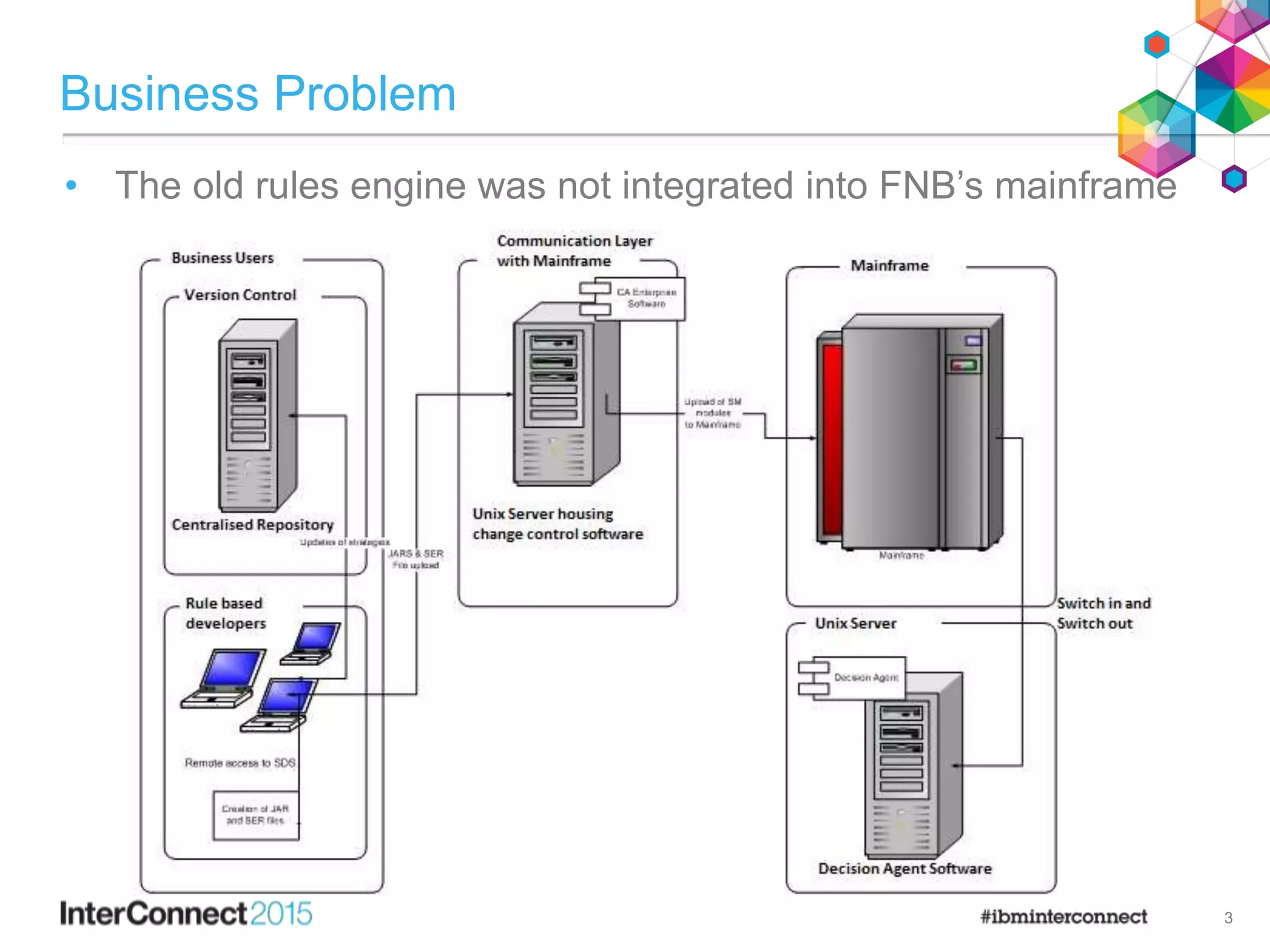
• The old rules engine was not integrated into FNB’s mainframe
Business Problem
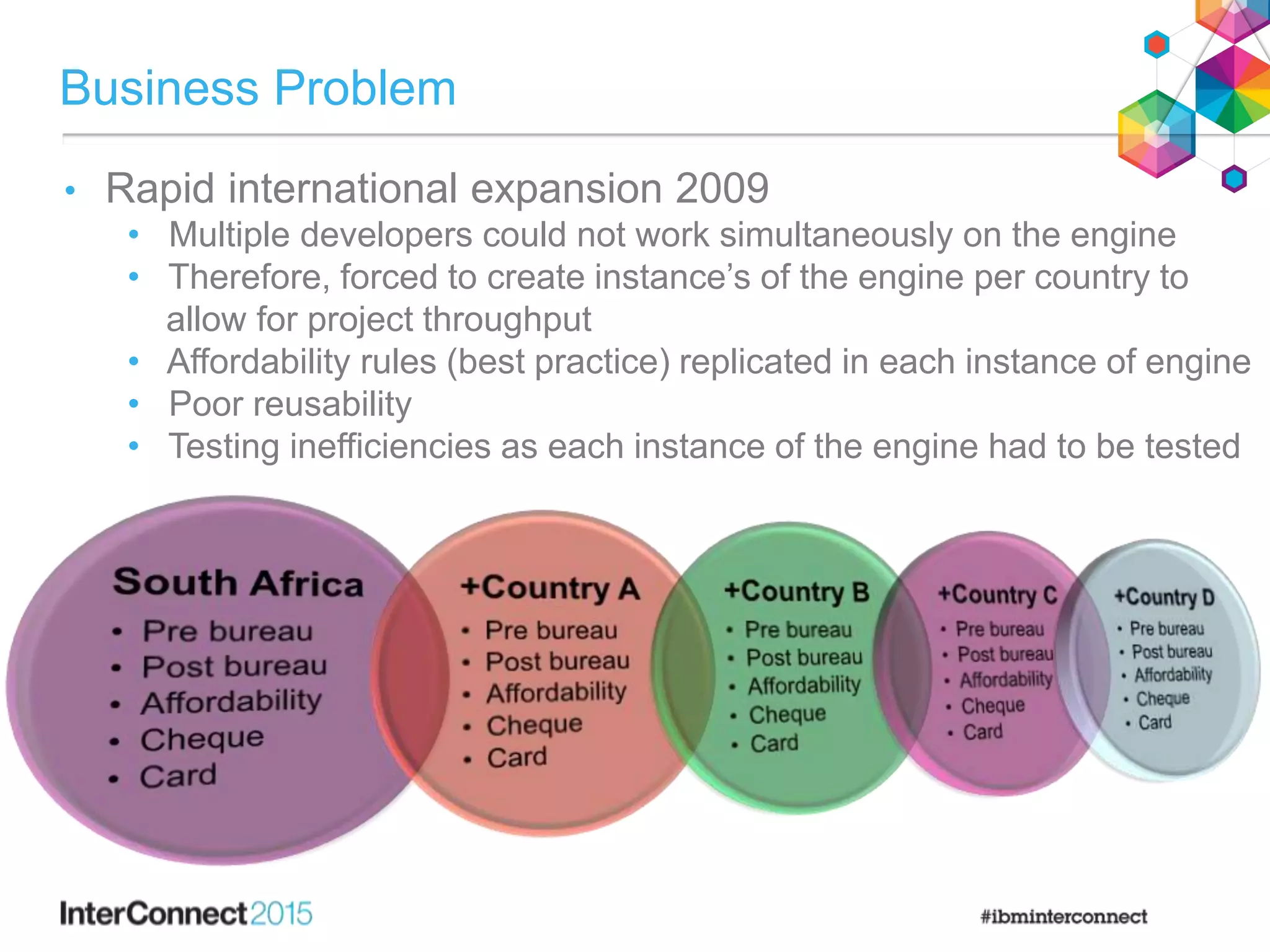
• Rapid international expansion 2009
• Multiple developers could not work simultaneously on the engine
• Therefore, forced to create instance’s of the engine per country to
allow for project throughput
• Affordability rules (best practice) replicated in each instance of engine
• Poor reusability
• Testing inefficiencies as each instance of the engine had to be tested
Business Requirement
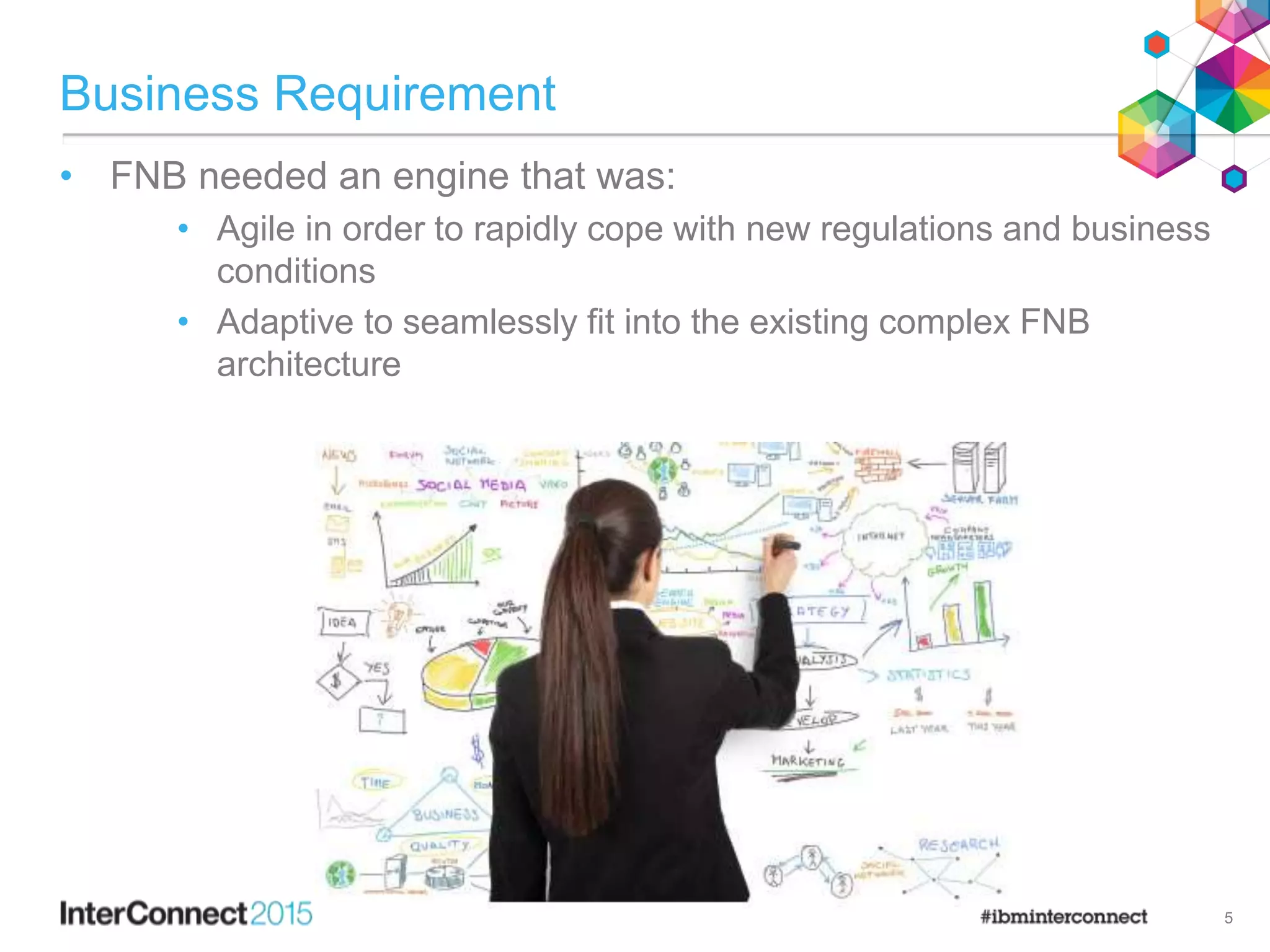
• FNB needed an engine that was:
• Agile in order to rapidly cope with new regulations and business
conditions
• Adaptive to seamlessly fit into the existing complex FNB
architecture
5
Business Requirement
• Reduction in time taken to code, develop and deploy rules
• Ability to deploy rules and parameters from a centralised source
to multiple distributed environments with central control
• Ability to execute rules/decisioning real-time through a single
unit of work
• Decisioning engine integration into FNB Mainframe Cobol
environment
6
Business Requirement
• Shift focus from Business Rules to Decision Management
• Not credit rules specific
• Incorporate fraud (both application and transactional)
• Loyalty program incorporation
• Cater for prototyping, model driven requirements and reverse
engineering of specification
• Manage business decisions in natural language
• Decouple development and business decision change lifecycles
• Single version of the Truth
• Maintainable with a Center of Competency model
• Focus on decisions that need to change often and quickly
7
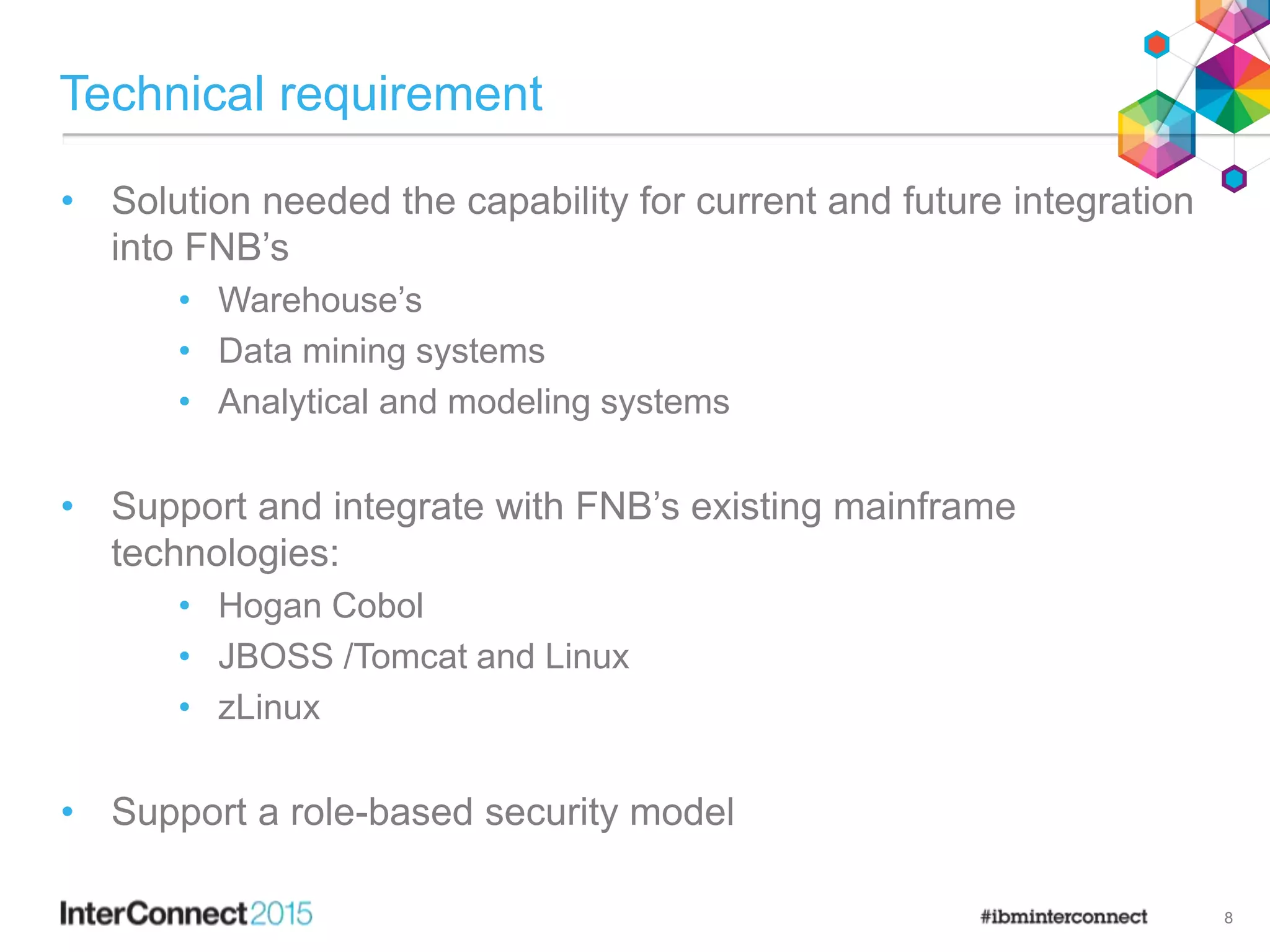
Technical requirement
• Solution needed the capability for current and future integration
into FNB’s
• Warehouse’s
• Data mining systems
• Analytical and modeling systems
• Support and integrate with FNB’s existing mainframe
technologies:
• Hogan Cobol
• JBOSS /Tomcat and Linux
• zLinux
• Support a role-based security model
8
9
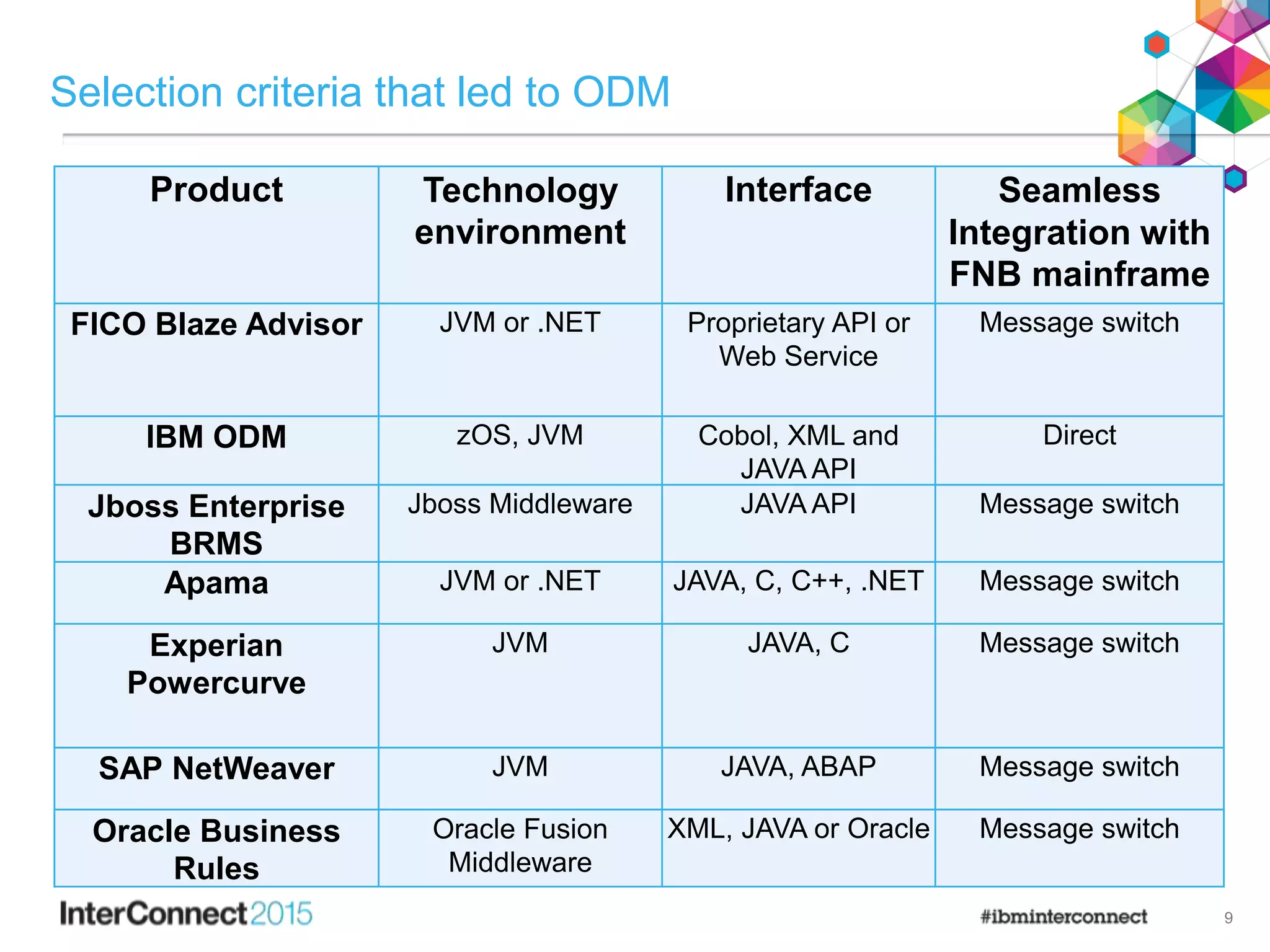
Selection criteria that led to ODM
. Product Technology
environment
Interface Seamless
Integration with
FNB mainframe
FICO Blaze Advisor JVM or .NET Proprietary API or
Web Service
Message switch
IBM ODM zOS, JVM Cobol, XML and
JAVA API
Direct
Jboss Enterprise
BRMS
Jboss Middleware JAVA API Message switch
Apama JVM or .NET JAVA, C, C++, .NET Message switch
Experian
Powercurve
JVM JAVA, C Message switch
SAP NetWeaver JVM JAVA, ABAP Message switch
Oracle Business
Rules
Oracle Fusion
Middleware
XML, JAVA or Oracle Message switch
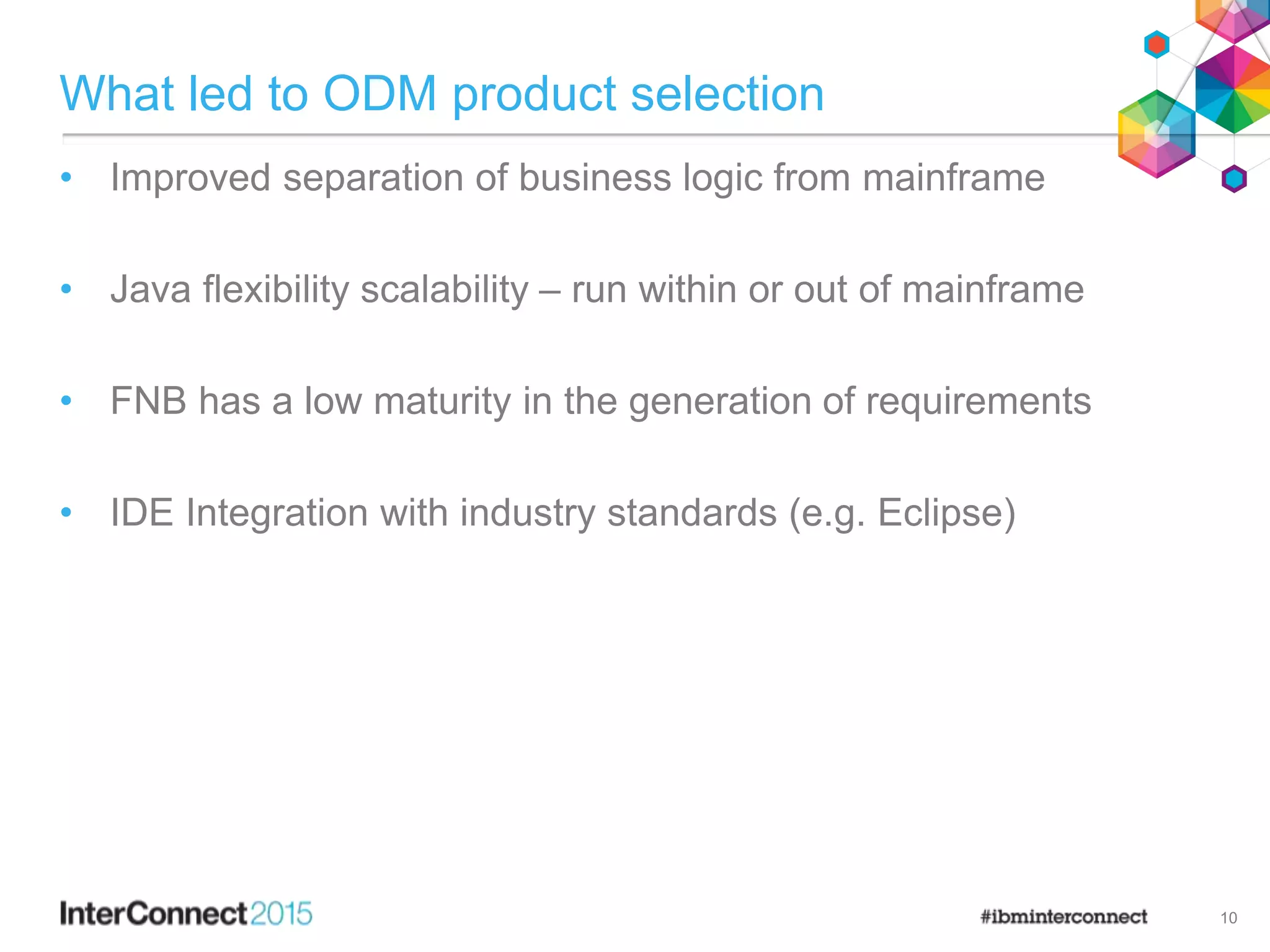
What led to ODM product selection
• Improved separation of business logic from mainframe
• Java flexibility scalability – run within or out of mainframe
• FNB has a low maturity in the generation of requirements
• IDE Integration with industry standards (e.g. Eclipse)
10
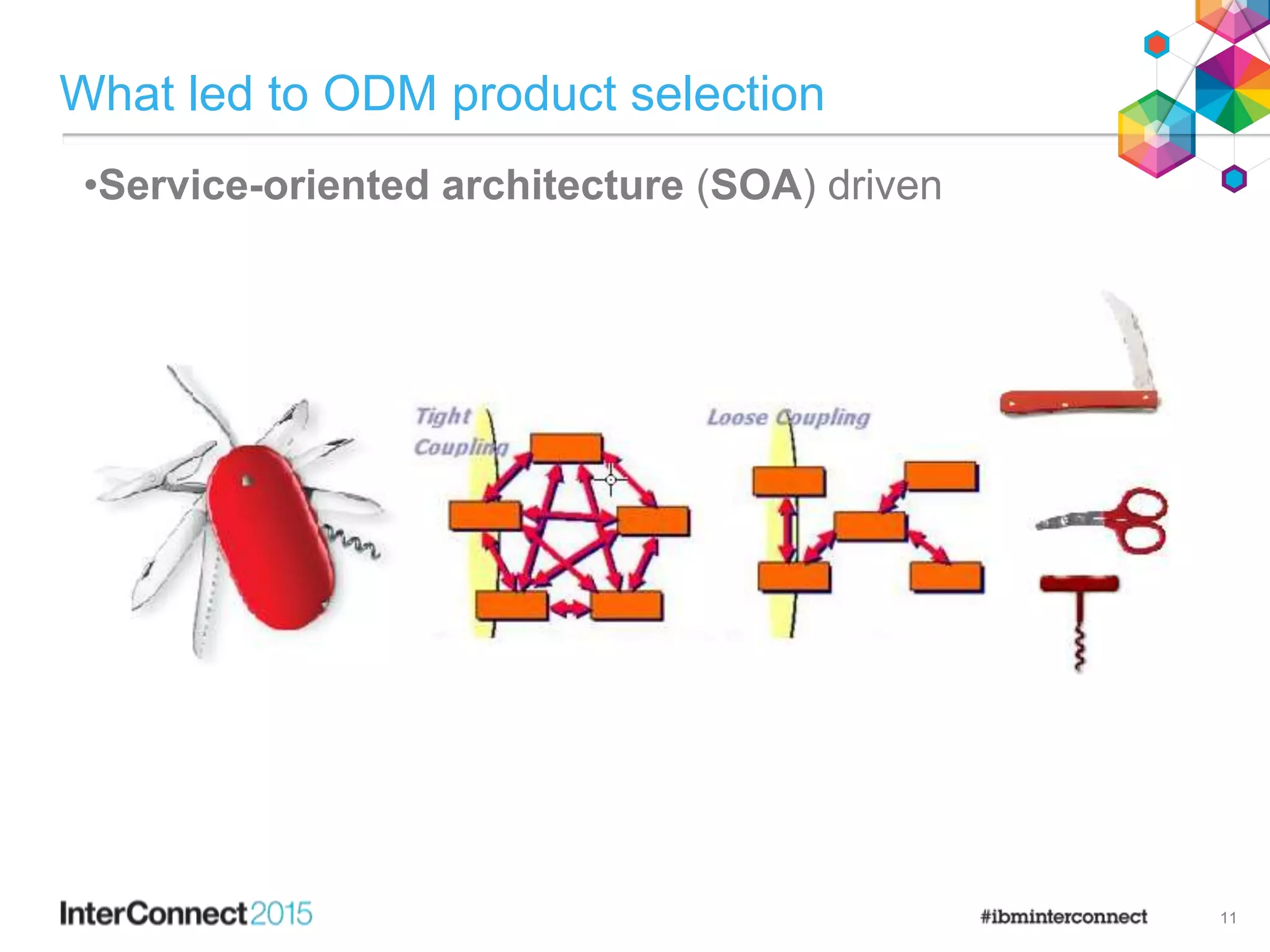
What led to ODM product selection
11
•Service-oriented architecture (SOA) driven
What led to ODM product selection
12
• Old engine had too many nested if then statements
• ODM relies on more atomic rules
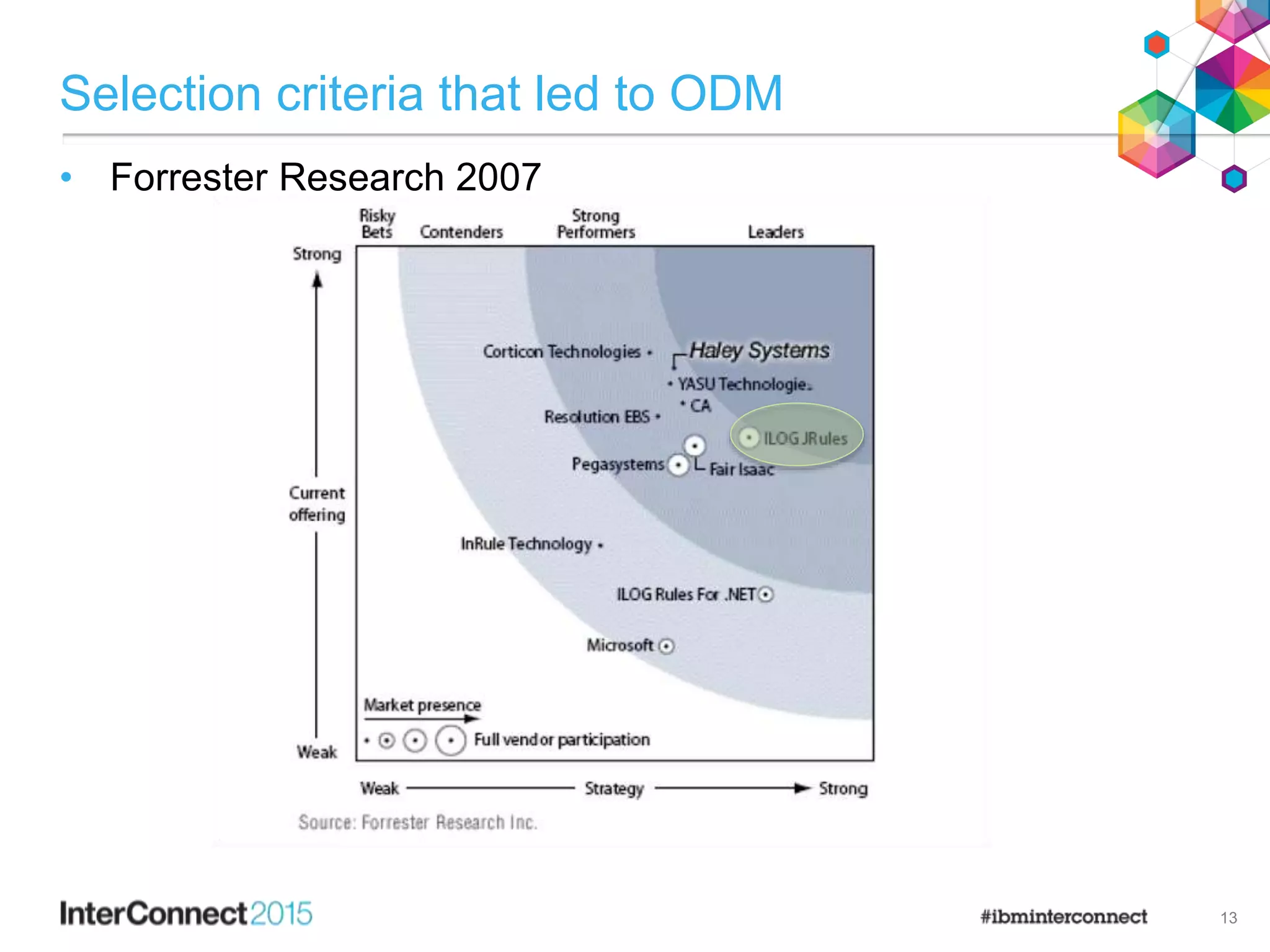
Selection criteria that led to ODM
13
• Forrester Research 2007
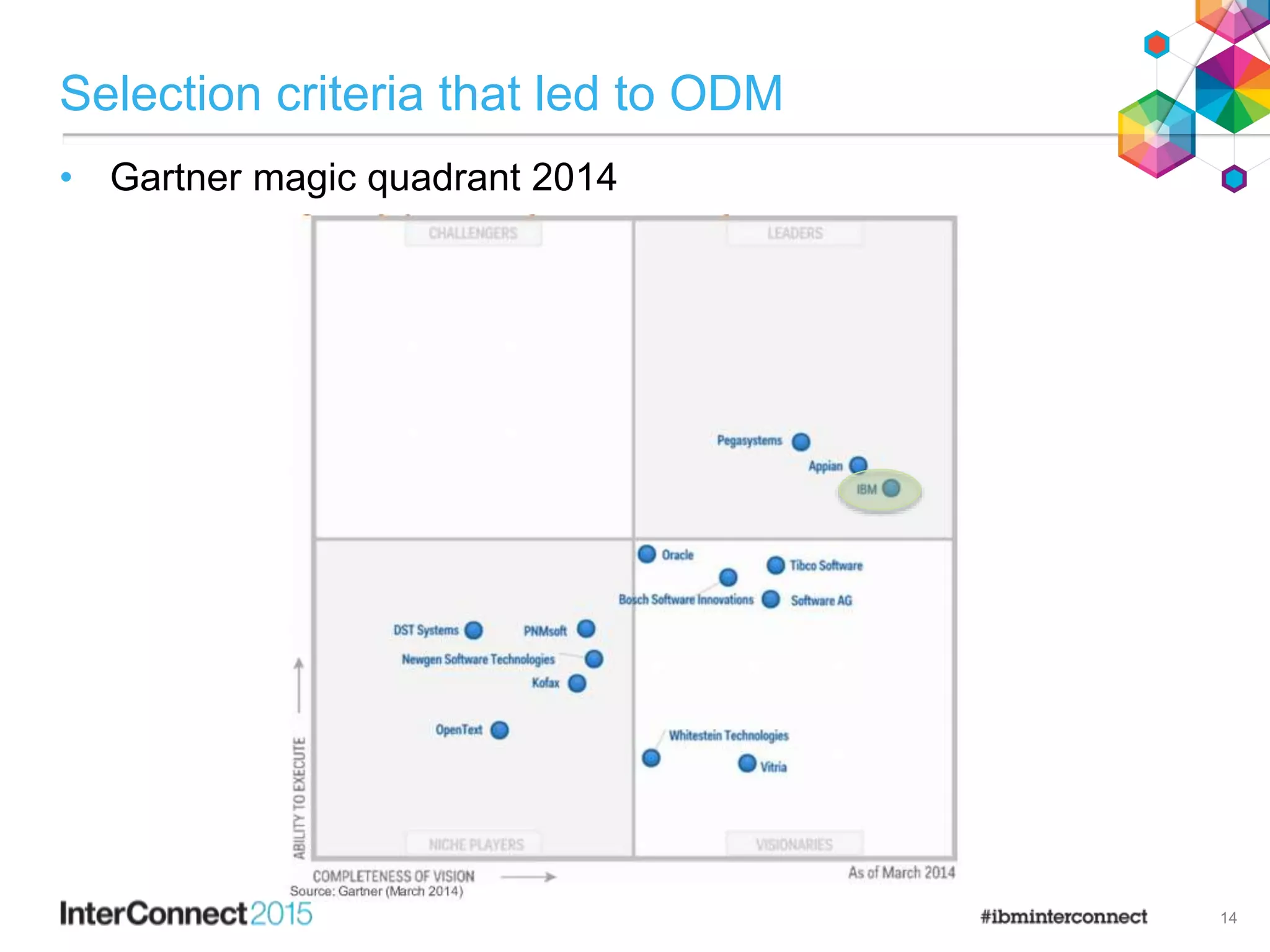
Selection criteria that led to ODM
• Gartner magic quadrant 2014
14
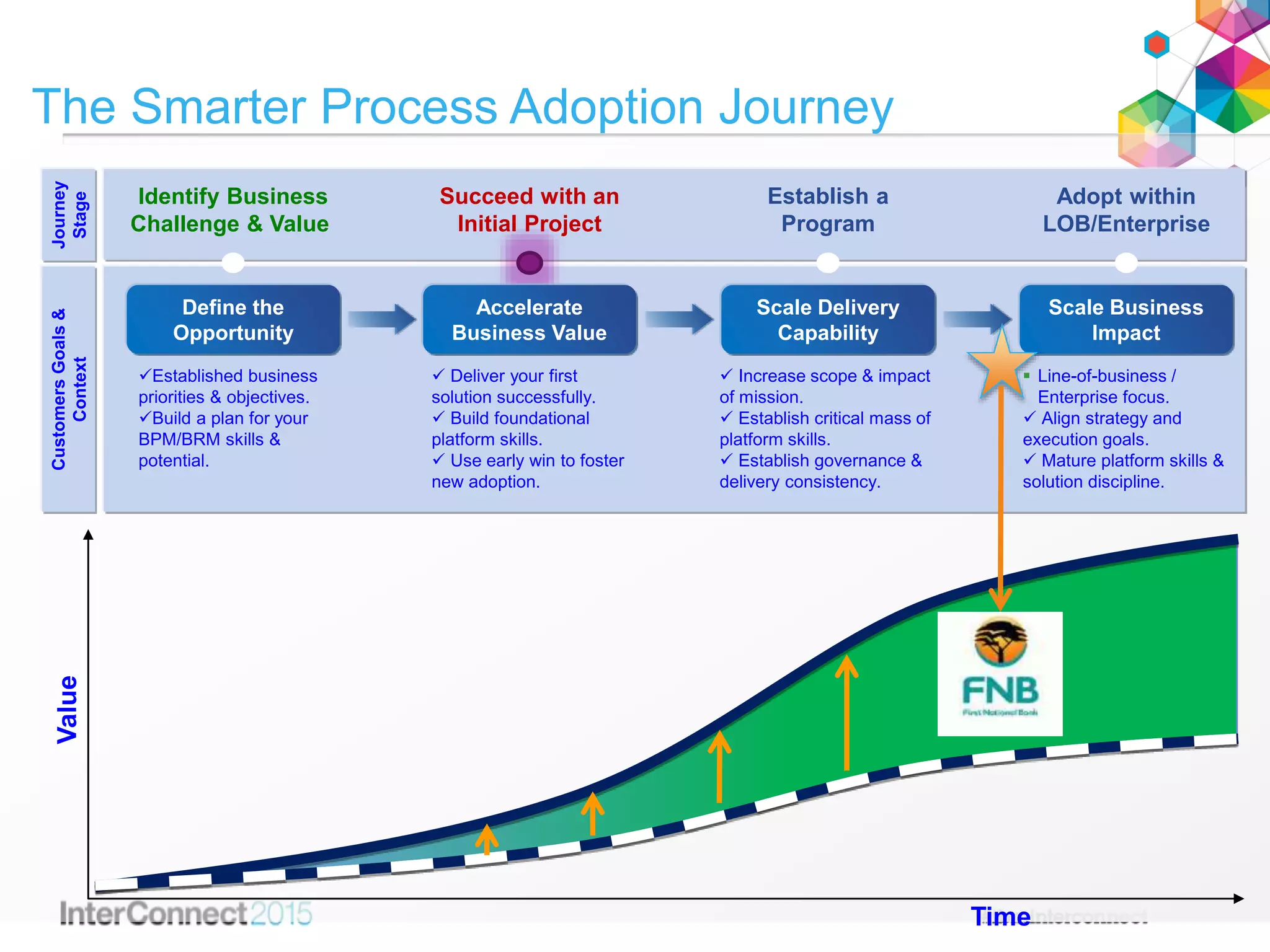
Journey
Stage
CustomersGoals&
Context
Identify Business
Challenge & Value
Established business
priorities & objectives.
Build a plan for your
BPM/BRM skills &
potential.
Define the
Opportunity
Succeed with an
Initial Project
 Deliver your first
solution successfully.
 Build foundational
platform skills.
 Use early win to foster
new adoption.
Accelerate
Business Value
Establish a
Program
 Increase scope & impact
of mission.
 Establish critical mass of
platform skills.
 Establish governance &
delivery consistency.
Scale Delivery
Capability
Adopt within
LOB/Enterprise
 Line-of-business /
Enterprise focus.
 Align strategy and
execution goals.
 Mature platform skills &
solution discipline.
Scale Business
Impact
Value
Time
The Smarter Process Adoption Journey
Technical Milestones
1. Proof integration with mainframe (through COBOL)
2. Deliver value consistently across various technical environments
• Batch / real-time
• Mainframe / distributed
• Same rule services running consistently
3. Address change and complexity by revamping a strategic system
• Not compromising business agility; independent decision services
combined through composite services
• Preserving a manageable governance model; avoiding too many fine
grain services across functions / countries
4. Expand and spread across the company (ongoing)
• Monthly events, ...
• Commercial, First Rand Group, ...
5. Explore additional value gain through related technologies (future)
• Decision Server Insights, ...
16
Dev
Infrastructure setup
17
(eg SVN)
Rule Designer
Rule Designer
Rule Designer
Rule
Execution
Server (RES)
(zRES on z/OS or RES
on distributed)
QA / INT PROD
zRES zRES
Decision Center
ruleapp
archive
Change
Management( through ant scripts)1
2
3
4
5 6
7
Future Plans
18
• Better leverage data through analytics
• Expand the scope of decision management
• Explore new value gains through technology
Thank You
Your Feedback is
Important!
Access the InterConnect 2015
Conference CONNECT Attendee Portal
to complete your session surveys from
your smartphone, laptop or conference
kiosk.

FNB's Decision Management Journey: Transforming IT towards sustainable business agility on system Z

  • 1.
    © 2014 IBMCorporation FNB's Decision Management Journey: Transforming IT towards sustainable business agility on system Z Vincent Baruchello, (IBM) Avsharn Bachoo, First National Bank (FNB) Business Process & Decision Management - Actionable Insights with Rules & Decision Management
  • 2.
    Company overview • Theoldest bank in South Africa formed in 1838 • Listed on the South African Stock Exchange and the Namibian Stock Exchange • One of the largest financial institutions in South Africa providing banking and insurance to retail, commercial, corporate and public sector customers 1
  • 3.
    Business Problem • FNBwas facing increased business pressure due to expansion, regulation and consumer demand • The old rules engine: • was inflexible • could not effectively apply analytics to take advantage of “Big Data” 2
  • 4.
    Business Problem 3 • Theold rules engine was not integrated into FNB’s mainframe
  • 5.
    Business Problem • Rapidinternational expansion 2009 • Multiple developers could not work simultaneously on the engine • Therefore, forced to create instance’s of the engine per country to allow for project throughput • Affordability rules (best practice) replicated in each instance of engine • Poor reusability • Testing inefficiencies as each instance of the engine had to be tested
  • 6.
    Business Requirement • FNBneeded an engine that was: • Agile in order to rapidly cope with new regulations and business conditions • Adaptive to seamlessly fit into the existing complex FNB architecture 5
  • 7.
    Business Requirement • Reductionin time taken to code, develop and deploy rules • Ability to deploy rules and parameters from a centralised source to multiple distributed environments with central control • Ability to execute rules/decisioning real-time through a single unit of work • Decisioning engine integration into FNB Mainframe Cobol environment 6
  • 8.
    Business Requirement • Shiftfocus from Business Rules to Decision Management • Not credit rules specific • Incorporate fraud (both application and transactional) • Loyalty program incorporation • Cater for prototyping, model driven requirements and reverse engineering of specification • Manage business decisions in natural language • Decouple development and business decision change lifecycles • Single version of the Truth • Maintainable with a Center of Competency model • Focus on decisions that need to change often and quickly 7
  • 9.
    Technical requirement • Solutionneeded the capability for current and future integration into FNB’s • Warehouse’s • Data mining systems • Analytical and modeling systems • Support and integrate with FNB’s existing mainframe technologies: • Hogan Cobol • JBOSS /Tomcat and Linux • zLinux • Support a role-based security model 8
  • 10.
    9 Selection criteria thatled to ODM . Product Technology environment Interface Seamless Integration with FNB mainframe FICO Blaze Advisor JVM or .NET Proprietary API or Web Service Message switch IBM ODM zOS, JVM Cobol, XML and JAVA API Direct Jboss Enterprise BRMS Jboss Middleware JAVA API Message switch Apama JVM or .NET JAVA, C, C++, .NET Message switch Experian Powercurve JVM JAVA, C Message switch SAP NetWeaver JVM JAVA, ABAP Message switch Oracle Business Rules Oracle Fusion Middleware XML, JAVA or Oracle Message switch
  • 11.
    What led toODM product selection • Improved separation of business logic from mainframe • Java flexibility scalability – run within or out of mainframe • FNB has a low maturity in the generation of requirements • IDE Integration with industry standards (e.g. Eclipse) 10
  • 12.
    What led toODM product selection 11 •Service-oriented architecture (SOA) driven
  • 13.
    What led toODM product selection 12 • Old engine had too many nested if then statements • ODM relies on more atomic rules
  • 14.
    Selection criteria thatled to ODM 13 • Forrester Research 2007
  • 15.
    Selection criteria thatled to ODM • Gartner magic quadrant 2014 14
  • 16.
    Journey Stage CustomersGoals& Context Identify Business Challenge &Value Established business priorities & objectives. Build a plan for your BPM/BRM skills & potential. Define the Opportunity Succeed with an Initial Project  Deliver your first solution successfully.  Build foundational platform skills.  Use early win to foster new adoption. Accelerate Business Value Establish a Program  Increase scope & impact of mission.  Establish critical mass of platform skills.  Establish governance & delivery consistency. Scale Delivery Capability Adopt within LOB/Enterprise  Line-of-business / Enterprise focus.  Align strategy and execution goals.  Mature platform skills & solution discipline. Scale Business Impact Value Time The Smarter Process Adoption Journey
  • 17.
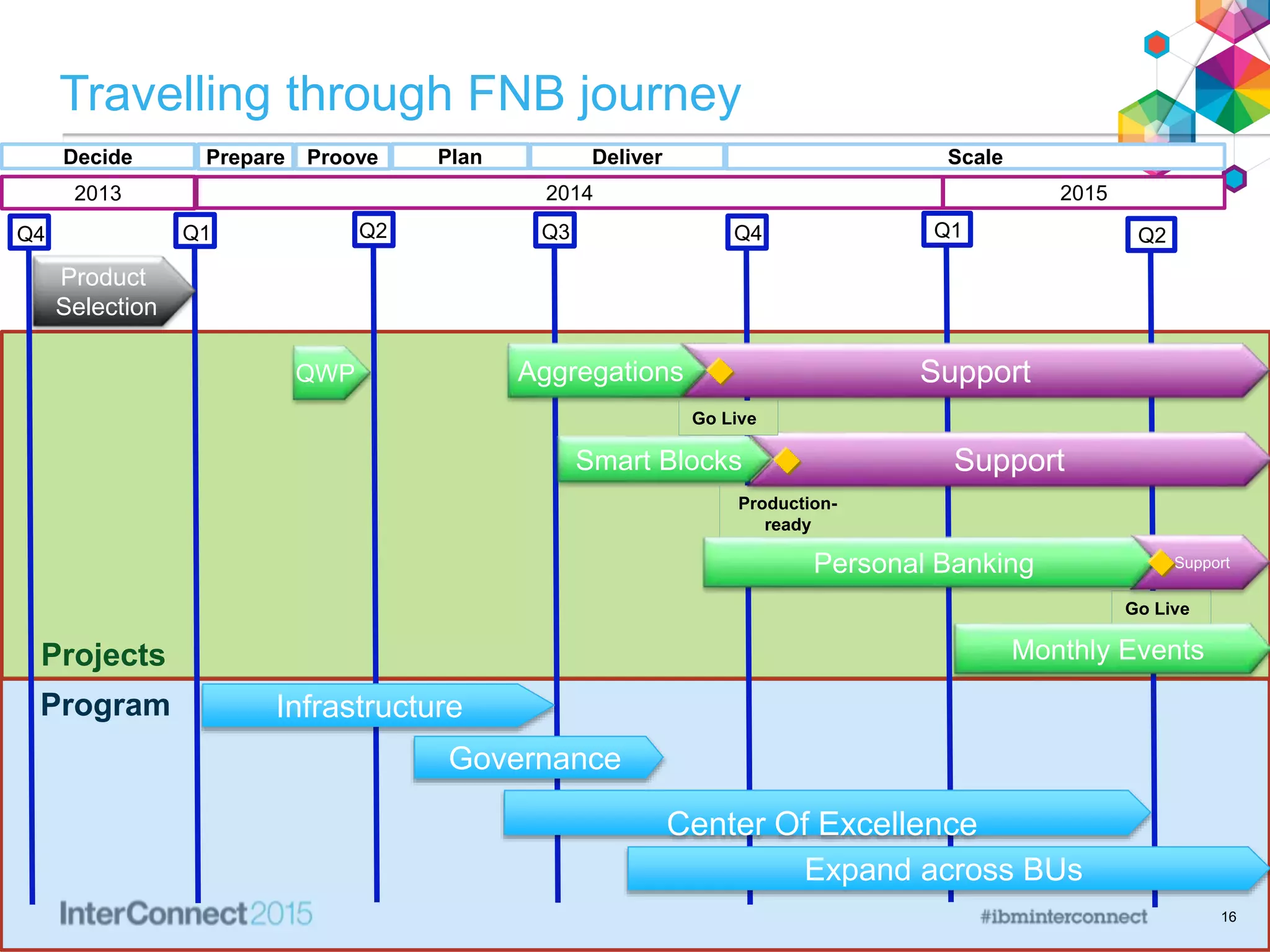
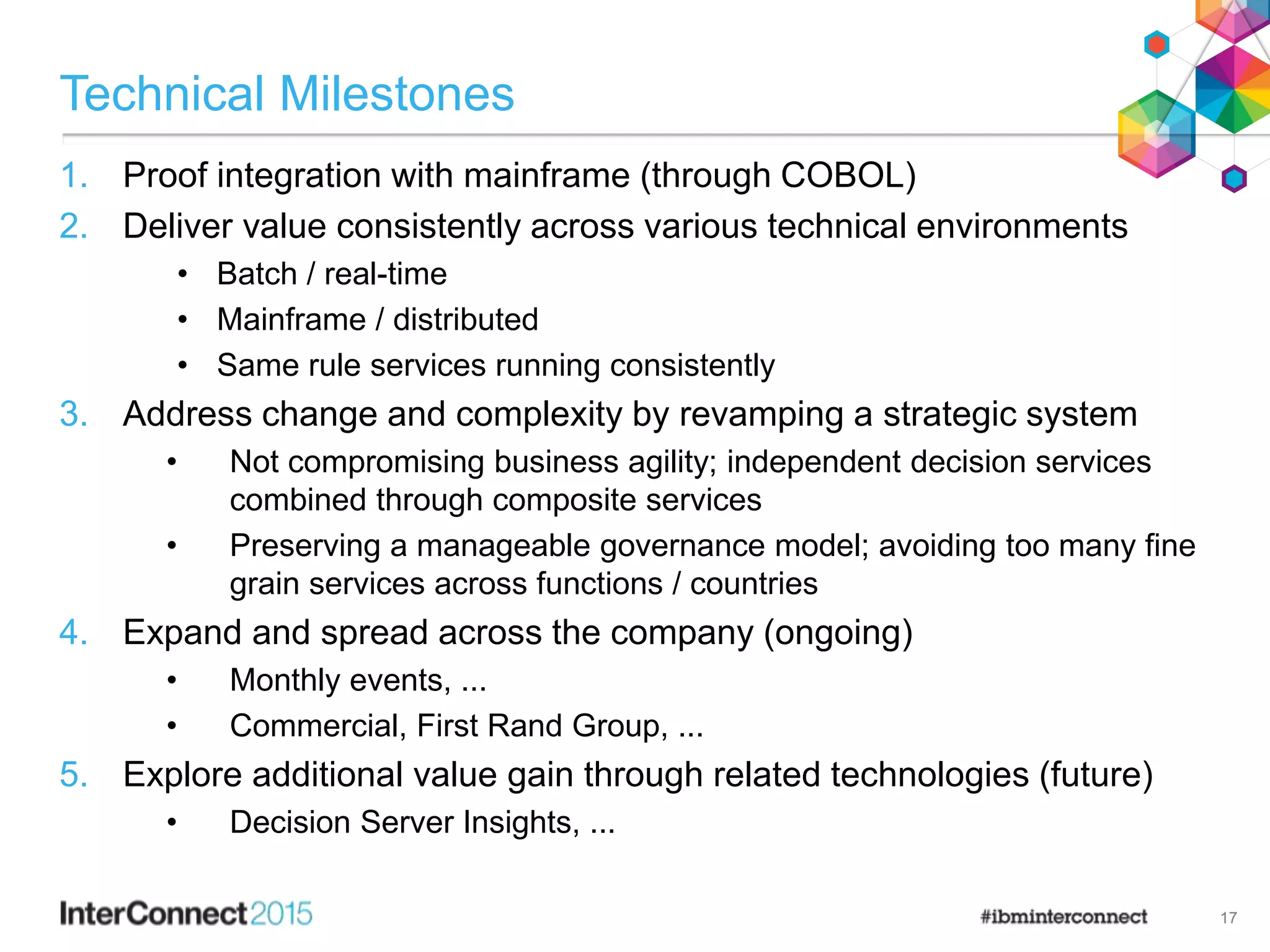
    Technical Milestones 1. Proofintegration with mainframe (through COBOL) 2. Deliver value consistently across various technical environments • Batch / real-time • Mainframe / distributed • Same rule services running consistently 3. Address change and complexity by revamping a strategic system • Not compromising business agility; independent decision services combined through composite services • Preserving a manageable governance model; avoiding too many fine grain services across functions / countries 4. Expand and spread across the company (ongoing) • Monthly events, ... • Commercial, First Rand Group, ... 5. Explore additional value gain through related technologies (future) • Decision Server Insights, ... 16
  • 18.
    Dev Infrastructure setup 17 (eg SVN) RuleDesigner Rule Designer Rule Designer Rule Execution Server (RES) (zRES on z/OS or RES on distributed) QA / INT PROD zRES zRES Decision Center ruleapp archive Change Management( through ant scripts)1 2 3 4 5 6 7
  • 19.
    Future Plans 18 • Betterleverage data through analytics • Expand the scope of decision management • Explore new value gains through technology
  • 20.
    Thank You Your Feedbackis Important! Access the InterConnect 2015 Conference CONNECT Attendee Portal to complete your session surveys from your smartphone, laptop or conference kiosk.