INTELLECTUAL PROPERTY


                                  October 24, 2009


                          Christopher A. Rothe
                           RatnerPrestia, PC
Information contained in this slide show, and any statements made by the presenter during
presentation of this slide show, are provided solely for educational purposes for the NCIIA Invention
to Venture Workshop, and do not constitute legal advice. Individuals seeking legal advice about
intellectual property should consult with competent legal counsel and explain their specific
circumstances. Laws are subject to change. © 2009 RatnerPrestia

                                                                                                        1
What is Intellectual Property?

    Intellectual Property =
    “creations of the mind: inventions, literary
    and artistic works, and symbols, names,
    images, and designs used in commerce.”
     - WIPO

  •  But what makes it property?


                                                   2
Legal Categories of IP in US:

  Copyrights
  Trademarks
  Trade Secrets
  Patents


                                3
Copyrights

  Protect works that are:
  Original;
  Creative; and
  Fixed in a tangible medium of expression


  Purpose: protects the expression of an
 idea, not the idea itself
  Examples:     Paintings, photographs,
                sound recordings, source code


                                                4
Copyrights
  What you get:
  Exclusive rights to (and authorize others to)
  –  Reproduce the work
  –  Prepare a derivative work
  –  Distribute copies
  –  Publicly perform or display the work

  Fair use exception


                                                  5
Copyrights

Copyright term (first published in US):

 70 years after the death of author.


                                          6
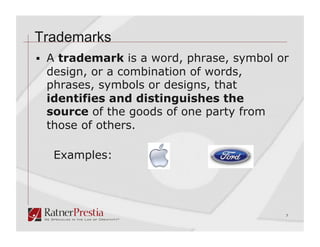
Trademarks
  A trademark is a word, phrase, symbol or
 design, or a combination of words,
 phrases, symbols or designs, that
 identifies and distinguishes the
 source of the goods of one party from
 those of others.

   Examples:


                                          7
Trademarks
  A service mark is the same as a
 trademark, except that it identifies and
 distinguishes the source of a service
 rather than a product.

 Examples:


                                            8
Trademarks
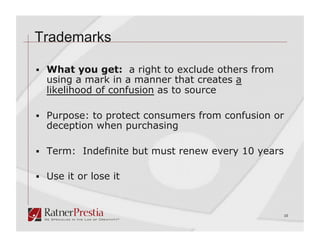
  Trade dress is any other feature seen in
 the presentation of a product or service
  – Product configuration
  – Product packaging


                                              9
Trademarks

  What you get: a right to exclude others from
  using a mark in a manner that creates a
  likelihood of confusion as to source

  Purpose: to protect consumers from confusion or
  deception when purchasing

  Term: Indefinite but must renew every 10 years


  Use it or lose it


                                                    10
Patents

  A “deal” with the government:

  –  A patent grants an inventor the right to
     exclude others from making, using, offering for
     sale, or selling the invention in the U.S. or
     importing the invention into the U.S. - for a
     limited patent term

  –  In exchange, the government publishes your
     invention & public gets to see it

                                                   11
Types of U.S. Patents
Utility patents
  Protect processes, machines, articles of
   manufacture, compositions of matter, etc.
  Term: 20 years from date of filing
Design patents
  Protect new, original, and ornamental designs for
   articles of manufacture
  Term:14 years from date of filing
Plant patents
  Protect distinct and new varieties of asexually-
   reproduced plants
  Term: 20 years from date of filing


                                                       12
Requirements for Utility Patent

Must be:

  Novel over prior art
  “Non-obvious” over prior art
  Useful


                                  13
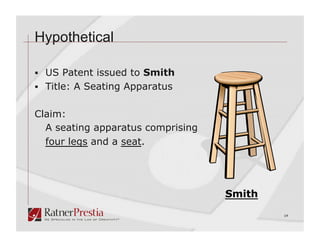
Hypothetical

  US Patent issued to Smith
  Title: A Seating Apparatus


Claim:
  A seating apparatus comprising
  four legs and a seat.


                                   Smith
                                           14
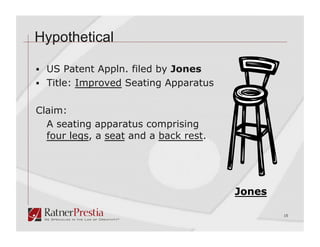
Hypothetical

  US Patent Appln. filed by Jones
  Title: Improved Seating Apparatus


Claim:
  A seating apparatus comprising
  four legs, a seat and a back rest.


                                       Jones

                                               15
Hypothetical

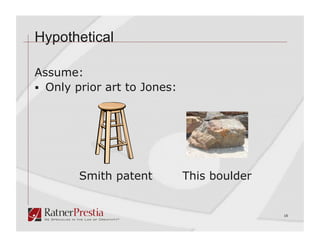
Assume:
  Only prior art to Jones:


        Smith patent          This boulder


                                             16
Hypothetical

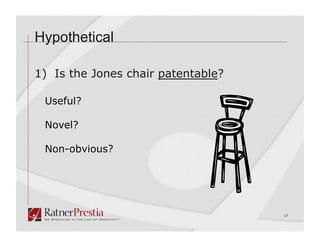
1) Is the Jones chair patentable?

 Useful?

 Novel?

 Non-obvious?


                                    17
Hypothetical
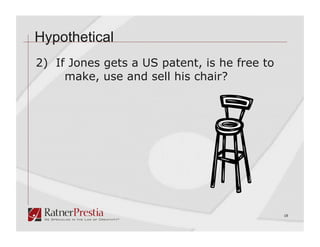
2) If Jones gets a US patent, is he free to
     make, use and sell his chair?


                                              18
Hypothetical
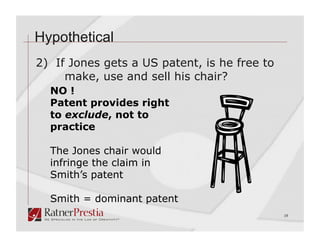
2) If Jones gets a US patent, is he free to
     make, use and sell his chair?
  NO !
  Patent provides right
  to exclude, not to
  practice

  The Jones chair would
  infringe the claim in
  Smith’s patent

  Smith = dominant patent
                                              19
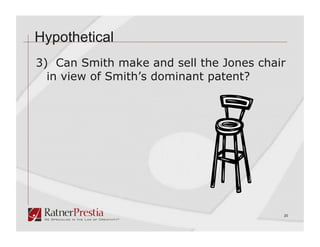
Hypothetical
3) Can Smith make and sell the Jones chair
  in view of Smith’s dominant patent?


                                         20
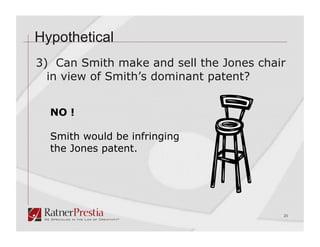
Hypothetical
3) Can Smith make and sell the Jones chair
  in view of Smith’s dominant patent?


  NO !

  Smith would be infringing
  the Jones patent.


                                         21
Patent Novelty & Time Bars

  One year grace period in U.S. to file
 patent application after commercial
 disclosure:
     •  Sale or Offer for sale
     •  Public use (“experimental use” exception)

  After that, you are barred from obtaining a
 patent in the U.S.

  Most other countries: no grace period

                                                    22
Territorial Protection

  U.S. patents - enforceable only in U.S.
  Filing options outside U.S.:

  –  File in individuals countries; OR

  –  Patent Cooperation Treaty (PCT)

     •  one procedure allowing party to apply for
        patents in multiple countries that are members
        of the PCT

                                                         23
Trade Secrets

  Trade Secret - information, including a formula,
  pattern, compilation, program, device, method,
  technique, or process that:
   –  provides value because it is not known to others who
      could benefit from it; AND
   –  safeguarded by the owner in a way that can reasonably
      be expected to prevent others from learning about it


  No term limit, so long as the info remains
  “secret”


                                                              24
Patents vs. Trade Secrets

  Conditions favoring patents:
   –  the technology is easily discoverable or reverse
      engineered
   –  licensing revenues
  Conditions favoring trade secrets:
   –  Life cycle is short (e.g. technology is obsolete
      in <3 years)
   –  Proving infringement would be difficult
   –  Technology can be easily “designed around”
      once it is known

                                                         25
What to Do If You Have “Something”


1. Articulate your invention
   –    New Apparatus / System?
   –    New Process / Method?
   –    All of the above?
   –    What exactly is novel?
   –    Explain the invention in one sentence.


                                                 26
What to Do If You Have “Something”


2. Is a patent a good idea?
   –    Would a trade secret be better?
   –    Who would infringe the patent?
   –    How would you know about infringement?
   –    Is the prior art “crowded”?
        •  USPTO search


                                                 27
What to Do If You Have “Something”


3. Get the record straight
   –  Keep dated information, preferably in a
      permanently bound notebook
   –  Document all contributors, and what they
      contributed
   –  If you disclosed it, record disclosure date
   –  Complete an “invention disclosure form”

                                                    28
What to Do If You Have “Something”


4. Control your Disclosure
   –  Try to get an NDA
   –  Limit disclosure to general summaries


                                              29
What to Do If You Have “Something”


 5. File a patent application before you
    disclose the invention

    Option: “provisional application”


                                           30
Provisional Applications
  Purpose: Gets you a U.S. filing date (f/d)


  Does not get you a patent


  Must file a “full-blown” patent application to
  obtain a patent

  Full blown application can claim the provisional’s
  f/d if it is filed within 1 year of the provisional
    “full-blown” = U.S. non-provisional or PCT


                                                        31
Provisional Applications
Benefits:
  inexpensive
  buys 1 year of time after f/d to determine
   commercial interest & refine invention
  “patent pending” status
But note:
  Must be detailed and descriptive


                                                32
For More Information…

  For general IP questions: www.uspto.gov


                                             33
QUESTIONS ?


              34

Invention 2 Venture: Chris Rothe

  • 1.
    INTELLECTUAL PROPERTY October 24, 2009 Christopher A. Rothe RatnerPrestia, PC Information contained in this slide show, and any statements made by the presenter during presentation of this slide show, are provided solely for educational purposes for the NCIIA Invention to Venture Workshop, and do not constitute legal advice. Individuals seeking legal advice about intellectual property should consult with competent legal counsel and explain their specific circumstances. Laws are subject to change. © 2009 RatnerPrestia 1
  • 2.
    What is IntellectualProperty? Intellectual Property = “creations of the mind: inventions, literary and artistic works, and symbols, names, images, and designs used in commerce.” - WIPO •  But what makes it property? 2
  • 3.
    Legal Categories ofIP in US:   Copyrights   Trademarks   Trade Secrets   Patents 3
  • 4.
    Copyrights   Protect worksthat are: Original; Creative; and Fixed in a tangible medium of expression   Purpose: protects the expression of an idea, not the idea itself Examples: Paintings, photographs, sound recordings, source code 4
  • 5.
    Copyrights   What youget: Exclusive rights to (and authorize others to) –  Reproduce the work –  Prepare a derivative work –  Distribute copies –  Publicly perform or display the work   Fair use exception 5
  • 6.
    Copyrights Copyright term (firstpublished in US): 70 years after the death of author. 6
  • 7.
    Trademarks   A trademarkis a word, phrase, symbol or design, or a combination of words, phrases, symbols or designs, that identifies and distinguishes the source of the goods of one party from those of others. Examples: 7
  • 8.
    Trademarks   A servicemark is the same as a trademark, except that it identifies and distinguishes the source of a service rather than a product. Examples: 8
  • 9.
    Trademarks   Trade dressis any other feature seen in the presentation of a product or service – Product configuration – Product packaging 9
  • 10.
    Trademarks   What youget: a right to exclude others from using a mark in a manner that creates a likelihood of confusion as to source   Purpose: to protect consumers from confusion or deception when purchasing   Term: Indefinite but must renew every 10 years   Use it or lose it 10
  • 11.
    Patents   A “deal”with the government: –  A patent grants an inventor the right to exclude others from making, using, offering for sale, or selling the invention in the U.S. or importing the invention into the U.S. - for a limited patent term –  In exchange, the government publishes your invention & public gets to see it 11
  • 12.
    Types of U.S.Patents Utility patents   Protect processes, machines, articles of manufacture, compositions of matter, etc.   Term: 20 years from date of filing Design patents   Protect new, original, and ornamental designs for articles of manufacture   Term:14 years from date of filing Plant patents   Protect distinct and new varieties of asexually- reproduced plants   Term: 20 years from date of filing 12
  • 13.
    Requirements for UtilityPatent Must be:   Novel over prior art   “Non-obvious” over prior art   Useful 13
  • 14.
    Hypothetical   US Patentissued to Smith   Title: A Seating Apparatus Claim: A seating apparatus comprising four legs and a seat. Smith 14
  • 15.
    Hypothetical   US PatentAppln. filed by Jones   Title: Improved Seating Apparatus Claim: A seating apparatus comprising four legs, a seat and a back rest. Jones 15
  • 16.
    Hypothetical Assume:   Only priorart to Jones: Smith patent This boulder 16
  • 17.
    Hypothetical 1) Is theJones chair patentable? Useful? Novel? Non-obvious? 17
  • 18.
    Hypothetical 2) If Jonesgets a US patent, is he free to make, use and sell his chair? 18
  • 19.
    Hypothetical 2) If Jonesgets a US patent, is he free to make, use and sell his chair? NO ! Patent provides right to exclude, not to practice The Jones chair would infringe the claim in Smith’s patent Smith = dominant patent 19
  • 20.
    Hypothetical 3) Can Smithmake and sell the Jones chair in view of Smith’s dominant patent? 20
  • 21.
    Hypothetical 3) Can Smithmake and sell the Jones chair in view of Smith’s dominant patent? NO ! Smith would be infringing the Jones patent. 21
  • 22.
    Patent Novelty &Time Bars   One year grace period in U.S. to file patent application after commercial disclosure: •  Sale or Offer for sale •  Public use (“experimental use” exception)   After that, you are barred from obtaining a patent in the U.S.   Most other countries: no grace period 22
  • 23.
    Territorial Protection   U.S.patents - enforceable only in U.S.   Filing options outside U.S.: –  File in individuals countries; OR –  Patent Cooperation Treaty (PCT) •  one procedure allowing party to apply for patents in multiple countries that are members of the PCT 23
  • 24.
    Trade Secrets   TradeSecret - information, including a formula, pattern, compilation, program, device, method, technique, or process that: –  provides value because it is not known to others who could benefit from it; AND –  safeguarded by the owner in a way that can reasonably be expected to prevent others from learning about it   No term limit, so long as the info remains “secret” 24
  • 25.
    Patents vs. TradeSecrets   Conditions favoring patents: –  the technology is easily discoverable or reverse engineered –  licensing revenues   Conditions favoring trade secrets: –  Life cycle is short (e.g. technology is obsolete in <3 years) –  Proving infringement would be difficult –  Technology can be easily “designed around” once it is known 25
  • 26.
    What to DoIf You Have “Something” 1. Articulate your invention –  New Apparatus / System? –  New Process / Method? –  All of the above? –  What exactly is novel? –  Explain the invention in one sentence. 26
  • 27.
    What to DoIf You Have “Something” 2. Is a patent a good idea? –  Would a trade secret be better? –  Who would infringe the patent? –  How would you know about infringement? –  Is the prior art “crowded”? •  USPTO search 27
  • 28.
    What to DoIf You Have “Something” 3. Get the record straight –  Keep dated information, preferably in a permanently bound notebook –  Document all contributors, and what they contributed –  If you disclosed it, record disclosure date –  Complete an “invention disclosure form” 28
  • 29.
    What to DoIf You Have “Something” 4. Control your Disclosure –  Try to get an NDA –  Limit disclosure to general summaries 29
  • 30.
    What to DoIf You Have “Something” 5. File a patent application before you disclose the invention Option: “provisional application” 30
  • 31.
    Provisional Applications   Purpose:Gets you a U.S. filing date (f/d)   Does not get you a patent   Must file a “full-blown” patent application to obtain a patent   Full blown application can claim the provisional’s f/d if it is filed within 1 year of the provisional “full-blown” = U.S. non-provisional or PCT 31
  • 32.
    Provisional Applications Benefits:   inexpensive  buys 1 year of time after f/d to determine commercial interest & refine invention   “patent pending” status But note:   Must be detailed and descriptive 32
  • 33.
    For More Information…  For general IP questions: www.uspto.gov 33
  • 34.