IP 101
BASIC INTELLECTUAL PROPERTY LESSONS FOR BEGINNERS
Benita O. Ezeigbo
Email: ezeigbobenita@gmail.com
CONTENT
What is Intellectual Property
Brief History of IP
Nature of IP
Areas of IP
General rights of an IP owner
Is the concept of Intellectual property
illegitimate?
Introduction:
• The concept of IP may sound vague and unrealistic to some individuals but like it or
not, as long as technology advances and digitization increases, IP and its protection
comes closer and closer to you! What do you loose by knowing just a bit of it?
• IP is established on the fact that every day, somewhere and in sometime, the human
mind goes on thinking and conceiving ideas that could better the peaceful sustenance
of humanity.
• It cuts across several fields that you may not even think and for sure, it will only get
broader. Before now, people can just come on stage and perform, get standing
ovations and they are fine, but no! they want more today because Performers rights
are real and are covered under IP too.
• These creations can be from the mind of a legal or natural person.
What is Intellectual Property?
• When you buy a house in your name, and all the papers to
that house is given to you and of course, the key too, you
are the owner and can choose to do whatever you want
with it. A property is owned.
• Intellectual property is an ownership born from your
mind’s creations. You thought it out, you put it to work
and you make others able to access it, it becomes your
intellectual property.
• Its not yours when you just think it, just like I can wish I
own a house but do nothing to make it mine. It’s yours
when you make it tangible and real, when you give it a
form!
What IP is not
• It is not a mere story that you conceive even if its
shared orally to another.
• It is not a scientific formula you arrive at and leave it
there.
• It is not innovation that is not expressed.
• It is not the exact replica of another person’s
expressed work.
• It is not a song you sing to yourself every morning
when you wake up.
• It is not an intangible machine built up in your head.
• If ideas and thoughts are protected, ut will hamper
the very freedom of individuals to think and express.
• For Intellectual property to confer rights on you, It
must be material, a product of those ideas conceived in
real concrete form. It is the result of your ideas that IP
identifies with!
“
”
IP confers rights on its owners to
maximize their creations to its
fullest, and for the most cases, a
limited period of time
STICKY NOTE!
BRIEF HISTORY OF IP.
The rationale behind protecting IP has never always been
economic in nature. It sought to protect the personhood of
an individual to be rewarded for efforts put in and to
universally encourage development.
The History of IP can be narrowed to three main stages:
• a. The medieval period
• b. The International advancement period
• c. The modern global period
Lets see the key factors in each of this periods…
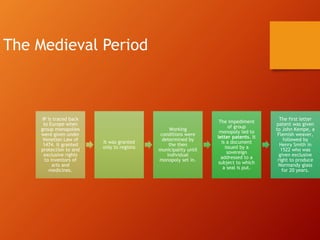
The Medieval Period
IP is traced back
to Europe when
group monopolies
were given under
Venetian Law of
1474. It granted
protection to and
exclusive rights
to inventors of
arts and
medicines.
It was granted
only to regions
Working
conditions were
determined by
the then
municipality until
individual
monopoly set in.
The impediment
of group
monopoly led to
letter patents. It
is a document
issued by a
sovereign
addressed to a
subject to which
a seal is put.
The first letter
patent was given
to John Kempe, a
Flemish weaver,
followed by
Henry Smith in
1522 who was
given exclusive
right to produce
Normandy glass
for 20 years.
Medieval Period Continued…
1
Queen Elizabeth
began to issue
letter patents to
anybody she liked
and even though
she said it was to
attract foreign
investors to
Europe, she
granted it to
almost everything.
2
This led to
people’s right to
food, healthy living
becoming infringed
and hence, the
The statute of
Monopoly
emerged. It
became the
landmark for
British Patent law.
3
The statute
eradicated all
monopolies except
the ones granted
to true and first
inventor or a
unique method of
manufacture.
4
Other countries
began the journey
too like India, the
Act VI of 1856, Act
of 1857 and 1859.
Protection was for
6 months to 12
months.
5
The medieval laws
were simple, direct
and clear but was
majorly limited by
territory. Also,
only few countries
enjoyed these
inventons and this
paved way to the
second era.
The International Advancement
Period
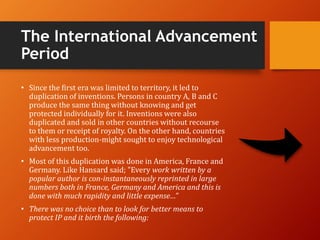
• Since the first era was limited to territory, it led to
duplication of inventions. Persons in country A, B and C
produce the same thing without knowing and get
protected individually for it. Inventions were also
duplicated and sold in other countries without recourse
to them or receipt of royalty. On the other hand, countries
with less production-might sought to enjoy technological
advancement too.
• Most of this duplication was done in America, France and
Germany. Like Hansard said; "Every work written by a
popular author is con-instantaneously reprinted in large
numbers both in France, Germany and America and this is
done with much rapidity and little expense…”
• There was no choice than to look for better means to
protect IP and it birth the following:
International Era continued…
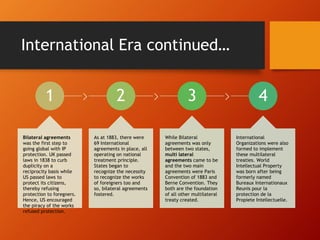
1
Bilateral agreements
was the first step to
going global with IP
protection. UK passed
laws in 1838 to curb
duplicity on a
reciprocity basis while
US passed laws to
protect its citizens,
thereby refusing
protection to foregners.
Hence, US encouraged
the piracy of the works
refused protection.
2
As at 1883, there were
69 International
agreements in place, all
operating on national
treatment principle.
States began to
recognize the necessity
to recognize the works
of foreigners too and
so, bilateral agreements
fostered.
3
While Bilateral
agreements was only
between two states,
multi lateral
agreements came to be
and the two main
agreements were Paris
Convention of 1883 and
Berne Convention. They
both are the foundation
of all other multilateral
treaty created.
4
International
Organizations were also
formed to implement
these multilateral
treaties. World
Intellectual Property
was born after being
formerly named
Bureaux Internationaux
Reunis pour la
protection de la
Propiete Intellectuelle.
Modern Global Period
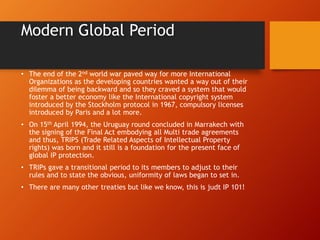
• The end of the 2nd world war paved way for more International
Organizations as the developing countries wanted a way out of their
dilemma of being backward and so they craved a system that would
foster a better economy like the International copyright system
introduced by the Stockholm protocol in 1967, compulsory licenses
introduced by Paris and a lot more.
• On 15th April 1994, the Uruguay round concluded in Marrakech with
the signing of the Final Act embodying all Multi trade agreements
and thus, TRIPS (Trade Related Aspects of Intellectual Property
rights) was born and it still is a foundation for the present face of
global IP protection.
• TRIPs gave a transitional period to its members to adjust to their
rules and to state the obvious, uniformity of laws began to set in.
• There are many other treaties but like we know, this is judt IP 101!
Nature of
Intellectual
Property
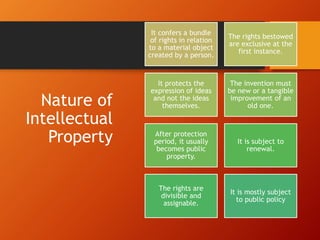
It confers a bundle
of rights in relation
to a material object
created by a person.
The rights bestowed
are exclusive at the
first instance.
It protects the
expression of ideas
and not the ideas
themselves.
The invention must
be new or a tangible
improvement of an
old one.
After protection
period, it usually
becomes public
property.
It is subject to
renewal.
The rights are
divisible and
assignable.
It is mostly subject
to public policy
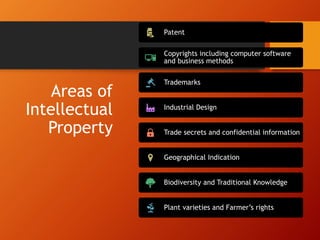
Areas of
Intellectual
Property
Patent
Copyrights including computer software
and business methods
Trademarks
Industrial Design
Trade secrets and confidential information
Geographical Indication
Biodiversity and Traditional Knowledge
Plant varieties and Farmer’s rights
General rights of an IP owner
The rights and duration of protection of an IP owner largely
depends on the intellectual property in question, however, there
are general rights that apply to all:
• Right to own the property
• Right to exploit the property for the period of time in the
exclusion of others
• Right to assign such ownership
• Right to exclude others from making, using, selling, offering to
sell, and importing that invention.
All these rights are in the exchange that the property MUST BE
DISCLOSED TO THE PUBLIC AND MADE ACCESSIBLE.
IS THE CONCEPT OF IP
ILLEGITIMATE?
• If you have ever asked this question, or probably asking now, I need you to know
that you are not alone.
• I have puzzled a lot about why should a creation be monetized? And even if it is,
why should it be so expensive that only a few can afford it?
• I came to this conclusion: We cannot rule out the fact that we are what we are!
We are humans who always need to be given credit for what we create, we want
others to know that we count and that we are definitely useful. The protection
of IP goes a long way to foster this from the minor level to the biggest of
companies owning several IP’s. The protection of IP was considered for three
main reasons – The glory, the money and the technological advancement it
brings.
• There may have been a time when people didn’t bother whether someone else
had their creations without proper recourse but that time isn’t now! The human
race has evolved and rather than dealing with the setbacks of evolvement, deal
with how to manage it, IP protection is the way.
• It not only allows people get the benefit of what they have made, but it makes
others want to become creative and to do inventive things themselves, it
enriches an economy, it reduces wars with regards to who owns what.
• I would say that the concept of IP is not illegitimate, but rather, must be made
to truly fulfil the reason why protection was granted in the first place.
Thank you!
See you in the next slide
Benita O. Ezeigbo

Intellectual Property 101

  • 1.
    IP 101 BASIC INTELLECTUALPROPERTY LESSONS FOR BEGINNERS Benita O. Ezeigbo Email: ezeigbobenita@gmail.com
  • 2.
    CONTENT What is IntellectualProperty Brief History of IP Nature of IP Areas of IP General rights of an IP owner Is the concept of Intellectual property illegitimate?
  • 3.
    Introduction: • The conceptof IP may sound vague and unrealistic to some individuals but like it or not, as long as technology advances and digitization increases, IP and its protection comes closer and closer to you! What do you loose by knowing just a bit of it? • IP is established on the fact that every day, somewhere and in sometime, the human mind goes on thinking and conceiving ideas that could better the peaceful sustenance of humanity. • It cuts across several fields that you may not even think and for sure, it will only get broader. Before now, people can just come on stage and perform, get standing ovations and they are fine, but no! they want more today because Performers rights are real and are covered under IP too. • These creations can be from the mind of a legal or natural person.
  • 4.
    What is IntellectualProperty? • When you buy a house in your name, and all the papers to that house is given to you and of course, the key too, you are the owner and can choose to do whatever you want with it. A property is owned. • Intellectual property is an ownership born from your mind’s creations. You thought it out, you put it to work and you make others able to access it, it becomes your intellectual property. • Its not yours when you just think it, just like I can wish I own a house but do nothing to make it mine. It’s yours when you make it tangible and real, when you give it a form!
  • 5.
    What IP isnot • It is not a mere story that you conceive even if its shared orally to another. • It is not a scientific formula you arrive at and leave it there. • It is not innovation that is not expressed. • It is not the exact replica of another person’s expressed work. • It is not a song you sing to yourself every morning when you wake up. • It is not an intangible machine built up in your head. • If ideas and thoughts are protected, ut will hamper the very freedom of individuals to think and express. • For Intellectual property to confer rights on you, It must be material, a product of those ideas conceived in real concrete form. It is the result of your ideas that IP identifies with!
  • 6.
    “ ” IP confers rightson its owners to maximize their creations to its fullest, and for the most cases, a limited period of time STICKY NOTE!
  • 7.
    BRIEF HISTORY OFIP. The rationale behind protecting IP has never always been economic in nature. It sought to protect the personhood of an individual to be rewarded for efforts put in and to universally encourage development. The History of IP can be narrowed to three main stages: • a. The medieval period • b. The International advancement period • c. The modern global period Lets see the key factors in each of this periods…
  • 8.
    The Medieval Period IPis traced back to Europe when group monopolies were given under Venetian Law of 1474. It granted protection to and exclusive rights to inventors of arts and medicines. It was granted only to regions Working conditions were determined by the then municipality until individual monopoly set in. The impediment of group monopoly led to letter patents. It is a document issued by a sovereign addressed to a subject to which a seal is put. The first letter patent was given to John Kempe, a Flemish weaver, followed by Henry Smith in 1522 who was given exclusive right to produce Normandy glass for 20 years.
  • 9.
    Medieval Period Continued… 1 QueenElizabeth began to issue letter patents to anybody she liked and even though she said it was to attract foreign investors to Europe, she granted it to almost everything. 2 This led to people’s right to food, healthy living becoming infringed and hence, the The statute of Monopoly emerged. It became the landmark for British Patent law. 3 The statute eradicated all monopolies except the ones granted to true and first inventor or a unique method of manufacture. 4 Other countries began the journey too like India, the Act VI of 1856, Act of 1857 and 1859. Protection was for 6 months to 12 months. 5 The medieval laws were simple, direct and clear but was majorly limited by territory. Also, only few countries enjoyed these inventons and this paved way to the second era.
  • 10.
    The International Advancement Period •Since the first era was limited to territory, it led to duplication of inventions. Persons in country A, B and C produce the same thing without knowing and get protected individually for it. Inventions were also duplicated and sold in other countries without recourse to them or receipt of royalty. On the other hand, countries with less production-might sought to enjoy technological advancement too. • Most of this duplication was done in America, France and Germany. Like Hansard said; "Every work written by a popular author is con-instantaneously reprinted in large numbers both in France, Germany and America and this is done with much rapidity and little expense…” • There was no choice than to look for better means to protect IP and it birth the following:
  • 11.
    International Era continued… 1 Bilateralagreements was the first step to going global with IP protection. UK passed laws in 1838 to curb duplicity on a reciprocity basis while US passed laws to protect its citizens, thereby refusing protection to foregners. Hence, US encouraged the piracy of the works refused protection. 2 As at 1883, there were 69 International agreements in place, all operating on national treatment principle. States began to recognize the necessity to recognize the works of foreigners too and so, bilateral agreements fostered. 3 While Bilateral agreements was only between two states, multi lateral agreements came to be and the two main agreements were Paris Convention of 1883 and Berne Convention. They both are the foundation of all other multilateral treaty created. 4 International Organizations were also formed to implement these multilateral treaties. World Intellectual Property was born after being formerly named Bureaux Internationaux Reunis pour la protection de la Propiete Intellectuelle.
  • 12.
    Modern Global Period •The end of the 2nd world war paved way for more International Organizations as the developing countries wanted a way out of their dilemma of being backward and so they craved a system that would foster a better economy like the International copyright system introduced by the Stockholm protocol in 1967, compulsory licenses introduced by Paris and a lot more. • On 15th April 1994, the Uruguay round concluded in Marrakech with the signing of the Final Act embodying all Multi trade agreements and thus, TRIPS (Trade Related Aspects of Intellectual Property rights) was born and it still is a foundation for the present face of global IP protection. • TRIPs gave a transitional period to its members to adjust to their rules and to state the obvious, uniformity of laws began to set in. • There are many other treaties but like we know, this is judt IP 101!
  • 13.
    Nature of Intellectual Property It confersa bundle of rights in relation to a material object created by a person. The rights bestowed are exclusive at the first instance. It protects the expression of ideas and not the ideas themselves. The invention must be new or a tangible improvement of an old one. After protection period, it usually becomes public property. It is subject to renewal. The rights are divisible and assignable. It is mostly subject to public policy
  • 14.
    Areas of Intellectual Property Patent Copyrights includingcomputer software and business methods Trademarks Industrial Design Trade secrets and confidential information Geographical Indication Biodiversity and Traditional Knowledge Plant varieties and Farmer’s rights
  • 15.
    General rights ofan IP owner The rights and duration of protection of an IP owner largely depends on the intellectual property in question, however, there are general rights that apply to all: • Right to own the property • Right to exploit the property for the period of time in the exclusion of others • Right to assign such ownership • Right to exclude others from making, using, selling, offering to sell, and importing that invention. All these rights are in the exchange that the property MUST BE DISCLOSED TO THE PUBLIC AND MADE ACCESSIBLE.
  • 16.
    IS THE CONCEPTOF IP ILLEGITIMATE? • If you have ever asked this question, or probably asking now, I need you to know that you are not alone. • I have puzzled a lot about why should a creation be monetized? And even if it is, why should it be so expensive that only a few can afford it? • I came to this conclusion: We cannot rule out the fact that we are what we are! We are humans who always need to be given credit for what we create, we want others to know that we count and that we are definitely useful. The protection of IP goes a long way to foster this from the minor level to the biggest of companies owning several IP’s. The protection of IP was considered for three main reasons – The glory, the money and the technological advancement it brings. • There may have been a time when people didn’t bother whether someone else had their creations without proper recourse but that time isn’t now! The human race has evolved and rather than dealing with the setbacks of evolvement, deal with how to manage it, IP protection is the way. • It not only allows people get the benefit of what they have made, but it makes others want to become creative and to do inventive things themselves, it enriches an economy, it reduces wars with regards to who owns what. • I would say that the concept of IP is not illegitimate, but rather, must be made to truly fulfil the reason why protection was granted in the first place.
  • 17.
    Thank you! See youin the next slide Benita O. Ezeigbo