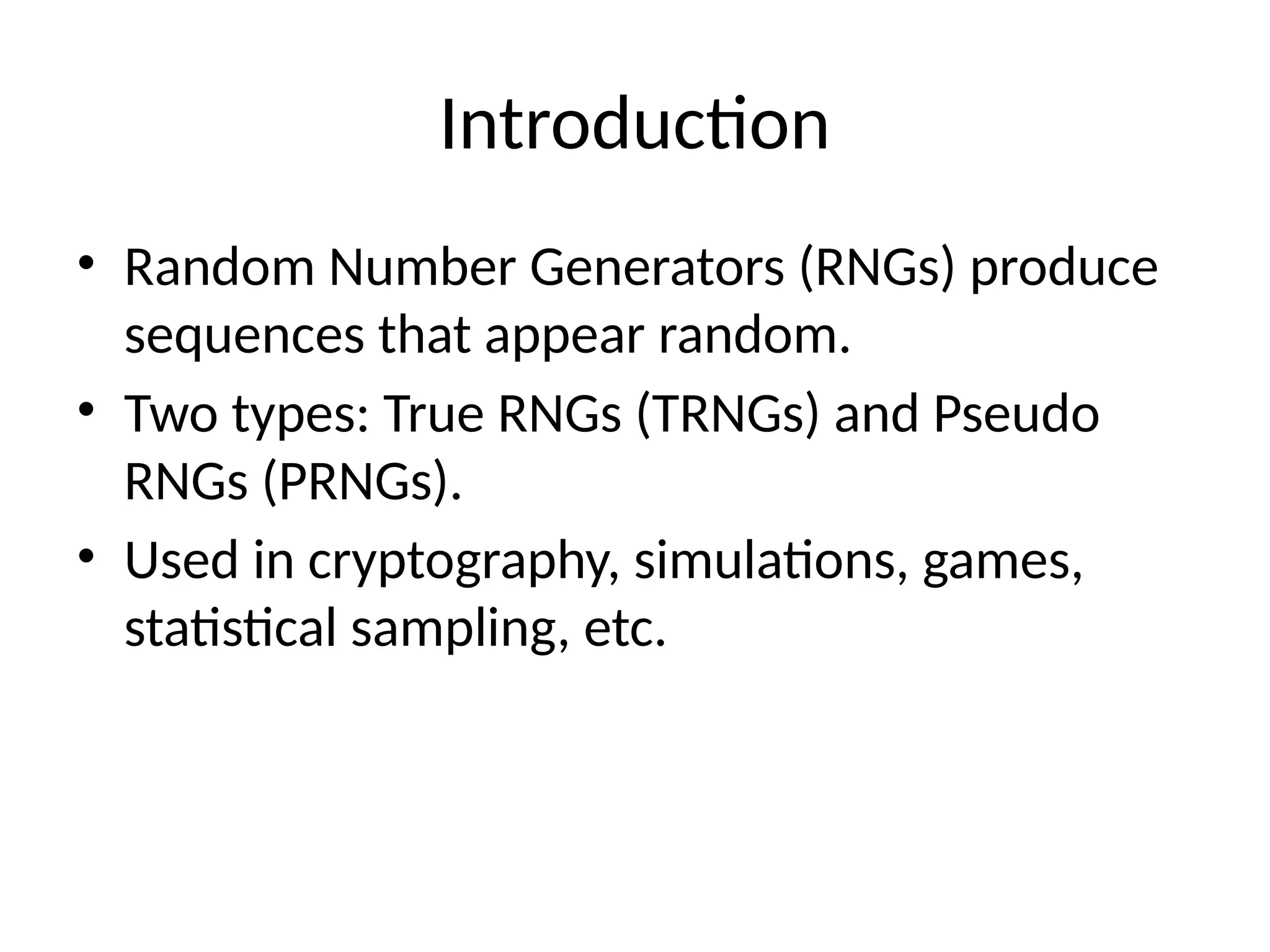
Introduction
• Random NumberGenerators (RNGs) produce
sequences that appear random.
• Two types: True RNGs (TRNGs) and Pseudo
RNGs (PRNGs).
• Used in cryptography, simulations, games,
statistical sampling, etc.
3.
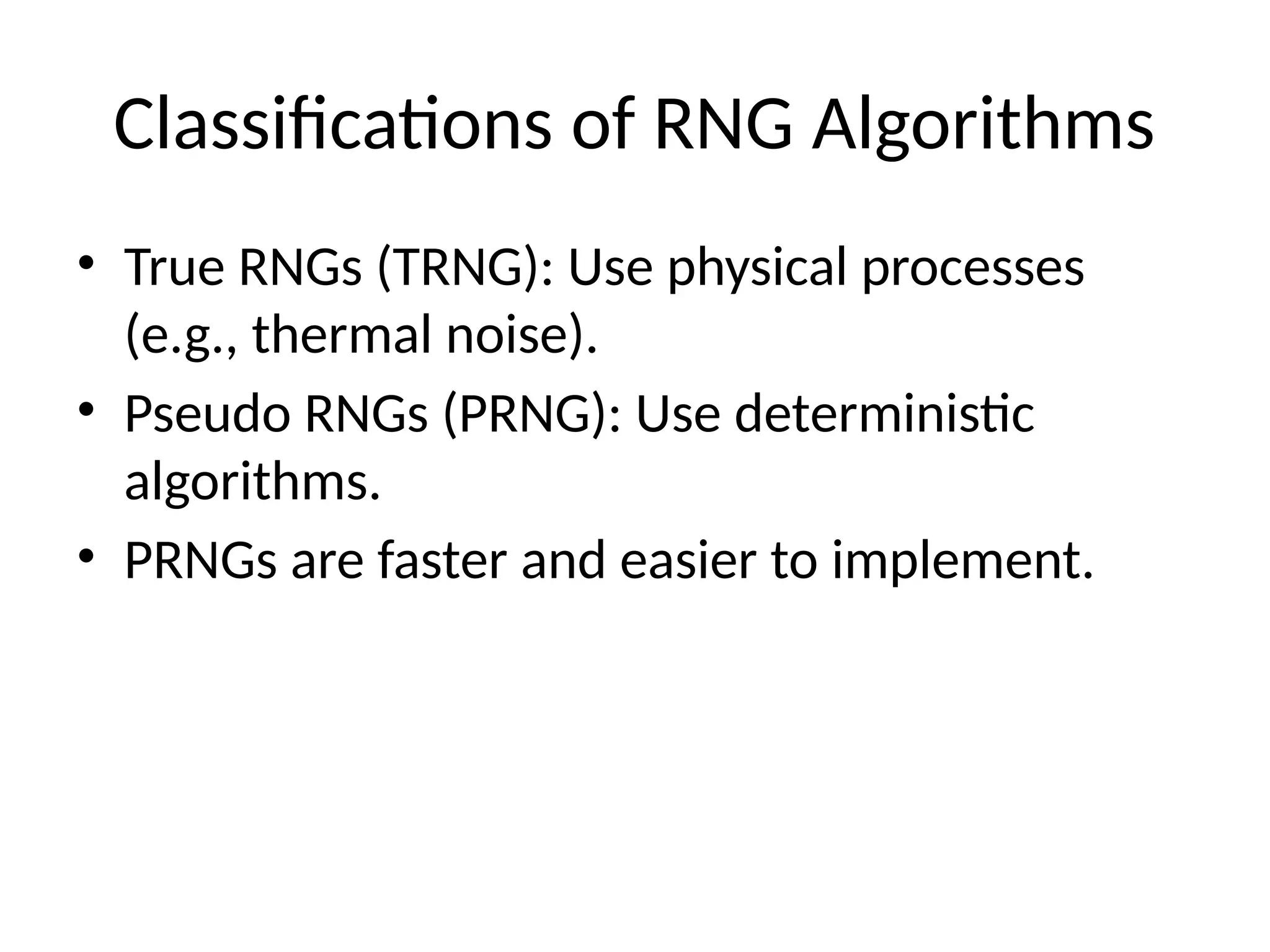
Classifications of RNGAlgorithms
• True RNGs (TRNG): Use physical processes
(e.g., thermal noise).
• Pseudo RNGs (PRNG): Use deterministic
algorithms.
• PRNGs are faster and easier to implement.
4.
Linear Congruential Generator
(LCG)
•Formula: X_{n+1} = (aX_n + c) mod m
• Deterministic and easy to implement.
• Example: a=1664525, c=1013904223, m=2^32
• With seed=1234: sequence =
[0.7143076679203659]
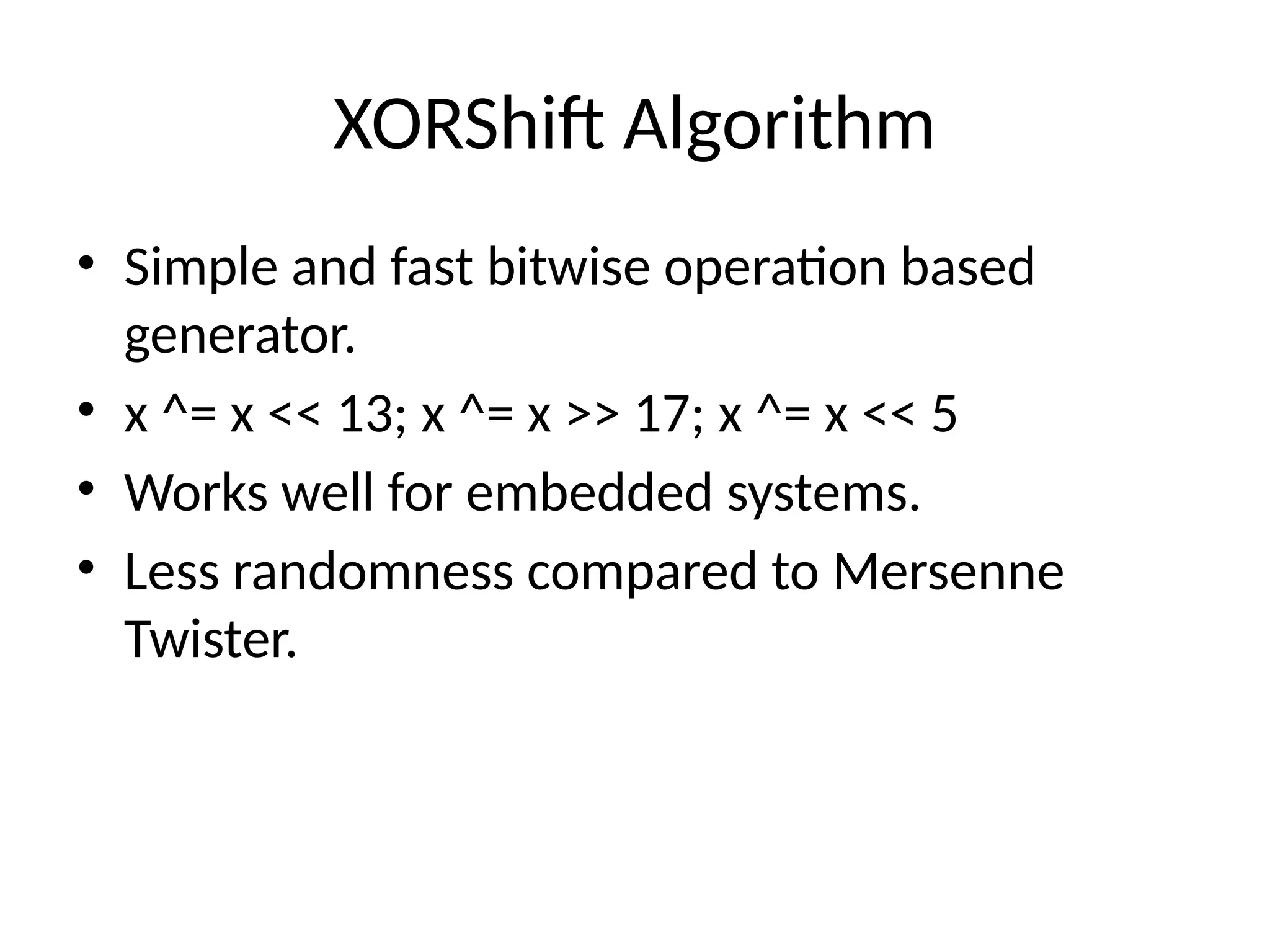
XORShift Algorithm
• Simpleand fast bitwise operation based
generator.
• x ^= x << 13; x ^= x >> 17; x ^= x << 5
• Works well for embedded systems.
• Less randomness compared to Mersenne
Twister.
9.
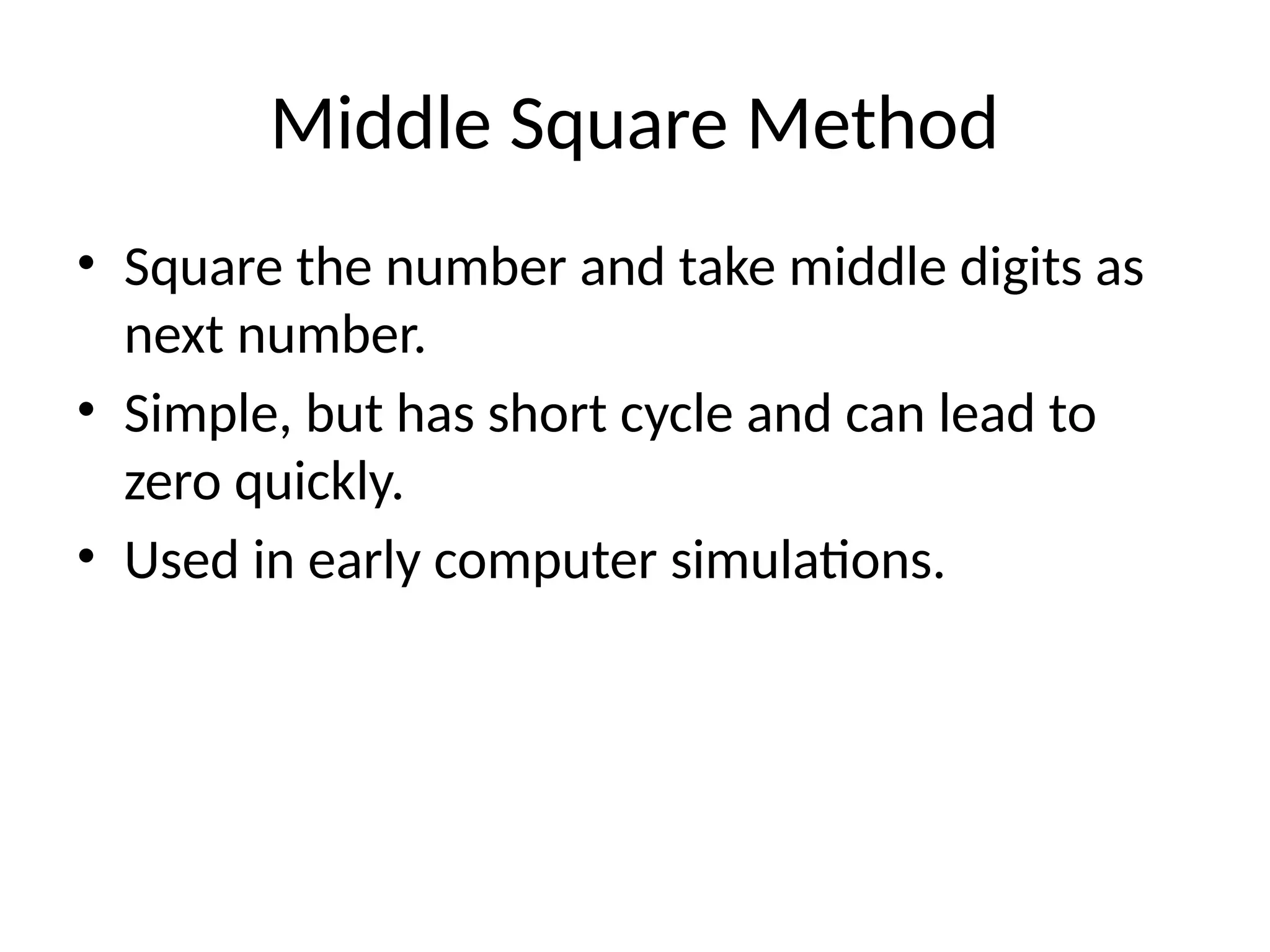
Middle Square Method
•Square the number and take middle digits as
next number.
• Simple, but has short cycle and can lead to
zero quickly.
• Used in early computer simulations.
10.
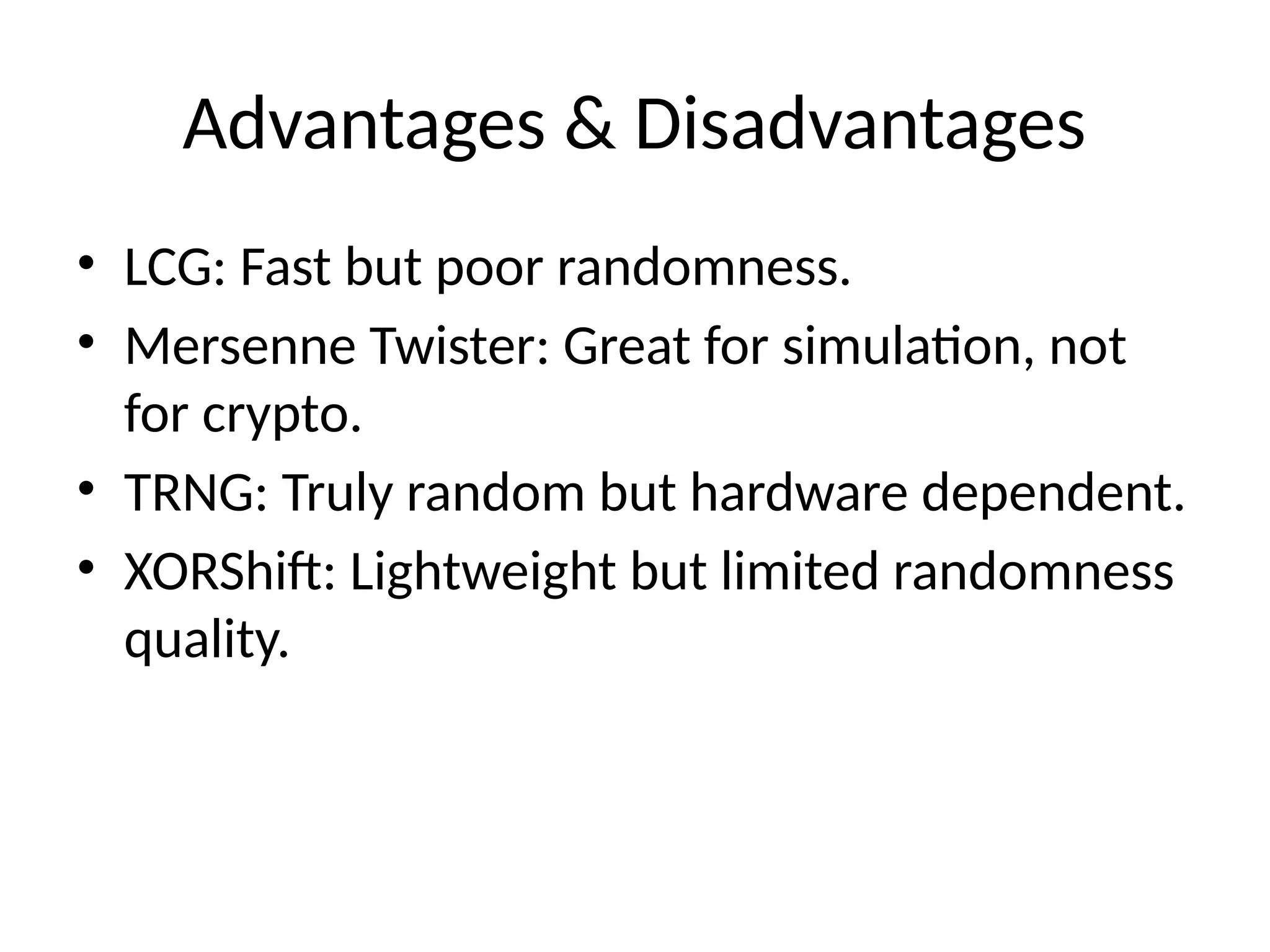
Advantages & Disadvantages
•LCG: Fast but poor randomness.
• Mersenne Twister: Great for simulation, not
for crypto.
• TRNG: Truly random but hardware dependent.
• XORShift: Lightweight but limited randomness
quality.
11.
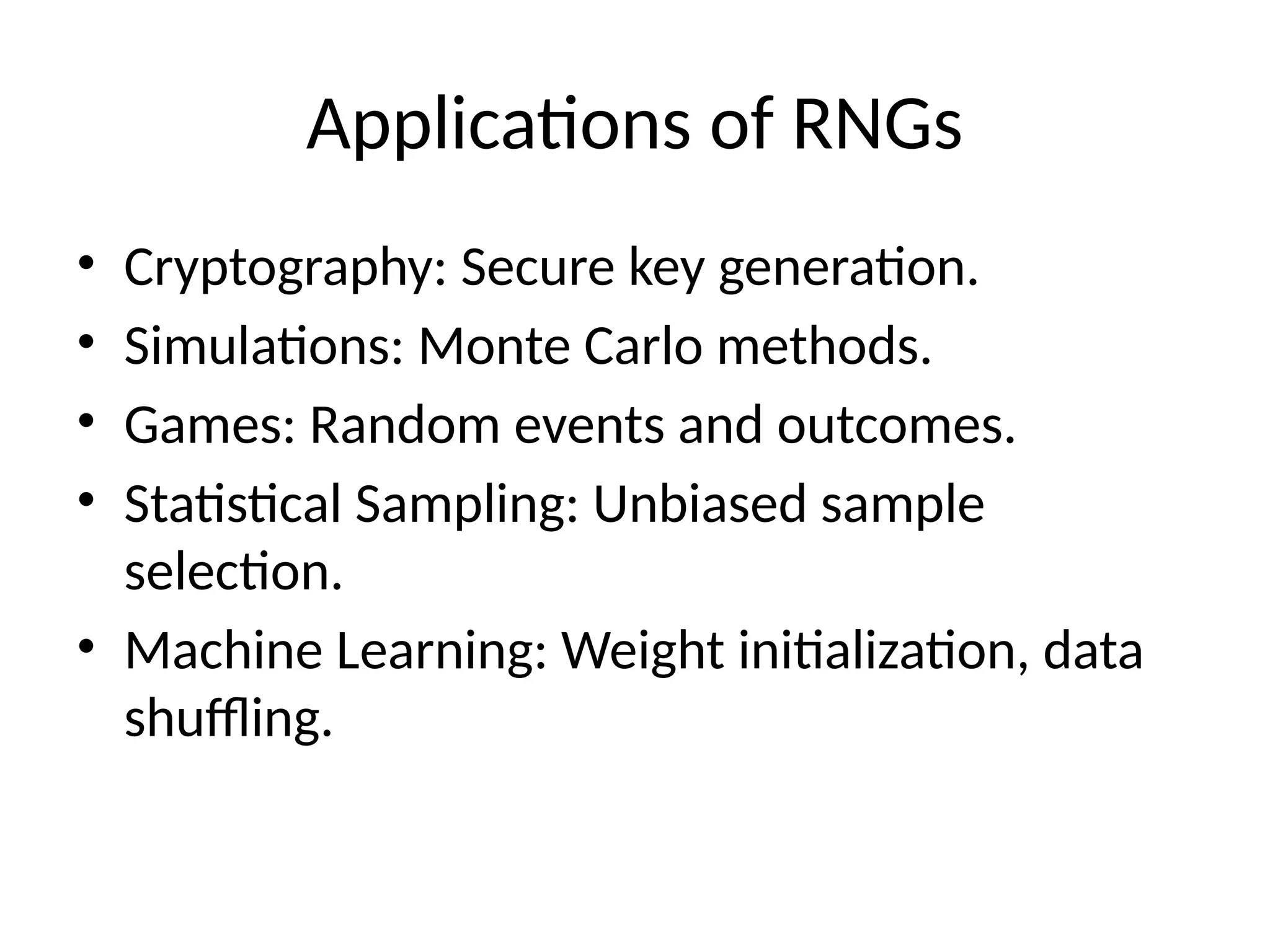
Applications of RNGs
•Cryptography: Secure key generation.
• Simulations: Monte Carlo methods.
• Games: Random events and outcomes.
• Statistical Sampling: Unbiased sample
selection.
• Machine Learning: Weight initialization, data
shuffling.
12.
Conclusion
• RNGs areessential in computing and
modeling.
• PRNGs dominate due to ease of use and
speed.
• Algorithm choice depends on the application.
• Understanding helps in choosing the right one.
![Linear Congruential Generator
(LCG)
• Formula: X_{n+1} = (aX_n + c) mod m
• Deterministic and easy to implement.
• Example: a=1664525, c=1013904223, m=2^32
• With seed=1234: sequence =
[0.7143076679203659]](https://image.slidesharecdn.com/randomnumbergenerationalgorithms-250413101049-73af4df7/75/Random_Number_Generation_Algorithms-pptx-4-2048.jpg)
![LCG: Sequences for Different Seeds
• Seed=123: [0.2837369213812053,
0.4351300236303359, 0.03865125775337219,
0.22087990469299257,
0.3594270762987435]
• Seed=456: [0.4127918796148151,
0.6394838229753077, 0.04650594689883292,
0.5473297527059913, 0.2926909129600972]
• Seed=789: [0.5418468378484249,
0.8438376223202795, 0.05436063604429364,
0.87377960071899, 0.2259547496214509]](https://image.slidesharecdn.com/randomnumbergenerationalgorithms-250413101049-73af4df7/75/Random_Number_Generation_Algorithms-pptx-5-2048.jpg)
![Mersenne Twister: Sequences for
Different Seeds
• Seed=11: [0.4523795535098186,
0.559772386080496, 0.9242105840237294,
0.4656500700997733, 0.5078412730622711]
• Seed=22: [0.9582093798172728,
0.1403685900763948, 0.02361614713882554,
0.9986306536729145,
0.18425364570285307]
• Seed=33: [0.5703284231368732,
0.6322329955787785, 0.8170038598832735,
0.2772908544463448, 0.6518599680085778]](https://image.slidesharecdn.com/randomnumbergenerationalgorithms-250413101049-73af4df7/75/Random_Number_Generation_Algorithms-pptx-7-2048.jpg)


![[IJET V2I3P1] Authors: G Hemanth kumar Dr. M. Saravanan, Charan kumar. K](https://cdn.slidesharecdn.com/ss_thumbnails/ijet-v2i3p1-160609050730-thumbnail.jpg?width=640&height=640&fit=bounds)


