Intel® Open Image Denoise
Optimized CPU Denoising
Carson Brownlee (Intel)
*OTHERNAMESANDBRANDSMAYBECLAIMEDASTHEPROPERTYOFOTHERS. ASSETCOURTESYOFUNITY.
INTEL®OPEN IMAGE DENOISE
OPTIMIZEDCPUDENOISING
Legal Notices and
Disclaimers
No license (express or implied, by estoppel or otherwise) to any intellectual property rights is granted by this document.

Intel disclaims all express and implied warranties, including without limitation, the implied warranties of merchantability, fitness for a particular purpose, and
non-infringement, as well as any warranty arising from course of performance, course of dealing, or usage in trade.

You may not use or facilitate the use of this document in connection with any infringement or other legal analysis concerning Intel products described
herein. You agree to grant Intel a non-exclusive, royalty-free license to any patent claim thereafter drafted which includes subject matter disclosed herein.

The products and services described may contain defects or errors known as errata which may cause deviations from published specifications. Current
characterized errata are available on request.

Intel technologies’ features and benefits depend on system configuration and may require enabled hardware, software or service activation. Performance
varies depending on system configuration. No computer system can be absolutely secure. Check with your system manufacturer or retailer or learn more at
[intel.com].

Software and workloads used in performance tests may have been optimized for performance only on Intel microprocessors. Performance tests, such as
SYSmark and MobileMark, are measured using specific computer systems, components, software, operations and functions. Any change to any of those
factors may cause the results to vary. You should consult other information and performance tests to assist you in fully evaluating your contemplated
purchases, including the performance of that product when combined with other products.   For more complete information visit www.intel.com/
benchmarks.  

Optimization Notice: Intel's compilers may or may not optimize to the same degree for non-Intel microprocessors for optimizations that are not unique to
Intel microprocessors. These optimizations include SSE2, SSE3, and SSSE3 instruction sets and other optimizations. Intel does not guarantee the
availability, functionality, or effectiveness of any optimization on microprocessors not manufactured by Intel. Microprocessor-dependent optimizations in
this product are intended for use with Intel microprocessors. Certain optimizations not specific to Intel microarchitecture are reserved for Intel
microprocessors. Please refer to the applicable product User and Reference Guides for more information regarding the specific instruction sets covered by
this notice. 

Results have been estimated or simulated using internal Intel analysis or architecture simulation or modeling, and provided to you for informational
purposes. Any differences in your system hardware, software or configuration may affect your actual performance.

Intel, Core and the Intel logo are trademarks of Intel Corporation in the U.S. and/or other countries. 

*Other names and brands may be claimed as the property of others

© Intel Corporation.
!2
!3
4
OSPRay Open
Image
Denoise
OpenVKL OpenSWREmbree
*Data courtesy Bentley, Disney
!5
Overview

Algorithm

Quality & Performance

API

Roadmap & Conclusion
6
Open
Image
Denoise
AI-based Denoising
Runs on any modern Intel® Architecture CPU
(SSE4.1 à AVX-512)
Windows, Mac, Linux
Straightforward application integration (in hours)
Depends only on the Intel® TBB library

Can use larger system memory
Interactive performance
Open Source under Apache* 2.0
Open Source
Open Source under Apache* 2.0
Binary packages for x86 Linux/Mac/Windows
Fast Integration
openimagedenoise.github.io
Usage of Denoising Today
• Noise is inevitable with Monte Carlo ray/path tracing

• Rendering fully converged, noise-free images is often too expensive

• Denoising partially converged images is getting more and more popular

• The movie industry is already using denoising to reduce rendering times

• About 2-10x overall speed improvement

• Negligible image quality loss

• Denoising is crucial for real-time ray tracing (e.g. games)

• Typically ~1 sample per pixels à extremely noisy

• Enables fully dynamic ray traced shadows, reflections, AO, and global
illumination
!7
Open Image Denoise
• Denoising library for images rendered with ray tracing

• Provides a high-quality deep learning based denoising filter

• Suitable for both interactive preview and final-frame rendering

• Runs on any modern Intel® Architecture CPU (SSE4.1 à AVX-512)

• Windows (64-bit), macOS, Linux

• Clean, minimalist C/C++ API and library design

• Straightforward application integration (in hours)

• Depends only on the Intel® TBB library

• Free and Open Source under Apache 2.0 license

• http://openimagedenoise.github.com
!8
!9
+ +
Albedo Normal Color
=
!10
Denoised Color
Albedo
(optional)
Normal
(optional)
Color
*Scene by Evermotion.
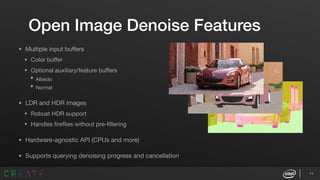
Open Image Denoise Features
• Multiple input buffers

• Color buffer

• Optional auxiliary/feature buffers

• Albedo

• Normal

• LDR and HDR images

• Robust HDR support

• Handles fireflies without pre-filtering

• Hardware-agnostic API (CPUs and more)

• Supports querying denoising progress and cancellation
!11
Overview

Algorithm

Quality & Performance

API

Roadmap & Conclusion
!127/8/2019
Denoising Algorithm
• Open Image Denoise currently uses a single denoising algorithm

• Convolutional neural network (CNN) based

• Direct-predicting autoencoder [Chaitanya et al. 2017]

• Variant of the U-Net architecture [Ronneberger et al. 2015]

• Good balance between quality and performance

• Quality suitable for final-frame rendering

• Interactive performance on many-core CPUs

• The library ships with a set of pre-trained models

• Inference implemented using the open source Intel® MKL-DNN library
!13
Denoising Pipeline
!14
LDR input CNN Inverse transfer
function
Transfer
function
LDR output
Denoising Pipeline
!15
LDR input CNN Inverse transfer
function
Transfer
function
LDR output
HDR input CNNAutoexposure Inverse transfer
function
Transfer
function
HDR output
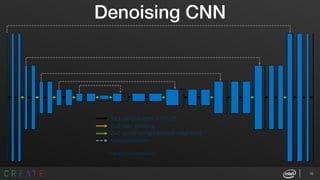
Denoising CNN
!16
3x3 convolution + ReLU*
2x2 max pooling
2x2 upsamping (nearest neighbor)
concatenation
* except final convolution
Overview

Algorithm

Quality & Performance

API

Roadmap & Conclusion
!177/8/2019
Example: Crytek Sponza (16 spp) – Original

!18
Scene courtesy of Frank Meinl, downloaded from Morgan McGuire’s Computer Graphics Archive.
Example: Crytek Sponza (16 spp) – Denoised

!19
Scene courtesy of Frank Meinl, downloaded from Morgan McGuire’s Computer Graphics Archive.
Example: Amazon Lumberyard Bistro (16
spp) – Original

!20
Scene created by Amazon Lumberyard, released publicly in the NVIDIA Open Research Content Archive collection.
Example: Amazon Lumberyard Bistro (16
spp) – Denoised

!21
Scene created by Amazon Lumberyard, released publicly in the NVIDIA Open Research Content Archive collection.
Example: Corona Academy Interior
(4 spp) – Original
!22
Rendered with Corona Renderer. Scene provided by Chaos Czech a.s.

www.corona-renderer.com
Example: Corona Academy Interior
(4 spp) – Denoised
!23
Rendered with Corona Renderer. Scene provided by Chaos Czech a.s.

www.corona-renderer.com
Example: Corona Academy Exterior
(4 spp) – Original
!24
Rendered with Corona Renderer. Scene provided by Chaos Czech a.s.

www.corona-renderer.com
Example: Corona Academy Exterior
(4 spp) – Denoised
!25
Rendered with Corona Renderer. Scene provided by Chaos Czech a.s.

www.corona-renderer.com
!26
Example: Moana Island
Scene (8 spp) – Original
!27
Rendered with Intel® OSPRay. Publicly available dataset courtesy of Walt Disney Animation Studios.
Example: Moana Island
Scene (8 spp) – Original
!28
Rendered with Intel® OSPRay. Publicly available dataset courtesy of Walt Disney Animation Studios.
Example: Moana Island
Scene (8 spp) – Denoised
!29
Rendered with Intel® OSPRay. Publicly available dataset courtesy of Walt Disney Animation Studios.
Example application -
Disney* Moana Island Scene
• Intel® OSPRay Renderer

• > 28 million instances

• > 15 billion primitives

• > 100GB memory utilization per node

• ~31GB compressed texture data

• 8 Xeon 8180 nodes (7 nodes for rendering, 1 for denoising)
!30*OTHERNAMESANDBRANDSMAYBECLAIMEDASTHEPROPERTYOFOTHERS.
!31
Use case - Unity
!32
Legal Notices and
Disclaimers
• No license (express or implied, by estoppel or otherwise) to any intellectual property rights is granted by this document.

• Intel disclaims all express and implied warranties, including without limitation, the implied warranties of merchantability, fitness for a particular purpose, and
non-infringement, as well as any warranty arising from course of performance, course of dealing, or usage in trade.

• You may not use or facilitate the use of this document in connection with any infringement or other legal analysis concerning Intel products described
herein. You agree to grant Intel a non-exclusive, royalty-free license to any patent claim thereafter drafted which includes subject matter disclosed herein.

• The products and services described may contain defects or errors known as errata which may cause deviations from published specifications. Current
characterized errata are available on request.

• Intel technologies’ features and benefits depend on system configuration and may require enabled hardware, software or service activation. Performance
varies depending on system configuration. No computer system can be absolutely secure. Check with your system manufacturer or retailer or learn more at
[intel.com].

• Software and workloads used in performance tests may have been optimized for performance only on Intel microprocessors. Performance tests, such as
SYSmark and MobileMark, are measured using specific computer systems, components, software, operations and functions. Any change to any of those
factors may cause the results to vary. You should consult other information and performance tests to assist you in fully evaluating your contemplated
purchases, including the performance of that product when combined with other products.   For more complete information visit www.intel.com/
benchmarks.  

• Optimization Notice: Intel's compilers may or may not optimize to the same degree for non-Intel microprocessors for optimizations that are not unique to
Intel microprocessors. These optimizations include SSE2, SSE3, and SSSE3 instruction sets and other optimizations. Intel does not guarantee the
availability, functionality, or effectiveness of any optimization on microprocessors not manufactured by Intel. Microprocessor-dependent optimizations in
this product are intended for use with Intel microprocessors. Certain optimizations not specific to Intel microarchitecture are reserved for Intel
microprocessors. Please refer to the applicable product User and Reference Guides for more information regarding the specific instruction sets covered by
this notice. 

• Results have been estimated or simulated using internal Intel analysis or architecture simulation or modeling, and provided to you for informational
purposes. Any differences in your system hardware, software or configuration may affect your actual performance.

• Intel, Core and the Intel logo are trademarks of Intel Corporation in the U.S. and/or other countries. 

• *Other names and brands may be claimed as the property of others

• © Intel Corporation.
!33*ASSETCOURTESYUNITY
!34
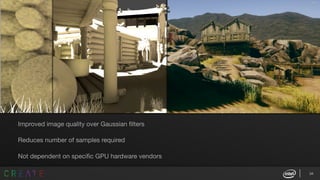
Improved image quality over Gaussian filters

Reduces number of samples required

Not dependent on specific GPU hardware vendors
Denoising Performance
• CPU: 2 × Intel® Xeon® Platinum 8180

• 2 × 28 cores, 2.50 GHz, AVX-512
!35
3840×2160
1920×1080
1280×720
ms
0 100 200 300 400
HDR
LDR
Overview

Algorithm

Quality & Performance

API

Roadmap & Conclusion
!367/8/2019
Open Image Denoise API
Overview
• Very similar to the Embree API 

• C and C++ (wrapper) version

• Object oriented

• Reference counted

• Device concept

• Compact and easy to use

• For details visit: https://openimagedenoise.github.io/
documentation.html
!37
Example: Filter Creation

• Images can be denoised using a
filter object

• Changes must be committed
(oidnCommitFilter), which typically
triggers JIT code generation
!38
//	Include	Open	Image	Denoise	headers	
#include	<OpenImageDenoise/oidn.h>	
int	main()	
{	
				//	Create	an	Open	Image	Denoise	device	
				OIDNDevice	device	=								 	 						 	 			
oidnNewDevice(OIDN_DEVICE_TYPE_DEFAULT);	
				oidnCommitDevice(device);	
				//	Create	a	denoising	filter	
				OIDNFilter	filter	=	oidnNewFilter(device,	"RT");	
				//	Set	filter	parameters	
				...	later	slide	...	
				//	Commit	changes	
				oidnCommitFilter(filter);	
				//	Filter	the	image	
				oidnExecuteFilter(filter);	
				//	Cleanup	
				oidnReleaseFilter(filter);	
				oidnReleaseDevice(device);	
}
Example: Filter Parameters

Buffers have to be attached to the
filter

Shared buffers of flexible layout
(offset + strides) supported
!39
//	Set	input	color	buffer	
oidnSetSharedFilterImage(filter,	"color",		colorPtr,	
				OIDN_FORMAT_FLOAT3,	width,	height,	0,	0,	0);	
//	Set	input	albedo	buffer	(optional)	
oidnSetSharedFilterImage(filter,	"albedo",	albedoPtr,	
				OIDN_FORMAT_FLOAT3,	width,	height,	0,	0,	0);	
//	Set	input	normal	buffer	(optional)	
oidnSetSharedFilterImage(filter,	"normal",	normalPtr,	
				OIDN_FORMAT_FLOAT3,	width,	height,	0,	0,	0);	
//	Set	output	color	buffer	
oidnSetSharedFilterImage(filter,	"output",	outputPtr,	
				OIDN_FORMAT_FLOAT3,	width,	height,	0,	0,	0);	
//	Set	other	filter	parametres	
oidnSetFilter1b(filter,	"hdr",	true);	//	image	is	HDR
Overview

Algorithm

Quality & Performance

API

Roadmap & Conclusion
!407/8/2019
Roadmap
• Next version (coming very soon!):

• Higher denoising quality with no performance impact (as shown in this
talk)

• Significantly lower memory consumption (especially for high resolutions)

• Later versions:

• Support for more auxiliary/feature buffers (e.g. depth)

• Temporal coherence

• Possibly other, more specialized denoising filters/algorithms

• … what else do you need?
!41
Conclusion
• Open Image Denoise is an open source denoising library for ray
tracing

• Suitable for both interactive and final-frame rendering

• Runs on almost any CPU (only SSE4.1 support is required)

• Takes advantage of AVX2 and AVX-512 instruction sets

• Simple, clean API

• Easy integration into renderers

• Under active development
!42
Questions?
Twitter: @attila_afra

https://openimagedenoise.github.io


openimagedenoise@googlegroups.com
!43
Thank You
Attila Afra

Jesper Mortenson
!44

Intel® Open Image Denoise: Optimized CPU Denoising | SIGGRAPH 2019 Technical Sessions

  • 1.
    Intel® Open ImageDenoise Optimized CPU Denoising Carson Brownlee (Intel) *OTHERNAMESANDBRANDSMAYBECLAIMEDASTHEPROPERTYOFOTHERS. ASSETCOURTESYOFUNITY. INTEL®OPEN IMAGE DENOISE OPTIMIZEDCPUDENOISING
  • 2.
    Legal Notices and Disclaimers Nolicense (express or implied, by estoppel or otherwise) to any intellectual property rights is granted by this document. Intel disclaims all express and implied warranties, including without limitation, the implied warranties of merchantability, fitness for a particular purpose, and non-infringement, as well as any warranty arising from course of performance, course of dealing, or usage in trade. You may not use or facilitate the use of this document in connection with any infringement or other legal analysis concerning Intel products described herein. You agree to grant Intel a non-exclusive, royalty-free license to any patent claim thereafter drafted which includes subject matter disclosed herein. The products and services described may contain defects or errors known as errata which may cause deviations from published specifications. Current characterized errata are available on request. Intel technologies’ features and benefits depend on system configuration and may require enabled hardware, software or service activation. Performance varies depending on system configuration. No computer system can be absolutely secure. Check with your system manufacturer or retailer or learn more at [intel.com]. Software and workloads used in performance tests may have been optimized for performance only on Intel microprocessors. Performance tests, such as SYSmark and MobileMark, are measured using specific computer systems, components, software, operations and functions. Any change to any of those factors may cause the results to vary. You should consult other information and performance tests to assist you in fully evaluating your contemplated purchases, including the performance of that product when combined with other products.   For more complete information visit www.intel.com/ benchmarks.   Optimization Notice: Intel's compilers may or may not optimize to the same degree for non-Intel microprocessors for optimizations that are not unique to Intel microprocessors. These optimizations include SSE2, SSE3, and SSSE3 instruction sets and other optimizations. Intel does not guarantee the availability, functionality, or effectiveness of any optimization on microprocessors not manufactured by Intel. Microprocessor-dependent optimizations in this product are intended for use with Intel microprocessors. Certain optimizations not specific to Intel microarchitecture are reserved for Intel microprocessors. Please refer to the applicable product User and Reference Guides for more information regarding the specific instruction sets covered by this notice. Results have been estimated or simulated using internal Intel analysis or architecture simulation or modeling, and provided to you for informational purposes. Any differences in your system hardware, software or configuration may affect your actual performance. Intel, Core and the Intel logo are trademarks of Intel Corporation in the U.S. and/or other countries. *Other names and brands may be claimed as the property of others © Intel Corporation. !2
  • 3.
  • 4.
  • 5.
  • 6.
    6 Open Image Denoise AI-based Denoising Runs onany modern Intel® Architecture CPU (SSE4.1 à AVX-512) Windows, Mac, Linux Straightforward application integration (in hours) Depends only on the Intel® TBB library Can use larger system memory Interactive performance Open Source under Apache* 2.0 Open Source Open Source under Apache* 2.0 Binary packages for x86 Linux/Mac/Windows Fast Integration openimagedenoise.github.io
  • 7.
    Usage of DenoisingToday • Noise is inevitable with Monte Carlo ray/path tracing • Rendering fully converged, noise-free images is often too expensive • Denoising partially converged images is getting more and more popular • The movie industry is already using denoising to reduce rendering times • About 2-10x overall speed improvement • Negligible image quality loss • Denoising is crucial for real-time ray tracing (e.g. games) • Typically ~1 sample per pixels à extremely noisy • Enables fully dynamic ray traced shadows, reflections, AO, and global illumination !7
  • 8.
    Open Image Denoise •Denoising library for images rendered with ray tracing • Provides a high-quality deep learning based denoising filter • Suitable for both interactive preview and final-frame rendering • Runs on any modern Intel® Architecture CPU (SSE4.1 à AVX-512) • Windows (64-bit), macOS, Linux • Clean, minimalist C/C++ API and library design • Straightforward application integration (in hours) • Depends only on the Intel® TBB library • Free and Open Source under Apache 2.0 license • http://openimagedenoise.github.com !8
  • 9.
  • 10.
  • 11.
    Open Image DenoiseFeatures • Multiple input buffers • Color buffer • Optional auxiliary/feature buffers • Albedo • Normal • LDR and HDR images • Robust HDR support • Handles fireflies without pre-filtering • Hardware-agnostic API (CPUs and more) • Supports querying denoising progress and cancellation !11
  • 12.
  • 13.
    Denoising Algorithm • OpenImage Denoise currently uses a single denoising algorithm • Convolutional neural network (CNN) based • Direct-predicting autoencoder [Chaitanya et al. 2017] • Variant of the U-Net architecture [Ronneberger et al. 2015] • Good balance between quality and performance • Quality suitable for final-frame rendering • Interactive performance on many-core CPUs • The library ships with a set of pre-trained models • Inference implemented using the open source Intel® MKL-DNN library !13
  • 14.
    Denoising Pipeline !14 LDR inputCNN Inverse transfer function Transfer function LDR output
  • 15.
    Denoising Pipeline !15 LDR inputCNN Inverse transfer function Transfer function LDR output HDR input CNNAutoexposure Inverse transfer function Transfer function HDR output
  • 16.
    Denoising CNN !16 3x3 convolution+ ReLU* 2x2 max pooling 2x2 upsamping (nearest neighbor) concatenation * except final convolution
  • 17.
  • 18.
    Example: Crytek Sponza(16 spp) – Original
 !18 Scene courtesy of Frank Meinl, downloaded from Morgan McGuire’s Computer Graphics Archive.
  • 19.
    Example: Crytek Sponza(16 spp) – Denoised
 !19 Scene courtesy of Frank Meinl, downloaded from Morgan McGuire’s Computer Graphics Archive.
  • 20.
    Example: Amazon LumberyardBistro (16 spp) – Original
 !20 Scene created by Amazon Lumberyard, released publicly in the NVIDIA Open Research Content Archive collection.
  • 21.
    Example: Amazon LumberyardBistro (16 spp) – Denoised
 !21 Scene created by Amazon Lumberyard, released publicly in the NVIDIA Open Research Content Archive collection.
  • 22.
    Example: Corona AcademyInterior (4 spp) – Original !22 Rendered with Corona Renderer. Scene provided by Chaos Czech a.s.
 www.corona-renderer.com
  • 23.
    Example: Corona AcademyInterior (4 spp) – Denoised !23 Rendered with Corona Renderer. Scene provided by Chaos Czech a.s.
 www.corona-renderer.com
  • 24.
    Example: Corona AcademyExterior (4 spp) – Original !24 Rendered with Corona Renderer. Scene provided by Chaos Czech a.s.
 www.corona-renderer.com
  • 25.
    Example: Corona AcademyExterior (4 spp) – Denoised !25 Rendered with Corona Renderer. Scene provided by Chaos Czech a.s.
 www.corona-renderer.com
  • 26.
  • 27.
    Example: Moana Island Scene(8 spp) – Original !27 Rendered with Intel® OSPRay. Publicly available dataset courtesy of Walt Disney Animation Studios.
  • 28.
    Example: Moana Island Scene(8 spp) – Original !28 Rendered with Intel® OSPRay. Publicly available dataset courtesy of Walt Disney Animation Studios.
  • 29.
    Example: Moana Island Scene(8 spp) – Denoised !29 Rendered with Intel® OSPRay. Publicly available dataset courtesy of Walt Disney Animation Studios.
  • 30.
    Example application - Disney*Moana Island Scene • Intel® OSPRay Renderer • > 28 million instances • > 15 billion primitives • > 100GB memory utilization per node • ~31GB compressed texture data • 8 Xeon 8180 nodes (7 nodes for rendering, 1 for denoising) !30*OTHERNAMESANDBRANDSMAYBECLAIMEDASTHEPROPERTYOFOTHERS.
  • 31.
  • 32.
    Use case -Unity !32
  • 33.
    Legal Notices and Disclaimers •No license (express or implied, by estoppel or otherwise) to any intellectual property rights is granted by this document. • Intel disclaims all express and implied warranties, including without limitation, the implied warranties of merchantability, fitness for a particular purpose, and non-infringement, as well as any warranty arising from course of performance, course of dealing, or usage in trade. • You may not use or facilitate the use of this document in connection with any infringement or other legal analysis concerning Intel products described herein. You agree to grant Intel a non-exclusive, royalty-free license to any patent claim thereafter drafted which includes subject matter disclosed herein. • The products and services described may contain defects or errors known as errata which may cause deviations from published specifications. Current characterized errata are available on request. • Intel technologies’ features and benefits depend on system configuration and may require enabled hardware, software or service activation. Performance varies depending on system configuration. No computer system can be absolutely secure. Check with your system manufacturer or retailer or learn more at [intel.com]. • Software and workloads used in performance tests may have been optimized for performance only on Intel microprocessors. Performance tests, such as SYSmark and MobileMark, are measured using specific computer systems, components, software, operations and functions. Any change to any of those factors may cause the results to vary. You should consult other information and performance tests to assist you in fully evaluating your contemplated purchases, including the performance of that product when combined with other products.   For more complete information visit www.intel.com/ benchmarks.   • Optimization Notice: Intel's compilers may or may not optimize to the same degree for non-Intel microprocessors for optimizations that are not unique to Intel microprocessors. These optimizations include SSE2, SSE3, and SSSE3 instruction sets and other optimizations. Intel does not guarantee the availability, functionality, or effectiveness of any optimization on microprocessors not manufactured by Intel. Microprocessor-dependent optimizations in this product are intended for use with Intel microprocessors. Certain optimizations not specific to Intel microarchitecture are reserved for Intel microprocessors. Please refer to the applicable product User and Reference Guides for more information regarding the specific instruction sets covered by this notice. • Results have been estimated or simulated using internal Intel analysis or architecture simulation or modeling, and provided to you for informational purposes. Any differences in your system hardware, software or configuration may affect your actual performance. • Intel, Core and the Intel logo are trademarks of Intel Corporation in the U.S. and/or other countries. • *Other names and brands may be claimed as the property of others • © Intel Corporation. !33*ASSETCOURTESYUNITY
  • 34.
    !34 Improved image qualityover Gaussian filters Reduces number of samples required Not dependent on specific GPU hardware vendors
  • 35.
    Denoising Performance • CPU:2 × Intel® Xeon® Platinum 8180 • 2 × 28 cores, 2.50 GHz, AVX-512 !35 3840×2160 1920×1080 1280×720 ms 0 100 200 300 400 HDR LDR
  • 36.
  • 37.
    Open Image DenoiseAPI Overview • Very similar to the Embree API • C and C++ (wrapper) version • Object oriented • Reference counted • Device concept • Compact and easy to use • For details visit: https://openimagedenoise.github.io/ documentation.html !37
  • 38.
    Example: Filter Creation
 •Images can be denoised using a filter object • Changes must be committed (oidnCommitFilter), which typically triggers JIT code generation !38 // Include Open Image Denoise headers #include <OpenImageDenoise/oidn.h> int main() { // Create an Open Image Denoise device OIDNDevice device = oidnNewDevice(OIDN_DEVICE_TYPE_DEFAULT); oidnCommitDevice(device); // Create a denoising filter OIDNFilter filter = oidnNewFilter(device, "RT"); // Set filter parameters ... later slide ... // Commit changes oidnCommitFilter(filter); // Filter the image oidnExecuteFilter(filter); // Cleanup oidnReleaseFilter(filter); oidnReleaseDevice(device); }
  • 39.
    Example: Filter Parameters
 Buffershave to be attached to the filter Shared buffers of flexible layout (offset + strides) supported !39 // Set input color buffer oidnSetSharedFilterImage(filter, "color", colorPtr, OIDN_FORMAT_FLOAT3, width, height, 0, 0, 0); // Set input albedo buffer (optional) oidnSetSharedFilterImage(filter, "albedo", albedoPtr, OIDN_FORMAT_FLOAT3, width, height, 0, 0, 0); // Set input normal buffer (optional) oidnSetSharedFilterImage(filter, "normal", normalPtr, OIDN_FORMAT_FLOAT3, width, height, 0, 0, 0); // Set output color buffer oidnSetSharedFilterImage(filter, "output", outputPtr, OIDN_FORMAT_FLOAT3, width, height, 0, 0, 0); // Set other filter parametres oidnSetFilter1b(filter, "hdr", true); // image is HDR
  • 40.
  • 41.
    Roadmap • Next version(coming very soon!): • Higher denoising quality with no performance impact (as shown in this talk) • Significantly lower memory consumption (especially for high resolutions) • Later versions: • Support for more auxiliary/feature buffers (e.g. depth) • Temporal coherence • Possibly other, more specialized denoising filters/algorithms • … what else do you need? !41
  • 42.
    Conclusion • Open ImageDenoise is an open source denoising library for ray tracing • Suitable for both interactive and final-frame rendering • Runs on almost any CPU (only SSE4.1 support is required) • Takes advantage of AVX2 and AVX-512 instruction sets • Simple, clean API • Easy integration into renderers • Under active development !42
  • 43.
  • 44.