Commissioning – a view from the frontline

Dr Robert Varnam                 PhD MRCGP
Clinical Lead for Primary Care & Commissioning


robert.varnam@institute.nhs.uk
   @robertvarnam
Commissioning for integration
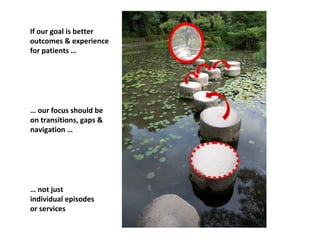
If our goal is better
outcomes & experience
for patients …


… our focus should be
on transitions, gaps &
navigation …


… not just
individual episodes
or services
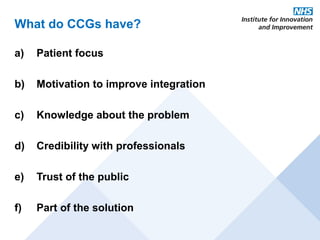
What do CCGs have?

a)   Patient focus

b)   Motivation to improve integration

c)   Knowledge about the problem

d)   Credibility with professionals

e)   Trust of the public

f)   Part of the solution
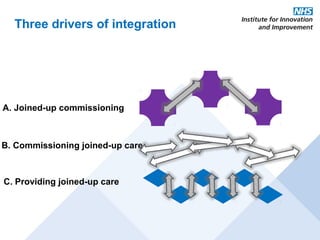
Three drivers of integration


A. Joined-up commissioning


B. Commissioning joined-up care


C. Providing joined-up care
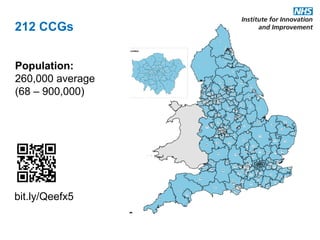
212 CCGs


Population:
260,000 average
(68 – 900,000)


bit.ly/Qeefx5
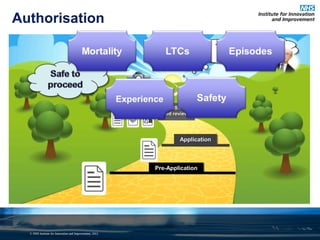
Authorisation


                                                              NHSCB
                                                               NHSCB
                                                            led review
                                                             led review


                                                                  Application
                                                                  Application


                                                         Pre-Application
                                                         Pre-Application


  © NHS Institute for Innovation and Improvement, 2012
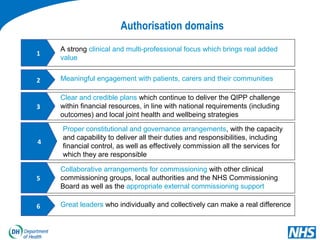
Authorisation domains
    A strong clinical and multi-professional focus which brings real added
1
    value


2   Meaningful engagement with patients, carers and their communities

    Clear and credible plans which continue to deliver the QIPP challenge
3   within financial resources, in line with national requirements (including
    outcomes) and local joint health and wellbeing strategies

    Proper constitutional and governance arrangements, with the capacity
    and capability to deliver all their duties and responsibilities, including
4
    financial control, as well as effectively commission all the services for
    which they are responsible

    Collaborative arrangements for commissioning with other clinical
5   commissioning groups, local authorities and the NHS Commissioning
    Board as well as the appropriate external commissioning support

6   Great leaders who individually and collectively can make a real difference


                    COMMISSIONING DEVELOPMENT PROGRAMME
            WORK IN PROGRESS – STRICTLY NOT FOR FURTHER CIRCULATION
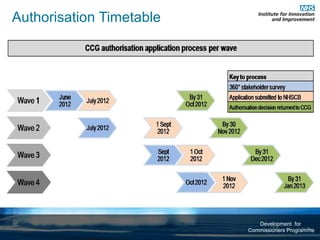
Authorisation Timetable


                             Development for
                          Commissioners Programme
Development for
Commissioners Programme
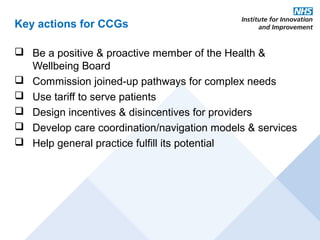
Key actions for CCGs

 Be a positive & proactive member of the Health &
  Wellbeing Board
 Commission joined-up pathways for complex needs
 Use tariff to serve patients
 Design incentives & disincentives for providers
 Develop care coordination/navigation models & services
 Help general practice fulfill its potential
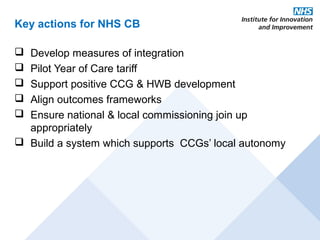
Key actions for NHS CB

 Develop measures of integration
 Pilot Year of Care tariff
 Support positive CCG & HWB development
 Align outcomes frameworks
 Ensure national & local commissioning join up
  appropriately
 Build a system which supports CCGs’ local autonomy
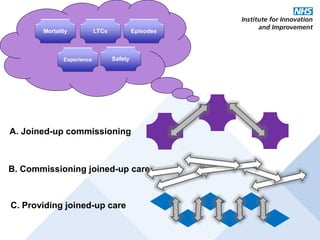
A. Joined-up commissioning


B. Commissioning joined-up care


C. Providing joined-up care
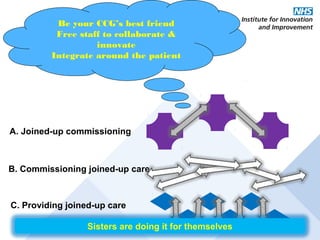
Be your CCG’s best friend
          Free staff to collaborate &
                   innovate
         Integrate around the patient


A. Joined-up commissioning


B. Commissioning joined-up care


C. Providing joined-up care

                 Sisters are doing it for themselves

Integration & CCGs

  • 1.
    Commissioning – aview from the frontline Dr Robert Varnam PhD MRCGP Clinical Lead for Primary Care & Commissioning robert.varnam@institute.nhs.uk @robertvarnam
  • 2.
  • 3.
    If our goalis better outcomes & experience for patients … … our focus should be on transitions, gaps & navigation … … not just individual episodes or services
  • 4.
    What do CCGshave? a) Patient focus b) Motivation to improve integration c) Knowledge about the problem d) Credibility with professionals e) Trust of the public f) Part of the solution
  • 5.
    Three drivers ofintegration A. Joined-up commissioning B. Commissioning joined-up care C. Providing joined-up care
  • 6.
    212 CCGs Population: 260,000 average (68– 900,000) bit.ly/Qeefx5
  • 21.
    Authorisation NHSCB NHSCB led review led review Application Application Pre-Application Pre-Application © NHS Institute for Innovation and Improvement, 2012
  • 22.
    Authorisation domains A strong clinical and multi-professional focus which brings real added 1 value 2 Meaningful engagement with patients, carers and their communities Clear and credible plans which continue to deliver the QIPP challenge 3 within financial resources, in line with national requirements (including outcomes) and local joint health and wellbeing strategies Proper constitutional and governance arrangements, with the capacity and capability to deliver all their duties and responsibilities, including 4 financial control, as well as effectively commission all the services for which they are responsible Collaborative arrangements for commissioning with other clinical 5 commissioning groups, local authorities and the NHS Commissioning Board as well as the appropriate external commissioning support 6 Great leaders who individually and collectively can make a real difference COMMISSIONING DEVELOPMENT PROGRAMME WORK IN PROGRESS – STRICTLY NOT FOR FURTHER CIRCULATION
  • 23.
    Authorisation Timetable Development for Commissioners Programme
  • 24.
  • 25.
    Key actions forCCGs  Be a positive & proactive member of the Health & Wellbeing Board  Commission joined-up pathways for complex needs  Use tariff to serve patients  Design incentives & disincentives for providers  Develop care coordination/navigation models & services  Help general practice fulfill its potential
  • 26.
    Key actions forNHS CB  Develop measures of integration  Pilot Year of Care tariff  Support positive CCG & HWB development  Align outcomes frameworks  Ensure national & local commissioning join up appropriately  Build a system which supports CCGs’ local autonomy
  • 27.
    A. Joined-up commissioning B.Commissioning joined-up care C. Providing joined-up care
  • 28.
    Be your CCG’sbest friend Free staff to collaborate & innovate Integrate around the patient A. Joined-up commissioning B. Commissioning joined-up care C. Providing joined-up care Sisters are doing it for themselves

Editor's Notes

  • #4 People with long-term conditions and other complex needs usually receive care from multiple different providers, both simultaneously and over a period of time. It is important that each individual episode or service is safe, effective and efficient, and provides a good patient experience. However, the ultimate outcome, safety, experience and cost depends at least as much on the patient journey as a whole, including the transitions and gaps between professionals, teams and providers. Transitions are a key source of patient harm, lost opportunity and effectiveness, delays, duplication and inappropriate resource utilisation. Commissioners have a responsibility to attend to the design of the whole journey, paying particularly attention to transitions, gaps and ease of navigation.
  • #5 The following 6 slides expand the narrative on these points, and are optional. a) Patient focus -- They begin with a patient orientation. Clinicians naturally bring the patient's perspective to priority-setting and decision-making around service reform. They are grounded in the patient's needs and experience, and committed to improving care and outcomes for patients. b) Motivation to improve -- They are motivated to improve integration. Clinicians have daily experience of the problems caused by poor integration. They witness the impact on the safety, quality, efficiency and experience of what would otherwise be great care. They know the effect poor integration has on patients, carers, the system and themselves as professionals. Improving integration would improve the daily experience for local clinicians, and they need little persuading to collaborate on such work. c) Knowledge about the problem -- They are knowledgeable about the problem. Clinicians understand the reasons why patients experience delays, defects and duplication in the course of their care journey. They have inside knowledge of the problems with culture, communication and collaboration which lead to disintegration. They know the specific reasons why it is hard for patients and staff to navigate the system, and are readily able to identify priorities for rapid improvement. d) Credibility with professionals -- They are credible with professionals. CCG leaders already have working relationships with the staff across health and social care whose collaboration and commitment is needed for integrated service design and delivery. They are better able than even the best managers to form effective coalitions across organisational boundaries, centred around the interests of patients. This ensures the right people are involved in evaluating and redesigning services, and that transformation is driven more by patient than corporate interests. e) Trust of the public -- They are trusted by the public. Improving integration will, in many instances, result in shifts of care from hospital to community and home settings. Explaining the implications for the size, location and type of hospital facilities will not always be an easy task. The public's knowledge of and trust in their local clinicians is an important asset in helping CCGs, in partnership with local people, elected members and the media, achieve the best balance between hospital and community. f) Part of the solution -- They will be part of the solution. CCGs are composed of GP practices, each of whom will be able to contribute to new ways of working designed by the CCG in collaboration with patients and other professionals. Commissioners have often had to design new systems or pathways which largely bypassed general practice, because of the difficulties of making change in that part of the local NHS. With practices now at the heart of the local NHS, it will be easier to think holistically about what is possible and to include general practice as an integral part of delivering improved patient journeys.
  • #6 Some progress made so far, but evidence & Future Forum interviews confirm that a concerted, coordinated effort is needed by everyone if we’re to roll out integration at scale & pace. There’s no silver bullet, and this is not a problem which will be solved by solo efforts – this is complex and our approach should be comprehensive and sophisticated. $
  • #7 Hyperlink to map and list of each CCG
  • #22 Pre-assessment Self-certification Policies & agreements Plans & contracts Stories
  • #24 Hand over to Jo (2pm)
  • #25 Message for slide: We’ve evolved with our customers We started off working with PBC clusters, the Health and Social Care Bill introduced GP Consortia and then they became Clinical Commissioning Groups During this time (only just over two years), we were working with customers that were ever changing. Organisations were forming, people were coming and going.
  • #26 1 Join up commissioning intelligence & priorities & plans & ?budgets with local authority. Be a full, proactive partner in the HWB. 2 Prioritise patients with the greatest need for joined-up care. Start by designing whole pathways for holistic care (not starting with single diseases or services). 3 Be confident & determined in using tariff to serve patients' interests. It isn't perfect, but it IS a tool in your hands – tariff was made for patients, not the other way round. Learn from commissioners who have done innovative things with existing tariff (cf Nuffield/King's report). New tariff models currently being refined will help, too. 4 Make it easier for providers (across the whole pathway) to do the right thing, and harder to do the wrong thing. Evidence & Future Forum’s listening demonstrate it’s not impossible for providers to collaborate in patients’ interests now – it’s just too hard to do it comprehensively & sustainably. 5 Many patients don't need any new services, just support to understand, made choices & join up existing ones. Prioritise the patients most likely to benefit, identify existing local assets (general practice, community nursing, 3rd sector, etc). 6 Successful & sustainable large scale change doesn't just happen. Requires excellent relationships, informpation, strategic planning, leadership skills, innovation development, implementation plans, perseverance. Not an amateur pursuit! Read a book (eg Large Scale Change, Bevan & Easton); learn from others (eg Nuffield/King's report); join with others; use a systematic method (eg NHS Change Model); develop skills (eg shared leadership development, commissioning reliable pathways, leading large scale change)
  • #27 These are the key Future Forum recommendations for NHS-CB action accepted by SoS.
  • #28 Some progress made so far, but evidence & Future Forum interviews confirm that a concerted, coordinated effort is needed by everyone if we’re to roll out integration at scale & pace. There’s no silver bullet, and this is not a problem which will be solved by solo efforts – this is complex and our approach should be comprehensive and sophisticated. $
  • #29 Some progress made so far, but evidence & Future Forum interviews confirm that a concerted, coordinated effort is needed by everyone if we’re to roll out integration at scale & pace. There’s no silver bullet, and this is not a problem which will be solved by solo efforts – this is complex and our approach should be comprehensive and sophisticated. $