1Oxford Professional Education Group Ltd
Integrating Digital Media and Branding
Integrating Digital and Offline
Communications
2Oxford Professional Education Group Ltd
Learning Outcomes
• Appraise the interaction between digital and offline communication in
meeting communication/advertising objectives.
3Oxford Professional Education Group Ltd
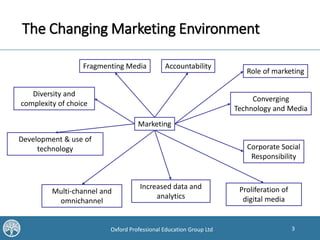
The Changing Marketing Environment
Fragmenting Media
Diversity and
complexity of choice
Multi-channel and
omnichannel
Accountability
Role of marketing
Corporate Social
Responsibility
Proliferation of
digital media
Development & use of
technology
Marketing
Converging
Technology and Media
Increased data and
analytics
4Oxford Professional Education Group Ltd
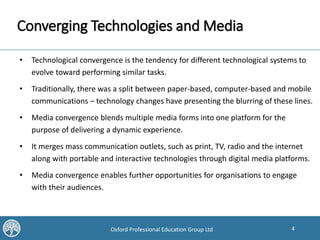
Converging Technologies and Media
• Technological convergence is the tendency for different technological systems to
evolve toward performing similar tasks.
• Traditionally, there was a split between paper-based, computer-based and mobile
communications – technology changes have presenting the blurring of these lines.
• Media convergence blends multiple media forms into one platform for the
purpose of delivering a dynamic experience.
• It merges mass communication outlets, such as print, TV, radio and the internet
along with portable and interactive technologies through digital media platforms.
• Media convergence enables further opportunities for organisations to engage
with their audiences.
5Oxford Professional Education Group Ltd
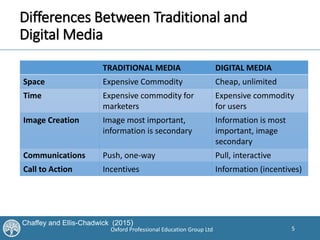
Differences Between Traditional and
Digital Media
TRADITIONAL MEDIA DIGITAL MEDIA
Space Expensive Commodity Cheap, unlimited
Time Expensive commodity for
marketers
Expensive commodity
for users
Image Creation Image most important,
information is secondary
Information is most
important, image
secondary
Communications Push, one-way Pull, interactive
Call to Action Incentives Information (incentives)
Chaffey and Ellis-Chadwick (2015)
6Oxford Professional Education Group Ltd
Digital TV
• When it comes to web TV, the change is primarily being driven
by two factors.
— The mass adoption of broadband in UK homes.
— The choice and control afforded by digital TV technology.
• Key trends include:
— Rise in tablets usage enabling an additional way to watch online TV and
video content
— Web-enabled TV and gaming platforms sets
— Streaming TV and film services (Netflix, Amazon Prime)
— Watching TV on the move (Sky Go, BBC iPlayer, ITV Player)
7Oxford Professional Education Group Ltd
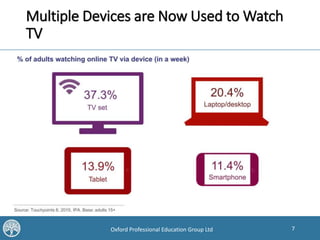
Multiple Devices are Now Used to Watch
TV
8Oxford Professional Education Group Ltd
TV On-Demand
• TV on-demand offers viewers more choice and convenience – providing
a method to catch up on TV, act on a recommendation or explore TV
archives.
• There are three main types of on-demand TV delivery:
— Internet Protocol Television (IPTV – such as BT Vision)
— Local storage (through Sky+ boxes)
— Via the web (YouTube)
• Technologies presenting new advertising formats:
— Pre, mid and post roll adverts
— Lower third adverts
— Live Buy
— ‘AdSmart’ – available through SkyPlayer, supplies targeted advertising
based on viewing habits.
9Oxford Professional Education Group Ltd
Benefits and Limitations of Web TV
Advertising
Benefits
• No limits or restrictions with the
number of adverts that can be
shown (unlike linear).
• Greater targeting options.
• ‘Clickability’ of adverts
(encouraging further research or
purchase).
• Incremental reach.
• Viewer still has to view some of
advert before content.
• Low cost access to special TV
events.
Limitations
• Likely to be solo viewing – no
talkability of adverts seen.
• Screen can be smaller if watching
through mobile or PC – picture
quality can be poor.
• User may not always have the
sound on.
• Irritability of having to watch
advert before content is view
could have negative effect on
brand.
10Oxford Professional Education Group Ltd
Digital Radio
• Digital radio services are available via a number of different
platforms including:
— DAB digital radio,
— Digital television (Sky, Freeview, Virgin Media, Freesat)
— Via the internet (fixed and mobile devices)
• Radio and online can be integrated well as part of a digital
campaign due to the high number of uses listen to radio online.
11Oxford Professional Education Group Ltd
Combining Radio and Online
• Radio and online can combine push and pull to reach out and engage
consumers and fulfil brand interactions.
• Benefits of using radio and online media together:
— Future growth: online and radio are the only media predicted to grow
audiences in the future.
— Size of opportunity: 50% of people listen to the radio when online each
week.
— Online and radio provide complementary rational and emotional
benefits: online is perceived as a channel for assisting people in finding
what they want, when they want, whereas radio is perceived as
offering the ‘human touch’.
— Radio and online are a ‘social connectivity’ media: both provide
connection with people’s social communities but on different levels.
12Oxford Professional Education Group Ltd
Digital Outdoor
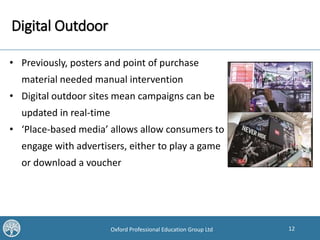
• Previously, posters and point of purchase
material needed manual intervention
• Digital outdoor sites mean campaigns can be
updated in real-time
• ‘Place-based media’ allows allow consumers to
engage with advertisers, either to play a game
or download a voucher
13Oxford Professional Education Group Ltd
Mobile Marketing
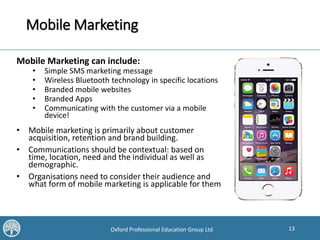
Mobile Marketing can include:
• Simple SMS marketing message
• Wireless Bluetooth technology in specific locations
• Branded mobile websites
• Branded Apps
• Communicating with the customer via a mobile
device!
• Mobile marketing is primarily about customer
acquisition, retention and brand building.
• Communications should be contextual: based on
time, location, need and the individual as well as
demographic.
• Organisations need to consider their audience and
what form of mobile marketing is applicable for them
14Oxford Professional Education Group Ltd
Mobile: Combining Offline and Online
Communications
• Mobile coupons
— Can drive online traffic offline, with redeemable in-store vouchers.
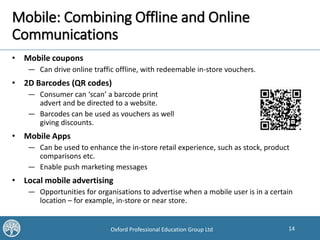
• 2D Barcodes (QR codes)
— Consumer can ‘scan’ a barcode print
advert and be directed to a website.
— Barcodes can be used as vouchers as well
giving discounts.
• Mobile Apps
— Can be used to enhance the in-store retail experience, such as stock, product
comparisons etc.
— Enable push marketing messages
• Local mobile advertising
— Opportunities for organisations to advertise when a mobile user is in a certain
location – for example, in-store or near store.
15Oxford Professional Education Group Ltd
Location-Based Marketing
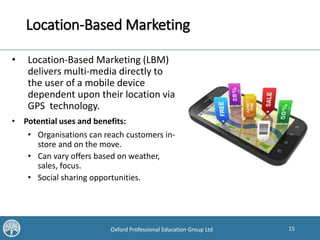
• Location-Based Marketing (LBM)
delivers multi-media directly to
the user of a mobile device
dependent upon their location via
GPS technology.
• Potential uses and benefits:
• Organisations can reach customers in-
store and on the move.
• Can vary offers based on weather,
sales, focus.
• Social sharing opportunities.
16Oxford Professional Education Group Ltd
Location-Based Marketing
• Location-based marketing relies on:
— Smartphones that allow users to access rich internet features wherever
they are
— GPS (global positioning system) technology that enables services to
pinpoint the locations of mobile devices and businesses.
— You also may enable ‘push notifications’ from apps downloaded or share
your location through social networks (Facebook Places, Foursquare)
• Potential uses and benefits:
— Reach customers in-store and on the move
— Can vary offers based on weather, sales, focus.
— Customers can find you easily.
— Social sharing opportunities.
17Oxford Professional Education Group Ltd
Using Traditional Media to Drive Traffic to
a Site
Range of response mechanisms for offline media:
• Home page – easiest and likely to be most memorable, but can
be hard to track ROI.
• Microsite of landing page – directing consumers to a landing
page on the site (such as www.dialaphone.com/tv) . Can help
measure responses, but can be difficult to remember .
• Microsite/campaign URLS (CURLs) – using specific campaign
URLs, such as www.underdog.co.uk, which can be easy to
remember and can help measure responses.
18Oxford Professional Education Group Ltd
Using Traditional Media to
Drive Traffic to a Website
Traditional Media
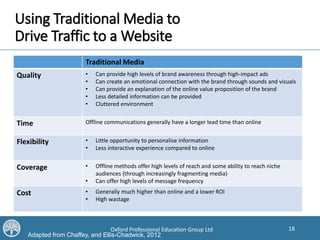
Quality • Can provide high levels of brand awareness through high-impact ads
• Can create an emotional connection with the brand through sounds and visuals
• Can provide an explanation of the online value proposition of the brand
• Less detailed information can be provided
• Cluttered environment
Time Offline communications generally have a longer lead time than online
Flexibility • Little opportunity to personalise information
• Less interactive experience compared to online
Coverage • Offline methods offer high levels of reach and some ability to reach niche
audiences (through increasingly fragmenting media)
• Can offer high levels of message frequency
Cost • Generally much higher than online and a lower ROI
• High wastage
Adapted from Chaffey, and Ellis-Chadwick, 2012
19Oxford Professional Education Group Ltd
Benefits of Using Offline Communications to
Support Digital Campaigns
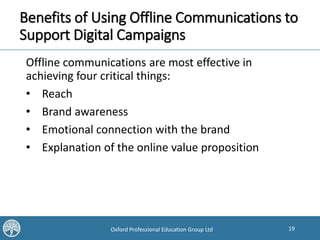
Offline communications are most effective in
achieving four critical things:
• Reach
• Brand awareness
• Emotional connection with the brand
• Explanation of the online value proposition
20Oxford Professional Education Group Ltd
Issues in Offline Communications to
Encourage Online Usage
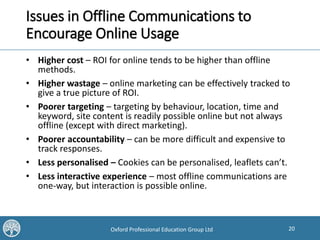
• Higher cost – ROI for online tends to be higher than offline
methods.
• Higher wastage – online marketing can be effectively tracked to
give a true picture of ROI.
• Poorer targeting – targeting by behaviour, location, time and
keyword, site content is readily possible online but not always
offline (except with direct marketing).
• Poorer accountability – can be more difficult and expensive to
track responses.
• Less personalised – Cookies can be personalised, leaflets can’t.
• Less interactive experience – most offline communications are
one-way, but interaction is possible online.
21Oxford Professional Education Group Ltd
Integrating Communications
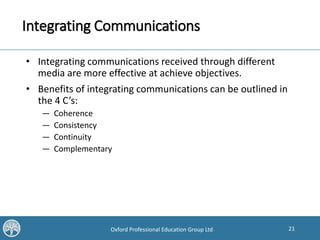
• Integrating communications received through different
media are more effective at achieve objectives.
• Benefits of integrating communications can be outlined in
the 4 C’s:
— Coherence
— Consistency
— Continuity
— Complementary
22Oxford Professional Education Group Ltd
About The Oxford College of Marketing
The Oxford College of Marketing is part of the Oxford Professional Education
Group and is a leading marketing institute that provides exceptional practical
marketing courses, qualifications and bespoke training solutions.
We offer a range of professional sales and marketing qualifications,
including; Chartered Institute of Marketing (CIM), CAM foundation, Institute
of Sales and Marketing Management (ISMM) and University of California
Irvine Extension (UCI).
Our training courses are delivered through an extensive network of UK study
centres and global partners as well as through our comprehensive online
learning system to support our large number of distance-learning delegates.
To find out more how we can help develop your marketing career, visit us at
www.oxfordcollegeofmarketing.com
You can also get in touch directly by emailing enquiries@oxfordpeg.com or
by calling +44 (0)1865 515255.
23Oxford Professional Education Group Ltd
Bibliography
• Chaffey, D. and Ellis-Chadwick , F. (2015) Digital Marketing: Strategy, Implementation and Practice.
Sixth edition, Harlow, Pearson.
• Thinkbox (2015) TV is Everywhere[online]. Available at:
https://www.thinkbox.tv/Research/Nickable-Charts/VOD-and-devices/TV-is-everywhere
[Accessed 10 June 2016]

Integrating Digital and Offline Media

  • 1.
    1Oxford Professional EducationGroup Ltd Integrating Digital Media and Branding Integrating Digital and Offline Communications
  • 2.
    2Oxford Professional EducationGroup Ltd Learning Outcomes • Appraise the interaction between digital and offline communication in meeting communication/advertising objectives.
  • 3.
    3Oxford Professional EducationGroup Ltd The Changing Marketing Environment Fragmenting Media Diversity and complexity of choice Multi-channel and omnichannel Accountability Role of marketing Corporate Social Responsibility Proliferation of digital media Development & use of technology Marketing Converging Technology and Media Increased data and analytics
  • 4.
    4Oxford Professional EducationGroup Ltd Converging Technologies and Media • Technological convergence is the tendency for different technological systems to evolve toward performing similar tasks. • Traditionally, there was a split between paper-based, computer-based and mobile communications – technology changes have presenting the blurring of these lines. • Media convergence blends multiple media forms into one platform for the purpose of delivering a dynamic experience. • It merges mass communication outlets, such as print, TV, radio and the internet along with portable and interactive technologies through digital media platforms. • Media convergence enables further opportunities for organisations to engage with their audiences.
  • 5.
    5Oxford Professional EducationGroup Ltd Differences Between Traditional and Digital Media TRADITIONAL MEDIA DIGITAL MEDIA Space Expensive Commodity Cheap, unlimited Time Expensive commodity for marketers Expensive commodity for users Image Creation Image most important, information is secondary Information is most important, image secondary Communications Push, one-way Pull, interactive Call to Action Incentives Information (incentives) Chaffey and Ellis-Chadwick (2015)
  • 6.
    6Oxford Professional EducationGroup Ltd Digital TV • When it comes to web TV, the change is primarily being driven by two factors. — The mass adoption of broadband in UK homes. — The choice and control afforded by digital TV technology. • Key trends include: — Rise in tablets usage enabling an additional way to watch online TV and video content — Web-enabled TV and gaming platforms sets — Streaming TV and film services (Netflix, Amazon Prime) — Watching TV on the move (Sky Go, BBC iPlayer, ITV Player)
  • 7.
    7Oxford Professional EducationGroup Ltd Multiple Devices are Now Used to Watch TV
  • 8.
    8Oxford Professional EducationGroup Ltd TV On-Demand • TV on-demand offers viewers more choice and convenience – providing a method to catch up on TV, act on a recommendation or explore TV archives. • There are three main types of on-demand TV delivery: — Internet Protocol Television (IPTV – such as BT Vision) — Local storage (through Sky+ boxes) — Via the web (YouTube) • Technologies presenting new advertising formats: — Pre, mid and post roll adverts — Lower third adverts — Live Buy — ‘AdSmart’ – available through SkyPlayer, supplies targeted advertising based on viewing habits.
  • 9.
    9Oxford Professional EducationGroup Ltd Benefits and Limitations of Web TV Advertising Benefits • No limits or restrictions with the number of adverts that can be shown (unlike linear). • Greater targeting options. • ‘Clickability’ of adverts (encouraging further research or purchase). • Incremental reach. • Viewer still has to view some of advert before content. • Low cost access to special TV events. Limitations • Likely to be solo viewing – no talkability of adverts seen. • Screen can be smaller if watching through mobile or PC – picture quality can be poor. • User may not always have the sound on. • Irritability of having to watch advert before content is view could have negative effect on brand.
  • 10.
    10Oxford Professional EducationGroup Ltd Digital Radio • Digital radio services are available via a number of different platforms including: — DAB digital radio, — Digital television (Sky, Freeview, Virgin Media, Freesat) — Via the internet (fixed and mobile devices) • Radio and online can be integrated well as part of a digital campaign due to the high number of uses listen to radio online.
  • 11.
    11Oxford Professional EducationGroup Ltd Combining Radio and Online • Radio and online can combine push and pull to reach out and engage consumers and fulfil brand interactions. • Benefits of using radio and online media together: — Future growth: online and radio are the only media predicted to grow audiences in the future. — Size of opportunity: 50% of people listen to the radio when online each week. — Online and radio provide complementary rational and emotional benefits: online is perceived as a channel for assisting people in finding what they want, when they want, whereas radio is perceived as offering the ‘human touch’. — Radio and online are a ‘social connectivity’ media: both provide connection with people’s social communities but on different levels.
  • 12.
    12Oxford Professional EducationGroup Ltd Digital Outdoor • Previously, posters and point of purchase material needed manual intervention • Digital outdoor sites mean campaigns can be updated in real-time • ‘Place-based media’ allows allow consumers to engage with advertisers, either to play a game or download a voucher
  • 13.
    13Oxford Professional EducationGroup Ltd Mobile Marketing Mobile Marketing can include: • Simple SMS marketing message • Wireless Bluetooth technology in specific locations • Branded mobile websites • Branded Apps • Communicating with the customer via a mobile device! • Mobile marketing is primarily about customer acquisition, retention and brand building. • Communications should be contextual: based on time, location, need and the individual as well as demographic. • Organisations need to consider their audience and what form of mobile marketing is applicable for them
  • 14.
    14Oxford Professional EducationGroup Ltd Mobile: Combining Offline and Online Communications • Mobile coupons — Can drive online traffic offline, with redeemable in-store vouchers. • 2D Barcodes (QR codes) — Consumer can ‘scan’ a barcode print advert and be directed to a website. — Barcodes can be used as vouchers as well giving discounts. • Mobile Apps — Can be used to enhance the in-store retail experience, such as stock, product comparisons etc. — Enable push marketing messages • Local mobile advertising — Opportunities for organisations to advertise when a mobile user is in a certain location – for example, in-store or near store.
  • 15.
    15Oxford Professional EducationGroup Ltd Location-Based Marketing • Location-Based Marketing (LBM) delivers multi-media directly to the user of a mobile device dependent upon their location via GPS technology. • Potential uses and benefits: • Organisations can reach customers in- store and on the move. • Can vary offers based on weather, sales, focus. • Social sharing opportunities.
  • 16.
    16Oxford Professional EducationGroup Ltd Location-Based Marketing • Location-based marketing relies on: — Smartphones that allow users to access rich internet features wherever they are — GPS (global positioning system) technology that enables services to pinpoint the locations of mobile devices and businesses. — You also may enable ‘push notifications’ from apps downloaded or share your location through social networks (Facebook Places, Foursquare) • Potential uses and benefits: — Reach customers in-store and on the move — Can vary offers based on weather, sales, focus. — Customers can find you easily. — Social sharing opportunities.
  • 17.
    17Oxford Professional EducationGroup Ltd Using Traditional Media to Drive Traffic to a Site Range of response mechanisms for offline media: • Home page – easiest and likely to be most memorable, but can be hard to track ROI. • Microsite of landing page – directing consumers to a landing page on the site (such as www.dialaphone.com/tv) . Can help measure responses, but can be difficult to remember . • Microsite/campaign URLS (CURLs) – using specific campaign URLs, such as www.underdog.co.uk, which can be easy to remember and can help measure responses.
  • 18.
    18Oxford Professional EducationGroup Ltd Using Traditional Media to Drive Traffic to a Website Traditional Media Quality • Can provide high levels of brand awareness through high-impact ads • Can create an emotional connection with the brand through sounds and visuals • Can provide an explanation of the online value proposition of the brand • Less detailed information can be provided • Cluttered environment Time Offline communications generally have a longer lead time than online Flexibility • Little opportunity to personalise information • Less interactive experience compared to online Coverage • Offline methods offer high levels of reach and some ability to reach niche audiences (through increasingly fragmenting media) • Can offer high levels of message frequency Cost • Generally much higher than online and a lower ROI • High wastage Adapted from Chaffey, and Ellis-Chadwick, 2012
  • 19.
    19Oxford Professional EducationGroup Ltd Benefits of Using Offline Communications to Support Digital Campaigns Offline communications are most effective in achieving four critical things: • Reach • Brand awareness • Emotional connection with the brand • Explanation of the online value proposition
  • 20.
    20Oxford Professional EducationGroup Ltd Issues in Offline Communications to Encourage Online Usage • Higher cost – ROI for online tends to be higher than offline methods. • Higher wastage – online marketing can be effectively tracked to give a true picture of ROI. • Poorer targeting – targeting by behaviour, location, time and keyword, site content is readily possible online but not always offline (except with direct marketing). • Poorer accountability – can be more difficult and expensive to track responses. • Less personalised – Cookies can be personalised, leaflets can’t. • Less interactive experience – most offline communications are one-way, but interaction is possible online.
  • 21.
    21Oxford Professional EducationGroup Ltd Integrating Communications • Integrating communications received through different media are more effective at achieve objectives. • Benefits of integrating communications can be outlined in the 4 C’s: — Coherence — Consistency — Continuity — Complementary
  • 22.
    22Oxford Professional EducationGroup Ltd About The Oxford College of Marketing The Oxford College of Marketing is part of the Oxford Professional Education Group and is a leading marketing institute that provides exceptional practical marketing courses, qualifications and bespoke training solutions. We offer a range of professional sales and marketing qualifications, including; Chartered Institute of Marketing (CIM), CAM foundation, Institute of Sales and Marketing Management (ISMM) and University of California Irvine Extension (UCI). Our training courses are delivered through an extensive network of UK study centres and global partners as well as through our comprehensive online learning system to support our large number of distance-learning delegates. To find out more how we can help develop your marketing career, visit us at www.oxfordcollegeofmarketing.com You can also get in touch directly by emailing enquiries@oxfordpeg.com or by calling +44 (0)1865 515255.
  • 23.
    23Oxford Professional EducationGroup Ltd Bibliography • Chaffey, D. and Ellis-Chadwick , F. (2015) Digital Marketing: Strategy, Implementation and Practice. Sixth edition, Harlow, Pearson. • Thinkbox (2015) TV is Everywhere[online]. Available at: https://www.thinkbox.tv/Research/Nickable-Charts/VOD-and-devices/TV-is-everywhere [Accessed 10 June 2016]

Editor's Notes

  • #11 RAJAR stands for Radio Joint Audience Research and is the official body in charge of measuring radio audiences in the UK. It is jointly owned by the BBC and the RadioCentre on behalf of the commercial sector. Radio is dominated by non-commercial stations in the UK (BBC), however, digital radio has provided new and additional stations, presenting opportunities for businesses to reach wider audiences. Radio and online can combine push and pull to reach out and engage consumers and fulfil brand interactions Benefits of using radio and online media together: Future growth: online and radio are the only media predicted to grow audiences in the future Size of opportunity: Two-thirds of web users have surfed the internet and listened to the radio at the same time Online and radio provide complementary rational and emotional benefits: online is perceived as a channel for assisting people in finding what they want, when they want, whereas radio is perceived as offering the ‘human touch’ Radio and online are a ‘social connectivity’ media: both provide connection with people’s social communities but on different levels
  • #13 Previously, posters and point of purchase material needed manual intervention, i.e. someone to do it. With digital, sites are updated from a central computer. Campaigns can be updated in real-time with offers based on availability, sales levels or time of day. Outdoor is split into transport, retail and roadside - the greatest potential for digital lies in retail and transport in what is called 'place-based media', referring to the interactivity of these environments. They allow rich content to be displayed, making the space more attractive for advertisers and consumers. The screens allow consumers to engage with advertisers, either to play a game or download a voucher
  • #14 Mobile internet usage over took fixed line or desktop internet usage at the start of 2014, which is driving many to focus more on to mobile marketing and developing a success mobile strategy. The Mobile Marketing Association (2014) defines mobile marketing as: “Mobile Marketing is a set of practices that enables organizations to communicate and engage with their audience in an interactive and relevant manner through any mobile device or network.” The term ‘Mobile marketing’ encompasses a wide range of activities including mobile optimised sites, mobile lead generation, mobile search and PPC, mobile advertising, SMS messages, building and marketing mobile apps, location-based services and QR codes. Mobile marketing data and statistics are being constantly updated, you can access the most up to date and relevant data here: http://www.smartinsights.com/mobile-marketing/mobile-marketing-analytics/mobile-marketing-statistics/