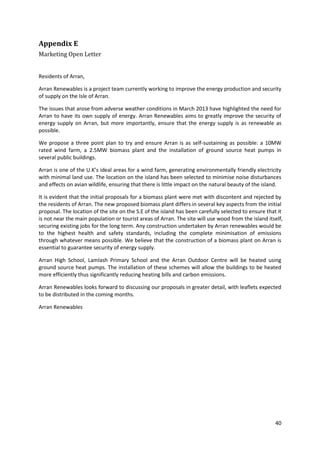
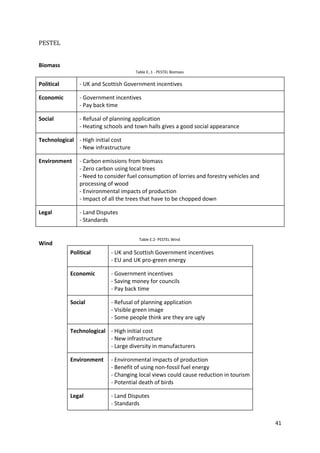
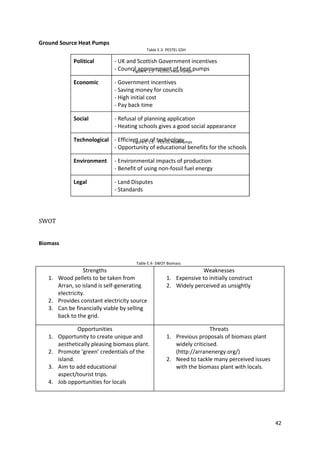
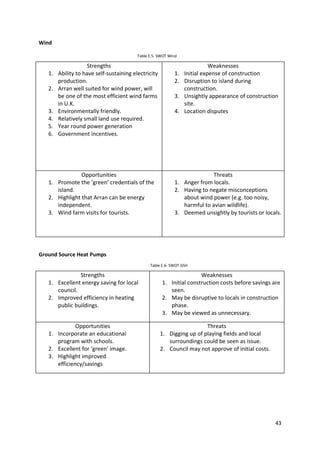
1
Integrated Systems Design Project
Group 13
2
Executive Summary
Following the adverse weather conditions in March 2013 which saw extensive loss of power on the
Isle of Arran, Arran Renewables were asked to come up with a solution which increased the
resilience of energy provision to the island. The proposal outlined in this report will create a near
self-sufficient energy system increasing the security of supply of electrical and heating energy to the
island whilst vastly reducing the carbon footprint and increasing the island’s green image. This will
be done in an efficient and profitable manner that incorporates all environmental and social
concerns adding to the island’s overall appeal to locals and tourists alike.
The proposal aimed to come as close as possible to meeting the Isle’s electrical power demand of 3-
13MW, and reduce the use of fossil fuels in heating systems. After considering all possible energy
sources, a three part scheme was devised. This comprised a biomass plant, a small wind farm and
the installation of electrically powered Ground Source Heat Pumps (GSHPs) in public buildings.
The Biomass Plant will be situated in the south of the island where supply is vast but population
sparse. Rated at 3.45MW it will provide baseload electricity to the island 8000 hours a year. In
accordance to Forestry Commission and Northern Energy figures, 40,000 tonnes of timber grown on
the island is available for use, which will be employed in a wood pellet production plant that
converts virgin wood into wood pellets using the excess heat generated from the plant. This process
increases calorific value of the fuel, improves the efficiency of the system and qualifies the plant for
government subsidy. The plant is located in a 4,000 hectare forest, where half of the commercial
supply of wood is grown, thus significantly reducing haulage by up to 16,800km in total per year in
comparison with current transportation routes. There are clearly major benefits in keeping Arran’s
wood for Arran’s use and this decrease in haulage distances and avoidance of exportation
contributes to the plant’s carbon payback period of less than four months. The location was also
chosen as the surrounding forestry will act as adequate screening of the plant and is far from the
population centres of the island and popular tourist destinations. It will be integrated into the
existing infrastructure on the island via an 11kV distribution line, around 1km from the plants
location.
Systems are proposed to control and reduce the emission of particulate matter, nitrogen oxides,
sulphur dioxides and other compounds. Measures were also taken to ensure there was no significant
damage to the air quality on the island, including electrostatic precipitators, non-catalytic reduction
systems and alkaline sorbent injection systems. The plant will also create thirty jobs on the island
whilst sustaining a further twenty-seven in the wood supply chain.
The Plant will have an initial capital cost of £15.5M with annual operating costs of £2.2M. Income
from sale of electricity, Renewable Electricity Certificates (ROCs) and Levy Exemption Certificates
(LECs) give the plant an estimated payback period of 11.3 years with a Net Present Value (NPV) after
twenty years of £9.55M.
The Wind Farm will be located in the south-east of the island and will consist of four General Electric
GE2.5-193 Horizontal-Axis Wind Turbines each with a rated power output of 2.5MW, giving a total
rated power output of 10MW. The location was chosen due to high average wind speeds, the
avoidance of Special Protected Areas and the minimal visibility levels from the majority of the island
including the population hubs of Brodick and Lamlash. Due to the sparse population of the area,
there will also be no noise concerns for the island’s inhabitants. Using capacity factor of 29.5%,
estimated from scaling of nearby sites, an annual estimated 25.8GWh of energy would be produced
by the plant. The turbines have a built in 690/33kV transformer and will be connected to existing
infrastructure by 3km of 33kV distribution lines. A carbon payback period for the scheme was
calculated at 1.5 years with over 11,000 tonnes of carbon being saved every year compared to the
existing grid mix.
3
The Wind Farm will have an initial capital cost of £14.3M with an annual operating cost of £390k.
Sale of electricity, ROCs and LECs will mean a payback period of 7.8 years with a NPV of £15.2M after
twenty years.
Ground Source Heat Pumps are proposed to be installed in public buildings which currently use oil
for heating. These buildings will be Arran High School, Lamlash Primary School and the Arran
Outdoor Education Centre. Due to their recent construction, all three of these buildings are highly
compatible for efficient use of heat pumps, thus represent a great opportunity to not only
significantly reduce emissions but make a sizeable savings in the long term. The majority of the
remaining public buildings currently use electricity as their heat source which can be considered as
green energy as it will originate from renewable sources via the biomass plant and wind farm. If the
proposed project proves a success this could be rolled out across all public buildings and into private
homes. A 350kV system consisting of three Dimplex heat pumps will be integrated into the schools
and a 60kW system will be installed in the Education Centre. The school system will draw its heat
from a network of eight 100m boreholes in a closed loop system. Due to greater available space and
lower heat demand the Outdoor Centre will acquire its heat from a network of horizontal coiled loop
collectors installed in trenches in the surrounding ground. It is hoped that with an effective
marketing strategy that successful installations of Ground Source Heat Pumps in these buildings will
also encourage homeowners to install their own heat pumps, and thus significantly increase the
energy efficiency on the island, and even further reduce the dependency on the national grid.
The GSHPs will have a combined capital cost of £554k. Very low operational costs and a significant
annual saving in fuel costs give the schemes a NPV of £1.5M based on savings over twenty years
with a relatively short payback period of just over four years.
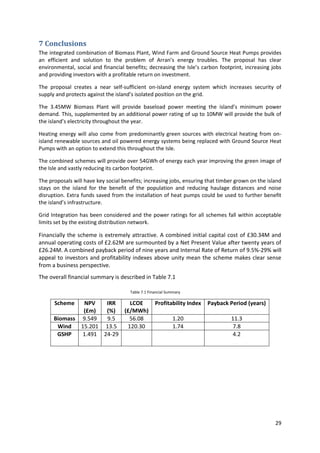
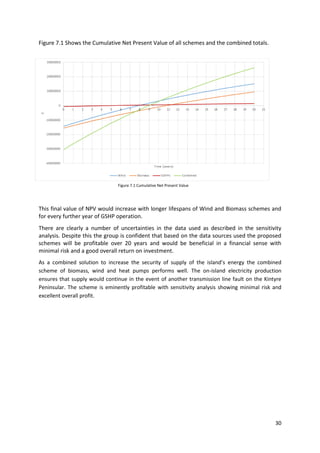
The scheme as a whole is financially attractive. A combined NPV of over £26 million and payback
period of nine years should prove appealing to investors and with an Internal Rate of Return of 9.5-
29% the proposal certainly makes sense from a business perspective. Levelised costs were estimated
at £56/MWh for Wind and £120/MWh for biomass. The respective profitability indexes were
calculated to be 1.20 and 1.74. It is worth noting that these NPVs were based on an estimated design
life of twenty years. This would likely be a conservative estimate particularly for the biomass plant
and heat pumps and increased longevity of the scheme would further increase the financial benefits
of the proposal.
As a combined solution to increase the security of supply of the island’s energy the integrated
scheme of biomass, wind and heat pumps combine well, producing 54.6GWh of energy every year.
The on-island electricity production provides defence against the island’s isolated position on the
grid and ensures that supply would continue in the event of another transmission line fault on the
Kintyre Peninsular. The scheme is eminently profitable with sensitivity analysis showing minimal risk
and excellent overall profit. By significantly reducing the carbon footprint on the island and
focussing on ensuring any public concerns are addressed, it is hoped that the success of this
integrated scheme will also act as a source of encouragement to other consultancies considering the
installation of sustainable energy solutions.
Throughout research on all aspects of the proposal, health and safety and risk concerns were
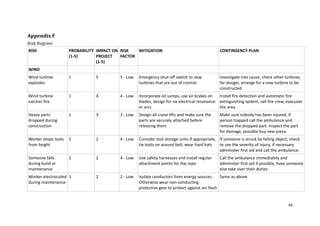
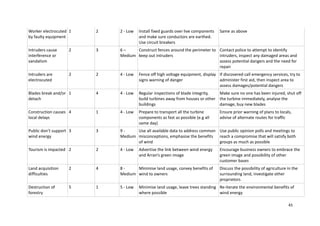
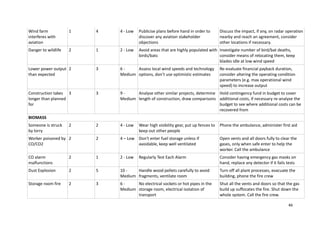
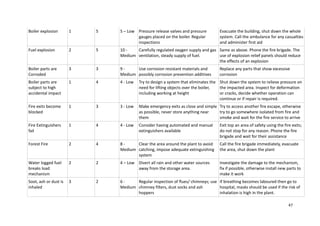
considered and are compiled in a full risk register in appendix F.
4
Contents
1 Introduction .........................................................................................................................................1
1.1 Scope.........................................................................................................................................1
1.2 Our Proposal .............................................................................................................................1
2 Biomass Plant.......................................................................................................................................2
2.1 Location.....................................................................................................................................2
2.2 Plant Type .................................................................................................................................3
2.3 Wood Fuel Supply on Arran ......................................................................................................3
2.4 Plant Power Rating....................................................................................................................4
2.5 Plant Operation.........................................................................................................................5
2.6 Transportation on Arran ...........................................................................................................7
2.7 Emissions...................................................................................................................................8
2.8 Construction..............................................................................................................................8
2.9 Employment and Community ...................................................................................................9
2.10 Financial Analysis of CHP Biomass Plant.................................................................................9
3. Wind Farm.........................................................................................................................................12
3.1 Location...................................................................................................................................12
3.2 Technical .................................................................................................................................12
3.3 Social Factors ..........................................................................................................................14
3.4 Site Access...............................................................................................................................15
3.5 Environmental Impacts...........................................................................................................16
3.6 Finance....................................................................................................................................17
4. Grid Integration.................................................................................................................................19
4.1 Connection to Existing Infrastructure.....................................................................................19
4.2 Wind Farm...............................................................................................................................19
4.3 Biomass Plant..........................................................................................................................19
4.4 Protection and Switch Gear ....................................................................................................19
5 Ground Source Heat Pumps...............................................................................................................20
5.1 Location:..................................................................................................................................20
5.2 Technical Details .....................................................................................................................20
5.3 Environmental and Social Considerations ..............................................................................23
5.4 Finance....................................................................................................................................24
6.1 Introduction ............................................................................................................................26
6.2 Public perceptions...................................................................................................................26
6.3 Campaign focus.......................................................................................................................26
5
6.5 The Marketing Mix..................................................................................................................28
7 Conclusions ........................................................................................................................................29
Appendix A............................................................................................................................................31
Appendix B............................................................................................................................................32
Appendix C............................................................................................................................................34
Appendix D............................................................................................................................................38
Appendix E ............................................................................................................................................40
Appendix F ............................................................................................................................................44
Appendix G - References.......................................................................................................................54
1
1 Introduction
1.1 Scope
Situated in the South West of Scotland, the Isle of Arran is a small, remote and sparsely populated
island that attracts countless tourists each year. Although its remote location adds to the islands
appeal, it also presents a certain amount vulnerability to the isle, as it relies on numerous resources
including energy supply from the mainland. In late March 2013, when adverse weather conditions
resulted in the toppling of eight large pylons on the 132 KV transmission system in the Kintyre
Peninsula and as a result cut the sole source of power to the Isle of Arran, transmitted through 2 x
33 KV underwater cables. Although power was restored to some parts of the island within a
relatively short period of time due to the presence of stand-by generators, thousands of properties
were affected, creating mass disruption on the island. In the aftermath of this event, it became clear
that the resilience of energy provision on the island had to be strengthened to ensure that this
incident was not repeated. The focus of this study is to provide this resilience, by installing clean
renewable energy sources on the island that would not only increase the security of energy supply
on Arran, but also significantly reduce its carbon footprint. By considering all forms of renewable
energy generation, we aim to create an efficient and profitable energy solution that incorporates all
environmental and social concerns, thus adding to the islands overall appeal to both locals and
tourists alike. As a company with a strong desire to help create a sustainable future, we also believe
that this project can set a precedent to other consultancies who doubt the feasibility of renewable
energy solutions.
1.2 Our Proposal
By studying all possible renewable energy sources and how they could be implemented on Arran, it
became apparent that in order to meet our initial aim, only a few sources where feasible. Having
contacted Arran Community Council it was found that the power demand of the island varies
seasonally from 3-13MW.
In order to provide an electrical base load, a Biomass Plant will be installed in the south of the island,
producing 3.45MW of electrical power. A previous Biomass Plant proposition was rejected due to
public opposition but by studying in depth all prior public concerns, this plant is not only more
efficient, but is hugely carbon beneficial and significantly reduces timber haulage on the island,
preventing mass exportation. These policies are emphasised in our marketing campaign. The plant
will be a CHP plant in the form of pellet production, the function of which, and measures employed
to ensure the efficiency of the plant, are discussed in Section 2.
In the south east of the island a 10MW rated wind farm is also proposed. As well as adding to the
base load produced, the wind farm will integrate well with the Biomass Plant, with the limited felled
forestry for the wind farm re-used as fuel for the Biomass Plant and downtime of the Biomass Plant
chosen when high constant winds are forecast. A full explanation of the technical specifications and
location considerations is found in Section 3.
Ground Source Heat Pumps will also be installed in three public buildings on the island, Lamlash
Primary School, Arran Outdoor Education Centre and Arran High School. These buildings have been
chosen due to their suitability. Unlike all other public buildings which are electrically heated by the
renewable sources discussed, these buildings are currently heated by oil boilers. A full description of
the various models and energy values used is found in Section 5.
All three systems were given a full financial analysis, risk register (Appendix F) and business plan, and
prove profitable over a twenty year period. This report aims to illustrate the benefits of the schemes
both individually and as an integrated system providing electrical and heating energy to the island.
2
2 Biomass Plant
2.1 Location
One of the main concerns when considering the installation of renewable energy systems at any
scale is the predictability of energy output. Few renewable sources can provide a consistent and
reliable output. Biomass is one of the few forms of renewable energy that delivers base load and
dispatchable energy. The fundamental principle of biomass is to produce carbon neutral energy.
Although the plant releases CO2 into the atmosphere, it also absorbs it at an equal or similar rate. In
order to achieve this it is important to have a sustainable fuel supply that is developed in an efficient
and environmentally friendly manner. With around 11,000 hectares of forestry on the island [2.1]
,
74% of which is owned by the Forestry Commission [2.2]
, Arran is the ideal location to utilise such a
vast resource, whilst also preventing mass exportation of timber. As the plant does not require any
importation of fuels, the energy supply will not be exposed to disruption, which crucially increases
the island’s security of supply. The plant itself is to be located on the South of Arran, within the main
forested area, where the supply is vast and the population sparse. Located less than 1km from an
11kV distribution line that will require no transformation, both costs and visible impact will be
minimised (which is discussed further in Section 4). The plant is also located out with Special
Protected Areas and Areas of Scientific Interest, which were created to protect the vast amount of
wildlife and in particular birds on the island [2.3]
The plant is to be situated in an open area within the largest forest on the island, which covers
around 4,000 hectares and is the source of about 50% of the islands commercial woodland [2.2]
. The
plant is situated just south of an Area of Scientific Interest. The site can be easily accessed by forest
estate roads and is not near any densely populated areas. The closest village to the site is that of
Kilmory which only has a few houses and is around 3.5km away from the site. Lamlash, which has
the highest population of any of the villages (1,100 people) is around 8.5km away and is out with the
sound range of the plant. The plant itself is not expected to make a lot of noise but in order to
ensure there are no adverse noise affects, components such as the cooling tower will face in a north
western direction, where there are no homes for over 10km. Mechanisms such as the steam turbine
generator and wood chipper will also be insulated to ensure that no hearing protection would be
required in close proximity of these areas. Due to the plants location, timber haulage will also be
dramatically reduced on the island, significantly lessening any transportation concerns (covered in
depth in section 2.6). Although the highest point of the plant is 30m, the visual impact of the plant
will be minimal, due to the surrounding forestry acting as a screening, ensuring the natural
appearance of the area will remain from afar. With no population within 3.5km of the site and
limited population within 8.5km, the plant will have very little impact on the people of Arran.
Figure 2.1 – Map of South Arran showing location of the Biomass Plant
Figure 2.2 – Image of proposed Biomass plant
Figure 2.3 -Special Protected Areas and Sites of Scientific Interests
(pink – SPA, pink and red stripes – AOSI)
3
2.2 Plant Type
Although Biomass Plants are capable of producing a constant and reliable source of energy, a large
amount of the energy produced is released as heat if not utilised efficiently. A common approach to
utilise such heat is to use a CHP plant with district heating. Though the location of our plant is
beneficial in terms of visual, sound and environmental aspects it will be positioned too far from
populations to make district heating effective and financially viable. To overcome the inefficiencies
of non CHP plants, our plant will be a CHP pellet production plant. This process involves producing
wood pellets by chipping and pulverising virgin wood into sawdust, then putting the sawdust under
intense pressure and heat (the excess heat from the biomass plant) so a glue type substance is
formed that binds the wood together into a single doughy mass. This mass is then pushed through a
die with small holes, cut and cooled to produce the pellets as shown in Figure 2.4. The weight of
pellets produced is roughly half of what you put into the processing plant but the pellets burn much
more efficiently due to their decreased moisture content (<10%)[2.23]
in comparison to virgin wood
(around 50% moisture content). The plant will therefore produce a more efficient fuel source which
can be burned in the biomass plant, and will also allow the proposal to qualify for government
subsidies and incentives. If at any point there is a surplus of pellets it is possible to sell them to local
homes and businesses for an estimated £200 per tonne [2.4]
.
2.3 Wood Fuel Supply on Arran
Having contacted the Forestry Commission directly, it was stated that they currently own 11,000
hectares of forestry on Arran, and fell the equivalent of 70,000m3
of woodland. Using a provided
standard conversion figure of 1.23, the predicted supply in tonnes is therefore 70,000/1.23 = 57,000
tonnes. Of this total, roughly 60% would be available as biomass wood fuel, giving a projected
supply of 34,000 tonnes of Small Round Wood (the majority of which is Sitka Spruce) per year (the
same figure as the was planned for the previous Northern Energy proposal) [2.2]
, with the other 40%,
which is a higher grade of wood, used in Troon as logs for kit houses and other construction. Small
Round Wood is currently transported to Irvine for making paper and producing electricity and to
Lockerbie to make pallets. A local supply chain for the proposed Biomass plant would eliminate mass
exportation, significantly decreasing costs and carbon emissions. Previous documents on
sustainable wood supply on the North Ayrshire Council website regarding the previous biomass plant
proposition on Arran states that both the Local Council and Forestry Commission are “seeking the
steady and sustainable long-term management of the woodland resource on an economic basis” [2. 2]
.
This is a sustainable and reliable source of energy that is provided on the island, which not only aids
the aim of carbon neutrality of the plant, but also provides a constant source of income for the local
economy. Taking figures from the Northern Energy previous Biomass Plant proposal, a further 6,000
tonnes will be available for use from private forestry, and 1,800 tonnes from “thinning” (reducing
density of forest to improve growing conditions for other trees by increasing space). This gives the
maximum total figure of biomass wood fuel supply on Arran as:
34,000tonnes (FC) + 6,000tonnes (private forestry) + 1800tonnes (thinning) = 41,800 tonnes
A total of 40,000 tonnes will be used for the plant, providing an adequate safety margin.
Figure 2.4 – Wood Pellet Production Process
4
2.4 Plant Power Rating
2.4.1 Maximum Power Calculations
Using the available 40,000 tonnes of wood fuel per year, the maximum rating of the biomass plant
was then calculated. As previously stated, the virgin wood supply is dried using the CHP plant to give
wood pellets of approximately 10% moisture content (this is a conservative estimate used in the
calculations to ensure the proposed power can certainly be provided – it will be 5-10% in reality).
The final mass of the wood pellets after drying to 10% moisture content was calculated to be 17,778
tonnes per year. This was calculated by using the ratio of initial to final mass of pellets, which is
divided by the wood supply as shown below:
From this the mass flow rate, ̇ of the pellets into the plant was found. Using a load factor 91% and
operation 8000 hours per year (leaving 760 hours of downtime for maintenance), the mass flow rate
in kg/s was calculated to be 0.6172 kg/s, as indicated in the following equation:
̇ ( )
( ) ( )
( ) ( )
The total power of the fuel to the biomass plant was then calculated by multiplying the calorific
value (C.V.) of the wood pellets by the mass flow rate into the plant. The calorific value of wood
pellets is kJ/kg[2.5]
, so the total power was found to be 10,777.7kW:
̇ ( ) ( )
The electrical power output (or power rating), , of the plant was then found from this using an
overall electrical efficiency of [2.6]
, giving a value of 3.45MWe as shown:
The energy from the fuel supply that is not converted to electricity is converted to excess heat
energy, , which is calculated to be 6.03MW, assuming a boiler efficiency of = 88% [2.7]
.This
6.03MW of thermal energy is used to dry the virgin wood for pellet production, increasing the
overall energy production of the plant. The equation used for this calculation is shown below:
2.4.2 Increase in power using CHP
The increase in power rating by using the CHP plant has been estimated by calculating the maximum
power output of virgin wood with a standard moisture content of 60%. The energy density of this
wood according to the forestry commission is 6.24MJ/kg [2.8]
. Using the same method employed in
calculating the total power of fuel above, for 6240kJ/kg and 40,000 tonnes of virgin wood supply for
combustion and the same 32% electrical efficiency, it can be calculated that the electrical power
rating of the plant would be 2.78MW. Therefore, this increase in plant efficiency, increases the
electrical power output of the biomass plant by 3.45MW – 2.78MW = 0.67MW. At a relatively
modest cost this is a significant increase in power rating over the lifespan of the biomass plant, and
is therefore an effective way to increase its overall efficiency.
5
2.5 Plant Operation
The virgin wood will be delivered by 25 tonne lorries with a tipper trailer that will tip the wood
directly to a silo. Once the wood is converted to pellets, it will be stored in a silo that will then feed
the wood pellets by auger directly into the boiler. The operation of the plant itself will require a
number of buildings and facilities for power generation, office buildings and manoeuvring areas. The
plant will therefore be built within a 4 hectare site, which will provide room for the following:-
 Boiler Building – height of 30m
 Turbine Building – height of 16m
 Cooling Systems
 Wood storage – 1 hectare
 Weighbridge
 Pellet production plant
 Pellet storage unit – height of 4m
 Pellet silo – height of 12m, capacity of 500 tonnes (around 9 days supply)
 Office (Including managerial, accountancy, secretarial offices, toilets, maintenance stores)9
 30m Flue (Chimney)
 Screening – trees to block view of plant as much as possible
 Room for parking (20 cars) and lorry manoeuvring
The equipment needed to produce the electricity includes:-
 Biomass boiler
 Steam turbine electrical generator
 Feedstock material handling system
 Electrical transformer
 Cooling water system
 Biomass unloading/transfer system
The plant itself will be powered by a process of combustion. Combustion directly burns the biomass
fuel to produce a hot flue gas which is used in a boiler system to generate steam. This is preferred to
gasification, which converts biomass fuels into a gas through use of chemicals into a combustible gas
which is then burnt to produce a hot flue gas that is then used in a boiler system to generate steam.
Although gasification is generally more efficient and produces fewer emissions than combustion, it is
still in its demonstration phase, with high capital and running costs, requiring very specific and clean
fuel which may lead to maintenance problems. As a result of this, the risk of using gasification is too
high, and the cheaper, simpler combustion process will be used as it has a more flexible fuel choice
and is a much more proven system.
In terms of the choice of boiler, the step grate combustion system will be installed. This method
moves fuel through different stages, combusting the material at each stage to ensure all
combustible material is used by the end of the combustion phase. Any waste ash falls through a
grate and is collected for disposal. This method is more efficient when using a single high grade
source such as pellets. A 3.45MW plant requires a thermal boiler with a capacity of 35MWh. For
capacities under 50MWh the stepped grate combustion boilers are the most economical. This
process has been chosen over fluidised bed technology, which although control emissions better,
without using more expensive equipment such as filters and scrubbers, is less efficient when using
one type of high grade fuel source (e.g. wood pellets). Figure 2.5 on the following page, illustrates
the step grate combustion process:
6
Figure 2.6 – Ebnervyncke Hot Gas Generator
The most suitable boiler found was the Ebnervyncke HGG Hot Gas Generator (Figure 2.6) which
comes in different models capable of producing 3-102MW of electricity. It is also effective for pellet
production and can heat hot gases, with the ability to feed heat directly to rotary drum dryers.
The turbine chosen was an M&M Turbinen Technik 7 to 9 stage turbine, which is the industry
preferred turbine for this application, using steam to power the turbine. The turbine
thermodynamics are shown below.
Steam at entry to turbine – Pressure 65 bar
Temperature 450o
C
Steam at exit of turbine - Pressure 1.5 bar
Temperature 80-120o
C
Using this information the mass flow rate through the turbine was calculated using enthalpy tables
[2.5.1]
and was found to be 6.003 kg/s. This process for this calculation is shown below:
⁄
⁄
⁄
̇
̇
̇ ⁄
Connected to the turbine will be an INDAR 3.5MWe (4,375 MVA) generator giving an output voltage
of 11kV at 50Hz [2.10]
. Due to the multi stage turbine the generator will have 2 poles and operate at
around 3000rpm. It will also have the capability to operate independently of the grid and will be
cooled by a cold air cold water system (water temperature of around 25o
C) and the design will
conform to BS4999 Part 101 (British Standards)[2.10]
Figure 2.5 – Step Grate Combustion Boiler
7
2.6 Transportation on Arran
As stated the plant will be located next to the source of about 50% of the islands commercial
forestry. Due to the chosen location of the plant, half of the year’s supply of wood can be
transported short distances on forestry roads, avoiding public routes. The 20,000 tonnes of wood
that will require significant transportation, will be transported using 25 tonne lorries. This is the
equivalent of 800 lorry loads per year (20,000 / 25 = 800), which within a five day working week is
only 3 lorry loads per day (800 / (365-(2x52)) = 3.06). In order to comply with noise regulations, this
transportation will only occur between 8.00 and 18.00. In terms of access to the site, the public
roads are divided into agreed routes (timber haulage any time), consultation routes (consultation on
timing and frequency), severely restricted routes (extra consultation on weight and vehicle type),
and excluded routes. A map of the agreed and consultation routes is shown below, within which red
- agreed routes, yellow - consultation routes, green - woodland that requires forest haulage, blue -
woodland accessed by consultation routes and the purple dashed lines are forest estate roads [2.2]
.
It is evident on the above map that almost all of the forested areas require the use of consultation
routes. However, with only three lorry loads per day, agreeing specific times that they can be used
will not be an issue. The haulage distances to the chosen site are compared to the current haulage
distances to Brodick in table 2.1. In total, 16,800 km in timber haulage will be saved each year as a
result of this proposal , which as well as reducing noise pollution, will also reduce transport costs and
carbon emissions, ensuring that the natural and tranquil feel of the island remains.
Forest Haulage distance to site (km) Haulage distance to Brodick (km)
1 27.5 22.6
2 22.5 12.1
3 16.4 21.5
4 15.1 14.3
5 5.4 19.7
Total Round Trip Haulage (km) 173.8 180.4
Tonnes of wood transported 20,000 20,000
Trips (25 tonne lorry) 800 800
Main Forested Area haulage (km) 0 7.2
Tonnes of wood transported 0 20,000
Trips (25 tonne lorry) 0 800
Total distance covered (km) 139,040 155,840
Figure 2.7 – Map of Arran showing possible transport routes to the site
Table 2.1 – Timber haulage for Biomass Plant compared with current haulage to Brodick
8
2.7 Emissions
Although Biomass Plants are a renewable source of energy, there are significant emissions that need
to be considered. Although CO2 will be released in the process, there are many factors that combine
to ensure that the plant itself is “carbon beneficial”. One major carbon saving is the preventing mass
exportation of woodland, which is illustrated in table 2.6.1 below. For creating this table, the
average haulage distance and CO2 production for haulage to the mainland are taken from the
document on the North Ayrshire council website on sustainable fuel supply for the previous plant
proposition [2. 2]
.
Distance
(km)
CO2 produced (kg)
based on 0.889kg/km
CO2 produced (kg) based on total tonne
haulage (40,000 - exportation, 20,000 - site)
Average haulage
to mainland 165 147 235,200
Average haulage
to site 17 15 12,000
Savings 148 132 223,200
The total CO2 produced for the site is based on calculating the total number of trips (22,000 / 25 = 800) and multiplying it by the CO2
produced for each trip (800 x 15 = 12,000kg).
With the Forestry Commission continuing to regrow the felled trees that provide fuel for the plant,
there will also be no net carbon gained by the atmosphere during production, with the CO2 released
being absorbed at the same rate. This carbon neutrality, coupled with the reduction in
transportation of wood and the related emissions from the previous energy source, ensures that the
plant will be carbon beneficial. There will be CO2 released as a result of the construction of the plant
and the renovation of access routes to the site. An overall carbon payback period can be calculated
by taking data from the International Energy Agency [2.11]
and Wind Action (which although is used
predominately for wind, states standard rules that can be used). This was found to be only 3.5
months, with the full calculations and working shown in Appendix B.
In order to control the release of particulate matter, the proposed plant will use an electrostatic
precipitator that will collect matter that is carried as dust in the hot exhaust gases [2.12]
. This
precipitator functions by electrostatically charging the dust particles that are attracted to collection
devices which then dislodge the dust when they are full, which are then used for disposal or
recycling. This process involves ionisation and then migration, which is followed by dissipating the
charge, dislodging the particles and then removing them. As well as this, selective non-catalytic
reduction systems (SNRC) will be used to control nitrogen oxide emissions by more than 80%. SNRC
systems inject a reagent like ammonia directly above the combustion, where temperatures are
between 850 and 1050o
C, creating N2, CO2 and H2O. It is an extremely cost effective and efficient
process compared to Selective Catalytic reduction (where a gaseous reductant is added to an
exhaust gas and is adsorbed onto a catalyst) and is installed in a matter of days. In order to control
the release of HCl and SO2 compounds, alkaline sorbent injection systems will also be installed. This
is a cost effective way, in comparison with scrubbers, to neutralise the Sulphur and Hydrogen
Chloride gases produced. It involves a direct injection of alkaline material, most probably lime, into
the flue gas, causing a continuation of neutralisation down to the filter. This is an easy process that
has low capital and maintenance cost, contributing significantly to the quality of the air released into
the atmosphere.
2.8 Construction
For the construction of the site, there will need to be work done to the access routes for the plant.
The site is most accessible from the south side, where there is a forestry route that is around 2.4km
to the plant from the public road. By widening and strengthening the road, it will allow heavy
machinery to enter the site. Taking guidance from a previous constructed plant by Rose Energy in
County Antrim of a similar size, the roads will be widened to 7.5m (around double the current width)
[2.13]
.
Table 2.2 – Carbon and cost transportation savings of proposed
plant
9
2.9 Employment and Community
Although the Isle of Arran has relatively high employment rates, 0.9% unemployment in comparison
to 2.9% for Scotland (courtesy of the Office of National Statistics), it is strongly affected by the
seasonal nature of the tourism industry [2.14]
. The proposed Biomass Plant will also benefit the island
and offer a consistent source of jobs all year round. Taking results from the same type and similar
size of plant[2.15]
, it is expected that a total of 30 jobs will become available. The breakdown of these
jobs is shown in Appendix B. As well as offering full time jobs and thus helping with the local
economy, the plant will also provide an opportunity for recreational and leisure activities, such as
guided tours round the plant. It will also be a useful educational source for both locals and tourists
eager to find out about the plant and renewable energy, helping raise awareness of clean energy
solutions and providing a great place for schools to learn more about sustainable energy.
2.10 Financial Analysis of CHP Biomass Plant
2.10.1 Capital Costs
Due to the project-specific nature of CHP biomass plants and pellet production plants, it is extremely
difficult to gauge an entirely accurate figure for the capital expenditure. To best represent this,
similar plants throughout Europe were investigated. By looking at a selection of plants with a similar
annual output and that also use the heat produced onsite to power wood production plants etc., a
typical value was estimated – £15.5 Million[2.16,2.17]
. The capital cost is inclusive of all aspects of
construction, including: access roads, grid connection and all start up equipment for both.
2.10.2 Operational Costs
The economics of biomass power generation are critically dependent upon the availability of a
secure, long term supply of an appropriate biomass feedstock at a competitive cost. A figure of
£22/tonne was given by the Forestry Commission.
Operational and Maintenance costs (O&M) can be divided into 2 components: fixed and variable.
Fixed O&M costs consist of labour, scheduled maintenance, routine component/equipment
replacement (for boilers, feedstock handling equipment, etc.), insurance, etc. The larger the plant,
the lower the specific (per MW) fixed O&M costs. Variable O&M costs are entirely dependent upon
the output of the plant. They include non-biomass fuels costs, ash disposal, unplanned maintenance,
equipment replacement and incremental servicing costs. Biomass systems generally require more
maintenance time than their counterparts – this can be 0.5 to 1.5days a month [2.18]
.
Given below is a table of the primary components of the operational costs of the CHP and pellet
production plants (values obtained by comparison with data from a 16MW plant in Wales) 25
.
Another crucial aspect of plant operation is the system employed to deal with ash. A figure of 0.5-1%
can be expected per tonne used. A rate of £10/tn is assigned to the removal [2.18]
. Although the
Table 2.3 – Operational and Maintenance Costs
10
values given are an estimate, various operational techniques may be employed to reduce the annual
costs[2.18]
. They include the use of high quality fuel (pellets reduce ash and therefore ash removal
cost), conducting regular checks and maintenance, thus to prevent any serious malfunction and
avoiding “short-cycling – maximise operating time between plant shutdown.
2.10.3 Subsidies and Income
The CHP Biomass plant will be connected to the UK Electricity Grid, and so any deficit or excess
can be buffered by the Grid. The sale of electricity to SSE is estimated to be £55/MWh[2.19]
. In
addition to this income, there are also various subsidies for the production of renewable energy.
Biomass CHP is considered eligible for the support of Renewable Obligation Certificate with the
claim that the biomass CHP is accredited under the Combined Heat and Power Quality
Assurance (CHPQA) programme by the supplier 26
. The plant is eligible for 2 Renewable
Obligation Certificates (ROCs) at a current price of £42.37/MWh and a Levy Exemption
Certificate (LEC) of £4.50 (as of Dec 2013) [2.20]
. Note: the plant is not eligible for the Renewable
Heating Incentive (RHI), as a consequence of the heat produced being used by the plant itself to
power a pellet production plant.21
2.10.4 Results
The following section outlines the main finding of this financial analysis:
 NPV £9.55 Million
 LCOE £120.30/MWh
 IRR 10%
Figure 10.2 above indicates a payback period of approximately 11.3 years. There is also a Benefit to Cost ratio of 1.2 (B/C>1,
thus indicating the project is feasible).
Table 2.4 – Plant Income
Figure 2.5 – Cumulative NPV
11
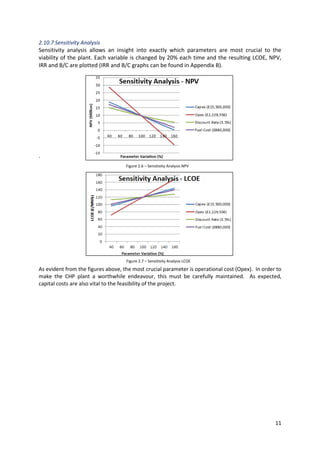
2.10.7 Sensitivity Analysis
Sensitivity analysis allows an insight into exactly which parameters are most crucial to the
viability of the plant. Each variable is changed by 20% each time and the resulting LCOE, NPV,
IRR and B/C are plotted (IRR and B/C graphs can be found in Appendix B).
.
As evident from the figures above, the most crucial parameter is operational cost (Opex). In order to
make the CHP plant a worthwhile endeavour, this must be carefully maintained. As expected,
capital costs are also vital to the feasibility of the project.
Figure 2.6 – Sensitivity Analysis NPV
Figure 2.7 – Sensitivity Analysis LCOE
12
3. Wind Farm
3.1 Location
With impressive average wind speeds and a sparse population, Arran is ideally suited for wind power.
Alongside the proposed Biomass Plant, wind energy will also increase the green image of the island
and generate profit with an impressive payback period. The wind farm is to be located on the South
East of the island close to Loch Garbad as shown in figure 3.1 below:
This location was chosen for a variety of reasons. It is situated in one of the windiest parts of the
island with a mean wind velocity of 10.2 m/s at 45m height [3.1]
. It is also outwith Areas of Scientific
Interest and Special Protected Areas[3.2]
, the map of which is shown as figure 2.3. There will also be
no noise concerns and visibility will be kept at a minimum.
The mean wind velocity is given on the NOABLE Wind Speed Map [3.1]
, which states that wind speed
is 9.3 m/s at 10m; 9.8 m/s at 25m and 10.2m/s at 45m height. Extrapolating these values using a
conservative Hellman exponent of 0.25, (complex terrain with mixed or continuous forest) the mean
wind velocity is found to be 12.4 m/s at a height of 98m. Whitelee wind farm, 60km to the North-
East of the site boasts mean wind velocities 10-20% lower. The load factor for the site was based on
this information, with Whitelee’s quoted value of 27%[3.3]
being scaled up to a conservative value of
29.5%.
The wind farm is located within the forested area and is a significant distance from any populated
areas on the island; around 3km from the small villages of Kildonan and Whiting Bay and around
7.5km from the larger village of Lamlash (which homes 1,100 people). As a result, there will be no
issues with noise as the sound impacts of wind turbines generally only stretch to a 400m radius [3.4]
.
3.2 Technical
3.2.1 Components
The wind farm will consist of four General Electric GE2.5-103 Horizontal-Axis Wind Turbines (HAWT);
each with a rated power output of 2.5MW. Thus, the nameplate capacity of the entire installation
will be 10MW. Using a capacity factor of 29.5% this gives a total annual energy output of 25,842
MWh. The components are as follows:
- Four General Electric GE2.5-103 wind turbines.
- 690V/33k step-up transformers (located in the base of each turbine)[3.5]
- 33kV collection system to link the wind turbines to the substation
- substation containing appropriate switchgear
- Wind turbine access roads
- 3km of 33kV distribution line to connect to the existing infrastructure in the South East of the
island, which is covered in detail in section 4.
Figure 3.1.1 – Location of Wind Farm
Figure 3.1 – Site Location
13
3.2.2 Wind Turbine Generators
The turbine towers have a hub height of 98.3m and a blade diameter of 103m. The nacelle atop each
tower contains the gearbox, bearings, couplings, generator and inverter, and is made of fiberglass
with sound insulating[3.5]
. It is lit and ventilated for the convenience of site workers. For reasons of
economy there will be no personnel lifts inside the towers, only stairs. However, there is a possibility
of retrofitting the towers with lifts at a later date if required.
3.2.3 Basic GE2.5-103 specification
Details of the turbines Reactive Power and Compensation can be found in Appendix C. The VAR
specification provides the option of a 'WindFree Reactive Power' function. This means that the
turbine can also make reactive power (up to 1328 kVAR) available as a voltage buffering during the
full operational range (0-2750 kW), even during calm periods or strong winds [3.6]
. Capacitors for the
compensation of reactive power are not necessary [3.6]
.
Manufacturer General Electric (GE)
Model 2.5-103
Nameplate Capacity 2500kW
Hub Height 98.3m
Rotor Diameter 103m
Blade Sweep Area 8328m
2
Generator Output Voltage 690V AC (50Hz)
Transformer Output Voltage 33’000V AC (50Hz)
Approximate Diameter of Foundation 18 metres
Figure 3.2- Turbine Dimensions
Table 3.1 - Basic Specification [3.17/3.18]
Figure 3.3 - Nacelle Layout
14
3.3 Social Factors
In terms of visibility, being in the sparsely populated south east of the island, within the main
forested area, the turbines will not have major effects on the scenery of Arran. The proposed wind
farm will consist of 4 turbines with a hub height of 98.3m and a blade radius of around 50m. In
order to gauge the level of visibility of the turbines on the island, they can be compared to the
turbines that were put forward in a previous proposal from Green Power[3.7]
within which there were
8 turbines with a tip height of 102m in a location just north east of the current proposition. On the
following page labelled Figure 3.1.2 is a visibility map for this proposal, where dark blue represents
visibility of 7-8 turbines, light blue 5-6, green 3-4, and yellow 1-2. The red dots are specified visibility
points. By analysing this map, it can be deduced that visibility from the most populated area of the
island (the central east part where Brodick and Lamlash are situated) is likely to be limited. Visibility
in the northern areas, particularly the west is also likely to be minimal with the south east the most
affected area, which is of little concern due to its sparse population. It is important to note that the
information stated is simply assumptions based on the analysis of Figure 3.4, noting that although
the turbines are taller for this proposal, the extent of visibility for the previous scheme suggests that
these turbines will not dominate the scenery of the island. These concerns are also lessened when
considering a survey conducted on Arran regarding the use of wind turbines on the island in 2006
(also sourced from Green Power [3.7]
). This indicated that the majority were in favour of wind
turbines on the island, which suggests that as long as there are no direct effects of such a scheme on
the island, its introduction would be welcomed. A pie chart of this summary is also shown below, as
Figure 3.5:
While the height of the proposed turbines does mean they will be significantly more visible than the
previous proposition in 2007, their height is justified as it ensures that the land usage is considerably
less, which has notable benefits in decreasing the impact on the wildlife and resulting in only
minimal levels of forestry being unavailable for regrowth. The four wind turbines will be situated
linearly in a south-east: north-west alignment, 200 metres apart. The turbines will require felling of
an estimated area of 7020m2
of forestry, including access roads and foundations (the calculations for
which can be found in Appendix C). Using the conversion ratio given by the Forestry Commission[3.8]
,
the felling of woodland will account for 5,707 (7020/1.23) tonnes of wood. In co-operation with the
Forestry Commission, this wood would be used for the biomass plant, ensuring that is used
Figure 3.4 – Visibility map of previous Wind Farm with 8, 102m tip height turbines.
Figure 3.5 – Survey conducted on Arran of a proposed wind farm in 2006
15
productively, even though there will be no regrowth within the purchased area. We are confident
that the Forestry Commission would oblige to this request having contacted them directly and also
providing them a steady and sustainable woodland consumer in the form of the Biomass Plant that
will require minimal transportation and zero exportation to the mainland.
3.4 Site Access
With significant hub heights and blade diameters, transportation of the turbine components will not
be a simple process. The components will be delivered to the island by boat, before reaching Brodick
Ferry Terminal. The route to the site, which is shown in figure 3.7 below, does encounter some
complications, as highlighted on the image. There are a few tight corners that will require close care
and attention, but most bends in the road do comply with GE specifications [3.9]
. The expanded
image shown in figure 3.7 does not but such complications will be circumvented by felling a small
area of forestry which will encompass around 30 trees and constructing an alternate route, ensuring
all GE specifications are met. This route extends as far as Woodlea Cottages, by Glenashdale Wood,
beyond which point it will be necessary to construct a bespoke access route southwards towards the
wind farm site. It is likely that the stretch of track from the Ross to Woodlea Cottages will also need
to be upgraded to meet GE specifications (figure 3.8) before it will be suitable for use for this
purpose. This has been accounted for in the total capital cost of the wind farm project.
Figure 3.6 – Wind Farm Layout
Figure 3.8 – Specification of required road characteristics for transportation from GE
Figure 3.7 – Site of particular interest where circumvention is required
16
3.5 Environmental Impacts
3.5.1 Wildlife
One of the main concerns with the instillation of wind turbines is the effects that it can have on birds
and bats, with some claiming it can result in a substantial amount of deaths. The prospect of such
events would be detrimental for Arran, as it inhabits over 250 different species of bird [3.2]
. Arran is
described as Scotland in miniature, with the northern half rugged, mountainous and remote and the
south made up of moorland and much of the islands farmland. The south east part of the island is
home to most of the widespread and common birds in the area including buzzards, kestrels and hen
harriers. Hen harriers in particular are very important to the nature of Arran as it has around 5% of
the UK’s breeding population (more than England). Although most studies show little overall impact
of wind turbines on birds, precautionary measures will be taken to ensure there are no adverse
effects on the islands birds. This will be done by making the wind turbines motionless during very
low wind speeds. This is when both birds and bats will be most active and will thus lessen the
chances of any instances significantly. When the winds are high and the turbines are in full motion,
the quantity of birds or bats at that height is likely to be limited.
3.5.2 Peat Land
Another environmental aspect that has to be considered is the potential impact on peat lands of
wind farm instillations. Installing wind farms can cause drainage of peat lands which can result in the
loss of CO2 to the atmosphere as a result of desiccation of acrotlem and exposure of catotelm to
oxidation [3.6]
. Although the area covered by the wind turbines is limited and the scale of carbon loss
is in most cases modest, it is important to at least consider its potential affects for the chosen
location. Having studied geological maps from the British Geological Survey, it seems relatively clear
that the wind farm is not within an area of peat land [3.10]
. Due to perhaps the level of forestry, there
are many areas within the map given by the BGS that state that there is no record for the superficial
geology, but the fact that the chosen area is surrounded by Devensian Till and Alluviam deposits
suggests that it is not a concern. Figure 3.9 is from the BGS map, with brown representing peat land,
yellow representing Alluviam deposits, blue representing Devensian Till and grew representing no
available data yellow representing Alluviam deposits:
Figure 3.9– British Geological Survey Map of superficial geology
17
3.5.3 Emissions
Although the wind turbines themselves have zero emissions, there will be emissions as a result of
the construction of the farm and the use of backup power, which must be factored. A carbon
payback period can be calculated by using data from “Wind Action”[3.11]
, Renewable Energy Solutions
for Penmanshiel Wind Farm [3.12]
and Viking Energy [3.13]
on the emissions during construction and
relating it to the current use of the grid.
The carbon payback period for the scheme was calculated at 1.46 years with 11,000 tonnes of
carbon being saved each year. This value was obtained taking into account the carbon level released
from the current energy use, as well as the carbon output of the construction process, back-up
system and deforestation. The calculations are shown in detail in Appendix C. With a carbon
payback period of under 1 and a half years and zero emissions throughout its lifespan, it can
therefore be stated that the wind farm is an extremely successful way of reducing the islands carbon
footprint.
3.6 Finance
Using estimated capital costs, operating costs, energy outputs and income the Net Present Value
(NPV), Internal Rate of Return (IRR) and Levelised Cost of Energy (LCOE) were calculated. These
variables were all considered in a full sensitivity analysis.
3.6.1 Capital Cost
The cost per 2.5MW turbine was estimated to be £2.5m. This arose from values given by the
European Wind Energy Association (EWEA)[3.14]
and the International Renewable Energy Association
(IRENA)[3.15]
, which were updated to current day prices. Wind power is a capital intensive operation
and the majority of the capital costs cover the cost of the turbine itself with the rest spent on
foundations, installation, grid connection, consultancy, land, financial costs and road construction.
EWEA estimates the percentage share of total capital costs occupied by the turbine at 75.6%. To
account for uncertainties and possible additional costs in road construction and grid integration a
more conservative value of 70% was used.
Total Capital Cost = £14.286M
3.6.2 Operational Costs
While capital costs make up the majority of the wind outlay, operational cost must not be ignored.
These costs cover insurance, maintenance, repair, spare parts and administration amongst others.
Operational costs vary more considerably however EWEA suggest values of 1.2-1.5c€/kWh. Updating
this to current UK prices gives a top value of £15/MWh; the value used in this analysis.
Total Operating Costs = £387630/year
3.6.3 - Income
The income generated from sale of electricity to energy companies was calculated using an assumed
current market sale price of £55/MWh. In addition to this the sale of Renewable Obligation
Certificates (ROCs) at a rate of 0.9 ROC/MWh acquires a further £38.31/MWh (as of 25 Jan 2014)[3.16]
and Levy Exemption Certificates (LECs) a further £4.50/MWh. This gives a current overall price of
£97.81/MWh, this value is however highly variable. Projects beginning before 2017 have the option
of either opting into the ROC scheme or the newly introduced Feed-In Tariff with Contract for
Difference scheme (FiT CfD). The new government scheme offers a strike rate for onshore wind of
£95/MWh for the next three years, dropping to £90/MWh in 2017/18.[3.17]
This seems less profitable
but would offer investors greater security against varying rates in the current RO scheme. A
comparison is provided in the sensitivity analysis.
18
3.6.5 Outcome
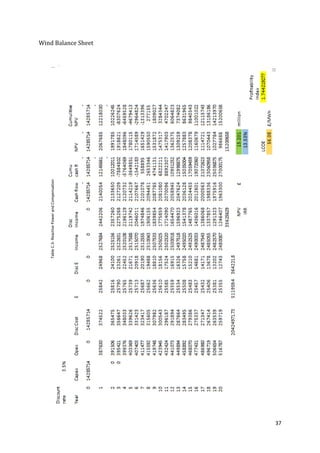
Using the values described above, a discounted cash flow analysis was carried out over a 20 year
period (the anticipated design life of the wind farm). A discount rate of 3.5% was used as per the
Treasury Green Book [3.18]
. It was calculated that the scheme has a payback period of about 7.8 years
and after 10 years has a NPV of £3.284M with an IRR of 8%, with the following results recorded:
Net Present Value = £15.20 M
Internal Rate of Return = 13.5%
Levelised Cost of Energy = £56.08/MWh
Profitability Index = 1.744
3.6.6 Sensitivity Analysis
The effects of opting for the FiT CfD strike price system compared with the current RO scheme are
shown below:
The results show a 16% decrease in Net Present Value if using the FiT CfD scheme. IRR also drops by
1.3% (a 10% decrease) and the Profitability Index is reduced by 7%.
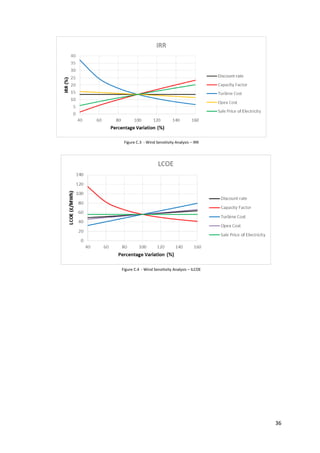
A full sensitivity analysis was carried out considering the effect of a change of up to 60% in certain
variables (Discount Rate, Capacity Factor, Turbine Cost, Opex Costs, Sale Price of Electricity) on the
NPV, IRR, Profitability Index and LCOE. The results for NPV are shown in Figure 3.4.6.2 below with
the remaining results in Appendix C. The sensitivity analysis shows that even with a pessimistic 20%
change in all considered variables, the scheme is still profitable with a NPV of £1.11M (IRR = 5%;
LCOE = £82.76/MWh; P.I. = 1.05). Conversely a 20% optimistic change in all variables gives a NPV of
£33.0M (IRR = 26%; LCOE = £38.06/MWh; P.I = 2.86). This is illustrated in the figure below:
Figure 3.10– ROC vs FiT CfD Sensitivity
Analysis
-20000000
-15000000
-10000000
-5000000
0
5000000
10000000
15000000
20000000
0 1 2 3 4 5 6 7 8 9 10 11 12 13 14 15 16 17 18 19 20 21
NetPresentValue(£)
Time (years)
ROC FiT CfD
-5
0
5
10
15
20
25
30
35
40 90 140
NPV(£million)
Percentage Variation (%)
NPV
Discount rate
Capacity Factor
Turbine Cost
Opex Cost
Sale Price of Electricity
Figure 3.11 – Graph of Net Present Value
Analysis
19
4. Grid Integration
4.1 Connection to Existing Infrastructure
Both the wind farm and biomass plant will connect to Arran’s existing grid infrastructure[4.1]
. The SSE
map below shows the existing high voltage lines on Arran[4.1]
. The solid red lines are 11kV lines and
the solid green lines are 33kV lines
4.2 Wind Farm
It is proposed that the wind farm will be connected to the end of the 33kV line at Whiting Bay. This
will require approximately 3km of 33kV lines to be built directly to the connection point as by the
dashed green line on the map below. The lines to be constructed will be above-ground cables, as
due to a number of waterways and areas of forestry which must be traversed; it would be a non-
trivial matter to lay these lines underground. The costs of this have been factored into the CAPEX
calculations for the wind farm. No transformation will be necessary in the site substation, as each
turbine will be equipped with a 690V-33kV step-up transformer in its base [4.2]
.
4.3 Biomass Plant
The biomass plant will be connected to the 11kV line running north from Kilmory. This will require
less than 1km of additional 11kV line to reach the proposed site as shown by the dashed red line on
the map. The biomass plant will generate at 11kV [2.10]
so a transformer will not be required.
However all of the necessary control circuitry will be implemented.
The biomass plant generates 3.45MW with a power factor of 0.8 [2.10]
.This gives an apparent power
rating of
The apparent power capacity of the 11kV line is 7MVA [4.3]
and therefore has the capacity to be
connected to the biomass plant.
The close proximity to a suitable power line minimises the costs of grid integration and was a factor
in choosing the site. These costs were factored into the CAPEX cost of the biomass plant.
Figure 4.1: SSE map of high voltage lines on Arran, 2013
4.4 Protection and Switch Gear
As the highest voltage under consideration is 33kV, it has been determined that gas-insulated
(Sulphur Hexafluoride) switchgear [4.4]
will be used for the protection of grid-connected equipment.
Two switchgear systems will be installed, one at the wind farm and another at the biomass plant.
20
Figure 5.2: Technical specifications, and dimensions of the SI TE models being used in the
school.
5 Ground Source Heat Pumps
5.1 Location:
In order to help reduce the oil usage on Arran the heating systems in public buildings that currently
use oil for heating will be replaced by a modern, efficient heat pump solution that will be electrically
powered. As well as making Arran more environmentally friendly, these instillations will also reduce
heating bills for the council. Three public buildings on Arran have been selected as suitable
candidates for heat pump installation. These are Arran High School, Lamlash Primary School (shown
in green), and the Arran Outdoor Activity Centre (in purple) as shown in figure 5.1. The schools will
share a heat pump system as they are so geographically close.
5.2 Technical Details
5.2.1 Schools
The schools have a combined area of 8,752m2
(7,728m2
for the high school and 1,024m2
for the
primary school)[5.1]
. The capacity of heat pump required was calculated using a heat requirement per
square meter of 50W/m using which is the BSRIA rule of thumb for the average peak load of a new
building [5.2]
.
Case studies from other commercial heat pump projects suggest that the heat pump capacity needs
to be roughly 80% of the peak load [5.3]
;
A 350kW system will be integrated into the schools. Three Dimplex SI 100 TE heat pump units will
supply the heat for the high school and one Dimplex SI 50 TE heat pump [5.4]
. The two systems will
take heat from the same vertical ground collector system. The large heat pumps will use twin
compressors at B0/W35 will give a rated 96.5kW with a COP of 4.6 and the small heat pump will be
single compressor at B0/W35 which will give a rated heat output of 46.7kW with a COP of 4.5. The
pumps can give water temperatures of up to 600
C which should be an acceptable temperature to
integrate the heat pumps into the already existing radiator network (figure 5.2).
Figure 5.1: Location of heat pumps
projects
21
5.2.2 Ground Collector System
The heat pump system will draw its heat from a network of vertical boreholes. The British Geological
Survey indicates there have been several 0-10m boreholes drilled near the school along with one,
10-30m borehole and two 30m+ boreholes in the nearby area (figure 5.3). The survey suggests the
ground underneath the school is primarily sandstone which should give around 30 watts per meter
of pipe used. One borehole will contain two loops of pipe giving four lengths of pipe per borehole
therefore;
This figure is subject to variation after a full geological survey of the area has been undertaken
(figure 5.4). The boreholes will be drilled in the school playing fields, preferably taking up an area in
the south west corner away from the sports pitches to ensure minimal disruption to the school.
5.2.3 Arran Outdoor Education Centre
The outdoor centre has a floor area of 1,431m2 [5.1]
. Using the same BSRIA value of heat per meter
squared and same percentage value as for the school, the required peak heat load of the building
and rated heat capacity of the heat pump system were calculated;
A 60kW system will be implemented in the outdoor centre using two Dimplex SI 30 TE heat pump
units which will use twin compressors at B0/W35, giving a combined rated output of 64.2kW with a
COP of 4.6 (figure 5.5) [5.3]
. As the Arran Outdoor Education Centre is also a relatively new building it
should be possible to integrate the system into the existing radiator and hot water network.
Figure 5.3: BGS borehole survey of the area surrounding Arran High
School. Purple = 0-10m, Green = 10-30m, Red = 30m+
Figure 5.4: School Grounds highlighting the
preferred area that the boreholes will be drilled.
Figure 5.5: Technical specifications and dimensions of the SI 30 TE being used in the
outdoor education centre heat pump network.
22
5.2.4 Ground Collector Calculations
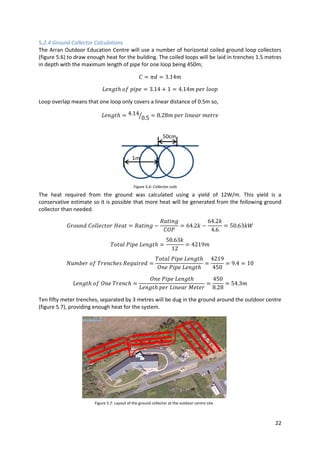
The Arran Outdoor Education Centre will use a number of horizontal coiled ground loop collectors
(figure 5.6) to draw enough heat for the building. The coiled loops will be laid in trenches 1.5 metres
in depth with the maximum length of pipe for one loop being 450m;
Loop overlap means that one loop only covers a linear distance of 0.5m so,
⁄
The heat required from the ground was calculated using a yield of 12W/m. This yield is a
conservative estimate so it is possible that more heat will be generated from the following ground
collector than needed.
Ten fifty meter trenches, separated by 3 metres will be dug in the ground around the outdoor centre
(figure 5.7), providing enough heat for the system.
50cm
1m
Figure 5.6: Collector coils
Figure 5.7: Layout of the ground collector at the outdoor centre site.
23
5.3 Environmental and Social Considerations
5.3.1 Carbon Emission Savings:
Ground source heat pumps when powered by green electricity have zero carbon emissions. The use
of GSHP’s combined with the biomass plant and wind farm will significantly reduce the total carbon
emissions of the buildings in which they are implemented.
5.3.2 Energy needs of buildings:
The schools require 350kW of power and use an average of 10 hours of heating a day (this figure is
based on estimates given verbally by the school), and 3650 hours in total throughout the year. The
schools therefore require 1277500kWh of heating a year.
Arran Outdoor Education Centre requires 60kW of power and uses an approximate average of 12
hours of heating a day (again verbal estimates from the centre), and 4380 hours in total throughout
the year. Arran Outdoor Education Centre therefore requires 262800kWh of heating a year.
Heat Source Oil Fired Boiler Ground Source Heat
Pump + Conventional
Electricity
Ground Source Heat
Pump + Green Electricity
Emission Levels (kg CO2/kWh of heat) 0.45 – 0.48 0.20 – 0.27
[5.5]
0.00
[5.5]
Operational Emissions for School (kg CO2/year) 574875 – 613200 255500 – 344925 0
Operational Emissions of Outdoor Centre (kg
CO2/year)
118260 – 126144 52560 – 70956 0
Maximum Total Reduction in Emissions
Compared to Current System (kg CO2/year)
0 323463 739344
5.3.3 Carbon Payback Period of Heat Pump Project:
Heat Pump Energy Output = 1540.3 MWh/year
Energy Carbon Factor of Oil Heating = 434 kg/MWh
Total Carbon Saving Compared to Oil Heating = 434 x 1540.3 = 668490 kg/year
Source of CO2 Point of Emission Resultant Emission (kg CO2)
Heat Pump Units Unit Manufacture, 2928kg of metal product
[5.6]
1000
[5.7]
Plastic Pipes Manufacture, 4430kg of plastic
[5.8]
15500
[5.9]
Excavation Work Approximately 300h digging/drilling, 8000L diesel
[5.10]
20800
[5.11]
Total 37300
Carbon Payback Period = 37300/668492 = 0.056years approximately 3 weeks
Table 5.1 – Carbon Emission Savings
Table 5.2– Construction CO2 emissions
24
5.3.4 Chemical Pollutants
Monoethylene glycol is used as antifreeze in the ground source heat pumps. It is classified as mildly
toxic and can become a pollutant if there is discharge of water waste or leakage from the system.[5.13]
Observed doses of 1221 milligrams per kilogram of body weight in ducks were reported to have no
effect.[5.15]
This is largely irrelevant because there would need to be a significant leakage of
monoethylene glycol directly into the water source for it to be consumed in the first place. This risk
is negligible if regulations and sensible installation instructions are followed. Furthermore, when
leaked into soil the bacteria present will break down the monoethylene glycol in a matter of weeks,
leaving no long term residual monoethylene glycol present.[5.15]
With the closed loop systems used in
this installation there should be no leakage of water. Monoethylene glycol pollution is not a major
concern for this project.
For vertical boreholes, the pipes are often secured in place using a bentonite grout which may also
contain silica. These substances are only considered dangerous if they are inhaled as dust. When
secured into grout they will not be mobilized in the air and therefore will not pose a threat to health.
They are not considered to be detrimental to the environment [5.15]
.
5.4 Finance
The net present value, IRR and profitability of the heat pumps were calculated over the course of a
20 year period (the life expectancy of a ground source heat pump can often exceed this so the
profitability of the heat pumps could actually be greater over their lifetime). To make these
calculations the initial capital costs of the installations were estimated. The running costs of the
current oil boiler and proposed heat pump systems were estimated and the savings were calculated
and treated as an income on a year by year basis.
5.4.1 Standard energy prices used in calculations
Cost of oil = £0.08/kWh[5.16]
of thermal energy produced by boiler (this already takes into account
average boiler efficiency) [reference]
Cost of electricity = £0.156/kWh[5.17]
5.4.2 Renewable Heat Incentive Subsidies
The Renewable Heat Incentive (RHI) provides subsidies based on the energy use of buildings. The
subsidies are 8.7p/kwh for first 1314 hours and then 2.6p/kWh for every hour thereafter [5.18]
.
Applying for these subsidies means that public grants will not be available; however these subsidies
are more profitable for the schools than even a full CAPEX grant would be over the 20 year period.
5.4.3 Costs and Savings in the Schools
The capital cost of the heat pump in the school was based on an estimate from Dimplex of £1200 -
£1500 per kW of installed capacity for the heat pump and collector. The capital cost estimate was
then taken to be £1350 per kW. So for the total 350kW system the estimated capital cost is £472500.
The total cost of running the current oil boiler was estimated to be £104400. This is based on a fuel
cost of £0.08 per kWh of thermal energy produced [5.16]
and a maintenance cost of £2200 on average
per year[5.19]
.
The costs of running the heat pumps in the school were calculated using a COP of 4 (as a
conservative estimate – it has been varied in the sensitivity analysis). The heat pumps require
319375kWh of electricity at a cost of £0.156 per kWh, leading to a cost of £49822 per year.
25
The subsidies as outlined above provide an income to the school of 350kW x 1314hours x
£0.087/kWh + 350kW x 2336hours x £0.026/kWh = £61268.90 [5.18]
. This means the school will
actually make £11,146.40 per year by using the ground source heat pumps.
Therefore the total savings with the ground source heat pumps will be approximately £115546.40
per year.
Net Present Value = £1,227,168.75
Internal Rate of Return = 24%
5.4.4 Costs and Savings in Arran Outdoor Education Centre
The capital cost was estimated using the same method as above and is predicted to be £81,000. The
operating costs of fuel and maintenance for the current oil boiler system were estimated to be
£22124 per year [5.16]
.
The costs of running the heat pump were also estimated using a COP of 4 (this has been varied in the
sensitivity analysis). The cost of electricity for AOEC is predicted to be £10249.20 per year [5.17]
. The
income through the RHI subsidy is estimated to be £11642 per year [5.18]
. This means the school
would have an overall income of £1292.84 per year.
This leads to a total saving of £23416 per year.
Net Present Value = £263,457.91
Internal Rate of Return = 29%
Figure 5.4 Net Present Values of both heat pump projects.
5.4.5 Sensitivity Analysis
Full sensitivity analysis was carried out looking at how the NPV and IRR vary with differences in
heating hours, COP, CAPEX, oil cost, electricity cost, and discount rate. The graphs of this analysis are
shown in Appendix D.
-1000000
-500000
0
500000
1000000
1500000
0 5 10 15 20 25
CumulitiveNetPresentValue(£)
Years
Net Present Values for Heat Pumps
Schools
AOEC
26
6. Marketing
6.1 Introduction
The influence of public opinion is an important factor to ensure the proposal can go ahead, and
create positive perceptions of the suggested renewable energy solutions. A strong marketing
campaign will therefore be implemented in order to highlight the positive impact the proposal can
have for the island.
6.2 Public perceptions
The public perceptions on Arran are essential to the marketing campaign for this proposal. A survey
conducted by the Department of Energy and Climate Change (DECC) [6.1]
found that 76% of people
were supportive of using renewable energy to provide electricity and heating; 68% supported
further construction of on-shore wind farms. A YouGov poll showed similar levels of support for on-
shore wind farms with 56% in support and a 2006 poll of 127 of Arran’s residents showed 75%
supported wind farms (as previously documented in Section 3) [3.5]
The DECC poll highlighted that 64% of UK residents had not heard of/considered ground source heat
pump use. This suggests that the profitability and green credentials of the heat pump systems
should be emphasised to the public to enhance perceptions of the proposal.
It was also found that 60% of UK residents supported the use of biomass plants as a renewable
energy source. However, a recent proposal for a biomass plant on Arran had been met with
overwhelming negativity from local residents.
6.3 Campaign focus
Based on the surveys carried out it was clear that the main focus of the marketing campaign should
be:
 To inform residents of the facts and benefits of using ground source heat pumps.
 To continue to reinforce the positive perception residents had of wind farms, whilst
highlighting positives to those opposed.
 To clearly outline the vital differences between our biomass proposal and the proposal
rejected previously by residents.
Figure 6.1: Results of 2006 survey of Arran residents,
asking their views on wind farms
27
6.4 Campaign implementation
SWOT and PESTEL analyses were undertaken as an initial basis for the direction of the marketing
campaign. These can be found in Appendix E.
Security of supply is a key focus of the campaign. It will be emphasised that extreme weather
conditions, such as those experienced in March 2013 will not result in complete loss of power for the
island - if the proposal goes ahead. By installing the integrated system proposed, the dependency
on the national grid will be minimal, thus significantly reducing the islands vulnerability. Both the
Biomass Plant and Wind Farm depend on no importation from the mainland and the installation of
Ground Source Heat Pumps will significantly increase the energy efficiency of the buildings where
they are installed.
Another main focus of the marketing campaign is to take the issues highlighted by Arran Energy
Action Group (AEAG), and comprehensively define why our biomass proposal would not have the
same problems. The reason for the failure of the Northern Energy proposal was due to the level of
opposition from the AEAG. The main problems put forward by the group are outlined below,
followed by the measures taken by the proposal to appease these concerns:
Health implications: One of AEAG’s main concerns was with the health implications related to the
emissions of particulate matter. The proposed biomass plant will make use of significant scrubbers,
filters, and catalytic converters to significantly reduce any negative impact on air quality that was of
concern with the previous proposal. This will also lessen the visual impact of the emissions from the
chimneys
Visual impacts and tourism: The greatest concern with the NEDL proposal was the visual impact of
the plant. Being positioned close to the east coast, the main visibility problem focussed on the fact
that the plant and its emissions would be visible from the Holy Isle. This is a great tourist attraction,
and so the people of Arran were opposed based on their own objections and with the prospect of
reduced tourism. For this reason the starting point for our biomass plant has been to ensure it is not
visible from the Holy Isle or main populations of Arran. The location we have chosen is non-obtrusive
and should appease the public concerns.
Energy Efficiency: The AEAG was concerned with the use of excess heat from the plant – it was
viewed as inefficient and wasteful of resources. Whilst these concerns were expressed it was clear
that the plant could not be situated in a position of high visibility, which ruled out the prospect of a
CHP plant with district heating. This is because district heating schemes are only effective with plants
in close proximity (roughly 3.5km) [6.2]
to their heating destinations, mainly due to financial viability.
This would require the plant to be close to populations and with a high level of visibility. To address
this issue we have chosen a site on the south of the island and will instead use the excess heat from
the plant for pellet production; thus increasing efficiency and removing the perception of the plant
of being wasteful of resources. This allows the plant to produce more electricity with fewer
resources.
Traffic: AEAG were concerned that the biomass plant would greatly increase traffic on public roads
due to the large number of lorry loads delivering wood fuel to the site. However, the site that we
have chosen is alongside half of the feedstock reducing transport needs dramatically, as detailed in
the biomass proposal.
28
6.5 The Marketing Mix
Product: This focuses on our proposal as a whole. Our ‘product’ or proposal is renewable energy on
Arran which will primarily provide security of supply to the island, and alleviate potential with
problems with power losses. As the network of pylons has already been strengthened on Arran there
should not be any issues with distributing power that is produced on the island. Were there to be
failures on Kintyre again our solution could provide energy to the people of Arran.
Price: The price of our renewable energy for the distribution network operator will be the standard
rate of £55/MWh. This will be sold to SSE, as they are the primary distribution network operator
(DNO) on Arran. The extra income in the finances comes through government incentives and
contributes to the profitability of the project.
The price of the heat pump systems is the capital cost. This is an investment for the Arran Council.
Although the capital costs are high (just over £0.5m) the payback period is only 4 years. After this
point the council will actually make money from the RHI subsidies. The savings made by the heat
pumps will allow more money to be invested in community projects and benefit the people of Arran.
By using these public buildings a successful precedent, there is also hope that this will encourage
local residents to employ such systems in their homes, thus reducing their long term expenditure
and the overall heat demand for the island.
Place: The locations we have chosen are favourable to winning over local communities. As explained
the biomass plant is in a non-obtrusive location and will not be visible from the Holy Isle. The wind
farm has been situated away from large populations and tourist attractions to ensure minimal
impact. The large turbines were selected to minimise the impacts on wildlife, and preserve the
natural environment as best as possible.
Promotion: The marketing campaign will focus largely on educating locals about renewable energies.
It is hoped that this can create a positive perception of our proposal whilst encouraging locals to
take their own green initiatives. In order to promote the proposal and the company, an informative
open letter will be placed in the local newspaper. This can be found in Appendix E. Leaflets will be
distributed to ensure maximum publicity. These will include conceptual pictures and emphasise the
positive impact our proposal will make. To further the educational value of the campaign free tours
of the wind farm and biomass plant will be made available to schools to promote renewable energy
to young people.
6.6 Summary
The marketing campaign to be undertaken as “Arran Renewables” should be effective in convincing
the residents of Arran to adopt our proposal, and give the island a renewable and secure supply of
electricity. The campaign will be conducted through various methods and directly address the
concerns of locals, thus ensuring that a positive impact is made on the island as a result of the
proposal.
29
7 Conclusions
The integrated combination of Biomass Plant, Wind Farm and Ground Source Heat Pumps provides
an efficient and solution to the problem of Arran’s energy troubles. The proposal has clear
environmental, social and financial benefits; decreasing the Isle’s carbon footprint, increasing jobs
and providing investors with a profitable return on investment.
The proposal creates a near self-sufficient on-island energy system which increases security of
supply and protects against the island’s isolated position on the grid.
The 3.45MW Biomass Plant will provide baseload power meeting the island’s minimum power
demand. This, supplemented by an additional power rating of up to 10MW will provide the bulk of
the island’s electricity throughout the year.
Heating energy will also come from predominantly green sources with electrical heating from on-
island renewable sources and oil powered energy systems being replaced with Ground Source Heat
Pumps with an option to extend this throughout the Isle.
The combined schemes will provide over 54GWh of energy each year improving the green image of
the Isle and vastly reducing its carbon footprint.
The proposals will have key social benefits; increasing jobs, ensuring that timber grown on the island
stays on the island for the benefit of the population and reducing haulage distances and noise
disruption. Extra funds saved from the installation of heat pumps could be used to further benefit
the island’s infrastructure.
Grid Integration has been considered and the power ratings for all schemes fall within acceptable
limits set by the existing distribution network.
Financially the scheme is extremely attractive. A combined initial capital cost of £30.34M and
annual operating costs of £2.62M are surmounted by a Net Present Value after twenty years of
£26.24M. A combined payback period of nine years and Internal Rate of Return of 9.5%-29% will
appeal to investors and profitability indexes above unity mean the scheme makes clear sense
from a business perspective.
The overall financial summary is described in Table 7.1
Scheme NPV
(£m)
IRR
(%)
LCOE
(£/MWh)
Profitability Index Payback Period (years)
Biomass 9.549 9.5 56.08 1.20 11.3
Wind 15.201 13.5 120.30 1.74 7.8
GSHP 1.491 24-29 4.2
Table 7.1 Financial Summary
30
Figure 7.1 Shows the Cumulative Net Present Value of all schemes and the combined totals.
This final value of NPV would increase with longer lifespans of Wind and Biomass schemes and
for every further year of GSHP operation.
There are clearly a number of uncertainties in the data used as described in the sensitivity
analysis. Despite this the group is confident that based on the data sources used the proposed
schemes will be profitable over 20 years and would be beneficial in a financial sense with
minimal risk and a good overall return on investment.
As a combined solution to increase the security of supply of the island’s energy the combined
scheme of biomass, wind and heat pumps performs well. The on-island electricity production
ensures that supply would continue in the event of another transmission line fault on the Kintyre
Peninsular. The scheme is eminently profitable with sensitivity analysis showing minimal risk and
excellent overall profit.
Figure 7.1 Cumulative Net Present Value
31
Appendix A
Discarded Energy Sources
Tidal power, was ruled out due to the relatively sheltered nature of Arran’s coastline. A maximum tidal range
of 3-4m and maximum tidal velocity of 1m/s were considered insufficient for economically viable production of
energy using tidal barrage or tidal stream plants.
Solar energy was discounted as the average amount of sunlight that Arran receives would not produce enough
electricity or heat for either a mass scale or household basis. This was considered from looking at
meteorological year and latitudinal position of Arran.
A waste-to-energy plant was discarded as the community of Arran would be unable to provide the waste
needed to run such a plant, and it would be difficult to ever make it profitable.
Biofuels were ruled out as a fuel option mostly because the resources were unavailable on Arran to produce
fuel in the quantities needed to provide a stable supply. Importing materials onto the island would force the
fuel price up to costs beyond that of regular diesel.
The use electric transport on Arran was discarded on the grounds of costs. Public transport was looked into,
especially electric busses. These were estimated be about 4 times more expensive than current busses, leading
to an excessively long payback period. A hybrid ferry was discarded due to costs and lack of technical
information.
Air source heat pumps were discarded due to the fact that they tend to lose their efficiency at low
temperatures, meaning that an additional heating system would have to be installed as a back-up.
Geothermal energy on Arran was ruled out due to the fact that the granite present in the northern part of the
island is fairly low in terms of heat production. Problems with distributing the heat over large areas and the
sparse nature of the population also meant that the efficiency would be low and costly, especially considering
the depths that may need to be drilled to obtain the required heat levels.
Hydro power was ruled out for a lack of cost effectiveness given the relatively small potential on Arran.
Impounded systems were considered at Coire-Fhionn Lochan and Loch Tanna. Another impounded system was
considered for the river systems around Goat Fell and Glen Rosa water, but ruled out on the grounds that
significantly altering the environment to create a reservoir in a prime tourist attraction and would be an
unwelcome move.It was calculated that these would provide no more than half a Megawatt of power each
whilst being incredibly costly to build. Run of river systems were considered ineffective on Arran due to low
flow rates.
Energy storage was considered for capturing excess energy from intermittent power sources such as wind. A
battery was considered but ruled out as we discovered that it is more cost efficient to simply not use excess
power than it is to attempt to store it and release it through a battery with current technology. Hydrogen was
researched, however the massive costs of infrastructure required for creating the hydrogen fuels and then
converting them into useful energy was considered far too expensive and inappropriate for a the scale of this
project. The potential for a pumped hydro system was considered between Loch Tanna and Dubh Loch but it
was deemed not to be worthwhile due to small power outputs.
32
Appendix B
Biomass Carbon Payback Period
Annual Energy Output: 3.45 x 8000 = 27,600 MWh
Total Carbon Savings: Energy Carbon Factor – 0.434?
27,600 x 0.434 = 11,978.4 tonnes/year + 223 tonnes/year (transport) = 12,201 tonnes/year
CO2 construction production: 19 Tonnes/TJ
(34,500 x 3600) x106
= 1.44x1014
x 10-12
= 124.2TJ
124.2 x 19 = 1,490.4 tonnes + 2000 (access road) = 3,490.4 tonnes
Carbon Payback Period: 3,490.4 / 12,201 = 0.29 years = 3.5 months
Biomass Plant Employees
Power Plant Number of Employees
Boiler Operators 8
Electricians 4
Labourers 4
Equipment Operators 6
Supervisors 4
Management 2
Accounting/Finance 2
Total 30
Table B.2 - Employees
33
Biomass Sensitivity Analysis
Figure B.1 - Sensitivity Analysis - IRR
Figure B.2 - Sensitivity Analysis – B/C
34
Appendix C
Wind Felling Area
The turbines will require felling of an area of:
Diameter of foundation = 18m, therefore around 23m by 23m for each turbine = 530m2
x 4 = 2120m2
.
Access roads: (200 x 3) + 100(say) = 700m at width of around 7m = 4,900m2
+ 2,120m2
= 7,020m2
Wind Reactive Power and Compensation
The power factor can be specified between cos( ) = 0.95 (904 kVAR) inductive (optional cos( )) =
0.9 (1328 kVAR)) and cos( ) = 0.95 (904 kVAR) capacitive (optional cos( ) = 0.9 (1328 kVAR)).
Figure C.1 - Reactive Power and Compensation
35
0
0.5
1
1.5
2
2.5
3
3.5
40 60 80 100 120 140 160
ProfitabilityIndex
Percentage Variation (%)
Profitability Index
Discount rate
Capacity Factor
Turbine Cost
Opex Cost
Sale Price of Electricity
Wind Carbon Payback
Annual Energy Output: 25842MWh
Total Carbon Savings: Energy carbon factor for grid = 0.434[3.9]
25,842 x 0.434 = 11,215 tonnes/year
CO2 construction production: Bases = 4 x 248 = 992 tonnes
Turbines = 1189 tonnes/MW x 10MW (capacity) = 11890 tonnes
Additional (access roads, concrete production, scaled data) = 3030 tonnes
Deforestation = 13.2tonnes/hectare/year – at 7 hectares = 92.4 tonnes/year
Back-up power[3.10]
: Rated capacity = 87600 MWh/year
Back-up power generation requirement (5% capacity) = 4380 MWh/yr
Additional production requirement due to thermal efficiency reduction (10% of back-up power) =
438MWh/yr
Annual CO2 emissions for back up = 438 x 0.434 = 190 tonnes/year
Carbon Payback Period: (992+11890+3030)/(11215-92.4-190) = 1.46 years = 1 year 5.5 months
Wind Sensitivity Analysis
Table C.2- Reactive Power and Compensation
Figure C.2 – Wind Sensitivity Analysis – PI
36
Figure C.3 - Wind Sensitivity Analysis – IRR
Figure C.4 - Wind Sensitivity Analysis – ILCOE
37
Wind Balance Sheet
TableC.3-ReactivePowerandCompensation
38
0
50000
100000
150000
200000
250000
300000
350000
400000
450000
500000
0% 50% 100% 150% 200%
Sensitivity Analysis - NPV for AOEC
Heating Hours (4380
hours/year base rate)
COP (4 base rate)
Capex (£81,000 base
rate)
Oil Cost (£0.08/kWh base
rate)
Electricity Cost
(£0.156/kWh)
Discount Rate (3.5% base
rate)
Appendix D
Ground Source Heat Pumps Sensitivity Analysis
0
500000
1000000
1500000
2000000
2500000
0% 50% 100% 150% 200%
Sensitivity Analysis - NPV for School
Systems
Heating Hours
(3650hours/year base
rate)
COP (4 base rate)
Capex (£472500 base
rate)
Figure D.1 – GSH Sensitivity School NPV
Figure D.2 – GSH Sensitivity AEOC NPV
39
0
10
20
30
40
50
60
70
0% 50% 100% 150% 200%
Sensitivity Analysis - IRR for School Systems
Heating Hours (3650 base
rate)
COP (4 base rate)
Capex (£472500 base rate)
Oil Costs (£0.08/kWh base
rate)
Electricity Cost (£0.156
base rate)
0
10
20
30
40
50
60
70
80
0% 50% 100% 150% 200%
Sensitivity Analysis - IRR for AOEC
Heating hours (4380 base
rate)
COP (4 base rate)
Capex (£81,000 base rate)
Oil Cost (£0.08/kWh base
rate)
Electricity Cost
(£0.156/kWh base rate)
Figure D.4 – GSH Sensitivity AEOC IRR
Figure D.3 – GSH Sensitivity School IRR
40
Appendix E
Marketing Open Letter
Residents of Arran,
Arran Renewables is a project team currently working to improve the energy production and security
of supply on the Isle of Arran.
The issues that arose from adverse weather conditions in March 2013 have highlighted the need for
Arran to have its own supply of energy. Arran Renewables aims to greatly improve the security of
energy supply on Arran, but more importantly, ensure that the energy supply is as renewable as
possible.
We propose a three point plan to try and ensure Arran is as self-sustaining as possible: a 10MW
rated wind farm, a 2.5MW biomass plant and the installation of ground source heat pumps in
several public buildings.
Arran is one of the U.K’s ideal areas for a wind farm, generating environmentally friendly electricity
with minimal land use. The location on the island has been selected to minimise noise disturbances
and effects on avian wildlife, ensuring that there is little impact on the natural beauty of the island.
It is evident that the initial proposals for a biomass plant were met with discontent and rejected by
the residents of Arran. The new proposed biomass plant differs in several key aspects from the initial
proposal. The location of the site on the S.E of the island has been carefully selected to ensure that it
is not near the main population or tourist areas of Arran. The site will use wood from the island itself,
securing existing jobs for the long term. Any construction undertaken by Arran renewables would be
to the highest health and safety standards, including the complete minimisation of emissions
through whatever means possible. We believe that the construction of a biomass plant on Arran is
essential to guarantee security of energy supply.
Arran High School, Lamlash Primary School and the Arran Outdoor Centre will be heated using
ground source heat pumps. The installation of these schemes will allow the buildings to be heated
more efficiently thus significantly reducing heating bills and carbon emissions.
Arran Renewables looks forward to discussing our proposals in greater detail, with leaflets expected
to be distributed in the coming months.
Arran Renewables
41
PESTEL
Biomass
Wind
Political - UK and Scottish Government incentives
Economic - Government incentives
- Pay back time
Social - Refusal of planning application
- Heating schools and town halls gives a good social appearance
Technological - High initial cost
- New infrastructure
Environment - Carbon emissions from biomass
- Zero carbon using local trees
- Need to consider fuel consumption of lorries and forestry vehicles and
processing of wood
- Environmental impacts of production
- Impact of all the trees that have to be chopped down
Legal - Land Disputes
- Standards
Political - UK and Scottish Government incentives
- EU and UK pro-green energy
Economic - Government incentives
- Saving money for councils
- Pay back time
Social - Refusal of planning application
- Visible green image
- Some people think are they are ugly
Technological - High initial cost
- New infrastructure
- Large diversity in manufacturers
Environment - Environmental impacts of production
- Benefit of using non-fossil fuel energy
- Changing local views could cause reduction in tourism
- Potential death of birds
Legal - Land Disputes
- Standards
Table E..1 - PESTEL Biomass
Table E.2- PESTEL Wind
42
Ground Source Heat Pumps
SWOT
Biomass
Political - UK and Scottish Government incentives
- Council approvement of heat pumps
Economic - Government incentives
- Saving money for councils
- High initial cost
- Pay back time
Social - Refusal of planning application
- Heating schools gives a good social appearance
Technological - Efficient use of technology
- Opportunity of educational benefits for the schools
Environment - Environmental impacts of production
- Benefit of using non-fossil fuel energy
Legal - Land Disputes
- Standards
Strengths
1. Wood pellets to be taken from
Arran, so island is self-generating
electricity.
2. Provides constant electricity source
3. Can be financially viable by selling
back to the grid.
Weaknesses
1. Expensive to initially construct
2. Widely perceived as unsightly
Opportunities
1. Opportunity to create unique and
aesthetically pleasing biomass plant.
2. Promote ‘green’ credentials of the
island.
3. Aim to add educational
aspect/tourist trips.
4. Job opportunities for locals
Threats
1. Previous proposals of biomass plant
widely criticised.
(http://arranenergy.org/)
2. Need to tackle many perceived issues
with the biomass plant with locals.
Table E.3- PESTEL GSH
Figure C 1.3 - PESTEL Heat Pumps
Table E.4- SWOT Biomass
43
Wind
Ground Source Heat Pumps
Strengths
1. Ability to have self-sustaining electricity
production.
2. Arran well suited for wind power, will
be one of the most efficient wind farms
in U.K.
3. Environmentally friendly.
4. Relatively small land use required.
5. Year round power generation
6. Government incentives.
Weaknesses
1. Initial expense of construction
2. Disruption to island during
construction.
3. Unsightly appearance of construction
site.
4. Location disputes
Opportunities
1. Promote the ‘green’ credentials of the
island.
2. Highlight that Arran can be energy
independent.
3. Wind farm visits for tourists.
Threats
1. Anger from locals.
2. Having to negate misconceptions
about wind power (e.g. too noisy,
harmful to avian wildlife).
3. Deemed unsightly by tourists or locals.
Strengths
1. Excellent energy saving for local
council.
2. Improved efficiency in heating
public buildings.
Weaknesses
1. Initial construction costs before savings are
seen.
2. May be disruptive to locals in construction
phase.
3. May be viewed as unnecessary.
Opportunities
1. Incorporate an educational
program with schools.
2. Excellent for ‘green’ image.
3. Highlight improved
efficiency/savings
Threats
1. Digging up of playing fields and local
surroundings could be seen as issue.
2. Council may not approve of initial costs.
Table E.5- SWOT Wind
Table E.6- SWOT GSH
44
Appendix F
Risk Register
RISK PROBABILITY
(1-5)
IMPACT ON
PROJECT
(1-5)
RISK
FACTOR
MITIGATION CONTINGENCY PLAN
WIND
Wind turbine
explodes
1 5 5 - Low Emergency shut-off switch to stop
turbines that are out of control.
Investigate into cause, check other turbines
for danger, arrange for a new turbine to be
constructed
Wind turbine
catches fire
1 4 4 - Low Incorporate oil sumps, use air brakes on
blades, design for no electrical resonance
or arcs
Install fire detection and automatic fire
extinguishing system, call fire crew, evacuate
the area
Heavy parts
dropped during
construction
1 3 3 - Low Design all crane lifts and make sure the
parts are securely attached before
releasing them
Make sure nobody has been injured, if
person trapped call the ambulance and
remove the dropped part. Inspect the part
for damage, possible buy new piece.
Worker drops tools
from height
2 2 4 - Low Consider tool storage units if appropriate,
tie tools on around belt, wear hard hats
If someone is struck by falling object, check
to see the severity of injury, if necessary
administer first aid and call the ambulance.
Someone falls
during build or
maintenance
2 2 4 - Low Use safety harnesses and install regular
attachment points for the rope
Call the ambulance immediately and
administer first aid if possible, have someone
else take over their duties
Worker electrocuted
during maintenance
1 2 2 - Low Isolate conductors from energy sources.
Otherwise wear non-conducting
protective gear to protect against arc flash
Same as above
45
Worker electrocuted
by faulty equipment
1 2 2 - Low Install fixed guards over live components
and make sure conductors are earthed.
Use circuit breakers
Same as above
Intruders cause
interference or
vandalism
2 3 6 –
Medium
Construct fences around the perimeter to
keep out intruders
Contact police to attempt to identify
intruders, inspect any damaged areas and
assess potential dangers and the need for
repair
Intruders are
electrocuted
2 2 4 - Low Fence off high voltage equipment, display
signs warning of danger
If discovered call emergency services, try to
administer first aid, then inspect area to
assess damages/potential dangers
Blades break and/or
detach
1 4 4 - Low Regular inspections of blade integrity,
build turbines away from houses or other
buildings
Make sure no one has been injured, shut off
the turbine immediately, analyse the
damage, buy new blades
Construction causes
local delays
4 1 4 - Low Prepare to transport all the turbine
components as fast as possible (e.g all
same day)
Ensure prior warning of plans to locals,
advise of alternate routes for traffic
Public don’t support
wind energy
3 3 9 -
Medium
Use all available data to address common
misconceptions, emphasise the benefits
of wind
Use public opinion polls and meetings to
reach a compromise that will satisfy both
groups as much as possible
Tourism is impacted 2 2 4 - Low Advertise the link between wind energy
and Arran’s green image
Encourage business owners to embrace the
green image and possibility of other
customer bases
Land acquisition
difficulties
2 4 8 -
Medium
Minimise land usage, convey benefits of
wind to owners
Discuss the possibility of agriculture in the
surrounding land, investigate other
proprietors
Destruction of
forestry
5 1 5 - Low Minimise land usage, leave trees standing
where possible
Re-iterate the environmental benefits of
wind energy
46
Wind farm
interferes with
aviation
1 4 4 - Low Publicise plans before hand in order to
discover any aviation stakeholder
objections
Discuss the impact, if any, on radar operation
nearby and reach an agreement, consider
other locations if necessary.
Danger to wildlife 2 1 2 - Low Avoid areas that are highly populated with
birds/bats
Investigate number of bird/bat deaths,
consider means of relocating them, keep
blades idle at low wind speed
Lower power output
than expected
2 3 6 -
Medium
Assess local wind speeds and technology
options, don’t use optimistic estimates
Re-evaluate financial payback duration,
consider altering the operating condition
parameters (e.g. max operational wind
speed) to increase output
Construction takes
longer than planned
for
3 3 9 -
Medium
Analyse other similar projects, determine
length of construction, draw comparisons
Hold contingency fund in budget to cover
additional costs, if necessary re-analyse the
budget to see where additional costs can be
recovered from
BIOMASS
Someone is struck
by lorry
2 2 4 - Low Wear high visibility gear, put up fences to
keep out other people
Phone the ambulance, administer first aid
Worker poisoned by
CO/CO2
2 2 4 – Low Don't enter fuel storage unless if
avoidable, keep well ventilated
Open vents and all doors fully to clear the
gases, only when safe enter to help the
worker. Call the ambulance
CO alarm
malfunctions
2 1 2 - Low Regularly Test Each Alarm Consider having emergency gas masks on
hand, replace any detector if it fails tests
Dust Explosion 2 5 10 -
Medium
Handle wood pellets carefully to avoid
fragments, ventilate room
Turn off all plant processes, evacuate the
building, phone the fire crew
Storage room fire 2 3 6 -
Medium
No electrical sockets or hot pipes in the
storage room, electrical isolation of
transport
Shut all the vents and doors so that the gas
build up suffocates the fire. Shut down the
whole system. Call the fire crew.
47
Boiler explosion 1 5 5 – Low Pressure release valves and pressure
gauges placed on the boiler. Regular
inspections
Evacuate the building, shut down the whole
system. Call the ambulance for any casualties
and administer first aid
Fuel explosion 2 5 10 -
Medium
Carefully regulated oxygen supply and gas
ventilation, steady supply of fuel.
Same as above. Phone the fire brigade. The
use of explosion relief panels should reduce
the effects of an explosion
Boiler parts are
Corroded
3 3 9 -
Medium
Use corrosion resistant materials and
possibly corrosion prevention additives
Replace any parts that show excessive
corrosion
Boiler parts are
subject to high
accidental impact
1 4 4 - Low Try to design a system that eliminates the
need for lifting objects over the boiler,
including working at height
Shut down the system to relieve pressure on
the impacted area. Inspect for deformation
or cracks, decide whether operation can
continue or if repair is required.
Fire exits become
blocked
1 3 3 - Low Make emergency exits as close and simple
as possible, never store anything near
them
Try to access another fire escape, otherwise
try to go somewhere isolated from fire and
smoke and wait for the fire service to arrive
Fire Extinguishers
fail
1 4 4 - Low Consider having automated and manual
extinguishers available
Exit top an area of safety using the fire exits;
do not stop for any reason. Phone the fire
brigade and wait for their assistance
Forest Fire 2 4 8 -
Medium
Clear the area around the plant to avoid
catching, impose adequate extinguishing
system
Call the fire brigade immediately, evacuate
the area, shut down the plant
Water logged fuel
breaks load
mechanism
2 2 4 – Low Divert all rain and other water sources
away from the storage area.
Investigate the damage to the mechanism,
fix if possible, otherwise install new parts to
make it work
Soot, ash or dust is
inhaled
3 2 6 -
Medium
Regular inspection of flues/ chimneys; use
chimney filters, dust socks and ash
hoppers
If breathing becomes laboured then go to
hospital, masks should be used if the risk of
inhalation is high in the plant.
48
Public don’t support
biomass energy
3 3 9 –
Medium
Determine cause of public objections,
analyse available data to address concerns
Hold public meetings to reach agreements
with points of view, compromise if necessary
to reach an understanding
Construction takes
longer than planned
for
3 3 9 -
Medium
Analyse other similar projects, determine
length of construction, draw comparisons
Hold contingency fund in budget to cover
additional costs, if necessary re-analyse the
budget to see where additional costs can be
recovered from
Lower power output
than expected
2 3 6 -
Medium
Design for the estimated available
resources and ensure up to date
technology
If possible, locate alternate source of wood
for more burning, upgrade the plant to be
more efficient, compensate to burn more
wood and make less pellets
Unsustainable wood
consumption
2 4 8 –
Medium
Analyse the available resources and
ensure the supply can be sustained at the
needed levels
Limit the supply to meet sustainable levels,
optimise the system to burn more efficiently
if possible
Air pollution levels
unacceptable
3 2 6 –
Medium
Design system to burn efficiently to
reduce fuel volume
If necessary, fit smoke filters on the
chimneys to remove pollutants and produce
cleaner smoke
Wildlife and
ecosystem affected
3 2 6 -
Medium
Perform biological survey of the
surroundings, compare results to previous
data before build
If species numbers dangerously decline,
install smoke filters, contain all waste output
and dispose of it appropriately
Soil erosion and
chemical run off at
logging site
3 1 3 - Low Use trees that can regenerate naturally,
minimise area for heavy machinery
Schedule log transport for when the soil is
dry to prevent water run-off, leave leaves
and branches to maintain nutrient balance
and quality in soil
Chemical
contamination of
water bodies
3 2 6 -
Medium
Incorporate a water treatment system
before the water in the boiler can be
released
Analyse the contaminant levels in the water,
determine if it is at a dangerous level,
consider replacing the pipework
49
HEAT PUMPS
Heat pump main
unit breakage
1 3 3 – Low Should last for more than 20 years, handle
carefully on installation, place on a sturdy
surface
Call technician to determine source of the
problem, if it can be fixed then do so,
otherwise replace the main unit.
Excavator breaks
down
2 2 4 - Low All construction equipment should be
inspected before us to make sure it is fit
for purpose
Get a mechanic to fix the excavator, or for
more severe problem get contractors to use
secondary excavator while original is fixed.
Excavator causes
personal injury
2 2 4 - Low Personnel should avoid moving
machinery, wear high visibility clothing,
only work in daylight
Contact emergency services, administer first
aid, stop all operations until the area has
been cleared and it is safe to continue work.
Someone falls in
pipe trench
3 1 3 – Low Don't approach the trench area in the
dark, pay attention to the surroundings
Administer first aid, call ambulance if
necessary.
Water pipe fails 2 3 6 –
Medium
Check before the pipes are laid that they
don't leak, use plastic components
Search the ground covering the area of the
pipes for water surfacing, isolate the pipe,
replace the section of pipe with the fault
Antifreeze
contaminates
surrounding area
2 2 4 - Low Ensure effective grouting around the
pipes, use corrosion resistant materials
Isolate the leak, fix the damaged area. Use a
low toxicity anti-freeze
Electricity supply is
broken
2 3 6 -
Medium
Keep electrical cables out of view and
reach from consumers
Call an electrician, or if grid is down, possibly
revert to a fuel generator or battery system
to provide power
FINANCE
Investor withdraws
funding
2 5 10 -
Medium
Be sure to keep the investor well informed
of progress, make sure the investor is
happy with the project
Re-assess the budget according to size of
contributed investment lost, pursue
alternate sources of funding
Capex is higher than 2 4 8 – Find the cost of each part before the Re-analyse the investor payback period, try
50
initial estimates Medium construction, remember easily overlooked
costs e.g. fuel
to recover some of the costs from the opex
estimates
Opex is higher than
expected
2 4 8 -
Medium
Carefully assess all the needs of the
project, insurance etc.
Re-evaluate the costs of running, switch to
cheaper alternatives if possible, hire
consultant if necessary
Unexpected part
failure
2 3-5 6- 10
Medium
Ensure the appropriate insurance covers
for part replacement
Recover the costs from the insurance
company. Have the part replaced as fast as
possible. If the part is under warranty then
claim from the supplier.
Company are liable
for employee injury
2 2 4 – Low Make sure appropriate regulations are
strictly followed, acquire insurance for
such event
Investigate claim to assess validity, go
through insurance company for pay-out,
correct the fault to ensure it doesn’t happen
again
Rapid rise in fuel
costs, bills or other
resources
3 3 9 –
Medium
Set up contracted supply of fuel at a fixed
price for a fixed term to avoid unexpected
rises
Take note of price rise and incorporate this
into the budget for the renewal of the
contract
Supplier goes into
insolvency
1 4 4 - Low Arrange for the time between purchase
and shipping to be a short as possible
Record the loss, find another supplier to
provide the necessary parts and claim the
money back from insolvency investigators or
the bank
New regulations
require expensive
upgrades
2 4 8 -
Medium
Stay involved with legal developments to
try and anticipate changes
If possible, find a solution to run the current
operation with no or minimal modification
while still complying with regulations.
Project is not
profitable
1 5 5 - Low Conduct full analysis of costs and profit
margins, make sure to cost is competitive
but profitable beforehand
Search for funding bodies, government
incentives that contribute to renewable
energy, upgrade systems for better
performance
51
Health and Safety
Legislation Key Points
Health and Safety at Work etc. Act 1974
The general point to be made by the HASAW is that the work place needs to be sufficiently safe for
workers to be there without ever getting hurt by fault of the employer. This includes making sure
the actual workplace itself is safe, then ensuring everyone in the work place has adequate training to
operate any dangerous equipment safely. In addition to this, method statements need to be
prepared for all tasks that are to be completed manually, and emergency protocol needs to be
created and made clear to employees. It is also necessary that when dangerous tasks are to be
performed, adequate personal protective equipment is also provided. The HASAW doesn’t only
apply to the people who work in that place but also anyone who may enter the area, and anyone
who may be potentially affected by work in that area, such as worker families if the employee is
working with dangerous substances that could be caught on clothing. Where there is no formal
instruction given by the HASAW, employers should defer to the relevant approved code of practice.
Management of Health and Safety at Work Regulations 1999
This includes the necessity for a formal risk assessment to be conducted. Every employee must be
fully informed of all the risks present in the work environment and demonstrate they understand
them. Employees are also required to report anything they deem to be unsafe.
Construction (Design and Management) Regulations 2007
It is the duty of the designer to makes sure that all aspects of work involving the structure are safe
for work including: the construction phase; anyone who may be affected by the construction;
employees working within the building, anyone responsible for cleaning or maintenance. They must
also include fire detection units and mire extinguishing equipment, with appropriate signage if it is
not automated. Fire exits must also be included. Ventilation or air purification must be adequate to
avoid asphyxiation and there must also be CO alarms to warn of any danger. They must also provide
the relevant information to clients and contractors in order for them to be able to comply with the
CDM regulations. Clients need to make sure a CDM co-ordinator and a principal contractor are
appointed as soon as the initial design phase is complete. Contractors need to make sure everyone
involved is competent to work and aware of all the health and safety risks associated with the
construction. They must not begin construction before notification has been given to the HSE, and
any work carried out must conform to the construction phase plan as created by the principle
contractor. Excavations must be carried out by professionals and they must be careful in order to
avoid material becoming unintentionally dislodged, or that they do not fall into any open pits. They
also need to ensure that access to the site is sealed off from unauthorised personnel before they
begin building.
Fire Safety (Scotland) 2005 & 2006
These essentially boil down to only a few points. There is a requirement to include an appropriate
number of fire exits pertaining to the size of the occupied area, the potential danger present and the
density of people within the area. Fire exits must be as direct and simple as possible, with adequate
signage to show their position. Extinguishing measures to stop fires must also be appropriate in their
context. Where they are not automated they must be clearly signed and easy to operate should the
need arise. There must be a full assessment of potential sources of fire hazards as well as an
emergency procedure with appointed co-ordinators and regular fire drills.
52
Pressure Equipment Regulations 1999 & Pressure Systems Safety Regulations 2000
Criteria that must be included in design calculations are: yield strength, tensile strength, time
dependant strength (creep), fatigue resistance, young’s modulus, shock loading (impact), fracture
toughness, corrosion and wear allowance( particularly at high temperatures), and additional margins
of error above the maximum allowed stress. Assemblies must be tested and must come with
adequate pressure relief and temperature reduction mechanisms. All parts of the assembly must be
certifiably safe and not present a danger within the product lifetime specified by the designer.
Control of Substances Hazardous to Health Regulations 2002
Emission of harmful substances needs to be reduced as much as reasonably possible. This includes
the particulate matter released in biomass burning so filtration is required. This is required to be less
than 100mg/m3
by law. Where harmful substances are present in areas that must be accessed,
personal protective equipment (PPE) is required such as gas masks. If these substances are likely to
reach people in the vicinity, they must either also have PPE or the area must be separate from
unprotected employees. All sources of hazardous substances must be identified and incorporated
into the risk assessment. In the case of dust release, workers must be equipped with low dust
retention and release clothing. Everyone working with hazardous substances must be trained to
handle it appropriately and be aware of the dangers of improper handling.
Dangerous Substances and Explosive Atmospheres Regulations
These regulations require that explosive substances are identified and their potential hazards be
incorporated into a risk assessment. The danger of explosion must be minimised as much as possible,
such as in the fuel storage with proper ventilation or the boiler with appropriate fuel feeding cycles
to avoid under or over-loading, either of which can cause an explosion. Control measures must be
put in place like explosion relief panels on chimneys. Emergency procedures must be created and all
employees must be trained to carry them out if necessary. Most importantly, there must be no
unexpected sources of ignition including electrostatic discharge from any surface
Work at Height Regulations 2005
All work at height must be properly planned; performed by a trained, competent individual with
supervision and must use the correct equipment. Working at height should be avoided unless it is
absolutely necessary, and if it is regular occurrence then this should be incorporated into the design,
such as standing platforms and ladders. These should be regularly inspected to ensure that they are
fit for purpose. If this is not reasonably practicable then proper equipment must be provided to
ensure that falling from height does not occur. The possibility of falling objects should be minimised,
for example by storage units. People working underneath should be protected if objects are likely to
fall and cause injury. Any areas in which falling objects are a possibility should be clearly marked.
Electricity at Work Regulations 1989
Designs of electrical systems must take into account various dangers that they must be protected
from to prevent them from being hazardous. These include mechanic stress, extreme temperature
or pressure, and exposure to wet, corrosive or explosive substances. Where conducting materials
might present a danger, they should be covered with an insulating material and/or moved into an
area of relative safety. Any conductor that might become inadvertently live either as part of
operation or by component failure must be earthed. Protection from excess current must be
installed wherever an excessive current may pose a threat to health and safety. Where it may be
necessary there should also be installed a means of isolating components from electrical sources.
53
Working in proximity to live equipment should only be done if it is entirely unreasonable to
deactivate it, or if it poses no threat to safety. Otherwise safety equipment is required. Adequate
lighting must be provided in order to carry out work in safety. Anybody carrying out such work must
have sufficient knowledge or experience of electrical systems, or otherwise be supervised by such a
person.
The Electricity (Safety, Quality and Continuity) Regulations 2002
Electricity suppliers and distributors are subject to more regulations regarding electrical installations
such as substations and transmission lines. The equipment must be fit for purpose and maintained in
order to prevent damage and potential danger. Substations must have restricted access only for use
of trained employees. There must also be signage to indicate the danger of entering these restricted
areas by unauthorised personnel. The possible risks associated with vandalism or interference must
be assessed and documented. It should be ensured that no part of the network carries an excessive
current for any period of time that could cause damage or danger. The earthing electrodes should be
installed as close as practicably possible to the voltage source. Underground cables need to be at
sufficient depth or have appropriate coverage in order to avoid any danger from land use. They
should also be marked for the benefit of anyone excavating the land not to disrupt the cables. There
must also be a map of the underground network with information on position and depth of cables.
Overhead wires need to be at least 5.8m above traffic routes, and where they are ordinarily
accessible they must be fully insulated. They should not come within close enough proximity to trees,
buildings or other structures that they may pose a risk to safety.
Confined Spaces Regulations 1997
Work in a confined space shall not take place unless it is unfeasible to perform the necessary work
without entry. They should also not enter unless arrangements have been made to perform a rescue
operation in the event of an emergency. This includes the provision of resuscitation equipment
where asphyxiation is a specified risk and resuscitation may be necessary.
Manual Handling Operations 1992
The risks associated with lifting and moving objects manually should be assessed if it is reasonable to
do so, individual lifts may not be required to be assessed unless they are particularly heavy, a
difficult shape to grasp or if it takes place at height. Lifts that occur regularly should also be assessed
if they pose any danger. The factors to look out for in an analysis are: if the lift requires the object to
be positioned away from the body trunk which may cause stress on the lower back, if the object is
unstable and contents may shift during lifting, if the object requires PPE to lift e.g. if it is very hot and
if the lift may occur on uneven or slippery surfaces.
Lifting Operations and Lifting Equipment Regulations 1998
It must be ensured that any lifting taking place is done using equipment with a strength that is
proportional to the load it must bear. The lifting operators should first of all ensure that the
possibility of falling objects is minimised by means of maximum stability, objects should be securely
fastened at enough points to make sure it doesn’t move out with the intended range of motion and
if required additional ropes or chains can be used. Workers should not be in any position around the
lifting equipment that may result in them being crushed or trapped if the load falls. If the load falls,
the exit of the operator from the machinery must not be impeded – they must be lifting from a
position of safety. The equipment must be clearly marked to display the maximum load it is safely
capable of lifting, and this should not be exceeded in any circumstances. Before the first lift of a
construction project the equipment should be inspected for any defects. The equipment should be
fully examined every 6 months if it is use to lift people, otherwise every 12 months.
54
Appendix G - References
2. Biomass
2.1 Arran and Ayrshire Forestry and woodland Strategy
http://www.aawp.org.uk/AAFWS_First%20Consultation%20Draft%20Feb%202012.pdf
2.2 Summary of the Report on the Sustainable Wood Fuel Supply for a Combined Heat and Power
Plant on the Isle of Arran, Scotland
http://www.eplanning.northayrshire.gov.uk/OnlinePlanning/files/00188D6206EF593765185A05
68BE961F/pdf/13_00313_PP-APPENDIX_1_-_SUSTAINABLE_WOOD_FUEL_SUPPLY-592786.pdf
2.3 Arran Birding
http://www.arranbirding.co.uk/
2.4 L Peretti, ORC technology with biomass its use for wood pellet production,(2010). Available:
http://www.cospp.com/articles/print/volume-11/issue-5/features/orc-technology-with-
biomass-its-use-for-wood-pellet-production.html. Last accessed 6th February 2014.
2.5 Kofman, P. (2010). Units, conversion factors and formulae for wood for energy. Available:
http://www.woodenergy.ie/media/coford/content/publications/projectreports/cofordconnects
/ht21.pdf. Last accessed 11th Feb 2014.
2.6 United States Environmental Protection Agency. (). Methods for Calculating Efficiency. Available:
http://www.epa.gov/chp/basic/methods.html. Last accessed 11th Feb 2014.
2.7 Actruba, J. (2009). Basic Calculations for a Power Plant- Calculating the Coal Quantity. Available:
http://www.brighthubengineering.com/power-plants/52544-basic-calculations-for-a-power-
plant-calculating-the-coal-quantity/. Last accessed 11th Feb 2014.
2.8 Moore, J. (2011). Wood properties and uses of Sitka spruce in Britain.Available:
http://www.forestry.gov.uk/pdf/FCRP015.pdf/$FILE/FCRP015.pdf. Last accessed 11th Feb 2014.
2.9 Fulton School of Engineering. (). Enthalpy Tables. Available:
http://enpub.fulton.asu.edu/ece340/pdf/steam_tables.PDF. Last accessed 6th February 2014.
2.10 Dr John O’Shea, Integrated Energy Systems International Limited, iesiltd@btconnect.com,
contacted on 21st
January 2014
2.11 Publication from International Energy Agency
http://www.seai.ie/Archive1/Files_Misc/emissionsdata.pdf
2.12 Neundorfor – Paticulate Knowledge
http://www.neundorfer.com/knowledge_base/electrostatic_precipitators.aspx
2.13 Rose Energy – Biomass Fuelled Power Plant
http://roseenergy.webbelief.com/Content/planning_1_WbEditorID_1/4)%20Architectural%20D
esign%20and%20Access%20Statement.pdf
2.14 Office of National Statistics
http://www.statistics.gov.uk/hub/index.html
2.15 Missouri Department of Natural Resources. (2012). Feasibility Study for a Biomass Electrical
Power Plant in the Viburnum Region.
http://www.ded.mo.gov/energy/docs/G11-SEP-RES-16VEDACFinalReport.pdf. Last accessed 6th
February 2014.
2.16 Urbas energietechnik, “Energy from Biomass” *Last accessed on 11/02/14+
http://www.fifthelementenergy.com/docs/Urbas%20Biomass%20Plant%20Brochure.pdfm
2.17 C. McCartney, “A feasibility study for small-scale wood pellet production in the Scottish
Borders”, November 2007
http://www.energyfarming.org.uk/resources/Wood%20Pellet%20final%20report%20CM%20No
v07.pdf
2.18 Carbon Trust, “Biomass Heating – A practical Guide”, 2005 *Last accessed on 07/02/14+
http://www.forestry.gov.uk/pdf/eng-yh-carbontrust-biomass-09.pdf/$FILE/eng-yh-carbontrust-
55
biomass-09.pdf
2.19 Business Electricity Prices [Last accessed: 16/02/14]
http://www.businesselectricityprices.org.uk/retail-versus-wholesale-prices/
2.20 Variable Pitch: Renewable Obligation Certificate Rates [Last accessed: 16/02/14]
http://www.variablepitch.co.uk/finance/rates/ROC/
2.21 H. Dickinson, phd business consultants, business consultants to PEBOC biomass project,
Anglesey, Wales
2.22 D. Jones, G. Hogan, ”Potential woodfuel CHP plant at Westonbirt Arboretum, Initial
feasibility study and technology assessment” , November 2006 *Last accessed on 07/02/14+
http://www.biomassenergycentre.org.uk/pls/portal/docs/PAGE/BEC_TECHNICAL/RESEARCH%2
0AND%20STUDIES/COMBINED%20HEAT%20AND%20POWER%20STUDIES/WESTONBIRT%20WO
ODFUEL%20REPORT.PDF
3. Wind
3.1 NOABL UK Wind Map
Available at rensmart.com
3.2 Arran Birding. arranbirding.co.uk
3.3 Whitelee Wind Farm: whiteleewindfarm.co.uk
3.4 Renewable Energy 4 Lecture Slides. Prof Paul Younger 2013
3.5 GE Energy: Technical Description: Wind Turbine Systems 2.5/275MW: General Specification
3.6 GE Energy: Technical Description: Wind Turbine Systems 2.5/2.75MW: Electrical Grid
Specificaitons
3.7 Green Power International Scoping Report April 2007
3.8 Direct Contact with Forestry Commission via email.
3.9 GE Energy: Technical Documentation: Wind Turbine Generator Systems, 2.5-2.75 Series:
Specifications - Site Roads and Crane Pad”, §3.2: “Turning Curves”
3.10 British Geological Survey
Available at bgs.ac.uk/data/boreholescans/home.html
3.11 Renewable Energy Solutions: Penmanshiel Wind farm Appendix 17.1 Carbon Balance
Calculations. Available: http://www.penmanshiel-
windfarm.co.uk/media/18877/Appendix%2017-1.pdf
3.12 Wind Action: A guide to calculating the carbon dioxide debt and payback time for wind farms
Available at windaction.org/posts/7149-a-guide-to-calculating-the#.Uvd6Zl_vlU
3.13 Viking Energy. Appendix A16.6: Carbon Payback Calculations
Available:www.shetland.gov.uk/planningcontrol/documents/AppendixA16.6CarbonPaybackCalc
ulations.pdf
3.14 The Economics of Wind Energy: A report by the European Wind Energy Association
3.15 International Renewable Energy Agency: Renewable Energy Technologies: Cost Analysis
Series. Volume 1: Power Sector. Issue 5/5. Wind Power. June 2012.
3.16 e-ROC: Online ROC Auction Service - www.e-roc.co.uk/trackrecord.htm
3.17 Department of Energy and Climate Change: Investing in renewable technologies = CfD
contract terms and strike prices. December 2013
3.18 HM Treasury: The Green Book. Appraisal and Evaluation in Central Government
56
4. Grid Integration
4.1 Scottish and Southern Energy plc. – Maps of Distribution Lines, Isle of Arran
4.2 “GE Energy: Technical Documentation: Wind Turbine Generator Systems 2.5MW 50 Hz and 60
Hz: Electric Grid Data”, §8: “Transformer Data for Connection of 2.5 to Medium High Voltage
Grid”
4.3 http://www.eolss.net/sample-chapters/c05/e6-39a-06-01.pdf
4.4 Schneider Electric Gas Insulated Circuit Breaker: http://download.schneider-
electric.com/files?p_File_Id=29235886&p_File_Name=NRJED111135EN_web.pdf
5. Ground Source Heat Pumps
5.1 Direct contact from Infrastructure & Design team on North Ayrshire Council. Email from Lesley
Lyon ‘Arran Property Data’ 21/11/2013
5.2 BSRIA - Rules of Thumb - Guidelines for building services (5th Edition) -Multi-site Licensed
Version (BG 9/2011GCD)
http://www.dimplex.co.uk/products/renewable_solutions/case_studies_ground_source_comm
ercial.htm
5.3 Dimplex Technical Documentation for heat pumps.
http://www.dimplex.de/en/heat-pumps/brine-to-water/universal-for-customer-specific-
versions/si-130te.html
5.4 http://www.greenspec.co.uk/ground-source-heat-pumps.php
5.5 http://www.dimplex.de/en/heat-pumps/brine-to-water/universal-for-customer-specific-
versions/si-100te.html
5.6 http://www.carbontrust.com/media/206500/ctg062-metalforming-industrial-energy-
efficiency.pdf
5.7 http://www.gogeothermal.co.uk/category.asp?c=2
5.8 http://timeforchange.org/plastic-bags-and-plastic-bottles-CO2-emissions
5.9 http://www.volvoce.com/SiteCollectionDocuments/VCE/Documents%20Global/others/hiddenF
uelEfficiecny_B-SeriesExcavatorsBigFuelSaving.pdf
5.10 http://www.carbontrust.com/media/18223/ctl153_conversion_factors.pdf
5.11 http://www.who.int/ipcs/publications/cicad/en/cicad22.pdf
5.12 http://www.epa.gov/ttnatw01/hlthef/ethy-gly.html
5.13 http://www.hpa.org.uk/webc/hpawebfile/hpaweb_c/1194947381509
5.14 http://capebentonite.co.za/downloads/BENTONITE%20MATERIAL%20SAFETY%20DATA%20S
HEET.pdf
5.15 http://www.nottenergy.com/energy_cost_comparison
5.16 http://www.hydro.co.uk/public/OurPrices/OurPrices.aspx?postcode=g4%209ar&fuelmode=
Electricity
5.17 https://www.gov.uk/government/uploads/system/uploads/attachment_data/file/265854/N
on-Domestic_Renewable_Heat_Incentive_-_Improving_Support_Increasing_Uptake_-
_PUBLISHED.pdf
5.18 http://www.kensaengineering.com/Library/Fact-sheets/RHI%20Commercial%20v3.pdf
5.19 http://www.tradeadvisor.com/a/cost-guides/boiler-cost-guide
57
6. Marketing
6.1 The Department of Energy and Climate Change
https://www.gov.uk/government/organisations/department-of-energy-climate-change
6.2 Boyle, G., (editor), 2012, Renewable energy: power for a sustainable future. (3rd
edition). Open
University / Oxford University Press, Oxford. 566pp.

Integrated systems design project

  • 1.
  • 2.
    2 Executive Summary Following theadverse weather conditions in March 2013 which saw extensive loss of power on the Isle of Arran, Arran Renewables were asked to come up with a solution which increased the resilience of energy provision to the island. The proposal outlined in this report will create a near self-sufficient energy system increasing the security of supply of electrical and heating energy to the island whilst vastly reducing the carbon footprint and increasing the island’s green image. This will be done in an efficient and profitable manner that incorporates all environmental and social concerns adding to the island’s overall appeal to locals and tourists alike. The proposal aimed to come as close as possible to meeting the Isle’s electrical power demand of 3- 13MW, and reduce the use of fossil fuels in heating systems. After considering all possible energy sources, a three part scheme was devised. This comprised a biomass plant, a small wind farm and the installation of electrically powered Ground Source Heat Pumps (GSHPs) in public buildings. The Biomass Plant will be situated in the south of the island where supply is vast but population sparse. Rated at 3.45MW it will provide baseload electricity to the island 8000 hours a year. In accordance to Forestry Commission and Northern Energy figures, 40,000 tonnes of timber grown on the island is available for use, which will be employed in a wood pellet production plant that converts virgin wood into wood pellets using the excess heat generated from the plant. This process increases calorific value of the fuel, improves the efficiency of the system and qualifies the plant for government subsidy. The plant is located in a 4,000 hectare forest, where half of the commercial supply of wood is grown, thus significantly reducing haulage by up to 16,800km in total per year in comparison with current transportation routes. There are clearly major benefits in keeping Arran’s wood for Arran’s use and this decrease in haulage distances and avoidance of exportation contributes to the plant’s carbon payback period of less than four months. The location was also chosen as the surrounding forestry will act as adequate screening of the plant and is far from the population centres of the island and popular tourist destinations. It will be integrated into the existing infrastructure on the island via an 11kV distribution line, around 1km from the plants location. Systems are proposed to control and reduce the emission of particulate matter, nitrogen oxides, sulphur dioxides and other compounds. Measures were also taken to ensure there was no significant damage to the air quality on the island, including electrostatic precipitators, non-catalytic reduction systems and alkaline sorbent injection systems. The plant will also create thirty jobs on the island whilst sustaining a further twenty-seven in the wood supply chain. The Plant will have an initial capital cost of £15.5M with annual operating costs of £2.2M. Income from sale of electricity, Renewable Electricity Certificates (ROCs) and Levy Exemption Certificates (LECs) give the plant an estimated payback period of 11.3 years with a Net Present Value (NPV) after twenty years of £9.55M. The Wind Farm will be located in the south-east of the island and will consist of four General Electric GE2.5-193 Horizontal-Axis Wind Turbines each with a rated power output of 2.5MW, giving a total rated power output of 10MW. The location was chosen due to high average wind speeds, the avoidance of Special Protected Areas and the minimal visibility levels from the majority of the island including the population hubs of Brodick and Lamlash. Due to the sparse population of the area, there will also be no noise concerns for the island’s inhabitants. Using capacity factor of 29.5%, estimated from scaling of nearby sites, an annual estimated 25.8GWh of energy would be produced by the plant. The turbines have a built in 690/33kV transformer and will be connected to existing infrastructure by 3km of 33kV distribution lines. A carbon payback period for the scheme was calculated at 1.5 years with over 11,000 tonnes of carbon being saved every year compared to the existing grid mix.
  • 3.
    3 The Wind Farmwill have an initial capital cost of £14.3M with an annual operating cost of £390k. Sale of electricity, ROCs and LECs will mean a payback period of 7.8 years with a NPV of £15.2M after twenty years. Ground Source Heat Pumps are proposed to be installed in public buildings which currently use oil for heating. These buildings will be Arran High School, Lamlash Primary School and the Arran Outdoor Education Centre. Due to their recent construction, all three of these buildings are highly compatible for efficient use of heat pumps, thus represent a great opportunity to not only significantly reduce emissions but make a sizeable savings in the long term. The majority of the remaining public buildings currently use electricity as their heat source which can be considered as green energy as it will originate from renewable sources via the biomass plant and wind farm. If the proposed project proves a success this could be rolled out across all public buildings and into private homes. A 350kV system consisting of three Dimplex heat pumps will be integrated into the schools and a 60kW system will be installed in the Education Centre. The school system will draw its heat from a network of eight 100m boreholes in a closed loop system. Due to greater available space and lower heat demand the Outdoor Centre will acquire its heat from a network of horizontal coiled loop collectors installed in trenches in the surrounding ground. It is hoped that with an effective marketing strategy that successful installations of Ground Source Heat Pumps in these buildings will also encourage homeowners to install their own heat pumps, and thus significantly increase the energy efficiency on the island, and even further reduce the dependency on the national grid. The GSHPs will have a combined capital cost of £554k. Very low operational costs and a significant annual saving in fuel costs give the schemes a NPV of £1.5M based on savings over twenty years with a relatively short payback period of just over four years. The scheme as a whole is financially attractive. A combined NPV of over £26 million and payback period of nine years should prove appealing to investors and with an Internal Rate of Return of 9.5- 29% the proposal certainly makes sense from a business perspective. Levelised costs were estimated at £56/MWh for Wind and £120/MWh for biomass. The respective profitability indexes were calculated to be 1.20 and 1.74. It is worth noting that these NPVs were based on an estimated design life of twenty years. This would likely be a conservative estimate particularly for the biomass plant and heat pumps and increased longevity of the scheme would further increase the financial benefits of the proposal. As a combined solution to increase the security of supply of the island’s energy the integrated scheme of biomass, wind and heat pumps combine well, producing 54.6GWh of energy every year. The on-island electricity production provides defence against the island’s isolated position on the grid and ensures that supply would continue in the event of another transmission line fault on the Kintyre Peninsular. The scheme is eminently profitable with sensitivity analysis showing minimal risk and excellent overall profit. By significantly reducing the carbon footprint on the island and focussing on ensuring any public concerns are addressed, it is hoped that the success of this integrated scheme will also act as a source of encouragement to other consultancies considering the installation of sustainable energy solutions. Throughout research on all aspects of the proposal, health and safety and risk concerns were considered and are compiled in a full risk register in appendix F.
  • 4.
    4 Contents 1 Introduction .........................................................................................................................................1 1.1Scope.........................................................................................................................................1 1.2 Our Proposal .............................................................................................................................1 2 Biomass Plant.......................................................................................................................................2 2.1 Location.....................................................................................................................................2 2.2 Plant Type .................................................................................................................................3 2.3 Wood Fuel Supply on Arran ......................................................................................................3 2.4 Plant Power Rating....................................................................................................................4 2.5 Plant Operation.........................................................................................................................5 2.6 Transportation on Arran ...........................................................................................................7 2.7 Emissions...................................................................................................................................8 2.8 Construction..............................................................................................................................8 2.9 Employment and Community ...................................................................................................9 2.10 Financial Analysis of CHP Biomass Plant.................................................................................9 3. Wind Farm.........................................................................................................................................12 3.1 Location...................................................................................................................................12 3.2 Technical .................................................................................................................................12 3.3 Social Factors ..........................................................................................................................14 3.4 Site Access...............................................................................................................................15 3.5 Environmental Impacts...........................................................................................................16 3.6 Finance....................................................................................................................................17 4. Grid Integration.................................................................................................................................19 4.1 Connection to Existing Infrastructure.....................................................................................19 4.2 Wind Farm...............................................................................................................................19 4.3 Biomass Plant..........................................................................................................................19 4.4 Protection and Switch Gear ....................................................................................................19 5 Ground Source Heat Pumps...............................................................................................................20 5.1 Location:..................................................................................................................................20 5.2 Technical Details .....................................................................................................................20 5.3 Environmental and Social Considerations ..............................................................................23 5.4 Finance....................................................................................................................................24 6.1 Introduction ............................................................................................................................26 6.2 Public perceptions...................................................................................................................26 6.3 Campaign focus.......................................................................................................................26
  • 5.
    5 6.5 The MarketingMix..................................................................................................................28 7 Conclusions ........................................................................................................................................29 Appendix A............................................................................................................................................31 Appendix B............................................................................................................................................32 Appendix C............................................................................................................................................34 Appendix D............................................................................................................................................38 Appendix E ............................................................................................................................................40 Appendix F ............................................................................................................................................44 Appendix G - References.......................................................................................................................54
  • 6.
    1 1 Introduction 1.1 Scope Situatedin the South West of Scotland, the Isle of Arran is a small, remote and sparsely populated island that attracts countless tourists each year. Although its remote location adds to the islands appeal, it also presents a certain amount vulnerability to the isle, as it relies on numerous resources including energy supply from the mainland. In late March 2013, when adverse weather conditions resulted in the toppling of eight large pylons on the 132 KV transmission system in the Kintyre Peninsula and as a result cut the sole source of power to the Isle of Arran, transmitted through 2 x 33 KV underwater cables. Although power was restored to some parts of the island within a relatively short period of time due to the presence of stand-by generators, thousands of properties were affected, creating mass disruption on the island. In the aftermath of this event, it became clear that the resilience of energy provision on the island had to be strengthened to ensure that this incident was not repeated. The focus of this study is to provide this resilience, by installing clean renewable energy sources on the island that would not only increase the security of energy supply on Arran, but also significantly reduce its carbon footprint. By considering all forms of renewable energy generation, we aim to create an efficient and profitable energy solution that incorporates all environmental and social concerns, thus adding to the islands overall appeal to both locals and tourists alike. As a company with a strong desire to help create a sustainable future, we also believe that this project can set a precedent to other consultancies who doubt the feasibility of renewable energy solutions. 1.2 Our Proposal By studying all possible renewable energy sources and how they could be implemented on Arran, it became apparent that in order to meet our initial aim, only a few sources where feasible. Having contacted Arran Community Council it was found that the power demand of the island varies seasonally from 3-13MW. In order to provide an electrical base load, a Biomass Plant will be installed in the south of the island, producing 3.45MW of electrical power. A previous Biomass Plant proposition was rejected due to public opposition but by studying in depth all prior public concerns, this plant is not only more efficient, but is hugely carbon beneficial and significantly reduces timber haulage on the island, preventing mass exportation. These policies are emphasised in our marketing campaign. The plant will be a CHP plant in the form of pellet production, the function of which, and measures employed to ensure the efficiency of the plant, are discussed in Section 2. In the south east of the island a 10MW rated wind farm is also proposed. As well as adding to the base load produced, the wind farm will integrate well with the Biomass Plant, with the limited felled forestry for the wind farm re-used as fuel for the Biomass Plant and downtime of the Biomass Plant chosen when high constant winds are forecast. A full explanation of the technical specifications and location considerations is found in Section 3. Ground Source Heat Pumps will also be installed in three public buildings on the island, Lamlash Primary School, Arran Outdoor Education Centre and Arran High School. These buildings have been chosen due to their suitability. Unlike all other public buildings which are electrically heated by the renewable sources discussed, these buildings are currently heated by oil boilers. A full description of the various models and energy values used is found in Section 5. All three systems were given a full financial analysis, risk register (Appendix F) and business plan, and prove profitable over a twenty year period. This report aims to illustrate the benefits of the schemes both individually and as an integrated system providing electrical and heating energy to the island.
  • 7.
    2 2 Biomass Plant 2.1Location One of the main concerns when considering the installation of renewable energy systems at any scale is the predictability of energy output. Few renewable sources can provide a consistent and reliable output. Biomass is one of the few forms of renewable energy that delivers base load and dispatchable energy. The fundamental principle of biomass is to produce carbon neutral energy. Although the plant releases CO2 into the atmosphere, it also absorbs it at an equal or similar rate. In order to achieve this it is important to have a sustainable fuel supply that is developed in an efficient and environmentally friendly manner. With around 11,000 hectares of forestry on the island [2.1] , 74% of which is owned by the Forestry Commission [2.2] , Arran is the ideal location to utilise such a vast resource, whilst also preventing mass exportation of timber. As the plant does not require any importation of fuels, the energy supply will not be exposed to disruption, which crucially increases the island’s security of supply. The plant itself is to be located on the South of Arran, within the main forested area, where the supply is vast and the population sparse. Located less than 1km from an 11kV distribution line that will require no transformation, both costs and visible impact will be minimised (which is discussed further in Section 4). The plant is also located out with Special Protected Areas and Areas of Scientific Interest, which were created to protect the vast amount of wildlife and in particular birds on the island [2.3] The plant is to be situated in an open area within the largest forest on the island, which covers around 4,000 hectares and is the source of about 50% of the islands commercial woodland [2.2] . The plant is situated just south of an Area of Scientific Interest. The site can be easily accessed by forest estate roads and is not near any densely populated areas. The closest village to the site is that of Kilmory which only has a few houses and is around 3.5km away from the site. Lamlash, which has the highest population of any of the villages (1,100 people) is around 8.5km away and is out with the sound range of the plant. The plant itself is not expected to make a lot of noise but in order to ensure there are no adverse noise affects, components such as the cooling tower will face in a north western direction, where there are no homes for over 10km. Mechanisms such as the steam turbine generator and wood chipper will also be insulated to ensure that no hearing protection would be required in close proximity of these areas. Due to the plants location, timber haulage will also be dramatically reduced on the island, significantly lessening any transportation concerns (covered in depth in section 2.6). Although the highest point of the plant is 30m, the visual impact of the plant will be minimal, due to the surrounding forestry acting as a screening, ensuring the natural appearance of the area will remain from afar. With no population within 3.5km of the site and limited population within 8.5km, the plant will have very little impact on the people of Arran. Figure 2.1 – Map of South Arran showing location of the Biomass Plant Figure 2.2 – Image of proposed Biomass plant Figure 2.3 -Special Protected Areas and Sites of Scientific Interests (pink – SPA, pink and red stripes – AOSI)
  • 8.
    3 2.2 Plant Type AlthoughBiomass Plants are capable of producing a constant and reliable source of energy, a large amount of the energy produced is released as heat if not utilised efficiently. A common approach to utilise such heat is to use a CHP plant with district heating. Though the location of our plant is beneficial in terms of visual, sound and environmental aspects it will be positioned too far from populations to make district heating effective and financially viable. To overcome the inefficiencies of non CHP plants, our plant will be a CHP pellet production plant. This process involves producing wood pellets by chipping and pulverising virgin wood into sawdust, then putting the sawdust under intense pressure and heat (the excess heat from the biomass plant) so a glue type substance is formed that binds the wood together into a single doughy mass. This mass is then pushed through a die with small holes, cut and cooled to produce the pellets as shown in Figure 2.4. The weight of pellets produced is roughly half of what you put into the processing plant but the pellets burn much more efficiently due to their decreased moisture content (<10%)[2.23] in comparison to virgin wood (around 50% moisture content). The plant will therefore produce a more efficient fuel source which can be burned in the biomass plant, and will also allow the proposal to qualify for government subsidies and incentives. If at any point there is a surplus of pellets it is possible to sell them to local homes and businesses for an estimated £200 per tonne [2.4] . 2.3 Wood Fuel Supply on Arran Having contacted the Forestry Commission directly, it was stated that they currently own 11,000 hectares of forestry on Arran, and fell the equivalent of 70,000m3 of woodland. Using a provided standard conversion figure of 1.23, the predicted supply in tonnes is therefore 70,000/1.23 = 57,000 tonnes. Of this total, roughly 60% would be available as biomass wood fuel, giving a projected supply of 34,000 tonnes of Small Round Wood (the majority of which is Sitka Spruce) per year (the same figure as the was planned for the previous Northern Energy proposal) [2.2] , with the other 40%, which is a higher grade of wood, used in Troon as logs for kit houses and other construction. Small Round Wood is currently transported to Irvine for making paper and producing electricity and to Lockerbie to make pallets. A local supply chain for the proposed Biomass plant would eliminate mass exportation, significantly decreasing costs and carbon emissions. Previous documents on sustainable wood supply on the North Ayrshire Council website regarding the previous biomass plant proposition on Arran states that both the Local Council and Forestry Commission are “seeking the steady and sustainable long-term management of the woodland resource on an economic basis” [2. 2] . This is a sustainable and reliable source of energy that is provided on the island, which not only aids the aim of carbon neutrality of the plant, but also provides a constant source of income for the local economy. Taking figures from the Northern Energy previous Biomass Plant proposal, a further 6,000 tonnes will be available for use from private forestry, and 1,800 tonnes from “thinning” (reducing density of forest to improve growing conditions for other trees by increasing space). This gives the maximum total figure of biomass wood fuel supply on Arran as: 34,000tonnes (FC) + 6,000tonnes (private forestry) + 1800tonnes (thinning) = 41,800 tonnes A total of 40,000 tonnes will be used for the plant, providing an adequate safety margin. Figure 2.4 – Wood Pellet Production Process
  • 9.
    4 2.4 Plant PowerRating 2.4.1 Maximum Power Calculations Using the available 40,000 tonnes of wood fuel per year, the maximum rating of the biomass plant was then calculated. As previously stated, the virgin wood supply is dried using the CHP plant to give wood pellets of approximately 10% moisture content (this is a conservative estimate used in the calculations to ensure the proposed power can certainly be provided – it will be 5-10% in reality). The final mass of the wood pellets after drying to 10% moisture content was calculated to be 17,778 tonnes per year. This was calculated by using the ratio of initial to final mass of pellets, which is divided by the wood supply as shown below: From this the mass flow rate, ̇ of the pellets into the plant was found. Using a load factor 91% and operation 8000 hours per year (leaving 760 hours of downtime for maintenance), the mass flow rate in kg/s was calculated to be 0.6172 kg/s, as indicated in the following equation: ̇ ( ) ( ) ( ) ( ) ( ) The total power of the fuel to the biomass plant was then calculated by multiplying the calorific value (C.V.) of the wood pellets by the mass flow rate into the plant. The calorific value of wood pellets is kJ/kg[2.5] , so the total power was found to be 10,777.7kW: ̇ ( ) ( ) The electrical power output (or power rating), , of the plant was then found from this using an overall electrical efficiency of [2.6] , giving a value of 3.45MWe as shown: The energy from the fuel supply that is not converted to electricity is converted to excess heat energy, , which is calculated to be 6.03MW, assuming a boiler efficiency of = 88% [2.7] .This 6.03MW of thermal energy is used to dry the virgin wood for pellet production, increasing the overall energy production of the plant. The equation used for this calculation is shown below: 2.4.2 Increase in power using CHP The increase in power rating by using the CHP plant has been estimated by calculating the maximum power output of virgin wood with a standard moisture content of 60%. The energy density of this wood according to the forestry commission is 6.24MJ/kg [2.8] . Using the same method employed in calculating the total power of fuel above, for 6240kJ/kg and 40,000 tonnes of virgin wood supply for combustion and the same 32% electrical efficiency, it can be calculated that the electrical power rating of the plant would be 2.78MW. Therefore, this increase in plant efficiency, increases the electrical power output of the biomass plant by 3.45MW – 2.78MW = 0.67MW. At a relatively modest cost this is a significant increase in power rating over the lifespan of the biomass plant, and is therefore an effective way to increase its overall efficiency.
  • 10.
    5 2.5 Plant Operation Thevirgin wood will be delivered by 25 tonne lorries with a tipper trailer that will tip the wood directly to a silo. Once the wood is converted to pellets, it will be stored in a silo that will then feed the wood pellets by auger directly into the boiler. The operation of the plant itself will require a number of buildings and facilities for power generation, office buildings and manoeuvring areas. The plant will therefore be built within a 4 hectare site, which will provide room for the following:-  Boiler Building – height of 30m  Turbine Building – height of 16m  Cooling Systems  Wood storage – 1 hectare  Weighbridge  Pellet production plant  Pellet storage unit – height of 4m  Pellet silo – height of 12m, capacity of 500 tonnes (around 9 days supply)  Office (Including managerial, accountancy, secretarial offices, toilets, maintenance stores)9  30m Flue (Chimney)  Screening – trees to block view of plant as much as possible  Room for parking (20 cars) and lorry manoeuvring The equipment needed to produce the electricity includes:-  Biomass boiler  Steam turbine electrical generator  Feedstock material handling system  Electrical transformer  Cooling water system  Biomass unloading/transfer system The plant itself will be powered by a process of combustion. Combustion directly burns the biomass fuel to produce a hot flue gas which is used in a boiler system to generate steam. This is preferred to gasification, which converts biomass fuels into a gas through use of chemicals into a combustible gas which is then burnt to produce a hot flue gas that is then used in a boiler system to generate steam. Although gasification is generally more efficient and produces fewer emissions than combustion, it is still in its demonstration phase, with high capital and running costs, requiring very specific and clean fuel which may lead to maintenance problems. As a result of this, the risk of using gasification is too high, and the cheaper, simpler combustion process will be used as it has a more flexible fuel choice and is a much more proven system. In terms of the choice of boiler, the step grate combustion system will be installed. This method moves fuel through different stages, combusting the material at each stage to ensure all combustible material is used by the end of the combustion phase. Any waste ash falls through a grate and is collected for disposal. This method is more efficient when using a single high grade source such as pellets. A 3.45MW plant requires a thermal boiler with a capacity of 35MWh. For capacities under 50MWh the stepped grate combustion boilers are the most economical. This process has been chosen over fluidised bed technology, which although control emissions better, without using more expensive equipment such as filters and scrubbers, is less efficient when using one type of high grade fuel source (e.g. wood pellets). Figure 2.5 on the following page, illustrates the step grate combustion process:
  • 11.
    6 Figure 2.6 –Ebnervyncke Hot Gas Generator The most suitable boiler found was the Ebnervyncke HGG Hot Gas Generator (Figure 2.6) which comes in different models capable of producing 3-102MW of electricity. It is also effective for pellet production and can heat hot gases, with the ability to feed heat directly to rotary drum dryers. The turbine chosen was an M&M Turbinen Technik 7 to 9 stage turbine, which is the industry preferred turbine for this application, using steam to power the turbine. The turbine thermodynamics are shown below. Steam at entry to turbine – Pressure 65 bar Temperature 450o C Steam at exit of turbine - Pressure 1.5 bar Temperature 80-120o C Using this information the mass flow rate through the turbine was calculated using enthalpy tables [2.5.1] and was found to be 6.003 kg/s. This process for this calculation is shown below: ⁄ ⁄ ⁄ ̇ ̇ ̇ ⁄ Connected to the turbine will be an INDAR 3.5MWe (4,375 MVA) generator giving an output voltage of 11kV at 50Hz [2.10] . Due to the multi stage turbine the generator will have 2 poles and operate at around 3000rpm. It will also have the capability to operate independently of the grid and will be cooled by a cold air cold water system (water temperature of around 25o C) and the design will conform to BS4999 Part 101 (British Standards)[2.10] Figure 2.5 – Step Grate Combustion Boiler
  • 12.
    7 2.6 Transportation onArran As stated the plant will be located next to the source of about 50% of the islands commercial forestry. Due to the chosen location of the plant, half of the year’s supply of wood can be transported short distances on forestry roads, avoiding public routes. The 20,000 tonnes of wood that will require significant transportation, will be transported using 25 tonne lorries. This is the equivalent of 800 lorry loads per year (20,000 / 25 = 800), which within a five day working week is only 3 lorry loads per day (800 / (365-(2x52)) = 3.06). In order to comply with noise regulations, this transportation will only occur between 8.00 and 18.00. In terms of access to the site, the public roads are divided into agreed routes (timber haulage any time), consultation routes (consultation on timing and frequency), severely restricted routes (extra consultation on weight and vehicle type), and excluded routes. A map of the agreed and consultation routes is shown below, within which red - agreed routes, yellow - consultation routes, green - woodland that requires forest haulage, blue - woodland accessed by consultation routes and the purple dashed lines are forest estate roads [2.2] . It is evident on the above map that almost all of the forested areas require the use of consultation routes. However, with only three lorry loads per day, agreeing specific times that they can be used will not be an issue. The haulage distances to the chosen site are compared to the current haulage distances to Brodick in table 2.1. In total, 16,800 km in timber haulage will be saved each year as a result of this proposal , which as well as reducing noise pollution, will also reduce transport costs and carbon emissions, ensuring that the natural and tranquil feel of the island remains. Forest Haulage distance to site (km) Haulage distance to Brodick (km) 1 27.5 22.6 2 22.5 12.1 3 16.4 21.5 4 15.1 14.3 5 5.4 19.7 Total Round Trip Haulage (km) 173.8 180.4 Tonnes of wood transported 20,000 20,000 Trips (25 tonne lorry) 800 800 Main Forested Area haulage (km) 0 7.2 Tonnes of wood transported 0 20,000 Trips (25 tonne lorry) 0 800 Total distance covered (km) 139,040 155,840 Figure 2.7 – Map of Arran showing possible transport routes to the site Table 2.1 – Timber haulage for Biomass Plant compared with current haulage to Brodick
  • 13.
    8 2.7 Emissions Although BiomassPlants are a renewable source of energy, there are significant emissions that need to be considered. Although CO2 will be released in the process, there are many factors that combine to ensure that the plant itself is “carbon beneficial”. One major carbon saving is the preventing mass exportation of woodland, which is illustrated in table 2.6.1 below. For creating this table, the average haulage distance and CO2 production for haulage to the mainland are taken from the document on the North Ayrshire council website on sustainable fuel supply for the previous plant proposition [2. 2] . Distance (km) CO2 produced (kg) based on 0.889kg/km CO2 produced (kg) based on total tonne haulage (40,000 - exportation, 20,000 - site) Average haulage to mainland 165 147 235,200 Average haulage to site 17 15 12,000 Savings 148 132 223,200 The total CO2 produced for the site is based on calculating the total number of trips (22,000 / 25 = 800) and multiplying it by the CO2 produced for each trip (800 x 15 = 12,000kg). With the Forestry Commission continuing to regrow the felled trees that provide fuel for the plant, there will also be no net carbon gained by the atmosphere during production, with the CO2 released being absorbed at the same rate. This carbon neutrality, coupled with the reduction in transportation of wood and the related emissions from the previous energy source, ensures that the plant will be carbon beneficial. There will be CO2 released as a result of the construction of the plant and the renovation of access routes to the site. An overall carbon payback period can be calculated by taking data from the International Energy Agency [2.11] and Wind Action (which although is used predominately for wind, states standard rules that can be used). This was found to be only 3.5 months, with the full calculations and working shown in Appendix B. In order to control the release of particulate matter, the proposed plant will use an electrostatic precipitator that will collect matter that is carried as dust in the hot exhaust gases [2.12] . This precipitator functions by electrostatically charging the dust particles that are attracted to collection devices which then dislodge the dust when they are full, which are then used for disposal or recycling. This process involves ionisation and then migration, which is followed by dissipating the charge, dislodging the particles and then removing them. As well as this, selective non-catalytic reduction systems (SNRC) will be used to control nitrogen oxide emissions by more than 80%. SNRC systems inject a reagent like ammonia directly above the combustion, where temperatures are between 850 and 1050o C, creating N2, CO2 and H2O. It is an extremely cost effective and efficient process compared to Selective Catalytic reduction (where a gaseous reductant is added to an exhaust gas and is adsorbed onto a catalyst) and is installed in a matter of days. In order to control the release of HCl and SO2 compounds, alkaline sorbent injection systems will also be installed. This is a cost effective way, in comparison with scrubbers, to neutralise the Sulphur and Hydrogen Chloride gases produced. It involves a direct injection of alkaline material, most probably lime, into the flue gas, causing a continuation of neutralisation down to the filter. This is an easy process that has low capital and maintenance cost, contributing significantly to the quality of the air released into the atmosphere. 2.8 Construction For the construction of the site, there will need to be work done to the access routes for the plant. The site is most accessible from the south side, where there is a forestry route that is around 2.4km to the plant from the public road. By widening and strengthening the road, it will allow heavy machinery to enter the site. Taking guidance from a previous constructed plant by Rose Energy in County Antrim of a similar size, the roads will be widened to 7.5m (around double the current width) [2.13] . Table 2.2 – Carbon and cost transportation savings of proposed plant
  • 14.
    9 2.9 Employment andCommunity Although the Isle of Arran has relatively high employment rates, 0.9% unemployment in comparison to 2.9% for Scotland (courtesy of the Office of National Statistics), it is strongly affected by the seasonal nature of the tourism industry [2.14] . The proposed Biomass Plant will also benefit the island and offer a consistent source of jobs all year round. Taking results from the same type and similar size of plant[2.15] , it is expected that a total of 30 jobs will become available. The breakdown of these jobs is shown in Appendix B. As well as offering full time jobs and thus helping with the local economy, the plant will also provide an opportunity for recreational and leisure activities, such as guided tours round the plant. It will also be a useful educational source for both locals and tourists eager to find out about the plant and renewable energy, helping raise awareness of clean energy solutions and providing a great place for schools to learn more about sustainable energy. 2.10 Financial Analysis of CHP Biomass Plant 2.10.1 Capital Costs Due to the project-specific nature of CHP biomass plants and pellet production plants, it is extremely difficult to gauge an entirely accurate figure for the capital expenditure. To best represent this, similar plants throughout Europe were investigated. By looking at a selection of plants with a similar annual output and that also use the heat produced onsite to power wood production plants etc., a typical value was estimated – £15.5 Million[2.16,2.17] . The capital cost is inclusive of all aspects of construction, including: access roads, grid connection and all start up equipment for both. 2.10.2 Operational Costs The economics of biomass power generation are critically dependent upon the availability of a secure, long term supply of an appropriate biomass feedstock at a competitive cost. A figure of £22/tonne was given by the Forestry Commission. Operational and Maintenance costs (O&M) can be divided into 2 components: fixed and variable. Fixed O&M costs consist of labour, scheduled maintenance, routine component/equipment replacement (for boilers, feedstock handling equipment, etc.), insurance, etc. The larger the plant, the lower the specific (per MW) fixed O&M costs. Variable O&M costs are entirely dependent upon the output of the plant. They include non-biomass fuels costs, ash disposal, unplanned maintenance, equipment replacement and incremental servicing costs. Biomass systems generally require more maintenance time than their counterparts – this can be 0.5 to 1.5days a month [2.18] . Given below is a table of the primary components of the operational costs of the CHP and pellet production plants (values obtained by comparison with data from a 16MW plant in Wales) 25 . Another crucial aspect of plant operation is the system employed to deal with ash. A figure of 0.5-1% can be expected per tonne used. A rate of £10/tn is assigned to the removal [2.18] . Although the Table 2.3 – Operational and Maintenance Costs
  • 15.
    10 values given arean estimate, various operational techniques may be employed to reduce the annual costs[2.18] . They include the use of high quality fuel (pellets reduce ash and therefore ash removal cost), conducting regular checks and maintenance, thus to prevent any serious malfunction and avoiding “short-cycling – maximise operating time between plant shutdown. 2.10.3 Subsidies and Income The CHP Biomass plant will be connected to the UK Electricity Grid, and so any deficit or excess can be buffered by the Grid. The sale of electricity to SSE is estimated to be £55/MWh[2.19] . In addition to this income, there are also various subsidies for the production of renewable energy. Biomass CHP is considered eligible for the support of Renewable Obligation Certificate with the claim that the biomass CHP is accredited under the Combined Heat and Power Quality Assurance (CHPQA) programme by the supplier 26 . The plant is eligible for 2 Renewable Obligation Certificates (ROCs) at a current price of £42.37/MWh and a Levy Exemption Certificate (LEC) of £4.50 (as of Dec 2013) [2.20] . Note: the plant is not eligible for the Renewable Heating Incentive (RHI), as a consequence of the heat produced being used by the plant itself to power a pellet production plant.21 2.10.4 Results The following section outlines the main finding of this financial analysis:  NPV £9.55 Million  LCOE £120.30/MWh  IRR 10% Figure 10.2 above indicates a payback period of approximately 11.3 years. There is also a Benefit to Cost ratio of 1.2 (B/C>1, thus indicating the project is feasible). Table 2.4 – Plant Income Figure 2.5 – Cumulative NPV
  • 16.
    11 2.10.7 Sensitivity Analysis Sensitivityanalysis allows an insight into exactly which parameters are most crucial to the viability of the plant. Each variable is changed by 20% each time and the resulting LCOE, NPV, IRR and B/C are plotted (IRR and B/C graphs can be found in Appendix B). . As evident from the figures above, the most crucial parameter is operational cost (Opex). In order to make the CHP plant a worthwhile endeavour, this must be carefully maintained. As expected, capital costs are also vital to the feasibility of the project. Figure 2.6 – Sensitivity Analysis NPV Figure 2.7 – Sensitivity Analysis LCOE
  • 17.
    12 3. Wind Farm 3.1Location With impressive average wind speeds and a sparse population, Arran is ideally suited for wind power. Alongside the proposed Biomass Plant, wind energy will also increase the green image of the island and generate profit with an impressive payback period. The wind farm is to be located on the South East of the island close to Loch Garbad as shown in figure 3.1 below: This location was chosen for a variety of reasons. It is situated in one of the windiest parts of the island with a mean wind velocity of 10.2 m/s at 45m height [3.1] . It is also outwith Areas of Scientific Interest and Special Protected Areas[3.2] , the map of which is shown as figure 2.3. There will also be no noise concerns and visibility will be kept at a minimum. The mean wind velocity is given on the NOABLE Wind Speed Map [3.1] , which states that wind speed is 9.3 m/s at 10m; 9.8 m/s at 25m and 10.2m/s at 45m height. Extrapolating these values using a conservative Hellman exponent of 0.25, (complex terrain with mixed or continuous forest) the mean wind velocity is found to be 12.4 m/s at a height of 98m. Whitelee wind farm, 60km to the North- East of the site boasts mean wind velocities 10-20% lower. The load factor for the site was based on this information, with Whitelee’s quoted value of 27%[3.3] being scaled up to a conservative value of 29.5%. The wind farm is located within the forested area and is a significant distance from any populated areas on the island; around 3km from the small villages of Kildonan and Whiting Bay and around 7.5km from the larger village of Lamlash (which homes 1,100 people). As a result, there will be no issues with noise as the sound impacts of wind turbines generally only stretch to a 400m radius [3.4] . 3.2 Technical 3.2.1 Components The wind farm will consist of four General Electric GE2.5-103 Horizontal-Axis Wind Turbines (HAWT); each with a rated power output of 2.5MW. Thus, the nameplate capacity of the entire installation will be 10MW. Using a capacity factor of 29.5% this gives a total annual energy output of 25,842 MWh. The components are as follows: - Four General Electric GE2.5-103 wind turbines. - 690V/33k step-up transformers (located in the base of each turbine)[3.5] - 33kV collection system to link the wind turbines to the substation - substation containing appropriate switchgear - Wind turbine access roads - 3km of 33kV distribution line to connect to the existing infrastructure in the South East of the island, which is covered in detail in section 4. Figure 3.1.1 – Location of Wind Farm Figure 3.1 – Site Location
  • 18.
    13 3.2.2 Wind TurbineGenerators The turbine towers have a hub height of 98.3m and a blade diameter of 103m. The nacelle atop each tower contains the gearbox, bearings, couplings, generator and inverter, and is made of fiberglass with sound insulating[3.5] . It is lit and ventilated for the convenience of site workers. For reasons of economy there will be no personnel lifts inside the towers, only stairs. However, there is a possibility of retrofitting the towers with lifts at a later date if required. 3.2.3 Basic GE2.5-103 specification Details of the turbines Reactive Power and Compensation can be found in Appendix C. The VAR specification provides the option of a 'WindFree Reactive Power' function. This means that the turbine can also make reactive power (up to 1328 kVAR) available as a voltage buffering during the full operational range (0-2750 kW), even during calm periods or strong winds [3.6] . Capacitors for the compensation of reactive power are not necessary [3.6] . Manufacturer General Electric (GE) Model 2.5-103 Nameplate Capacity 2500kW Hub Height 98.3m Rotor Diameter 103m Blade Sweep Area 8328m 2 Generator Output Voltage 690V AC (50Hz) Transformer Output Voltage 33’000V AC (50Hz) Approximate Diameter of Foundation 18 metres Figure 3.2- Turbine Dimensions Table 3.1 - Basic Specification [3.17/3.18] Figure 3.3 - Nacelle Layout
  • 19.
    14 3.3 Social Factors Interms of visibility, being in the sparsely populated south east of the island, within the main forested area, the turbines will not have major effects on the scenery of Arran. The proposed wind farm will consist of 4 turbines with a hub height of 98.3m and a blade radius of around 50m. In order to gauge the level of visibility of the turbines on the island, they can be compared to the turbines that were put forward in a previous proposal from Green Power[3.7] within which there were 8 turbines with a tip height of 102m in a location just north east of the current proposition. On the following page labelled Figure 3.1.2 is a visibility map for this proposal, where dark blue represents visibility of 7-8 turbines, light blue 5-6, green 3-4, and yellow 1-2. The red dots are specified visibility points. By analysing this map, it can be deduced that visibility from the most populated area of the island (the central east part where Brodick and Lamlash are situated) is likely to be limited. Visibility in the northern areas, particularly the west is also likely to be minimal with the south east the most affected area, which is of little concern due to its sparse population. It is important to note that the information stated is simply assumptions based on the analysis of Figure 3.4, noting that although the turbines are taller for this proposal, the extent of visibility for the previous scheme suggests that these turbines will not dominate the scenery of the island. These concerns are also lessened when considering a survey conducted on Arran regarding the use of wind turbines on the island in 2006 (also sourced from Green Power [3.7] ). This indicated that the majority were in favour of wind turbines on the island, which suggests that as long as there are no direct effects of such a scheme on the island, its introduction would be welcomed. A pie chart of this summary is also shown below, as Figure 3.5: While the height of the proposed turbines does mean they will be significantly more visible than the previous proposition in 2007, their height is justified as it ensures that the land usage is considerably less, which has notable benefits in decreasing the impact on the wildlife and resulting in only minimal levels of forestry being unavailable for regrowth. The four wind turbines will be situated linearly in a south-east: north-west alignment, 200 metres apart. The turbines will require felling of an estimated area of 7020m2 of forestry, including access roads and foundations (the calculations for which can be found in Appendix C). Using the conversion ratio given by the Forestry Commission[3.8] , the felling of woodland will account for 5,707 (7020/1.23) tonnes of wood. In co-operation with the Forestry Commission, this wood would be used for the biomass plant, ensuring that is used Figure 3.4 – Visibility map of previous Wind Farm with 8, 102m tip height turbines. Figure 3.5 – Survey conducted on Arran of a proposed wind farm in 2006
  • 20.
    15 productively, even thoughthere will be no regrowth within the purchased area. We are confident that the Forestry Commission would oblige to this request having contacted them directly and also providing them a steady and sustainable woodland consumer in the form of the Biomass Plant that will require minimal transportation and zero exportation to the mainland. 3.4 Site Access With significant hub heights and blade diameters, transportation of the turbine components will not be a simple process. The components will be delivered to the island by boat, before reaching Brodick Ferry Terminal. The route to the site, which is shown in figure 3.7 below, does encounter some complications, as highlighted on the image. There are a few tight corners that will require close care and attention, but most bends in the road do comply with GE specifications [3.9] . The expanded image shown in figure 3.7 does not but such complications will be circumvented by felling a small area of forestry which will encompass around 30 trees and constructing an alternate route, ensuring all GE specifications are met. This route extends as far as Woodlea Cottages, by Glenashdale Wood, beyond which point it will be necessary to construct a bespoke access route southwards towards the wind farm site. It is likely that the stretch of track from the Ross to Woodlea Cottages will also need to be upgraded to meet GE specifications (figure 3.8) before it will be suitable for use for this purpose. This has been accounted for in the total capital cost of the wind farm project. Figure 3.6 – Wind Farm Layout Figure 3.8 – Specification of required road characteristics for transportation from GE Figure 3.7 – Site of particular interest where circumvention is required
  • 21.
    16 3.5 Environmental Impacts 3.5.1Wildlife One of the main concerns with the instillation of wind turbines is the effects that it can have on birds and bats, with some claiming it can result in a substantial amount of deaths. The prospect of such events would be detrimental for Arran, as it inhabits over 250 different species of bird [3.2] . Arran is described as Scotland in miniature, with the northern half rugged, mountainous and remote and the south made up of moorland and much of the islands farmland. The south east part of the island is home to most of the widespread and common birds in the area including buzzards, kestrels and hen harriers. Hen harriers in particular are very important to the nature of Arran as it has around 5% of the UK’s breeding population (more than England). Although most studies show little overall impact of wind turbines on birds, precautionary measures will be taken to ensure there are no adverse effects on the islands birds. This will be done by making the wind turbines motionless during very low wind speeds. This is when both birds and bats will be most active and will thus lessen the chances of any instances significantly. When the winds are high and the turbines are in full motion, the quantity of birds or bats at that height is likely to be limited. 3.5.2 Peat Land Another environmental aspect that has to be considered is the potential impact on peat lands of wind farm instillations. Installing wind farms can cause drainage of peat lands which can result in the loss of CO2 to the atmosphere as a result of desiccation of acrotlem and exposure of catotelm to oxidation [3.6] . Although the area covered by the wind turbines is limited and the scale of carbon loss is in most cases modest, it is important to at least consider its potential affects for the chosen location. Having studied geological maps from the British Geological Survey, it seems relatively clear that the wind farm is not within an area of peat land [3.10] . Due to perhaps the level of forestry, there are many areas within the map given by the BGS that state that there is no record for the superficial geology, but the fact that the chosen area is surrounded by Devensian Till and Alluviam deposits suggests that it is not a concern. Figure 3.9 is from the BGS map, with brown representing peat land, yellow representing Alluviam deposits, blue representing Devensian Till and grew representing no available data yellow representing Alluviam deposits: Figure 3.9– British Geological Survey Map of superficial geology
  • 22.
    17 3.5.3 Emissions Although thewind turbines themselves have zero emissions, there will be emissions as a result of the construction of the farm and the use of backup power, which must be factored. A carbon payback period can be calculated by using data from “Wind Action”[3.11] , Renewable Energy Solutions for Penmanshiel Wind Farm [3.12] and Viking Energy [3.13] on the emissions during construction and relating it to the current use of the grid. The carbon payback period for the scheme was calculated at 1.46 years with 11,000 tonnes of carbon being saved each year. This value was obtained taking into account the carbon level released from the current energy use, as well as the carbon output of the construction process, back-up system and deforestation. The calculations are shown in detail in Appendix C. With a carbon payback period of under 1 and a half years and zero emissions throughout its lifespan, it can therefore be stated that the wind farm is an extremely successful way of reducing the islands carbon footprint. 3.6 Finance Using estimated capital costs, operating costs, energy outputs and income the Net Present Value (NPV), Internal Rate of Return (IRR) and Levelised Cost of Energy (LCOE) were calculated. These variables were all considered in a full sensitivity analysis. 3.6.1 Capital Cost The cost per 2.5MW turbine was estimated to be £2.5m. This arose from values given by the European Wind Energy Association (EWEA)[3.14] and the International Renewable Energy Association (IRENA)[3.15] , which were updated to current day prices. Wind power is a capital intensive operation and the majority of the capital costs cover the cost of the turbine itself with the rest spent on foundations, installation, grid connection, consultancy, land, financial costs and road construction. EWEA estimates the percentage share of total capital costs occupied by the turbine at 75.6%. To account for uncertainties and possible additional costs in road construction and grid integration a more conservative value of 70% was used. Total Capital Cost = £14.286M 3.6.2 Operational Costs While capital costs make up the majority of the wind outlay, operational cost must not be ignored. These costs cover insurance, maintenance, repair, spare parts and administration amongst others. Operational costs vary more considerably however EWEA suggest values of 1.2-1.5c€/kWh. Updating this to current UK prices gives a top value of £15/MWh; the value used in this analysis. Total Operating Costs = £387630/year 3.6.3 - Income The income generated from sale of electricity to energy companies was calculated using an assumed current market sale price of £55/MWh. In addition to this the sale of Renewable Obligation Certificates (ROCs) at a rate of 0.9 ROC/MWh acquires a further £38.31/MWh (as of 25 Jan 2014)[3.16] and Levy Exemption Certificates (LECs) a further £4.50/MWh. This gives a current overall price of £97.81/MWh, this value is however highly variable. Projects beginning before 2017 have the option of either opting into the ROC scheme or the newly introduced Feed-In Tariff with Contract for Difference scheme (FiT CfD). The new government scheme offers a strike rate for onshore wind of £95/MWh for the next three years, dropping to £90/MWh in 2017/18.[3.17] This seems less profitable but would offer investors greater security against varying rates in the current RO scheme. A comparison is provided in the sensitivity analysis.
  • 23.
    18 3.6.5 Outcome Using thevalues described above, a discounted cash flow analysis was carried out over a 20 year period (the anticipated design life of the wind farm). A discount rate of 3.5% was used as per the Treasury Green Book [3.18] . It was calculated that the scheme has a payback period of about 7.8 years and after 10 years has a NPV of £3.284M with an IRR of 8%, with the following results recorded: Net Present Value = £15.20 M Internal Rate of Return = 13.5% Levelised Cost of Energy = £56.08/MWh Profitability Index = 1.744 3.6.6 Sensitivity Analysis The effects of opting for the FiT CfD strike price system compared with the current RO scheme are shown below: The results show a 16% decrease in Net Present Value if using the FiT CfD scheme. IRR also drops by 1.3% (a 10% decrease) and the Profitability Index is reduced by 7%. A full sensitivity analysis was carried out considering the effect of a change of up to 60% in certain variables (Discount Rate, Capacity Factor, Turbine Cost, Opex Costs, Sale Price of Electricity) on the NPV, IRR, Profitability Index and LCOE. The results for NPV are shown in Figure 3.4.6.2 below with the remaining results in Appendix C. The sensitivity analysis shows that even with a pessimistic 20% change in all considered variables, the scheme is still profitable with a NPV of £1.11M (IRR = 5%; LCOE = £82.76/MWh; P.I. = 1.05). Conversely a 20% optimistic change in all variables gives a NPV of £33.0M (IRR = 26%; LCOE = £38.06/MWh; P.I = 2.86). This is illustrated in the figure below: Figure 3.10– ROC vs FiT CfD Sensitivity Analysis -20000000 -15000000 -10000000 -5000000 0 5000000 10000000 15000000 20000000 0 1 2 3 4 5 6 7 8 9 10 11 12 13 14 15 16 17 18 19 20 21 NetPresentValue(£) Time (years) ROC FiT CfD -5 0 5 10 15 20 25 30 35 40 90 140 NPV(£million) Percentage Variation (%) NPV Discount rate Capacity Factor Turbine Cost Opex Cost Sale Price of Electricity Figure 3.11 – Graph of Net Present Value Analysis
  • 24.
    19 4. Grid Integration 4.1Connection to Existing Infrastructure Both the wind farm and biomass plant will connect to Arran’s existing grid infrastructure[4.1] . The SSE map below shows the existing high voltage lines on Arran[4.1] . The solid red lines are 11kV lines and the solid green lines are 33kV lines 4.2 Wind Farm It is proposed that the wind farm will be connected to the end of the 33kV line at Whiting Bay. This will require approximately 3km of 33kV lines to be built directly to the connection point as by the dashed green line on the map below. The lines to be constructed will be above-ground cables, as due to a number of waterways and areas of forestry which must be traversed; it would be a non- trivial matter to lay these lines underground. The costs of this have been factored into the CAPEX calculations for the wind farm. No transformation will be necessary in the site substation, as each turbine will be equipped with a 690V-33kV step-up transformer in its base [4.2] . 4.3 Biomass Plant The biomass plant will be connected to the 11kV line running north from Kilmory. This will require less than 1km of additional 11kV line to reach the proposed site as shown by the dashed red line on the map. The biomass plant will generate at 11kV [2.10] so a transformer will not be required. However all of the necessary control circuitry will be implemented. The biomass plant generates 3.45MW with a power factor of 0.8 [2.10] .This gives an apparent power rating of The apparent power capacity of the 11kV line is 7MVA [4.3] and therefore has the capacity to be connected to the biomass plant. The close proximity to a suitable power line minimises the costs of grid integration and was a factor in choosing the site. These costs were factored into the CAPEX cost of the biomass plant. Figure 4.1: SSE map of high voltage lines on Arran, 2013 4.4 Protection and Switch Gear As the highest voltage under consideration is 33kV, it has been determined that gas-insulated (Sulphur Hexafluoride) switchgear [4.4] will be used for the protection of grid-connected equipment. Two switchgear systems will be installed, one at the wind farm and another at the biomass plant.
  • 25.
    20 Figure 5.2: Technicalspecifications, and dimensions of the SI TE models being used in the school. 5 Ground Source Heat Pumps 5.1 Location: In order to help reduce the oil usage on Arran the heating systems in public buildings that currently use oil for heating will be replaced by a modern, efficient heat pump solution that will be electrically powered. As well as making Arran more environmentally friendly, these instillations will also reduce heating bills for the council. Three public buildings on Arran have been selected as suitable candidates for heat pump installation. These are Arran High School, Lamlash Primary School (shown in green), and the Arran Outdoor Activity Centre (in purple) as shown in figure 5.1. The schools will share a heat pump system as they are so geographically close. 5.2 Technical Details 5.2.1 Schools The schools have a combined area of 8,752m2 (7,728m2 for the high school and 1,024m2 for the primary school)[5.1] . The capacity of heat pump required was calculated using a heat requirement per square meter of 50W/m using which is the BSRIA rule of thumb for the average peak load of a new building [5.2] . Case studies from other commercial heat pump projects suggest that the heat pump capacity needs to be roughly 80% of the peak load [5.3] ; A 350kW system will be integrated into the schools. Three Dimplex SI 100 TE heat pump units will supply the heat for the high school and one Dimplex SI 50 TE heat pump [5.4] . The two systems will take heat from the same vertical ground collector system. The large heat pumps will use twin compressors at B0/W35 will give a rated 96.5kW with a COP of 4.6 and the small heat pump will be single compressor at B0/W35 which will give a rated heat output of 46.7kW with a COP of 4.5. The pumps can give water temperatures of up to 600 C which should be an acceptable temperature to integrate the heat pumps into the already existing radiator network (figure 5.2). Figure 5.1: Location of heat pumps projects
  • 26.
    21 5.2.2 Ground CollectorSystem The heat pump system will draw its heat from a network of vertical boreholes. The British Geological Survey indicates there have been several 0-10m boreholes drilled near the school along with one, 10-30m borehole and two 30m+ boreholes in the nearby area (figure 5.3). The survey suggests the ground underneath the school is primarily sandstone which should give around 30 watts per meter of pipe used. One borehole will contain two loops of pipe giving four lengths of pipe per borehole therefore; This figure is subject to variation after a full geological survey of the area has been undertaken (figure 5.4). The boreholes will be drilled in the school playing fields, preferably taking up an area in the south west corner away from the sports pitches to ensure minimal disruption to the school. 5.2.3 Arran Outdoor Education Centre The outdoor centre has a floor area of 1,431m2 [5.1] . Using the same BSRIA value of heat per meter squared and same percentage value as for the school, the required peak heat load of the building and rated heat capacity of the heat pump system were calculated; A 60kW system will be implemented in the outdoor centre using two Dimplex SI 30 TE heat pump units which will use twin compressors at B0/W35, giving a combined rated output of 64.2kW with a COP of 4.6 (figure 5.5) [5.3] . As the Arran Outdoor Education Centre is also a relatively new building it should be possible to integrate the system into the existing radiator and hot water network. Figure 5.3: BGS borehole survey of the area surrounding Arran High School. Purple = 0-10m, Green = 10-30m, Red = 30m+ Figure 5.4: School Grounds highlighting the preferred area that the boreholes will be drilled. Figure 5.5: Technical specifications and dimensions of the SI 30 TE being used in the outdoor education centre heat pump network.
  • 27.
    22 5.2.4 Ground CollectorCalculations The Arran Outdoor Education Centre will use a number of horizontal coiled ground loop collectors (figure 5.6) to draw enough heat for the building. The coiled loops will be laid in trenches 1.5 metres in depth with the maximum length of pipe for one loop being 450m; Loop overlap means that one loop only covers a linear distance of 0.5m so, ⁄ The heat required from the ground was calculated using a yield of 12W/m. This yield is a conservative estimate so it is possible that more heat will be generated from the following ground collector than needed. Ten fifty meter trenches, separated by 3 metres will be dug in the ground around the outdoor centre (figure 5.7), providing enough heat for the system. 50cm 1m Figure 5.6: Collector coils Figure 5.7: Layout of the ground collector at the outdoor centre site.
  • 28.
    23 5.3 Environmental andSocial Considerations 5.3.1 Carbon Emission Savings: Ground source heat pumps when powered by green electricity have zero carbon emissions. The use of GSHP’s combined with the biomass plant and wind farm will significantly reduce the total carbon emissions of the buildings in which they are implemented. 5.3.2 Energy needs of buildings: The schools require 350kW of power and use an average of 10 hours of heating a day (this figure is based on estimates given verbally by the school), and 3650 hours in total throughout the year. The schools therefore require 1277500kWh of heating a year. Arran Outdoor Education Centre requires 60kW of power and uses an approximate average of 12 hours of heating a day (again verbal estimates from the centre), and 4380 hours in total throughout the year. Arran Outdoor Education Centre therefore requires 262800kWh of heating a year. Heat Source Oil Fired Boiler Ground Source Heat Pump + Conventional Electricity Ground Source Heat Pump + Green Electricity Emission Levels (kg CO2/kWh of heat) 0.45 – 0.48 0.20 – 0.27 [5.5] 0.00 [5.5] Operational Emissions for School (kg CO2/year) 574875 – 613200 255500 – 344925 0 Operational Emissions of Outdoor Centre (kg CO2/year) 118260 – 126144 52560 – 70956 0 Maximum Total Reduction in Emissions Compared to Current System (kg CO2/year) 0 323463 739344 5.3.3 Carbon Payback Period of Heat Pump Project: Heat Pump Energy Output = 1540.3 MWh/year Energy Carbon Factor of Oil Heating = 434 kg/MWh Total Carbon Saving Compared to Oil Heating = 434 x 1540.3 = 668490 kg/year Source of CO2 Point of Emission Resultant Emission (kg CO2) Heat Pump Units Unit Manufacture, 2928kg of metal product [5.6] 1000 [5.7] Plastic Pipes Manufacture, 4430kg of plastic [5.8] 15500 [5.9] Excavation Work Approximately 300h digging/drilling, 8000L diesel [5.10] 20800 [5.11] Total 37300 Carbon Payback Period = 37300/668492 = 0.056years approximately 3 weeks Table 5.1 – Carbon Emission Savings Table 5.2– Construction CO2 emissions
  • 29.
    24 5.3.4 Chemical Pollutants Monoethyleneglycol is used as antifreeze in the ground source heat pumps. It is classified as mildly toxic and can become a pollutant if there is discharge of water waste or leakage from the system.[5.13] Observed doses of 1221 milligrams per kilogram of body weight in ducks were reported to have no effect.[5.15] This is largely irrelevant because there would need to be a significant leakage of monoethylene glycol directly into the water source for it to be consumed in the first place. This risk is negligible if regulations and sensible installation instructions are followed. Furthermore, when leaked into soil the bacteria present will break down the monoethylene glycol in a matter of weeks, leaving no long term residual monoethylene glycol present.[5.15] With the closed loop systems used in this installation there should be no leakage of water. Monoethylene glycol pollution is not a major concern for this project. For vertical boreholes, the pipes are often secured in place using a bentonite grout which may also contain silica. These substances are only considered dangerous if they are inhaled as dust. When secured into grout they will not be mobilized in the air and therefore will not pose a threat to health. They are not considered to be detrimental to the environment [5.15] . 5.4 Finance The net present value, IRR and profitability of the heat pumps were calculated over the course of a 20 year period (the life expectancy of a ground source heat pump can often exceed this so the profitability of the heat pumps could actually be greater over their lifetime). To make these calculations the initial capital costs of the installations were estimated. The running costs of the current oil boiler and proposed heat pump systems were estimated and the savings were calculated and treated as an income on a year by year basis. 5.4.1 Standard energy prices used in calculations Cost of oil = £0.08/kWh[5.16] of thermal energy produced by boiler (this already takes into account average boiler efficiency) [reference] Cost of electricity = £0.156/kWh[5.17] 5.4.2 Renewable Heat Incentive Subsidies The Renewable Heat Incentive (RHI) provides subsidies based on the energy use of buildings. The subsidies are 8.7p/kwh for first 1314 hours and then 2.6p/kWh for every hour thereafter [5.18] . Applying for these subsidies means that public grants will not be available; however these subsidies are more profitable for the schools than even a full CAPEX grant would be over the 20 year period. 5.4.3 Costs and Savings in the Schools The capital cost of the heat pump in the school was based on an estimate from Dimplex of £1200 - £1500 per kW of installed capacity for the heat pump and collector. The capital cost estimate was then taken to be £1350 per kW. So for the total 350kW system the estimated capital cost is £472500. The total cost of running the current oil boiler was estimated to be £104400. This is based on a fuel cost of £0.08 per kWh of thermal energy produced [5.16] and a maintenance cost of £2200 on average per year[5.19] . The costs of running the heat pumps in the school were calculated using a COP of 4 (as a conservative estimate – it has been varied in the sensitivity analysis). The heat pumps require 319375kWh of electricity at a cost of £0.156 per kWh, leading to a cost of £49822 per year.
  • 30.
    25 The subsidies asoutlined above provide an income to the school of 350kW x 1314hours x £0.087/kWh + 350kW x 2336hours x £0.026/kWh = £61268.90 [5.18] . This means the school will actually make £11,146.40 per year by using the ground source heat pumps. Therefore the total savings with the ground source heat pumps will be approximately £115546.40 per year. Net Present Value = £1,227,168.75 Internal Rate of Return = 24% 5.4.4 Costs and Savings in Arran Outdoor Education Centre The capital cost was estimated using the same method as above and is predicted to be £81,000. The operating costs of fuel and maintenance for the current oil boiler system were estimated to be £22124 per year [5.16] . The costs of running the heat pump were also estimated using a COP of 4 (this has been varied in the sensitivity analysis). The cost of electricity for AOEC is predicted to be £10249.20 per year [5.17] . The income through the RHI subsidy is estimated to be £11642 per year [5.18] . This means the school would have an overall income of £1292.84 per year. This leads to a total saving of £23416 per year. Net Present Value = £263,457.91 Internal Rate of Return = 29% Figure 5.4 Net Present Values of both heat pump projects. 5.4.5 Sensitivity Analysis Full sensitivity analysis was carried out looking at how the NPV and IRR vary with differences in heating hours, COP, CAPEX, oil cost, electricity cost, and discount rate. The graphs of this analysis are shown in Appendix D. -1000000 -500000 0 500000 1000000 1500000 0 5 10 15 20 25 CumulitiveNetPresentValue(£) Years Net Present Values for Heat Pumps Schools AOEC
  • 31.
    26 6. Marketing 6.1 Introduction Theinfluence of public opinion is an important factor to ensure the proposal can go ahead, and create positive perceptions of the suggested renewable energy solutions. A strong marketing campaign will therefore be implemented in order to highlight the positive impact the proposal can have for the island. 6.2 Public perceptions The public perceptions on Arran are essential to the marketing campaign for this proposal. A survey conducted by the Department of Energy and Climate Change (DECC) [6.1] found that 76% of people were supportive of using renewable energy to provide electricity and heating; 68% supported further construction of on-shore wind farms. A YouGov poll showed similar levels of support for on- shore wind farms with 56% in support and a 2006 poll of 127 of Arran’s residents showed 75% supported wind farms (as previously documented in Section 3) [3.5] The DECC poll highlighted that 64% of UK residents had not heard of/considered ground source heat pump use. This suggests that the profitability and green credentials of the heat pump systems should be emphasised to the public to enhance perceptions of the proposal. It was also found that 60% of UK residents supported the use of biomass plants as a renewable energy source. However, a recent proposal for a biomass plant on Arran had been met with overwhelming negativity from local residents. 6.3 Campaign focus Based on the surveys carried out it was clear that the main focus of the marketing campaign should be:  To inform residents of the facts and benefits of using ground source heat pumps.  To continue to reinforce the positive perception residents had of wind farms, whilst highlighting positives to those opposed.  To clearly outline the vital differences between our biomass proposal and the proposal rejected previously by residents. Figure 6.1: Results of 2006 survey of Arran residents, asking their views on wind farms
  • 32.
    27 6.4 Campaign implementation SWOTand PESTEL analyses were undertaken as an initial basis for the direction of the marketing campaign. These can be found in Appendix E. Security of supply is a key focus of the campaign. It will be emphasised that extreme weather conditions, such as those experienced in March 2013 will not result in complete loss of power for the island - if the proposal goes ahead. By installing the integrated system proposed, the dependency on the national grid will be minimal, thus significantly reducing the islands vulnerability. Both the Biomass Plant and Wind Farm depend on no importation from the mainland and the installation of Ground Source Heat Pumps will significantly increase the energy efficiency of the buildings where they are installed. Another main focus of the marketing campaign is to take the issues highlighted by Arran Energy Action Group (AEAG), and comprehensively define why our biomass proposal would not have the same problems. The reason for the failure of the Northern Energy proposal was due to the level of opposition from the AEAG. The main problems put forward by the group are outlined below, followed by the measures taken by the proposal to appease these concerns: Health implications: One of AEAG’s main concerns was with the health implications related to the emissions of particulate matter. The proposed biomass plant will make use of significant scrubbers, filters, and catalytic converters to significantly reduce any negative impact on air quality that was of concern with the previous proposal. This will also lessen the visual impact of the emissions from the chimneys Visual impacts and tourism: The greatest concern with the NEDL proposal was the visual impact of the plant. Being positioned close to the east coast, the main visibility problem focussed on the fact that the plant and its emissions would be visible from the Holy Isle. This is a great tourist attraction, and so the people of Arran were opposed based on their own objections and with the prospect of reduced tourism. For this reason the starting point for our biomass plant has been to ensure it is not visible from the Holy Isle or main populations of Arran. The location we have chosen is non-obtrusive and should appease the public concerns. Energy Efficiency: The AEAG was concerned with the use of excess heat from the plant – it was viewed as inefficient and wasteful of resources. Whilst these concerns were expressed it was clear that the plant could not be situated in a position of high visibility, which ruled out the prospect of a CHP plant with district heating. This is because district heating schemes are only effective with plants in close proximity (roughly 3.5km) [6.2] to their heating destinations, mainly due to financial viability. This would require the plant to be close to populations and with a high level of visibility. To address this issue we have chosen a site on the south of the island and will instead use the excess heat from the plant for pellet production; thus increasing efficiency and removing the perception of the plant of being wasteful of resources. This allows the plant to produce more electricity with fewer resources. Traffic: AEAG were concerned that the biomass plant would greatly increase traffic on public roads due to the large number of lorry loads delivering wood fuel to the site. However, the site that we have chosen is alongside half of the feedstock reducing transport needs dramatically, as detailed in the biomass proposal.
  • 33.
    28 6.5 The MarketingMix Product: This focuses on our proposal as a whole. Our ‘product’ or proposal is renewable energy on Arran which will primarily provide security of supply to the island, and alleviate potential with problems with power losses. As the network of pylons has already been strengthened on Arran there should not be any issues with distributing power that is produced on the island. Were there to be failures on Kintyre again our solution could provide energy to the people of Arran. Price: The price of our renewable energy for the distribution network operator will be the standard rate of £55/MWh. This will be sold to SSE, as they are the primary distribution network operator (DNO) on Arran. The extra income in the finances comes through government incentives and contributes to the profitability of the project. The price of the heat pump systems is the capital cost. This is an investment for the Arran Council. Although the capital costs are high (just over £0.5m) the payback period is only 4 years. After this point the council will actually make money from the RHI subsidies. The savings made by the heat pumps will allow more money to be invested in community projects and benefit the people of Arran. By using these public buildings a successful precedent, there is also hope that this will encourage local residents to employ such systems in their homes, thus reducing their long term expenditure and the overall heat demand for the island. Place: The locations we have chosen are favourable to winning over local communities. As explained the biomass plant is in a non-obtrusive location and will not be visible from the Holy Isle. The wind farm has been situated away from large populations and tourist attractions to ensure minimal impact. The large turbines were selected to minimise the impacts on wildlife, and preserve the natural environment as best as possible. Promotion: The marketing campaign will focus largely on educating locals about renewable energies. It is hoped that this can create a positive perception of our proposal whilst encouraging locals to take their own green initiatives. In order to promote the proposal and the company, an informative open letter will be placed in the local newspaper. This can be found in Appendix E. Leaflets will be distributed to ensure maximum publicity. These will include conceptual pictures and emphasise the positive impact our proposal will make. To further the educational value of the campaign free tours of the wind farm and biomass plant will be made available to schools to promote renewable energy to young people. 6.6 Summary The marketing campaign to be undertaken as “Arran Renewables” should be effective in convincing the residents of Arran to adopt our proposal, and give the island a renewable and secure supply of electricity. The campaign will be conducted through various methods and directly address the concerns of locals, thus ensuring that a positive impact is made on the island as a result of the proposal.
  • 34.
    29 7 Conclusions The integratedcombination of Biomass Plant, Wind Farm and Ground Source Heat Pumps provides an efficient and solution to the problem of Arran’s energy troubles. The proposal has clear environmental, social and financial benefits; decreasing the Isle’s carbon footprint, increasing jobs and providing investors with a profitable return on investment. The proposal creates a near self-sufficient on-island energy system which increases security of supply and protects against the island’s isolated position on the grid. The 3.45MW Biomass Plant will provide baseload power meeting the island’s minimum power demand. This, supplemented by an additional power rating of up to 10MW will provide the bulk of the island’s electricity throughout the year. Heating energy will also come from predominantly green sources with electrical heating from on- island renewable sources and oil powered energy systems being replaced with Ground Source Heat Pumps with an option to extend this throughout the Isle. The combined schemes will provide over 54GWh of energy each year improving the green image of the Isle and vastly reducing its carbon footprint. The proposals will have key social benefits; increasing jobs, ensuring that timber grown on the island stays on the island for the benefit of the population and reducing haulage distances and noise disruption. Extra funds saved from the installation of heat pumps could be used to further benefit the island’s infrastructure. Grid Integration has been considered and the power ratings for all schemes fall within acceptable limits set by the existing distribution network. Financially the scheme is extremely attractive. A combined initial capital cost of £30.34M and annual operating costs of £2.62M are surmounted by a Net Present Value after twenty years of £26.24M. A combined payback period of nine years and Internal Rate of Return of 9.5%-29% will appeal to investors and profitability indexes above unity mean the scheme makes clear sense from a business perspective. The overall financial summary is described in Table 7.1 Scheme NPV (£m) IRR (%) LCOE (£/MWh) Profitability Index Payback Period (years) Biomass 9.549 9.5 56.08 1.20 11.3 Wind 15.201 13.5 120.30 1.74 7.8 GSHP 1.491 24-29 4.2 Table 7.1 Financial Summary
  • 35.
    30 Figure 7.1 Showsthe Cumulative Net Present Value of all schemes and the combined totals. This final value of NPV would increase with longer lifespans of Wind and Biomass schemes and for every further year of GSHP operation. There are clearly a number of uncertainties in the data used as described in the sensitivity analysis. Despite this the group is confident that based on the data sources used the proposed schemes will be profitable over 20 years and would be beneficial in a financial sense with minimal risk and a good overall return on investment. As a combined solution to increase the security of supply of the island’s energy the combined scheme of biomass, wind and heat pumps performs well. The on-island electricity production ensures that supply would continue in the event of another transmission line fault on the Kintyre Peninsular. The scheme is eminently profitable with sensitivity analysis showing minimal risk and excellent overall profit. Figure 7.1 Cumulative Net Present Value
  • 36.
    31 Appendix A Discarded EnergySources Tidal power, was ruled out due to the relatively sheltered nature of Arran’s coastline. A maximum tidal range of 3-4m and maximum tidal velocity of 1m/s were considered insufficient for economically viable production of energy using tidal barrage or tidal stream plants. Solar energy was discounted as the average amount of sunlight that Arran receives would not produce enough electricity or heat for either a mass scale or household basis. This was considered from looking at meteorological year and latitudinal position of Arran. A waste-to-energy plant was discarded as the community of Arran would be unable to provide the waste needed to run such a plant, and it would be difficult to ever make it profitable. Biofuels were ruled out as a fuel option mostly because the resources were unavailable on Arran to produce fuel in the quantities needed to provide a stable supply. Importing materials onto the island would force the fuel price up to costs beyond that of regular diesel. The use electric transport on Arran was discarded on the grounds of costs. Public transport was looked into, especially electric busses. These were estimated be about 4 times more expensive than current busses, leading to an excessively long payback period. A hybrid ferry was discarded due to costs and lack of technical information. Air source heat pumps were discarded due to the fact that they tend to lose their efficiency at low temperatures, meaning that an additional heating system would have to be installed as a back-up. Geothermal energy on Arran was ruled out due to the fact that the granite present in the northern part of the island is fairly low in terms of heat production. Problems with distributing the heat over large areas and the sparse nature of the population also meant that the efficiency would be low and costly, especially considering the depths that may need to be drilled to obtain the required heat levels. Hydro power was ruled out for a lack of cost effectiveness given the relatively small potential on Arran. Impounded systems were considered at Coire-Fhionn Lochan and Loch Tanna. Another impounded system was considered for the river systems around Goat Fell and Glen Rosa water, but ruled out on the grounds that significantly altering the environment to create a reservoir in a prime tourist attraction and would be an unwelcome move.It was calculated that these would provide no more than half a Megawatt of power each whilst being incredibly costly to build. Run of river systems were considered ineffective on Arran due to low flow rates. Energy storage was considered for capturing excess energy from intermittent power sources such as wind. A battery was considered but ruled out as we discovered that it is more cost efficient to simply not use excess power than it is to attempt to store it and release it through a battery with current technology. Hydrogen was researched, however the massive costs of infrastructure required for creating the hydrogen fuels and then converting them into useful energy was considered far too expensive and inappropriate for a the scale of this project. The potential for a pumped hydro system was considered between Loch Tanna and Dubh Loch but it was deemed not to be worthwhile due to small power outputs.
  • 37.
    32 Appendix B Biomass CarbonPayback Period Annual Energy Output: 3.45 x 8000 = 27,600 MWh Total Carbon Savings: Energy Carbon Factor – 0.434? 27,600 x 0.434 = 11,978.4 tonnes/year + 223 tonnes/year (transport) = 12,201 tonnes/year CO2 construction production: 19 Tonnes/TJ (34,500 x 3600) x106 = 1.44x1014 x 10-12 = 124.2TJ 124.2 x 19 = 1,490.4 tonnes + 2000 (access road) = 3,490.4 tonnes Carbon Payback Period: 3,490.4 / 12,201 = 0.29 years = 3.5 months Biomass Plant Employees Power Plant Number of Employees Boiler Operators 8 Electricians 4 Labourers 4 Equipment Operators 6 Supervisors 4 Management 2 Accounting/Finance 2 Total 30 Table B.2 - Employees
  • 38.
    33 Biomass Sensitivity Analysis FigureB.1 - Sensitivity Analysis - IRR Figure B.2 - Sensitivity Analysis – B/C
  • 39.
    34 Appendix C Wind FellingArea The turbines will require felling of an area of: Diameter of foundation = 18m, therefore around 23m by 23m for each turbine = 530m2 x 4 = 2120m2 . Access roads: (200 x 3) + 100(say) = 700m at width of around 7m = 4,900m2 + 2,120m2 = 7,020m2 Wind Reactive Power and Compensation The power factor can be specified between cos( ) = 0.95 (904 kVAR) inductive (optional cos( )) = 0.9 (1328 kVAR)) and cos( ) = 0.95 (904 kVAR) capacitive (optional cos( ) = 0.9 (1328 kVAR)). Figure C.1 - Reactive Power and Compensation
  • 40.
    35 0 0.5 1 1.5 2 2.5 3 3.5 40 60 80100 120 140 160 ProfitabilityIndex Percentage Variation (%) Profitability Index Discount rate Capacity Factor Turbine Cost Opex Cost Sale Price of Electricity Wind Carbon Payback Annual Energy Output: 25842MWh Total Carbon Savings: Energy carbon factor for grid = 0.434[3.9] 25,842 x 0.434 = 11,215 tonnes/year CO2 construction production: Bases = 4 x 248 = 992 tonnes Turbines = 1189 tonnes/MW x 10MW (capacity) = 11890 tonnes Additional (access roads, concrete production, scaled data) = 3030 tonnes Deforestation = 13.2tonnes/hectare/year – at 7 hectares = 92.4 tonnes/year Back-up power[3.10] : Rated capacity = 87600 MWh/year Back-up power generation requirement (5% capacity) = 4380 MWh/yr Additional production requirement due to thermal efficiency reduction (10% of back-up power) = 438MWh/yr Annual CO2 emissions for back up = 438 x 0.434 = 190 tonnes/year Carbon Payback Period: (992+11890+3030)/(11215-92.4-190) = 1.46 years = 1 year 5.5 months Wind Sensitivity Analysis Table C.2- Reactive Power and Compensation Figure C.2 – Wind Sensitivity Analysis – PI
  • 41.
    36 Figure C.3 -Wind Sensitivity Analysis – IRR Figure C.4 - Wind Sensitivity Analysis – ILCOE
  • 42.
  • 43.
    38 0 50000 100000 150000 200000 250000 300000 350000 400000 450000 500000 0% 50% 100%150% 200% Sensitivity Analysis - NPV for AOEC Heating Hours (4380 hours/year base rate) COP (4 base rate) Capex (£81,000 base rate) Oil Cost (£0.08/kWh base rate) Electricity Cost (£0.156/kWh) Discount Rate (3.5% base rate) Appendix D Ground Source Heat Pumps Sensitivity Analysis 0 500000 1000000 1500000 2000000 2500000 0% 50% 100% 150% 200% Sensitivity Analysis - NPV for School Systems Heating Hours (3650hours/year base rate) COP (4 base rate) Capex (£472500 base rate) Figure D.1 – GSH Sensitivity School NPV Figure D.2 – GSH Sensitivity AEOC NPV
  • 44.
    39 0 10 20 30 40 50 60 70 0% 50% 100%150% 200% Sensitivity Analysis - IRR for School Systems Heating Hours (3650 base rate) COP (4 base rate) Capex (£472500 base rate) Oil Costs (£0.08/kWh base rate) Electricity Cost (£0.156 base rate) 0 10 20 30 40 50 60 70 80 0% 50% 100% 150% 200% Sensitivity Analysis - IRR for AOEC Heating hours (4380 base rate) COP (4 base rate) Capex (£81,000 base rate) Oil Cost (£0.08/kWh base rate) Electricity Cost (£0.156/kWh base rate) Figure D.4 – GSH Sensitivity AEOC IRR Figure D.3 – GSH Sensitivity School IRR
  • 45.
    40 Appendix E Marketing OpenLetter Residents of Arran, Arran Renewables is a project team currently working to improve the energy production and security of supply on the Isle of Arran. The issues that arose from adverse weather conditions in March 2013 have highlighted the need for Arran to have its own supply of energy. Arran Renewables aims to greatly improve the security of energy supply on Arran, but more importantly, ensure that the energy supply is as renewable as possible. We propose a three point plan to try and ensure Arran is as self-sustaining as possible: a 10MW rated wind farm, a 2.5MW biomass plant and the installation of ground source heat pumps in several public buildings. Arran is one of the U.K’s ideal areas for a wind farm, generating environmentally friendly electricity with minimal land use. The location on the island has been selected to minimise noise disturbances and effects on avian wildlife, ensuring that there is little impact on the natural beauty of the island. It is evident that the initial proposals for a biomass plant were met with discontent and rejected by the residents of Arran. The new proposed biomass plant differs in several key aspects from the initial proposal. The location of the site on the S.E of the island has been carefully selected to ensure that it is not near the main population or tourist areas of Arran. The site will use wood from the island itself, securing existing jobs for the long term. Any construction undertaken by Arran renewables would be to the highest health and safety standards, including the complete minimisation of emissions through whatever means possible. We believe that the construction of a biomass plant on Arran is essential to guarantee security of energy supply. Arran High School, Lamlash Primary School and the Arran Outdoor Centre will be heated using ground source heat pumps. The installation of these schemes will allow the buildings to be heated more efficiently thus significantly reducing heating bills and carbon emissions. Arran Renewables looks forward to discussing our proposals in greater detail, with leaflets expected to be distributed in the coming months. Arran Renewables
  • 46.
    41 PESTEL Biomass Wind Political - UKand Scottish Government incentives Economic - Government incentives - Pay back time Social - Refusal of planning application - Heating schools and town halls gives a good social appearance Technological - High initial cost - New infrastructure Environment - Carbon emissions from biomass - Zero carbon using local trees - Need to consider fuel consumption of lorries and forestry vehicles and processing of wood - Environmental impacts of production - Impact of all the trees that have to be chopped down Legal - Land Disputes - Standards Political - UK and Scottish Government incentives - EU and UK pro-green energy Economic - Government incentives - Saving money for councils - Pay back time Social - Refusal of planning application - Visible green image - Some people think are they are ugly Technological - High initial cost - New infrastructure - Large diversity in manufacturers Environment - Environmental impacts of production - Benefit of using non-fossil fuel energy - Changing local views could cause reduction in tourism - Potential death of birds Legal - Land Disputes - Standards Table E..1 - PESTEL Biomass Table E.2- PESTEL Wind
  • 47.
    42 Ground Source HeatPumps SWOT Biomass Political - UK and Scottish Government incentives - Council approvement of heat pumps Economic - Government incentives - Saving money for councils - High initial cost - Pay back time Social - Refusal of planning application - Heating schools gives a good social appearance Technological - Efficient use of technology - Opportunity of educational benefits for the schools Environment - Environmental impacts of production - Benefit of using non-fossil fuel energy Legal - Land Disputes - Standards Strengths 1. Wood pellets to be taken from Arran, so island is self-generating electricity. 2. Provides constant electricity source 3. Can be financially viable by selling back to the grid. Weaknesses 1. Expensive to initially construct 2. Widely perceived as unsightly Opportunities 1. Opportunity to create unique and aesthetically pleasing biomass plant. 2. Promote ‘green’ credentials of the island. 3. Aim to add educational aspect/tourist trips. 4. Job opportunities for locals Threats 1. Previous proposals of biomass plant widely criticised. (http://arranenergy.org/) 2. Need to tackle many perceived issues with the biomass plant with locals. Table E.3- PESTEL GSH Figure C 1.3 - PESTEL Heat Pumps Figure C 1.3 - PESTEL Heat Pumps Table E.4- SWOT Biomass
  • 48.
    43 Wind Ground Source HeatPumps Strengths 1. Ability to have self-sustaining electricity production. 2. Arran well suited for wind power, will be one of the most efficient wind farms in U.K. 3. Environmentally friendly. 4. Relatively small land use required. 5. Year round power generation 6. Government incentives. Weaknesses 1. Initial expense of construction 2. Disruption to island during construction. 3. Unsightly appearance of construction site. 4. Location disputes Opportunities 1. Promote the ‘green’ credentials of the island. 2. Highlight that Arran can be energy independent. 3. Wind farm visits for tourists. Threats 1. Anger from locals. 2. Having to negate misconceptions about wind power (e.g. too noisy, harmful to avian wildlife). 3. Deemed unsightly by tourists or locals. Strengths 1. Excellent energy saving for local council. 2. Improved efficiency in heating public buildings. Weaknesses 1. Initial construction costs before savings are seen. 2. May be disruptive to locals in construction phase. 3. May be viewed as unnecessary. Opportunities 1. Incorporate an educational program with schools. 2. Excellent for ‘green’ image. 3. Highlight improved efficiency/savings Threats 1. Digging up of playing fields and local surroundings could be seen as issue. 2. Council may not approve of initial costs. Table E.5- SWOT Wind Table E.6- SWOT GSH
  • 49.
    44 Appendix F Risk Register RISKPROBABILITY (1-5) IMPACT ON PROJECT (1-5) RISK FACTOR MITIGATION CONTINGENCY PLAN WIND Wind turbine explodes 1 5 5 - Low Emergency shut-off switch to stop turbines that are out of control. Investigate into cause, check other turbines for danger, arrange for a new turbine to be constructed Wind turbine catches fire 1 4 4 - Low Incorporate oil sumps, use air brakes on blades, design for no electrical resonance or arcs Install fire detection and automatic fire extinguishing system, call fire crew, evacuate the area Heavy parts dropped during construction 1 3 3 - Low Design all crane lifts and make sure the parts are securely attached before releasing them Make sure nobody has been injured, if person trapped call the ambulance and remove the dropped part. Inspect the part for damage, possible buy new piece. Worker drops tools from height 2 2 4 - Low Consider tool storage units if appropriate, tie tools on around belt, wear hard hats If someone is struck by falling object, check to see the severity of injury, if necessary administer first aid and call the ambulance. Someone falls during build or maintenance 2 2 4 - Low Use safety harnesses and install regular attachment points for the rope Call the ambulance immediately and administer first aid if possible, have someone else take over their duties Worker electrocuted during maintenance 1 2 2 - Low Isolate conductors from energy sources. Otherwise wear non-conducting protective gear to protect against arc flash Same as above
  • 50.
    45 Worker electrocuted by faultyequipment 1 2 2 - Low Install fixed guards over live components and make sure conductors are earthed. Use circuit breakers Same as above Intruders cause interference or vandalism 2 3 6 – Medium Construct fences around the perimeter to keep out intruders Contact police to attempt to identify intruders, inspect any damaged areas and assess potential dangers and the need for repair Intruders are electrocuted 2 2 4 - Low Fence off high voltage equipment, display signs warning of danger If discovered call emergency services, try to administer first aid, then inspect area to assess damages/potential dangers Blades break and/or detach 1 4 4 - Low Regular inspections of blade integrity, build turbines away from houses or other buildings Make sure no one has been injured, shut off the turbine immediately, analyse the damage, buy new blades Construction causes local delays 4 1 4 - Low Prepare to transport all the turbine components as fast as possible (e.g all same day) Ensure prior warning of plans to locals, advise of alternate routes for traffic Public don’t support wind energy 3 3 9 - Medium Use all available data to address common misconceptions, emphasise the benefits of wind Use public opinion polls and meetings to reach a compromise that will satisfy both groups as much as possible Tourism is impacted 2 2 4 - Low Advertise the link between wind energy and Arran’s green image Encourage business owners to embrace the green image and possibility of other customer bases Land acquisition difficulties 2 4 8 - Medium Minimise land usage, convey benefits of wind to owners Discuss the possibility of agriculture in the surrounding land, investigate other proprietors Destruction of forestry 5 1 5 - Low Minimise land usage, leave trees standing where possible Re-iterate the environmental benefits of wind energy
  • 51.
    46 Wind farm interferes with aviation 14 4 - Low Publicise plans before hand in order to discover any aviation stakeholder objections Discuss the impact, if any, on radar operation nearby and reach an agreement, consider other locations if necessary. Danger to wildlife 2 1 2 - Low Avoid areas that are highly populated with birds/bats Investigate number of bird/bat deaths, consider means of relocating them, keep blades idle at low wind speed Lower power output than expected 2 3 6 - Medium Assess local wind speeds and technology options, don’t use optimistic estimates Re-evaluate financial payback duration, consider altering the operating condition parameters (e.g. max operational wind speed) to increase output Construction takes longer than planned for 3 3 9 - Medium Analyse other similar projects, determine length of construction, draw comparisons Hold contingency fund in budget to cover additional costs, if necessary re-analyse the budget to see where additional costs can be recovered from BIOMASS Someone is struck by lorry 2 2 4 - Low Wear high visibility gear, put up fences to keep out other people Phone the ambulance, administer first aid Worker poisoned by CO/CO2 2 2 4 – Low Don't enter fuel storage unless if avoidable, keep well ventilated Open vents and all doors fully to clear the gases, only when safe enter to help the worker. Call the ambulance CO alarm malfunctions 2 1 2 - Low Regularly Test Each Alarm Consider having emergency gas masks on hand, replace any detector if it fails tests Dust Explosion 2 5 10 - Medium Handle wood pellets carefully to avoid fragments, ventilate room Turn off all plant processes, evacuate the building, phone the fire crew Storage room fire 2 3 6 - Medium No electrical sockets or hot pipes in the storage room, electrical isolation of transport Shut all the vents and doors so that the gas build up suffocates the fire. Shut down the whole system. Call the fire crew.
  • 52.
    47 Boiler explosion 15 5 – Low Pressure release valves and pressure gauges placed on the boiler. Regular inspections Evacuate the building, shut down the whole system. Call the ambulance for any casualties and administer first aid Fuel explosion 2 5 10 - Medium Carefully regulated oxygen supply and gas ventilation, steady supply of fuel. Same as above. Phone the fire brigade. The use of explosion relief panels should reduce the effects of an explosion Boiler parts are Corroded 3 3 9 - Medium Use corrosion resistant materials and possibly corrosion prevention additives Replace any parts that show excessive corrosion Boiler parts are subject to high accidental impact 1 4 4 - Low Try to design a system that eliminates the need for lifting objects over the boiler, including working at height Shut down the system to relieve pressure on the impacted area. Inspect for deformation or cracks, decide whether operation can continue or if repair is required. Fire exits become blocked 1 3 3 - Low Make emergency exits as close and simple as possible, never store anything near them Try to access another fire escape, otherwise try to go somewhere isolated from fire and smoke and wait for the fire service to arrive Fire Extinguishers fail 1 4 4 - Low Consider having automated and manual extinguishers available Exit top an area of safety using the fire exits; do not stop for any reason. Phone the fire brigade and wait for their assistance Forest Fire 2 4 8 - Medium Clear the area around the plant to avoid catching, impose adequate extinguishing system Call the fire brigade immediately, evacuate the area, shut down the plant Water logged fuel breaks load mechanism 2 2 4 – Low Divert all rain and other water sources away from the storage area. Investigate the damage to the mechanism, fix if possible, otherwise install new parts to make it work Soot, ash or dust is inhaled 3 2 6 - Medium Regular inspection of flues/ chimneys; use chimney filters, dust socks and ash hoppers If breathing becomes laboured then go to hospital, masks should be used if the risk of inhalation is high in the plant.
  • 53.
    48 Public don’t support biomassenergy 3 3 9 – Medium Determine cause of public objections, analyse available data to address concerns Hold public meetings to reach agreements with points of view, compromise if necessary to reach an understanding Construction takes longer than planned for 3 3 9 - Medium Analyse other similar projects, determine length of construction, draw comparisons Hold contingency fund in budget to cover additional costs, if necessary re-analyse the budget to see where additional costs can be recovered from Lower power output than expected 2 3 6 - Medium Design for the estimated available resources and ensure up to date technology If possible, locate alternate source of wood for more burning, upgrade the plant to be more efficient, compensate to burn more wood and make less pellets Unsustainable wood consumption 2 4 8 – Medium Analyse the available resources and ensure the supply can be sustained at the needed levels Limit the supply to meet sustainable levels, optimise the system to burn more efficiently if possible Air pollution levels unacceptable 3 2 6 – Medium Design system to burn efficiently to reduce fuel volume If necessary, fit smoke filters on the chimneys to remove pollutants and produce cleaner smoke Wildlife and ecosystem affected 3 2 6 - Medium Perform biological survey of the surroundings, compare results to previous data before build If species numbers dangerously decline, install smoke filters, contain all waste output and dispose of it appropriately Soil erosion and chemical run off at logging site 3 1 3 - Low Use trees that can regenerate naturally, minimise area for heavy machinery Schedule log transport for when the soil is dry to prevent water run-off, leave leaves and branches to maintain nutrient balance and quality in soil Chemical contamination of water bodies 3 2 6 - Medium Incorporate a water treatment system before the water in the boiler can be released Analyse the contaminant levels in the water, determine if it is at a dangerous level, consider replacing the pipework
  • 54.
    49 HEAT PUMPS Heat pumpmain unit breakage 1 3 3 – Low Should last for more than 20 years, handle carefully on installation, place on a sturdy surface Call technician to determine source of the problem, if it can be fixed then do so, otherwise replace the main unit. Excavator breaks down 2 2 4 - Low All construction equipment should be inspected before us to make sure it is fit for purpose Get a mechanic to fix the excavator, or for more severe problem get contractors to use secondary excavator while original is fixed. Excavator causes personal injury 2 2 4 - Low Personnel should avoid moving machinery, wear high visibility clothing, only work in daylight Contact emergency services, administer first aid, stop all operations until the area has been cleared and it is safe to continue work. Someone falls in pipe trench 3 1 3 – Low Don't approach the trench area in the dark, pay attention to the surroundings Administer first aid, call ambulance if necessary. Water pipe fails 2 3 6 – Medium Check before the pipes are laid that they don't leak, use plastic components Search the ground covering the area of the pipes for water surfacing, isolate the pipe, replace the section of pipe with the fault Antifreeze contaminates surrounding area 2 2 4 - Low Ensure effective grouting around the pipes, use corrosion resistant materials Isolate the leak, fix the damaged area. Use a low toxicity anti-freeze Electricity supply is broken 2 3 6 - Medium Keep electrical cables out of view and reach from consumers Call an electrician, or if grid is down, possibly revert to a fuel generator or battery system to provide power FINANCE Investor withdraws funding 2 5 10 - Medium Be sure to keep the investor well informed of progress, make sure the investor is happy with the project Re-assess the budget according to size of contributed investment lost, pursue alternate sources of funding Capex is higher than 2 4 8 – Find the cost of each part before the Re-analyse the investor payback period, try
  • 55.
    50 initial estimates Mediumconstruction, remember easily overlooked costs e.g. fuel to recover some of the costs from the opex estimates Opex is higher than expected 2 4 8 - Medium Carefully assess all the needs of the project, insurance etc. Re-evaluate the costs of running, switch to cheaper alternatives if possible, hire consultant if necessary Unexpected part failure 2 3-5 6- 10 Medium Ensure the appropriate insurance covers for part replacement Recover the costs from the insurance company. Have the part replaced as fast as possible. If the part is under warranty then claim from the supplier. Company are liable for employee injury 2 2 4 – Low Make sure appropriate regulations are strictly followed, acquire insurance for such event Investigate claim to assess validity, go through insurance company for pay-out, correct the fault to ensure it doesn’t happen again Rapid rise in fuel costs, bills or other resources 3 3 9 – Medium Set up contracted supply of fuel at a fixed price for a fixed term to avoid unexpected rises Take note of price rise and incorporate this into the budget for the renewal of the contract Supplier goes into insolvency 1 4 4 - Low Arrange for the time between purchase and shipping to be a short as possible Record the loss, find another supplier to provide the necessary parts and claim the money back from insolvency investigators or the bank New regulations require expensive upgrades 2 4 8 - Medium Stay involved with legal developments to try and anticipate changes If possible, find a solution to run the current operation with no or minimal modification while still complying with regulations. Project is not profitable 1 5 5 - Low Conduct full analysis of costs and profit margins, make sure to cost is competitive but profitable beforehand Search for funding bodies, government incentives that contribute to renewable energy, upgrade systems for better performance
  • 56.
    51 Health and Safety LegislationKey Points Health and Safety at Work etc. Act 1974 The general point to be made by the HASAW is that the work place needs to be sufficiently safe for workers to be there without ever getting hurt by fault of the employer. This includes making sure the actual workplace itself is safe, then ensuring everyone in the work place has adequate training to operate any dangerous equipment safely. In addition to this, method statements need to be prepared for all tasks that are to be completed manually, and emergency protocol needs to be created and made clear to employees. It is also necessary that when dangerous tasks are to be performed, adequate personal protective equipment is also provided. The HASAW doesn’t only apply to the people who work in that place but also anyone who may enter the area, and anyone who may be potentially affected by work in that area, such as worker families if the employee is working with dangerous substances that could be caught on clothing. Where there is no formal instruction given by the HASAW, employers should defer to the relevant approved code of practice. Management of Health and Safety at Work Regulations 1999 This includes the necessity for a formal risk assessment to be conducted. Every employee must be fully informed of all the risks present in the work environment and demonstrate they understand them. Employees are also required to report anything they deem to be unsafe. Construction (Design and Management) Regulations 2007 It is the duty of the designer to makes sure that all aspects of work involving the structure are safe for work including: the construction phase; anyone who may be affected by the construction; employees working within the building, anyone responsible for cleaning or maintenance. They must also include fire detection units and mire extinguishing equipment, with appropriate signage if it is not automated. Fire exits must also be included. Ventilation or air purification must be adequate to avoid asphyxiation and there must also be CO alarms to warn of any danger. They must also provide the relevant information to clients and contractors in order for them to be able to comply with the CDM regulations. Clients need to make sure a CDM co-ordinator and a principal contractor are appointed as soon as the initial design phase is complete. Contractors need to make sure everyone involved is competent to work and aware of all the health and safety risks associated with the construction. They must not begin construction before notification has been given to the HSE, and any work carried out must conform to the construction phase plan as created by the principle contractor. Excavations must be carried out by professionals and they must be careful in order to avoid material becoming unintentionally dislodged, or that they do not fall into any open pits. They also need to ensure that access to the site is sealed off from unauthorised personnel before they begin building. Fire Safety (Scotland) 2005 & 2006 These essentially boil down to only a few points. There is a requirement to include an appropriate number of fire exits pertaining to the size of the occupied area, the potential danger present and the density of people within the area. Fire exits must be as direct and simple as possible, with adequate signage to show their position. Extinguishing measures to stop fires must also be appropriate in their context. Where they are not automated they must be clearly signed and easy to operate should the need arise. There must be a full assessment of potential sources of fire hazards as well as an emergency procedure with appointed co-ordinators and regular fire drills.
  • 57.
    52 Pressure Equipment Regulations1999 & Pressure Systems Safety Regulations 2000 Criteria that must be included in design calculations are: yield strength, tensile strength, time dependant strength (creep), fatigue resistance, young’s modulus, shock loading (impact), fracture toughness, corrosion and wear allowance( particularly at high temperatures), and additional margins of error above the maximum allowed stress. Assemblies must be tested and must come with adequate pressure relief and temperature reduction mechanisms. All parts of the assembly must be certifiably safe and not present a danger within the product lifetime specified by the designer. Control of Substances Hazardous to Health Regulations 2002 Emission of harmful substances needs to be reduced as much as reasonably possible. This includes the particulate matter released in biomass burning so filtration is required. This is required to be less than 100mg/m3 by law. Where harmful substances are present in areas that must be accessed, personal protective equipment (PPE) is required such as gas masks. If these substances are likely to reach people in the vicinity, they must either also have PPE or the area must be separate from unprotected employees. All sources of hazardous substances must be identified and incorporated into the risk assessment. In the case of dust release, workers must be equipped with low dust retention and release clothing. Everyone working with hazardous substances must be trained to handle it appropriately and be aware of the dangers of improper handling. Dangerous Substances and Explosive Atmospheres Regulations These regulations require that explosive substances are identified and their potential hazards be incorporated into a risk assessment. The danger of explosion must be minimised as much as possible, such as in the fuel storage with proper ventilation or the boiler with appropriate fuel feeding cycles to avoid under or over-loading, either of which can cause an explosion. Control measures must be put in place like explosion relief panels on chimneys. Emergency procedures must be created and all employees must be trained to carry them out if necessary. Most importantly, there must be no unexpected sources of ignition including electrostatic discharge from any surface Work at Height Regulations 2005 All work at height must be properly planned; performed by a trained, competent individual with supervision and must use the correct equipment. Working at height should be avoided unless it is absolutely necessary, and if it is regular occurrence then this should be incorporated into the design, such as standing platforms and ladders. These should be regularly inspected to ensure that they are fit for purpose. If this is not reasonably practicable then proper equipment must be provided to ensure that falling from height does not occur. The possibility of falling objects should be minimised, for example by storage units. People working underneath should be protected if objects are likely to fall and cause injury. Any areas in which falling objects are a possibility should be clearly marked. Electricity at Work Regulations 1989 Designs of electrical systems must take into account various dangers that they must be protected from to prevent them from being hazardous. These include mechanic stress, extreme temperature or pressure, and exposure to wet, corrosive or explosive substances. Where conducting materials might present a danger, they should be covered with an insulating material and/or moved into an area of relative safety. Any conductor that might become inadvertently live either as part of operation or by component failure must be earthed. Protection from excess current must be installed wherever an excessive current may pose a threat to health and safety. Where it may be necessary there should also be installed a means of isolating components from electrical sources.
  • 58.
    53 Working in proximityto live equipment should only be done if it is entirely unreasonable to deactivate it, or if it poses no threat to safety. Otherwise safety equipment is required. Adequate lighting must be provided in order to carry out work in safety. Anybody carrying out such work must have sufficient knowledge or experience of electrical systems, or otherwise be supervised by such a person. The Electricity (Safety, Quality and Continuity) Regulations 2002 Electricity suppliers and distributors are subject to more regulations regarding electrical installations such as substations and transmission lines. The equipment must be fit for purpose and maintained in order to prevent damage and potential danger. Substations must have restricted access only for use of trained employees. There must also be signage to indicate the danger of entering these restricted areas by unauthorised personnel. The possible risks associated with vandalism or interference must be assessed and documented. It should be ensured that no part of the network carries an excessive current for any period of time that could cause damage or danger. The earthing electrodes should be installed as close as practicably possible to the voltage source. Underground cables need to be at sufficient depth or have appropriate coverage in order to avoid any danger from land use. They should also be marked for the benefit of anyone excavating the land not to disrupt the cables. There must also be a map of the underground network with information on position and depth of cables. Overhead wires need to be at least 5.8m above traffic routes, and where they are ordinarily accessible they must be fully insulated. They should not come within close enough proximity to trees, buildings or other structures that they may pose a risk to safety. Confined Spaces Regulations 1997 Work in a confined space shall not take place unless it is unfeasible to perform the necessary work without entry. They should also not enter unless arrangements have been made to perform a rescue operation in the event of an emergency. This includes the provision of resuscitation equipment where asphyxiation is a specified risk and resuscitation may be necessary. Manual Handling Operations 1992 The risks associated with lifting and moving objects manually should be assessed if it is reasonable to do so, individual lifts may not be required to be assessed unless they are particularly heavy, a difficult shape to grasp or if it takes place at height. Lifts that occur regularly should also be assessed if they pose any danger. The factors to look out for in an analysis are: if the lift requires the object to be positioned away from the body trunk which may cause stress on the lower back, if the object is unstable and contents may shift during lifting, if the object requires PPE to lift e.g. if it is very hot and if the lift may occur on uneven or slippery surfaces. Lifting Operations and Lifting Equipment Regulations 1998 It must be ensured that any lifting taking place is done using equipment with a strength that is proportional to the load it must bear. The lifting operators should first of all ensure that the possibility of falling objects is minimised by means of maximum stability, objects should be securely fastened at enough points to make sure it doesn’t move out with the intended range of motion and if required additional ropes or chains can be used. Workers should not be in any position around the lifting equipment that may result in them being crushed or trapped if the load falls. If the load falls, the exit of the operator from the machinery must not be impeded – they must be lifting from a position of safety. The equipment must be clearly marked to display the maximum load it is safely capable of lifting, and this should not be exceeded in any circumstances. Before the first lift of a construction project the equipment should be inspected for any defects. The equipment should be fully examined every 6 months if it is use to lift people, otherwise every 12 months.
  • 59.
    54 Appendix G -References 2. Biomass 2.1 Arran and Ayrshire Forestry and woodland Strategy http://www.aawp.org.uk/AAFWS_First%20Consultation%20Draft%20Feb%202012.pdf 2.2 Summary of the Report on the Sustainable Wood Fuel Supply for a Combined Heat and Power Plant on the Isle of Arran, Scotland http://www.eplanning.northayrshire.gov.uk/OnlinePlanning/files/00188D6206EF593765185A05 68BE961F/pdf/13_00313_PP-APPENDIX_1_-_SUSTAINABLE_WOOD_FUEL_SUPPLY-592786.pdf 2.3 Arran Birding http://www.arranbirding.co.uk/ 2.4 L Peretti, ORC technology with biomass its use for wood pellet production,(2010). Available: http://www.cospp.com/articles/print/volume-11/issue-5/features/orc-technology-with- biomass-its-use-for-wood-pellet-production.html. Last accessed 6th February 2014. 2.5 Kofman, P. (2010). Units, conversion factors and formulae for wood for energy. Available: http://www.woodenergy.ie/media/coford/content/publications/projectreports/cofordconnects /ht21.pdf. Last accessed 11th Feb 2014. 2.6 United States Environmental Protection Agency. (). Methods for Calculating Efficiency. Available: http://www.epa.gov/chp/basic/methods.html. Last accessed 11th Feb 2014. 2.7 Actruba, J. (2009). Basic Calculations for a Power Plant- Calculating the Coal Quantity. Available: http://www.brighthubengineering.com/power-plants/52544-basic-calculations-for-a-power- plant-calculating-the-coal-quantity/. Last accessed 11th Feb 2014. 2.8 Moore, J. (2011). Wood properties and uses of Sitka spruce in Britain.Available: http://www.forestry.gov.uk/pdf/FCRP015.pdf/$FILE/FCRP015.pdf. Last accessed 11th Feb 2014. 2.9 Fulton School of Engineering. (). Enthalpy Tables. Available: http://enpub.fulton.asu.edu/ece340/pdf/steam_tables.PDF. Last accessed 6th February 2014. 2.10 Dr John O’Shea, Integrated Energy Systems International Limited, iesiltd@btconnect.com, contacted on 21st January 2014 2.11 Publication from International Energy Agency http://www.seai.ie/Archive1/Files_Misc/emissionsdata.pdf 2.12 Neundorfor – Paticulate Knowledge http://www.neundorfer.com/knowledge_base/electrostatic_precipitators.aspx 2.13 Rose Energy – Biomass Fuelled Power Plant http://roseenergy.webbelief.com/Content/planning_1_WbEditorID_1/4)%20Architectural%20D esign%20and%20Access%20Statement.pdf 2.14 Office of National Statistics http://www.statistics.gov.uk/hub/index.html 2.15 Missouri Department of Natural Resources. (2012). Feasibility Study for a Biomass Electrical Power Plant in the Viburnum Region. http://www.ded.mo.gov/energy/docs/G11-SEP-RES-16VEDACFinalReport.pdf. Last accessed 6th February 2014. 2.16 Urbas energietechnik, “Energy from Biomass” *Last accessed on 11/02/14+ http://www.fifthelementenergy.com/docs/Urbas%20Biomass%20Plant%20Brochure.pdfm 2.17 C. McCartney, “A feasibility study for small-scale wood pellet production in the Scottish Borders”, November 2007 http://www.energyfarming.org.uk/resources/Wood%20Pellet%20final%20report%20CM%20No v07.pdf 2.18 Carbon Trust, “Biomass Heating – A practical Guide”, 2005 *Last accessed on 07/02/14+ http://www.forestry.gov.uk/pdf/eng-yh-carbontrust-biomass-09.pdf/$FILE/eng-yh-carbontrust-
  • 60.
    55 biomass-09.pdf 2.19 Business ElectricityPrices [Last accessed: 16/02/14] http://www.businesselectricityprices.org.uk/retail-versus-wholesale-prices/ 2.20 Variable Pitch: Renewable Obligation Certificate Rates [Last accessed: 16/02/14] http://www.variablepitch.co.uk/finance/rates/ROC/ 2.21 H. Dickinson, phd business consultants, business consultants to PEBOC biomass project, Anglesey, Wales 2.22 D. Jones, G. Hogan, ”Potential woodfuel CHP plant at Westonbirt Arboretum, Initial feasibility study and technology assessment” , November 2006 *Last accessed on 07/02/14+ http://www.biomassenergycentre.org.uk/pls/portal/docs/PAGE/BEC_TECHNICAL/RESEARCH%2 0AND%20STUDIES/COMBINED%20HEAT%20AND%20POWER%20STUDIES/WESTONBIRT%20WO ODFUEL%20REPORT.PDF 3. Wind 3.1 NOABL UK Wind Map Available at rensmart.com 3.2 Arran Birding. arranbirding.co.uk 3.3 Whitelee Wind Farm: whiteleewindfarm.co.uk 3.4 Renewable Energy 4 Lecture Slides. Prof Paul Younger 2013 3.5 GE Energy: Technical Description: Wind Turbine Systems 2.5/275MW: General Specification 3.6 GE Energy: Technical Description: Wind Turbine Systems 2.5/2.75MW: Electrical Grid Specificaitons 3.7 Green Power International Scoping Report April 2007 3.8 Direct Contact with Forestry Commission via email. 3.9 GE Energy: Technical Documentation: Wind Turbine Generator Systems, 2.5-2.75 Series: Specifications - Site Roads and Crane Pad”, §3.2: “Turning Curves” 3.10 British Geological Survey Available at bgs.ac.uk/data/boreholescans/home.html 3.11 Renewable Energy Solutions: Penmanshiel Wind farm Appendix 17.1 Carbon Balance Calculations. Available: http://www.penmanshiel- windfarm.co.uk/media/18877/Appendix%2017-1.pdf 3.12 Wind Action: A guide to calculating the carbon dioxide debt and payback time for wind farms Available at windaction.org/posts/7149-a-guide-to-calculating-the#.Uvd6Zl_vlU 3.13 Viking Energy. Appendix A16.6: Carbon Payback Calculations Available:www.shetland.gov.uk/planningcontrol/documents/AppendixA16.6CarbonPaybackCalc ulations.pdf 3.14 The Economics of Wind Energy: A report by the European Wind Energy Association 3.15 International Renewable Energy Agency: Renewable Energy Technologies: Cost Analysis Series. Volume 1: Power Sector. Issue 5/5. Wind Power. June 2012. 3.16 e-ROC: Online ROC Auction Service - www.e-roc.co.uk/trackrecord.htm 3.17 Department of Energy and Climate Change: Investing in renewable technologies = CfD contract terms and strike prices. December 2013 3.18 HM Treasury: The Green Book. Appraisal and Evaluation in Central Government
  • 61.
    56 4. Grid Integration 4.1Scottish and Southern Energy plc. – Maps of Distribution Lines, Isle of Arran 4.2 “GE Energy: Technical Documentation: Wind Turbine Generator Systems 2.5MW 50 Hz and 60 Hz: Electric Grid Data”, §8: “Transformer Data for Connection of 2.5 to Medium High Voltage Grid” 4.3 http://www.eolss.net/sample-chapters/c05/e6-39a-06-01.pdf 4.4 Schneider Electric Gas Insulated Circuit Breaker: http://download.schneider- electric.com/files?p_File_Id=29235886&p_File_Name=NRJED111135EN_web.pdf 5. Ground Source Heat Pumps 5.1 Direct contact from Infrastructure & Design team on North Ayrshire Council. Email from Lesley Lyon ‘Arran Property Data’ 21/11/2013 5.2 BSRIA - Rules of Thumb - Guidelines for building services (5th Edition) -Multi-site Licensed Version (BG 9/2011GCD) http://www.dimplex.co.uk/products/renewable_solutions/case_studies_ground_source_comm ercial.htm 5.3 Dimplex Technical Documentation for heat pumps. http://www.dimplex.de/en/heat-pumps/brine-to-water/universal-for-customer-specific- versions/si-130te.html 5.4 http://www.greenspec.co.uk/ground-source-heat-pumps.php 5.5 http://www.dimplex.de/en/heat-pumps/brine-to-water/universal-for-customer-specific- versions/si-100te.html 5.6 http://www.carbontrust.com/media/206500/ctg062-metalforming-industrial-energy- efficiency.pdf 5.7 http://www.gogeothermal.co.uk/category.asp?c=2 5.8 http://timeforchange.org/plastic-bags-and-plastic-bottles-CO2-emissions 5.9 http://www.volvoce.com/SiteCollectionDocuments/VCE/Documents%20Global/others/hiddenF uelEfficiecny_B-SeriesExcavatorsBigFuelSaving.pdf 5.10 http://www.carbontrust.com/media/18223/ctl153_conversion_factors.pdf 5.11 http://www.who.int/ipcs/publications/cicad/en/cicad22.pdf 5.12 http://www.epa.gov/ttnatw01/hlthef/ethy-gly.html 5.13 http://www.hpa.org.uk/webc/hpawebfile/hpaweb_c/1194947381509 5.14 http://capebentonite.co.za/downloads/BENTONITE%20MATERIAL%20SAFETY%20DATA%20S HEET.pdf 5.15 http://www.nottenergy.com/energy_cost_comparison 5.16 http://www.hydro.co.uk/public/OurPrices/OurPrices.aspx?postcode=g4%209ar&fuelmode= Electricity 5.17 https://www.gov.uk/government/uploads/system/uploads/attachment_data/file/265854/N on-Domestic_Renewable_Heat_Incentive_-_Improving_Support_Increasing_Uptake_- _PUBLISHED.pdf 5.18 http://www.kensaengineering.com/Library/Fact-sheets/RHI%20Commercial%20v3.pdf 5.19 http://www.tradeadvisor.com/a/cost-guides/boiler-cost-guide
  • 62.
    57 6. Marketing 6.1 TheDepartment of Energy and Climate Change https://www.gov.uk/government/organisations/department-of-energy-climate-change 6.2 Boyle, G., (editor), 2012, Renewable energy: power for a sustainable future. (3rd edition). Open University / Oxford University Press, Oxford. 566pp.