www.dafne-project.eu
@dafne_project
DECISION ANALYTIC FRAMEWORK TO EXPLORE THE
WATER-ENERGY-FOOD NEXUS IN COMPLEX TRANSBOUNDARY
WATER RESOURCES OF FAST DEVELOPING COUNTRIES.
Funded under the H2020 Framework
Programme of the EU, GA No. 690268
A decision-analytic framework &
multi-perspective visualization
for participatory WEF nexus analysis
for policy making
Prof. Dr Jasminko Novak
European Institute for Participatory Media
Univ. of Applied Sciences Stralsund
2
The DAFNE project
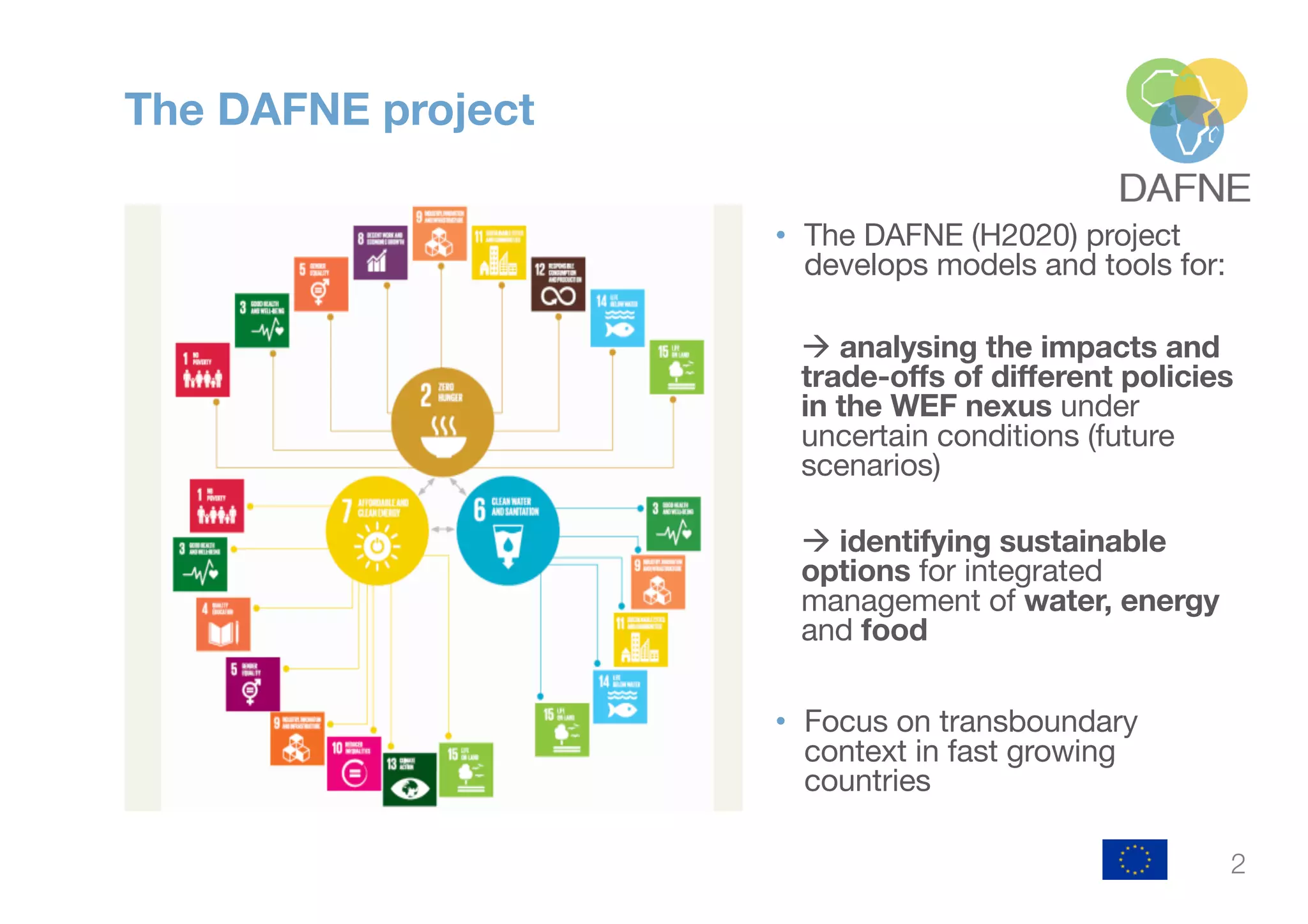
• The DAFNE (H2020) project
develops models and tools for:
à analysing the impacts and
trade-offs of different policies
in the WEF nexus under
uncertain conditions (future
scenarios)
à identifying sustainable
options for integrated
management of water, energy
and food
• Focus on transboundary
context in fast growing
countries
2
What is DAFNE?
The DAFNE (H2020)
project explores
sustainable and
integrated options for
the management of
water, energy and
food.
Focus on
transboundary context
in fast growing
countries.
3
We need more energy and food …
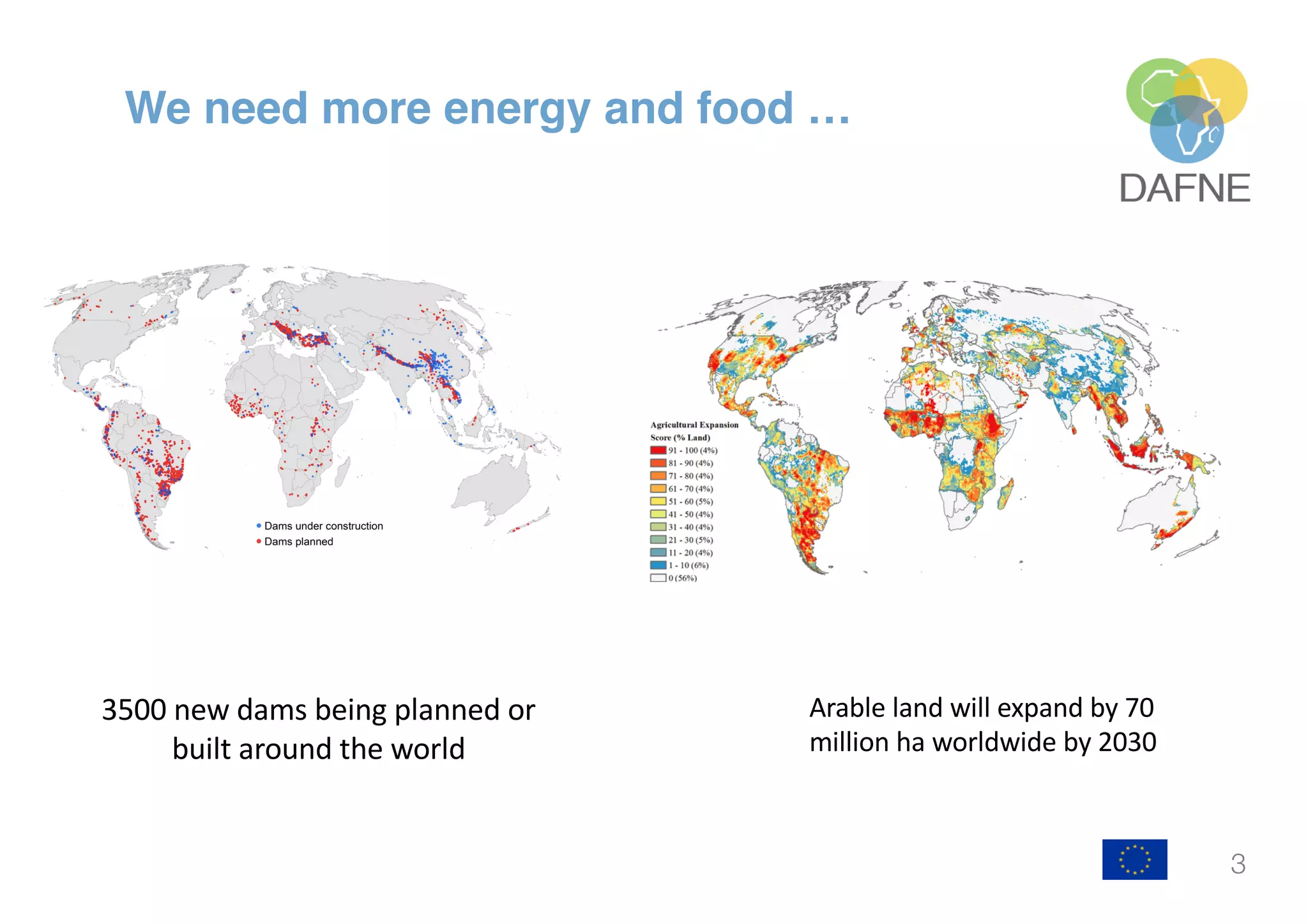
3500 new dams being planned or
built around the world
Arable land will expand by 70
million ha worldwide by 2030
4
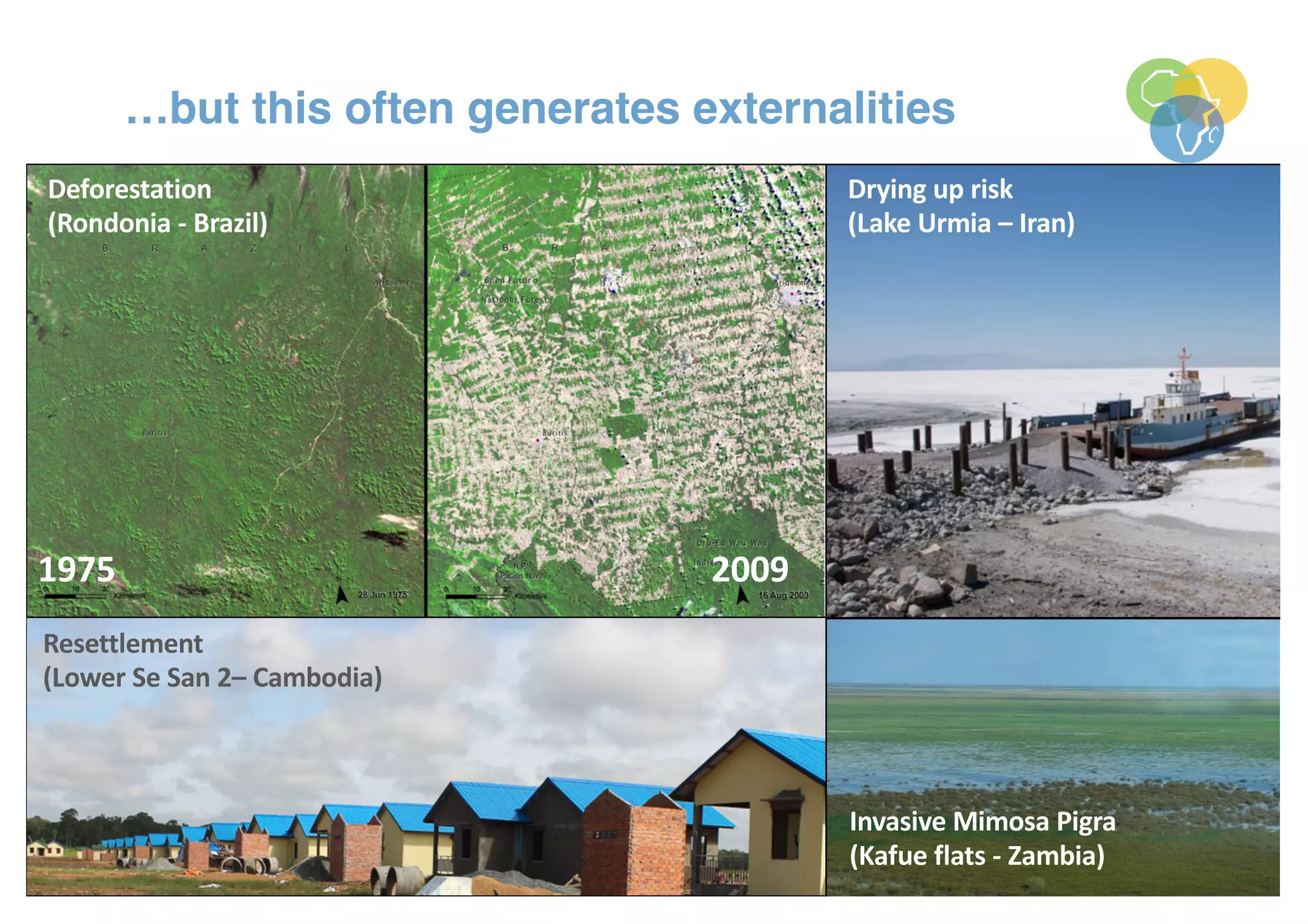
…but this often generates externalities
Deforestation
(Rondonia - Brazil)
1975 2009
Drying up risk
(Lake Urmia – Iran)
Resettlement
(Lower Se San 2– Cambodia)
Invasive Mimosa Pigra
(Kafue flats - Zambia)
5
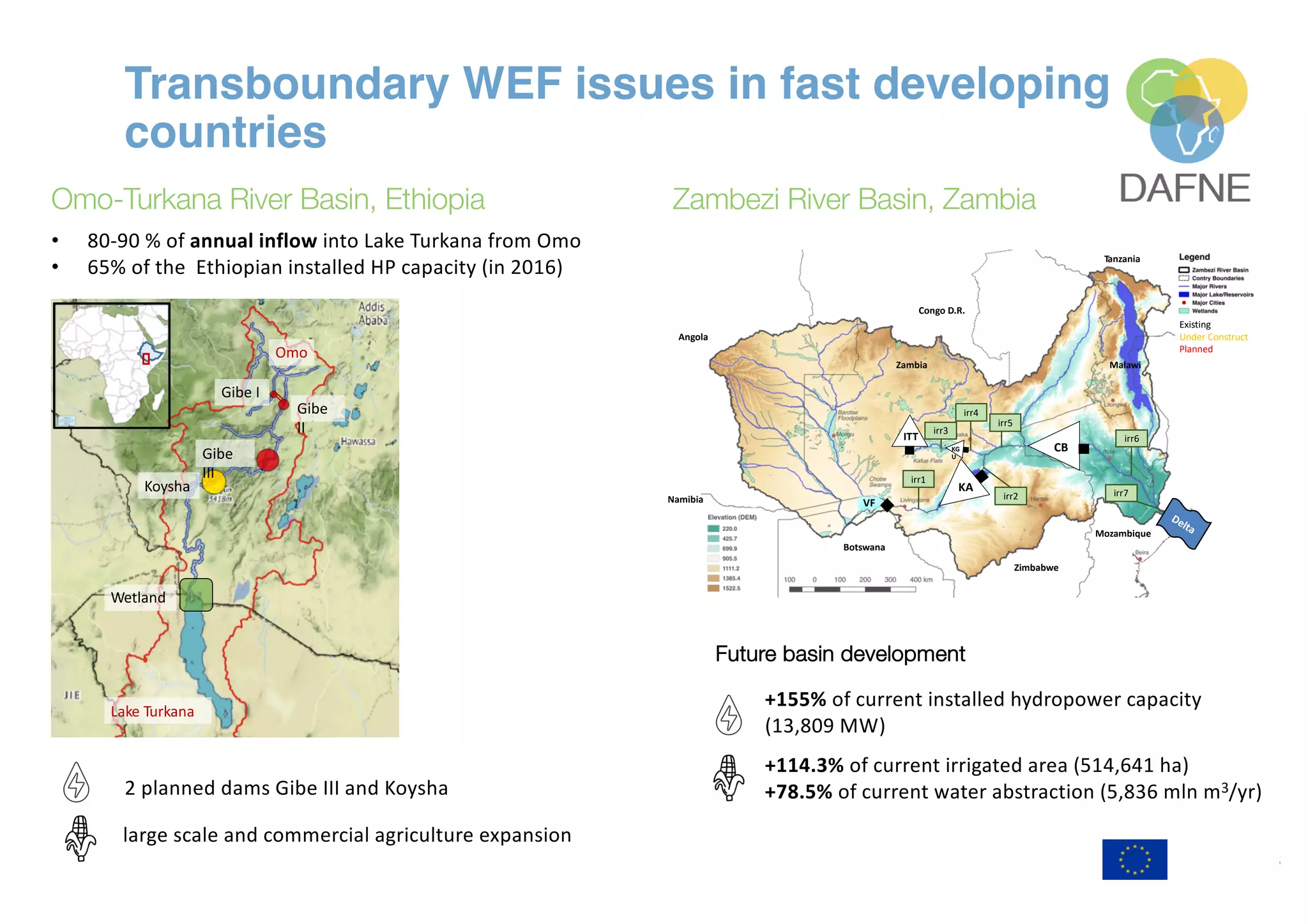
Transboundary WEF issues in fast developing
countries
Delta
Congo D.R.
Angola
Namibia
Botswana
Zimbabwe
Mozambique
Malawi
Tanzania
Zambia
KA
CB
ITT
KG
U
VF
irr3
irr1
irr2
irr4
irr5
irr6
irr7
Existing
Under Construct
Planned
Omo-Turkana River Basin, Ethiopia Zambezi River Basin, Zambia
+155% of current installed hydropower capacity
(13,809 MW)
+114.3% of current irrigated area (514,641 ha)
+78.5% of current water abstraction (5,836 mln m3/yr)
Future basin development
2 planned dams Gibe III and Koysha
large scale and commercial agriculture expansion
Gibe I
Gibe
II
Gibe
III
Koysha
Wetland
Lake Turkana
Omo
• 80-90 % of annual inflow into Lake Turkana from Omo
• 65% of the Ethiopian installed HP capacity (in 2016)
6
Transboundary WEF issues in fast developing
countries
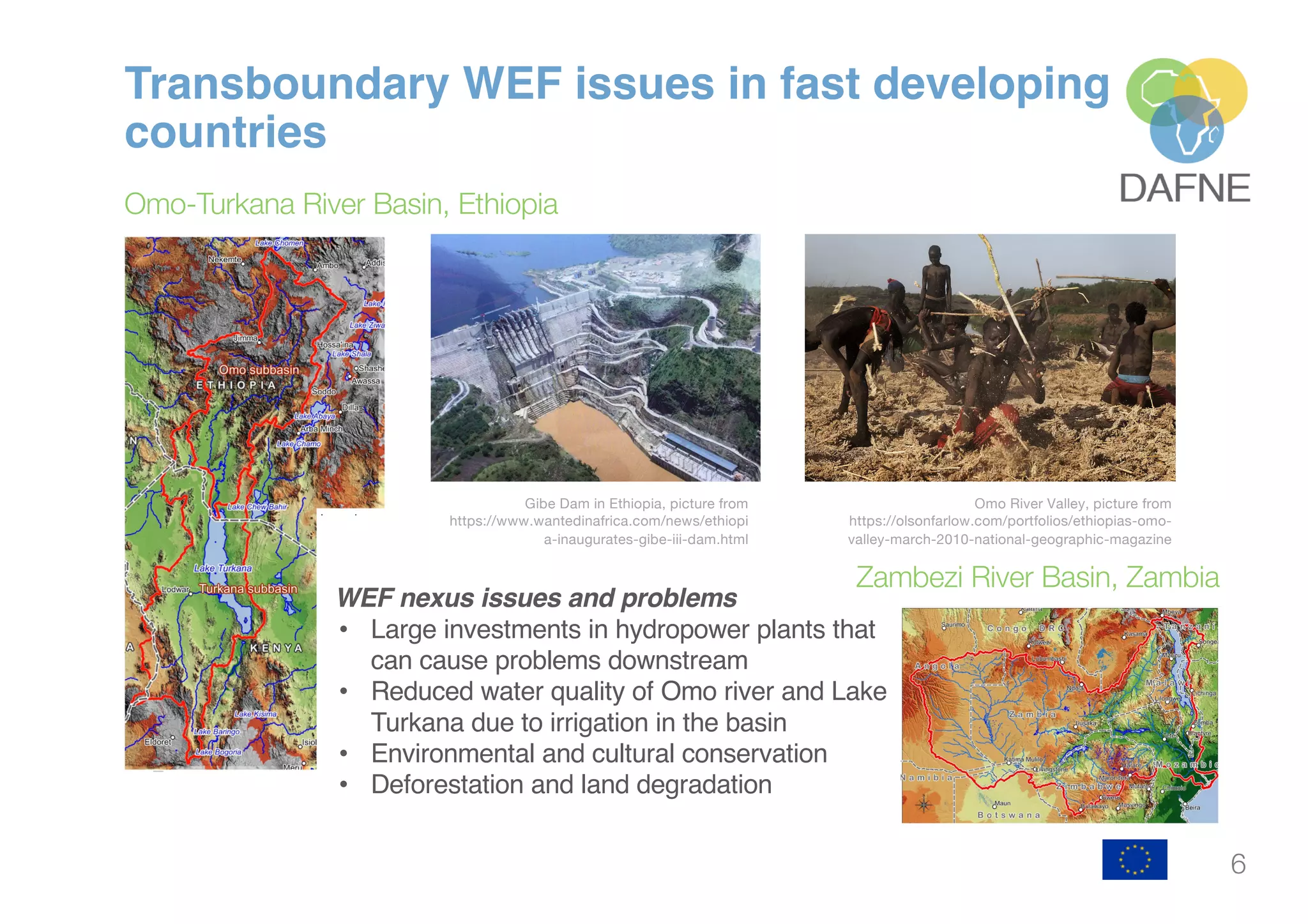
Omo-Turkana River Basin, Ethiopia
WEF nexus issues and problems
• Large investments in hydropower plants that
can cause problems downstream
• Reduced water quality of Omo river and Lake
Turkana due to irrigation in the basin
• Environmental and cultural conservation
• Deforestation and land degradation
Gibe Dam in Ethiopia, picture from
https://www.wantedinafrica.com/news/ethiopi
a-inaugurates-gibe-iii-dam.html
Omo River Valley, picture from
https://olsonfarlow.com/portfolios/ethiopias-omo-
valley-march-2010-national-geographic-magazine
Zambezi River Basin, Zambia
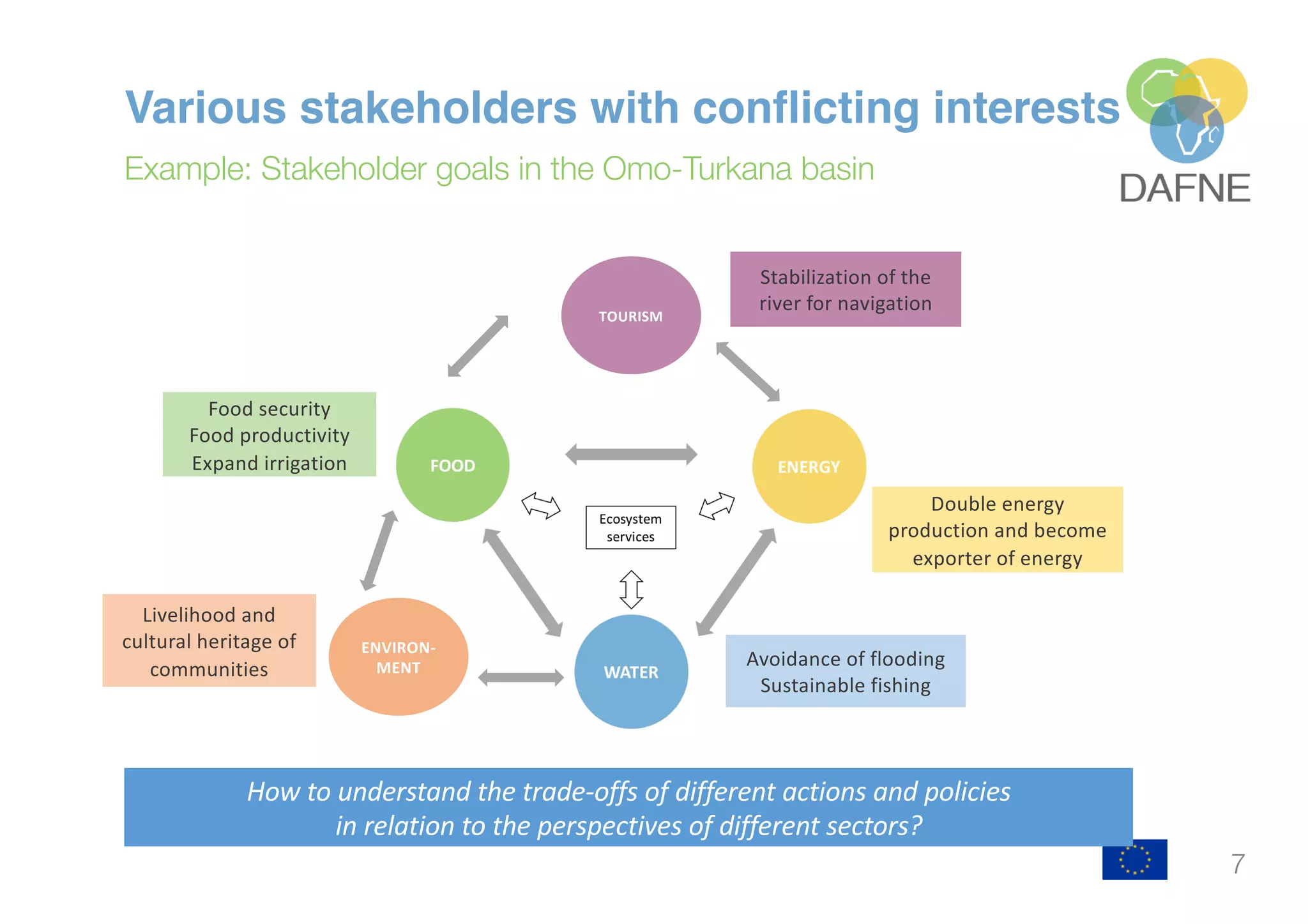
Various stakeholders with conflicting interests
Example: Stakeholder goals in the Omo-Turkana basin
7
Double energy
production and become
exporter of energy
Avoidance of flooding
Sustainable fishing
Food security
Food productivity
Expand irrigation
ENVIRON-
MENT
TOURISM
Stabilization of the
river for navigation
Livelihood and
cultural heritage of
communities
How to understand the trade-offs of different actions and policies
in relation to the perspectives of different sectors?
8
3rd NSL
Selected
pathways
2nd NSL
Selection of
interesting
pathways
Preview of
the WEF
model
Review results
of WEF/DAF
models
WEF
WEF
modelWEF model Evaluation of
extended indicators
set and full model
resultsDAF
strategic
model
1st NSL
Efficient
pathways
Development
pathways
Design
indicators
DAF
Indicators
Actions
Screening Multi-perspective Geoportal
+
TOOLS
Online interaction
PROCESS
Scenarios
DAFNE project: Main results
Decision-Analytic Framework & Visual tools to analyse the WEF nexus
Participatory approach from the outset
NSL = Negotiation Simulation Lab
9
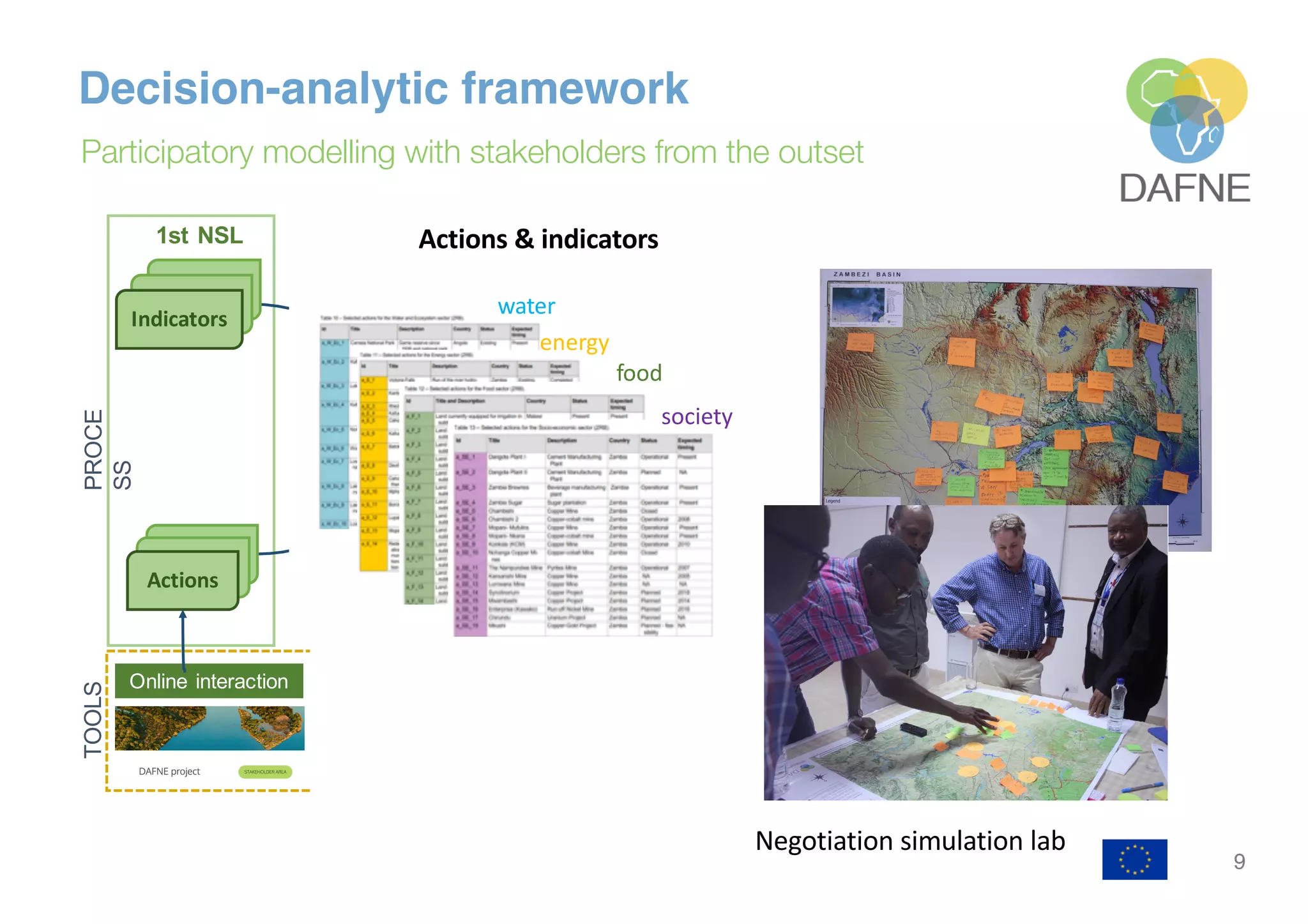
Decision-analytic framework
Participatory modelling with stakeholders from the outset
3rd NSL
Selected
pathways
2nd NSL
Selection of
interesting
pathways
Preview of
the WEF
model
Review results
of WEF/DAF
models
WEF
WEFmodel
WEF model
Evaluation of
extended
indicators set
and full model
results
DAF strategic
model
1st NSL
Efficient
pathway
s
Development
pathways
Design
indicators
DAF
Indicators
Actions
Screening Multi-
perspective
Geoportal
+
TOOLS
Online interaction
PROCE
SS
Scenarios
water
energy
food
society
Actions & indicators
Negotiation simulation lab
10
Decision-Analytic framework
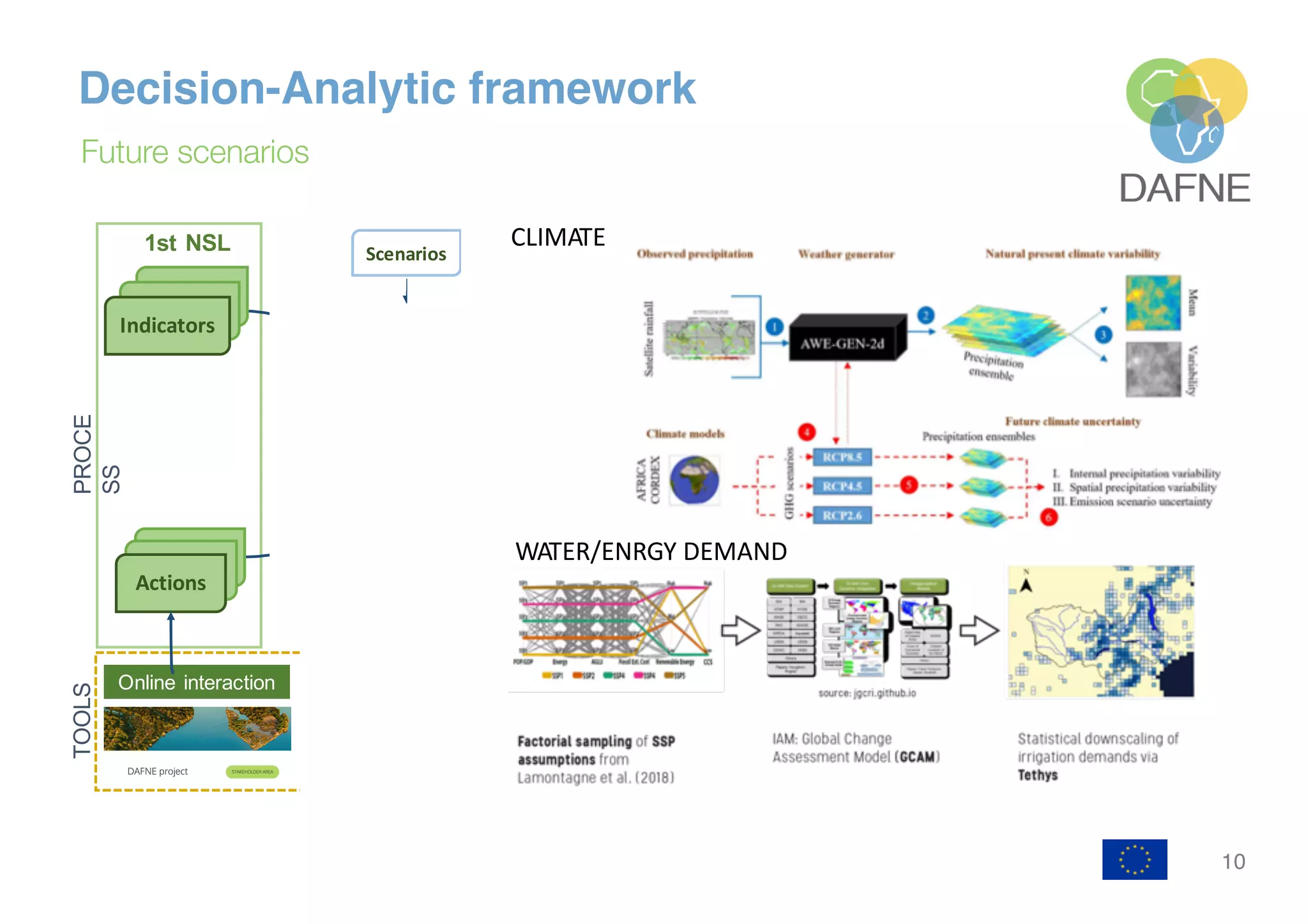
Future scenarios
Future Scenarios
3rd NSL
Selected
pathways
2nd NSL
Selection of
interesting
pathways
Preview of
the WEF
model
Review results
of WEF/DAF
models
WEF
WEFmodel
WEF model
Evaluation of
extended
indicators set
and full model
results
DAF strategic
model
1st NSL
Efficient
pathway
s
Development
pathways
Design
indicators
DAF
Indicators
Actions
Screening Multi-
perspective
Geoportal
+
TOOLS
Online interaction
PROCE
SS
Scenarios
CLIMATE
WATER/ENRGY DEMAND
11
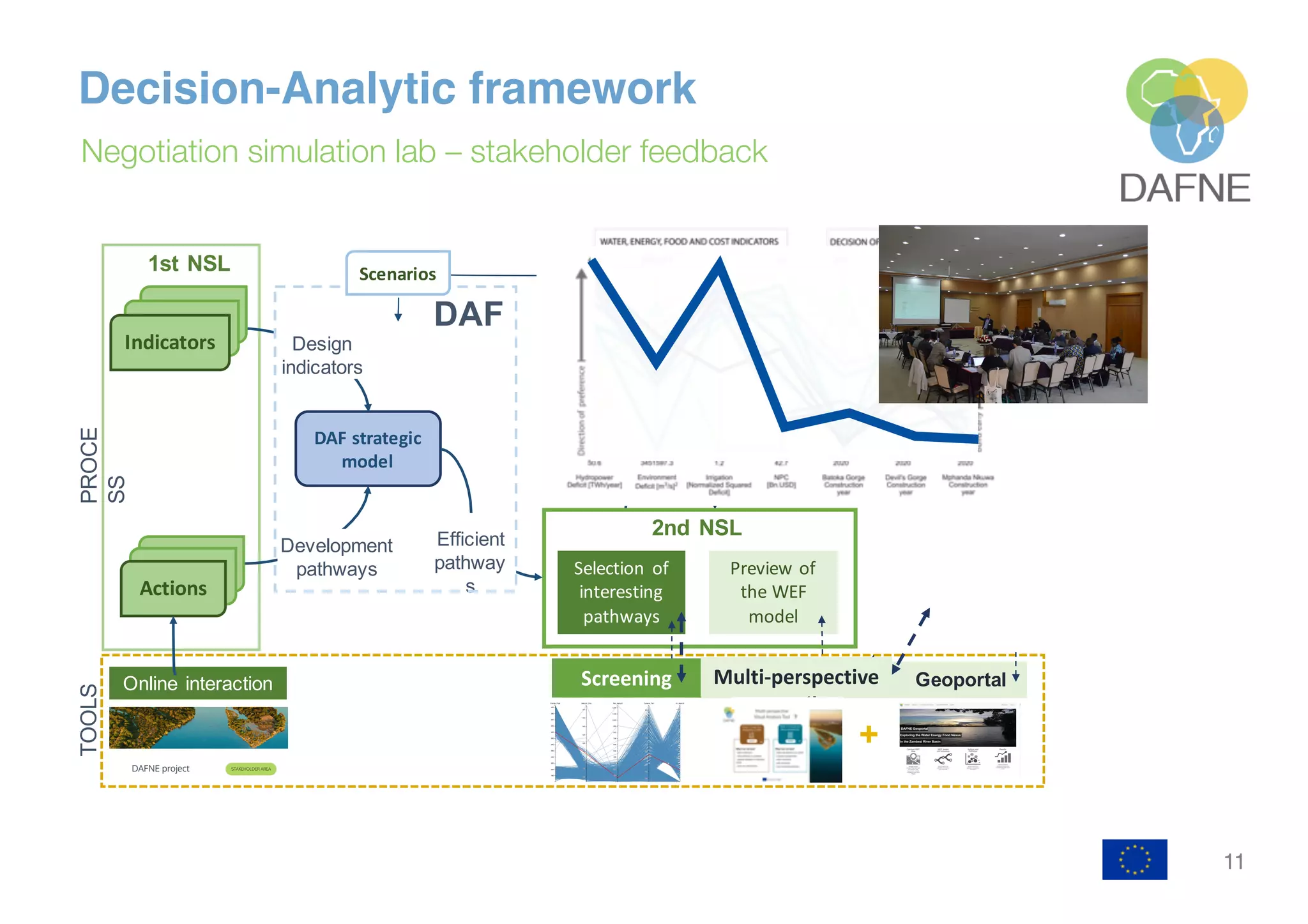
Decision-Analytic framework
Negotiation simulation lab – stakeholder feedback
3rd NSL
Selected
pathways
2nd NSL
Selection of
interesting
pathways
Preview of
the WEF
model
Review results
of WEF/DAF
models
WEF
WEFmodelWEF model
Evaluation of
extended
indicators set
and full model
results
DAF strategic
model
1st NSL
Efficient
pathway
s
Development
pathways
Design
indicators
DAF
Indicators
Actions
Screening Multi-
perspective
Geoportal
+
TOOLS
Online interaction
PROCE
SS
Scenarios
Screening Multi-perspective
11
Decision-Analytic framework
Negotiation simulation lab – stakeholder feedback
3rd NSL
Selected
pathways
2nd NSL
Selection of
interesting
pathways
Preview of
the WEF
model
Review results
of WEF/DAF
models
WEF
WEFmodelWEF model
Evaluation of
extended
indicators set
and full model
results
DAF strategic
model
1st NSL
Efficient
pathway
s
Development
pathways
Design
indicators
DAF
Indicators
Actions
Screening Multi-
perspective
Geoportal
+
TOOLS
Online interaction
PROCE
SS
Scenarios
Screening Multi-perspective
12
3rd NSL
Selected
pathways
2nd NSL
Selection of
interesting
pathways
Preview of
the WEF
model
Review results
of WEF/DAF
models
WEF
WEF
modelWEF model Evaluation of
extended indicators
set and full model
resultsDAF
strategic
model
1st NSL
Efficient
pathways
Development
pathways
Design
indicators
DAF
Indicators
Actions
Screening Multi-perspective Geoportal
+
TOOLS
Online interaction
PROCESS
Scenarios
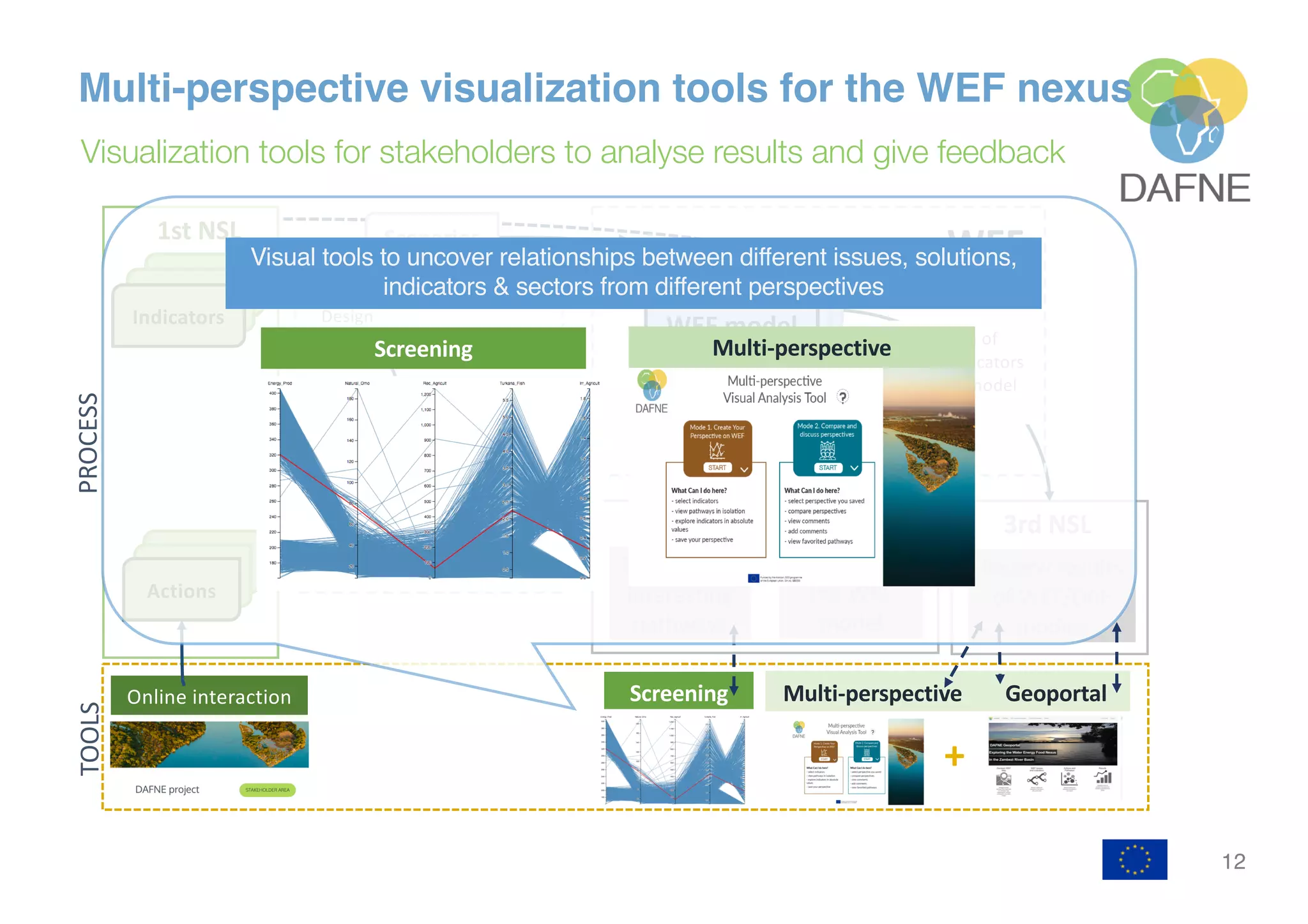
Multi-perspective visualization tools for the WEF nexus
Visualization tools for stakeholders to analyse results and give feedback
Screening
Visual tools to uncover relationships between different issues, solutions,
indicators & sectors from different perspectives
Multi-perspective
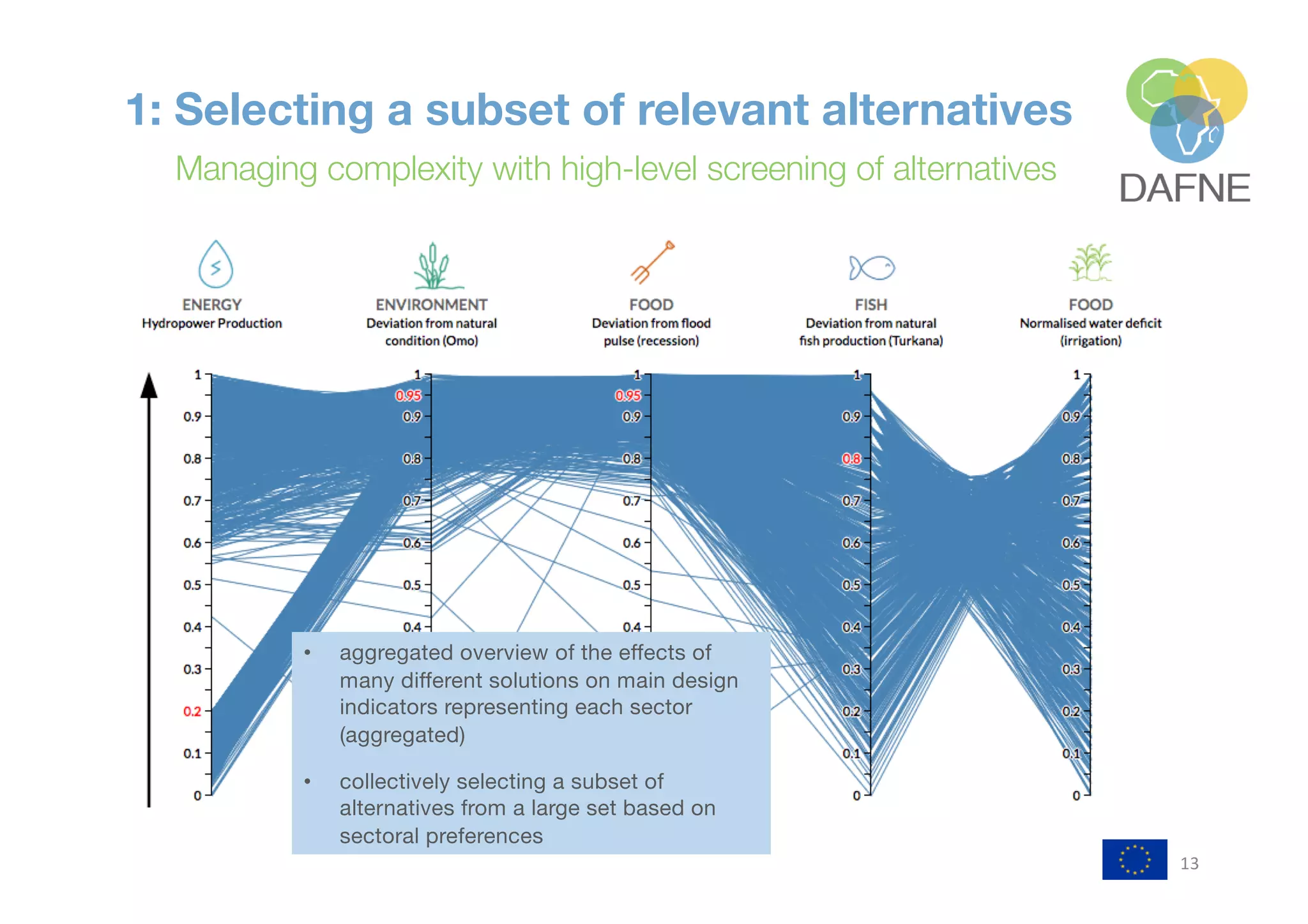
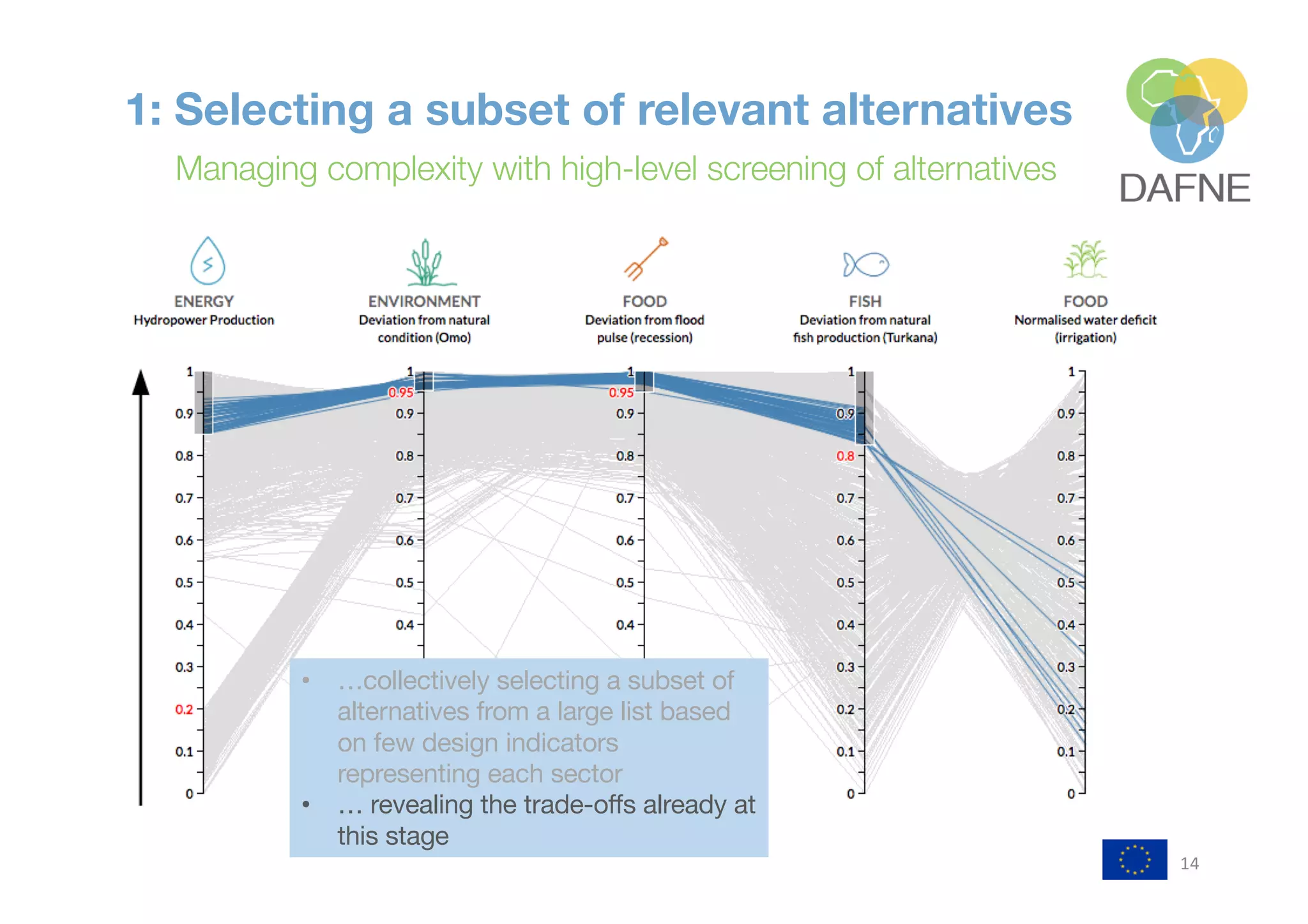
1: Selecting a subset of relevant alternatives
Managing complexity with high-level screening of alternatives
13
• aggregated overview of the effects of
many different solutions on main design
indicators representing each sector
(aggregated)
• collectively selecting a subset of
alternatives from a large set based on
sectoral preferences
1: Selecting a subset of relevant alternatives
14
• …collectively selecting a subset of
alternatives from a large list based
on few design indicators
representing each sector
• … revealing the trade-offs already at
this stage
Managing complexity with high-level screening of alternatives
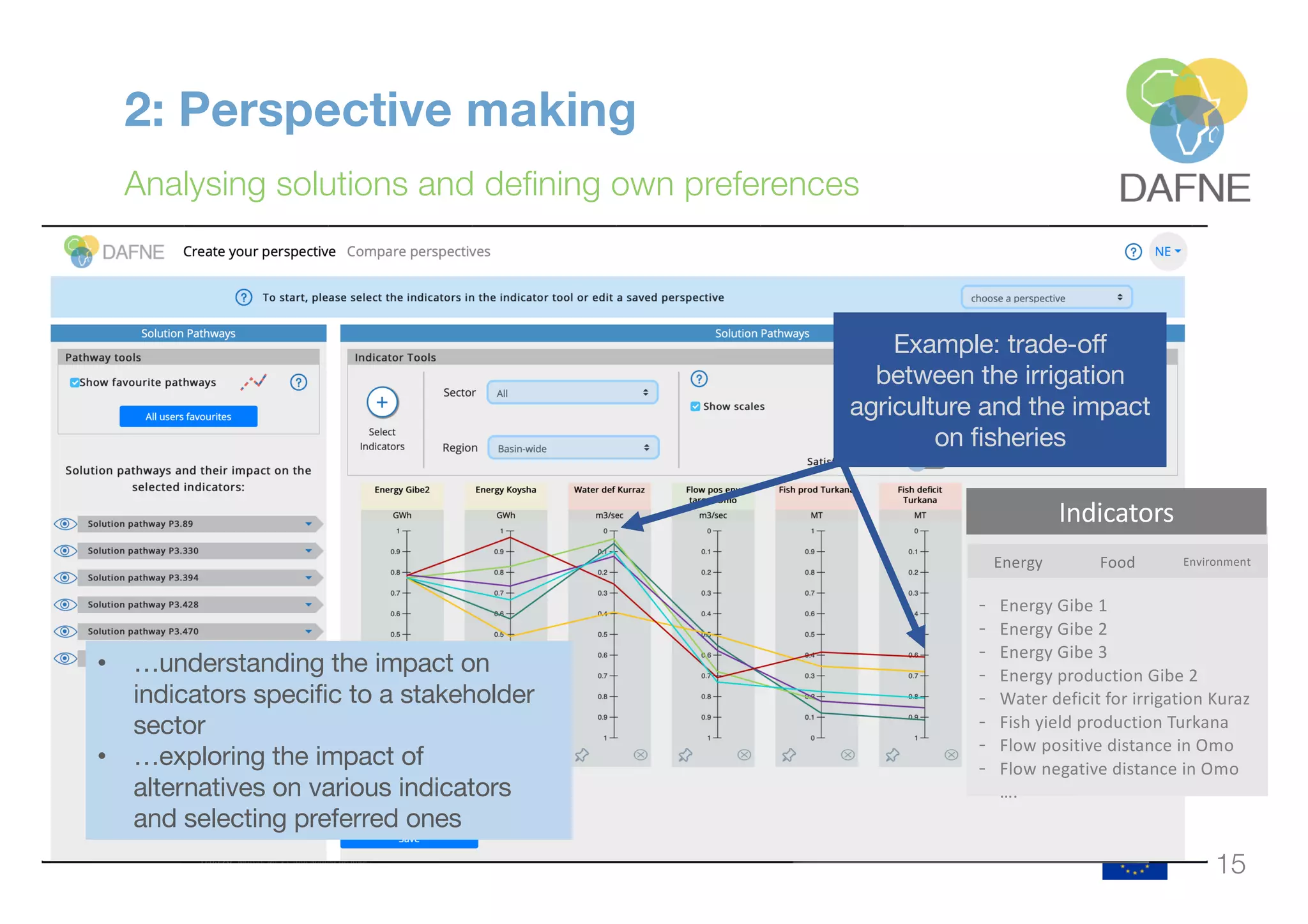
2: Perspective making
Analysing solutions and defining own preferences
15
Example: trade-off
between the irrigation
agriculture and the impact
on fisheries
- Energy Gibe 1
- Energy Gibe 2
- Energy Gibe 3
- Energy production Gibe 2
- Water deficit for irrigation Kuraz
- Fish yield production Turkana
- Flow positive distance in Omo
- Flow negative distance in Omo
….
Indicators
• …understanding the impact on
indicators specific to a stakeholder
sector
• …exploring the impact of
alternatives on various indicators
and selecting preferred ones
Energy Food Environment
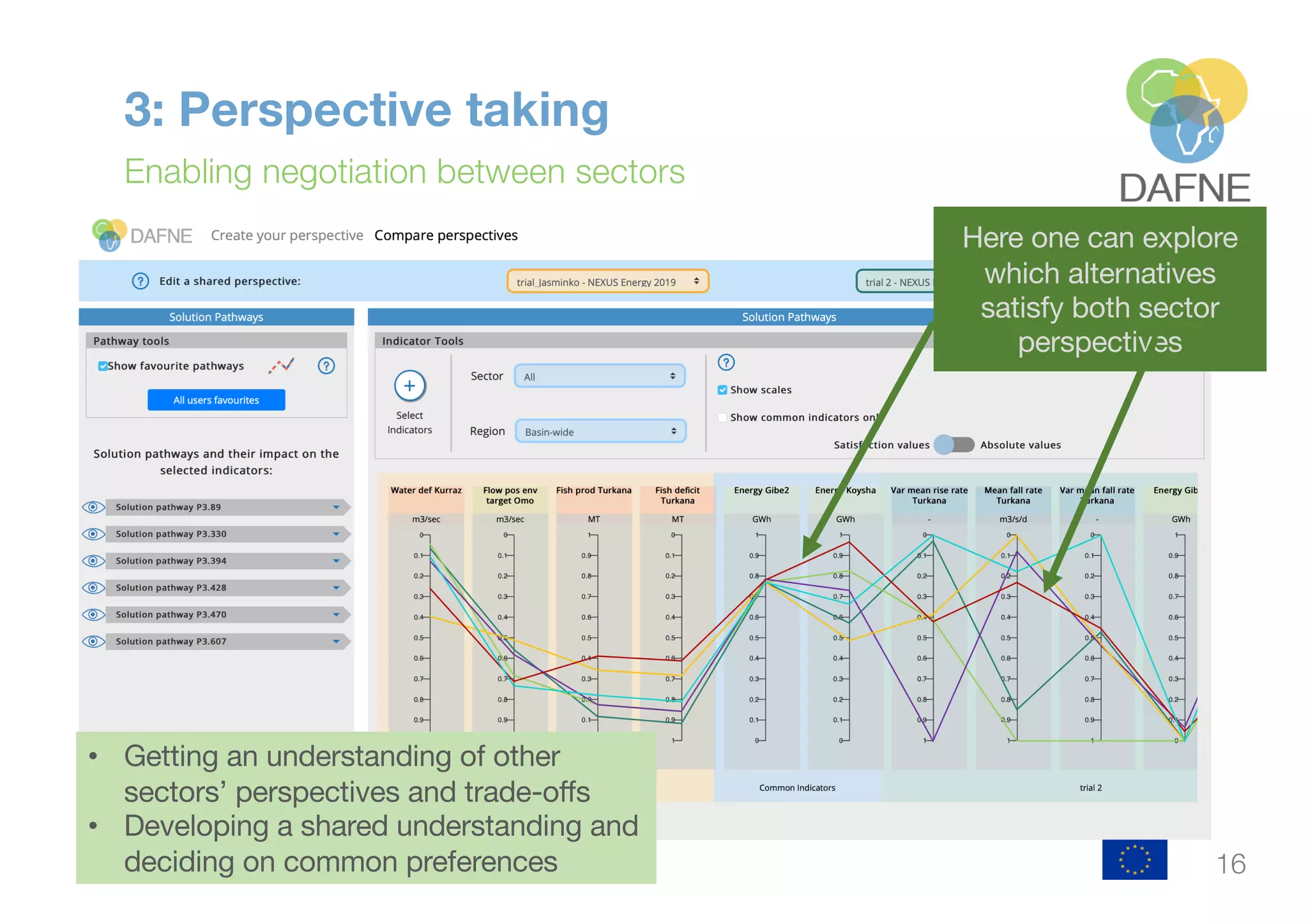
3: Perspective taking
Enabling negotiation between sectors
16
• Getting an understanding of other
sectors’ perspectives and trade-offs
• Developing a shared understanding and
deciding on common preferences
Here one can explore
which alternatives
satisfy both sector
perspectives
17
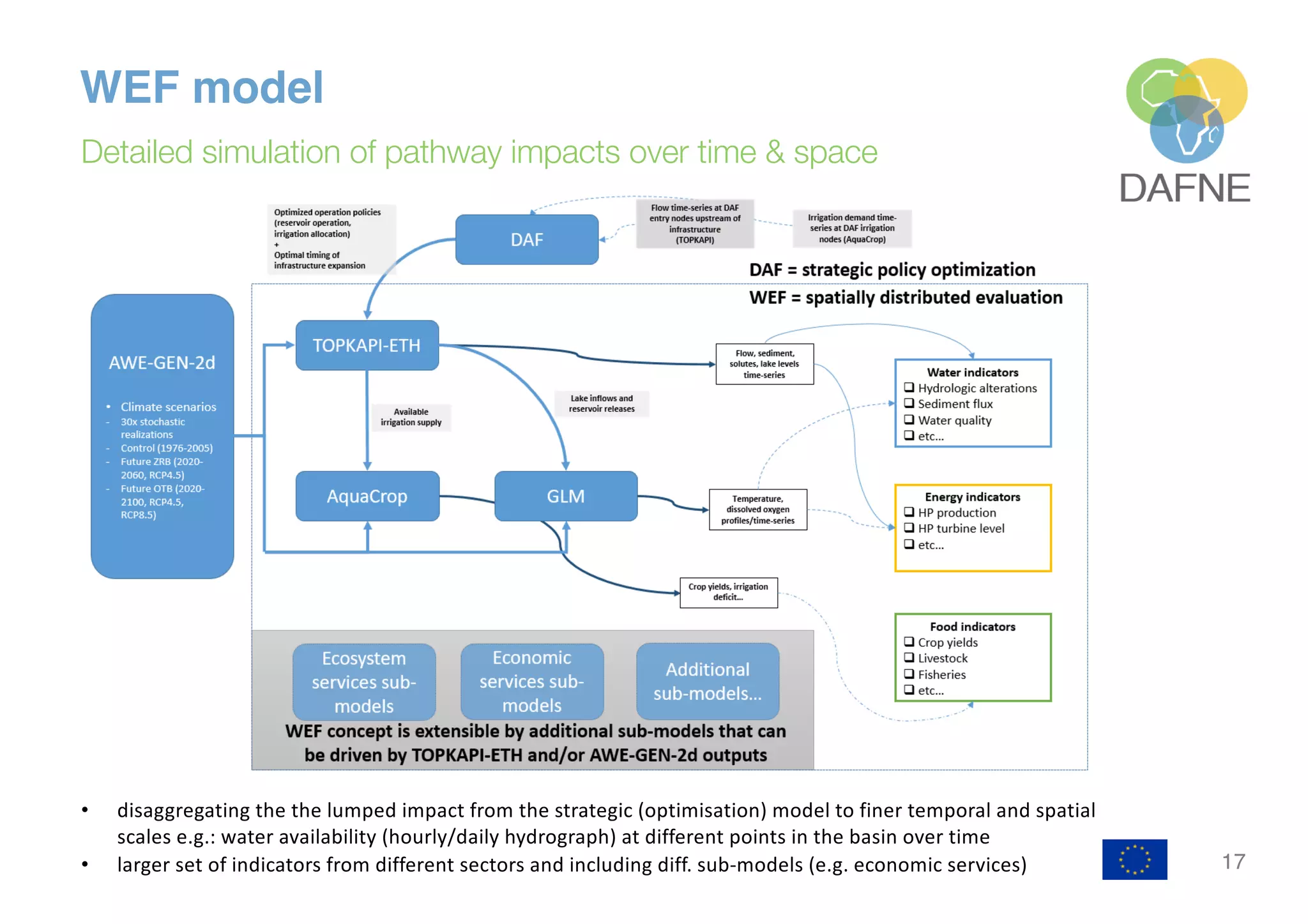
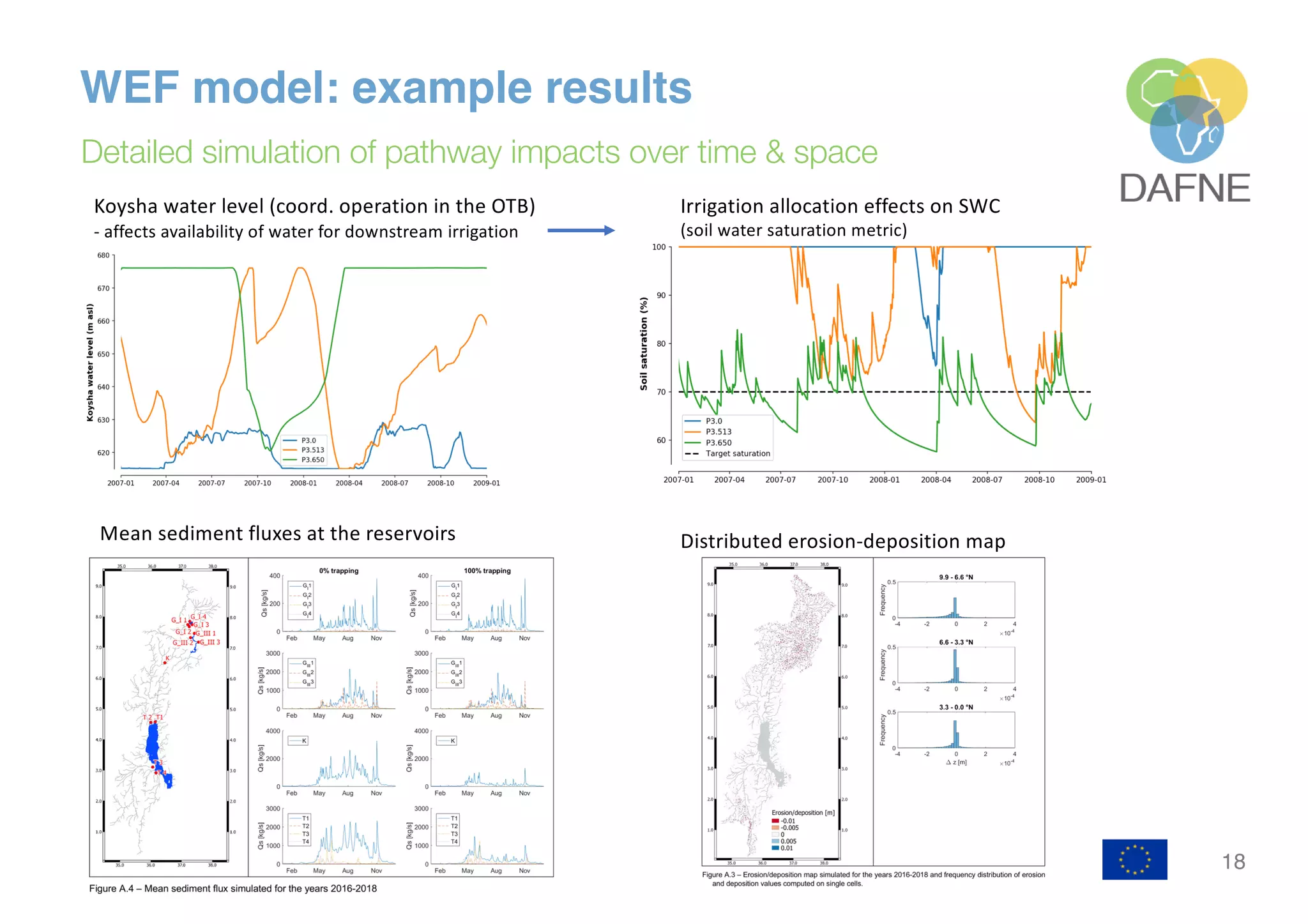
WEF model
Detailed simulation of pathway impacts over time & space
• disaggregating the the lumped impact from the strategic (optimisation) model to finer temporal and spatial
scales e.g.: water availability (hourly/daily hydrograph) at different points in the basin over time
• larger set of indicators from different sectors and including diff. sub-models (e.g. economic services)
18
WEF model: example results
Detailed simulation of pathway impacts over time & space
Koysha water level (coord. operation in the OTB)
- affects availability of water for downstream irrigation
Irrigation allocation effects on SWC
(soil water saturation metric)
Mean sediment fluxes at the reservoirs Distributed erosion-deposition map
19
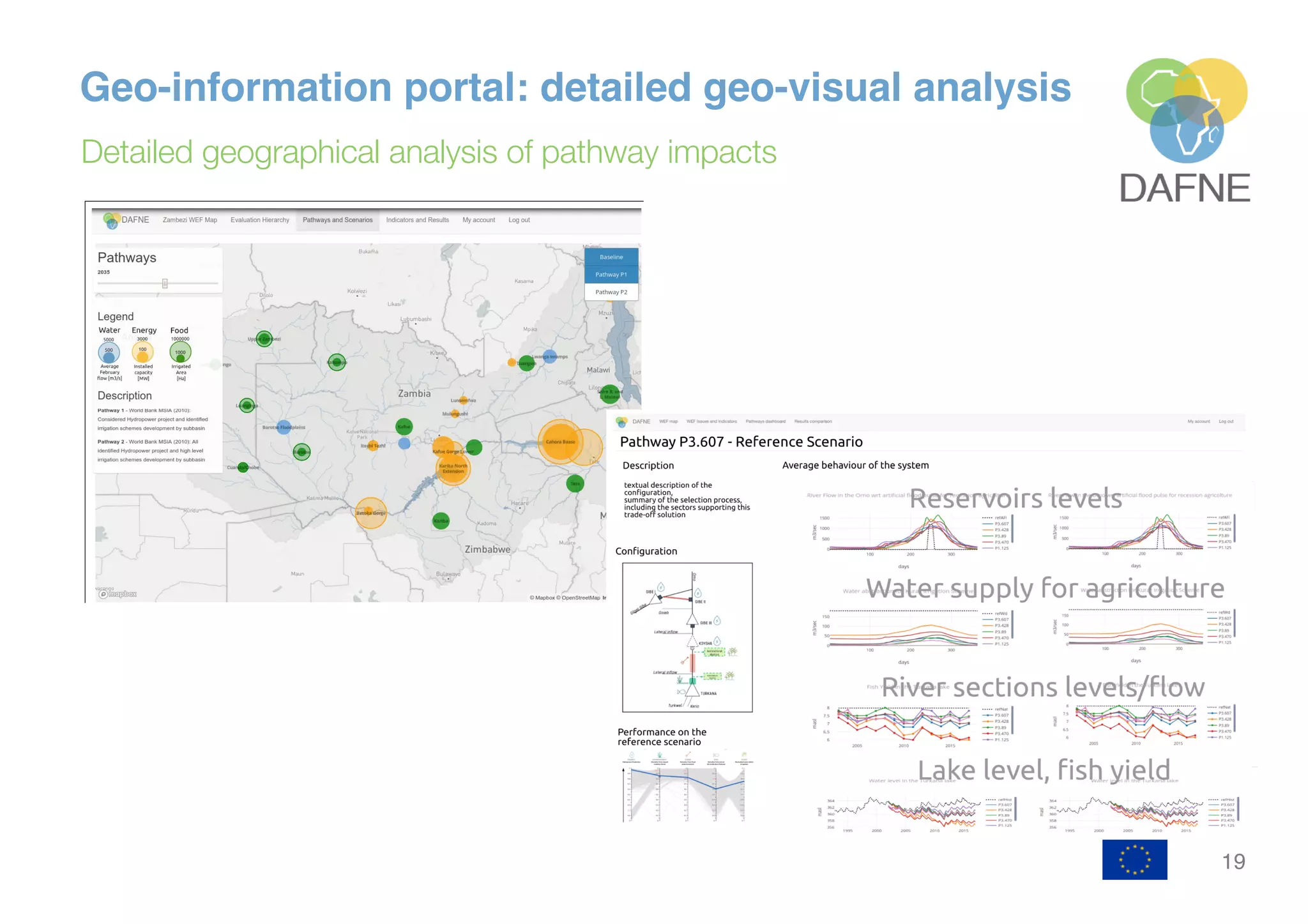
Geo-information portal: detailed geo-visual analysis
Detailed geographical analysis of pathway impacts
20
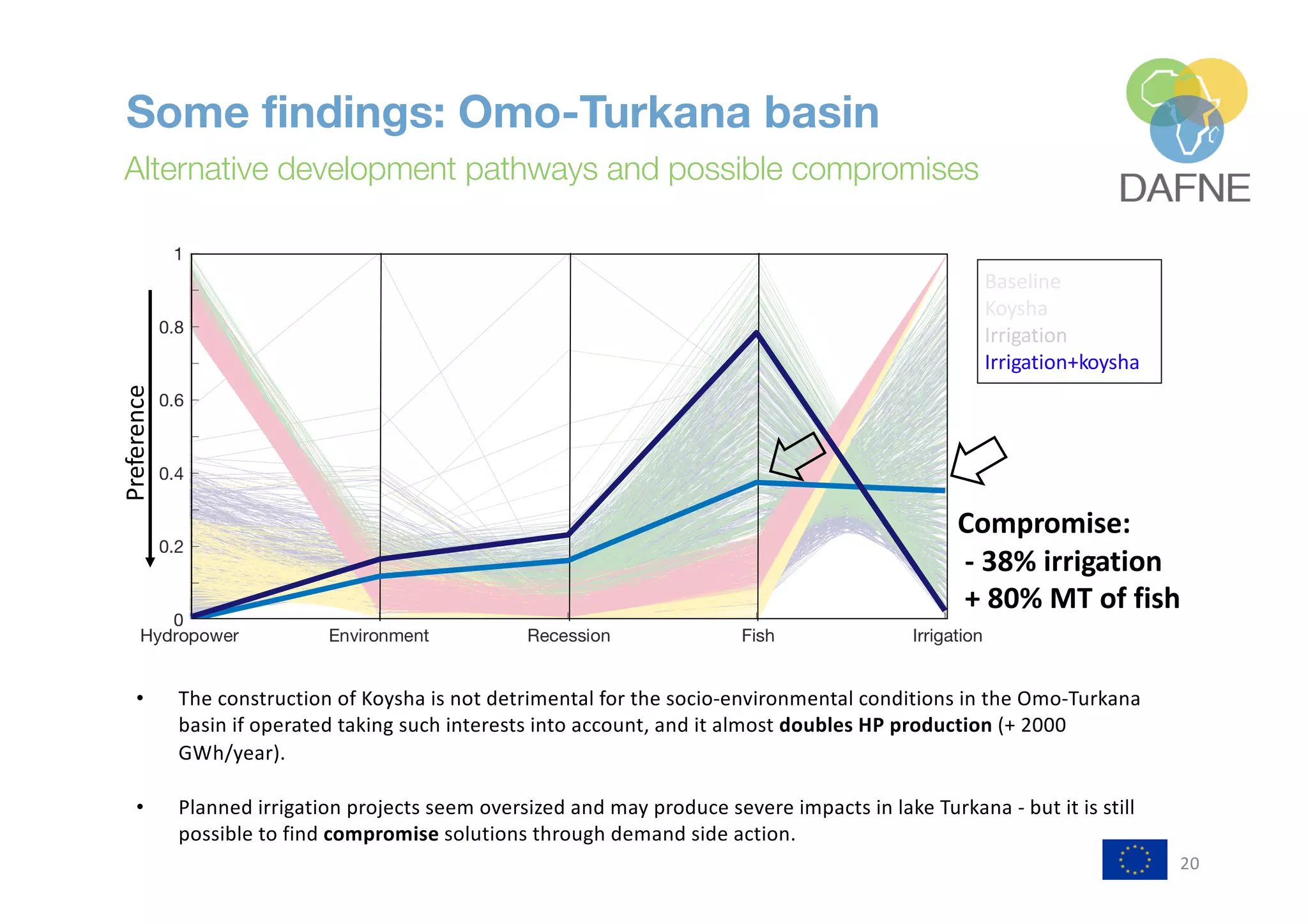
Some findings: Omo-Turkana basin
Alternative development pathways and possible compromises
Baseline
Koysha
Irrigation
Irrigation+koysha
1 2 3 4 5
0
0.1
0.2
0.3
0.4
0.5
0.6
0.7
0.8
0.9
1
Compromise:
- 38% irrigation
+ 80% MT of fish
Preference
• The construction of Koysha is not detrimental for the socio-environmental conditions in the Omo-Turkana
basin if operated taking such interests into account, and it almost doubles HP production (+ 2000
GWh/year).
• Planned irrigation projects seem oversized and may produce severe impacts in lake Turkana - but it is still
possible to find compromise solutions through demand side action.
21
Some findings: Omo-Turkana basin
Policies for operating water infrastructures for different alternatives
2002 2004 2006 2008 2010 2012 2014 2016
345
350
355
360
365
Level[masl]
GIBE I
GIBE III
TURKANA
Turkwel Kerio
Omo
GIBE II
Gojeb
Gilgel Gibe
KOYSHA
Agricultural
district
Agricultural
district
Turkana Level
Gibe III Level
Koysha Level
Delta
Agricultural diversion
No irrigation
Extreme irrigation
Max-min operational level
Water demand
Natural delta regime
Jan Feb Mar Apr May Jun Jul Aug Sep Oct Nov Dec
0
50
100
150
200
Irrigation[m3
/s]
Jan Feb Mar Apr May Jun Jul Aug Sep Oct Nov Dec
620
640
660
680
Level[masl]
Max-min operational level
Jan FebMar Apr May Jun Jul Aug Sep Oct Nov Dec
0
500
1000
1500
2000
Streamflow[m3
/s]
Jan FebMar AprMay Jun Jul AugSep Oct NovDec
800
850
900
Level[masl]
22
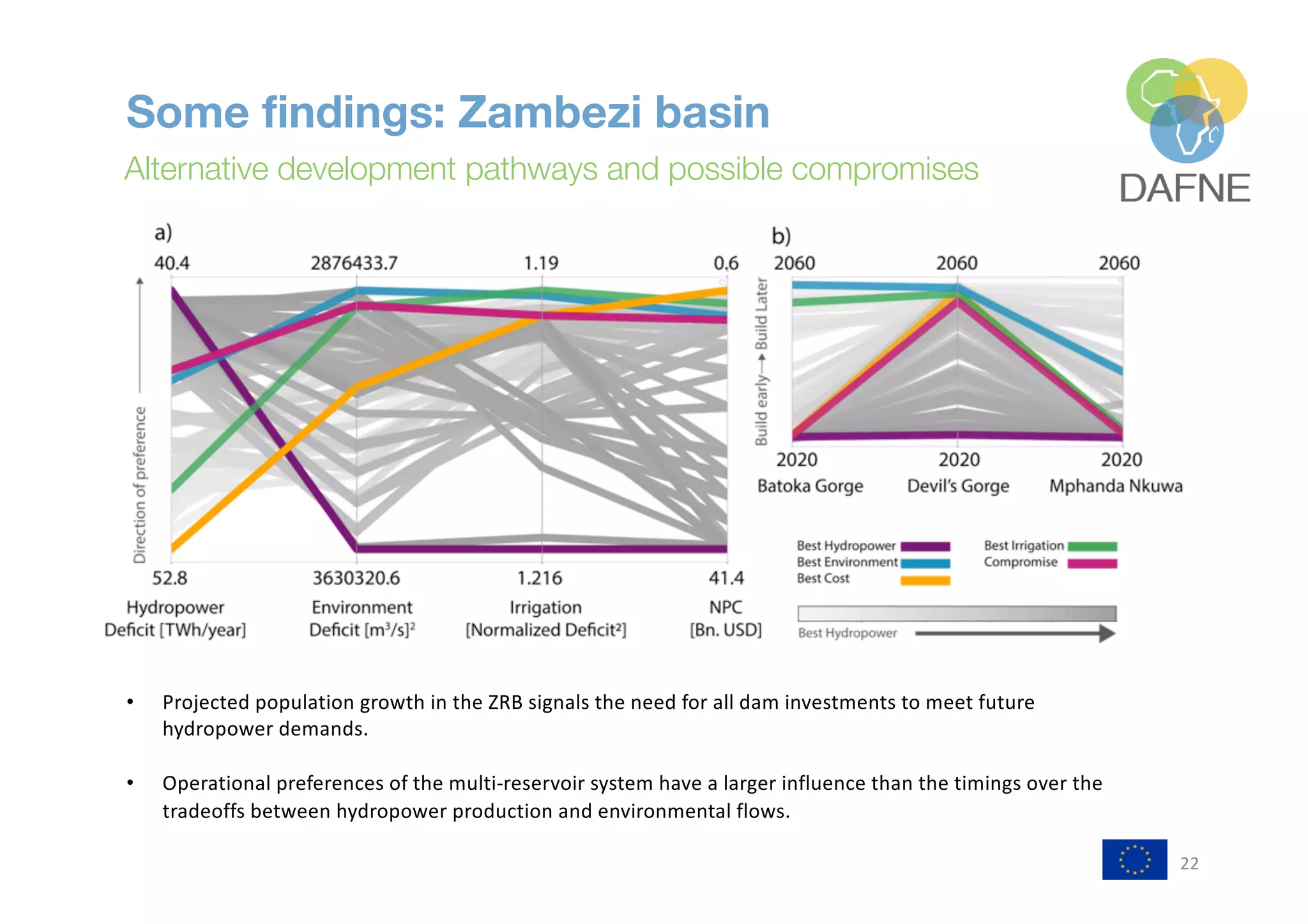
Some findings: Zambezi basin
Alternative development pathways and possible compromises
• Projected population growth in the ZRB signals the need for all dam investments to meet future
hydropower demands.
• Operational preferences of the multi-reservoir system have a larger influence than the timings over the
tradeoffs between hydropower production and environmental flows.
23
Some findings: Econometric modelling
Estimation of Sector Specific Production Functions
25
Case Study: Omo Turkana Basin
Estimation of Sector Specific Production Functions
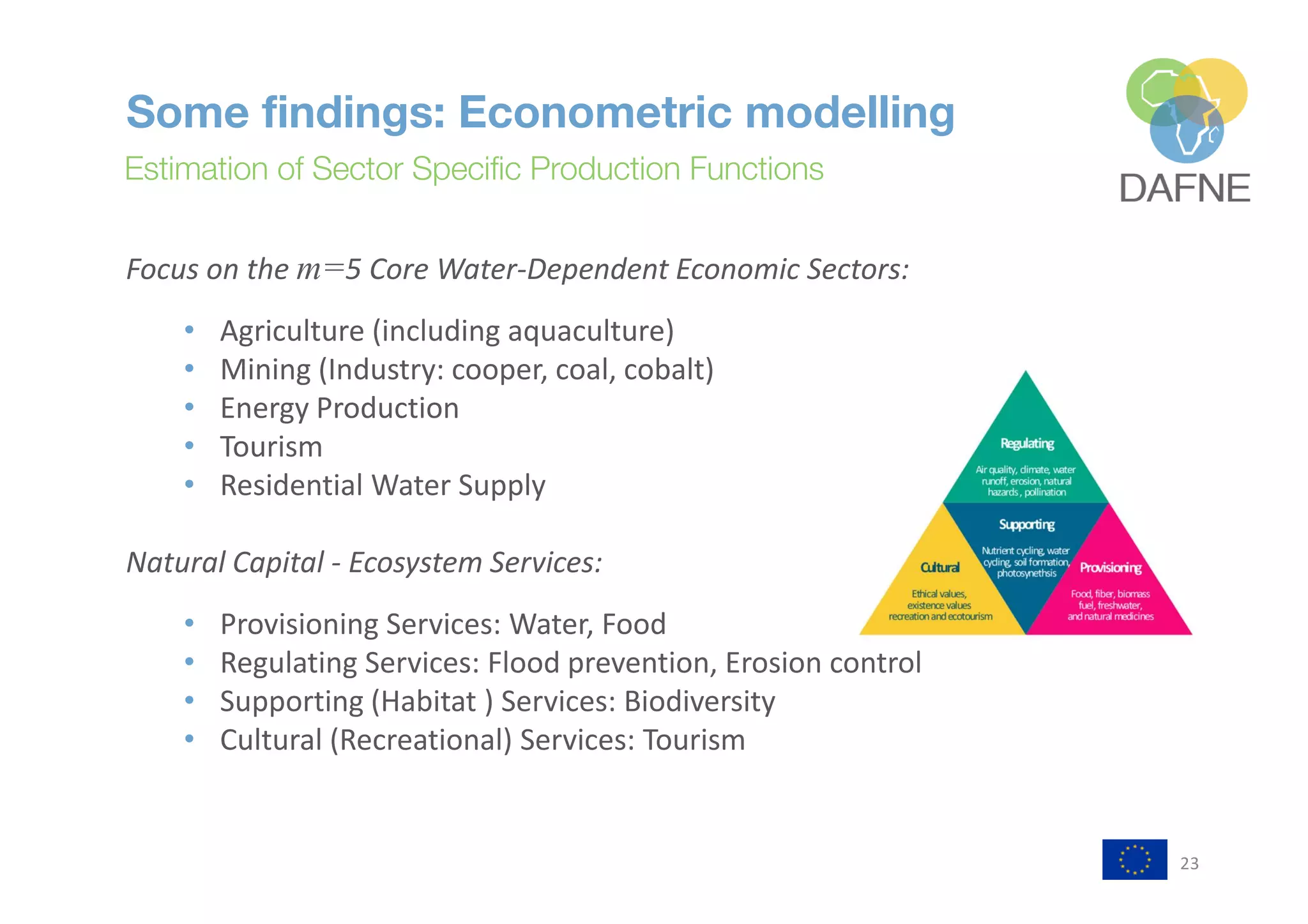
Focus on the m=5 Core Water-Dependent Economic Sectors:
• Agriculture (including aquaculture)
• Mining (Industry: cooper, coal, cobalt)
• Energy Production
• Tourism
• Residential Water Supply
Natural Capital - Ecosystem Services:
• Provisioning Services: Water, Food
• Regulating Services: Flood prevention, Erosion control
• Supporting (Habitat ) Services: Biodiversity
• Cultural (Recreational) Services: Tourism
24
Some findings: Simulation of actor behaviour
Non-cooperative vs. cooperative water use: downstream
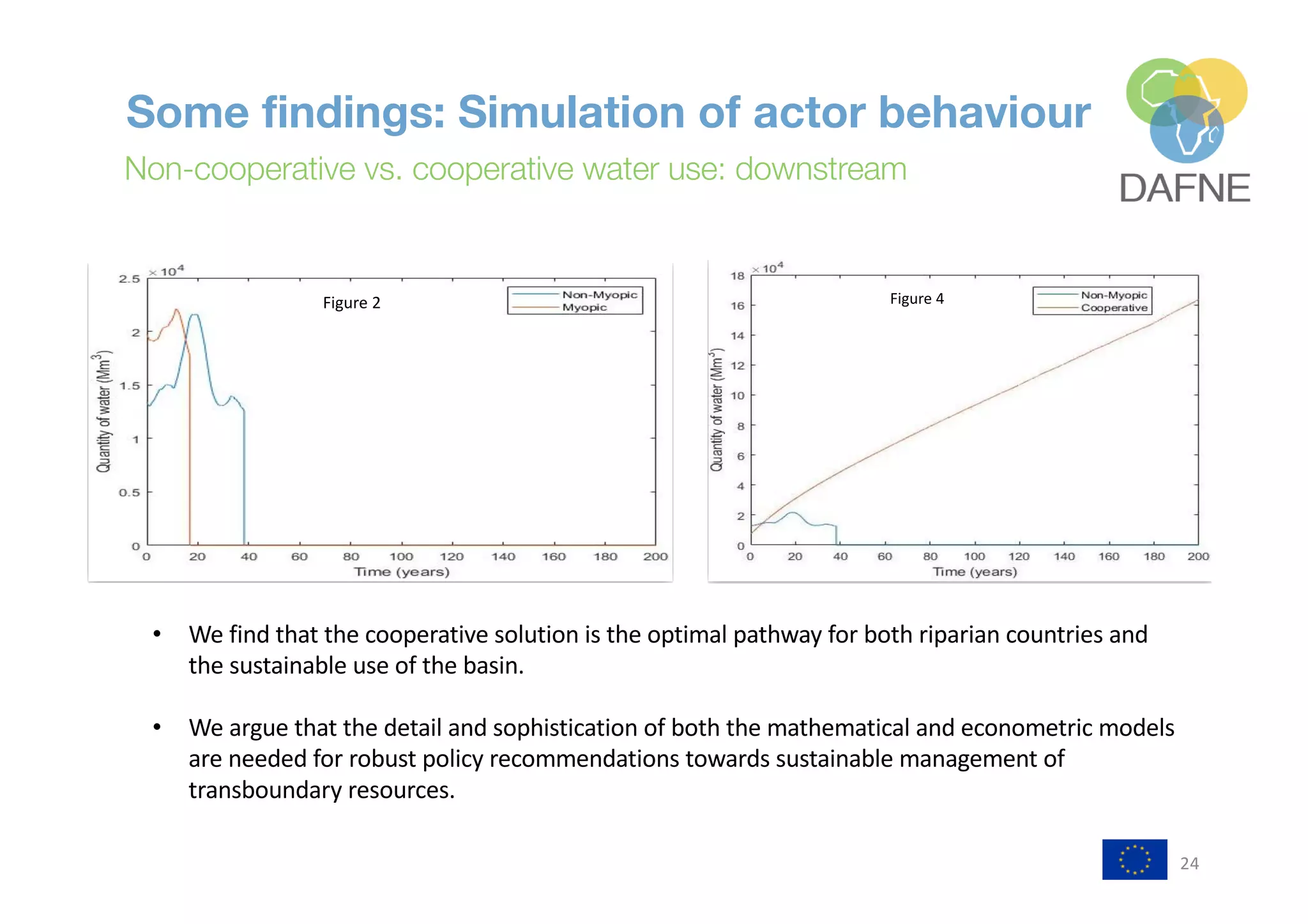
• We find that the cooperative solution is the optimal pathway for both riparian countries and
the sustainable use of the basin.
• We argue that the detail and sophistication of both the mathematical and econometric models
are needed for robust policy recommendations towards sustainable management of
transboundary resources.
Simulation Results: Non cooperative Downstream
37
• The water use becomes zero after a period of time due to the lake exhaustion
both under myopic and non-myopic case
Figure 2
Simulation Results: Cooperative Downstream
40
Figure 4
Non-myopic: U considers river stock, D considers lake stock
Cooperative: U gives hydro and takes food from D
25
Some findings: Multi-perspective visualization
helpful for analyzing trade-offs in the nexus
Facilitating analysis for the policy making and negotiation process
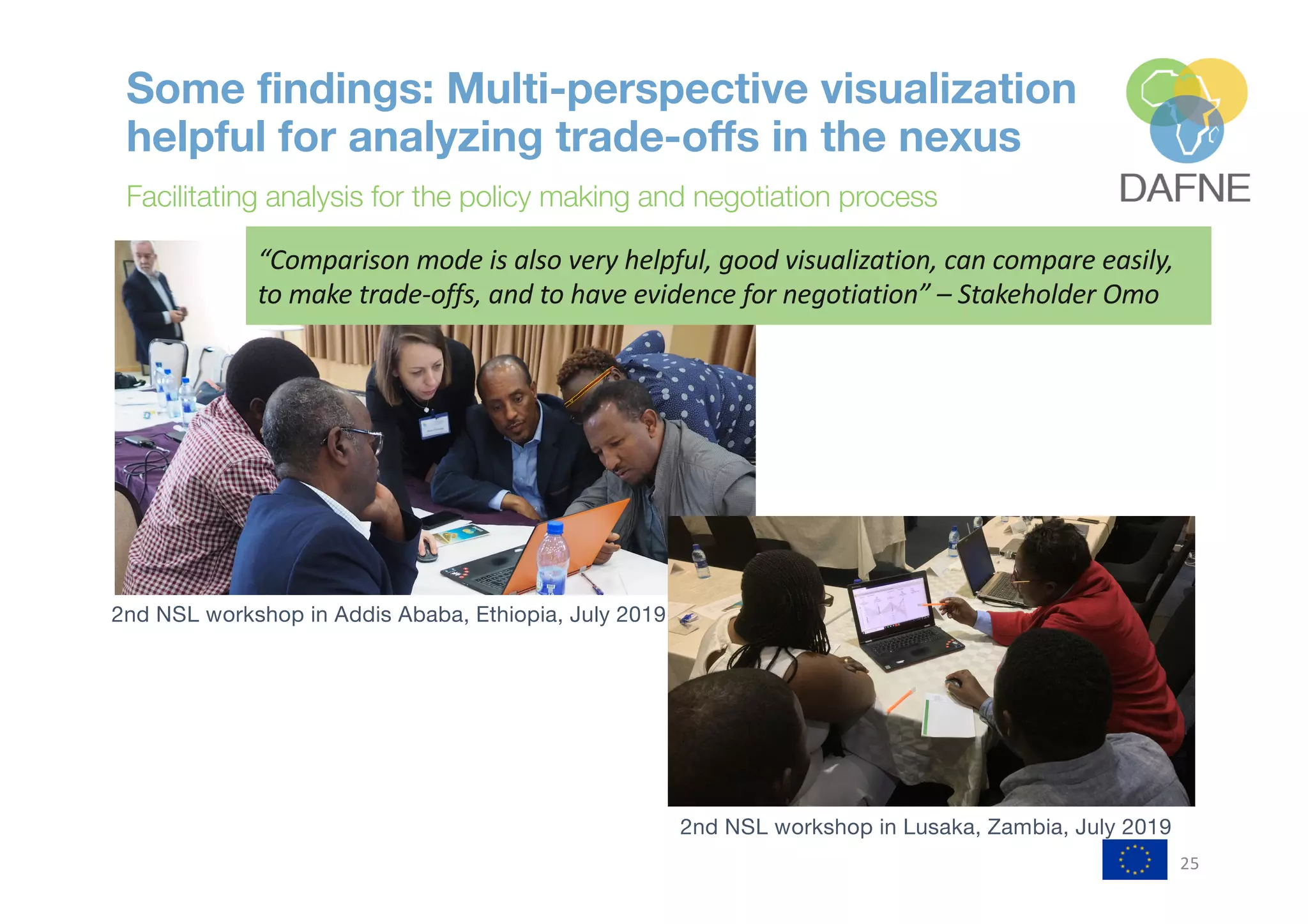
2nd NSL workshop in Addis Ababa, Ethiopia, July 2019
“Comparison mode is also very helpful, good visualization, can compare easily,
to make trade-offs, and to have evidence for negotiation” – Stakeholder Omo
2nd NSL workshop in Lusaka, Zambia, July 2019
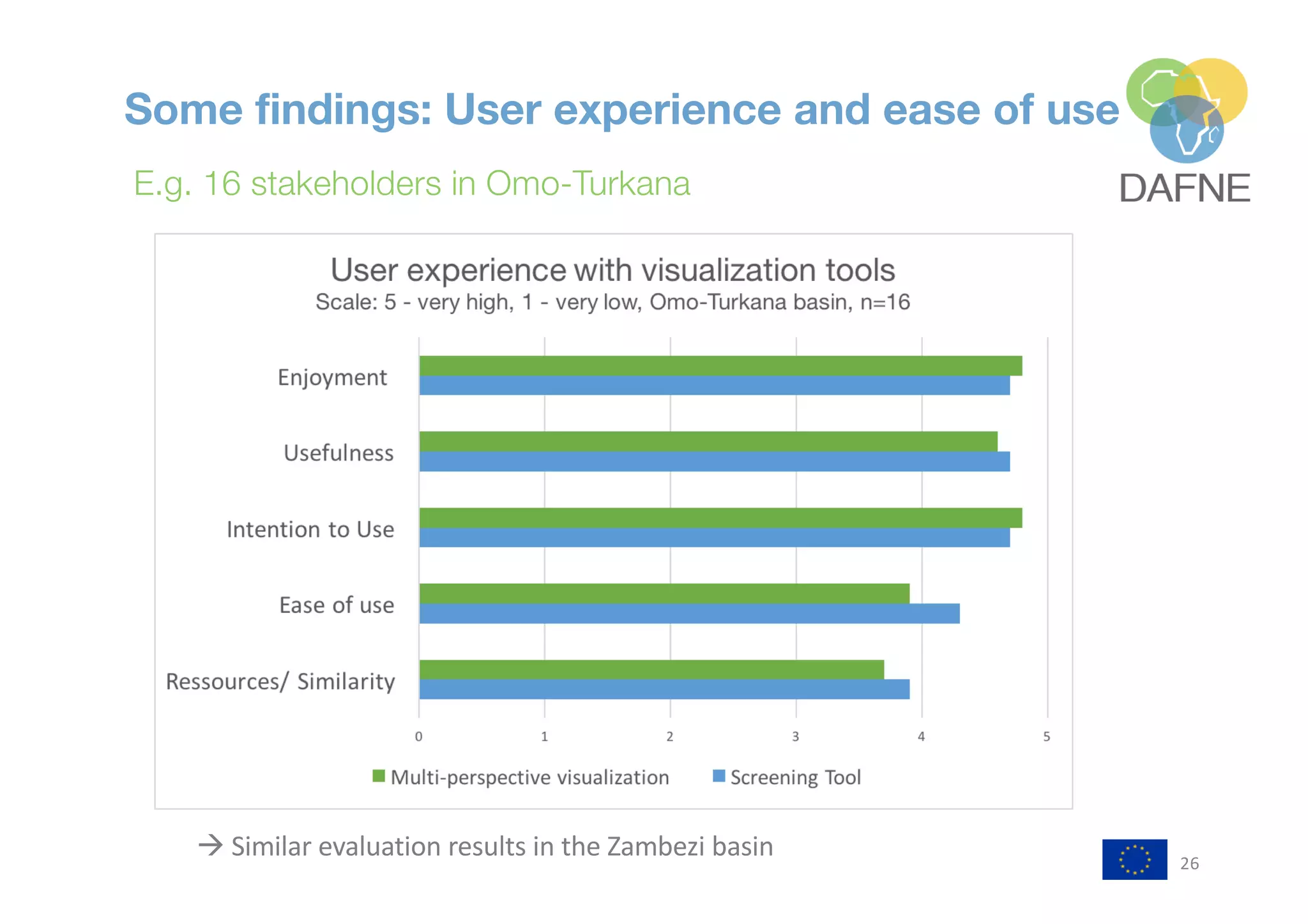
Some findings: User experience and ease of use
E.g. 16 stakeholders in Omo-Turkana
26
à Similar evaluation results in the Zambezi basin
Some findings: Visualizing the WEF nexus
Multi-perspective visualization for analysing WEF relationships
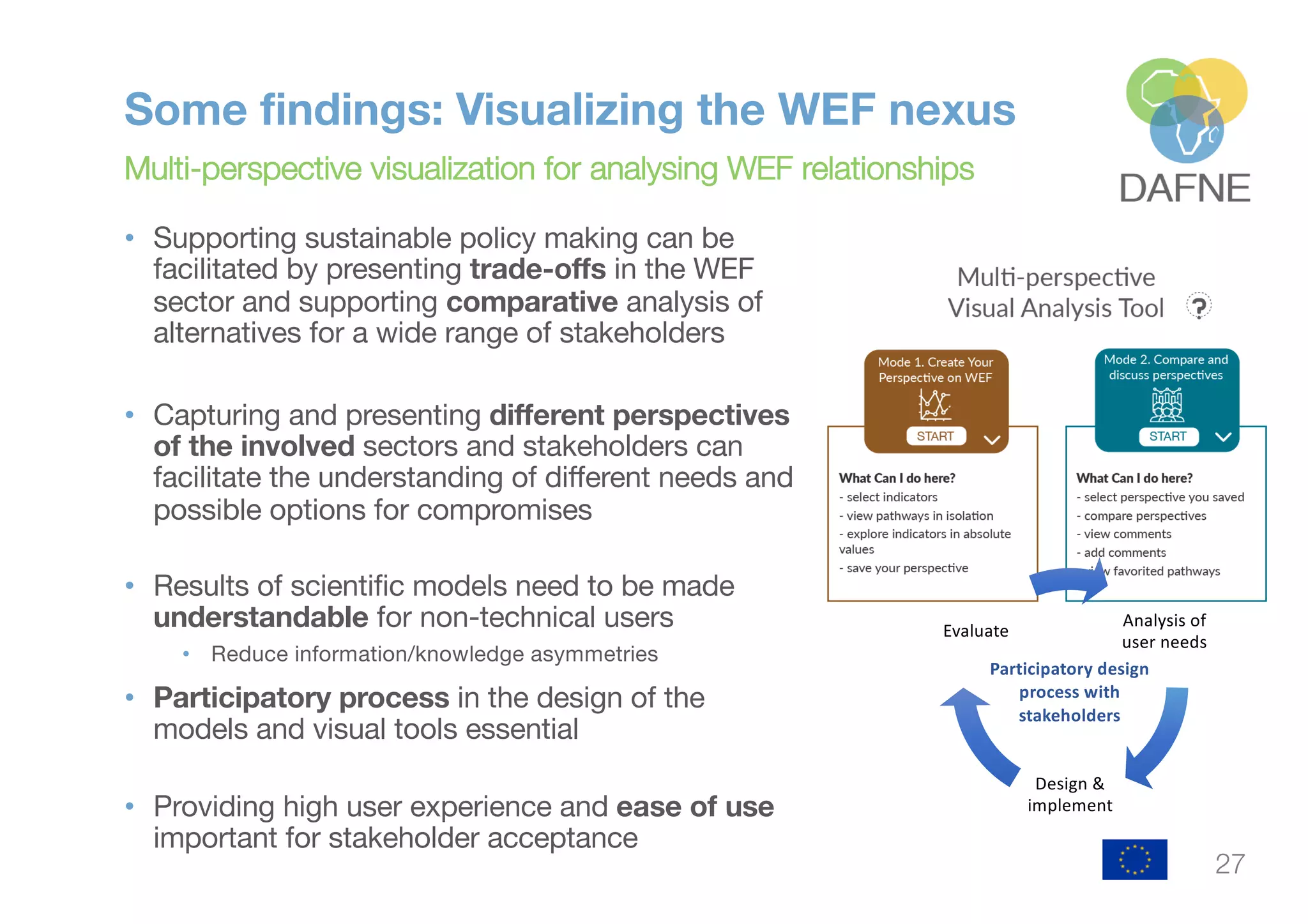
• Supporting sustainable policy making can be
facilitated by presenting trade-offs in the WEF
sector and supporting comparative analysis of
alternatives for a wide range of stakeholders
• Capturing and presenting different perspectives
of the involved sectors and stakeholders can
facilitate the understanding of different needs and
possible options for compromises
• Results of scientific models need to be made
understandable for non-technical users
• Reduce information/knowledge asymmetries
• Participatory process in the design of the
models and visual tools essential
• Providing high user experience and ease of use
important for stakeholder acceptance
27
Participatory design
process with
stakeholders
Analysis of
user needs
Design &
implement
Evaluate
Some challenges for further research
„Common“ ground, understandability and trustworthiness
Multi-perspective approach and tools adaptable to broader range of
multi-stakeholder and/or multi-criteria scenarios
• Providing stakeholders with guidance for the analysis
• Enabling an easy analysis of trade-offs of alternative solutions
• Supporting the definition of preferences and different perspectives
• Facilitating the understanding of perspectives of others
• Reducing information & knowledge asymmetries
Some (ongoing) challenges:
• How to make results trustworthy and more understandable, especially to
non-technical stakeholders?
• How to connect operational WEF indicators to higher level issues
(e.g. SDGs)?
• Data availability and sharing for modelling and simulation
28
www.dafne-project.eu
@dafne_project

A decision-analytic framework & multi-perspective visualization for participatory WEF nexus analysis for policy making

  • 1.
    www.dafne-project.eu @dafne_project DECISION ANALYTIC FRAMEWORKTO EXPLORE THE WATER-ENERGY-FOOD NEXUS IN COMPLEX TRANSBOUNDARY WATER RESOURCES OF FAST DEVELOPING COUNTRIES. Funded under the H2020 Framework Programme of the EU, GA No. 690268 A decision-analytic framework & multi-perspective visualization for participatory WEF nexus analysis for policy making Prof. Dr Jasminko Novak European Institute for Participatory Media Univ. of Applied Sciences Stralsund
  • 2.
    2 The DAFNE project •The DAFNE (H2020) project develops models and tools for: à analysing the impacts and trade-offs of different policies in the WEF nexus under uncertain conditions (future scenarios) à identifying sustainable options for integrated management of water, energy and food • Focus on transboundary context in fast growing countries 2 What is DAFNE? The DAFNE (H2020) project explores sustainable and integrated options for the management of water, energy and food. Focus on transboundary context in fast growing countries.
  • 3.
    3 We need moreenergy and food … 3500 new dams being planned or built around the world Arable land will expand by 70 million ha worldwide by 2030
  • 4.
    4 …but this oftengenerates externalities Deforestation (Rondonia - Brazil) 1975 2009 Drying up risk (Lake Urmia – Iran) Resettlement (Lower Se San 2– Cambodia) Invasive Mimosa Pigra (Kafue flats - Zambia)
  • 5.
    5 Transboundary WEF issuesin fast developing countries Delta Congo D.R. Angola Namibia Botswana Zimbabwe Mozambique Malawi Tanzania Zambia KA CB ITT KG U VF irr3 irr1 irr2 irr4 irr5 irr6 irr7 Existing Under Construct Planned Omo-Turkana River Basin, Ethiopia Zambezi River Basin, Zambia +155% of current installed hydropower capacity (13,809 MW) +114.3% of current irrigated area (514,641 ha) +78.5% of current water abstraction (5,836 mln m3/yr) Future basin development 2 planned dams Gibe III and Koysha large scale and commercial agriculture expansion Gibe I Gibe II Gibe III Koysha Wetland Lake Turkana Omo • 80-90 % of annual inflow into Lake Turkana from Omo • 65% of the Ethiopian installed HP capacity (in 2016)
  • 6.
    6 Transboundary WEF issuesin fast developing countries Omo-Turkana River Basin, Ethiopia WEF nexus issues and problems • Large investments in hydropower plants that can cause problems downstream • Reduced water quality of Omo river and Lake Turkana due to irrigation in the basin • Environmental and cultural conservation • Deforestation and land degradation Gibe Dam in Ethiopia, picture from https://www.wantedinafrica.com/news/ethiopi a-inaugurates-gibe-iii-dam.html Omo River Valley, picture from https://olsonfarlow.com/portfolios/ethiopias-omo- valley-march-2010-national-geographic-magazine Zambezi River Basin, Zambia
  • 7.
    Various stakeholders withconflicting interests Example: Stakeholder goals in the Omo-Turkana basin 7 Double energy production and become exporter of energy Avoidance of flooding Sustainable fishing Food security Food productivity Expand irrigation ENVIRON- MENT TOURISM Stabilization of the river for navigation Livelihood and cultural heritage of communities How to understand the trade-offs of different actions and policies in relation to the perspectives of different sectors?
  • 8.
    8 3rd NSL Selected pathways 2nd NSL Selectionof interesting pathways Preview of the WEF model Review results of WEF/DAF models WEF WEF modelWEF model Evaluation of extended indicators set and full model resultsDAF strategic model 1st NSL Efficient pathways Development pathways Design indicators DAF Indicators Actions Screening Multi-perspective Geoportal + TOOLS Online interaction PROCESS Scenarios DAFNE project: Main results Decision-Analytic Framework & Visual tools to analyse the WEF nexus Participatory approach from the outset NSL = Negotiation Simulation Lab
  • 9.
    9 Decision-analytic framework Participatory modellingwith stakeholders from the outset 3rd NSL Selected pathways 2nd NSL Selection of interesting pathways Preview of the WEF model Review results of WEF/DAF models WEF WEFmodel WEF model Evaluation of extended indicators set and full model results DAF strategic model 1st NSL Efficient pathway s Development pathways Design indicators DAF Indicators Actions Screening Multi- perspective Geoportal + TOOLS Online interaction PROCE SS Scenarios water energy food society Actions & indicators Negotiation simulation lab
  • 10.
    10 Decision-Analytic framework Future scenarios FutureScenarios 3rd NSL Selected pathways 2nd NSL Selection of interesting pathways Preview of the WEF model Review results of WEF/DAF models WEF WEFmodel WEF model Evaluation of extended indicators set and full model results DAF strategic model 1st NSL Efficient pathway s Development pathways Design indicators DAF Indicators Actions Screening Multi- perspective Geoportal + TOOLS Online interaction PROCE SS Scenarios CLIMATE WATER/ENRGY DEMAND
  • 11.
    11 Decision-Analytic framework Negotiation simulationlab – stakeholder feedback 3rd NSL Selected pathways 2nd NSL Selection of interesting pathways Preview of the WEF model Review results of WEF/DAF models WEF WEFmodelWEF model Evaluation of extended indicators set and full model results DAF strategic model 1st NSL Efficient pathway s Development pathways Design indicators DAF Indicators Actions Screening Multi- perspective Geoportal + TOOLS Online interaction PROCE SS Scenarios Screening Multi-perspective 11 Decision-Analytic framework Negotiation simulation lab – stakeholder feedback 3rd NSL Selected pathways 2nd NSL Selection of interesting pathways Preview of the WEF model Review results of WEF/DAF models WEF WEFmodelWEF model Evaluation of extended indicators set and full model results DAF strategic model 1st NSL Efficient pathway s Development pathways Design indicators DAF Indicators Actions Screening Multi- perspective Geoportal + TOOLS Online interaction PROCE SS Scenarios Screening Multi-perspective
  • 12.
    12 3rd NSL Selected pathways 2nd NSL Selectionof interesting pathways Preview of the WEF model Review results of WEF/DAF models WEF WEF modelWEF model Evaluation of extended indicators set and full model resultsDAF strategic model 1st NSL Efficient pathways Development pathways Design indicators DAF Indicators Actions Screening Multi-perspective Geoportal + TOOLS Online interaction PROCESS Scenarios Multi-perspective visualization tools for the WEF nexus Visualization tools for stakeholders to analyse results and give feedback Screening Visual tools to uncover relationships between different issues, solutions, indicators & sectors from different perspectives Multi-perspective
  • 13.
    1: Selecting asubset of relevant alternatives Managing complexity with high-level screening of alternatives 13 • aggregated overview of the effects of many different solutions on main design indicators representing each sector (aggregated) • collectively selecting a subset of alternatives from a large set based on sectoral preferences
  • 14.
    1: Selecting asubset of relevant alternatives 14 • …collectively selecting a subset of alternatives from a large list based on few design indicators representing each sector • … revealing the trade-offs already at this stage Managing complexity with high-level screening of alternatives
  • 15.
    2: Perspective making Analysingsolutions and defining own preferences 15 Example: trade-off between the irrigation agriculture and the impact on fisheries - Energy Gibe 1 - Energy Gibe 2 - Energy Gibe 3 - Energy production Gibe 2 - Water deficit for irrigation Kuraz - Fish yield production Turkana - Flow positive distance in Omo - Flow negative distance in Omo …. Indicators • …understanding the impact on indicators specific to a stakeholder sector • …exploring the impact of alternatives on various indicators and selecting preferred ones Energy Food Environment
  • 16.
    3: Perspective taking Enablingnegotiation between sectors 16 • Getting an understanding of other sectors’ perspectives and trade-offs • Developing a shared understanding and deciding on common preferences Here one can explore which alternatives satisfy both sector perspectives
  • 17.
    17 WEF model Detailed simulationof pathway impacts over time & space • disaggregating the the lumped impact from the strategic (optimisation) model to finer temporal and spatial scales e.g.: water availability (hourly/daily hydrograph) at different points in the basin over time • larger set of indicators from different sectors and including diff. sub-models (e.g. economic services)
  • 18.
    18 WEF model: exampleresults Detailed simulation of pathway impacts over time & space Koysha water level (coord. operation in the OTB) - affects availability of water for downstream irrigation Irrigation allocation effects on SWC (soil water saturation metric) Mean sediment fluxes at the reservoirs Distributed erosion-deposition map
  • 19.
    19 Geo-information portal: detailedgeo-visual analysis Detailed geographical analysis of pathway impacts
  • 20.
    20 Some findings: Omo-Turkanabasin Alternative development pathways and possible compromises Baseline Koysha Irrigation Irrigation+koysha 1 2 3 4 5 0 0.1 0.2 0.3 0.4 0.5 0.6 0.7 0.8 0.9 1 Compromise: - 38% irrigation + 80% MT of fish Preference • The construction of Koysha is not detrimental for the socio-environmental conditions in the Omo-Turkana basin if operated taking such interests into account, and it almost doubles HP production (+ 2000 GWh/year). • Planned irrigation projects seem oversized and may produce severe impacts in lake Turkana - but it is still possible to find compromise solutions through demand side action.
  • 21.
    21 Some findings: Omo-Turkanabasin Policies for operating water infrastructures for different alternatives 2002 2004 2006 2008 2010 2012 2014 2016 345 350 355 360 365 Level[masl] GIBE I GIBE III TURKANA Turkwel Kerio Omo GIBE II Gojeb Gilgel Gibe KOYSHA Agricultural district Agricultural district Turkana Level Gibe III Level Koysha Level Delta Agricultural diversion No irrigation Extreme irrigation Max-min operational level Water demand Natural delta regime Jan Feb Mar Apr May Jun Jul Aug Sep Oct Nov Dec 0 50 100 150 200 Irrigation[m3 /s] Jan Feb Mar Apr May Jun Jul Aug Sep Oct Nov Dec 620 640 660 680 Level[masl] Max-min operational level Jan FebMar Apr May Jun Jul Aug Sep Oct Nov Dec 0 500 1000 1500 2000 Streamflow[m3 /s] Jan FebMar AprMay Jun Jul AugSep Oct NovDec 800 850 900 Level[masl]
  • 22.
    22 Some findings: Zambezibasin Alternative development pathways and possible compromises • Projected population growth in the ZRB signals the need for all dam investments to meet future hydropower demands. • Operational preferences of the multi-reservoir system have a larger influence than the timings over the tradeoffs between hydropower production and environmental flows.
  • 23.
    23 Some findings: Econometricmodelling Estimation of Sector Specific Production Functions 25 Case Study: Omo Turkana Basin Estimation of Sector Specific Production Functions Focus on the m=5 Core Water-Dependent Economic Sectors: • Agriculture (including aquaculture) • Mining (Industry: cooper, coal, cobalt) • Energy Production • Tourism • Residential Water Supply Natural Capital - Ecosystem Services: • Provisioning Services: Water, Food • Regulating Services: Flood prevention, Erosion control • Supporting (Habitat ) Services: Biodiversity • Cultural (Recreational) Services: Tourism
  • 24.
    24 Some findings: Simulationof actor behaviour Non-cooperative vs. cooperative water use: downstream • We find that the cooperative solution is the optimal pathway for both riparian countries and the sustainable use of the basin. • We argue that the detail and sophistication of both the mathematical and econometric models are needed for robust policy recommendations towards sustainable management of transboundary resources. Simulation Results: Non cooperative Downstream 37 • The water use becomes zero after a period of time due to the lake exhaustion both under myopic and non-myopic case Figure 2 Simulation Results: Cooperative Downstream 40 Figure 4 Non-myopic: U considers river stock, D considers lake stock Cooperative: U gives hydro and takes food from D
  • 25.
    25 Some findings: Multi-perspectivevisualization helpful for analyzing trade-offs in the nexus Facilitating analysis for the policy making and negotiation process 2nd NSL workshop in Addis Ababa, Ethiopia, July 2019 “Comparison mode is also very helpful, good visualization, can compare easily, to make trade-offs, and to have evidence for negotiation” – Stakeholder Omo 2nd NSL workshop in Lusaka, Zambia, July 2019
  • 26.
    Some findings: Userexperience and ease of use E.g. 16 stakeholders in Omo-Turkana 26 à Similar evaluation results in the Zambezi basin
  • 27.
    Some findings: Visualizingthe WEF nexus Multi-perspective visualization for analysing WEF relationships • Supporting sustainable policy making can be facilitated by presenting trade-offs in the WEF sector and supporting comparative analysis of alternatives for a wide range of stakeholders • Capturing and presenting different perspectives of the involved sectors and stakeholders can facilitate the understanding of different needs and possible options for compromises • Results of scientific models need to be made understandable for non-technical users • Reduce information/knowledge asymmetries • Participatory process in the design of the models and visual tools essential • Providing high user experience and ease of use important for stakeholder acceptance 27 Participatory design process with stakeholders Analysis of user needs Design & implement Evaluate
  • 28.
    Some challenges forfurther research „Common“ ground, understandability and trustworthiness Multi-perspective approach and tools adaptable to broader range of multi-stakeholder and/or multi-criteria scenarios • Providing stakeholders with guidance for the analysis • Enabling an easy analysis of trade-offs of alternative solutions • Supporting the definition of preferences and different perspectives • Facilitating the understanding of perspectives of others • Reducing information & knowledge asymmetries Some (ongoing) challenges: • How to make results trustworthy and more understandable, especially to non-technical stakeholders? • How to connect operational WEF indicators to higher level issues (e.g. SDGs)? • Data availability and sharing for modelling and simulation 28
  • 29.