INSURANCE FOR
DUMMIES
People insure things that are of value to them and
would cost a lot of money to replace if they were
stolen or damaged in some way
TYPES OF INSURANCE
DEFINITION
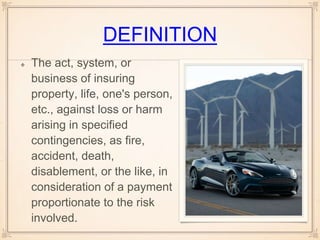
The act, system, or
business of insuring
property, life, one's person,
etc., against loss or harm
arising in specified
contingencies, as fire,
accident, death,
disablement, or the like, in
consideration of a payment
proportionate to the risk
involved.
ADEQUATE INSURANCE SHOULD
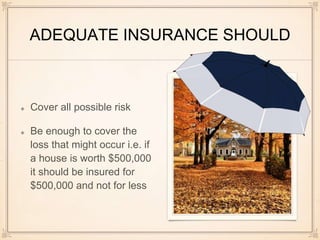
Cover all possible risk
Be enough to cover the
loss that might occur i.e. if
a house is worth $500,000
it should be insured for
$500,000 and not for less
THE RULES OF INSURANCE
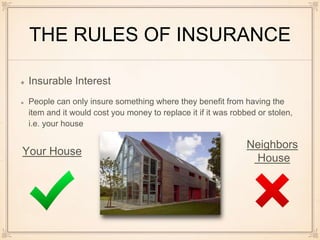
Insurable Interest
People can only insure something where they benefit from having the
item and it would cost you money to replace it if it was robbed or stolen,
i.e. your house
Your House
Neighbors
House
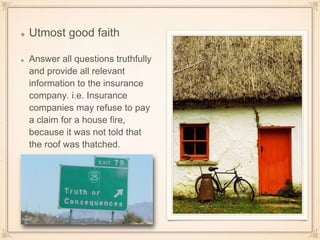
Utmost good faith
Answer all questions truthfully
and provide all relevant
information to the insurance
company. i.e. Insurance
companies may refuse to pay
a claim for a house fire,
because it was not told that
the roof was thatched.
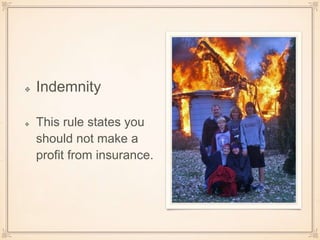
Indemnity
This rule states you
should not make a
profit from insurance.
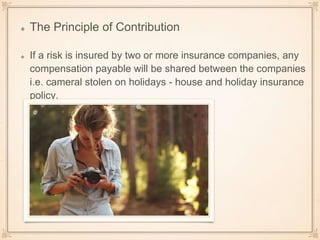
The Principle of Contribution
If a risk is insured by two or more insurance companies, any
compensation payable will be shared between the companies
i.e. cameral stolen on holidays - house and holiday insurance
policy.
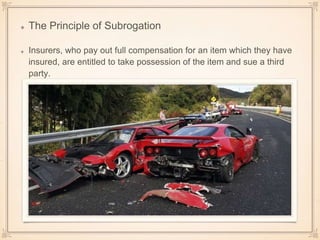
The Principle of Subrogation
Insurers, who pay out full compensation for an item which they have
insured, are entitled to take possession of the item and sue a third
party.
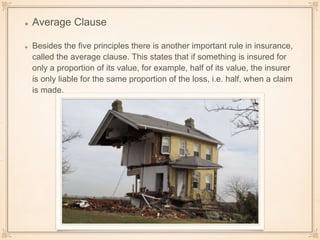
Average Clause
Besides the five principles there is another important rule in insurance,
called the average clause. This states that if something is insured for
only a proportion of its value, for example, half of its value, the insurer
is only liable for the same proportion of the loss, i.e. half, when a claim
is made.
GETTING THE INSURANCE
INFORMATION YOU NEED
Calculate the value of the item you wish to
insure
Complete the proposal form
Multiple individual insurance agents will contact
you with a quote
Compare the best rates and coverage for your
needs
WE
ARE
SOCIAL.facebook.com
twitter.com
pinterest.com
psiquotes.com
youtube.com
yelp.com
plus.google.com

Insurance for Dummies

  • 1.
    INSURANCE FOR DUMMIES People insurethings that are of value to them and would cost a lot of money to replace if they were stolen or damaged in some way
  • 3.
  • 4.
    DEFINITION The act, system,or business of insuring property, life, one's person, etc., against loss or harm arising in specified contingencies, as fire, accident, death, disablement, or the like, in consideration of a payment proportionate to the risk involved.
  • 5.
    ADEQUATE INSURANCE SHOULD Coverall possible risk Be enough to cover the loss that might occur i.e. if a house is worth $500,000 it should be insured for $500,000 and not for less
  • 6.
    THE RULES OFINSURANCE Insurable Interest People can only insure something where they benefit from having the item and it would cost you money to replace it if it was robbed or stolen, i.e. your house Your House Neighbors House
  • 7.
    Utmost good faith Answerall questions truthfully and provide all relevant information to the insurance company. i.e. Insurance companies may refuse to pay a claim for a house fire, because it was not told that the roof was thatched.
  • 8.
    Indemnity This rule statesyou should not make a profit from insurance.
  • 10.
    The Principle ofContribution If a risk is insured by two or more insurance companies, any compensation payable will be shared between the companies i.e. cameral stolen on holidays - house and holiday insurance policy.
  • 11.
    The Principle ofSubrogation Insurers, who pay out full compensation for an item which they have insured, are entitled to take possession of the item and sue a third party.
  • 12.
    Average Clause Besides thefive principles there is another important rule in insurance, called the average clause. This states that if something is insured for only a proportion of its value, for example, half of its value, the insurer is only liable for the same proportion of the loss, i.e. half, when a claim is made.
  • 13.
    GETTING THE INSURANCE INFORMATIONYOU NEED Calculate the value of the item you wish to insure Complete the proposal form Multiple individual insurance agents will contact you with a quote Compare the best rates and coverage for your needs
  • 14.