INDUSTRY ANALYSIS OF
INSURANCE SECTOR
IN INDIA
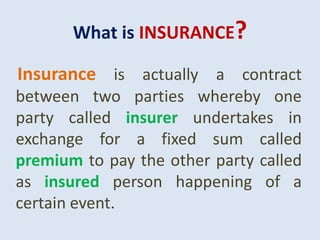
What is INSURANCE?
Insurance is actually a contract
between two parties whereby one
party called insurer undertakes in
exchange for a fixed sum called
premium to pay the other party called
as insured person happening of a
certain event.
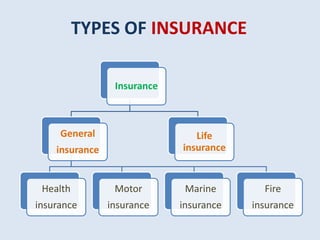
TYPES OF INSURANCE
Insurance
General
insurance
Health
insurance
Motor
insurance
Marine
insurance
Fire
insurance
Life
insurance
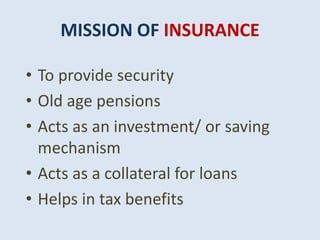
MISSION OF INSURANCE
• To provide security
• Old age pensions
• Acts as an investment/ or saving
mechanism
• Acts as a collateral for loans
• Helps in tax benefits
FUNCTIONS OF INSURANCE
• Provide protection
• Provide Certainty
• Collective bearing of risk Primary Functions
• Small capital to cover larger risk Secondary
Functions
• Means of saving & investments
• Sources of earning foreign exchange Other
Functions
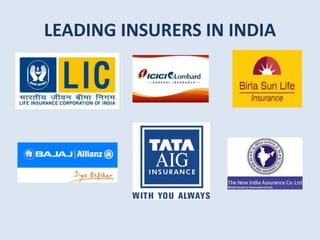
LEADING INSURERS IN INDIA
REGULATORY AUTHORITY
• The Insurance Regulatory and Development
Authority of India (IRDAI) is an autonomous,
statutory agency tasked with regulating and
promoting the insurance and re-insurance
industries in India.
• The functions of the IRDAI starts from Issuing,
renewing, modifying, withdrawing,
suspending or cancelling registrations
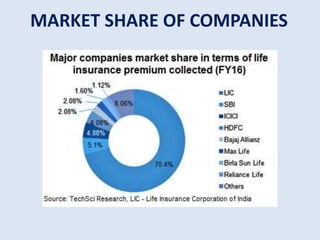
MARKET SHARE OF COMPANIES
ECONOMIC FACTORS AFFECTING
INSURANCE INDUSTRY
• INFLATION
If the inflation rate is so high, many people may
feel threatened to lose their property and may
rush to acquire insurance. This will mean more
business and revenues to the insurance sector.
• DEFLATION
Deflation means the economy is doing well and
the value of the currency is competitive in the
market. As a result of this, many people are able
to spend more, which is good news to insurance
companies
ECONOMIC FACTORS AFFECTING
INSURANCE INDUSTRY
• ECONOMIC POLICIES
In times when an economy is facing a crisis, the
government can implement economic policies to
shield consumers from exploitation by insurers
while also protecting insurance companies.
• COMPETITION
The economy of a country can also affect the
level of competition by increasing or decreasing
it.
ONLINE PRESENCE OF INSURANCE
INDUSTRY IN INDIA
• In 2010-11, most of the insurers started selling
online. And at present, insurers have made
online mode a priority in their distribution
strategy
• Online purchase of policies has increased from
2 per cent to 200 per cent in just two years.
• The research by BCG implies that the insurance
industry in online is slated to enjoy a growth of
2000 per cent in the next five years.
FUTURE PROSPECTS
• India’s insurable population is anticipated to touch
750 million in 2020, with life expectancy reaching
74 years. Furthermore, life insurance is projected to
comprise 35 per cent of total savings by the end of
this decade, as against 26 per cent in 2009-10.
• Demographic factors such as growing middle class,
young insurable population and growing awareness
of the need for protection and retirement planning
will support the growth of Indian life insurance.
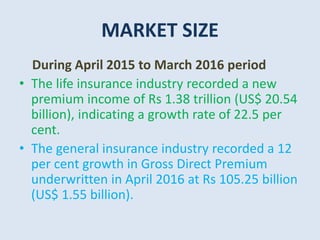
MARKET SIZE
During April 2015 to March 2016 period
• The life insurance industry recorded a new
premium income of Rs 1.38 trillion (US$ 20.54
billion), indicating a growth rate of 22.5 per
cent.
• The general insurance industry recorded a 12
per cent growth in Gross Direct Premium
underwritten in April 2016 at Rs 105.25 billion
(US$ 1.55 billion).
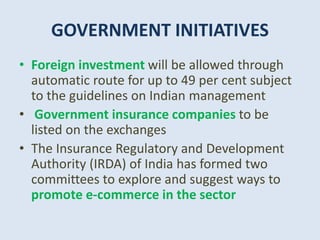
GOVERNMENT INITIATIVES
• Foreign investment will be allowed through
automatic route for up to 49 per cent subject
to the guidelines on Indian management
• Government insurance companies to be
listed on the exchanges
• The Insurance Regulatory and Development
Authority (IRDA) of India has formed two
committees to explore and suggest ways to
promote e-commerce in the sector
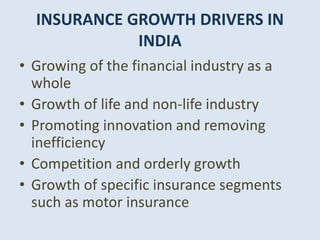
INSURANCE GROWTH DRIVERS IN
INDIA
• Growing of the financial industry as a
whole
• Growth of life and non-life industry
• Promoting innovation and removing
inefficiency
• Competition and orderly growth
• Growth of specific insurance segments
such as motor insurance
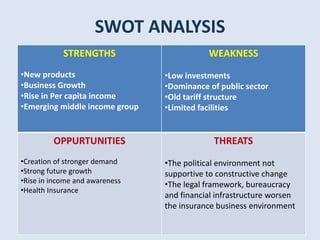
SWOT ANALYSIS
STRENGTHS
•New products
•Business Growth
•Rise in Per capita income
•Emerging middle income group
WEAKNESS
•Low investments
•Dominance of public sector
•Old tariff structure
•Limited facilities
OPPURTUNITIES
•Creation of stronger demand
•Strong future growth
•Rise in income and awareness
•Health Insurance
THREATS
•The political environment not
supportive to constructive change
•The legal framework, bureaucracy
and financial infrastructure worsen
the insurance business environment
Insurance sector

Insurance sector

  • 1.
  • 2.
    What is INSURANCE? Insuranceis actually a contract between two parties whereby one party called insurer undertakes in exchange for a fixed sum called premium to pay the other party called as insured person happening of a certain event.
  • 3.
  • 4.
    MISSION OF INSURANCE •To provide security • Old age pensions • Acts as an investment/ or saving mechanism • Acts as a collateral for loans • Helps in tax benefits
  • 5.
    FUNCTIONS OF INSURANCE •Provide protection • Provide Certainty • Collective bearing of risk Primary Functions • Small capital to cover larger risk Secondary Functions • Means of saving & investments • Sources of earning foreign exchange Other Functions
  • 6.
  • 7.
    REGULATORY AUTHORITY • TheInsurance Regulatory and Development Authority of India (IRDAI) is an autonomous, statutory agency tasked with regulating and promoting the insurance and re-insurance industries in India. • The functions of the IRDAI starts from Issuing, renewing, modifying, withdrawing, suspending or cancelling registrations
  • 8.
    MARKET SHARE OFCOMPANIES
  • 9.
    ECONOMIC FACTORS AFFECTING INSURANCEINDUSTRY • INFLATION If the inflation rate is so high, many people may feel threatened to lose their property and may rush to acquire insurance. This will mean more business and revenues to the insurance sector. • DEFLATION Deflation means the economy is doing well and the value of the currency is competitive in the market. As a result of this, many people are able to spend more, which is good news to insurance companies
  • 10.
    ECONOMIC FACTORS AFFECTING INSURANCEINDUSTRY • ECONOMIC POLICIES In times when an economy is facing a crisis, the government can implement economic policies to shield consumers from exploitation by insurers while also protecting insurance companies. • COMPETITION The economy of a country can also affect the level of competition by increasing or decreasing it.
  • 11.
    ONLINE PRESENCE OFINSURANCE INDUSTRY IN INDIA • In 2010-11, most of the insurers started selling online. And at present, insurers have made online mode a priority in their distribution strategy • Online purchase of policies has increased from 2 per cent to 200 per cent in just two years. • The research by BCG implies that the insurance industry in online is slated to enjoy a growth of 2000 per cent in the next five years.
  • 12.
    FUTURE PROSPECTS • India’sinsurable population is anticipated to touch 750 million in 2020, with life expectancy reaching 74 years. Furthermore, life insurance is projected to comprise 35 per cent of total savings by the end of this decade, as against 26 per cent in 2009-10. • Demographic factors such as growing middle class, young insurable population and growing awareness of the need for protection and retirement planning will support the growth of Indian life insurance.
  • 13.
    MARKET SIZE During April2015 to March 2016 period • The life insurance industry recorded a new premium income of Rs 1.38 trillion (US$ 20.54 billion), indicating a growth rate of 22.5 per cent. • The general insurance industry recorded a 12 per cent growth in Gross Direct Premium underwritten in April 2016 at Rs 105.25 billion (US$ 1.55 billion).
  • 14.
    GOVERNMENT INITIATIVES • Foreigninvestment will be allowed through automatic route for up to 49 per cent subject to the guidelines on Indian management • Government insurance companies to be listed on the exchanges • The Insurance Regulatory and Development Authority (IRDA) of India has formed two committees to explore and suggest ways to promote e-commerce in the sector
  • 15.
    INSURANCE GROWTH DRIVERSIN INDIA • Growing of the financial industry as a whole • Growth of life and non-life industry • Promoting innovation and removing inefficiency • Competition and orderly growth • Growth of specific insurance segments such as motor insurance
  • 16.
    SWOT ANALYSIS STRENGTHS •New products •BusinessGrowth •Rise in Per capita income •Emerging middle income group WEAKNESS •Low investments •Dominance of public sector •Old tariff structure •Limited facilities OPPURTUNITIES •Creation of stronger demand •Strong future growth •Rise in income and awareness •Health Insurance THREATS •The political environment not supportive to constructive change •The legal framework, bureaucracy and financial infrastructure worsen the insurance business environment