Gursharan Singh Tatla
professorgstatla@gmail.com
21-Nov-2010 1www.eazynotes.com
Instruction Set of 8086
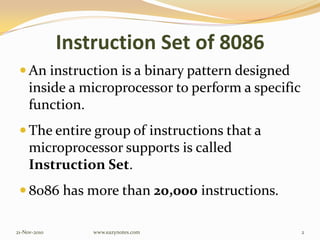
 An instruction is a binary pattern designed
inside a microprocessor to perform a specific
function.
 The entire group of instructions that a
microprocessor supports is called
Instruction Set.
 8086 has more than 20,000 instructions.
21-Nov-2010 2www.eazynotes.com
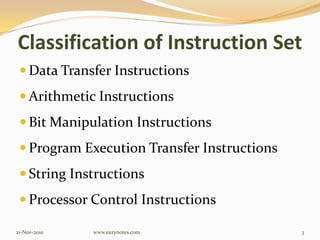
Classification of Instruction Set
 Data Transfer Instructions
 Arithmetic Instructions
 Bit Manipulation Instructions
 Program Execution Transfer Instructions
 String Instructions
 Processor Control Instructions
21-Nov-2010 3www.eazynotes.com
Data Transfer Instructions
 These instructions are used to transfer data
from source to destination.
 The operand can be a constant, memory
location, register or I/O port address.
21-Nov-2010 4www.eazynotes.com
Data Transfer Instructions
 MOV Des, Src:
 Src operand can be register, memory location or immediate
operand.
 Des can be register or memory operand.
 Both Src and Des cannot be memory location at the same
time.
 E.g.:
 MOV CX, 037A H
 MOV AL, BL
 MOV BX, [0301 H]
21-Nov-2010 5www.eazynotes.com
Data Transfer Instructions
 PUSH Operand:
 It pushes the operand into top of stack.
 E.g.: PUSH BX
 POP Des:
 It pops the operand from top of stack to Des.
 Des can be a general purpose register, segment register
(except CS) or memory location.
 E.g.: POP AX
21-Nov-2010 6www.eazynotes.com
Data Transfer Instructions
 XCHG Des, Src:
 This instruction exchanges Src with Des.
 It cannot exchange two memory locations directly.
 E.g.: XCHG DX, AX
21-Nov-2010 7www.eazynotes.com
Data Transfer Instructions
 IN Accumulator, Port Address:
 It transfers the operand from specified port to accumulator
register.
 E.g.: IN AX, 0028 H
 OUT Port Address, Accumulator:
 It transfers the operand from accumulator to specified port.
 E.g.: OUT 0028 H, AX
21-Nov-2010 8www.eazynotes.com
Data Transfer Instructions
LEA Register, Src:
 It loads a 16-bit register with the offset
address of the data specified by the Src.
 E.g.: LEA BX, [DI]
 This instruction loads the contents of DI
(offset) into the BX register.
21-Nov-2010 9www.eazynotes.com
Data Transfer Instructions
 LDS Des, Src:
 It loads 32-bit pointer from memory source to
destination register and DS.
 The offset is placed in the destination register and the
segment is placed in DS.
 To use this instruction the word at the lower memory
address must contain the offset and the word at the
higher address must contain the segment.
 E.g.: LDS BX, [0301 H]
21-Nov-2010 10www.eazynotes.com
Data Transfer Instructions
 LES Des, Src:
 It loads 32-bit pointer from memory source to
destination register and ES.
 The offset is placed in the destination register and the
segment is placed in ES.
 This instruction is very similar to LDS except that it
initializes ES instead of DS.
 E.g.: LES BX, [0301 H]
21-Nov-2010 11www.eazynotes.com
Data Transfer Instructions
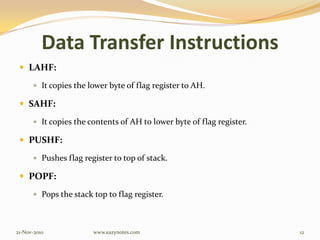
 LAHF:
 It copies the lower byte of flag register to AH.
 SAHF:
 It copies the contents of AH to lower byte of flag register.
 PUSHF:
 Pushes flag register to top of stack.
 POPF:
 Pops the stack top to flag register.
21-Nov-2010 12www.eazynotes.com
Arithmetic Instructions
 ADD Des, Src:
 It adds a byte to byte or a word to word.
 It effects AF, CF, OF, PF, SF, ZF flags.
 E.g.:
 ADD AL, 74H
 ADD DX, AX
 ADD AX, [BX]
21-Nov-2010 13www.eazynotes.com
Arithmetic Instructions
 ADC Des, Src:
 It adds the two operands with CF.
 It effects AF, CF, OF, PF, SF, ZF flags.
 E.g.:
 ADC AL, 74H
 ADC DX, AX
 ADC AX, [BX]
21-Nov-2010 14www.eazynotes.com
Arithmetic Instructions
 SUB Des, Src:
 It subtracts a byte from byte or a word from word.
 It effects AF, CF, OF, PF, SF, ZF flags.
 For subtraction, CF acts as borrow flag.
 E.g.:
 SUB AL, 74H
 SUB DX, AX
 SUB AX, [BX]
21-Nov-2010 15www.eazynotes.com
Arithmetic Instructions
 SBB Des, Src:
 It subtracts the two operands and also the
borrow from the result.
 It effects AF, CF, OF, PF, SF, ZF flags.
 E.g.:
 SBB AL, 74H
 SBB DX, AX
 SBB AX, [BX]
21-Nov-2010 16www.eazynotes.com
Arithmetic Instructions
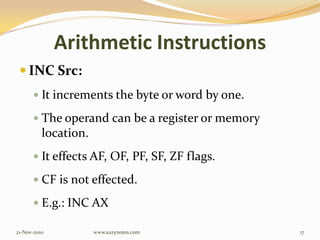
 INC Src:
 It increments the byte or word by one.
 The operand can be a register or memory
location.
 It effects AF, OF, PF, SF, ZF flags.
 CF is not effected.
 E.g.: INC AX
21-Nov-2010 17www.eazynotes.com
Arithmetic Instructions
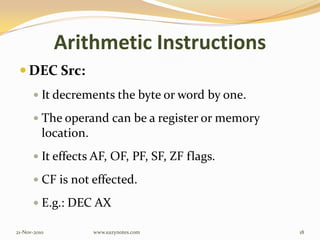
 DEC Src:
 It decrements the byte or word by one.
 The operand can be a register or memory
location.
 It effects AF, OF, PF, SF, ZF flags.
 CF is not effected.
 E.g.: DEC AX
21-Nov-2010 18www.eazynotes.com
Arithmetic Instructions
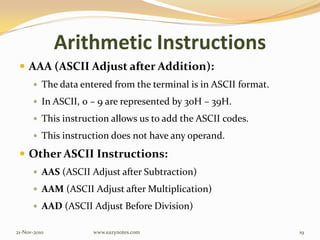
 AAA (ASCII Adjust after Addition):
 The data entered from the terminal is in ASCII format.
 In ASCII, 0 – 9 are represented by 30H – 39H.
 This instruction allows us to add the ASCII codes.
 This instruction does not have any operand.
 Other ASCII Instructions:
 AAS (ASCII Adjust after Subtraction)
 AAM (ASCII Adjust after Multiplication)
 AAD (ASCII Adjust Before Division)
21-Nov-2010 19www.eazynotes.com
Arithmetic Instructions
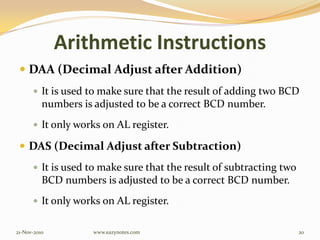
 DAA (Decimal Adjust after Addition)
 It is used to make sure that the result of adding two BCD
numbers is adjusted to be a correct BCD number.
 It only works on AL register.
 DAS (Decimal Adjust after Subtraction)
 It is used to make sure that the result of subtracting two
BCD numbers is adjusted to be a correct BCD number.
 It only works on AL register.
21-Nov-2010 20www.eazynotes.com
Arithmetic Instructions
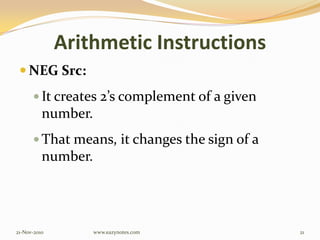
 NEG Src:
 It creates 2’s complement of a given
number.
 That means, it changes the sign of a
number.
21-Nov-2010 21www.eazynotes.com
Arithmetic Instructions
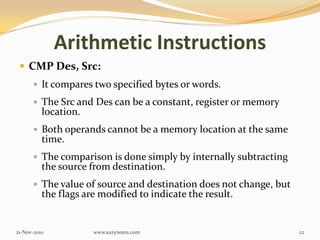
 CMP Des, Src:
 It compares two specified bytes or words.
 The Src and Des can be a constant, register or memory
location.
 Both operands cannot be a memory location at the same
time.
 The comparison is done simply by internally subtracting
the source from destination.
 The value of source and destination does not change, but
the flags are modified to indicate the result.
21-Nov-2010 22www.eazynotes.com
Arithmetic Instructions
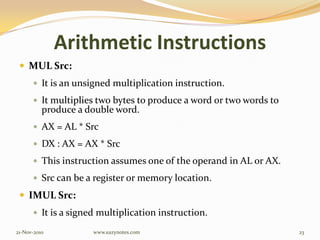
 MUL Src:
 It is an unsigned multiplication instruction.
 It multiplies two bytes to produce a word or two words to
produce a double word.
 AX = AL * Src
 DX : AX = AX * Src
 This instruction assumes one of the operand in AL or AX.
 Src can be a register or memory location.
 IMUL Src:
 It is a signed multiplication instruction.
21-Nov-2010 23www.eazynotes.com
Arithmetic Instructions
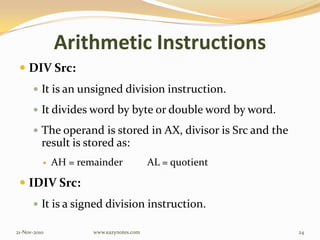
 DIV Src:
 It is an unsigned division instruction.
 It divides word by byte or double word by word.
 The operand is stored in AX, divisor is Src and the
result is stored as:
 AH = remainder AL = quotient
 IDIV Src:
 It is a signed division instruction.
21-Nov-2010 24www.eazynotes.com
Arithmetic Instructions
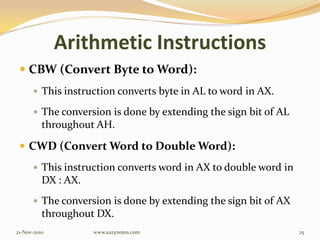
 CBW (Convert Byte to Word):
 This instruction converts byte in AL to word in AX.
 The conversion is done by extending the sign bit of AL
throughout AH.
 CWD (Convert Word to Double Word):
 This instruction converts word in AX to double word in
DX : AX.
 The conversion is done by extending the sign bit of AX
throughout DX.
21-Nov-2010 25www.eazynotes.com
Bit Manipulation Instructions
 These instructions are used at the bit level.
 These instructions can be used for:
 Testing a zero bit
 Set or reset a bit
 Shift bits across registers
21-Nov-2010 26www.eazynotes.com
Bit Manipulation Instructions
 NOT Src:
 It complements each bit of Src to produce 1’s
complement of the specified operand.
 The operand can be a register or memory location.
21-Nov-2010 27www.eazynotes.com
Bit Manipulation Instructions
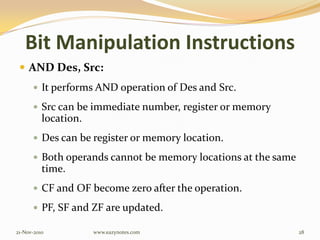
 AND Des, Src:
 It performs AND operation of Des and Src.
 Src can be immediate number, register or memory
location.
 Des can be register or memory location.
 Both operands cannot be memory locations at the same
time.
 CF and OF become zero after the operation.
 PF, SF and ZF are updated.
21-Nov-2010 28www.eazynotes.com
Bit Manipulation Instructions
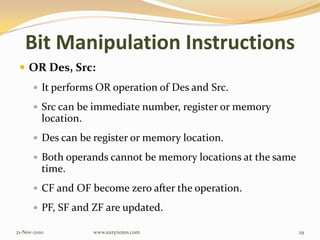
 OR Des, Src:
 It performs OR operation of Des and Src.
 Src can be immediate number, register or memory
location.
 Des can be register or memory location.
 Both operands cannot be memory locations at the same
time.
 CF and OF become zero after the operation.
 PF, SF and ZF are updated.
21-Nov-2010 29www.eazynotes.com
Bit Manipulation Instructions
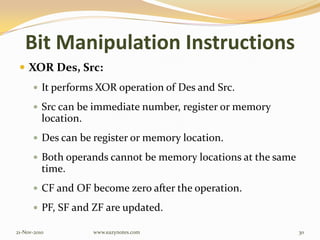
 XOR Des, Src:
 It performs XOR operation of Des and Src.
 Src can be immediate number, register or memory
location.
 Des can be register or memory location.
 Both operands cannot be memory locations at the same
time.
 CF and OF become zero after the operation.
 PF, SF and ZF are updated.
21-Nov-2010 30www.eazynotes.com
Bit Manipulation Instructions
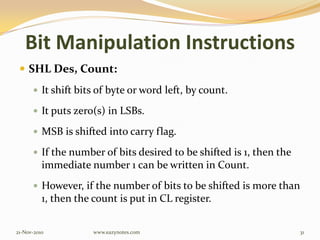
 SHL Des, Count:
 It shift bits of byte or word left, by count.
 It puts zero(s) in LSBs.
 MSB is shifted into carry flag.
 If the number of bits desired to be shifted is 1, then the
immediate number 1 can be written in Count.
 However, if the number of bits to be shifted is more than
1, then the count is put in CL register.
21-Nov-2010 31www.eazynotes.com
Bit Manipulation Instructions
 SHR Des, Count:
 It shift bits of byte or word right, by count.
 It puts zero(s) in MSBs.
 LSB is shifted into carry flag.
 If the number of bits desired to be shifted is 1, then the
immediate number 1 can be written in Count.
 However, if the number of bits to be shifted is more than
1, then the count is put in CL register.
21-Nov-2010 32www.eazynotes.com
Bit Manipulation Instructions
 ROL Des, Count:
 It rotates bits of byte or word left, by count.
 MSB is transferred to LSB and also to CF.
 If the number of bits desired to be shifted is 1, then the
immediate number 1 can be written in Count.
 However, if the number of bits to be shifted is more than
1, then the count is put in CL register.
21-Nov-2010 33www.eazynotes.com
Bit Manipulation Instructions
 ROR Des, Count:
 It rotates bits of byte or word right, by count.
 LSB is transferred to MSB and also to CF.
 If the number of bits desired to be shifted is 1, then the
immediate number 1 can be written in Count.
 However, if the number of bits to be shifted is more than
1, then the count is put in CL register.
21-Nov-2010 34www.eazynotes.com
Program Execution Transfer Instructions
 These instructions cause change in the sequence of the
execution of instruction.
 This change can be through a condition or sometimes
unconditional.
 The conditions are represented by flags.
21-Nov-2010 35www.eazynotes.com
Program Execution Transfer Instructions
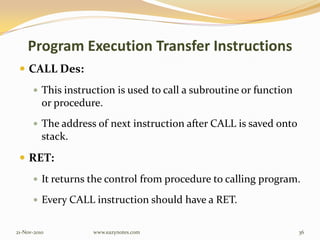
 CALL Des:
 This instruction is used to call a subroutine or function
or procedure.
 The address of next instruction after CALL is saved onto
stack.
 RET:
 It returns the control from procedure to calling program.
 Every CALL instruction should have a RET.
21-Nov-2010 36www.eazynotes.com
Program Execution Transfer Instructions
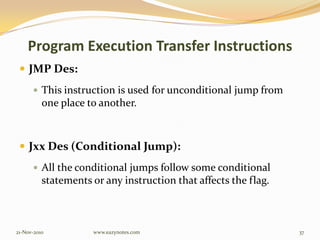
 JMP Des:
 This instruction is used for unconditional jump from
one place to another.
 Jxx Des (Conditional Jump):
 All the conditional jumps follow some conditional
statements or any instruction that affects the flag.
21-Nov-2010 37www.eazynotes.com
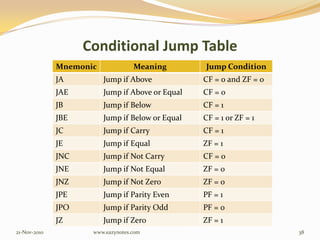
Conditional Jump Table
Mnemonic Meaning Jump Condition
JA Jump if Above CF = 0 and ZF = 0
JAE Jump if Above or Equal CF = 0
JB Jump if Below CF = 1
JBE Jump if Below or Equal CF = 1 or ZF = 1
JC Jump if Carry CF = 1
JE Jump if Equal ZF = 1
JNC Jump if Not Carry CF = 0
JNE Jump if Not Equal ZF = 0
JNZ Jump if Not Zero ZF = 0
JPE Jump if Parity Even PF = 1
JPO Jump if Parity Odd PF = 0
JZ Jump if Zero ZF = 1
21-Nov-2010 38www.eazynotes.com
Program Execution Transfer Instructions
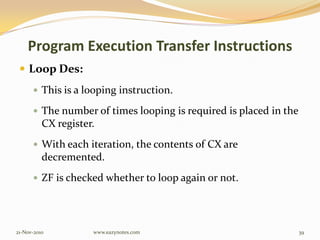
 Loop Des:
 This is a looping instruction.
 The number of times looping is required is placed in the
CX register.
 With each iteration, the contents of CX are
decremented.
 ZF is checked whether to loop again or not.
21-Nov-2010 39www.eazynotes.com
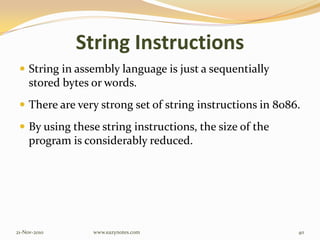
String Instructions
 String in assembly language is just a sequentially
stored bytes or words.
 There are very strong set of string instructions in 8086.
 By using these string instructions, the size of the
program is considerably reduced.
21-Nov-2010 40www.eazynotes.com
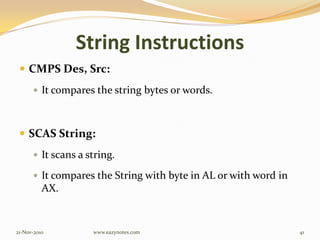
String Instructions
 CMPS Des, Src:
 It compares the string bytes or words.
 SCAS String:
 It scans a string.
 It compares the String with byte in AL or with word in
AX.
21-Nov-2010 41www.eazynotes.com
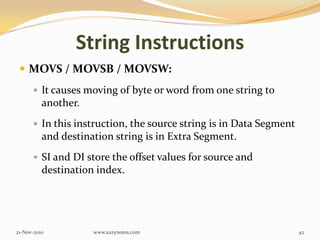
String Instructions
 MOVS / MOVSB / MOVSW:
 It causes moving of byte or word from one string to
another.
 In this instruction, the source string is in Data Segment
and destination string is in Extra Segment.
 SI and DI store the offset values for source and
destination index.
21-Nov-2010 42www.eazynotes.com
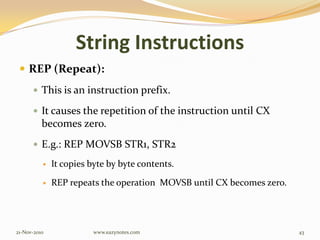
String Instructions
 REP (Repeat):
 This is an instruction prefix.
 It causes the repetition of the instruction until CX
becomes zero.
 E.g.: REP MOVSB STR1, STR2
 It copies byte by byte contents.
 REP repeats the operation MOVSB until CX becomes zero.
21-Nov-2010 43www.eazynotes.com
Processor Control Instructions
 These instructions control the processor itself.
 8086 allows to control certain control flags that:
 causes the processing in a certain direction
 processor synchronization if more than one
microprocessor attached.
21-Nov-2010 44www.eazynotes.com
Processor Control Instructions
 STC:
 It sets the carry flag to 1.
 CLC:
 It clears the carry flag to 0.
 CMC:
 It complements the carry flag.
21-Nov-2010 45www.eazynotes.com
Processor Control Instructions
 STD:
 It sets the direction flag to 1.
 If it is set, string bytes are accessed from higher memory
address to lower memory address.
 CLD:
 It clears the direction flag to 0.
 If it is reset, the string bytes are accessed from lower
memory address to higher memory address.
21-Nov-2010 46www.eazynotes.com
4723-Nov-10www.eazynotes.com

Instruction set-of-8086

  • 1.
  • 2.
    Instruction Set of8086  An instruction is a binary pattern designed inside a microprocessor to perform a specific function.  The entire group of instructions that a microprocessor supports is called Instruction Set.  8086 has more than 20,000 instructions. 21-Nov-2010 2www.eazynotes.com
  • 3.
    Classification of InstructionSet  Data Transfer Instructions  Arithmetic Instructions  Bit Manipulation Instructions  Program Execution Transfer Instructions  String Instructions  Processor Control Instructions 21-Nov-2010 3www.eazynotes.com
  • 4.
    Data Transfer Instructions These instructions are used to transfer data from source to destination.  The operand can be a constant, memory location, register or I/O port address. 21-Nov-2010 4www.eazynotes.com
  • 5.
    Data Transfer Instructions MOV Des, Src:  Src operand can be register, memory location or immediate operand.  Des can be register or memory operand.  Both Src and Des cannot be memory location at the same time.  E.g.:  MOV CX, 037A H  MOV AL, BL  MOV BX, [0301 H] 21-Nov-2010 5www.eazynotes.com
  • 6.
    Data Transfer Instructions PUSH Operand:  It pushes the operand into top of stack.  E.g.: PUSH BX  POP Des:  It pops the operand from top of stack to Des.  Des can be a general purpose register, segment register (except CS) or memory location.  E.g.: POP AX 21-Nov-2010 6www.eazynotes.com
  • 7.
    Data Transfer Instructions XCHG Des, Src:  This instruction exchanges Src with Des.  It cannot exchange two memory locations directly.  E.g.: XCHG DX, AX 21-Nov-2010 7www.eazynotes.com
  • 8.
    Data Transfer Instructions IN Accumulator, Port Address:  It transfers the operand from specified port to accumulator register.  E.g.: IN AX, 0028 H  OUT Port Address, Accumulator:  It transfers the operand from accumulator to specified port.  E.g.: OUT 0028 H, AX 21-Nov-2010 8www.eazynotes.com
  • 9.
    Data Transfer Instructions LEARegister, Src:  It loads a 16-bit register with the offset address of the data specified by the Src.  E.g.: LEA BX, [DI]  This instruction loads the contents of DI (offset) into the BX register. 21-Nov-2010 9www.eazynotes.com
  • 10.
    Data Transfer Instructions LDS Des, Src:  It loads 32-bit pointer from memory source to destination register and DS.  The offset is placed in the destination register and the segment is placed in DS.  To use this instruction the word at the lower memory address must contain the offset and the word at the higher address must contain the segment.  E.g.: LDS BX, [0301 H] 21-Nov-2010 10www.eazynotes.com
  • 11.
    Data Transfer Instructions LES Des, Src:  It loads 32-bit pointer from memory source to destination register and ES.  The offset is placed in the destination register and the segment is placed in ES.  This instruction is very similar to LDS except that it initializes ES instead of DS.  E.g.: LES BX, [0301 H] 21-Nov-2010 11www.eazynotes.com
  • 12.
    Data Transfer Instructions LAHF:  It copies the lower byte of flag register to AH.  SAHF:  It copies the contents of AH to lower byte of flag register.  PUSHF:  Pushes flag register to top of stack.  POPF:  Pops the stack top to flag register. 21-Nov-2010 12www.eazynotes.com
  • 13.
    Arithmetic Instructions  ADDDes, Src:  It adds a byte to byte or a word to word.  It effects AF, CF, OF, PF, SF, ZF flags.  E.g.:  ADD AL, 74H  ADD DX, AX  ADD AX, [BX] 21-Nov-2010 13www.eazynotes.com
  • 14.
    Arithmetic Instructions  ADCDes, Src:  It adds the two operands with CF.  It effects AF, CF, OF, PF, SF, ZF flags.  E.g.:  ADC AL, 74H  ADC DX, AX  ADC AX, [BX] 21-Nov-2010 14www.eazynotes.com
  • 15.
    Arithmetic Instructions  SUBDes, Src:  It subtracts a byte from byte or a word from word.  It effects AF, CF, OF, PF, SF, ZF flags.  For subtraction, CF acts as borrow flag.  E.g.:  SUB AL, 74H  SUB DX, AX  SUB AX, [BX] 21-Nov-2010 15www.eazynotes.com
  • 16.
    Arithmetic Instructions  SBBDes, Src:  It subtracts the two operands and also the borrow from the result.  It effects AF, CF, OF, PF, SF, ZF flags.  E.g.:  SBB AL, 74H  SBB DX, AX  SBB AX, [BX] 21-Nov-2010 16www.eazynotes.com
  • 17.
    Arithmetic Instructions  INCSrc:  It increments the byte or word by one.  The operand can be a register or memory location.  It effects AF, OF, PF, SF, ZF flags.  CF is not effected.  E.g.: INC AX 21-Nov-2010 17www.eazynotes.com
  • 18.
    Arithmetic Instructions  DECSrc:  It decrements the byte or word by one.  The operand can be a register or memory location.  It effects AF, OF, PF, SF, ZF flags.  CF is not effected.  E.g.: DEC AX 21-Nov-2010 18www.eazynotes.com
  • 19.
    Arithmetic Instructions  AAA(ASCII Adjust after Addition):  The data entered from the terminal is in ASCII format.  In ASCII, 0 – 9 are represented by 30H – 39H.  This instruction allows us to add the ASCII codes.  This instruction does not have any operand.  Other ASCII Instructions:  AAS (ASCII Adjust after Subtraction)  AAM (ASCII Adjust after Multiplication)  AAD (ASCII Adjust Before Division) 21-Nov-2010 19www.eazynotes.com
  • 20.
    Arithmetic Instructions  DAA(Decimal Adjust after Addition)  It is used to make sure that the result of adding two BCD numbers is adjusted to be a correct BCD number.  It only works on AL register.  DAS (Decimal Adjust after Subtraction)  It is used to make sure that the result of subtracting two BCD numbers is adjusted to be a correct BCD number.  It only works on AL register. 21-Nov-2010 20www.eazynotes.com
  • 21.
    Arithmetic Instructions  NEGSrc:  It creates 2’s complement of a given number.  That means, it changes the sign of a number. 21-Nov-2010 21www.eazynotes.com
  • 22.
    Arithmetic Instructions  CMPDes, Src:  It compares two specified bytes or words.  The Src and Des can be a constant, register or memory location.  Both operands cannot be a memory location at the same time.  The comparison is done simply by internally subtracting the source from destination.  The value of source and destination does not change, but the flags are modified to indicate the result. 21-Nov-2010 22www.eazynotes.com
  • 23.
    Arithmetic Instructions  MULSrc:  It is an unsigned multiplication instruction.  It multiplies two bytes to produce a word or two words to produce a double word.  AX = AL * Src  DX : AX = AX * Src  This instruction assumes one of the operand in AL or AX.  Src can be a register or memory location.  IMUL Src:  It is a signed multiplication instruction. 21-Nov-2010 23www.eazynotes.com
  • 24.
    Arithmetic Instructions  DIVSrc:  It is an unsigned division instruction.  It divides word by byte or double word by word.  The operand is stored in AX, divisor is Src and the result is stored as:  AH = remainder AL = quotient  IDIV Src:  It is a signed division instruction. 21-Nov-2010 24www.eazynotes.com
  • 25.
    Arithmetic Instructions  CBW(Convert Byte to Word):  This instruction converts byte in AL to word in AX.  The conversion is done by extending the sign bit of AL throughout AH.  CWD (Convert Word to Double Word):  This instruction converts word in AX to double word in DX : AX.  The conversion is done by extending the sign bit of AX throughout DX. 21-Nov-2010 25www.eazynotes.com
  • 26.
    Bit Manipulation Instructions These instructions are used at the bit level.  These instructions can be used for:  Testing a zero bit  Set or reset a bit  Shift bits across registers 21-Nov-2010 26www.eazynotes.com
  • 27.
    Bit Manipulation Instructions NOT Src:  It complements each bit of Src to produce 1’s complement of the specified operand.  The operand can be a register or memory location. 21-Nov-2010 27www.eazynotes.com
  • 28.
    Bit Manipulation Instructions AND Des, Src:  It performs AND operation of Des and Src.  Src can be immediate number, register or memory location.  Des can be register or memory location.  Both operands cannot be memory locations at the same time.  CF and OF become zero after the operation.  PF, SF and ZF are updated. 21-Nov-2010 28www.eazynotes.com
  • 29.
    Bit Manipulation Instructions OR Des, Src:  It performs OR operation of Des and Src.  Src can be immediate number, register or memory location.  Des can be register or memory location.  Both operands cannot be memory locations at the same time.  CF and OF become zero after the operation.  PF, SF and ZF are updated. 21-Nov-2010 29www.eazynotes.com
  • 30.
    Bit Manipulation Instructions XOR Des, Src:  It performs XOR operation of Des and Src.  Src can be immediate number, register or memory location.  Des can be register or memory location.  Both operands cannot be memory locations at the same time.  CF and OF become zero after the operation.  PF, SF and ZF are updated. 21-Nov-2010 30www.eazynotes.com
  • 31.
    Bit Manipulation Instructions SHL Des, Count:  It shift bits of byte or word left, by count.  It puts zero(s) in LSBs.  MSB is shifted into carry flag.  If the number of bits desired to be shifted is 1, then the immediate number 1 can be written in Count.  However, if the number of bits to be shifted is more than 1, then the count is put in CL register. 21-Nov-2010 31www.eazynotes.com
  • 32.
    Bit Manipulation Instructions SHR Des, Count:  It shift bits of byte or word right, by count.  It puts zero(s) in MSBs.  LSB is shifted into carry flag.  If the number of bits desired to be shifted is 1, then the immediate number 1 can be written in Count.  However, if the number of bits to be shifted is more than 1, then the count is put in CL register. 21-Nov-2010 32www.eazynotes.com
  • 33.
    Bit Manipulation Instructions ROL Des, Count:  It rotates bits of byte or word left, by count.  MSB is transferred to LSB and also to CF.  If the number of bits desired to be shifted is 1, then the immediate number 1 can be written in Count.  However, if the number of bits to be shifted is more than 1, then the count is put in CL register. 21-Nov-2010 33www.eazynotes.com
  • 34.
    Bit Manipulation Instructions ROR Des, Count:  It rotates bits of byte or word right, by count.  LSB is transferred to MSB and also to CF.  If the number of bits desired to be shifted is 1, then the immediate number 1 can be written in Count.  However, if the number of bits to be shifted is more than 1, then the count is put in CL register. 21-Nov-2010 34www.eazynotes.com
  • 35.
    Program Execution TransferInstructions  These instructions cause change in the sequence of the execution of instruction.  This change can be through a condition or sometimes unconditional.  The conditions are represented by flags. 21-Nov-2010 35www.eazynotes.com
  • 36.
    Program Execution TransferInstructions  CALL Des:  This instruction is used to call a subroutine or function or procedure.  The address of next instruction after CALL is saved onto stack.  RET:  It returns the control from procedure to calling program.  Every CALL instruction should have a RET. 21-Nov-2010 36www.eazynotes.com
  • 37.
    Program Execution TransferInstructions  JMP Des:  This instruction is used for unconditional jump from one place to another.  Jxx Des (Conditional Jump):  All the conditional jumps follow some conditional statements or any instruction that affects the flag. 21-Nov-2010 37www.eazynotes.com
  • 38.
    Conditional Jump Table MnemonicMeaning Jump Condition JA Jump if Above CF = 0 and ZF = 0 JAE Jump if Above or Equal CF = 0 JB Jump if Below CF = 1 JBE Jump if Below or Equal CF = 1 or ZF = 1 JC Jump if Carry CF = 1 JE Jump if Equal ZF = 1 JNC Jump if Not Carry CF = 0 JNE Jump if Not Equal ZF = 0 JNZ Jump if Not Zero ZF = 0 JPE Jump if Parity Even PF = 1 JPO Jump if Parity Odd PF = 0 JZ Jump if Zero ZF = 1 21-Nov-2010 38www.eazynotes.com
  • 39.
    Program Execution TransferInstructions  Loop Des:  This is a looping instruction.  The number of times looping is required is placed in the CX register.  With each iteration, the contents of CX are decremented.  ZF is checked whether to loop again or not. 21-Nov-2010 39www.eazynotes.com
  • 40.
    String Instructions  Stringin assembly language is just a sequentially stored bytes or words.  There are very strong set of string instructions in 8086.  By using these string instructions, the size of the program is considerably reduced. 21-Nov-2010 40www.eazynotes.com
  • 41.
    String Instructions  CMPSDes, Src:  It compares the string bytes or words.  SCAS String:  It scans a string.  It compares the String with byte in AL or with word in AX. 21-Nov-2010 41www.eazynotes.com
  • 42.
    String Instructions  MOVS/ MOVSB / MOVSW:  It causes moving of byte or word from one string to another.  In this instruction, the source string is in Data Segment and destination string is in Extra Segment.  SI and DI store the offset values for source and destination index. 21-Nov-2010 42www.eazynotes.com
  • 43.
    String Instructions  REP(Repeat):  This is an instruction prefix.  It causes the repetition of the instruction until CX becomes zero.  E.g.: REP MOVSB STR1, STR2  It copies byte by byte contents.  REP repeats the operation MOVSB until CX becomes zero. 21-Nov-2010 43www.eazynotes.com
  • 44.
    Processor Control Instructions These instructions control the processor itself.  8086 allows to control certain control flags that:  causes the processing in a certain direction  processor synchronization if more than one microprocessor attached. 21-Nov-2010 44www.eazynotes.com
  • 45.
    Processor Control Instructions STC:  It sets the carry flag to 1.  CLC:  It clears the carry flag to 0.  CMC:  It complements the carry flag. 21-Nov-2010 45www.eazynotes.com
  • 46.
    Processor Control Instructions STD:  It sets the direction flag to 1.  If it is set, string bytes are accessed from higher memory address to lower memory address.  CLD:  It clears the direction flag to 0.  If it is reset, the string bytes are accessed from lower memory address to higher memory address. 21-Nov-2010 46www.eazynotes.com
  • 47.