Submitted to:
Ms sanjna walia

1/27/2014

1








What is fluctuation in rupee value?
Reasons behind it
How rupee-dollar rate are determined
How does the value of rupee change against the
dollar
5 Questions on Rupee Depreciation…
RBI in action …..
Real story of American dollar and Indian rupee.
1/27/2014

2


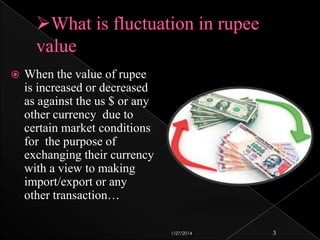
When the value of rupee
is increased or decreased
as against the us $ or any
other currency due to
certain market conditions
for the purpose of
exchanging their currency
with a view to making
import/export or any
other transaction…
1/27/2014

3
1/27/2014

4


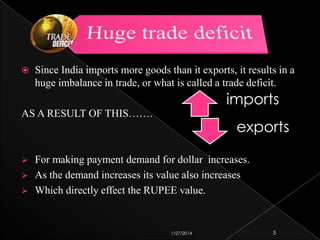
Since India imports more goods than it exports, it results in a
huge imbalance in trade, or what is called a trade deficit.

imports

AS A RESULT OF THIS…….





exports

For making payment demand for dollar increases.
As the demand increases its value also increases
Which directly effect the RUPEE value.

1/27/2014

5


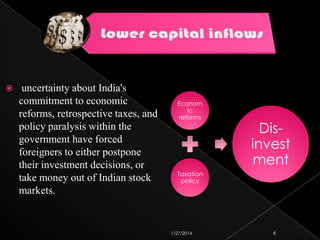
uncertainty about India's
commitment to economic
reforms, retrospective taxes, and
policy paralysis within the
government have forced
foreigners to either postpone
their investment decisions, or
take money out of Indian stock
markets.

Econom
ic
reforms

Disinvest
ment

Taxation
policy

1/27/2014

6


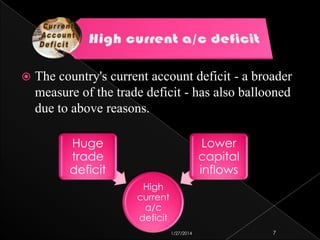
The country's current account deficit - a broader
measure of the trade deficit - has also ballooned
due to above reasons.
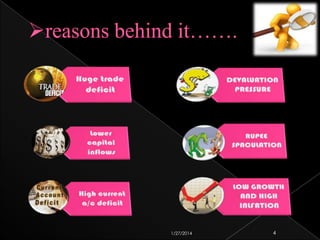
Huge
trade
deficit

Lower
capital
inflows
High
current
a/c
deficit
1/27/2014

7
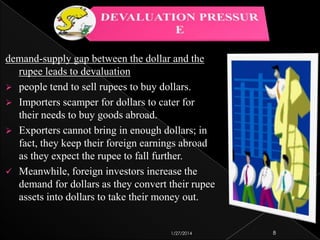
demand-supply gap between the dollar and the
rupee leads to devaluation
 people tend to sell rupees to buy dollars.
 Importers scamper for dollars to cater for
their needs to buy goods abroad.
 Exporters cannot bring in enough dollars; in
fact, they keep their foreign earnings abroad
as they expect the rupee to fall further.
 Meanwhile, foreign investors increase the
demand for dollars as they convert their rupee
assets into dollars to take their money out.

1/27/2014

8
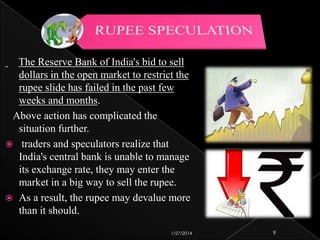
The Reserve Bank of India's bid to sell
dollars in the open market to restrict the
rupee slide has failed in the past few
weeks and months.
Above action has complicated the
situation further.
 traders and speculators realize that
India's central bank is unable to manage
its exchange rate, they may enter the
market in a big way to sell the rupee.
 As a result, the rupee may devalue more
than it should.
1/27/2014

9



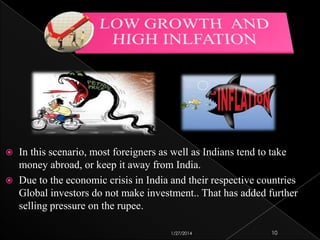
In this scenario, most foreigners as well as Indians tend to take
money abroad, or keep it away from India.
Due to the economic crisis in India and their respective countries
Global investors do not make investment.. That has added further
selling pressure on the rupee.
1/27/2014

10
NARENDER MODI’S STATEMENT
OVER RUPEE DEVALUATION



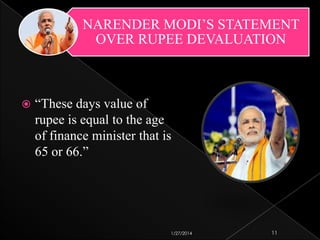
“These days value of
rupee is equal to the age
of finance minister that is
65 or 66.”

1/27/2014

11
10%
8%
6%

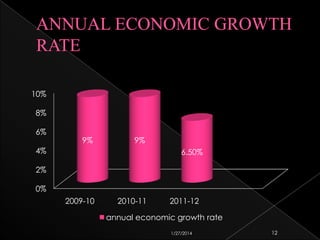
9%

9%

4%

6.50%

2%
0%
2009-10

2010-11

2011-12

annual economic growth rate
1/27/2014

12
1/27/2014

13
Cont..



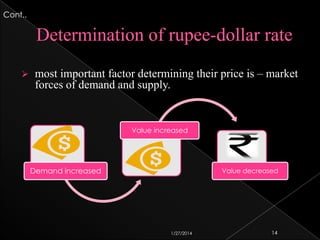
most important factor determining their price is – market
forces of demand and supply.

Value increased

Demand increased

Value decreased

1/27/2014

14
Cont..
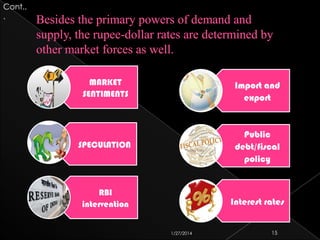
.

MARKET
SENTIMENTS

Import and
export

SPECULATION

Public
debt/fiscal
policy

RBI
intervention

Interest rates

1/27/2014

15
Cont..

MARKET SENTIMENTS



During turbulent markets, investors usually prefer to
park their money in safe havens such as US
treasuries, Swiss franc, gold and so on to avoid losses to
their portfolios. This flight to safety would lead to
foreign investors redeeming their investments from
India. This could increase the demand for dollar.

1/27/2014

16
SPECULATION



There are derivative instruments and
over-the-counter currency instruments
through which one can speculate/
hedge the underlying currency rates.
When speculators sense
improvements/ deterioration of the
sentiments of the markets, they too
want to benefit from such rising/
falling dollar. They then start
buying/selling dollar which would
further change the demand/ supply of
the dollar.

1/27/2014

17
Cont..

RBI intervention



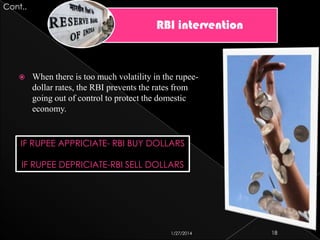
When there is too much volatility in the rupeedollar rates, the RBI prevents the rates from
going out of control to protect the domestic
economy.

IF RUPEE APPRICIATE- RBI BUY DOLLARS
IF RUPEE DEPRICIATE-RBI SELL DOLLARS

1/27/2014

18
Import and export



There are a lot of schemes and incentives for exporters
while importers are burdened with many conditions and
taxes. This is to protect our economy from high rupee
depreciation. Importing foreign goods requires us to make
payment in dollars thus strengthening the dollar’s demand.
Exports do the exact reverse.
1/27/2014

19
Cont..

Public debt/fiscal policy


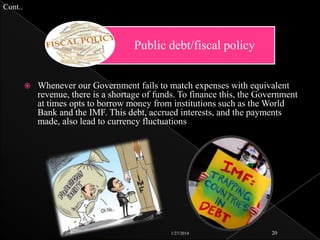
Whenever our Government fails to match expenses with equivalent
revenue, there is a shortage of funds. To finance this, the Government
at times opts to borrow money from institutions such as the World
Bank and the IMF. This debt, accrued interests, and the payments
made, also lead to currency fluctuations

1/27/2014

20
Interest rates


The prevailing interest rates on the government bonds
attract foreign capital to India. If the rates are high
enough to cover the foreign market risk and if the foreign
investor is comfortable with the fundamentals or credit
ratings, money would start pouring into India and thus
provide us with a supply of dollars.

1/27/2014

21
1/27/2014

22
Cont..

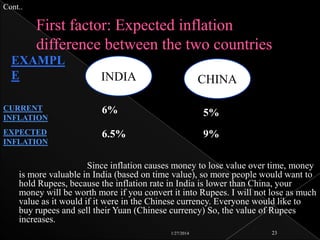
EXAMPL
E

INDIA

CHINA

CURRENT
INFLATION

6%

5%

EXPECTED
INFLATION

6.5%

9%

Since inflation causes money to lose value over time, money
is more valuable in India (based on time value), so more people would want to
hold Rupees, because the inflation rate in India is lower than China, your
money will be worth more if you convert it into Rupees. I will not lose as much
value as it would if it were in the Chinese currency. Everyone would like to
buy rupees and sell their Yuan (Chinese currency) So, the value of Rupees
increases.
1/27/2014

23
Cont..

Lets say that the US has an interest rate of 5% and India has an interest rate of
10%, thus the same amount of money is more valuable in India in this example
because you are earning more interest on the same investment.
 So, effectively the people in US would be selling their dollars and buying
Rupees (i.e. converting their dollars into Rupees) and putting all that money in
Indian banks to earn a much higher interest rate. Therefore the more is the
demand of Rupees; the more is the supply or sale of dollar and the value of
Rupee increases.


1/27/2014

24
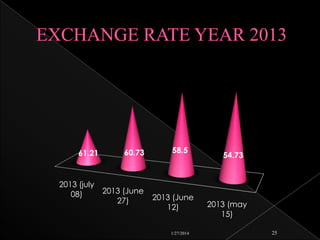
61.21

2013 (july
08)

60.73

2013 (June
27)

58.5

2013 (June
12)

1/27/2014

54.73

2013 (may
15)
25
1/27/2014

26
Let’s replace rupee with potatoes.
 Today US$ 1 can buy 50 pieces of
potatoes. Tomorrow, 1 US$ can buy
60 potatoes.
 This means that potatoes have
gotten cheaper since you can buy
more pieces for the same US$ 1
Alternatively, it means that potatoes
have depreciated or declined in
value.
 The same is true for the rupee


1/27/2014

27
Lets assume........you need to buy crude oil.
1 barrel of crude oil = 100 US $
(1 US $ = Rs. 50) according to this you need Rs.
5000 to pay for it.
 Next time.. Value of rupee goes to Rs.60 per US$
from Rs. 50. And you again need to buy crude
oil.
 Now you need Rs.6000 to pay in return for oil.
This shows that now you have to pay Rs 1000
more than earlier.


1/27/2014

28
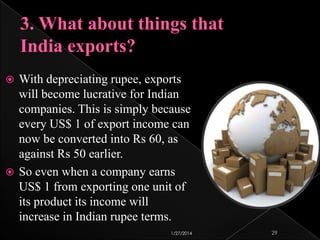
With depreciating rupee, exports
will become lucrative for Indian
companies. This is simply because
every US$ 1 of export income can
now be converted into Rs 60, as
against Rs 50 earlier.
 So even when a company earns
US$ 1 from exporting one unit of
its product its income will
increase in Indian rupee terms.


1/27/2014

29
ITS SIMPLY DEMAND AND SUPPLY.


When supply of rupee rises while demand
falls, the value of the rupee depreciates. As far
as the current rupee depreciation is
concerned, it results of appreciation of US dollar.



When foreigners sell in Indian rupee and
demand US dollars to take back home, it pulls
the rupee down. And before the rupee gets
pulled down even further, the foreigners would
like to sell even more, which would add to the
pressure on the rupee.

1/27/2014

30
Indian companies that import a lot of raw materials
will face pressure on their profits if the rupee continues to
weaken against the US dollar, or even if it remains at the
current weak levels.
 Also, companies that have foreign borrowings on their
books will see a negative impact on their profits.
 On the other hand, Indian companies (like those from the
IT and pharmaceutical sectors) that are major
exporters, will benefit from the falling rupee.
 rupee’s current depreciation is bad for a consumer or an
investor in companies that import a lot.


1/27/2014

31
1/27/2014

32
Cont..



The central bank directed exporters to convert
50% of their foreign currency holding with banks
into rupee balances

 expected to

infuse at least $2.5 billion (around
Rs 13,325 crores today) into the
market, lending support to the rupee.
1/27/2014

33
Cont..



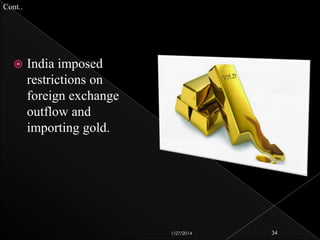
India imposed
restrictions on
foreign exchange
outflow and
importing gold.

1/27/2014

34
Cont..



Indians could spend
up to 2 lakh dollars a
year to finance their
children’s education
or for any indulgence
or even investment.
Now they can spend
75,000 dollars a year
and they can’t remit
dollars to buy land
abroad.

1/27/2014

35
Cont..



Companies until now could spend up to 400
percent of their net worth abroad to acquire or
expand. The RBI has brought this limit down to
100 percent of net worth.

1/27/2014

36
Cont..



RBI announced its decision to buy long-term
govt bonds from open market worth Rs.80
billion to pump more liquidity into the
country’s banking system.

1/27/2014

37
1/27/2014

38
Americans understood that Petrol is equally
valuable as Gold so they made Agreement with all
the Middle East countries to sell petrol in Dollars
only.
 That is why Americans print their Dollar as legal
tender for debts.


1/27/2014

39


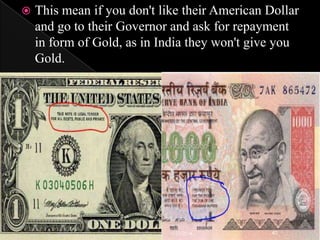
This mean if you don't like their American Dollar
and go to their Governor and ask for repayment
in form of Gold, as in India they won't give you
Gold.

1/27/2014

40
Indian petroleum minister goes to Middle East
country to purchase petrol,
 The Middle East petrol bunk people will
say that liter petrol is one Dollar.


1/27/2014

41
But Indians won't have dollars. They have Indian
Rupees. So what to do now?
 Indian Minister will ask America to give Dollars.
 American Federal Reserve will take a white
paper , print Dollars on it and give it to the
Indian Minister.


1/27/2014

42
1/27/2014

43
If you change your mind and want to give back
the Dollars to America we can't demand them to
pay Gold in return for the Dollars.
 They will say " Have we promised to return
something back to you? Haven't you checked the
Dollar ? We clearly printed on the Dollar that it is
Debt"


1/27/2014

44


So, Americans don't need any Gold with them to
print Dollars. They will print Dollars on white
papers as they like.

1/27/2014

45


But what will Americans give to the Middle East
countries for selling petrol in Dollars only?????

1/27/2014

46
Middle East kings pay rent to America for
protecting their kings and heirs.
 Similarly they are still paying back the Debt to
America for constructing Roads and Buildings in
their countries. This is the value of American
Dollar.
 That is why Many say some day the Dollar will
be destroyed.


1/27/2014

47
At present the problem of India is the result of
buying those American Dollars.
 American white papers are equal to Indian Gold.
So if we reduce the consumption of petrol and
cars, Dollar will come down.


1/27/2014

48
1/27/2014

49
1/27/2014

50


More than 30,000 crore rupees of foreign
exchange are being siphoned out of our country
on products such as
cosmetics, snacks, tea, beverages, etc. which are
grown, produced and consumed here.

1/27/2014

51
A cold drink that costs only 70 / 80 paisa to
produce, is sold for Rs.9 and a major chunk of
profits from these are sent abroad.
 we request everybody to use INDIAN products
only at least for the next two years.


1/27/2014

52


With the rise in petrol prices, if we do not do
this, the Rupee will devalue further and we will
end up paying much more for the same products
in the near future.

1/27/2014

53
Buy only products manufactured by WHOLLY
INDIAN COMPANIES
 You don't need to give-up your lifestyle. You just
need to choose an alternate product.


1/27/2014

54
Daily products which are
 COLD DRINKS,

BATHING SOAP ,

TOOTH PASTE/BRUSH,

SHAVING CREAM/BLADE,

TALCUM POWDER ,

MILK POWDER ,SHAMPOO Food Items etc.
All you need to do is buy Indian Goods and
Make sure Indian rupee is not crossing outside
India.


It saves INDIA!!!!!!!
1/27/2014

55
1/27/2014

56

Fluctuations in rupee value arti

  • 1.
    Submitted to: Ms sanjnawalia 1/27/2014 1
  • 2.
           What is fluctuationin rupee value? Reasons behind it How rupee-dollar rate are determined How does the value of rupee change against the dollar 5 Questions on Rupee Depreciation… RBI in action ….. Real story of American dollar and Indian rupee. 1/27/2014 2
  • 3.
     When the valueof rupee is increased or decreased as against the us $ or any other currency due to certain market conditions for the purpose of exchanging their currency with a view to making import/export or any other transaction… 1/27/2014 3
  • 4.
  • 5.
     Since India importsmore goods than it exports, it results in a huge imbalance in trade, or what is called a trade deficit. imports AS A RESULT OF THIS…….    exports For making payment demand for dollar increases. As the demand increases its value also increases Which directly effect the RUPEE value. 1/27/2014 5
  • 6.
     uncertainty about India's commitmentto economic reforms, retrospective taxes, and policy paralysis within the government have forced foreigners to either postpone their investment decisions, or take money out of Indian stock markets. Econom ic reforms Disinvest ment Taxation policy 1/27/2014 6
  • 7.
     The country's currentaccount deficit - a broader measure of the trade deficit - has also ballooned due to above reasons. Huge trade deficit Lower capital inflows High current a/c deficit 1/27/2014 7
  • 8.
    demand-supply gap betweenthe dollar and the rupee leads to devaluation  people tend to sell rupees to buy dollars.  Importers scamper for dollars to cater for their needs to buy goods abroad.  Exporters cannot bring in enough dollars; in fact, they keep their foreign earnings abroad as they expect the rupee to fall further.  Meanwhile, foreign investors increase the demand for dollars as they convert their rupee assets into dollars to take their money out. 1/27/2014 8
  • 9.
    The Reserve Bankof India's bid to sell dollars in the open market to restrict the rupee slide has failed in the past few weeks and months. Above action has complicated the situation further.  traders and speculators realize that India's central bank is unable to manage its exchange rate, they may enter the market in a big way to sell the rupee.  As a result, the rupee may devalue more than it should. 1/27/2014 9
  • 10.
      In this scenario,most foreigners as well as Indians tend to take money abroad, or keep it away from India. Due to the economic crisis in India and their respective countries Global investors do not make investment.. That has added further selling pressure on the rupee. 1/27/2014 10
  • 11.
    NARENDER MODI’S STATEMENT OVERRUPEE DEVALUATION  “These days value of rupee is equal to the age of finance minister that is 65 or 66.” 1/27/2014 11
  • 12.
  • 13.
  • 14.
    Cont..  most important factordetermining their price is – market forces of demand and supply. Value increased Demand increased Value decreased 1/27/2014 14
  • 15.
  • 16.
    Cont.. MARKET SENTIMENTS  During turbulentmarkets, investors usually prefer to park their money in safe havens such as US treasuries, Swiss franc, gold and so on to avoid losses to their portfolios. This flight to safety would lead to foreign investors redeeming their investments from India. This could increase the demand for dollar. 1/27/2014 16
  • 17.
    SPECULATION  There are derivativeinstruments and over-the-counter currency instruments through which one can speculate/ hedge the underlying currency rates. When speculators sense improvements/ deterioration of the sentiments of the markets, they too want to benefit from such rising/ falling dollar. They then start buying/selling dollar which would further change the demand/ supply of the dollar. 1/27/2014 17
  • 18.
    Cont.. RBI intervention  When thereis too much volatility in the rupeedollar rates, the RBI prevents the rates from going out of control to protect the domestic economy. IF RUPEE APPRICIATE- RBI BUY DOLLARS IF RUPEE DEPRICIATE-RBI SELL DOLLARS 1/27/2014 18
  • 19.
    Import and export  Thereare a lot of schemes and incentives for exporters while importers are burdened with many conditions and taxes. This is to protect our economy from high rupee depreciation. Importing foreign goods requires us to make payment in dollars thus strengthening the dollar’s demand. Exports do the exact reverse. 1/27/2014 19
  • 20.
    Cont.. Public debt/fiscal policy  Wheneverour Government fails to match expenses with equivalent revenue, there is a shortage of funds. To finance this, the Government at times opts to borrow money from institutions such as the World Bank and the IMF. This debt, accrued interests, and the payments made, also lead to currency fluctuations 1/27/2014 20

  • 21.
    Interest rates  The prevailinginterest rates on the government bonds attract foreign capital to India. If the rates are high enough to cover the foreign market risk and if the foreign investor is comfortable with the fundamentals or credit ratings, money would start pouring into India and thus provide us with a supply of dollars. 1/27/2014 21
  • 22.
  • 23.
    Cont.. EXAMPL E INDIA CHINA CURRENT INFLATION 6% 5% EXPECTED INFLATION 6.5% 9% Since inflation causesmoney to lose value over time, money is more valuable in India (based on time value), so more people would want to hold Rupees, because the inflation rate in India is lower than China, your money will be worth more if you convert it into Rupees. I will not lose as much value as it would if it were in the Chinese currency. Everyone would like to buy rupees and sell their Yuan (Chinese currency) So, the value of Rupees increases. 1/27/2014 23
  • 24.
    Cont.. Lets say thatthe US has an interest rate of 5% and India has an interest rate of 10%, thus the same amount of money is more valuable in India in this example because you are earning more interest on the same investment.  So, effectively the people in US would be selling their dollars and buying Rupees (i.e. converting their dollars into Rupees) and putting all that money in Indian banks to earn a much higher interest rate. Therefore the more is the demand of Rupees; the more is the supply or sale of dollar and the value of Rupee increases.  1/27/2014 24
  • 25.
    61.21 2013 (july 08) 60.73 2013 (June 27) 58.5 2013(June 12) 1/27/2014 54.73 2013 (may 15) 25
  • 26.
  • 27.
    Let’s replace rupeewith potatoes.  Today US$ 1 can buy 50 pieces of potatoes. Tomorrow, 1 US$ can buy 60 potatoes.  This means that potatoes have gotten cheaper since you can buy more pieces for the same US$ 1 Alternatively, it means that potatoes have depreciated or declined in value.  The same is true for the rupee  1/27/2014 27
  • 28.
    Lets assume........you needto buy crude oil. 1 barrel of crude oil = 100 US $ (1 US $ = Rs. 50) according to this you need Rs. 5000 to pay for it.  Next time.. Value of rupee goes to Rs.60 per US$ from Rs. 50. And you again need to buy crude oil.  Now you need Rs.6000 to pay in return for oil. This shows that now you have to pay Rs 1000 more than earlier.  1/27/2014 28
  • 29.
    With depreciating rupee,exports will become lucrative for Indian companies. This is simply because every US$ 1 of export income can now be converted into Rs 60, as against Rs 50 earlier.  So even when a company earns US$ 1 from exporting one unit of its product its income will increase in Indian rupee terms.  1/27/2014 29
  • 30.
    ITS SIMPLY DEMANDAND SUPPLY.  When supply of rupee rises while demand falls, the value of the rupee depreciates. As far as the current rupee depreciation is concerned, it results of appreciation of US dollar.  When foreigners sell in Indian rupee and demand US dollars to take back home, it pulls the rupee down. And before the rupee gets pulled down even further, the foreigners would like to sell even more, which would add to the pressure on the rupee. 1/27/2014 30
  • 31.
    Indian companies thatimport a lot of raw materials will face pressure on their profits if the rupee continues to weaken against the US dollar, or even if it remains at the current weak levels.  Also, companies that have foreign borrowings on their books will see a negative impact on their profits.  On the other hand, Indian companies (like those from the IT and pharmaceutical sectors) that are major exporters, will benefit from the falling rupee.  rupee’s current depreciation is bad for a consumer or an investor in companies that import a lot.  1/27/2014 31
  • 32.
  • 33.
    Cont..  The central bankdirected exporters to convert 50% of their foreign currency holding with banks into rupee balances  expected to infuse at least $2.5 billion (around Rs 13,325 crores today) into the market, lending support to the rupee. 1/27/2014 33
  • 34.
    Cont..  India imposed restrictions on foreignexchange outflow and importing gold. 1/27/2014 34
  • 35.
    Cont..  Indians could spend upto 2 lakh dollars a year to finance their children’s education or for any indulgence or even investment. Now they can spend 75,000 dollars a year and they can’t remit dollars to buy land abroad. 1/27/2014 35
  • 36.
    Cont..  Companies until nowcould spend up to 400 percent of their net worth abroad to acquire or expand. The RBI has brought this limit down to 100 percent of net worth. 1/27/2014 36
  • 37.
    Cont..  RBI announced itsdecision to buy long-term govt bonds from open market worth Rs.80 billion to pump more liquidity into the country’s banking system. 1/27/2014 37
  • 38.
  • 39.
    Americans understood thatPetrol is equally valuable as Gold so they made Agreement with all the Middle East countries to sell petrol in Dollars only.  That is why Americans print their Dollar as legal tender for debts.  1/27/2014 39
  • 40.
     This mean ifyou don't like their American Dollar and go to their Governor and ask for repayment in form of Gold, as in India they won't give you Gold. 1/27/2014 40
  • 41.
    Indian petroleum ministergoes to Middle East country to purchase petrol,  The Middle East petrol bunk people will say that liter petrol is one Dollar.  1/27/2014 41
  • 42.
    But Indians won'thave dollars. They have Indian Rupees. So what to do now?  Indian Minister will ask America to give Dollars.  American Federal Reserve will take a white paper , print Dollars on it and give it to the Indian Minister.  1/27/2014 42
  • 43.
  • 44.
    If you changeyour mind and want to give back the Dollars to America we can't demand them to pay Gold in return for the Dollars.  They will say " Have we promised to return something back to you? Haven't you checked the Dollar ? We clearly printed on the Dollar that it is Debt"  1/27/2014 44
  • 45.
     So, Americans don'tneed any Gold with them to print Dollars. They will print Dollars on white papers as they like. 1/27/2014 45
  • 46.
     But what willAmericans give to the Middle East countries for selling petrol in Dollars only????? 1/27/2014 46
  • 47.
    Middle East kingspay rent to America for protecting their kings and heirs.  Similarly they are still paying back the Debt to America for constructing Roads and Buildings in their countries. This is the value of American Dollar.  That is why Many say some day the Dollar will be destroyed.  1/27/2014 47
  • 48.
    At present theproblem of India is the result of buying those American Dollars.  American white papers are equal to Indian Gold. So if we reduce the consumption of petrol and cars, Dollar will come down.  1/27/2014 48
  • 49.
  • 50.
  • 51.
     More than 30,000crore rupees of foreign exchange are being siphoned out of our country on products such as cosmetics, snacks, tea, beverages, etc. which are grown, produced and consumed here. 1/27/2014 51
  • 52.
    A cold drinkthat costs only 70 / 80 paisa to produce, is sold for Rs.9 and a major chunk of profits from these are sent abroad.  we request everybody to use INDIAN products only at least for the next two years.  1/27/2014 52
  • 53.
     With the risein petrol prices, if we do not do this, the Rupee will devalue further and we will end up paying much more for the same products in the near future. 1/27/2014 53
  • 54.
    Buy only productsmanufactured by WHOLLY INDIAN COMPANIES  You don't need to give-up your lifestyle. You just need to choose an alternate product.  1/27/2014 54
  • 55.
    Daily products whichare  COLD DRINKS,  BATHING SOAP ,  TOOTH PASTE/BRUSH,  SHAVING CREAM/BLADE,  TALCUM POWDER ,  MILK POWDER ,SHAMPOO Food Items etc. All you need to do is buy Indian Goods and Make sure Indian rupee is not crossing outside India.  It saves INDIA!!!!!!! 1/27/2014 55
  • 56.