What is Inquiry based learning
1. Inquiry-based learning is an approach to teaching and
learning that places students’ questions, ideas and
observations at the centre of the learning experience.
2. Educators play an active role throughout the process
by establishing a culture where ideas are respectfully
challenged, tested, redefined and viewed as
improvable, moving children from a position of
wondering to a position of enacted understanding and
further questioning
The essence of inquiry
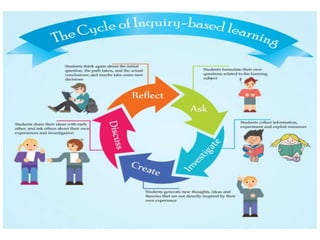
• Inquiry requires more than simply answering questions
or getting a right answer. It promotes investigation,
exploration, search, quest, research, pursuit, and study.
It is enhanced by involvement with a community of
learners, each learning from the other in social
interaction.
Preparing classroom for inquiry
based learning
1. Educators must first immerse themselves in professional
development focused on building inquiry skills such as philosophy
2. Teachers must verbally model thinking skills for students by
thinking aloud and making unlikely connections
3. Students should respect ideas of others and should not be afraid of
making mistakes
4. Start with simple concepts and build on those ideas
5. It is important to make learning relevant, meaningful and tied to the
generational characteristics of your students
6. Integrate technology such as twitter chats, blogs or group text
messaging
What does inquiry-based classroom look like?
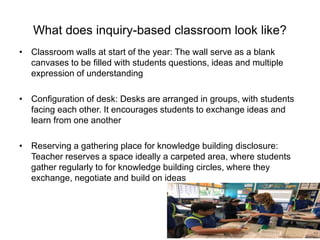
• Classroom walls at start of the year: The wall serve as a blank
canvases to be filled with students questions, ideas and multiple
expression of understanding
• Configuration of desk: Desks are arranged in groups, with students
facing each other. It encourages students to exchange ideas and
learn from one another
• Reserving a gathering place for knowledge building disclosure:
Teacher reserves a space ideally a carpeted area, where students
gather regularly to for knowledge building circles, where they
exchange, negotiate and build on ideas
• Classroom walls at start of the year: The wall serve as a blank
canvases to be filled with students questions, ideas and multiple
expression of understanding
• Configuration of desk: Desks are arranged in groups, with students
facing each other. It encourages students to exchange ideas and
learn from one another
• Reserving a gathering place for knowledge building disclosure:
Teacher reserves a space ideally a carpeted area, where students
gather regularly to for knowledge building circles, where they
exchange, negotiate and build on ideas

Inquiry Based Learning.ppt

  • 1.
    What is Inquirybased learning 1. Inquiry-based learning is an approach to teaching and learning that places students’ questions, ideas and observations at the centre of the learning experience. 2. Educators play an active role throughout the process by establishing a culture where ideas are respectfully challenged, tested, redefined and viewed as improvable, moving children from a position of wondering to a position of enacted understanding and further questioning
  • 2.
    The essence ofinquiry • Inquiry requires more than simply answering questions or getting a right answer. It promotes investigation, exploration, search, quest, research, pursuit, and study. It is enhanced by involvement with a community of learners, each learning from the other in social interaction.
  • 4.
    Preparing classroom forinquiry based learning 1. Educators must first immerse themselves in professional development focused on building inquiry skills such as philosophy 2. Teachers must verbally model thinking skills for students by thinking aloud and making unlikely connections 3. Students should respect ideas of others and should not be afraid of making mistakes 4. Start with simple concepts and build on those ideas 5. It is important to make learning relevant, meaningful and tied to the generational characteristics of your students 6. Integrate technology such as twitter chats, blogs or group text messaging
  • 5.
    What does inquiry-basedclassroom look like? • Classroom walls at start of the year: The wall serve as a blank canvases to be filled with students questions, ideas and multiple expression of understanding • Configuration of desk: Desks are arranged in groups, with students facing each other. It encourages students to exchange ideas and learn from one another • Reserving a gathering place for knowledge building disclosure: Teacher reserves a space ideally a carpeted area, where students gather regularly to for knowledge building circles, where they exchange, negotiate and build on ideas
  • 6.
    • Classroom wallsat start of the year: The wall serve as a blank canvases to be filled with students questions, ideas and multiple expression of understanding • Configuration of desk: Desks are arranged in groups, with students facing each other. It encourages students to exchange ideas and learn from one another • Reserving a gathering place for knowledge building disclosure: Teacher reserves a space ideally a carpeted area, where students gather regularly to for knowledge building circles, where they exchange, negotiate and build on ideas