Methods for Education
for Sustainable Development
Innovative Methods for
Tertiary Education for Sustainable Development
International Conference on
Engineering and Business Education
 Ulrich Holzbaur
 Gerrit Jordaan

2

 Monika Bühr

1,2

1

Aalen University of Applied Science, Aalen, Germany
2 Central University of Technology, Bloemfontein, South Africa

1

- 1

© Prof. Dr. Ulrich D. Holzbaur, AAUAS STZAM
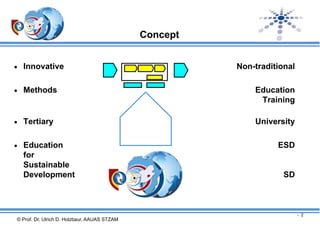
Concept
 Innovative

Non-traditional

 Methods

Education
Training

 Tertiary

University

 Education

for
Sustainable
Development

ESD

SD

- 2

© Prof. Dr. Ulrich D. Holzbaur, AAUAS STZAM
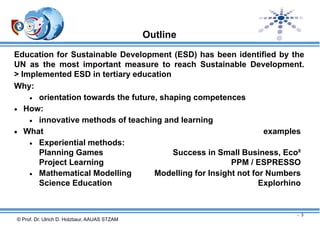
Outline
Education for Sustainable Development (ESD) has been identified by the
UN as the most important measure to reach Sustainable Development.
> Implemented ESD in tertiary education
Why:
 orientation towards the future, shaping competences
 How:
 innovative methods of teaching and learning
 What
examples
 Experiential methods:
Planning Games
Success in Small Business, Eco²
Project Learning
PPM / ESPRESSO
 Mathematical Modelling
Modelling for Insight not for Numbers
Science Education
Explorhino

- 3

© Prof. Dr. Ulrich D. Holzbaur, AAUAS STZAM
Sustainable Development


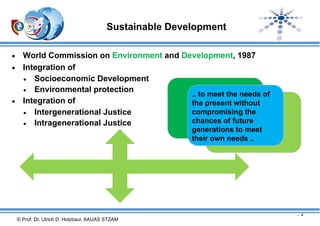
World Commission on Environment and Development, 1987
 Integration of
 Socioeconomic Development
.. to meet the needs of
 Environmental protection
.. to meet the
the present withoutneeds of
 Integration of
.. to meet
the present without
compromising the the needs of
compromising the
 Intergenerational Justice
chances ofthe present without
future
compromising the
chances meet
generations to of future
 Intragenerational Justice
chances
generations of future
their own needs .. to meet
their generations..to meet
own needs
their own needs ..

- 4

© Prof. Dr. Ulrich D. Holzbaur, AAUAS STZAM
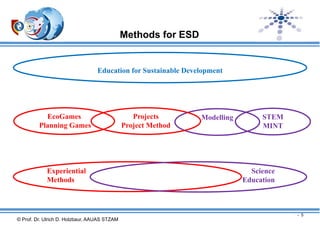
Methods for ESD

Education for Sustainable Development

EcoGames
Planning Games

Experiential
Methods

Projects
Project Method

Modelling

STEM
MINT

Science
Education

- 5

© Prof. Dr. Ulrich D. Holzbaur, AAUAS STZAM
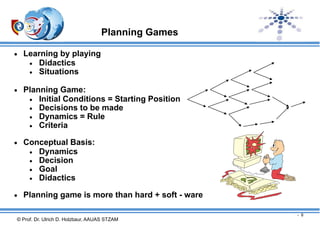
Planning Games
 Learning by playing



Didactics
Situations

 Planning Game:





Initial Conditions = Starting Position
Decisions to be made
Dynamics = Rule
Criteria

 Conceptual Basis:





Dynamics
Decision
Goal
Didactics

 Planning game is more than hard + soft - ware
- 6

© Prof. Dr. Ulrich D. Holzbaur, AAUAS STZAM
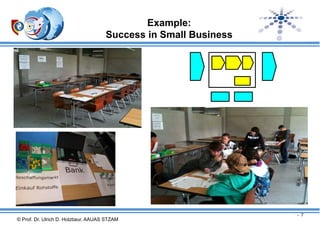
Example:
Success in Small Business

- 7

© Prof. Dr. Ulrich D. Holzbaur, AAUAS STZAM
Example:
Success in Small Business
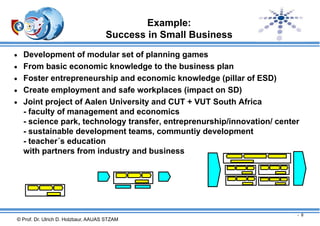
 Development of modular set of planning games
 From basic economic knowledge to the business plan
 Foster entrepreneurship and economic knowledge (pillar of ESD)
 Create employment and safe workplaces (impact on SD)
 Joint project of Aalen University and CUT + VUT South Africa

- faculty of management and economics
- science park, technology transfer, entreprenurship/innovation/ center
- sustainable development teams, communtiy development
- teacher´s education
with partners from industry and business

- 8

© Prof. Dr. Ulrich D. Holzbaur, AAUAS STZAM
Example:
Success in Small Business
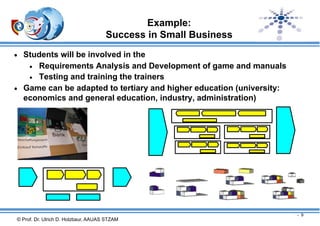
 Students will be involved in the


Requirements Analysis and Development of game and manuals
 Testing and training the trainers
 Game can be adapted to tertiary and higher education (university:
economics and general education, industry, administration)

- 9

© Prof. Dr. Ulrich D. Holzbaur, AAUAS STZAM
Project Method (PPM)
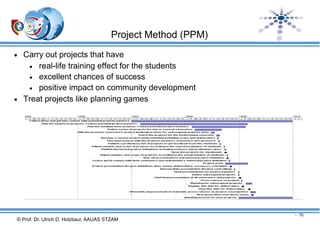
 Carry out projects that have


real-life training effect for the students
 excellent chances of success
 positive impact on community development
 Treat projects like planning games

- 10

© Prof. Dr. Ulrich D. Holzbaur, AAUAS STZAM
Project Portfolio

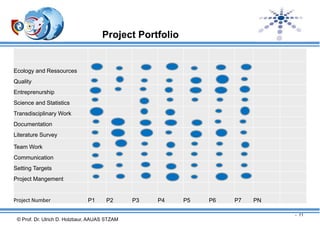
Ecology and Ressources
Quality
Entreprenurship
Science and Statistics
Transdisciplinary Work
Documentation
Literature Survey
Team Work
Communication
Setting Targets
Project Mangement

Project Number

P1

P2

P3

P4

P5

P6

P7

PN
- 11

© Prof. Dr. Ulrich D. Holzbaur, AAUAS STZAM
Experiential aspects of
projects
 Activation and Decision: Students plan and control, decide and act
 Dynamics: as the projects evolves, problems arise and are solved
 Didactics: the supervisor considers didactical aims and principles
 Skills: Soft skills and competences are supported
 Experience: the supervisor considers didactical aims and introduces

activation
 Model orientation: the project can be seen as a real world model of
real problems
 Success: the preparation and control by the supervisor ensures
training success and achievement of project results
 Shaping competences: Project portfolio convers subjects and
competences for ESD

- 12

© Prof. Dr. Ulrich D. Holzbaur, AAUAS STZAM
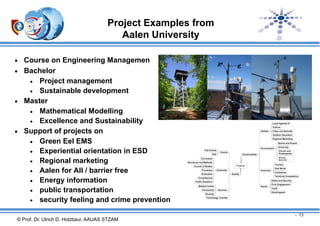
Project Examples from
Aalen University


Course on Engineering Managemen
 Bachelor
 Project management
 Sustainable development
 Master
 Mathematical Modelling
 Excellence and Sustainability
 Support of projects on
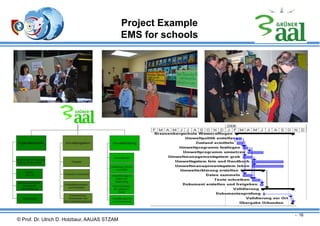
 Green Eel EMS
 Experiential orientation in ESD
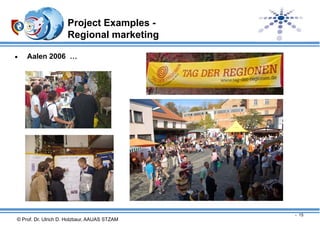
 Regional marketing
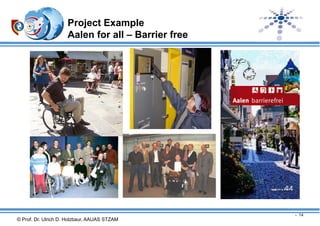
 Aalen for All / barrier free
 Energy information
 public transportation
 security feeling and crime prevention
- 13

© Prof. Dr. Ulrich D. Holzbaur, AAUAS STZAM
Project Example
Aalen for all – Barrier free

- 14

© Prof. Dr. Ulrich D. Holzbaur, AAUAS STZAM
Project Examples Regional marketing


Aalen 2006 …

- 15

© Prof. Dr. Ulrich D. Holzbaur, AAUAS STZAM
Project Example
EMS for schools

- 16

© Prof. Dr. Ulrich D. Holzbaur, AAUAS STZAM
Education for
Sustainable Development
UNESCO Decade Education for Sustainable Development
Projects (2 years each)
 Integrate ESD systemically via Projects (4)
 Green Eel Environmental Management System (4)
 Experience sustainability in the city of Aalen (3)
 Sustainability@CUT (2)
Contributions
 Day of open University + Sustainable Event Management
 “Sustainability kitchen “format + Manager´s cookbook
 Guide Aalen barrier free
Aalen as a City of the EDS Decade (2)

- 17

© Prof. Dr. Ulrich D. Holzbaur, AAUAS STZAM
ESPRESSO

Experience Science and
Practical RElevance
and learn Sustainably
by means of
Sustainability prOjects

- 18

© Prof. Dr. Ulrich D. Holzbaur, AAUAS STZAM
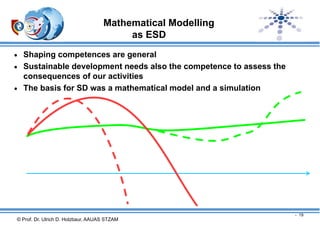
Mathematical Modelling
as ESD
 Shaping competences are general
 Sustainable development needs also the competence to assess the

consequences of our activities
 The basis for SD was a mathematical model and a simulation

- 19

© Prof. Dr. Ulrich D. Holzbaur, AAUAS STZAM
Modelling and shaping
Competences
 Modelling is essential for perception, communication, knowledge

creation and planning. Hence, modelling supports the following
shaping competences:
 foresighted thinking;
 interdisciplinary work;
 planning and implementation;
 reflection on individual and cultural models.
 Shaping competences and modelling:
 1. ethics as a very abstract level of thinking.
 2. knowledge: competency to acquire and integrate new knowledge
 3. planning as a model of the future
 4. action: competency to implement plans
 5. reflection: competency to analyse and reflect on processes

- 20

© Prof. Dr. Ulrich D. Holzbaur, AAUAS STZAM
Example: Modelling for
Renewable Energy
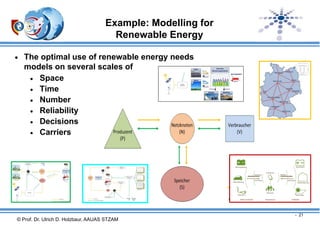
 The optimal use of renewable energy needs

models on several scales of
 Space
 Time
 Number
 Reliability
 Decisions
 Carriers

- 21

© Prof. Dr. Ulrich D. Holzbaur, AAUAS STZAM
Modelling
Atlas
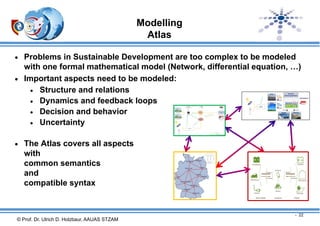
 Problems in Sustainable Development are too complex to be modeled

with one formal mathematical model (Network, differential equation, …)
 Important aspects need to be modeled:
 Structure and relations
 Dynamics and feedback loops
 Decision and behavior
 Uncertainty
 The Atlas covers all aspects

with
common semantics
and
compatible syntax

- 22

© Prof. Dr. Ulrich D. Holzbaur, AAUAS STZAM
Science Education by Teaching:
Explorhino
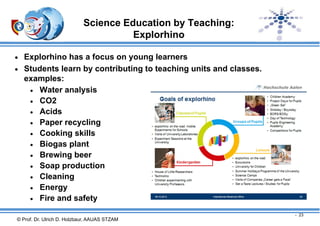
 Explorhino has a focus on young learners
 Students learn by contributing to teaching units and classes.

examples:
 Water analysis
 CO2
 Acids
 Paper recycling
 Cooking skills
 Biogas plant
 Brewing beer
 Soap production
 Cleaning
 Energy
 Fire and safety
- 23

© Prof. Dr. Ulrich D. Holzbaur, AAUAS STZAM
Work supported by a grant from Baden-Württemberg
ministry of science, research and culture within the
programme
„Welcome at Science“

ESPRESSO:
Experience Science and
Practical RElevance
and
learn Sustainably
by means of
Sustainability prOjects

- 24

© Prof. Dr. Ulrich D. Holzbaur, AAUAS STZAM

Innovative Methods for Tertiary Education for Sustainable Development ICEBE

  • 1.
    Methods for Education forSustainable Development Innovative Methods for Tertiary Education for Sustainable Development International Conference on Engineering and Business Education  Ulrich Holzbaur  Gerrit Jordaan 2  Monika Bühr 1,2 1 Aalen University of Applied Science, Aalen, Germany 2 Central University of Technology, Bloemfontein, South Africa 1 - 1 © Prof. Dr. Ulrich D. Holzbaur, AAUAS STZAM
  • 2.
    Concept  Innovative Non-traditional  Methods Education Training Tertiary University  Education for Sustainable Development ESD SD - 2 © Prof. Dr. Ulrich D. Holzbaur, AAUAS STZAM
  • 3.
    Outline Education for SustainableDevelopment (ESD) has been identified by the UN as the most important measure to reach Sustainable Development. > Implemented ESD in tertiary education Why:  orientation towards the future, shaping competences  How:  innovative methods of teaching and learning  What examples  Experiential methods: Planning Games Success in Small Business, Eco² Project Learning PPM / ESPRESSO  Mathematical Modelling Modelling for Insight not for Numbers Science Education Explorhino - 3 © Prof. Dr. Ulrich D. Holzbaur, AAUAS STZAM
  • 4.
    Sustainable Development  World Commissionon Environment and Development, 1987  Integration of  Socioeconomic Development .. to meet the needs of  Environmental protection .. to meet the the present withoutneeds of  Integration of .. to meet the present without compromising the the needs of compromising the  Intergenerational Justice chances ofthe present without future compromising the chances meet generations to of future  Intragenerational Justice chances generations of future their own needs .. to meet their generations..to meet own needs their own needs .. - 4 © Prof. Dr. Ulrich D. Holzbaur, AAUAS STZAM
  • 5.
    Methods for ESD Educationfor Sustainable Development EcoGames Planning Games Experiential Methods Projects Project Method Modelling STEM MINT Science Education - 5 © Prof. Dr. Ulrich D. Holzbaur, AAUAS STZAM
  • 6.
    Planning Games  Learningby playing   Didactics Situations  Planning Game:     Initial Conditions = Starting Position Decisions to be made Dynamics = Rule Criteria  Conceptual Basis:     Dynamics Decision Goal Didactics  Planning game is more than hard + soft - ware - 6 © Prof. Dr. Ulrich D. Holzbaur, AAUAS STZAM
  • 7.
    Example: Success in SmallBusiness - 7 © Prof. Dr. Ulrich D. Holzbaur, AAUAS STZAM
  • 8.
    Example: Success in SmallBusiness  Development of modular set of planning games  From basic economic knowledge to the business plan  Foster entrepreneurship and economic knowledge (pillar of ESD)  Create employment and safe workplaces (impact on SD)  Joint project of Aalen University and CUT + VUT South Africa - faculty of management and economics - science park, technology transfer, entreprenurship/innovation/ center - sustainable development teams, communtiy development - teacher´s education with partners from industry and business - 8 © Prof. Dr. Ulrich D. Holzbaur, AAUAS STZAM
  • 9.
    Example: Success in SmallBusiness  Students will be involved in the  Requirements Analysis and Development of game and manuals  Testing and training the trainers  Game can be adapted to tertiary and higher education (university: economics and general education, industry, administration) - 9 © Prof. Dr. Ulrich D. Holzbaur, AAUAS STZAM
  • 10.
    Project Method (PPM) Carry out projects that have  real-life training effect for the students  excellent chances of success  positive impact on community development  Treat projects like planning games - 10 © Prof. Dr. Ulrich D. Holzbaur, AAUAS STZAM
  • 11.
    Project Portfolio Ecology andRessources Quality Entreprenurship Science and Statistics Transdisciplinary Work Documentation Literature Survey Team Work Communication Setting Targets Project Mangement Project Number P1 P2 P3 P4 P5 P6 P7 PN - 11 © Prof. Dr. Ulrich D. Holzbaur, AAUAS STZAM
  • 12.
    Experiential aspects of projects Activation and Decision: Students plan and control, decide and act  Dynamics: as the projects evolves, problems arise and are solved  Didactics: the supervisor considers didactical aims and principles  Skills: Soft skills and competences are supported  Experience: the supervisor considers didactical aims and introduces activation  Model orientation: the project can be seen as a real world model of real problems  Success: the preparation and control by the supervisor ensures training success and achievement of project results  Shaping competences: Project portfolio convers subjects and competences for ESD - 12 © Prof. Dr. Ulrich D. Holzbaur, AAUAS STZAM
  • 13.
    Project Examples from AalenUniversity  Course on Engineering Managemen  Bachelor  Project management  Sustainable development  Master  Mathematical Modelling  Excellence and Sustainability  Support of projects on  Green Eel EMS  Experiential orientation in ESD  Regional marketing  Aalen for All / barrier free  Energy information  public transportation  security feeling and crime prevention - 13 © Prof. Dr. Ulrich D. Holzbaur, AAUAS STZAM
  • 14.
    Project Example Aalen forall – Barrier free - 14 © Prof. Dr. Ulrich D. Holzbaur, AAUAS STZAM
  • 15.
    Project Examples Regionalmarketing  Aalen 2006 … - 15 © Prof. Dr. Ulrich D. Holzbaur, AAUAS STZAM
  • 16.
    Project Example EMS forschools - 16 © Prof. Dr. Ulrich D. Holzbaur, AAUAS STZAM
  • 17.
    Education for Sustainable Development UNESCODecade Education for Sustainable Development Projects (2 years each)  Integrate ESD systemically via Projects (4)  Green Eel Environmental Management System (4)  Experience sustainability in the city of Aalen (3)  Sustainability@CUT (2) Contributions  Day of open University + Sustainable Event Management  “Sustainability kitchen “format + Manager´s cookbook  Guide Aalen barrier free Aalen as a City of the EDS Decade (2) - 17 © Prof. Dr. Ulrich D. Holzbaur, AAUAS STZAM
  • 18.
    ESPRESSO Experience Science and PracticalRElevance and learn Sustainably by means of Sustainability prOjects - 18 © Prof. Dr. Ulrich D. Holzbaur, AAUAS STZAM
  • 19.
    Mathematical Modelling as ESD Shaping competences are general  Sustainable development needs also the competence to assess the consequences of our activities  The basis for SD was a mathematical model and a simulation - 19 © Prof. Dr. Ulrich D. Holzbaur, AAUAS STZAM
  • 20.
    Modelling and shaping Competences Modelling is essential for perception, communication, knowledge creation and planning. Hence, modelling supports the following shaping competences:  foresighted thinking;  interdisciplinary work;  planning and implementation;  reflection on individual and cultural models.  Shaping competences and modelling:  1. ethics as a very abstract level of thinking.  2. knowledge: competency to acquire and integrate new knowledge  3. planning as a model of the future  4. action: competency to implement plans  5. reflection: competency to analyse and reflect on processes - 20 © Prof. Dr. Ulrich D. Holzbaur, AAUAS STZAM
  • 21.
    Example: Modelling for RenewableEnergy  The optimal use of renewable energy needs models on several scales of  Space  Time  Number  Reliability  Decisions  Carriers - 21 © Prof. Dr. Ulrich D. Holzbaur, AAUAS STZAM
  • 22.
    Modelling Atlas  Problems inSustainable Development are too complex to be modeled with one formal mathematical model (Network, differential equation, …)  Important aspects need to be modeled:  Structure and relations  Dynamics and feedback loops  Decision and behavior  Uncertainty  The Atlas covers all aspects with common semantics and compatible syntax - 22 © Prof. Dr. Ulrich D. Holzbaur, AAUAS STZAM
  • 23.
    Science Education byTeaching: Explorhino  Explorhino has a focus on young learners  Students learn by contributing to teaching units and classes. examples:  Water analysis  CO2  Acids  Paper recycling  Cooking skills  Biogas plant  Brewing beer  Soap production  Cleaning  Energy  Fire and safety - 23 © Prof. Dr. Ulrich D. Holzbaur, AAUAS STZAM
  • 24.
    Work supported bya grant from Baden-Württemberg ministry of science, research and culture within the programme „Welcome at Science“ ESPRESSO: Experience Science and Practical RElevance and learn Sustainably by means of Sustainability prOjects - 24 © Prof. Dr. Ulrich D. Holzbaur, AAUAS STZAM