Reading Summary Week 2, 09/08/2015
Innovation Management & Strategy (MSB510), By Prof. Kim WonJoon
Prepared by : Riri Kusumarani /20155636
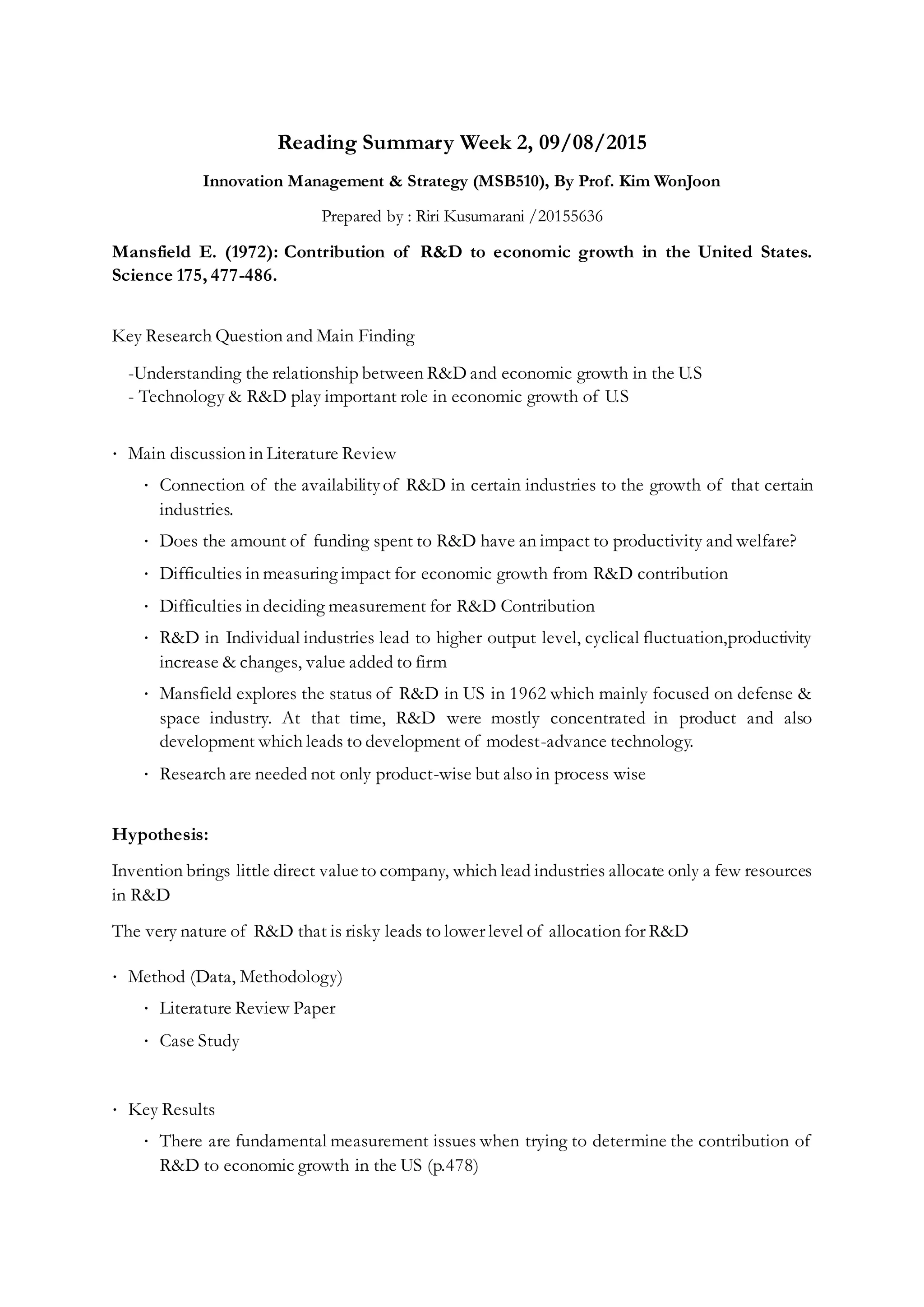
Mansfield E. (1972): Contribution of R&D to economic growth in the United States.
Science 175, 477-486.
Key Research Question and Main Finding
-Understanding the relationship between R&D and economic growth in the U.S
- Technology & R&D play important role in economic growth of U.S
∙ Main discussion in Literature Review
∙ Connection of the availabilityof R&D in certain industries to the growth of that certain
industries.
∙ Does the amount of funding spent to R&D have an impact to productivity and welfare?
∙ Difficulties in measuring impact for economic growth from R&D contribution
∙ Difficulties in deciding measurement for R&D Contribution
∙ R&D in Individual industries lead to higher output level, cyclical fluctuation,productivity
increase & changes, value added to firm
∙ Mansfield explores the status of R&D in US in 1962 which mainly focused on defense &
space industry. At that time, R&D were mostly concentrated in product and also
development which leads to development of modest-advance technology.
∙ Research are needed not only product-wise but also in process wise
Hypothesis:
Invention brings little direct valueto company, which lead industries allocate only a few resources
in R&D
The very nature of R&D that is risky leads to lower level of allocation for R&D
∙ Method (Data, Methodology)
∙ Literature Review Paper
∙ Case Study
∙ Key Results
∙ There are fundamental measurement issues when trying to determine the contribution of
R&D to economic growth in the US (p.478)
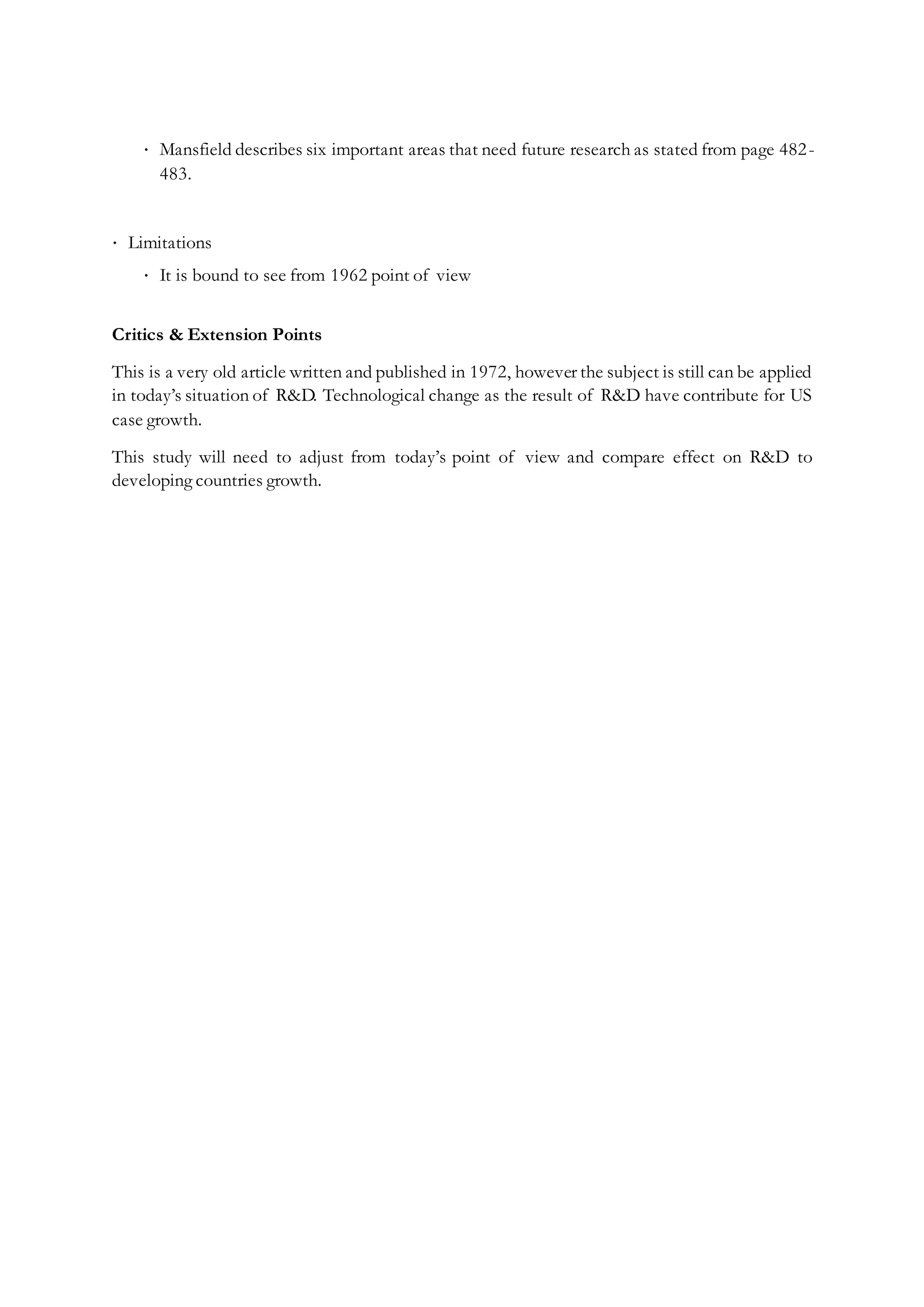
∙ Mansfield describes six important areas that need future research as stated from page 482-
483.
∙ Limitations
∙ It is bound to see from 1962 point of view
Critics & Extension Points
This is a very old article written and published in 1972, however the subject is still can be applied
in today’s situation of R&D. Technological change as the result of R&D have contribute for US
case growth.
This study will need to adjust from today’s point of view and compare effect on R&D to
developing countries growth.
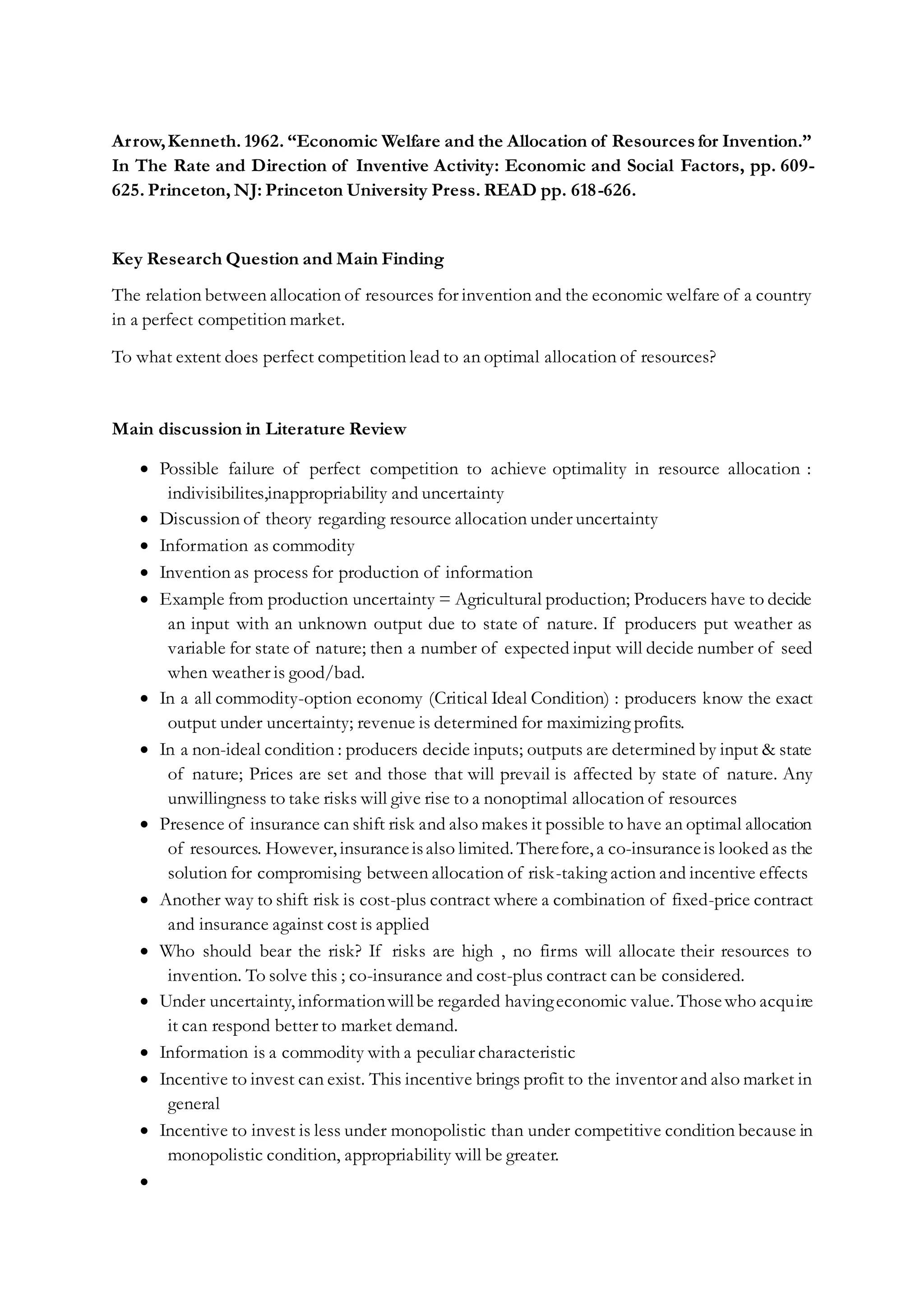
Arrow,Kenneth. 1962. “Economic Welfare and the Allocation of Resourcesfor Invention.”
In The Rate and Direction of Inventive Activity: Economic and Social Factors, pp. 609-
625. Princeton, NJ: Princeton University Press. READ pp. 618-626.
Key Research Question and Main Finding
The relation between allocation of resources for invention and the economic welfare of a country
in a perfect competition market.
To what extent does perfect competition lead to an optimal allocation of resources?
Main discussion in Literature Review
 Possible failure of perfect competition to achieve optimality in resource allocation :
indivisibilites,inappropriability and uncertainty
 Discussion of theory regarding resource allocation under uncertainty
 Information as commodity
 Invention as process for production of information
 Example from production uncertainty = Agricultural production; Producers have to decide
an input with an unknown output due to state of nature. If producers put weather as
variable for state of nature; then a number of expected input will decide number of seed
when weather is good/bad.
 In a all commodity-option economy (Critical Ideal Condition) : producers know the exact
output under uncertainty; revenue is determined for maximizing profits.
 In a non-ideal condition : producers decide inputs; outputs are determined by input & state
of nature; Prices are set and those that will prevail is affected by state of nature. Any
unwillingness to take risks will give rise to a nonoptimal allocation of resources
 Presence of insurance can shift risk and also makes it possible to have an optimal allocation
of resources. However, insuranceisalso limited. Therefore, a co-insuranceis looked as the
solution for compromising between allocation of risk-taking action and incentive effects
 Another way to shift risk is cost-plus contract where a combination of fixed-price contract
and insurance against cost is applied
 Who should bear the risk? If risks are high , no firms will allocate their resources to
invention. To solve this ; co-insurance and cost-plus contract can be considered.
 Under uncertainty, informationwillbe regarded havingeconomic value. Thosewho acquire
it can respond better to market demand.
 Information is a commodity with a peculiar characteristic
 Incentive to invest can exist. This incentive brings profit to the inventor and also market in
general
 Incentive to invest is less under monopolistic than under competitive condition because in
monopolistic condition, appropriability will be greater.

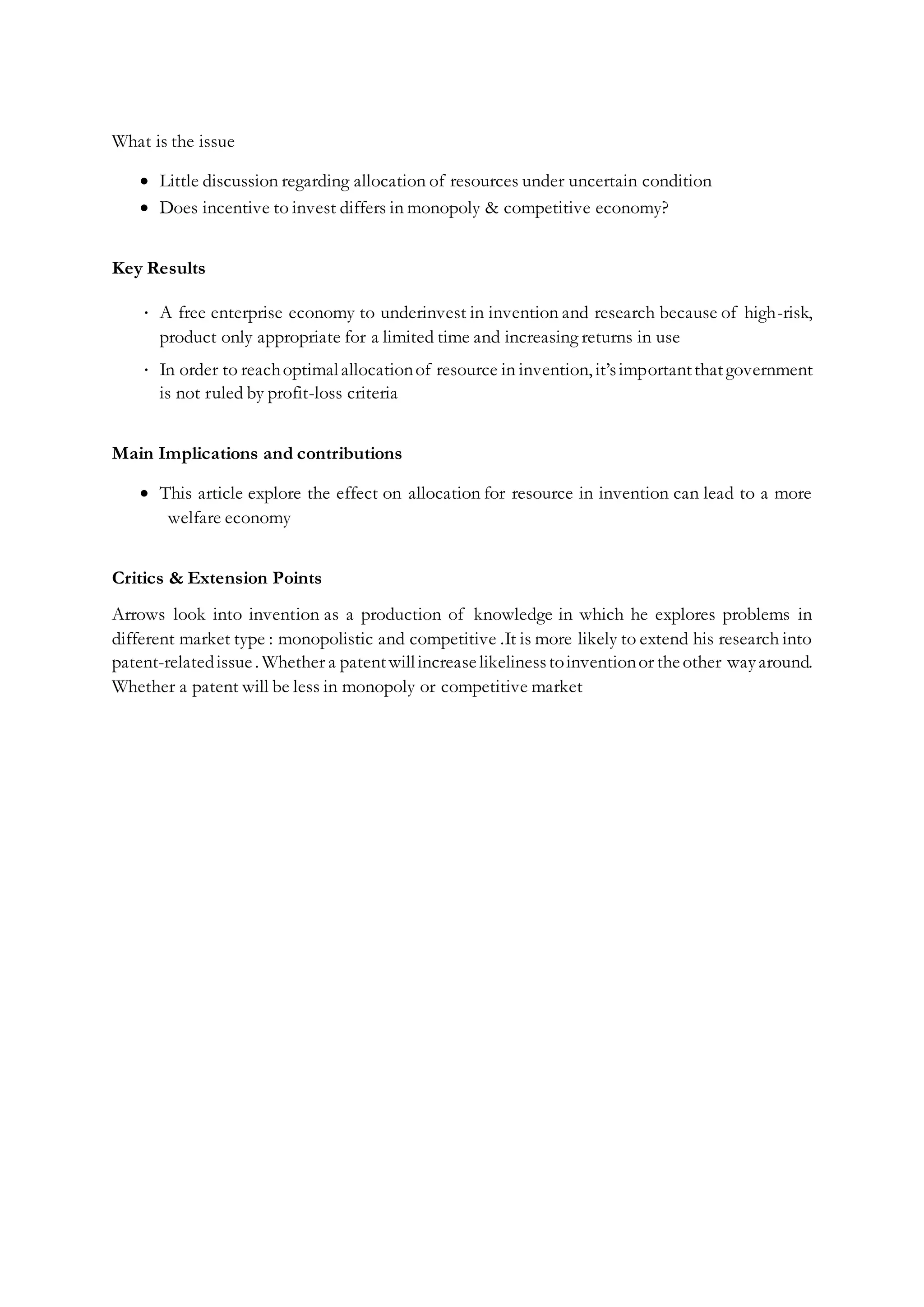
What is the issue
 Little discussion regarding allocation of resources under uncertain condition
 Does incentive to invest differs in monopoly & competitive economy?
Key Results
∙ A free enterprise economy to underinvest in invention and research because of high-risk,
product only appropriate for a limited time and increasing returns in use
∙ In order to reachoptimalallocationof resource in invention, it’simportantthatgovernment
is not ruled by profit-loss criteria
Main Implications and contributions
 This article explore the effect on allocation for resource in invention can lead to a more
welfare economy
Critics & Extension Points
Arrows look into invention as a production of knowledge in which he explores problems in
different market type : monopolistic and competitive .It is more likely to extend his research into
patent-relatedissue. Whether a patentwillincreaselikelinesstoinventionor theother wayaround.
Whether a patent will be less in monopoly or competitive market
Romer, Paul M., "Endogenous Technological Change," Journal of Political Economy,
1990, 98 (5, Part 2--Supplement): S71-S102.
Key Research Question and Main Finding
How human capital determines the rate of growth by proposing a model of growth
Main Discussion
What has been done
 Through her proposed model, she shows that Human Capital is affecting Growth of
economy
What is the issue
 Too little human capital is devoted to research
 Large population is not sufficient to generate growth
Key research questions (Hypothesis)
 Fixed cost is affecting increase in profit of the market growth
 A higher market size will lead to growth of income level, welfare and rate of growth
 Population is not the right measurement for market size
 The presence of large domestic market in high populated countries is not a substitute
for trade
∙ Method (Data, Methodology)
∙ Data
Romer explores previous models of growth and analyze why variables are not suitable
anymore.
∙ (Econometric) Model can be seen on page S92
∙ Key Results
∙ Human Capital will define a faster growth of economy
∙ Free international trade is an option to countries who want to speed up growth
∙ Developed economies in today’s era permited rates of growth of income per capita
∙ Low levels of human capital help to explain why growth is not observed in underdeveloped
economies
∙ If there’s no technological change means no growth
Main Implications and contributions
- Her Model made it possible to determine growth rate from parameters such as human
capital, labor and technological change.
- Decision to participate in trade will be important for a country that has large population
- However, population is not the most important factor, But Human capital is.
Limitations
- it does not differentiate between growth in developing and developed countries
Critics & Extension Points
- It’s interesting for me to read this article despite the calculation that Ibarely understand.
- This paper shows us that human capital is important for economic growth and by means
of human capital is knowledge, habit, personality and creativity.
- Extension point for this paper is to explore factors from different perspective such as
developing countries human capital and also policy side.

Innovation Management Course : Review on 3 Papers

  • 1.
    Reading Summary Week2, 09/08/2015 Innovation Management & Strategy (MSB510), By Prof. Kim WonJoon Prepared by : Riri Kusumarani /20155636 Mansfield E. (1972): Contribution of R&D to economic growth in the United States. Science 175, 477-486. Key Research Question and Main Finding -Understanding the relationship between R&D and economic growth in the U.S - Technology & R&D play important role in economic growth of U.S ∙ Main discussion in Literature Review ∙ Connection of the availabilityof R&D in certain industries to the growth of that certain industries. ∙ Does the amount of funding spent to R&D have an impact to productivity and welfare? ∙ Difficulties in measuring impact for economic growth from R&D contribution ∙ Difficulties in deciding measurement for R&D Contribution ∙ R&D in Individual industries lead to higher output level, cyclical fluctuation,productivity increase & changes, value added to firm ∙ Mansfield explores the status of R&D in US in 1962 which mainly focused on defense & space industry. At that time, R&D were mostly concentrated in product and also development which leads to development of modest-advance technology. ∙ Research are needed not only product-wise but also in process wise Hypothesis: Invention brings little direct valueto company, which lead industries allocate only a few resources in R&D The very nature of R&D that is risky leads to lower level of allocation for R&D ∙ Method (Data, Methodology) ∙ Literature Review Paper ∙ Case Study ∙ Key Results ∙ There are fundamental measurement issues when trying to determine the contribution of R&D to economic growth in the US (p.478)
  • 2.
    ∙ Mansfield describessix important areas that need future research as stated from page 482- 483. ∙ Limitations ∙ It is bound to see from 1962 point of view Critics & Extension Points This is a very old article written and published in 1972, however the subject is still can be applied in today’s situation of R&D. Technological change as the result of R&D have contribute for US case growth. This study will need to adjust from today’s point of view and compare effect on R&D to developing countries growth.
  • 3.
    Arrow,Kenneth. 1962. “EconomicWelfare and the Allocation of Resourcesfor Invention.” In The Rate and Direction of Inventive Activity: Economic and Social Factors, pp. 609- 625. Princeton, NJ: Princeton University Press. READ pp. 618-626. Key Research Question and Main Finding The relation between allocation of resources for invention and the economic welfare of a country in a perfect competition market. To what extent does perfect competition lead to an optimal allocation of resources? Main discussion in Literature Review  Possible failure of perfect competition to achieve optimality in resource allocation : indivisibilites,inappropriability and uncertainty  Discussion of theory regarding resource allocation under uncertainty  Information as commodity  Invention as process for production of information  Example from production uncertainty = Agricultural production; Producers have to decide an input with an unknown output due to state of nature. If producers put weather as variable for state of nature; then a number of expected input will decide number of seed when weather is good/bad.  In a all commodity-option economy (Critical Ideal Condition) : producers know the exact output under uncertainty; revenue is determined for maximizing profits.  In a non-ideal condition : producers decide inputs; outputs are determined by input & state of nature; Prices are set and those that will prevail is affected by state of nature. Any unwillingness to take risks will give rise to a nonoptimal allocation of resources  Presence of insurance can shift risk and also makes it possible to have an optimal allocation of resources. However, insuranceisalso limited. Therefore, a co-insuranceis looked as the solution for compromising between allocation of risk-taking action and incentive effects  Another way to shift risk is cost-plus contract where a combination of fixed-price contract and insurance against cost is applied  Who should bear the risk? If risks are high , no firms will allocate their resources to invention. To solve this ; co-insurance and cost-plus contract can be considered.  Under uncertainty, informationwillbe regarded havingeconomic value. Thosewho acquire it can respond better to market demand.  Information is a commodity with a peculiar characteristic  Incentive to invest can exist. This incentive brings profit to the inventor and also market in general  Incentive to invest is less under monopolistic than under competitive condition because in monopolistic condition, appropriability will be greater. 
  • 4.
    What is theissue  Little discussion regarding allocation of resources under uncertain condition  Does incentive to invest differs in monopoly & competitive economy? Key Results ∙ A free enterprise economy to underinvest in invention and research because of high-risk, product only appropriate for a limited time and increasing returns in use ∙ In order to reachoptimalallocationof resource in invention, it’simportantthatgovernment is not ruled by profit-loss criteria Main Implications and contributions  This article explore the effect on allocation for resource in invention can lead to a more welfare economy Critics & Extension Points Arrows look into invention as a production of knowledge in which he explores problems in different market type : monopolistic and competitive .It is more likely to extend his research into patent-relatedissue. Whether a patentwillincreaselikelinesstoinventionor theother wayaround. Whether a patent will be less in monopoly or competitive market
  • 5.
    Romer, Paul M.,"Endogenous Technological Change," Journal of Political Economy, 1990, 98 (5, Part 2--Supplement): S71-S102. Key Research Question and Main Finding How human capital determines the rate of growth by proposing a model of growth Main Discussion What has been done  Through her proposed model, she shows that Human Capital is affecting Growth of economy What is the issue  Too little human capital is devoted to research  Large population is not sufficient to generate growth Key research questions (Hypothesis)  Fixed cost is affecting increase in profit of the market growth  A higher market size will lead to growth of income level, welfare and rate of growth  Population is not the right measurement for market size  The presence of large domestic market in high populated countries is not a substitute for trade ∙ Method (Data, Methodology) ∙ Data Romer explores previous models of growth and analyze why variables are not suitable anymore. ∙ (Econometric) Model can be seen on page S92 ∙ Key Results ∙ Human Capital will define a faster growth of economy ∙ Free international trade is an option to countries who want to speed up growth ∙ Developed economies in today’s era permited rates of growth of income per capita ∙ Low levels of human capital help to explain why growth is not observed in underdeveloped economies
  • 6.
    ∙ If there’sno technological change means no growth Main Implications and contributions - Her Model made it possible to determine growth rate from parameters such as human capital, labor and technological change. - Decision to participate in trade will be important for a country that has large population - However, population is not the most important factor, But Human capital is. Limitations - it does not differentiate between growth in developing and developed countries Critics & Extension Points - It’s interesting for me to read this article despite the calculation that Ibarely understand. - This paper shows us that human capital is important for economic growth and by means of human capital is knowledge, habit, personality and creativity. - Extension point for this paper is to explore factors from different perspective such as developing countries human capital and also policy side.