Table of Contents
i 3140e
INTRODUCTION
WHAT IS OBD? ............................................................................................................................................. 1
YOU CAN DO IT! ......................................................................................................................................................... 2
SAFETY PRECAUTIONS
SAFETY FIRST! ............................................................................................................................................. 3
ABOUT THE SCAN TOOL
VEHICLES COVERED .................................................................................................................................. 5
BATTERY REPLACEMENT .......................................................................................................................... 6
SCAN TOOL CONTROLS
CONTROLS AND INDICATORS ................................................................................................................... 7
DISPLAY FUNCTIONS .................................................................................................................................. 9
ONBOARD DIAGNOSTICS
COMPUTER ENGINE CONTROLS ............................................................................................................... 11
DIAGNOSTIC TROUBLE CODES (DTCs) ..................................................................................................... 16
OBD2 MONITORS ......................................................................................................................................... 19
PREPARATION FOR TESTING
PRELIMINARY VEHICLE DIAGNOSTIC WORKSHEET ............................................................................... 28
BEFORE YOU BEGIN ................................................................................................................................... 31
VEHICLE SERVICE MANUALS .................................................................................................................... 32
USING THE SCAN TOOL
CODE RETRIEVAL PROCEDURE ................................................................................................................ 33
THE SYSTEM MENU...................................................................................................................................... 40
VIEWING OEM ENHANCED DTCs ............................................................................................................... 40
VIEWING ABS DTCs ..................................................................................................................................... 50
ERASING DIAGNOSTIC TROUBLE CODES (DTCs) ................................................................................... 52
I/M READINESS TESTING ............................................................................................................................ 54
ABOUT REPAIRSOLUTIONS® ..................................................................................................................... 59
CHRYSLER/JEEP OBD1 SYSTEMS
CHRYSLER/JEEP OBD1 SYSTEMS ............................................................................................................ 64
VEHICLES COVERED .................................................................................................................................. 65
INSTRUMENT PANEL INDICATOR LIGHTS ................................................................................................ 65
DATA LINK CONNECTOR (DLC) .................................................................................................................. 65
CODE RETRIEVAL PROCEDURE ................................................................................................................ 66
ERASING DTCs ............................................................................................................................................. 68
FORD OBD1 SYSTEMS
FORD COMPUTER SYSTEM OVERVIEW ................................................................................................... 70
VEHICLES COVERED .................................................................................................................................. 70
TEST CONNECTORS ................................................................................................................................... 73
CONNECTING THE SCAN TOOL ................................................................................................................. 74
DIAGNOSTIC TROUBLE CODES (DTCs) .................................................................................................... 74
CODE RETRIEVAL PROCEDURES ............................................................................................................. 75
ADDITIONAL TESTS FOR EEC-IV SYSTEMS ............................................................................................. 85
ERASING DTCs ............................................................................................................................................. 93
GM OBD1 SYSTEMS
YOUR VEHICLE'S COMPUTER SYSTEM .................................................................................................... 95
VEHICLES COVERED .................................................................................................................................. 95
ABOUT THE SCAN TOOL ............................................................................................................................. 96
DATA LINK CONNECTOR (DLC) .................................................................................................................. 96
MALFUNCTION INDICATOR LIGHT (MIL) ................................................................................................... 96
DIAGNOSTIC TROUBLE CODES (DTC's) ................................................................................................... 96
CODE RETRIEVAL PROCEDURE ................................................................................................................ 97
ERASING DTCs ............................................................................................................................................. 99
HONDA OBD1 SYSTEMS
YOUR VEHICLE'S COMPUTER SYSTEM .................................................................................................... 101
VEHICLES COVERED .................................................................................................................................. 101
ABOUT THE SCAN TOOL ............................................................................................................................. 101
DATA LINK CONNECTOR (DLC) .................................................................................................................. 101
MALFUNCTION INDICATOR LIGHT (MIL) ................................................................................................... 101
DIAGNOSTIC TROUBLE CODES (DTC's) ................................................................................................... 102
CODE RETRIEVAL PROCEDURE ................................................................................................................ 102
ERASING DTCs ............................................................................................................................................. 104
TOYOTA/LEXUS OBD1 SYSTEMS
ON-BOARD VEHICLE DIAGNOSTICS (OBD1) ............................................................................................ 106
VEHICLES COVERED .................................................................................................................................. 106
DATA LINK CONNECTOR (DLC) .................................................................................................................. 109
INSTRUMENT PANEL MALFUNCTION INDICATOR LIGHTS (MIL) ........................................................... 109
DIAGNOSTIC TROUBLE CODES ................................................................................................................. 110
CODE RETRIEVAL PROCEDURE ................................................................................................................ 110
ERASING DTCs ............................................................................................................................................. 112
LIVE DATA MODE
VIEWING LIVE DATA .................................................................................................................................... 114
CUSTOMIZING LIVE DATA (PIDs) ............................................................................................................... 115
RECORDING (CAPTURING) LIVE DATA ..................................................................................................... 117
LIVE DATA PLAYBACK ................................................................................................................................. 121
ADDITIONAL TESTS
SYSTEM TEST MENU ................................................................................................................................... 123
VIEWING VEHICLE INFORMATION ............................................................................................................. 127
RESETTING THE OIL MAINTENANCE LIGHT ............................................................................................ 130
USING THE DLC LOCATOR ......................................................................................................................... 131
BATTERY/ALTERNATOR MONITOR ........................................................................................................... 132
VIEWING THE FIRMWARE VERSION .......................................................................................................... 134
THE TOOL LIBRARY ..................................................................................................................................... 134
ADJUSTMENTS AND SETTINGS ................................................................................................................. 138
USING SCAN TOOL MEMORY
VIEWING DATA IN MEMORY ....................................................................................................................... 142
GENERIC (GLOBAL) OBD2 PID LIST ........................................................................................................................ 144
VEHICLE APPLICATIONS - ABS
VEHICLE APPLICATIONS – MAKES COVERED.......................................................................................... 149
VEHICLE APPLICATIONS - OIL RESET
VEHICLE APPLICATIONS – MAKES COVERED ......................................................................................... 150
GLOSSARY
GLOSSARY OF TERMS AND ABBREVIATIONS.......................................................................................... 151
WARRANTY AND SERVICING
LIMITED ONE YEAR WARRANTY ................................................................................................................ 153
SERVICE PROCEDURES ............................................................................................................................. 153
Introduction
WHAT IS OBD?
3140e 1
WHAT IS OBD?
The Scan Tool is designed to work on all OBD2 compliant vehicles.
All 1996 and newer vehicles (cars, light trucks and SUVs) sold in
the United States are OBD2 compliant.
One of the most exciting improvements in the
automobile industry was the addition of on-
board diagnostics (OBD) on vehicles, or in more
basic terms, the computer that activates the
vehicle’s “CHECK ENGINE” light. OBD1 was
designed to monitor manufacturer-specific
systems on vehicles built from 1981 to 1995.
Then came the development of OBD2, which is
on all 1996 cars and light trucks sold in the U.S. Like its predecessor,
OBD2 was adopted as part of a government mandate to lower vehicle
emissions. But what makes OBD2 unique is its universal application for
all late model cars and trucks - domestic and import. This sophisticated
program in the vehicle’s main computer system is designed to detect
failures in a range of systems, and can be accessed through a universal
OBD2 port, which is usually found under the dashboard. For all OBD
systems, if a problem is found, the computer turns on the “CHECK
ENGINE” light to warn the driver, and sets a Diagnostic Trouble Code
(DTC) to identify where the problem occurred. A special scan tool, such
as the Scan Tool, is required to retrieve these codes, which consumers
and professionals use as a starting point for repairs.
The Scan Tool provides the additional ability to retrieve enhanced DTCs
from most Chrysler/Jeep, Ford/Mazda, GM/Izusu, Honda/Acura and
Toyota/Lexus vehicles, as well as Anti-Lock Brake System (ABS) DTCs
and vehicle information. The types of enhanced data available depends
on the vehicle make.
The Scan Tool is also compatible with most Chrysler, Ford, GM, Honda
and Toyota vehicles equipped with OBD1 systems.
You Can Do It!
EASY TO USE - EASY TO VIEW - EASY TO DEFINE
2 3140e
Easy To Use . . . .
Connect the Scan Tool to the vehicle’s
test connector.
Turn the ignition key "On.”
The tool will automatically link to the
vehicle’s computer.
Easy To View . . . .
The Scan Tool retrieves stored codes,
Freeze Frame data and I/M Readiness
Status.
Codes, I/M Readiness Status and
Freeze Frame data are displayed on the
Scan Tool’s display screen. System
Status is indicated by LED indicators.
Easy To Define . . . .
Read code definitions from the Scan
Tool’s display.
View Freeze Frame data.
View Live Data.
View ABS DTCs.
Safety Precautions
SAFETY FIRST!
3140e 3
SAFETY FIRST!
This manual describes common test procedures used
by experienced service technicians. Many test procedures
require precautions to avoid accidents that can result in
personal injury, and/or damage to your vehicle or test
equipment. Always read your vehicle's service manual and
follow its safety precautions before and during any test or
service procedure. ALWAYS observe the following general
safety precautions:
When an engine is running, it produces carbon monoxide,
a toxic and poisonous gas. To prevent serious injury or
death from carbon monoxide poisoning, operate the
vehicle ONLY in a well-ventilated area.
To protect your eyes from propelled objects as well as hot
or caustic liquids, always wear approved safety eye
protection.
When an engine is running, many parts (such as the
coolant fan, pulleys, fan belt etc.) turn at high speed. To
avoid serious injury, always be aware of moving parts.
Keep a safe distance from these parts as well as other
potentially moving objects.
Engine parts become very hot when the engine is running.
To prevent severe burns, avoid contact with hot engine
parts.
Before starting an engine for testing or troubleshooting,
make sure the parking brake is engaged. Put the
transmission in park (for automatic transmission) or
neutral (for manual transmission). Block the drive wheels
with suitable blocks.
Connecting or disconnecting test equipment when the
ignition is ON can damage test equipment and the
vehicle's electronic components. Turn the ignition OFF
before connecting the Scan Tool to or disconnecting the
Scan Tool from the vehicle’s Data Link Connector (DLC).
To avoid personal injury, instrument damage and/or
damage to your vehicle; do not use the Scan Tool before
reading this manual.
N LDRP
Safety Precautions
SAFETY FIRST!
4 3140e
To prevent damage to the on-board computer when taking
vehicle electrical measurements, always use a digital
multimeter with at least 10 megOhms of impedance.
Fuel and battery vapors are highly flammable. To prevent
an explosion, keep all sparks, heated items and open
flames away from the battery and fuel / fuel vapors. DO
NOT SMOKE NEAR THE VEHICLE DURING TESTING.
Don't wear loose clothing or jewelry when working on an
engine. Loose clothing can become caught in the fan,
pulleys, belts, etc. Jewelry is highly conductive, and can
cause a severe burn if it makes contact between a power
source and ground.
About the Scan Tool
VEHICLES COVERED
3140e 5
VEHICLE EMISSION CONTROL INFORMATION
VEHICLE
MANUFACTURER
OBD II
CERTIFIED
ENGINE FAMILY EFN2.6YBT2BA
DISPLACEMENT 2.6L
THIS VEHICLE CONFORMS TO U.S. EPA AND STATE
OF CALIFORNIA REGULATIONS APPLICABLE TO
1999 MODEL YEAR NEW TLEV PASSENGER CARS.
REFER TO SERVICE MANUAL FOR ADDITIONAL INFORMATION
TUNE-UP CONDITIONS: NORMAL OPERATING ENGINE TEMPERATURE,
ACCESSORIES OFF, COOLING FAN OFF, TRANSMISSION IN NEUTRAL
SPARK PLUG
TYPE NGK BPRE-11
GAP: 1.1MM
CATALYST
EXHAUST EMISSIONS STANDARDS STANDARD CATEGORY
CERTIFICATION
IN-USE
TLEV
TLEV INTERMEDIATE
OBD II
CERTIFIED
VEHICLES COVERED
The Scan Tool is designed to work on all OBD2 compliant vehicles. All
1996 and newer vehicles (cars and light trucks) sold in the United States
are OBD2 compliant.
Federal law requires that all 1996 and newer cars and light
trucks sold in the United States must be OBD2 compliant; this
includes all Domestic, Asian and European vehicles.
Some 1994 and 1995 vehicles are OBD2 compliant. To find out if a
1994 or 1995 vehicle is OBD2 compliant, check the following:
1. The Vehicle Emissions Control Information (VECI) Label. This
label is located under the hood or by the radiator of most vehicles. If
the vehicle is OBD2 compliant, the label will state “OBD II
Certified.”
2. Government Regulations require that all
OBD2 compliant vehicles must have a
“common” sixteen-pin Data Link
Connector (DLC).
Some 1994 and 1995 vehicles have 16-pin connectors but are
not OBD2 compliant. Only those vehicles with a Vehicle
Emissions Control Label stating “OBD II Certified” are OBD2
compliant.
Data Link Connector (DLC) Location
The 16-pin DLC is usually
located under the instrument
panel (dash), within 12 inches
(300 mm) of center of the panel,
on the driver’s side of most
vehicles. It should be easily
accessible and visible from a
kneeling position outside the
vehicle with the door open.
1 2 3 4 5 6 7 8
9 10111213141516
NEAR
CENTER
OF DASH
BEHIND
ASHTRAY
LEFT CORNER
OF DASH
About the Scan Tool
BATTERY REPLACEMENT
6 3140e
On some Asian and European vehicles the DLC is located
behind the “ashtray” (the ashtray must be removed to
access it) or on the far left corner of the dash. If the DLC
cannot be located, consult the vehicle’s service manual for
the location.
BATTERY REPLACEMENT
Replace batteries when the battery symbol is visible on display
and/or the 3 LEDS are all lit and no other data is visible on screen.
1. Locate the battery cover on the back of the Scan Tool.
2. Slide the battery cover off (use your fingers).
3. Replace batteries with three AA-size batteries (for longer life, use
Alkaline-type batteries).
4. Reinstall the battery cover on the back of the Scan Tool.
Adjustments After Battery Installation
The first time the Scan Tool is turned on, you must select the desired
display language (English, French or Spanish) and unit of measurement
(Standard or metric) as follows:
1. Press the POWER/LINK button
to turn the Scan Tool “ON.”
The Select Language screen dis-
plays.
2. Use the UP and DOWN buttons,
as necessary, to highlight the desired
display language.
3. When the desired display language is
selected, press the ENTER button to
confirm your selection.
The Select Unit screen displays.
4. Use the UP and DOWN buttons,
as necessary, to highlight the desired
unit of measurement.
5. When the desired unit of measurement
is selected, press the ENTER button
to confirm your selection.
The Scan Tool’s Firmware Version
screen displays.
After the initial language and unit of measurement selections
are performed, these, as well as other settings, can be
changed as desired. Proceed to “ADJUSTMENTS AND
SETTINGS” on page 138 for further instructions.
Scan Tool Controls
CONTROLS AND INDICATORS
3140e 7
CONTROLS AND INDICATORS
Figure 1. Controls and Indicators
See Figure 1 for the locations of items 1 through 20, below.
1. ERASE button - Erases Diagnostic Trouble Codes (DTCs),
and “Freeze Frame” data from your vehicle’s computer, and resets
Monitor status.
2. SYSTEM MENU button – When pressed, displays the System
Test Menu.
3. DTC/FF button - Displays the DTC View screen and/or scrolls the
LCD display to view DTCs and Freeze Frame data.
4. POWER/LINK button - When the Scan Tool IS NOT
connected to a vehicle, turns the Scan Tool “On” and “Off”. When
the Scan Tool is connected to a vehicle, links the Scan Tool to the
vehicle’s PCM to retrieve diagnostic data from the computer’s
memory.
5. M button – When pressed, displays the Main Menu.
To turn the Scan Tool "On", you must press and hold the
POWER/LINK button for approximately 3 seconds.
6. LD button – When pressed while linked to a vehicle, places the
Scan Tool in Live Data mode.
20
19
14
1
3
2
4
12
6
5
7
10 11
13
8 9
15 1816 17
Scan Tool Controls
CONTROLS AND INDICATORS
8 3140e
7. UP button – When in MENU mode, scrolls UP through the menu
and submenu selection options. When LINKED to a vehicle, scrolls
UP through the current display screen to display any additional data.
8. ENTER button - When in MENU mode, confirms the selected
option or value.
9. DOWN button - When in MENU mode, scrolls DOWN through
the menu and submenu selection options. When LINKED to a
vehicle, scrolls DOWN through the current display screen to display
any additional data.
10. GREEN LED - Indicates that all engine systems are running
normally (all Monitors on the vehicle are active and performing their
diagnostic testing, and no DTCs are present).
11. YELLOW LED - Indicates there is a possible problem. A “Pending”
DTC is present and/or some of the vehicle’s emission monitors have
not run their diagnostic testing.
12. RED LED - Indicates there is a problem in one or more of the
vehicle’s systems. The red LED is also used to show that DTC(s)
are present. DTCs are shown on the Scan Tool’s display. In this
case, the Malfunction Indicator (“Check Engine”) lamp on the
vehicle’s instrument panel will light steady on.
13. Display - Color LCD display shows menu and submenus, test
results, Scan Tool functions and Monitor status information. See
DISPLAY FUNCTIONS, following, for more details.
14. CABLE - Connects the Scan Tool to the vehicle’s Data Link
Connector (DLC).
15. CHRYSLER Connector Cable Adaptor - Installs on cable (item 14)
when connecting to a Chrysler OBD1 Data Link Connector.
16. FORD Connector Cable Adaptor - Installs on cable (item 14) when
connecting to a Ford OBD1 Data Link Connector.
17. GM Connector Cable Adaptor - Installs on cable (item 14) when
connecting to a GM OBD1 Data Link Connector.
18. HONDA Connector Cable Adaptor - Installs on cable (item 14)
when connecting to a Honda OBD1 Data Link Connector.
19. OBD II Cable - Connects the scan tool to the vehicle's Data Link
Connector (DLC) when retrieving codes from OBD II systems.
20. TOYOTA Connector Cable Adaptor - Installs on cable (item 14)
when connecting to a Toyota OBD1 Data Link Connector.
Scan Tool Controls
DISPLAY FUNCTIONS
3140e 9
DISPLAY FUNCTIONS
Figure 2. Display Functions
See Figure 2 for the locations of items 1 through 13, following.
1. I/M MONITOR STATUS field - Identifies the I/M Monitor status area.
2. Monitor icons - Indicate which Monitors are supported by the
vehicle under test, and whether or not the associated Monitor has
run its diagnostic testing (Monitor status). When a Monitor icon is
solid, it indicates that the associated Monitor has completed its
diagnostic testing. When a Monitor icon is flashing, it indicates that
the vehicle supports the associated Monitor, but the Monitor has not
yet run its diagnostic testing.
3. Vehicle icon - Indicates whether or not the Scan Tool is being
properly powered through the vehicle’s Data Link Connector (DLC).
A visible icon indicates that the Scan Tool is being powered through
the vehicle’s DLC connector.
4. Link icon - Indicates whether or not the Scan Tool is
communicating (linked) with the vehicle’s on-board computer. When
visible, the Scan Tool is communicating with the computer. If the
Link icon is not visible, the Scan Tool is not communicating with the
computer.
5. Computer icon - When this icon is visible it indicates that the
Scan Tool is linked to a personal computer. Optional software is
available that makes it possible to upload retrieved data to a
personal computer.
6. Scan Tool Internal Battery icon - When visible, indicates the
Scan Tool batteries are “low” and should be replaced. If the
batteries are not replaced when the battery symbol is "on", all 3
LEDs will light up as a last resort indicator to warn you that the
batteries need replacement. No data will be displayed on screen
when all 3 LEDs are lit.
4
3
2
5
8
6
7
1
11
12
13
9
10
Scan Tool Controls
DISPLAY FUNCTIONS
10 3140e
7. DTC Display Area - Displays the Diagnostic Trouble Code (DTC)
number. Each fault is assigned a code number that is specific to that
fault. The DTC number is color-coded as follows:
RED – Indicates the currently displayed DTC is a PERMANENT
DTC.
YELLOW – Indicates the currently displayed DTC is a
PENDING DTC.
GREEN – In cases where no codes are retrieved, a “No DTCs
are presently stored in the vehicle’s computer” message is
shown in green.
8. Code Number Sequence - The Scan Tool assigns a sequence
number to each DTC that is present in the computer’s memory,
starting with “01.” This number indicates which code is currently
displayed. Code number “01” is always the highest priority code,
and the one for which “Freeze Frame” data has been stored.
If “01” is a “Pending” code, there may or may not be “Freeze
Frame” data stored in memory.
9. Code Enumerator - Indicates the total number of codes retrieved
from the vehicle’s computer.
10. Test Data Display Area - Displays DTC definitions, Freeze Frame
data and other pertinent test information messages.
11. SYSTEM icon - Indicates the system with which the code is
associated:
MIL icon ABS icon
12. FREEZE FRAME icon - Indicates that there is Freeze Frame data
from “Priority Code” (Code #1) stored in the vehicle’s computer
memory.
13. Code type - Indicates the type of code being displayed; Generic
Stored, Generic Pending, Generic permanent, etc.
Onboard Diagnostics
COMPUTER ENGINE CONTROLS
3140e 11
COMPUTER ENGINE CONTROLS
The Introduction of Electronic Engine Controls
As a result of increased air pollution (smog) in large cities,
such as Los Angeles, the California Air Resources Board
(CARB) and the Environmental Protection Agency (EPA)
set new regulations and air pollution standards to deal with
the problem. To further complicate matters, the energy crisis of
the early 1970s caused a sharp increase in fuel prices over a
short period. As a result, vehicle manufacturers were not only
required to comply with the new emissions standards, they also
had to make their vehicles more fuel-efficient. Most vehicles
were required to meet a miles-per-gallon (MPG) standard set by the U.S.
Federal Government.
Precise fuel delivery and spark timing are needed to reduce vehicle
emissions. Mechanical engine controls in use at the time (such as
ignition points, mechanical spark advance and the carburetor)
responded too slowly to driving conditions to properly control fuel
delivery and spark timing. This made it difficult for vehicle manufacturers
to meet the new standards.
A new Engine Control System had to be designed and integrated with
the engine controls to meet the stricter standards. The new system had
to:
Respond instantly to supply the proper mixture of air and fuel for any
driving condition (idle, cruising, low-speed driving, high-speed
driving, etc.).
Calculate instantly the best time to “ignite” the air/fuel mixture for
maximum engine efficiency.
Perform both these tasks without affecting vehicle performance or
fuel economy.
Vehicle Computer Control Systems can perform millions of calculations
each second. This makes them an ideal substitute for the slower
mechanical engine controls. By switching from mechanical to electronic
engine controls, vehicle manufacturers are able to control fuel delivery
and spark timing more precisely. Some newer Computer Control
Systems also provide control over other vehicle functions, such as
transmission, brakes, charging, body, and suspension systems.
Electronic Computer Control Systems make it possible
for vehicle manufacturers to comply with the tougher
emissions and fuel efficiency standards mandated by
State and Federal Governments.
Onboard Diagnostics
COMPUTER ENGINE CONTROLS
12 3140e
The Basic Engine Computer Control System
The on-board computer is the heart of the Computer
Control System. The computer contains several programs
with preset reference values for air/fuel ratio, spark or
ignition timing, injector pulse width, engine speed, etc.
Separate values are provided for various driving conditions,
such as idle, low speed driving, high-speed driving, low load,
or high load. The preset reference values represent the ideal
air/fuel mixture, spark timing, transmission gear selection,
etc., for any driving condition. These values are programmed
by the vehicle manufacturer, and are specific to each vehicle model.
Most on-board computers are located inside the vehicle behind the dashboard,
under the passenger’s or driver’s seat, or behind the right kick panel. However,
some manufacturers may still position it in the engine compartment.
Vehicle sensors, switches, and actuators are located throughout the
engine, and are connected by electrical wiring to the on-board computer.
These devices include oxygen sensors, coolant temperature sensors,
throttle position sensors, fuel injectors, etc. Sensors and switches are
input devices. They provide signals representing current engine
operating conditions to the computer. Actuators are output devices. They
perform actions in response to commands received from the computer.
The on-board computer receives information inputs from sensors and
switches located throughout the engine. These devices monitor critical
engine conditions such as coolant temperature, engine speed, engine
load, throttle position, air/fuel ratio etc.
The computer compares the values received from these sensors with its
preset reference values, and makes corrective actions as needed so
that the sensor values always match the preset reference values for the
current driving condition. The computer makes adjustments by
commanding other devices such as the fuel injectors, idle air control,
EGR valve or Ignition Module to perform these actions.
The Computer Control System consists of an on-board
computer and several related control devices (sensors,
switches, and actuators).
OUTPUT DEVICES
Fuel Injectors
Idle Air Control
EGR Valve
Ignition Module
On-Board
Computer
INPUT DEVICES
Coolant Temperature Sensor
Throttle Position Sensor
Fuel Injectors
INPUT DEVICES
Oxygen Sensors
TYPICAL COMPUTER
CONTROL SYSTEM
Onboard Diagnostics
COMPUTER ENGINE CONTROLS
3140e 13
Vehicle operating conditions are constantly changing. The computer
continuously makes adjustments or corrections (especially to the air/fuel
mixture and spark timing) to keep all the engine systems operating
within the preset reference values.
On-Board Diagnostics - First Generation (OBD1)
Beginning in 1988, California’s Air Resources Board
(CARB), and later the Environmental Protection Agency (EPA)
required vehicle manufacturers to include a self-diagnostic
program in their on-board computers. The program would be
capable of identifying emissions-related faults in a system. The
first generation of Onboard Diagnostics came to be known as
OBD1.
OBD1 is a set of self-testing and diagnostic instructions
programmed into the vehicle’s on-board computer. The
programs are specifically designed to detect failures in the sensors,
actuators, switches and wiring of the various vehicle emissions-related
systems. If the computer detects a failure in any of these components or
systems, it lights an indicator on the dashboard to alert the driver. The
indicator lights only when an emissions-related problem is detected.
The computer also assigns a numeric code for each specific problem
that it detects, and stores these codes in its memory for later retrieval.
These codes can be retrieved from the computer’s memory with the use
of a “Code Reader” or a “Scan Tool.”
On-Board Diagnostics - Second Generation (OBD2)
In addition to performing all the
functions of the OBD1 System, the
OBD2 System has been enhanced with
new Diagnostic Programs. These
programs closely monitor the functions
of various emissions-related compo-
nents and systems (as well as other
systems) and make this information readily available (with
the proper equipment) to the technician for evaluation.
The California Air Resources Board (CARB) conducted
studies on OBD1 equipped vehicles. The information that was
gathered from these studies showed the following:
A large number of vehicles had deteriorating or degraded
emissions-related components. These components were
causing an increase in emissions.
With the exception of some 1994 and 1995 vehicles,
most vehicles from 1982 to 1995 are equipped with
some type of first generation On-Board Diagnostics.
The OBD2 System is
an enhancement of the
OBD1 System.
Onboard Diagnostics
COMPUTER ENGINE CONTROLS
14 3140e
Because OBD1 systems only detect failed components, the
degraded components were not setting codes.
Some emissions problems related to degraded components only
occur when the vehicle is being driven under a load. The emission
checks being conducted at the time were not performed under
simulated driving conditions. As a result, a significant number of
vehicles with degraded components were passing Emissions Tests.
Codes, code definitions, diagnostic connectors, communication
protocols and emissions terminology were different for each
manufacturer. This caused confusion for the technicians working on
different make and model vehicles.
To address the problems made evident by this study, CARB and the
EPA passed new laws and standardization requirements. These laws
required that vehicle manufacturers to equip their new vehicles with
devices capable of meeting all of the new emissions standards and
regulations. It was also decided that an enhanced on-board diagnostic
system, capable of addressing all of these problems, was needed. This
new system is known as “On-Board Diagnostics Generation Two
(OBD2).” The primary objective of the OBD2 system is to comply with
the latest regulations and emissions standards established by CARB
and the EPA.
The Main Objectives of the OBD2 System are:
To detect degraded and/or failed emissions-related components or
systems that could cause tailpipe emissions to exceed by 1.5 times
the Federal Test Procedure (FTP) standard.
To expand emissions-related system monitoring. This includes a set
of computer run diagnostics called Monitors. Monitors perform
diagnostics and testing to verify that all emissions-related
components and/or systems are operating correctly and within the
manufacturer’s specifications.
To use a standardized Diagnostic Link Connector (DLC) in all
vehicles. (Before OBD2, DLCs were of different shapes and sizes.)
To standardize the code numbers, code definitions and language
used to describe faults. (Before OBD2, each vehicle manufacturer
used their own code numbers, code definitions and language to
describe the same faults.)
To expand the operation of the Malfunction Indicator Lamp (MIL).
To standardize communication procedures and protocols between
the diagnostic equipment (Scan Tools, Code Readers, etc.) and the
vehicle’s on-board computer.
OBD2 Terminology
The following terms and their definitions are related to OBD2 systems.
Read and reference this list as needed to aid in the understanding of
OBD2 systems.
Onboard Diagnostics
COMPUTER ENGINE CONTROLS
3140e 15
Powertrain Control Module (PCM) - The PCM is the OBD2
accepted term for the vehicle’s “on-board computer.” In addition
to controlling the engine management and emissions systems,
the PCM also participates in controlling the powertrain
(transmission) operation. Most PCMs also have the ability to
communicate with other computers on the vehicle (ABS, ride
control, body, etc.).
Monitor - Monitors are “diagnostic routines” programmed into the
PCM. The PCM utilizes these programs to run diagnostic tests, and
to monitor operation of the vehicle’s emissions-related components
or systems to ensure they are operating correctly and within the
vehicle’s manufacturer specifications. Currently, up to fifteen
Monitors are used in OBD2 systems. Additional Monitors will be
added as the OBD2 system is further developed.
Not all vehicles support all fifteen Monitors.
Enabling Criteria - Each Monitor is designed to test and monitor
the operation of a specific part of the vehicle’s emissions system
(EGR system, oxygen sensor, catalytic converter, etc.). A specific
set of “conditions” or “driving procedures” must be met before the
computer can command a Monitor to run tests on its related system.
These “conditions” are known as “Enabling Criteria.” The
requirements and procedures vary for each Monitor. Some Monitors
only require the ignition key to be turned “On” for them to run and
complete their diagnostic testing. Others may require a set of
complex procedures, such as, starting the vehicle when cold,
bringing it to operating temperature, and driving the vehicle under
specific conditions before the Monitor can run and complete its
diagnostic testing.
Monitor Has/Has Not Run - The terms “Monitor has run” or
“Monitor has not run” are used throughout this manual. “Monitor
has run,” means the PCM has commanded a particular Monitor to
perform the required diagnostic testing on a system to ensure the
system is operating correctly (within factory specifications). The term
“Monitor has not run” means the PCM has not yet commanded a
particular Monitor to perform diagnostic testing on its associated part
of the emissions system.
Trip - A Trip for a particular Monitor requires that the vehicle is
being driven in such a way that all the required “Enabling Criteria”
for the Monitor to run and complete its diagnostic testing are met.
The “Trip Drive Cycle” for a particular Monitor begins when the
ignition key is turned “On.” It is successfully completed when all the
“Enabling Criteria” for the Monitor to run and complete its diagnostic
testing are met by the time the ignition key is turned “Off.” Since
each of the fifteen monitors is designed to run diagnostics and
testing on a different part of the engine or emissions system, the
“Trip Drive Cycle” needed for each individual Monitor to run and
complete varies.
Onboard Diagnostics
DIAGNOSTIC TROUBLE CODES (DTCs)
16 3140e
OBD2 Drive Cycle - An OBD2 Drive Cycle is an extended set of
driving procedures that takes into consideration the various types of
driving conditions encountered in real life. These conditions may
include starting the vehicle when it is cold, driving the vehicle at a
steady speed (cruising), accelerating, etc. An OBD2 Drive Cycle
begins when the ignition key is turned “On” (when cold) and ends
when the vehicle has been driven in such a way as to have all the
“Enabling Criteria” met for all its applicable Monitors. Only those
trips that provide the Enabling Criteria for all Monitors applicable to
the vehicle to run and complete their individual diagnostic tests
qualify as an OBD2 Drive Cycle. OBD2 Drive Cycle requirements
vary from one model of vehicle to another. Vehicle manufacturers
set these procedures. Consult your vehicle’s service manual for
OBD2 Drive Cycle procedures.
Do not confuse a “Trip” Drive Cycle with an OBD2 Drive Cycle. A
“Trip” Drive Cycle provides the “Enabling Criteria” for one specific
Monitor to run and complete its diagnostic testing. An OBD2 Drive
Cycle must meet the “Enabling Criteria” for all Monitors on a
particular vehicle to run and complete their diagnostic testing.
Warm-up Cycle - Vehicle operation after an engine off period where
engine temperature rises at least 40°F (22°C) from its temperature
before starting, and reaches at least 160°F (70°C). The PCM uses
warm-up cycles as a counter to automatically erase a specific code
and related data from its memory. When no faults related to the
original problem are detected within a specified number of warm-up
cycles, the code is erased automatically.
DIAGNOSTIC TROUBLE CODES (DTCs)
Diagnostic Trouble Codes (DTCs) are
meant to guide you to the proper
service procedure in the vehicle’s
service manual. DO NOT replace parts
based only on DTCs without first
consulting the vehicle’s service manual
for proper testing procedures for that
particular system, circuit or component.
DTCs are alphanumeric codes that are used to identify a
problem that is present in any of the systems that are
monitored by the on-board computer (PCM). Each trouble
code has an assigned message that identifies the circuit,
component or system area where the problem was found.
OBD2 diagnostic trouble codes are made up of five characters:
The 1st character is a letter (B, C, P or U). It identifies the
“main system” where the fault occurred (Body, Chassis, Powertrain,
or Network).
The 2nd character is a numeric digit (0 thru 3). It identifies the
“type” of code (Generic or Manufacturer-Specific).
Generic DTCs are codes that are used by all vehicle manu-
facturers. The standards for generic DTCs, as well as their
definitions, are set by the Society of Automotive Engineers (SAE).
Diagnostic Trouble
Codes (DTCs) are
codes that identify a
specific problem area.
Onboard Diagnostics
DIAGNOSTIC TROUBLE CODES (DTCs)
3140e 17
Manufacturer-Specific DTCs are codes that are controlled by
the vehicle manufacturers. The Federal Government does not
require vehicle manufacturers to go beyond the standardized
generic DTCs in order to comply with the new OBD2 emissions
standards. However, manufacturers are free to expand beyond
the standardized codes to make their systems easier to
diagnose.
The 3rd character is a letter or a numeric digit (0 thru 9, A thru F).
It identifies the specific system or sub-system where the problem is
located.
The 4th and 5th characters are letters or numeric digits (0 thru 9, A
thru F). They identify the section of the system that is malfunctioning.
P 0 2 0 1B
C
P
U
-
-
-
-
Body
Chassis
Powertrain
Network
-
-
-
-
Generic
Manufacturer Specific
Generic ("P" Codes) and Manufacturer
Specific ("B", "C" and "U" Codes)
Includes both Generic and Manufacturer
Specific Codes
0
1
2
3
Identifies what section of the system
is malfunctioning
Identifies the system where the problem is
located. "P" Code systems are listed below.
"B", "C" and "U" Code systems will vary.
0
2
3
4
5
6
7
C
-
-
-
-
-
-
-
-
Fuel and Air Metering; Auxiliary Emission
1 - Fuel and Air Metering
Controls
Fuel and Air Metering (injector circuit
malfunction only)
Ignition System or Misfire
Auxiliary Emission Control System
Vehicle Speed Control and Idle Control
System
Computer Output Circuits
Transmission
8 - Transmission
9 - Transmission
A - Hybrid Propulsion
B - Hybrid Propulsion
Hybrid Propulsion
OBD2 DTC EXAMPLE
P0201 - Injector Circuit Malfunction, Cylinder 1
Onboard Diagnostics
DIAGNOSTIC TROUBLE CODES (DTCs)
18 3140e
DTCs and MIL Status
When the vehicle’s on-board computer detects
a failure in an emissions-related component or
system, the computer’s internal diagnostic
program assigns a diagnostic trouble code
(DTC) that points to the system (and subsystem)
where the fault was found. The diagnostic
program saves the code in the computer’s
memory. It records a “Freeze Frame” of
conditions present when the fault was found, and lights the Malfunction
Indicator Lamp (MIL). Some faults require detection for two trips in a row
before the MIL is turned on.
The “Malfunction Indicator Lamp” (MIL) is the accepted term
used to describe the lamp on the dashboard that lights to warn
the driver that an emissions-related fault has been found.
Some manufacturers may still call this lamp a “Check Engine”
or “Service Engine Soon” light.
There are two types of DTCs used for emissions-related faults: Type “A”
and Type “B.” Type “A” codes are “One-Trip” codes; Type “B” DTCs are
usually Two-Trip DTCs.
When a Type “A” DTC is found on the First Trip, the following events
take place:
The computer commands the MIL “On” when the failure is first found.
If the failure causes a severe misfire that may cause damage to the
catalytic converter, the MIL “flashes” once per second. The MIL
continues to flash as long as the condition exists. If the condition
that caused the MIL to flash is no longer present, the MIL will light
“steady” On.
A DTC is saved in the computer’s memory for later retrieval.
A “Freeze Frame” of the conditions present in the engine or emissions
system when the MIL was ordered “On” is saved in the computer’s
memory for later retrieval. This information shows fuel system status
(closed loop or open loop), engine load, coolant temperature, fuel trim
value, MAP vacuum, engine RPM and DTC priority.
When a Type “B” DTC is found on the First Trip, the following events
take place:
The computer sets a Pending DTC, but the MIL is not ordered “On.”
“Freeze Frame” data may or may not be saved at this time
depending on manufacturer. The Pending DTC is saved in the
computer’s memory for later retrieval.
If the failure is found on the second consecutive trip, the MIL is
ordered “On.” “Freeze Frame” data is saved in the computer’s
memory.
If the failure is not found on the second Trip, the Pending DTC is
erased from the computer’s memory.
The MIL will stay lit for both Type “A” and Type “B” codes until one of
the following conditions occurs:
Onboard Diagnostics
OBD2 MONITORS
3140e 19
If the conditions that caused the MIL to light are no longer present
for the next three trips in a row, the computer automatically turns the
MIL “Off” if no other emissions-related faults are present. However,
the DTCs remain in the computer’s memory as a history code for 40
warm-up cycles (80 warm-up cycles for fuel and misfire faults). The
DTCs are automatically erased if the fault that caused them to be
set is not detected again during that period.
Misfire and fuel system faults require three trips with “similar
conditions” before the MIL is turned “Off.” These are trips where the
engine load, RPM and temperature are similar to the conditions
present when the fault was first found.
After the MIL has been turned off, DTCs and Freeze Frame
data stay in the computer’s memory.
Erasing the DTCs from the computer’s memory can also turn off the
MIL. See ERASING DIAGNOSTIC TROUBLE CODES (DTCs) on
page 50, before erasing codes from the computer’s memory. If a
Diagnostic Tool or Scan Tool is used to erase the codes, Freeze
Frame data will also be erased.
OBD2 MONITORS
To ensure the correct operation of the various emissions-related
components and systems, a diagnostic program was developed and
installed in the vehicle’s on-board computer. The program has several
procedures and diagnostic strategies. Each procedure or diagnostic
strategy is made to monitor the operation of, and run diagnostic tests on,
a specific emissions-related component or system. These tests ensure
the system is running correctly and is within the manufacturer’s
specifications. On OBD2 systems, these procedures and diagnostic
strategies are called “Monitors.”
Currently, fifteen Monitors are supported by OBD2 systems. Additional
monitors may be added as a result of Government regulations as the
OBD2 system grows and matures. Not all vehicles support all fifteen
Monitors. Additionally, some Monitors are supported by “spark ignition”
vehicles only, while others are supported by “compression ignition”
vehicles only.
Monitor operation is either “Continuous” or “Non-Continuous,”
depending on the specific monitor.
Continuous Monitors
Three of these Monitors are designed to constantly monitor their
associated components and/or systems for proper operation.
Continuous Monitors run constantly when the engine is running. The
Continuous Monitors are:
Comprehensive Component Monitor (CCM)
Misfire Monitor
Fuel System Monitor
Onboard Diagnostics
OBD2 MONITORS
20 3140e
Non-Continuous Monitors
The other twelve Monitors are “non-continuous” Monitors. “Non-
continuous” Monitors perform and complete their testing once per trip.
The “non-continuous” Monitors are:
Oxygen Sensor Monitor
Oxygen Sensor Heater Monitor
Catalyst Monitor
Heated Catalyst Monitor
EGR System Monitor
EVAP System Monitor
Secondary Air System Monitor
The following Monitors became standard beginning in 2010.
The majority of vehicles produced before this time will not
support these Monitors
NMHC Monitor
NOx Adsorber Monitor
Boost Pressure System Monitor
Exhaust Gas Sensor Monitor
PM Filter Monitor
The following provides a brief explanation of the function of each Monitor:
Comprehensive Component Monitor (CCM) - This Monitor
continuously checks all inputs and outputs from sensors,
actuators, switches and other devices that provide a signal to the
computer. The Monitor checks for shorts, opens, out of range value,
functionality and “rationality.”
Rationality: Each input signal is compared against all other
inputs and against information in the computer’s memory to see
if it makes sense under the current operating conditions.
Example: The signal from the throttle position sensor indicates
the vehicle is in a wide-open throttle condition, but the vehicle is
really at idle, and the idle condition is confirmed by the signals
from all other sensors. Based on the input data, the computer
determines that the signal from the throttle position sensor is not
rational (does not make sense when compared to the other
inputs). In this case, the signal would fail the rationality test.
The CCM is supported by both “spark ignition” vehicles and
“compression ignition” vehicles. The CCM may be either a “One-Trip” or
a “Two-Trip” Monitor, depending on the component.
Onboard Diagnostics
OBD2 MONITORS
3140e 21
Fuel System Monitor - This Monitor uses a Fuel System
Correction program, called Fuel Trim, inside the on-board
computer. Fuel Trim is a set of positive and negative values that
represent adding or subtracting fuel from the engine. This program is
used to correct for a lean (too much air/not enough fuel) or rich (too
much fuel/not enough air) air-fuel mixture. The program is designed to
add or subtract fuel, as needed, up to a certain percent. If the correction
needed is too large and exceeds the time and percent allowed by the
program, a fault is indicated by the computer.
The Fuel System Monitor is supported by both “spark ignition” vehicles
and “compression ignition” vehicles. The Fuel System Monitor may be a
“One-Trip” or “Two-Trip” Monitor, depending on the severity of the
problem.
Misfire Monitor - This Monitor continuously checks for engine misfires.
A misfire occurs when the air-fuel mixture in the cylinder does not
ignite. The misfire Monitor uses changes in crankshaft speed to sense an
engine misfire. When a cylinder misfires, it no longer contributes to the speed
of the engine, and engine speed decreases each time the affected cylinder(s)
misfire. The misfire Monitor is designed to sense engine speed fluctuations
and determine from which cylinder(s) the misfire is coming, as well as how
bad the misfire is. There are three types of engine misfires, Types 1, 2, and 3.
- Type 1 and Type 3 misfires are two-trip monitor faults. If a fault is sensed
on the first trip, the computer temporarily saves the fault in its memory as
a Pending Code. The MIL is not commanded on at this time. If the fault is
found again on the second trip, under similar conditions of engine speed,
load and temperature, the computer commands the MIL “On,” and the
code is saved in its long term memory.
- Type 2 misfires are the most severe type of misfire. When a Type 2
misfire is sensed on the first trip, the computer commands the MIL to
light when the misfire is sensed. If the computer determines that a
Type 2 misfire is severe , and may cause catalytic converter damage,
it commands the MIL to “flash” once per second as soon as the
misfire is sensed. When the misfire is no longer present, the MIL
reverts to steady “On” condition.
The Misfire Monitor is supported by both “spark ignition” vehicles and
“compression ignition” vehicles.
Catalyst Monitor - The catalytic converter is a device that is
installed downstream of the exhaust manifold. It helps to oxidize
(burn) the unburned fuel (hydrocarbons) and partially burned fuel
(carbon monoxide) left over from the combustion process. To
accomplish this, heat and catalyst materials inside the converter react
with the exhaust gases to burn the remaining fuel. Some materials
inside the catalytic converter also have the ability to store oxygen, and
release it as needed to oxidize hydrocarbons and carbon monoxide. In
the process, it reduces vehicle emissions by converting the polluting
gases into carbon dioxide and water.
The computer checks the efficiency of the catalytic converter by
monitoring the oxygen sensors used by the system. One sensor is located
before (upstream of) the converter; the other is located after (downstream
of) the converter. If the catalytic converter loses its ability to store oxygen,
Onboard Diagnostics
OBD2 MONITORS
22 3140e
the downstream sensor signal voltage becomes almost the same as the
upstream sensor signal. In this case, the monitor fails the test.
The Catalyst Monitor is supported by “spark ignition” vehicles only. The
Catalyst Monitor is a “Two-Trip” Monitor. If a fault is found on the first
trip, the computer temporarily saves the fault in its memory as a
Pending Code. The computer does not command the MIL on at this time.
If the fault is sensed again on the second trip, the computer commands
the MIL “On” and saves the code in its long-term memory.
Heated Catalyst Monitor - Operation of the “heated” catalytic
converter is similar to the catalytic converter. The main
difference is that a heater is added to bring the catalytic converter to its
operating temperature more quickly. This helps reduce emissions by
reducing the converter’s down time when the engine is cold. The Heated
Catalyst Monitor performs the same diagnostic tests as the catalyst
Monitor, and also tests the catalytic converter’s heater for proper
operation.
The Heated Catalyst Monitor is supported by “spark ignition” vehicles
only. This Monitor is also a “Two-Trip” Monitor.
Exhaust Gas Recirculation (EGR) Monitor - The Exhaust Gas
Recirculation (EGR) system helps reduce the formation of
Oxides of Nitrogen during combustion. Temperatures above 2500°F
cause nitrogen and oxygen to combine and form Oxides of Nitrogen in
the combustion chamber. To reduce the formation of Oxides of Nitrogen,
combustion temperatures must be kept below 2500°F. The EGR system
recirculates small amounts of exhaust gas back into the intake manifold,
where it is mixed with the incoming air/fuel mixture. This reduces
combustion temperatures by up to 500°F. The computer determines
when, for how long, and how much exhaust gas is recirculated back to
the intake manifold. The EGR Monitor performs EGR system function
tests at preset times during vehicle operation.
The EGR Monitor is supported by both “spark ignition” vehicles and
“compression ignition” vehicles. The EGR Monitor is a “Two-Trip”
Monitor. If a fault is found on the first trip, the computer temporarily
saves the fault in its memory as a Pending Code. The computer does
not command the MIL on at this time. If the fault is sensed again on the
second trip, the computer commands the MIL “On,” and saves the code
in its long-term memory.
Evaporative System (EVAP) Monitor - OBD2 vehicles are
equipped with a fuel Evaporative system (EVAP) that helps
prevent fuel vapors from evaporating into the air. The EVAP system
carries fumes from the fuel tank to the engine where they are burned
during combustion. The EVAP system may consist of a charcoal
canister, fuel tank cap, purge solenoid, vent solenoid, flow monitor, leak
detector and connecting tubes, lines and hoses.
Fumes are carried from the fuel tank to the charcoal canister by hoses
or tubes. The fumes are stored in the charcoal canister. The computer
controls the flow of fuel vapors from the charcoal canister to the engine
via a purge solenoid. The computer energizes or de-energizes the purge
solenoid (depending on solenoid design). The purge solenoid opens a
Onboard Diagnostics
OBD2 MONITORS
3140e 23
valve to allow engine vacuum to draw the fuel vapors from the canister
into the engine where the vapors are burned. The EVAP Monitor checks
for proper fuel vapor flow to the engine, and pressurizes the system to
test for leaks. The computer runs this Monitor once per trip.
The EVAP Monitor is supported by “spark ignition” vehicles only. The
EVAP Monitor is a “Two-Trip” Monitor. If a fault is found on the first trip,
the computer temporarily saves the fault in its memory as a Pending
Code. The computer does not command the MIL on at this time. If the
fault is sensed again on the second trip, the PCM commands the MIL
“On,” and saves the code in its long-term memory.
Oxygen Sensor Heater Monitor - The Oxygen Sensor Heater
Monitor tests the operation of the oxygen sensor’s heater. There
are two modes of operation on a computer-controlled vehicle: “open-
loop” and “closed-loop.” The vehicle operates in open-loop when the
engine is cold, before it reaches normal operating temperature. The
vehicle also goes to open-loop mode at other times, such as heavy load
and full throttle conditions. When the vehicle is running in open-loop, the
oxygen sensor signal is ignored by the computer for air/fuel mixture
corrections. Engine efficiency during open-loop operation is very low,
and results in the production of more vehicle emissions.
Closed-loop operation is the best condition for both vehicle emissions
and vehicle operation. When the vehicle is operating in closed-loop, the
computer uses the oxygen sensor signal for air/fuel mixture corrections.
In order for the computer to enter closed-loop operation, the oxygen
sensor must reach a temperature of at least 600°F. The oxygen sensor
heater helps the oxygen sensor reach and maintain its minimum
operating temperature (600°F) more quickly, to bring the vehicle into
closed-loop operation as soon as possible.
The Oxygen Sensor Heater Monitor is supported by “spark ignition”
vehicles only. The Oxygen Sensor Heater Monitor is a “Two-Trip”
Monitor. If a fault is found on the first trip, the computer temporarily
saves the fault in its memory as a Pending Code. The computer does
not command the MIL on at this time. If the fault is sensed again on the
second trip, the computer commands the MIL “On,” and saves the code
in its long-term memory.
Oxygen Sensor Monitor - The Oxygen Sensor monitors how
much oxygen is in the vehicle’s exhaust. It generates a varying
voltage of up to one volt, based on how much oxygen is in the exhaust
gas, and sends the signal to the computer. The computer uses this
signal to make corrections to the air/fuel mixture. If the exhaust gas has
a large amount of oxygen (a lean air/fuel mixture), the oxygen sensor
generates a “low” voltage signal. If the exhaust gas has very little
oxygen (a rich mixture condition), the oxygen sensor generates a “high”
voltage signal. A 450mV signal indicates the most efficient, and least
polluting, air/fuel ratio of 14.7 parts of air to one part of fuel.
The oxygen sensor must reach a temperature of at least 600-650°F,
and the engine must reach normal operating temperature, for the
computer to enter into closed-loop operation. The oxygen sensor only
functions when the computer is in closed-loop. A properly operating
Onboard Diagnostics
OBD2 MONITORS
24 3140e
oxygen sensor reacts quickly to any change in oxygen content in the
exhaust stream. A faulty oxygen sensor reacts slowly, or its voltage
signal is weak or missing.
The Oxygen Sensor Monitor is supported by “spark ignition” vehicles
only. The Oxygen Sensor Monitor is a “Two-Trip” monitor. If a fault is
found on the first trip, the computer temporarily saves the fault in its
memory as a Pending Code. The computer does not command the MIL
on at this time. If the fault is sensed again on the second trip, the
computer commands the MIL “On,” and saves the code in its long-term
memory.
Secondary Air System Monitor - When a cold engine is first
started, it runs in open-loop mode. During open-loop operation,
the engine usually runs rich. A vehicle running rich wastes fuel and
creates increased emissions, such as carbon monoxide and some
hydrocarbons. A Secondary Air System injects air into the exhaust
stream to aid catalytic converter operation:
1. It supplies the catalytic converter with the oxygen it needs to oxidize
the carbon monoxide and hydrocarbons left over from the
combustion process during engine warm-up.
2. The extra oxygen injected into the exhaust stream also helps the
catalytic converter reach operating temperature more quickly during
warm-up periods. The catalytic converter must heat to operating
temperature to work properly.
The Secondary Air System Monitor checks for component integrity and
system operation, and tests for faults in the system. The computer runs
this Monitor once per trip.
The Secondary Air System Monitor is a “Two-Trip” monitor. If a fault is
found on the first trip, the computer temporarily saves this fault in its
memory as a Pending Code. The computer does not command the MIL
on at this time. If the fault is sensed again on the second trip, the
computer commands the MIL “On,” and saves the code in its long-term
memory.
Non-Methane Hydrocarbon Catalyst (NMHC) Monitor - The
non-methane hydrocarbon catalyst is a type of catalytic
converter. It helps to remove non-methane hydrocarbons (NMH) left
over from the combustion process from the exhaust stream. To
accomplish this, heat and catalyst materials react with the exhaust
gases to convert NMH to less harmful compounds. The computer checks
the efficiency of the catalyst by monitoring the quantity of NMH in the
exhaust stream. The monitor also verifies that sufficient temperature is
present to aid in particulate matter (PM) filter regeneration.
The NMHC Monitor is supported by “compression ignition” vehicles only.
The NMHC Monitor is a “Two-Trip” Monitor. If a fault is found on the first
trip, the computer temporarily saves the fault in its memory as a
Pending Code. The computer does not command the MIL on at this time.
If the fault is sensed again on the second trip, the computer commands
the MIL “On,” and saves the code in its long-term memory.
Onboard Diagnostics
OBD2 MONITORS
3140e 25
NOx Aftertreatment Monitor - NOx aftertreatment is based on a
catalytic converter support that has been coated with a special
washcoat containing zeolites. NOx Aftertreatment is designed to reduce
oxides of nitrogen emitted in the exhaust stream. The zeolite acts as a
molecular "sponge" to trap the NO and NO2 molecules in the exhaust
stream. In some implementations, injection of a reactant before the
aftertreatment purges it. NO2 in particular is unstable, and will join with
hydrocarbons to produce H2O and N2. The NOx Aftertreatment Monitor
monitors the function of the NOx aftertreatment to ensure that tailpipe
emissions remain within acceptable limits.
The NOx Aftertreatment Monitor is supported by “compression ignition”
vehicles only. The NOx Aftertreatment Monitor is a “Two-Trip” Monitor. If
a fault is found on the first trip, the computer temporarily saves the fault
in its memory as a Pending Code. The computer does not command the
MIL on at this time. If the fault is sensed again on the second trip, the
computer commands the MIL “On,” and saves the code in its long-term
memory.
Boost Pressure System Monitor - The boost pressure system
serves to increase the pressure produced inside the intake
manifold to a level greater than atmospheric pressure. This increase in
pressure helps to ensure compete combustion of the air-fuel mixture.
The Boost Pressure System Monitor checks for component integrity and
system operation, and tests for faults in the system. The computer runs
this Monitor once per trip.
The Boost Pressure System Monitor is supported by “compression
ignition” vehicles only. The Boost Pressure System Monitor is a “Two-
Trip” Monitor. If a fault is found on the first trip, the computer temporarily
saves the fault in its memory as a Pending Code. The computer does
not command the MIL on at this time. If the fault is sensed again on the
second trip, the computer commands the MIL “On,” and saves the code
in its long-term memory.
Exhaust Gas Sensor Monitor - The exhaust gas sensor is used
by a number of systems/monitors to determine the content of the
exhaust stream. The computer checks for component integrity, system
operation, and tests for faults in the system, as well as feedback faults
that may affect other emission control systems.
The Exhaust Gas Sensor Monitor is supported by “compression ignition”
vehicles only. The Exhaust Gas Sensor Monitor is a “Two-Trip” Monitor.
If a fault is found on the first trip, the computer temporarily saves the
fault in its memory as a Pending Code. The computer does not
command the MIL on at this time. If the fault is sensed again on the
second trip, the computer commands the MIL “On,” and saves the code
in its long-term memory.
Onboard Diagnostics
OBD2 MONITORS
26 3140e
PM Filter Monitor - The particulate matter (PM) filter removes
particulate matter from the exhaust stream by filtration. The filter
has a honeycomb structure similar to a catalyst substrate, but with the
channels blocked at alternate ends. This forces the exhaust gas to flow
through the walls between the channels, filtering the particulate matter
out. The filters are self-cleaning by periodic modification of the exhaust
gas concentration in order to burn off the trapped particles (oxidizing the
particles to form CO2 and water). The computer monitors the efficiency
of the filter in trapping particulate matter, as well as the ability of the filter
to regenerate (self-clean).
The PM Filter Monitor is supported by “compression ignition” vehicles
only. The PM Filter Monitor is a “Two-Trip” Monitor. If a fault is found on
the first trip, the computer temporarily saves the fault in its memory as a
Pending Code. The computer does not command the MIL on at this time.
If the fault is sensed again on the second trip, the computer commands
the MIL “On,” and saves the code in its long-term memory.
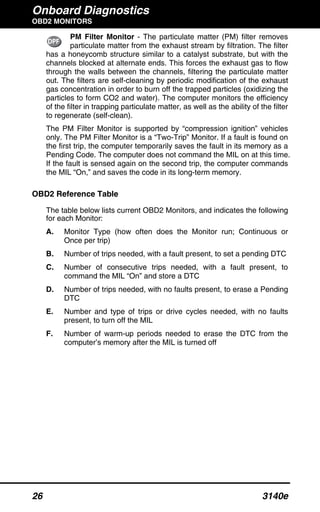
OBD2 Reference Table
The table below lists current OBD2 Monitors, and indicates the following
for each Monitor:
A. Monitor Type (how often does the Monitor run; Continuous or
Once per trip)
B. Number of trips needed, with a fault present, to set a pending DTC
C. Number of consecutive trips needed, with a fault present, to
command the MIL “On” and store a DTC
D. Number of trips needed, with no faults present, to erase a Pending
DTC
E. Number and type of trips or drive cycles needed, with no faults
present, to turn off the MIL
F. Number of warm-up periods needed to erase the DTC from the
computer’s memory after the MIL is turned off
Onboard Diagnostics
OBD2 MONITORS
3140e 27
Name of
Monitor A B C D E F
Comprehensive
Component Monitor
Continuous 1 2 1 3 40
Misfire Monitor
(Type 1 and 3)
Continuous 1 2 1
3 - similar
conditions
80
Misfire Monitor
(Type 2)
Continuous 1
3 - similar
conditions
80
Fuel System Monitor
Continuous 1 1 or 2 1
3 - similar
conditions
80
Catalytic Converter
Monitor
Once per
trip
1 2 1 3 trips 40
Oxygen Sensor
Monitor
Once per
trip
1 2 1 3 trips 40
Oxygen Sensor
Heater Monitor
Once per
trip
1 2 1 3 trips 40
Exhaust Gas
Recirculation (EGR)
Monitor
Once per
trip
1 2 1 3 trips 40
Evaporative
Emissions Controls
Monitor
Once per
trip
1 2 1 3 trips 40
Secondary Air
System (AIR) Monitor
Once per
trip
1 2 1 3 trips 40
NMHC Monitor Once per
trip
1 2 1 3 trips 40
Nox Adsorber Monitor Once per
trip
1 2 1 3 trips 40
Boost Pressure
System Monitor
Once per
trip
1 2 1 3 trips 40
Exhaust Gas Sensor
Monitor
Once per
trip
1 2 1 3 trips 40
PM Filter Monitor Once per
trip
1 2 1 3 trips 40
Preparation for Testing
PRELIMINARY VEHICLE DIAGNOSTIC WORKSHEET
28 3140e
PRELIMINARY VEHICLE DIAGNOSTIC WORKSHEET
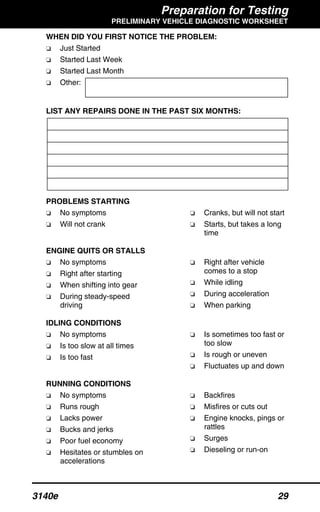
The purpose of this form is to help you gather preliminary information on
your vehicle before you retrieve codes. By having a complete account of
your vehicle's current problem(s), you will be able to systematically
pinpoint the problem(s) by comparing your answers to the fault codes
you retrieve. You can also provide this information to your mechanic to
assist in diagnosis and help avoid costly and unnecessary repairs. It is
important for you to complete this form to help you and/or your
mechanic have a clear understanding of your vehicle's problems.
NAME:
DATE:
VIN*:
YEAR:
MAKE:
MODEL:
ENGINE SIZE:
VEHICLE MILEAGE:
*VIN: Vehicle Identification Number, found at the base of the windshield
on a metallic plate, or at the driver door latch area (consult your vehicle
owner's manual for location).
TRANSMISSION:
❏ Automatic
❏ Manual
Please check all applicable items in each category.
DESCRIBE THE PROBLEM:
Preparation for Testing
PRELIMINARY VEHICLE DIAGNOSTIC WORKSHEET
3140e 29
WHEN DID YOU FIRST NOTICE THE PROBLEM:
❏ Just Started
❏ Started Last Week
❏ Started Last Month
❏ Other:
m
LIST ANY REPAIRS DONE IN THE PAST SIX MONTHS:
PROBLEMS STARTING
❏ No symptoms
❏ Will not crank
❏ Cranks, but will not start
❏ Starts, but takes a long
time
ENGINE QUITS OR STALLS
❏ No symptoms
❏ Right after starting
❏ When shifting into gear
❏ During steady-speed
driving
❏ Right after vehicle
comes to a stop
❏ While idling
❏ During acceleration
❏ When parking
IDLING CONDITIONS
❏ No symptoms
❏ Is too slow at all times
❏ Is too fast
❏ Is sometimes too fast or
too slow
❏ Is rough or uneven
❏ Fluctuates up and down
RUNNING CONDITIONS
❏ No symptoms
❏ Runs rough
❏ Lacks power
❏ Bucks and jerks
❏ Poor fuel economy
❏ Hesitates or stumbles on
accelerations
❏ Backfires
❏ Misfires or cuts out
❏ Engine knocks, pings or
rattles
❏ Surges
❏ Dieseling or run-on
Preparation for Testing
PRELIMINARY VEHICLE DIAGNOSTIC WORKSHEET
30 3140e
AUTOMATIC TRANSMISSION PROBLEMS (if applicable)
❏ No symptoms
❏ Shifts too early or too late
❏ Changes gear incorrectly
❏ Vehicle does not move
when in gear
❏ Jerks or bucks
PROBLEM OCCURS
❏ Morning ❏ Afternoon ❏ Anytime
ENGINE TEMPERATURE WHEN PROBLEM OCCURS
❏ Cold ❏ Warm ❏ Hot
DRIVING CONDITIONS WHEN PROBLEM OCCURS
❏ Short - less than 2 miles
❏ 2 - 10 miles
❏ Long - more than 10 miles
❏ Stop and go
❏ While turning
❏ While braking
❏ At gear engagement
❏ With A/C operating
❏ With headlights on
❏ During acceleration
❏ Mostly driving downhill
❏ Mostly driving uphill
❏ Mostly driving level
❏ Mostly driving curvy
roads
❏ Mostly driving rough
roads
DRIVING HABITS
❏ Mostly city driving
❏ Highway
❏ Park vehicle inside
❏ Park vehicle outside
❏ Drive less than 10 miles per day
❏ Drive 10 to 50 miles per day
❏ Drive more than 50 miles per
day
GASOLINE USED
❏ 87 Octane
❏ 89 Octane
❏ 91 Octane
❏ More than 91 Octane
WEATHER CONDITIONS WHEN PROBLEM OCCURS
❏ 32 - 55° F (0 - 13° C)
❏ Below freezing (32° F /0° C)
❏ Above 55° F (13° C)
CHECK ENGINE LIGHT / DASH WARNING LIGHT
❏ Sometimes ON ❏ Always ON ❏ Never ON
PECULIAR SMELLS
❏ "Hot"
❏ Sulfur ("rotten egg")
❏ Burning rubber
❏ Gasoline
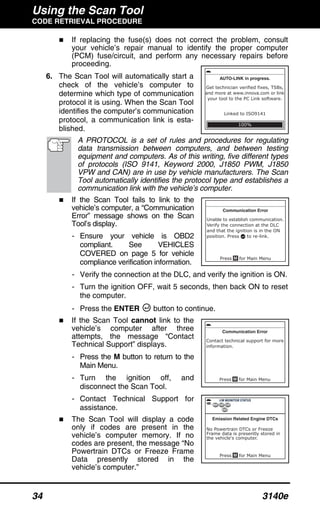
❏ Burning oil
❏ Electrical
STRANGE NOISES
❏ Rattle
❏ Knock
❏ Squeak
❏ Other
Preparation for Testing
BEFORE YOU BEGIN
3140e 31
BEFORE YOU BEGIN
The Scan Tool aids in monitoring
electronic- and emissions-related
faults in your vehicle and
retrieving fault codes related to
malfunctions in these systems.
Mechanical problems such as low
oil level or damaged hoses, wiring
or electrical connectors can cause poor engine performance and may also
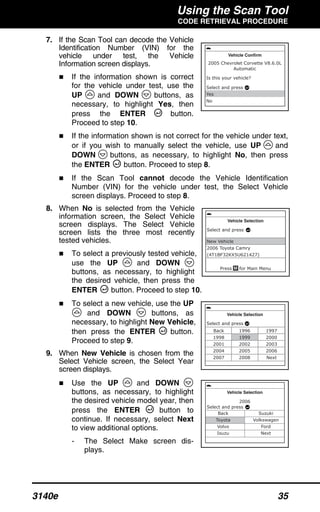
cause a fault code to set. Fix any known mechanical problems before
performing any test. See your vehicle’s service manual or a mechanic for
more information.
Check the following areas before starting any test:
Check the engine oil, power steering fluid, transmission fluid (if
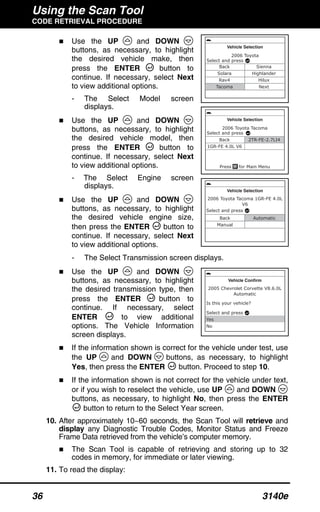
applicable), engine coolant and other fluids for proper levels. Top off
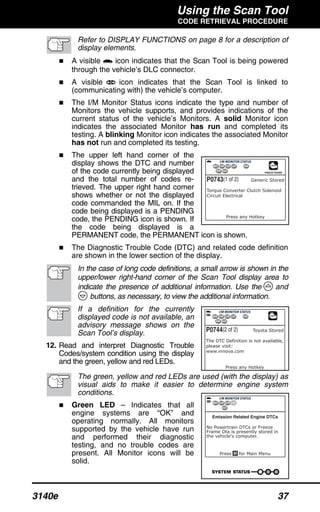
low fluid levels if needed.
Make sure the air filter is clean and in good condition. Make sure all
air filter ducts are properly connected. Check the air filter ducts for
holes, rips or cracks.
Make sure all engine belts are in good condition. Check for cracked,
torn, brittle, loose or missing belts.
Make sure mechanical linkages to engine sensors (throttle, gearshift
position, transmission, etc.) are secure and properly connected. See
your vehicle’s service manual for locations.
Check all rubber hoses (radiator) and steel hoses (vacuum/fuel) for
leaks, cracks, blockage or other damage. Make sure all hoses are
routed and connected properly.
Make sure all spark plugs are clean and in good condition. Check
for damaged, loose, disconnected or missing spark plug wires.
Make sure the battery terminals are clean and tight. Check for
corrosion or broken connections. Check for proper battery and
charging system voltages.
Check all electrical wiring and harnesses for proper connection.
Make sure wire insulation is in good condition, and there are no bare
wires.
Make sure the engine is mechanically sound. If needed, perform a
compression check, engine vacuum check, timing check (if
applicable), etc.
Preparation for Testing
VEHICLE SERVICE MANUALS
32 3140e
VEHICLE SERVICE MANUALS
Always refer to the manufacturer’s service manual for your vehicle
before performing any test or repair procedures. Contact your local car
dealership, auto parts store or bookstore for availability of these
manuals. The following companies publish valuable repair manuals:
Haynes Publications
861 Lawrence Drive
Newbury Park, California 91320
Phone: 800-442-9637
Web: www.haynes.com
Mitchell 1
14145 Danielson Street
Poway, California 92064
Phone: 888-724-6742
Web: www.m1products.com
Motor Publications
5600 Crooks Road, Suite 200
Troy, Michigan 48098
Phone: 800-426-6867
Web: www.motor.com
FACTORY SOURCES
Ford, GM, Chrysler, Honda, Isuzu, Hyundai and Subaru Service
Manuals
Helm Inc.
14310 Hamilton Avenue
Highland Park, Michigan 48203
Phone: 800-782-4356
Web: www.helminc.com
Using the Scan Tool
CODE RETRIEVAL PROCEDURE
3140e 33
Retrieving and using Diagnostic Trouble Codes (DTCs) for
troubleshooting vehicle operation is only one part of an
overall diagnostic strategy.
CODE RETRIEVAL PROCEDURE
Never replace a part based only on the DTC definition.
Each DTC has a set of testing procedures, instructions and
flow charts that must be followed to confirm the location of
the problem. This information is found in the vehicle's
service manual. Always refer to the vehicle's service manual
for detailed testing instructions.
Check your vehicle thoroughly before performing
any test. See BEFORE YOU BEGIN on page 31 for
details.
ALWAYS observe safety precautions whenever working on a
vehicle. See SAFETY PRECAUTIONS on page 3 for more
information.
1. Turn the ignition off.
2. Locate the vehicle's 16-pin Data Link
Connector (DLC). See page 5 for
connector location.
Some DLCs have a plastic cover
that must be removed before
connecting the Scan Tool cable
connector.
If the Scan Tool is ON, turn it OFF
by pressing the POWER/LINK
button BEFORE connecting
the Scan Tool to the DLC.
3. Connect the Scan Tool cable connector to the vehicle’s DLC. The
cable connector is keyed and will only fit one way.
If you have problems connecting the cable connector to the DLC,
rotate the connector 180° and try again.
If you still have problems, check the DLC on the vehicle and on
the Scan Tool. Refer to your vehicle’s service manual to properly
check the vehicle’s DLC.
4. Turn the ignition on. DO NOT start the engine.
5. When the Scan Tool’s cable connector is properly connected to the
vehicle’s DLC, the unit automatically turns ON.
If the unit does not power on automatically when connected to
the vehicle’s DLC connector, it usually indicates there is no
power present at the vehicle’s DLC connector. Check your fuse
panel and replace any burned-out fuses.
Using the Scan Tool
CODE RETRIEVAL PROCEDURE
34 3140e
If replacing the fuse(s) does not correct the problem, consult
your vehicle’s repair manual to identify the proper computer
(PCM) fuse/circuit, and perform any necessary repairs before
proceeding.
6. The Scan Tool will automatically start a
check of the vehicle’s computer to
determine which type of communication
protocol it is using. When the Scan Tool
identifies the computer’s communication
protocol, a communication link is esta-
blished.
A PROTOCOL is a set of rules and procedures for regulating
data transmission between computers, and between testing
equipment and computers. As of this writing, five different types
of protocols (ISO 9141, Keyword 2000, J1850 PWM, J1850
VPW and CAN) are in use by vehicle manufacturers. The Scan
Tool automatically identifies the protocol type and establishes a
communication link with the vehicle’s computer.
If the Scan Tool fails to link to the
vehicle’s computer, a “Communication
Error” message shows on the Scan
Tool’s display.
- Ensure your vehicle is OBD2
compliant. See VEHICLES
COVERED on page 5 for vehicle
compliance verification information.
- Verify the connection at the DLC, and verify the ignition is ON.
- Turn the ignition OFF, wait 5 seconds, then back ON to reset
the computer.
- Press the ENTER button to continue.
If the Scan Tool cannot link to the
vehicle’s computer after three
attempts, the message “Contact
Technical Support” displays.
- Press the M button to return to the
Main Menu.
- Turn the ignition off, and
disconnect the Scan Tool.
- Contact Technical Support for
assistance.
The Scan Tool will display a code
only if codes are present in the
vehicle’s computer memory. If no
codes are present, the message “No
Powertrain DTCs or Freeze Frame
Data presently stored in the
vehicle’s computer.”
Using the Scan Tool
CODE RETRIEVAL PROCEDURE
3140e 35
7. If the Scan Tool can decode the Vehicle
Identification Number (VIN) for the
vehicle under test, the Vehicle
Information screen displays.
If the information shown is correct
for the vehicle under test, use the
UP and DOWN buttons, as
necessary, to highlight Yes, then
press the ENTER button.
Proceed to step 10.
If the information shown is not correct for the vehicle under text,
or if you wish to manually select the vehicle, use UP and
DOWN buttons, as necessary, to highlight No, then press
the ENTER button. Proceed to step 8.
If the Scan Tool cannot decode the Vehicle Identification
Number (VIN) for the vehicle under test, the Select Vehicle
screen displays. Proceed to step 8.
8. When No is selected from the Vehicle
information screen, the Select Vehicle
screen displays. The Select Vehicle
screen lists the three most recently
tested vehicles.
To select a previously tested vehicle,
use the UP and DOWN
buttons, as necessary, to highlight
the desired vehicle, then press the
ENTER button. Proceed to step 10.
To select a new vehicle, use the UP
and DOWN buttons, as
necessary, to highlight New Vehicle,
then press the ENTER button.
Proceed to step 9.
9. When New Vehicle is chosen from the
Select Vehicle screen, the Select Year
screen displays.
Use the UP and DOWN
buttons, as necessary, to highlight
the desired vehicle model year, then
press the ENTER button to
continue. If necessary, select Next
to view additional options.
- The Select Make screen dis-
plays.
Using the Scan Tool
CODE RETRIEVAL PROCEDURE
36 3140e
Use the UP and DOWN
buttons, as necessary, to highlight
the desired vehicle make, then
press the ENTER button to
continue. If necessary, select Next
to view additional options.
- The Select Model screen
displays.
Use the UP and DOWN
buttons, as necessary, to highlight
the desired vehicle model, then
press the ENTER button to
continue. If necessary, select Next
to view additional options.
- The Select Engine screen
displays.
Use the UP and DOWN
buttons, as necessary, to highlight
the desired vehicle engine size,
then press the ENTER button to
continue. If necessary, select Next
to view additional options.
- The Select Transmission screen displays.
Use the UP and DOWN
buttons, as necessary, to highlight
the desired transmission type, then
press the ENTER button to
continue. If necessary, select
ENTER to view additional
options. The Vehicle Information
screen displays.
If the information shown is correct for the vehicle under test, use
the UP and DOWN buttons, as necessary, to highlight
Yes, then press the ENTER button. Proceed to step 10.
If the information shown is not correct for the vehicle under text,
or if you wish to reselect the vehicle, use UP and DOWN
buttons, as necessary, to highlight No, then press the ENTER
button to return to the Select Year screen.
10. After approximately 10~60 seconds, the Scan Tool will retrieve and
display any Diagnostic Trouble Codes, Monitor Status and Freeze
Frame Data retrieved from the vehicle’s computer memory.
The Scan Tool is capable of retrieving and storing up to 32
codes in memory, for immediate or later viewing.
11. To read the display:
Using the Scan Tool
CODE RETRIEVAL PROCEDURE
3140e 37
Refer to DISPLAY FUNCTIONS on page 8 for a description of
display elements.
A visible icon indicates that the Scan Tool is being powered
through the vehicle’s DLC connector.
A visible icon indicates that the Scan Tool is linked to
(communicating with) the vehicle’s computer.
The I/M Monitor Status icons indicate the type and number of
Monitors the vehicle supports, and provides indications of the
current status of the vehicle’s Monitors. A solid Monitor icon
indicates the associated Monitor has run and completed its
testing. A blinking Monitor icon indicates the associated Monitor
has not run and completed its testing.
The upper left hand corner of the
display shows the DTC and number
of the code currently being displayed
and the total number of codes re-
trieved. The upper right hand corner
shows whether or not the displayed
code commanded the MIL on. If the
code being displayed is a PENDING
code, the PENDING icon is shown. If
the code being displayed is a
PERMANENT code, the PERMANENT icon is shown.
The Diagnostic Trouble Code (DTC) and related code definition
are shown in the lower section of the display.
In the case of long code definitions, a small arrow is shown in the
upper/lower right-hand corner of the Scan Tool display area to
indicate the presence of additional information. Use the and
buttons, as necessary, to view the additional information.
If a definition for the currently
displayed code is not available, an
advisory message shows on the
Scan Tool’s display.
12. Read and interpret Diagnostic Trouble
Codes/system condition using the display
and the green, yellow and red LEDs.
The green, yellow and red LEDs are used (with the display) as
visual aids to make it easier to determine engine system
conditions.
Green LED – Indicates that all
engine systems are “OK” and
operating normally. All monitors
supported by the vehicle have run
and performed their diagnostic
testing, and no trouble codes are
present. All Monitor icons will be
solid.
Using the Scan Tool
CODE RETRIEVAL PROCEDURE
38 3140e
Yellow LED – Indicates one of the following conditions:
A. A PENDING CODE IS PRESENT –
If the yellow LED is illuminated, it
may indicate a Pending code is
present. Check the Scan Tool’s
display for confirmation. A Pending
code is confirmed by the presence
of a numeric code and the word
PENDING on the Scan Tool’s
display.
B. MONITOR NOT RUN STATUS – If
the Scan Tool’s display shows a
zero (indicating there are no DTC’s
present in the vehicle’s computer
memory), but the yellow LED is
illuminated, it may be an indication
that some of the Monitors
supported by the vehicle have not
yet run and completed their
diagnostic testing. Check the Scan
Tool’s display for confirmation. All
Monitor icons that are blinking
have not yet run and completed
their diagnostic testing; all Monitor
icons that are solid have run and
completed their diagnostic testing.
Red LED – Indicates there is a
problem with one or more of the
vehicle’s systems. The red LED is
also used to indicate that DTC(s)
are present (displayed on the Scan
Tool’s screen). In this case, the
Malfunction Indicator (Check Engine)
lamp on the vehicle’s instrument
panel will be illuminated.
DTC’s that start with “P0”, “P2” and some “P3” are considered
Generic (Universal). All Generic DTC definitions are the same on all
OBD2 equipped vehicles. The Scan Tool automatically displays the
code definitions (if available) for Generic DTC’s.
DTC’s that start with “P1” and some “P3” are Manufacturer specific
codes and their code definitions vary with each vehicle
manufacturer.
13. If more than one DTC was retrieved, and to view Freeze Frame
Data, press and release the DTC/FF button, as necessary.
Each time the DTC/FF button is pressed and released, the Scan
Tool will scroll and display the next DTC in sequence until all
DTCs in its memory have displayed.
Freeze Frame Data (if available) will display after DTC #1.
Using the Scan Tool
CODE RETRIEVAL PROCEDURE
3140e 39
In OBD2 systems, when an
emissions-related engine malfunction
occurs that causes a DTC to set, a
record or snapshot of engine
conditions at the time that the
malfunction occurred is also saved in
the vehicle’s computer memory. The
record saved is called Freeze Frame
data. Saved engine conditions include,
but are not limited to: engine speed, open or closed loop operation,
fuel system commands, coolant temperature, calculated load value,
fuel pressure, vehicle speed, air flow rate, and intake manifold
pressure.
If more than one malfunction is present that causes more than
one DTC to be set, only the code with the highest priority will
contain Freeze Frame data. The code designated “01” on the
Scan Tool display is referred to as the PRIORITY code, and
Freeze Frame data always refers to this code. The priority
code is also the one that has commanded the MIL on.
Retrieved information can be uploaded to a Personal Computer
(PC) with the use of optional software (see instructions included
with the software for more information).
14. When the last retrieved DTC has been displayed and the DTC/FF
button is pressed, the Scan Tool returns to the “Priority” Code.
15. Determine engine system(s) condition by viewing the Scan Tool’s
display for any retrieved Diagnostic Trouble Codes, code definitions and
Freeze Frame data, interpreting the green, yellow and red LEDs.
If DTC’s were retrieved and you are going to perform the repairs
yourself, proceed by consulting the Vehicle’s Service Repair
Manual for testing instructions, testing procedures, and flow
charts related to retrieved code(s).
If you plan to take the vehicle to a professional to have it
serviced, complete the PRELIMINARY VEHICLE DIAGNOSTIC
WORKSHEET on page 28 and take it together with the retrieved
codes, freeze frame data and LED information to aid in the
troubleshooting procedure.
To prolong battery life, the Scan Tool automatically shuts “Off”
approximately three minutes after it is disconnected from the
vehicle. The DTCs retrieved, Monitor Status and Freeze Frame
data (if any) will remain in the Scan Tool’s memory, and may be
viewed at any time by turning the unit “On”. If the Scan Tool’s
batteries are removed, or if the Scan Tool is re-linked to a
vehicle to retrieve codes/data, any prior codes/data in its
memory are automatically cleared.
Using the Scan Tool
THE SYSTEM MENU - VIEWING OEM ENHANCED DTCs
40 3140e
THE SYSTEM MENU
The System Menu provides the ability to retrieve “enhanced” DTCs, Anti-
Lock Brake System (ABS) and Supplemental Restraint System (SRS)
DTCs for most Audi, BMW, Chrysler/Jeep, Ford/Mazda, GM/Isuzu, Hyundai,
Kia, Mercedes Benz, Toyota/Lexus and Volkswagen vehicles. The types of
enhanced data available depends on the vehicle make. You can also
access an “Oil Maintenance Light” reset function, and return to the Global
OBD2 mode.
Depending on the vehicle under test, some features and functions
may not be available.
To access the System Menu, press the
SYSTEM MENU button. Use the
UP and DOWN buttons, as
necessary, to highlight the desired
option, then press the ENTER
button to view the selected information.
If enhanced communication is not sup-
ported by the vehicle under test, an advi-
sory message displays. Press the
POWER/LINK button to re-link to
the vehicle’s computer. Enhanced functio-
nality is not available for your vehicle.
To view ABS DTCs: Select ABS from the
System Menu. Refer to VIEWING ABS
DTCs on page 50 to view ABS DTCs for
your vehicle.
To view OEM enhanced DTCs: Select
OEM Enhanced from the System Menu.
Refer to VIEWING OEM ENHANCED DTCs
on page 40 to view OEM enhanced DTCs
for your vehicle.
VIEWING OEM ENHANCED DTCs
Refer to the appropriate paragraph to view enhanced data for your vehicle:
Chrysler/Jeep......................................... page 41
Ford/Mazda............................................ page 42
GM/Isuzu................................................ page 45
Honda/Acura.......................................... page 47
Toyota/Lexus ......................................... page 49
Using the Scan Tool
VIEWING OEM ENHANCED DTCs
3140e 41
Chrysler/Jeep Enhanced DTCs
When Chrysler/Jeep OEM Enhanced is
chosen from the System Menu, the Scan
Tool retrieves OEM enhanced DTCs from
the vehicle’s computer.
1. A “One moment please” message
displays while the Scan Tool retrieves
the selected DTCs.
If the Scan Tool fails to link to the
vehicle’s computer, a “Communication
Error” message shows on the Scan
Tool’s display.
- Ensure your vehicle is OBD2
compliant. See VEHICLES
COVERED on page 5 for vehicle
compliance verification
information.
- Verify the connection at the DLC, and verify the ignition is ON.
- Turn the ignition OFF, wait 5 seconds, then back ON to reset
the computer.
- Press the ENTER button to continue.
If the Scan Tool cannot link to the
vehicle’s computer after three
attempts, the message “Contact
Technical Support” displays.
- Press the M button to return to the
Main Menu.
- Turn the ignition off, and
disconnect the Scan Tool.
- Contact Technical Support for assistance.
2. To read the display:
Refer to DISPLAY FUNCTIONS on page 8 for a description of
LCD display elements.
A visible icon indicates that the Scan Tool is being powered
through the vehicle’s DLC connector.
The upper left hand corner of the
display shows the DTC and number
of the code currently being dis-
played and the total number of
codes retrieved.
The Diagnostic Trouble Code (DTC)
definition is shown in the lower
section of the LCD display.
Using the Scan Tool
VIEWING OEM ENHANCED DTCs
42 3140e
If the definition for the
currently displayed code is
not available, an advisory
message shows on the
Scan Tool’s LCD display.
I/M MONITOR STATUS
icons are not displayed
when viewing enhanced
DTCs.
In the case of long code definitions, or when viewing
Freeze Frame data, a small arrow is shown in the
upper/lower right-hand corner of the code display area
to indicate the presence of additional information. Use
the UP and DOWN buttons, as necessary, to
view the additional information.
The Scan Tool will display a code only
if codes are present in the vehicle’s
computer memory. If no codes are
present, a “No Enhanced DTC’s are
presently stored in the vehicle’s
computer” is displayed. Press the M
button to return to the Main Menu.
3. If more than one code was retrieved press the DTC/FF button, as
necessary, to display additional codes one at a time.
Whenever the Scroll function is used to view additional codes,
the Scan Tool’s communication link with the vehicle’s computer
disconnects. To re-establish communication, press the
POWER/LINK button again.
4. When the last retrieved DTC has been displayed and the DTC/FF
button is pressed, the Scan Tool returns to the “Priority” Code.
To exit the enhanced mode, press the SYSTEM MENU
button to return to the System menu. Use the UP and DOWN
buttons, as necessary, to highlight Global OBD, then press
the ENTER button to return to the Global OBD2 mode.
Ford/Mazda Enhanced DTCs
Mazda Enhanced DTCs are available for Mazda-branded
Ford vehicles only.
When Ford OEM Enhanced is chosen from
the System Menu, the Ford Enhanced
menu displays. You may view DTCs for
either the “Continuous Memory Test”,
“KOEO (Key On Engine Off) Test” or
“KOER (Key On Engine Running) Test.”
Using the Scan Tool
VIEWING OEM ENHANCED DTCs
3140e 43
1. Use the UP and DOWN buttons,
as necessary, to highlight the desired
option, then press the ENTER button.
If KOER is selected, an advisory
message shows on the Scan Tool’s
display.
- Start and warm the engine to
normal operating temperature,
then press the ENTER button.
Proceed to step 3.
2. If KOEO or Continuous Memory is
selected, an “instructional” message
shows on the Scan Tool’s display.
Turn the ignition OFF, then back
ON. Press the ENTER button.
Proceed to step 3.
3. A “One moment please” message displays while the test is in
progress.
If the Scan Tool fails to link to the
vehicle’s computer, a “Communication
Error” message shows on the Scan
Tool’s display.
- Ensure your vehicle is OBD2
compliant. See VEHICLES
COVERED on page 5 for vehicle
compliance verification information.
- Verify the connection at the DLC, and verify the ignition is ON.
- Turn the ignition OFF, wait 5 seconds, then back ON to reset
the computer.
- Press the ENTER button to continue.
If the Scan Tool cannot link to the
vehicle’s computer after three
attempts, the message “Contact
Technical Support” displays.
- Press the M button to return to the
Main Menu.
- Turn the ignition off, and
disconnect the Scan Tool.
- Contact Technical Support for
assistance.
If the KOER Test was selected, and
the vehicle’s engine is not running,
an advisory message shows on the
Scan Tool’s display.
Using the Scan Tool
VIEWING OEM ENHANCED DTCs
44 3140e
- Press the SYSTEM MENU
button to return to the System
Menu.
If the KOEO Test was selected, and
the vehicle’s engine is running, an
advisory message shows on the
Scan Tool’s display.
- Press the SYSTEM MENU
button to return to the System Menu.
4. If the KOER test was selected, an
“instructional” message shows on the
Scan Tool’s display.
Turn the steering wheel to the right,
then release.
Press and release the brake pedal.
Cycle the overdrive switch (if
equipped).
A “One moment please” message displays while the test is in
progress.
5. To read the display:
Refer to DISPLAY FUNCTIONS on page 8 for a description of
LCD display elements.
A visible icon indicates that the Scan Tool is being powered
through the vehicle’s DLC connector.
The upper left hand corner of the
display shows the DTC and number
of the code currently being dis-
played and the total number of
codes retrieved.
The Diagnostic Trouble Code (DTC)
definition is shown in the lower
section of the LCD display.
I/M MONITOR STATUS icons are not displayed when
viewing enhanced DTCs.
In the case of long code definitions, or when viewing
Freeze Frame data, a small arrow is shown in the
upper/lower right-hand corner of the code display area to
indicate the presence of additional information. Use the
and buttons, as necessary, to view the additional
information.
Using the Scan Tool
VIEWING OEM ENHANCED DTCs
3140e 45
The Scan Tool will display a code
only if codes are present in the
vehicle’s computer memory. If no
codes are present, a “System Pass”
message is displayed. Press the
SYSTEM MENU button to return
to the System Menu.
6. If more than one code was retrieved press the DTC/FF button, as
necessary, to display additional codes one at a time.
Whenever the Scroll function is used to view additional codes,
the Scan Tool’s communication link with the vehicle’s computer
disconnects. To re-establish communication, press the
POWER/LINK button again.
7. When the last retrieved DTC has been displayed and the DTC/FF
button is pressed, the Scan Tool returns to the “Priority” Code.
To view additional enhanced DTCs, repeat steps 1 through 5,
above.
To exit the enhanced mode, press the SYSTEM MENU
button to return to the System menu. Use the UP and DOWN
buttons, as necessary, to highlight Global OBD, then press
the ENTER button to return to the Global OBD2 mode.
General Motors/Isuzu Enhanced DTCs
When GM/Chevrolet/Isuzu OEM Enhanced is chosen from the System
Menu, the Scan Tool retrieves OEM enhanced DTCs from the vehicle’s
computer.
1. A “One moment please” message
displays while the Scan Tool retrieves
the selected DTCs.
If the Scan Tool fails to link to the
vehicle’s computer, a “Communication
Error” message shows on the Scan
Tool’s display.
- Ensure your vehicle is OBD2
compliant. See VEHICLES
COVERED on page 5 for vehicle
compliance verification information.
- Verify the connection at the DLC,
and verify the ignition is ON.
- Turn the ignition OFF, wait 5
seconds, then back ON to reset
the computer.
- Press the ENTER button to continue.
Using the Scan Tool
VIEWING OEM ENHANCED DTCs
46 3140e
If the Scan Tool cannot link to the
vehicle’s computer after three
attempts, the message “Contact
Technical Support” displays.
- Press the M button to return to the
Main Menu.
- Turn the ignition off, and
disconnect the Scan Tool.
- Contact Technical Support for assistance.
2. To read the display:
Refer to DISPLAY FUNCTIONS on page 8 for a description of
LCD display elements.
A visible icon indicates that the Scan Tool is being powered
through the vehicle’s DLC connector.
The upper left hand corner of the
display shows the DTC and number
of the code currently being dis-
played and the total number of
codes retrieved.
The Diagnostic Trouble Code (DTC)
definition is shown in the lower
section of the LCD display.
If the definition for the cur-
rently displayed code is not
available, an advisory mes-
sage shows on the Scan
Tool’s LCD display.
I/M MONITOR STATUS
icons are not displayed
when viewing enhanced
DTCs.
In the case of long code definitions, or when viewing
Freeze Frame data, a small arrow is shown in the upper/
lower right-hand corner of the code display area to
indicate the presence of additional information. Use the
and buttons, as necessary, to view the additional
information.
The Scan Tool will display a code
only if codes are present in the
vehicle’s computer memory. If no
codes are present, a “No Enhanced
DTC’s are presently stored in the
vehicle’s computer” is displayed.
Press the M button to return to the
Main Menu.
Using the Scan Tool
VIEWING OEM ENHANCED DTCs
3140e 47
3. If more than one code was retrieved press the DTC/FF button, as
necessary, to display additional codes one at a time.
Whenever the Scroll function is used to view additional codes,
the Scan Tool’s communication link with the vehicle’s computer
disconnects. To re-establish communication, press the
POWER/LINK button again.
4. When the last retrieved DTC has been displayed and the DTC/FF
button is pressed, the Scan Tool returns to the “Priority” Code.
To exit the enhanced mode, press the SYSTEM MENU
button to return to the System menu. Use the UP and DOWN
buttons, as necessary, to highlight Global OBD, then press
the ENTER button to return to the Global OBD2 mode.
Honda/Acura Enhanced DTCs
When Honda/Acura OEM Enhanced is chosen from the System Menu,
the Scan Tool retrieves OEM enhanced DTCs from the vehicle’s computer.
1. A “One moment please” message
displays while the Scan Tool retrieves
the selected DTCs.
If the Scan Tool fails to link to the
vehicle’s computer, a “Communication
Error” message shows on the Scan
Tool’s display.
- Ensure your vehicle is OBD2
compliant. See VEHICLES
COVERED on page 5 for vehicle
compliance verification information.
- Verify the connection at the DLC,
and verify the ignition is ON.
- Turn the ignition OFF, wait 5
seconds, then back ON to reset
the computer.
- Press the ENTER button to continue.
If the Scan Tool cannot link to the
vehicle’s computer after three
attempts, the message “Contact
Technical Support” displays.
- Press the M button to return to the
Main Menu.
- Turn the ignition off, and
disconnect the Scan Tool.
- Contact Technical Support for assistance.
2. To read the display:
Using the Scan Tool
VIEWING OEM ENHANCED DTCs
48 3140e
Refer to DISPLAY FUNCTIONS on page 8 for a description of
LCD display elements.
A visible icon indicates that the
Scan Tool is being powered through
the vehicle’s DLC connector.
The upper left hand corner of the
display shows the DTC and number
of the code currently being dis-
played and the total number of
codes retrieved.
The Diagnostic Trouble Code (DTC)
definition is shown in the lower
section of the LCD display.
If the definition for the
currently displayed code is
not available, an advisory
message shows on the
Scan Tool’s LCD display.
I/M MONITOR STATUS icons are not displayed when
viewing enhanced DTCs.
In the case of long code definitions, or when viewing
Freeze Frame data, a small arrow is shown in the
upper/lower right-hand corner of the code display area
to indicate the presence of additional information. Use
the and buttons, as necessary, to view the
additional information.
The Scan Tool will display a code only
if codes are present in the vehicle’s
computer memory. If no codes are
present, a “No Enhanced DTC’s are
presently stored in the vehicle’s
computer” is displayed. Press the M
button to return to the Main Menu.
3. If more than one code was retrieved press the DTC/FF button, as
necessary, to display additional codes one at a time.
Whenever the Scroll function is used to view additional codes,
the Scan Tool’s communication link with the vehicle’s computer
disconnects. To re-establish communication, press the
POWER/LINK button again.
4. When the last retrieved DTC has been displayed and the DTC/FF
button is pressed, the Scan Tool returns to the “Priority” Code.
To exit the enhanced mode, press the SYSTEM MENU
button to return to the System menu. Use the UP and DOWN
buttons, as necessary, to highlight Global OBD, then press
the ENTER button to return to the Global OBD2 mode.
Using the Scan Tool
VIEWING OEM ENHANCED DTCs
3140e 49
Toyota/Lexus Enhanced DTCs
When Toyota/Lexus OEM Enhanced is
chosen from the System Menu, the Scan
Tool retrieves OEM enhanced DTCs from
the vehicle’s computer.
1. A “One moment please” message
displays while the Scan Tool retrieves
the selected DTCs.
If the Scan Tool fails to link to the
vehicle’s computer, a “Communication
Error” message shows on the Scan
Tool’s display.
- Ensure your vehicle is OBD2
compliant. See VEHICLES
COVERED on page 5 for vehicle
compliance verification information.
- Verify the connection at the DLC,
and verify the ignition is ON.
- Turn the ignition OFF, wait 5 seconds, then back ON to reset
the computer.
- Press the ENTER button to continue.
If the Scan Tool cannot link to the
vehicle’s computer after three
attempts, the message “Contact
Technical Support” displays.
- Press the M button to return to the
Main Menu.
- Turn the ignition off, and
disconnect the Scan Tool.
- Contact Technical Support for assistance.
2. To read the display:
Refer to DISPLAY FUNCTIONS on page 8 for a description of
LCD display elements.
A visible icon indicates that the Scan Tool is being powered
through the vehicle’s DLC connector.
The upper left hand corner of the
display shows the DTC and number
of the code currently being dis-
played and the total number of
codes retrieved.
The Diagnostic Trouble Code (DTC)
definition is shown in the lower
section of the LCD display.
Using the Diagnostic Tool
VIEWING ABS DTCs
50 3140e
If the definition for the
currently displayed code is
not available, an advisory
message shows on the
Scan Tool’s LCD display.
I/M MONITOR STATUS
icons are not displayed
when viewing enhanced
DTCs.
In the case of long code definitions, or when viewing
Freeze Frame data, a small arrow is shown in the
upper/lower right-hand corner of the code display area
to indicate the presence of additional information. Use
the and buttons, as necessary, to view the
additional information.
The Scan Tool will display a code only
if codes are present in the vehicle’s
computer memory. If no codes are
present, a “No Enhanced DTC’s are
presently stored in the vehicle’s
computer” is displayed. Press the M
button to return to the Main Menu.
3. If more than one code was retrieved press the DTC/FF button, as
necessary, to display additional codes one at a time.
Whenever the Scroll function is used to view additional codes,
the Scan Tool’s communication link with the vehicle’s computer
disconnects. To re-establish communication, press the
POWER/LINK button again.
4. When the last retrieved DTC has been displayed and the DTC/FF
button is pressed, the Scan Tool returns to the “Priority” Code.
To exit the enhanced mode, press the SYSTEM MENU
button to return to the System menu. Use the UP and DOWN
buttons, as necessary, to highlight Global OBD, then press
the ENTER button to return to the Global OBD2 mode.
VIEWING ABS DTCs
Refer to Vehicle Applications - ABS on page 149 for vehicle
makes covered.
Reading ABS DTCs
1. When ABS is chosen from the System
Menu, a "One moment please"
message displays while the Scan Tool
retrieves the selected DTCs.
Using the Scan Tool
VIEWING ABS DTCs
3140e 51
If ABS functionality is not supported
by the vehicle under test, an
advisory message shows on the
Scan Tool’s display. Press the M
button to return to the Main Menu.
If the Scan Tool fails to link to the
vehicle’s computer, a "Communication
Error" message shows on the Scan
Tool’s display.
- Ensure your vehicle is OBD2 compliant. See VEHICLES
COVERED on page 5 for vehicle compliance verification
information.
- Verify the connection at the DLC, and verify the ignition is ON.
- Turn the ignition OFF, wait 5 seconds, then back ON to reset
the computer.
- Press the ENTER button to continue.
If the Scan Tool cannot link to the
vehicle’s computer after three
attempts, the message “Contact
Technical Support” displays.
- Press the M button to return to the
Main Menu.
- Turn the ignition off, and
disconnect the Scan Tool.
- Contact Technical Support for assistance.
2. To read the display:
Refer to DISPLAY FUNCTIONS on page 8 for a description of
LCD display elements.
A visible icon indicates that the Scan Tool is being powered
through the vehicle’s DLC connector.
A visible icon indicates that the Scan Tool is linked to
(communicating with) the vehicle’s computer.
The upper left hand corner of the
display shows the DTC and number
of the code currently being dis-
played and the total number of
codes retrieved.
The Diagnostic Trouble Code (DTC)
definition is shown in the lower
section of the LCD display.
Using the Scan Tool
ERASING DIAGNOSTIC TROUBLE CODES (DTCs)
52 3140e
If the definition for the currently
displayed code is not available,
an advisory message shows on
the Scan Tool’s LCD display.
I/M MONITOR STATUS icons are
not displayed when viewing ABS
DTCs.
In the case of long code definitions, a small arrow is shown in
the upper/lower right-hand corner of the code display area to
indicate the presence of additional information. Use the UP
and DOWN buttons, as necessary, to view the additional
information.
The Scan Tool will display a code
only if codes are present in the
vehicle’s computer memory. If no
codes are present, a "No ABS
DTC’s are presently stored in the
vehicle’s computer" is displayed.
Press the M button to return to the
Main Menu.
3. If more than one code was retrieved press the DTC button, as
necessary, to display additional codes one at a time.
Whenever the Scroll function is used to view additional codes,
the Scan Tool’s communication link with the vehicle’s computer
disconnects. To re-establish communication, press the
POWER/LINK button again.
4. When the last retrieved DTC has been displayed and the DTC button is
pressed, the Scan Tool returns to the “Priority” Code.
To exit the enhanced mode, press the SYSTEM MENU
button to return to the System menu. Use the UP and DOWN
buttons, as necessary, to highlight Global OBD, then press
the ENTER button to return to the Global OBD2 mode.
ERASING DIAGNOSTIC TROUBLE CODES (DTCs)
When the Scan Tool’s ERASE function is used to erase DTCs
from the vehicle's on-board computer, "Freeze Frame" data
and manufacturer-specific-enhanced data are also erased.
"Permanent" DTCs ARE NOT erased by the ERASE function.
If you plan to take the vehicle to a Service Center for repair, DO NOT
erase the codes from the vehicle's computer. If the codes are erased,
valuable information that might help the technician troubleshoot the
problem will also be erased.
Erase DTCs from the computer's memory as follows:
Using the Scan Tool
ERASING DIAGNOSTIC TROUBLE CODES (DTCs)
3140e 53
When DTCs are erased from the vehicle's computer memory, the
I/M Readiness Monitor Status program resets the status of all
Monitors to a not run "flashing" condition. To set all of the Monitors
to a DONE status, an OBD2 Drive Cycle must be performed.
Refer to your vehicle's service manual for information on how to
perform an OBD2 Drive Cycle for the vehicle under test.
1. If not connected already, connect the
Scan Tool to the vehicle's DLC, and
turn the ignition "On.” (If the Scan Tool
is already connected and linked to the
vehicle's computer, proceed directly to
step 3. If not, continue to step 2.)
2. Perform the Code Retrieval procedure
as described on page 33.
To erase OBD2 DTCs: Wait until
the codes are displayed on the
Scan Tool’s LCD and then proceed
to step 3.
To erase enhanced or ABS DTCs: Press the SYSTEM MENU
button to display the System menu. Use the UP and
DOWN buttons, as necessary, to highlight the desired option,
then press the ENTER button. Perform the appropriate Code
Retrieval procedure (see page 33 for more information) and then
proceed to step 3.
3. Press and release the ERASE
button. A confirmation message shows
on the LCD display.
If you are sure you want to proceed,
use the UP and DOWN
buttons, as necessary, to highlight
Yes, then press the ENTER
button to continue.
If you do not want to proceed, use
the UP and DOWN buttons,
as necessary, to highlight No, then
press the ENTER button to
cancel the erase procedure.
4. If you chose to erase DTCs, a “One
moment please…” message displays
while the erase function is in progress.
If the vehicle’s engine is running,
an advisory message shows on
the Scan Tool’s display. Turn the
engine OFF, then turn the ignition
back to ON. DO NOT start the
engine. Press the ENTER
button to continue.
Using the Scan Tool
I/M READINESS TESTING
54 3140e
If the erase was successful, a
confirmation message shows on the
display. Press the SYSTEM MENU
button to return to the System
Menu.
If the erase was not successful, an
advisory message shows on the dis-
play. Press the SYSTEM MENU
button to return to the System Menu.
I/M READINESS TESTING
I/M is an Inspection and Maintenance program legislated by the
Government to meet federal clean-air standards.
The program requires that a vehicle be taken periodically to an
Emissions Station for an "Emissions Test" or "Smog Check,” where the
emissions-related components and systems are inspected and tested
for proper operation. Emissions Tests are generally performed once a
year, or once every two years.
On OBD2 systems, the I/M program is enhanced by requiring vehicles
to meet stricter test standards. One of the tests instituted by the Federal
Government is called I/M 240. On I/M 240, the vehicle under test is
driven under different speeds and load conditions on a dynamometer for
240 seconds, while the vehicle's emissions are measured.
Emissions tests vary depending on the geographic or regional
area in which the vehicle is registered. If the vehicle is
registered in a highly urbanized area, the I/M 240 is probably
the type of test required. If the vehicle is registered in a rural
area, the stricter “dynamometer type” test may not be required.
I/M Readiness Monitors
I/M Readiness shows whether the various emissions-related systems on
the vehicle are operating properly and are ready for Inspection and
Maintenance testing.
State and Federal Governments enacted Regulations, Procedures and
Emission Standards to ensure that all emissions-related components
and systems are continuously or periodically monitored, tested and
diagnosed whenever the vehicle is in operation. It also requires vehicle
manufacturers to automatically detect and report any problems or faults
that may increase the vehicle's emissions to an unacceptable level.
The vehicle's emissions control system consists of several components
or sub-systems (Oxygen Sensor, Catalytic Converter, EGR, Fuel
System, etc.) that aid in reducing vehicle emissions.
To have an efficient Vehicle Emission Control System, all the emissions-
related components and systems must work correctly whenever the
vehicle is in operation.
Using the Scan Tool
I/M READINESS TESTING
3140e 55
To comply with State and Federal Government regulations, vehicle
manufacturers designed a series of special computer programs called
"Monitors" that are programmed into the vehicle's computer. Each of these
Monitors is specifically designed to run tests and diagnostics on a specific
emissions-related component or system (Oxygen Sensor, Catalytic
Converter, EGR Valve, Fuel System, etc.) to ensure their proper operation.
Currently, there are a maximum of fifteen Monitors available for use.
Each Monitor has a specific function to test and diagnose only
its designated emissions-related component or system. The
names of the Monitors (Oxygen Sensor Monitor, Catalyst
Monitor, EGR Monitor, Misfire Monitor, etc.) describe which
component or system each Monitor is designed to test and
diagnose.
Emissions Inspection and Maintenance (I/M) Readiness
Monitor Status Information
I/M Readiness Monitor Status shows which of the vehicle's Monitors
have run and completed their diagnosis and testing, and which ones
have not yet run and completed testing and diagnosis of their
designated sections of the vehicle's emissions system.
If a Monitor was able to meet all the conditions required to enable it
to perform the self-diagnosis and testing of its assigned engine
system, it means the monitor "HAS RUN.”
If a Monitor has not yet met all the conditions required for it to
perform the self-diagnosis and testing of its assigned engine system;
it means the Monitor "HAS NOT RUN.”
The Monitor Run/Not Run status does not show whether
or not a problem exists in a system. Monitor status only
indicates whether a particular Monitor has or has not run
and performed the self-diagnosis and testing of its
associated system.
Performing I/M Readiness Quick Check
When a vehicle first comes from the factory, all Monitors
indicate a “HAVE RUN” status. This indicates that all Monitors
have run and completed their diagnostic testing. The “HAVE
RUN” status remains in the computer's memory, unless the
Diagnostic Trouble Codes are erased or the vehicle's
computer memory is cleared.
The Scan Tool allows you to retrieve Monitor/System Status Information
to help you determine if the vehicle is ready for an Emissions Test
(Smog Check). In addition to retrieving Diagnostic Trouble Codes, the
Scan Tool also retrieves Monitor Run/Not Run status. This information is
very important since different areas of the state/country have different
emissions laws and regulations concerning Monitor Run/Not Run status.
Before an Emissions Test (Smog Check) can be performed, your
vehicle must meet certain rules, requirements and procedures legislated
by the Federal and state (country) governments where you live.
Using the Scan Tool
I/M READINESS TESTING
56 3140e
1. In most areas, one of the requirements that must be met before a
vehicle is allowed to be Emissions Tested (Smog Checked) is that
the vehicle does not have any Diagnostic Trouble Codes present
(with the exception of PENDING Diagnostic Trouble Codes).
2. In addition to the requirement that no Diagnostic Trouble Codes be
present, some areas also require that all the Monitors that a
particular vehicle supports indicate a "Has Run" status condition
before an Emissions Check may be performed.
3. Other areas may only require that some (but not all) Monitors
indicate a "Has Run" status before an Emissions Test (Smog Check)
may be performed.
Monitors with a "Has Run" status indicate that all the
required conditions they needed to perform diagnosis and
testing of their assigned engine area (system) have been
met, and all diagnostic testing has completed successfully.
Monitors with a "Has Not Run" status have not yet met the
conditions they need to perform diagnosis and testing of
their assigned engine area (system), and have not been
able to perform diagnostic testing on that system.
The green, yellow and red LEDs provide a quick way to help you
determine if a vehicle is ready for an Emissions Test (Smog Check).
Follow the instructions below to perform the Quick Check.
Perform the CODE RETRIEVAL PROCEDURE as described on page
33, then interpret the LED indications as follows:
Interpreting I/M Readiness Test Results
1. GREEN LED - Indicates that all engine
systems are "OK" and operating
normally (all Monitors supported by the
vehicle have run and performed their
self-diagnostic testing). The vehicle is
ready for an Emissions Test (Smog
Check), and there is a good possibility
that it can be certified.
2. YELLOW LED - Determine from the
CODE RETRIEVAL PROCEDURE (page
33) which of the two possible conditions is
causing the yellow LED to light.
If a "PENDING" Diagnostic Trouble
Code is causing the yellow LED to
light, it is possible that the vehicle will
be allowed to be tested for emissions
and certified. Currently, most areas
(states / countries) will allow an
Emissions Test (Smog Check) to be
performed if the only code in the
vehicle's computer is a "PENDING"
Diagnostic Trouble Code.
Using the Scan Tool
I/M READINESS TESTING
3140e 57
If the illumination of the Yellow LED
is being caused by monitors that
“have not run” their diagnostic
testing, then the issue of the vehicle
being ready for an Emissions Test
(Smog Check) depends on the
emissions regulations and laws of
your local area.
- Some areas require that all
Monitors indicate a "Has Run"
status before they allow an
Emissions Test (Smog Check) to be performed. Other areas
only require that some, but not all, Monitors have run their
self-diagnostic testing before an Emissions Test (Smog
Check) may be performed.
- From the code retrieval procedure, determine the status of
each Monitor (a solid Monitor icon shows Monitor "Has Run"
status, a flashing Monitor icon indicates "Has Not Run" status).
Take this information to an emissions professional to
determine (based on your test results) if your vehicle is ready
for an Emissions Test (Smog Check).
3. RED LED - Indicates there is a problem
with one or more of the vehicle's
systems. A vehicle displaying a red LED
is definitely not ready for an Emissions
Test (Smog Check). The red LED is
also an indication that there are
Diagnostic Trouble Code(s) present
(displayed on the Scan Tool's screen).
The Malfunction Indicator (Check
Engine) Lamp on the vehicle's
instrument panel will light steady. The
problem that is causing the red LED to
light must be repaired before an Emissions Test (Smog Check) can
be performed. It is also suggested that the vehicle be
inspected/repaired before driving the vehicle further.
If the Red LED was obtained, there is a definite problem present in
the system(s). In these cases, you have the following options.
Repair the vehicle yourself. If you are going to perform the
repairs yourself, proceed by reading the vehicle service manual
and following all its procedures and recommendations.
Take the vehicle to a professional to have it serviced. The
problem(s) causing the red LED to light must be repaired before
the vehicle is ready for an Emissions Test (Smog Check).
Using the I/M Readiness Monitor Status to Confirm a Repair
The I/M Readiness Monitor Status function can be used (after repair of a
fault has been performed) to confirm that the repair has been performed
correctly, and/or to check for Monitor Run Status. Use the following
procedure to determine I/M Readiness Monitor Status:
Using the Scan Tool
I/M READINESS TESTING
58 3140e
1. Using retrieved Diagnostic Trouble Codes (DTCs) and code
definitions as a guide, and following manufacturer's repair
procedures, repair the fault or faults as instructed.
2. After the fault or faults have been repaired, connect the Scan Tool to
the vehicle's DLC and erase the code or codes from the vehicle's
computer memory.
See page 50 for procedures for ERASING DIAGNOSTIC
TROUBLE CODES (DTCs) from the vehicle's on-board
computer.
Write the codes down on a piece of paper for reference before
erasing.
3. After the erase procedure is performed, most of the Monitor icons on
the Scan Tool’s display will be flashing. Leave the Scan Tool
connected to the vehicle, and perform a Trip Drive Cycle for each
"flashing" Monitor:
Misfire, Fuel and Comprehensive Component Monitors run
continuously and their icons will always be on solid, even after
the erase function is performed.
Each DTC is associated with a specific Monitor. Consult the
vehicle's service manual to identify the Monitor (or Monitors)
associated with the faults that were repaired. Follow the
manufacturer's procedures to perform a Trip Drive Cycle for the
appropriate Monitors.
While observing the Monitor icons on the Scan Tool’s display,
perform a Trip Drive Cycle for the appropriate Monitor or
Monitors.
If the vehicle needs to be driven in order to perform a Trip
Drive Cycle, ALWAYS have a second person help you.
One person should drive the vehicle while the other
person observes the Monitor icons on the Scan Tool for
Monitor RUN status. Trying to drive and observe the Scan
Tool at the same time is dangerous, and could cause a
serious traffic accident.
4. When a Monitor's Trip Drive Cycle is performed properly, the
Monitor icon on the Scan Tool’s display changes from "flashing" to
"solid,” indicating that the Monitor has run and finished its diagnostic
testing.
If, after the Monitor has run, the MIL on the vehicle's dash is not lit, and
no stored or pending codes associated with that particular Monitor are
present in the vehicle's computer, the repair was successful.
If, after the Monitor has run, the MIL on the vehicle's dash lights
and/or a DTC associated with that Monitor is present in the
vehicle's computer, the repair was unsuccessful. Refer to the
vehicle's service manual and recheck repair procedures.
Using the Scan Tool
ABOUT REPAIRSOLUTIONS®
3140e 59
ABOUT REPAIRSOLUTIONS®
RepairSolutions® is a web-based service that provides you with the tools
and information you need to quickly and accurately diagnose and repair
today’s vehicles. RepairSolutions® lets you view, save, and email the
diagnostic data retrieved from a vehicle’s on-board computer(s) using an
Innova Scan Tool. At the core of RepairSolutions® is an extensive
knowledge database, developed by compiling and analyzing years worth
of “real world” vehicle service data. RepairSolutions® builds on
manufacturer-recommended diagnostic and repair information by
providing verified, vehicle-specific fixes supplied by ASE technicians
across the country. The basic RepairSolutions® account is free, and is
available immediately upon purchase of your Innova tool and a one-time
software download. Certain “value added” premium information is
available on demand at nominal charge or through “premium” subscription.
The RepairSolutions® Diagnostic Report
The RepairSolutions® Diagnostic Report provides you with detailed
information for diagnosing and repairing vehicle issues. The Diagnostic
Report gives you the following information:
Some features are available only with a “premium” subscrip-
tion to RepairSolutions®.
Summary – The Summary page shows the current status of your
vehicle’s emissions, engine/transmission, supplemental restraint
(airbag) and anti-lock brake systems, and provides a summary of
the issues associated with your vehicle.
Verified Fixes – The Verified Fixes page lists the most likely
repair(s) needed by your vehicle based on the DTCs retrieved. It
includes cost estimates for the repair(s) based on your geographic
location, provides access to detailed instructions for performing the
repair(s), and includes links to supplemental information (including
articles and videos) related to the affected component or system.
Diagnostic Data – The Diagnostic Data page provides detailed
information related to the DTCs retrieved from your vehicle’s
computer. It includes descriptions of the retrieved DTCs including
the conditions under which each DTC was set, the probable causes
for the issue and recommendations for verifying the problem. You
can also view Freeze Frame data for the “priority” DTC (the DTC
that caused the MIL to illuminate) and current I/M Monitor status.
TSBs / Recalls - Even with the exhaustive testing a vehicle
undergoes before being made available to the public, some issues are
discovered only under “real world” driving conditions. Depending on
the severity of the problem, the vehicle manufacturer may issue a
Technical Service Bulletin describing the problem, and providing the
procedures necessary to correct it. For safety related problems,
vehicle manufacturers are required to issue vehicle recalls to correct
the problem. The TSBs / Recalls page lists three main categories for
issues related to your vehicle: Factory Technical Service Bulletins
(TSBs), Factory Recalls, and Government-mandated NHTSA Safety
Recalls. This information can help you identify a problem before it
occurs, and ensure your vehicle meets Federal safety standards.
Using the Scan Tool
ABOUT REPAIRSOLUTIONS®
60 3140e
Maintenance - The Maintenance page provides information to help
keep your vehicle in top running condition. The page uses your
vehicle’s year, make, model and current mileage to provide a list of
manufacturer-recommended periodic maintenance procedures that
should be performed during its next scheduled service. These
maintenance items are highly recommended and should be per-
formed to best protect against premature failure. The page also
includes additional recommended service procedures based on
analysis of component failures reported by the RepairSolutions®
network of technicians for vehicles of your make, model and mileage.
All procedures include estimates of cost and level of difficulty.
Warranty – Warranties are the vehicle manufacturer's promise to
cover certain repair/replacement costs for a specific amount of time or
until the vehicle has been driven for a specific number of miles. The
Warranty page provides an estimation of the current state of your
vehicle’s warranties (whether they are active, expired, and/or
transferable). This information is intended for reference only. It is
based on manufacturer published data available at the time the data
was gathered and may not fully reflect your actual warranty coverage.
Predicted Repairs – Solving a problem before it becomes a
problem can reduce out-of-pocket cost and minimize personal
inconvenience. Through detailed analysis of historical repair
information supplied by technician across the country,
RepairSolutions® is able to provide highly accurate predictions of
potential service and repair requirements based on your vehicle’s
year, make, model and mileage. The Predicted Repairs page
provides a list of predicted repairs for your vehicle over the next 12
months. The predicted repairs are weighted by probability (high,
moderate or low) and include cost estimates.
Vehicle History Reports – Thinking of buying a vehicle?
RepairSolutions® provides “one click” access for the purchase of a
vehicle history report.
The Portal Page
The Portal page gives you an overview of your RepairSolutions®
account. It shows your Account Status and provides access to the
reports you have most recently generated using a registered Innova tool.
Innova Account
The Innova Account section lets you manage the vehicles and tools you’ve
registered with your account and manage your personal information.
My Garage – Your RepairSolutions® account can be used for
multiple vehicles. The My Garage page you add, view and edit
vehicles for your account.
Report History – Each report you create through RepairSolutions® is
retained through the lifetime of your membership, giving you an
overview of the health of your vehicles. The Report History page lets
you browse a list of all reports created through RepairSolutions® for all
vehicles registered to your account, and view any report listed. You can
also search the list based on the criteria (report #, VIN, etc.) you specify.
Using the Scan Tool
ABOUT REPAIRSOLUTIONS®
3140e 61
Registered Devices – You can register all of your Innova tools with
your RepairSolutions® account. The Registered Devices page
shows all the tools registered to your account along with the date on
which the device was activated.
Order History – You can purchase “premium” access to
RepairSolutions® on a monthly or annual basis. The Order History
page lists all subscriptions you’ve purchased for your account.
Profile and Reset Password – These pages let you update and
maintain your personal account information and change the
password you use to log in to RepairSolutions®.
Tools
The RepairSolutions® Tools section provides access to several
databases offering maintenance and repair instruction, “tech tips,” safety
information and general reference data.
How-To Videos – With the complexity of today’s vehicles, repair
tasks can seem daunting even to the seasoned do-it-yourselfer.
RepairSolutions® offers a rich selection of How-To Videos that
provide step-by-step instruction for a variety of tasks, including
general maintenance, diagnosis and troubleshooting, and detailed
repair information. The “basic” membership provides access to a
selection of available videos, while the “premium” subscription
allows access to the complete video library.
Recalls – Even with the exhaustive testing a vehicle undergoes
before being made available to the public, some issues are
discovered only under “real world” driving conditions. When an issue
that affects personal safety is found, or if a vehicle does not meet
Federal safety standards, the Government mandates that the
vehicle manufacturer issue a “safety recall.” Safety recalls are
official notices that describe known vehicle issues as well as the
related safety concerns. Repairs performed to address a safety
recall are provided free of cost by the vehicle manufacturer’s
dealership. The Recalls database helps you ensure the safety of
your vehicle. You can search for safety recalls by entering a
vehicle’s year, make and model.
DTC Library – Diagnostic Trouble Codes (DTCs) are the starting
point for identifying, troubleshooting and repairing vehicle issues. The
DTC Library contains definitions for “generic” and “manufacturer-
specific” OBD2 DTCs as well as OBD1 codes. Currently, the database
provides code definitions for 43 different vehicle makes. Select the
desired make and enter the DTC to retrieve the specific definition for
your vehicle. Because OBD2 is an evolving system, the DTC Library
is continuously updated to include additional “manufacturer-specific”
definitions as the system matures.
DLC Locator – The key to unlocking the wealth of information
available through OBD2 is the Data Link Connector (DLC), the
doorway to your vehicle’s computer. The DLC Locator is a
comprehensive database of DLC locations for all OBD2-certified
vehicles. Simply enter a Vehicle Identification Number (VIN), or
select the desired year, make and model, and the DLC Locator will
return a description and photo illustration of the DLC location.
Using the Scan Tool
ABOUT REPAIRSOLUTIONS®
62 3140e
Tech Tips – Updated quarterly, RepairSolutions® Tech Tips are
designed to provide basic solutions to everyday vehicle issues,
explain how to perform much needed maintenance, and provide
basic information on how to take care of your vehicle. All Tech Tips
are prepared, reviewed and approved with the support of ASE
Certified Technicians.
Shop Locator – Whether you want to purchase parts to make a
repair yourself or find a local repair shop, the Shop Locator will return
a list facilities near your location based on the Zip Code you provide.
Hardware Requirements:
Innova Scan Tool
Mini USB Cable (included with tool)
Minimum System Operating Requirements:
Windows®
OS Requirements
- Windows® XP / Windows® Vista (32/64-bit editions) / Windows®
7 (32/64-bit editions) / Windows® 8 / Windows® 8.1
Minimum Hardware Requirements
- 50 MB free disk space
- 128 MB RAM
- Pentium processor or better
- One available USB port (USB 2.0 preferred)
Other Requirements
- Internet Connection
- Internet Explorer 5.5, Netscape 7.0 or Firefox 2.0 browser or newer
MAC®
OS Requirements
- Mac OS 10.4.4 and newer
Minimum Hardware Requirements
- 100 MB free disk space
- 256 MB of RAM
- Intel processor running at 700 MHz or greater
- One available USB port
Other Requirements
- Internet Connection
- Safari 3.0, Netscape 7.2 or Firefox 3.0 browser or newer
Using the Scan Tool
ABOUT REPAIRSOLUTIONS®
3140e 63
Accessing RepairSolutions®
1. Link your Scan Tool to a vehicle and retrieve diagnostic data.
2. Visit www.innova.com, download and install the latest PC-Link soft-
ware for your Scan Tool. Select the Support tab, then choose
Manuals and Software. Use the drop-down menu provided to
select your tool Category and tool Model to download the latest PC-
Link software.
3. Connect the Scan Tool to your PC using a Mini USB cable (cable
included).
Your default web browser launches automatically and connects
to the www.innova.com website.
4. Login to your RepairSolutions® account using your registered Email
Address and Password.
If you have not yet established an account, you must register
for a FREE RepairSolutions® account before proceeding.
Chrysler/Jeep OBD1 Systems
CHRYSLER/JEEP OBD1 SYSTEMS
64 3140e
CHRYSLER/JEEP OBD1 SYSTEMS
Chrysler Motors On-Board Computer Systems
Chrysler Motors introduced its first electronic fuel injected vehicle in late
1983. The on-board computer management systems used on Chrysler
vehicles have evolved over the years, and their names have changed
accordingly.
1983-87: The on-board computer used in these vehicles is a split-
system, composed of two separate units: the Logic Module and the
Power Module. The Logic Module contains a microprocessor which
processes data received from sensors located throughout the vehicle
and makes decisions (based on these inputs) which effect engine
operation. The Logic Module is usually located on the right-hand side,
behind the kick panel. The Power Module supplies operating power to
the Logic Module, and contains the circuits which control the high-
current devices. Power Module operation is controlled by the Logic
Module. The Power Module is located in the engine compartment, near
the vehicle’s battery.
1987-90: This system is called a Single Module Engine Controller
(SMEC). This system still uses two separate circuit boards (Logic
Module and Power Module). However, both circuit boards are located in
a common enclosure.
1989-95: This system is called a Single Board Engine Controller
(SBEC). On this system, the Logic Module and Power Module circuit
boards are integrated on a single circuit board.
1993-97: Beginning in 1993, the computer was renamed the
Powertrain Control Module (PCM). In addition to controlling the engine
management system and emission system, the computer also takes
an active role in controlling powertrain (transmission system)
operation.
Unless otherwise specified, all references to “computer” within
this manual also apply to “Logic Module/ Power Module”,
“SMEC”, “SBEC” or “PCM”.
Jeep On-Board Computer Systems
1993-95: In 1993, Jeep on-board computer systems (fuel injected
vehicles only) were converted to the Chrysler on-board computer
systems. All 1993 through 1995 fuel injected Jeep and Chrysler vehicles
are equipped with similar on-board computer systems.
Chrysler/Jeep OBD1 Systems
VEHICLES COVERED - INSTRUMENT PANEL INDICATOR LIGHTS - DLC
3140e 65
VEHICLES COVERED
This section covers Chrysler fuel injected vehicles from 1989-1995.
Type
Model
Year Model
Passenger
Cars
1989-1994 Chrysler, Dodge and Plymouth Fuel
Injected Models Only (Excluding
Lasor/Talon 1.8L, 2.0L (ALL YEARS), 1990
Monaco/Premier, 1993-1995 Intrepid, LHS,
Concorde and Vision, 1995 Avenger,
Stealth (ALL YEARS) and Cirrus 2.5L (ALL
YEARS))
1989-1995 Chrysler, Dodge and Plymouth Fuel
Injected Models Only
Light Truck
and Vans
1992-1995 Diesel Models
Jeep 1993-1995 Jeep Fuel Injected Models Only
INSTRUMENT PANEL INDICATOR LIGHTS
Your vehicle’s instrument panel has either a “Power Loss”, “Check
Engine” or “Malfunction Indicator Lamp”, depending on the year of the
vehicle. These lights are designed to warn you of component
malfunctions.
POWER
LOSS
CHECK
ENGINE
MALFUNCTION
INDICATOR
LAMP
If your instrument panel indicator lights do not come on when
you turn on the ignition, please refer to your vehicle’s service
manual. You may have problems in the car’s circuitry. It is
recommended that you fix these problems before retrieving
DTC’s from your vehicle’s computer.
DATA LINK CONNECTOR (DLC)
Chrysler vehicles are equipped with special
test connectors that make it possible to
connect specialized testing equipment that
communicates with the vehicle’s on-board
computer. Chrysler’s vehicle test connectors
are usually dark in color (BLACK or GREY)
and are located under the hood.
Chrysler/Jeep OBD1 Systems
CODE RETRIEVAL PROCEDURE
66 3140e
Retrieving and using Diagnostic Trouble Codes (DTCs) for
troubleshooting vehicle operation is only one part of an
overall diagnostic strategy.
CODE RETRIEVAL PROCEDURE
Never replace a part based only on the DTC
definition. Each DTC has a set of testing procedures,
instructions and flow charts that must be followed to
confirm the location of the problem. This information
is found in the vehicle’s service manual. Always refer to
the vehicle’s service manual for detailed testing
instructions.
Check your vehicle thoroughly before performing
any test. See BEFORE YOU BEGIN on page 31 for details.
ALWAYS observe safety precautions whenever working on a
vehicle. See Safety Precautions on page 3 for more informa-
tion.
1. Locate the vehicle’s Data Link Connector (DLC). See Data Link
Connector (DLC) on page 65 for connector location.
Some DLCs have a plastic cover that must be removed before
connecting the Scan Tool’s cable connector.
2. Connect the Scan Tool cable (with the
Chrysler Connector Cable Adaptor
attached) to the Scan Tool, then
connect the adaptor to the vehicle’s
DLC. Press the POWER/LINK
button to turn the Scan Tool ON.
Set the parking brake, and make
sure all vehicle accessories are
turned off.
3. Turn the ignition ON. DO NOT start the
engine.
The Chrysler Menu displays.
4. To retrieve codes from the vehicle’s
computer:
Use the UP and DOWN
buttons, as necessary, to highlight
the model year of the vehicle, then
press the ENTER button.
Chrysler/Jeep OBD1 Systems
CODE RETRIEVAL PROCEDURE
3140e 67
5. When the Scan Tool is in the process of
retrieving codes, a “One Moment
Please...” message shows on the Scan
Tool’s LCD display.
If the Scan Tool fails to link to the
vehicle’s computer, a “Communica-
tion Error” message shows on the
Scan Tool’s LCD display. Do the
following:
- Verify the ignition is ON.
- Check the cable connections at
the Scan Tool and at the
vehicle’s DLC.
- Turn the ignition OFF, wait 10-12
seconds, then turn back ON to
reset the computer.
- Press the ENTER button to
continue.
If the Scan Tool cannot link to the
vehicle’s computer after three
attempts, the message “Contact
Technical Support” displays.
- Press the SYSTEM MENU
button to return to the Chrysler
Menu.
- Turn the ignition off, and
disconnect the Scan Tool.
- Contact Technical Support for
assistance.
6. If the Scan Tool was able to link to the
vehicle successfully, the Scan Tool
displays the retrieved DTCs.
The Scan Tool will display a code
only if codes are present in the
vehicle's computer memory. If no
codes are present, a "No DTC's are
presently stored in the vehicle's
computer" message is displayed.
7. If more than one code was retrieved
press the DTC/FF button, as necessary,
to display additional codes one at a time.
In the case of long code definitions, a small arrow is shown in
the upper/lower right-hand corner of the code display area to
indicate the presence of additional information. Use the
button to view the additional information.
8. Disconnect the Scan Tool from the vehicle and turn the ignition key
OFF.
Chrysler/Jeep OBD1 Systems
ERASING DTCs
68 3140e
9. To prolong battery life, the Scan Tool automatically shuts "Off" after
approximately three minutes of no button activity. The DTCs
retrieved will remain in the Scan Tool's memory, and may be viewed
at any time. If the Scan Tool’s batteries are removed, or if the Scan
Tool is re-linked to a vehicle to retrieve codes, any prior codes in its
memory are automatically cleared.
10. Follow the testing and repair procedures outlined in the vehicle's
service repair manual to correct "hard" DTCs. Codes should be
addressed and eliminated in the order they were received, erasing
and retesting after each repair is made to be sure the fault was
eliminated.
ERASING DTCs
When the Scan Tool's ERASE function is used to erase
DTCs from the vehicle's on-board computer, manufacturer
specific data (where applicable) is also erased.
If you plan to take the vehicle to a service center for repair, DO NOT
erase the codes from the vehicle's computer. If the codes are erased,
valuable information that might help the technician troubleshoot the
problem will also be erased.
Erase DTC’s from the computer’s memory as follows:
1. Connect the Scan Tool to the vehicle’s DLC. Press the ENTER
button to continue.
2. Turn the ignition ON. DO NOT start the engine.
3. Press and release the ERASE button. A confirmation message
shows on the LCD display.
If you are sure you want to proceed,
use the UP and DOWN
buttons, as necessary, to highlight
Yes, then press the ENTER
button to continue.
If you do not want to proceed, use
the UP and DOWN buttons,
as necessary, to highlight No, then
press the ENTER button to exit
the erase function.
4. If you chose to erase DTCs, a “One
moment please…” message displays
while the erase function is in progress.
If the erase was successful, a
confirmation message shows on the
Scan Tool’s LCD display. Press the
SYSTEM MENU button to
return to the Chrysler Menu.
Chrysler/Jeep OBD1 Systems
ERASING DTCs
3140e 69
Due to the differences in
computer systems, the Scan Tool
can be used to erase codes for
some vehicles, while others
require codes to be erased
manually. If the “This vehicle does
not support this function.” screen
displays, you must consult the
vehicle’s service repair manual for
procedures to erase DTCs.
If the erase was not successful, an
advisory message shows on the
LCD display. Verify that the Scan
Tool is properly connected to the
vehicle's DLC and that the ignition
is ON. Press the ENTER button
to continue. If the erase process still
does not complete, turn the ignition
OFF, wait 10 seconds, then turn
back ON and repeat steps 2 and 3.
Erasing DTCs does not fix the problem(s) that caused the
code(s) to be set. If proper repairs to correct the problem that
caused the code(s) to be set are not made, the code(s) will
appear again and the check engine light will illuminate as soon
as the problem that cause the DTC to set manifests itself.
Ford OBD1 Systems
FORD COMPUTER SYSTEM OVERVIEW - VEHICLES COVERED
70 3140e
FORD COMPUTER SYSTEM OVERVIEW
The Scan Tool is compatible only with EEC-IV Computer
Control systems.
IMPORTANT: When the computer is in Self-Test mode (is
testing the sensors or actuators for proper operation), it relies
on voltage signals that is sends to and / or receives from the
sensors or actuators to determine whether or not these
components are operating properly. The sensors and
actuators are all connected to the computer by wires. If any
defects are present in any part of the circuit that connects
these devices to the computer (such as defective connectors
or wires, faulty grounds, improper voltage, shorts etc.), the
voltage signal that the computer receives from these devices
will be affected. The computer has no way of determining if
the improper voltage signal is being caused by a defect in the
circuit or by the sensors or actuators themselves. Keep this in
mind when servicing fault codes, and do not replace any
devices (sensors or actuators) before checking the complete
circuit (or circuits) that are part of the device from which the
code was generated.
VEHICLES COVERED
CAR - Ford, Lincoln, Mercury Computer System/ScanTool
Application Table
The following table lists the year and model of all the cars that are
covered by the Scan Tool.
Engine
8th
VIN
Digit**
Fuel Systems
(Carburetor
Model) Application/Special Notes
Computer
System
1981-1982
1.6L I-4 5, 2 EFI, EFI Turbo Escort, EXP, LN7, Lynx
2.3L I-4 5 EFI Turbo Capri, Cougar, Mustang, T-
Bird
2.3L I-4 HSC R, J FBC (6149)* Capri, Fairmont, LTD, Marquis,
Mustang, Tempo, Topaz,
Zephyr
EEC-IV
1984-1986
1.6L I-4 4, 5, 8 EFI EFI Turbo Escort, EXP, Lynx
2.3L I-4
2.3L I-4 OHC
A, J, R FBC
(YFA)* (6149)*
Capri, Cougar, LTD, Marquis,
Mustang, Tempo, Topaz
2.3L I-4 T, W EFI Turbo Capri, Cougar, Merkur XR4Ti,
Mustang, T-Bird
2.3L I-4 HSC S, X CFI Tempo, Topaz
3.8L V-6 3 CFI Capri, Cougar, LTD, Marquis,
Mustang, T-Bird
EEC-IV
Ford OBD1 Systems
VEHICLES COVERED - CARS
3140e 71
Engine
8th
VIN
Digit**
Fuel Systems
(Carburetor
Model) Application/Special Notes
Computer
System
1984-1986 (Cont)
5.0L V-8 F, M CFI, SEFI Capri, Continental, Colony
Park, Cougar, Country Squire,
Crown Victoria, Grand
Marquis, LTD, Mark VII,
Marquis, Mustang, T-Bird,
Town Car
EEC-IV
1987-1993
1.9L I-4 J, 9 EFI, CFI, SFI Escort, EXP, Lynx, Tracer
2.0L I-4 A SEFI Probe (1993 manual
transmission only)
2.3L I-4 A FBC (YFA)* Capri, LTD, Marquis, Mustang
(1996 models)
2.3L I-4 OHC A, M EFI Mustang
2.3L I-4 T, W EFI Turbo Capri, Cougar, Merkur,
Mustang, T-Bird, XR4Ti
2.3L I-4 HSC S, X CFI, EFI, SEFI Tempo, Topaz
2.5L I-4 D EFI, CFI Sable, Taurus
3.0L V-6
3.0L V-6 SHO
1, U, Y EFI, SEFI, SFI Probe, Sable, Taurus, Tempo,
Topaz (VIN 1 Taurus models
are Flexible Fuel)
3.8L V-6 3, 4, C,
R
CFI, EFI, SFI Capri, Continental, Cougar,
LTD, Marquis, Mustang, Sable,
T-Bird,Taurus
4.6L V-8 W, V SEFI Crown Victoria, Grand
Marquis, Mark VII, Town Car
5.0L V-8 F, M,
E, T,
D, 4
SEFI Capri, Continental, Cougar,
Crown Victoria, Grand Marquis,
Mark VII, Mustang, Mustang
Cobra, T-Bird, Town Car
EEC-IV
1994
1.9L I-4 J SFI Escort, Topaz, Tracer
2.0L I-4 A SFI Probe
3.0L V-6 1, U, Y SFI Sable, Taurus, Tempo (VIN 1
Taurus models are Flexible Fuel)
3.8L V-6
3.8L V-6 SC
4
R
SFI Continental, Cougar, Sable,
Taurus, T-Bird
4.6L V-8 W, V SFI Crown Victoria, Grand
Marquis, Mark VIII, Town Car
5.0L V-8 T, D SFI Mustang, Mustang Cobra
EEC-IV
1995
1.9L I-4 J SFI Escort, Tracer
2.0L I-4 A, 3 SFI Contour, Mystique, Probe
2.5L V-6 L SFI Contour, Mystique
3.0L V-6 1, U
3.0L V-6 SHO Y
SFI Sable, Taurus (VIN 1 Taurus
models are Flexible Fuel)
3.8L V-6 4
3.8L V-6 SC R
SFI Cougar, Sable, Taurus, T-Bird
EEC-IV
Ford OBD1 Systems
VEHICLES COVERED - TRUCKS/VANS
72 3140e
Engine
8th
VIN
Digit**
Fuel Systems
(Carburetor
Model) Application/Special Notes
Computer
System
1995 (Cont)
4.6LV8DOHC V SFI Mark VIII
5.0L V-8 HO T
5.0L V-8 SHP D
SFI Mustang
EEC-IV
NOTES
* Carburetor Model. Carburetor model numbers are usually stamped on top of the
carburetor, or on a metal tab attached to the carburetor. Consult your vehicle’s repair manual
for proper identification.
**VIN Number. The VIN number(s) used in this column identify the vehicle’s engine type.
This number is the 8th digit of the VIN (Vehicle Identification Number). Consult your vehicle’s
repair manual for details.
Application Table Definitions. CFI = Central Fuel Injection; DOHC = Dual Overhead Cam;
EFI = Electronic Fuel Injection; FBC = Feedback Carburetor; HSC = High Swirl Combustion;
MFI = Multiport Fuel Injection; OHC = Overhead Cam; SC = Super Charged; SEFI =
Sequential Electronic Fuel Injection; SFI = Sequential Fuel Injection; SHO = Super High
Output
TRUCKS/VANS - Ford Computer System/Scan Tool Application Table
The following table lists the year and model of all the trucks and vans
that are covered by the Scan Tool.
Engine
8th
VIN
Digit**
Fuel Systems
(Carburetor
Model) Application/Special Notes
Computer
System
1983
2.8L V-6 S FBC (2150A)* Bronco II and Ranger Pickup EEC-IV
1984
2.8L V-6 S FBC (2150A)* Bronco II, Ranger Pickup
4.9L I-6 Y FBC (YFA)*
5.0L V-8 F FBC (2150A)*
5.8L V-8 G FBC (2150A)*
Bronco, E and F Series
Trucks/Vans (8500 lb. GVW or
less only)
EEC-IV
1985-1990
2.3L I-4 OHC A EFI
2.9L V-6 T EFI
Aerostar, Bronco II, Ranger
(excluding Diesel)
2.8L V-6 S FBC (2150A)*
4.9L I-6 Y, 9 FBC (YFA)*,
EFI
5.0L V-8
5.0L V-8
F
N
FBC (2150A)*
EFI
Bronco, E and F Series
Trucks/Vans (8500 lb. GVW or
less only)
5.8L V-8 G FBC (2150A)*
7.3L V-8 M Diesel
7.5L V-8 G EFI
E and F Series Trucks/Vans
(8500 lb. GVW or less only)
EEC-IV
1991-1994
2.3L I-4 OHC A EFI, MFI
2.9L V-6 T EFI
Ranger
3.0L V-6 U EFI, SEFI, SFI Aerostar, Ranger
EEC-IV
Ford OBD1 Systems
VEHICLES COVERED - TRUCKS/VANS - TEST CONNECTORS
3140e 73
Engine
8th
VIN
Digit**
Fuel Systems
(Carburetor
Model) Application/Special Notes
Computer
System
1991-1994 (Cont)
4.0L V-6 X EFI, MFI Aerostar, Explorer, Ranger
4.9L I-6 Y, H EFI, MFI, SFI
5.0L V-8 N EFI, MFI, SFI
5.8L V-8 H, R EFI, MFI, SFI
Bronco, E and F Series
Trucks/Vans (8500 lb. GVW or
less only)
7.3L V-8 M Diesel
7.3L V-8 K Turbo Diesel
7.5L V-8 G EFI, MFI
E and F Series Trucks/Vans
(Excludes 1994 diesel models)
EEC-IV
1995
3.0L V-6 U SFI
4.0L V-6 X SFI
Aerostar (Excludes Explorer,
Ranger and Windstar)
4.9L I-6 Y SFI E and F series Trucks and
Vans (Excludes Natural Gas
equipped vehicles)
5.0L V-8 N SFI
5.8L V-8 H, R MFI
Bronco, E and F series Trucks
and Vans
7.5L V-8 G MFI E-350; F-250-350 (Excludes
California ); F-Super Duty
(Excludes Diesel)
EEC-IV
NOTES
* Carburetor Model. Carburetor model numbers are usually stamped on top of the carbure-
tor, or on a metal tab attached to the carburetor. Consult your vehicle’s repair manual for
proper identification.
**VIN Number. The VIN number(s) used in this column identify the vehicle’s engine type.
This number is the 8th digit of the VIN (Vehicle Identification Number). Consult your vehicle’s
repair manual for details.
Application Table Definitions. EFI = Electronic Fuel Injection; FBC = Feedback Carburetor;
MFI = Multiport Fuel Injection; OHC = Overhead Cam; SC = Super Charged; SEFI =
Sequential Electronic Fuel Injection; SFI = Sequential Fuel Injection
TEST CONNECTORS
Ford vehicles are equipped with
special test connectors that make
it possible to connect specialized
testing equipment that communi-
cates with the vehicle's onboard
computer. Ford's vehicle test con-
nectors are usually dark in color
(BLACK or GREY). Sometimes
they have a plastic cover over
them or are labeled EEC Test. The
connectors can be found in the
following general locations in the
engine compartment:
EEC-IV TEST CONNECTOR
6-PIN
SINGLE
PIN
Ford OBD1 Systems
CONNECTING THE SCAN TOOL - DIAGNOSTIC TROUBLE CODES (DTCs)
74 3140e
Near the front corner (right or left).
Near the fender well (right or left).
Near the fire wall (right or left).
CONNECTING THE SCAN TOOL
The Scan Tool's Ford Connector Cable Adaptor is designed to
match the vehicle's computer DLC. When properly connected,
the vehicle's DLC should match the pre-molded guides around
the adaptor. Make sure the adaptor and the vehicle's DLC
mate properly before applying force. Forcing the adaptor onto
the DLC improperly may result in damage to the adaptor
and/or Scan Tool, and possible damage to the vehicle's
computer system.
Connect the Scan Tool to BOTH.
1. large, six pin female connector with
molded housing
2. small, single pin female connector
1988 and newer vehicles
may have more than one
similar connector for other
systems (i.e. Anti-Lock
Brakes). Only the connector
with an extra single pin is the
correct test connector for
computer service codes use. If you have any questions about
the correct connector, please refer to your vehicle's service
manual for detailed information.
DIAGNOSTIC TROUBLE CODES (DTCs)
Diagnostic Trouble Codes, or Fault Codes, can be used to identify
engine systems or components that are malfunctioning. The computer
records codes for two types of problems:
"Hard" Diagnostic Trouble Codes
"Hard" DTCs represent problems which are happening now and
cause the instrument panel Malfunction Indicator Lamp (MIL) or
Check engine light to illuminate and remain on until the failure is
repaired. A DTC is stored in the vehicle's computer memory for
each fault detected. A Scan Tool or Scanner can be used to retrieve
DTCs that are stored in the vehicle's computer memory.
Intermittent/History DTCs
Intermittent/History DTCs are stored in the computer's memory for
problems that occur intermittently, or for problems that happened in
the past but are not currently present. Intermittent DTCs may cause
the Malfunction Indicator light to flicker or stay on until the
intermittent malfunction goes away. However, the corresponding
CODE
READER
EEC-IV
TEST
CONNECTOR
Ford OBD1 Systems
CODE RETRIEVAL PROCEDURES - OVERVIEW - REVIEWING DTCs
3140e 75
fault code will be stored in memory as a history DTC. If the
malfunction that caused the history DTC to set does not recur within
a predetermined length of time (usually within 40-80 ignition key
start cycles), the computer will automatically erase the related fault
code from its memory.
CODE RETRIEVAL PROCEDURES
Overview of Ford Code Retrieval Process
Ford's computer self-diagnostic system is divided into four main
sections:
1. "Key On Engine Off" (KOEO) Self-Test
2. "Continuous Memory" (CM) Self-Test
3. "Key On Engine Running" (KOER) Self-Test
4. Other EEC-IV System tests
These Self-Tests are specially designed to monitor and/or test the
various components and circuits that are controlled by the vehicle's
computer, and to save and/or transmit diagnostic test results to the
Scan Tool in the form of numerical fault codes.
The "Continuous Memory" Self-Test is designed to run continuously
whenever the vehicle is normal operation. If a fault is detected by the
"Continuous Memory" Self-Test, a fault code is saved in the vehicle's
computer memory for later retrieval.
Ford’s On-Board Diagnostic Self-Tests are designed in such a way that
in order to properly diagnose a problem, you must perform all the Self-
Tests, in the proper sequence.
As described previously, some tests are designed to detect problems
only when the vehicle is in normal operation. Some tests are designed
to activate components and detect problems only with the Key On and
Engine Off. Other tests are designed to activate components and test
their operation only with the Key On and Engine Running. Do not take
short cuts. If you fail to perform a test, or you perform a test out of
sequence, you might miss a problem that is only detected during that
part of the test.
Reviewing DTCs
To view codes in the Scan Tool’s memory:
1. Locate the vehicle’s Data Link Connector (DLC). See TEST
CONNECTORS on page 73 for connector location.
Some DLCs have a plastic cover that must be removed before
connecting the Scan Tool’s cable connector.
Ford OBD1 Systems
CODE RETRIEVAL PROCEDURES - KOEO TEST
76 3140e
2. Connect the Scan Tool cable (with the
Ford Connector Cable Adaptor attached)
to the Scan Tool, then connect the
adaptor to the vehicle’s DLC. Press the
POWER/LINK button to turn the
Scan Tool ON, then press the ENTER
button to continue.
The Ford Menu displays.
3. Use the UP and DOWN buttons,
as necessary, to highlight Review
DTCs, then press the ENTER button.
Key On Engine Off (KOEO) Test
During the KOEO Self-Test, two groups of codes are retrieved by the
Scan Tool.
The first group of codes retrieved by the Scan Tool are called
"KOEO codes". A "KOEO" icon will show in the upper right corner of
the LCD display to indicate that the code retrieved is a "KOEO" code.
The second group of codes are called "Continuous Memory" codes.
A "CM" icon will show in the upper right corner of the LCD display to
indicate that the code retrieved is a "Continuous Memory" code.
Check your vehicle thoroughly before performing any test. See
BEFORE YOU BEGIN on page 31 for details.
ALWAYS observe safety precautions whenever working on a
vehicle. See Safety Precautions on page 3 for more informa-
tion.
1. Locate the vehicle's Data Link Connector (DLC). See TEST
CONNECTORS on page 73 for connector location.
Some DLCs have a plastic cover that must be removed before
connecting the Scan Tool's cable connector.
2. Connect the Scan Tool cable (with the
Ford Connector Cable Adaptor attached)
to the Scan Tool, then connect the
adaptor to the vehicle's DLC. Press the
POWER/LINK button to turn the
Scan Tool ON, then press the ENTER
button to continue.
The Ford Menu displays.
Use the and buttons, as
necessary, to make menu selections.
3. From the Ford Menu, highlight KOEO
Test, then press the ENTER button.
Ford OBD1 Systems
CODE RETRIEVAL PROCEDURES – KOEO TEST
3140e 77
The LCD display shows instructions to
prepare the vehicle for the KOEO Test.
4. Start and warm-up engine to normal
operating temperature. Press the
ENTER button to continue.
5. Turn ignition key OFF and wait for the
on screen prompt. If you wish to exit the
KOEO test at this time, press the
SYSTEM MENU button.
6. Turn the ignition ON. DO NOT start the
engine. If your vehicle is equipped with
one of the following engine types, perform
the added procedures described below:
For 4.9L engines with standard
transmission: Press and hold the
clutch until all codes are sent (steps
7 through 9).
For 7.3L diesel engines: Press and hold accelerator until all
codes are sent (steps 7 through 9).
For 2.3L turbo engines with octane switch: Put switch in
premium position.
7. Press the ENTER button to continue.
8. While codes are being retrieved, a "One
moment please KOEO test is in
progress..." message shows on the
Scan Tool's LCD display.
As soon as the ignition is turned "on", the vehicle's computer
enters the Self-Test mode. Clicking sounds will be heard
coming from the engine. This is normal. It indicates that the
vehicle's computer is activating relays, solenoids, and other
components to check their operation.
WARNING: On some vehicles equipped with an Electric
Cooling Fan, the computer activates the cooling fan to check
its operation. To avoid injury, keep hands or any part of your
body a safe distance from the engine during this test.
If the Scan Tool fails to link to the
vehicle's computer after three
attempts, a "Vehicle is not responding"
message shows on the Scan Tool's
LCD display. Do the following:
- Verify the ignition is ON.
- Check the cable connections at
the Scan Tool and at the vehicle's
DLC.
- Turn the ignition OFF, wait 10 seconds, then turn back ON to
reset the computer.
Ford OBD1 Systems
CODE RETRIEVAL PROCEDURES - KOEO TEST
78 3140e
BE SURE to perform the added procedures in step 6, if
appropriate for your vehicle, BEFORE turning the
ignition ON.
- Press ENTER button to continue.
If the Scan Tool cannot link to the
vehicle’s computer, the message
“Contact Technical Support” displays.
- Press the M button to return to the
Main Menu.
- Turn the ignition off, and discon-
nect the Scan Tool.
- Contact Technical Support for assistance.
9. If the Scan Tool was able to link to the vehicle successfully a "Code
retrieval was successful..." message shows temporarily on the Scan
Tool's LCD display followed by any retrieved DTCs.
The Scan Tool will display a code
only if codes are present in the
vehicle's computer memory.
If no problems are found during the
KOEO Self-Test, the computer
sends a "PASS" code (code 11 or
111) to the Scan Tool.
If no Continuous Memory codes are
present in the vehicle's computer
memory, the Scan Tool will display a
"PASS" code (code 11 or 111).
Most Ford EEC-IV vehicle compu-
ters up to 1991 use a two-digit code
system. From 1991 to 1995 most
use a three digit code system.
The Scan Tool will display a code
only if codes are present in the
vehicle’s computer memory. If no
codes are present, a “No DTC’s are
presently stored in the vehicle’s
computer” message is displayed.
10. If more than one code was retrieved,
press DTC/FF button, as necessary, to
display additional codes one at a time.
In the case of long code definitions, a small arrow is shown in
the upper/lower right-hand corner of the code display area to
indicate the presence of additional information. Use the
button to view the additional information.
11. Disconnect the Scan Tool from the vehicle and turn the ignition key
OFF.
Ford OBD1 Systems
CODE RETRIEVAL PROCEDURES - ENGINE TIMING CHECK
3140e 79
12. To prolong battery life, the Scan Tool automatically shuts "Off" after
approximately three minutes of no button activity. The DTCs retrieved
will remain in the Scan Tool's memory, and may be viewed at any time.
If the Scan Tool's batteries are removed, or if the Scan Tool is re-linked
to a vehicle to retrieve codes, any prior codes in its memory are
automatically cleared.
13. Follow the testing and repair procedures outlined in the vehicle's
service repair manual to correct "hard" DTCs. Codes should be
addressed and eliminated in the order they were received, erasing
and retesting after each repair is done to be sure the fault was
eliminated.
IMPORTANT: DO NOT service "Continuous Memory" codes
at this time. Before "Continuous Memory" codes can be
serviced, both the KOEO and the KOER Self-Tests must pass
(a PASS code 11 or 111 is obtained). After both of these tests
have passed, erase the vehicle's computer memory, take the
vehicle for a short drive, then repeat the KOEO Self-Test. If
any Continuous Memory faults are present, service them all
this time. Consult the vehicle's service repair manual for
servicing Continuous Memory Fault Codes.
Do not proceed to the ignition timing check procedure or the
KOER test until a PASS code (code 11 or 111) for KOEO test
is obtained.
Engine Timing Check
Before performing the KOER Self-Test, the vehicle's Ignition Base
Timing and the computer's ability to electronically control timing
advance must be checked for proper operation. Maladjustment of
ignition timing, or a problem in the advance circuit, might generate
false fault codes when performing the KOER Self-Test that would
cause the test to be invalid. Use the following procedures to check
for proper ignition timing and to verify the computer's ability to
electronically advance ignition timing.
The following "Timing Check" procedure is only
applicable to 1992 and older vehicles (excluding diesel
engines). For 1993 and newer vehicles, refer to the
vehicle's service repair manual for procedures to check
and adjust timing. DO NOT ATTEMPT TO ADJUST TIMING
ON THESE VEHICLES WITHOUT MANUFACTURER'S
SPECIFICATIONS AND PROCEDURES.
For 1992 and older vehicles, the Scan Tool can be used in combination
with a timing light to check ignition timing and the vehicle computers
ability to advance ignition timing.
Check your vehicle thoroughly before performing any test. See
BEFORE YOU BEGIN on page 31 for details.
ALWAYS observe safety precautions whenever working on a
vehicle. Read and follow Safety Precautions on page 3 before
performing this test.
Ford OBD1 Systems
CODE RETRIEVAL PROCEDURES - ENGINE TIMING CHECK
80 3140e
A timing light is required to perform this test.
The vehicle must pass the KOEO Test (page 76) before performing
this test.
1. Locate the vehicle's Data Link Connector (DLC). See TEST
CONNECTORS on page 73 for connector location.
Some DLCs have a plastic cover that must be removed before
connecting the Scan Tool's cable connector.
2. Connect the Scan Tool cable (with the
Ford Connector Cable Adaptor attached)
to the Scan Tool, then connect the
adaptor to the vehicle's DLC. Press the
POWER/LINK button to turn the
Scan Tool ON, then press ENTER
button to continue.
The Ford Menu displays.
Use the and buttons, as
necessary, to make menu
selections.
3. From the Ford Menu, highlight Timing
Check, then press the ENTER
button.
The Select Model Year screen
displays.
4. From the Select Model Year screen,
highlight the vehicle model year, then
press the ENTER button.
For 1993 and newer vehicles: The
message “Follow instructions in
vehicle service manual to perform
timing check” displays. Press the
SYSTEM MENU button to
return to the Ford Menu. Refer to
the vehicle’s service manual for
timing check procedures.
For 1992 and older vehicles: The
message “Warm up engine to
operating temperature” displays.
5. Start and warm-up engine to normal
operating temperature. Press the
ENTER button to continue.
6. When prompted, turn off all vehicle accessories, turn ignition key OFF
and wait for the on screen prompt. If you wish to exit the Timing Check
procedure at this time, press the SYSTEM MENU button.
Ford OBD1 Systems
CODE RETRIEVAL PROCEDURES - ENGINE TIMING CHECK
3140e 81
7. When instructed by the message on the
Scan Tool's display, start the engine
and press the ENTER button.
A "One moment please preparation
for test is in progress” message
shows temporarily on the Scan
Tool's LCD display, followed by the
message "Perform Timing Check
within two minutes."
8. When "Perform Timing Check within 2
minutes" displays, perform the Timing
Check as follows:
The vehicle's computer is pro-
grammed to advance ignition timing
20° (±3°) above the vehicle's "base
timing" value, and to freeze this
setting for two minutes from the time
the "Perform Timing Check within 2
minutes" message displays. This
allows the user to check the
computer's ability to advance igni-
tion timing.
Within this two-minute period, follow instructions in the vehicle's
service repair manual to check the ignition timing with a timing
light and ensure that it is 20° above the specified base timing
value (±3°).
Example: If base timing specification is 10° BTDC, the acceptable
timing light reading should be in the range of 27° to 33° BTDC.
Base-timing specifications can be found on the Vehicle
Emission Control Information (VECI) decal. The decal is
located under the hood or near the radiator. If the VECI decal
is missing or damaged, refer to your vehicle's service repair
manual for specifications.
9. If timing light readings are within the acceptable range:
Base timing and the vehicle computer's ability to advance timing
are working properly.
Proceed to the KOER Self-Test below.
10. If timing light readings are not within the acceptable range:
Base timing may be out of adjustment, or the computer may
have problems with the timing advance circuit.
Refer to the vehicle's service repair manual for procedures on
adjusting and/or repairing ignition timing. Repairs to ignition
timing must be made before proceeding to the KOER Test.
Ford OBD1 Systems
CODE RETRIEVAL PROCEDURES - KOER TEST
82 3140e
Key on Engine Running (KOER) Self-Test
IMPORTANT: The KOEO Self-Test (page 76) must be
performed first, and a "pass code" (code 11 or 111) must be
obtained before performing the KOER Self-Test; otherwise,
results of the KOER Self-Test may be invalid.
Ignition timing and timing advance must be operating properly
in order for the KOER Self-Test results to be considered valid.
Perform an Engine Timing check (page 79) before performing
the KOER Self-Test.
Check your vehicle thoroughly before performing any test. See
BEFORE YOU BEGIN on page 31 for details.
ALWAYS observe safety precautions whenever working on a
vehicle. Read and follow Safety Precautions on page 3 before
performing this test.
1. Locate the vehicle's Data Link Connector (DLC). See TEST
CONNECTORS on page 73 for connector location.
Some DLCs have a plastic cover that must be removed before
connecting the Scan Tool cable connector.
2. Connect the Scan Tool cable (with the
Ford Connector Cable Adaptor attached)
to the Scan Tool, then connect the
adaptor to the vehicle's DLC. Press the
POWER/LINK button to turn the
Scan Tool ON, then press the ENTER
button to continue.
The Ford Menu displays.
Use the and buttons, as
necessary, to make menu selections.
3. From the Ford Menu, highlight KOER
Test, then press the ENTER button.
The message “Make sure ignition timing is within factory
specifications” displays. If necessary, press the M button to exit,
and perform an Engine Timing Check (page 79). Otherwise,
press the ENTER button to continue.
4. The message “Warm up engine to
operating temperature” displays. Start
and warm-up engine to normal
operating temperature. Press the
ENTER button to continue.
Ford OBD1 Systems
CODE RETRIEVAL PROCEDURES - KOER TEST
3140e 83
5. When prompted, turn off all vehicle
accessories, turn ignition key OFF and
wait for the on screen prompt. If you
wish to exit the KOER test at this time,
press the SYSTEM MENU button.
6. When instructed by the message on the
Scan Tool's display, start the engine and
press the ENTER button to continue.
A "One moment please KOER test is in
progress..." message shows temporarily
on the Scan Tool's LCD display.
7. The Scan Tool will retrieve the Cylinder
Identification (ID) Code. The Cylinder ID
Code identifies the number of cylinders
for the vehicle under test.
If the Scan Tool cannot retrieve the
Cylinder ID Code, an advisory
message displays. Press the
SYSTEM MENU button to exit
and repeat the Key On Engine Off
(KOEO) test (page 76) until DTC 11
or 111 displays.
8. Perform the following procedures when
prompted by the message on the Scan
Tool's display.
Turn the steering wheel 1/2 turn to
right, hold for four seconds and
release.
Press the brake pedal to the floor and then release it.
Cycle the Overdrive Switch (if equipped).
Quickly press the accelerator pedal
to the floor and then release it.
9. After the above procedures are performed
a "One moment please KOER test is in
progress..." message shows temporarily
on the Scan Tool's LCD display, followed
by a "Retrieving codes" message.
Most Ford EEC-IV vehicle com-
puters up to 1991 use a two-digit
code system. From 1991 to 1995
most use a three-digit code system.
If the Scan Tool fails to link to the
vehicle’s computer, a “Vehicle is not
responding” message shows on the
Scan Tool’s LCD display. Do the
following:
Ford OBD1 Systems
CODE RETRIEVAL PROCEDURES - KOER TEST
84 3140e
- Verify the ignition is ON.
- Check the cable connections at the Scan Tool and at the
vehicle’s DLC.
- Turn the ignition OFF, wait 10 seconds, then turn back ON to
reset the computer.
- Press the ENTER button to
continue.
The Scan Tool will display a code
only if codes are present in the
vehicle’s computer memory. If no
codes are present, a “No DTC’s are
presently stored in the vehicle’s
computer” message is displayed.
10. If no problems are found during the
KOER Self-Test, the computer sends a
"PASS code" (code 11 or 111) to the
Scan Tool. Code 11 or 111 indicates
that all the relays and actuators and
their related circuits that were tested
during the KOER Self-Test are OK, and
no faults were found.
11. After the Scan Tool retrieves all the KOER Self-Test DTCs, turn the
engine off, and disconnect the Scan Tool from the vehicle's test
connectors. The DTCs retrieved are now stored in the Scan Tool's
memory.
All retrieved DTCs will remain in the Scan Tool's memory. If
the KOER Test procedure is performed again, DTC's from a
prior test will automatically clear and will be replaced by the
most current DTCs retrieved.
12. All KOER codes that are retrieved by the Scan Tool during the
KOER Self-Test represent problems that are present now (at the
time the test is performed). The related vehicle problems that
caused the codes to be sent must be repaired using the procedures
described in the vehicle's repair manual.
13. After all repairs have been completed, repeat the KOER Self-Test.
14. If a "pass code" (code 11 or 111) is
received, it indicates that the repairs
were successful and all the related
systems are working properly.
15. If a "pass code" (code 111 or 111) is not
received, the repair was unsuccessful.
Consult the vehicle's service manual
and recheck repair procedure.
Ford OBD1 Systems
ADDITIONAL TESTS FOR EEC-IV SYSTEMS - CYLINDER BALANCE TEST
3140e 85
ADDITIONAL TESTS FOR EEC-IV SYSTEMS
These tests are additional, supplemental tests, and are not
needed to retrieve Diagnostic Trouble Codes. Ford has
included them to further assist the technician / do-it-yourselfer
in the troubleshooting of vehicle problems.
Cylinder Balance Test (Vehicles equipped with Sequential
Electronic Fuel Injected (SEFI) systems only)
The Cylinder Balance Test assists in finding a weak or noncontributing
cylinder. The computer shuts off fuel (cuts off power to injectors) to each
cylinder, in sequence, and monitors for RPM changes (drop). Based on
this information, the computer determines if all the cylinders are
contributing power equally (for proper engine operation), or if some
cylinders are only contributing partially or not contributing at all.
SEFI Introduction
Sequential Electronic Fuel Injection (SEFI) belongs to a family of fuel
injection systems called "Multi-port/Multipoint Fuel Injection". Multi-port
(MFI) fuel injection systems contain one fuel injector per cylinder, and
the vehicle's computer electronically controls their operation. On some
multi-port fuel injection systems, the injectors all fire at the same time
and at every engine revolution. On other systems the injectors fire in
groups and/or at every other engine revolution. What distinguishes
Sequential Electronic Fuel Injection systems from other multi-port fuel
injection systems is that each injector is independently energized and
fires sequentially one after the other in the proper firing order. This gives
the vehicle's computer more control to cut the fuel to one injector at a
time (this can't be accomplished on the other systems because they fire
in groups of two ore more injectors).
Cylinder Balance Test Procedure
Check your vehicle thoroughly before performing any test. See
BEFORE YOU BEGIN on page 31 for details.
ALWAYS observe safety precautions whenever working on a
vehicle. Read and follow Safety Precautions on page 3 before
performing this test.
1. Locate the vehicle's Data Link Connector (DLC). See TEST
CONNECTORS on page 73 for connector location.
Some DLCs have a plastic cover that must be removed before
connecting the Scan Tool cable connector.
2. Connect the Scan Tool cable (with the
Ford Connector Cable Adaptor attached)
to the Scan Tool, then connect the
adaptor to the vehicle's DLC. Press the
POWER/LINK button to turn the
Scan Tool ON, then press the ENTER
button to continue.
Ford OBD1 Systems
ADDITIONAL TESTS FOR EEC-IV SYSTEMS - CYLINDER BALANCE TEST
86 3140e
The Ford Menu displays.
Use the and buttons, as
necessary, to make menu selections.
3. From the Ford Menu, highlight Cylinder
Balance Test, then press the ENTER
button.
An advisory message displays. If
the vehicle is not equipped with
Sequential Electronic Fuel Injection
(SEFI), press the SYSTEM MENU
button to exit. Otherwise, press
the ENTER button to continue.
4. Start and warm-up engine to normal
operating temperature. Press the
ENTER button to continue.
5. When prompted, turn off all vehicle
accessories, turn ignition key OFF and
wait for the on screen prompt. If you
wish to exit the Cylinder Balance test at
this time, press the SYSTEM MENU
button.
6. When instructed by the message on the
Scan Tool's display, start the engine
and press the ENTER button.
A "One moment please preparation
for test is in progress..." message
shows temporarily on the Scan
Tool's LCD display.
7. When prompted by the message on the
Scan Tool's display, lightly press the
accelerator pedal half way and release
to activate the cylinder balance test.
For 1986 models ONLY: Fully
press accelerator once and
release.
The computer is now in Cylinder
Balance Test mode, and will start
cutting fuel to each cylinder in
sequence to determine if all the
cylinders are contributing equally. It
may take up to five minutes
before the test results are
transmitted to the Scan Tool.
Ford OBD1 Systems
ADDITIONAL TESTS FOR EEC-IV SYSTEMS – RELAY AND SOLENOID TEST
3140e 87
8. If the vehicle's computer fails to enter Cylinder Balance Test mode,
do the following:
Lightly press the accelerator pedal again as described in step 7
above.
9. After the Cylinder Balance Test is completed, the test results are
sent to the Scan Tool.
The computer compares the power
contribution that each cylinder
makes to engine operation.
10. If all cylinders are contributing equally,
the computer determines that power
distribution is normal and a “System
Pass” message will display.
If the computer detects a problem with a cylinder(s) when
performing the initial Cylinder Balance Test, it needs to repeat the
test two more times to properly determine which cylinder or
cylinders are malfunctioning. If this is the case, the Scan Tool will
display the “Lightly press the accelerator half way and release”
message again instead of the “System Pass”. Proceed to step 11.
11. If a cylinder is not contributing at the same level as the other
cylinders, the computer prompts you to repeat the test two more
times by displaying the “Lightly press the accelerator half way and
release” message again. Each time the message displays, perform
the procedures as instructed.
12. After the repeat Cylinder Balance tests
have completed, the computer will identify
which cylinder (or cylinders) are not
contributing equally, and will send this
information to the Scan Tool’s LCD display.
If any weak cylinders are identified,
consult the vehicle’s service repair
manual to perform further testing
and/or repairs.
Relay and Solenoid Test (Output State Check)
The "Output State Check" is a special program in the vehicle's computer
that allows the user to energize (turn ON) and de-energize (turn OFF),
on command, most of the actuators (relays and solenoids) that are
controlled by the computer.
Use this test to check computer output voltages and relay/solenoid
operation.
The fuel injectors and fuel pump are not energized during this
test. Check your vehicle thoroughly before performing any test.
See BEFORE YOU BEGIN on page 31 for details.
ALWAYS observe safety precautions whenever working on a
vehicle.
Read and follow Safety Precautions on page 3 before
performing this test.
Ford OBD1 Systems
ADDITIONAL TESTS FOR EEC-IV SYSTEMS - RELAY AND SOLENOID TEST
88 3140e
1. Locate the vehicle's Data Link Connector (DLC). See TEST
CONNECTORS on page 73 for connector location.
Some DLCS have a plastic cover that must be removed before
connecting the Scan Tool cable connector.
2. Connect the Scan Tool cable (with the
Ford Connector Cable Adaptor attached)
to the Scan Tool, then connect the
adaptor to the vehicle's DLC. Press the
POWER/LINK button to turn the
Scan Tool ON, then press the ENTER
button to continue.
The Ford Menu displays.
Use the and buttons, as
necessary, to make menu selections.
3. From the Ford Menu, highlight Output
State Test, then press the ENTER
button.
4. The message “Warm up engine to
operating temperature” displays. Start
and warm-up engine to normal
operating temperature. Press the
ENTER button to continue.
5. When prompted, turn ignition key OFF
and wait for the on screen prompt. If
you wish to exit the Output State Check
at this time, press the SYSTEM MENU button.
6. Turn ignition ON. DO NOT start the
engine. If your vehicle is equipped with
one of the following engine types,
perform the added procedures
described below:
For 4.9L engines with standard
transmission: Press and hold the
clutch until the "Output State Check
Active" screen displays.
For 7.3L diesel engines: Press and hold accelerator until the
"Output State Check Active" screen displays.
For 2.3L turbo engines with
octane switch: Put switch in
premium position.
7. Press the ENTER button to continue.
8. A "One moment please test is in
progress..." message shows on the
Scan Tool's LCD display.
Ford OBD1 Systems
ADDITIONAL TESTS FOR EEC-IV SYSTEMS – RELAY AND SOLENOID TEST
3140e 89
As soon as the ignition is turned "on", the vehicle's computer
enters the Self-Test mode. Clicking sounds will be heard
coming from the engine. This is normal.
WARNING: On some vehicles equipped with an Electric
Cooling Fan, the computer activates the cooling fan to
check its operation. To avoid injury, keep hands or any part
of your body a safe distance from engine during the test.
If the Scan Tool fails to link to the
vehicle's computer, a “Vehicle is not
responding” message shows on the
Scan Tool’s LCD display. Do the
following:
- Verify the ignition is ON.
- Check the cable connections at
the Scan Tool and at the vehicle’s
DLC.
- Turn the ignition OFF, wait 10 seconds, then turn back ON to
reset the computer.
BE SURE to perform the added procedures in step 6, if
appropriate for your vehicle, BEFORE turning the ignition ON.
- Press the ENTER button to continue.
If the Scan Tool cannot link to the
vehicle's computer after three
attempts, the message “Contact
Technical Support” displays.
- Press the M button to return to
the Main Menu.
- Turn the ignition OFF, and
disconnect the Scan Tool.
- Contact Technical Support for
assistance.
9. If the Scan Tool was able to link to the
vehicle successfully an "Output State
check active..." message shows temporar-
ily on the Scan Tool's LCD display. This
message is followed by a display that
instructs you how to perform the test.
10. When prompted, press the accelerator
pedal once, then release. This activates
the Output State Check and energizes
most of the actuators (relays and
solenoids) that are controlled by the
vehicle's computer.
If your vehicle is equipped with an
Integrated Vehicle Speed Control,
disconnect the vacuum supply
hose from the speed control servo before pressing the
accelerator. Reconnect vacuum hose after test.
Ford OBD1 Systems
ADDITIONAL TESTS FOR EEC-IV SYSTEMS - WIGGLE TEST
90 3140e
11. To de-energize the actuators, press the accelerator pedal again and
release, the actuators are now de-energized.
12. The procedure can be repeated as many times as desired by
pressing and releasing the accelerator pedal to energize and de-
energize the actuators.
13. Consult the vehicle's service repair manual for a list of actuators
(solenoids and relays) controlled by the computer that apply to the
vehicle under test, and which actuators should energize and de-
energize when performing the Output State Check. All applicable
actuators should be on when energized and off when de-energized.
14. If an actuator is not responding to the Output State Check, follow the
procedures described in the vehicle's service manual to check
computer actuator output circuit voltages and/or grounds.
15. The Output State Check will stay active as long as desired. To quit
the Output State Check, turn the ignition OFF and disconnect the
Scan Tool from the vehicle.
Wiggle Test
Since any DTC’s from Wiggle Test results are saved in
Continuous Memory, it is suggested that you clear any DTC’s
in Continuous Memory before performing Wiggle Test. This
way you start with a clean slate, and any faults detected during
the procedure will be related to that particular circuit tested.
Use this test to check for intermittent faults in some circuits.
Circuits Tested:
1984 & Newer - Air Charge Temp Sensor (ACT), Barometer Pressure
Sensor (BP), Engine Coolant Temp Sensor (ECT), Exhaust Gas
Oxygen Sensor (EGO), EGR Valve Position Sensor (EVP), Manifold
Absolute Pressure (MAP), Throttle Position Sensor (TP), Vane Air Temp
Sensor (VAT)
1985 & Newer - Vane Air Flow Sensor (VAF)
1986 & Newer - Pressure Feedback EGR Sensor (PFE)
1990 & Newer - Exhaust Gas Oxygen Sensor (EGO), Ignition
Diagnostic Monitor (IDM) (DIS or Dual Plug DIS only), Idle Tracking
Switch (ITS), Mass Air Flow Sensor (MAF)
ALWAYS observe safety precautions whenever working on a
vehicle. Read and follow Safety Precautions on page 3 before
performing this test.
1. Locate the vehicle's Data Link Connector (DLC). TEST
CONNECTORS on page 73 for connector location.
Some DLCs have a plastic cover that must be removed before
connecting the Scan Tool cable connector.
Ford OBD1 Systems
ADDITIONAL TESTS FOR EEC-IV SYSTEMS - WIGGLE TEST
3140e 91
2. Connect the Scan Tool cable (with the
Ford Connector Cable Adaptor attached)
to the Scan Tool, then connect the
adaptor to the vehicle's DLC. Press the
POWER/LINK button to turn the
Scan Tool ON, then press the ENTER
button to continue.
The Ford Menu displays.
Use the and buttons, as
necessary, to make menu
selections.
3. From the Ford Menu, highlight Wiggle
Test, then press the ENTER button.
4. The message “Warm up engine to
operating temperature” displays. Start
and warm-up engine to normal
operating temperature. Press the
ENTER button to continue.
5. When prompted, turn ignition key OFF
and wait for the on screen prompt. If you
wish to exit the KOEO test at this time,
press the SYSTEM MENU button.
6. Select the desired Wiggle Test from the
menu displayed.
To perform the KOEO Wiggle Test:
- Highlight KOEO Wiggle Test.
- Turn ignition ON. DO NOT
START THE ENGINE.
- Press the ENTER button to
continue.
To perform the KOER Wiggle Test:
- Highlight KOER Wiggle Test.
- Turn the ignition ON and start the
engine.
- Press the ENTER button to continue.
7. A "One moment please test is in
progress" message shows temporarily
on the Scan Tool’s LCD display.
If the Scan Tool fails to link to the
vehicle's computer, a "Vehicle is not
responding" message shows on the
Scan Tool's LCD display. Do the
following:
Ford OBD1 Systems
ADDITIONAL TESTS FOR EEC-IV SYSTEMS - WIGGLE TEST
92 3140e
For KOEO Wiggle Test:
- Verify the ignition is ON.
- Turn the ignition OFF, wait 10 seconds, then turn back ON to
reset the computer. Press the ENTER button to continue.
For KOER Wiggle Test:
- Turn the engine OFF, wait 10 seconds, then turn back ON.
Press the ENTER button to continue.
BE SURE to perform the added procedures in step 6, if
appropriate for your vehicle, BEFORE turning the ignition ON.
- Press ENTER button to continue.
If the Scan Tool cannot link to the
vehicle’s computer after three
attempts, the message “Contact
Technical Support” displays.
- Press the M button to return to
the Main menu.
- Turn the ignition OFF, and dis-
connect the Scan Tool.
- Contact Technical Support for
assistance.
8. If the Scan Tool was able to link to the
vehicle successfully, a "Wiggle test is
active..." message shows temporarily on
the Scan Tool’s LCD display. This is
followed by a message instructing you
how to perform the test.
Press the SYSTEM MENU
button if you wish to exit the Wiggle
Test at this time.
9. Wiggle, tap and move the suspected
sensor or wiring.
If no faults are detected when
performing the Wiggle Test, a
"System Pass" message displays.
If a fault is detected when performing
the Wiggle Test, a "Circuit Fault
detected" message displays.
If the Wiggle Test detects
any problems, the related
DTC will be stored by the
computer in "Continuous Memory". To view any Wiggle
Test DTC’s you must perform the KOEO Test. See
page 76 for KOEO Test procedures.
Ford OBD1 Systems
ERASING DTCs
3140e 93
10. Follow the procedures in the vehicle's service repair manual to
perform troubleshooting and repairs for Wiggle Test results.
11. The Wiggle Test will stay active as long as desired. To quit the
Wiggle Test, turn the ignition OFF and disconnect the Scan Tool
from the vehicle.
ERASING DTCs
When the Scan Tool's ERASE function is used to erase
DTCs from the vehicle's on-board computer, manufacturer
specific data (where applicable) is also erased.
If you plan to take the vehicle to a service center for repair, DO NOT
erase the codes from the vehicle's computer. If the codes are erased,
valuable information that might help the technician troubleshoot the
problem will also be erased.
Erase DTC’s from the computer’s memory as follows:
1. Connect the Scan Tool to the vehicle’s DLC. Press the ENTER
button to continue.
2. Turn the ignition ON. DO NOT start the engine.
3. Press and release the ERASE button. A confirmation message
shows on the LCD display.
If you are sure you want to proceed,
use the UP and DOWN
buttons, as necessary, to highlight
YES, then press the ENTER
button to continue.
- Turn the ignition OFF and wait
for the on-screen prompt.
- When prompted, turn the ignition ON and press the ENTER
button to continue.
If you do not want to proceed, use the UP and DOWN
buttons, as necessary, to highlight NO, then press the ENTER
button to exit the erase function.
4. If you chose to erase DTCs, a “One
moment please…” message displays
while the erase function is in progress.
If the erase was successful, a
confirmation message shows on the
Scan Tool’s LCD display. Press the
SYSTEM MENU button to return
to the Ford Menu.
Ford OBD1 Systems
ERASING DTCs
94 3140e
If the erase was not successful, a
“Request has been sent” message
shows on the Scan Tool’s display.
Press the SYSTEM MENU
button to return to the Ford Menu.
Erasing DTCs does not fix the
problem(s) that caused the code(s)
to be set. If proper repairs to
correct the problem that caused the code(s) to be set are not
made, the code(s) will appear again and the check engine light
will illuminate as soon as the problem that cause the DTC to
set manifests itself.
GM OBD1 Systems
YOUR VEHICLE’S COMPUTER SYSTEM - VEHICLES COVERED
3140e 95
YOUR VEHICLE'S COMPUTER SYSTEM
Today's vehicles are equipped with computer self-testing abilities that
can locate problems in your vehicle and store them as Diagnostic
Trouble Codes (DTC's) in the vehicle's onboard computer. The Scan
Tool allows you access to the computer's memory and retrieves the
DTC's.
VEHICLES COVERED
This Scan Tool may be used to retrieve engine service codes from most
General Motors (GM) domestic cars and trucks (EXCEPT Geo, Nova,
Saturn and Sprint).
Model
Year Make Model
Buick Century, Electra, Electra Wagon, Estate Wagon,
Le Sabre, Le Sabre Wagon, Park Avenue, Reatta,
Regal, Grand National, Riviera, Roadmaster,
Skyhawk, Skylark, Somerset
Cadillac De Ville, El Dorado, Fleetwood, Seville
Chevrolet Beretta, Camaro, Caprice, Cavalier, Celebrity,
Chevette, Citation, Corsica, Corvette, El Camino,
Impala, Lumina, Monte Carlo
Oldsmobile Achieva, Calais, Custom Cruiser, Cutlass Calais,
Ciera, Cutlass Cruiser, Cruiser Wagon, Cutlass
Supreme, Supreme Classic, Delta 88, Eighty-
eight, Firenze, Ninety-eight, Omega, Toronado,
Touring Sedan, Trofeo
Pontiac 6000, 6000 STE, Bonneville, Fiero, Firebird,
Grand Am, Grand Prix, J 2000, Lemans,
J Parisienne, Phoenix, Safari, Safari Wagon,
Sunbird, T 1000
1982-93
Trucks and
Vans
All one ton capacity or less with gas engines
Buick Roadmaster 5.7 liter
Chevrolet Camaro 3.4 liter/5.7 liter, Caprice 5.7 liter,
Caprice 5.7 liter, Cavalier 3.1 liter,
Lumina 3.1 liter
Pontiac Firebird 3.4 liter/5.7 liter, Sunbird 2.0 liter/
3.1 liter
1994
Trucks and
Vans
All one ton capacity or less with gas engines
Chevrolet Caprice 4.3 liter1995
Trucks and
Vans
All one ton capacity or less with gas engines
(EXCEPT S/T Series vehicles)
GM OBD1 Systems
ABOUT THE SCAN TOOL - DLC - MIL - DTCs
96 3140e
In addition to the list on the previous page, this Scan Tool
IS ALSO COMPATIBLE with OBD1 GM models that are
equipped with "Climate Control Computers".
For 1994 and 1995 vehicles, only the models listed above are
compatible with the Scan Tool.
ABOUT THE SCAN TOOL
The Scan Tool is a device that connects to your vehicle's Data Link
Connector to retrieve any Diagnostic Trouble Codes that are stored in
the vehicle's on-board computer.
DATA LINK CONNECTOR (DLC)
Your vehicle test connector is known as the
Assembly Line Data Link (ALDL) connector,
Assembly Line Communication Link (ALCL)
Connector or the Data Link Connector
(DLC). The GM DLC connector contains 12 pins and is usually black in
color. On most GM vehicles, the connector is found under the left side of
the dashboard.
MALFUNCTION INDICATOR LIGHT (MIL)
Your vehicle's instrument panel has a Malfunction Indicator Light (MIL)
also called the "Check Engine" or "Service Engine soon" light. The MIL
is an indicator to warn the vehicle operator of a problem in the computer
control system.
CHECK ENGINE
SERVICESERVICE
ENGINEENGINE
SOON
If your instrument panel indicator lights do not come on when
you turn on the ignition, please refer to your vehicle's service
manual. You may have problems in the vehicle's circuitry.
DIAGNOSTIC TROUBLE CODES (DTC's)
The service codes are also called "fault codes", "Diagnostic Trouble
Codes" (DTC's) or "trouble codes". These codes can be used to identify
systems or components that are malfunctioning. The computer records
codes for two types of problems:
"Hard" Diagnostic Trouble Codes
"Hard" DTCs represent problems that are occurring now and cause
the instrument panel Malfunction Indicator Lamp (MIL) or Check
Engine light to illuminate and remain on until the failure is repaired.
A DTC is stored in the vehicle's computer memory for each fault
detected. A Scan Tool or Scanner can be used to retrieve DTCs
that are stored in the vehicle's computer memory.
GM OBD1 Systems
CODE RETRIEVAL PROCEDURE
3140e 97
Retrieving and using Diagnostic Trouble Codes (DTCs) for
troubleshooting vehicle operation is only one part of an
overall diagnostic strategy.
Intermittent/History DTCs
Intermittent/History DTCs are stored in the computer's memory for
problems that occur intermittently, or for problems that happened in
the past but are not currently present. Intermittent DTCs may cause
the Malfunction Indicator light to flicker or stay on until the
intermittent malfunction goes away. However, the corresponding
fault code will be stored in memory as a history DTC. If the
malfunction that caused the history DTC to set does not recur within
a predetermined length of time (usually within 40-80 ignition key
start cycles), the computer will automatically erase the related fault
code from its memory.
CODE RETRIEVAL PROCEDURE
Never replace a part based only on the DTC definition.
Each DTC has a set of testing procedures, instructions
and flow charts that must be followed to confirm the
location of the problem. This information is found in the
vehicle's service manual. Always refer to the vehicle's
service manual for detailed testing instructions.
Check your vehicle thoroughly before performing
any test. See BEFORE YOU BEGIN on page 31
for details.
ALWAYS observe safety precautions whenever working on a
vehicle. See Safety Precautions on page 3 for more
information.
1. Locate the vehicle's Data Link Connector (DLC). See DATA LINK
CONNECTOR (DLC) on page 96 for connector location.
Some DLCs have a plastic cover that must be removed before
connecting the Scan Tool's cable connector.
2. Connect the Scan Tool cable (with the
GM Connector Cable Adaptor attached)
to the Scan Tool, then connect the
adaptor to the vehicle’s DLC. Press the
POWER/LINK button to turn the
Scan Tool ON, then press the ENTER
button to continue.
The Select Vehicle Year screen
displays.
GM OBD1 Systems
CODE RETRIEVAL PROCEDURE
98 3140e
- Highlight the desired year, then
press the ENTER button; the
Enter 8th VIN menu displays.
3. Highlight the 8th digit of the vehicle’s
VIN, then press the ENTER button.
If the “Enter 4th VIN Digit” screen
displays (not applicable to all
vehicles), highlight the 4th digit of
the vehicle’s VIN, then press the
ENTER button.
If the “Truck” screen displays (not
applicable to all vehicles), highlight
Yes or No, as appropriate, then
press the ENTER button.
4. When the Scan Tool is in the process of
retrieving codes, a "One moment
please..." message shows on the Scan
Tool’s LCD display.
If the Scan Tool fails to link to the
vehicle's computer, a "Vehicle is not
responding" message shows on the
Scan Tool’s LCD display. Do the
following:
- Verify the ignition is ON.
- Check the cable connections at the
Scan Tool and at the vehicle’s DLC.
- Turn the ignition OFF, wait 10-12
seconds, then turn back ON to
reset the computer.
- Press the ENTER button.
5. If the Scan Tool was able to link to the
vehicle successfully, the Scan Tool
displays the retrieved DTCs.
The Scan Tool will display a code
only of codes are present in the
vehicle's computer memory. If no
codes are present, a "No DTC's are
presently stored in the vehicle's
computer" is displayed.
6. If more than one code was retrieved,
press the DTC/FF button, as necessary,
to display additional codes one at a time.
GM OBD1 Systems
ERASING DTCs
3140e 99
In the case of long code definitions, a small arrow is shown in the
upper/lower right-hand corner of the code display area to indicate
the presence of additional information. Use the button to view
the additional information.
Code 12 will always be present and it has one of the following meanings:
If code 12 is the only DTC retrieved and your vehicle "STARTS OK"
then code 12 indicates system "PASS" and all computer control
systems are functioning properly.
If code 12 is present and your vehicle "DOES NOT START", then it
may indicate a problem with the ignition control system.
7. Disconnect the Scan Tool from the vehicle and turn the ignition key
OFF.
8. To prolong battery life, the Scan Tool automatically shuts "Off" after
approximately three minutes with no button activity. The DTCs
retrieved will remain in the Scan Tool's memory, and may be viewed
at any time. If the Scan Tool’s batteries are removed, or if the Scan
Tool is re-linked to a vehicle to retrieve codes, any prior codes in its
memory are automatically cleared.
9. Follow the testing and repair procedures outlined in the vehicle's
service repair manual to correct "hard" DTCs. Codes should be
addressed and eliminated in the order they were received, erasing
and retesting after each repair is made to be sure the fault was
eliminated. Code 12 will appear alone when no other fault codes are
present.
It may be necessary to test drive the vehicle to reset "hard" fault
codes 13, 15, 24, 44, 45, and 55 after they have been erased.
Whenever codes 51, 52, 54, or 55 are displayed with other
codes, troubleshoot and eliminate the "50 Series" codes first,
then proceed with the lower numbered codes.
ERASING DTCs
When the Scan Tool's ERASE function is used to erase
DTCs from the vehicle's on-board computer, manufacturer
specific data (where applicable) is also erased.
If you plan to take the vehicle to a service center for repair, DO NOT
erase the codes from the vehicle's computer. If the codes are erased,
valuable information that might help the technician troubleshoot the
problem will also be erased.
Erase DTC’s from the computer’s memory as follows:
1. Connect the Scan Tool to the vehicle’s DLC. Press the ENTER
button to continue.
2. Turn the ignition ON. DO NOT start the engine.
3. Press and release the ERASE button. A confirmation message
shows on the LCD display.
GM OBD1 Systems
ERASING DTCs
100 3140e
If you are sure you want to proceed,
use the UP and DOWN
buttons, as necessary, to highlight
Yes, then press the ENTER
button to continue.
- If you do not want to proceed, use
the UP and DOWN
buttons, as necessary, to highlight
No, then press the ENTER
button to exit the erase function.
4. If you chose to erase DTCs, a “One
moment please…” message displays
while the erase function is in progress.
If the erase was successful, a
confirmation message shows on the
Scan Tool’s LCD display. Press the
SYSTEM MENU button to return
to the GM Menu.
Due to the differences in computer
systems, the Scan Tool can be
used to erase codes for some
vehicles, while others require
codes to be erased manually. If
the “This vehicle does not support
this function.” screen displays, you
must consult the vehicle’s service
repair manual for procedures to
erase DTCs.
If the erase was not successful, an
advisory message shows on the
LCD display. Verify that the Scan
Tool is properly connected to the
vehicle's DLC and that the ignition is
ON. Press the ENTER button to
continue. If the erase process still
does not complete, turn the ignition
OFF, wait 10 seconds, then turn
back ON and repeat steps 2 and 3.
Erasing DTCs does not fix the problem(s) that caused the
code(s) to be set. If proper repairs to correct the problem that
caused the code(s) to be set are not made, the code(s) will
appear again and the check engine light will illuminate as soon
as the problem that cause the DTC to set manifests itself.
Honda OBD1 Systems
COMPUTER - VEHICLES COVERED - SCAN TOOL - DLC - MIL
3140e 101
YOUR VEHICLE'S COMPUTER SYSTEM
Today's vehicles are equipped with computer self-testing abilities that can
locate problems in your vehicle and store them as Diagnostic Trouble
Codes (DTC's) in the vehicle's onboard computer. The Scan Tool allows
you access to the computer's memory and retrieves the DTC's.
VEHICLES COVERED
Honda/Acura vehicles use a variety of computer systems. The Scan
Tool may be used to retrieve engine service codes from the following
Honda/Acura vehicles.
Model Year Make Model
1990-1991,
1994-1995
Honda Accord
1992-1995 Honda Civic
1992-1995 Honda Prelude
1993-1995 Honda Del Sol
1995 Honda Odyssey
1993-1995 Acura Integra
ABOUT THE SCAN TOOL
The Scan Tool is a device that connects to your vehicle's Data Link
Connector to retrieve any Diagnostic Trouble Codes that are stored in
the vehicle's on-board computer.
DATA LINK CONNECTOR (DLC)
Your vehicle test connector is known as the
Data Link Connector (DLC) or Diagnostic
Connector. The Honda DLC connector is a
rectangular two-socket plastic connector,
usually light blue in color. The connector
may be located behind the passenger side
of the dashboard, near the center console
close to the accelerator pedal, or near the
underhood fuse/relay block.
MALFUNCTION INDICATOR LIGHT (MIL)
Your vehicle's instrument panel has a "Check Engine" light. It may be
labeled "PGM-FI", "PGM-CARB", "CHECK", or show a picture of an
engine. The :Check Engine" light is an indicator to warn the vehicle
operator of a problem in the computer control system.
PGM-FI PGM-CARB CHECK
Honda OBD1 Systems
DIAGNOSTIC TROUBLE CODES (DTCs) - CODE RETRIEVAL PROCEDURE
102 3140e
Retrieving and using Diagnostic Trouble Codes (DTCs) for
troubleshooting vehicle operation is only one part of an
overall diagnostic strategy.
DIAGNOSTIC TROUBLE CODES (DTC's)
"Diagnostic Trouble Codes" (DTC's) are used to identify systems or
components that are malfunctioning.
CODE RETRIEVAL PROCEDURE
Never replace a part based only on the DTC definition.
Each DTC has a set of testing procedures, instructions and
flow charts that must be followed to confirm the location
of the problem. This information is found in the vehicle's
service manual. Always refer to the vehicle's service manual
for detailed testing instructions.
Check your vehicle thoroughly before performing
any test. See BEFORE YOU BEGIN on page 31 for
details.
ALWAYS observe safety precautions whenever working on a
vehicle. See Safety Precautions on page 3 for more information.
1. Locate the vehicle's Data Link Connector (DLC). See DATA LINK
CONNECTOR (DLC) on page 101 for connector location.
Some DLCs have a plastic cover that must be removed before
connecting the Scan Tool's cable connector.
2. Connect the Scan Tool cable (with the
Honda Connector Cable Adaptor at-
tached) to the Scan Tool, then connect
the adaptor to the vehicle’s DLC. Press
the POWER/LINK button to turn
the Scan Tool ON, then press the
ENTER button to continue.
The Honda Menu displays.
Use the button to make
menu selections.
Turn the Ignition key "ON."
Make sure the throttle is fully closed.
Make sure the emergency brake is
applied.
Place the transmission in neutral.
Turn all vehicle accessories "OFF."
Honda OBD1 Systems
CODE RETRIEVAL PROCEDURE
3140e 103
Press the ENTER button to
continue.
3. Highlight Read DTCs and press the
ENTER button.
4. When the Scan Tool is in the process of
retrieving codes, a "One moment
please..." message shows on the Scan
Tool’s display.
If the Scan Tool fails to link to the
vehicle's computer, a "Vehicle is not
responding" message shows on the
Scan Tool’s display. Do the
following:
- Verify the ignition is ON.
- Check the cable connections at
the Scan Tool and at the vehi-
cle’s DLC.
- Turn the ignition OFF, wait 10-
12 seconds, then turn back ON
to reset the computer.
- Press the ENTER button and
repeat step 3 as necessary.
If the Scan Tool fails to link with the
vehicle’s computer after three
attempts, the "Contact Technical
Support" screen displays. Press the M
button to return to the Main Menu.
Contact Technical Support for further
assistance.
5. If the Scan Tool was able to link to the
vehicle successfully, the Scan Tool
displays the retrieved DTCs.
The Scan Tool will display a code
only of codes are present in the
vehicle's computer memory. If no
codes are present, a "No DTC's are
presently stored in the vehicle's
computer" is displayed.
6. If more than one code was retrieved,
press the DTC/FF button, as necessary,
to display additional codes one at a time.
In the case of long code definitions, a small arrow is shown
in the upper/lower right-hand corner of the code display
area to indicate the presence of additional information. Use
the and buttons, as necessary, to view the additional
information.
Honda OBD1 Systems
ERASING DTCs
104 3140e
7. Disconnect the Scan Tool from the vehicle and turn the ignition key
OFF.
8. To prolong battery life, the Scan Tool automatically shuts "Off" after
approximately three minutes with no button activity. The DTCs
retrieved will remain in the Scan Tool's memory, and may be viewed
at any time. If the Scan Tool’s batteries are removed, or if the Scan
Tool is re-linked to a vehicle to retrieve codes, any prior codes in its
memory are automatically cleared.
9. Follow the testing and repair procedures outlined in the vehicle's
service repair manual to correct DTCs. Codes should be addressed
and eliminated in the order they were received, erasing and
retesting after each repair is made to be sure the fault was
eliminated.
ERASING DTCs
When the Scan Tool's ERASE function is used to erase
DTCs from the vehicle's on-board computer, manufacturer
specific data (where applicable) is also erased.
If you plan to take the vehicle to a service center for repair, DO NOT
erase the codes from the vehicle's computer. If the codes are erased,
valuable information that might help the technician troubleshoot the
problem will also be erased.
Erase DTC’s from the computer’s memory as follows:
1. Connect the Scan Tool to the vehicle’s DLC. Press the ENTER
button to continue.
2. Turn the ignition ON. DO NOT start the engine.
3. Press and release the ERASE button. A confirmation message
shows on the LCD display.
If you are sure you want to proceed,
use the UP and DOWN
buttons, as necessary, to highlight
Yes, then press the ENTER
button to continue.
- If you do not want to proceed,
use the UP and DOWN
buttons, as necessary, to
highlight No, then press the
ENTER button to exit the
erase function.
4. If you chose to erase DTCs, a “One
moment please…” message displays
while the erase function is in progress.
Honda OBD1 Systems
ERASING DTCs
3140e 105
If the erase was successful, a confirmation message shows on
the Scan Tool’s LCD display. Press the M button to exit.
If the erase was not successful, an
advisory message shows on the
LCD display. Verify that the Scan
Tool is properly connected to the
vehicle's DLC and that the ignition is
ON. Press the ENTER button to
continue. If the erase process still
does not complete, turn the ignition
OFF, wait 10 seconds, then turn
back ON and repeat steps 2 and 3.
Erasing DTCs does not fix the problem(s) that caused the
code(s) to be set. If proper repairs to correct the problem that
caused the code(s) to be set are not made, the code(s) will
appear again and the check engine light will illuminate as soon
as the problem that cause the DTC to set manifests itself.
Toyota/Lexus OBD1 Systems
ON-BOARD VEHICLE DIAGNOSTICS - VEHICLES COVERED
106 3140e
ON-BOARD VEHICLE DIAGNOSTICS (OBD1)
Beginning in 1988, California's Air Resources Board (CARB), and
later, the Federal Government's Environmental Protection Agency
(EPA), required vehicle manufacturers to include a self diagnostic
program capable of identifying an emissions-related fault via the
vehicles On-Board Computers (some manufacturers used OBD
before it was required). The first generation of Onboard Diagnostics
came to be known as OBD I.
OBD I is a set of self-testing or self-diagnosing instructions that are
programmed into the vehicle's on-board computer.
The program is specifically designed to detect failures in the sensors,
actuators, switches and wiring of the various vehicle emissions-
related systems (fuel injection system, ignition system, EGR system,
catalytic converter, etc.). If the computer detects a failure in any one
of these components or systems, it alerts the driver by illuminating
the "Check Engine" light on the dash.
The computer also assigns a numeric code (OBD I systems utilized
a 2 or 3 digit code) for each specific problem that it detects, and
stores these codes in it's memory for later retrieval. The codes can
be retrieved from the computer's memory with the use of a device
called a "Diagnostic Tool" or a "Scan Tool".
With the exception of some 1994 and 1995 vehicles, most
vehicles from about 1982 to 1995 are equipped with OBD I
systems.
VEHICLES COVERED
The following tables identify the Toyota and Lexus OBD1 vehicles that
are covered by the Scan Tool.
DLC 1 Cars
Year Model
Eng.
Size
Eng.
Code
DOHC/
SOHC Other
DLC
Type
1995 Camry Coupe 2.2L 5S-FE DOHC 1
1992 Camry Sedan 2.2L 5S-FE DOHC 1
1992 Camry Sedan 3.0L 2VZ-FE DOHC 1
1993 Camry Sedan 3.0L 3VZ-FE DOHC 1
1993 Camry Sedan 2.2L 5S-FE DOHC 1
1994 Camry Sedan 2.2L 5S-FE DOHC 1
1993 Celica 2.0L 3S-GTE DOHC Turbo 1
1993 Celica 2.2L 5S-FE DOHC 1
1994 Celica 1.8L 7A-FE DOHC 1
1994 Celica 2.2L 5S-FE DOHC 1
Toyota/Lexus OBD1 Systems
VEHICLES COVERED
3140e 107
Year Model
Eng.
Size
Eng.
Code
DOHC/
SOHC Other
DLC
Type
1992 Celica
Convertible
2.2L 5S-FE DOHC A/T 1
1992 Celica Coupe 1.6L 4A-FE DOHC 1
1992 Celica Coupe 2.2L 5S-FE DOHC A/T 1
1993 Celica Coupe 1.6L 4A-FE DOHC 1
1995 Celica Coupe 1.8L 7A-FE DOHC 1
1992 Celica Liftback 2.0L 3S-GTE DOHC Turbo 1
1992 Celica Liftback 2.2L 5S-FE DOHC 1
1993 Corolla Sedan 1.6L 4A-FE DOHC 1
1993 Corolla Sedan 1.8L 7A-FE DOHC 1
1994 Corolla Sedan 1.6L 4A-FE DOHC 1
1994 Corolla Sedan 1.8L 7A-FE DOHC 1
1993 ES-300 3.0L 3VZ-FE DOHC 1
1993 GS-300 3.0L 2JZ-GE DOHC 1
1993 LS-400 4.0L 1UZ-FE DOHC 1
1993 MR2 2.0L 3S-GTE DOHC Turbo 1
1993 MR2 2.2L 5S-FE DOHC 1
1994 MR2 2.0L 3S-GTE DOHC Turbo 1
1994 MR2 2.2L 5S-FE DOHC 1
1994 Paseo 1.5L 5E-FE DOHC 1
1995 Paseo 1.5L 5E-FE DOHC 1
1995 SC-300 3.0L 2JZ-GE DOHC 1
1991 Supra 3.0L 7M-GTE DOHC Turbo 1
1991 Supra 3.0L 7M-GE DOHC 1
1992 Supra 3.0L 7M-GTE DOHC Turbo 1
1992 Supra 3.0L 7M-GE DOHC 1
1993 Tercel Sedan 1.5L 3E-E SOHC 1
1994 Tercel Sedan 1.5L 3E SOHC 1
DLC 2 Cars
Year Model
Eng.
Size
Eng.
Code
DOHC/
SOHC Other
DLC
Type
1989 Cressida 3.0L 7M-GE DOHC 2
1990 Cressida 3.0L 7M-GE DOHC 2
1991 Cressida 3.0L 7M-GE DOHC 2
1992 Cressida 3.0L 7M-GE DOHC 2
1993 Camry 3.0L 3VZ-FE DOHC 2
Toyota/Lexus OBD1 Systems
VEHICLES COVERED
108 3140e
Year Model
Eng.
Size
Eng.
Code
DOHC/
SOHC Other
DLC
Type
1993 Supra 3.0L 2JZ-GTE DOHC Turbo 2
1993 Supra 3.0L 2JZ-GE DOHC 2
1994 Camry 3.0L 3VZ-FE DOHC 2
1994 Supra 3.0L 2JZ-GTE DOHC Turbo 2
1994 Supra 3.0L 2JZ-GE DOHC 2
1995 Supra 3.0L 2JZ-GTE DOHC Turbo 2
1995 Supra 3.0L 2JZ-GE DOHC 2
1992 SC-300 3.0L 2JZ-GE DOHC 2
1990 ES-250 2.5L 2VZ-FE DOHC 2
1991 ES-250 2.5L 2VZ-FE DOHC 2
1992 ES-300 3.0L 3VZ-FE DOHC 2
1992 SC-400 4.0L 1UZ-FE DOHC 2
1991 LS-400 4.0L 1UZ-FE DOHC 2
1992 LS-400 4.0L 1UZ-FE DOHC 2
1993 SC-400 4.0L 1UZ-FE DOHC 2
1994 SC-400 4.0L 1UZ-FE DOHC 2
1994 SC-300 3.0L 2JZ-GE DOHC 2
1993 SC-400 4.0L 1UZ-FE DOHC 2
1994 GS-300 3.0L 2JZ-GE DOHC 2
1993 SC-300 3.0L 2JZ-GE DOHC 2
DLC 1 Light Trucks
Year Model
Eng.
Size
Eng.
Code
DOHC/
SOHC Other
DLC
Type
1992 Previa 2.4L 2TZ-FE DOHC 1
1993 Previa 2.4L 2TZ-FE DOHC 1
1994 Previa 2.4L 2TZ-FE DOHC 1
1994 T100 3.0L 3VZ-FE SOHC 1
1995 4 Runner 2.4L 22R-E SOHC 1
1995 4 Runner 3.0L 3VZ-FE SOHC 1
1995 Pickup 2.4L 22R-E SOHC 1
1995 Pickup 3.0L 3VZ-FE SOHC 1
1995 Previa 2.4L 2TZ-FE DOHC 1
Toyota/Lexus OBD1 Systems
DATA LINK CONNECTOR (DLC) - MIL
3140e 109
CHECK ENGINE
SERVICESERVICE
ENGINEENGINE
SOON
DATA LINK CONNECTOR (DLC)
Toyota vehicles are equipped with special Test Connectors that make it
possible to connect specialized testing equipment that communicates
with the vehicle's onboard computer. This Scan Tool is designed for use
with two types of Toyota DLC connectors; DLC Number 1 and DLC
Number 2, as described below.
The Scan Tool's Toyota Connector Cable Adaptor is designed
to match the vehicle's DLC. Make sure the adaptor mates
properly before applying any force when making the
connection. Applying force to the connector when not mated
properly may cause damage to the connectors.
1. Type 1 connector is also known as Data Link Connector Number 1.
The type 1 DLC connector is a rectangular connector and is usually
black or gray in color. The connector is located under the hood
(engine compartment) in the following general locations:
Front corner (right or left)
Fender well (right or left)
Fire wall (right or left)
It has a cover labeled "DIAGNOSTIC",
"DIAGNOSIS", or "CHECK CONN", Use the
square head of the Toyota Connector Cable
Adaptor on vehicles with this type of connector.
2. Type 2 connector is also known as Data
Link Connector (DLC) Number 2. The
type 2 DLC connector is a round
connector and is usually black or gray in
color.
The connector is located "under the
dash" on the left hand side.
It may have a protective cap that needs to be removed before
connecting the Scan Tool's DLC. Use the round head of the Toyota
Connector Cable Adaptor on vehicles with this type of connector.
INSTRUMENT PANEL MALFUNCTION INDICATOR LIGHTS
(MIL)
Your vehicle's instrument panel has a Malfunction Indicator Light (MIL)
also called the "Check Engine" or "Service Engine soon" light. The MIL
is an indicator to warn the vehicle operator of a problem in the computer
control system.
Toyota/Lexus OBD1 Systems
DIAGNOSTIC TROUBLE CODES - CODE RETRIEVAL PROCEDURE
110 3140e
Retrieving and using Diagnostic Trouble Codes (DTCs) for
troubleshooting vehicle operation is only one part of an
overall diagnostic strategy.
If your instrument panel indicator lights do not come on when
you turn on the ignition, please refer to your vehicle's service
manual. You may have problems in the car's circuitry. It is
recommended that you fix these problems before retrieving
DTCs from your vehicle’s computer.
DIAGNOSTIC TROUBLE CODES
Diagnostic Trouble Codes, or Fault Codes, can be used to identify
engine systems or components that are malfunctioning. The computer
records codes for the following two types of engine problems:
"Hard" Diagnostic Trouble Codes
"Hard" DTCs represent problems that are occurring now and cause
the instrument panel Malfunction Indicator Lamp (MIL) or Check
Engine light to illuminate and remain on until the failure is repaired.
A DTC is stored in the vehicle's computer memory for each fault
detected. A Scan Tool or Scanner can be used to retrieve DTCs
that are stored in the vehicle's computer memory.
Intermittent/History DTCs
Intermittent/History DTCs are stored in the computer's memory for
problems that occur intermittently, or for problems that happened in
the past but are not currently present. Intermittent DTCs may cause
the Malfunction Indicator light to flicker or stay on until the
intermittent malfunction goes away. However, the corresponding
fault code will be stored in memory as a history DTC. If the
malfunction that caused the history DTC to set does not recur within
a predetermined length of time (usually within 40-80 ignition key
start cycles), the computer will automatically erase the related fault
code from its memory.
CODE RETRIEVAL PROCEDURE
Never replace a part based only on the DTC definition.
Each DTC has a set of testing procedures, instructions and
flow charts that must be followed to confirm the location of
the problem. This information is found in the vehicle's service
manual. Always refer to the vehicle's service manual for
detailed testing instructions.
Toyota/Lexus OBD1 Systems
CODE RETRIEVAL PROCEDURE
3140e 111
Check your vehicle thoroughly before performing any test. See
BEFORE YOU BEGIN on page 31 for details.
ALWAYS observe safety precautions whenever working on a
vehicle. See Safety Precautions on page 3 for more
information.
1. Locate the vehicle's Data Link Connector (DLC). See DATA LINK
CONNECTOR (DLC) on page 109 for connection location.
Some DLCs have a plastic cover that must be removed before
connecting the Scan Tool's cable connector.
2. Connect the Scan Tool cable (with the Toyota Connector Cable
Adaptor attached) to the Scan Tool, then connect the adaptor to the
vehicle’s DLC. Press the POWER/LINK button to turn the
Scan Tool ON.
The Toyota Menu displays.
Turn ignition ON and start engine.
Warm engine to operating
temperature. (Shut engine off after
warm up, then turn the ignition back
ON).
Make sure throttle is closed.
Set gear lever in "park" (for auto-
matic transmissions) or “neutral” for
manual transmissions.
Turn off all accessories.
3. Use the UP and DOWN buttons, as necessary, to highlight
Read DTCs, then press the ENTER button.
The Scan Tool will begin the code retrieval process.
4. When the Scan Tool is in the process of
retrieving codes, a "One moment
please..." message shows on the Scan
Tool’s LCD display.
If the Scan Tool fails to link to the
vehicle’s computer a “Vehicle is not
responding” message shows on the
Scan Tool’s LCD display. Do the
following:
- Verify the ignition is ON.
- Check the cable connections at
the Scan Tool and at the
vehicle’s DLC.
- Turn the ignition OFF, wait 10-12
seconds, then turn back ON to
reset the computer.
- Press the ENTER button.
Toyota/Lexus OBD1 Systems
ERASING DTCs
112 3140e
If the Scan Tool cannot link to the
vehicle’s computer after three
attempts, the message “Contact
Technical Support” displays.
- Press the M button to return to the
Main Menu.
- Turn the ignition off and
disconnect the Scan Tool.
- Contact Technical Support for
assistance.
5. If the Scan Tool was able to link to the
vehicle successfully a "Code retrieval
was successful..." message shows
temporarily on the Scan Tool’s LCD
display followed by any retrieved DTCs.
The Scan Tool will display a code
only if codes are present in the
vehicle's computer memory. If no
codes are present, a "No DTC's are
presently stored in the vehicle's
computer" message is displayed.
6. If more than one code was retrieved
press the DTC/FF button, as necessary,
to display additional codes one at a time.
In the case of long code definitions, a small arrow is shown in the
upper/lower right-hand corner of the code display area to indicate
the presence of additional information. Use the and
buttons, as necessary, to view the additional information.
7. Disconnect the Scan Tool from the vehicle and turn the ignition key OFF.
8. To prolong battery life, the Scan Tool automatically shuts "Off" after
approximately three minutes with no button activity. The DTCs
retrieved will remain in the Scan Tool's memory, and may be viewed
at any time. If the Scan Tool’s batteries are removed, or if the Scan
Tool is re-linked to a vehicle to retrieve codes, any prior codes in its
memory are automatically cleared.
9. Follow the testing and repair procedures outlined in the vehicle's service
repair manual to correct "hard" DTCs. Codes should be addressed and
eliminated in the order they were received, erasing and retesting after
each repair is made to be sure the fault was eliminated.
ERASING DTCs
When the Scan Tool's ERASE function is used to erase
DTCs from the vehicle's on-board computer, manufacturer
specific data (where applicable) is also erased.
Toyota/Lexus OBD1 Systems
ERASING DTCs
3140e 113
If you plan to take the vehicle to a service center for repair, DO NOT
erase the codes from the vehicle's computer. If the codes are erased,
valuable information that might help the technician troubleshoot the
problem will also be erased.
Erase DTC’s from the computer’s memory as follows:
1. Connect the Scan Tool to the vehicle’s DLC. Press the ENTER
button to continue.
2. Turn the ignition ON. DO NOT start the
engine.
3. Press and release the ERASE
button. A confirmation message shows
on the LCD display.
If you are sure you want to proceed,
use the UP and DOWN
buttons, as necessary, to highlight
Yes, then press the ENTER
button to continue.
- If you do not want to proceed,
use the UP and DOWN
buttons, as necessary, to
highlight No, then press the
ENTER button to exit the
erase function.
4. If you chose to erase DTCs, the “To erase DTC’s consult the vehicle’s
service repair manual...” screen displays. You must consult the vehicle’s
service repair manual for procedures to erase DTCs.
Erasing DTCs does not fix the problem(s) that caused the
code(s) to be set. If proper repairs to correct the problem that
caused the code(s) to be set are not made, the code(s) will
appear again and the check engine light will illuminate as soon
as the problem that cause the DTC to set manifests itself.
Live Data Mode
VIEWING LIVE DATA
114 3140e
The Scan Tool is a special tool that communicates with the vehicle's
computer. The Scan Tool lets you view and/or "capture" (record) "real-
time" Live Data. This information includes values (volts, rpm,
temperature, speed etc.) and system status information (open loop,
closed loop, fuel system status, etc.) generated by the various vehicle
sensors, switches and actuators.
In effect the Scan Tool lets you view, in "real time", the same signal
values generated by the sensors, actuators, switches and/or vehicle
system status information used by the vehicle's computer when
calculating and conducting system adjustments and corrections.
The real time (Live Data) vehicle operating information (values/status)
that the computer supplies to the Scan Tool for each sensor, actuator,
switch, etc. is called Parameter Identification (PID) Data.
Each PID (sensor, actuator switch, status, etc.) has a set of operating
characteristics and features (parameters) that serve to identify it. The
Scan Tool displays this information for each sensor, actuator, switch or
status that is supported by the vehicle under test.
WARNING: If the vehicle must be driven in order to perform a
troubleshooting procedure, ALWAYS have a second person
help you. One person should drive the vehicle while the other
person observes the Scan Tool data. Trying to drive and
operate the Scan Tool at the same time is dangerous, and
could cause a serious traffic accident.
VIEWING LIVE DATA
1. While linked to the vehicle, start the
engine, then press and release the LD
button.
2. A “One moment please . . .” message
displays while the Scan Tool establishes
communication with the vehicle.
If the Scan Tool fails to establish
communication with the vehicle, a
“Communication Error” message is
shown on the Scan Tool’s display.
- Ensure your vehicle is OBD2
compliant. See VEHICLES
COVERED on page 5 for vehicle
compliance verification information.
- Verify the connection at the DLC,
and verify the ignition is ON.
- Turn the ignition OFF, wait 5
seconds, then back ON to reset
the computer.
- Press the ENTER button to
continue.
3. Real-time Live Data (PID) information supported by the vehicle
under test displays.
Live Data Mode
CUSTOMIZING LIVE DATA (PIDs)
3140e 115
If Live Data is not supported by the
vehicle under test, an advisory
message displays. Press the M
button to return to the Main Menu.
Live Data is not available for your
vehicle.
Remember, what you are viewing is
"real-time" Live Data. The values (volts, rpm, temperature, vehicle
speed, system status etc) for the various PIDS displayed may
change as the vehicle's operating conditions change.
4. A vehicle usually supports several PIDs, however, only a limited
amount of PID data can be displayed on the screen at one time. If
additional PID data is available, a small arrow will be shown on the
display. Use the UP and DOWN buttons, as necessary, to
scroll up or down to view all available PID data.
If communication with the vehicle is
lost while viewing Live Data, a
Communication Lost" message
shows on the Scan Tool's display.
5. Press and release the ENTER button
to view the currently selected PID in
“graph” mode. Press and release the
ENTER button again to return to the
PID list.
6. Press and hold the ENTER button to
view the “expanded” definition for the
currently selected PID. Release the
ENTER button to return to the PID list.
7. If you experience vehicle problems, view
and/or compare the Live Data (PID)
information displayed on the Scan Tool
to specifications in the vehicle's repair
manual.
If desired, you can "customize" the
Live Data display to show only those
PIDs you are interested in viewing.
See Customizing Live Data (PIDs)
below for details. You may also
choose to "capture" (record) Live Data for later viewing. See
RECORDING (CAPTURING) LIVE DATA on page 117 for details.
CUSTOMIZING LIVE DATA (PIDs)
This feature lets you customize the Scan Tool display to show only
those PIDs that are of interest at the current time. You can customize
the Live Data display by placing the Scan Tool in "Custom Live Data"
mode and selecting only the PIDs that you wish to display. To customize
the Live Data display, proceed as follows:
Live Data Mode
CUSTOMIZING LIVE DATA (PIDs)
116 3140e
1. With the Scan Tool in Live Data mode
(see VIEWING LIVE DATA on page
114), press and hold the LD button until
the Live Data Menu displays, then
release the LD button.
2. Use the UP and DOWN buttons,
as necessary, to highlight Custom Live
Data, then press the ENTER button.
If the Scan Tool fails to establish
communication with the vehicle, a
“Communication Error” message is
shown on the Scan Tool’s display.
- Ensure your vehicle is OBD2
compliant. See VEHICLES
COVERED on page 5 for vehicle
compliance verification information.
- Verify the connection at the DLC,
and verify the ignition is ON.
- Turn the ignition OFF, wait 5
seconds, then back ON to reset
the computer.
- Press the ENTER button to
continue.
If Live Data is not supported by the
vehicle under test, an advisory
message displays. Press the M
button to return to the Main Menu.
Live Data is not available for your
vehicle.
If custom Live Data was previously
selected, the Select PIDs to Use
screen displays.
- To use the existing custom Live data selections, use the UP
and DOWN buttons, as necessary, to highlight Use
existing PIDs, then press the ENTER button. Proceed to
step 5.
- To select new custom Live Data, use the UP and DOWN
buttons, as necessary, to highlight Select new PIDs, then
press the ENTER button. The Custom Live Data menu
displays, with the first PID in the menu highlighted. Proceed to
step 3.
If custom Live Data was not previously selected, the Custom
Live Data menu displays, with the first PID in the menu
highlighted. Proceed to step 3.
Live Data Mode
RECORDING (CAPTURING) LIVE DATA
3140e 117
3. Use the UP and DOWN buttons
to scroll through the available PIDs.
When the PID you wish to display is
highlighted, press the ENTER button
to select it (a "checkmark" will show in
the checkbox to the right of the PID to
confirm your selection). Repeat the
procedure until only the PIDs you want
to display have all been selected.
To deselect a currently selected PID, highlight the PID, then
press the ENTER button. The checkmark will be removed
from the checkbox.
4. When you are finished making your
selection(s), scroll to the end of the PID
list and highlight the word Done, then
press the ENTER button.
If no PIDs have been selected, an
advisory message displays. Press
the M button to return to the Custom
Live Data menu.
5. The Scan Tool is now in "Custom Live Data" mode. Only the PIDs
you selected are shown on the Scan Tools display.
To add additional PIDs to the
current custom Live Data selections,
use the UP and DOWN
buttons, as necessary, to highlight
More PIDs, then press the ENTER
button to return to the Custom
Live Data menu. Repeat step 4.
6. To exit the "Custom Live Data" mode, press the SYSTEM MENU
button to return to the System Menu.
RECORDING (CAPTURING) LIVE DATA
You can record and save several frames of Live Data information for
each PID supported by the vehicle in the Scan Tool's memory.
Recorded Live Data can serve as valuable information to help you in the
troubleshooting of vehicle problems.
There are two ways that the Scan Tool can "record" Live Data:
Record by DTC Trigger
Record by Manual Trigger
If the POWER/LINK button is pressed at any time while
in Live Data mode, any stored (recorded) Live Data will be
cleared (erased) from the Scan Tool’s memory.
Live Data Mode
RECORDING (CAPTURING) LIVE DATA
118 3140e
Record by DTC Trigger
This function automatically records (captures) Live Data information
when a DTC sets and saves it in the Scan Tool’s memory. The recorded
(captured) data can be a valuable troubleshooting aid, particularly if you
are experiencing a fault that is causing a DTC to set. The Scan Tool is
capable of recording approximately 100 frames of Live Data.
1. With the Scan Tool in Live Data mode
(see VIEWING LIVE DATA on page
114), press and hold the LD button until
the Live Data Menu displays, then
release the LD button.
2. Use the UP and DOWN buttons,
as necessary, to highlight Record Live
Data, then press the ENTER button.
The Record Live Data Menu dis-
plays.
If the Scan Tool fails to establish
communication with the vehicle, a
“Communication Error” message is
shown on the Scan Tool’s display.
- Ensure your vehicle is OBD2
compliant. See VEHICLES
COVERED on page 5 for vehicle
compliance verification information.
- Verify the connection at the DLC, and verify the ignition is ON.
- Turn the ignition OFF, wait 5 seconds, then back ON to reset
the computer.
- Press the ENTER button to continue.
3. Use the UP and DOWN buttons,
as necessary, to highlight Record by
DTC Trigger, then press the ENTER
button.
If DTCs are presently stored in the
vehicle’s computer, an advisory
message displays. Use the UP
and DOWN buttons, as neces-
sary, to highlight Erase DTCs, then
press the ENTER button. A “One
moment please…” message dis-
plays while DTCs are erased from
the vehicle’s computer. When the
Erase process is complete, the
Record Live Data screen displays.
Live Data Mode
RECORDING (CAPTURING) LIVE DATA
3140e 119
If the erase was not successful, an
advisory message shows on the
display.
- To retry the erase process, verify
that the Scan Tool is properly
connected to the vehicle’s DLC and
that the ignition is on. Use the UP
and DOWN buttons, as
necessary, to highlight Erase DTCs,
then press the ENTER button.
- To exit the record function, use the UP and DOWN
buttons, as necessary, to highlight Back, then press the
ENTER button to return to the Record Live Data menu.
4. Put the engine in the operating condition
that causes the DTC to set.
If necessary, drive the vehicle until
you reach the vehicle speed at
which the problem occurs.
5. When the Scan Tool detects a fault that
causes a DTC to set, it automatically
records and saves approximately 20
frames of Live Data information in its
memory for each PID supported by the
vehicle.
All three LEDs will blink for three
seconds to indicate that Live Data is
being recorded, and a "One moment
please..." message shows on the
display.
When recording is complete, a
confirmation screen displays, asking
if you would like to view the
recorded data. Use the UP and
DOWN buttons, as necessary, to
select Yes or No, as desired, then
press the ENTER button.
If recording was not successful, an
advisory message shows on the
display. Press the ENTER button
to return to the Record Live Data
menu.
If Yes is selected, the Scan Tool
enters "Playback" mode from
which you can view a frame-by-frame playback of recorded
Live Data (see LIVE DATA PLAYBACK on page 121 for
details). If No is selected, the display returns to the Live Data
Menu.
Live Data Mode
RECORDING (CAPTURING) LIVE DATA
120 3140e
6. You can exit the "Record Live Data Mode" at any time by pressing
the SYSTEM MENU button to return to the System Menu.
If desired, you can transfer the recorded Live Data information
to a personal computer with the use of optional software (see
instructions included with the software for more information).
Record by Manual Trigger
This option lets you select the precise time at which the Live Data recording
will occur. Record by Manual Trigger can be a very valuable tool when
troubleshooting intermittent problems that do not meet the requirements for
a DTC to set. Even though a DTC is not present, the intermittent problems
will sometimes manifest themselves briefly, for a few fractions of a second
and/or only at certain vehicle speeds or vehicle operating conditions. The
Scan Tool is capable of recording approximately 100 frames of Live Data.
1. With the Scan Tool in Live Data mode
(see VIEWING LIVE DATA on page
114), press and hold the LD button until
the Live Data Menu displays, then
release the LD button.
2. Use the UP and DOWN buttons,
as necessary, to highlight Record Live
Data, then press the ENTER button.
The Record Live Data Menu dis-
plays.
If the Scan Tool fails to establish
communication with the vehicle, a
“Communication Error” message is
shown on the Scan Tool’s display.
- Ensure your vehicle is OBD2
compliant. See VEHICLES
COVERED on page 5 for vehicle
compliance verification information.
- Verify the connection at the DLC, and verify the ignition is ON.
- Turn the ignition OFF, wait 5 seconds, then back ON to reset
the computer.
- Press the ENTER button to continue.
3. Use the UP and DOWN buttons,
as necessary, to highlight Record by
Manual Trigger.
Put the engine in the operating con-
dition where the problem manifests
itself.
- If necessary, drive the vehicle
until you reach the vehicle speed
at which the problem occurs.
Live Data Mode
LIVE DATA PLAYBACK
3140e 121
4. When the problem occurs, press and
release the LD button.
All three LEDs will blink for three
seconds to indicate that Live Data is
being recorded, and a "One moment
please. . ." message shows on the
display.
When recording is complete, a
confirmation screen displays, asking
if you would like to view the
recorded data. Use the UP and
DOWN buttons, as necessary, to
select Yes or No, as desired, then
press the ENTER button.
If recording was not successful, an
advisory message shows on the
display. Press the ENTER button
to return to the Record Live Data
menu.
If Yes is selected, the Scan Tool
enters "Playback" mode from which
you can view a frame-by-frame
playback of recorded Live Data (see LIVE DATA PLAYBACK on
page 121 for details). If No is selected, the display returns to the
Live Data Menu.
5. You can exit the "Record Live Data Mode" at any time by pressing
the SYSTEM MENU button to return to the System Menu.
If desired, you can transfer the recorded Live Data information
to a personal computer with the use of optional software (see
instructions included with the software for more information).
LIVE DATA PLAYBACK
Once Live Data has been recorded, it is saved in the Scan Tool's
memory. You can view recorded Live Data immediately after recording
by selecting Yes from the Record Live Data confirmation screen (see
RECORDING (CAPTURING) LIVE DATA on page 117 for more
information), or you can view it later using the "Playback" function.
1. With the Scan Tool not connected to a
vehicle, press the POWER/LINK
button.
The "To Link" screen shows on the
Scan Tool's display.
2. Press and hold the LD button until the
Live Data Menu displays, then release
the LD button.
Live Data Mode
LIVE DATA PLAYBACK
122 3140e
3. Use the UP and DOWN buttons,
as necessary, to highlight Playback
Live Data, then press the ENTER
button to place the Scan Tool in “Live
Data Playback” mode.
The display shows the recorded Live
Data, beginning with the “trigger”
frame.
When you select Yes from the Record Live Data confirmation
screen, the Scan Tool enters the "Live Data Playback" mode,
and the display shows the recorded Live Data, beginning with
the "trigger" frame.
A vehicle usually supports several PIDs, however, only a limited
amount of PID data can be displayed on the screen at one time.
If additional PID data is available, a small arrow will be shown on
the display. Use the UP and DOWN buttons, as
necessary, to scroll up or down to view all available PID data.
When viewing recorded Live Data, look for any irregularities in any
of the PID values/signal information (LTFT %, RPM, MAP, TEMP,
etc.). If any PIDs are not within specification, or irregularities are
detected, follow the procedures in the vehicle's service repair
manual to perform additional troubleshooting and repair.
When recorded Live Data is played back, all available PIDs
are shown, even if you have customized the Live Data
selections.
If there is no Live Data currently
stored in the Scan Tool's memory,
an advisory message shows on
the display. Press the M button to
exit the "Live Data Playback"
mode.
4. When you have viewed all PID
information for the current frame of Live
Data, use the DOWN button to scroll to the end of the PID list.
Highlight Next Frame or Previous Frame, as desired, then press
the ENTER button.
5. When you have finished viewing the recorded Live Data, exit the
“Live Data Playback” mode using the appropriate procedure shown
below:
If the Scan Tool is connected to a vehicle, use the DOWN
button to scroll to the end of the PID list, highlight Exit Playback,
then press the ENTER button.
If the Scan Tool is not connected to a vehicle, press the DTC/FF
button.
Additional Tests
SYSTEM TEST MENU
3140e 123
In addition to retrieving Diagnostic Trouble Codes (DTCs), you can use
the Scan Tool to perform additional diagnostic tests, to view diagnostic
and vehicle information stored in your vehicle's on-board computer, and
to configure the Scan Tool for your particular needs. Additional tests and
related functions are accessed through the Main Menu. The following
functions are available:
System Tests – Displays the System
Test menu, which lets your retrieve and
view results for the O2 Sensor Test and
OBD Monitor Test, and lets you initiate
a test of the vehicle’s EVAP system.
Vehicle Information – Displays the
Vehicle Info menu, which lets you
retrieve and view reference information
for the vehicle under test.
Oil Reset – Lets you reset the Oil Maintenance Light.
DLC Locator – Lets you find the location of the Data Link
Connector (DLC) for a specified vehicle.
Battery/Alternator Monitor – Performs a check of the vehicle’s
battery and alternator system to ensure the system is operating
within acceptable limits.
Firmware Version – Displays the Scan Tool’s firmware version.
Tool Library – Displays the Tool Library menu, which provides
access to OBD1 and OBD2 DTC libraries and to definitions for
Monitor icons and LED indications.
Tool Settings – Displays the Tool Settings menu, which lets you
make several adjustments and settings to configure the Scan Tool
to your particular needs.
The Mode Tests and Vehicle Information options are shown
only when the Scan Tool is in Global OBD2 mode.
SYSTEM TEST MENU
Additional tests are accessed through the Mode Test menu. The
following functions are available:
O2 Sensor Test - Retrieves and displays O2 sensor monitor test
results from your vehicle's on-board computer.
OBD Monitor Test - Retrieves and displays test results for
emission-related powertrain components and systems that are not
continuously monitored.
EVAP Test - Performs a leak test for
the vehicle's EVAP system.
1. While linked to the vehicle, press the M
button.
The Main Menu displays.
Additional Tests
SYSTEM TEST MENU
124 3140e
2. Use the UP and DOWN buttons,
as necessary, to highlight System
Tests, then press the ENTER button.
The System Test menu displays.
If Mode Tests is not shown on
the Main Menu, the Mode Tests
functions are not available for
your vehicle.
O2 Sensor Test
OBD2 regulations require that applicable vehicles monitor and test operation
of the oxygen (O2) sensors to identify problems that can affect fuel
efficiency and vehicle emissions. These tests are performed automatically
when engine operating conditions are within predefined limits. Results of
these tests are stored in the on-board computer's memory.
The O2 Sensor Test function lets you retrieve and view O2 sensor
monitor test results for the most recently completed tests from your
vehicle's on-board computer.
Vehicles are equipped with multiple O2 sensors. O2 sensors are installed
both upstream of (before) and downstream of (after) the exhaust system
Catalytic Converters. The name of an O2 sensor identifies its location in the
exhaust system. The name of each O2 sensor is made up of three parts:
O2S XX YY -or- O2S X Y
O2S - this is the basic designation for all O2 sensors.
X or XX - These characters identify the location of the O2 sensor in
relation to a cylinder bank. An O2 sensor for cylinder bank 1 is
identified by the designation “1” or "B1"; a sensor for cylinder bank 2
is identified as “2” or "B2."
”Bank One” indicates the side of the engine where cylinder
number one is located (V-type engines). Bank Two is opposite
of Bank One.
Y or YY - These characters identity the location of the O2 sensor in
relation to the exhaust system catalyst. An O2 sensor located upstream
of the catalyst is identified by the designation”1” or "S1", a sensor lo-
cated downstream of the Catalytic Converter is identified as “2” or "S2."
For example, O2S12 or O2SB1S2 is the designation for the
downstream O2 sensor for cylinder bank 1.
The Scan Tool does not perform O2 sensor tests, but retrieves
results from the most recently performed O2 sensor tests from
the on-board computer's memory. You may retrieve O2 sensor
test results for only one test of one sensor at any given time.
1. From the System Test menu, use the
UP and DOWN buttons, as
necessary, to highlight O2 Sensor Test,
then press the ENTER button.
Additional Tests
SYSTEM TEST MENU
3140e 125
2. A "One moment please..." message
displays while the request is sent to the
vehicle's on-board computer.
The Select Sensor screen displays.
The screen shows all O2 sensors
applicable to the vehicle under test.
If O2 sensor tests are not
supported by the vehicle under
test, an advisory message shows
on the Scan Tool's display. Press
the M button to return to the Main
Menu.
3. Use the UP and DOWN buttons,
as necessary, to highlight the O2 sensor
for which you wish to view test results,
then press the ENTER button.
4. When test results have been retrieved,
data for the selected sensor test will
show on the Scan Tool's display.
5. When you have finished viewing the
retrieved test data, use the UP and
DOWN buttons, as necessary, to high-
light Back, then press the ENTER but-
ton to return to the Select Sensor screen.
6. Repeat steps 3 through 5 to view test results for additional sensors.
When you have finished viewing the retrieved test data use the UP
and DOWN buttons, as necessary, to highlight Back on the
Select Sensor screen, then press the ENTER button to return to
the System Test menu; or, press the M button to return to the Main
Menu.
OBD Monitor Test
The OBD Monitor Test function retrieves and displays test results for
emission-related powertrain components and systems that are not
continuously monitored. The tests available are determined by the
vehicle manufacturer.
The Scan Tool does not perform the OBD monitor test, but
retrieves results from the most recently performed tests from
the on-board computer’s memory. You may retrieve OBD
monitor test results for only one test at any given time.
1. From the System Test menu, use the
UP and DOWN buttons, as
necessary, to highlight OBD Monitor
Test, then press the ENTER button.
Additional Tests
SYSTEM TEST MENU
126 3140e
2. A “One moment please. . .” message
displays while the request is sent to the
vehicle’s on-board computer.
The Select Test screen displays.
The screen shows all tests
applicable to the vehicle under test.
Refer to the vehicle’s service repair
manual for information related to
non-continuous tests.
If OBD monitor tests are not
supported by the vehicle under test,
an advisory message shows on the
Scan Tool's display. Press the M
button to return to the Main Menu.
3. Use the UP and DOWN buttons,
as necessary, to highlight the desired
test, then press the ENTER button.
4. When test results have been retrieved,
data for the selected test will show on
the Scan Tool’s display. The display
shows the following information:
Test ID number
Module ID number
Component ID number
Min or Max test limit
Only one test limit, either Min or Max, is shown for any
given test.
Test Value and status
Status is calculated by the Scan Tool by comparing the Test
Value against the displayed test limit (either Min or Max).
Status is shown as either Low, High or OK.
5. Repeat steps 3 and 4 to view test results for additional tests. When
you have finished viewing the retrieved test data, use the UP
and DOWN buttons, as necessary, to highlight Back on the
Select Test screen, then press the ENTER button to return to the
System Test menu; or, press the M button to return to the Main
Menu.
EVAP Test
The EVAP Test function lets you initiate a leak test for the vehicle's
EVAP system.
Additional Tests
VIEWING VEHICLE INFORMATION
3140e 127
The Scan Tool does not perform the leak test, but signals to
vehicle's on-board computer to initiate the test. The vehicle
manufacturer determines the criteria and method for stopping
the test once it has been started. BEFORE using the EVAP
Test function, refer to the vehicle's service repair manual to
determine the procedures necessary to stop the test.
1. From the System Test menu, use the
UP and DOWN buttons as
necessary, to highlight EVAP Test, then
press the ENTER button.
2. A "One moment please..." message
displays while the request is sent to the
vehicle's on-board computer.
Some vehicle manufacturers do not
allow Scan Tools or other external
devices to control vehicle systems. If
the EVAP Test is not supported by
the vehicle under test, an advisory
message shows on the Scan Tool's
display. Use the UP and DOWN
buttons, as necessary, to
highlight Back, then press the
ENTER button to return to the
Select Sensor screen.
3. When the EVAP leak test has been
initiated by the vehicle's on-board
computer, a confirmation message
shows on the Scan Tool's display. Use
the UP and DOWN buttons, as
necessary, to highlight Back, then press
the ENTER button to return to the
System Test menu; or, press the M
button to return to the Main Menu.
VIEWING VEHICLE INFORMATION
The Vehicle Information function offers three options for retrieving
reference information for the vehicle under test; Vehicle ID, Available
Modules and IPT (In-Use Performance Tracking).
Retrieving Vehicle ID Information
The Vehicle ID function is applicable to model year 2000 and
newer OBD2-compliant vehicles.
The Scan Tool can retrieve a list of information (provided by the vehicle
manufacturer), unique to the vehicle under test, from the vehicle's on-
board computer. This information may include:
Additional Tests
VIEWING VEHICLE INFORMATION
128 3140e
The vehicle's VIN number
The control module identification number
The vehicle's calibration ID(s). These IDs uniquely identify the
software version(s) for the vehicle's control module(s).
The Vehicle's Calibration Verification Number(s) (CVNs) required by
ODB2 regulations. CVNs are used to determine if emission-related
calibrations for the vehicle under test have been changed. One or
more CVNs may be returned by the vehicle's computer.
1. With the Scan Tool in OBD2 mode,
press and release the M button.
The Main Menu displays.
2. Use the UP and DOWN buttons,
as necessary, to highlight Vehicle
Information, then press the ENTER
button.
The Vehicle Info menu displays.
3. Use the UP and DOWN buttons,
as necessary, to highlight Vehicle ID,
then press the ENTER button.
The first time the Vehicle ID function
is used, it may take several minutes
to retrieve the information from the
vehicle's computer.
4. When the retrieval process is completed,
the vehicle ID information is shown on
the Scan Tool's display. Use the UP
and DOWN buttons, as necessary,
to view the entire list.
5. When you have finished viewing the
retrieved vehicle ID information, press
the M button to return to the Main Menu.
Viewing Available Modules
The Scan Tool can retrieve a list of modules supported by the vehicle
under test.
1. With the Scan Tool in OBD2 mode,
press and release the M button.
The Main Menu displays.
2. Use the UP and DOWN buttons,
as necessary, to highlight Vehicle
Information, then press the ENTER
button.
Additional Tests
VIEWING VEHICLE INFORMATION
3140e 129
The Vehicle Info menu displays.
3. Use the UP and DOWN buttons,
as necessary, to highlight Available
Modules, then press the ENTER
button.
4. When the retrieval process is completed,
a complete list of modules supported by
the vehicle under test is shown on the
Scan Tool's display. Use the UP and
DOWN buttons, as necessary, to
view the entire list.
5. When you have finished viewing the list
of available modules, press the M button
to return to the Main Menu.
Viewing In-use Performance Tracking (IPT)
The Scan Tool can retrieve In-use Performance Tracking (IPT) statistics
for monitors supported by the vehicle under test. Two values are
returned for each monitor; the number of times that all conditions
necessary for a specific monitor to detect a malfunction have been
encountered (XXXCOND), and the number of times that the vehicle has
been operated under the specific conditions for the monitor (XXXCOMP).
Statistics are also provided for the number of times the vehicle has been
operated in OBD monitoring conditions (OBDCOND), and the number of
times the vehicle’s engine has been started (IGNCNTR).
1. With the Scan Tool in OBD2 mode,
press and release the M button.
The Main Menu displays.
2. Use the UP and DOWN buttons,
as necessary, to highlight Vehicle
Information, then press the ENTER
button.
The Vehicle Info menu displays.
3. Use the UP and DOWN buttons,
as necessary, to highlight IPT, then
press the ENTER button.
4. When the retrieved process is completed,
In-use Performance Tracking statistics
for monitors supported by the vehicle
under test are shown on the Scan Tool’s
display. Use the UP and DOWN
buttons, as necessary, to view the entire
list.
Additional Tests
USING THE DLC LOCATOR
130 3140e
5. When you have finished viewing the statistics, press the M button to
return to the Main Menu.
RESETTING THE OIL MAINTENANCE LIGHT
Refer to VEHICLE APPLICATIONS – MAKES COVERED on
page 150 for vehicle makes covered.
1. While linked to the vehicle, press the M
button.
The Main Menu displays.
2. Use the UP and DOWN buttons,
as necessary, to highlight Oil Reset,
then press the ENTER button.
The Oil Reset screen displays.
If the vehicle under test is equipped
with a navigation system, use the UP
and DOWN buttons, as neces-
sary, to highlight Yes, then press the
ENTER button to continue.
If the vehicle under test is now equipped with a navigation
system, use the UP and DOWN buttons, as necessary, to
highlight No, then press the ENTER button to continue.
If the Scan Tool cannot reset the
Oil Maintenance Light, an “instruc-
tional” dialog displays, showing
the manual procedures for reset-
ting the indicator light. Use the UP
and DOWN buttons to view
the entire procedure. When fi-
nished, press the M button to
return to the Main Menu.
3. The Reset Oil Maintenance Indicator
screen displays.
If you do not wish to proceed with the
reset process, use the UP and
DOWN buttons, as necessary, to
highlight No, then press the ENTER
button to return to the System
Menu.
If you wish to proceed with the reset
process, use the UP and DOWN
buttons, as necessary, to
highlight Yes, then press the
ENTER button to continue.
Additional Tests
USING THE DLC LOCATOR
3140e 131
4. When the reset process has competed, a confirmation message
shows on the Scan Tool’s display. Press the M button to return to
the Main Menu.
USING THE DLC LOCATOR
1. Use the UP and DOWN buttons,
as necessary, to highlight DLC Locator
in the Main Menu, then press the
ENTER button.
The Select Vehicle Model Year
screen displays.
2. Use the UP and DOWN buttons,
as necessary, to highlight the desired
vehicle model year, then press the
ENTER button.
The Select Vehicle Manufacturer
screen displays.
3. Use the UP and DOWN buttons,
as necessary, to highlight the desired
vehicle manufacturer, then press the
ENTER button.
The Select Vehicle Model screen
displays.
4. Use the UP and DOWN buttons,
as necessary, to highlight the desired
model, then press the ENTER
button.
The Select Vehicle Engine Size
screen displays.
5. Use the UP and DOWN buttons,
as necessary, to highlight the desired
engine size, then press the ENTER
button.
The DLC Location screen for the
selected vehicle displays.
The DLC Location screen shows the
selected vehicle make and model, a
description of the DLC location and
whether the DLC is “covered” or
“uncovered,” and includes a picture
of the DLC location.
6. When you have finished viewing the
DLC location, press the M button to
return to the Main Menu.
Additional Tests
BATTERY/ALTERNATOR MONITOR
132 3140e
BATTERY/ALTERNATOR MONITOR
The scan tool can perform a check of the vehicle’s battery and alternator
system to ensure the system is operating within acceptable limits. You
can perform a battery check only, or an alternator system (battery and
alternator) check.
To perform a battery check ONLY:
1. With the scan tool on the Code
Retrieval screen, press and release the
M button.
The Main Menu displays.
2. Use the UP and DOWN buttons,
as necessary, to highlight Battery/
Alternator Monitor, then press the
ENTER button.
The Battery/Alternator Monitor Menu
displays.
3. Use the UP and DOWN buttons,
as necessary, to highlight Battery
Monitor, then press the ENTER
button.
4. When the battery check is complete, a
results screen displays the current
Battery Voltage, and indicates whether
or not the voltage is within acceptable
limits. The System Status LEDs provide
a PASS/FAIL indication, as follows:
Green = PASS
Yellow = Caution/LOW
Red = FAIL
5. If you wish to perform an alternator check at this time, use the UP
and DOWN buttons, as necessary, to highlight Yes, then
press the ENTER button.
If you do not wish to perform an alternator check at this time,
use the UP and DOWN buttons, as necessary, to
highlight No, then press the ENTER button.
To return to the Main Menu, press the M button.
To perform a charging system check:
1. Start the engine.
Battery/Alternator Monitor
Battery Monitor
Alternator Monitor
Select and press
Press M for Main Menu
Additional Tests
BATTERY/ALTERNATOR MONITOR
3140e 133
2. With the scan tool on the Code
Retrieval screen, press and release the
M button.
The Main Menu displays.
3. Use the UP and DOWN buttons,
as necessary, to highlight Battery/
Alternator Monitor, then press the
ENTER button.
The Battery/Alternator Monitor Menu
displays.
4. Use the UP and DOWN buttons,
as necessary, to highlight Alternator
Monitor, then press the ENTER
button.
An instructional screen displays.
5. Warm the engine to normal operating
temperature. Turn on the headlights.
Press the ENTER button to continue.
An instructional screen displays.
6. Press the accelerator pedal to raise
engine speed to 2000 RPM, and
maintain the engine speed.
When engine speed is within the
required range, the alternator test
begins. A progress screen shows
the Engine RPM and countdown
(time remaining until the test is
complete).
7. When the alternator check is complete,
a results screen indicates whether or
not the charging system is within
acceptable limits. The System Status
LEDs provide a PASS/FAIL indication,
as follows:
Green = PASS
Yellow = Caution/LOW
Red = FAIL
If the alternator voltage is less than 9 V, the red, yellow and
green SYSTEM STATUS LEDs will flash on and off.
8. Press the M button to return to the Main Menu.
Additional Tests
VIEWING THE FIRMWARE VERSION - THE TOOL LIBRARY
134 3140e
VIEWING THE FIRMWARE VERSION
1. Use the UP and DOWN buttons,
as necessary, to highlight Firmware
Version in the Main Menu, then press
the ENTER button.
The Firmware Version screen dis-
plays.
The screen shows the Scan Tool’s
current firmware version, bootloader
version and database version.
2. Press the M button to return to the Main
Menu.
THE TOOL LIBRARY
The Tool Library contains valuable reference information for the Scan
Tool. The following functions are available:
Monitor Icon – Shows the full names for the I/M MONITOR
STATUS icons shown on the Scan Tool’s display.
DTC Library – Provides access to
libraries of OBD1 and OBD2 DTC
definitions.
LED Meaning – Provides descriptions
of the meaning of the Scan Tool
SYSTEM STATUS LEDs.
1. While linked to the vehicle, press the M
button.
The Main Menu displays.
2. Use the UP and DOWN buttons,
as necessary, to highlight Tool Library,
then press the ENTER button.
The Tool Library menu displays.
Viewing Monitor Icon Descriptions
The I/M MONITOR STATUS icons on the Scan Tool’s LCD display
provide an indication of the “Completed / Not Complete” status for all I/M
Monitors supported by the vehicle under test. The Monitor Icon function
displays the full name for each Monitor icon.
Additional Tests
THE TOOL LIBRARY
3140e 135
1. From the Tool Library menu, use the UP
and DOWN buttons, as
necessary, to highlight Monitor Icon,
then press the ENTER button.
The Monitor Icon screen displays.
The screen shows a list of the 15
Monitor icons, along with the full
name for each icon. Use the UP
and DOWN buttons, as
necessary, to scroll the list.
2. When you have finished viewing the
Monitor icon descriptions, press the M
button to return to the Main Menu.
Using the DTC Library (OBD1)
1. From the Tool Library menu, use the UP
and DOWN buttons, as neces-
sary, to highlight DTC Library, then
press the ENTER button.
The Select Library screen displays.
2. Use the UP and DOWN buttons,
as necessary, to highlight OBD1 Library,
then press the ENTER button.
The Enter DTC screen displays. The
screen shows the code “001,” with
the first “0” highlighted.
3. Select the remaining digits in the DTC in
the same way, pressing the DTC/FF
button to confirm each digit. When you
have selected all the DTC digits, press
the ENTER button to continue.
The Select Manufacturer screen
displays.
4. Use the UP and DOWN buttons,
as necessary, to highlight the desired
vehicle manufacturer, then press the
DTC/FF button.
A confirmation message shows on
the LCD display.
5. Use the UP and DOWN buttons,
as necessary, to scroll to the first digit of the DTC, then press the
DTC/FF button.
The selected character displays solid, and the next character is
highlighted.
Additional Tests
THE TOOL LIBRARY
136 3140e
- If the correct manufacturer is not
shown, use the UP and DOWN
buttons, as necessary, to
highlight No, then press the
ENTER button to return to the
list of vehicle manufacturers.
- If the correct manufacturer is
shown, use the UP and
DOWN buttons, as necessary, to highlight Yes, then press
the ENTER button to view the DTC definition.
6. When you have finished viewing the
DTC definition, use the UP and
DOWN buttons, as necessary, to
highlight Back, then press the ENTER
button to return to the Enter DTC
screen and enter additional DTCs; or,
press the M button to return to the Main
Menu.
If a definition for the DTC you
entered is not available, an advisory
message shows on the Scan Tool’s
display. Use the UP and DOWN
buttons, as necessary, to high-
light Back, then press the ENTER
button to return to the Enter DTC
screen and enter additional DTCs;
or, press the M button to return to
the Main Menu.
Using the DTC Library (OBD2)
1. From the Tool Library menu, use the UP
and DOWN buttons, as neces-
sary, to highlight DTC Library, then
press the ENTER button.
The Select Library screen displays.
2. Use the UP and DOWN buttons,
as necessary, to highlight OBD2 Library,
then press the ENTER button.
The Enter DTC screen displays. The
screen shows the code “P0001,”
with the “P” highlighted.
3. Use the UP and DOWN buttons, as necessary, to scroll to the
desired DTC type (P=Powertrain, U=Network, B=Body, C=Chassis),
then press the DTC/FF button.
Additional Tests
THE TOOL LIBRARY
3140e 137
The selected character displays solid,
and the next character is highlighted.
4. Select the remaining digits in the DTC in
the same way, pressing the DTC/FF
button to confirm each digit. When you
have selected all the DTC digits, press
the ENTER button to continue.
The Select Manufacturer screen
displays.
5. Use the UP and DOWN buttons,
as necessary, to highlight the desired
vehicle manufacturer, then press the
DTC/FF button.
A confirmation message shows on
the LCD display.
- If the correct manufacturer is not
shown, use the UP and DOWN
buttons, as necessary, to
highlight No, then press the
ENTER button to return to the
list of vehicle manufacturers.
- If the correct manufacturer is shown, use the UP and
DOWN buttons, as necessary, to highlight Yes, then press
the ENTER button to view the DTC definition.
6. When you have finished viewing the DTC
definition, use the UP and DOWN
buttons, as necessary, to highlight Back,
then press the ENTER button to
return to the Enter DTC screen and enter
additional DTCs; or, press the M button
to return to the Main Menu.
If a definition for the DTC you
entered is not available, an advisory
message shows on the Scan Tool’s
display. Use the UP and DOWN
buttons, as necessary, to high-
light Back, then press the ENTER
button to return to the Enter DTC
screen and enter additional DTCs;
or, press the M button to return to
the Main Menu.
Additional Tests
ADJUSTMENTS AND SETTINGS
138 3140e
Viewing the LED Meaning
The SYSTEM STATUS LEDs on the Scan
Tool provide a visual indication of the I/M
Readiness status of the vehicle under test.
The LED Meaning function provides a
description of the meanings of the green,
yellow and red SYSTEM STATUS LEDs.
1. From the Tool Library menu, use the UP
and DOWN buttons, as
necessary, to highlight LED Meaning,
then press the ENTER button.
The LED Meaning screen displays.
The screen provides a description of
the meanings of the green, yellow
and red SYSTEM STATUS LEDs.
Use the UP and DOWN
buttons, as necessary, to scroll the
display.
2. When you have finished viewing the LED meanings, press the M
button to return to the Main Menu.
ADJUSTMENTS AND SETTINGS
The Scan Tool lets you make several adjustments and settings to
configure the Scan Tool to your particular needs. It also contains an
OBD2 DTC Library that allows you to search for DTC definitions. The
following functions, adjustments and settings can be performed when
the Scan Tool is in “MENU Mode”:
Footer: Turns the navigational “footers” at the bottom of most
display screens “on” and “off.”
Adjust Brightness: Adjusts the brightness of the display screen.
Audible Tone: Turns the Scan Tool’s audible tone “on” and “off.”
When turned “on,” a tone sounds each time a button is pressed.
Select Language: Sets the display language for the Scan Tool to
English, French or Spanish.
Unit of Measurement: Sets the Unit of Measurement for the Scan
Tool’s display to USA or metric.
Hotkeys Legends: Shows functional descriptions for the Scan
Tool’s hotkeys.
To enter the Tool Settings mode:
1. While linked to the vehicle, press and
release the M button.
The Main Menu displays.
Additional Tests
ADJUSTMENTS AND SETTINGS
3140e 139
2. Use the UP and DOWN buttons,
as necessary, to highlight Tool
Settings, then press the ENTER
button.
The Tool Setting menu displays.
3. Make adjustments and settings as
described in the following paragraphs.
Disabling Navigational Footers
Navigational “footers” are shown at the bottom of most display
screens. They show which hotkey to press to return to the
topmost menu for the current function.
1. Use the UP and DOWN buttons,
as necessary, to highlight Footer in the
Tool Settings menu, then press the
ENTER button.
The Footer screen displays.
2. Use the UP and DOWN buttons,
as necessary, to highlight On of Off as
desired.
3. When the desired option is selected, press the ENTER button to
save your changes are return to the Tool Settings menu.
Adjusting Display Brightness
1. Use the UP and DOWN buttons,
as necessary, to highlight Adjust
Brightness in the Tool Settings menu,
then press the ENTER button.
The Adjust Brightness screen displays.
The Adjust Brightness field shows
the current brightness setting, from 1
to 4.
2. Press the UP button to decrease the
brightness of the display (make the
display darker).
3. Press the DOWN button to increase
the brightness of the display (make the
display lighter).
4. When the desired brightness is obtained, press the ENTER
button to save your changes and return to the Tool Settings menu.
Additional Tests
ADJUSTMENTS AND SETTINGS
140 3140e
Enabling the Audible Tone
1. Use the UP and DOWN buttons,
as necessary, to highlight Audible
Tone in the Tool Settings menu, then
press the ENTER button.
The Audible Tone screen displays.
2. Use the UP and DOWN buttons,
as necessary, to highlight On or Off as
desired.
3. When the desired option is selected,
press the ENTER button to save your
changes and return to the Tool Settings
menu.
Selecting the Display Language
1. Use the UP and DOWN buttons,
as necessary, to highlight Language
Selection in the Tool Settings menu,
then press the ENTER button.
The Select Language screen dis-
plays.
The currently selected display
language is highlighted.
2. Use the UP and DOWN buttons,
as necessary, to highlight the desired
display language.
3. When the desired display language is
highlighted, press the ENTER button
to save your changes and return to the
Tool Settings menu (shown in the
selected display language).
Setting the Unit of Measurement
1. Use the UP and DOWN buttons,
as necessary, to highlight Unit of
Measurement in the Tool Settings
menu, then press the ENTER button.
Additional Tests
ADJUSTMENTS AND SETTINGS
3140e 141
2. Use the UP and DOWN buttons,
as necessary, to highlight the desired
Unit of Measurement.
3. When the desired Unit of Measurement
value is selected, press the ENTER
button to save your changes and return to
the Tool Settings menu.
Viewing Hotkey Legends
1. Use the UP and DOWN buttons,
as necessary, to highlight Hotkey
Legends in the Tool Settings menu,
then press the ENTER button.
The Hotkey Legends screen dis-
plays.
The screen shows a functional
description of each of the Scan
Tool’s hotkeys.
2. When you have finished viewing the Hotkey Legends, press the
ENTER button to return to the Tool Settings menu.
Exiting the MENU Mode
Press the M button to return to the Main Menu.
Using Scan Tool Memory
VIEWING DATA IN MEMORY
142 3140e
When you retrieve DTCs from a vehicle, the data is saved to the Scan
Tool’s memory.
Each time you retrieve DTCs, existing data in the Scan Tool's
memory is overwritten with the new data.
VIEWING DATA IN MEMORY
When you turn the Scan Tool on while NOT connected to a vehicle, and
data is currently saved in the Scan Tool's memory, the Scan Tool enters
Memory mode. You can view DTCs and Live Data stored in the Scan
Tool's memory.
1. With the Scan Tool NOT connected to a
vehicle. press and release the
POWER/LINK button to turn the
Scan Tool on.
If the Scan Tool’s batteries are low,
a warning message displays.
Replace the batteries before con-
tinuing.
2. If the diagnostic data stored in the Scan
Tool’s memory was retrieved from an
OBD1 vehicle, the Scan Tool displays
the first code retrieved. Proceed to step
4.
3. If the diagnostic data stored in the Scan
Tool’s memory was retrieved from an
OBD2 vehicle, the Memory Enhanced
Menu displays.
4. Use the UP and DOWN buttons,
as necessary, to highlight the DTCs you
wish to view, then press the ENTER
button.
The Scan Tool displays the "priority"
DTC.
If there are no OBD2 DTCs
currently stored in the Scan
Tool's memory, an advisory
message shows on the display.
Press the DTC/FF button to scroll
through all stored DTCs, and to view
Freeze Frame data for the priority
DTC.
When all OBD2 DTCs have been
displayed and the DTC/FF button is
pressed, the Scan Tool displays the
first enhanced DTC stored in memory.
Press the DTC/FF button to scroll
through all stored enhanced DTCs.
Using Scan Tool Memory
VIEWING DATA IN MEMORY
3140e 143
5. When you have finished viewing data in the Scan Tool's memory,
press and release the POWER/LINK button to turn the Scan
Tool off.
Generic (Global) OBD2 PID List
144 3140e
The following is a list of Generic (Global) PIDs and their descriptions.
Tool
Display Unit Value PID Description
ACC Pedal D % XXX.X Accelerator Pedal Position D
ACC Pedal E % XXX.X Accelerator Pedal Position E
ACC Pedal F % XXX.X Accelerator Pedal Position F
Air Status - UPS, DNS,
OFF
Commanded Secondary Air Status
Ambient *C /
*F
XXX Ambient Air Temperature
Aux Input
Status
- On / Off Auxiliary Input Status
BARO kPa
/inHg
XXX /
XX.X
Barometric Pressure
Calc LOAD % XXX.X Calculated LOAD Value
CAT Temp 11 *C /
*F
XXXX.X Catalyst Temperature Bank 1-
Sensor 1
CAT Temp 12 *C /
*F
XXXX.X Catalyst Temperature Bank 1-
Sensor 2
CAT Temp 21 *C /
*F
XXXX.X Catalyst Temperature Bank 2-
Sensor 1
CAT Temp 22 *C /
*F
XXXX.X Catalyst Temperature Bank 2-
Sensor 2
Command
EGR
% XXX.X Commanded EGR
Command
EVAP
% XXX.X Commanded Evaporative Purge
Command
TAC
% XXX.X Commanded Throttle Actuator
Dist DTC Clr km
/mile
XXXXX Distance since DTC Cleared
Dist MIL ON km
/mile
s
XXXXX Distance Traveled while MIL ON
ECT *C /
*F
XXX / XXX Engine Coolant Temp
ECU Volts V XX.XXX Control Module Voltage
EGR Error % XXX.X EGR Error
Eng RPM min XXXXX Engine RPM
EQ Ratio - X.XXX Commanded Equivalence Ratio
EQ Ratio 11 - X.XXX Bank 1 - Sensor 1 Equivalence
Ratio
EQ Ratio 12 - X.XXX Bank 1 - Sensor 2 Equivalence
Ratio
EQ Ratio 13 - X.XXX Bank 1 - Sensor 3 Equivalence
Ratio
Generic (Global) OBD2 PID List
3140e 145
Tool
Display Unit Value PID Description
EQ Ratio 14 - X.XXX Bank 1 - Sensor 4 Equivalence
Ratio
EQ Ratio 21 - X.XXX Bank 2 - Sensor 1 Equivalence
Ratio
EQ Ratio 22 - X.XXX Bank 2 - Sensor 2 Equivalence
Ratio
EQ Ratio 23 - X.XXX Bank 2 - Sensor 3 Equivalence
Ratio
EQ Ratio 24 - X.XXX Bank 2 - Sensor 4 Equivalence
Ratio
EVAP Press Pa
/in
H2O
XXXX.XX
/XX.XXX
Evap System Vapor Pressure
FP / Vac kPa
/PSI
XXXX.XXX
/XXX.X
Fuel Rail Pressure relative
toVacuum
Fuel Level % XXX.X Fuel Level Input
Fuel Press kPa
/PSI
XXX /
XX.X
Fuel Rail Pressure
Fuel Press kPa
/PSI
XXXXX
/XXXX.X
Fuel Rail Pressure
Fuel Sys 1 - OL Fuel System 1 Status
Fuel Sys 1 - CL Fuel System 1 Status
Fuel Sys 1 - OL-Drive Fuel System 1 Status
Fuel Sys 1 - OL-Fault Fuel System 1 Status
Fuel Sys 1 - CL-Fault Fuel System 1 Status
Fuel Sys 2 - OL Fuel System 2 Status
Fuel Sys 2 - CL Fuel System 2 Status
Fuel Sys 2 - OL-Drive Fuel System 2 Status
Fuel Sys 2 - OL-Fault Fuel System 2 Status
Fuel Sys 2 - CL-Fault Fuel System 2 Status
IAT *C /
*F
XXX / XXX Intake Air Temperature
LOAD Value % XXX.X Absolute Load Value
LTFT B1 % XXX.X Long Term Fuel Trim-Bank 1
LTFT B2 % XXX.X Long Term Fuel Trim-Bank 2
LTFT B3 % XXX.X Long Term Fuel Trim-Bank 3
LTFT B4 % XXX.X Long Term Fuel Trim-Bank 4
MAF g/s ;l
b/min
XXX.XX
/XXXX.X
Air Flow Rate from Mass Air Flow
Sensor
MAP kPa
/PSI
XXX /
XX.X
Intake Manifold Absolute Pressure
MIL On Time hrs,
min
XXXX, XX Engine Run Time while MIL ON
Monitor Status - ICONS on
Display
Monitor Status this Driving Cycle
O2S B1 S1 V X.XXX Bank 1 - Sensor 1
Generic (Global) OBD2 PID List
146 3140e
Tool
Display Unit Value PID Description
O2S B1 S1
mA
mA X.XXX Bank 1 - Sensor 1 O2S Current
O2S B1 S1 V V X.XXX Bank 1 - Sensor 1 O2S Voltage
O2S B1 S2 V X.XXX Bank 1 - Sensor 2
O2S B1 S2
mA
mA X.XXX Bank 1 - Sensor 2 O2S Current
O2S B1 S2 V V X.XXX Bank 1 - Sensor 2 O2S Voltage
O2S B1 S3 V X.XXX Bank 1 - Sensor 3
O2S B1 S3
mA
mA X.XXX Bank 1 - Sensor 3 O2S Current
O2S B1 S3 V V X.XXX Bank 1 - Sensor 3 O2S Voltage
O2S B1 S4 V X.XXX Bank 1 - Sensor 4
O2S B1 S4
mA
mA X.XXX Bank 1 - Sensor 4 O2S Current
O2S B1 S4 V V X.XXX Bank 1 - Sensor 4 O2S Voltage
O2S B2 S1 V X.XXX Bank 2 - Sensor 1
O2S B2 S1
mA
mA X.XXX Bank 2 - Sensor 1 O2S Current
O2S B2 S1 V V X.XXX Bank 2 - Sensor 1 O2S Voltage
O2S B2 S2 V X.XXX Bank 2 - Sensor 2
O2S B2 S2
mA
mA X.XXX Bank 2 - Sensor 2 O2S Current
O2S B2 S2 V V X.XXX Bank 2 - Sensor 2 O2S Voltage
O2S B2 S3 V X.XXX Bank 2 - Sensor 3
O2S B2 S3
mA
mA X.XXX Bank 2 - Sensor 3 O2S Current
O2S B2 S3 V V X.XXX Bank 2 - Sensor 3 O2S Voltage
O2S B2 S4 V X.XXX Bank 2 - Sensor 4
O2S B2 S4
mA
mA X.XXX Bank 2 - Sensor 4 O2S Current
O2S B2 S4 V V X.XXX Bank 2 - Sensor 4 O2S Voltage
O2S Location - O2S11 Oxygen Sensor, Bank 1, Sensor 1
O2S Location - O2S12 Oxygen Sensor, Bank 1, Sensor 2
O2S Location - O2S13 Oxygen Sensor, Bank 1, Sensor 3
O2S Location - O2S14 Oxygen Sensor, Bank 1, Sensor 4
O2S Location - O2S21 Oxygen Sensor, Bank 2, Sensor 1
O2S Location - O2S22 Oxygen Sensor, Bank 2, Sensor 1
O2S Location - O2S23 Oxygen Sensor, Bank 2, Sensor 3
O2S Location - O2S24 Oxygen Sensor, Bank 2, Sensor 4
O2S Location - O2S11 Oxygen Sensor, Bank 1, Sensor 1
O2S Location - O2S12 Oxygen Sensor, Bank 1, Sensor 2
O2S Location - O2S21 Oxygen Sensor, Bank 2, Sensor 1
O2S Location - O2S22 Oxygen Sensor, Bank 2, Sensor 2
O2S Location - O2S31 Oxygen Sensor, Bank 3, Sensor 1
O2S Location - O2S32 Oxygen Sensor, Bank 3, Sensor 2
O2S Location - O2S41 Oxygen Sensor, Bank 4, Sensor 1
Generic (Global) OBD2 PID List
3140e 147
Tool
Display Unit Value PID Description
O2S Location - O2S42 Oxygen Sensor, Bank 4, Sensor 2
OBD Support - OBD2 OBD Requirements
OBD Support - OBD OBD Requirements
OBD Support - OBD and
OBD2
OBD Requirements
OBD Support - OBD1 OBD Requirements
OBD Support - No OBD OBD Requirements
OBD Support - EOBD OBD Requirements
OBD Support - EOBD and
OBD2
OBD Requirements
OBD Support - EOBD and
OBD
OBD Requirements
OBD Support - EOBD,
OBD and
OBD2
OBD Requirements
OBD Support - JOBD OBD Requirements
OBD Support - JOBD and
OBD2
OBD Requirements
OBD Support - JOBD and
EOBD
OBD Requirements
OBD Support - JOBD,
EOBD and
OBD2
OBD Requirements
PTO Status - On / Off Power Take Off Status
Rel TPS % XXX.X Relative Throttle Position
Spark Adv deg XX Ignition Timing Advance #1
Cylinder
STFT B1 % XXX.X Short Term Fuel Trim-Bank 1
STFT B1 S1 % XXX.X Bank 1 - Sensor 1
STFT B1 S2 % XXX.X Bank 1 - Sensor 2
STFT B1 S3 % XXX.X Bank 1 - Sensor 3
STFT B1 S4 % XXX.X Bank 1 - Sensor 4
STFT B2 % XXX.X Short Term Fuel Trim-Bank 2
STFT B2 S1 % XXX.X Bank 2 - Sensor 1
STFT B2 S2 % XXX.X Bank 2 - Sensor 2
STFT B2 S3 % XXX.X Bank 2 - Sensor 3
STFT B2 S4 % XXX.X Bank 2 - Sensor 4
STFT B3 % XXX.X Short Term Fuel Trim-Bank 3
STFT B4 % XXX.X Short Term Fuel Trim-Bank 4
Time DTC Clr hrs,
min
XXXX, XX Time since DTC Cleared
Time Since
Start
sec XXXX Time Since Engine Start
TPS % XXX.X Absolute Throttle Position
TPS B % XXX.X Absolute Throttle Position B
TPS C % XXX.X Absolute Throttle Position C
Generic (Global) OBD2 PID List
148 3140e
Tool
Display Unit Value PID Description
Veh Speed km/h
/
mph
XXX / XXX Vehicle Speed Sensor
Warm-up DTC
Clr
- XXX # Warm-ups since DTC Cleared
Vehicle Applications - ABS
3140e 149
VEHICLE APPLICATIONS – MAKES COVERED
The scan tool has the ability to retrieve and erase ABS codes. Vehicle
Makes supported by the scan tool are shown below. Please visit
www.innova.com for a complete list of vehicles covered.
ACURA KIA (optional upgrade)
AM GENERAL LEXUS
AUDI (optional upgrade) LINCOLN
BMW (optional upgrade) MERCEDES-BENZ (opt. upgrade)
BUICK MERCURY
CADILLAC MINI (optional upgrade)
CHEVROLET NISSAN (optional upgrade)
CHRYSLER OLDSMOBILE
DAEWOO PLYMOUTH
DODGE PONTIAC
FORD RAM
GENERAL MOTORS
GEO
SATURN
GMC
SCION
HONDA
SRT
HUMMER
TOYOTA
HYUNDAI
(optional upgrade)
VOLKSWAGEN (optional upgrade)
INFINITI
(optional upgrade) VOLVO (optional upgrade)
JEEP
Vehicle Applications - Oil Reset
150 3140e
VEHICLE APPLICATIONS – MAKES COVERED
The scan tool has the ability to reset the vehicle’s Oil Maintenance Light.
Vehicle Makes supported by the scan tool are shown below. Please visit
www.innova.com for a complete list of vehicles covered.
ACURA LEXUS
AUDI LINCOLN
BMW MERCEDES-BENZ
BUICK MERCURY
CADILLAC MINI
CHEVROLET MITSUBISHI
CHRYSLER NISSAN
DODGE OLDSMOBILE
EAGLE PONTIAC
FIAT RAM
FORD
FREIGHTLINER
SATURN
GMC
SCION
HONDA
SMART
HUMMER
SPRINTER
INFINITI
SUZUKI
ISUZU
TOYOTA
JAGUAR
VOLKSWAGEN
JEEP
VOLVO
LAND ROVER
Glossary
GLOSSARY OF TERMS AND ABBREVIATIONS
3140e 151
GLOSSARY OF TERMS AND ABBREVIATIONS
ABS – Anti-Lock Brake System
CARB – California Air Resources Board
CCM – Central Control Module
Computer Control System – An electronic control system, consisting
of an on-board computer and related sensors, switches and actuators,
used to ensure peak performance and fuel efficiency while reducing
pollutants in the vehicle’s emissions.
DIY – Do-It-Yourself
DLC – Data Link Connector
Drive Cycle – An extended set of driving procedures that takes into
consideration the various types of driving conditions encountered in real
life.
Driving Condition – A specific environmental or operation condition
under which a vehicle is operated; such as starting the vehicle when
cold, driving at steady speed (cruising), accelerating, etc.
DTC(s) – Diagnostic Trouble Code(s)
EGR – Exhaust Gas Recirculation
EPA – Environmental Protection Agency
EVAP – Evaporative Emissions System
Fault Code – See DTCs
Freeze Frame – A digital representation of engine and/or emissions
system conditions present when a fault code was recorded.
FTP – Fuel Tank Pressure
Generic Code – A DTC that applies to all OBD2 compliant vehicles.
I/M Readiness – An indication of whether or not a vehicle’s emissions-
related system are operating properly and are ready for Inspection and
Maintenance testing.
I/M Test / Emissions Test / Smog Check – A functional test of a
vehicle to determine if tailpipe emissions are within Federal/State/Local
requirements.
LCD – Liquid Crystal Display
LED – Light Emitting Diode
LTFT – Long Term Fuel Trim, is a program in the vehicle’s computer
designed to add or subtract fuel from the vehicle to compensate for
operating conditions that vary from the ideal A/F ratio (long term).
Manufacturer Specific Code – A DTC that applies only to OBD2
compliant vehicles made by a specific manufacturer.
MIL – Malfunction Indicator Lamp (also referred to as “Check Engine”
light
Glossary
GLOSSARY OF TERMS AND ABBREVIATIONS
152 3140e
OBD1 – On-Board Diagnostics Version 1 (also referred to as “OBD I”)
OBD2 – On-Board Diagnostics Version 2 (also referred to as “OBD II”)
On-Board Computer – The central processing unit in the vehicle’s
computer control system.
PCM – Powertrain Control Module
Pending Code – A code recorded on the “first trip” for a “two-trip” code.
If the fault that caused the code to be set is not detected on the second
trip, the code is automatically erased.
PID – Parameter Identification
SRS – Supplemental Restraint System
STFT – Short Term Fuel Trim, is a program in the vehicle’s computer
designed to add or subtract fuel from the vehicle to compensate for
operating conditions that vary from the ideal A/F ratio. The vehicle uses
this program to make minor fuel adjustments (fine tune) on a short-term
basis.
Trip Drive Cycle – Vehicle operation that provides the necessary
driving condition to enable a vehicle Monitor to run and complete its
diagnostic testing.
VECI – Vehicle Emission Control Information Decal
Warranty and Servicing
3140e 153
LIMITED ONE YEAR WARRANTY
The Manufacturer warrants to the original purchaser that this unit is free
of defects in materials and workmanship under normal use and
maintenance for a period of one (1) year from the date of original
purchase.
If the unit fails within the one (1) year period, it will be repaired or
replaced, at the Manufacturer’s option, at no charge, when returned
prepaid to the Service Center with Proof of Purchase. The sales receipt
may be used for this purpose. Installation labor is not covered under this
warranty. All replacement parts, whether new or remanufactured,
assume as their warranty period only the remaining time of this warranty.
This warranty does not apply to damage caused by improper use,
accident, abuse, improper voltage, service, fire, flood, lightning, or other
acts of God, or if the product was altered or repaired by anyone other
than the Manufacturer’s Service Center.
The Manufacturer, under no circumstances shall be liable for any
consequential damages for breach of any written warranty of this unit.
This warranty gives you specific legal rights, and you may also have
rights, which vary from state to state. This manual is copyrighted with all
rights reserved. No portion of this document may be copied or
reproduced by any means without the express written permission of the
Manufacturer. THIS WARRANTY IS NOT TRANSFERABLE. For
service, send via U.P.S. (if possible) prepaid to Manufacturer. Allow 3-4
weeks for service/repair.
SERVICE PROCEDURES
If you have any questions, require technical support or information on
UPDATES and OPTIONAL ACCESSORIES, please contact your local
store, distributor or the Service Center.
USA & Canada:
(800) 544-4124 (6:00 AM-6:00 PM PST, Monday through Saturday)
All others: (714) 241-6802 (6:00 AM-6:00 PM PST,Monday through
Saturday )
FAX: (714) 241-3979 (24
hr.) Web: www.innova.com
Innova 3140e User Manual

Innova 3140e User Manual

  • 2.
    Table of Contents i3140e INTRODUCTION WHAT IS OBD? ............................................................................................................................................. 1 YOU CAN DO IT! ......................................................................................................................................................... 2 SAFETY PRECAUTIONS SAFETY FIRST! ............................................................................................................................................. 3 ABOUT THE SCAN TOOL VEHICLES COVERED .................................................................................................................................. 5 BATTERY REPLACEMENT .......................................................................................................................... 6 SCAN TOOL CONTROLS CONTROLS AND INDICATORS ................................................................................................................... 7 DISPLAY FUNCTIONS .................................................................................................................................. 9 ONBOARD DIAGNOSTICS COMPUTER ENGINE CONTROLS ............................................................................................................... 11 DIAGNOSTIC TROUBLE CODES (DTCs) ..................................................................................................... 16 OBD2 MONITORS ......................................................................................................................................... 19 PREPARATION FOR TESTING PRELIMINARY VEHICLE DIAGNOSTIC WORKSHEET ............................................................................... 28 BEFORE YOU BEGIN ................................................................................................................................... 31 VEHICLE SERVICE MANUALS .................................................................................................................... 32 USING THE SCAN TOOL CODE RETRIEVAL PROCEDURE ................................................................................................................ 33 THE SYSTEM MENU...................................................................................................................................... 40 VIEWING OEM ENHANCED DTCs ............................................................................................................... 40 VIEWING ABS DTCs ..................................................................................................................................... 50 ERASING DIAGNOSTIC TROUBLE CODES (DTCs) ................................................................................... 52 I/M READINESS TESTING ............................................................................................................................ 54 ABOUT REPAIRSOLUTIONS® ..................................................................................................................... 59 CHRYSLER/JEEP OBD1 SYSTEMS CHRYSLER/JEEP OBD1 SYSTEMS ............................................................................................................ 64 VEHICLES COVERED .................................................................................................................................. 65 INSTRUMENT PANEL INDICATOR LIGHTS ................................................................................................ 65 DATA LINK CONNECTOR (DLC) .................................................................................................................. 65 CODE RETRIEVAL PROCEDURE ................................................................................................................ 66 ERASING DTCs ............................................................................................................................................. 68 FORD OBD1 SYSTEMS FORD COMPUTER SYSTEM OVERVIEW ................................................................................................... 70 VEHICLES COVERED .................................................................................................................................. 70 TEST CONNECTORS ................................................................................................................................... 73 CONNECTING THE SCAN TOOL ................................................................................................................. 74 DIAGNOSTIC TROUBLE CODES (DTCs) .................................................................................................... 74 CODE RETRIEVAL PROCEDURES ............................................................................................................. 75 ADDITIONAL TESTS FOR EEC-IV SYSTEMS ............................................................................................. 85 ERASING DTCs ............................................................................................................................................. 93 GM OBD1 SYSTEMS YOUR VEHICLE'S COMPUTER SYSTEM .................................................................................................... 95 VEHICLES COVERED .................................................................................................................................. 95 ABOUT THE SCAN TOOL ............................................................................................................................. 96 DATA LINK CONNECTOR (DLC) .................................................................................................................. 96 MALFUNCTION INDICATOR LIGHT (MIL) ................................................................................................... 96 DIAGNOSTIC TROUBLE CODES (DTC's) ................................................................................................... 96 CODE RETRIEVAL PROCEDURE ................................................................................................................ 97 ERASING DTCs ............................................................................................................................................. 99 HONDA OBD1 SYSTEMS YOUR VEHICLE'S COMPUTER SYSTEM .................................................................................................... 101 VEHICLES COVERED .................................................................................................................................. 101 ABOUT THE SCAN TOOL ............................................................................................................................. 101 DATA LINK CONNECTOR (DLC) .................................................................................................................. 101 MALFUNCTION INDICATOR LIGHT (MIL) ................................................................................................... 101 DIAGNOSTIC TROUBLE CODES (DTC's) ................................................................................................... 102 CODE RETRIEVAL PROCEDURE ................................................................................................................ 102 ERASING DTCs ............................................................................................................................................. 104 TOYOTA/LEXUS OBD1 SYSTEMS ON-BOARD VEHICLE DIAGNOSTICS (OBD1) ............................................................................................ 106 VEHICLES COVERED .................................................................................................................................. 106 DATA LINK CONNECTOR (DLC) .................................................................................................................. 109 INSTRUMENT PANEL MALFUNCTION INDICATOR LIGHTS (MIL) ........................................................... 109 DIAGNOSTIC TROUBLE CODES ................................................................................................................. 110 CODE RETRIEVAL PROCEDURE ................................................................................................................ 110 ERASING DTCs ............................................................................................................................................. 112 LIVE DATA MODE VIEWING LIVE DATA .................................................................................................................................... 114 CUSTOMIZING LIVE DATA (PIDs) ............................................................................................................... 115 RECORDING (CAPTURING) LIVE DATA ..................................................................................................... 117 LIVE DATA PLAYBACK ................................................................................................................................. 121 ADDITIONAL TESTS SYSTEM TEST MENU ................................................................................................................................... 123 VIEWING VEHICLE INFORMATION ............................................................................................................. 127 RESETTING THE OIL MAINTENANCE LIGHT ............................................................................................ 130 USING THE DLC LOCATOR ......................................................................................................................... 131 BATTERY/ALTERNATOR MONITOR ........................................................................................................... 132 VIEWING THE FIRMWARE VERSION .......................................................................................................... 134 THE TOOL LIBRARY ..................................................................................................................................... 134 ADJUSTMENTS AND SETTINGS ................................................................................................................. 138 USING SCAN TOOL MEMORY VIEWING DATA IN MEMORY ....................................................................................................................... 142 GENERIC (GLOBAL) OBD2 PID LIST ........................................................................................................................ 144 VEHICLE APPLICATIONS - ABS VEHICLE APPLICATIONS – MAKES COVERED.......................................................................................... 149 VEHICLE APPLICATIONS - OIL RESET VEHICLE APPLICATIONS – MAKES COVERED ......................................................................................... 150 GLOSSARY GLOSSARY OF TERMS AND ABBREVIATIONS.......................................................................................... 151 WARRANTY AND SERVICING LIMITED ONE YEAR WARRANTY ................................................................................................................ 153 SERVICE PROCEDURES ............................................................................................................................. 153
  • 3.
    Introduction WHAT IS OBD? 3140e1 WHAT IS OBD? The Scan Tool is designed to work on all OBD2 compliant vehicles. All 1996 and newer vehicles (cars, light trucks and SUVs) sold in the United States are OBD2 compliant. One of the most exciting improvements in the automobile industry was the addition of on- board diagnostics (OBD) on vehicles, or in more basic terms, the computer that activates the vehicle’s “CHECK ENGINE” light. OBD1 was designed to monitor manufacturer-specific systems on vehicles built from 1981 to 1995. Then came the development of OBD2, which is on all 1996 cars and light trucks sold in the U.S. Like its predecessor, OBD2 was adopted as part of a government mandate to lower vehicle emissions. But what makes OBD2 unique is its universal application for all late model cars and trucks - domestic and import. This sophisticated program in the vehicle’s main computer system is designed to detect failures in a range of systems, and can be accessed through a universal OBD2 port, which is usually found under the dashboard. For all OBD systems, if a problem is found, the computer turns on the “CHECK ENGINE” light to warn the driver, and sets a Diagnostic Trouble Code (DTC) to identify where the problem occurred. A special scan tool, such as the Scan Tool, is required to retrieve these codes, which consumers and professionals use as a starting point for repairs. The Scan Tool provides the additional ability to retrieve enhanced DTCs from most Chrysler/Jeep, Ford/Mazda, GM/Izusu, Honda/Acura and Toyota/Lexus vehicles, as well as Anti-Lock Brake System (ABS) DTCs and vehicle information. The types of enhanced data available depends on the vehicle make. The Scan Tool is also compatible with most Chrysler, Ford, GM, Honda and Toyota vehicles equipped with OBD1 systems.
  • 4.
    You Can DoIt! EASY TO USE - EASY TO VIEW - EASY TO DEFINE 2 3140e Easy To Use . . . . Connect the Scan Tool to the vehicle’s test connector. Turn the ignition key "On.” The tool will automatically link to the vehicle’s computer. Easy To View . . . . The Scan Tool retrieves stored codes, Freeze Frame data and I/M Readiness Status. Codes, I/M Readiness Status and Freeze Frame data are displayed on the Scan Tool’s display screen. System Status is indicated by LED indicators. Easy To Define . . . . Read code definitions from the Scan Tool’s display. View Freeze Frame data. View Live Data. View ABS DTCs.
  • 5.
    Safety Precautions SAFETY FIRST! 3140e3 SAFETY FIRST! This manual describes common test procedures used by experienced service technicians. Many test procedures require precautions to avoid accidents that can result in personal injury, and/or damage to your vehicle or test equipment. Always read your vehicle's service manual and follow its safety precautions before and during any test or service procedure. ALWAYS observe the following general safety precautions: When an engine is running, it produces carbon monoxide, a toxic and poisonous gas. To prevent serious injury or death from carbon monoxide poisoning, operate the vehicle ONLY in a well-ventilated area. To protect your eyes from propelled objects as well as hot or caustic liquids, always wear approved safety eye protection. When an engine is running, many parts (such as the coolant fan, pulleys, fan belt etc.) turn at high speed. To avoid serious injury, always be aware of moving parts. Keep a safe distance from these parts as well as other potentially moving objects. Engine parts become very hot when the engine is running. To prevent severe burns, avoid contact with hot engine parts. Before starting an engine for testing or troubleshooting, make sure the parking brake is engaged. Put the transmission in park (for automatic transmission) or neutral (for manual transmission). Block the drive wheels with suitable blocks. Connecting or disconnecting test equipment when the ignition is ON can damage test equipment and the vehicle's electronic components. Turn the ignition OFF before connecting the Scan Tool to or disconnecting the Scan Tool from the vehicle’s Data Link Connector (DLC). To avoid personal injury, instrument damage and/or damage to your vehicle; do not use the Scan Tool before reading this manual. N LDRP
  • 6.
    Safety Precautions SAFETY FIRST! 43140e To prevent damage to the on-board computer when taking vehicle electrical measurements, always use a digital multimeter with at least 10 megOhms of impedance. Fuel and battery vapors are highly flammable. To prevent an explosion, keep all sparks, heated items and open flames away from the battery and fuel / fuel vapors. DO NOT SMOKE NEAR THE VEHICLE DURING TESTING. Don't wear loose clothing or jewelry when working on an engine. Loose clothing can become caught in the fan, pulleys, belts, etc. Jewelry is highly conductive, and can cause a severe burn if it makes contact between a power source and ground.
  • 7.
    About the ScanTool VEHICLES COVERED 3140e 5 VEHICLE EMISSION CONTROL INFORMATION VEHICLE MANUFACTURER OBD II CERTIFIED ENGINE FAMILY EFN2.6YBT2BA DISPLACEMENT 2.6L THIS VEHICLE CONFORMS TO U.S. EPA AND STATE OF CALIFORNIA REGULATIONS APPLICABLE TO 1999 MODEL YEAR NEW TLEV PASSENGER CARS. REFER TO SERVICE MANUAL FOR ADDITIONAL INFORMATION TUNE-UP CONDITIONS: NORMAL OPERATING ENGINE TEMPERATURE, ACCESSORIES OFF, COOLING FAN OFF, TRANSMISSION IN NEUTRAL SPARK PLUG TYPE NGK BPRE-11 GAP: 1.1MM CATALYST EXHAUST EMISSIONS STANDARDS STANDARD CATEGORY CERTIFICATION IN-USE TLEV TLEV INTERMEDIATE OBD II CERTIFIED VEHICLES COVERED The Scan Tool is designed to work on all OBD2 compliant vehicles. All 1996 and newer vehicles (cars and light trucks) sold in the United States are OBD2 compliant. Federal law requires that all 1996 and newer cars and light trucks sold in the United States must be OBD2 compliant; this includes all Domestic, Asian and European vehicles. Some 1994 and 1995 vehicles are OBD2 compliant. To find out if a 1994 or 1995 vehicle is OBD2 compliant, check the following: 1. The Vehicle Emissions Control Information (VECI) Label. This label is located under the hood or by the radiator of most vehicles. If the vehicle is OBD2 compliant, the label will state “OBD II Certified.” 2. Government Regulations require that all OBD2 compliant vehicles must have a “common” sixteen-pin Data Link Connector (DLC). Some 1994 and 1995 vehicles have 16-pin connectors but are not OBD2 compliant. Only those vehicles with a Vehicle Emissions Control Label stating “OBD II Certified” are OBD2 compliant. Data Link Connector (DLC) Location The 16-pin DLC is usually located under the instrument panel (dash), within 12 inches (300 mm) of center of the panel, on the driver’s side of most vehicles. It should be easily accessible and visible from a kneeling position outside the vehicle with the door open. 1 2 3 4 5 6 7 8 9 10111213141516 NEAR CENTER OF DASH BEHIND ASHTRAY LEFT CORNER OF DASH
  • 8.
    About the ScanTool BATTERY REPLACEMENT 6 3140e On some Asian and European vehicles the DLC is located behind the “ashtray” (the ashtray must be removed to access it) or on the far left corner of the dash. If the DLC cannot be located, consult the vehicle’s service manual for the location. BATTERY REPLACEMENT Replace batteries when the battery symbol is visible on display and/or the 3 LEDS are all lit and no other data is visible on screen. 1. Locate the battery cover on the back of the Scan Tool. 2. Slide the battery cover off (use your fingers). 3. Replace batteries with three AA-size batteries (for longer life, use Alkaline-type batteries). 4. Reinstall the battery cover on the back of the Scan Tool. Adjustments After Battery Installation The first time the Scan Tool is turned on, you must select the desired display language (English, French or Spanish) and unit of measurement (Standard or metric) as follows: 1. Press the POWER/LINK button to turn the Scan Tool “ON.” The Select Language screen dis- plays. 2. Use the UP and DOWN buttons, as necessary, to highlight the desired display language. 3. When the desired display language is selected, press the ENTER button to confirm your selection. The Select Unit screen displays. 4. Use the UP and DOWN buttons, as necessary, to highlight the desired unit of measurement. 5. When the desired unit of measurement is selected, press the ENTER button to confirm your selection. The Scan Tool’s Firmware Version screen displays. After the initial language and unit of measurement selections are performed, these, as well as other settings, can be changed as desired. Proceed to “ADJUSTMENTS AND SETTINGS” on page 138 for further instructions.
  • 9.
    Scan Tool Controls CONTROLSAND INDICATORS 3140e 7 CONTROLS AND INDICATORS Figure 1. Controls and Indicators See Figure 1 for the locations of items 1 through 20, below. 1. ERASE button - Erases Diagnostic Trouble Codes (DTCs), and “Freeze Frame” data from your vehicle’s computer, and resets Monitor status. 2. SYSTEM MENU button – When pressed, displays the System Test Menu. 3. DTC/FF button - Displays the DTC View screen and/or scrolls the LCD display to view DTCs and Freeze Frame data. 4. POWER/LINK button - When the Scan Tool IS NOT connected to a vehicle, turns the Scan Tool “On” and “Off”. When the Scan Tool is connected to a vehicle, links the Scan Tool to the vehicle’s PCM to retrieve diagnostic data from the computer’s memory. 5. M button – When pressed, displays the Main Menu. To turn the Scan Tool "On", you must press and hold the POWER/LINK button for approximately 3 seconds. 6. LD button – When pressed while linked to a vehicle, places the Scan Tool in Live Data mode. 20 19 14 1 3 2 4 12 6 5 7 10 11 13 8 9 15 1816 17
  • 10.
    Scan Tool Controls CONTROLSAND INDICATORS 8 3140e 7. UP button – When in MENU mode, scrolls UP through the menu and submenu selection options. When LINKED to a vehicle, scrolls UP through the current display screen to display any additional data. 8. ENTER button - When in MENU mode, confirms the selected option or value. 9. DOWN button - When in MENU mode, scrolls DOWN through the menu and submenu selection options. When LINKED to a vehicle, scrolls DOWN through the current display screen to display any additional data. 10. GREEN LED - Indicates that all engine systems are running normally (all Monitors on the vehicle are active and performing their diagnostic testing, and no DTCs are present). 11. YELLOW LED - Indicates there is a possible problem. A “Pending” DTC is present and/or some of the vehicle’s emission monitors have not run their diagnostic testing. 12. RED LED - Indicates there is a problem in one or more of the vehicle’s systems. The red LED is also used to show that DTC(s) are present. DTCs are shown on the Scan Tool’s display. In this case, the Malfunction Indicator (“Check Engine”) lamp on the vehicle’s instrument panel will light steady on. 13. Display - Color LCD display shows menu and submenus, test results, Scan Tool functions and Monitor status information. See DISPLAY FUNCTIONS, following, for more details. 14. CABLE - Connects the Scan Tool to the vehicle’s Data Link Connector (DLC). 15. CHRYSLER Connector Cable Adaptor - Installs on cable (item 14) when connecting to a Chrysler OBD1 Data Link Connector. 16. FORD Connector Cable Adaptor - Installs on cable (item 14) when connecting to a Ford OBD1 Data Link Connector. 17. GM Connector Cable Adaptor - Installs on cable (item 14) when connecting to a GM OBD1 Data Link Connector. 18. HONDA Connector Cable Adaptor - Installs on cable (item 14) when connecting to a Honda OBD1 Data Link Connector. 19. OBD II Cable - Connects the scan tool to the vehicle's Data Link Connector (DLC) when retrieving codes from OBD II systems. 20. TOYOTA Connector Cable Adaptor - Installs on cable (item 14) when connecting to a Toyota OBD1 Data Link Connector.
  • 11.
    Scan Tool Controls DISPLAYFUNCTIONS 3140e 9 DISPLAY FUNCTIONS Figure 2. Display Functions See Figure 2 for the locations of items 1 through 13, following. 1. I/M MONITOR STATUS field - Identifies the I/M Monitor status area. 2. Monitor icons - Indicate which Monitors are supported by the vehicle under test, and whether or not the associated Monitor has run its diagnostic testing (Monitor status). When a Monitor icon is solid, it indicates that the associated Monitor has completed its diagnostic testing. When a Monitor icon is flashing, it indicates that the vehicle supports the associated Monitor, but the Monitor has not yet run its diagnostic testing. 3. Vehicle icon - Indicates whether or not the Scan Tool is being properly powered through the vehicle’s Data Link Connector (DLC). A visible icon indicates that the Scan Tool is being powered through the vehicle’s DLC connector. 4. Link icon - Indicates whether or not the Scan Tool is communicating (linked) with the vehicle’s on-board computer. When visible, the Scan Tool is communicating with the computer. If the Link icon is not visible, the Scan Tool is not communicating with the computer. 5. Computer icon - When this icon is visible it indicates that the Scan Tool is linked to a personal computer. Optional software is available that makes it possible to upload retrieved data to a personal computer. 6. Scan Tool Internal Battery icon - When visible, indicates the Scan Tool batteries are “low” and should be replaced. If the batteries are not replaced when the battery symbol is "on", all 3 LEDs will light up as a last resort indicator to warn you that the batteries need replacement. No data will be displayed on screen when all 3 LEDs are lit. 4 3 2 5 8 6 7 1 11 12 13 9 10
  • 12.
    Scan Tool Controls DISPLAYFUNCTIONS 10 3140e 7. DTC Display Area - Displays the Diagnostic Trouble Code (DTC) number. Each fault is assigned a code number that is specific to that fault. The DTC number is color-coded as follows: RED – Indicates the currently displayed DTC is a PERMANENT DTC. YELLOW – Indicates the currently displayed DTC is a PENDING DTC. GREEN – In cases where no codes are retrieved, a “No DTCs are presently stored in the vehicle’s computer” message is shown in green. 8. Code Number Sequence - The Scan Tool assigns a sequence number to each DTC that is present in the computer’s memory, starting with “01.” This number indicates which code is currently displayed. Code number “01” is always the highest priority code, and the one for which “Freeze Frame” data has been stored. If “01” is a “Pending” code, there may or may not be “Freeze Frame” data stored in memory. 9. Code Enumerator - Indicates the total number of codes retrieved from the vehicle’s computer. 10. Test Data Display Area - Displays DTC definitions, Freeze Frame data and other pertinent test information messages. 11. SYSTEM icon - Indicates the system with which the code is associated: MIL icon ABS icon 12. FREEZE FRAME icon - Indicates that there is Freeze Frame data from “Priority Code” (Code #1) stored in the vehicle’s computer memory. 13. Code type - Indicates the type of code being displayed; Generic Stored, Generic Pending, Generic permanent, etc.
  • 13.
    Onboard Diagnostics COMPUTER ENGINECONTROLS 3140e 11 COMPUTER ENGINE CONTROLS The Introduction of Electronic Engine Controls As a result of increased air pollution (smog) in large cities, such as Los Angeles, the California Air Resources Board (CARB) and the Environmental Protection Agency (EPA) set new regulations and air pollution standards to deal with the problem. To further complicate matters, the energy crisis of the early 1970s caused a sharp increase in fuel prices over a short period. As a result, vehicle manufacturers were not only required to comply with the new emissions standards, they also had to make their vehicles more fuel-efficient. Most vehicles were required to meet a miles-per-gallon (MPG) standard set by the U.S. Federal Government. Precise fuel delivery and spark timing are needed to reduce vehicle emissions. Mechanical engine controls in use at the time (such as ignition points, mechanical spark advance and the carburetor) responded too slowly to driving conditions to properly control fuel delivery and spark timing. This made it difficult for vehicle manufacturers to meet the new standards. A new Engine Control System had to be designed and integrated with the engine controls to meet the stricter standards. The new system had to: Respond instantly to supply the proper mixture of air and fuel for any driving condition (idle, cruising, low-speed driving, high-speed driving, etc.). Calculate instantly the best time to “ignite” the air/fuel mixture for maximum engine efficiency. Perform both these tasks without affecting vehicle performance or fuel economy. Vehicle Computer Control Systems can perform millions of calculations each second. This makes them an ideal substitute for the slower mechanical engine controls. By switching from mechanical to electronic engine controls, vehicle manufacturers are able to control fuel delivery and spark timing more precisely. Some newer Computer Control Systems also provide control over other vehicle functions, such as transmission, brakes, charging, body, and suspension systems. Electronic Computer Control Systems make it possible for vehicle manufacturers to comply with the tougher emissions and fuel efficiency standards mandated by State and Federal Governments.
  • 14.
    Onboard Diagnostics COMPUTER ENGINECONTROLS 12 3140e The Basic Engine Computer Control System The on-board computer is the heart of the Computer Control System. The computer contains several programs with preset reference values for air/fuel ratio, spark or ignition timing, injector pulse width, engine speed, etc. Separate values are provided for various driving conditions, such as idle, low speed driving, high-speed driving, low load, or high load. The preset reference values represent the ideal air/fuel mixture, spark timing, transmission gear selection, etc., for any driving condition. These values are programmed by the vehicle manufacturer, and are specific to each vehicle model. Most on-board computers are located inside the vehicle behind the dashboard, under the passenger’s or driver’s seat, or behind the right kick panel. However, some manufacturers may still position it in the engine compartment. Vehicle sensors, switches, and actuators are located throughout the engine, and are connected by electrical wiring to the on-board computer. These devices include oxygen sensors, coolant temperature sensors, throttle position sensors, fuel injectors, etc. Sensors and switches are input devices. They provide signals representing current engine operating conditions to the computer. Actuators are output devices. They perform actions in response to commands received from the computer. The on-board computer receives information inputs from sensors and switches located throughout the engine. These devices monitor critical engine conditions such as coolant temperature, engine speed, engine load, throttle position, air/fuel ratio etc. The computer compares the values received from these sensors with its preset reference values, and makes corrective actions as needed so that the sensor values always match the preset reference values for the current driving condition. The computer makes adjustments by commanding other devices such as the fuel injectors, idle air control, EGR valve or Ignition Module to perform these actions. The Computer Control System consists of an on-board computer and several related control devices (sensors, switches, and actuators). OUTPUT DEVICES Fuel Injectors Idle Air Control EGR Valve Ignition Module On-Board Computer INPUT DEVICES Coolant Temperature Sensor Throttle Position Sensor Fuel Injectors INPUT DEVICES Oxygen Sensors TYPICAL COMPUTER CONTROL SYSTEM
  • 15.
    Onboard Diagnostics COMPUTER ENGINECONTROLS 3140e 13 Vehicle operating conditions are constantly changing. The computer continuously makes adjustments or corrections (especially to the air/fuel mixture and spark timing) to keep all the engine systems operating within the preset reference values. On-Board Diagnostics - First Generation (OBD1) Beginning in 1988, California’s Air Resources Board (CARB), and later the Environmental Protection Agency (EPA) required vehicle manufacturers to include a self-diagnostic program in their on-board computers. The program would be capable of identifying emissions-related faults in a system. The first generation of Onboard Diagnostics came to be known as OBD1. OBD1 is a set of self-testing and diagnostic instructions programmed into the vehicle’s on-board computer. The programs are specifically designed to detect failures in the sensors, actuators, switches and wiring of the various vehicle emissions-related systems. If the computer detects a failure in any of these components or systems, it lights an indicator on the dashboard to alert the driver. The indicator lights only when an emissions-related problem is detected. The computer also assigns a numeric code for each specific problem that it detects, and stores these codes in its memory for later retrieval. These codes can be retrieved from the computer’s memory with the use of a “Code Reader” or a “Scan Tool.” On-Board Diagnostics - Second Generation (OBD2) In addition to performing all the functions of the OBD1 System, the OBD2 System has been enhanced with new Diagnostic Programs. These programs closely monitor the functions of various emissions-related compo- nents and systems (as well as other systems) and make this information readily available (with the proper equipment) to the technician for evaluation. The California Air Resources Board (CARB) conducted studies on OBD1 equipped vehicles. The information that was gathered from these studies showed the following: A large number of vehicles had deteriorating or degraded emissions-related components. These components were causing an increase in emissions. With the exception of some 1994 and 1995 vehicles, most vehicles from 1982 to 1995 are equipped with some type of first generation On-Board Diagnostics. The OBD2 System is an enhancement of the OBD1 System.
  • 16.
    Onboard Diagnostics COMPUTER ENGINECONTROLS 14 3140e Because OBD1 systems only detect failed components, the degraded components were not setting codes. Some emissions problems related to degraded components only occur when the vehicle is being driven under a load. The emission checks being conducted at the time were not performed under simulated driving conditions. As a result, a significant number of vehicles with degraded components were passing Emissions Tests. Codes, code definitions, diagnostic connectors, communication protocols and emissions terminology were different for each manufacturer. This caused confusion for the technicians working on different make and model vehicles. To address the problems made evident by this study, CARB and the EPA passed new laws and standardization requirements. These laws required that vehicle manufacturers to equip their new vehicles with devices capable of meeting all of the new emissions standards and regulations. It was also decided that an enhanced on-board diagnostic system, capable of addressing all of these problems, was needed. This new system is known as “On-Board Diagnostics Generation Two (OBD2).” The primary objective of the OBD2 system is to comply with the latest regulations and emissions standards established by CARB and the EPA. The Main Objectives of the OBD2 System are: To detect degraded and/or failed emissions-related components or systems that could cause tailpipe emissions to exceed by 1.5 times the Federal Test Procedure (FTP) standard. To expand emissions-related system monitoring. This includes a set of computer run diagnostics called Monitors. Monitors perform diagnostics and testing to verify that all emissions-related components and/or systems are operating correctly and within the manufacturer’s specifications. To use a standardized Diagnostic Link Connector (DLC) in all vehicles. (Before OBD2, DLCs were of different shapes and sizes.) To standardize the code numbers, code definitions and language used to describe faults. (Before OBD2, each vehicle manufacturer used their own code numbers, code definitions and language to describe the same faults.) To expand the operation of the Malfunction Indicator Lamp (MIL). To standardize communication procedures and protocols between the diagnostic equipment (Scan Tools, Code Readers, etc.) and the vehicle’s on-board computer. OBD2 Terminology The following terms and their definitions are related to OBD2 systems. Read and reference this list as needed to aid in the understanding of OBD2 systems.
  • 17.
    Onboard Diagnostics COMPUTER ENGINECONTROLS 3140e 15 Powertrain Control Module (PCM) - The PCM is the OBD2 accepted term for the vehicle’s “on-board computer.” In addition to controlling the engine management and emissions systems, the PCM also participates in controlling the powertrain (transmission) operation. Most PCMs also have the ability to communicate with other computers on the vehicle (ABS, ride control, body, etc.). Monitor - Monitors are “diagnostic routines” programmed into the PCM. The PCM utilizes these programs to run diagnostic tests, and to monitor operation of the vehicle’s emissions-related components or systems to ensure they are operating correctly and within the vehicle’s manufacturer specifications. Currently, up to fifteen Monitors are used in OBD2 systems. Additional Monitors will be added as the OBD2 system is further developed. Not all vehicles support all fifteen Monitors. Enabling Criteria - Each Monitor is designed to test and monitor the operation of a specific part of the vehicle’s emissions system (EGR system, oxygen sensor, catalytic converter, etc.). A specific set of “conditions” or “driving procedures” must be met before the computer can command a Monitor to run tests on its related system. These “conditions” are known as “Enabling Criteria.” The requirements and procedures vary for each Monitor. Some Monitors only require the ignition key to be turned “On” for them to run and complete their diagnostic testing. Others may require a set of complex procedures, such as, starting the vehicle when cold, bringing it to operating temperature, and driving the vehicle under specific conditions before the Monitor can run and complete its diagnostic testing. Monitor Has/Has Not Run - The terms “Monitor has run” or “Monitor has not run” are used throughout this manual. “Monitor has run,” means the PCM has commanded a particular Monitor to perform the required diagnostic testing on a system to ensure the system is operating correctly (within factory specifications). The term “Monitor has not run” means the PCM has not yet commanded a particular Monitor to perform diagnostic testing on its associated part of the emissions system. Trip - A Trip for a particular Monitor requires that the vehicle is being driven in such a way that all the required “Enabling Criteria” for the Monitor to run and complete its diagnostic testing are met. The “Trip Drive Cycle” for a particular Monitor begins when the ignition key is turned “On.” It is successfully completed when all the “Enabling Criteria” for the Monitor to run and complete its diagnostic testing are met by the time the ignition key is turned “Off.” Since each of the fifteen monitors is designed to run diagnostics and testing on a different part of the engine or emissions system, the “Trip Drive Cycle” needed for each individual Monitor to run and complete varies.
  • 18.
    Onboard Diagnostics DIAGNOSTIC TROUBLECODES (DTCs) 16 3140e OBD2 Drive Cycle - An OBD2 Drive Cycle is an extended set of driving procedures that takes into consideration the various types of driving conditions encountered in real life. These conditions may include starting the vehicle when it is cold, driving the vehicle at a steady speed (cruising), accelerating, etc. An OBD2 Drive Cycle begins when the ignition key is turned “On” (when cold) and ends when the vehicle has been driven in such a way as to have all the “Enabling Criteria” met for all its applicable Monitors. Only those trips that provide the Enabling Criteria for all Monitors applicable to the vehicle to run and complete their individual diagnostic tests qualify as an OBD2 Drive Cycle. OBD2 Drive Cycle requirements vary from one model of vehicle to another. Vehicle manufacturers set these procedures. Consult your vehicle’s service manual for OBD2 Drive Cycle procedures. Do not confuse a “Trip” Drive Cycle with an OBD2 Drive Cycle. A “Trip” Drive Cycle provides the “Enabling Criteria” for one specific Monitor to run and complete its diagnostic testing. An OBD2 Drive Cycle must meet the “Enabling Criteria” for all Monitors on a particular vehicle to run and complete their diagnostic testing. Warm-up Cycle - Vehicle operation after an engine off period where engine temperature rises at least 40°F (22°C) from its temperature before starting, and reaches at least 160°F (70°C). The PCM uses warm-up cycles as a counter to automatically erase a specific code and related data from its memory. When no faults related to the original problem are detected within a specified number of warm-up cycles, the code is erased automatically. DIAGNOSTIC TROUBLE CODES (DTCs) Diagnostic Trouble Codes (DTCs) are meant to guide you to the proper service procedure in the vehicle’s service manual. DO NOT replace parts based only on DTCs without first consulting the vehicle’s service manual for proper testing procedures for that particular system, circuit or component. DTCs are alphanumeric codes that are used to identify a problem that is present in any of the systems that are monitored by the on-board computer (PCM). Each trouble code has an assigned message that identifies the circuit, component or system area where the problem was found. OBD2 diagnostic trouble codes are made up of five characters: The 1st character is a letter (B, C, P or U). It identifies the “main system” where the fault occurred (Body, Chassis, Powertrain, or Network). The 2nd character is a numeric digit (0 thru 3). It identifies the “type” of code (Generic or Manufacturer-Specific). Generic DTCs are codes that are used by all vehicle manu- facturers. The standards for generic DTCs, as well as their definitions, are set by the Society of Automotive Engineers (SAE). Diagnostic Trouble Codes (DTCs) are codes that identify a specific problem area.
  • 19.
    Onboard Diagnostics DIAGNOSTIC TROUBLECODES (DTCs) 3140e 17 Manufacturer-Specific DTCs are codes that are controlled by the vehicle manufacturers. The Federal Government does not require vehicle manufacturers to go beyond the standardized generic DTCs in order to comply with the new OBD2 emissions standards. However, manufacturers are free to expand beyond the standardized codes to make their systems easier to diagnose. The 3rd character is a letter or a numeric digit (0 thru 9, A thru F). It identifies the specific system or sub-system where the problem is located. The 4th and 5th characters are letters or numeric digits (0 thru 9, A thru F). They identify the section of the system that is malfunctioning. P 0 2 0 1B C P U - - - - Body Chassis Powertrain Network - - - - Generic Manufacturer Specific Generic ("P" Codes) and Manufacturer Specific ("B", "C" and "U" Codes) Includes both Generic and Manufacturer Specific Codes 0 1 2 3 Identifies what section of the system is malfunctioning Identifies the system where the problem is located. "P" Code systems are listed below. "B", "C" and "U" Code systems will vary. 0 2 3 4 5 6 7 C - - - - - - - - Fuel and Air Metering; Auxiliary Emission 1 - Fuel and Air Metering Controls Fuel and Air Metering (injector circuit malfunction only) Ignition System or Misfire Auxiliary Emission Control System Vehicle Speed Control and Idle Control System Computer Output Circuits Transmission 8 - Transmission 9 - Transmission A - Hybrid Propulsion B - Hybrid Propulsion Hybrid Propulsion OBD2 DTC EXAMPLE P0201 - Injector Circuit Malfunction, Cylinder 1
  • 20.
    Onboard Diagnostics DIAGNOSTIC TROUBLECODES (DTCs) 18 3140e DTCs and MIL Status When the vehicle’s on-board computer detects a failure in an emissions-related component or system, the computer’s internal diagnostic program assigns a diagnostic trouble code (DTC) that points to the system (and subsystem) where the fault was found. The diagnostic program saves the code in the computer’s memory. It records a “Freeze Frame” of conditions present when the fault was found, and lights the Malfunction Indicator Lamp (MIL). Some faults require detection for two trips in a row before the MIL is turned on. The “Malfunction Indicator Lamp” (MIL) is the accepted term used to describe the lamp on the dashboard that lights to warn the driver that an emissions-related fault has been found. Some manufacturers may still call this lamp a “Check Engine” or “Service Engine Soon” light. There are two types of DTCs used for emissions-related faults: Type “A” and Type “B.” Type “A” codes are “One-Trip” codes; Type “B” DTCs are usually Two-Trip DTCs. When a Type “A” DTC is found on the First Trip, the following events take place: The computer commands the MIL “On” when the failure is first found. If the failure causes a severe misfire that may cause damage to the catalytic converter, the MIL “flashes” once per second. The MIL continues to flash as long as the condition exists. If the condition that caused the MIL to flash is no longer present, the MIL will light “steady” On. A DTC is saved in the computer’s memory for later retrieval. A “Freeze Frame” of the conditions present in the engine or emissions system when the MIL was ordered “On” is saved in the computer’s memory for later retrieval. This information shows fuel system status (closed loop or open loop), engine load, coolant temperature, fuel trim value, MAP vacuum, engine RPM and DTC priority. When a Type “B” DTC is found on the First Trip, the following events take place: The computer sets a Pending DTC, but the MIL is not ordered “On.” “Freeze Frame” data may or may not be saved at this time depending on manufacturer. The Pending DTC is saved in the computer’s memory for later retrieval. If the failure is found on the second consecutive trip, the MIL is ordered “On.” “Freeze Frame” data is saved in the computer’s memory. If the failure is not found on the second Trip, the Pending DTC is erased from the computer’s memory. The MIL will stay lit for both Type “A” and Type “B” codes until one of the following conditions occurs:
  • 21.
    Onboard Diagnostics OBD2 MONITORS 3140e19 If the conditions that caused the MIL to light are no longer present for the next three trips in a row, the computer automatically turns the MIL “Off” if no other emissions-related faults are present. However, the DTCs remain in the computer’s memory as a history code for 40 warm-up cycles (80 warm-up cycles for fuel and misfire faults). The DTCs are automatically erased if the fault that caused them to be set is not detected again during that period. Misfire and fuel system faults require three trips with “similar conditions” before the MIL is turned “Off.” These are trips where the engine load, RPM and temperature are similar to the conditions present when the fault was first found. After the MIL has been turned off, DTCs and Freeze Frame data stay in the computer’s memory. Erasing the DTCs from the computer’s memory can also turn off the MIL. See ERASING DIAGNOSTIC TROUBLE CODES (DTCs) on page 50, before erasing codes from the computer’s memory. If a Diagnostic Tool or Scan Tool is used to erase the codes, Freeze Frame data will also be erased. OBD2 MONITORS To ensure the correct operation of the various emissions-related components and systems, a diagnostic program was developed and installed in the vehicle’s on-board computer. The program has several procedures and diagnostic strategies. Each procedure or diagnostic strategy is made to monitor the operation of, and run diagnostic tests on, a specific emissions-related component or system. These tests ensure the system is running correctly and is within the manufacturer’s specifications. On OBD2 systems, these procedures and diagnostic strategies are called “Monitors.” Currently, fifteen Monitors are supported by OBD2 systems. Additional monitors may be added as a result of Government regulations as the OBD2 system grows and matures. Not all vehicles support all fifteen Monitors. Additionally, some Monitors are supported by “spark ignition” vehicles only, while others are supported by “compression ignition” vehicles only. Monitor operation is either “Continuous” or “Non-Continuous,” depending on the specific monitor. Continuous Monitors Three of these Monitors are designed to constantly monitor their associated components and/or systems for proper operation. Continuous Monitors run constantly when the engine is running. The Continuous Monitors are: Comprehensive Component Monitor (CCM) Misfire Monitor Fuel System Monitor
  • 22.
    Onboard Diagnostics OBD2 MONITORS 203140e Non-Continuous Monitors The other twelve Monitors are “non-continuous” Monitors. “Non- continuous” Monitors perform and complete their testing once per trip. The “non-continuous” Monitors are: Oxygen Sensor Monitor Oxygen Sensor Heater Monitor Catalyst Monitor Heated Catalyst Monitor EGR System Monitor EVAP System Monitor Secondary Air System Monitor The following Monitors became standard beginning in 2010. The majority of vehicles produced before this time will not support these Monitors NMHC Monitor NOx Adsorber Monitor Boost Pressure System Monitor Exhaust Gas Sensor Monitor PM Filter Monitor The following provides a brief explanation of the function of each Monitor: Comprehensive Component Monitor (CCM) - This Monitor continuously checks all inputs and outputs from sensors, actuators, switches and other devices that provide a signal to the computer. The Monitor checks for shorts, opens, out of range value, functionality and “rationality.” Rationality: Each input signal is compared against all other inputs and against information in the computer’s memory to see if it makes sense under the current operating conditions. Example: The signal from the throttle position sensor indicates the vehicle is in a wide-open throttle condition, but the vehicle is really at idle, and the idle condition is confirmed by the signals from all other sensors. Based on the input data, the computer determines that the signal from the throttle position sensor is not rational (does not make sense when compared to the other inputs). In this case, the signal would fail the rationality test. The CCM is supported by both “spark ignition” vehicles and “compression ignition” vehicles. The CCM may be either a “One-Trip” or a “Two-Trip” Monitor, depending on the component.
  • 23.
    Onboard Diagnostics OBD2 MONITORS 3140e21 Fuel System Monitor - This Monitor uses a Fuel System Correction program, called Fuel Trim, inside the on-board computer. Fuel Trim is a set of positive and negative values that represent adding or subtracting fuel from the engine. This program is used to correct for a lean (too much air/not enough fuel) or rich (too much fuel/not enough air) air-fuel mixture. The program is designed to add or subtract fuel, as needed, up to a certain percent. If the correction needed is too large and exceeds the time and percent allowed by the program, a fault is indicated by the computer. The Fuel System Monitor is supported by both “spark ignition” vehicles and “compression ignition” vehicles. The Fuel System Monitor may be a “One-Trip” or “Two-Trip” Monitor, depending on the severity of the problem. Misfire Monitor - This Monitor continuously checks for engine misfires. A misfire occurs when the air-fuel mixture in the cylinder does not ignite. The misfire Monitor uses changes in crankshaft speed to sense an engine misfire. When a cylinder misfires, it no longer contributes to the speed of the engine, and engine speed decreases each time the affected cylinder(s) misfire. The misfire Monitor is designed to sense engine speed fluctuations and determine from which cylinder(s) the misfire is coming, as well as how bad the misfire is. There are three types of engine misfires, Types 1, 2, and 3. - Type 1 and Type 3 misfires are two-trip monitor faults. If a fault is sensed on the first trip, the computer temporarily saves the fault in its memory as a Pending Code. The MIL is not commanded on at this time. If the fault is found again on the second trip, under similar conditions of engine speed, load and temperature, the computer commands the MIL “On,” and the code is saved in its long term memory. - Type 2 misfires are the most severe type of misfire. When a Type 2 misfire is sensed on the first trip, the computer commands the MIL to light when the misfire is sensed. If the computer determines that a Type 2 misfire is severe , and may cause catalytic converter damage, it commands the MIL to “flash” once per second as soon as the misfire is sensed. When the misfire is no longer present, the MIL reverts to steady “On” condition. The Misfire Monitor is supported by both “spark ignition” vehicles and “compression ignition” vehicles. Catalyst Monitor - The catalytic converter is a device that is installed downstream of the exhaust manifold. It helps to oxidize (burn) the unburned fuel (hydrocarbons) and partially burned fuel (carbon monoxide) left over from the combustion process. To accomplish this, heat and catalyst materials inside the converter react with the exhaust gases to burn the remaining fuel. Some materials inside the catalytic converter also have the ability to store oxygen, and release it as needed to oxidize hydrocarbons and carbon monoxide. In the process, it reduces vehicle emissions by converting the polluting gases into carbon dioxide and water. The computer checks the efficiency of the catalytic converter by monitoring the oxygen sensors used by the system. One sensor is located before (upstream of) the converter; the other is located after (downstream of) the converter. If the catalytic converter loses its ability to store oxygen,
  • 24.
    Onboard Diagnostics OBD2 MONITORS 223140e the downstream sensor signal voltage becomes almost the same as the upstream sensor signal. In this case, the monitor fails the test. The Catalyst Monitor is supported by “spark ignition” vehicles only. The Catalyst Monitor is a “Two-Trip” Monitor. If a fault is found on the first trip, the computer temporarily saves the fault in its memory as a Pending Code. The computer does not command the MIL on at this time. If the fault is sensed again on the second trip, the computer commands the MIL “On” and saves the code in its long-term memory. Heated Catalyst Monitor - Operation of the “heated” catalytic converter is similar to the catalytic converter. The main difference is that a heater is added to bring the catalytic converter to its operating temperature more quickly. This helps reduce emissions by reducing the converter’s down time when the engine is cold. The Heated Catalyst Monitor performs the same diagnostic tests as the catalyst Monitor, and also tests the catalytic converter’s heater for proper operation. The Heated Catalyst Monitor is supported by “spark ignition” vehicles only. This Monitor is also a “Two-Trip” Monitor. Exhaust Gas Recirculation (EGR) Monitor - The Exhaust Gas Recirculation (EGR) system helps reduce the formation of Oxides of Nitrogen during combustion. Temperatures above 2500°F cause nitrogen and oxygen to combine and form Oxides of Nitrogen in the combustion chamber. To reduce the formation of Oxides of Nitrogen, combustion temperatures must be kept below 2500°F. The EGR system recirculates small amounts of exhaust gas back into the intake manifold, where it is mixed with the incoming air/fuel mixture. This reduces combustion temperatures by up to 500°F. The computer determines when, for how long, and how much exhaust gas is recirculated back to the intake manifold. The EGR Monitor performs EGR system function tests at preset times during vehicle operation. The EGR Monitor is supported by both “spark ignition” vehicles and “compression ignition” vehicles. The EGR Monitor is a “Two-Trip” Monitor. If a fault is found on the first trip, the computer temporarily saves the fault in its memory as a Pending Code. The computer does not command the MIL on at this time. If the fault is sensed again on the second trip, the computer commands the MIL “On,” and saves the code in its long-term memory. Evaporative System (EVAP) Monitor - OBD2 vehicles are equipped with a fuel Evaporative system (EVAP) that helps prevent fuel vapors from evaporating into the air. The EVAP system carries fumes from the fuel tank to the engine where they are burned during combustion. The EVAP system may consist of a charcoal canister, fuel tank cap, purge solenoid, vent solenoid, flow monitor, leak detector and connecting tubes, lines and hoses. Fumes are carried from the fuel tank to the charcoal canister by hoses or tubes. The fumes are stored in the charcoal canister. The computer controls the flow of fuel vapors from the charcoal canister to the engine via a purge solenoid. The computer energizes or de-energizes the purge solenoid (depending on solenoid design). The purge solenoid opens a
  • 25.
    Onboard Diagnostics OBD2 MONITORS 3140e23 valve to allow engine vacuum to draw the fuel vapors from the canister into the engine where the vapors are burned. The EVAP Monitor checks for proper fuel vapor flow to the engine, and pressurizes the system to test for leaks. The computer runs this Monitor once per trip. The EVAP Monitor is supported by “spark ignition” vehicles only. The EVAP Monitor is a “Two-Trip” Monitor. If a fault is found on the first trip, the computer temporarily saves the fault in its memory as a Pending Code. The computer does not command the MIL on at this time. If the fault is sensed again on the second trip, the PCM commands the MIL “On,” and saves the code in its long-term memory. Oxygen Sensor Heater Monitor - The Oxygen Sensor Heater Monitor tests the operation of the oxygen sensor’s heater. There are two modes of operation on a computer-controlled vehicle: “open- loop” and “closed-loop.” The vehicle operates in open-loop when the engine is cold, before it reaches normal operating temperature. The vehicle also goes to open-loop mode at other times, such as heavy load and full throttle conditions. When the vehicle is running in open-loop, the oxygen sensor signal is ignored by the computer for air/fuel mixture corrections. Engine efficiency during open-loop operation is very low, and results in the production of more vehicle emissions. Closed-loop operation is the best condition for both vehicle emissions and vehicle operation. When the vehicle is operating in closed-loop, the computer uses the oxygen sensor signal for air/fuel mixture corrections. In order for the computer to enter closed-loop operation, the oxygen sensor must reach a temperature of at least 600°F. The oxygen sensor heater helps the oxygen sensor reach and maintain its minimum operating temperature (600°F) more quickly, to bring the vehicle into closed-loop operation as soon as possible. The Oxygen Sensor Heater Monitor is supported by “spark ignition” vehicles only. The Oxygen Sensor Heater Monitor is a “Two-Trip” Monitor. If a fault is found on the first trip, the computer temporarily saves the fault in its memory as a Pending Code. The computer does not command the MIL on at this time. If the fault is sensed again on the second trip, the computer commands the MIL “On,” and saves the code in its long-term memory. Oxygen Sensor Monitor - The Oxygen Sensor monitors how much oxygen is in the vehicle’s exhaust. It generates a varying voltage of up to one volt, based on how much oxygen is in the exhaust gas, and sends the signal to the computer. The computer uses this signal to make corrections to the air/fuel mixture. If the exhaust gas has a large amount of oxygen (a lean air/fuel mixture), the oxygen sensor generates a “low” voltage signal. If the exhaust gas has very little oxygen (a rich mixture condition), the oxygen sensor generates a “high” voltage signal. A 450mV signal indicates the most efficient, and least polluting, air/fuel ratio of 14.7 parts of air to one part of fuel. The oxygen sensor must reach a temperature of at least 600-650°F, and the engine must reach normal operating temperature, for the computer to enter into closed-loop operation. The oxygen sensor only functions when the computer is in closed-loop. A properly operating
  • 26.
    Onboard Diagnostics OBD2 MONITORS 243140e oxygen sensor reacts quickly to any change in oxygen content in the exhaust stream. A faulty oxygen sensor reacts slowly, or its voltage signal is weak or missing. The Oxygen Sensor Monitor is supported by “spark ignition” vehicles only. The Oxygen Sensor Monitor is a “Two-Trip” monitor. If a fault is found on the first trip, the computer temporarily saves the fault in its memory as a Pending Code. The computer does not command the MIL on at this time. If the fault is sensed again on the second trip, the computer commands the MIL “On,” and saves the code in its long-term memory. Secondary Air System Monitor - When a cold engine is first started, it runs in open-loop mode. During open-loop operation, the engine usually runs rich. A vehicle running rich wastes fuel and creates increased emissions, such as carbon monoxide and some hydrocarbons. A Secondary Air System injects air into the exhaust stream to aid catalytic converter operation: 1. It supplies the catalytic converter with the oxygen it needs to oxidize the carbon monoxide and hydrocarbons left over from the combustion process during engine warm-up. 2. The extra oxygen injected into the exhaust stream also helps the catalytic converter reach operating temperature more quickly during warm-up periods. The catalytic converter must heat to operating temperature to work properly. The Secondary Air System Monitor checks for component integrity and system operation, and tests for faults in the system. The computer runs this Monitor once per trip. The Secondary Air System Monitor is a “Two-Trip” monitor. If a fault is found on the first trip, the computer temporarily saves this fault in its memory as a Pending Code. The computer does not command the MIL on at this time. If the fault is sensed again on the second trip, the computer commands the MIL “On,” and saves the code in its long-term memory. Non-Methane Hydrocarbon Catalyst (NMHC) Monitor - The non-methane hydrocarbon catalyst is a type of catalytic converter. It helps to remove non-methane hydrocarbons (NMH) left over from the combustion process from the exhaust stream. To accomplish this, heat and catalyst materials react with the exhaust gases to convert NMH to less harmful compounds. The computer checks the efficiency of the catalyst by monitoring the quantity of NMH in the exhaust stream. The monitor also verifies that sufficient temperature is present to aid in particulate matter (PM) filter regeneration. The NMHC Monitor is supported by “compression ignition” vehicles only. The NMHC Monitor is a “Two-Trip” Monitor. If a fault is found on the first trip, the computer temporarily saves the fault in its memory as a Pending Code. The computer does not command the MIL on at this time. If the fault is sensed again on the second trip, the computer commands the MIL “On,” and saves the code in its long-term memory.
  • 27.
    Onboard Diagnostics OBD2 MONITORS 3140e25 NOx Aftertreatment Monitor - NOx aftertreatment is based on a catalytic converter support that has been coated with a special washcoat containing zeolites. NOx Aftertreatment is designed to reduce oxides of nitrogen emitted in the exhaust stream. The zeolite acts as a molecular "sponge" to trap the NO and NO2 molecules in the exhaust stream. In some implementations, injection of a reactant before the aftertreatment purges it. NO2 in particular is unstable, and will join with hydrocarbons to produce H2O and N2. The NOx Aftertreatment Monitor monitors the function of the NOx aftertreatment to ensure that tailpipe emissions remain within acceptable limits. The NOx Aftertreatment Monitor is supported by “compression ignition” vehicles only. The NOx Aftertreatment Monitor is a “Two-Trip” Monitor. If a fault is found on the first trip, the computer temporarily saves the fault in its memory as a Pending Code. The computer does not command the MIL on at this time. If the fault is sensed again on the second trip, the computer commands the MIL “On,” and saves the code in its long-term memory. Boost Pressure System Monitor - The boost pressure system serves to increase the pressure produced inside the intake manifold to a level greater than atmospheric pressure. This increase in pressure helps to ensure compete combustion of the air-fuel mixture. The Boost Pressure System Monitor checks for component integrity and system operation, and tests for faults in the system. The computer runs this Monitor once per trip. The Boost Pressure System Monitor is supported by “compression ignition” vehicles only. The Boost Pressure System Monitor is a “Two- Trip” Monitor. If a fault is found on the first trip, the computer temporarily saves the fault in its memory as a Pending Code. The computer does not command the MIL on at this time. If the fault is sensed again on the second trip, the computer commands the MIL “On,” and saves the code in its long-term memory. Exhaust Gas Sensor Monitor - The exhaust gas sensor is used by a number of systems/monitors to determine the content of the exhaust stream. The computer checks for component integrity, system operation, and tests for faults in the system, as well as feedback faults that may affect other emission control systems. The Exhaust Gas Sensor Monitor is supported by “compression ignition” vehicles only. The Exhaust Gas Sensor Monitor is a “Two-Trip” Monitor. If a fault is found on the first trip, the computer temporarily saves the fault in its memory as a Pending Code. The computer does not command the MIL on at this time. If the fault is sensed again on the second trip, the computer commands the MIL “On,” and saves the code in its long-term memory.
  • 28.
    Onboard Diagnostics OBD2 MONITORS 263140e PM Filter Monitor - The particulate matter (PM) filter removes particulate matter from the exhaust stream by filtration. The filter has a honeycomb structure similar to a catalyst substrate, but with the channels blocked at alternate ends. This forces the exhaust gas to flow through the walls between the channels, filtering the particulate matter out. The filters are self-cleaning by periodic modification of the exhaust gas concentration in order to burn off the trapped particles (oxidizing the particles to form CO2 and water). The computer monitors the efficiency of the filter in trapping particulate matter, as well as the ability of the filter to regenerate (self-clean). The PM Filter Monitor is supported by “compression ignition” vehicles only. The PM Filter Monitor is a “Two-Trip” Monitor. If a fault is found on the first trip, the computer temporarily saves the fault in its memory as a Pending Code. The computer does not command the MIL on at this time. If the fault is sensed again on the second trip, the computer commands the MIL “On,” and saves the code in its long-term memory. OBD2 Reference Table The table below lists current OBD2 Monitors, and indicates the following for each Monitor: A. Monitor Type (how often does the Monitor run; Continuous or Once per trip) B. Number of trips needed, with a fault present, to set a pending DTC C. Number of consecutive trips needed, with a fault present, to command the MIL “On” and store a DTC D. Number of trips needed, with no faults present, to erase a Pending DTC E. Number and type of trips or drive cycles needed, with no faults present, to turn off the MIL F. Number of warm-up periods needed to erase the DTC from the computer’s memory after the MIL is turned off
  • 29.
    Onboard Diagnostics OBD2 MONITORS 3140e27 Name of Monitor A B C D E F Comprehensive Component Monitor Continuous 1 2 1 3 40 Misfire Monitor (Type 1 and 3) Continuous 1 2 1 3 - similar conditions 80 Misfire Monitor (Type 2) Continuous 1 3 - similar conditions 80 Fuel System Monitor Continuous 1 1 or 2 1 3 - similar conditions 80 Catalytic Converter Monitor Once per trip 1 2 1 3 trips 40 Oxygen Sensor Monitor Once per trip 1 2 1 3 trips 40 Oxygen Sensor Heater Monitor Once per trip 1 2 1 3 trips 40 Exhaust Gas Recirculation (EGR) Monitor Once per trip 1 2 1 3 trips 40 Evaporative Emissions Controls Monitor Once per trip 1 2 1 3 trips 40 Secondary Air System (AIR) Monitor Once per trip 1 2 1 3 trips 40 NMHC Monitor Once per trip 1 2 1 3 trips 40 Nox Adsorber Monitor Once per trip 1 2 1 3 trips 40 Boost Pressure System Monitor Once per trip 1 2 1 3 trips 40 Exhaust Gas Sensor Monitor Once per trip 1 2 1 3 trips 40 PM Filter Monitor Once per trip 1 2 1 3 trips 40
  • 30.
    Preparation for Testing PRELIMINARYVEHICLE DIAGNOSTIC WORKSHEET 28 3140e PRELIMINARY VEHICLE DIAGNOSTIC WORKSHEET The purpose of this form is to help you gather preliminary information on your vehicle before you retrieve codes. By having a complete account of your vehicle's current problem(s), you will be able to systematically pinpoint the problem(s) by comparing your answers to the fault codes you retrieve. You can also provide this information to your mechanic to assist in diagnosis and help avoid costly and unnecessary repairs. It is important for you to complete this form to help you and/or your mechanic have a clear understanding of your vehicle's problems. NAME: DATE: VIN*: YEAR: MAKE: MODEL: ENGINE SIZE: VEHICLE MILEAGE: *VIN: Vehicle Identification Number, found at the base of the windshield on a metallic plate, or at the driver door latch area (consult your vehicle owner's manual for location). TRANSMISSION: ❏ Automatic ❏ Manual Please check all applicable items in each category. DESCRIBE THE PROBLEM:
  • 31.
    Preparation for Testing PRELIMINARYVEHICLE DIAGNOSTIC WORKSHEET 3140e 29 WHEN DID YOU FIRST NOTICE THE PROBLEM: ❏ Just Started ❏ Started Last Week ❏ Started Last Month ❏ Other: m LIST ANY REPAIRS DONE IN THE PAST SIX MONTHS: PROBLEMS STARTING ❏ No symptoms ❏ Will not crank ❏ Cranks, but will not start ❏ Starts, but takes a long time ENGINE QUITS OR STALLS ❏ No symptoms ❏ Right after starting ❏ When shifting into gear ❏ During steady-speed driving ❏ Right after vehicle comes to a stop ❏ While idling ❏ During acceleration ❏ When parking IDLING CONDITIONS ❏ No symptoms ❏ Is too slow at all times ❏ Is too fast ❏ Is sometimes too fast or too slow ❏ Is rough or uneven ❏ Fluctuates up and down RUNNING CONDITIONS ❏ No symptoms ❏ Runs rough ❏ Lacks power ❏ Bucks and jerks ❏ Poor fuel economy ❏ Hesitates or stumbles on accelerations ❏ Backfires ❏ Misfires or cuts out ❏ Engine knocks, pings or rattles ❏ Surges ❏ Dieseling or run-on
  • 32.
    Preparation for Testing PRELIMINARYVEHICLE DIAGNOSTIC WORKSHEET 30 3140e AUTOMATIC TRANSMISSION PROBLEMS (if applicable) ❏ No symptoms ❏ Shifts too early or too late ❏ Changes gear incorrectly ❏ Vehicle does not move when in gear ❏ Jerks or bucks PROBLEM OCCURS ❏ Morning ❏ Afternoon ❏ Anytime ENGINE TEMPERATURE WHEN PROBLEM OCCURS ❏ Cold ❏ Warm ❏ Hot DRIVING CONDITIONS WHEN PROBLEM OCCURS ❏ Short - less than 2 miles ❏ 2 - 10 miles ❏ Long - more than 10 miles ❏ Stop and go ❏ While turning ❏ While braking ❏ At gear engagement ❏ With A/C operating ❏ With headlights on ❏ During acceleration ❏ Mostly driving downhill ❏ Mostly driving uphill ❏ Mostly driving level ❏ Mostly driving curvy roads ❏ Mostly driving rough roads DRIVING HABITS ❏ Mostly city driving ❏ Highway ❏ Park vehicle inside ❏ Park vehicle outside ❏ Drive less than 10 miles per day ❏ Drive 10 to 50 miles per day ❏ Drive more than 50 miles per day GASOLINE USED ❏ 87 Octane ❏ 89 Octane ❏ 91 Octane ❏ More than 91 Octane WEATHER CONDITIONS WHEN PROBLEM OCCURS ❏ 32 - 55° F (0 - 13° C) ❏ Below freezing (32° F /0° C) ❏ Above 55° F (13° C) CHECK ENGINE LIGHT / DASH WARNING LIGHT ❏ Sometimes ON ❏ Always ON ❏ Never ON PECULIAR SMELLS ❏ "Hot" ❏ Sulfur ("rotten egg") ❏ Burning rubber ❏ Gasoline ❏ Burning oil ❏ Electrical STRANGE NOISES ❏ Rattle ❏ Knock ❏ Squeak ❏ Other
  • 33.
    Preparation for Testing BEFOREYOU BEGIN 3140e 31 BEFORE YOU BEGIN The Scan Tool aids in monitoring electronic- and emissions-related faults in your vehicle and retrieving fault codes related to malfunctions in these systems. Mechanical problems such as low oil level or damaged hoses, wiring or electrical connectors can cause poor engine performance and may also cause a fault code to set. Fix any known mechanical problems before performing any test. See your vehicle’s service manual or a mechanic for more information. Check the following areas before starting any test: Check the engine oil, power steering fluid, transmission fluid (if applicable), engine coolant and other fluids for proper levels. Top off low fluid levels if needed. Make sure the air filter is clean and in good condition. Make sure all air filter ducts are properly connected. Check the air filter ducts for holes, rips or cracks. Make sure all engine belts are in good condition. Check for cracked, torn, brittle, loose or missing belts. Make sure mechanical linkages to engine sensors (throttle, gearshift position, transmission, etc.) are secure and properly connected. See your vehicle’s service manual for locations. Check all rubber hoses (radiator) and steel hoses (vacuum/fuel) for leaks, cracks, blockage or other damage. Make sure all hoses are routed and connected properly. Make sure all spark plugs are clean and in good condition. Check for damaged, loose, disconnected or missing spark plug wires. Make sure the battery terminals are clean and tight. Check for corrosion or broken connections. Check for proper battery and charging system voltages. Check all electrical wiring and harnesses for proper connection. Make sure wire insulation is in good condition, and there are no bare wires. Make sure the engine is mechanically sound. If needed, perform a compression check, engine vacuum check, timing check (if applicable), etc.
  • 34.
    Preparation for Testing VEHICLESERVICE MANUALS 32 3140e VEHICLE SERVICE MANUALS Always refer to the manufacturer’s service manual for your vehicle before performing any test or repair procedures. Contact your local car dealership, auto parts store or bookstore for availability of these manuals. The following companies publish valuable repair manuals: Haynes Publications 861 Lawrence Drive Newbury Park, California 91320 Phone: 800-442-9637 Web: www.haynes.com Mitchell 1 14145 Danielson Street Poway, California 92064 Phone: 888-724-6742 Web: www.m1products.com Motor Publications 5600 Crooks Road, Suite 200 Troy, Michigan 48098 Phone: 800-426-6867 Web: www.motor.com FACTORY SOURCES Ford, GM, Chrysler, Honda, Isuzu, Hyundai and Subaru Service Manuals Helm Inc. 14310 Hamilton Avenue Highland Park, Michigan 48203 Phone: 800-782-4356 Web: www.helminc.com
  • 35.
    Using the ScanTool CODE RETRIEVAL PROCEDURE 3140e 33 Retrieving and using Diagnostic Trouble Codes (DTCs) for troubleshooting vehicle operation is only one part of an overall diagnostic strategy. CODE RETRIEVAL PROCEDURE Never replace a part based only on the DTC definition. Each DTC has a set of testing procedures, instructions and flow charts that must be followed to confirm the location of the problem. This information is found in the vehicle's service manual. Always refer to the vehicle's service manual for detailed testing instructions. Check your vehicle thoroughly before performing any test. See BEFORE YOU BEGIN on page 31 for details. ALWAYS observe safety precautions whenever working on a vehicle. See SAFETY PRECAUTIONS on page 3 for more information. 1. Turn the ignition off. 2. Locate the vehicle's 16-pin Data Link Connector (DLC). See page 5 for connector location. Some DLCs have a plastic cover that must be removed before connecting the Scan Tool cable connector. If the Scan Tool is ON, turn it OFF by pressing the POWER/LINK button BEFORE connecting the Scan Tool to the DLC. 3. Connect the Scan Tool cable connector to the vehicle’s DLC. The cable connector is keyed and will only fit one way. If you have problems connecting the cable connector to the DLC, rotate the connector 180° and try again. If you still have problems, check the DLC on the vehicle and on the Scan Tool. Refer to your vehicle’s service manual to properly check the vehicle’s DLC. 4. Turn the ignition on. DO NOT start the engine. 5. When the Scan Tool’s cable connector is properly connected to the vehicle’s DLC, the unit automatically turns ON. If the unit does not power on automatically when connected to the vehicle’s DLC connector, it usually indicates there is no power present at the vehicle’s DLC connector. Check your fuse panel and replace any burned-out fuses.
  • 36.
    Using the ScanTool CODE RETRIEVAL PROCEDURE 34 3140e If replacing the fuse(s) does not correct the problem, consult your vehicle’s repair manual to identify the proper computer (PCM) fuse/circuit, and perform any necessary repairs before proceeding. 6. The Scan Tool will automatically start a check of the vehicle’s computer to determine which type of communication protocol it is using. When the Scan Tool identifies the computer’s communication protocol, a communication link is esta- blished. A PROTOCOL is a set of rules and procedures for regulating data transmission between computers, and between testing equipment and computers. As of this writing, five different types of protocols (ISO 9141, Keyword 2000, J1850 PWM, J1850 VPW and CAN) are in use by vehicle manufacturers. The Scan Tool automatically identifies the protocol type and establishes a communication link with the vehicle’s computer. If the Scan Tool fails to link to the vehicle’s computer, a “Communication Error” message shows on the Scan Tool’s display. - Ensure your vehicle is OBD2 compliant. See VEHICLES COVERED on page 5 for vehicle compliance verification information. - Verify the connection at the DLC, and verify the ignition is ON. - Turn the ignition OFF, wait 5 seconds, then back ON to reset the computer. - Press the ENTER button to continue. If the Scan Tool cannot link to the vehicle’s computer after three attempts, the message “Contact Technical Support” displays. - Press the M button to return to the Main Menu. - Turn the ignition off, and disconnect the Scan Tool. - Contact Technical Support for assistance. The Scan Tool will display a code only if codes are present in the vehicle’s computer memory. If no codes are present, the message “No Powertrain DTCs or Freeze Frame Data presently stored in the vehicle’s computer.”
  • 37.
    Using the ScanTool CODE RETRIEVAL PROCEDURE 3140e 35 7. If the Scan Tool can decode the Vehicle Identification Number (VIN) for the vehicle under test, the Vehicle Information screen displays. If the information shown is correct for the vehicle under test, use the UP and DOWN buttons, as necessary, to highlight Yes, then press the ENTER button. Proceed to step 10. If the information shown is not correct for the vehicle under text, or if you wish to manually select the vehicle, use UP and DOWN buttons, as necessary, to highlight No, then press the ENTER button. Proceed to step 8. If the Scan Tool cannot decode the Vehicle Identification Number (VIN) for the vehicle under test, the Select Vehicle screen displays. Proceed to step 8. 8. When No is selected from the Vehicle information screen, the Select Vehicle screen displays. The Select Vehicle screen lists the three most recently tested vehicles. To select a previously tested vehicle, use the UP and DOWN buttons, as necessary, to highlight the desired vehicle, then press the ENTER button. Proceed to step 10. To select a new vehicle, use the UP and DOWN buttons, as necessary, to highlight New Vehicle, then press the ENTER button. Proceed to step 9. 9. When New Vehicle is chosen from the Select Vehicle screen, the Select Year screen displays. Use the UP and DOWN buttons, as necessary, to highlight the desired vehicle model year, then press the ENTER button to continue. If necessary, select Next to view additional options. - The Select Make screen dis- plays.
  • 38.
    Using the ScanTool CODE RETRIEVAL PROCEDURE 36 3140e Use the UP and DOWN buttons, as necessary, to highlight the desired vehicle make, then press the ENTER button to continue. If necessary, select Next to view additional options. - The Select Model screen displays. Use the UP and DOWN buttons, as necessary, to highlight the desired vehicle model, then press the ENTER button to continue. If necessary, select Next to view additional options. - The Select Engine screen displays. Use the UP and DOWN buttons, as necessary, to highlight the desired vehicle engine size, then press the ENTER button to continue. If necessary, select Next to view additional options. - The Select Transmission screen displays. Use the UP and DOWN buttons, as necessary, to highlight the desired transmission type, then press the ENTER button to continue. If necessary, select ENTER to view additional options. The Vehicle Information screen displays. If the information shown is correct for the vehicle under test, use the UP and DOWN buttons, as necessary, to highlight Yes, then press the ENTER button. Proceed to step 10. If the information shown is not correct for the vehicle under text, or if you wish to reselect the vehicle, use UP and DOWN buttons, as necessary, to highlight No, then press the ENTER button to return to the Select Year screen. 10. After approximately 10~60 seconds, the Scan Tool will retrieve and display any Diagnostic Trouble Codes, Monitor Status and Freeze Frame Data retrieved from the vehicle’s computer memory. The Scan Tool is capable of retrieving and storing up to 32 codes in memory, for immediate or later viewing. 11. To read the display:
  • 39.
    Using the ScanTool CODE RETRIEVAL PROCEDURE 3140e 37 Refer to DISPLAY FUNCTIONS on page 8 for a description of display elements. A visible icon indicates that the Scan Tool is being powered through the vehicle’s DLC connector. A visible icon indicates that the Scan Tool is linked to (communicating with) the vehicle’s computer. The I/M Monitor Status icons indicate the type and number of Monitors the vehicle supports, and provides indications of the current status of the vehicle’s Monitors. A solid Monitor icon indicates the associated Monitor has run and completed its testing. A blinking Monitor icon indicates the associated Monitor has not run and completed its testing. The upper left hand corner of the display shows the DTC and number of the code currently being displayed and the total number of codes re- trieved. The upper right hand corner shows whether or not the displayed code commanded the MIL on. If the code being displayed is a PENDING code, the PENDING icon is shown. If the code being displayed is a PERMANENT code, the PERMANENT icon is shown. The Diagnostic Trouble Code (DTC) and related code definition are shown in the lower section of the display. In the case of long code definitions, a small arrow is shown in the upper/lower right-hand corner of the Scan Tool display area to indicate the presence of additional information. Use the and buttons, as necessary, to view the additional information. If a definition for the currently displayed code is not available, an advisory message shows on the Scan Tool’s display. 12. Read and interpret Diagnostic Trouble Codes/system condition using the display and the green, yellow and red LEDs. The green, yellow and red LEDs are used (with the display) as visual aids to make it easier to determine engine system conditions. Green LED – Indicates that all engine systems are “OK” and operating normally. All monitors supported by the vehicle have run and performed their diagnostic testing, and no trouble codes are present. All Monitor icons will be solid.
  • 40.
    Using the ScanTool CODE RETRIEVAL PROCEDURE 38 3140e Yellow LED – Indicates one of the following conditions: A. A PENDING CODE IS PRESENT – If the yellow LED is illuminated, it may indicate a Pending code is present. Check the Scan Tool’s display for confirmation. A Pending code is confirmed by the presence of a numeric code and the word PENDING on the Scan Tool’s display. B. MONITOR NOT RUN STATUS – If the Scan Tool’s display shows a zero (indicating there are no DTC’s present in the vehicle’s computer memory), but the yellow LED is illuminated, it may be an indication that some of the Monitors supported by the vehicle have not yet run and completed their diagnostic testing. Check the Scan Tool’s display for confirmation. All Monitor icons that are blinking have not yet run and completed their diagnostic testing; all Monitor icons that are solid have run and completed their diagnostic testing. Red LED – Indicates there is a problem with one or more of the vehicle’s systems. The red LED is also used to indicate that DTC(s) are present (displayed on the Scan Tool’s screen). In this case, the Malfunction Indicator (Check Engine) lamp on the vehicle’s instrument panel will be illuminated. DTC’s that start with “P0”, “P2” and some “P3” are considered Generic (Universal). All Generic DTC definitions are the same on all OBD2 equipped vehicles. The Scan Tool automatically displays the code definitions (if available) for Generic DTC’s. DTC’s that start with “P1” and some “P3” are Manufacturer specific codes and their code definitions vary with each vehicle manufacturer. 13. If more than one DTC was retrieved, and to view Freeze Frame Data, press and release the DTC/FF button, as necessary. Each time the DTC/FF button is pressed and released, the Scan Tool will scroll and display the next DTC in sequence until all DTCs in its memory have displayed. Freeze Frame Data (if available) will display after DTC #1.
  • 41.
    Using the ScanTool CODE RETRIEVAL PROCEDURE 3140e 39 In OBD2 systems, when an emissions-related engine malfunction occurs that causes a DTC to set, a record or snapshot of engine conditions at the time that the malfunction occurred is also saved in the vehicle’s computer memory. The record saved is called Freeze Frame data. Saved engine conditions include, but are not limited to: engine speed, open or closed loop operation, fuel system commands, coolant temperature, calculated load value, fuel pressure, vehicle speed, air flow rate, and intake manifold pressure. If more than one malfunction is present that causes more than one DTC to be set, only the code with the highest priority will contain Freeze Frame data. The code designated “01” on the Scan Tool display is referred to as the PRIORITY code, and Freeze Frame data always refers to this code. The priority code is also the one that has commanded the MIL on. Retrieved information can be uploaded to a Personal Computer (PC) with the use of optional software (see instructions included with the software for more information). 14. When the last retrieved DTC has been displayed and the DTC/FF button is pressed, the Scan Tool returns to the “Priority” Code. 15. Determine engine system(s) condition by viewing the Scan Tool’s display for any retrieved Diagnostic Trouble Codes, code definitions and Freeze Frame data, interpreting the green, yellow and red LEDs. If DTC’s were retrieved and you are going to perform the repairs yourself, proceed by consulting the Vehicle’s Service Repair Manual for testing instructions, testing procedures, and flow charts related to retrieved code(s). If you plan to take the vehicle to a professional to have it serviced, complete the PRELIMINARY VEHICLE DIAGNOSTIC WORKSHEET on page 28 and take it together with the retrieved codes, freeze frame data and LED information to aid in the troubleshooting procedure. To prolong battery life, the Scan Tool automatically shuts “Off” approximately three minutes after it is disconnected from the vehicle. The DTCs retrieved, Monitor Status and Freeze Frame data (if any) will remain in the Scan Tool’s memory, and may be viewed at any time by turning the unit “On”. If the Scan Tool’s batteries are removed, or if the Scan Tool is re-linked to a vehicle to retrieve codes/data, any prior codes/data in its memory are automatically cleared.
  • 42.
    Using the ScanTool THE SYSTEM MENU - VIEWING OEM ENHANCED DTCs 40 3140e THE SYSTEM MENU The System Menu provides the ability to retrieve “enhanced” DTCs, Anti- Lock Brake System (ABS) and Supplemental Restraint System (SRS) DTCs for most Audi, BMW, Chrysler/Jeep, Ford/Mazda, GM/Isuzu, Hyundai, Kia, Mercedes Benz, Toyota/Lexus and Volkswagen vehicles. The types of enhanced data available depends on the vehicle make. You can also access an “Oil Maintenance Light” reset function, and return to the Global OBD2 mode. Depending on the vehicle under test, some features and functions may not be available. To access the System Menu, press the SYSTEM MENU button. Use the UP and DOWN buttons, as necessary, to highlight the desired option, then press the ENTER button to view the selected information. If enhanced communication is not sup- ported by the vehicle under test, an advi- sory message displays. Press the POWER/LINK button to re-link to the vehicle’s computer. Enhanced functio- nality is not available for your vehicle. To view ABS DTCs: Select ABS from the System Menu. Refer to VIEWING ABS DTCs on page 50 to view ABS DTCs for your vehicle. To view OEM enhanced DTCs: Select OEM Enhanced from the System Menu. Refer to VIEWING OEM ENHANCED DTCs on page 40 to view OEM enhanced DTCs for your vehicle. VIEWING OEM ENHANCED DTCs Refer to the appropriate paragraph to view enhanced data for your vehicle: Chrysler/Jeep......................................... page 41 Ford/Mazda............................................ page 42 GM/Isuzu................................................ page 45 Honda/Acura.......................................... page 47 Toyota/Lexus ......................................... page 49
  • 43.
    Using the ScanTool VIEWING OEM ENHANCED DTCs 3140e 41 Chrysler/Jeep Enhanced DTCs When Chrysler/Jeep OEM Enhanced is chosen from the System Menu, the Scan Tool retrieves OEM enhanced DTCs from the vehicle’s computer. 1. A “One moment please” message displays while the Scan Tool retrieves the selected DTCs. If the Scan Tool fails to link to the vehicle’s computer, a “Communication Error” message shows on the Scan Tool’s display. - Ensure your vehicle is OBD2 compliant. See VEHICLES COVERED on page 5 for vehicle compliance verification information. - Verify the connection at the DLC, and verify the ignition is ON. - Turn the ignition OFF, wait 5 seconds, then back ON to reset the computer. - Press the ENTER button to continue. If the Scan Tool cannot link to the vehicle’s computer after three attempts, the message “Contact Technical Support” displays. - Press the M button to return to the Main Menu. - Turn the ignition off, and disconnect the Scan Tool. - Contact Technical Support for assistance. 2. To read the display: Refer to DISPLAY FUNCTIONS on page 8 for a description of LCD display elements. A visible icon indicates that the Scan Tool is being powered through the vehicle’s DLC connector. The upper left hand corner of the display shows the DTC and number of the code currently being dis- played and the total number of codes retrieved. The Diagnostic Trouble Code (DTC) definition is shown in the lower section of the LCD display.
  • 44.
    Using the ScanTool VIEWING OEM ENHANCED DTCs 42 3140e If the definition for the currently displayed code is not available, an advisory message shows on the Scan Tool’s LCD display. I/M MONITOR STATUS icons are not displayed when viewing enhanced DTCs. In the case of long code definitions, or when viewing Freeze Frame data, a small arrow is shown in the upper/lower right-hand corner of the code display area to indicate the presence of additional information. Use the UP and DOWN buttons, as necessary, to view the additional information. The Scan Tool will display a code only if codes are present in the vehicle’s computer memory. If no codes are present, a “No Enhanced DTC’s are presently stored in the vehicle’s computer” is displayed. Press the M button to return to the Main Menu. 3. If more than one code was retrieved press the DTC/FF button, as necessary, to display additional codes one at a time. Whenever the Scroll function is used to view additional codes, the Scan Tool’s communication link with the vehicle’s computer disconnects. To re-establish communication, press the POWER/LINK button again. 4. When the last retrieved DTC has been displayed and the DTC/FF button is pressed, the Scan Tool returns to the “Priority” Code. To exit the enhanced mode, press the SYSTEM MENU button to return to the System menu. Use the UP and DOWN buttons, as necessary, to highlight Global OBD, then press the ENTER button to return to the Global OBD2 mode. Ford/Mazda Enhanced DTCs Mazda Enhanced DTCs are available for Mazda-branded Ford vehicles only. When Ford OEM Enhanced is chosen from the System Menu, the Ford Enhanced menu displays. You may view DTCs for either the “Continuous Memory Test”, “KOEO (Key On Engine Off) Test” or “KOER (Key On Engine Running) Test.”
  • 45.
    Using the ScanTool VIEWING OEM ENHANCED DTCs 3140e 43 1. Use the UP and DOWN buttons, as necessary, to highlight the desired option, then press the ENTER button. If KOER is selected, an advisory message shows on the Scan Tool’s display. - Start and warm the engine to normal operating temperature, then press the ENTER button. Proceed to step 3. 2. If KOEO or Continuous Memory is selected, an “instructional” message shows on the Scan Tool’s display. Turn the ignition OFF, then back ON. Press the ENTER button. Proceed to step 3. 3. A “One moment please” message displays while the test is in progress. If the Scan Tool fails to link to the vehicle’s computer, a “Communication Error” message shows on the Scan Tool’s display. - Ensure your vehicle is OBD2 compliant. See VEHICLES COVERED on page 5 for vehicle compliance verification information. - Verify the connection at the DLC, and verify the ignition is ON. - Turn the ignition OFF, wait 5 seconds, then back ON to reset the computer. - Press the ENTER button to continue. If the Scan Tool cannot link to the vehicle’s computer after three attempts, the message “Contact Technical Support” displays. - Press the M button to return to the Main Menu. - Turn the ignition off, and disconnect the Scan Tool. - Contact Technical Support for assistance. If the KOER Test was selected, and the vehicle’s engine is not running, an advisory message shows on the Scan Tool’s display.
  • 46.
    Using the ScanTool VIEWING OEM ENHANCED DTCs 44 3140e - Press the SYSTEM MENU button to return to the System Menu. If the KOEO Test was selected, and the vehicle’s engine is running, an advisory message shows on the Scan Tool’s display. - Press the SYSTEM MENU button to return to the System Menu. 4. If the KOER test was selected, an “instructional” message shows on the Scan Tool’s display. Turn the steering wheel to the right, then release. Press and release the brake pedal. Cycle the overdrive switch (if equipped). A “One moment please” message displays while the test is in progress. 5. To read the display: Refer to DISPLAY FUNCTIONS on page 8 for a description of LCD display elements. A visible icon indicates that the Scan Tool is being powered through the vehicle’s DLC connector. The upper left hand corner of the display shows the DTC and number of the code currently being dis- played and the total number of codes retrieved. The Diagnostic Trouble Code (DTC) definition is shown in the lower section of the LCD display. I/M MONITOR STATUS icons are not displayed when viewing enhanced DTCs. In the case of long code definitions, or when viewing Freeze Frame data, a small arrow is shown in the upper/lower right-hand corner of the code display area to indicate the presence of additional information. Use the and buttons, as necessary, to view the additional information.
  • 47.
    Using the ScanTool VIEWING OEM ENHANCED DTCs 3140e 45 The Scan Tool will display a code only if codes are present in the vehicle’s computer memory. If no codes are present, a “System Pass” message is displayed. Press the SYSTEM MENU button to return to the System Menu. 6. If more than one code was retrieved press the DTC/FF button, as necessary, to display additional codes one at a time. Whenever the Scroll function is used to view additional codes, the Scan Tool’s communication link with the vehicle’s computer disconnects. To re-establish communication, press the POWER/LINK button again. 7. When the last retrieved DTC has been displayed and the DTC/FF button is pressed, the Scan Tool returns to the “Priority” Code. To view additional enhanced DTCs, repeat steps 1 through 5, above. To exit the enhanced mode, press the SYSTEM MENU button to return to the System menu. Use the UP and DOWN buttons, as necessary, to highlight Global OBD, then press the ENTER button to return to the Global OBD2 mode. General Motors/Isuzu Enhanced DTCs When GM/Chevrolet/Isuzu OEM Enhanced is chosen from the System Menu, the Scan Tool retrieves OEM enhanced DTCs from the vehicle’s computer. 1. A “One moment please” message displays while the Scan Tool retrieves the selected DTCs. If the Scan Tool fails to link to the vehicle’s computer, a “Communication Error” message shows on the Scan Tool’s display. - Ensure your vehicle is OBD2 compliant. See VEHICLES COVERED on page 5 for vehicle compliance verification information. - Verify the connection at the DLC, and verify the ignition is ON. - Turn the ignition OFF, wait 5 seconds, then back ON to reset the computer. - Press the ENTER button to continue.
  • 48.
    Using the ScanTool VIEWING OEM ENHANCED DTCs 46 3140e If the Scan Tool cannot link to the vehicle’s computer after three attempts, the message “Contact Technical Support” displays. - Press the M button to return to the Main Menu. - Turn the ignition off, and disconnect the Scan Tool. - Contact Technical Support for assistance. 2. To read the display: Refer to DISPLAY FUNCTIONS on page 8 for a description of LCD display elements. A visible icon indicates that the Scan Tool is being powered through the vehicle’s DLC connector. The upper left hand corner of the display shows the DTC and number of the code currently being dis- played and the total number of codes retrieved. The Diagnostic Trouble Code (DTC) definition is shown in the lower section of the LCD display. If the definition for the cur- rently displayed code is not available, an advisory mes- sage shows on the Scan Tool’s LCD display. I/M MONITOR STATUS icons are not displayed when viewing enhanced DTCs. In the case of long code definitions, or when viewing Freeze Frame data, a small arrow is shown in the upper/ lower right-hand corner of the code display area to indicate the presence of additional information. Use the and buttons, as necessary, to view the additional information. The Scan Tool will display a code only if codes are present in the vehicle’s computer memory. If no codes are present, a “No Enhanced DTC’s are presently stored in the vehicle’s computer” is displayed. Press the M button to return to the Main Menu.
  • 49.
    Using the ScanTool VIEWING OEM ENHANCED DTCs 3140e 47 3. If more than one code was retrieved press the DTC/FF button, as necessary, to display additional codes one at a time. Whenever the Scroll function is used to view additional codes, the Scan Tool’s communication link with the vehicle’s computer disconnects. To re-establish communication, press the POWER/LINK button again. 4. When the last retrieved DTC has been displayed and the DTC/FF button is pressed, the Scan Tool returns to the “Priority” Code. To exit the enhanced mode, press the SYSTEM MENU button to return to the System menu. Use the UP and DOWN buttons, as necessary, to highlight Global OBD, then press the ENTER button to return to the Global OBD2 mode. Honda/Acura Enhanced DTCs When Honda/Acura OEM Enhanced is chosen from the System Menu, the Scan Tool retrieves OEM enhanced DTCs from the vehicle’s computer. 1. A “One moment please” message displays while the Scan Tool retrieves the selected DTCs. If the Scan Tool fails to link to the vehicle’s computer, a “Communication Error” message shows on the Scan Tool’s display. - Ensure your vehicle is OBD2 compliant. See VEHICLES COVERED on page 5 for vehicle compliance verification information. - Verify the connection at the DLC, and verify the ignition is ON. - Turn the ignition OFF, wait 5 seconds, then back ON to reset the computer. - Press the ENTER button to continue. If the Scan Tool cannot link to the vehicle’s computer after three attempts, the message “Contact Technical Support” displays. - Press the M button to return to the Main Menu. - Turn the ignition off, and disconnect the Scan Tool. - Contact Technical Support for assistance. 2. To read the display:
  • 50.
    Using the ScanTool VIEWING OEM ENHANCED DTCs 48 3140e Refer to DISPLAY FUNCTIONS on page 8 for a description of LCD display elements. A visible icon indicates that the Scan Tool is being powered through the vehicle’s DLC connector. The upper left hand corner of the display shows the DTC and number of the code currently being dis- played and the total number of codes retrieved. The Diagnostic Trouble Code (DTC) definition is shown in the lower section of the LCD display. If the definition for the currently displayed code is not available, an advisory message shows on the Scan Tool’s LCD display. I/M MONITOR STATUS icons are not displayed when viewing enhanced DTCs. In the case of long code definitions, or when viewing Freeze Frame data, a small arrow is shown in the upper/lower right-hand corner of the code display area to indicate the presence of additional information. Use the and buttons, as necessary, to view the additional information. The Scan Tool will display a code only if codes are present in the vehicle’s computer memory. If no codes are present, a “No Enhanced DTC’s are presently stored in the vehicle’s computer” is displayed. Press the M button to return to the Main Menu. 3. If more than one code was retrieved press the DTC/FF button, as necessary, to display additional codes one at a time. Whenever the Scroll function is used to view additional codes, the Scan Tool’s communication link with the vehicle’s computer disconnects. To re-establish communication, press the POWER/LINK button again. 4. When the last retrieved DTC has been displayed and the DTC/FF button is pressed, the Scan Tool returns to the “Priority” Code. To exit the enhanced mode, press the SYSTEM MENU button to return to the System menu. Use the UP and DOWN buttons, as necessary, to highlight Global OBD, then press the ENTER button to return to the Global OBD2 mode.
  • 51.
    Using the ScanTool VIEWING OEM ENHANCED DTCs 3140e 49 Toyota/Lexus Enhanced DTCs When Toyota/Lexus OEM Enhanced is chosen from the System Menu, the Scan Tool retrieves OEM enhanced DTCs from the vehicle’s computer. 1. A “One moment please” message displays while the Scan Tool retrieves the selected DTCs. If the Scan Tool fails to link to the vehicle’s computer, a “Communication Error” message shows on the Scan Tool’s display. - Ensure your vehicle is OBD2 compliant. See VEHICLES COVERED on page 5 for vehicle compliance verification information. - Verify the connection at the DLC, and verify the ignition is ON. - Turn the ignition OFF, wait 5 seconds, then back ON to reset the computer. - Press the ENTER button to continue. If the Scan Tool cannot link to the vehicle’s computer after three attempts, the message “Contact Technical Support” displays. - Press the M button to return to the Main Menu. - Turn the ignition off, and disconnect the Scan Tool. - Contact Technical Support for assistance. 2. To read the display: Refer to DISPLAY FUNCTIONS on page 8 for a description of LCD display elements. A visible icon indicates that the Scan Tool is being powered through the vehicle’s DLC connector. The upper left hand corner of the display shows the DTC and number of the code currently being dis- played and the total number of codes retrieved. The Diagnostic Trouble Code (DTC) definition is shown in the lower section of the LCD display.
  • 52.
    Using the DiagnosticTool VIEWING ABS DTCs 50 3140e If the definition for the currently displayed code is not available, an advisory message shows on the Scan Tool’s LCD display. I/M MONITOR STATUS icons are not displayed when viewing enhanced DTCs. In the case of long code definitions, or when viewing Freeze Frame data, a small arrow is shown in the upper/lower right-hand corner of the code display area to indicate the presence of additional information. Use the and buttons, as necessary, to view the additional information. The Scan Tool will display a code only if codes are present in the vehicle’s computer memory. If no codes are present, a “No Enhanced DTC’s are presently stored in the vehicle’s computer” is displayed. Press the M button to return to the Main Menu. 3. If more than one code was retrieved press the DTC/FF button, as necessary, to display additional codes one at a time. Whenever the Scroll function is used to view additional codes, the Scan Tool’s communication link with the vehicle’s computer disconnects. To re-establish communication, press the POWER/LINK button again. 4. When the last retrieved DTC has been displayed and the DTC/FF button is pressed, the Scan Tool returns to the “Priority” Code. To exit the enhanced mode, press the SYSTEM MENU button to return to the System menu. Use the UP and DOWN buttons, as necessary, to highlight Global OBD, then press the ENTER button to return to the Global OBD2 mode. VIEWING ABS DTCs Refer to Vehicle Applications - ABS on page 149 for vehicle makes covered. Reading ABS DTCs 1. When ABS is chosen from the System Menu, a "One moment please" message displays while the Scan Tool retrieves the selected DTCs.
  • 53.
    Using the ScanTool VIEWING ABS DTCs 3140e 51 If ABS functionality is not supported by the vehicle under test, an advisory message shows on the Scan Tool’s display. Press the M button to return to the Main Menu. If the Scan Tool fails to link to the vehicle’s computer, a "Communication Error" message shows on the Scan Tool’s display. - Ensure your vehicle is OBD2 compliant. See VEHICLES COVERED on page 5 for vehicle compliance verification information. - Verify the connection at the DLC, and verify the ignition is ON. - Turn the ignition OFF, wait 5 seconds, then back ON to reset the computer. - Press the ENTER button to continue. If the Scan Tool cannot link to the vehicle’s computer after three attempts, the message “Contact Technical Support” displays. - Press the M button to return to the Main Menu. - Turn the ignition off, and disconnect the Scan Tool. - Contact Technical Support for assistance. 2. To read the display: Refer to DISPLAY FUNCTIONS on page 8 for a description of LCD display elements. A visible icon indicates that the Scan Tool is being powered through the vehicle’s DLC connector. A visible icon indicates that the Scan Tool is linked to (communicating with) the vehicle’s computer. The upper left hand corner of the display shows the DTC and number of the code currently being dis- played and the total number of codes retrieved. The Diagnostic Trouble Code (DTC) definition is shown in the lower section of the LCD display.
  • 54.
    Using the ScanTool ERASING DIAGNOSTIC TROUBLE CODES (DTCs) 52 3140e If the definition for the currently displayed code is not available, an advisory message shows on the Scan Tool’s LCD display. I/M MONITOR STATUS icons are not displayed when viewing ABS DTCs. In the case of long code definitions, a small arrow is shown in the upper/lower right-hand corner of the code display area to indicate the presence of additional information. Use the UP and DOWN buttons, as necessary, to view the additional information. The Scan Tool will display a code only if codes are present in the vehicle’s computer memory. If no codes are present, a "No ABS DTC’s are presently stored in the vehicle’s computer" is displayed. Press the M button to return to the Main Menu. 3. If more than one code was retrieved press the DTC button, as necessary, to display additional codes one at a time. Whenever the Scroll function is used to view additional codes, the Scan Tool’s communication link with the vehicle’s computer disconnects. To re-establish communication, press the POWER/LINK button again. 4. When the last retrieved DTC has been displayed and the DTC button is pressed, the Scan Tool returns to the “Priority” Code. To exit the enhanced mode, press the SYSTEM MENU button to return to the System menu. Use the UP and DOWN buttons, as necessary, to highlight Global OBD, then press the ENTER button to return to the Global OBD2 mode. ERASING DIAGNOSTIC TROUBLE CODES (DTCs) When the Scan Tool’s ERASE function is used to erase DTCs from the vehicle's on-board computer, "Freeze Frame" data and manufacturer-specific-enhanced data are also erased. "Permanent" DTCs ARE NOT erased by the ERASE function. If you plan to take the vehicle to a Service Center for repair, DO NOT erase the codes from the vehicle's computer. If the codes are erased, valuable information that might help the technician troubleshoot the problem will also be erased. Erase DTCs from the computer's memory as follows:
  • 55.
    Using the ScanTool ERASING DIAGNOSTIC TROUBLE CODES (DTCs) 3140e 53 When DTCs are erased from the vehicle's computer memory, the I/M Readiness Monitor Status program resets the status of all Monitors to a not run "flashing" condition. To set all of the Monitors to a DONE status, an OBD2 Drive Cycle must be performed. Refer to your vehicle's service manual for information on how to perform an OBD2 Drive Cycle for the vehicle under test. 1. If not connected already, connect the Scan Tool to the vehicle's DLC, and turn the ignition "On.” (If the Scan Tool is already connected and linked to the vehicle's computer, proceed directly to step 3. If not, continue to step 2.) 2. Perform the Code Retrieval procedure as described on page 33. To erase OBD2 DTCs: Wait until the codes are displayed on the Scan Tool’s LCD and then proceed to step 3. To erase enhanced or ABS DTCs: Press the SYSTEM MENU button to display the System menu. Use the UP and DOWN buttons, as necessary, to highlight the desired option, then press the ENTER button. Perform the appropriate Code Retrieval procedure (see page 33 for more information) and then proceed to step 3. 3. Press and release the ERASE button. A confirmation message shows on the LCD display. If you are sure you want to proceed, use the UP and DOWN buttons, as necessary, to highlight Yes, then press the ENTER button to continue. If you do not want to proceed, use the UP and DOWN buttons, as necessary, to highlight No, then press the ENTER button to cancel the erase procedure. 4. If you chose to erase DTCs, a “One moment please…” message displays while the erase function is in progress. If the vehicle’s engine is running, an advisory message shows on the Scan Tool’s display. Turn the engine OFF, then turn the ignition back to ON. DO NOT start the engine. Press the ENTER button to continue.
  • 56.
    Using the ScanTool I/M READINESS TESTING 54 3140e If the erase was successful, a confirmation message shows on the display. Press the SYSTEM MENU button to return to the System Menu. If the erase was not successful, an advisory message shows on the dis- play. Press the SYSTEM MENU button to return to the System Menu. I/M READINESS TESTING I/M is an Inspection and Maintenance program legislated by the Government to meet federal clean-air standards. The program requires that a vehicle be taken periodically to an Emissions Station for an "Emissions Test" or "Smog Check,” where the emissions-related components and systems are inspected and tested for proper operation. Emissions Tests are generally performed once a year, or once every two years. On OBD2 systems, the I/M program is enhanced by requiring vehicles to meet stricter test standards. One of the tests instituted by the Federal Government is called I/M 240. On I/M 240, the vehicle under test is driven under different speeds and load conditions on a dynamometer for 240 seconds, while the vehicle's emissions are measured. Emissions tests vary depending on the geographic or regional area in which the vehicle is registered. If the vehicle is registered in a highly urbanized area, the I/M 240 is probably the type of test required. If the vehicle is registered in a rural area, the stricter “dynamometer type” test may not be required. I/M Readiness Monitors I/M Readiness shows whether the various emissions-related systems on the vehicle are operating properly and are ready for Inspection and Maintenance testing. State and Federal Governments enacted Regulations, Procedures and Emission Standards to ensure that all emissions-related components and systems are continuously or periodically monitored, tested and diagnosed whenever the vehicle is in operation. It also requires vehicle manufacturers to automatically detect and report any problems or faults that may increase the vehicle's emissions to an unacceptable level. The vehicle's emissions control system consists of several components or sub-systems (Oxygen Sensor, Catalytic Converter, EGR, Fuel System, etc.) that aid in reducing vehicle emissions. To have an efficient Vehicle Emission Control System, all the emissions- related components and systems must work correctly whenever the vehicle is in operation.
  • 57.
    Using the ScanTool I/M READINESS TESTING 3140e 55 To comply with State and Federal Government regulations, vehicle manufacturers designed a series of special computer programs called "Monitors" that are programmed into the vehicle's computer. Each of these Monitors is specifically designed to run tests and diagnostics on a specific emissions-related component or system (Oxygen Sensor, Catalytic Converter, EGR Valve, Fuel System, etc.) to ensure their proper operation. Currently, there are a maximum of fifteen Monitors available for use. Each Monitor has a specific function to test and diagnose only its designated emissions-related component or system. The names of the Monitors (Oxygen Sensor Monitor, Catalyst Monitor, EGR Monitor, Misfire Monitor, etc.) describe which component or system each Monitor is designed to test and diagnose. Emissions Inspection and Maintenance (I/M) Readiness Monitor Status Information I/M Readiness Monitor Status shows which of the vehicle's Monitors have run and completed their diagnosis and testing, and which ones have not yet run and completed testing and diagnosis of their designated sections of the vehicle's emissions system. If a Monitor was able to meet all the conditions required to enable it to perform the self-diagnosis and testing of its assigned engine system, it means the monitor "HAS RUN.” If a Monitor has not yet met all the conditions required for it to perform the self-diagnosis and testing of its assigned engine system; it means the Monitor "HAS NOT RUN.” The Monitor Run/Not Run status does not show whether or not a problem exists in a system. Monitor status only indicates whether a particular Monitor has or has not run and performed the self-diagnosis and testing of its associated system. Performing I/M Readiness Quick Check When a vehicle first comes from the factory, all Monitors indicate a “HAVE RUN” status. This indicates that all Monitors have run and completed their diagnostic testing. The “HAVE RUN” status remains in the computer's memory, unless the Diagnostic Trouble Codes are erased or the vehicle's computer memory is cleared. The Scan Tool allows you to retrieve Monitor/System Status Information to help you determine if the vehicle is ready for an Emissions Test (Smog Check). In addition to retrieving Diagnostic Trouble Codes, the Scan Tool also retrieves Monitor Run/Not Run status. This information is very important since different areas of the state/country have different emissions laws and regulations concerning Monitor Run/Not Run status. Before an Emissions Test (Smog Check) can be performed, your vehicle must meet certain rules, requirements and procedures legislated by the Federal and state (country) governments where you live.
  • 58.
    Using the ScanTool I/M READINESS TESTING 56 3140e 1. In most areas, one of the requirements that must be met before a vehicle is allowed to be Emissions Tested (Smog Checked) is that the vehicle does not have any Diagnostic Trouble Codes present (with the exception of PENDING Diagnostic Trouble Codes). 2. In addition to the requirement that no Diagnostic Trouble Codes be present, some areas also require that all the Monitors that a particular vehicle supports indicate a "Has Run" status condition before an Emissions Check may be performed. 3. Other areas may only require that some (but not all) Monitors indicate a "Has Run" status before an Emissions Test (Smog Check) may be performed. Monitors with a "Has Run" status indicate that all the required conditions they needed to perform diagnosis and testing of their assigned engine area (system) have been met, and all diagnostic testing has completed successfully. Monitors with a "Has Not Run" status have not yet met the conditions they need to perform diagnosis and testing of their assigned engine area (system), and have not been able to perform diagnostic testing on that system. The green, yellow and red LEDs provide a quick way to help you determine if a vehicle is ready for an Emissions Test (Smog Check). Follow the instructions below to perform the Quick Check. Perform the CODE RETRIEVAL PROCEDURE as described on page 33, then interpret the LED indications as follows: Interpreting I/M Readiness Test Results 1. GREEN LED - Indicates that all engine systems are "OK" and operating normally (all Monitors supported by the vehicle have run and performed their self-diagnostic testing). The vehicle is ready for an Emissions Test (Smog Check), and there is a good possibility that it can be certified. 2. YELLOW LED - Determine from the CODE RETRIEVAL PROCEDURE (page 33) which of the two possible conditions is causing the yellow LED to light. If a "PENDING" Diagnostic Trouble Code is causing the yellow LED to light, it is possible that the vehicle will be allowed to be tested for emissions and certified. Currently, most areas (states / countries) will allow an Emissions Test (Smog Check) to be performed if the only code in the vehicle's computer is a "PENDING" Diagnostic Trouble Code.
  • 59.
    Using the ScanTool I/M READINESS TESTING 3140e 57 If the illumination of the Yellow LED is being caused by monitors that “have not run” their diagnostic testing, then the issue of the vehicle being ready for an Emissions Test (Smog Check) depends on the emissions regulations and laws of your local area. - Some areas require that all Monitors indicate a "Has Run" status before they allow an Emissions Test (Smog Check) to be performed. Other areas only require that some, but not all, Monitors have run their self-diagnostic testing before an Emissions Test (Smog Check) may be performed. - From the code retrieval procedure, determine the status of each Monitor (a solid Monitor icon shows Monitor "Has Run" status, a flashing Monitor icon indicates "Has Not Run" status). Take this information to an emissions professional to determine (based on your test results) if your vehicle is ready for an Emissions Test (Smog Check). 3. RED LED - Indicates there is a problem with one or more of the vehicle's systems. A vehicle displaying a red LED is definitely not ready for an Emissions Test (Smog Check). The red LED is also an indication that there are Diagnostic Trouble Code(s) present (displayed on the Scan Tool's screen). The Malfunction Indicator (Check Engine) Lamp on the vehicle's instrument panel will light steady. The problem that is causing the red LED to light must be repaired before an Emissions Test (Smog Check) can be performed. It is also suggested that the vehicle be inspected/repaired before driving the vehicle further. If the Red LED was obtained, there is a definite problem present in the system(s). In these cases, you have the following options. Repair the vehicle yourself. If you are going to perform the repairs yourself, proceed by reading the vehicle service manual and following all its procedures and recommendations. Take the vehicle to a professional to have it serviced. The problem(s) causing the red LED to light must be repaired before the vehicle is ready for an Emissions Test (Smog Check). Using the I/M Readiness Monitor Status to Confirm a Repair The I/M Readiness Monitor Status function can be used (after repair of a fault has been performed) to confirm that the repair has been performed correctly, and/or to check for Monitor Run Status. Use the following procedure to determine I/M Readiness Monitor Status:
  • 60.
    Using the ScanTool I/M READINESS TESTING 58 3140e 1. Using retrieved Diagnostic Trouble Codes (DTCs) and code definitions as a guide, and following manufacturer's repair procedures, repair the fault or faults as instructed. 2. After the fault or faults have been repaired, connect the Scan Tool to the vehicle's DLC and erase the code or codes from the vehicle's computer memory. See page 50 for procedures for ERASING DIAGNOSTIC TROUBLE CODES (DTCs) from the vehicle's on-board computer. Write the codes down on a piece of paper for reference before erasing. 3. After the erase procedure is performed, most of the Monitor icons on the Scan Tool’s display will be flashing. Leave the Scan Tool connected to the vehicle, and perform a Trip Drive Cycle for each "flashing" Monitor: Misfire, Fuel and Comprehensive Component Monitors run continuously and their icons will always be on solid, even after the erase function is performed. Each DTC is associated with a specific Monitor. Consult the vehicle's service manual to identify the Monitor (or Monitors) associated with the faults that were repaired. Follow the manufacturer's procedures to perform a Trip Drive Cycle for the appropriate Monitors. While observing the Monitor icons on the Scan Tool’s display, perform a Trip Drive Cycle for the appropriate Monitor or Monitors. If the vehicle needs to be driven in order to perform a Trip Drive Cycle, ALWAYS have a second person help you. One person should drive the vehicle while the other person observes the Monitor icons on the Scan Tool for Monitor RUN status. Trying to drive and observe the Scan Tool at the same time is dangerous, and could cause a serious traffic accident. 4. When a Monitor's Trip Drive Cycle is performed properly, the Monitor icon on the Scan Tool’s display changes from "flashing" to "solid,” indicating that the Monitor has run and finished its diagnostic testing. If, after the Monitor has run, the MIL on the vehicle's dash is not lit, and no stored or pending codes associated with that particular Monitor are present in the vehicle's computer, the repair was successful. If, after the Monitor has run, the MIL on the vehicle's dash lights and/or a DTC associated with that Monitor is present in the vehicle's computer, the repair was unsuccessful. Refer to the vehicle's service manual and recheck repair procedures.
  • 61.
    Using the ScanTool ABOUT REPAIRSOLUTIONS® 3140e 59 ABOUT REPAIRSOLUTIONS® RepairSolutions® is a web-based service that provides you with the tools and information you need to quickly and accurately diagnose and repair today’s vehicles. RepairSolutions® lets you view, save, and email the diagnostic data retrieved from a vehicle’s on-board computer(s) using an Innova Scan Tool. At the core of RepairSolutions® is an extensive knowledge database, developed by compiling and analyzing years worth of “real world” vehicle service data. RepairSolutions® builds on manufacturer-recommended diagnostic and repair information by providing verified, vehicle-specific fixes supplied by ASE technicians across the country. The basic RepairSolutions® account is free, and is available immediately upon purchase of your Innova tool and a one-time software download. Certain “value added” premium information is available on demand at nominal charge or through “premium” subscription. The RepairSolutions® Diagnostic Report The RepairSolutions® Diagnostic Report provides you with detailed information for diagnosing and repairing vehicle issues. The Diagnostic Report gives you the following information: Some features are available only with a “premium” subscrip- tion to RepairSolutions®. Summary – The Summary page shows the current status of your vehicle’s emissions, engine/transmission, supplemental restraint (airbag) and anti-lock brake systems, and provides a summary of the issues associated with your vehicle. Verified Fixes – The Verified Fixes page lists the most likely repair(s) needed by your vehicle based on the DTCs retrieved. It includes cost estimates for the repair(s) based on your geographic location, provides access to detailed instructions for performing the repair(s), and includes links to supplemental information (including articles and videos) related to the affected component or system. Diagnostic Data – The Diagnostic Data page provides detailed information related to the DTCs retrieved from your vehicle’s computer. It includes descriptions of the retrieved DTCs including the conditions under which each DTC was set, the probable causes for the issue and recommendations for verifying the problem. You can also view Freeze Frame data for the “priority” DTC (the DTC that caused the MIL to illuminate) and current I/M Monitor status. TSBs / Recalls - Even with the exhaustive testing a vehicle undergoes before being made available to the public, some issues are discovered only under “real world” driving conditions. Depending on the severity of the problem, the vehicle manufacturer may issue a Technical Service Bulletin describing the problem, and providing the procedures necessary to correct it. For safety related problems, vehicle manufacturers are required to issue vehicle recalls to correct the problem. The TSBs / Recalls page lists three main categories for issues related to your vehicle: Factory Technical Service Bulletins (TSBs), Factory Recalls, and Government-mandated NHTSA Safety Recalls. This information can help you identify a problem before it occurs, and ensure your vehicle meets Federal safety standards.
  • 62.
    Using the ScanTool ABOUT REPAIRSOLUTIONS® 60 3140e Maintenance - The Maintenance page provides information to help keep your vehicle in top running condition. The page uses your vehicle’s year, make, model and current mileage to provide a list of manufacturer-recommended periodic maintenance procedures that should be performed during its next scheduled service. These maintenance items are highly recommended and should be per- formed to best protect against premature failure. The page also includes additional recommended service procedures based on analysis of component failures reported by the RepairSolutions® network of technicians for vehicles of your make, model and mileage. All procedures include estimates of cost and level of difficulty. Warranty – Warranties are the vehicle manufacturer's promise to cover certain repair/replacement costs for a specific amount of time or until the vehicle has been driven for a specific number of miles. The Warranty page provides an estimation of the current state of your vehicle’s warranties (whether they are active, expired, and/or transferable). This information is intended for reference only. It is based on manufacturer published data available at the time the data was gathered and may not fully reflect your actual warranty coverage. Predicted Repairs – Solving a problem before it becomes a problem can reduce out-of-pocket cost and minimize personal inconvenience. Through detailed analysis of historical repair information supplied by technician across the country, RepairSolutions® is able to provide highly accurate predictions of potential service and repair requirements based on your vehicle’s year, make, model and mileage. The Predicted Repairs page provides a list of predicted repairs for your vehicle over the next 12 months. The predicted repairs are weighted by probability (high, moderate or low) and include cost estimates. Vehicle History Reports – Thinking of buying a vehicle? RepairSolutions® provides “one click” access for the purchase of a vehicle history report. The Portal Page The Portal page gives you an overview of your RepairSolutions® account. It shows your Account Status and provides access to the reports you have most recently generated using a registered Innova tool. Innova Account The Innova Account section lets you manage the vehicles and tools you’ve registered with your account and manage your personal information. My Garage – Your RepairSolutions® account can be used for multiple vehicles. The My Garage page you add, view and edit vehicles for your account. Report History – Each report you create through RepairSolutions® is retained through the lifetime of your membership, giving you an overview of the health of your vehicles. The Report History page lets you browse a list of all reports created through RepairSolutions® for all vehicles registered to your account, and view any report listed. You can also search the list based on the criteria (report #, VIN, etc.) you specify.
  • 63.
    Using the ScanTool ABOUT REPAIRSOLUTIONS® 3140e 61 Registered Devices – You can register all of your Innova tools with your RepairSolutions® account. The Registered Devices page shows all the tools registered to your account along with the date on which the device was activated. Order History – You can purchase “premium” access to RepairSolutions® on a monthly or annual basis. The Order History page lists all subscriptions you’ve purchased for your account. Profile and Reset Password – These pages let you update and maintain your personal account information and change the password you use to log in to RepairSolutions®. Tools The RepairSolutions® Tools section provides access to several databases offering maintenance and repair instruction, “tech tips,” safety information and general reference data. How-To Videos – With the complexity of today’s vehicles, repair tasks can seem daunting even to the seasoned do-it-yourselfer. RepairSolutions® offers a rich selection of How-To Videos that provide step-by-step instruction for a variety of tasks, including general maintenance, diagnosis and troubleshooting, and detailed repair information. The “basic” membership provides access to a selection of available videos, while the “premium” subscription allows access to the complete video library. Recalls – Even with the exhaustive testing a vehicle undergoes before being made available to the public, some issues are discovered only under “real world” driving conditions. When an issue that affects personal safety is found, or if a vehicle does not meet Federal safety standards, the Government mandates that the vehicle manufacturer issue a “safety recall.” Safety recalls are official notices that describe known vehicle issues as well as the related safety concerns. Repairs performed to address a safety recall are provided free of cost by the vehicle manufacturer’s dealership. The Recalls database helps you ensure the safety of your vehicle. You can search for safety recalls by entering a vehicle’s year, make and model. DTC Library – Diagnostic Trouble Codes (DTCs) are the starting point for identifying, troubleshooting and repairing vehicle issues. The DTC Library contains definitions for “generic” and “manufacturer- specific” OBD2 DTCs as well as OBD1 codes. Currently, the database provides code definitions for 43 different vehicle makes. Select the desired make and enter the DTC to retrieve the specific definition for your vehicle. Because OBD2 is an evolving system, the DTC Library is continuously updated to include additional “manufacturer-specific” definitions as the system matures. DLC Locator – The key to unlocking the wealth of information available through OBD2 is the Data Link Connector (DLC), the doorway to your vehicle’s computer. The DLC Locator is a comprehensive database of DLC locations for all OBD2-certified vehicles. Simply enter a Vehicle Identification Number (VIN), or select the desired year, make and model, and the DLC Locator will return a description and photo illustration of the DLC location.
  • 64.
    Using the ScanTool ABOUT REPAIRSOLUTIONS® 62 3140e Tech Tips – Updated quarterly, RepairSolutions® Tech Tips are designed to provide basic solutions to everyday vehicle issues, explain how to perform much needed maintenance, and provide basic information on how to take care of your vehicle. All Tech Tips are prepared, reviewed and approved with the support of ASE Certified Technicians. Shop Locator – Whether you want to purchase parts to make a repair yourself or find a local repair shop, the Shop Locator will return a list facilities near your location based on the Zip Code you provide. Hardware Requirements: Innova Scan Tool Mini USB Cable (included with tool) Minimum System Operating Requirements: Windows® OS Requirements - Windows® XP / Windows® Vista (32/64-bit editions) / Windows® 7 (32/64-bit editions) / Windows® 8 / Windows® 8.1 Minimum Hardware Requirements - 50 MB free disk space - 128 MB RAM - Pentium processor or better - One available USB port (USB 2.0 preferred) Other Requirements - Internet Connection - Internet Explorer 5.5, Netscape 7.0 or Firefox 2.0 browser or newer MAC® OS Requirements - Mac OS 10.4.4 and newer Minimum Hardware Requirements - 100 MB free disk space - 256 MB of RAM - Intel processor running at 700 MHz or greater - One available USB port Other Requirements - Internet Connection - Safari 3.0, Netscape 7.2 or Firefox 3.0 browser or newer
  • 65.
    Using the ScanTool ABOUT REPAIRSOLUTIONS® 3140e 63 Accessing RepairSolutions® 1. Link your Scan Tool to a vehicle and retrieve diagnostic data. 2. Visit www.innova.com, download and install the latest PC-Link soft- ware for your Scan Tool. Select the Support tab, then choose Manuals and Software. Use the drop-down menu provided to select your tool Category and tool Model to download the latest PC- Link software. 3. Connect the Scan Tool to your PC using a Mini USB cable (cable included). Your default web browser launches automatically and connects to the www.innova.com website. 4. Login to your RepairSolutions® account using your registered Email Address and Password. If you have not yet established an account, you must register for a FREE RepairSolutions® account before proceeding.
  • 66.
    Chrysler/Jeep OBD1 Systems CHRYSLER/JEEPOBD1 SYSTEMS 64 3140e CHRYSLER/JEEP OBD1 SYSTEMS Chrysler Motors On-Board Computer Systems Chrysler Motors introduced its first electronic fuel injected vehicle in late 1983. The on-board computer management systems used on Chrysler vehicles have evolved over the years, and their names have changed accordingly. 1983-87: The on-board computer used in these vehicles is a split- system, composed of two separate units: the Logic Module and the Power Module. The Logic Module contains a microprocessor which processes data received from sensors located throughout the vehicle and makes decisions (based on these inputs) which effect engine operation. The Logic Module is usually located on the right-hand side, behind the kick panel. The Power Module supplies operating power to the Logic Module, and contains the circuits which control the high- current devices. Power Module operation is controlled by the Logic Module. The Power Module is located in the engine compartment, near the vehicle’s battery. 1987-90: This system is called a Single Module Engine Controller (SMEC). This system still uses two separate circuit boards (Logic Module and Power Module). However, both circuit boards are located in a common enclosure. 1989-95: This system is called a Single Board Engine Controller (SBEC). On this system, the Logic Module and Power Module circuit boards are integrated on a single circuit board. 1993-97: Beginning in 1993, the computer was renamed the Powertrain Control Module (PCM). In addition to controlling the engine management system and emission system, the computer also takes an active role in controlling powertrain (transmission system) operation. Unless otherwise specified, all references to “computer” within this manual also apply to “Logic Module/ Power Module”, “SMEC”, “SBEC” or “PCM”. Jeep On-Board Computer Systems 1993-95: In 1993, Jeep on-board computer systems (fuel injected vehicles only) were converted to the Chrysler on-board computer systems. All 1993 through 1995 fuel injected Jeep and Chrysler vehicles are equipped with similar on-board computer systems.
  • 67.
    Chrysler/Jeep OBD1 Systems VEHICLESCOVERED - INSTRUMENT PANEL INDICATOR LIGHTS - DLC 3140e 65 VEHICLES COVERED This section covers Chrysler fuel injected vehicles from 1989-1995. Type Model Year Model Passenger Cars 1989-1994 Chrysler, Dodge and Plymouth Fuel Injected Models Only (Excluding Lasor/Talon 1.8L, 2.0L (ALL YEARS), 1990 Monaco/Premier, 1993-1995 Intrepid, LHS, Concorde and Vision, 1995 Avenger, Stealth (ALL YEARS) and Cirrus 2.5L (ALL YEARS)) 1989-1995 Chrysler, Dodge and Plymouth Fuel Injected Models Only Light Truck and Vans 1992-1995 Diesel Models Jeep 1993-1995 Jeep Fuel Injected Models Only INSTRUMENT PANEL INDICATOR LIGHTS Your vehicle’s instrument panel has either a “Power Loss”, “Check Engine” or “Malfunction Indicator Lamp”, depending on the year of the vehicle. These lights are designed to warn you of component malfunctions. POWER LOSS CHECK ENGINE MALFUNCTION INDICATOR LAMP If your instrument panel indicator lights do not come on when you turn on the ignition, please refer to your vehicle’s service manual. You may have problems in the car’s circuitry. It is recommended that you fix these problems before retrieving DTC’s from your vehicle’s computer. DATA LINK CONNECTOR (DLC) Chrysler vehicles are equipped with special test connectors that make it possible to connect specialized testing equipment that communicates with the vehicle’s on-board computer. Chrysler’s vehicle test connectors are usually dark in color (BLACK or GREY) and are located under the hood.
  • 68.
    Chrysler/Jeep OBD1 Systems CODERETRIEVAL PROCEDURE 66 3140e Retrieving and using Diagnostic Trouble Codes (DTCs) for troubleshooting vehicle operation is only one part of an overall diagnostic strategy. CODE RETRIEVAL PROCEDURE Never replace a part based only on the DTC definition. Each DTC has a set of testing procedures, instructions and flow charts that must be followed to confirm the location of the problem. This information is found in the vehicle’s service manual. Always refer to the vehicle’s service manual for detailed testing instructions. Check your vehicle thoroughly before performing any test. See BEFORE YOU BEGIN on page 31 for details. ALWAYS observe safety precautions whenever working on a vehicle. See Safety Precautions on page 3 for more informa- tion. 1. Locate the vehicle’s Data Link Connector (DLC). See Data Link Connector (DLC) on page 65 for connector location. Some DLCs have a plastic cover that must be removed before connecting the Scan Tool’s cable connector. 2. Connect the Scan Tool cable (with the Chrysler Connector Cable Adaptor attached) to the Scan Tool, then connect the adaptor to the vehicle’s DLC. Press the POWER/LINK button to turn the Scan Tool ON. Set the parking brake, and make sure all vehicle accessories are turned off. 3. Turn the ignition ON. DO NOT start the engine. The Chrysler Menu displays. 4. To retrieve codes from the vehicle’s computer: Use the UP and DOWN buttons, as necessary, to highlight the model year of the vehicle, then press the ENTER button.
  • 69.
    Chrysler/Jeep OBD1 Systems CODERETRIEVAL PROCEDURE 3140e 67 5. When the Scan Tool is in the process of retrieving codes, a “One Moment Please...” message shows on the Scan Tool’s LCD display. If the Scan Tool fails to link to the vehicle’s computer, a “Communica- tion Error” message shows on the Scan Tool’s LCD display. Do the following: - Verify the ignition is ON. - Check the cable connections at the Scan Tool and at the vehicle’s DLC. - Turn the ignition OFF, wait 10-12 seconds, then turn back ON to reset the computer. - Press the ENTER button to continue. If the Scan Tool cannot link to the vehicle’s computer after three attempts, the message “Contact Technical Support” displays. - Press the SYSTEM MENU button to return to the Chrysler Menu. - Turn the ignition off, and disconnect the Scan Tool. - Contact Technical Support for assistance. 6. If the Scan Tool was able to link to the vehicle successfully, the Scan Tool displays the retrieved DTCs. The Scan Tool will display a code only if codes are present in the vehicle's computer memory. If no codes are present, a "No DTC's are presently stored in the vehicle's computer" message is displayed. 7. If more than one code was retrieved press the DTC/FF button, as necessary, to display additional codes one at a time. In the case of long code definitions, a small arrow is shown in the upper/lower right-hand corner of the code display area to indicate the presence of additional information. Use the button to view the additional information. 8. Disconnect the Scan Tool from the vehicle and turn the ignition key OFF.
  • 70.
    Chrysler/Jeep OBD1 Systems ERASINGDTCs 68 3140e 9. To prolong battery life, the Scan Tool automatically shuts "Off" after approximately three minutes of no button activity. The DTCs retrieved will remain in the Scan Tool's memory, and may be viewed at any time. If the Scan Tool’s batteries are removed, or if the Scan Tool is re-linked to a vehicle to retrieve codes, any prior codes in its memory are automatically cleared. 10. Follow the testing and repair procedures outlined in the vehicle's service repair manual to correct "hard" DTCs. Codes should be addressed and eliminated in the order they were received, erasing and retesting after each repair is made to be sure the fault was eliminated. ERASING DTCs When the Scan Tool's ERASE function is used to erase DTCs from the vehicle's on-board computer, manufacturer specific data (where applicable) is also erased. If you plan to take the vehicle to a service center for repair, DO NOT erase the codes from the vehicle's computer. If the codes are erased, valuable information that might help the technician troubleshoot the problem will also be erased. Erase DTC’s from the computer’s memory as follows: 1. Connect the Scan Tool to the vehicle’s DLC. Press the ENTER button to continue. 2. Turn the ignition ON. DO NOT start the engine. 3. Press and release the ERASE button. A confirmation message shows on the LCD display. If you are sure you want to proceed, use the UP and DOWN buttons, as necessary, to highlight Yes, then press the ENTER button to continue. If you do not want to proceed, use the UP and DOWN buttons, as necessary, to highlight No, then press the ENTER button to exit the erase function. 4. If you chose to erase DTCs, a “One moment please…” message displays while the erase function is in progress. If the erase was successful, a confirmation message shows on the Scan Tool’s LCD display. Press the SYSTEM MENU button to return to the Chrysler Menu.
  • 71.
    Chrysler/Jeep OBD1 Systems ERASINGDTCs 3140e 69 Due to the differences in computer systems, the Scan Tool can be used to erase codes for some vehicles, while others require codes to be erased manually. If the “This vehicle does not support this function.” screen displays, you must consult the vehicle’s service repair manual for procedures to erase DTCs. If the erase was not successful, an advisory message shows on the LCD display. Verify that the Scan Tool is properly connected to the vehicle's DLC and that the ignition is ON. Press the ENTER button to continue. If the erase process still does not complete, turn the ignition OFF, wait 10 seconds, then turn back ON and repeat steps 2 and 3. Erasing DTCs does not fix the problem(s) that caused the code(s) to be set. If proper repairs to correct the problem that caused the code(s) to be set are not made, the code(s) will appear again and the check engine light will illuminate as soon as the problem that cause the DTC to set manifests itself.
  • 72.
    Ford OBD1 Systems FORDCOMPUTER SYSTEM OVERVIEW - VEHICLES COVERED 70 3140e FORD COMPUTER SYSTEM OVERVIEW The Scan Tool is compatible only with EEC-IV Computer Control systems. IMPORTANT: When the computer is in Self-Test mode (is testing the sensors or actuators for proper operation), it relies on voltage signals that is sends to and / or receives from the sensors or actuators to determine whether or not these components are operating properly. The sensors and actuators are all connected to the computer by wires. If any defects are present in any part of the circuit that connects these devices to the computer (such as defective connectors or wires, faulty grounds, improper voltage, shorts etc.), the voltage signal that the computer receives from these devices will be affected. The computer has no way of determining if the improper voltage signal is being caused by a defect in the circuit or by the sensors or actuators themselves. Keep this in mind when servicing fault codes, and do not replace any devices (sensors or actuators) before checking the complete circuit (or circuits) that are part of the device from which the code was generated. VEHICLES COVERED CAR - Ford, Lincoln, Mercury Computer System/ScanTool Application Table The following table lists the year and model of all the cars that are covered by the Scan Tool. Engine 8th VIN Digit** Fuel Systems (Carburetor Model) Application/Special Notes Computer System 1981-1982 1.6L I-4 5, 2 EFI, EFI Turbo Escort, EXP, LN7, Lynx 2.3L I-4 5 EFI Turbo Capri, Cougar, Mustang, T- Bird 2.3L I-4 HSC R, J FBC (6149)* Capri, Fairmont, LTD, Marquis, Mustang, Tempo, Topaz, Zephyr EEC-IV 1984-1986 1.6L I-4 4, 5, 8 EFI EFI Turbo Escort, EXP, Lynx 2.3L I-4 2.3L I-4 OHC A, J, R FBC (YFA)* (6149)* Capri, Cougar, LTD, Marquis, Mustang, Tempo, Topaz 2.3L I-4 T, W EFI Turbo Capri, Cougar, Merkur XR4Ti, Mustang, T-Bird 2.3L I-4 HSC S, X CFI Tempo, Topaz 3.8L V-6 3 CFI Capri, Cougar, LTD, Marquis, Mustang, T-Bird EEC-IV
  • 73.
    Ford OBD1 Systems VEHICLESCOVERED - CARS 3140e 71 Engine 8th VIN Digit** Fuel Systems (Carburetor Model) Application/Special Notes Computer System 1984-1986 (Cont) 5.0L V-8 F, M CFI, SEFI Capri, Continental, Colony Park, Cougar, Country Squire, Crown Victoria, Grand Marquis, LTD, Mark VII, Marquis, Mustang, T-Bird, Town Car EEC-IV 1987-1993 1.9L I-4 J, 9 EFI, CFI, SFI Escort, EXP, Lynx, Tracer 2.0L I-4 A SEFI Probe (1993 manual transmission only) 2.3L I-4 A FBC (YFA)* Capri, LTD, Marquis, Mustang (1996 models) 2.3L I-4 OHC A, M EFI Mustang 2.3L I-4 T, W EFI Turbo Capri, Cougar, Merkur, Mustang, T-Bird, XR4Ti 2.3L I-4 HSC S, X CFI, EFI, SEFI Tempo, Topaz 2.5L I-4 D EFI, CFI Sable, Taurus 3.0L V-6 3.0L V-6 SHO 1, U, Y EFI, SEFI, SFI Probe, Sable, Taurus, Tempo, Topaz (VIN 1 Taurus models are Flexible Fuel) 3.8L V-6 3, 4, C, R CFI, EFI, SFI Capri, Continental, Cougar, LTD, Marquis, Mustang, Sable, T-Bird,Taurus 4.6L V-8 W, V SEFI Crown Victoria, Grand Marquis, Mark VII, Town Car 5.0L V-8 F, M, E, T, D, 4 SEFI Capri, Continental, Cougar, Crown Victoria, Grand Marquis, Mark VII, Mustang, Mustang Cobra, T-Bird, Town Car EEC-IV 1994 1.9L I-4 J SFI Escort, Topaz, Tracer 2.0L I-4 A SFI Probe 3.0L V-6 1, U, Y SFI Sable, Taurus, Tempo (VIN 1 Taurus models are Flexible Fuel) 3.8L V-6 3.8L V-6 SC 4 R SFI Continental, Cougar, Sable, Taurus, T-Bird 4.6L V-8 W, V SFI Crown Victoria, Grand Marquis, Mark VIII, Town Car 5.0L V-8 T, D SFI Mustang, Mustang Cobra EEC-IV 1995 1.9L I-4 J SFI Escort, Tracer 2.0L I-4 A, 3 SFI Contour, Mystique, Probe 2.5L V-6 L SFI Contour, Mystique 3.0L V-6 1, U 3.0L V-6 SHO Y SFI Sable, Taurus (VIN 1 Taurus models are Flexible Fuel) 3.8L V-6 4 3.8L V-6 SC R SFI Cougar, Sable, Taurus, T-Bird EEC-IV
  • 74.
    Ford OBD1 Systems VEHICLESCOVERED - TRUCKS/VANS 72 3140e Engine 8th VIN Digit** Fuel Systems (Carburetor Model) Application/Special Notes Computer System 1995 (Cont) 4.6LV8DOHC V SFI Mark VIII 5.0L V-8 HO T 5.0L V-8 SHP D SFI Mustang EEC-IV NOTES * Carburetor Model. Carburetor model numbers are usually stamped on top of the carburetor, or on a metal tab attached to the carburetor. Consult your vehicle’s repair manual for proper identification. **VIN Number. The VIN number(s) used in this column identify the vehicle’s engine type. This number is the 8th digit of the VIN (Vehicle Identification Number). Consult your vehicle’s repair manual for details. Application Table Definitions. CFI = Central Fuel Injection; DOHC = Dual Overhead Cam; EFI = Electronic Fuel Injection; FBC = Feedback Carburetor; HSC = High Swirl Combustion; MFI = Multiport Fuel Injection; OHC = Overhead Cam; SC = Super Charged; SEFI = Sequential Electronic Fuel Injection; SFI = Sequential Fuel Injection; SHO = Super High Output TRUCKS/VANS - Ford Computer System/Scan Tool Application Table The following table lists the year and model of all the trucks and vans that are covered by the Scan Tool. Engine 8th VIN Digit** Fuel Systems (Carburetor Model) Application/Special Notes Computer System 1983 2.8L V-6 S FBC (2150A)* Bronco II and Ranger Pickup EEC-IV 1984 2.8L V-6 S FBC (2150A)* Bronco II, Ranger Pickup 4.9L I-6 Y FBC (YFA)* 5.0L V-8 F FBC (2150A)* 5.8L V-8 G FBC (2150A)* Bronco, E and F Series Trucks/Vans (8500 lb. GVW or less only) EEC-IV 1985-1990 2.3L I-4 OHC A EFI 2.9L V-6 T EFI Aerostar, Bronco II, Ranger (excluding Diesel) 2.8L V-6 S FBC (2150A)* 4.9L I-6 Y, 9 FBC (YFA)*, EFI 5.0L V-8 5.0L V-8 F N FBC (2150A)* EFI Bronco, E and F Series Trucks/Vans (8500 lb. GVW or less only) 5.8L V-8 G FBC (2150A)* 7.3L V-8 M Diesel 7.5L V-8 G EFI E and F Series Trucks/Vans (8500 lb. GVW or less only) EEC-IV 1991-1994 2.3L I-4 OHC A EFI, MFI 2.9L V-6 T EFI Ranger 3.0L V-6 U EFI, SEFI, SFI Aerostar, Ranger EEC-IV
  • 75.
    Ford OBD1 Systems VEHICLESCOVERED - TRUCKS/VANS - TEST CONNECTORS 3140e 73 Engine 8th VIN Digit** Fuel Systems (Carburetor Model) Application/Special Notes Computer System 1991-1994 (Cont) 4.0L V-6 X EFI, MFI Aerostar, Explorer, Ranger 4.9L I-6 Y, H EFI, MFI, SFI 5.0L V-8 N EFI, MFI, SFI 5.8L V-8 H, R EFI, MFI, SFI Bronco, E and F Series Trucks/Vans (8500 lb. GVW or less only) 7.3L V-8 M Diesel 7.3L V-8 K Turbo Diesel 7.5L V-8 G EFI, MFI E and F Series Trucks/Vans (Excludes 1994 diesel models) EEC-IV 1995 3.0L V-6 U SFI 4.0L V-6 X SFI Aerostar (Excludes Explorer, Ranger and Windstar) 4.9L I-6 Y SFI E and F series Trucks and Vans (Excludes Natural Gas equipped vehicles) 5.0L V-8 N SFI 5.8L V-8 H, R MFI Bronco, E and F series Trucks and Vans 7.5L V-8 G MFI E-350; F-250-350 (Excludes California ); F-Super Duty (Excludes Diesel) EEC-IV NOTES * Carburetor Model. Carburetor model numbers are usually stamped on top of the carbure- tor, or on a metal tab attached to the carburetor. Consult your vehicle’s repair manual for proper identification. **VIN Number. The VIN number(s) used in this column identify the vehicle’s engine type. This number is the 8th digit of the VIN (Vehicle Identification Number). Consult your vehicle’s repair manual for details. Application Table Definitions. EFI = Electronic Fuel Injection; FBC = Feedback Carburetor; MFI = Multiport Fuel Injection; OHC = Overhead Cam; SC = Super Charged; SEFI = Sequential Electronic Fuel Injection; SFI = Sequential Fuel Injection TEST CONNECTORS Ford vehicles are equipped with special test connectors that make it possible to connect specialized testing equipment that communi- cates with the vehicle's onboard computer. Ford's vehicle test con- nectors are usually dark in color (BLACK or GREY). Sometimes they have a plastic cover over them or are labeled EEC Test. The connectors can be found in the following general locations in the engine compartment: EEC-IV TEST CONNECTOR 6-PIN SINGLE PIN
  • 76.
    Ford OBD1 Systems CONNECTINGTHE SCAN TOOL - DIAGNOSTIC TROUBLE CODES (DTCs) 74 3140e Near the front corner (right or left). Near the fender well (right or left). Near the fire wall (right or left). CONNECTING THE SCAN TOOL The Scan Tool's Ford Connector Cable Adaptor is designed to match the vehicle's computer DLC. When properly connected, the vehicle's DLC should match the pre-molded guides around the adaptor. Make sure the adaptor and the vehicle's DLC mate properly before applying force. Forcing the adaptor onto the DLC improperly may result in damage to the adaptor and/or Scan Tool, and possible damage to the vehicle's computer system. Connect the Scan Tool to BOTH. 1. large, six pin female connector with molded housing 2. small, single pin female connector 1988 and newer vehicles may have more than one similar connector for other systems (i.e. Anti-Lock Brakes). Only the connector with an extra single pin is the correct test connector for computer service codes use. If you have any questions about the correct connector, please refer to your vehicle's service manual for detailed information. DIAGNOSTIC TROUBLE CODES (DTCs) Diagnostic Trouble Codes, or Fault Codes, can be used to identify engine systems or components that are malfunctioning. The computer records codes for two types of problems: "Hard" Diagnostic Trouble Codes "Hard" DTCs represent problems which are happening now and cause the instrument panel Malfunction Indicator Lamp (MIL) or Check engine light to illuminate and remain on until the failure is repaired. A DTC is stored in the vehicle's computer memory for each fault detected. A Scan Tool or Scanner can be used to retrieve DTCs that are stored in the vehicle's computer memory. Intermittent/History DTCs Intermittent/History DTCs are stored in the computer's memory for problems that occur intermittently, or for problems that happened in the past but are not currently present. Intermittent DTCs may cause the Malfunction Indicator light to flicker or stay on until the intermittent malfunction goes away. However, the corresponding CODE READER EEC-IV TEST CONNECTOR
  • 77.
    Ford OBD1 Systems CODERETRIEVAL PROCEDURES - OVERVIEW - REVIEWING DTCs 3140e 75 fault code will be stored in memory as a history DTC. If the malfunction that caused the history DTC to set does not recur within a predetermined length of time (usually within 40-80 ignition key start cycles), the computer will automatically erase the related fault code from its memory. CODE RETRIEVAL PROCEDURES Overview of Ford Code Retrieval Process Ford's computer self-diagnostic system is divided into four main sections: 1. "Key On Engine Off" (KOEO) Self-Test 2. "Continuous Memory" (CM) Self-Test 3. "Key On Engine Running" (KOER) Self-Test 4. Other EEC-IV System tests These Self-Tests are specially designed to monitor and/or test the various components and circuits that are controlled by the vehicle's computer, and to save and/or transmit diagnostic test results to the Scan Tool in the form of numerical fault codes. The "Continuous Memory" Self-Test is designed to run continuously whenever the vehicle is normal operation. If a fault is detected by the "Continuous Memory" Self-Test, a fault code is saved in the vehicle's computer memory for later retrieval. Ford’s On-Board Diagnostic Self-Tests are designed in such a way that in order to properly diagnose a problem, you must perform all the Self- Tests, in the proper sequence. As described previously, some tests are designed to detect problems only when the vehicle is in normal operation. Some tests are designed to activate components and detect problems only with the Key On and Engine Off. Other tests are designed to activate components and test their operation only with the Key On and Engine Running. Do not take short cuts. If you fail to perform a test, or you perform a test out of sequence, you might miss a problem that is only detected during that part of the test. Reviewing DTCs To view codes in the Scan Tool’s memory: 1. Locate the vehicle’s Data Link Connector (DLC). See TEST CONNECTORS on page 73 for connector location. Some DLCs have a plastic cover that must be removed before connecting the Scan Tool’s cable connector.
  • 78.
    Ford OBD1 Systems CODERETRIEVAL PROCEDURES - KOEO TEST 76 3140e 2. Connect the Scan Tool cable (with the Ford Connector Cable Adaptor attached) to the Scan Tool, then connect the adaptor to the vehicle’s DLC. Press the POWER/LINK button to turn the Scan Tool ON, then press the ENTER button to continue. The Ford Menu displays. 3. Use the UP and DOWN buttons, as necessary, to highlight Review DTCs, then press the ENTER button. Key On Engine Off (KOEO) Test During the KOEO Self-Test, two groups of codes are retrieved by the Scan Tool. The first group of codes retrieved by the Scan Tool are called "KOEO codes". A "KOEO" icon will show in the upper right corner of the LCD display to indicate that the code retrieved is a "KOEO" code. The second group of codes are called "Continuous Memory" codes. A "CM" icon will show in the upper right corner of the LCD display to indicate that the code retrieved is a "Continuous Memory" code. Check your vehicle thoroughly before performing any test. See BEFORE YOU BEGIN on page 31 for details. ALWAYS observe safety precautions whenever working on a vehicle. See Safety Precautions on page 3 for more informa- tion. 1. Locate the vehicle's Data Link Connector (DLC). See TEST CONNECTORS on page 73 for connector location. Some DLCs have a plastic cover that must be removed before connecting the Scan Tool's cable connector. 2. Connect the Scan Tool cable (with the Ford Connector Cable Adaptor attached) to the Scan Tool, then connect the adaptor to the vehicle's DLC. Press the POWER/LINK button to turn the Scan Tool ON, then press the ENTER button to continue. The Ford Menu displays. Use the and buttons, as necessary, to make menu selections. 3. From the Ford Menu, highlight KOEO Test, then press the ENTER button.
  • 79.
    Ford OBD1 Systems CODERETRIEVAL PROCEDURES – KOEO TEST 3140e 77 The LCD display shows instructions to prepare the vehicle for the KOEO Test. 4. Start and warm-up engine to normal operating temperature. Press the ENTER button to continue. 5. Turn ignition key OFF and wait for the on screen prompt. If you wish to exit the KOEO test at this time, press the SYSTEM MENU button. 6. Turn the ignition ON. DO NOT start the engine. If your vehicle is equipped with one of the following engine types, perform the added procedures described below: For 4.9L engines with standard transmission: Press and hold the clutch until all codes are sent (steps 7 through 9). For 7.3L diesel engines: Press and hold accelerator until all codes are sent (steps 7 through 9). For 2.3L turbo engines with octane switch: Put switch in premium position. 7. Press the ENTER button to continue. 8. While codes are being retrieved, a "One moment please KOEO test is in progress..." message shows on the Scan Tool's LCD display. As soon as the ignition is turned "on", the vehicle's computer enters the Self-Test mode. Clicking sounds will be heard coming from the engine. This is normal. It indicates that the vehicle's computer is activating relays, solenoids, and other components to check their operation. WARNING: On some vehicles equipped with an Electric Cooling Fan, the computer activates the cooling fan to check its operation. To avoid injury, keep hands or any part of your body a safe distance from the engine during this test. If the Scan Tool fails to link to the vehicle's computer after three attempts, a "Vehicle is not responding" message shows on the Scan Tool's LCD display. Do the following: - Verify the ignition is ON. - Check the cable connections at the Scan Tool and at the vehicle's DLC. - Turn the ignition OFF, wait 10 seconds, then turn back ON to reset the computer.
  • 80.
    Ford OBD1 Systems CODERETRIEVAL PROCEDURES - KOEO TEST 78 3140e BE SURE to perform the added procedures in step 6, if appropriate for your vehicle, BEFORE turning the ignition ON. - Press ENTER button to continue. If the Scan Tool cannot link to the vehicle’s computer, the message “Contact Technical Support” displays. - Press the M button to return to the Main Menu. - Turn the ignition off, and discon- nect the Scan Tool. - Contact Technical Support for assistance. 9. If the Scan Tool was able to link to the vehicle successfully a "Code retrieval was successful..." message shows temporarily on the Scan Tool's LCD display followed by any retrieved DTCs. The Scan Tool will display a code only if codes are present in the vehicle's computer memory. If no problems are found during the KOEO Self-Test, the computer sends a "PASS" code (code 11 or 111) to the Scan Tool. If no Continuous Memory codes are present in the vehicle's computer memory, the Scan Tool will display a "PASS" code (code 11 or 111). Most Ford EEC-IV vehicle compu- ters up to 1991 use a two-digit code system. From 1991 to 1995 most use a three digit code system. The Scan Tool will display a code only if codes are present in the vehicle’s computer memory. If no codes are present, a “No DTC’s are presently stored in the vehicle’s computer” message is displayed. 10. If more than one code was retrieved, press DTC/FF button, as necessary, to display additional codes one at a time. In the case of long code definitions, a small arrow is shown in the upper/lower right-hand corner of the code display area to indicate the presence of additional information. Use the button to view the additional information. 11. Disconnect the Scan Tool from the vehicle and turn the ignition key OFF.
  • 81.
    Ford OBD1 Systems CODERETRIEVAL PROCEDURES - ENGINE TIMING CHECK 3140e 79 12. To prolong battery life, the Scan Tool automatically shuts "Off" after approximately three minutes of no button activity. The DTCs retrieved will remain in the Scan Tool's memory, and may be viewed at any time. If the Scan Tool's batteries are removed, or if the Scan Tool is re-linked to a vehicle to retrieve codes, any prior codes in its memory are automatically cleared. 13. Follow the testing and repair procedures outlined in the vehicle's service repair manual to correct "hard" DTCs. Codes should be addressed and eliminated in the order they were received, erasing and retesting after each repair is done to be sure the fault was eliminated. IMPORTANT: DO NOT service "Continuous Memory" codes at this time. Before "Continuous Memory" codes can be serviced, both the KOEO and the KOER Self-Tests must pass (a PASS code 11 or 111 is obtained). After both of these tests have passed, erase the vehicle's computer memory, take the vehicle for a short drive, then repeat the KOEO Self-Test. If any Continuous Memory faults are present, service them all this time. Consult the vehicle's service repair manual for servicing Continuous Memory Fault Codes. Do not proceed to the ignition timing check procedure or the KOER test until a PASS code (code 11 or 111) for KOEO test is obtained. Engine Timing Check Before performing the KOER Self-Test, the vehicle's Ignition Base Timing and the computer's ability to electronically control timing advance must be checked for proper operation. Maladjustment of ignition timing, or a problem in the advance circuit, might generate false fault codes when performing the KOER Self-Test that would cause the test to be invalid. Use the following procedures to check for proper ignition timing and to verify the computer's ability to electronically advance ignition timing. The following "Timing Check" procedure is only applicable to 1992 and older vehicles (excluding diesel engines). For 1993 and newer vehicles, refer to the vehicle's service repair manual for procedures to check and adjust timing. DO NOT ATTEMPT TO ADJUST TIMING ON THESE VEHICLES WITHOUT MANUFACTURER'S SPECIFICATIONS AND PROCEDURES. For 1992 and older vehicles, the Scan Tool can be used in combination with a timing light to check ignition timing and the vehicle computers ability to advance ignition timing. Check your vehicle thoroughly before performing any test. See BEFORE YOU BEGIN on page 31 for details. ALWAYS observe safety precautions whenever working on a vehicle. Read and follow Safety Precautions on page 3 before performing this test.
  • 82.
    Ford OBD1 Systems CODERETRIEVAL PROCEDURES - ENGINE TIMING CHECK 80 3140e A timing light is required to perform this test. The vehicle must pass the KOEO Test (page 76) before performing this test. 1. Locate the vehicle's Data Link Connector (DLC). See TEST CONNECTORS on page 73 for connector location. Some DLCs have a plastic cover that must be removed before connecting the Scan Tool's cable connector. 2. Connect the Scan Tool cable (with the Ford Connector Cable Adaptor attached) to the Scan Tool, then connect the adaptor to the vehicle's DLC. Press the POWER/LINK button to turn the Scan Tool ON, then press ENTER button to continue. The Ford Menu displays. Use the and buttons, as necessary, to make menu selections. 3. From the Ford Menu, highlight Timing Check, then press the ENTER button. The Select Model Year screen displays. 4. From the Select Model Year screen, highlight the vehicle model year, then press the ENTER button. For 1993 and newer vehicles: The message “Follow instructions in vehicle service manual to perform timing check” displays. Press the SYSTEM MENU button to return to the Ford Menu. Refer to the vehicle’s service manual for timing check procedures. For 1992 and older vehicles: The message “Warm up engine to operating temperature” displays. 5. Start and warm-up engine to normal operating temperature. Press the ENTER button to continue. 6. When prompted, turn off all vehicle accessories, turn ignition key OFF and wait for the on screen prompt. If you wish to exit the Timing Check procedure at this time, press the SYSTEM MENU button.
  • 83.
    Ford OBD1 Systems CODERETRIEVAL PROCEDURES - ENGINE TIMING CHECK 3140e 81 7. When instructed by the message on the Scan Tool's display, start the engine and press the ENTER button. A "One moment please preparation for test is in progress” message shows temporarily on the Scan Tool's LCD display, followed by the message "Perform Timing Check within two minutes." 8. When "Perform Timing Check within 2 minutes" displays, perform the Timing Check as follows: The vehicle's computer is pro- grammed to advance ignition timing 20° (±3°) above the vehicle's "base timing" value, and to freeze this setting for two minutes from the time the "Perform Timing Check within 2 minutes" message displays. This allows the user to check the computer's ability to advance igni- tion timing. Within this two-minute period, follow instructions in the vehicle's service repair manual to check the ignition timing with a timing light and ensure that it is 20° above the specified base timing value (±3°). Example: If base timing specification is 10° BTDC, the acceptable timing light reading should be in the range of 27° to 33° BTDC. Base-timing specifications can be found on the Vehicle Emission Control Information (VECI) decal. The decal is located under the hood or near the radiator. If the VECI decal is missing or damaged, refer to your vehicle's service repair manual for specifications. 9. If timing light readings are within the acceptable range: Base timing and the vehicle computer's ability to advance timing are working properly. Proceed to the KOER Self-Test below. 10. If timing light readings are not within the acceptable range: Base timing may be out of adjustment, or the computer may have problems with the timing advance circuit. Refer to the vehicle's service repair manual for procedures on adjusting and/or repairing ignition timing. Repairs to ignition timing must be made before proceeding to the KOER Test.
  • 84.
    Ford OBD1 Systems CODERETRIEVAL PROCEDURES - KOER TEST 82 3140e Key on Engine Running (KOER) Self-Test IMPORTANT: The KOEO Self-Test (page 76) must be performed first, and a "pass code" (code 11 or 111) must be obtained before performing the KOER Self-Test; otherwise, results of the KOER Self-Test may be invalid. Ignition timing and timing advance must be operating properly in order for the KOER Self-Test results to be considered valid. Perform an Engine Timing check (page 79) before performing the KOER Self-Test. Check your vehicle thoroughly before performing any test. See BEFORE YOU BEGIN on page 31 for details. ALWAYS observe safety precautions whenever working on a vehicle. Read and follow Safety Precautions on page 3 before performing this test. 1. Locate the vehicle's Data Link Connector (DLC). See TEST CONNECTORS on page 73 for connector location. Some DLCs have a plastic cover that must be removed before connecting the Scan Tool cable connector. 2. Connect the Scan Tool cable (with the Ford Connector Cable Adaptor attached) to the Scan Tool, then connect the adaptor to the vehicle's DLC. Press the POWER/LINK button to turn the Scan Tool ON, then press the ENTER button to continue. The Ford Menu displays. Use the and buttons, as necessary, to make menu selections. 3. From the Ford Menu, highlight KOER Test, then press the ENTER button. The message “Make sure ignition timing is within factory specifications” displays. If necessary, press the M button to exit, and perform an Engine Timing Check (page 79). Otherwise, press the ENTER button to continue. 4. The message “Warm up engine to operating temperature” displays. Start and warm-up engine to normal operating temperature. Press the ENTER button to continue.
  • 85.
    Ford OBD1 Systems CODERETRIEVAL PROCEDURES - KOER TEST 3140e 83 5. When prompted, turn off all vehicle accessories, turn ignition key OFF and wait for the on screen prompt. If you wish to exit the KOER test at this time, press the SYSTEM MENU button. 6. When instructed by the message on the Scan Tool's display, start the engine and press the ENTER button to continue. A "One moment please KOER test is in progress..." message shows temporarily on the Scan Tool's LCD display. 7. The Scan Tool will retrieve the Cylinder Identification (ID) Code. The Cylinder ID Code identifies the number of cylinders for the vehicle under test. If the Scan Tool cannot retrieve the Cylinder ID Code, an advisory message displays. Press the SYSTEM MENU button to exit and repeat the Key On Engine Off (KOEO) test (page 76) until DTC 11 or 111 displays. 8. Perform the following procedures when prompted by the message on the Scan Tool's display. Turn the steering wheel 1/2 turn to right, hold for four seconds and release. Press the brake pedal to the floor and then release it. Cycle the Overdrive Switch (if equipped). Quickly press the accelerator pedal to the floor and then release it. 9. After the above procedures are performed a "One moment please KOER test is in progress..." message shows temporarily on the Scan Tool's LCD display, followed by a "Retrieving codes" message. Most Ford EEC-IV vehicle com- puters up to 1991 use a two-digit code system. From 1991 to 1995 most use a three-digit code system. If the Scan Tool fails to link to the vehicle’s computer, a “Vehicle is not responding” message shows on the Scan Tool’s LCD display. Do the following:
  • 86.
    Ford OBD1 Systems CODERETRIEVAL PROCEDURES - KOER TEST 84 3140e - Verify the ignition is ON. - Check the cable connections at the Scan Tool and at the vehicle’s DLC. - Turn the ignition OFF, wait 10 seconds, then turn back ON to reset the computer. - Press the ENTER button to continue. The Scan Tool will display a code only if codes are present in the vehicle’s computer memory. If no codes are present, a “No DTC’s are presently stored in the vehicle’s computer” message is displayed. 10. If no problems are found during the KOER Self-Test, the computer sends a "PASS code" (code 11 or 111) to the Scan Tool. Code 11 or 111 indicates that all the relays and actuators and their related circuits that were tested during the KOER Self-Test are OK, and no faults were found. 11. After the Scan Tool retrieves all the KOER Self-Test DTCs, turn the engine off, and disconnect the Scan Tool from the vehicle's test connectors. The DTCs retrieved are now stored in the Scan Tool's memory. All retrieved DTCs will remain in the Scan Tool's memory. If the KOER Test procedure is performed again, DTC's from a prior test will automatically clear and will be replaced by the most current DTCs retrieved. 12. All KOER codes that are retrieved by the Scan Tool during the KOER Self-Test represent problems that are present now (at the time the test is performed). The related vehicle problems that caused the codes to be sent must be repaired using the procedures described in the vehicle's repair manual. 13. After all repairs have been completed, repeat the KOER Self-Test. 14. If a "pass code" (code 11 or 111) is received, it indicates that the repairs were successful and all the related systems are working properly. 15. If a "pass code" (code 111 or 111) is not received, the repair was unsuccessful. Consult the vehicle's service manual and recheck repair procedure.
  • 87.
    Ford OBD1 Systems ADDITIONALTESTS FOR EEC-IV SYSTEMS - CYLINDER BALANCE TEST 3140e 85 ADDITIONAL TESTS FOR EEC-IV SYSTEMS These tests are additional, supplemental tests, and are not needed to retrieve Diagnostic Trouble Codes. Ford has included them to further assist the technician / do-it-yourselfer in the troubleshooting of vehicle problems. Cylinder Balance Test (Vehicles equipped with Sequential Electronic Fuel Injected (SEFI) systems only) The Cylinder Balance Test assists in finding a weak or noncontributing cylinder. The computer shuts off fuel (cuts off power to injectors) to each cylinder, in sequence, and monitors for RPM changes (drop). Based on this information, the computer determines if all the cylinders are contributing power equally (for proper engine operation), or if some cylinders are only contributing partially or not contributing at all. SEFI Introduction Sequential Electronic Fuel Injection (SEFI) belongs to a family of fuel injection systems called "Multi-port/Multipoint Fuel Injection". Multi-port (MFI) fuel injection systems contain one fuel injector per cylinder, and the vehicle's computer electronically controls their operation. On some multi-port fuel injection systems, the injectors all fire at the same time and at every engine revolution. On other systems the injectors fire in groups and/or at every other engine revolution. What distinguishes Sequential Electronic Fuel Injection systems from other multi-port fuel injection systems is that each injector is independently energized and fires sequentially one after the other in the proper firing order. This gives the vehicle's computer more control to cut the fuel to one injector at a time (this can't be accomplished on the other systems because they fire in groups of two ore more injectors). Cylinder Balance Test Procedure Check your vehicle thoroughly before performing any test. See BEFORE YOU BEGIN on page 31 for details. ALWAYS observe safety precautions whenever working on a vehicle. Read and follow Safety Precautions on page 3 before performing this test. 1. Locate the vehicle's Data Link Connector (DLC). See TEST CONNECTORS on page 73 for connector location. Some DLCs have a plastic cover that must be removed before connecting the Scan Tool cable connector. 2. Connect the Scan Tool cable (with the Ford Connector Cable Adaptor attached) to the Scan Tool, then connect the adaptor to the vehicle's DLC. Press the POWER/LINK button to turn the Scan Tool ON, then press the ENTER button to continue.
  • 88.
    Ford OBD1 Systems ADDITIONALTESTS FOR EEC-IV SYSTEMS - CYLINDER BALANCE TEST 86 3140e The Ford Menu displays. Use the and buttons, as necessary, to make menu selections. 3. From the Ford Menu, highlight Cylinder Balance Test, then press the ENTER button. An advisory message displays. If the vehicle is not equipped with Sequential Electronic Fuel Injection (SEFI), press the SYSTEM MENU button to exit. Otherwise, press the ENTER button to continue. 4. Start and warm-up engine to normal operating temperature. Press the ENTER button to continue. 5. When prompted, turn off all vehicle accessories, turn ignition key OFF and wait for the on screen prompt. If you wish to exit the Cylinder Balance test at this time, press the SYSTEM MENU button. 6. When instructed by the message on the Scan Tool's display, start the engine and press the ENTER button. A "One moment please preparation for test is in progress..." message shows temporarily on the Scan Tool's LCD display. 7. When prompted by the message on the Scan Tool's display, lightly press the accelerator pedal half way and release to activate the cylinder balance test. For 1986 models ONLY: Fully press accelerator once and release. The computer is now in Cylinder Balance Test mode, and will start cutting fuel to each cylinder in sequence to determine if all the cylinders are contributing equally. It may take up to five minutes before the test results are transmitted to the Scan Tool.
  • 89.
    Ford OBD1 Systems ADDITIONALTESTS FOR EEC-IV SYSTEMS – RELAY AND SOLENOID TEST 3140e 87 8. If the vehicle's computer fails to enter Cylinder Balance Test mode, do the following: Lightly press the accelerator pedal again as described in step 7 above. 9. After the Cylinder Balance Test is completed, the test results are sent to the Scan Tool. The computer compares the power contribution that each cylinder makes to engine operation. 10. If all cylinders are contributing equally, the computer determines that power distribution is normal and a “System Pass” message will display. If the computer detects a problem with a cylinder(s) when performing the initial Cylinder Balance Test, it needs to repeat the test two more times to properly determine which cylinder or cylinders are malfunctioning. If this is the case, the Scan Tool will display the “Lightly press the accelerator half way and release” message again instead of the “System Pass”. Proceed to step 11. 11. If a cylinder is not contributing at the same level as the other cylinders, the computer prompts you to repeat the test two more times by displaying the “Lightly press the accelerator half way and release” message again. Each time the message displays, perform the procedures as instructed. 12. After the repeat Cylinder Balance tests have completed, the computer will identify which cylinder (or cylinders) are not contributing equally, and will send this information to the Scan Tool’s LCD display. If any weak cylinders are identified, consult the vehicle’s service repair manual to perform further testing and/or repairs. Relay and Solenoid Test (Output State Check) The "Output State Check" is a special program in the vehicle's computer that allows the user to energize (turn ON) and de-energize (turn OFF), on command, most of the actuators (relays and solenoids) that are controlled by the computer. Use this test to check computer output voltages and relay/solenoid operation. The fuel injectors and fuel pump are not energized during this test. Check your vehicle thoroughly before performing any test. See BEFORE YOU BEGIN on page 31 for details. ALWAYS observe safety precautions whenever working on a vehicle. Read and follow Safety Precautions on page 3 before performing this test.
  • 90.
    Ford OBD1 Systems ADDITIONALTESTS FOR EEC-IV SYSTEMS - RELAY AND SOLENOID TEST 88 3140e 1. Locate the vehicle's Data Link Connector (DLC). See TEST CONNECTORS on page 73 for connector location. Some DLCS have a plastic cover that must be removed before connecting the Scan Tool cable connector. 2. Connect the Scan Tool cable (with the Ford Connector Cable Adaptor attached) to the Scan Tool, then connect the adaptor to the vehicle's DLC. Press the POWER/LINK button to turn the Scan Tool ON, then press the ENTER button to continue. The Ford Menu displays. Use the and buttons, as necessary, to make menu selections. 3. From the Ford Menu, highlight Output State Test, then press the ENTER button. 4. The message “Warm up engine to operating temperature” displays. Start and warm-up engine to normal operating temperature. Press the ENTER button to continue. 5. When prompted, turn ignition key OFF and wait for the on screen prompt. If you wish to exit the Output State Check at this time, press the SYSTEM MENU button. 6. Turn ignition ON. DO NOT start the engine. If your vehicle is equipped with one of the following engine types, perform the added procedures described below: For 4.9L engines with standard transmission: Press and hold the clutch until the "Output State Check Active" screen displays. For 7.3L diesel engines: Press and hold accelerator until the "Output State Check Active" screen displays. For 2.3L turbo engines with octane switch: Put switch in premium position. 7. Press the ENTER button to continue. 8. A "One moment please test is in progress..." message shows on the Scan Tool's LCD display.
  • 91.
    Ford OBD1 Systems ADDITIONALTESTS FOR EEC-IV SYSTEMS – RELAY AND SOLENOID TEST 3140e 89 As soon as the ignition is turned "on", the vehicle's computer enters the Self-Test mode. Clicking sounds will be heard coming from the engine. This is normal. WARNING: On some vehicles equipped with an Electric Cooling Fan, the computer activates the cooling fan to check its operation. To avoid injury, keep hands or any part of your body a safe distance from engine during the test. If the Scan Tool fails to link to the vehicle's computer, a “Vehicle is not responding” message shows on the Scan Tool’s LCD display. Do the following: - Verify the ignition is ON. - Check the cable connections at the Scan Tool and at the vehicle’s DLC. - Turn the ignition OFF, wait 10 seconds, then turn back ON to reset the computer. BE SURE to perform the added procedures in step 6, if appropriate for your vehicle, BEFORE turning the ignition ON. - Press the ENTER button to continue. If the Scan Tool cannot link to the vehicle's computer after three attempts, the message “Contact Technical Support” displays. - Press the M button to return to the Main Menu. - Turn the ignition OFF, and disconnect the Scan Tool. - Contact Technical Support for assistance. 9. If the Scan Tool was able to link to the vehicle successfully an "Output State check active..." message shows temporar- ily on the Scan Tool's LCD display. This message is followed by a display that instructs you how to perform the test. 10. When prompted, press the accelerator pedal once, then release. This activates the Output State Check and energizes most of the actuators (relays and solenoids) that are controlled by the vehicle's computer. If your vehicle is equipped with an Integrated Vehicle Speed Control, disconnect the vacuum supply hose from the speed control servo before pressing the accelerator. Reconnect vacuum hose after test.
  • 92.
    Ford OBD1 Systems ADDITIONALTESTS FOR EEC-IV SYSTEMS - WIGGLE TEST 90 3140e 11. To de-energize the actuators, press the accelerator pedal again and release, the actuators are now de-energized. 12. The procedure can be repeated as many times as desired by pressing and releasing the accelerator pedal to energize and de- energize the actuators. 13. Consult the vehicle's service repair manual for a list of actuators (solenoids and relays) controlled by the computer that apply to the vehicle under test, and which actuators should energize and de- energize when performing the Output State Check. All applicable actuators should be on when energized and off when de-energized. 14. If an actuator is not responding to the Output State Check, follow the procedures described in the vehicle's service manual to check computer actuator output circuit voltages and/or grounds. 15. The Output State Check will stay active as long as desired. To quit the Output State Check, turn the ignition OFF and disconnect the Scan Tool from the vehicle. Wiggle Test Since any DTC’s from Wiggle Test results are saved in Continuous Memory, it is suggested that you clear any DTC’s in Continuous Memory before performing Wiggle Test. This way you start with a clean slate, and any faults detected during the procedure will be related to that particular circuit tested. Use this test to check for intermittent faults in some circuits. Circuits Tested: 1984 & Newer - Air Charge Temp Sensor (ACT), Barometer Pressure Sensor (BP), Engine Coolant Temp Sensor (ECT), Exhaust Gas Oxygen Sensor (EGO), EGR Valve Position Sensor (EVP), Manifold Absolute Pressure (MAP), Throttle Position Sensor (TP), Vane Air Temp Sensor (VAT) 1985 & Newer - Vane Air Flow Sensor (VAF) 1986 & Newer - Pressure Feedback EGR Sensor (PFE) 1990 & Newer - Exhaust Gas Oxygen Sensor (EGO), Ignition Diagnostic Monitor (IDM) (DIS or Dual Plug DIS only), Idle Tracking Switch (ITS), Mass Air Flow Sensor (MAF) ALWAYS observe safety precautions whenever working on a vehicle. Read and follow Safety Precautions on page 3 before performing this test. 1. Locate the vehicle's Data Link Connector (DLC). TEST CONNECTORS on page 73 for connector location. Some DLCs have a plastic cover that must be removed before connecting the Scan Tool cable connector.
  • 93.
    Ford OBD1 Systems ADDITIONALTESTS FOR EEC-IV SYSTEMS - WIGGLE TEST 3140e 91 2. Connect the Scan Tool cable (with the Ford Connector Cable Adaptor attached) to the Scan Tool, then connect the adaptor to the vehicle's DLC. Press the POWER/LINK button to turn the Scan Tool ON, then press the ENTER button to continue. The Ford Menu displays. Use the and buttons, as necessary, to make menu selections. 3. From the Ford Menu, highlight Wiggle Test, then press the ENTER button. 4. The message “Warm up engine to operating temperature” displays. Start and warm-up engine to normal operating temperature. Press the ENTER button to continue. 5. When prompted, turn ignition key OFF and wait for the on screen prompt. If you wish to exit the KOEO test at this time, press the SYSTEM MENU button. 6. Select the desired Wiggle Test from the menu displayed. To perform the KOEO Wiggle Test: - Highlight KOEO Wiggle Test. - Turn ignition ON. DO NOT START THE ENGINE. - Press the ENTER button to continue. To perform the KOER Wiggle Test: - Highlight KOER Wiggle Test. - Turn the ignition ON and start the engine. - Press the ENTER button to continue. 7. A "One moment please test is in progress" message shows temporarily on the Scan Tool’s LCD display. If the Scan Tool fails to link to the vehicle's computer, a "Vehicle is not responding" message shows on the Scan Tool's LCD display. Do the following:
  • 94.
    Ford OBD1 Systems ADDITIONALTESTS FOR EEC-IV SYSTEMS - WIGGLE TEST 92 3140e For KOEO Wiggle Test: - Verify the ignition is ON. - Turn the ignition OFF, wait 10 seconds, then turn back ON to reset the computer. Press the ENTER button to continue. For KOER Wiggle Test: - Turn the engine OFF, wait 10 seconds, then turn back ON. Press the ENTER button to continue. BE SURE to perform the added procedures in step 6, if appropriate for your vehicle, BEFORE turning the ignition ON. - Press ENTER button to continue. If the Scan Tool cannot link to the vehicle’s computer after three attempts, the message “Contact Technical Support” displays. - Press the M button to return to the Main menu. - Turn the ignition OFF, and dis- connect the Scan Tool. - Contact Technical Support for assistance. 8. If the Scan Tool was able to link to the vehicle successfully, a "Wiggle test is active..." message shows temporarily on the Scan Tool’s LCD display. This is followed by a message instructing you how to perform the test. Press the SYSTEM MENU button if you wish to exit the Wiggle Test at this time. 9. Wiggle, tap and move the suspected sensor or wiring. If no faults are detected when performing the Wiggle Test, a "System Pass" message displays. If a fault is detected when performing the Wiggle Test, a "Circuit Fault detected" message displays. If the Wiggle Test detects any problems, the related DTC will be stored by the computer in "Continuous Memory". To view any Wiggle Test DTC’s you must perform the KOEO Test. See page 76 for KOEO Test procedures.
  • 95.
    Ford OBD1 Systems ERASINGDTCs 3140e 93 10. Follow the procedures in the vehicle's service repair manual to perform troubleshooting and repairs for Wiggle Test results. 11. The Wiggle Test will stay active as long as desired. To quit the Wiggle Test, turn the ignition OFF and disconnect the Scan Tool from the vehicle. ERASING DTCs When the Scan Tool's ERASE function is used to erase DTCs from the vehicle's on-board computer, manufacturer specific data (where applicable) is also erased. If you plan to take the vehicle to a service center for repair, DO NOT erase the codes from the vehicle's computer. If the codes are erased, valuable information that might help the technician troubleshoot the problem will also be erased. Erase DTC’s from the computer’s memory as follows: 1. Connect the Scan Tool to the vehicle’s DLC. Press the ENTER button to continue. 2. Turn the ignition ON. DO NOT start the engine. 3. Press and release the ERASE button. A confirmation message shows on the LCD display. If you are sure you want to proceed, use the UP and DOWN buttons, as necessary, to highlight YES, then press the ENTER button to continue. - Turn the ignition OFF and wait for the on-screen prompt. - When prompted, turn the ignition ON and press the ENTER button to continue. If you do not want to proceed, use the UP and DOWN buttons, as necessary, to highlight NO, then press the ENTER button to exit the erase function. 4. If you chose to erase DTCs, a “One moment please…” message displays while the erase function is in progress. If the erase was successful, a confirmation message shows on the Scan Tool’s LCD display. Press the SYSTEM MENU button to return to the Ford Menu.
  • 96.
    Ford OBD1 Systems ERASINGDTCs 94 3140e If the erase was not successful, a “Request has been sent” message shows on the Scan Tool’s display. Press the SYSTEM MENU button to return to the Ford Menu. Erasing DTCs does not fix the problem(s) that caused the code(s) to be set. If proper repairs to correct the problem that caused the code(s) to be set are not made, the code(s) will appear again and the check engine light will illuminate as soon as the problem that cause the DTC to set manifests itself.
  • 97.
    GM OBD1 Systems YOURVEHICLE’S COMPUTER SYSTEM - VEHICLES COVERED 3140e 95 YOUR VEHICLE'S COMPUTER SYSTEM Today's vehicles are equipped with computer self-testing abilities that can locate problems in your vehicle and store them as Diagnostic Trouble Codes (DTC's) in the vehicle's onboard computer. The Scan Tool allows you access to the computer's memory and retrieves the DTC's. VEHICLES COVERED This Scan Tool may be used to retrieve engine service codes from most General Motors (GM) domestic cars and trucks (EXCEPT Geo, Nova, Saturn and Sprint). Model Year Make Model Buick Century, Electra, Electra Wagon, Estate Wagon, Le Sabre, Le Sabre Wagon, Park Avenue, Reatta, Regal, Grand National, Riviera, Roadmaster, Skyhawk, Skylark, Somerset Cadillac De Ville, El Dorado, Fleetwood, Seville Chevrolet Beretta, Camaro, Caprice, Cavalier, Celebrity, Chevette, Citation, Corsica, Corvette, El Camino, Impala, Lumina, Monte Carlo Oldsmobile Achieva, Calais, Custom Cruiser, Cutlass Calais, Ciera, Cutlass Cruiser, Cruiser Wagon, Cutlass Supreme, Supreme Classic, Delta 88, Eighty- eight, Firenze, Ninety-eight, Omega, Toronado, Touring Sedan, Trofeo Pontiac 6000, 6000 STE, Bonneville, Fiero, Firebird, Grand Am, Grand Prix, J 2000, Lemans, J Parisienne, Phoenix, Safari, Safari Wagon, Sunbird, T 1000 1982-93 Trucks and Vans All one ton capacity or less with gas engines Buick Roadmaster 5.7 liter Chevrolet Camaro 3.4 liter/5.7 liter, Caprice 5.7 liter, Caprice 5.7 liter, Cavalier 3.1 liter, Lumina 3.1 liter Pontiac Firebird 3.4 liter/5.7 liter, Sunbird 2.0 liter/ 3.1 liter 1994 Trucks and Vans All one ton capacity or less with gas engines Chevrolet Caprice 4.3 liter1995 Trucks and Vans All one ton capacity or less with gas engines (EXCEPT S/T Series vehicles)
  • 98.
    GM OBD1 Systems ABOUTTHE SCAN TOOL - DLC - MIL - DTCs 96 3140e In addition to the list on the previous page, this Scan Tool IS ALSO COMPATIBLE with OBD1 GM models that are equipped with "Climate Control Computers". For 1994 and 1995 vehicles, only the models listed above are compatible with the Scan Tool. ABOUT THE SCAN TOOL The Scan Tool is a device that connects to your vehicle's Data Link Connector to retrieve any Diagnostic Trouble Codes that are stored in the vehicle's on-board computer. DATA LINK CONNECTOR (DLC) Your vehicle test connector is known as the Assembly Line Data Link (ALDL) connector, Assembly Line Communication Link (ALCL) Connector or the Data Link Connector (DLC). The GM DLC connector contains 12 pins and is usually black in color. On most GM vehicles, the connector is found under the left side of the dashboard. MALFUNCTION INDICATOR LIGHT (MIL) Your vehicle's instrument panel has a Malfunction Indicator Light (MIL) also called the "Check Engine" or "Service Engine soon" light. The MIL is an indicator to warn the vehicle operator of a problem in the computer control system. CHECK ENGINE SERVICESERVICE ENGINEENGINE SOON If your instrument panel indicator lights do not come on when you turn on the ignition, please refer to your vehicle's service manual. You may have problems in the vehicle's circuitry. DIAGNOSTIC TROUBLE CODES (DTC's) The service codes are also called "fault codes", "Diagnostic Trouble Codes" (DTC's) or "trouble codes". These codes can be used to identify systems or components that are malfunctioning. The computer records codes for two types of problems: "Hard" Diagnostic Trouble Codes "Hard" DTCs represent problems that are occurring now and cause the instrument panel Malfunction Indicator Lamp (MIL) or Check Engine light to illuminate and remain on until the failure is repaired. A DTC is stored in the vehicle's computer memory for each fault detected. A Scan Tool or Scanner can be used to retrieve DTCs that are stored in the vehicle's computer memory.
  • 99.
    GM OBD1 Systems CODERETRIEVAL PROCEDURE 3140e 97 Retrieving and using Diagnostic Trouble Codes (DTCs) for troubleshooting vehicle operation is only one part of an overall diagnostic strategy. Intermittent/History DTCs Intermittent/History DTCs are stored in the computer's memory for problems that occur intermittently, or for problems that happened in the past but are not currently present. Intermittent DTCs may cause the Malfunction Indicator light to flicker or stay on until the intermittent malfunction goes away. However, the corresponding fault code will be stored in memory as a history DTC. If the malfunction that caused the history DTC to set does not recur within a predetermined length of time (usually within 40-80 ignition key start cycles), the computer will automatically erase the related fault code from its memory. CODE RETRIEVAL PROCEDURE Never replace a part based only on the DTC definition. Each DTC has a set of testing procedures, instructions and flow charts that must be followed to confirm the location of the problem. This information is found in the vehicle's service manual. Always refer to the vehicle's service manual for detailed testing instructions. Check your vehicle thoroughly before performing any test. See BEFORE YOU BEGIN on page 31 for details. ALWAYS observe safety precautions whenever working on a vehicle. See Safety Precautions on page 3 for more information. 1. Locate the vehicle's Data Link Connector (DLC). See DATA LINK CONNECTOR (DLC) on page 96 for connector location. Some DLCs have a plastic cover that must be removed before connecting the Scan Tool's cable connector. 2. Connect the Scan Tool cable (with the GM Connector Cable Adaptor attached) to the Scan Tool, then connect the adaptor to the vehicle’s DLC. Press the POWER/LINK button to turn the Scan Tool ON, then press the ENTER button to continue. The Select Vehicle Year screen displays.
  • 100.
    GM OBD1 Systems CODERETRIEVAL PROCEDURE 98 3140e - Highlight the desired year, then press the ENTER button; the Enter 8th VIN menu displays. 3. Highlight the 8th digit of the vehicle’s VIN, then press the ENTER button. If the “Enter 4th VIN Digit” screen displays (not applicable to all vehicles), highlight the 4th digit of the vehicle’s VIN, then press the ENTER button. If the “Truck” screen displays (not applicable to all vehicles), highlight Yes or No, as appropriate, then press the ENTER button. 4. When the Scan Tool is in the process of retrieving codes, a "One moment please..." message shows on the Scan Tool’s LCD display. If the Scan Tool fails to link to the vehicle's computer, a "Vehicle is not responding" message shows on the Scan Tool’s LCD display. Do the following: - Verify the ignition is ON. - Check the cable connections at the Scan Tool and at the vehicle’s DLC. - Turn the ignition OFF, wait 10-12 seconds, then turn back ON to reset the computer. - Press the ENTER button. 5. If the Scan Tool was able to link to the vehicle successfully, the Scan Tool displays the retrieved DTCs. The Scan Tool will display a code only of codes are present in the vehicle's computer memory. If no codes are present, a "No DTC's are presently stored in the vehicle's computer" is displayed. 6. If more than one code was retrieved, press the DTC/FF button, as necessary, to display additional codes one at a time.
  • 101.
    GM OBD1 Systems ERASINGDTCs 3140e 99 In the case of long code definitions, a small arrow is shown in the upper/lower right-hand corner of the code display area to indicate the presence of additional information. Use the button to view the additional information. Code 12 will always be present and it has one of the following meanings: If code 12 is the only DTC retrieved and your vehicle "STARTS OK" then code 12 indicates system "PASS" and all computer control systems are functioning properly. If code 12 is present and your vehicle "DOES NOT START", then it may indicate a problem with the ignition control system. 7. Disconnect the Scan Tool from the vehicle and turn the ignition key OFF. 8. To prolong battery life, the Scan Tool automatically shuts "Off" after approximately three minutes with no button activity. The DTCs retrieved will remain in the Scan Tool's memory, and may be viewed at any time. If the Scan Tool’s batteries are removed, or if the Scan Tool is re-linked to a vehicle to retrieve codes, any prior codes in its memory are automatically cleared. 9. Follow the testing and repair procedures outlined in the vehicle's service repair manual to correct "hard" DTCs. Codes should be addressed and eliminated in the order they were received, erasing and retesting after each repair is made to be sure the fault was eliminated. Code 12 will appear alone when no other fault codes are present. It may be necessary to test drive the vehicle to reset "hard" fault codes 13, 15, 24, 44, 45, and 55 after they have been erased. Whenever codes 51, 52, 54, or 55 are displayed with other codes, troubleshoot and eliminate the "50 Series" codes first, then proceed with the lower numbered codes. ERASING DTCs When the Scan Tool's ERASE function is used to erase DTCs from the vehicle's on-board computer, manufacturer specific data (where applicable) is also erased. If you plan to take the vehicle to a service center for repair, DO NOT erase the codes from the vehicle's computer. If the codes are erased, valuable information that might help the technician troubleshoot the problem will also be erased. Erase DTC’s from the computer’s memory as follows: 1. Connect the Scan Tool to the vehicle’s DLC. Press the ENTER button to continue. 2. Turn the ignition ON. DO NOT start the engine. 3. Press and release the ERASE button. A confirmation message shows on the LCD display.
  • 102.
    GM OBD1 Systems ERASINGDTCs 100 3140e If you are sure you want to proceed, use the UP and DOWN buttons, as necessary, to highlight Yes, then press the ENTER button to continue. - If you do not want to proceed, use the UP and DOWN buttons, as necessary, to highlight No, then press the ENTER button to exit the erase function. 4. If you chose to erase DTCs, a “One moment please…” message displays while the erase function is in progress. If the erase was successful, a confirmation message shows on the Scan Tool’s LCD display. Press the SYSTEM MENU button to return to the GM Menu. Due to the differences in computer systems, the Scan Tool can be used to erase codes for some vehicles, while others require codes to be erased manually. If the “This vehicle does not support this function.” screen displays, you must consult the vehicle’s service repair manual for procedures to erase DTCs. If the erase was not successful, an advisory message shows on the LCD display. Verify that the Scan Tool is properly connected to the vehicle's DLC and that the ignition is ON. Press the ENTER button to continue. If the erase process still does not complete, turn the ignition OFF, wait 10 seconds, then turn back ON and repeat steps 2 and 3. Erasing DTCs does not fix the problem(s) that caused the code(s) to be set. If proper repairs to correct the problem that caused the code(s) to be set are not made, the code(s) will appear again and the check engine light will illuminate as soon as the problem that cause the DTC to set manifests itself.
  • 103.
    Honda OBD1 Systems COMPUTER- VEHICLES COVERED - SCAN TOOL - DLC - MIL 3140e 101 YOUR VEHICLE'S COMPUTER SYSTEM Today's vehicles are equipped with computer self-testing abilities that can locate problems in your vehicle and store them as Diagnostic Trouble Codes (DTC's) in the vehicle's onboard computer. The Scan Tool allows you access to the computer's memory and retrieves the DTC's. VEHICLES COVERED Honda/Acura vehicles use a variety of computer systems. The Scan Tool may be used to retrieve engine service codes from the following Honda/Acura vehicles. Model Year Make Model 1990-1991, 1994-1995 Honda Accord 1992-1995 Honda Civic 1992-1995 Honda Prelude 1993-1995 Honda Del Sol 1995 Honda Odyssey 1993-1995 Acura Integra ABOUT THE SCAN TOOL The Scan Tool is a device that connects to your vehicle's Data Link Connector to retrieve any Diagnostic Trouble Codes that are stored in the vehicle's on-board computer. DATA LINK CONNECTOR (DLC) Your vehicle test connector is known as the Data Link Connector (DLC) or Diagnostic Connector. The Honda DLC connector is a rectangular two-socket plastic connector, usually light blue in color. The connector may be located behind the passenger side of the dashboard, near the center console close to the accelerator pedal, or near the underhood fuse/relay block. MALFUNCTION INDICATOR LIGHT (MIL) Your vehicle's instrument panel has a "Check Engine" light. It may be labeled "PGM-FI", "PGM-CARB", "CHECK", or show a picture of an engine. The :Check Engine" light is an indicator to warn the vehicle operator of a problem in the computer control system. PGM-FI PGM-CARB CHECK
  • 104.
    Honda OBD1 Systems DIAGNOSTICTROUBLE CODES (DTCs) - CODE RETRIEVAL PROCEDURE 102 3140e Retrieving and using Diagnostic Trouble Codes (DTCs) for troubleshooting vehicle operation is only one part of an overall diagnostic strategy. DIAGNOSTIC TROUBLE CODES (DTC's) "Diagnostic Trouble Codes" (DTC's) are used to identify systems or components that are malfunctioning. CODE RETRIEVAL PROCEDURE Never replace a part based only on the DTC definition. Each DTC has a set of testing procedures, instructions and flow charts that must be followed to confirm the location of the problem. This information is found in the vehicle's service manual. Always refer to the vehicle's service manual for detailed testing instructions. Check your vehicle thoroughly before performing any test. See BEFORE YOU BEGIN on page 31 for details. ALWAYS observe safety precautions whenever working on a vehicle. See Safety Precautions on page 3 for more information. 1. Locate the vehicle's Data Link Connector (DLC). See DATA LINK CONNECTOR (DLC) on page 101 for connector location. Some DLCs have a plastic cover that must be removed before connecting the Scan Tool's cable connector. 2. Connect the Scan Tool cable (with the Honda Connector Cable Adaptor at- tached) to the Scan Tool, then connect the adaptor to the vehicle’s DLC. Press the POWER/LINK button to turn the Scan Tool ON, then press the ENTER button to continue. The Honda Menu displays. Use the button to make menu selections. Turn the Ignition key "ON." Make sure the throttle is fully closed. Make sure the emergency brake is applied. Place the transmission in neutral. Turn all vehicle accessories "OFF."
  • 105.
    Honda OBD1 Systems CODERETRIEVAL PROCEDURE 3140e 103 Press the ENTER button to continue. 3. Highlight Read DTCs and press the ENTER button. 4. When the Scan Tool is in the process of retrieving codes, a "One moment please..." message shows on the Scan Tool’s display. If the Scan Tool fails to link to the vehicle's computer, a "Vehicle is not responding" message shows on the Scan Tool’s display. Do the following: - Verify the ignition is ON. - Check the cable connections at the Scan Tool and at the vehi- cle’s DLC. - Turn the ignition OFF, wait 10- 12 seconds, then turn back ON to reset the computer. - Press the ENTER button and repeat step 3 as necessary. If the Scan Tool fails to link with the vehicle’s computer after three attempts, the "Contact Technical Support" screen displays. Press the M button to return to the Main Menu. Contact Technical Support for further assistance. 5. If the Scan Tool was able to link to the vehicle successfully, the Scan Tool displays the retrieved DTCs. The Scan Tool will display a code only of codes are present in the vehicle's computer memory. If no codes are present, a "No DTC's are presently stored in the vehicle's computer" is displayed. 6. If more than one code was retrieved, press the DTC/FF button, as necessary, to display additional codes one at a time. In the case of long code definitions, a small arrow is shown in the upper/lower right-hand corner of the code display area to indicate the presence of additional information. Use the and buttons, as necessary, to view the additional information.
  • 106.
    Honda OBD1 Systems ERASINGDTCs 104 3140e 7. Disconnect the Scan Tool from the vehicle and turn the ignition key OFF. 8. To prolong battery life, the Scan Tool automatically shuts "Off" after approximately three minutes with no button activity. The DTCs retrieved will remain in the Scan Tool's memory, and may be viewed at any time. If the Scan Tool’s batteries are removed, or if the Scan Tool is re-linked to a vehicle to retrieve codes, any prior codes in its memory are automatically cleared. 9. Follow the testing and repair procedures outlined in the vehicle's service repair manual to correct DTCs. Codes should be addressed and eliminated in the order they were received, erasing and retesting after each repair is made to be sure the fault was eliminated. ERASING DTCs When the Scan Tool's ERASE function is used to erase DTCs from the vehicle's on-board computer, manufacturer specific data (where applicable) is also erased. If you plan to take the vehicle to a service center for repair, DO NOT erase the codes from the vehicle's computer. If the codes are erased, valuable information that might help the technician troubleshoot the problem will also be erased. Erase DTC’s from the computer’s memory as follows: 1. Connect the Scan Tool to the vehicle’s DLC. Press the ENTER button to continue. 2. Turn the ignition ON. DO NOT start the engine. 3. Press and release the ERASE button. A confirmation message shows on the LCD display. If you are sure you want to proceed, use the UP and DOWN buttons, as necessary, to highlight Yes, then press the ENTER button to continue. - If you do not want to proceed, use the UP and DOWN buttons, as necessary, to highlight No, then press the ENTER button to exit the erase function. 4. If you chose to erase DTCs, a “One moment please…” message displays while the erase function is in progress.
  • 107.
    Honda OBD1 Systems ERASINGDTCs 3140e 105 If the erase was successful, a confirmation message shows on the Scan Tool’s LCD display. Press the M button to exit. If the erase was not successful, an advisory message shows on the LCD display. Verify that the Scan Tool is properly connected to the vehicle's DLC and that the ignition is ON. Press the ENTER button to continue. If the erase process still does not complete, turn the ignition OFF, wait 10 seconds, then turn back ON and repeat steps 2 and 3. Erasing DTCs does not fix the problem(s) that caused the code(s) to be set. If proper repairs to correct the problem that caused the code(s) to be set are not made, the code(s) will appear again and the check engine light will illuminate as soon as the problem that cause the DTC to set manifests itself.
  • 108.
    Toyota/Lexus OBD1 Systems ON-BOARDVEHICLE DIAGNOSTICS - VEHICLES COVERED 106 3140e ON-BOARD VEHICLE DIAGNOSTICS (OBD1) Beginning in 1988, California's Air Resources Board (CARB), and later, the Federal Government's Environmental Protection Agency (EPA), required vehicle manufacturers to include a self diagnostic program capable of identifying an emissions-related fault via the vehicles On-Board Computers (some manufacturers used OBD before it was required). The first generation of Onboard Diagnostics came to be known as OBD I. OBD I is a set of self-testing or self-diagnosing instructions that are programmed into the vehicle's on-board computer. The program is specifically designed to detect failures in the sensors, actuators, switches and wiring of the various vehicle emissions- related systems (fuel injection system, ignition system, EGR system, catalytic converter, etc.). If the computer detects a failure in any one of these components or systems, it alerts the driver by illuminating the "Check Engine" light on the dash. The computer also assigns a numeric code (OBD I systems utilized a 2 or 3 digit code) for each specific problem that it detects, and stores these codes in it's memory for later retrieval. The codes can be retrieved from the computer's memory with the use of a device called a "Diagnostic Tool" or a "Scan Tool". With the exception of some 1994 and 1995 vehicles, most vehicles from about 1982 to 1995 are equipped with OBD I systems. VEHICLES COVERED The following tables identify the Toyota and Lexus OBD1 vehicles that are covered by the Scan Tool. DLC 1 Cars Year Model Eng. Size Eng. Code DOHC/ SOHC Other DLC Type 1995 Camry Coupe 2.2L 5S-FE DOHC 1 1992 Camry Sedan 2.2L 5S-FE DOHC 1 1992 Camry Sedan 3.0L 2VZ-FE DOHC 1 1993 Camry Sedan 3.0L 3VZ-FE DOHC 1 1993 Camry Sedan 2.2L 5S-FE DOHC 1 1994 Camry Sedan 2.2L 5S-FE DOHC 1 1993 Celica 2.0L 3S-GTE DOHC Turbo 1 1993 Celica 2.2L 5S-FE DOHC 1 1994 Celica 1.8L 7A-FE DOHC 1 1994 Celica 2.2L 5S-FE DOHC 1
  • 109.
    Toyota/Lexus OBD1 Systems VEHICLESCOVERED 3140e 107 Year Model Eng. Size Eng. Code DOHC/ SOHC Other DLC Type 1992 Celica Convertible 2.2L 5S-FE DOHC A/T 1 1992 Celica Coupe 1.6L 4A-FE DOHC 1 1992 Celica Coupe 2.2L 5S-FE DOHC A/T 1 1993 Celica Coupe 1.6L 4A-FE DOHC 1 1995 Celica Coupe 1.8L 7A-FE DOHC 1 1992 Celica Liftback 2.0L 3S-GTE DOHC Turbo 1 1992 Celica Liftback 2.2L 5S-FE DOHC 1 1993 Corolla Sedan 1.6L 4A-FE DOHC 1 1993 Corolla Sedan 1.8L 7A-FE DOHC 1 1994 Corolla Sedan 1.6L 4A-FE DOHC 1 1994 Corolla Sedan 1.8L 7A-FE DOHC 1 1993 ES-300 3.0L 3VZ-FE DOHC 1 1993 GS-300 3.0L 2JZ-GE DOHC 1 1993 LS-400 4.0L 1UZ-FE DOHC 1 1993 MR2 2.0L 3S-GTE DOHC Turbo 1 1993 MR2 2.2L 5S-FE DOHC 1 1994 MR2 2.0L 3S-GTE DOHC Turbo 1 1994 MR2 2.2L 5S-FE DOHC 1 1994 Paseo 1.5L 5E-FE DOHC 1 1995 Paseo 1.5L 5E-FE DOHC 1 1995 SC-300 3.0L 2JZ-GE DOHC 1 1991 Supra 3.0L 7M-GTE DOHC Turbo 1 1991 Supra 3.0L 7M-GE DOHC 1 1992 Supra 3.0L 7M-GTE DOHC Turbo 1 1992 Supra 3.0L 7M-GE DOHC 1 1993 Tercel Sedan 1.5L 3E-E SOHC 1 1994 Tercel Sedan 1.5L 3E SOHC 1 DLC 2 Cars Year Model Eng. Size Eng. Code DOHC/ SOHC Other DLC Type 1989 Cressida 3.0L 7M-GE DOHC 2 1990 Cressida 3.0L 7M-GE DOHC 2 1991 Cressida 3.0L 7M-GE DOHC 2 1992 Cressida 3.0L 7M-GE DOHC 2 1993 Camry 3.0L 3VZ-FE DOHC 2
  • 110.
    Toyota/Lexus OBD1 Systems VEHICLESCOVERED 108 3140e Year Model Eng. Size Eng. Code DOHC/ SOHC Other DLC Type 1993 Supra 3.0L 2JZ-GTE DOHC Turbo 2 1993 Supra 3.0L 2JZ-GE DOHC 2 1994 Camry 3.0L 3VZ-FE DOHC 2 1994 Supra 3.0L 2JZ-GTE DOHC Turbo 2 1994 Supra 3.0L 2JZ-GE DOHC 2 1995 Supra 3.0L 2JZ-GTE DOHC Turbo 2 1995 Supra 3.0L 2JZ-GE DOHC 2 1992 SC-300 3.0L 2JZ-GE DOHC 2 1990 ES-250 2.5L 2VZ-FE DOHC 2 1991 ES-250 2.5L 2VZ-FE DOHC 2 1992 ES-300 3.0L 3VZ-FE DOHC 2 1992 SC-400 4.0L 1UZ-FE DOHC 2 1991 LS-400 4.0L 1UZ-FE DOHC 2 1992 LS-400 4.0L 1UZ-FE DOHC 2 1993 SC-400 4.0L 1UZ-FE DOHC 2 1994 SC-400 4.0L 1UZ-FE DOHC 2 1994 SC-300 3.0L 2JZ-GE DOHC 2 1993 SC-400 4.0L 1UZ-FE DOHC 2 1994 GS-300 3.0L 2JZ-GE DOHC 2 1993 SC-300 3.0L 2JZ-GE DOHC 2 DLC 1 Light Trucks Year Model Eng. Size Eng. Code DOHC/ SOHC Other DLC Type 1992 Previa 2.4L 2TZ-FE DOHC 1 1993 Previa 2.4L 2TZ-FE DOHC 1 1994 Previa 2.4L 2TZ-FE DOHC 1 1994 T100 3.0L 3VZ-FE SOHC 1 1995 4 Runner 2.4L 22R-E SOHC 1 1995 4 Runner 3.0L 3VZ-FE SOHC 1 1995 Pickup 2.4L 22R-E SOHC 1 1995 Pickup 3.0L 3VZ-FE SOHC 1 1995 Previa 2.4L 2TZ-FE DOHC 1
  • 111.
    Toyota/Lexus OBD1 Systems DATALINK CONNECTOR (DLC) - MIL 3140e 109 CHECK ENGINE SERVICESERVICE ENGINEENGINE SOON DATA LINK CONNECTOR (DLC) Toyota vehicles are equipped with special Test Connectors that make it possible to connect specialized testing equipment that communicates with the vehicle's onboard computer. This Scan Tool is designed for use with two types of Toyota DLC connectors; DLC Number 1 and DLC Number 2, as described below. The Scan Tool's Toyota Connector Cable Adaptor is designed to match the vehicle's DLC. Make sure the adaptor mates properly before applying any force when making the connection. Applying force to the connector when not mated properly may cause damage to the connectors. 1. Type 1 connector is also known as Data Link Connector Number 1. The type 1 DLC connector is a rectangular connector and is usually black or gray in color. The connector is located under the hood (engine compartment) in the following general locations: Front corner (right or left) Front corner (right or left) Fender well (right or left) Fire wall (right or left) It has a cover labeled "DIAGNOSTIC", "DIAGNOSIS", or "CHECK CONN", Use the square head of the Toyota Connector Cable Adaptor on vehicles with this type of connector. 2. Type 2 connector is also known as Data Link Connector (DLC) Number 2. The type 2 DLC connector is a round connector and is usually black or gray in color. The connector is located "under the dash" on the left hand side. It may have a protective cap that needs to be removed before connecting the Scan Tool's DLC. Use the round head of the Toyota Connector Cable Adaptor on vehicles with this type of connector. INSTRUMENT PANEL MALFUNCTION INDICATOR LIGHTS (MIL) Your vehicle's instrument panel has a Malfunction Indicator Light (MIL) also called the "Check Engine" or "Service Engine soon" light. The MIL is an indicator to warn the vehicle operator of a problem in the computer control system.
  • 112.
    Toyota/Lexus OBD1 Systems DIAGNOSTICTROUBLE CODES - CODE RETRIEVAL PROCEDURE 110 3140e Retrieving and using Diagnostic Trouble Codes (DTCs) for troubleshooting vehicle operation is only one part of an overall diagnostic strategy. If your instrument panel indicator lights do not come on when you turn on the ignition, please refer to your vehicle's service manual. You may have problems in the car's circuitry. It is recommended that you fix these problems before retrieving DTCs from your vehicle’s computer. DIAGNOSTIC TROUBLE CODES Diagnostic Trouble Codes, or Fault Codes, can be used to identify engine systems or components that are malfunctioning. The computer records codes for the following two types of engine problems: "Hard" Diagnostic Trouble Codes "Hard" DTCs represent problems that are occurring now and cause the instrument panel Malfunction Indicator Lamp (MIL) or Check Engine light to illuminate and remain on until the failure is repaired. A DTC is stored in the vehicle's computer memory for each fault detected. A Scan Tool or Scanner can be used to retrieve DTCs that are stored in the vehicle's computer memory. Intermittent/History DTCs Intermittent/History DTCs are stored in the computer's memory for problems that occur intermittently, or for problems that happened in the past but are not currently present. Intermittent DTCs may cause the Malfunction Indicator light to flicker or stay on until the intermittent malfunction goes away. However, the corresponding fault code will be stored in memory as a history DTC. If the malfunction that caused the history DTC to set does not recur within a predetermined length of time (usually within 40-80 ignition key start cycles), the computer will automatically erase the related fault code from its memory. CODE RETRIEVAL PROCEDURE Never replace a part based only on the DTC definition. Each DTC has a set of testing procedures, instructions and flow charts that must be followed to confirm the location of the problem. This information is found in the vehicle's service manual. Always refer to the vehicle's service manual for detailed testing instructions.
  • 113.
    Toyota/Lexus OBD1 Systems CODERETRIEVAL PROCEDURE 3140e 111 Check your vehicle thoroughly before performing any test. See BEFORE YOU BEGIN on page 31 for details. ALWAYS observe safety precautions whenever working on a vehicle. See Safety Precautions on page 3 for more information. 1. Locate the vehicle's Data Link Connector (DLC). See DATA LINK CONNECTOR (DLC) on page 109 for connection location. Some DLCs have a plastic cover that must be removed before connecting the Scan Tool's cable connector. 2. Connect the Scan Tool cable (with the Toyota Connector Cable Adaptor attached) to the Scan Tool, then connect the adaptor to the vehicle’s DLC. Press the POWER/LINK button to turn the Scan Tool ON. The Toyota Menu displays. Turn ignition ON and start engine. Warm engine to operating temperature. (Shut engine off after warm up, then turn the ignition back ON). Make sure throttle is closed. Set gear lever in "park" (for auto- matic transmissions) or “neutral” for manual transmissions. Turn off all accessories. 3. Use the UP and DOWN buttons, as necessary, to highlight Read DTCs, then press the ENTER button. The Scan Tool will begin the code retrieval process. 4. When the Scan Tool is in the process of retrieving codes, a "One moment please..." message shows on the Scan Tool’s LCD display. If the Scan Tool fails to link to the vehicle’s computer a “Vehicle is not responding” message shows on the Scan Tool’s LCD display. Do the following: - Verify the ignition is ON. - Check the cable connections at the Scan Tool and at the vehicle’s DLC. - Turn the ignition OFF, wait 10-12 seconds, then turn back ON to reset the computer. - Press the ENTER button.
  • 114.
    Toyota/Lexus OBD1 Systems ERASINGDTCs 112 3140e If the Scan Tool cannot link to the vehicle’s computer after three attempts, the message “Contact Technical Support” displays. - Press the M button to return to the Main Menu. - Turn the ignition off and disconnect the Scan Tool. - Contact Technical Support for assistance. 5. If the Scan Tool was able to link to the vehicle successfully a "Code retrieval was successful..." message shows temporarily on the Scan Tool’s LCD display followed by any retrieved DTCs. The Scan Tool will display a code only if codes are present in the vehicle's computer memory. If no codes are present, a "No DTC's are presently stored in the vehicle's computer" message is displayed. 6. If more than one code was retrieved press the DTC/FF button, as necessary, to display additional codes one at a time. In the case of long code definitions, a small arrow is shown in the upper/lower right-hand corner of the code display area to indicate the presence of additional information. Use the and buttons, as necessary, to view the additional information. 7. Disconnect the Scan Tool from the vehicle and turn the ignition key OFF. 8. To prolong battery life, the Scan Tool automatically shuts "Off" after approximately three minutes with no button activity. The DTCs retrieved will remain in the Scan Tool's memory, and may be viewed at any time. If the Scan Tool’s batteries are removed, or if the Scan Tool is re-linked to a vehicle to retrieve codes, any prior codes in its memory are automatically cleared. 9. Follow the testing and repair procedures outlined in the vehicle's service repair manual to correct "hard" DTCs. Codes should be addressed and eliminated in the order they were received, erasing and retesting after each repair is made to be sure the fault was eliminated. ERASING DTCs When the Scan Tool's ERASE function is used to erase DTCs from the vehicle's on-board computer, manufacturer specific data (where applicable) is also erased.
  • 115.
    Toyota/Lexus OBD1 Systems ERASINGDTCs 3140e 113 If you plan to take the vehicle to a service center for repair, DO NOT erase the codes from the vehicle's computer. If the codes are erased, valuable information that might help the technician troubleshoot the problem will also be erased. Erase DTC’s from the computer’s memory as follows: 1. Connect the Scan Tool to the vehicle’s DLC. Press the ENTER button to continue. 2. Turn the ignition ON. DO NOT start the engine. 3. Press and release the ERASE button. A confirmation message shows on the LCD display. If you are sure you want to proceed, use the UP and DOWN buttons, as necessary, to highlight Yes, then press the ENTER button to continue. - If you do not want to proceed, use the UP and DOWN buttons, as necessary, to highlight No, then press the ENTER button to exit the erase function. 4. If you chose to erase DTCs, the “To erase DTC’s consult the vehicle’s service repair manual...” screen displays. You must consult the vehicle’s service repair manual for procedures to erase DTCs. Erasing DTCs does not fix the problem(s) that caused the code(s) to be set. If proper repairs to correct the problem that caused the code(s) to be set are not made, the code(s) will appear again and the check engine light will illuminate as soon as the problem that cause the DTC to set manifests itself.
  • 116.
    Live Data Mode VIEWINGLIVE DATA 114 3140e The Scan Tool is a special tool that communicates with the vehicle's computer. The Scan Tool lets you view and/or "capture" (record) "real- time" Live Data. This information includes values (volts, rpm, temperature, speed etc.) and system status information (open loop, closed loop, fuel system status, etc.) generated by the various vehicle sensors, switches and actuators. In effect the Scan Tool lets you view, in "real time", the same signal values generated by the sensors, actuators, switches and/or vehicle system status information used by the vehicle's computer when calculating and conducting system adjustments and corrections. The real time (Live Data) vehicle operating information (values/status) that the computer supplies to the Scan Tool for each sensor, actuator, switch, etc. is called Parameter Identification (PID) Data. Each PID (sensor, actuator switch, status, etc.) has a set of operating characteristics and features (parameters) that serve to identify it. The Scan Tool displays this information for each sensor, actuator, switch or status that is supported by the vehicle under test. WARNING: If the vehicle must be driven in order to perform a troubleshooting procedure, ALWAYS have a second person help you. One person should drive the vehicle while the other person observes the Scan Tool data. Trying to drive and operate the Scan Tool at the same time is dangerous, and could cause a serious traffic accident. VIEWING LIVE DATA 1. While linked to the vehicle, start the engine, then press and release the LD button. 2. A “One moment please . . .” message displays while the Scan Tool establishes communication with the vehicle. If the Scan Tool fails to establish communication with the vehicle, a “Communication Error” message is shown on the Scan Tool’s display. - Ensure your vehicle is OBD2 compliant. See VEHICLES COVERED on page 5 for vehicle compliance verification information. - Verify the connection at the DLC, and verify the ignition is ON. - Turn the ignition OFF, wait 5 seconds, then back ON to reset the computer. - Press the ENTER button to continue. 3. Real-time Live Data (PID) information supported by the vehicle under test displays.
  • 117.
    Live Data Mode CUSTOMIZINGLIVE DATA (PIDs) 3140e 115 If Live Data is not supported by the vehicle under test, an advisory message displays. Press the M button to return to the Main Menu. Live Data is not available for your vehicle. Remember, what you are viewing is "real-time" Live Data. The values (volts, rpm, temperature, vehicle speed, system status etc) for the various PIDS displayed may change as the vehicle's operating conditions change. 4. A vehicle usually supports several PIDs, however, only a limited amount of PID data can be displayed on the screen at one time. If additional PID data is available, a small arrow will be shown on the display. Use the UP and DOWN buttons, as necessary, to scroll up or down to view all available PID data. If communication with the vehicle is lost while viewing Live Data, a Communication Lost" message shows on the Scan Tool's display. 5. Press and release the ENTER button to view the currently selected PID in “graph” mode. Press and release the ENTER button again to return to the PID list. 6. Press and hold the ENTER button to view the “expanded” definition for the currently selected PID. Release the ENTER button to return to the PID list. 7. If you experience vehicle problems, view and/or compare the Live Data (PID) information displayed on the Scan Tool to specifications in the vehicle's repair manual. If desired, you can "customize" the Live Data display to show only those PIDs you are interested in viewing. See Customizing Live Data (PIDs) below for details. You may also choose to "capture" (record) Live Data for later viewing. See RECORDING (CAPTURING) LIVE DATA on page 117 for details. CUSTOMIZING LIVE DATA (PIDs) This feature lets you customize the Scan Tool display to show only those PIDs that are of interest at the current time. You can customize the Live Data display by placing the Scan Tool in "Custom Live Data" mode and selecting only the PIDs that you wish to display. To customize the Live Data display, proceed as follows:
  • 118.
    Live Data Mode CUSTOMIZINGLIVE DATA (PIDs) 116 3140e 1. With the Scan Tool in Live Data mode (see VIEWING LIVE DATA on page 114), press and hold the LD button until the Live Data Menu displays, then release the LD button. 2. Use the UP and DOWN buttons, as necessary, to highlight Custom Live Data, then press the ENTER button. If the Scan Tool fails to establish communication with the vehicle, a “Communication Error” message is shown on the Scan Tool’s display. - Ensure your vehicle is OBD2 compliant. See VEHICLES COVERED on page 5 for vehicle compliance verification information. - Verify the connection at the DLC, and verify the ignition is ON. - Turn the ignition OFF, wait 5 seconds, then back ON to reset the computer. - Press the ENTER button to continue. If Live Data is not supported by the vehicle under test, an advisory message displays. Press the M button to return to the Main Menu. Live Data is not available for your vehicle. If custom Live Data was previously selected, the Select PIDs to Use screen displays. - To use the existing custom Live data selections, use the UP and DOWN buttons, as necessary, to highlight Use existing PIDs, then press the ENTER button. Proceed to step 5. - To select new custom Live Data, use the UP and DOWN buttons, as necessary, to highlight Select new PIDs, then press the ENTER button. The Custom Live Data menu displays, with the first PID in the menu highlighted. Proceed to step 3. If custom Live Data was not previously selected, the Custom Live Data menu displays, with the first PID in the menu highlighted. Proceed to step 3.
  • 119.
    Live Data Mode RECORDING(CAPTURING) LIVE DATA 3140e 117 3. Use the UP and DOWN buttons to scroll through the available PIDs. When the PID you wish to display is highlighted, press the ENTER button to select it (a "checkmark" will show in the checkbox to the right of the PID to confirm your selection). Repeat the procedure until only the PIDs you want to display have all been selected. To deselect a currently selected PID, highlight the PID, then press the ENTER button. The checkmark will be removed from the checkbox. 4. When you are finished making your selection(s), scroll to the end of the PID list and highlight the word Done, then press the ENTER button. If no PIDs have been selected, an advisory message displays. Press the M button to return to the Custom Live Data menu. 5. The Scan Tool is now in "Custom Live Data" mode. Only the PIDs you selected are shown on the Scan Tools display. To add additional PIDs to the current custom Live Data selections, use the UP and DOWN buttons, as necessary, to highlight More PIDs, then press the ENTER button to return to the Custom Live Data menu. Repeat step 4. 6. To exit the "Custom Live Data" mode, press the SYSTEM MENU button to return to the System Menu. RECORDING (CAPTURING) LIVE DATA You can record and save several frames of Live Data information for each PID supported by the vehicle in the Scan Tool's memory. Recorded Live Data can serve as valuable information to help you in the troubleshooting of vehicle problems. There are two ways that the Scan Tool can "record" Live Data: Record by DTC Trigger Record by Manual Trigger If the POWER/LINK button is pressed at any time while in Live Data mode, any stored (recorded) Live Data will be cleared (erased) from the Scan Tool’s memory.
  • 120.
    Live Data Mode RECORDING(CAPTURING) LIVE DATA 118 3140e Record by DTC Trigger This function automatically records (captures) Live Data information when a DTC sets and saves it in the Scan Tool’s memory. The recorded (captured) data can be a valuable troubleshooting aid, particularly if you are experiencing a fault that is causing a DTC to set. The Scan Tool is capable of recording approximately 100 frames of Live Data. 1. With the Scan Tool in Live Data mode (see VIEWING LIVE DATA on page 114), press and hold the LD button until the Live Data Menu displays, then release the LD button. 2. Use the UP and DOWN buttons, as necessary, to highlight Record Live Data, then press the ENTER button. The Record Live Data Menu dis- plays. If the Scan Tool fails to establish communication with the vehicle, a “Communication Error” message is shown on the Scan Tool’s display. - Ensure your vehicle is OBD2 compliant. See VEHICLES COVERED on page 5 for vehicle compliance verification information. - Verify the connection at the DLC, and verify the ignition is ON. - Turn the ignition OFF, wait 5 seconds, then back ON to reset the computer. - Press the ENTER button to continue. 3. Use the UP and DOWN buttons, as necessary, to highlight Record by DTC Trigger, then press the ENTER button. If DTCs are presently stored in the vehicle’s computer, an advisory message displays. Use the UP and DOWN buttons, as neces- sary, to highlight Erase DTCs, then press the ENTER button. A “One moment please…” message dis- plays while DTCs are erased from the vehicle’s computer. When the Erase process is complete, the Record Live Data screen displays.
  • 121.
    Live Data Mode RECORDING(CAPTURING) LIVE DATA 3140e 119 If the erase was not successful, an advisory message shows on the display. - To retry the erase process, verify that the Scan Tool is properly connected to the vehicle’s DLC and that the ignition is on. Use the UP and DOWN buttons, as necessary, to highlight Erase DTCs, then press the ENTER button. - To exit the record function, use the UP and DOWN buttons, as necessary, to highlight Back, then press the ENTER button to return to the Record Live Data menu. 4. Put the engine in the operating condition that causes the DTC to set. If necessary, drive the vehicle until you reach the vehicle speed at which the problem occurs. 5. When the Scan Tool detects a fault that causes a DTC to set, it automatically records and saves approximately 20 frames of Live Data information in its memory for each PID supported by the vehicle. All three LEDs will blink for three seconds to indicate that Live Data is being recorded, and a "One moment please..." message shows on the display. When recording is complete, a confirmation screen displays, asking if you would like to view the recorded data. Use the UP and DOWN buttons, as necessary, to select Yes or No, as desired, then press the ENTER button. If recording was not successful, an advisory message shows on the display. Press the ENTER button to return to the Record Live Data menu. If Yes is selected, the Scan Tool enters "Playback" mode from which you can view a frame-by-frame playback of recorded Live Data (see LIVE DATA PLAYBACK on page 121 for details). If No is selected, the display returns to the Live Data Menu.
  • 122.
    Live Data Mode RECORDING(CAPTURING) LIVE DATA 120 3140e 6. You can exit the "Record Live Data Mode" at any time by pressing the SYSTEM MENU button to return to the System Menu. If desired, you can transfer the recorded Live Data information to a personal computer with the use of optional software (see instructions included with the software for more information). Record by Manual Trigger This option lets you select the precise time at which the Live Data recording will occur. Record by Manual Trigger can be a very valuable tool when troubleshooting intermittent problems that do not meet the requirements for a DTC to set. Even though a DTC is not present, the intermittent problems will sometimes manifest themselves briefly, for a few fractions of a second and/or only at certain vehicle speeds or vehicle operating conditions. The Scan Tool is capable of recording approximately 100 frames of Live Data. 1. With the Scan Tool in Live Data mode (see VIEWING LIVE DATA on page 114), press and hold the LD button until the Live Data Menu displays, then release the LD button. 2. Use the UP and DOWN buttons, as necessary, to highlight Record Live Data, then press the ENTER button. The Record Live Data Menu dis- plays. If the Scan Tool fails to establish communication with the vehicle, a “Communication Error” message is shown on the Scan Tool’s display. - Ensure your vehicle is OBD2 compliant. See VEHICLES COVERED on page 5 for vehicle compliance verification information. - Verify the connection at the DLC, and verify the ignition is ON. - Turn the ignition OFF, wait 5 seconds, then back ON to reset the computer. - Press the ENTER button to continue. 3. Use the UP and DOWN buttons, as necessary, to highlight Record by Manual Trigger. Put the engine in the operating con- dition where the problem manifests itself. - If necessary, drive the vehicle until you reach the vehicle speed at which the problem occurs.
  • 123.
    Live Data Mode LIVEDATA PLAYBACK 3140e 121 4. When the problem occurs, press and release the LD button. All three LEDs will blink for three seconds to indicate that Live Data is being recorded, and a "One moment please. . ." message shows on the display. When recording is complete, a confirmation screen displays, asking if you would like to view the recorded data. Use the UP and DOWN buttons, as necessary, to select Yes or No, as desired, then press the ENTER button. If recording was not successful, an advisory message shows on the display. Press the ENTER button to return to the Record Live Data menu. If Yes is selected, the Scan Tool enters "Playback" mode from which you can view a frame-by-frame playback of recorded Live Data (see LIVE DATA PLAYBACK on page 121 for details). If No is selected, the display returns to the Live Data Menu. 5. You can exit the "Record Live Data Mode" at any time by pressing the SYSTEM MENU button to return to the System Menu. If desired, you can transfer the recorded Live Data information to a personal computer with the use of optional software (see instructions included with the software for more information). LIVE DATA PLAYBACK Once Live Data has been recorded, it is saved in the Scan Tool's memory. You can view recorded Live Data immediately after recording by selecting Yes from the Record Live Data confirmation screen (see RECORDING (CAPTURING) LIVE DATA on page 117 for more information), or you can view it later using the "Playback" function. 1. With the Scan Tool not connected to a vehicle, press the POWER/LINK button. The "To Link" screen shows on the Scan Tool's display. 2. Press and hold the LD button until the Live Data Menu displays, then release the LD button.
  • 124.
    Live Data Mode LIVEDATA PLAYBACK 122 3140e 3. Use the UP and DOWN buttons, as necessary, to highlight Playback Live Data, then press the ENTER button to place the Scan Tool in “Live Data Playback” mode. The display shows the recorded Live Data, beginning with the “trigger” frame. When you select Yes from the Record Live Data confirmation screen, the Scan Tool enters the "Live Data Playback" mode, and the display shows the recorded Live Data, beginning with the "trigger" frame. A vehicle usually supports several PIDs, however, only a limited amount of PID data can be displayed on the screen at one time. If additional PID data is available, a small arrow will be shown on the display. Use the UP and DOWN buttons, as necessary, to scroll up or down to view all available PID data. When viewing recorded Live Data, look for any irregularities in any of the PID values/signal information (LTFT %, RPM, MAP, TEMP, etc.). If any PIDs are not within specification, or irregularities are detected, follow the procedures in the vehicle's service repair manual to perform additional troubleshooting and repair. When recorded Live Data is played back, all available PIDs are shown, even if you have customized the Live Data selections. If there is no Live Data currently stored in the Scan Tool's memory, an advisory message shows on the display. Press the M button to exit the "Live Data Playback" mode. 4. When you have viewed all PID information for the current frame of Live Data, use the DOWN button to scroll to the end of the PID list. Highlight Next Frame or Previous Frame, as desired, then press the ENTER button. 5. When you have finished viewing the recorded Live Data, exit the “Live Data Playback” mode using the appropriate procedure shown below: If the Scan Tool is connected to a vehicle, use the DOWN button to scroll to the end of the PID list, highlight Exit Playback, then press the ENTER button. If the Scan Tool is not connected to a vehicle, press the DTC/FF button.
  • 125.
    Additional Tests SYSTEM TESTMENU 3140e 123 In addition to retrieving Diagnostic Trouble Codes (DTCs), you can use the Scan Tool to perform additional diagnostic tests, to view diagnostic and vehicle information stored in your vehicle's on-board computer, and to configure the Scan Tool for your particular needs. Additional tests and related functions are accessed through the Main Menu. The following functions are available: System Tests – Displays the System Test menu, which lets your retrieve and view results for the O2 Sensor Test and OBD Monitor Test, and lets you initiate a test of the vehicle’s EVAP system. Vehicle Information – Displays the Vehicle Info menu, which lets you retrieve and view reference information for the vehicle under test. Oil Reset – Lets you reset the Oil Maintenance Light. DLC Locator – Lets you find the location of the Data Link Connector (DLC) for a specified vehicle. Battery/Alternator Monitor – Performs a check of the vehicle’s battery and alternator system to ensure the system is operating within acceptable limits. Firmware Version – Displays the Scan Tool’s firmware version. Tool Library – Displays the Tool Library menu, which provides access to OBD1 and OBD2 DTC libraries and to definitions for Monitor icons and LED indications. Tool Settings – Displays the Tool Settings menu, which lets you make several adjustments and settings to configure the Scan Tool to your particular needs. The Mode Tests and Vehicle Information options are shown only when the Scan Tool is in Global OBD2 mode. SYSTEM TEST MENU Additional tests are accessed through the Mode Test menu. The following functions are available: O2 Sensor Test - Retrieves and displays O2 sensor monitor test results from your vehicle's on-board computer. OBD Monitor Test - Retrieves and displays test results for emission-related powertrain components and systems that are not continuously monitored. EVAP Test - Performs a leak test for the vehicle's EVAP system. 1. While linked to the vehicle, press the M button. The Main Menu displays.
  • 126.
    Additional Tests SYSTEM TESTMENU 124 3140e 2. Use the UP and DOWN buttons, as necessary, to highlight System Tests, then press the ENTER button. The System Test menu displays. If Mode Tests is not shown on the Main Menu, the Mode Tests functions are not available for your vehicle. O2 Sensor Test OBD2 regulations require that applicable vehicles monitor and test operation of the oxygen (O2) sensors to identify problems that can affect fuel efficiency and vehicle emissions. These tests are performed automatically when engine operating conditions are within predefined limits. Results of these tests are stored in the on-board computer's memory. The O2 Sensor Test function lets you retrieve and view O2 sensor monitor test results for the most recently completed tests from your vehicle's on-board computer. Vehicles are equipped with multiple O2 sensors. O2 sensors are installed both upstream of (before) and downstream of (after) the exhaust system Catalytic Converters. The name of an O2 sensor identifies its location in the exhaust system. The name of each O2 sensor is made up of three parts: O2S XX YY -or- O2S X Y O2S - this is the basic designation for all O2 sensors. X or XX - These characters identify the location of the O2 sensor in relation to a cylinder bank. An O2 sensor for cylinder bank 1 is identified by the designation “1” or "B1"; a sensor for cylinder bank 2 is identified as “2” or "B2." ”Bank One” indicates the side of the engine where cylinder number one is located (V-type engines). Bank Two is opposite of Bank One. Y or YY - These characters identity the location of the O2 sensor in relation to the exhaust system catalyst. An O2 sensor located upstream of the catalyst is identified by the designation”1” or "S1", a sensor lo- cated downstream of the Catalytic Converter is identified as “2” or "S2." For example, O2S12 or O2SB1S2 is the designation for the downstream O2 sensor for cylinder bank 1. The Scan Tool does not perform O2 sensor tests, but retrieves results from the most recently performed O2 sensor tests from the on-board computer's memory. You may retrieve O2 sensor test results for only one test of one sensor at any given time. 1. From the System Test menu, use the UP and DOWN buttons, as necessary, to highlight O2 Sensor Test, then press the ENTER button.
  • 127.
    Additional Tests SYSTEM TESTMENU 3140e 125 2. A "One moment please..." message displays while the request is sent to the vehicle's on-board computer. The Select Sensor screen displays. The screen shows all O2 sensors applicable to the vehicle under test. If O2 sensor tests are not supported by the vehicle under test, an advisory message shows on the Scan Tool's display. Press the M button to return to the Main Menu. 3. Use the UP and DOWN buttons, as necessary, to highlight the O2 sensor for which you wish to view test results, then press the ENTER button. 4. When test results have been retrieved, data for the selected sensor test will show on the Scan Tool's display. 5. When you have finished viewing the retrieved test data, use the UP and DOWN buttons, as necessary, to high- light Back, then press the ENTER but- ton to return to the Select Sensor screen. 6. Repeat steps 3 through 5 to view test results for additional sensors. When you have finished viewing the retrieved test data use the UP and DOWN buttons, as necessary, to highlight Back on the Select Sensor screen, then press the ENTER button to return to the System Test menu; or, press the M button to return to the Main Menu. OBD Monitor Test The OBD Monitor Test function retrieves and displays test results for emission-related powertrain components and systems that are not continuously monitored. The tests available are determined by the vehicle manufacturer. The Scan Tool does not perform the OBD monitor test, but retrieves results from the most recently performed tests from the on-board computer’s memory. You may retrieve OBD monitor test results for only one test at any given time. 1. From the System Test menu, use the UP and DOWN buttons, as necessary, to highlight OBD Monitor Test, then press the ENTER button.
  • 128.
    Additional Tests SYSTEM TESTMENU 126 3140e 2. A “One moment please. . .” message displays while the request is sent to the vehicle’s on-board computer. The Select Test screen displays. The screen shows all tests applicable to the vehicle under test. Refer to the vehicle’s service repair manual for information related to non-continuous tests. If OBD monitor tests are not supported by the vehicle under test, an advisory message shows on the Scan Tool's display. Press the M button to return to the Main Menu. 3. Use the UP and DOWN buttons, as necessary, to highlight the desired test, then press the ENTER button. 4. When test results have been retrieved, data for the selected test will show on the Scan Tool’s display. The display shows the following information: Test ID number Module ID number Component ID number Min or Max test limit Only one test limit, either Min or Max, is shown for any given test. Test Value and status Status is calculated by the Scan Tool by comparing the Test Value against the displayed test limit (either Min or Max). Status is shown as either Low, High or OK. 5. Repeat steps 3 and 4 to view test results for additional tests. When you have finished viewing the retrieved test data, use the UP and DOWN buttons, as necessary, to highlight Back on the Select Test screen, then press the ENTER button to return to the System Test menu; or, press the M button to return to the Main Menu. EVAP Test The EVAP Test function lets you initiate a leak test for the vehicle's EVAP system.
  • 129.
    Additional Tests VIEWING VEHICLEINFORMATION 3140e 127 The Scan Tool does not perform the leak test, but signals to vehicle's on-board computer to initiate the test. The vehicle manufacturer determines the criteria and method for stopping the test once it has been started. BEFORE using the EVAP Test function, refer to the vehicle's service repair manual to determine the procedures necessary to stop the test. 1. From the System Test menu, use the UP and DOWN buttons as necessary, to highlight EVAP Test, then press the ENTER button. 2. A "One moment please..." message displays while the request is sent to the vehicle's on-board computer. Some vehicle manufacturers do not allow Scan Tools or other external devices to control vehicle systems. If the EVAP Test is not supported by the vehicle under test, an advisory message shows on the Scan Tool's display. Use the UP and DOWN buttons, as necessary, to highlight Back, then press the ENTER button to return to the Select Sensor screen. 3. When the EVAP leak test has been initiated by the vehicle's on-board computer, a confirmation message shows on the Scan Tool's display. Use the UP and DOWN buttons, as necessary, to highlight Back, then press the ENTER button to return to the System Test menu; or, press the M button to return to the Main Menu. VIEWING VEHICLE INFORMATION The Vehicle Information function offers three options for retrieving reference information for the vehicle under test; Vehicle ID, Available Modules and IPT (In-Use Performance Tracking). Retrieving Vehicle ID Information The Vehicle ID function is applicable to model year 2000 and newer OBD2-compliant vehicles. The Scan Tool can retrieve a list of information (provided by the vehicle manufacturer), unique to the vehicle under test, from the vehicle's on- board computer. This information may include:
  • 130.
    Additional Tests VIEWING VEHICLEINFORMATION 128 3140e The vehicle's VIN number The control module identification number The vehicle's calibration ID(s). These IDs uniquely identify the software version(s) for the vehicle's control module(s). The Vehicle's Calibration Verification Number(s) (CVNs) required by ODB2 regulations. CVNs are used to determine if emission-related calibrations for the vehicle under test have been changed. One or more CVNs may be returned by the vehicle's computer. 1. With the Scan Tool in OBD2 mode, press and release the M button. The Main Menu displays. 2. Use the UP and DOWN buttons, as necessary, to highlight Vehicle Information, then press the ENTER button. The Vehicle Info menu displays. 3. Use the UP and DOWN buttons, as necessary, to highlight Vehicle ID, then press the ENTER button. The first time the Vehicle ID function is used, it may take several minutes to retrieve the information from the vehicle's computer. 4. When the retrieval process is completed, the vehicle ID information is shown on the Scan Tool's display. Use the UP and DOWN buttons, as necessary, to view the entire list. 5. When you have finished viewing the retrieved vehicle ID information, press the M button to return to the Main Menu. Viewing Available Modules The Scan Tool can retrieve a list of modules supported by the vehicle under test. 1. With the Scan Tool in OBD2 mode, press and release the M button. The Main Menu displays. 2. Use the UP and DOWN buttons, as necessary, to highlight Vehicle Information, then press the ENTER button.
  • 131.
    Additional Tests VIEWING VEHICLEINFORMATION 3140e 129 The Vehicle Info menu displays. 3. Use the UP and DOWN buttons, as necessary, to highlight Available Modules, then press the ENTER button. 4. When the retrieval process is completed, a complete list of modules supported by the vehicle under test is shown on the Scan Tool's display. Use the UP and DOWN buttons, as necessary, to view the entire list. 5. When you have finished viewing the list of available modules, press the M button to return to the Main Menu. Viewing In-use Performance Tracking (IPT) The Scan Tool can retrieve In-use Performance Tracking (IPT) statistics for monitors supported by the vehicle under test. Two values are returned for each monitor; the number of times that all conditions necessary for a specific monitor to detect a malfunction have been encountered (XXXCOND), and the number of times that the vehicle has been operated under the specific conditions for the monitor (XXXCOMP). Statistics are also provided for the number of times the vehicle has been operated in OBD monitoring conditions (OBDCOND), and the number of times the vehicle’s engine has been started (IGNCNTR). 1. With the Scan Tool in OBD2 mode, press and release the M button. The Main Menu displays. 2. Use the UP and DOWN buttons, as necessary, to highlight Vehicle Information, then press the ENTER button. The Vehicle Info menu displays. 3. Use the UP and DOWN buttons, as necessary, to highlight IPT, then press the ENTER button. 4. When the retrieved process is completed, In-use Performance Tracking statistics for monitors supported by the vehicle under test are shown on the Scan Tool’s display. Use the UP and DOWN buttons, as necessary, to view the entire list.
  • 132.
    Additional Tests USING THEDLC LOCATOR 130 3140e 5. When you have finished viewing the statistics, press the M button to return to the Main Menu. RESETTING THE OIL MAINTENANCE LIGHT Refer to VEHICLE APPLICATIONS – MAKES COVERED on page 150 for vehicle makes covered. 1. While linked to the vehicle, press the M button. The Main Menu displays. 2. Use the UP and DOWN buttons, as necessary, to highlight Oil Reset, then press the ENTER button. The Oil Reset screen displays. If the vehicle under test is equipped with a navigation system, use the UP and DOWN buttons, as neces- sary, to highlight Yes, then press the ENTER button to continue. If the vehicle under test is now equipped with a navigation system, use the UP and DOWN buttons, as necessary, to highlight No, then press the ENTER button to continue. If the Scan Tool cannot reset the Oil Maintenance Light, an “instruc- tional” dialog displays, showing the manual procedures for reset- ting the indicator light. Use the UP and DOWN buttons to view the entire procedure. When fi- nished, press the M button to return to the Main Menu. 3. The Reset Oil Maintenance Indicator screen displays. If you do not wish to proceed with the reset process, use the UP and DOWN buttons, as necessary, to highlight No, then press the ENTER button to return to the System Menu. If you wish to proceed with the reset process, use the UP and DOWN buttons, as necessary, to highlight Yes, then press the ENTER button to continue.
  • 133.
    Additional Tests USING THEDLC LOCATOR 3140e 131 4. When the reset process has competed, a confirmation message shows on the Scan Tool’s display. Press the M button to return to the Main Menu. USING THE DLC LOCATOR 1. Use the UP and DOWN buttons, as necessary, to highlight DLC Locator in the Main Menu, then press the ENTER button. The Select Vehicle Model Year screen displays. 2. Use the UP and DOWN buttons, as necessary, to highlight the desired vehicle model year, then press the ENTER button. The Select Vehicle Manufacturer screen displays. 3. Use the UP and DOWN buttons, as necessary, to highlight the desired vehicle manufacturer, then press the ENTER button. The Select Vehicle Model screen displays. 4. Use the UP and DOWN buttons, as necessary, to highlight the desired model, then press the ENTER button. The Select Vehicle Engine Size screen displays. 5. Use the UP and DOWN buttons, as necessary, to highlight the desired engine size, then press the ENTER button. The DLC Location screen for the selected vehicle displays. The DLC Location screen shows the selected vehicle make and model, a description of the DLC location and whether the DLC is “covered” or “uncovered,” and includes a picture of the DLC location. 6. When you have finished viewing the DLC location, press the M button to return to the Main Menu.
  • 134.
    Additional Tests BATTERY/ALTERNATOR MONITOR 1323140e BATTERY/ALTERNATOR MONITOR The scan tool can perform a check of the vehicle’s battery and alternator system to ensure the system is operating within acceptable limits. You can perform a battery check only, or an alternator system (battery and alternator) check. To perform a battery check ONLY: 1. With the scan tool on the Code Retrieval screen, press and release the M button. The Main Menu displays. 2. Use the UP and DOWN buttons, as necessary, to highlight Battery/ Alternator Monitor, then press the ENTER button. The Battery/Alternator Monitor Menu displays. 3. Use the UP and DOWN buttons, as necessary, to highlight Battery Monitor, then press the ENTER button. 4. When the battery check is complete, a results screen displays the current Battery Voltage, and indicates whether or not the voltage is within acceptable limits. The System Status LEDs provide a PASS/FAIL indication, as follows: Green = PASS Yellow = Caution/LOW Red = FAIL 5. If you wish to perform an alternator check at this time, use the UP and DOWN buttons, as necessary, to highlight Yes, then press the ENTER button. If you do not wish to perform an alternator check at this time, use the UP and DOWN buttons, as necessary, to highlight No, then press the ENTER button. To return to the Main Menu, press the M button. To perform a charging system check: 1. Start the engine. Battery/Alternator Monitor Battery Monitor Alternator Monitor Select and press Press M for Main Menu
  • 135.
    Additional Tests BATTERY/ALTERNATOR MONITOR 3140e133 2. With the scan tool on the Code Retrieval screen, press and release the M button. The Main Menu displays. 3. Use the UP and DOWN buttons, as necessary, to highlight Battery/ Alternator Monitor, then press the ENTER button. The Battery/Alternator Monitor Menu displays. 4. Use the UP and DOWN buttons, as necessary, to highlight Alternator Monitor, then press the ENTER button. An instructional screen displays. 5. Warm the engine to normal operating temperature. Turn on the headlights. Press the ENTER button to continue. An instructional screen displays. 6. Press the accelerator pedal to raise engine speed to 2000 RPM, and maintain the engine speed. When engine speed is within the required range, the alternator test begins. A progress screen shows the Engine RPM and countdown (time remaining until the test is complete). 7. When the alternator check is complete, a results screen indicates whether or not the charging system is within acceptable limits. The System Status LEDs provide a PASS/FAIL indication, as follows: Green = PASS Yellow = Caution/LOW Red = FAIL If the alternator voltage is less than 9 V, the red, yellow and green SYSTEM STATUS LEDs will flash on and off. 8. Press the M button to return to the Main Menu.
  • 136.
    Additional Tests VIEWING THEFIRMWARE VERSION - THE TOOL LIBRARY 134 3140e VIEWING THE FIRMWARE VERSION 1. Use the UP and DOWN buttons, as necessary, to highlight Firmware Version in the Main Menu, then press the ENTER button. The Firmware Version screen dis- plays. The screen shows the Scan Tool’s current firmware version, bootloader version and database version. 2. Press the M button to return to the Main Menu. THE TOOL LIBRARY The Tool Library contains valuable reference information for the Scan Tool. The following functions are available: Monitor Icon – Shows the full names for the I/M MONITOR STATUS icons shown on the Scan Tool’s display. DTC Library – Provides access to libraries of OBD1 and OBD2 DTC definitions. LED Meaning – Provides descriptions of the meaning of the Scan Tool SYSTEM STATUS LEDs. 1. While linked to the vehicle, press the M button. The Main Menu displays. 2. Use the UP and DOWN buttons, as necessary, to highlight Tool Library, then press the ENTER button. The Tool Library menu displays. Viewing Monitor Icon Descriptions The I/M MONITOR STATUS icons on the Scan Tool’s LCD display provide an indication of the “Completed / Not Complete” status for all I/M Monitors supported by the vehicle under test. The Monitor Icon function displays the full name for each Monitor icon.
  • 137.
    Additional Tests THE TOOLLIBRARY 3140e 135 1. From the Tool Library menu, use the UP and DOWN buttons, as necessary, to highlight Monitor Icon, then press the ENTER button. The Monitor Icon screen displays. The screen shows a list of the 15 Monitor icons, along with the full name for each icon. Use the UP and DOWN buttons, as necessary, to scroll the list. 2. When you have finished viewing the Monitor icon descriptions, press the M button to return to the Main Menu. Using the DTC Library (OBD1) 1. From the Tool Library menu, use the UP and DOWN buttons, as neces- sary, to highlight DTC Library, then press the ENTER button. The Select Library screen displays. 2. Use the UP and DOWN buttons, as necessary, to highlight OBD1 Library, then press the ENTER button. The Enter DTC screen displays. The screen shows the code “001,” with the first “0” highlighted. 3. Select the remaining digits in the DTC in the same way, pressing the DTC/FF button to confirm each digit. When you have selected all the DTC digits, press the ENTER button to continue. The Select Manufacturer screen displays. 4. Use the UP and DOWN buttons, as necessary, to highlight the desired vehicle manufacturer, then press the DTC/FF button. A confirmation message shows on the LCD display. 5. Use the UP and DOWN buttons, as necessary, to scroll to the first digit of the DTC, then press the DTC/FF button. The selected character displays solid, and the next character is highlighted.
  • 138.
    Additional Tests THE TOOLLIBRARY 136 3140e - If the correct manufacturer is not shown, use the UP and DOWN buttons, as necessary, to highlight No, then press the ENTER button to return to the list of vehicle manufacturers. - If the correct manufacturer is shown, use the UP and DOWN buttons, as necessary, to highlight Yes, then press the ENTER button to view the DTC definition. 6. When you have finished viewing the DTC definition, use the UP and DOWN buttons, as necessary, to highlight Back, then press the ENTER button to return to the Enter DTC screen and enter additional DTCs; or, press the M button to return to the Main Menu. If a definition for the DTC you entered is not available, an advisory message shows on the Scan Tool’s display. Use the UP and DOWN buttons, as necessary, to high- light Back, then press the ENTER button to return to the Enter DTC screen and enter additional DTCs; or, press the M button to return to the Main Menu. Using the DTC Library (OBD2) 1. From the Tool Library menu, use the UP and DOWN buttons, as neces- sary, to highlight DTC Library, then press the ENTER button. The Select Library screen displays. 2. Use the UP and DOWN buttons, as necessary, to highlight OBD2 Library, then press the ENTER button. The Enter DTC screen displays. The screen shows the code “P0001,” with the “P” highlighted. 3. Use the UP and DOWN buttons, as necessary, to scroll to the desired DTC type (P=Powertrain, U=Network, B=Body, C=Chassis), then press the DTC/FF button.
  • 139.
    Additional Tests THE TOOLLIBRARY 3140e 137 The selected character displays solid, and the next character is highlighted. 4. Select the remaining digits in the DTC in the same way, pressing the DTC/FF button to confirm each digit. When you have selected all the DTC digits, press the ENTER button to continue. The Select Manufacturer screen displays. 5. Use the UP and DOWN buttons, as necessary, to highlight the desired vehicle manufacturer, then press the DTC/FF button. A confirmation message shows on the LCD display. - If the correct manufacturer is not shown, use the UP and DOWN buttons, as necessary, to highlight No, then press the ENTER button to return to the list of vehicle manufacturers. - If the correct manufacturer is shown, use the UP and DOWN buttons, as necessary, to highlight Yes, then press the ENTER button to view the DTC definition. 6. When you have finished viewing the DTC definition, use the UP and DOWN buttons, as necessary, to highlight Back, then press the ENTER button to return to the Enter DTC screen and enter additional DTCs; or, press the M button to return to the Main Menu. If a definition for the DTC you entered is not available, an advisory message shows on the Scan Tool’s display. Use the UP and DOWN buttons, as necessary, to high- light Back, then press the ENTER button to return to the Enter DTC screen and enter additional DTCs; or, press the M button to return to the Main Menu.
  • 140.
    Additional Tests ADJUSTMENTS ANDSETTINGS 138 3140e Viewing the LED Meaning The SYSTEM STATUS LEDs on the Scan Tool provide a visual indication of the I/M Readiness status of the vehicle under test. The LED Meaning function provides a description of the meanings of the green, yellow and red SYSTEM STATUS LEDs. 1. From the Tool Library menu, use the UP and DOWN buttons, as necessary, to highlight LED Meaning, then press the ENTER button. The LED Meaning screen displays. The screen provides a description of the meanings of the green, yellow and red SYSTEM STATUS LEDs. Use the UP and DOWN buttons, as necessary, to scroll the display. 2. When you have finished viewing the LED meanings, press the M button to return to the Main Menu. ADJUSTMENTS AND SETTINGS The Scan Tool lets you make several adjustments and settings to configure the Scan Tool to your particular needs. It also contains an OBD2 DTC Library that allows you to search for DTC definitions. The following functions, adjustments and settings can be performed when the Scan Tool is in “MENU Mode”: Footer: Turns the navigational “footers” at the bottom of most display screens “on” and “off.” Adjust Brightness: Adjusts the brightness of the display screen. Audible Tone: Turns the Scan Tool’s audible tone “on” and “off.” When turned “on,” a tone sounds each time a button is pressed. Select Language: Sets the display language for the Scan Tool to English, French or Spanish. Unit of Measurement: Sets the Unit of Measurement for the Scan Tool’s display to USA or metric. Hotkeys Legends: Shows functional descriptions for the Scan Tool’s hotkeys. To enter the Tool Settings mode: 1. While linked to the vehicle, press and release the M button. The Main Menu displays.
  • 141.
    Additional Tests ADJUSTMENTS ANDSETTINGS 3140e 139 2. Use the UP and DOWN buttons, as necessary, to highlight Tool Settings, then press the ENTER button. The Tool Setting menu displays. 3. Make adjustments and settings as described in the following paragraphs. Disabling Navigational Footers Navigational “footers” are shown at the bottom of most display screens. They show which hotkey to press to return to the topmost menu for the current function. 1. Use the UP and DOWN buttons, as necessary, to highlight Footer in the Tool Settings menu, then press the ENTER button. The Footer screen displays. 2. Use the UP and DOWN buttons, as necessary, to highlight On of Off as desired. 3. When the desired option is selected, press the ENTER button to save your changes are return to the Tool Settings menu. Adjusting Display Brightness 1. Use the UP and DOWN buttons, as necessary, to highlight Adjust Brightness in the Tool Settings menu, then press the ENTER button. The Adjust Brightness screen displays. The Adjust Brightness field shows the current brightness setting, from 1 to 4. 2. Press the UP button to decrease the brightness of the display (make the display darker). 3. Press the DOWN button to increase the brightness of the display (make the display lighter). 4. When the desired brightness is obtained, press the ENTER button to save your changes and return to the Tool Settings menu.
  • 142.
    Additional Tests ADJUSTMENTS ANDSETTINGS 140 3140e Enabling the Audible Tone 1. Use the UP and DOWN buttons, as necessary, to highlight Audible Tone in the Tool Settings menu, then press the ENTER button. The Audible Tone screen displays. 2. Use the UP and DOWN buttons, as necessary, to highlight On or Off as desired. 3. When the desired option is selected, press the ENTER button to save your changes and return to the Tool Settings menu. Selecting the Display Language 1. Use the UP and DOWN buttons, as necessary, to highlight Language Selection in the Tool Settings menu, then press the ENTER button. The Select Language screen dis- plays. The currently selected display language is highlighted. 2. Use the UP and DOWN buttons, as necessary, to highlight the desired display language. 3. When the desired display language is highlighted, press the ENTER button to save your changes and return to the Tool Settings menu (shown in the selected display language). Setting the Unit of Measurement 1. Use the UP and DOWN buttons, as necessary, to highlight Unit of Measurement in the Tool Settings menu, then press the ENTER button.
  • 143.
    Additional Tests ADJUSTMENTS ANDSETTINGS 3140e 141 2. Use the UP and DOWN buttons, as necessary, to highlight the desired Unit of Measurement. 3. When the desired Unit of Measurement value is selected, press the ENTER button to save your changes and return to the Tool Settings menu. Viewing Hotkey Legends 1. Use the UP and DOWN buttons, as necessary, to highlight Hotkey Legends in the Tool Settings menu, then press the ENTER button. The Hotkey Legends screen dis- plays. The screen shows a functional description of each of the Scan Tool’s hotkeys. 2. When you have finished viewing the Hotkey Legends, press the ENTER button to return to the Tool Settings menu. Exiting the MENU Mode Press the M button to return to the Main Menu.
  • 144.
    Using Scan ToolMemory VIEWING DATA IN MEMORY 142 3140e When you retrieve DTCs from a vehicle, the data is saved to the Scan Tool’s memory. Each time you retrieve DTCs, existing data in the Scan Tool's memory is overwritten with the new data. VIEWING DATA IN MEMORY When you turn the Scan Tool on while NOT connected to a vehicle, and data is currently saved in the Scan Tool's memory, the Scan Tool enters Memory mode. You can view DTCs and Live Data stored in the Scan Tool's memory. 1. With the Scan Tool NOT connected to a vehicle. press and release the POWER/LINK button to turn the Scan Tool on. If the Scan Tool’s batteries are low, a warning message displays. Replace the batteries before con- tinuing. 2. If the diagnostic data stored in the Scan Tool’s memory was retrieved from an OBD1 vehicle, the Scan Tool displays the first code retrieved. Proceed to step 4. 3. If the diagnostic data stored in the Scan Tool’s memory was retrieved from an OBD2 vehicle, the Memory Enhanced Menu displays. 4. Use the UP and DOWN buttons, as necessary, to highlight the DTCs you wish to view, then press the ENTER button. The Scan Tool displays the "priority" DTC. If there are no OBD2 DTCs currently stored in the Scan Tool's memory, an advisory message shows on the display. Press the DTC/FF button to scroll through all stored DTCs, and to view Freeze Frame data for the priority DTC. When all OBD2 DTCs have been displayed and the DTC/FF button is pressed, the Scan Tool displays the first enhanced DTC stored in memory. Press the DTC/FF button to scroll through all stored enhanced DTCs.
  • 145.
    Using Scan ToolMemory VIEWING DATA IN MEMORY 3140e 143 5. When you have finished viewing data in the Scan Tool's memory, press and release the POWER/LINK button to turn the Scan Tool off.
  • 146.
    Generic (Global) OBD2PID List 144 3140e The following is a list of Generic (Global) PIDs and their descriptions. Tool Display Unit Value PID Description ACC Pedal D % XXX.X Accelerator Pedal Position D ACC Pedal E % XXX.X Accelerator Pedal Position E ACC Pedal F % XXX.X Accelerator Pedal Position F Air Status - UPS, DNS, OFF Commanded Secondary Air Status Ambient *C / *F XXX Ambient Air Temperature Aux Input Status - On / Off Auxiliary Input Status BARO kPa /inHg XXX / XX.X Barometric Pressure Calc LOAD % XXX.X Calculated LOAD Value CAT Temp 11 *C / *F XXXX.X Catalyst Temperature Bank 1- Sensor 1 CAT Temp 12 *C / *F XXXX.X Catalyst Temperature Bank 1- Sensor 2 CAT Temp 21 *C / *F XXXX.X Catalyst Temperature Bank 2- Sensor 1 CAT Temp 22 *C / *F XXXX.X Catalyst Temperature Bank 2- Sensor 2 Command EGR % XXX.X Commanded EGR Command EVAP % XXX.X Commanded Evaporative Purge Command TAC % XXX.X Commanded Throttle Actuator Dist DTC Clr km /mile XXXXX Distance since DTC Cleared Dist MIL ON km /mile s XXXXX Distance Traveled while MIL ON ECT *C / *F XXX / XXX Engine Coolant Temp ECU Volts V XX.XXX Control Module Voltage EGR Error % XXX.X EGR Error Eng RPM min XXXXX Engine RPM EQ Ratio - X.XXX Commanded Equivalence Ratio EQ Ratio 11 - X.XXX Bank 1 - Sensor 1 Equivalence Ratio EQ Ratio 12 - X.XXX Bank 1 - Sensor 2 Equivalence Ratio EQ Ratio 13 - X.XXX Bank 1 - Sensor 3 Equivalence Ratio
  • 147.
    Generic (Global) OBD2PID List 3140e 145 Tool Display Unit Value PID Description EQ Ratio 14 - X.XXX Bank 1 - Sensor 4 Equivalence Ratio EQ Ratio 21 - X.XXX Bank 2 - Sensor 1 Equivalence Ratio EQ Ratio 22 - X.XXX Bank 2 - Sensor 2 Equivalence Ratio EQ Ratio 23 - X.XXX Bank 2 - Sensor 3 Equivalence Ratio EQ Ratio 24 - X.XXX Bank 2 - Sensor 4 Equivalence Ratio EVAP Press Pa /in H2O XXXX.XX /XX.XXX Evap System Vapor Pressure FP / Vac kPa /PSI XXXX.XXX /XXX.X Fuel Rail Pressure relative toVacuum Fuel Level % XXX.X Fuel Level Input Fuel Press kPa /PSI XXX / XX.X Fuel Rail Pressure Fuel Press kPa /PSI XXXXX /XXXX.X Fuel Rail Pressure Fuel Sys 1 - OL Fuel System 1 Status Fuel Sys 1 - CL Fuel System 1 Status Fuel Sys 1 - OL-Drive Fuel System 1 Status Fuel Sys 1 - OL-Fault Fuel System 1 Status Fuel Sys 1 - CL-Fault Fuel System 1 Status Fuel Sys 2 - OL Fuel System 2 Status Fuel Sys 2 - CL Fuel System 2 Status Fuel Sys 2 - OL-Drive Fuel System 2 Status Fuel Sys 2 - OL-Fault Fuel System 2 Status Fuel Sys 2 - CL-Fault Fuel System 2 Status IAT *C / *F XXX / XXX Intake Air Temperature LOAD Value % XXX.X Absolute Load Value LTFT B1 % XXX.X Long Term Fuel Trim-Bank 1 LTFT B2 % XXX.X Long Term Fuel Trim-Bank 2 LTFT B3 % XXX.X Long Term Fuel Trim-Bank 3 LTFT B4 % XXX.X Long Term Fuel Trim-Bank 4 MAF g/s ;l b/min XXX.XX /XXXX.X Air Flow Rate from Mass Air Flow Sensor MAP kPa /PSI XXX / XX.X Intake Manifold Absolute Pressure MIL On Time hrs, min XXXX, XX Engine Run Time while MIL ON Monitor Status - ICONS on Display Monitor Status this Driving Cycle O2S B1 S1 V X.XXX Bank 1 - Sensor 1
  • 148.
    Generic (Global) OBD2PID List 146 3140e Tool Display Unit Value PID Description O2S B1 S1 mA mA X.XXX Bank 1 - Sensor 1 O2S Current O2S B1 S1 V V X.XXX Bank 1 - Sensor 1 O2S Voltage O2S B1 S2 V X.XXX Bank 1 - Sensor 2 O2S B1 S2 mA mA X.XXX Bank 1 - Sensor 2 O2S Current O2S B1 S2 V V X.XXX Bank 1 - Sensor 2 O2S Voltage O2S B1 S3 V X.XXX Bank 1 - Sensor 3 O2S B1 S3 mA mA X.XXX Bank 1 - Sensor 3 O2S Current O2S B1 S3 V V X.XXX Bank 1 - Sensor 3 O2S Voltage O2S B1 S4 V X.XXX Bank 1 - Sensor 4 O2S B1 S4 mA mA X.XXX Bank 1 - Sensor 4 O2S Current O2S B1 S4 V V X.XXX Bank 1 - Sensor 4 O2S Voltage O2S B2 S1 V X.XXX Bank 2 - Sensor 1 O2S B2 S1 mA mA X.XXX Bank 2 - Sensor 1 O2S Current O2S B2 S1 V V X.XXX Bank 2 - Sensor 1 O2S Voltage O2S B2 S2 V X.XXX Bank 2 - Sensor 2 O2S B2 S2 mA mA X.XXX Bank 2 - Sensor 2 O2S Current O2S B2 S2 V V X.XXX Bank 2 - Sensor 2 O2S Voltage O2S B2 S3 V X.XXX Bank 2 - Sensor 3 O2S B2 S3 mA mA X.XXX Bank 2 - Sensor 3 O2S Current O2S B2 S3 V V X.XXX Bank 2 - Sensor 3 O2S Voltage O2S B2 S4 V X.XXX Bank 2 - Sensor 4 O2S B2 S4 mA mA X.XXX Bank 2 - Sensor 4 O2S Current O2S B2 S4 V V X.XXX Bank 2 - Sensor 4 O2S Voltage O2S Location - O2S11 Oxygen Sensor, Bank 1, Sensor 1 O2S Location - O2S12 Oxygen Sensor, Bank 1, Sensor 2 O2S Location - O2S13 Oxygen Sensor, Bank 1, Sensor 3 O2S Location - O2S14 Oxygen Sensor, Bank 1, Sensor 4 O2S Location - O2S21 Oxygen Sensor, Bank 2, Sensor 1 O2S Location - O2S22 Oxygen Sensor, Bank 2, Sensor 1 O2S Location - O2S23 Oxygen Sensor, Bank 2, Sensor 3 O2S Location - O2S24 Oxygen Sensor, Bank 2, Sensor 4 O2S Location - O2S11 Oxygen Sensor, Bank 1, Sensor 1 O2S Location - O2S12 Oxygen Sensor, Bank 1, Sensor 2 O2S Location - O2S21 Oxygen Sensor, Bank 2, Sensor 1 O2S Location - O2S22 Oxygen Sensor, Bank 2, Sensor 2 O2S Location - O2S31 Oxygen Sensor, Bank 3, Sensor 1 O2S Location - O2S32 Oxygen Sensor, Bank 3, Sensor 2 O2S Location - O2S41 Oxygen Sensor, Bank 4, Sensor 1
  • 149.
    Generic (Global) OBD2PID List 3140e 147 Tool Display Unit Value PID Description O2S Location - O2S42 Oxygen Sensor, Bank 4, Sensor 2 OBD Support - OBD2 OBD Requirements OBD Support - OBD OBD Requirements OBD Support - OBD and OBD2 OBD Requirements OBD Support - OBD1 OBD Requirements OBD Support - No OBD OBD Requirements OBD Support - EOBD OBD Requirements OBD Support - EOBD and OBD2 OBD Requirements OBD Support - EOBD and OBD OBD Requirements OBD Support - EOBD, OBD and OBD2 OBD Requirements OBD Support - JOBD OBD Requirements OBD Support - JOBD and OBD2 OBD Requirements OBD Support - JOBD and EOBD OBD Requirements OBD Support - JOBD, EOBD and OBD2 OBD Requirements PTO Status - On / Off Power Take Off Status Rel TPS % XXX.X Relative Throttle Position Spark Adv deg XX Ignition Timing Advance #1 Cylinder STFT B1 % XXX.X Short Term Fuel Trim-Bank 1 STFT B1 S1 % XXX.X Bank 1 - Sensor 1 STFT B1 S2 % XXX.X Bank 1 - Sensor 2 STFT B1 S3 % XXX.X Bank 1 - Sensor 3 STFT B1 S4 % XXX.X Bank 1 - Sensor 4 STFT B2 % XXX.X Short Term Fuel Trim-Bank 2 STFT B2 S1 % XXX.X Bank 2 - Sensor 1 STFT B2 S2 % XXX.X Bank 2 - Sensor 2 STFT B2 S3 % XXX.X Bank 2 - Sensor 3 STFT B2 S4 % XXX.X Bank 2 - Sensor 4 STFT B3 % XXX.X Short Term Fuel Trim-Bank 3 STFT B4 % XXX.X Short Term Fuel Trim-Bank 4 Time DTC Clr hrs, min XXXX, XX Time since DTC Cleared Time Since Start sec XXXX Time Since Engine Start TPS % XXX.X Absolute Throttle Position TPS B % XXX.X Absolute Throttle Position B TPS C % XXX.X Absolute Throttle Position C
  • 150.
    Generic (Global) OBD2PID List 148 3140e Tool Display Unit Value PID Description Veh Speed km/h / mph XXX / XXX Vehicle Speed Sensor Warm-up DTC Clr - XXX # Warm-ups since DTC Cleared
  • 151.
    Vehicle Applications -ABS 3140e 149 VEHICLE APPLICATIONS – MAKES COVERED The scan tool has the ability to retrieve and erase ABS codes. Vehicle Makes supported by the scan tool are shown below. Please visit www.innova.com for a complete list of vehicles covered. ACURA KIA (optional upgrade) AM GENERAL LEXUS AUDI (optional upgrade) LINCOLN BMW (optional upgrade) MERCEDES-BENZ (opt. upgrade) BUICK MERCURY CADILLAC MINI (optional upgrade) CHEVROLET NISSAN (optional upgrade) CHRYSLER OLDSMOBILE DAEWOO PLYMOUTH DODGE PONTIAC FORD RAM GENERAL MOTORS GEO SATURN GMC SCION HONDA SRT HUMMER TOYOTA HYUNDAI (optional upgrade) VOLKSWAGEN (optional upgrade) INFINITI (optional upgrade) VOLVO (optional upgrade) JEEP
  • 152.
    Vehicle Applications -Oil Reset 150 3140e VEHICLE APPLICATIONS – MAKES COVERED The scan tool has the ability to reset the vehicle’s Oil Maintenance Light. Vehicle Makes supported by the scan tool are shown below. Please visit www.innova.com for a complete list of vehicles covered. ACURA LEXUS AUDI LINCOLN BMW MERCEDES-BENZ BUICK MERCURY CADILLAC MINI CHEVROLET MITSUBISHI CHRYSLER NISSAN DODGE OLDSMOBILE EAGLE PONTIAC FIAT RAM FORD FREIGHTLINER SATURN GMC SCION HONDA SMART HUMMER SPRINTER INFINITI SUZUKI ISUZU TOYOTA JAGUAR VOLKSWAGEN JEEP VOLVO LAND ROVER
  • 153.
    Glossary GLOSSARY OF TERMSAND ABBREVIATIONS 3140e 151 GLOSSARY OF TERMS AND ABBREVIATIONS ABS – Anti-Lock Brake System CARB – California Air Resources Board CCM – Central Control Module Computer Control System – An electronic control system, consisting of an on-board computer and related sensors, switches and actuators, used to ensure peak performance and fuel efficiency while reducing pollutants in the vehicle’s emissions. DIY – Do-It-Yourself DLC – Data Link Connector Drive Cycle – An extended set of driving procedures that takes into consideration the various types of driving conditions encountered in real life. Driving Condition – A specific environmental or operation condition under which a vehicle is operated; such as starting the vehicle when cold, driving at steady speed (cruising), accelerating, etc. DTC(s) – Diagnostic Trouble Code(s) EGR – Exhaust Gas Recirculation EPA – Environmental Protection Agency EVAP – Evaporative Emissions System Fault Code – See DTCs Freeze Frame – A digital representation of engine and/or emissions system conditions present when a fault code was recorded. FTP – Fuel Tank Pressure Generic Code – A DTC that applies to all OBD2 compliant vehicles. I/M Readiness – An indication of whether or not a vehicle’s emissions- related system are operating properly and are ready for Inspection and Maintenance testing. I/M Test / Emissions Test / Smog Check – A functional test of a vehicle to determine if tailpipe emissions are within Federal/State/Local requirements. LCD – Liquid Crystal Display LED – Light Emitting Diode LTFT – Long Term Fuel Trim, is a program in the vehicle’s computer designed to add or subtract fuel from the vehicle to compensate for operating conditions that vary from the ideal A/F ratio (long term). Manufacturer Specific Code – A DTC that applies only to OBD2 compliant vehicles made by a specific manufacturer. MIL – Malfunction Indicator Lamp (also referred to as “Check Engine” light
  • 154.
    Glossary GLOSSARY OF TERMSAND ABBREVIATIONS 152 3140e OBD1 – On-Board Diagnostics Version 1 (also referred to as “OBD I”) OBD2 – On-Board Diagnostics Version 2 (also referred to as “OBD II”) On-Board Computer – The central processing unit in the vehicle’s computer control system. PCM – Powertrain Control Module Pending Code – A code recorded on the “first trip” for a “two-trip” code. If the fault that caused the code to be set is not detected on the second trip, the code is automatically erased. PID – Parameter Identification SRS – Supplemental Restraint System STFT – Short Term Fuel Trim, is a program in the vehicle’s computer designed to add or subtract fuel from the vehicle to compensate for operating conditions that vary from the ideal A/F ratio. The vehicle uses this program to make minor fuel adjustments (fine tune) on a short-term basis. Trip Drive Cycle – Vehicle operation that provides the necessary driving condition to enable a vehicle Monitor to run and complete its diagnostic testing. VECI – Vehicle Emission Control Information Decal
  • 155.
    Warranty and Servicing 3140e153 LIMITED ONE YEAR WARRANTY The Manufacturer warrants to the original purchaser that this unit is free of defects in materials and workmanship under normal use and maintenance for a period of one (1) year from the date of original purchase. If the unit fails within the one (1) year period, it will be repaired or replaced, at the Manufacturer’s option, at no charge, when returned prepaid to the Service Center with Proof of Purchase. The sales receipt may be used for this purpose. Installation labor is not covered under this warranty. All replacement parts, whether new or remanufactured, assume as their warranty period only the remaining time of this warranty. This warranty does not apply to damage caused by improper use, accident, abuse, improper voltage, service, fire, flood, lightning, or other acts of God, or if the product was altered or repaired by anyone other than the Manufacturer’s Service Center. The Manufacturer, under no circumstances shall be liable for any consequential damages for breach of any written warranty of this unit. This warranty gives you specific legal rights, and you may also have rights, which vary from state to state. This manual is copyrighted with all rights reserved. No portion of this document may be copied or reproduced by any means without the express written permission of the Manufacturer. THIS WARRANTY IS NOT TRANSFERABLE. For service, send via U.P.S. (if possible) prepaid to Manufacturer. Allow 3-4 weeks for service/repair. SERVICE PROCEDURES If you have any questions, require technical support or information on UPDATES and OPTIONAL ACCESSORIES, please contact your local store, distributor or the Service Center. USA & Canada: (800) 544-4124 (6:00 AM-6:00 PM PST, Monday through Saturday) All others: (714) 241-6802 (6:00 AM-6:00 PM PST,Monday through Saturday ) FAX: (714) 241-3979 (24 hr.) Web: www.innova.com