Timbuktu Manuscripts Project
Lessons in understanding and preserving
Africa’s manuscript heritage
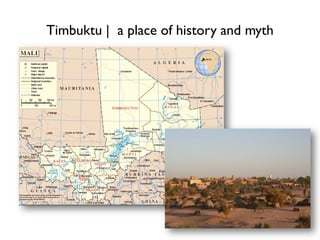
Timbuktu | a place of history and myth
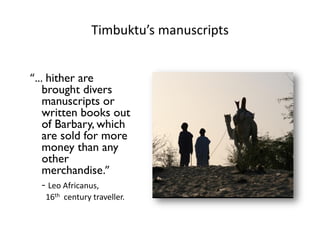
Timbuktu’s manuscripts
“… hither are
brought divers
manuscripts or
written books out
of Barbary, which
are sold for more
money than any
other
merchandise.”
- Leo Africanus,
16th century traveller.
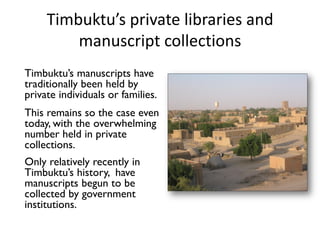
Timbuktu’s private libraries and
manuscript collections
Timbuktu’s manuscripts have
traditionally been held by
private individuals or families.
This remains so the case even
today, with the overwhelming
number held in private
collections.
Only relatively recently in
Timbuktu’s history, have
manuscripts begun to be
collected by government
institutions.
Timbuktu | geography and climate
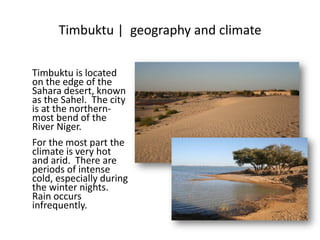
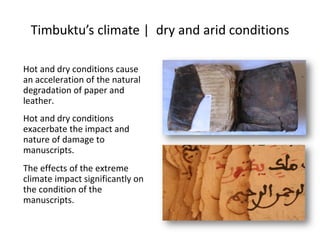
Timbuktu is located
on the edge of the
Sahara desert, known
as the Sahel. The city
is at the northern-
most bend of the
River Niger.
For the most part the
climate is very hot
and arid. There are
periods of intense
cold, especially during
the winter nights.
Rain occurs
infrequently.
Timbuktu’s climate | dry and arid conditions
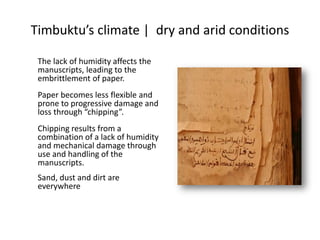
Hot and dry conditions cause
an acceleration of the natural
degradation of paper and
leather.
Hot and dry conditions
exacerbate the impact and
nature of damage to
manuscripts.
The effects of the extreme
climate impact significantly on
the condition of the
manuscripts.
Timbuktu’s climate | dry and arid conditions
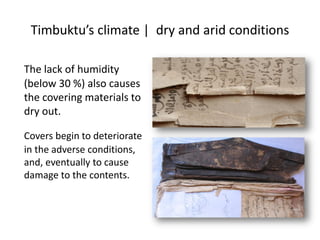
The lack of humidity affects the
manuscripts, leading to the
embrittlement of paper.
Paper becomes less flexible and
prone to progressive damage and
loss through “chipping”.
Chipping results from a
combination of a lack of humidity
and mechanical damage through
use and handling of the
manuscripts.
Sand, dust and dirt are
everywhere
Timbuktu’s climate | dry and arid conditions
The lack of humidity
(below 30 %) also causes
the covering materials to
dry out.
Covers begin to deteriorate
in the adverse conditions,
and, eventually to cause
damage to the contents.
Timbuktu’s climate | dry and arid conditions
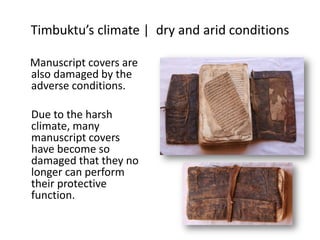
Manuscript covers are
also damaged by the
adverse conditions.
Due to the harsh
climate, many
manuscript covers
have become so
damaged that they no
longer can perform
their protective
function.
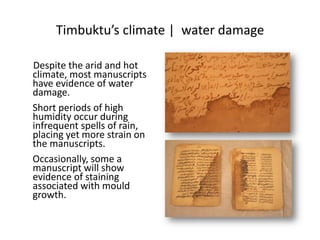
Timbuktu’s climate | water damage
Despite the arid and hot
climate, most manuscripts
have evidence of water
damage.
Short periods of high
humidity occur during
infrequent spells of rain,
placing yet more strain on
the manuscripts.
Occasionally, some a
manuscript will show
evidence of staining
associated with mould
growth.
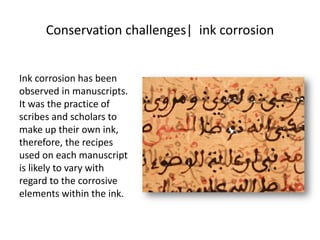
Conservation challenges| ink corrosion
Ink corrosion has been
observed in manuscripts.
It was the practice of
scribes and scholars to
make up their own ink,
therefore, the recipes
used on each manuscript
is likely to vary with
regard to the corrosive
elements within the ink.
Conservation challenges| damaged covers
Covers that have ceased
to perform their
protective functions pose
a conservation challenge.
Ethical conservation
treatment requires the
respect of the context
of the manuscript, it
has a history. – means
keeping all items.
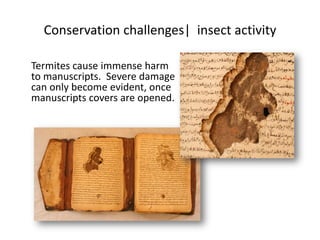
Conservation challenges| insect activity
Termites cause immense harm
to manuscripts. Severe damage
can only become evident, once
manuscripts covers are opened.
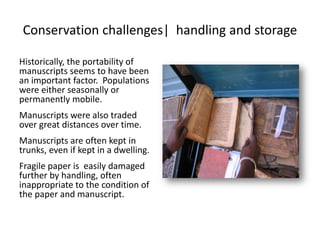
Conservation challenges| handling and storage
Historically, the portability of
manuscripts seems to have been
an important factor. Populations
were either seasonally or
permanently mobile.
Manuscripts were also traded
over great distances over time.
Manuscripts are often kept in
trunks, even if kept in a dwelling.
Fragile paper is easily damaged
further by handling, often
inappropriate to the condition of
the paper and manuscript.
Conservation challenges| inappropriate
conservation methods and training
Sustainability was an important
factor in the design of the
conservation project.
Emphasis was placed on training
Malians in order to provide a pool
of skilled people, able to continue
conservation work independently
to ensure conservation activities
continued.
Additionally, to devise and teach
methods appropriate to the
climate and conditions found in
Timbuktu in collaboration with the
Malian counterparts.
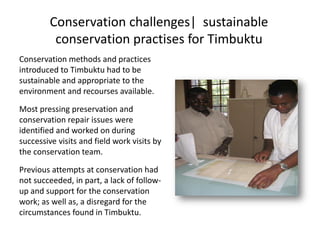
Conservation challenges| sustainable
conservation practises for Timbuktu
Conservation methods and practices
introduced to Timbuktu had to be
sustainable and appropriate to the
environment and recourses available.
Most pressing preservation and
conservation repair issues were
identified and worked on during
successive visits and field work visits by
the conservation team.
Previous attempts at conservation had
not succeeded, in part, a lack of follow-
up and support for the conservation
work; as well as, a disregard for the
circumstances found in Timbuktu.
Conservation challenges| sustainable
conservation practises for Timbuktu
Surface cleaning, with appropriate
techniques and tools.
Ditching white cotton gloves
provided by a previous
conservation project.
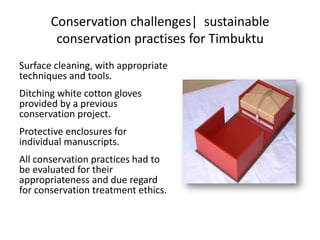
Protective enclosures for
individual manuscripts.
All conservation practices had to
be evaluated for their
appropriateness and due regard
for conservation treatment ethics.
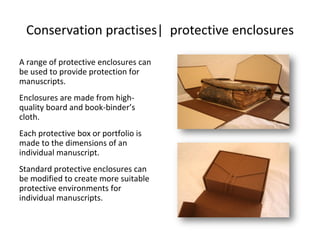
Conservation practises| protective enclosures
A range of protective enclosures can
be used to provide protection for
manuscripts.
Enclosures are made from high-
quality board and book-binder’s
cloth.
Each protective box or portfolio is
made to the dimensions of an
individual manuscript.
Standard protective enclosures can
be modified to create more suitable
protective environments for
individual manuscripts.
Conservation practises| surface cleaning
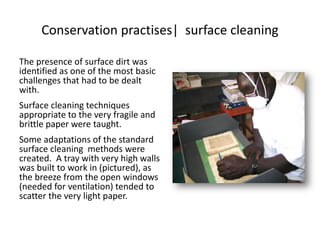
The presence of surface dirt was
identified as one of the most basic
challenges that had to be dealt
with.
Surface cleaning techniques
appropriate to the very fragile and
brittle paper were taught.
Some adaptations of the standard
surface cleaning methods were
created. A tray with very high walls
was built to work in (pictured), as
the breeze from the open windows
(needed for ventilation) tended to
scatter the very light paper.
Conservation practises| replacement covers
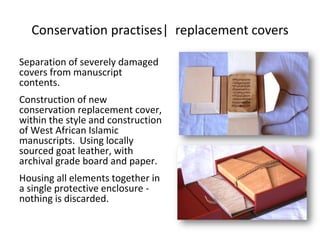
Separation of severely damaged
covers from manuscript
contents.
Construction of new
conservation replacement cover,
within the style and construction
of West African Islamic
manuscripts. Using locally
sourced goat leather, with
archival grade board and paper.
Housing all elements together in
a single protective enclosure -
nothing is discarded.
Conservation practises| supportive pillows for
covers
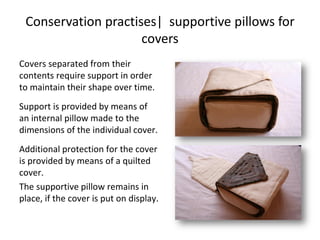
Covers separated from their
contents require support in order
to maintain their shape over time.
Support is provided by means of
an internal pillow made to the
dimensions of the individual cover.
Additional protection for the cover
is provided by means of a quilted
cover.
The supportive pillow remains in
place, if the cover is put on display.
Conservation practises| supportive pillows for
manuscript satchels
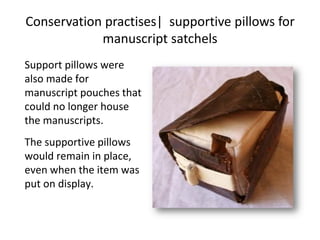
Support pillows were
also made for
manuscript pouches that
could no longer house
the manuscripts.
The supportive pillows
would remain in place,
even when the item was
put on display.
The manuscripts of Timbuktu | a distinct
tradition
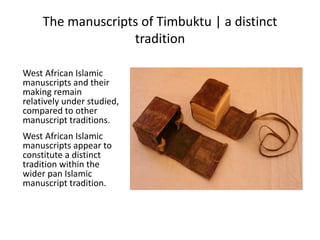
West African Islamic
manuscripts and their
making remain
relatively under studied,
compared to other
manuscript traditions.
West African Islamic
manuscripts appear to
constitute a distinct
tradition within the
wider pan Islamic
manuscript tradition.
The manuscripts of Timbuktu | part of a distinct
regional tradition
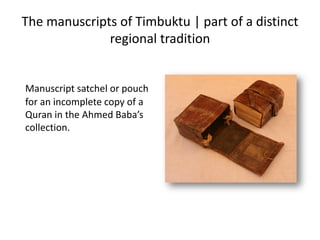
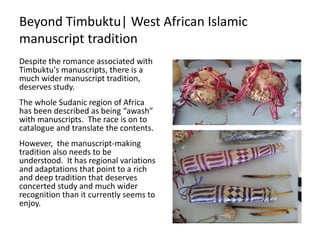
Manuscript satchel or pouch
for an incomplete copy of a
Quran in the Ahmed Baba’s
collection.
The manuscripts of Timbuktu | a distinct
tradition
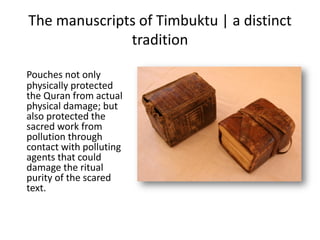
Pouches not only
physically protected
the Quran from actual
physical damage; but
also protected the
sacred work from
pollution through
contact with polluting
agents that could
damage the ritual
purity of the scared
text.
The manuscripts of Timbuktu | a distinct
tradition
Manuscript covers conformed
to general Islamic manuscript
structure and aesthetic; with
characteristics associated with
West African Islamic
manuscript composition,
namely the use of ties to bind
the manuscript when closed.
The manuscripts of Timbuktu | a distinct
tradition
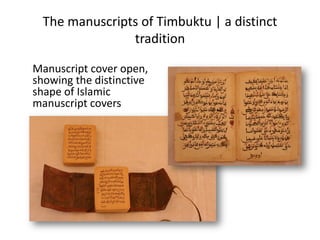
Manuscript cover open,
showing the distinctive
shape of Islamic
manuscript covers
The manuscripts of Timbuktu | evidence of
human agency in the making of a mss
Mastara made from
leather and string,
found at the start of
a manuscript.
Mastara are guides
used by scribes to
rule pages before
writing.
The manuscripts of Timbuktu | evidence of
human agency in the making of a mss
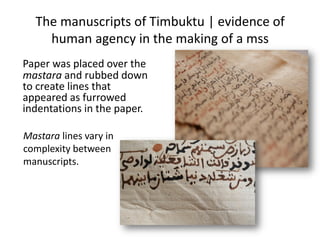
Paper was placed over the
mastara and rubbed down
to create lines that
appeared as furrowed
indentations in the paper.
Mastara lines vary in
complexity between
manuscripts.
The manuscripts of Timbuktu | evidence of
human agency in the making of a mss
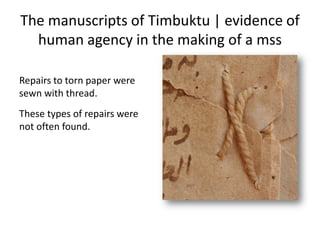
Repairs to torn paper were
sewn with thread.
These types of repairs were
not often found.
The manuscripts of Timbuktu | evidence of
human agency in the making of a mss
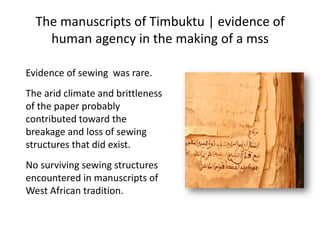
Evidence of sewing was rare.
The arid climate and brittleness
of the paper probably
contributed toward the
breakage and loss of sewing
structures that did exist.
No surviving sewing structures
encountered in manuscripts of
West African tradition.
The manuscripts of Timbuktu | textile
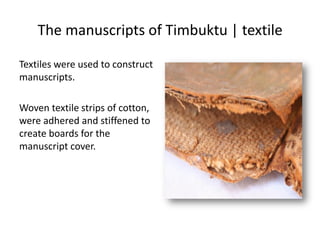
Textiles were used to construct
manuscripts.
Woven textile strips of cotton,
were adhered and stiffened to
create boards for the
manuscript cover.
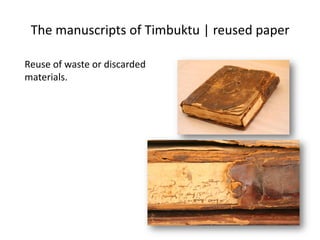
The manuscripts of Timbuktu | reused paper
Reuse of waste or discarded
materials.
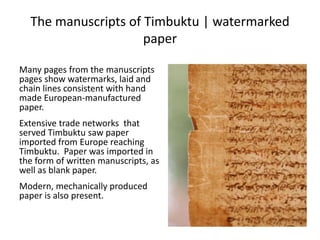
The manuscripts of Timbuktu | watermarked
paper
Many pages from the manuscripts
pages show watermarks, laid and
chain lines consistent with hand
made European-manufactured
paper.
Extensive trade networks that
served Timbuktu saw paper
imported from Europe reaching
Timbuktu. Paper was imported in
the form of written manuscripts, as
well as blank paper.
Modern, mechanically produced
paper is also present.
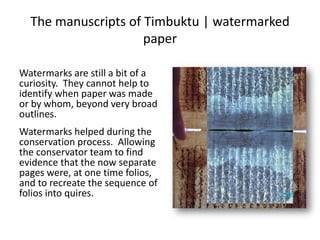
The manuscripts of Timbuktu | watermarked
paper
Watermarks are still a bit of a
curiosity. They cannot help to
identify when paper was made
or by whom, beyond very broad
outlines.
Watermarks helped during the
conservation process. Allowing
the conservator team to find
evidence that the now separate
pages were, at one time folios,
and to recreate the sequence of
folios into quires.
The manuscripts of Timbuktu | watermarked
paper
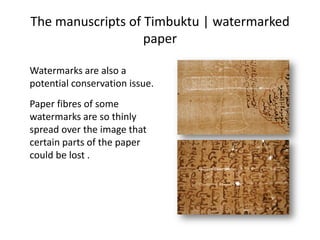
Watermarks are also a
potential conservation issue.
Paper fibres of some
watermarks are so thinly
spread over the image that
certain parts of the paper
could be lost .
Indigenous craft and manufacturing knowledge|
leather work
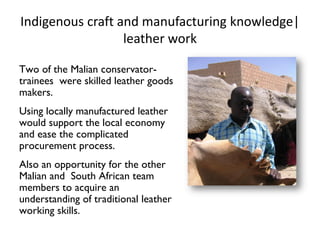
Two of the Malian conservator-
trainees were skilled leather goods
makers.
Using locally manufactured leather
would support the local economy
and ease the complicated
procurement process.
Also an opportunity for the other
Malian and South African team
members to acquire an
understanding of traditional leather
working skills.
Indigenous craft and manufacturing knowledge|
leather work
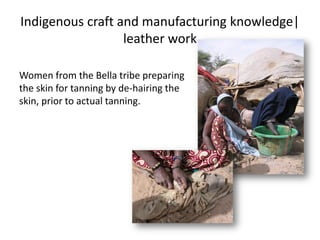
Women from the Bella tribe preparing
the skin for tanning by de-hairing the
skin, prior to actual tanning.
Indigenous craft and manufacturing knowledge|
leather work
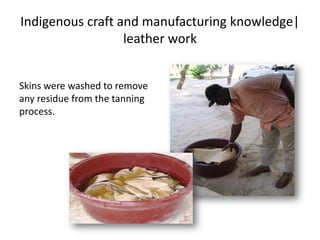
Skins were washed to remove
any residue from the tanning
process.
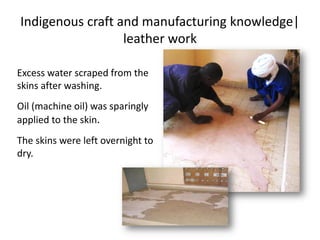
Indigenous craft and manufacturing knowledge|
leather work
Excess water scraped from the
skins after washing.
Oil (machine oil) was sparingly
applied to the skin.
The skins were left overnight to
dry.
Indigenous craft and manufacturing knowledge|
leather work
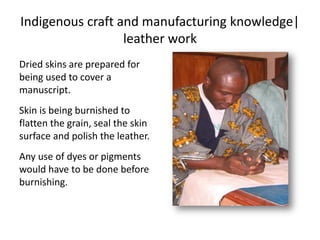
Dried skins are prepared for
being used to cover a
manuscript.
Skin is being burnished to
flatten the grain, seal the skin
surface and polish the leather.
Any use of dyes or pigments
would have to be done before
burnishing.
Indigenous craft and manufacturing knowledge|
leather work
After the leather’s
burnishing, the leather was
pared down to create a more
flexible skin that allowed for
the opening and closing of
cover.
Beyond Timbuktu| West African Islamic
manuscript tradition
Despite the romance associated with
Timbuktu's manuscripts, there is a
much wider manuscript tradition,
deserves study.
The whole Sudanic region of Africa
has been described as being “awash”
with manuscripts. The race is on to
catalogue and translate the contents.
However, the manuscript-making
tradition also needs to be
understood. It has regional variations
and adaptations that point to a rich
and deep tradition that deserves
concerted study and much wider
recognition than it currently seems to
enjoy.
Beyond Timbuktu| West African Islamic
manuscript tradition
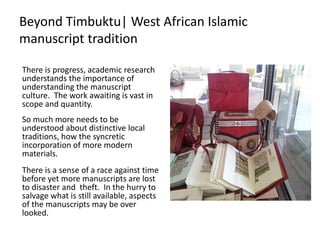
There is progress, academic research
understands the importance of
understanding the manuscript
culture. The work awaiting is vast in
scope and quantity.
So much more needs to be
understood about distinctive local
traditions, how the syncretic
incorporation of more modern
materials.
There is a sense of a race against time
before yet more manuscripts are lost
to disaster and theft. In the hurry to
salvage what is still available, aspects
of the manuscripts may be over
looked.
Thank you

IFLA-illustrated-presentation June2015

  • 1.
    Timbuktu Manuscripts Project Lessonsin understanding and preserving Africa’s manuscript heritage
  • 2.
    Timbuktu | aplace of history and myth
  • 3.
    Timbuktu’s manuscripts “… hitherare brought divers manuscripts or written books out of Barbary, which are sold for more money than any other merchandise.” - Leo Africanus, 16th century traveller.
  • 4.
    Timbuktu’s private librariesand manuscript collections Timbuktu’s manuscripts have traditionally been held by private individuals or families. This remains so the case even today, with the overwhelming number held in private collections. Only relatively recently in Timbuktu’s history, have manuscripts begun to be collected by government institutions.
  • 5.
    Timbuktu | geographyand climate Timbuktu is located on the edge of the Sahara desert, known as the Sahel. The city is at the northern- most bend of the River Niger. For the most part the climate is very hot and arid. There are periods of intense cold, especially during the winter nights. Rain occurs infrequently.
  • 6.
    Timbuktu’s climate |dry and arid conditions Hot and dry conditions cause an acceleration of the natural degradation of paper and leather. Hot and dry conditions exacerbate the impact and nature of damage to manuscripts. The effects of the extreme climate impact significantly on the condition of the manuscripts.
  • 7.
    Timbuktu’s climate |dry and arid conditions The lack of humidity affects the manuscripts, leading to the embrittlement of paper. Paper becomes less flexible and prone to progressive damage and loss through “chipping”. Chipping results from a combination of a lack of humidity and mechanical damage through use and handling of the manuscripts. Sand, dust and dirt are everywhere
  • 8.
    Timbuktu’s climate |dry and arid conditions The lack of humidity (below 30 %) also causes the covering materials to dry out. Covers begin to deteriorate in the adverse conditions, and, eventually to cause damage to the contents.
  • 9.
    Timbuktu’s climate |dry and arid conditions Manuscript covers are also damaged by the adverse conditions. Due to the harsh climate, many manuscript covers have become so damaged that they no longer can perform their protective function.
  • 10.
    Timbuktu’s climate |water damage Despite the arid and hot climate, most manuscripts have evidence of water damage. Short periods of high humidity occur during infrequent spells of rain, placing yet more strain on the manuscripts. Occasionally, some a manuscript will show evidence of staining associated with mould growth.
  • 11.
    Conservation challenges| inkcorrosion Ink corrosion has been observed in manuscripts. It was the practice of scribes and scholars to make up their own ink, therefore, the recipes used on each manuscript is likely to vary with regard to the corrosive elements within the ink.
  • 12.
    Conservation challenges| damagedcovers Covers that have ceased to perform their protective functions pose a conservation challenge. Ethical conservation treatment requires the respect of the context of the manuscript, it has a history. – means keeping all items.
  • 13.
    Conservation challenges| insectactivity Termites cause immense harm to manuscripts. Severe damage can only become evident, once manuscripts covers are opened.
  • 14.
    Conservation challenges| handlingand storage Historically, the portability of manuscripts seems to have been an important factor. Populations were either seasonally or permanently mobile. Manuscripts were also traded over great distances over time. Manuscripts are often kept in trunks, even if kept in a dwelling. Fragile paper is easily damaged further by handling, often inappropriate to the condition of the paper and manuscript.
  • 15.
    Conservation challenges| inappropriate conservationmethods and training Sustainability was an important factor in the design of the conservation project. Emphasis was placed on training Malians in order to provide a pool of skilled people, able to continue conservation work independently to ensure conservation activities continued. Additionally, to devise and teach methods appropriate to the climate and conditions found in Timbuktu in collaboration with the Malian counterparts.
  • 16.
    Conservation challenges| sustainable conservationpractises for Timbuktu Conservation methods and practices introduced to Timbuktu had to be sustainable and appropriate to the environment and recourses available. Most pressing preservation and conservation repair issues were identified and worked on during successive visits and field work visits by the conservation team. Previous attempts at conservation had not succeeded, in part, a lack of follow- up and support for the conservation work; as well as, a disregard for the circumstances found in Timbuktu.
  • 17.
    Conservation challenges| sustainable conservationpractises for Timbuktu Surface cleaning, with appropriate techniques and tools. Ditching white cotton gloves provided by a previous conservation project. Protective enclosures for individual manuscripts. All conservation practices had to be evaluated for their appropriateness and due regard for conservation treatment ethics.
  • 18.
    Conservation practises| protectiveenclosures A range of protective enclosures can be used to provide protection for manuscripts. Enclosures are made from high- quality board and book-binder’s cloth. Each protective box or portfolio is made to the dimensions of an individual manuscript. Standard protective enclosures can be modified to create more suitable protective environments for individual manuscripts.
  • 19.
    Conservation practises| surfacecleaning The presence of surface dirt was identified as one of the most basic challenges that had to be dealt with. Surface cleaning techniques appropriate to the very fragile and brittle paper were taught. Some adaptations of the standard surface cleaning methods were created. A tray with very high walls was built to work in (pictured), as the breeze from the open windows (needed for ventilation) tended to scatter the very light paper.
  • 20.
    Conservation practises| replacementcovers Separation of severely damaged covers from manuscript contents. Construction of new conservation replacement cover, within the style and construction of West African Islamic manuscripts. Using locally sourced goat leather, with archival grade board and paper. Housing all elements together in a single protective enclosure - nothing is discarded.
  • 21.
    Conservation practises| supportivepillows for covers Covers separated from their contents require support in order to maintain their shape over time. Support is provided by means of an internal pillow made to the dimensions of the individual cover. Additional protection for the cover is provided by means of a quilted cover. The supportive pillow remains in place, if the cover is put on display.
  • 22.
    Conservation practises| supportivepillows for manuscript satchels Support pillows were also made for manuscript pouches that could no longer house the manuscripts. The supportive pillows would remain in place, even when the item was put on display.
  • 23.
    The manuscripts ofTimbuktu | a distinct tradition West African Islamic manuscripts and their making remain relatively under studied, compared to other manuscript traditions. West African Islamic manuscripts appear to constitute a distinct tradition within the wider pan Islamic manuscript tradition.
  • 24.
    The manuscripts ofTimbuktu | part of a distinct regional tradition Manuscript satchel or pouch for an incomplete copy of a Quran in the Ahmed Baba’s collection.
  • 25.
    The manuscripts ofTimbuktu | a distinct tradition Pouches not only physically protected the Quran from actual physical damage; but also protected the sacred work from pollution through contact with polluting agents that could damage the ritual purity of the scared text.
  • 26.
    The manuscripts ofTimbuktu | a distinct tradition Manuscript covers conformed to general Islamic manuscript structure and aesthetic; with characteristics associated with West African Islamic manuscript composition, namely the use of ties to bind the manuscript when closed.
  • 27.
    The manuscripts ofTimbuktu | a distinct tradition Manuscript cover open, showing the distinctive shape of Islamic manuscript covers
  • 28.
    The manuscripts ofTimbuktu | evidence of human agency in the making of a mss Mastara made from leather and string, found at the start of a manuscript. Mastara are guides used by scribes to rule pages before writing.
  • 29.
    The manuscripts ofTimbuktu | evidence of human agency in the making of a mss Paper was placed over the mastara and rubbed down to create lines that appeared as furrowed indentations in the paper. Mastara lines vary in complexity between manuscripts.
  • 30.
    The manuscripts ofTimbuktu | evidence of human agency in the making of a mss Repairs to torn paper were sewn with thread. These types of repairs were not often found.
  • 31.
    The manuscripts ofTimbuktu | evidence of human agency in the making of a mss Evidence of sewing was rare. The arid climate and brittleness of the paper probably contributed toward the breakage and loss of sewing structures that did exist. No surviving sewing structures encountered in manuscripts of West African tradition.
  • 32.
    The manuscripts ofTimbuktu | textile Textiles were used to construct manuscripts. Woven textile strips of cotton, were adhered and stiffened to create boards for the manuscript cover.
  • 33.
    The manuscripts ofTimbuktu | reused paper Reuse of waste or discarded materials.
  • 34.
    The manuscripts ofTimbuktu | watermarked paper Many pages from the manuscripts pages show watermarks, laid and chain lines consistent with hand made European-manufactured paper. Extensive trade networks that served Timbuktu saw paper imported from Europe reaching Timbuktu. Paper was imported in the form of written manuscripts, as well as blank paper. Modern, mechanically produced paper is also present.
  • 35.
    The manuscripts ofTimbuktu | watermarked paper Watermarks are still a bit of a curiosity. They cannot help to identify when paper was made or by whom, beyond very broad outlines. Watermarks helped during the conservation process. Allowing the conservator team to find evidence that the now separate pages were, at one time folios, and to recreate the sequence of folios into quires.
  • 36.
    The manuscripts ofTimbuktu | watermarked paper Watermarks are also a potential conservation issue. Paper fibres of some watermarks are so thinly spread over the image that certain parts of the paper could be lost .
  • 37.
    Indigenous craft andmanufacturing knowledge| leather work Two of the Malian conservator- trainees were skilled leather goods makers. Using locally manufactured leather would support the local economy and ease the complicated procurement process. Also an opportunity for the other Malian and South African team members to acquire an understanding of traditional leather working skills.
  • 38.
    Indigenous craft andmanufacturing knowledge| leather work Women from the Bella tribe preparing the skin for tanning by de-hairing the skin, prior to actual tanning.
  • 39.
    Indigenous craft andmanufacturing knowledge| leather work Skins were washed to remove any residue from the tanning process.
  • 40.
    Indigenous craft andmanufacturing knowledge| leather work Excess water scraped from the skins after washing. Oil (machine oil) was sparingly applied to the skin. The skins were left overnight to dry.
  • 41.
    Indigenous craft andmanufacturing knowledge| leather work Dried skins are prepared for being used to cover a manuscript. Skin is being burnished to flatten the grain, seal the skin surface and polish the leather. Any use of dyes or pigments would have to be done before burnishing.
  • 42.
    Indigenous craft andmanufacturing knowledge| leather work After the leather’s burnishing, the leather was pared down to create a more flexible skin that allowed for the opening and closing of cover.
  • 43.
    Beyond Timbuktu| WestAfrican Islamic manuscript tradition Despite the romance associated with Timbuktu's manuscripts, there is a much wider manuscript tradition, deserves study. The whole Sudanic region of Africa has been described as being “awash” with manuscripts. The race is on to catalogue and translate the contents. However, the manuscript-making tradition also needs to be understood. It has regional variations and adaptations that point to a rich and deep tradition that deserves concerted study and much wider recognition than it currently seems to enjoy.
  • 44.
    Beyond Timbuktu| WestAfrican Islamic manuscript tradition There is progress, academic research understands the importance of understanding the manuscript culture. The work awaiting is vast in scope and quantity. So much more needs to be understood about distinctive local traditions, how the syncretic incorporation of more modern materials. There is a sense of a race against time before yet more manuscripts are lost to disaster and theft. In the hurry to salvage what is still available, aspects of the manuscripts may be over looked.
  • 45.