Introduction
Inhalants are breathablechemical vapors or gases abused for their psychoactive effects.
These are usually among the first drugs used by young people.
Toluene is one of common constituent in many abused products.
Commonly abused inhalants in India are: ink eraser fluid/correction fluid, petrol and
adhesive glue.
Among US eighth graders, inhalants are among the most commonly used illicit drugs,
with about 11 percent reporting lifetime use.
With increasing age, prevalence of past-year inhalant use declines; most adolescents
discontinue their inhalant use and few people ever meet criteria for inhalant use
disorder.
DSM-5 describes inhalant use disorder, ICD-10 describes the following “mental and
behavioral disorders due to use of volatile solvents” and ICD-11 describes 6A4B
‘’Disorders due to use of volatile inhalants’’.
Classification
Inhalants can beclassified into four broad types, as follows:
(a) Volatile solvents are liquids that vaporize at room temperature if left in
unsealed containers. Paint thinner, gasoline, correction fluid, nail polish
remover and glue are some of examples
(b) Aerosols are sprays that contain propellants and solvents e.g. paint,
deodorant etc.
(c) Gases e.g. refrigerants and medical anesthetics
(d) Nitrites.
5.
Mode of administration
Inhalantscan be used by various modes of administration:
- huffing (soaking a rag and placing it on the mouth to inhale) – most
common
- sniffing/snorting (inhaling through the nose) the product after placement on the fingernails,
- bagging (inhaling from a bag that contains the substance),
- dusting (spraying directly into the mouth or nose),
- inhaling vapors from cotton balls or cotton swabs placed into the nose or mouth,
-breathing vapors from an inverted aerosol/spray can.
6.
Pharmacology of inhalantuse
• Abuse usually involves 15 to 20 deep breaths, which results in a rapid onset of
intoxication.
• Rebreathing the exhaled air may enhance the effect if the
breath is into a bag containing the inhalant.
• While the exact solvent concentration for one of the most commonly abused
inhalants, toluene, vary from 5,000 to 15,000 ppm (industrial maximum of 100 ppm
for exposure).
• A concentration that can produce temporary performance decrements after 6 to 8
hours of exposure.
• The intoxication achieved has been reported to continue from 15 to 60 min and can
be sustained for hours by either continuous or repeated vapor inhalation.
7.
• Tolerance appearsto develop that individuals will increase the number of tubes of glue they
inhale across days of abuse.
• Toluene and other inhalants can also be absorbed through the skin and the GI tract that
increases total body burden.
• Toluene blood levels can increase significantly with co-administration of ethanol, which can
dramatically increase levels of toxicity.
• Autoradiography studies have demonstrated high levels of radioactivity in body fat, the spinal
cord and spinal nerves, as well as the white matter of the brain in mice exposed to toluene
via inhalation.
• Several studies have shown that toluene exposure increases dopamine in the striatum, VTA
and prefrontal cortex.
• Repeated toluene exposure increases the amount of dopamine within the caudate and
nucleus accumbens.
8.
Neuroimaging in inhalantuse disorders
• Demyelination, brain shrinkage, and white matter damage (leukoencephalopathy).
• MRI has shown significant cerebral, cerebellar and brain stem atrophy, diffuse CNS
demyelination, sulcal widening, and enlargement of the ventricles in long-term
toluene abusers.
• T2-weighted MRI demonstrated that repeated toluene abuse led to significant
axonal damage and loss.
• Chronic high toluene concentrations producing deterioration of the frontal cortex,
the hippocampus, and brain stem as well as impaired dendritic outgrowth and
white matter damage.
• SPECT studies have shown that chronic inhalant abusers have significant decreases
in regional blood flow to the bilateral prefrontal cortices.
9.
Risk factors forinhalant use
• economically underprivileged, marginalized (e.g. street children)
• dropping out of school, delinquency
• conduct disorder/anti-social personality
• drug-using /delinquent peers
• psychiatric co-morbidity
• child abuse, low parental supervision, family instability
• family history of substance dependence
10.
When to suspect
a.Any discernible or unusual odor or stains on fingernails, body parts or
clothes
b. Presence of sniffer's rash around nose and mouth, rhinorrhea, injected
sclera
c. Appears to be under influence of a drug (e.g. drowsiness,
incoordination)
d. Deterioration in physical appearance
e. A recent change in child' behavior
f. Drop in school performance/ frequent absenteeism
g. Impairments in attention, memory or other cognitive functions
h. Secretive behavior regarding actions and possessions
i. Unusual borrowing/stealing of money from home or friends
11.
Inhalant intoxication
Acute effectsof inhalants resemble that of other CNS depressants e.g.
alcohol.
They comprise of stimulation, disinhibition and euphoria. It may be followed
by hallucinations and then a general depression including slurred speech
and disturbed gait, dizziness, disorientation, and drowsiness or sleep within
seconds to minutes.
Intoxication occurs rapidly and is relatively short-lived (average elimination
half-life for toluene from breath is 25 minutes).
Some users may self-administer inhalants repeatedly or continuously to
maintain intoxication.
12.
DSM-5: Inhalant Intoxication
A.Recent intentional use or short-term, high-dose exposure to volatile inhalants.
B. Clinically significant maladaptive behavioral or psychological changes that developed
during or shortly after inhalant use or exposure.
C. Two (or more) of the following signs, developing during, or shortly after, inhalant use
or exposure: dizziness, nystagmus, incoordination, slurred speech, unsteady gait,
lethargy, depressed reflexes, psychomotor retardation, tremor, generalized muscle
weakness, blurred vision or diplopia, stupor or coma, euphoria.
D. The symptoms are not due to a general medical condition and are not
better accounted for by another mental disorder.
13.
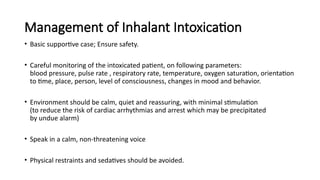
Management of InhalantIntoxication
• Basic supportive case; Ensure safety.
• Careful monitoring of the intoxicated patient, on following parameters:
blood pressure, pulse rate , respiratory rate, temperature, oxygen saturation, orientation
to time, place, person, level of consciousness, changes in mood and behavior.
• Environment should be calm, quiet and reassuring, with minimal stimulation
(to reduce the risk of cardiac arrhythmias and arrest which may be precipitated
by undue alarm)
• Speak in a calm, non-threatening voice
• Physical restraints and sedatives should be avoided.
14.
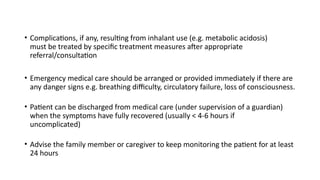
• Complications, ifany, resulting from inhalant use (e.g. metabolic acidosis)
must be treated by specific treatment measures after appropriate
referral/consultation
• Emergency medical care should be arranged or provided immediately if there are
any danger signs e.g. breathing difficulty, circulatory failure, loss of consciousness.
• Patient can be discharged from medical care (under supervision of a guardian)
when the symptoms have fully recovered (usually < 4-6 hours if
uncomplicated)
• Advise the family member or caregiver to keep monitoring the patient for at least
24 hours
15.
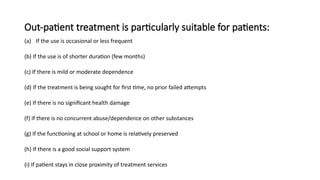
Out-patient treatment isparticularly suitable for patients:
(a) If the use is occasional or less frequent
(b) If the use is of shorter duration (few months)
(c) If there is mild or moderate dependence
(d) If the treatment is being sought for first time, no prior failed attempts
(e) If there is no significant health damage
(f) If there is no concurrent abuse/dependence on other substances
(g) If the functioning at school or home is relatively preserved
(h) If there is a good social support system
(i) If patient stays in close proximity of treatment services
16.
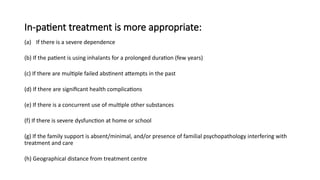
In-patient treatment ismore appropriate:
(a) If there is a severe dependence
(b) If the patient is using inhalants for a prolonged duration (few years)
(c) If there are multiple failed abstinent attempts in the past
(d) If there are significant health complications
(e) If there is a concurrent use of multiple other substances
(f) If there is severe dysfunction at home or school
(g) If the family support is absent/minimal, and/or presence of familial psychopathology interfering with
treatment and care
(h) Geographical distance from treatment centre
18.
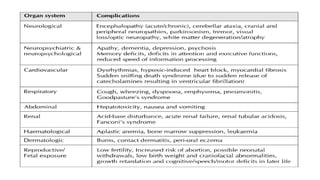
Complications
• Inhalant-related deathshave been reported from direct toxic effects of the drug,
aspiration, suffocation, flash burns, and accidental injury, among many other causes.
• Inhalant use is thought to increase myocardial cell depolarization, reducing
conductivity and predisposing to arrhythmia, especially when paired with increased
blood concentrations of epinephrine; this has sometimes been termed sudden
sniffer’s death.
• Significant cognitive and neurological impairments can be observed that include
personality changes, hallucinations, paranoid psychosis, memory and information-
processing deficits, decreased IQ, concentration problems, speech abnormalities,
impaired judgment, increased impulsivity, abnormal electroencephalogram (EEG)
activity.
• Nystagmus, vision loss, tinnitus and hearing loss.
19.
• Continuous long-termtoluene exposure has been reported to produce
neuronal damage to the hippocampus.
• Behavioral effects progress from motor excitation to motor impairment,
ataxia, loss of righting reflex, and finally anesthesia.
• Continued exposure to high concentrations results in coma, seizures, and
ultimately death by depression of respiration.
• One common practice of putting substances into plastic bags and then putting
the bag over the user’s head may result in unconsciousness and/or death
from suffocation.
• Death may also result indirectly from aspiration of either the compound or
vomit.
20.
• Fatalities havealso been reported as a direct result of the inhalant.
These include anoxia, asphyxiation. Inhalation of gas fuels like butane
has been shown to produce laryngeal edema as well as laryngospasm.
• The severe behavioral and physical impairments associated with
inhalant intoxication have resulted in trauma (i.e.,falling and car
accidents) that produced fatalities.
• Death has also been reported from fire-related injuries from inhalant
combustion.
• Chronic inhalant use has been linked to renal and haptic failure, as
well as liver tumors, which can also lead to death.
21.
Fetal solvent syndrome(FSS) or Toulene embyopathy
• So named because of their similarities to fetal alcohol syndrome.
• Infants who were born prematurely, delayed in growth, reduced head sizes,
hypoplastic mid-faces and jaws as well as lower set ears, shortened palpebral fissures,
thin upper lips, and deep-set eyes.
• Other features include downturned corners of the mouth, abnormal hair patterns on
the scalp, small fingernails with blunted finger tips, abnormal palmer creases, and
urinary tract deformities.
• Fetal death was also reported where maternal exposure was very high during
pregnancy.
• Follow-up studies with these FSS infants have demonstrated continued developmental
delays and impairments such as marked growth retardation, cerebellar dysfunction,
hyperactivity, language impairments, and elevated levels of aggression.
22.
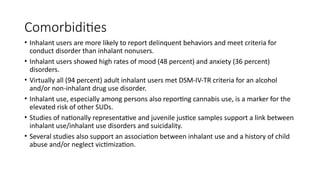
Comorbidities
• Inhalant usersare more likely to report delinquent behaviors and meet criteria for
conduct disorder than inhalant nonusers.
• Inhalant users showed high rates of mood (48 percent) and anxiety (36 percent)
disorders.
• Virtually all (94 percent) adult inhalant users met DSM-IV-TR criteria for an alcohol
and/or non-inhalant drug use disorder.
• Inhalant use, especially among persons also reporting cannabis use, is a marker for the
elevated risk of other SUDs.
• Studies of nationally representative and juvenile justice samples support a link between
inhalant use/inhalant use disorders and suicidality.
• Several studies also support an association between inhalant use and a history of child
abuse and/or neglect victimization.
23.
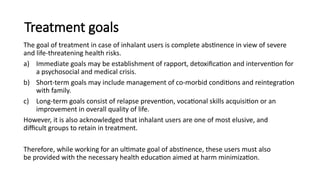
Treatment goals
The goalof treatment in case of inhalant users is complete abstinence in view of severe
and life-threatening health risks.
a) Immediate goals may be establishment of rapport, detoxification and intervention for
a psychosocial and medical crisis.
b) Short-term goals may include management of co-morbid conditions and reintegration
with family.
c) Long-term goals consist of relapse prevention, vocational skills acquisition or an
improvement in overall quality of life.
However, it is also acknowledged that inhalant users are one of most elusive, and
difficult groups to retain in treatment.
Therefore, while working for an ultimate goal of abstinence, these users must also
be provided with the necessary health education aimed at harm minimization.
24.
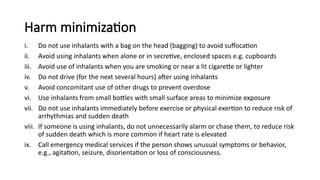
Harm minimization
i. Donot use inhalants with a bag on the head (bagging) to avoid suffocation
ii. Avoid using inhalants when alone or in secretive, enclosed spaces e.g. cupboards
iii. Avoid use of inhalants when you are smoking or near a lit cigarette or lighter
iv. Do not drive (for the next several hours) after using inhalants
v. Avoid concomitant use of other drugs to prevent overdose
vi. Use inhalants from small bottles with small surface areas to minimize exposure
vii. Do not use inhalants immediately before exercise or physical exertion to reduce risk of
arrhythmias and sudden death
viii. If someone is using inhalants, do not unnecessarily alarm or chase them, to reduce risk
of sudden death which is more common if heart rate is elevated
ix. Call emergency medical services if the person shows unusual symptoms or behavior,
e.g., agitation, seizure, disorientation or loss of consciousness.
25.
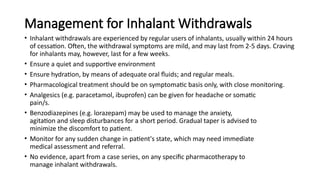
Management for InhalantWithdrawals
• Inhalant withdrawals are experienced by regular users of inhalants, usually within 24 hours
of cessation. Often, the withdrawal symptoms are mild, and may last from 2-5 days. Craving
for inhalants may, however, last for a few weeks.
• Ensure a quiet and supportive environment
• Ensure hydration, by means of adequate oral fluids; and regular meals.
• Pharmacological treatment should be on symptomatic basis only, with close monitoring.
• Analgesics (e.g. paracetamol, ibuprofen) can be given for headache or somatic
pain/s.
• Benzodiazepines (e.g. lorazepam) may be used to manage the anxiety,
agitation and sleep disturbances for a short period. Gradual taper is advised to
minimize the discomfort to patient.
• Monitor for any sudden change in patient's state, which may need immediate
medical assessment and referral.
• No evidence, apart from a case series, on any specific pharmacotherapy to
manage inhalant withdrawals.
26.
PSYCHOSOCIAL INTERVENTIONS
• Psychosocialtreatment should be offered to all inhalant users.
• Psychological interventions for inhalant users should be kept as brief (e.g., 20-
minute sessions) in the initial few months. This is because the attention span and
other cognitive functions are often impaired to a varying degree.
• Deviant or drug using peers have a powerful influence on adolescent drug use. It
is often necessary to work towards building an alternate group of non-drug using
friends in the course of therapy.
• Emphasis should be placed on retry into school and school re-adjustment
issues.
• The management should also focus on imparting life skills training and vocational
skills training for older inhalant abusers to promote self-sufficiency
• Extensive aftercare and follow-up period, extending as many as 2 years, is
advisable.
27.
Specific therapies
• BriefIntervention
• Targeted education
• CBT based approaches
• Supportive psychotherapy
• Narrative therapy
• Contingency management
• Person-centered general counselling
• Family based approaches
• Activity and engagement based approaches
• Life Skills based approaches
• Residential rehabilitation
28.
MANAGEMENT OF CO-MORBIDCONDITIONS
• Careful history and mental state examination (especially for attention
deficit/hyperactivity disorders, learning disorders, oppositional defiant
disorder, conduct disorder, etc).
• Inhalant-induced psychiatric disorders are likely to subside with supportive
treatment and maintenance of abstinence. Specific psychotropic medications
are not warranted, unless the symptoms are severe, risky or life-threatening.
• Inhalant users are more likely to have underlying neurological damage, and
consequently, may be more susceptible to develop adverse effects. May avoid
typical antipsychotics.
• Medication, if needed, must be started at low dose and increased very
gradually (start low, go slow) with close monitoring.
29.
Take home points
•Toulene is the active ingredient in many inhalant solvents.
• Volatile inhalant use is the only substance use that is more prevalent in
children and adolescents compared to adults.
• Volatile inhalant use cause demyelination and less features of intoxication
and withdrawal symptoms with serious longterm irreversible complications.
• There is no evidence acute and long-term pharmacotherapy for volatile
inhalant use pharmacotherapy targets symptomatic treatment and
treatment of comorbidities.
• Mainstay treatment include long-term multidisciplinary psychosocial
interventions with need for lot of patience with poor follow-up rates.