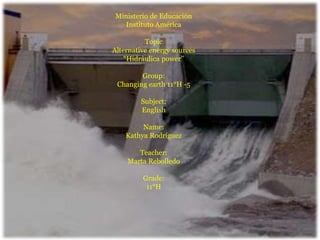
Ministerio de Educación
  Instituto América

          Topic
Alternative energy sources
    “Hidráulica power’’

        Group:
 Changing earth 11°H -5

         Subject:
         English

         Name:
    Kathya Rodríguez

       Teacher:
    Marta Rebolledo

         Grade:
          11°H
Introduction

The hydraulic power is that one who
takes advantage of two qualities of
the water currents: the speed and
the position (kinetic and potential
energy). The idea is very simple and
though it does not seem it removes
using for hundreds of years: we all
have seen mills that take advantage
of the flow of a river to move a series
of mechanisms that realize a work.
Hydraulic power:
                                      Definition:
    we must begin for defining hydroelectricity the same one it is a natural available resource in the
    zones that present sufficient quantity of water.

•   Also we can define it that one that is obtained of the utilization of the energies kinetic and
    potentially of the current of the water, jumps of water or tides.
Since it is the hydraulic power
    and since it is effected:


                                  Is a type of green energy when his environmental impact is
                                  minimal and uses the water force without repressing her, in
                                  opposite case it is considered to be only a form of renewable
                                  energy
Some advantages and disadvantages of the hydraulic power:


    advantages
                                                         Disadvantages
1. is inexhaustible whereas it does not change the
hydrological cycle.                                  1 High cost in the initial installation.

2 It has a low cost of maintenance.                  2 Great environmental impacts in case of
                                                     hydroelectric power stations
3 It has a low impact in the environment.

4 It has long life.

5 It is possible to use both for small
consumptions and for industrial level.
Benefits:


•    The hydraulic power is a generating source of so many resources since across the same one we
    obtain of the water (this one is a renewable resource) this water it is possible to collect and retain
    by means of dams. Part of the stored water is left to go out in order that one moves the blades of a
    turbine geared into a generator of electric power
The hydraulic machines can qualify attending to different criteria

                                                           •    According to the type of exchange
     1. According to the variation of energy


     In the hydraulic engines, the energy of the fluid         Bearing in mind the way in which the energy
     that crosses the machine diminishes, mechanical
                                                           exchanges inside the machine his classification it can be
     energy being obtained, whereas in case of
     hydraulic generators, the process is the inverse      like that:
     one, so that the fluid increases his energy on
     having crossed the machine.                           •     Machines of positive or volumetric displacement. It
                                                                is a question of one of the most ancient types of
•    Attending to the fluid type of energy dynamics that        hydraulic machines and they are based on the
    is exchanged across the machine we have:                    displacement of a volume of fluid compressing it.
                                                                The clearest example of this type of machines is the
•            Machines in which there takes place a              pump for bicycles. They supply a flow that is not
    variation of the potential energy, as for example           constant; to avoid it in occasions several join to
    Arquimedes's screw.                                         achieve a major uniformity. These machines are
                                                                adapted for supplies of high pressure and low
•    ·       Machines in which there takes place a
                                                                caudal
    variation of the kinetic energy, as for example wind
    generators, propellers or turbine pelton. These are
    named machines of action and do not have
    framework.

•    ·       Machines in which there takes place a
    variation of the entalpía (pressure), as for example
    the centrifugal bombs. These machines are named
    machines of reaction.
The hydraulic machines can qualify attending to different criteria


•      According to the encirclement                          •    According to the movement


                                                     •    Other criteria exist, as the division in rotary
    According to the encirclement
                                                          and alternative, depending on if the organ
                                                          interchanger of energy has a rotary or
Attending to the presence or not of framework:
                                                          alternative movement, this classification is
Machines since they can be the machines of                very intuitive but he does not attend initially
action.                                                   basic of functioning of these machines.
conclusion


•
    Hydropower has the quality to be renewable, it does not exhaust the primary source to exploit it,
    and it is clean, because its operation produces no pollutants of any kind. However, the
    environmental impact of large dams, for the severe alteration of the landscape and even the
    induction of a distinct microclimate at your site, have undeserved kindness ecological concept in
    recent years.
    At the same time, the maturity of the operation means that in developed countries are not only
    attractive locations for developing new hydroelectric plants.

Inglz pwp

  • 1.
    Ministerio de Educación Instituto América Topic Alternative energy sources “Hidráulica power’’ Group: Changing earth 11°H -5 Subject: English Name: Kathya Rodríguez Teacher: Marta Rebolledo Grade: 11°H
  • 2.
    Introduction The hydraulic poweris that one who takes advantage of two qualities of the water currents: the speed and the position (kinetic and potential energy). The idea is very simple and though it does not seem it removes using for hundreds of years: we all have seen mills that take advantage of the flow of a river to move a series of mechanisms that realize a work.
  • 3.
    Hydraulic power: Definition: we must begin for defining hydroelectricity the same one it is a natural available resource in the zones that present sufficient quantity of water. • Also we can define it that one that is obtained of the utilization of the energies kinetic and potentially of the current of the water, jumps of water or tides.
  • 4.
    Since it isthe hydraulic power and since it is effected: Is a type of green energy when his environmental impact is minimal and uses the water force without repressing her, in opposite case it is considered to be only a form of renewable energy
  • 5.
    Some advantages anddisadvantages of the hydraulic power: advantages Disadvantages 1. is inexhaustible whereas it does not change the hydrological cycle. 1 High cost in the initial installation. 2 It has a low cost of maintenance. 2 Great environmental impacts in case of hydroelectric power stations 3 It has a low impact in the environment. 4 It has long life. 5 It is possible to use both for small consumptions and for industrial level.
  • 6.
    Benefits: • The hydraulic power is a generating source of so many resources since across the same one we obtain of the water (this one is a renewable resource) this water it is possible to collect and retain by means of dams. Part of the stored water is left to go out in order that one moves the blades of a turbine geared into a generator of electric power
  • 7.
    The hydraulic machinescan qualify attending to different criteria • According to the type of exchange 1. According to the variation of energy In the hydraulic engines, the energy of the fluid Bearing in mind the way in which the energy that crosses the machine diminishes, mechanical exchanges inside the machine his classification it can be energy being obtained, whereas in case of hydraulic generators, the process is the inverse like that: one, so that the fluid increases his energy on having crossed the machine. • Machines of positive or volumetric displacement. It is a question of one of the most ancient types of • Attending to the fluid type of energy dynamics that hydraulic machines and they are based on the is exchanged across the machine we have: displacement of a volume of fluid compressing it. The clearest example of this type of machines is the • Machines in which there takes place a pump for bicycles. They supply a flow that is not variation of the potential energy, as for example constant; to avoid it in occasions several join to Arquimedes's screw. achieve a major uniformity. These machines are adapted for supplies of high pressure and low • · Machines in which there takes place a caudal variation of the kinetic energy, as for example wind generators, propellers or turbine pelton. These are named machines of action and do not have framework. • · Machines in which there takes place a variation of the entalpía (pressure), as for example the centrifugal bombs. These machines are named machines of reaction.
  • 8.
    The hydraulic machinescan qualify attending to different criteria • According to the encirclement • According to the movement • Other criteria exist, as the division in rotary According to the encirclement and alternative, depending on if the organ interchanger of energy has a rotary or Attending to the presence or not of framework: alternative movement, this classification is Machines since they can be the machines of very intuitive but he does not attend initially action. basic of functioning of these machines.
  • 9.
    conclusion • Hydropower has the quality to be renewable, it does not exhaust the primary source to exploit it, and it is clean, because its operation produces no pollutants of any kind. However, the environmental impact of large dams, for the severe alteration of the landscape and even the induction of a distinct microclimate at your site, have undeserved kindness ecological concept in recent years. At the same time, the maturity of the operation means that in developed countries are not only attractive locations for developing new hydroelectric plants.