Infrastructure Engineering
& Construction Techniques
Department of Civil Engineering
Indira College of Engineering and Management Pune.
Unit-1_Part-5
Outline_Recap
1. Salient features of smart city
2. Permanent way,
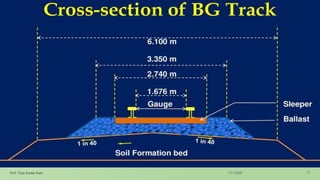
3. Track structure of BG,
4. Functions of rail
7/17/2020Prof. Vijay Kumar Saini 2
Outline
❖Standard rail,
❖Tilting of rail,
❖Coning of wheels,
❖Types of sleepers,
7/17/2020Prof. Vijay Kumar Saini 3
1.1 Standard Rail
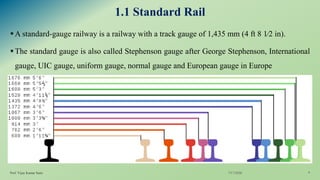
▪A standard-gauge railway is a railway with a track gauge of 1,435 mm (4 ft 8 1⁄2 in).
▪The standard gauge is also called Stephenson gauge after George Stephenson, International
gauge, UIC gauge, uniform gauge, normal gauge and European gauge in Europe
7/17/2020Prof. Vijay Kumar Saini 4
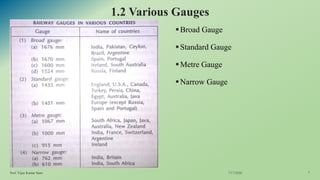
1.2 Various Gauges
7/17/2020Prof. Vijay Kumar Saini 5
▪Broad Gauge
▪Standard Gauge
▪Metre Gauge
▪Narrow Gauge
1.3 Factors Affecting choice of a Gauge
1. Traffic Condition
2. Development of poor areas
3. Cost of track
4. Speed of Movement
5. Nature of Country
7/17/2020Prof. Vijay Kumar Saini 6
1.3 Benefits of Uniformity of Gauges
1. Difficulties to passengers
2. Difficulties for sending goods
3. Inefficient use of rolling stock
4. Difficulty in war
5. Equipment at station
6. Hindrance for future conversion
7/17/2020Prof. Vijay Kumar Saini 7
2.1 Coning of Wheels
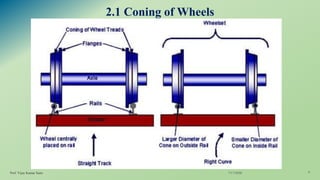
▪In coning of wheel the tread or rim of wheels of railway vehicles is made in the shape of a
cone with the slope of about 1 in 20.
▪It maintains vehicle in the central position w.r.t. the track. On straight track, portions of
wheels running on track have same diameter.
▪While on curved path, the outer wheel has to cover larger distance than the inner wheel.
Thus, the portions of wheels running on track have different diameters which help in
smooth running of wheels.
7/17/2020Prof. Vijay Kumar Saini 8
7/17/2020Prof. Vijay Kumar Saini 9
2.1 Coning of Wheels
2.2 Coning of Wheels_Advantages
▪Smooth riding - Help vehicle to negotiate curves smoothly
▪Reduces wear and tear of wheel flanges. Damage is caused because of the friction action of
rims with inner faces of the rail top.
▪It gives an option of lateral drift of the hinge with its wheels.
▪It prevents, to some extent, the slipping of the wheels.
7/17/2020Prof. Vijay Kumar Saini 10
2.3 Coning of Wheels_Disadvantages
▪The pressure on the horizontal component of force near the inner edge of outer rail has a
tendency to wear the rail quickly
▪The horizontal component has to turn the rail outwards and hence the gauge may be
widened
▪If no base plates are provided, sleepers under the outer edge of the rail may be damaged
7/17/2020Prof. Vijay Kumar Saini 11
3.1 Tilting of Rails
▪In order to minimize the disadvantages caused by coning of wheels, the rails are tilted
inwards at an angle of 1 in 20.
▪This reduces wear on the rail as well as on the tread of the wheel.
▪Tilting of rails can be achieved by:
✓Adzing of Sleepers
✓Use of Canted Base Plate
7/17/2020Prof. Vijay Kumar Saini 12
3.2 Tilting of Rails_Advantages
▪It maintains the gauge properly
▪The wear at the head of rail is uniform
▪It increases the life of sleepers and rails.
7/17/2020Prof. Vijay Kumar Saini 13
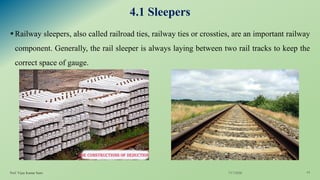
4.1 Sleepers
▪Railway sleepers, also called railroad ties, railway ties or crossties, are an important railway
component. Generally, the rail sleeper is always laying between two rail tracks to keep the
correct space of gauge.
7/17/2020Prof. Vijay Kumar Saini 14
7/17/2020Prof. Vijay Kumar Saini 15
4.2 Sleepers_Functions
▪ To hold the rails to proper gauge in all situations. i.e. exact gauge along straights and flat curves, slightly loose on sharp curves
and slightly tight in diamond crossings.
▪ To support the rails firmly and evenly throughout.
▪ To distribute the load transmitted through rails over large area of ballast underneath or to the bridge girders.
▪ To hold the rails to proper level in turnouts and crossovers, and at 1 in 20 in ward slope along straight tracks.
▪ To provide and elastic medium between the rails and ballast and also to absorb the vibrations caused due to moving axle loads.
▪ To maintain proper alignment of the track. On curves proper cant is provided by raising the outer rail and tamping the required
quantity of ballast bellow the rails.
▪ To provide the general stability of the permanent way throughout.
▪ To provide the insulation of track for the electrified for signaling.
▪ To provide easy replacement of the rail fastenings without any serious traffic disturbances.
7/17/2020Prof. Vijay Kumar Saini 16
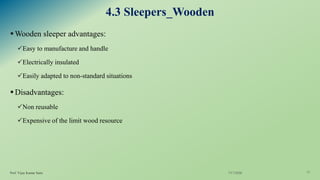
4.3 Sleepers_Wooden
▪Wooden sleeper advantages:
✓Easy to manufacture and handle
✓Electrically insulated
✓Easily adapted to non-standard situations
▪Disadvantages:
✓Non reusable
✓Expensive of the limit wood resource
7/17/2020Prof. Vijay Kumar Saini 17
4.4 Sleepers_Steel
▪Steel sleeper advantages:
✓Easy to install and manufacture
✓Handle more weight
▪Disadvantages:
✓Sensitive to the chemical attacks
✓Hard to maintain
✓Low transverse resistance
7/17/2020Prof. Vijay Kumar Saini 18
4.5 Sleepers_Concrete
▪Concrete sleeper advantages:
✓Cheaper
✓Easier to obtain
✓Less maintenance required
✓Longer service life
▪Disadvantages:
✓Hard to handle due to large weight
✓Difficult to maintain longitudinal level due to higher inertia moment and lower elasticity
7/17/2020Prof. Vijay Kumar Saini 19
5. Railyway Engineering_NPTEL
▪Railway Engineering
7/17/2020Prof. Vijay Kumar Saini 20
Dr. Rajat Rastogi
Department of Civil Engineering
IIT Roorkee
7/17/2020Prof. Vijay Kumar Saini 21

Infrastructure Engineering-Part-5

  • 1.
    Infrastructure Engineering & ConstructionTechniques Department of Civil Engineering Indira College of Engineering and Management Pune. Unit-1_Part-5
  • 2.
    Outline_Recap 1. Salient featuresof smart city 2. Permanent way, 3. Track structure of BG, 4. Functions of rail 7/17/2020Prof. Vijay Kumar Saini 2
  • 3.
    Outline ❖Standard rail, ❖Tilting ofrail, ❖Coning of wheels, ❖Types of sleepers, 7/17/2020Prof. Vijay Kumar Saini 3
  • 4.
    1.1 Standard Rail ▪Astandard-gauge railway is a railway with a track gauge of 1,435 mm (4 ft 8 1⁄2 in). ▪The standard gauge is also called Stephenson gauge after George Stephenson, International gauge, UIC gauge, uniform gauge, normal gauge and European gauge in Europe 7/17/2020Prof. Vijay Kumar Saini 4
  • 5.
    1.2 Various Gauges 7/17/2020Prof.Vijay Kumar Saini 5 ▪Broad Gauge ▪Standard Gauge ▪Metre Gauge ▪Narrow Gauge
  • 6.
    1.3 Factors Affectingchoice of a Gauge 1. Traffic Condition 2. Development of poor areas 3. Cost of track 4. Speed of Movement 5. Nature of Country 7/17/2020Prof. Vijay Kumar Saini 6
  • 7.
    1.3 Benefits ofUniformity of Gauges 1. Difficulties to passengers 2. Difficulties for sending goods 3. Inefficient use of rolling stock 4. Difficulty in war 5. Equipment at station 6. Hindrance for future conversion 7/17/2020Prof. Vijay Kumar Saini 7
  • 8.
    2.1 Coning ofWheels ▪In coning of wheel the tread or rim of wheels of railway vehicles is made in the shape of a cone with the slope of about 1 in 20. ▪It maintains vehicle in the central position w.r.t. the track. On straight track, portions of wheels running on track have same diameter. ▪While on curved path, the outer wheel has to cover larger distance than the inner wheel. Thus, the portions of wheels running on track have different diameters which help in smooth running of wheels. 7/17/2020Prof. Vijay Kumar Saini 8
  • 9.
    7/17/2020Prof. Vijay KumarSaini 9 2.1 Coning of Wheels
  • 10.
    2.2 Coning ofWheels_Advantages ▪Smooth riding - Help vehicle to negotiate curves smoothly ▪Reduces wear and tear of wheel flanges. Damage is caused because of the friction action of rims with inner faces of the rail top. ▪It gives an option of lateral drift of the hinge with its wheels. ▪It prevents, to some extent, the slipping of the wheels. 7/17/2020Prof. Vijay Kumar Saini 10
  • 11.
    2.3 Coning ofWheels_Disadvantages ▪The pressure on the horizontal component of force near the inner edge of outer rail has a tendency to wear the rail quickly ▪The horizontal component has to turn the rail outwards and hence the gauge may be widened ▪If no base plates are provided, sleepers under the outer edge of the rail may be damaged 7/17/2020Prof. Vijay Kumar Saini 11
  • 12.
    3.1 Tilting ofRails ▪In order to minimize the disadvantages caused by coning of wheels, the rails are tilted inwards at an angle of 1 in 20. ▪This reduces wear on the rail as well as on the tread of the wheel. ▪Tilting of rails can be achieved by: ✓Adzing of Sleepers ✓Use of Canted Base Plate 7/17/2020Prof. Vijay Kumar Saini 12
  • 13.
    3.2 Tilting ofRails_Advantages ▪It maintains the gauge properly ▪The wear at the head of rail is uniform ▪It increases the life of sleepers and rails. 7/17/2020Prof. Vijay Kumar Saini 13
  • 14.
    4.1 Sleepers ▪Railway sleepers,also called railroad ties, railway ties or crossties, are an important railway component. Generally, the rail sleeper is always laying between two rail tracks to keep the correct space of gauge. 7/17/2020Prof. Vijay Kumar Saini 14
  • 15.
  • 16.
    4.2 Sleepers_Functions ▪ Tohold the rails to proper gauge in all situations. i.e. exact gauge along straights and flat curves, slightly loose on sharp curves and slightly tight in diamond crossings. ▪ To support the rails firmly and evenly throughout. ▪ To distribute the load transmitted through rails over large area of ballast underneath or to the bridge girders. ▪ To hold the rails to proper level in turnouts and crossovers, and at 1 in 20 in ward slope along straight tracks. ▪ To provide and elastic medium between the rails and ballast and also to absorb the vibrations caused due to moving axle loads. ▪ To maintain proper alignment of the track. On curves proper cant is provided by raising the outer rail and tamping the required quantity of ballast bellow the rails. ▪ To provide the general stability of the permanent way throughout. ▪ To provide the insulation of track for the electrified for signaling. ▪ To provide easy replacement of the rail fastenings without any serious traffic disturbances. 7/17/2020Prof. Vijay Kumar Saini 16
  • 17.
    4.3 Sleepers_Wooden ▪Wooden sleeperadvantages: ✓Easy to manufacture and handle ✓Electrically insulated ✓Easily adapted to non-standard situations ▪Disadvantages: ✓Non reusable ✓Expensive of the limit wood resource 7/17/2020Prof. Vijay Kumar Saini 17
  • 18.
    4.4 Sleepers_Steel ▪Steel sleeperadvantages: ✓Easy to install and manufacture ✓Handle more weight ▪Disadvantages: ✓Sensitive to the chemical attacks ✓Hard to maintain ✓Low transverse resistance 7/17/2020Prof. Vijay Kumar Saini 18
  • 19.
    4.5 Sleepers_Concrete ▪Concrete sleeperadvantages: ✓Cheaper ✓Easier to obtain ✓Less maintenance required ✓Longer service life ▪Disadvantages: ✓Hard to handle due to large weight ✓Difficult to maintain longitudinal level due to higher inertia moment and lower elasticity 7/17/2020Prof. Vijay Kumar Saini 19
  • 20.
    5. Railyway Engineering_NPTEL ▪RailwayEngineering 7/17/2020Prof. Vijay Kumar Saini 20 Dr. Rajat Rastogi Department of Civil Engineering IIT Roorkee
  • 21.