Infrastructure as code managing servers in the cloud Morris
Infrastructure as code managing servers in the cloud Morris
Infrastructure as code managing servers in the cloud Morris
Infrastructure as code managing servers in the cloud Morris
Infrastructure as code managing servers in the cloud Morris
1.
Infrastructure as codemanaging servers in the
cloud Morris download
https://textbookfull.com/product/infrastructure-as-code-managing-
servers-in-the-cloud-morris/
Download full version ebook from https://textbookfull.com
2.
We believe theseproducts will be a great fit for you. Click
the link to download now, or visit textbookfull.com
to discover even more!
Infrastructure as Code: Dynamic Systems for the Cloud
Age 2nd Edition Kief Morris
https://textbookfull.com/product/infrastructure-as-code-dynamic-
systems-for-the-cloud-age-2nd-edition-kief-morris/
Infrastructure as Code 2nd Edition Early Access Kief
Morris
https://textbookfull.com/product/infrastructure-as-code-2nd-
edition-early-access-kief-morris/
Managing Distributed Cloud Applications and
Infrastructure: A Self-Optimising Approach Theo Lynn
https://textbookfull.com/product/managing-distributed-cloud-
applications-and-infrastructure-a-self-optimising-approach-theo-
lynn/
Terraform Up and Running Writing Infrastructure as Code
1st Edition Yevgeniy Brikman
https://textbookfull.com/product/terraform-up-and-running-
writing-infrastructure-as-code-1st-edition-yevgeniy-brikman/
3.
Terraform Up RunningWriting Infrastructure as Code 2 /
converted Edition Yevgeniy Brikman
https://textbookfull.com/product/terraform-up-running-writing-
infrastructure-as-code-2-converted-edition-yevgeniy-brikman/
Cybersecurity in the Electricity Sector Managing
Critical Infrastructure Rafa■ Leszczyna
https://textbookfull.com/product/cybersecurity-in-the-
electricity-sector-managing-critical-infrastructure-rafal-
leszczyna/
The Cloud DBA-Oracle : Managing Oracle Database in the
Cloud 1st Edition Abhinivesh Jain
https://textbookfull.com/product/the-cloud-dba-oracle-managing-
oracle-database-in-the-cloud-1st-edition-abhinivesh-jain/
DevOps in Python: Infrastructure as Python Zadka
https://textbookfull.com/product/devops-in-python-infrastructure-
as-python-zadka/
Leading and Managing Professional Services Firms in the
Infrastructure Sector First Edition Ellis
https://textbookfull.com/product/leading-and-managing-
professional-services-firms-in-the-infrastructure-sector-first-
edition-ellis/
Table of Contents
Preface.. . . . . . . . . . . . . . . . . . . . . . . . . . . . . . . . . . . . . . . . . . . . . . . . . . . . . . . . . . . . . . . . . . . . . xiii
Part I. Foundations
1. Challenges and Principles. . . . . . . . . . . . . . . . . . . . . . . . . . . . . . . . . . . . . . . . . . . . . . . . . . . . 3
Why Infrastructure as Code? 3
What Is Infrastructure as Code? 5
Goals of Infrastructure as Code 5
Challenges with Dynamic Infrastructure 6
Server Sprawl 6
Configuration Drift 7
Snowflake Servers 7
Fragile Infrastructure 8
Automation Fear 9
Erosion 10
Principles of Infrastructure as Code 10
Systems Can Be Easily Reproduced 10
Systems Are Disposable 11
Systems Are Consistent 12
Processes Are Repeatable 12
Design Is Always Changing 13
Practices 13
Use Definition Files 13
Self-Documented Systems and Processes 14
Version All the Things 15
Continuously Test Systems and Processes 16
Small Changes Rather Than Batches 16
iii
9.
Keep Services AvailableContinuously 17
Antifragility: Beyond “Robust” 17
The Secret Ingredient of Antifragile IT Systems 18
Conclusion 18
What’s Next? 19
2. Dynamic Infrastructure Platforms. . . . . . . . . . . . . . . . . . . . . . . . . . . . . . . . . . . . . . . . . . . 21
What Is a Dynamic Infrastructure Platform? 21
Requirements for a Dynamic Infrastructure Platform 22
Programmable 23
On-Demand 24
Self-Service 25
Infrastructure Resources Provided by the Platform 25
Compute Resources 26
Storage Resources 26
Network Resources 28
Types of Dynamic Infrastructure Platforms 30
Public IaaS Cloud 30
Community IaaS Cloud 30
Private IaaS Cloud 30
Antipattern: Hand-Cranked Cloud 31
Hybrid and Mixed Cloud Options 32
Bare-Metal Clouds 32
Deciding on a Dynamic Infrastructure Platform 34
Public or Private? 34
Cloud Portability 37
Mechanical Sympathy with the Cloud and Virtualization 38
Conclusion 40
3. Infrastructure Definition Tools. . . . . . . . . . . . . . . . . . . . . . . . . . . . . . . . . . . . . . . . . . . . . . 41
Choosing Tools for Infrastructure as Code 42
Requirement: Scriptable Interface 42
Requirement: Unattended Mode for Command-Line Tools 42
Requirement: Support for Unattended Execution 43
Requirement: Externalized Configuration 45
Configuration Definition Files 48
Reusability with Configuration Definitions 49
Working with Infrastructure Definition Tools 50
Provisioning Infrastructure with Procedural Scripts 51
Defining Infrastructure Declaratively 52
Using Infrastructure Definition Tools 54
Configuring Servers 54
iv | Table of Contents
10.
Configuration Registries 55
LightweightConfiguration Registries 56
Is a Configuration Registry a CMDB? 57
The CMDB Audit and Fix Antipattern 58
The Infrastructure-as-Code Approach to CMDB 58
Conclusion 59
4. Server Configuration Tools. . . . . . . . . . . . . . . . . . . . . . . . . . . . . . . . . . . . . . . . . . . . . . . . . . 61
Goals for Automated Server Management 62
Tools for Different Server Management Functions 62
Tools for Creating Servers 63
Tools for Configuring Servers 64
Tools for Packaging Server Templates 65
Tools for Running Commands on Servers 66
Using Configuration from a Central Registry 68
Server Change Management Models 69
Ad Hoc Change Management 69
Configuration Synchronization 69
Immutable Infrastructure 70
Containerized Services 70
Containers 70
Managing Ruby Applications with and without Containers 72
Are Containers Virtual Machines? 73
Using Containers Rather than Virtual Machines 74
Running Containers 75
Security and Containers 76
Conclusion 78
5. General Infrastructure Services. . . . . . . . . . . . . . . . . . . . . . . . . . . . . . . . . . . . . . . . . . . . . . 81
Considerations for Infrastructure Services and Tools 81
Prefer Tools with Externalized Configuration 83
Prefer Tools That Assume Infrastructure Is Dynamic 84
Prefer Products with Cloud-Compatible Licensing 84
Prefer Products That Support Loose Coupling 85
Sharing a Service Between Teams 85
Service Instance Templates 86
Monitoring: Alerting, Metrics, and Logging 87
Alerting: Tell Me When Something Is Wrong 87
Metrics: Collect and Analyze Data 89
Log Aggregation and Analysis 89
Service Discovery 90
Server-Side Service Discovery Pattern 91
Table of Contents | v
11.
Client-Side Service DiscoveryPattern 91
Distributed Process Management 91
Orchestrating Processes with Server Roles 92
Orchestrating Processes with Containers 92
Scheduling Short Jobs 92
Container Orchestration Tools 92
Software Deployment 93
Deployment Pipeline Software 93
Packaging Software 94
Conclusion 96
Part II. Patterns
6. Patterns for Provisioning Servers. . . . . . . . . . . . . . . . . . . . . . . . . . . . . . . . . . . . . . . . . . . . 99
Server Provisioning 100
A Server’s Life 100
What Goes onto a Server 105
Types of Things on a Server 105
Server Roles 107
Patterns for Creating Servers 108
Antipattern: Handcrafted Server 109
Practice: Wrap Server Creation Options in a Script 110
Antipattern: Hot Cloned Server 111
Pattern: Server Template 111
Antipattern: Snowflake Factory 112
Patterns for Bootstrapping New Servers 112
Pushing to Bootstrap 113
Pulling to Bootstrap 113
Practice: Smoke Test Every New Server Instance 114
Conclusion 115
7. Patterns for Managing Server Templates. . . . . . . . . . . . . . . . . . . . . . . . . . . . . . . . . . . . 117
Stock Templates: Can’t Someone Else Do It? 117
Provisioning Servers Using Templates 118
Provisioning at Creation Time 118
Provisioning in the Template 119
Balancing Provisioning Across Template and Creation 120
The Process for Building a Server Template 121
Creating Templates for Multiple Platforms 122
Origin Images 123
Antipattern: Hot Cloned Server Template 123
vi | Table of Contents
12.
Baking a Templatefrom an OS Installation Image 123
Baking a Template from a Stock Image 124
Building a Template from a Unikernel 125
Customizing a Server Template without Booting It 125
Updating Server Templates 126
Reheating a Template 126
Baking a Fresh Template 126
Versioning Server Templates 126
Building Templates for Roles 129
Pattern: Layered Template 129
Sharing Base Scripts for Templates 130
Automating Server Template Management 131
Customizing Servers Before Baking 131
Practice: Automatically Test Server Templates 132
Conclusion 132
8. Patterns for Updating and Changing Servers. . . . . . . . . . . . . . . . . . . . . . . . . . . . . . . . . 133
Models for Server Change Management 134
Ad Hoc Change Management 134
Continuous Configuration Synchronization 134
Immutable Servers 135
Containerized Servers 136
General Patterns and Practices 136
Practice: Minimize Server Templates 136
Practice: Replace Servers When the Server Template Changes 137
Pattern: Phoenix Servers 137
Patterns and Practices for Continuous Deployment 138
Pattern: Masterless Configuration Management 139
Practice: Apply Cron 139
Continuous Synchronization Flow 140
The Unconfigured Country 141
Patterns and Practices for Immutable Servers 143
Server Image as Artifact 144
Simplifying Confirmation Management Tooling with Immutable Servers 144
Immutable Server Flow 144
Bootstrap Configuration with Immutable Servers 145
Transactional Server Updates 147
Practices for Managing Configuration Definitions 148
Practice: Keep Configuration Definitions Minimal 148
Organizing Definitions 149
Practice: Use Test-Driven Development (TDD) to Drive Good Design 149
Conclusion 150
Table of Contents | vii
13.
9. Patterns forDefining Infrastructure. . . . . . . . . . . . . . . . . . . . . . . . . . . . . . . . . . . . . . . . . 151
Environments 152
Antipattern: Handcrafted Infrastructure 153
Defining Infrastructure Stacks as Code 153
Antipattern: Per-Environment Definition Files 155
Pattern: Reusable Definition Files 155
Practice: Test and Promote Stack Definitions 157
Self-Service Environments 158
Organizing Infrastructure 158
Antipattern: Monolithic Stack 158
Avoid “Lift and Shift” When Migrating Infrastructure 160
Dividing an Application Environment into Multiple Stacks 160
Managing Configuration Parameters Between Stacks 162
Sharing Infrastructure Elements 164
Practice: Manage Application Code and Infrastructure Code Together 166
Approaches to Sharing Definitions 167
Practice: Align Infrastructure Design with the Scope of Change 168
Example: An Infrastructure Design for Microservices 169
Running Definition Tools 174
Conclusion 175
Part III. Practices
10. Software Engineering Practices for Infrastructure. . . . . . . . . . . . . . . . . . . . . . . . . . . . . 179
System Quality 180
Poor-Quality Systems Are Difficult to Change 180
High-Quality Systems Are Easier and Safer to Change 181
Infrastructure Quality Through Code 181
Fast Feedback 181
VCS for Infrastructure Management 182
What to Manage in a VCS 182
Continuous Integration (CI) 183
Continuously Testing Branches Is Not Continuous Integration 183
Who Broke the Build? 185
Ignoring Tests That Fail 186
CI for Infrastructure 187
Continuous Delivery (CD) 187
The Problem with the Integration Phase 187
Deployment Pipelines and Change Pipelines 188
Continuous Delivery Is Not Continuous Deployment 189
Code Quality 190
viii | Table of Contents
14.
Clean Code 190
Practice:Manage Technical Debt 191
Managing Major Infrastructure Changes 192
Feature Toggles 193
Conclusion 194
11. Testing Infrastructure Changes. . . . . . . . . . . . . . . . . . . . . . . . . . . . . . . . . . . . . . . . . . . . . 195
The Agile Approach to Testing 196
Automating Tests for Fast Feedback 197
Organically Building a Test Suite 197
Structuring the Test Suite: The Test Pyramid 198
Avoiding an Unbalanced Test Suite 199
Practice: Test at the Lowest Level Possible 200
Practice: Only Implement the Layers You Need 201
Practice: Prune the Test Suite Often 202
Practice: Continuously Review Testing Effectiveness 202
Implementing a Balanced Test Suite 202
Low-Level Testing 204
Mid-Level Testing 206
Higher-Level Tests 209
Testing Operational Quality 211
Managing Test Code 212
Practice: Keep Test Code with the Code It Tests 212
Anti-Pattern: Reflective Tests 213
Techniques to Isolate Components for Testing 213
Refactoring Components so They Can Be Isolated 215
Managing External Dependencies 215
Test Setup 216
Roles and Workflow for Testing 218
Principle: People Should Write Tests for What They Build 219
The Test-Writing Habit 219
Principle: Everyone Should Have Access to the Testing Tools 219
The Value of a Quality Analyst 220
Test-Driven Development (TDD) 221
Conclusion 222
12. Change Management Pipelines for Infrastructure. . . . . . . . . . . . . . . . . . . . . . . . . . . . . 223
Benefits of a Change Management Pipeline 225
Guidelines for Designing Pipelines 226
Ensure Consistency Across Stages 226
Get Immediate Feedback for Every Change 227
Run Automated Stages Before Manual Stages 227
Table of Contents | ix
15.
Get Production-Like SoonerRather Than Later 228
Basic Pipeline Designs 229
The Local Development Stage 229
The Build Stage 230
Publishing a Configuration Artifact 231
Automated Testing Stages 233
Manual Validation Stages 234
Apply to Live 235
The Rhythm of the Pipeline 235
Practices for Using a Pipeline 236
Practice: Prove Production Readiness for Every Change 237
Practice: Start Every Change from the Beginning of the Pipeline 237
Practice: Stop the Line on Any Failure 238
Scaling Pipelines to More Complex Systems 238
Pattern: Fan-In Pipelines 239
Practice: Keep Pipelines Short 243
Practice: Decouple Pipelines 243
Integration Models 243
Techniques for Handling Dependencies Between Components 246
Pattern: Library Dependency 246
Pattern: Self-Provisioned Service Instance 248
Providing Pre-Release Library Builds 248
Providing Test Instances of a Service to Consumers 249
Using Test Instances of a Service as a Consumer 250
Practices for Managing Interfaces Between Components 252
Practice: Ensure Backward Compatibility of Interfaces 252
Practice: Decouple Deploying from Releasing 253
Practice: Use Version Tolerance 253
Practice: Provide Test Doubles 254
Practice: Test the Provider with Contract Tests 254
Practice: Test with a Reference Consumer 255
Practice: Smoke Test the Provider Interface 255
Practice: Run Consumer-Driven Contract (CDC) Tests 255
Conclusion 256
13. Workflow for the Infrastructure Team. . . . . . . . . . . . . . . . . . . . . . . . . . . . . . . . . . . . . . . 257
Automate Anything That Moves 258
Make the Change Manually 259
Ad Hoc Automation 259
Autonomic Automation 260
Autonomic Automation Workflow 261
Using a Local Sandbox 262
x | Table of Contents
16.
Using Local Virtualizationfor a Sandbox 263
Example Workflow with Local Testing 265
Using the Virtualization Platform for Sandboxes 266
Codebase Organization Patterns 267
Antipattern: Branch-Based Codebases 268
Pattern: One Trunk per Component 268
Pattern: Single Trunk 269
Workflow Effectiveness 269
Expediting Changes 269
Code Reviews 270
Fitting Governance into the Workflow 271
Conclusion 273
14. Continuity with Dynamic Infrastructure. . . . . . . . . . . . . . . . . . . . . . . . . . . . . . . . . . . . . 275
Service Continuity 276
True Availability 276
Using Dynamic Server Pools for Recovery 277
Software Design for Dynamic Infrastructure 279
Compartmentalizing for Continuity 281
Zero-Downtime Changes 282
Pattern: Blue-Green Replacement 282
Pattern: Phoenix Replacement 283
Practice: Reduce the Scope of Replacement 284
Pattern: Canary Replacement 285
Routing Traffic for Zero-Downtime Replacements 286
Zero-Downtime Changes with Data 288
Data Continuity 289
Replicating Data Redundantly 289
Regenerating Data 290
Delegating Data Persistence 290
Backing Up to Persistent Storage 291
Disaster Recovery 292
Continuous Disaster Recovery 293
The DR Plan: Planning for Disaster 294
Practice: Prefer Rebuilding Things over Cold Standby 295
Continuous Monitoring through the Pipeline 296
Security 298
Automatically Papering over Compromises 298
Reliable Updates as a Defense 299
Provenance of Packages 299
Automated Hardening 301
Automating Security Validation in the Pipeline 302
Table of Contents | xi
17.
The Change Pipelineas a Vulnerability 302
Managing Security Risks with Cloud Accounts 303
Conclusion 305
15. Organizing for Infrastructure as Code. . . . . . . . . . . . . . . . . . . . . . . . . . . . . . . . . . . . . . . 307
Evolutionary Architecture 308
Learning under Fire 309
Start with a Trailblazer Pipeline 310
Measuring Effectiveness 311
Agree on Desired Outcomes First 311
Choose Metrics that Help the Team 312
Track and Improve Cycle Time 313
Use Kanban to Make Work Visible 315
Retrospectives and Post-Mortems 316
Organize to Empower Users 317
Pitfalls of the Divided Function Model 317
Adopt a Self-Service Model 319
Take Full Responsibility: You Build It, You Run It 320
Organizing into Cross-Functional Teams 321
Governance through Continuous Change Management 322
Provide Solid Building Blocks 322
Prove Operational Readiness in the Pipeline 323
Sharing Ownership of Operational Quality 324
Review and Audit Automated Processes 324
Optimize for Time to Detect and Fix Problems 324
Conclusion: It’s Never Finished 325
Index. . . . . . . . . . . . . . . . . . . . . . . . . . . . . . . . . . . . . . . . . . . . . . . . . . . . . . . . . . . . . . . . . . . . . . . 327
xii | Table of Contents
18.
1 Andrew ClayShafer and Patrick Debois triggered the DevOps movement with a talk at the Agile 2008 confer‐
ence. The movement grew, mainly driven by the series of DevOpsDays conferences organized by Debois.
2 A BBS is a bulletin board system.
Preface
Infrastructure and software development teams are increasingly building and manag‐
ing infrastructure using automated tools that have been described as “infrastructure
as code.” These tools expect users to define their servers, networking, and other ele‐
ments of an infrastructure in files modeled after software source code. The tools then
compile and interpret these files to decide what action to take.
This class of tool has grown naturally with the DevOps movement.1
The DevOps
movement is mainly about culture and collaboration between software developers
and software operations people. Tooling that manages infrastructure based on a soft‐
ware development paradigm has helped bring these communities together.
Managing infrastructure as code is very different from classic infrastructure manage‐
ment. I’ve met many teams who have struggled to work out how to make this shift.
But ideas, patterns, and practices for using these tools effectively have been scattered
across conference talks, blog posts, and articles. I’ve been waiting for someone to
write a book to pull these ideas together into a single place. I haven’t seen any sign of
this, so finally took matters into my own hands. You’re now reading the results of
this effort!
How I Learned to Stop Worrying and to Love the Cloud
I set up my first server, a dialup BBS,2
in 1992. This led to Unix system administra‐
tion and then to building and running hosted software systems (before we called it
SaaS, aka “Software as a Service”) for various companies, from startups to enterprises.
I’ve been on a journey to infrastructure as code the entire time, before I’d ever heard
the term.
Preface | xiii
19.
Things came toa head with virtualization. The story of my stumbling adoption of
virtualization and the cloud may be familiar, and it illustrates the role that infrastruc‐
ture as code has to play in modern IT operations.
My First Virtual Server Farm
I was thrilled when my team got the budget to buy a pair of beefy HP rack servers and
licenses for VMware ESX Server back in 2007.
We had in our office’s server racks around 20 1U and 2U servers named after fruits
(Linux servers) and berries (Windows database servers) running test environments
for our development teams. Stretching these servers to test various releases, branches,
and high-priority, proof-of-concept applications was a way of life. Network services
like DNS, file servers, and email were crammed onto servers running multiple appli‐
cation instances, web servers, and database servers.
So we were sure these new virtual servers would change our lives. We could cleanly
split each of these services onto its own virtual machine (VM), and the ESX hypervi‐
sor software would help us to squeeze the most out of the multicore server machines
and gobs of RAM we’d allocated. We could easily duplicate servers to create new
environments and archive those servers that weren’t needed onto disk, confident they
could be restored in the future if needed.
Those servers did change our lives. But although many of our old problems went
away, we discovered new ones, and we had to learn completely different ways of
thinking about our infrastructure.
Virtualization made creating and managing servers much easier. The flip side of this
was that we ended up creating far more servers than we could have imagined. The
product and marketing people were delighted that we could give them a new envi‐
ronment to demo things in well under a day, rather than need them to find money in
the budget and then wait a few weeks for us to order and set up hardware servers.
The Sorcerer’s Apprentice
A year later, we were running well over 100 VMs and counting. We were well under‐
way with virtualizing our production servers and experimenting with Amazon’s new
cloud hosting service. The benefits virtualization had brought to the business people
meant we had money for more ESX servers and for shiny SAN devices to feed the
surprising appetite our infrastructure had for storage.
But we found ourselves a bit like Mickey Mouse in “The Sorcerer’s Apprentice” from
Fantasia. We spawned virtual servers, then more, then even more. They over‐
whelmed us. When something broke, we tracked down the VM and fixed whatever
was wrong with it, but we couldn’t keep track of what changes we’d made where.
xiv | Preface
20.
Well, a perfecthit!
See how he is split!
Now there’s hope for me,
and I can breathe free!
Woe is me! Both pieces
come to life anew,
now, to do my bidding
I have servants two!
Help me, O great powers!
Please, I’m begging you!
—Excerpted from Brigitte Dubiel’s translation of “Der Zauberlehrling” (“The Sor‐
cerer’s Apprentice”) by Johann Wolfgang von Goethe
As new updates to operating systems, web servers, app servers, database servers,
JVMs, and various other software packages came out, we would struggle to install
them across all of our systems. We would apply them successfully to some servers,
but on others the upgrades broke things, and we didn’t have time to stomp out every
incompatibility. Over time, we ended up with many combinations of versions of
things strewn across hundreds of servers.
We had been using configuration automation software even before we virtualized,
which should have helped with these issues. I had used CFEngine in previous compa‐
nies, and when I started this team, I tried a new tool called Puppet. Later, when spik‐
ing out ideas for an AWS infrastructure, my colleague Andrew introduced Chef. All
of these tools were useful, but particularly in the early days, they didn’t get us out of
the quagmire of wildly different servers.
The problem was that, although Puppet (and Chef and the others) should have been
set up and left running unattended across all of our servers, we couldn’t trust it. Our
servers were just too different. We would write manifests to configure and manage a
particular application server. But when we ran it against another, theoretically similar
app server, we found that different versions of Java, application software, and OS
components would cause the Puppet run to fail, or worse, break the application
server.
So we ended up using Puppet ad hoc. We could safely run it against new VMs,
although we might need to make some tweaks after it ran. We would write manifests
for a specific task and then run them against servers one at a time, carefully checking
the result and making fixes as needed.
So configuration automation was a useful aid, somewhat better than shell scripts, but
the way we used it didn’t save us from our sprawl of inconsistent servers.
Preface | xv
21.
Cloud from Scratch
Thingschanged when we began moving things onto the cloud. The technology itself
wasn’t what improved things; we could have done the same thing with our own
VMware servers. But because we were starting fresh, we adopted new ways of manag‐
ing servers based on what we had learned with our virtualized farm and on what we
were reading and hearing from IT Ops teams at companies like Flickr, Etsy, and
Netflix. We baked these new ideas into the way we managed services as we migrated
them onto the cloud.
The key idea of our new approach was that every server could be automatically
rebuilt from scratch, and our configuration tooling would run continuously, not ad
hoc. Every server added into our new infrastructure would fall under this approach.
If automation broke on some edge case, we would either change the automation to
handle it, or else fix the design of the service so it was no longer an edge case.
The new regime wasn’t painless. We had to learn new habits, and we had to find ways
of coping with the challenges of a highly automated infrastructure. As the members
of the team moved on to other organizations and got involved with communities
such as DevOpsDays, we learned and grew. Over time, we reached the point where
we were habitually working with automated infrastructures with hundreds of servers,
with much less effort and headache than we had been in our “Sorcerer’s Apprentice”
days.
Joining ThoughtWorks was an eye-opener for me. The development teams I worked
with were passionate about using XP engineering practices like test-driven develop‐
ment (TDD), continuous integration (CI) and continuous delivery (CD). Because I
had already learned to manage infrastructure scripts and configuration files in source
control systems, it was natural to apply these rigorous development and testing
approaches to them.
Working with ThoughtWorks has also brought me into contact with many IT opera‐
tions teams, most of whom are using virtualization, cloud, and automation tools to
handle a variety of challenges. Working with them to share and learn new ideas and
techniques has been a fantastic experience.
Why I’m Writing This Book
I’ve run across many teams who are in the same place I was a few years ago: people
who are using cloud, virtualization, and automation tools but haven’t got it all run‐
ning as smoothly as they know they could.
Much of the challenge is time. Day-to-day life for system administrators is coping
with a never-ending flow of critical work. Fighting fires, fixing problems, and setting
xvi | Preface
22.
up new business-criticalprojects doesn’t leave much time to work on the fundamen‐
tal improvements that will make the routine work easier.
My hope is that this book provides a practical vision for how to manage IT infra‐
structure, with techniques and patterns that teams can try and use. I will avoid the
details of configuring and using specific tools so that the content will be useful for
working with different tools, including ones that may not exist yet. Meanwhile, I will
use examples from existing tools to illustrate points I make.
The infrastructure-as-code approach is essential for managing cloud infrastructure of
any real scale or complexity, but it’s not exclusive to organizations using public cloud
providers. The techniques and practices in this book have proven effective in virtual‐
ized environments and even for bare-metal servers that aren’t virtualized.
Infrastructure as Code is one of the cornerstones of DevOps. It is the “A” in “CAMS”:
culture, automation, measurement, and sharing.
Who This Book Is For
This book is for people who work with IT infrastructure, particularly at the level of
managing servers and collections of servers. You may be a system administrator,
infrastructure engineer, team lead, architect, or a manager with technical interest.
You might also be a software developer who wants to build and use infrastructure.
I’m assuming you have some exposure to virtualization or IaaS (Infrastructure as a
Service) cloud, so you know how to create a server, and the concepts of configuring
operating systems. You’ve probably at least played with configuration automation
software like Ansible, Chef, or Puppet.
While this book may introduce some readers to infrastructure as code, I hope it will
also be interesting to people who work this way already and a vehicle through which
to share ideas and start conversations about how to do it even better.
What Tools Are Covered
This book doesn’t offer instructions in using specific scripting languages or tools.
There are code examples from specific tools, but these are intended to illustrate con‐
cepts and approaches, rather than to provide instruction. This book should be helpful
to you regardless of whether you use Chef on OpenStack, Puppet on AWS, Ansible
on bare metal, or a completely different stack.
The specific tools that I do mention are ones which I’m aware of, and which seem to
have a certain amount of traction in the field. But this is a constantly changing land‐
scape, and there are plenty of other relevant tools.
Preface | xvii
23.
The tools Iuse in examples tend to be ones with which I am familiar enough to write
examples that demonstrate the point I’m trying to make. For example, I use Terra‐
form for examples of infrastructure definitions because it has a nice, clean syntax,
and I’ve used it on multiple projects. Many of my examples use Amazon’s AWS cloud
platform because it is likely to be the most familiar to readers.
How to Read This Book
Read Chapter 1, or at least skim it, to understand the terms this book uses and the
principles this book advocates. You can then use this to decide which parts of the
book to focus on.
If you’re new to this kind of automation, cloud, and infrastructure orchestration tool‐
ing, then you’ll want to focus on Part I, and then move on to Part II. Get comfortable
with those topics before proceeding to Part III.
If you’ve been using the types of automation tools described here, but don’t feel like
you’re using them the way they’re intended after reading Chapter 1, then you may
want to skip or skim the rest of Part I. Focus on Part II, which describes ways of using
dynamic and automated infrastructure that align with the principles outlined in
Chapter 1.
If you’re comfortable with the dynamic infrastructure and automation approaches
described in Chapter 1, then you may want to skim Parts I and II and focus on
Part III, which gets more deeply into the infrastructure management regime: archi‐
tectural approaches as well as team workflow.
Conventions Used in This Book
The following typographical conventions are used in this book:
Italic
Indicates new terms, URLs, email addresses, filenames, and file extensions.
Constant width
Used for program listings, as well as within paragraphs to refer to program ele‐
ments such as variable or function names, databases, data types, environment
variables, statements, and keywords.
Constant width bold
Shows commands or other text that should be typed literally by the user.
Constant width italic
Shows text that should be replaced with user-supplied values or by values deter‐
mined by context.
xviii | Preface
24.
This element signifiesa tip or suggestion.
This element signifies a general note.
This element indicates a warning or caution.
Safari® Books Online
Safari Books Online is an on-demand digital library that deliv‐
ers expert content in both book and video form from the
world’s leading authors in technology and business.
Technology professionals, software developers, web designers, and business and crea‐
tive professionals use Safari Books Online as their primary resource for research,
problem solving, learning, and certification training.
Safari Books Online offers a range of plans and pricing for enterprise, government,
education, and individuals.
Members have access to thousands of books, training videos, and prepublication
manuscripts in one fully searchable database from publishers like O’Reilly Media,
Prentice Hall Professional, Addison-Wesley Professional, Microsoft Press, Sams,
Que, Peachpit Press, Focal Press, Cisco Press, John Wiley & Sons, Syngress, Morgan
Kaufmann, IBM Redbooks, Packt, Adobe Press, FT Press, Apress, Manning, New
Riders, McGraw-Hill, Jones & Bartlett, Course Technology, and hundreds more. For
more information about Safari Books Online, please visit us online.
Preface | xix
25.
How to ContactUs
Please address comments and questions concerning this book to the publisher:
O’Reilly Media, Inc.
1005 Gravenstein Highway North
Sebastopol, CA 95472
800-998-9938 (in the United States or Canada)
707-829-0515 (international or local)
707-829-0104 (fax)
We have a web page for this book, where we list errata, examples, and any additional
information. You can access this page at http://bit.ly/infrastructureAsCode_1e.
To comment or ask technical questions about this book, send email to bookques‐
tions@oreilly.com.
For more information about our books, courses, conferences, and news, see our web‐
site at http://www.oreilly.com.
Find us on Facebook: http://facebook.com/oreilly
Follow us on Twitter: http://twitter.com/oreillymedia
Watch us on YouTube: http://www.youtube.com/oreillymedia
Acknowledgments
When I started working on this book, I assumed the result would be a product that
was entirely my own. But in the end, it’s just the opposite: this book is the product of
the ideas, thoughts, opinions, and experiences of far more people than I could have
imagined. I have probably mangled, oversimplified, and misrepresented this input.
But this book would not exist as it is without these contributions.
The people I worked with on the University of Tennessee’s computer science lab staff
taught me my Unix chops and inducted me into the culture. Chad Mynhier was par‐
ticularly responsible for hooking me into the Unix world. He explained why I could
no longer cd into my own home area after I had experimented with the chmod com‐
mand.
Working with a series of companies, including Syzygy, Vizyon, Cellectivity, and the
Map of Medicine, gave me the arena to develop my understanding and to learn how
to apply infrastructure automation to real-world business and user problems. I owe
much to the many good people of those organizations. I’ll specifically call out Jona‐
than Waywell and Ketan Patel for their unending support and encouragement,
xx | Preface
26.
3 Sadly, asof early 2016, Infrastructures.org hasn’t been updated since 2007.
Andrew Fulcher for quickly learning what I had to teach and then teaching me even
more, and Nat Billington for his inspiration.
This book would truly never have happened without my current home, Thought‐
Works. I’ve learned much about the ideas in this book and how to think about and
explain them to other people, thanks to more than five years of exposure to a dizzy‐
ing number of organizations of various sizes, sectors, and technologies. The endless
curiosity of my colleagues, past and present, and their heartfelt drive to improve our
industry and the experiences of people in it, continually challenges me.
Generous support and encouragement from ThoughtWorks as an organization has
been vital for this book, especially as my energy flagged with the finish line coming
into view. Chris Murphy, Dave Elliman, Maneesh Subherwal, and Suzi Edwards-
Alexander are a few among many who have made this more than a personal project
for me.
An incomplete list of past and present ThoughtWorks colleagues who have gone out
of their way to contribute suggestions, feedback, and other support include: Abigail
Bangser, Ashok Subramanian, Barry O’Reilly, Ben Butler-Cole, Chris Bird
(DevOops!), Chris Ford, David Farley, Gurpreet Luthra, Inny So, Jason Yip, Jim
Gumbley, Kesha Stickland, Marco Abis, Nassos Antoniou, Paul Hammant, Peter
Gillard-Moss, Peter Staples, Philip Potter, Rafael Gomes, Sam Newman, Simon Brun‐
ning, Tom Duckering, Venu Murthy, and Vijay Raghavan Aravamudhan.
Martin Fowler has given me tremendous encouragement and practical support in
writing this book. He gave me far more time than I could have asked, thoroughly
reviewing the manuscript several times. Martin gave me detailed, useful feedback and
advice based on his considerable experience of organizing and conveying technical
concepts. He has been a true champion of this book.
My colleague Rong Tang created the images for this book. She was extremely patient
with my muddled explanations of what I wanted. Any failings of clarity or consis‐
tency is down to me, but the great look is a credit to her.
The folks behind the long-dormant Infrastructures.org exposed me to the ideas of
Infrastructure as Code before the term existed.3
I owe a great debt to the people of the DevOpsDays community, who are collectively
responsible for bringing the ideas of DevOps and Infrastructure as Code to promi‐
nence. Regardless of who actually coined the term “Infrastructure as Code,” people
like Adam Jacob, Andrew Clay-Shafer, John Allspaw, John Willis, Luke Kaines, Mark
Burgess, and of course, Patrick Debois (“The Godfather of DevOps”) have given me
inspiration and many great ideas.
Preface | xxi
27.
A number ofother people have given me feedback and advice on earlier drafts of this
book, including Axel Fontaine, Jon Cowie, Jose Maria San Jose Juarez, Marcos Her‐
mida, and Matt Jones. I also want to thank Kent Spillner, although I don’t recall why.
Ovine and dairy. Putney Bridge.
Last, but the furthest from least, everlasting love to Ozlem and Erel, who endured my
obsession with this book.
xxii | Preface
CHAPTER 1
Challenges andPrinciples
The new generation of infrastructure management technologies promises to trans‐
form the way we manage IT infrastructure. But many organizations today aren’t see‐
ing any dramatic differences, and some are finding that these tools only make life
messier. As we’ll see, infrastructure as code is an approach that provides principles,
practices, and patterns for using these technologies effectively.
Why Infrastructure as Code?
Virtualization, cloud, containers, server automation, and software-defined network‐
ing should simplify IT operations work. It should take less time and effort to provi‐
sion, configure, update, and maintain services. Problems should be quickly detected
and resolved, and systems should all be consistently configured and up to date. IT
staff should spend less time on routine drudgery, having time to rapidly make
changes and improvements to help their organizations meet the ever-changing needs
of the modern world.
But even with the latest and best new tools and platforms, IT operations teams still
find that they can’t keep up with their daily workload. They don’t have the time to fix
longstanding problems with their systems, much less revamp them to make the best
use of new tools. In fact, cloud and automation often makes things worse. The ease of
provisioning new infrastructure leads to an ever-growing portfolio of systems, and it
takes an ever-increasing amount of time just to keep everything from collapsing.
Adopting cloud and automation tools immediately lowers barriers for making
changes to infrastructure. But managing changes in a way that improves consistency
and reliability doesn’t come out of the box with the software. It takes people to think
through how they will use the tools and put in place the systems, processes, and hab‐
its to use them effectively.
3
31.
1 “Shadow IT”is when people bypass formal IT governance to bring in their own devices, buy and install unap‐
proved software, or adopt cloud-hosted services. This is typically a sign that internal IT is not able to keep up
with the needs of the organization it serves.
2 The phrase “infrastructure as code” doesn’t have a clear origin or author. While writing this book, I followed
a chain of people who have influenced thinking around the concept, each of whom said it wasn’t them, but
offered suggestions. This chain had a number of loops. The earliest reference I could find was from the Veloc‐
ity conference in 2009, in a talk by Andrew Clay-Shafer and Adam Jacob. John Willis may be the first to
document the phrase, in an article about the conference. Luke Kaines has admitted that he may have been
involved, the closest anyone has come to accepting credit.
Some IT organizations respond to this challenge by applying the same types of pro‐
cesses, structures, and governance that they used to manage infrastructure and soft‐
ware before cloud and automation became commonplace. But the principles that
applied in a time when it took days or weeks to provision a new server struggle to
cope now that it takes minutes or seconds.
Legacy change management processes are commonly ignored, bypassed, or overruled
by people who need to get things done.1
Organizations that are more successful in
enforcing these processes are increasingly seeing themselves outrun by more techni‐
cally nimble competitors.
Legacy change management approaches struggle to cope with the pace of change
offered by cloud and automation. But there is still a need to cope with the ever-
growing, continuously changing landscape of systems created by cloud and automa‐
tion tools. This is where infrastructure as code2
comes in.
The Iron Age and the Cloud Age
In the “iron age” of IT, systems were directly bound to physical hardware. Provision‐
ing and maintaining infrastructure was manual work, forcing humans to spend their
time pointing, clicking, and typing to keep the gears turning. Because changes
involved so much work, change management processes emphasized careful up-front
consideration, design, and review work. This made sense because getting it wrong
was expensive.
In the “cloud age” of IT, systems have been decoupled from the physical hardware.
Routine provisioning and maintenance can be delegated to software systems, freeing
the humans from drudgery. Changes can be made in minutes, if not seconds. Change
management can exploit this speed, providing better reliability along with faster time
to market.
4 | Chapter 1: Challenges and Principles
32.
What Is Infrastructureas Code?
Infrastructure as code is an approach to infrastructure automation based on practices
from software development. It emphasizes consistent, repeatable routines for provi‐
sioning and changing systems and their configuration. Changes are made to defini‐
tions and then rolled out to systems through unattended processes that include
thorough validation.
The premise is that modern tooling can treat infrastructure as if it were software and
data. This allows people to apply software development tools such as version control
systems (VCS), automated testing libraries, and deployment orchestration to manage
infrastructure. It also opens the door to exploit development practices such as test-
driven development (TDD), continuous integration (CI), and continuous delivery
(CD).
Infrastructure as code has been proven in the most demanding environments. For
companies like Amazon, Netflix, Google, Facebook, and Etsy, IT systems are not just
business critical; they are the business. There is no tolerance for downtime. Amazon’s
systems handle hundreds of millions of dollars in transactions every day. So it’s no
surprise that organizations like these are pioneering new practices for large scale,
highly reliable IT infrastructure.
This book aims to explain how to take advantage of the cloud-era, infrastructure-as-
code approaches to IT infrastructure management. This chapter explores the pitfalls
that organizations often fall into when adopting the new generation of infrastructure
technology. It describes the core principles and key practices of infrastructure as code
that are used to avoid these pitfalls.
Goals of Infrastructure as Code
The types of outcomes that many teams and organizations look to achieve through
infrastructure as code include:
• IT infrastructure supports and enables change, rather than being an obstacle or a
constraint.
• Changes to the system are routine, without drama or stress for users or IT staff.
• IT staff spends their time on valuable things that engage their abilities, not on
routine, repetitive tasks.
• Users are able to define, provision, and manage the resources they need, without
needing IT staff to do it for them.
• Teams are able to easily and quickly recover from failures, rather than assuming
failure can be completely prevented.
What Is Infrastructure as Code? | 5
II.
HOW THE EASTRIDING WAS MADE.
Stand on the very highest point of the white limestone cliffs that
stretch northwards from Flamborough Head, and realise that you are
standing on what was once the bed of the sea.
Strange though this be, it is nevertheless true. Countless ages ago
what now towers up 450 feet above sea-level had over it the
ceaseless rolling of the waters of the ocean, and during countless
ages it was slowly formed out of the shells and teeth and bones of
the creatures that lived in these waters.
Men who know tell us that the layer of chalk at the bottom of the
ocean to-day is composed principally of the remains of creatures so
minute as to be visible only by the aid of a microscope, and that this
layer grows in thickness at the rate of not more than one-tenth of an
inch per year. They tell us also that the layer of chalk which extends
under our county is not less than 1200 feet in thickness, and thus a
simple calculation will help us to form some idea of the extent of
time necessary for its formation. But however long this time actually
was, it came to an end with a tremendous upheaval of a portion of
the ocean bed, and the formation of a new area of ‘dry land.’
All the coast line of the East Riding, however, does not consist of
chalk cliffs. North of Bempton and Speeton lie cliffs of sandstone and
clay, which have yielded the fossil remains of living beings that once
inhabited the water and the shore. Such are the belemnites and
ammonites—the ‘thunderbolts’ and ‘St. Hilda’s snakes’ we may have
heard them called—and the Ichthyosaurus, whose skeleton was
recently discovered embedded in the clay cliffs at Speeton and may
35.
now be seenin the Hull Museum. Not a very handsome gentleman
in the flesh he must have been, unless appearances are deceptive.
One of the First Inhabitants of the East Riding.
Actual length about twelve feet.
Again, walk southwards from Flamborough Head, and the chalk
cliffs are found to get less and less in height until they disappear
altogether, and their place is taken by cliffs of clay. Then these
disappear, and are succeeded by the long, flat bank of sand and
shingle which is known as Spurn Point; and if we round this point
and follow the river bank, we find it nothing but mud and clay until
we get past the mouth of the river Hull. At Hessle the chalk cliffs
break out once more, and we know, from investigations, that the
bed of chalk comes to the surface completely westwards of a line
drawn from Flamborough to this point.
Draw on a map of the East Riding a line from Sewerby, through
Driffield and Beverley, to Hessle, and you are drawing the line of the
old sea-beach when the upheaval previously mentioned had taken
place. This was the shore of a land inhabited by races of animals
now found living only in tropical regions. The elephant, rhinoceros,
hippopotamus and hyena ranged the land for food, and bones of
these creatures have been found in considerable numbers in the
caves that exist at Kirkdale in the North Riding.
Then came a great change. The climate of Northern Europe
became colder and colder till there prevailed what scientists call the
36.
‘Great Ice Age.’This was the time of formation of huge glaciers
which spread from the mountains of Scandinavia, Scotland, and
north-west England southwards and eastwards into the sea, until
they met and made its whole area a slowly moving mass of ice. With
the ice were carried sand, gravel, clay, boulders torn from projecting
rocks, and bones of Arctic animals, such as the walrus, the reindeer,
and the Irish elk; and as the ice gradually melted, all these were
deposited at the base of the line of chalk cliffs, or even on the
summit of the cliffs where these were low. From the gravel pits at
Burstwick excavations of ballast for the embankments of the North
Eastern Railway brought to light animal bones in such quantities that
many tons were sold to chemical manure manufacturers, and it is
probable that many tons still remain undiscovered.
37.
Photo by] Relicsof the Ice Age. [C. W. Mason
A walrus tusk from Kelsey Hill and the tooth of a mammoth from
the cliffs at Atwick.[2]
In this way was formed the ‘great mass of gravel, clay, and sand
... east of the Yorkshire Wolds’ which we know as the Plain of
Holderness. Here is what one of our foremost local geologists has to
say of its beginnings:—
‘Let us imagine the probable appearance of East Yorkshire on the
final melting of the ice. Huge fans or sheets of gravel occur at
Bridlington and other places as a result of the floods. Rounded
hillocks of gravel and clay stand out in all directions; the hollows in
between are filled with water, forming miniature lakes or meres. Of
animal or plant life there is little or none. The climate gradually
becomes milder; at first Arctic plants and animals exist in small
numbers. Later, the margins of the meres become clothed in
vegetation; peat is eventually formed, and huge trees of Oak and Fir
thrive. The Red Deer, Beaver, Short-horned Ox, Otter, and Wild
Horse, haunt the woods, and finally primitive man makes his
appearance.’
III.
MEN OF THESTONE AGE.
What sort of man was it who first inhabited Holderness and how
did he live? Artists in his day were few and far between, and the few
who did exist in Europe gave pleasure to themselves and to their
companions by drawing portraits of reindeer and horses on pieces of
bone. To draw portraits of their fellows was probably the last thing
they would think of doing. Reindeer and horses are graceful
creatures, but the artists’ fellows were anything but graceful.
As far as we know, the first inhabitants of Holderness were a race
of short, dark-haired men, who depended for their food and clothing
on the animals of the forest and the mere, who pursued their prey
and fought one another with weapons of stone, and who lived in
dwellings built on piles driven into the bed of a lake in exactly the
same way as the New Guinea islanders live to-day.
Something definite about their dwelling-places we know; for what
is appropriately called a lake-dwelling was discovered thirty years
ago at Ulrome. This was a structure made of tree trunks laid side by
side and held together by piles driven into the bed of what was then
a large mere.
40.
Bone Implements andWeapons from Barrows on the Wolds.
A, B. Hammer head and pick made from the shed
antlers of a red deer (1/1, 1/4).
C. Bodkin or needle (1/1).
D. Dagger made from a man’s thigh-bone (1/3).
On this rough sort of platform, which measured 90 feet by 60 feet,
dwelling-places had been constructed, and a ‘popular watering-place’
41.
it must havebeen; for there was evidence that it had been built in
the first place by a race of people whose tools were of flint and
bone, and that this race had been ousted many years later by
another more advanced race who had weapons and tools of bronze.
That the dwellers here were mighty hunters and mighty eaters was
proved by enormous accumulations of animal bones under and
around the platform. That they were also cannibals is likely from the
presence of human bones among this refuse.
So much for the ‘lake-dwellers’ of Ulrome. Up on the Wolds there
were men living a somewhat different life. These hunted and ate the
same kinds of creatures, and they used the same kinds of weapons,
but their dwellings were dug out of the soil—shallow circular or
elliptical pits each covered over with a conical roof of branches and
turf, supported on a central post; or deeper troughs covered over
with sods and scrub laid on slabs of chalk, so that the roof was level
with the surrounding earth and indistinguishable from it.
Of the former kind of pit-dwelling an example has been discovered
in the hollow known as Garton Slack, the pit measuring rather less
than 9 feet by 6 feet in length and breadth, and 5 feet in depth;
while one of the latter kind has come to light under Kemp Howe, a
few miles north of Driffield.[3]
The underground chamber here
measured 25 feet by 4½ feet, had a depth of 6 feet at its deeper
end, and was approached by a sloping passage 11 feet in length, the
entrance to which would doubtless be hidden with scrub. The roof
had been supported on six upright posts, and for twelve feet along
one side of the chamber ran a stone ledge—this last being evidently
a luxury.
It is probable that these two kinds of dwellings may have been
respectively the summer and winter houses of the same people. For
the Roman historian Tacitus says of the ancient tribes on the other
side of the North Sea:—
Besides their ordinary habitations, they have a number of
subterranean caves, dug by their own labour and carefully
42.
covered over withsoil, in winter their retreat from cold and the
repository for their corn. In these recesses they not only find a
shelter from the rigour of the seasons, but in times of foreign
invasions their effects are safely concealed.
Of the men who lived on the Yorkshire Wolds we know a great
deal; for it was their custom to raise over the burial places of their
chiefs circular mounds of earth, some still very large, others now
only a foot or two high. The relative size of a burial mound, which
we speak of either by the Latin name tumulus or by the English
names barrow and howe, marks the importance of the chieftain
whose body or ashes once lay under it.
These tumuli, or barrows, are very plentifully strewn over the
Yorkshire Wolds, and for more than fifty years the late Mr. J. R.
Mortimer, of Driffield, devoted all his leisure time to their excavation.
The results of his labours are to be seen in his private museum—the
Mortimer Museum—and details of his ‘finds’ are recorded in his large
book on the Burial Mounds of East Yorkshire, some of the
illustrations in which are here reproduced.
A general idea of how a barrow has been constructed, and of
what it may contain, can be gained from the illustration on the next
page.
Howe Hill, Duggleby, is one of the larger barrows, built on a
sloping hillside, and having at its base a diameter of 125 feet and at
its flattened top one of 47 feet.
43.
Section of HoweHill, Duggleby.
A-K. Skeletons in position as buried.
O. Cremated
remains.
Y. Band of blue clay impervious
to water.
W. Inner mound
of clay.
Z. Outer mound of chalk.
X. Bed of chalk
grit.
* Probable summit of the
barrow when built.
From the diagram we see that the bodies first interred have been
placed at the bottom of a cavity dug out of the solid chalk. This hole
not proving large enough for the numbers to be buried, an extension
has been begun, but not finished. Time was evidently pressing, for
some bodies have been buried above the surface of the ground.
They have been placed in different positions, but the legs of all have
been bent at the knees and all are enclosed in a low mound of clay.
Above this lie the remains of numerous other bodies, which have
been burnt before burial; and over them comes a twelve-inch layer
of a blue clay which is impervious to water. Then a large mound of
44.
soil and piecesof chalk has been raised over all, the mound being
originally much higher than it is to-day.
Such has been the building of Howe Hill. But it must not be
thought that all barrows contain the remains of a large number of
bodies. Most contain one only, and the body has either been buried
as it was when life left it or been burnt and the calcined bones
gathered up in an earthenware vessel, or pinned in a skin garment.
The eight full-grown skeletons discovered under Howe Hill are those
of men, and we may suppose that they represent a chieftain and his
relatives killed in the onslaught by a hostile clan. The cremated
bodies, forty of which were discovered in the digging of a trench
through the barrow, would be those of his dependants, who died
fighting in defence of their lord and master.
But the barrow contains evidence of the lives of the people of the
time as well as of their deaths. Scattered through the soil under the
band of blue clay were found many broken bones of the ox, roebuck,
red deer, fox, goat, and pig, the remains of the burial feast; and
among these were human bones which had quite evidently been
broken and cooked. It is horrible to think of the people of our East
Riding as having once been cannibals, but the evidence to that
effect is indisputable.
Here and there were also found portions of the weapons with
which the defenders of the settlement had fought—the hammer
head shown on page 9, made from the shed antler of a red deer,
and the broken javelin head of flint shown on page 15. In this
barrow was also found the wonderfully made flint knife represented
below—an implement fashioned out of a piece of flint with no other
tools than such as are mentioned below, and yet fashioned so
delicately that its greatest thickness is only one-sixteenth of an inch.
45.
Polished Flint Knifefound in Duggleby
Howe (1/1).
A clever workman he must have been who made this wonderful
knife. But such beautifully wrought implements are very rare. Only
one similar knife—found in a barrow at Aldro—was known to its
discoverer, and he had himself superintended the excavation of no
fewer than two hundred and eighty-eight barrows.
The weapons and tools which have been buried with their owners
are more commonly of the rougher types figured on the opposite
page. They include knives, chisels, spear heads, saws, and arrow
heads, all made from flints by the processes of chipping and flaking,
with hammer heads, picks, needles and daggers of bone.
Compare the figures A and B given on page 9 with the illustration
of the antlers of a red deer on page 7, and see how cleverly the
hammer head and the pick have been fashioned. Equally clever has
been the adaptation of a bone in the making of the very primitive
dagger figured at D on the same page. But in this case it has been
not the antler of a red deer that has been brought into use, but the
thigh-bone of a man.
46.
Flint Implement andWeapons.
A. Chisel from Aldro (1/1). B. Barbed arrow head from
Grimston (1/1) C. Javelin head from Duggleby Howe
(1/1).
So far we have spoken of weapons and implements of bone and of
flint. Others were then in use made of whinstone and greenstone,
such as the axe heads figured overleaf. Notice the different
arrangement of the cutting edge in these two implements, and
notice also that in the first one the hole intended for the insertion of
a wooden handle has, for some reason or other, not been finished.
Perhaps the maker was killed before he had time to finish it, or
perhaps he grew tired of his work and threw it away. At any rate this
unfinished adze head was found loose on the surface of the ground,
and not buried under a howe as was the other.
47.
Unfinished Stone AdzeHead
picked up on Acklam Wold (1/1).
Whinstone Axe Head from
a Barrow on Calais
Wold (2/3).
Weapons and implements of stone! May we not justly call their
makers Men of the Stone Age? They lived before man knew how to
dig metals from the earth, and how, having obtained them, to melt
and mould them to his wish.
But besides these weapons which have lain buried with their
owners for some thousands of years, there are yielded up by the
barrows earthenware vessels of different sizes and shapes. Some,
like that shown below, are wide-mouthed and have a thick rim;
others are narrower, and their rim is not thickened. Then others
have an overhanging rim; and others, again, are small, only an inch
or two in height, and have from two to six holes perforated in their
48.
sides. All aremarked with simple patterns, made by pressing the
pointed end of a stick or the thumb-nail into the moist clay, or by
pressing round it a twisted thong of hide. There has been no glazing
and no attempt to make use of artificial colour.
Food Vessel from a Barrow on Acklam Wold
(1/2).
Each of these vessels has had its particular use. The first-named
vessels, which are by far the most common, are always found to be
stained with some decomposed matter on the inside of the bottom,
and their use has undoubtedly been as food vessels. So also we may
consider the second group to be drinking vessels. The food and
drink which these two contained when they were buried have been
intended for their owners in the new life to come, when food and
drink would be again required. The vessels of the third kind are
always found to contain remains of a body which has been cremated
before burial—hence their name cinerary urns—and the last-named
and smallest, which are found with them, have probably been used
to hold the precious spark of fire which lit the funeral pyre.
49.
The Rudston Monolith
Letus leave these howes and barrows and examine another
example of the work of the Men of the Stone Age. Close to the wall
of the village church at Rudston stands a huge upright stone, or
monolith. Twenty-five feet is its height above the ground, and
sixteen feet its girth, while it is said to be embedded in the ground
as deep as it is high above the surface. Its weight is estimated as
not far short of forty tons. What is it doing in a village churchyard,
and who put it there? When and how was it placed where it now
stands?
50.
The earliest kindof Axe used in East Yorkshire.
It is impossible to give any definite answers to these questions. A
century ago, however, the village people answered them all very
easily. The Devil, they said, objected to the building of the church,
and flung this stone to destroy it before its completion. But his aim
was not so accurate as it was intended to be, and the missile missed
its mark. Asked for a proof of their wonderful story, they would point
to the stone itself. There it was for everyone to see. What further
proof could be needed?[4]
Whether we believe this legend or not,
two things are certain. First, that the stone is as old as the barrows
in the surrounding wolds; secondly, that there is no rock of the same
nature nearer to it than Filey Brig and the Brimham Rocks. Was it
brought down by the great ice sheet and then erected by the men of
the Stone Age to serve some purpose in their heathen rites, or did
they bring it up from Filey or down from the hills of the North Riding
on wooden rollers? Perhaps it is not more difficult to conceive of
their doing this than of their raising such a huge barrow as that
which stands unopened at the foot of Garrowby Hill—a mound 250
feet in diameter at its base and 50 feet in height.
Bronze Celt
or AxeHead
found at
Swine.
The Ancient Britons.
With the coming of Julius Caesar to Britain in the middle of the
first century before the birth of Christ, we reach the time in the
history of our country when definite facts about its people begin to
be recorded.
Thus we know from Caesar’s own writings that the Britons lived in
houses like those of the Gauls, that they had great numbers of
cattle, that they used copper coins, that many of the inland tribes
did not grow corn but lived on milk and flesh and went clothed in
skins, that in war time they dyed their bodies with a blue stain to
give them a more terrible aspect, and that they wore long hair on
their heads and their upper lips.
So also, with regard to their religion, Caesar tells us that their
priests were called Druids; that if any crime had been committed, or
if there were any dispute about an inheritance or a boundary, it was
the Druids who gave judgment; that they had vast stores of
learning, all of which was committed to memory and none
committed to writing; and that their chief doctrine was that the soul
of man did not perish, but passed after death into another body, so
that no man should fear death.
From these accounts we see that there had been
great progress made since the times described in the
last chapter. This was due to the migration westwards
of a new race of people—the Kelts—who had gained a
knowledge of the use of metal, and who, consequently,
had weapons and implements made of bronze instead
of stone. Their greater knowledge gave them greater
power, and the extinction of the men of the Stone Age
was only a question of time. For not often was the
bronze-weaponed warrior slain by a weapon of stone.
53.
But the accountwritten by Julius Caesar refers to the inhabitants
of the southern parts of our island. ‘Many of the inland tribes do not
grow corn, but live on milk and flesh and go clothed in skins.’ This
passage may be taken as true of the tribes living north of the
Humber, known—so later Roman writers tell us—as the Brigantes, the
wildest and most savage of the tribes inhabiting Britain.
Let us see what Mr. Mortimer’s discoveries have to tell us of these
Brigantes. The most interesting discovery, perhaps, was that made in
a barrow on Calais Wold, the highest point of the Yorkshire Wolds,
807 feet above sea-level. Here, on the mound being removed, a
double row of stake-holes was exposed in the surface of the ground.
These were from 3 to 15 inches in diameter, and were arranged in
circles having diameters of 21½ and 28 feet. Outside these were
four other stake-holes, and beyond these again a circular trench 100
feet in diameter, 3 feet 9 inches deep, 9 feet across at the top, and 1
foot across at the bottom. Within the double circle of stake-holes
was a cavity cut in the chalk and containing a skeleton lying on its
side, with its knees bent.
The plan on the opposite page shows the arrangement exactly,
and the drawing which accompanies it gives Mr. Mortimer’s clever
conjecture of the meaning of the stake-holes. The space enclosed
between the inner and outer walls would be used, Mr. Mortimer
thought, as a storage place for food, skins, and weapons. It would
also serve to keep the inside living-room warm in winter.
Plan of aBarrow on Calais Wold, showing the Encircling
Trench and Stake-holes.
‘We will bury our chieftain in his home, which no one after him
shall have power to defile.’ So, probably, thought those who buried
him. But, if so, time has played them false; for men of a race
undreamt of and speaking a tongue of which he would understand
hardly one word, have ruthlessly laid bare his burial place, and have
carted away his bones to be measured with tape and pencil, and his
skull to have its brain cavity estimated with grains of millet seed.
What an insult added to injury!
A mighty chieftain he had doubtless been, and it must be his
favourite weapon that lies buried with him, so placed that he should
be buried as he slept—grasping its handle firmly in his right hand.
One wonders how many of his enemies’ skulls that weapon of his
had beaten in before its master ceased to use it. Perhaps it had
56.
been wielded againstthe Roman legions brought north of the
Humber by Ostorius Scapula in A.D. 50. Who knows? If you would
see the head of the weapon you must go to the museum at Driffield;
its likeness you will find on page 16.
The Brigantes buried their dead chiefs just as the earlier tribes
had done, and the photograph on page 25 shows very clearly the
curious way in which the legs were doubled and the head bent back.
This skeleton was obtained from a barrow in Garton Slack, and here
is what its discoverer says of the pains taken to obtain it:—
‘Being desirous of possessing this skeleton in its entirety, we
obtained a quantity of stiff, mortar-like material, scraped from the
adjoining high road, with which we covered the remains, in order to
keep all the bones in position. We then passed three broad pieces of
sheet iron under it without displacing any of the bones. The remains
were then lifted on a prepared board, and conveyed to Fimber. After
being carefully cleaned, the skeleton was mounted in a glass case,
and now, with its relics, and part of the ground on which it was
found, forms a highly interesting relic in the museum at Driffield.’
The skeleton is that of a woman, and with it, you will notice, are
two objects. There is no need to say what has been the use of the
bone ornament lying behind the head, but the use of the flint
implement placed before the jaw is not so obvious. This is one of a
class of implements known to us as scrapers—roughly chipped
pieces of flint used by the women of a household in scraping the
insides of animal skins when preparing them for human wear, and in
scraping the roots that went into the ‘stock-pot’ with the flesh of the
animals that provided also garments and beds for the household.
57.
Photo by] [C.W.Mason
British Gold Coin.
Found at Atwick by Mr. W. Morfitt
(1/1).
How a British Chieftain’s Wife was buried in Garton Slack.
In neither of these two barrows was
there any sign of a bronze implement.
Weapons and implements of bronze
are rare among those found in the
barrows of East Yorkshire, and the
few discovered are dagger or knife
heads and prickers. The Brigantes
were far behind the Britons of the
south in their knowledge of the use of
metal; and at the time when the latter
were making use of bronze, the wild
and savage tribes of the north were content still to make use of
greenstone and flint.
Personal ornaments, too, are rare, and were found accompanying
only fifty-seven out of eight hundred and ninety-three burials that
Mr. Mortimer excavated. They include dress-fastenings, such as rings
and links of jet, and buttons of amber, jet and bone. With only one
British interment was gold found, and of silver ornaments none were
discovered at all.
58.
Welcome to ourwebsite – the ideal destination for book lovers and
knowledge seekers. With a mission to inspire endlessly, we offer a
vast collection of books, ranging from classic literary works to
specialized publications, self-development books, and children's
literature. Each book is a new journey of discovery, expanding
knowledge and enriching the soul of the reade
Our website is not just a platform for buying books, but a bridge
connecting readers to the timeless values of culture and wisdom. With
an elegant, user-friendly interface and an intelligent search system,
we are committed to providing a quick and convenient shopping
experience. Additionally, our special promotions and home delivery
services ensure that you save time and fully enjoy the joy of reading.
Let us accompany you on the journey of exploring knowledge and
personal growth!
textbookfull.com
![978-1-491-92435-8
[LSI]
Infrastructure as Code
by Kief Morris
Copyright © 2016 Kief Morris. All rights reserved.
Printed in the United States of America.
Published by O’Reilly Media, Inc., 1005 Gravenstein Highway North, Sebastopol, CA 95472.
O’Reilly books may be purchased for educational, business, or sales promotional use. Online editions are
also available for most titles (http://safaribooksonline.com). For more information, contact our corporate/
institutional sales department: 800-998-9938 or corporate@oreilly.com.
Editor: Brian Anderson Indexer: Judy McConville
Production Editor: Kristen Brown Interior Designer: David Futato
Copyeditor: Amanda Kersey Cover Designer: Karen Montgomery
Proofreader: Jasmine Kwityn Illustrator: Rong Tang and Rebecca Demarest
June 2016: First Edition
Revision History for the First Edition
2016-06-07: First Release
See http://oreilly.com/catalog/errata.csp?isbn=9781491924358 for release details.
The O’Reilly logo is a registered trademark of O’Reilly Media, Inc. Infrastructure as Code, the cover
image, and related trade dress are trademarks of O’Reilly Media, Inc.
While the publisher and the author have used good faith efforts to ensure that the information and
instructions contained in this work are accurate, the publisher and the author disclaim all responsibility
for errors or omissions, including without limitation responsibility for damages resulting from the use of
or reliance on this work. Use of the information and instructions contained in this work is at your own
risk. If any code samples or other technology this work contains or describes is subject to open source
licenses or the intellectual property rights of others, it is your responsibility to ensure that your use
thereof complies with such licenses and/or rights.](https://image.slidesharecdn.com/74980-250616015204-cbdae5a6/75/Infrastructure-as-code-managing-servers-in-the-cloud-Morris-7-2048.jpg)
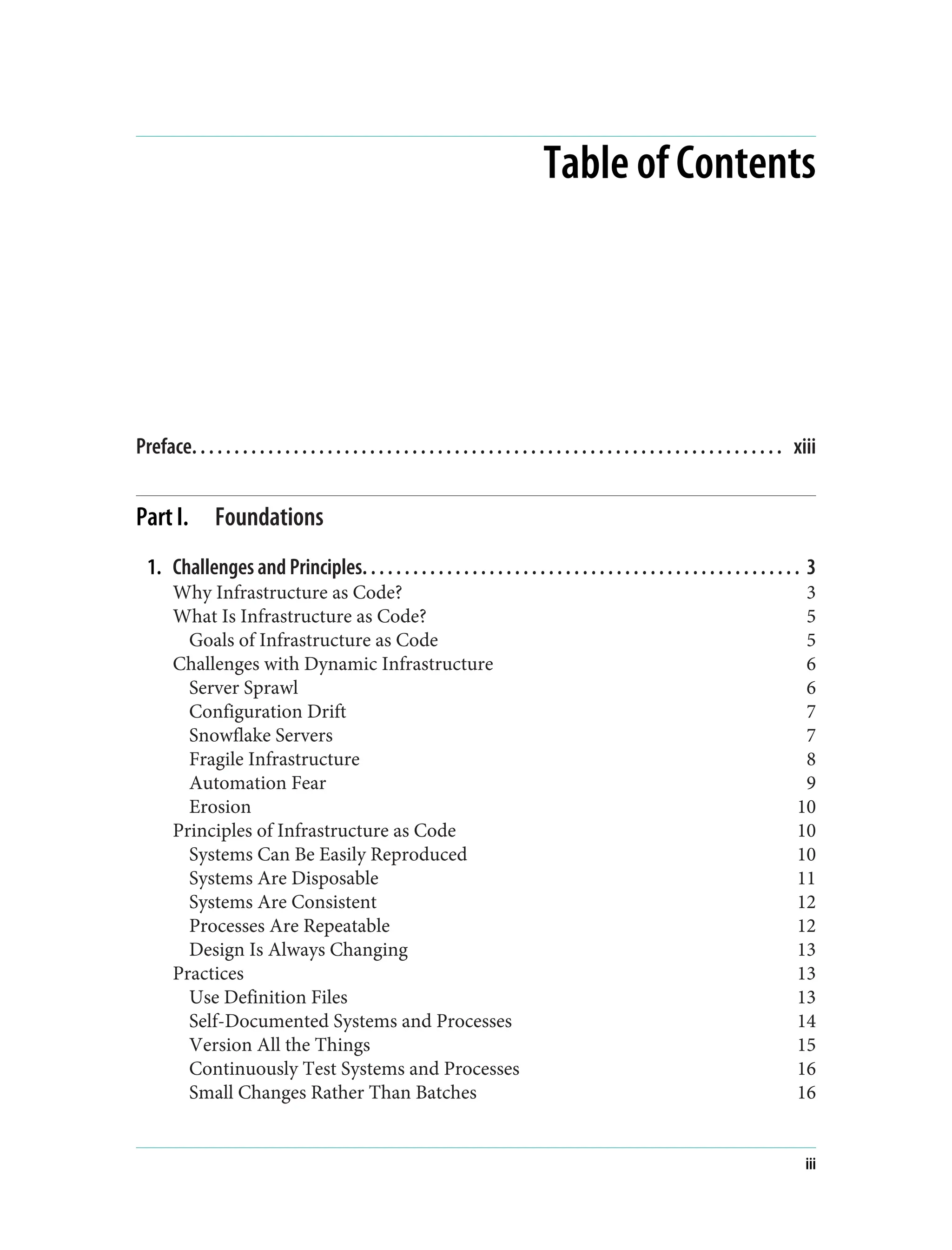
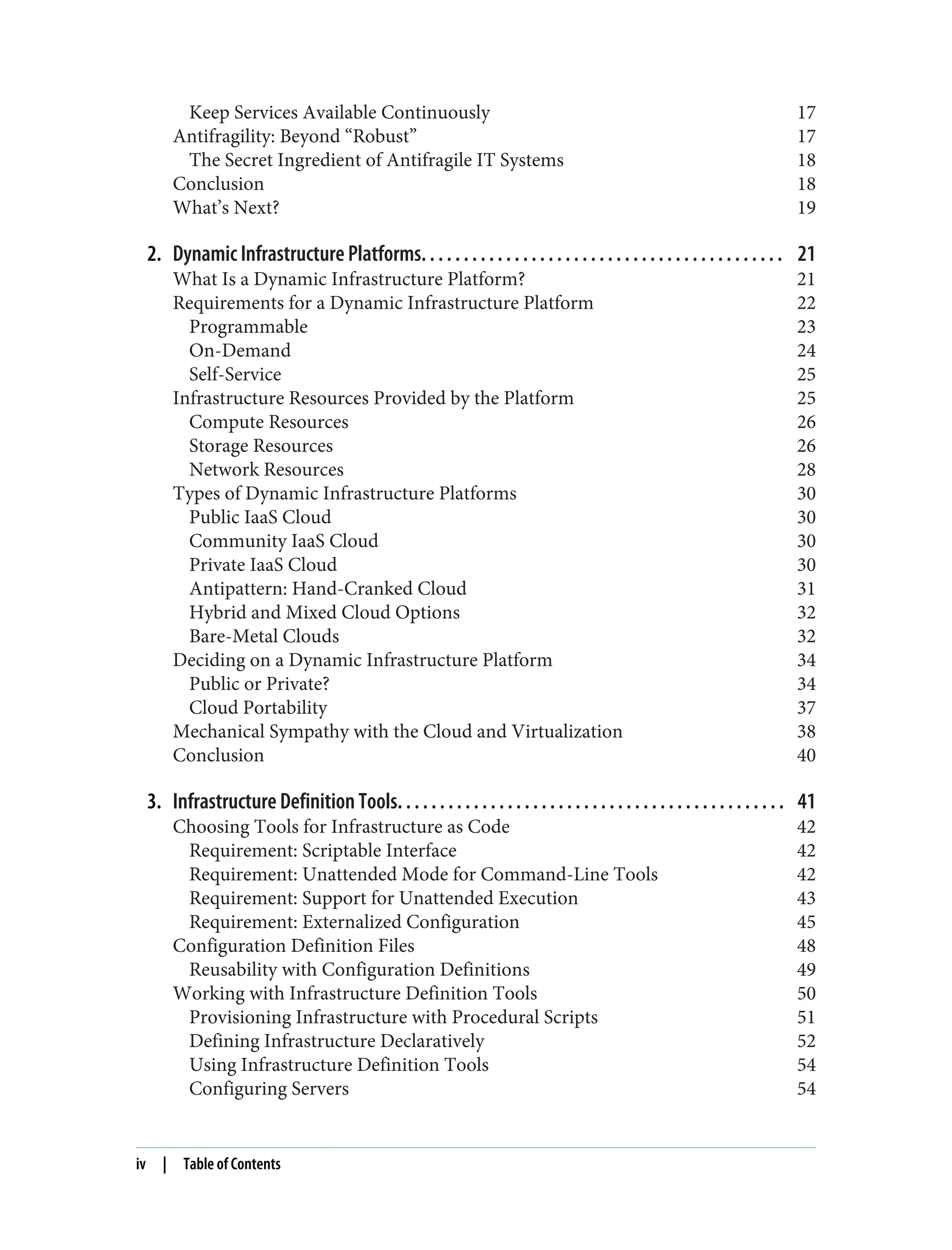
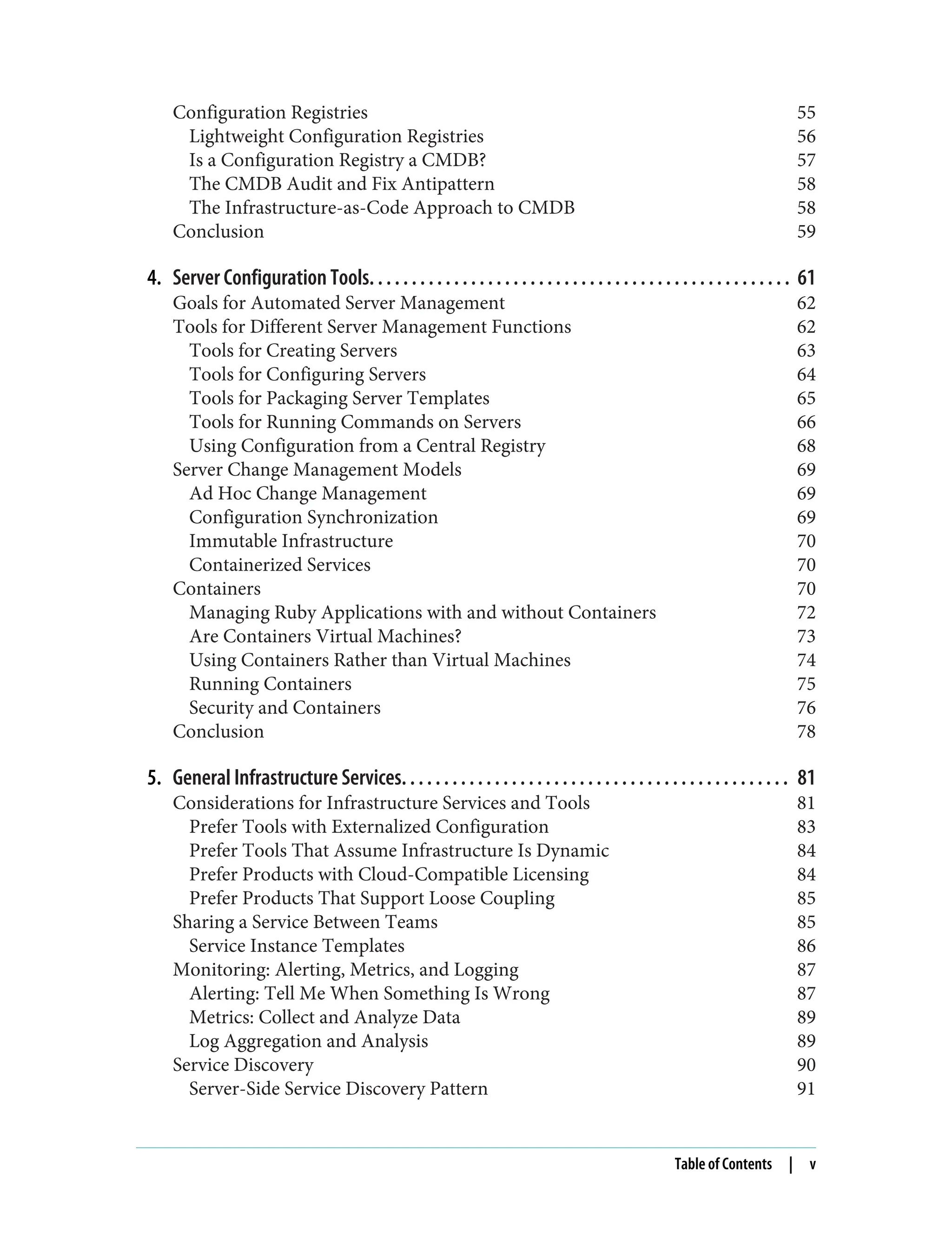
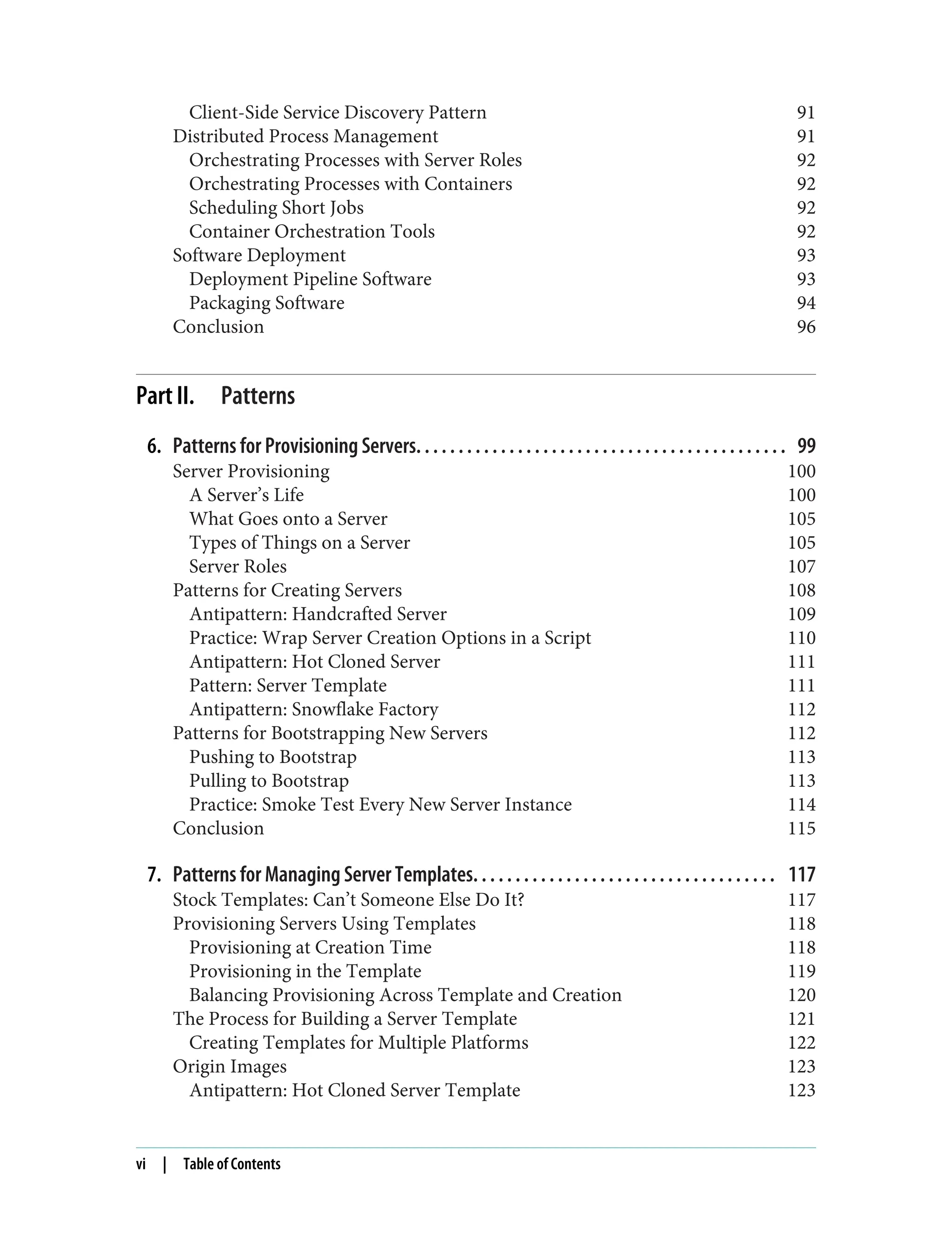
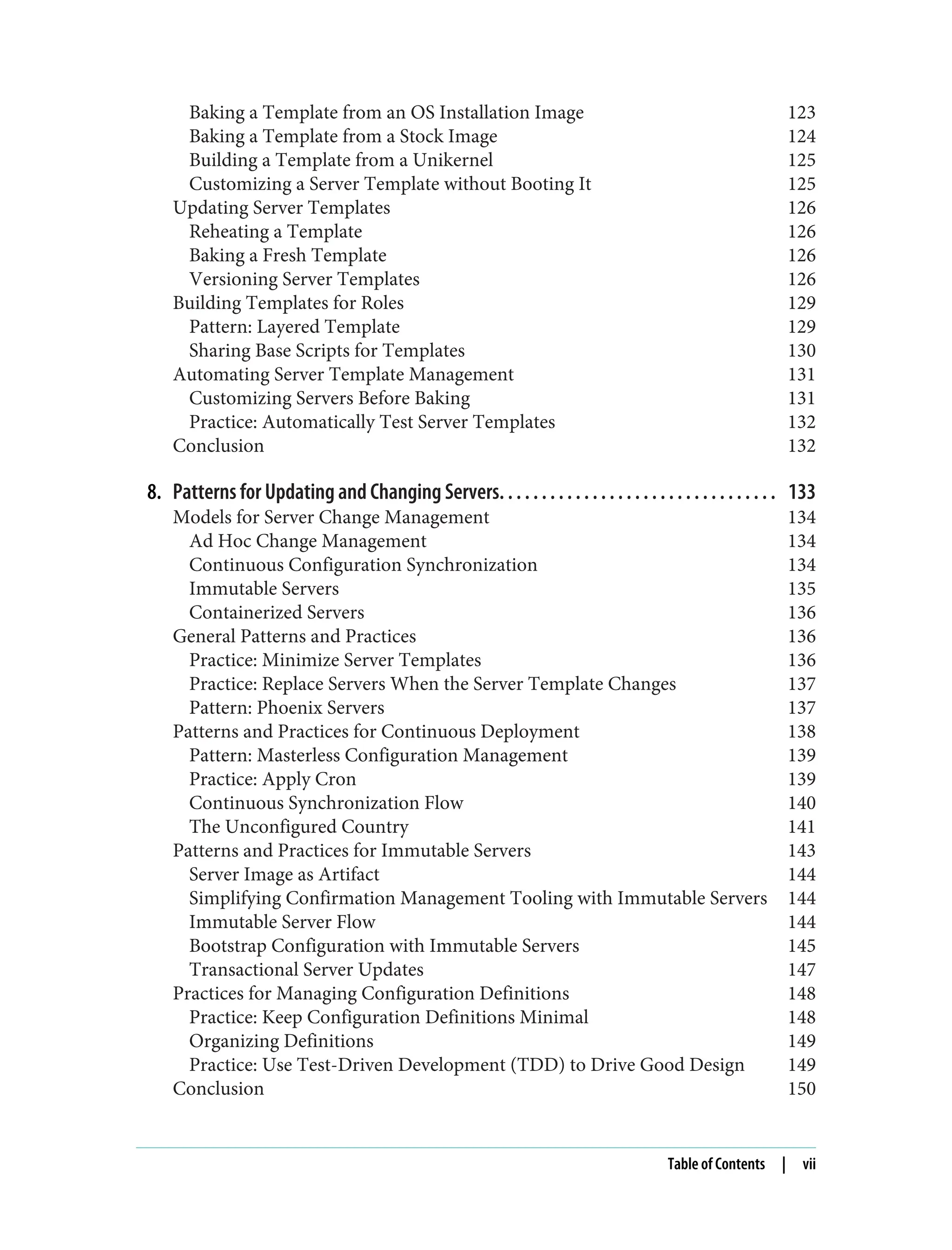
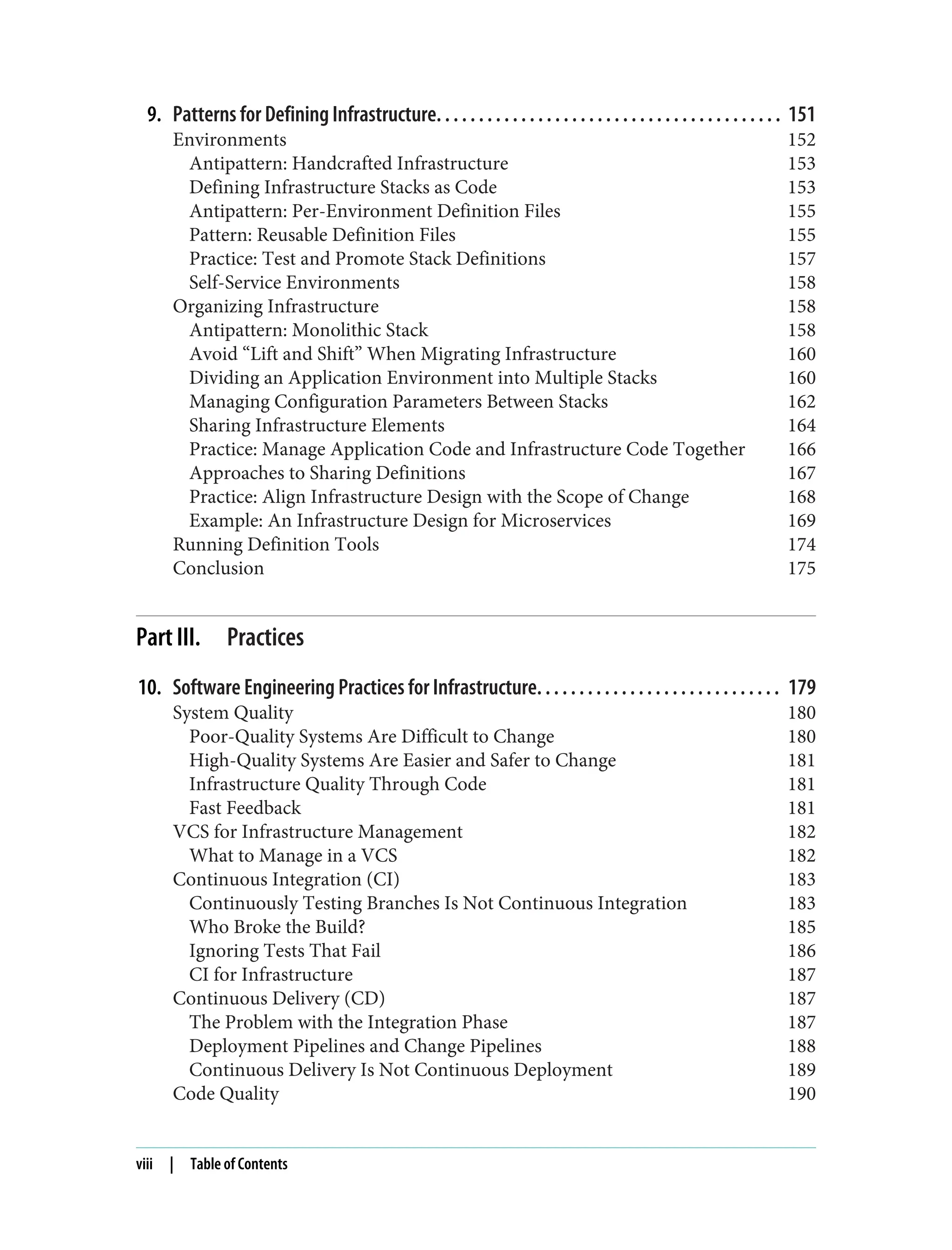
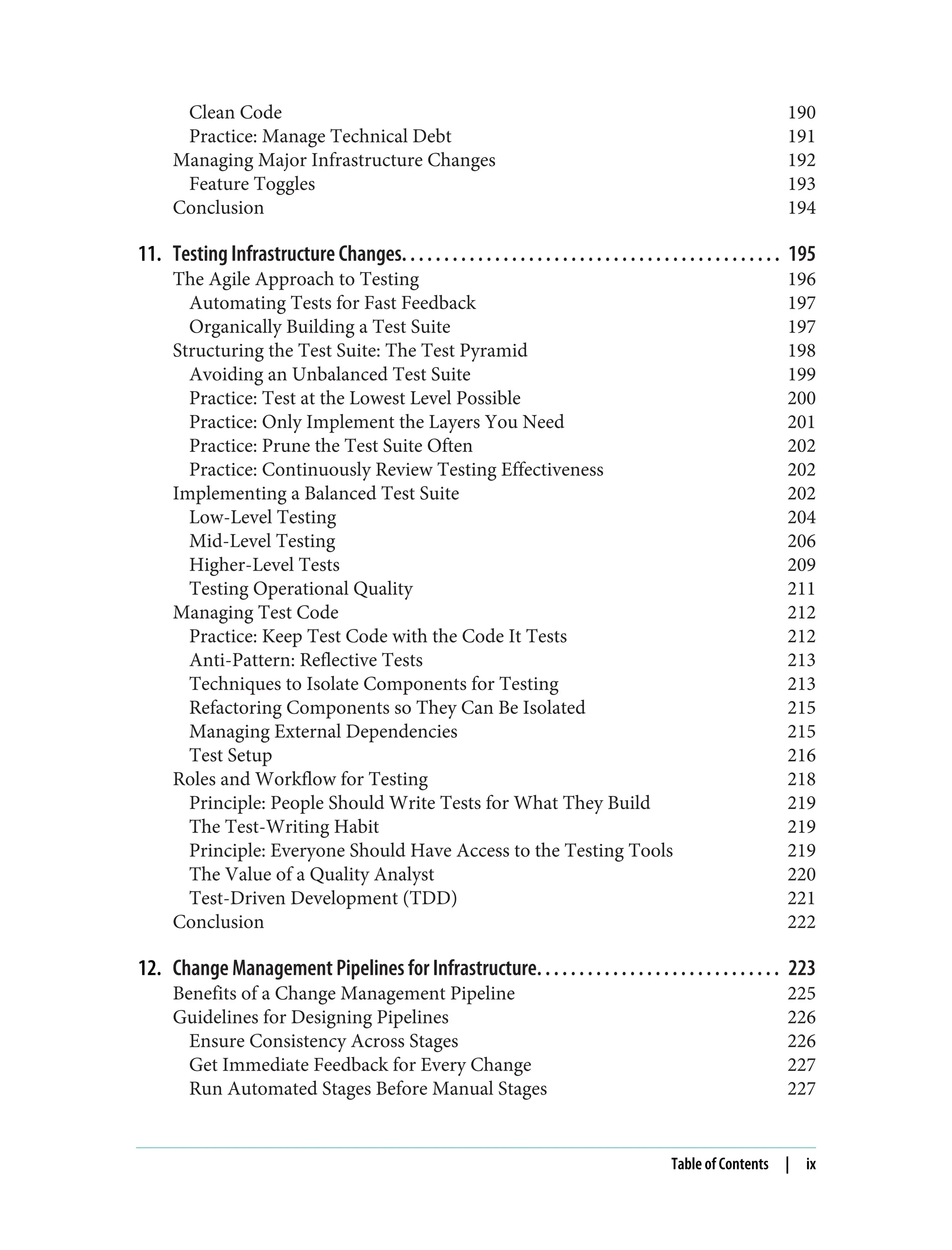
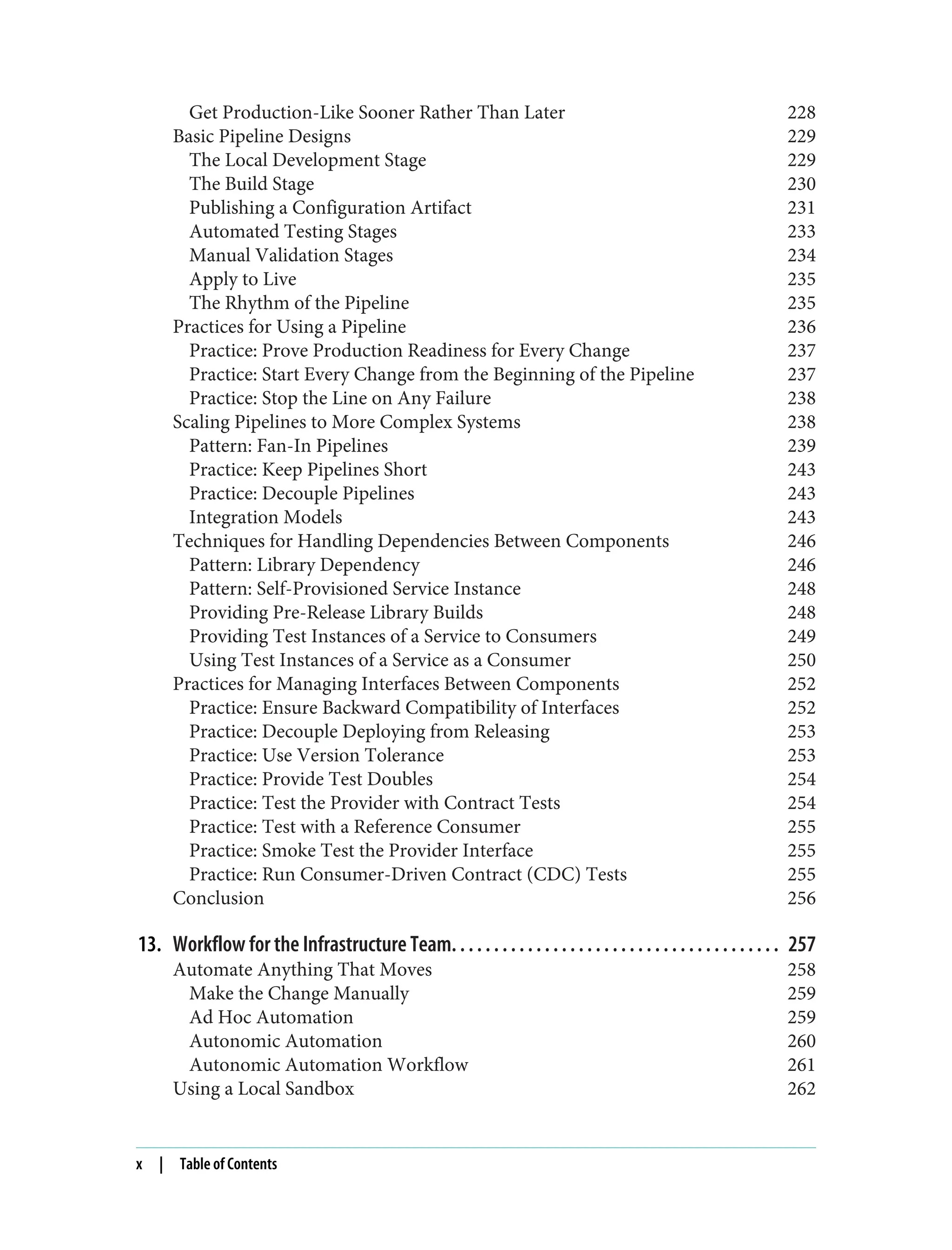
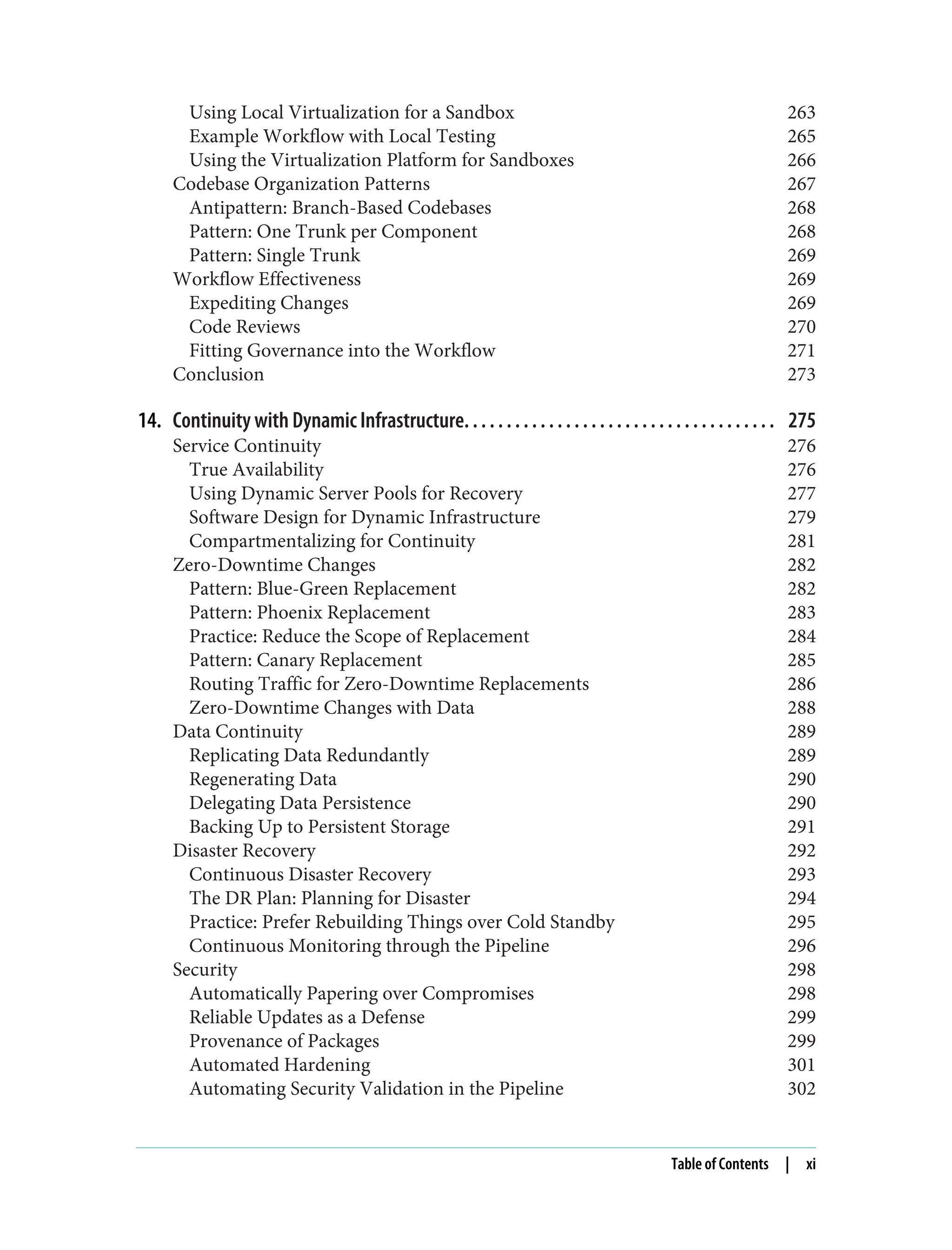
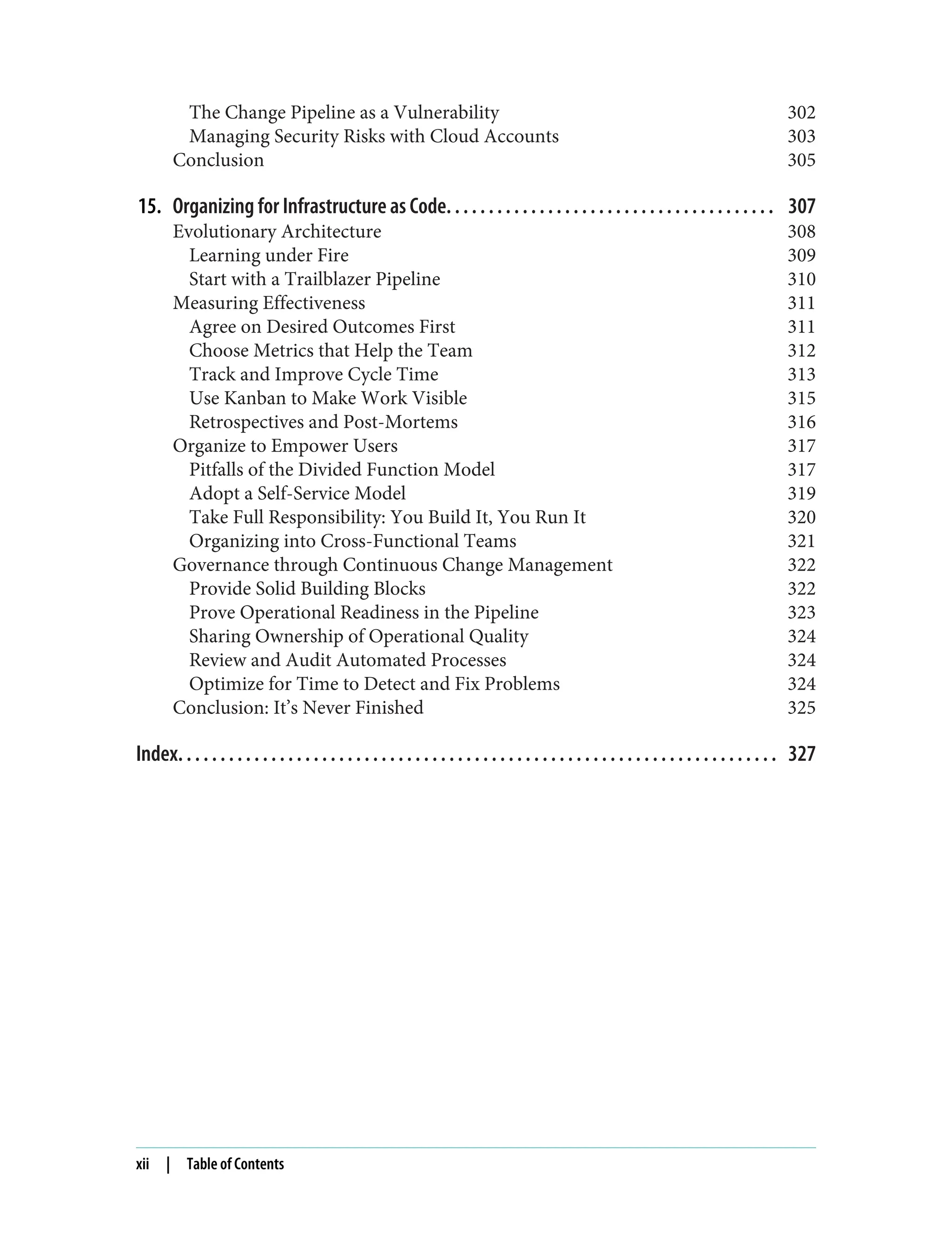





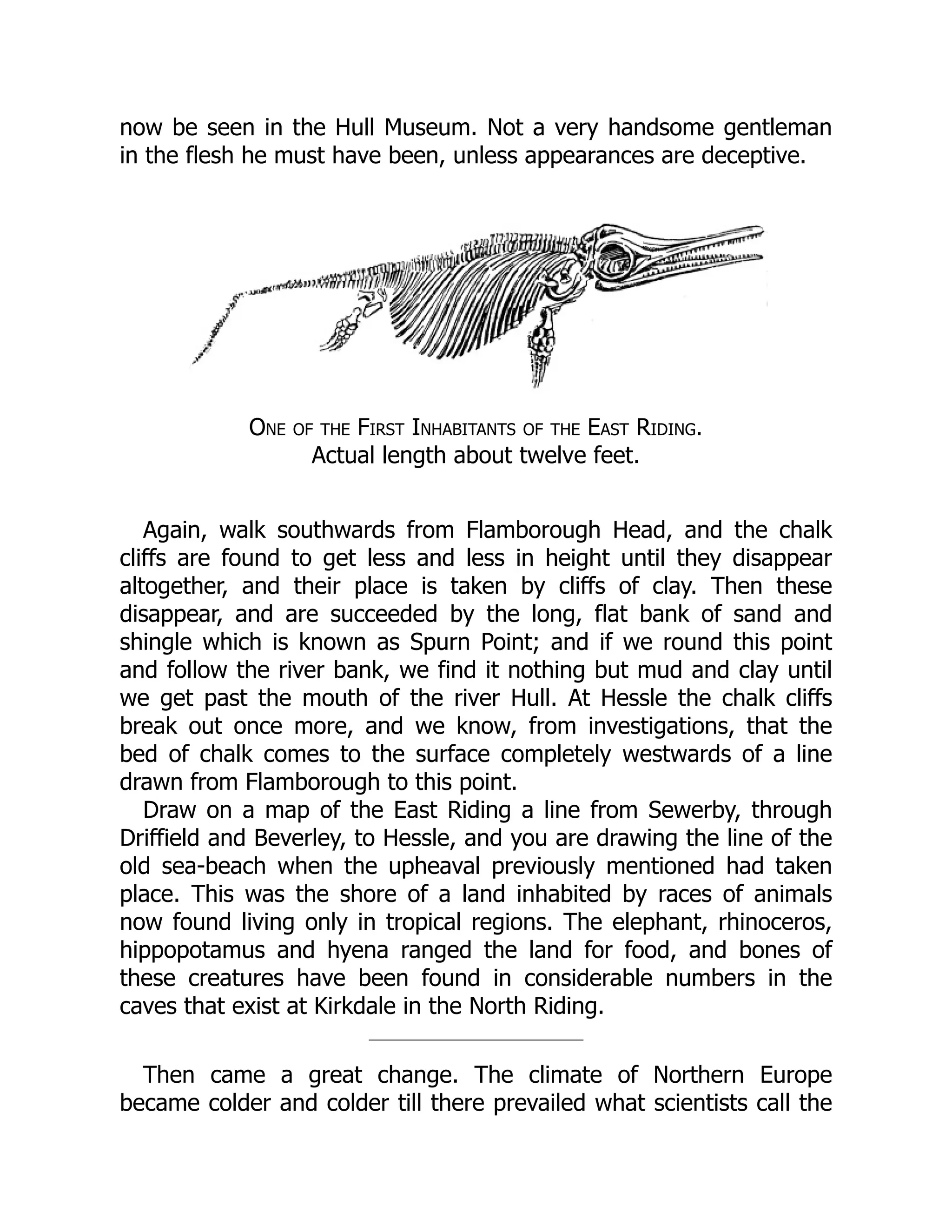
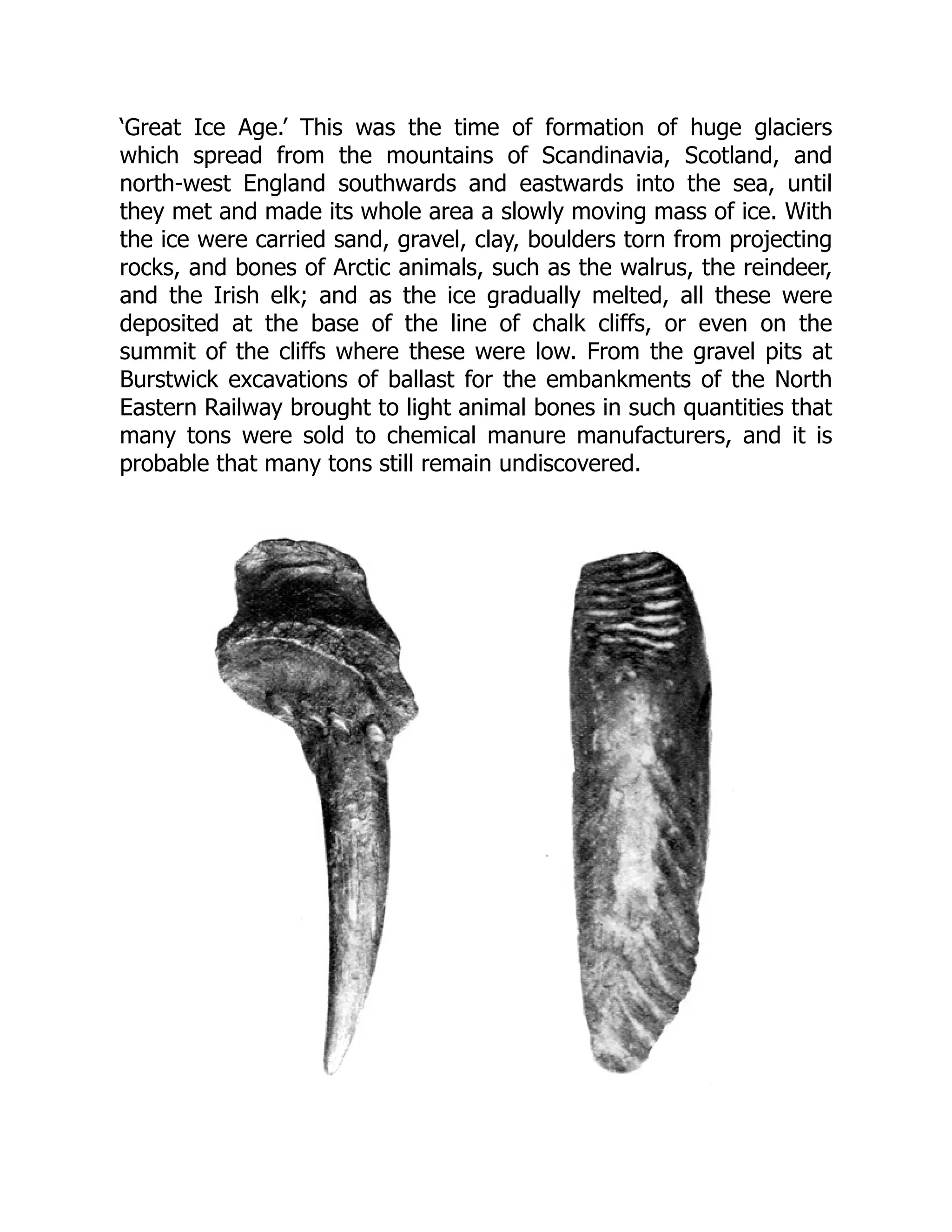
![Photo by] Relics of the Ice Age. [C. W. Mason
A walrus tusk from Kelsey Hill and the tooth of a mammoth from
the cliffs at Atwick.[2]
In this way was formed the ‘great mass of gravel, clay, and sand
... east of the Yorkshire Wolds’ which we know as the Plain of
Holderness. Here is what one of our foremost local geologists has to
say of its beginnings:—
‘Let us imagine the probable appearance of East Yorkshire on the
final melting of the ice. Huge fans or sheets of gravel occur at
Bridlington and other places as a result of the floods. Rounded
hillocks of gravel and clay stand out in all directions; the hollows in
between are filled with water, forming miniature lakes or meres. Of
animal or plant life there is little or none. The climate gradually
becomes milder; at first Arctic plants and animals exist in small
numbers. Later, the margins of the meres become clothed in
vegetation; peat is eventually formed, and huge trees of Oak and Fir
thrive. The Red Deer, Beaver, Short-horned Ox, Otter, and Wild
Horse, haunt the woods, and finally primitive man makes his
appearance.’](https://image.slidesharecdn.com/74980-250616015204-cbdae5a6/75/Infrastructure-as-code-managing-servers-in-the-cloud-Morris-37-2048.jpg)
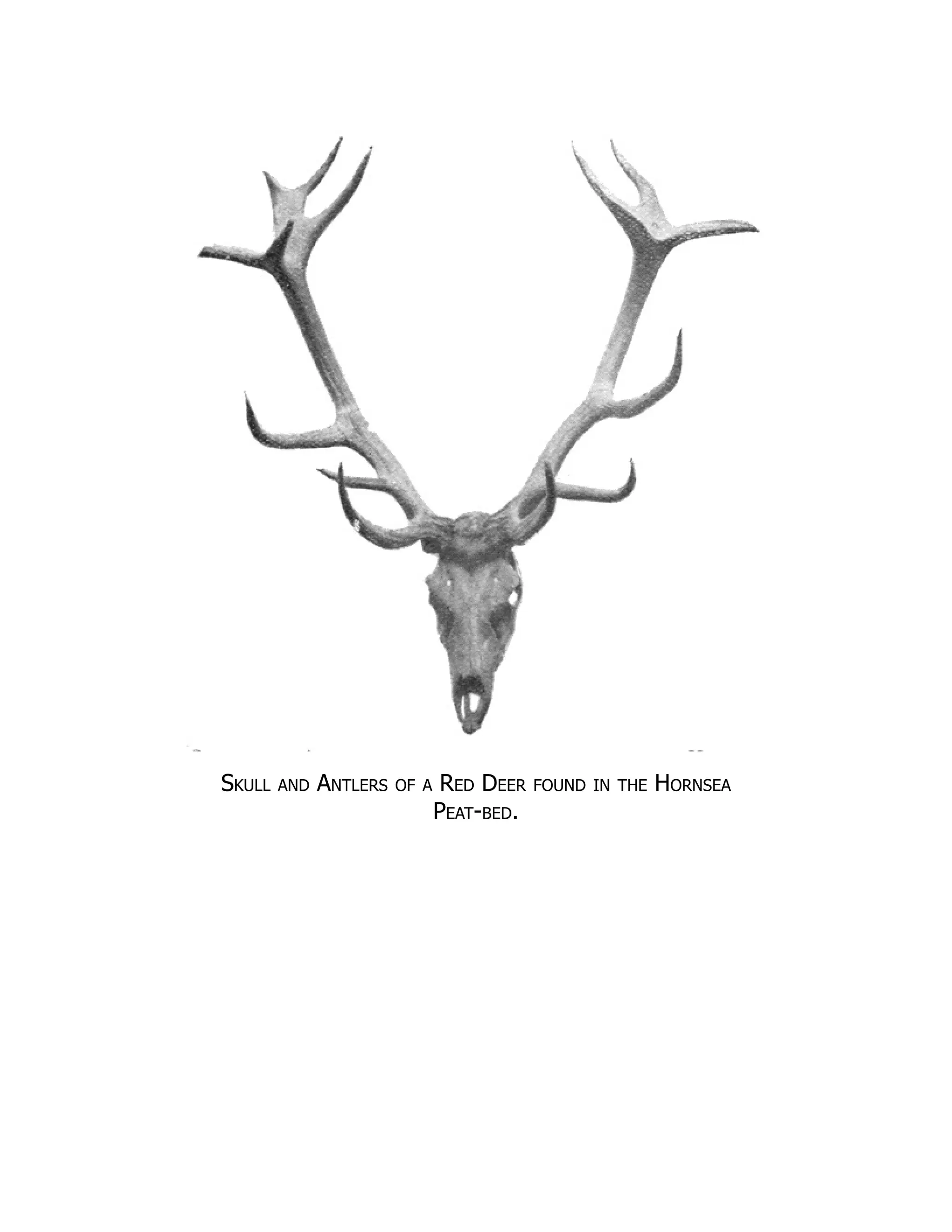
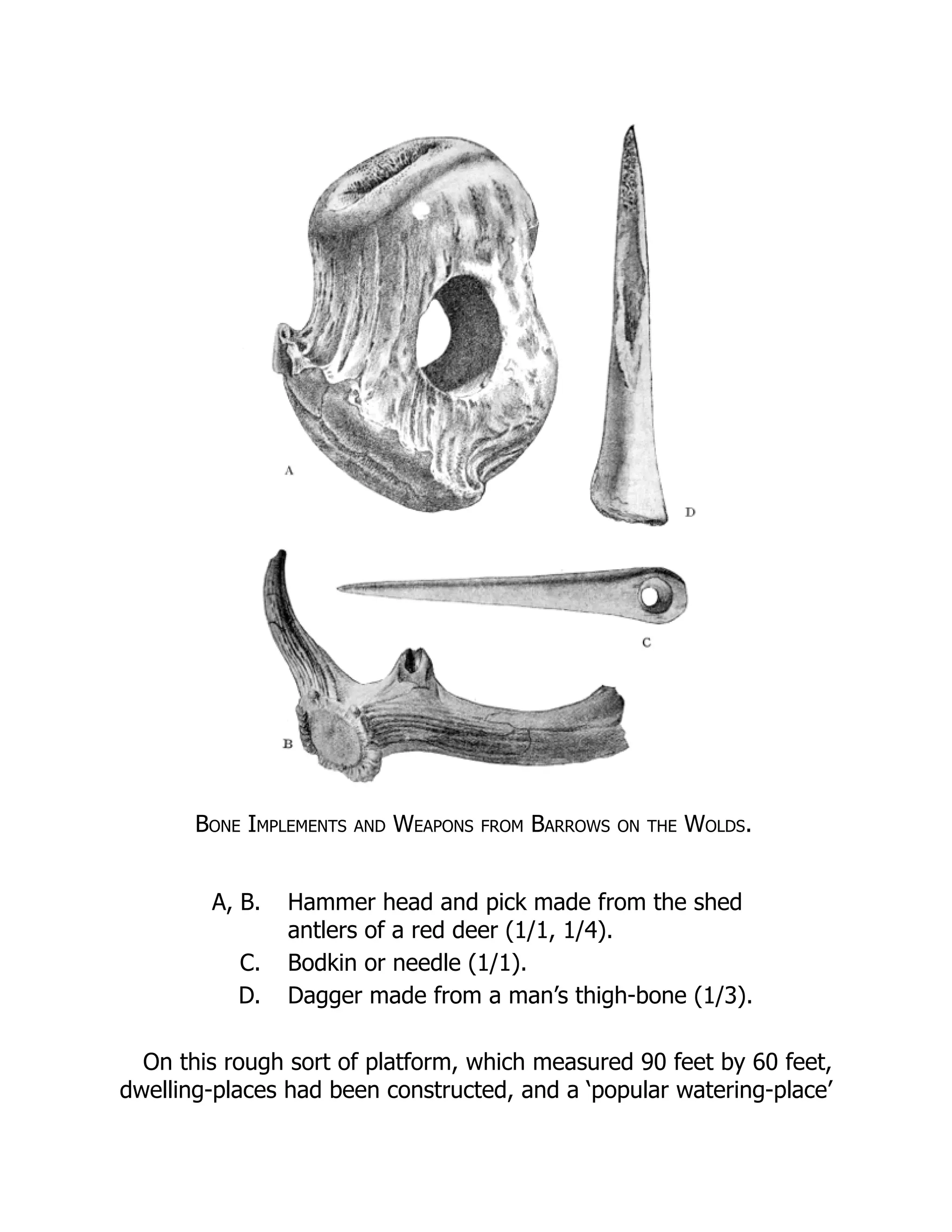
![it must have been; for there was evidence that it had been built in
the first place by a race of people whose tools were of flint and
bone, and that this race had been ousted many years later by
another more advanced race who had weapons and tools of bronze.
That the dwellers here were mighty hunters and mighty eaters was
proved by enormous accumulations of animal bones under and
around the platform. That they were also cannibals is likely from the
presence of human bones among this refuse.
So much for the ‘lake-dwellers’ of Ulrome. Up on the Wolds there
were men living a somewhat different life. These hunted and ate the
same kinds of creatures, and they used the same kinds of weapons,
but their dwellings were dug out of the soil—shallow circular or
elliptical pits each covered over with a conical roof of branches and
turf, supported on a central post; or deeper troughs covered over
with sods and scrub laid on slabs of chalk, so that the roof was level
with the surrounding earth and indistinguishable from it.
Of the former kind of pit-dwelling an example has been discovered
in the hollow known as Garton Slack, the pit measuring rather less
than 9 feet by 6 feet in length and breadth, and 5 feet in depth;
while one of the latter kind has come to light under Kemp Howe, a
few miles north of Driffield.[3]
The underground chamber here
measured 25 feet by 4½ feet, had a depth of 6 feet at its deeper
end, and was approached by a sloping passage 11 feet in length, the
entrance to which would doubtless be hidden with scrub. The roof
had been supported on six upright posts, and for twelve feet along
one side of the chamber ran a stone ledge—this last being evidently
a luxury.
It is probable that these two kinds of dwellings may have been
respectively the summer and winter houses of the same people. For
the Roman historian Tacitus says of the ancient tribes on the other
side of the North Sea:—
Besides their ordinary habitations, they have a number of
subterranean caves, dug by their own labour and carefully](https://image.slidesharecdn.com/74980-250616015204-cbdae5a6/75/Infrastructure-as-code-managing-servers-in-the-cloud-Morris-41-2048.jpg)
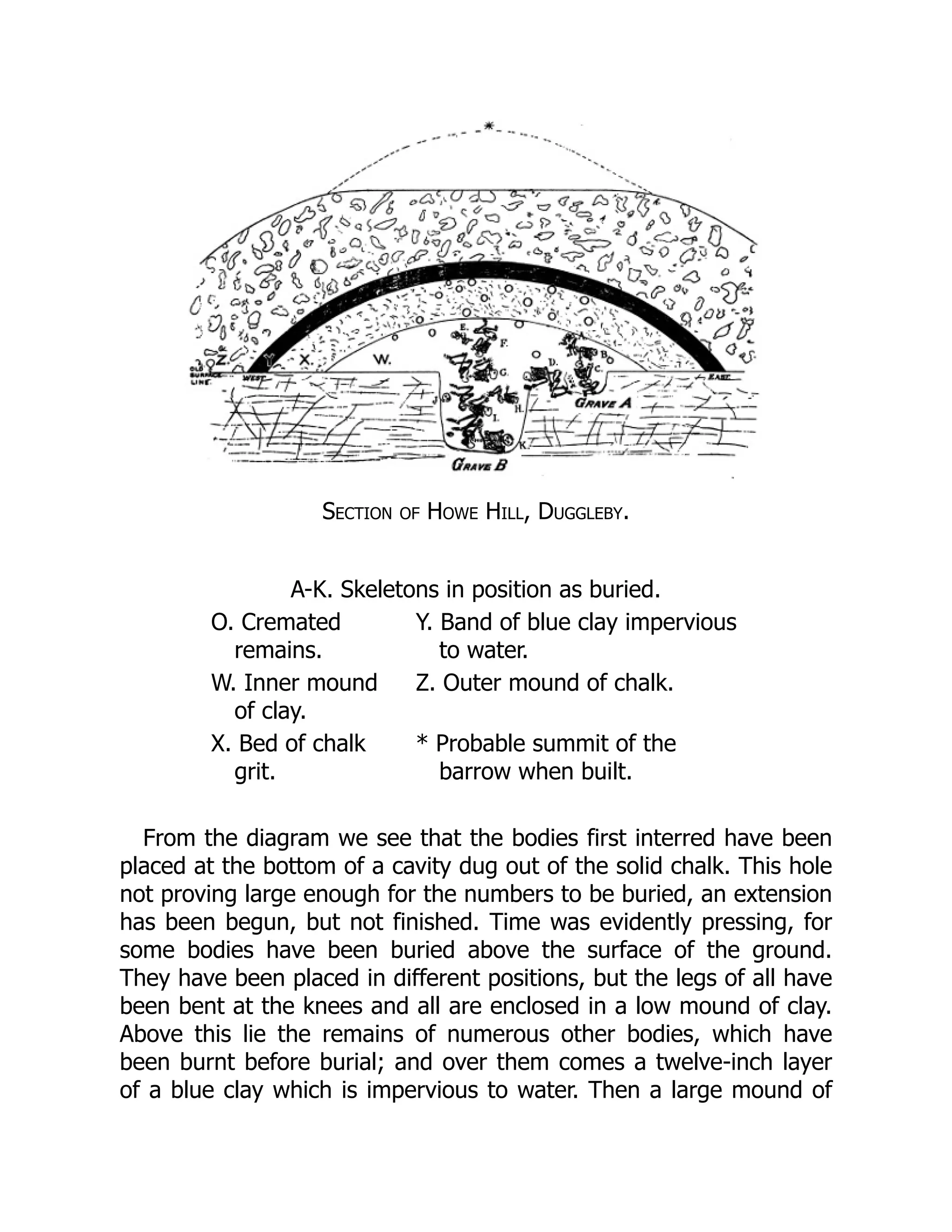
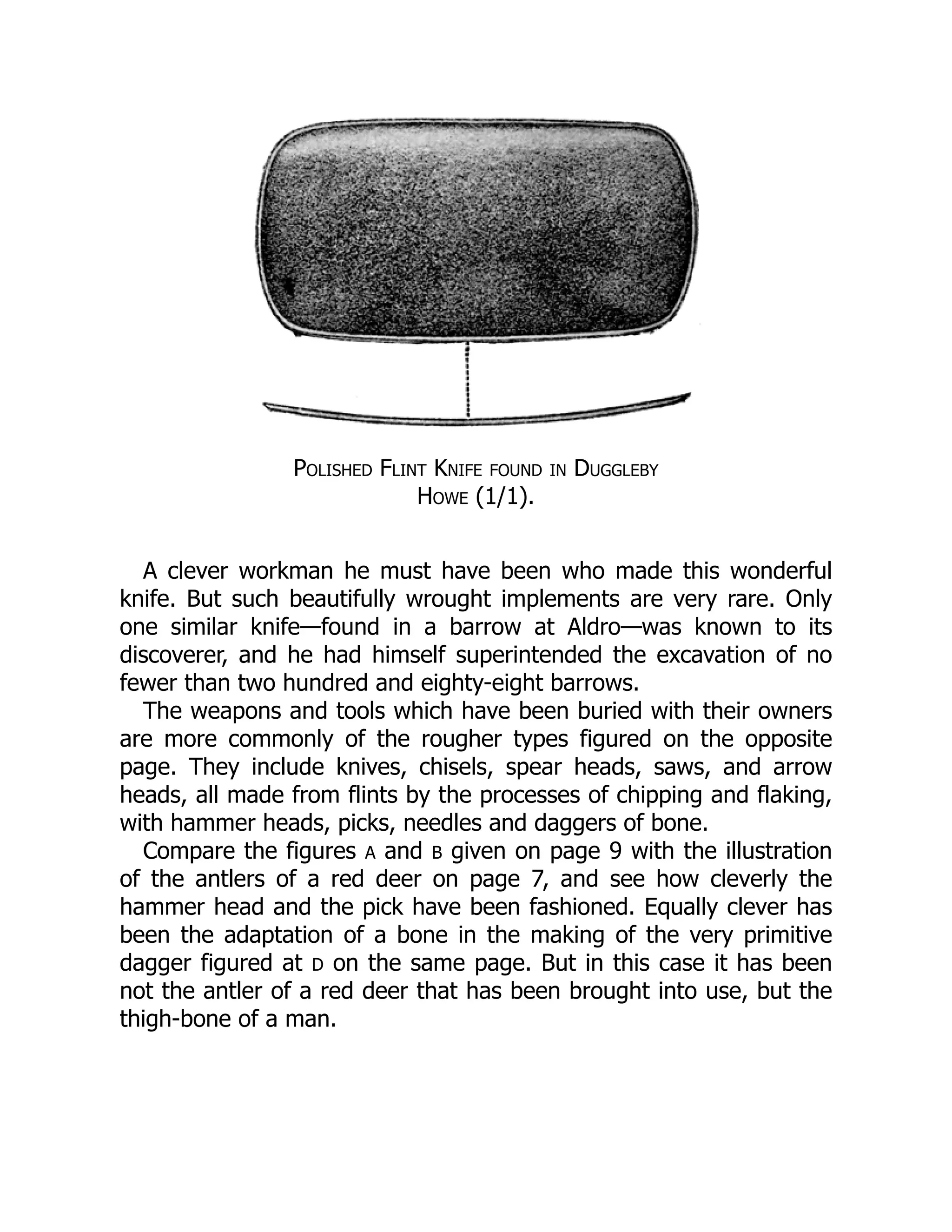
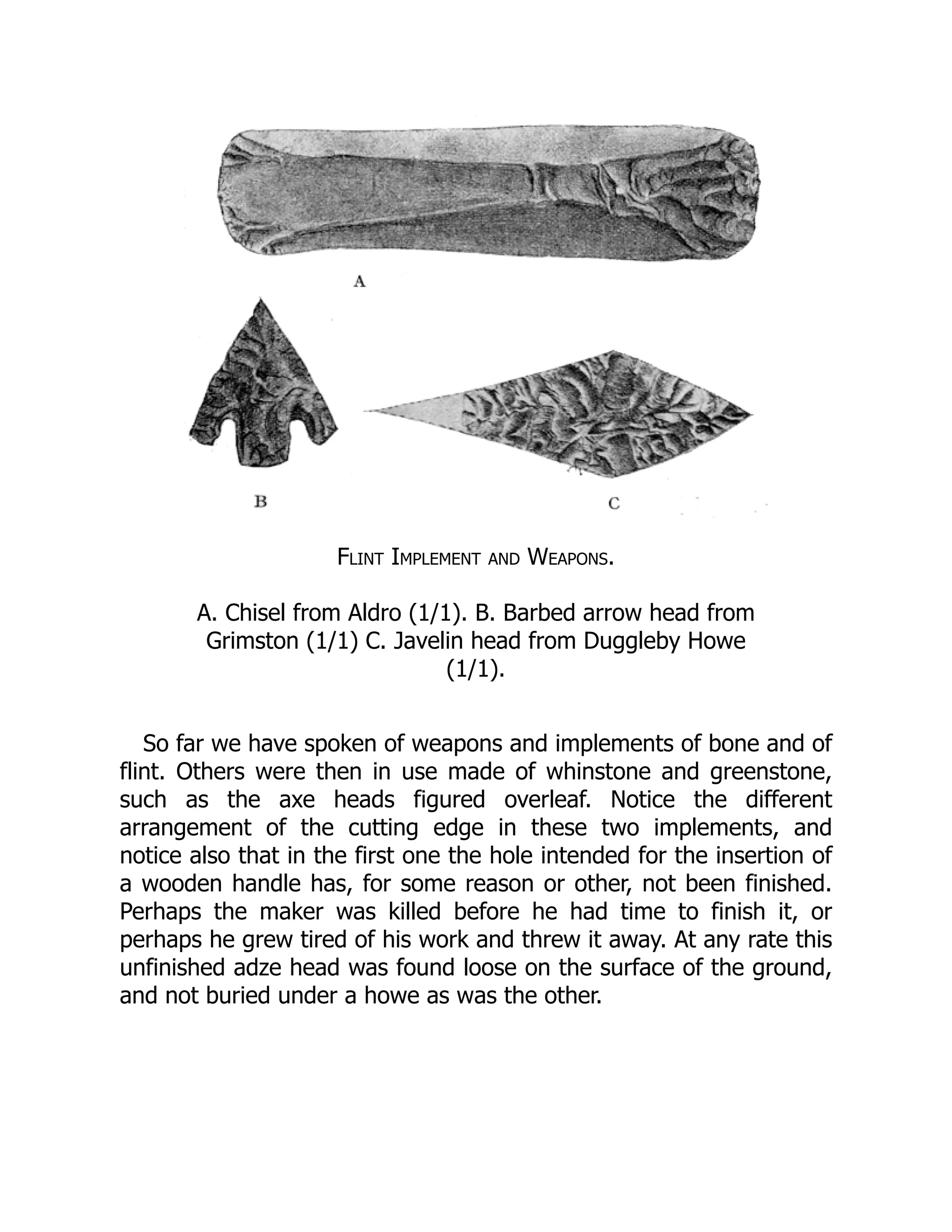
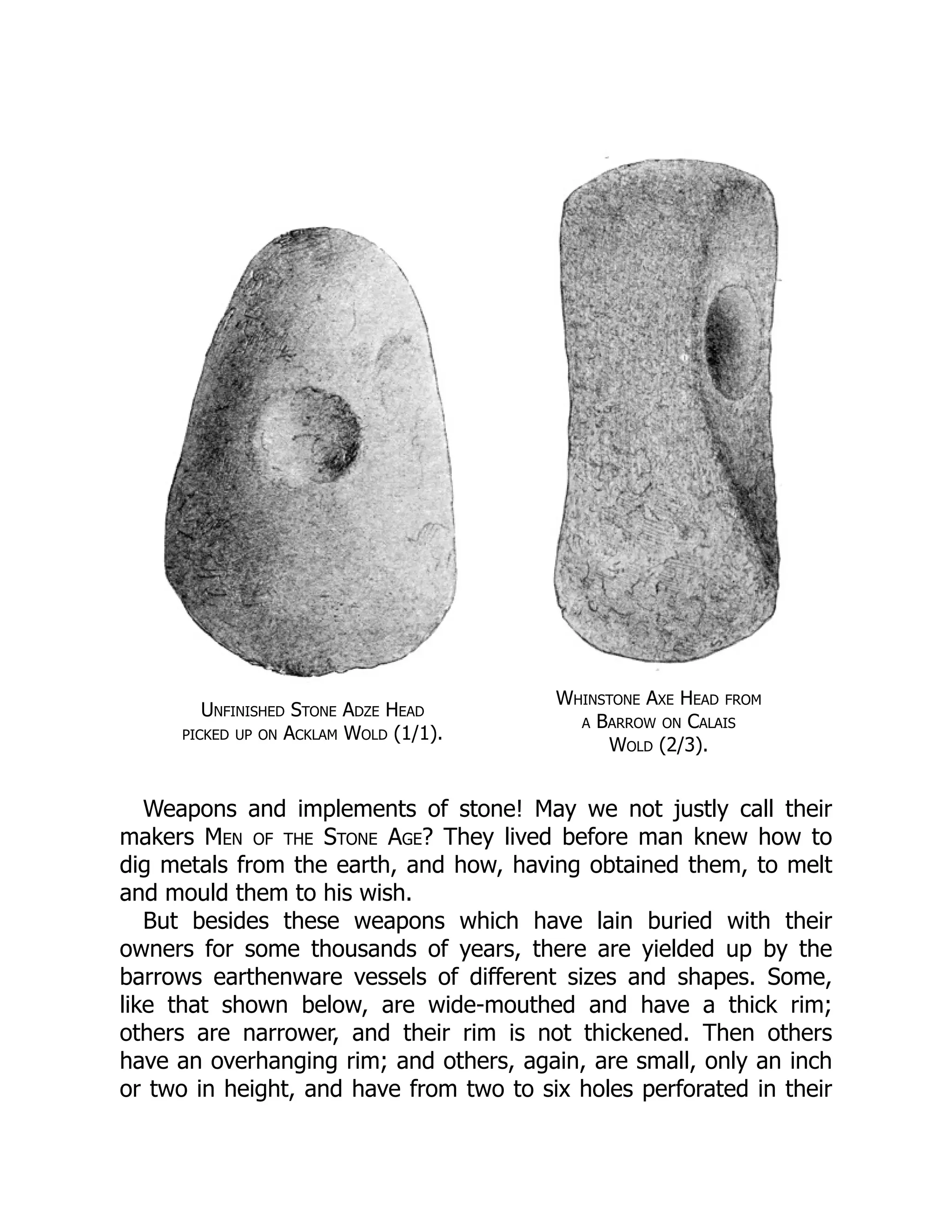
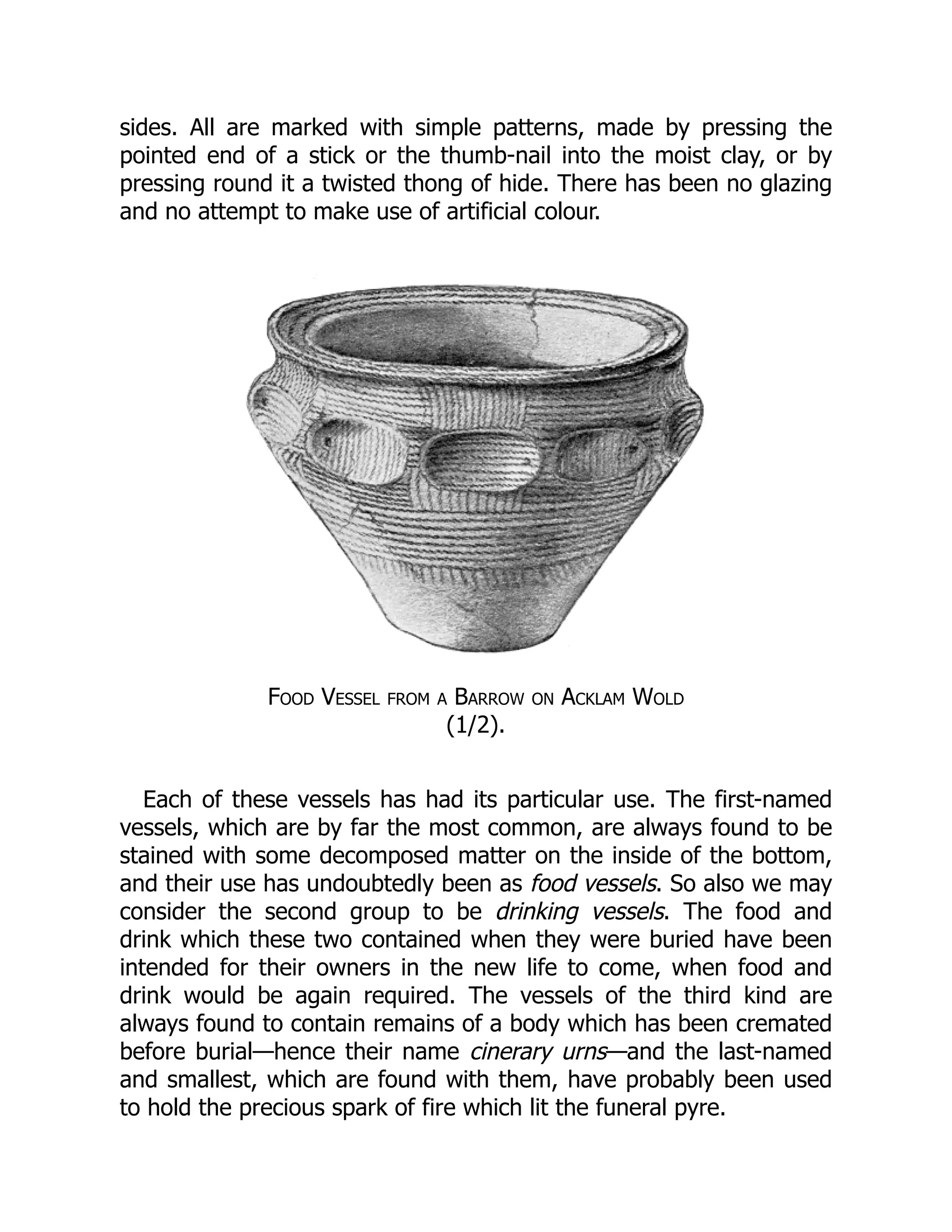
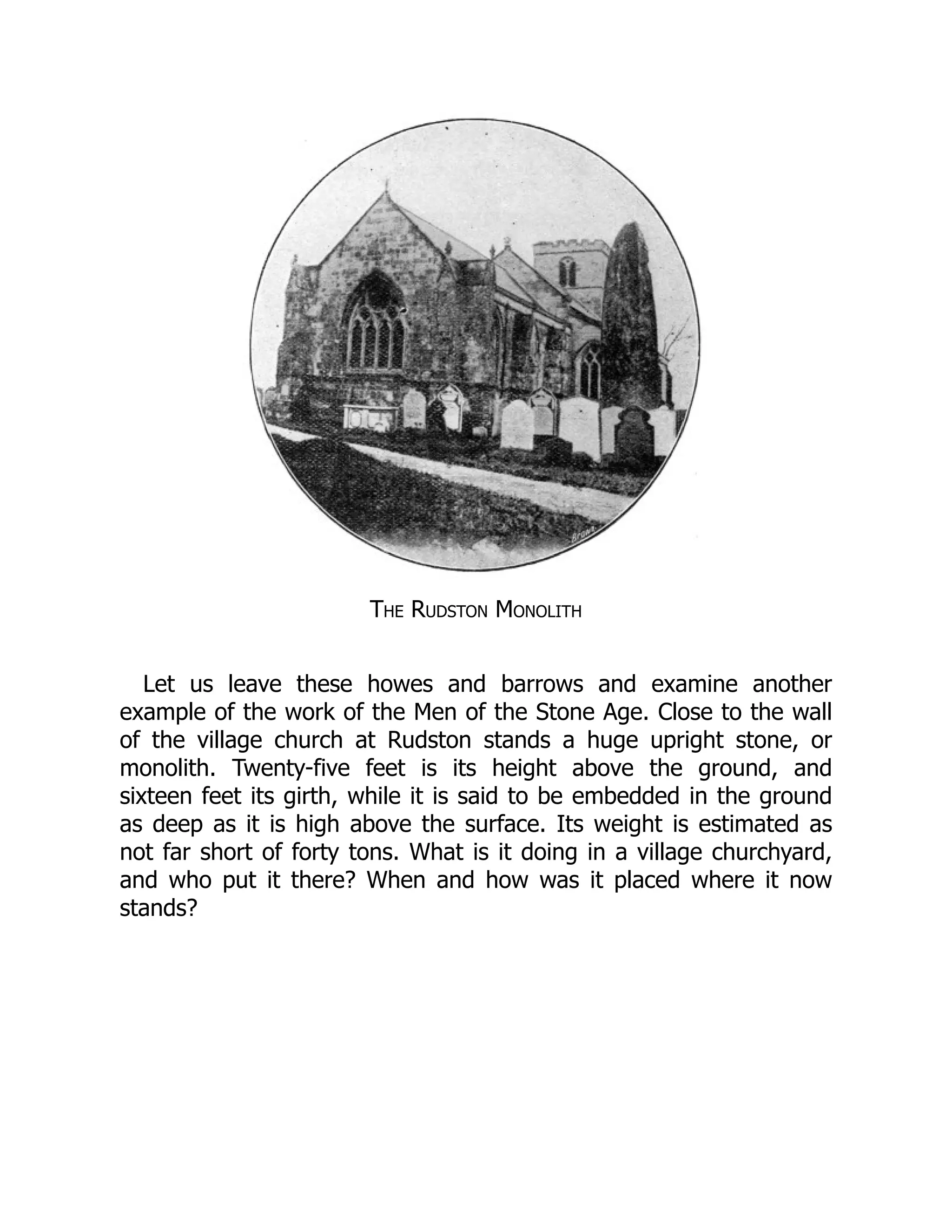
![The earliest kind of Axe used in East Yorkshire.
It is impossible to give any definite answers to these questions. A
century ago, however, the village people answered them all very
easily. The Devil, they said, objected to the building of the church,
and flung this stone to destroy it before its completion. But his aim
was not so accurate as it was intended to be, and the missile missed
its mark. Asked for a proof of their wonderful story, they would point
to the stone itself. There it was for everyone to see. What further
proof could be needed?[4]
Whether we believe this legend or not,
two things are certain. First, that the stone is as old as the barrows
in the surrounding wolds; secondly, that there is no rock of the same
nature nearer to it than Filey Brig and the Brimham Rocks. Was it
brought down by the great ice sheet and then erected by the men of
the Stone Age to serve some purpose in their heathen rites, or did
they bring it up from Filey or down from the hills of the North Riding
on wooden rollers? Perhaps it is not more difficult to conceive of
their doing this than of their raising such a huge barrow as that
which stands unopened at the foot of Garrowby Hill—a mound 250
feet in diameter at its base and 50 feet in height.](https://image.slidesharecdn.com/74980-250616015204-cbdae5a6/75/Infrastructure-as-code-managing-servers-in-the-cloud-Morris-50-2048.jpg)

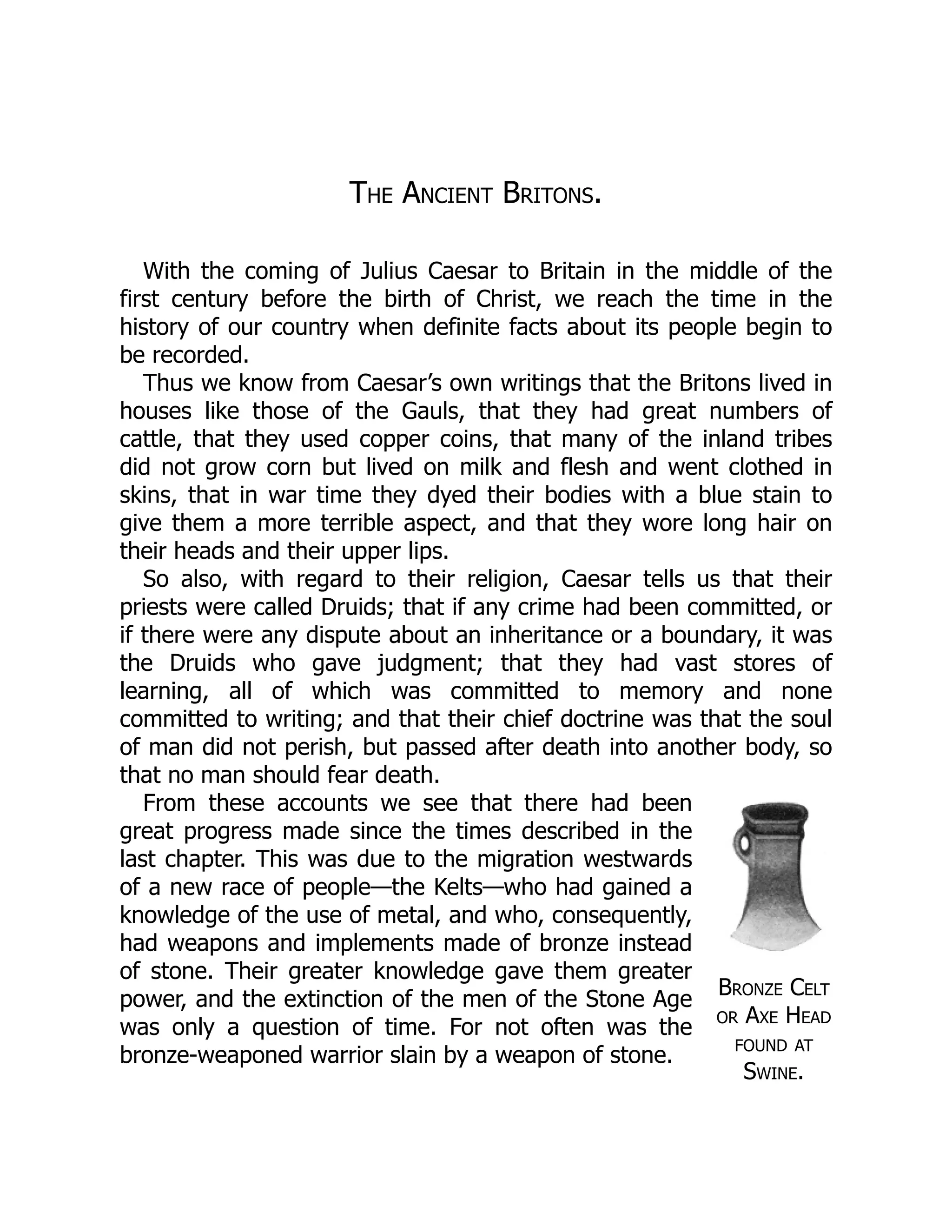
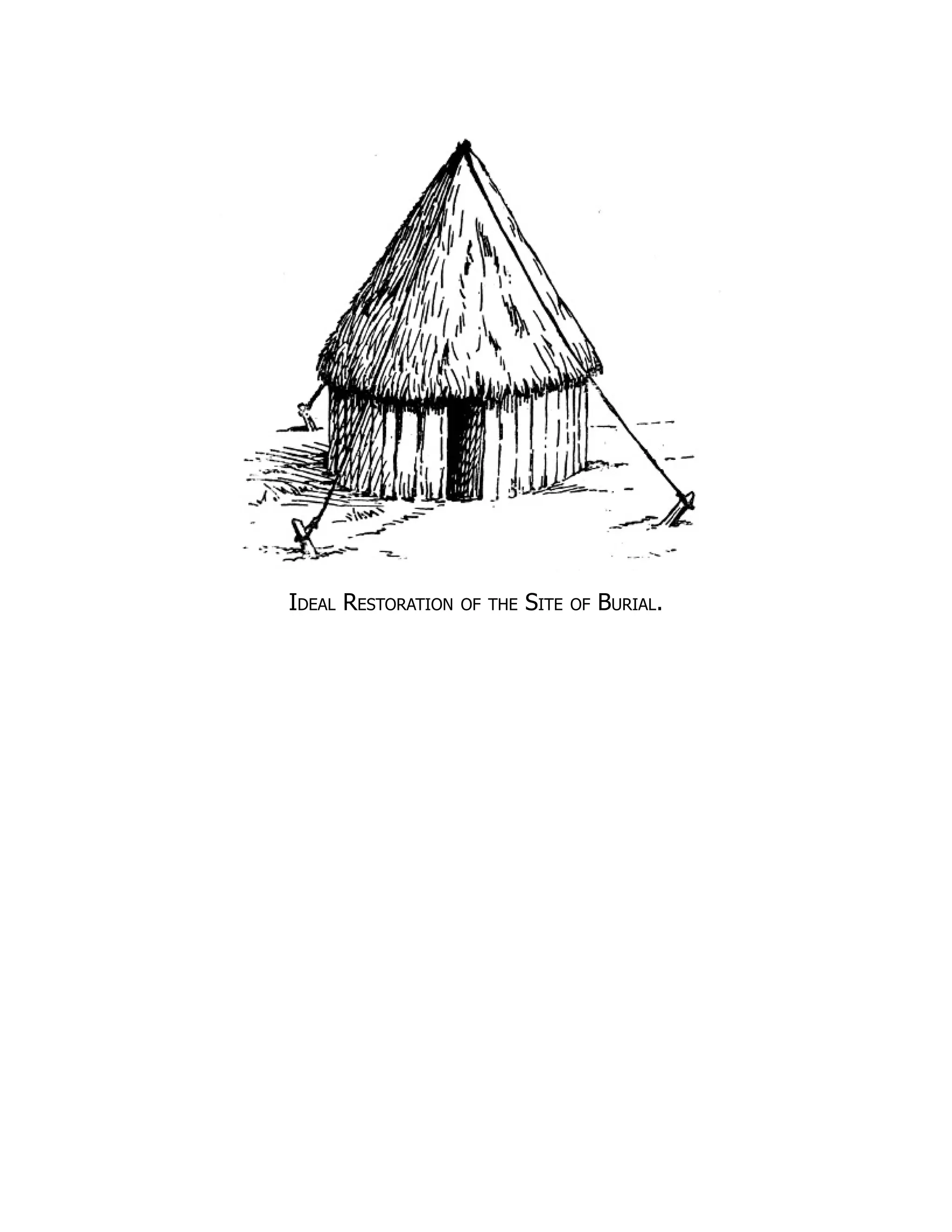
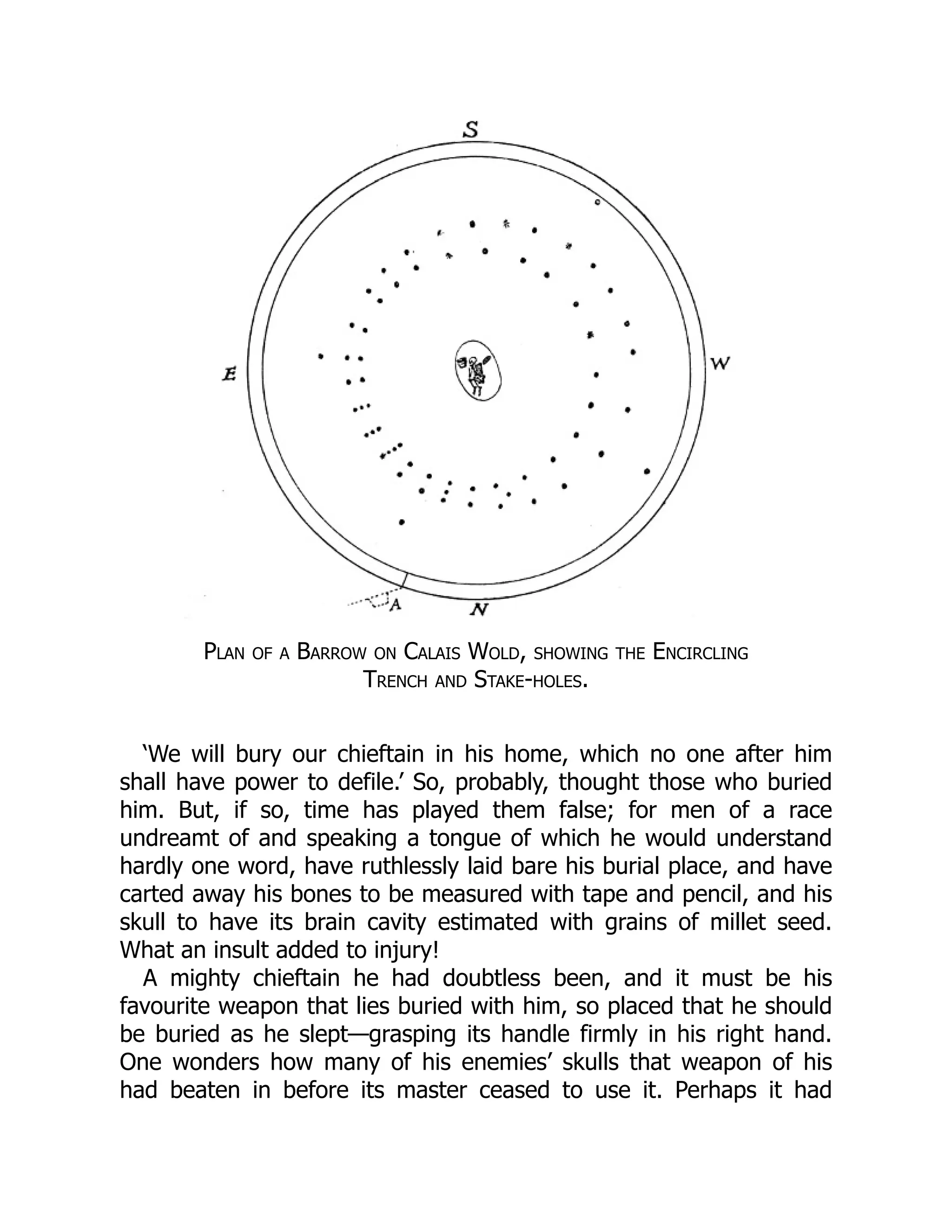
![Photo by] [C.W. Mason
British Gold Coin.
Found at Atwick by Mr. W. Morfitt
(1/1).
How a British Chieftain’s Wife was buried in Garton Slack.
In neither of these two barrows was
there any sign of a bronze implement.
Weapons and implements of bronze
are rare among those found in the
barrows of East Yorkshire, and the
few discovered are dagger or knife
heads and prickers. The Brigantes
were far behind the Britons of the
south in their knowledge of the use of
metal; and at the time when the latter
were making use of bronze, the wild
and savage tribes of the north were content still to make use of
greenstone and flint.
Personal ornaments, too, are rare, and were found accompanying
only fifty-seven out of eight hundred and ninety-three burials that
Mr. Mortimer excavated. They include dress-fastenings, such as rings
and links of jet, and buttons of amber, jet and bone. With only one
British interment was gold found, and of silver ornaments none were
discovered at all.](https://image.slidesharecdn.com/74980-250616015204-cbdae5a6/75/Infrastructure-as-code-managing-servers-in-the-cloud-Morris-57-2048.jpg)