Infrastructure as Code 2nd Edition Early Access Kief Morris
Infrastructure as Code 2nd Edition Early Access Kief Morris
Infrastructure as Code 2nd Edition Early Access Kief Morris
Infrastructure as Code 2nd Edition Early Access Kief Morris
Infrastructure as Code 2nd Edition Early Access Kief Morris
1.
Infrastructure as Code2nd Edition Early Access
Kief Morris download
https://textbookfull.com/product/infrastructure-as-code-2nd-
edition-early-access-kief-morris/
Download full version ebook from https://textbookfull.com
2.
We believe theseproducts will be a great fit for you. Click
the link to download now, or visit textbookfull.com
to discover even more!
Infrastructure as Code: Dynamic Systems for the Cloud
Age 2nd Edition Kief Morris
https://textbookfull.com/product/infrastructure-as-code-dynamic-
systems-for-the-cloud-age-2nd-edition-kief-morris/
Infrastructure as code managing servers in the cloud
Morris
https://textbookfull.com/product/infrastructure-as-code-managing-
servers-in-the-cloud-morris/
Terraform Up and Running Writing Infrastructure as Code
1st Edition Yevgeniy Brikman
https://textbookfull.com/product/terraform-up-and-running-
writing-infrastructure-as-code-1st-edition-yevgeniy-brikman/
Terraform Up Running Writing Infrastructure as Code 2 /
converted Edition Yevgeniy Brikman
https://textbookfull.com/product/terraform-up-running-writing-
infrastructure-as-code-2-converted-edition-yevgeniy-brikman/
3.
Mastering Git EarlyAccess Edition Jawwad Ahmad
https://textbookfull.com/product/mastering-git-early-access-
edition-jawwad-ahmad/
DevOps in Python: Infrastructure as Python Zadka
https://textbookfull.com/product/devops-in-python-infrastructure-
as-python-zadka/
Infrastructure as an Asset Class Investment Strategy
Sustainability Project Finance and PPP 2nd Edition
Barbara Weber
https://textbookfull.com/product/infrastructure-as-an-asset-
class-investment-strategy-sustainability-project-finance-and-
ppp-2nd-edition-barbara-weber/
Integrating Educational Technology Into Teaching [with
eText Access Code] Margaret D. Roblyer
https://textbookfull.com/product/integrating-educational-
technology-into-teaching-with-etext-access-code-margaret-d-
roblyer/
Mosaics: Reading and Writing Paragraphs -- MyLab
Writing with Pearson eText Access Code 8th Edition
Flachmann
https://textbookfull.com/product/mosaics-reading-and-writing-
paragraphs-mylab-writing-with-pearson-etext-access-code-8th-
edition-flachmann/
6.
1. Preface
a. HowI Learned to Stop Worrying and to Love
the Cloud
i. The Sorcerer’s Apprentice
ii. Cloud from Scratch
iii. Legacy cloud infrastructure
b. Why I Wrote This Book
c. Why A Second Edition
d. Who This Book Is For
e. What Tools Are Covered
f. Principles, Practices, and Patterns
g. The FoodSpin examples
h. Conventions Used in This Book
i. O’Reilly Online Learning
j. How to Contact Us
2. I. Foundations
3. 1. What is Infrastructure as Code?
a. From the Iron Age to the Cloud Age
b. Infrastructure as Code
i. Benefits of Infrastructure as Code
c. Use Infrastructure as Code to optimize for
change
7.
i. Objection: “Wedon’t make changes
often enough to justify automating
them”
ii. Objection: “We should build first and
automate later”
iii. Objection: “We must choose between
speed and quality”
d. Three core practices for Infrastructure as Code
i. Core practice: Define everything as
code
ii. Core practice: Continuously validate all
your work in progress
iii. Core practice: Build small, simple
pieces that you can change
independently
e. The parts of an infrastructure system
f. Conclusion
4. 2. Principles of Cloud Age Infrastructure
a. Principle: Assume systems are unreliable
b. Principle: Make everything reproducible
c. Pitfall: Snowflake systems
d. Principle: Create disposable things
e. Principle: Minimize variation
i. Configuration Drift
8.
f. Principle: Ensurethat you can repeat any
process
g. Conclusion
5. 3. Infrastructure Platforms
a. What is a dynamic infrastructure platform?
b. Infrastructure Resources
c. Compute Resources
i. Virtual machines
ii. Physical servers
iii. Containers
iv. Server clusters
v. Serverless code execution (FaaS)
d. Storage Resources
i. Block storage (virtual disk volumes)
ii. Object storage
iii. Networked filesystems (shared network
volumes)
iv. Structured data storage
v. Secrets management
e. Network Resources
i. Network address blocks
ii. Traffic management and routing
iii. Network access rules
9.
iv. Caches
v. Servicemeshes
f. Conclusion
6. 4. Core Practice: Define everything as code
a. Why you should define your infrastructure as
code
b. What you can define as code
i. Choose tools that are configured with
code
ii. Manage your code in a version control
system
iii. Secrets and source code
c. Infrastructure coding languages
i. Scripting your infrastructure
ii. Building infrastructure with declarative
code
iii. DSLs for infrastructure
iv. The return of general-purpose
languages for infrastructure
d. Implementation Principles for defining
infrastructure as code
i. Implementation Principle: Avoid
mixing different types of code
ii. Implementation Principle: Separate
infrastructure code concerns
10.
iii. Implementation Principle:Treat
infrastructure code like real code
e. Conclusion
7. II. Working With Infrastructure Stacks
8. 5. Building Infrastructure Stacks as Code
a. What is an infrastructure stack?
i. Stack code
ii. Stack instance
iii. Configuring servers in a stack
b. Patterns and antipatterns for structuring stacks
i. Antipattern: Monolithic Stack
ii. Pattern: Application Group Stack
iii. Pattern: Service Stack
iv. Pattern: Micro Stack
c. Conclusion
9. 6. Using Modules to Share Stack Code
a. Examples of using modules
b. Patterns and antipatterns for infrastructure
modules
i. Pattern: Facade Module
ii. Antipattern: Anemic Module
iii. Pattern: Domain Entity Module
iv. Antipattern: Spaghetti Module
11.
v. Antipattern: ObfuscationLayer
vi. Antipattern: One-shot Module
c. Conclusion
10. 7. Building Environments With Stacks
a. What environments are all about
i. Release delivery environments
ii. Multiple production environments
iii. Environments, consistency, and
configuration
b. Patterns for building environments
i. Antipattern: Multiple-Environment
Stack
ii. Antipattern: Copy-Paste Environments
iii. Pattern: Reusable Stack
c. Building environments with multiple stacks
d. Conclusion
11. 8. Configuring Stacks
a. Using stack parameters to create unique
identifiers
b. Example stack parameters
i. Handling secrets as parameters
c. Patterns for configuring stacks
i. Antipattern: Manual Stack Parameters
12.
ii. Pattern: StackEnvironment Variables
iii. Pattern: Scripted Parameters
iv. Pattern: Stack Configuration Files
v. Pattern: Wrapper Stack
vi. Pattern: Pipeline Stack Parameters
vii. Pattern: Stack Parameter Registry
d. Configuration Registry
i. Implementing a Configuration Registry
ii. Single or multiple configuration
registries
iii. Configuration Management Database
(CMDB)
e. Conclusion
12. 9. Core Practice: Continuously validate all work in
progress
a. Why continuously validate infrastructure code?
i. What continuous validation means
ii. What should we validate with
infrastructure?
b. Challenges with testing infrastructure code
i. Challenge: Tests for declarative code
often have low value
ii. Challenge: Testing infrastructure code
is slow
13.
c. Progressive validation
i.Validation stages
ii. Testing in production
d. Progressive validation models
i. Test pyramid
ii. Swiss cheese testing model
e. Pipelines for validation
i. Pipeline stages
ii. Delivery pipeline software and services
f. Conclusion
13. 10. Testing Infrastructure Stacks
a. Example infrastructure
i. The example stack
ii. Pipeline for the example stack
b. Offline validation stages for stacks
i. Syntax checking
ii. Offline static code analysis
iii. Static code analysis with API
iv. Testing with mock API
c. Online validation stages for stacks
i. Preview: Seeing what changes will be
made
14.
ii. Verification: Makingassertions about
infrastructure resources
iii. Outcomes: Proving infrastructure
works correctly
d. Using test fixtures to handle dependencies
i. Test doubles for upstream
dependencies
ii. Test fixtures for downstream
dependencies
e. Lifecycle patterns for test instances of stacks
i. Pattern: Persistent test stack
ii. Pattern: Ephemeral test stack
iii. Antipattern: Dual Persistent and
Ephemeral Stack Stages
iv. Pattern: Periodic stack rebuild
v. Pattern: Continuous stack reset
f. Test orchestration
i. Support local testing
ii. Avoid tight coupling with pipeline tools
iii. Test orchestration tools
g. Conclusion
15.
Infrastructure as Code
SECONDEDITION
Evolving systems in the Cloud
With Early Release ebooks, you get books in their earliest form—the author’s
raw and unedited content as they write—so you can take advantage of these
technologies long before the official release of these titles.
Kief Morris
See http://oreilly.com/catalog/errata.csp?isbn=9781098114671
for releasedetails.
The O’Reilly logo is a registered trademark of O’Reilly Media,
Inc. Infrastructure as Code, the cover image, and related trade
dress are trademarks of O’Reilly Media, Inc.
While the publisher and the author have used good faith
efforts to ensure that the information and instructions
contained in this work are accurate, the publisher and the
author disclaim all responsibility for errors or omissions,
including without limitation responsibility for damages resulting
from the use of or reliance on this work. Use of the information
and instructions contained in this work is at your own risk. If
any code samples or other technology this work contains or
describes is subject to open source licenses or the intellectual
property rights of others, it is your responsibility to ensure that
your use thereof complies with such licenses and/or rights.
978-1-098-11460-2
18.
Preface
Modern organizations areincreasingly using dynamic cloud
platforms, whether public or private, to exploit digital
technology to deliver services and products to their users.
Automation is essential to managing continuously changing
and evolving systems, and tools that define systems “as code”
have become dominant for this.
Although cloud technology and infrastructure coding tools are
becoming pervasive, most teams are still learning the best
ways to put them to use.
This book is my attempt to share what I’ve learned from
various people, teams, and organizations. I’m not giving you
specific instructions on how to implement a specific tool or
language. Instead, I’ve assembled principles, practices, and
patterns that you can use to shape how you approach the
design, implementation, and evolution of your infrastructure.
These draw heavily on agile engineering principles and
practices. I believe that given cloud-based infrastructure is
essentially just another software system, we can benefit from
lessons learned in other software domains.
19.
Infrastructure as codehas grown along with the DevOps
movement. Andrew Clay-Shafer and Patrick Debois triggered
the DevOps movement with a talk at the Agile 2008
conference. The first uses I’ve found for the term
“Infrastructure as Code” are from a talk on Agile Infrastructure
that Clay-Shafer gave at the Velocity conference in 2009, and
an article John Willis wrote summarizing the talk . My own
Infrastructure as Code journey began a decade or so before
this.
How I Learned to Stop Worrying and to
Love the Cloud
I set up my first server, a dialup BBS, in 1992. This led to Unix
system administration and then to building and running hosted
applications for various companies, from startups to
enterprises. In 2001 I discovered the Infrastructures.org
website, which taught me how to build servers in a highly
consistent way using CFEngine
By 2007, my team had accumulated around 20 1U and 2U
physical servers in our office’s server racks. These overflowed
with test instances of our company’s software, along with a
variety of miscellaneous applications and services - a couple of
wikis, bug trackers, DNS servers, mail servers, databases, and
so on. Whenever someone found something else to run, we
crammed it onto an existing server. When the product folks
wanted a new environment, it took several weeks to order and
assemble the hardware.
1
2
3
20.
Then we learnedthat virtualization was a thing. We started
with a pair of beefy HP rack servers and VMWare ESX Server
licenses, and before long, everything was a VM. Every
application could run on a dedicated VM, and it took minutes
to create a new environment.
Virtualization made it easy to create new servers, which solved
one set of problems. But it led to a whole new set of problems.
The Sorcerer’s Apprentice
A year later, we were running well over 100 VMs and counting.
We were well underway with virtualizing our production servers
and experimenting with Amazon’s new cloud hosting service.
The benefits virtualization had brought to the business people
meant we had money for more ESX servers and for shiny SAN
devices to feed our infrastructure’s shocking appetite for
storage.
We created virtual servers, then more, then even more. They
overwhelmed us. When something broke, we tracked down the
VM and fixed whatever was wrong with it, but we couldn’t
keep track of what changes we’d made where. We felt like
Mickey Mouse in “The Sorcerer’s Apprentice” from Fantasia (an
adaption of the von Goethe poem).
21.
Well, a perfecthit!
See how he is split!
Now there’s hope for me,
and I can breathe free!
Woe is me! Both pieces
come to life anew,
now, to do my bidding
I have servants two!
Help me, O great powers!
Please, I’m begging you!
—Excerpted from Brigitte Dubiel’s translation of
“Der Zauberlehrling” (“The Sorcerer’s
Apprentice”) by Johann Wolfgang von Goethe
We faced a never-ending stream of updates to the operating
systems, web servers, application servers, database servers,
JVMs, and other software packages we used. We struggled to
keep up with them. We might apply them successfully to some
VMs, but on others, the upgrades broke things. We didn’t have
time to stomp out every incompatibility, and over time had
many combinations of versions of things strewn across
hundreds of VMs.
We were using configuration automation software even before
we virtualized, which should have helped with these issues. I
had used CFEngine in previous companies, and when I started
this team, we tried a new tool called Puppet. Later, my
colleague introduced us to Chef when he spiked out ideas for
22.
an AWS infrastructure.All of these tools were useful, but
particularly in the early days, they didn’t get us out of the
quagmire of wildly different servers.
In theory, we should have configured our automation tools to
run continuously, applying and reapplying the same
configuration to all of our servers every hour or so. But we
didn’t trust them enough to let them run unattended. We had
too much variation across our servers, and it was too easy for
something to break without us noticing. We would write a
Puppet manifest to configure and manage a particular
application server. But when we ran it against a different
server, we found that it had a different version of Java,
application server software, or OS packages. The Puppet run
would fail, or worse, corrupt the application server.
So we ended up using Puppet ad hoc. We could safely run it
against new VMs, although we might need to make some
tweaks to make it work. We would write a new manifest to
carry out a specific upgrade, and then run it against our
servers one at a time, carefully checking the result and making
fixes as needed.
Configuration automation was a useful aid, better than shell
scripts, but the way we used it didn’t save us from our sprawl
of inconsistent servers.
23.
Cloud from Scratch
Thingschanged when we began moving things onto the cloud.
The technology itself wasn’t what improved things; we could
have done the same thing with our own VMware servers. But
because we were starting fresh, we adopted new ways of
managing servers based on what we had learned with our
virtualized farm. We also followed what people were doing at
companies like Flickr, Etsy, and Netflix. We baked these new
ideas into the way we managed services as we migrated them
onto the cloud.
The key idea of our new approach was that we could rebuild
every server automatically from scratch. Our configuration
tooling would run continuously, not ad hoc. Every server added
into our new infrastructure would fall under this approach. If
automation broke on some edge case, we would either change
the automation to include it or else fix the design of the service
so that it was no longer an edge case.
The new regime wasn’t painless. We had to learn new habits,
and we had to find ways of coping with the challenges of a
highly automated infrastructure. As the members of the team
moved on to other organizations and got involved with
communities such as DevOpsDays, we learned and grew. Over
time, we reached the point where we were habitually working
with automated infrastructures with hundreds of servers, with
much less effort and headache than we had been in our
“Sorcerer’s Apprentice” days.
24.
Joining ThoughtWorks wasan eye-opener for me. The
development teams I worked with were passionate about using
XP engineering practices like test-driven development (TDD),
continuous integration (CI) and continuous delivery (CD).
Because I had already learned to manage infrastructure scripts
and configuration files in source control systems, it was natural
to apply these rigorous engineering practices to them.
Working with ThoughtWorks has also brought me into contact
with many IT operations teams. Over the years, I’ve seen
organizations experimenting with and then adopting
virtualization, cloud, containers, and automation tooling.
Working with them to share and learn new ideas and
techniques has been a fantastic experience.
Legacy cloud infrastructure
In the past few years, I’ve seen more teams who have moved
beyond early adoption of cloud-based infrastructures using “as-
code” tools. My ThoughtWorks colleagues and I have noticed
some common issues with more mature infrastructure.
Many teams find that their infrastructure codebases have
grown difficult to manage. Setting up a new environment for a
new customer may take a month or more. Rolling out patches
to a container orchestration system is a painful, disruptive
process. New members of the team take too long to learn the
complicated and messy set of scripts they use to run their
infrastructure tools.
25.
The interesting thingabout these situations is that they look
oddly familiar. For years, clients have asked us to help them
with messy, monolithic software architectures, and error-prone
application deployment processes. And now we’re seeing the
same issues appearing with infrastructure.
Turns out, infrastructure as code isn’t just a metaphor. Code
really is code!
So we’ve doubled down on the idea that software engineering
practices can be useful with infrastructure codebases. TDD, CI,
CD, microservices , and Evolutionary
Architectures[http://shop.oreilly.com/product/0636920080237.
do] are coming into their own for cloud infrastructure.
Why I Wrote This Book
I’ve met and worked with many teams who are in the same
place I was a few years ago: people who were using cloud,
virtualization, and automation tools but hadn’t got it all running
as smoothly as they know they could. I hope that this book
provides a practical vision and specific techniques for
managing complex IT infrastructure in the cloud.
Why A Second Edition
I started working on the first edition of this book in 2014. The
landscape of cloud and infrastructure was shifting as I worked,
with innovations like Docker popping up, forcing me to add and
4
26.
revise what Iwas writing. I felt like I was in a race, with
people in the industry creating things for me to write about
faster than I could write it.
Things haven’t slowed down since we published the book in
June 2016. Docker went from a curiosity to the mainstream,
and Kubernetes emerged as the dominant way to orchestrate
Docker containers. Existing distributed orchestration and PaaS
(Platform as a Service) products either fell by the wayside or
rebuilt themselves around Docker and Kubernetes. Serverless,
service meshes, and observability are all emerging as core
technologies for modern cloud-based systems.
Even as I write the second edition, a new generation of
infrastructure tools is emerging, led (so far) by Pulumi and the
AWS CDK (Cloud Development Kit). These are challenging the
incumbent tools, using general-purpose procedural languages
rather than dedicated declarative languages.
Nevertheless, it feels useful to update the book, bringing it up
to the current state of the industry. Some books explain how to
use a specific tool or language. The concepts in this book are
relevant across tools, and even across new versions and types
of tools. The core practices, principles, and most of the
implementation patterns I describe are valid even if specific
technologies and tools become obsolete.
I have several goals with this new edition:
27.
Include newer technologies
Althoughthe concepts apply regardless of the specific tools
you use, it’s useful to describe them in current contexts.
People often ask me how infrastructure as code applies
with serverless, containers, and service meshes. This
second edition should make this more clear.
Improve relevance to mature cloud systems
When I wrote the first edition, very few organizations were
making full use of cloud and infrastructure as code. Since
then, even conservative organizations like banks and
governments have begun adopting public cloud. And many
other teams have built up large infrastructure codebases,
often accumulating technical debt and even legacy systems
and code. I’ve updated the content in this book based on
lessons I’ve learned working with these teams.
Evolve and expand
One of the benefits that I hadn’t anticipated from writing a
book was the amount of exposure I gained to different
people building systems on the cloud. I’ve learned so much
from giving talks, running workshops, visiting organizations
at various phases of adoption, and working with clients.
I’ve learned about pitfalls, good practices, and challenges
from many people and teams. I’ve also learned how
different ways of talking about this stuff resonates with
people, so I’ve been able to hone my messaging. The result
28.
is that thisedition of the book has more content and is
presented in what I believe is a stronger structure.
29.
Who This BookIs For
This book is for people who work with dynamic IT
infrastructure. You may be a system administrator,
infrastructure engineer, team lead, architect, or a manager
with technical interest. You might also be a software developer
who wants to build and use infrastructure.
I’m assuming you have some exposure to cloud infrastructure,
so you know how to provision and configure systems. You’ve
probably at least played with tools like Ansible, Chef,
CloudFormation, Puppet, or Terraform.
While this book may introduce some readers to infrastructure
as code, I hope people who work this way already will also find
it interesting. I see it as a way to share ideas and start
conversations about how to do it even better.
What Tools Are Covered
This book doesn’t offer instructions in using specific scripting
languages or tools. I generally use pseudo-code for examples
and try to avoid making examples specific to a particular cloud
platform. This book should be helpful to you regardless of
whether you use CloudFormation and Ansible on AWS,
Terraform, and Puppet on Azure, Pulumi and Chef on Google
Cloud, or a completely different stack.
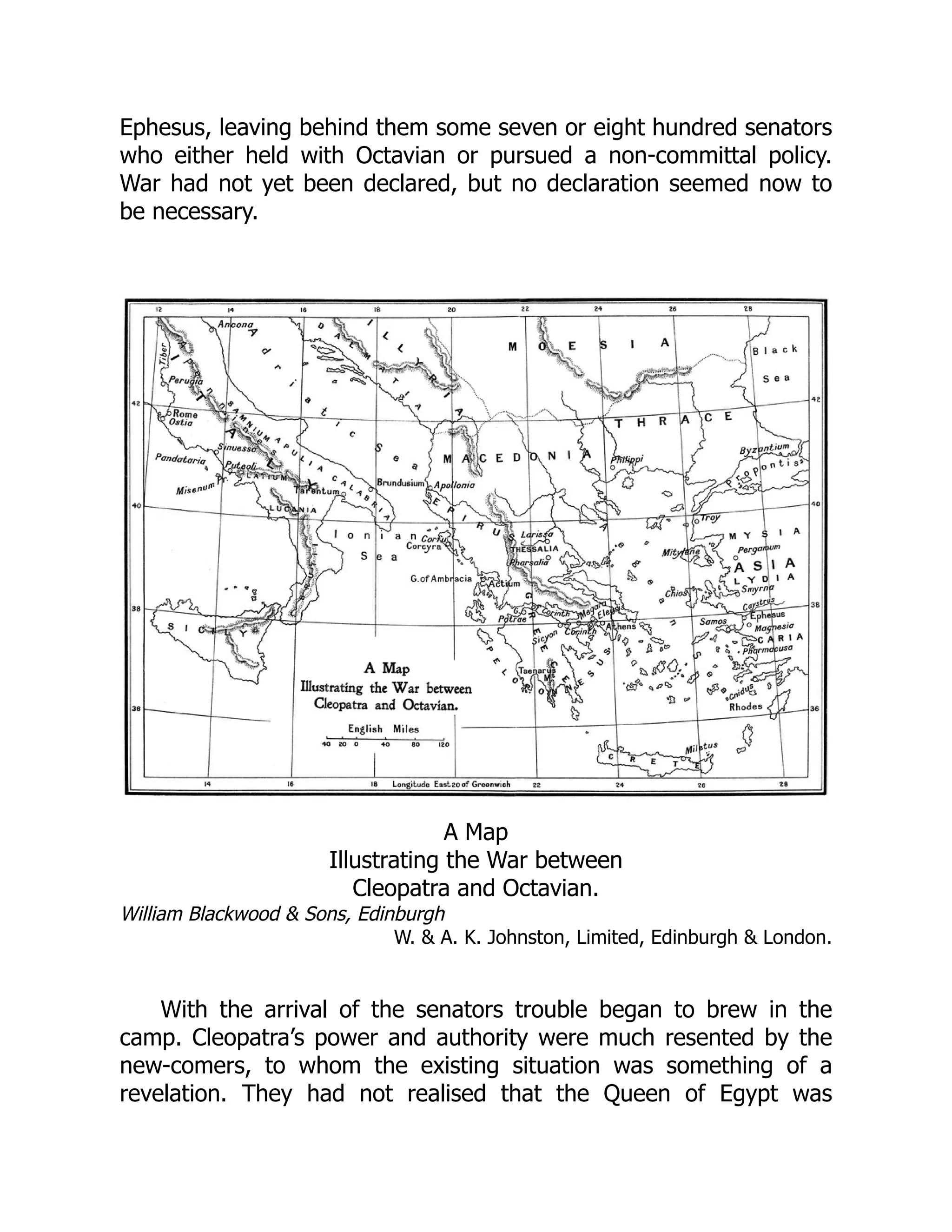
William Blackwood &Sons, Edinburgh
W. & A. K. Johnston, Limited, Edinburgh & London.
Ephesus, leaving behind them some seven or eight hundred senators
who either held with Octavian or pursued a non-committal policy.
War had not yet been declared, but no declaration seemed now to
be necessary.
A Map
Illustrating the War between
Cleopatra and Octavian.
With the arrival of the senators trouble began to brew in the
camp. Cleopatra’s power and authority were much resented by the
new-comers, to whom the existing situation was something of a
revelation. They had not realised that the Queen of Egypt was
32.
playing an activepart in the preparations, and many of them
speedily recognised the fact that Antony, as Autocrat of the East and
husband of Cleopatra, was hardly the man to restore a republican
government to Rome. It was not long before some of them began to
show their dislike of the Queen and to hint that she ought to retire
into the background, at any rate for the time being. There was one
old soldier, Cnæus Domitius Ahenobarbus, the representative of an
ancient republican family, who would never acknowledge Cleopatra’s
right to the supremacy which she had attained, nor, on any occasion,
would he address her by her title, but always called her simply by
her name. This man at length told Antony in the most direct manner
that he ought to send Cleopatra back to Egypt, there to await the
conclusion of the war. He seems to have pointed out that her
presence with the army gave a false impression, and would be liable
to alienate the sympathies of many of his Roman friends. He
suggested, perhaps, that the Queen should vacate her place in
favour of Cæsarion, whose rights few denied. Antony, seeing the
wisdom of this advice, told Cleopatra to return to Alexandria; but
she, in great alarm, is said to have bribed Publius Canidius, one of
Antony’s most trusted councillors, to plead with him on her behalf—
the result being that the proposal of Domitius Ahenobarbus was
discarded, and the Queen remained with the army. Publius Canidius
had pointed out to Antony that the Egyptian fleet would fight much
more willingly if their Queen were with them, and Egyptian money
would be more readily obtained if she herself were felt to be in need
of it. “And, besides,” said he, “I do not see to which of the kings who
have joined this expedition Cleopatra is inferior in wisdom; for she
has for a long time governed by herself a vast kingdom, and has
learnt in your company the handling of great affairs.”
111
The Queen’s continuance at Ephesus and her connection with
the war was the cause of great dissensions, and the Roman senators
began to range themselves into two distinct parties: those who fell
in with Antony’s schemes, and those who now favoured a
reconciliation with Octavian as a means of ridding Roman politics of
Cleopatra’s disturbing influence. When the efforts of the
33.
peacemakers came toher ears her annoyance must have been
intense. Were all her hopes to be dashed to the ground just because
a few stiff-backed senators disliked the idea of a foreign sovereign
concerning herself with republican politics? She no longer trusted
Antony, for it seemed apparent to her that he was, at heart, striving
only for his own aggrandisement, and was prepared to push her into
the background at the moment when her interests threatened to
injure his own. It was she who had incited him into warfare, who
had kept him up to the mark, aroused him to his duties, and
financed to a large extent his present operations; and yet he was,
even at this eleventh hour, half-minded to listen to those who urged
him to make peace. Only recently he had made some sort of offer to
Octavian to lay down his arms if the latter would do likewise. At the
time Cleopatra had probably thought this simply a diplomatic move
designed to gain popularity; but now she seems to have questioned
seriously Antony’s desire for war, and to have asked herself whether
he would not much prefer peace, quietness, and leisure wherein to
drink and feast to his jovial heart’s content. Yet war was essential to
her ambitions, and to the realisation of the rights of her son. If
Octavian were not overthrown, she would never have any sense of
security; and with all her heart she desired to come to a safe
harbour after these years of storm and stress.
It will be seen, then, that to her the need of preventing peace
was paramount. She therefore made one last effort in this direction;
and, bringing all her arts and devices to bear upon her husband, she
began to persuade him to issue a writ casting off Octavia and
thereby insulting Octavian beyond the limits of apology. As soon as
the scheme came to the ears of the peace party pressure was
brought to bear on Antony to effect a reconciliation with Octavia;
and the unfortunate man appears to have been badgered and
pestered by both factions until he must have been heartily sick of
the subject. Cleopatra’s councils, however, at last prevailed to this
extent, that Antony decided to make a forward movement and to
cross the sea to Greece, thus bringing hostilities a step nearer. At the
end of April he sailed over from Ephesus to the island of Samos,
34.
leaving a partof the army behind him. Here he remained for two or
three weeks, during which time, in reaction after his worries, he
indulged in a round of dissipations. He had told his various vassals to
bring with them to the rendezvous their leading actors and
comedians, so that the great gathering should not lack amusement;
and now these players were shipped across to Samos, there to
perform before this audience of kings and rulers. These sovereigns
competed with one another in the giving of superb banquets, but we
do not now hear of any such extravagances on the part of Cleopatra,
who was probably far too anxious, and too sobered, to give any
extraordinary attention to her duties as hostess. Splendid sacrifices
were offered to the gods in the island temples, each city contributing
an ox for this purpose; and the sacred buildings must have
resounded with invocations to almost every popular deity of the east
and west. The contrast was striking between the brilliancy and
festivity at Samos and the anxiety and dejection of the cities of the
rest of the world, which had been bereft of their soldiers and their
money, and were about to be plunged into all the horrors of
internecine warfare. “While pretty nearly the whole world,” says
Plutarch, “was filled with groans and lamentations, this one island
for some days resounded with piping and harping, theatres filling,
and choruses playing; so that men began to ask themselves what
would be done to celebrate victory when they went to such an
expense of festivity at the opening of the war.”
Towards the end of May the great assemblage crossed over the
sea to Athens, and here Antony and Cleopatra held their court. The
Queen’s mind was now, I fancy, in a very disturbed condition, owing
to the ominous dissensions arising from her presence with the army,
and to the lack of confidence which she was feeling in her husband’s
sincerity. I think it very probable that they were not on the best of
terms with one another at this time, and, although Antony was
perhaps a good deal more devoted to the Queen than he had been
before, there may have been some bickering and actual quarrelling.
Cleopatra desired the divorce of Octavia and immediate war, but
Antony on his part was seemingly disinclined to take any decisive
35.
steps. He was,in fact, in a very great dilemma. He had, apparently,
promised the Queen that if he were victorious he would at once aim
for the monarchy proposed by Julius Cæsar, and would arrange for
Cæsarion to succeed in due course to the throne; but now it had
been pointed out to him by the majority of the senators who were
with him that he was earnestly expected to restore the republic, and
to celebrate his victory by becoming once more an ordinary citizen.
In early life he would have faced these difficulties with a light heart,
and devised some means of turning the situation to his own
advantage. Now, however, the power of his will had been
undermined by excessive drinking; and, moreover, he had come to
be extremely dependent upon Cleopatra in all things. He was very
fond of her, and was becoming daily more maudlin in his affections.
He was now nearly fifty years old; and, with the decrease of his
vitality, he had ceased to be so promiscuous in affairs of the heart,
centering his interest more wholly upon the Queen, though she
herself was no longer very youthful, being at this time some thirty-
eight years of age. His quarrels with her seemed to have distressed
him very much, and in his weakened condition, her growing
disrespect for him caused him to be more devotedly her slave. He
seems to have watched with a sort of bibulous admiration her
masterly and energetic handling of affairs, and he was anxious to do
his best to retain her affection for him, which he could see, was on
the wane. To the dauntless heart of a woman like Cleopatra,
however, no appeal could be made save by manly strength and
powerful determination; and one seems to observe the growth in the
Queen’s mind of a kind of horror at the rapid degeneration of the
man whom she had loved and trusted.
To make matters worse, there arrived at Athens Antony’s
fourteen-year-old son, Antyllus, whom we have already met at
Alexandria. He had recently been in Rome, where he had been
kindly treated by the dutiful Octavia, whose attitude to all her
husband’s children was invariably generous and noble. Antony
regarded this boy, it would seem, with great affection, and had
caused him to be proclaimed an hereditary prince. The lad became
36.
something of arival to Cæsarion, to whom Cleopatra was devotedly
attached; and one may perhaps see in his presence at Athens a
further cause for dissension.
At length, however, early in June the Queen persuaded Antony
to take the final step, and to divorce Octavia. Having placed the
matter before his senators, by whom the question was angrily
discussed, he sent messengers to Rome to serve Octavia with the
order of ejection from his house; and at the same time he issued a
command to the troops still at Ephesus to cross at once to Greece.
This was tantamount to a declaration of war, and Cleopatra’s mind
must have been extremely relieved thereby. No sooner, however, had
this step been taken than many of Antony’s Roman friends appear to
have come to him in the greatest alarm, pointing out that the brutal
treatment of Octavia, who had won all men’s sympathy by her quiet
and dutiful behaviour, would turn from him a great number of his
supporters in Italy, and would be received as a clear indication of his
subserviency to Cleopatra. They implored him to correct this
impression; and Antony, harassed and confused, thereupon made a
speech to his Roman legions promising them that within two months
of their final victory he would re-establish the republic.
The announcement must have come as a shock to Cleopatra,
and must have shown her clearly that Antony was playing a double
game. She realised, no doubt, that the promise did not necessitate
the abandonment of their designs in regard to the monarchy; for,
after establishing the old constitution, Antony would have plenty of
time in which to build the foundations of a throne. Yet the
declaration unnerved her, and caused her to recognise with more
clarity the great divergence between her autocratic sentiments and
the democratic principles of the country she was attempting to bring
under her sway. She saw that, little by little, the basis upon which
the project of the war was founded was being changed. At first the
great justification for hostilities had been the ousting of Octavian
from the estate belonging by right to her son, Cæsarion. Now the
talk was all of liberty, of democracy, and of the restoration of
republican institutions.
37.
Her overwrought feelings,however, were somewhat soothed by
Antony’s personal behaviour, which at this time was anything but
democratic. He was allowing himself to be recognised as a divine
personage by the Athenians, and he insisted on the payment of the
most royal and celestial honours to Cleopatra, of whom he was at
this time inordinately proud. The Queen was, indeed, in these days
supreme, and the early authors are all agreed that Antony was to a
large extent under her thumb. The Athenians, recognising her as
their fellow-Greek, were eager to admit her omnipotence. They
caused her statue to be set up in the Acropolis near that already
erected to Antony; they hailed her as Aphrodite; they voted her all
manner of municipal honours, and, to announce the fact, sent a
deputation to her which was headed by Antony in his rôle as a
freeman of the city. Octavia, it will be remembered, had resided at
Athens some years previously, and had been much liked by the
citizens; but the memory of her quiet and pathetic figure was quickly
obliterated by the presence of the splendid little Queen of Egypt who
sat by Antony’s side at the head of a gathering of kings and princes.
Already she seemed to be Queen of the Earth; for, acting as hostess
to all these monarchs, speaking to each in his own language, and
entertaining them with her brilliant wit, she appeared to be the
leading spirit both in their festivities and in their councils.
Antony, meanwhile, having quieted the dissensions amongst his
supporters, gave himself up to merry-making in his habitual manner;
and presently he caused the Athenians to recognise him formally as
Dionysos, or Bacchus, come down to earth. In anticipation of a
certain Bacchic day of festival he set all the carpenters in the city to
make a huge skeleton roof over the big theatre, this being then
covered with green branches and vines, as in the caves sacred to
this god; and from these branches hundreds of drums, faun-skins,
and other Bacchic toys and symbols were suspended. On the festal
day Antony sat himself, with his friends around him, in the middle of
the theatre, the afternoon sun splashing down upon them through
the interlaced greenery; and thus, in the guise of Bacchus, he
presided at a wild drinking-bout, hundreds of astonished Athenians
38.
watching him fromaround the theatre. When darkness had fallen
the city was illuminated, and, in the light of a thousand torches and
lanterns, Antony rollicked up to the Acropolis, where he was
proclaimed as the god himself.
Many were the banquets given at this time both by Antony and
Cleopatra, and the behaviour of the former was often uproarious and
undignified. On one state occasion he caused much excitement by
going across to Cleopatra in the middle of the meal and rubbing her
feet, a ministration always performed by a slave, and now
undertaken by him, it is said, to fulfil a wager. He was always
heedless of public opinion, and at this period of his life the habit of
indifference to comment had grown upon him to a startling extent.
Frequently he would rudely interrupt an audience which he was
giving to one of the vassal kings by receiving and openly reading
some message from Cleopatra written upon a tablet of onyx or
crystal; and once when Furnius, a famous orator, was pleading a
case before him, he brought the eloquent speech to an abrupt end
by hurrying off to join the Queen outside, having entirely forgotten,
it would seem, that the orator’s arguments were being addressed to
himself.
An event now occurred which threw the whole of the Antonian
party into a state of the utmost anxiety. Two of the leading men at
that time in Athens deserted and went over to Octavian. One of
these, Titius, has already been noticed in connection with the arrest
and execution of Sextus Pompeius; the other, Plancus, was the man
who made so great a fool of himself at Alexandria when he painted
himself blue and danced naked about the room, as has been
described already.
112
Velleius speaks of him as “the meanest flatterer
of the Queen, a man more obsequious than any slave”; and one
need not be surprised, therefore, that Cleopatra was rude to him,
which was the cause, so he said, of his desertion. These two men
had both been witnesses to Antony’s will, a copy of which had been
deposited with the Vestal Virgins; and as soon as they were come to
Rome they informed Octavian of its contents, who promptly went to
39.
the temple ofVesta, seized the document, and, a few days later,
read it out to the Senate. Many senators were scandalised at the
proceedings; but they were, nevertheless, curious to hear what the
will set forth, and therefore did not oppose the reading. The only
clause, however, out of which Octavian was able to make much
capital was that wherein Antony stated that if he were to die in
Rome he desired his body, after being carried in state through the
Forum, to be sent to Alexandria, there to be buried beside Cleopatra.
The two deserters now began to spread throughout Italy all
manner of stories derogatory to Antony, and to heap abuse upon the
Queen, whom they described as having complete ascendancy over
her husband, due, they were sure, to the magical love-potions which
she secretly administered to him. When we consider that the
accusations made by disreputable tattlers, such as Plancus, were all
concerned with Antony’s devotion to her, we may realise how little
there really was to be brought against her. Antony, they said, was
under her magical spell; he had allowed the Ephesians to hail her as
Queen; she had forced him to present to her the library of
Pergamum (a city not far from Ephesus), consisting of 200,000
volumes; he was wont to become drunken while she, of course by
magic, remained sober; he had become her slave and even rubbed
her feet always for her, and so on. Such rubbishy tales as these were
the basis upon which the fabulous story of Cleopatra’s terrible
wickedness was founded, and presently we hear her spoken of as
“the harlot queen of incestuous Canopus, who aspired to set up
against Jupiter the barking Anubis, and to drown the Roman trumpet
with her jangling systrum.”
113
The friends of Antony in Rome, alarmed by the hostile attitude of
the majority of the public, sent a certain Geminius to Athens to warn
their leader that he would soon be proclaimed an enemy of the
State. On his arrival at the headquarters, he was thought to be an
agent of Octavia, and both Cleopatra and Antony treated him with
considerable coldness, assigning to him the least important place at
their banquets, and making him a continual butt for their most biting
40.
remarks. For sometime he bore this treatment patiently; but at
length one night, when both he and Antony were somewhat
intoxicated, the latter asked him point-blank what was his business
at Athens, and Geminius, springing to his feet, replied that he would
keep that until a soberer hour, but one thing he would say here and
now, drunk or sober, that if only the Queen would go back to Egypt
all would be well with their cause. At this Antony was furious, but
Cleopatra, keeping her temper, said in her most scathing manner:
“You have done well, Geminius, to tell your secret without being put
to torture.” A day or two later he slipped away from Athens and
hurried back to Rome.
The next man to desert was Marcus Silanus, formerly an officer
of Julius Cæsar in Gaul, who also carried to Rome stories of
Cleopatra’s power and Antony’s weakness. Shortly after this Octavian
issued a formal declaration of war, not, however, against Antony but
against Cleopatra. The decree deprived Antony of his offices and his
authority, because, it declared, he had allowed a woman to exercise
it in his place. Octavian added that Antony had evidently drunk
potions which had bereft him of his senses, and that the generals
against whom the Romans would fight would be the Egyptian court-
eunuchs, Mardion and Potheinos;
114
Cleopatra’s hair-dressing girl,
Iras, and her attendant, Charmion; for these nowadays were
Antony’s chief state-councillors. The Queen was thus made to realise
that her husband’s cause in Rome was suffering very seriously from
her presence with the army; but, at the same time, were she now to
return to Egypt she knew that Antony might play her false, and the
fact that war had not been declared upon him but upon her would
give him an easy loophole for escape. To counteract the prevailing
impression in Italy Antony despatched a large number of agents who
were to attempt to turn popular opinion in his favour, and meanwhile
he disposed his army for the final struggle. He had decided to wait
for Octavian to attack him, partly because he felt confident in the
ability of his great fleet to destroy the enemy before ever it could
land on the shores of Greece, and partly because he believed that
Octavian’s forces would become disaffected long before they could
41.
be brought acrossthe sea. The state of war would be felt in Italy
very soon, whereas in Greece and Asia Minor it would hardly make
any difference to the price of provisions. Egypt alone would supply
enough corn to feed the whole army, while Italy would soon starve;
and Egypt would provide money for the regular payment of the
troops, while Octavian did not know where to turn for cash. Indeed,
so great was the distress in Italy, and so great the likelihood of
mutinies in the enemy’s army, that Antony did not expect to have to
fight a big battle on land. For this reason he had felt it safe to leave
four of his legions at Cyrene, four in Egypt, and three in Syria; and
he linked up the whole of the sea-coast around the eastern
Mediterranean with small garrisons. The army which he kept with
him in Greece consisted of some 100,000 foot and 12,000 horse, a
force which must certainly have seemed adequate, since it was
greater than that of the enemy. Octavian had at least 250 ships of
war, 80,000 foot, and 12,000 horse.
When winter approached Cleopatra and Antony advanced with
the whole army from Athens to Patrae, and there went into winter
quarters. Patrae stood near the mouth of the Gulf of Corinth, on the
Achaian side, not much more than 200 miles from the Italian coast.
The fleet, meanwhile, was sent farther north to the Gulf of
Ambracia, which formed a huge natural harbour with a narrow
entrance; and outposts were placed at Corcyra, the modern Corfu,
some 70 miles from the Italian coast. In the period of waiting which
followed, when the storms of winter made warfare almost out of the
question, Antony and Octavian exchanged several pugnacious
messages. Octavian, constrained by the restlessness of his men and
the difficulty of providing for them during the winter, is said to have
written to Antony asking him not to protract the war, but to come
over to Italy and fight him at once. He even promised not to oppose
his disembarkation, but to offer him battle only when he was quite
prepared to meet him with his full forces. Antony replied by
challenging Octavian to a single combat, although, as he stated, he
was already an elderly man. This challenge Octavian refused to
accept, and thereupon Antony invited him to bring his army over to
42.
the plains toPharsalia and to fight him there, where Julius Cæsar
and Pompey had fought nearly seventeen years before. This offer
was likewise refused; and thereafter the two huge armies settled
down once more to glare at one another across the Ionian Sea.
Octavian now sent a message to Greece inviting the Roman
senators who were still with Antony to return to Rome where they
would be well received; and this offer must have found many ready
ears, though none yet dared to act upon it. Several of these senators
felt disgust at their leader’s intemperate habits, and were deeply
jealous of the power of Cleopatra, whose influence did not seem
likely to serve the cause of the Republic. The declaring of war
against the Queen and not against themselves had touched them
sharply, and to add to their discomfort in this regard news now came
across the sea that Octavian, in making his official sacrifices to the
gods at the opening of hostilities, had employed the ritual observed
before a campaign against a foreign enemy. He had stood, as the
ancient rites of Rome prescribed, before the temple of Bellona in the
Campus Martius, and, clad in the robes of a Fetial priest, had thrown
the javelin, as a declaration that war was undertaken against an
alien enemy.
Now came disconcerting rumours from the Gulf of Ambracia
which could not be kept secret. During the winter the supplies had
run out, and all manner of diseases had attacked the rowing-slaves
and sailors, the result being that nearly a third of their number had
perished. To fill their places Antony had ordered his officers to press
into service every man on whom they could lay their hands.
Peasants, farm hands, harvesters, ploughboys, donkey-drivers, and
even common travellers had been seized upon and thrust into the
ships, but still their complements were incomplete, and many of
them were unfit for action. The news caused the greatest anxiety in
the camp, and when, in March B.C. 31, the cessation of the storms of
winter brought the opening of actual hostilities close at hand, there
was many a man at Patrae who wished with all his heart that he
were safe in his own country.
43.
The first blowwas struck by Octavian, who sent a flying
squadron across the open sea to the south coast of Greece, under
the command of his great friend Marcus Vipsanius Agrippa. This
force seized Methone, and appeared to be seeking a landing-place
for the main army; and Antony at once prepared to march down and
hold the coast against the expected attack. But while his eyes were
turned in this direction Octavian slipped across with his army from
Brindisi and Tarentum to Corcyra, and thence to the mainland,
marching down through Epirus towards the Gulf of Ambracia, thus
menacing the ill-manned fleet lying in those waters. Antony
thereupon hastened northwards with all possible speed, and arrived
at the promontory of Actium, which formed the southern side of the
mouth of the Gulf, almost at the same moment at which Octavian
reached the opposite, or northern, promontory. Realising that an
attack was about to be made upon the fleet, Antony drew his ships
up in battle array, manning them where necessary with legionaries;
and thereupon Octavian gave up the project of immediate battle.
Antony then settled himself down on his southern promontory where
he formed an enormous camp, and a few days later he was joined
there by Cleopatra.
44.
CHAPTER XVII.
THE BATTLEOF ACTIUM AND THE FLIGHT TO
EGYPT.
The story of the battle of Actium has troubled historians of all
periods, and no one has been able to offer a satisfactory explanation
of the startling incidents which occurred in it or of the events which
led up to them. I am not able to accept the ingenious theory set
forward by Ferrero, nor is it easy to agree wholly with the
explanations given by classical authors. In the following chapter I
relate the events as I think they occurred, but of course my
interpretation is open to question. The reader, however, may refer to
the early authors to check my statements; and there he will find, as
no doubt he has already observed in other parts of this volume, that
while the incidents and facts all have the authority of these early
writers, the theories which explain them, representing my own
opinion, are frankly open to discussion.
For the time being Octavian did not care to be at too close
quarters to Antony, and he therefore fortified himself in a position a
few miles back from the actual entrance to the Gulf of Ambracia.
Antony at once shipped a part of his army across from Actium to the
north side of the great harbour’s mouth, and thus placed himself in
command of the passage into the inland water. Octavian soon threw
up impregnable earthworks around his camp, and built a wall down
to the shore of the Ionian Sea, so that the enemy could not interfere
with the landing of his supplies, all of which had to come from
45.
across the water.He stationed his ships in such a position that they
could command the entrance to the Gulf of Ambracia; and, these
vessels proving to be extremely well manned and handled, Antony
soon found that his own fleet was actually bottled up in the Gulf, and
could not pass into the open sea without fighting every inch of the
passage out through the narrow fairway. Octavian was thus in
command of the Ionian Sea, and was free to receive provisions or
munitions of war day by day from Italy. He could not, however, leave
his fortified camp, for Antony commanded all the country around
him. Thus, while Octavian blockaded Antony’s fleet in the Gulf,
Antony besieged Octavian’s army in their camp; and while Octavian
commanded the open sea and obtained his supplies freely from Italy,
Antony commanded the land and received his provisions without
interruption from Greece. A deadlock therefore ensued, and neither
side was able to make a hostile move. It seems clear to me that a
decisive battle could only be brought on by one of two manœuvres:
either Antony must retire from Actium and induce Octavian to come
after him into Greece, or else his fleet must fight its way out of the
Gulf and cut off Octavian’s supplies, thus starving him into surrender.
Many of Antony’s generals were of opinion that the former
movement should be undertaken, and they pressed him to retire and
thus draw Octavian from his stronghold. Cleopatra, however, appears
to have been in favour of breaking the blockade and regaining
possession of the sea. She may have considered Antony’s army to be
composed of too many nationalities to make success on land
absolutely assured, and any retreat at this moment might easily be
misinterpreted and might lead to desertions. On the other hand, she
had confidence in her Egyptian fleet and in Antony’s own ships, if, by
cutting down their number, their crews could be brought up to the
full complement; and she believed that with, say, 300 vessels
Octavian’s blockade could be forced, and his own position subjected
to the same treatment. I gather that this plan, however, was hotly
opposed by Domitius Ahenobarbus and others; and, since a loss of
time was not likely to alter the situation to their disadvantage, no
movement was yet made.
46.
Some time inJune Antony sent a squadron of cavalry round the
shores of the Gulf to try to cut off Octavian’s water-supply, but the
move was not attended with much success and was abandoned.
Shortly after this the deserter Titius defeated a small body of
Antony’s cavalry, and Agrippa captured a few of his ships which had
been cruising from stations outside the Gulf; whereupon Octavian
sent despatches to Rome announcing these successes as important
victories, and stating that he had trapped Antony’s fleet within the
Gulf. He also sent agents into Greece to try to shake the confidence
of the inhabitants in his enemy, and these men appear to have been
partially successful in their endeavours.
These small victories of Octavian seem to have unnerved Antony,
and to have had a dispiriting effect upon the army. Cleopatra, too,
must have been particularly depressed by them, for they seemed to
be a confirmation of the several ominous and inauspicious
occurrences which had recently taken place. An Egyptian soothsayer
had once told Antony that his genius would go down before that of
Octavian; and Cleopatra, having watched her husband’s rapid
deterioration in the last two years, now feared that the man’s words
were indeed true. News had lately come from Athens that a violent
hurricane had torn down the statue of Bacchus, the god whom
Antony impersonated, from a group representing the Battle of the
Giants; and two colossal statues of Fumenes and Attalus, each of
which was inscribed with Antony’s name, had also been knocked
over during the same cyclone. This news recalled the fact that a few
months previously at Patrae the temple of Hercules, the ancestor of
Antony, had been struck by lightning; and at about the same time a
small township founded by him at Pisaurum, on the east coast of
Italy, north of Ancona, had been destroyed by an earthquake. These
and other ill-omened accidents had a very depressing effect on
Cleopatra’s spirits, and her constant quarrels with Antony and his
generals seem to have caused her to be in a state of great nervous
tension. Towards the end of July or early in August, when the low-
lying ground on which their camp was pitched became infested with
mosquitos, and when the damp heat of summer had set the tempers
47.
of everybody onedge, the quarrels in regard to the conduct of the
campaign broke out with renewed fury. Domitius Ahenobarbus,
Dellius, Amyntas, and others, again urged Antony to retire inland
and to fight a pitched battle with Octavian as soon as he should
come after them. Cleopatra, however, still appears to have
considered that the forcing of the blockade was the most important
operation to be undertaken, and this she urged upon her undecided
husband. It was of course a risky undertaking, but by reason of the
very danger it made a strong appeal to Cleopatra’s mind. If their
fleet could destroy that of Octavian, they would have him caught in
his stronghold as in a trap. They would not even have to wait for the
surrender; but, leaving eighty or a hundred thousand men to
prevent his escape, they might sail over to Italy with twenty or thirty
thousand legionaries and take possession of empty Rome. There was
not a senator nor a military force in the capital, for Octavian had
lately made the entire senate in Rome come over to his camp, in
order to give tone to his proceedings; and, when once Octavian’s
sea-power had been destroyed, Antony and Cleopatra would be free
to ride unchecked into Rome while the enemy was starved into
surrender in Greece. A single naval battle, and Rome would be
theirs! This, surely, was better than a slow and ponderous retreat
into the interior.
Antony, however, could not persuade his generals to agree to
this. The risk was great, they seem to have argued; and even if they
were victorious, was he going to march into Rome with Cleopatra by
his side? The citizens would never stand it, after the stories they had
heard in regard to the Queen’s magical power over him. Let her go
back to Egypt, nor any longer remain to undermine Antony’s
popularity. How could he appear to the world as a good republican
with royal Cleopatra’s arm linked in his? By abandoning the idea of a
naval battle the Egyptian fleet could be dispensed with, and could be
allowed to depart to Egypt if it succeeded in running the blockade.
Cleopatra had supplied ships but hardly any soldiers, and a land
battle could be fought without her aid, and therefore without cause
for criticism; nor would Octavian any longer be able to say that he
48.
was waging waragainst Cleopatra and not against Antony. The
money which she had supplied for the campaign was almost
exhausted, and thus she was of no further use to the cause. Let
Antony then give up the projected naval battle, and order the Queen
to go back quickly with her ships to her own country: for thus, and
thus only, could the disaffected republican element in their army be
brought into line. Cleopatra, they said, had been the moving spirit in
the war; Cleopatra had supplied the money; it was against Cleopatra
that Octavian had declared war; it was Cleopatra’s name, and the
false stories regarding her, which had aroused Rome to Octavian’s
support; it was Cleopatra who was now said on all sides to be
supreme in command of the whole army; and it was of Cleopatra
that every senator, every vassal king, and every general, was
furiously jealous. Unless she were made to go, the whole cause was
lost.
Antony seems to have realised the justice of these arguments,
and to have promised to try to persuade his wife to retire to Egypt to
await the outcome of the war; and he was further strengthened in
this resolve when even Canidius, who had all along favoured the
keeping of Cleopatra with the army, now urged him to ask her to
leave them to fight their own battle. He therefore told the Queen, it
would seem, that he desired her to go, pointing out that in this way
alone could victory be secured.
Cleopatra, I take it, was furious. She did not trust Antony, and
she appears to have been very doubtful whether he would still
champion her cause after victory. She even doubted that he would
be victorious. He was now but the wreck of the man he had once
been, for a too lifelike impersonation of the god Bacchus had played
havoc with his nerves and with his character. He had no longer the
strength and the determination necessary for the founding of an
imperial throne in Rome; and she felt that, even if he were
successful in arms against Octavian, he would make but a poor
regent for her son Cæsarion. Having used her money and her ships
for his war, he might abandon her cause; and the fact that they were
fighting for Cæsar’s son and heir, which had already been placed in
49.
the background, mightbe for ever banished. It must have seemed
madness for her to leave her husband at this critical juncture. In
order to prevent further desertions he would probably proclaim his
republican principles as soon as her back was turned; and, in his
drunken weakness, he might commit himself so deeply that he
would never be able to go back upon his democratic promises. Since
she was unpopular with his generals, he would perhaps at once tell
them that she was nothing to him; and for the sake of assuring
victory he might even divorce her. Of course, it was obvious that he
was devoted to her, and relied on her in all matters, seeming to be
utterly lost without her; but, for all she knew, his ambition might be
stronger than his love. She therefore refused absolutely to go; and
Antony was too kind-hearted, and perhaps too much afraid of her
anger, to press the matter.
His talk with her, however, seems to have decided him to break
the blockade as soon as possible, and at the same time to invest
Octavian’s lines so that he could not escape from the stronghold
which would become his death-trap. Once master of the sea, he
would, at any rate, have opened a path for Cleopatra’s departure,
and she could retire unmolested with her fleet to her own country.
He therefore hurried on the manning of his ships, and at the same
time sent Dellius and Amyntas into Thrace to recruit a force of
cavalry to supplement those at his disposal. Cleopatra pointed out to
him that the ground upon which their camp was pitched at Actium
was extremely unhealthy, and if they remained there much longer
the troops would be decimated by malaria; and she seems perhaps
to have urged him to move round to the north of the Gulf of
Ambracia, in order both to obtain more healthy conditions for the
army and to invest more closely the camp of Octavian in preparation
for the naval fight. Domitius Ahenobarbus was still hotly opposed to
this fight; and now, finding that not only was Cleopatra to be
allowed to remain with the army, but also that her plan of breaking
the blockade was to be adopted, instead of that of the retreat
inland, he was deeply incensed, and could no longer bear to remain
in the same camp with the Queen. Going on board a vessel,
50.
therefore, as hesaid, for the sake of his health, he slipped over to
Octavian’s lines and offered his services to the enemy. He did not
live, however, to enjoy the favourable consequences of his change,
for, having contracted a fever while at Actium, he died before the
battle of that name was fought.
This desertion, which occurred probably early in August, came as
a terrible shock to Antony, and he seems to have accused his wife of
being the cause of it, which undoubtedly she was. This time he
insisted more vehemently on her leaving the army and retiring to
Egypt; and thereupon a violent quarrel ensued, which lasted, I think,
without cessation during the remainder of their stay in Greece. At
first, it seems to me, the Queen positively refused to leave him, and
she probably accused him of wishing to abandon her cause. With a
sneer, she may have reminded him that his compact with her, and
his arrangements for an Egypto-Roman monarchy, were made at a
time when he had, to a great extent, cut himself off from Rome and
when he required financial aid; but now he had four hundred
respectable republican senators to influence him, and, no doubt,
their support at this juncture was far more valuable to him than her
own. He had deserted her once before, and she was quite prepared
for him to do so again.
Her anger, mistrust, and unhappiness must have distressed
Antony deeply, and he would, perhaps, have given way once again
had not three more desertions from his camp taken place. The King
of Paphlagonia, jealous, apparently, of Cleopatra’s power, slipped
across to Octavian’s lines, carrying thither an account of the
dissensions in Antony’s camp. The two others, a Roman senator
named Quintus Postumius, and an Arab chieftain from Emesa,
named Iamblichus, were both caught; and, to terrify those who
might intend to go over to the enemy, both were put to death, the
one being torn to pieces and the other tortured. Every day
Octavian’s cause was growing in popularity, and Antony was being
subjected to greater ridicule for his subserviency to the little Queen
of Egypt, who appeared to direct all his councils and who now
seemed to frighten him by her anger. Octavian’s men were becoming
51.
self-confident and evenaudacious. On one occasion while Antony,
accompanied by an officer, was walking at night down to the harbour
between the two ramparts which he had thrown up to guard the
road, some of the enemy’s men crept over the wall and laid in wait
for him. As they sprang up from their ambush, however, they seized
Antony’s attendant officer in mistake for himself, and, by a rapid
flight down the road, he was able to escape.
Thoroughly unnerved by the course events were taking, he again
ordered the Queen to retire to Egypt; and at last, stung by Antony’s
reproaches, Cleopatra made up her mind to go and to take her fleet
with her. Having formed this decision, she appears to have treated
Antony with the utmost hostility; and he, being in a highly nervous
condition, began to fear that she might kill him. Her great eyes
seemed to blaze with anger when she looked upon him, and the
contempt which she now felt for him was shown in the expression of
her face. He appears to have cowered before her in the manner of a
naughty boy, and to have told his friends that he believed she would
murder him in her wrath. On hearing this, Cleopatra decided to
teach him a lesson which he should not forget. One night at supper,
she caused her goblet to be filled from the same wine-jar from
which all had been drinking, and having herself drunk some of the
wine, she handed the cup to Antony as though in token of
reconciliation; and he, eagerly raising it to his mouth, was about to
place his lips where those of the Queen had rested a moment
before, when, as though to add grace to her act, she took the
wreath of flowers from her hair and dipped it into the wine. Antony
again lifted the cup, but suddenly Cleopatra dashed it from his hand,
telling him that the wine was poisoned. Antony appears to have
protested that she was mistaken, since she herself had just drunk
from the same cup; but Cleopatra calmly explained that the wreath
which she had dipped into the wine as she handed it to him was
poisoned, and that she had chosen this means of showing him how
baseless were his fears for his life, for that, did she wish to rid
herself of him, she could do so at any moment by some such subtle
52.
means. “I couldhave killed you at any time,” she said, “if I could
have done without you.”
The Queen, I imagine, now carried herself very proudly and
disdainfully, regarding Antony’s insistence on her departure as a
breach of faith. In her own mind she must have feared lest he would
actually abandon her, and the anxiety in regard to the future of her
country and dynasty must have gnawed at her heart all day and all
night; but to him she seems only to have shown coldness and
contempt, thus driving him to a condition of complete wretchedness.
He did not dare, however, to alter his decision in regard to her
departure, for he seems to have admitted some of his senators and
generals into the secret of this coming event, and it had much
quieted the volcanic atmosphere so long prevalent in the camp. I am
of opinion that the plan upon which he and his wife had agreed was
as follows: Having invested Octavian’s lines more closely, and having
taken all steps to prevent him issuing from his stronghold, the pick
of Antony’s legionaries would be embarked upon as many of the
vessels in the Gulf of Ambracia as were seaworthy, and these
warships would force their way out and destroy Octavian’s fleet. As
soon as this was done an assault would be made on the enemy’s
position by sea and land; and Cleopatra, taking with her the
Egyptian fleet, could then sail away to Alexandria, leaving Antony to
enter Rome alone.
This scheme, in my opinion, presented the only possible means
by which the Antonian army could rid itself of Egyptian influence. If
Cleopatra was made to retire overland by way of Asia Minor and
Syria, not only would her passage through these countries be
regarded by the inhabitants as a flight, thus causing instant panic
and revolt, but also the Egyptian fleet would still remain in the Gulf
of Ambracia to show by its presence that Cleopatra and her Kingdom
of Egypt were yet the main factors in the war. On the other hand, if
the Queen retired by sea with her ships, a naval battle designed to
force the blockade would have to be fought in order to permit her to
escape by that route. Thus, the republican demand that the Queen
should go to her own country, and Cleopatra’s own reiterated
53.
proposal that thewar should be decided by a sea-fight, here
concurred in determining Antony to stake all upon a naval
engagement.
This being settled, Antony announced to the army that the fleet
should break the blockade on August 29, but the fact that the
Egyptian ships were to depart immediately after the battle was not
made known, save to a few. A great many of the vessels were ill
furnished for the fight, and were much under-manned; and Antony
now ordered these to be burnt, for, though they were useless to
him, they might be of value to the enemy, and might be seized by
them while the fleet was away scouring the Ionian Sea. Sixty of the
best Egyptian vessels, and at least three hundred
115
other ships,
were made ready for the contest; and during these preparations it
was no easy matter to keep the secret of the Egyptian departure
from leaking out. In order to cross to Egypt Cleopatra’s sixty ships
required their large sails, but these sails would not under ordinary
circumstances be taken into battle; and in order that the Egyptian
vessels should not be made conspicuous by alone preparing for a
long voyage, thereby causing suspicions to arise, all the fleet was
ordered to ship its big sails; Antony, therefore, having to explain that
they would be required in the pursuit of the enemy. Another
difficulty arose from the fact that Cleopatra had to ship her baggage,
including her plate and jewels; but this was ultimately done under
cover of darkness without arousing suspicion.
Many of the generals, not realising that the naval battle was
largely forced upon Antony by those who desired to rid his party of
the Egyptians, were much opposed to the scheme; and one infantry
officer, pointing to the many scars and marks of wounds which his
body bore, implored Antony to fight upon land. “O General,” he said,
“what have our wounds and our swords done to displease you, that
you should give your confidence to rotten timbers? Let Egyptians
and Phœnicians fight on the sea; but give us the land, where we
well know how to die where we stand or else gain the victory.”
54.
Antony, however, gavehim no reply, but made a motion with his
hand as though to bid him be of good courage.
On August 28 twenty thousand legionaries and two thousand
archers were embarked upon the ships of war
116
in preparation for
the morrow’s battle. The vessels were much larger than those of
Octavian, some of them having as many as ten banks of oars; and it
seemed likely that victory would be on their side. On the next day,
however, the sea was extremely rough, and the battle had to be
postponed. The storm proved to be of great violence, and all
question of breaking the blockade had to be abandoned for the next
four days. The delay was found to be a very heavy strain upon the
nerves of all concerned, and so great was the anxiety of the two
important generals, Dellius
117
and Amyntas, that they both deserted
to Octavian’s lines, the latter taking with him two thousand Galatian
cavalry. Dellius had probably heard rumours about the proposed
departure of Cleopatra, and he was able to tell Octavian something
of the plans for the battle. In after years he stated that his desertion
was partly due to his fear of the Queen, for he believed her to be
angry with him for having once remarked that Antony’s friends were
served with sour wine, whereas even Sarmentus, Octavian’s delicia,
or page, drank Falernian. One may understand Cleopatra’s
annoyance at this hint that money and supplies were running short,
more especially since this must actually have been the fact.
On September 1st the storm abated, and in the evening Antony
went from ship to ship encouraging his men. Octavian, informed by
Dellius, also prepared for battle, embarking eight legions and five
pretorian cohorts upon his ships of war, which seem to have been
more numerous, but much smaller, than those of Antony.
The morning of September 2nd was calm, and at an early hour
Octavian’s workmanlike ships stationed themselves about three-
quarters of a mile from the mouth of the Gulf of Ambracia, where
they were watched by the eyes of both armies. They were formed
into three divisions, the left wing being commanded by Agrippa, the
55.
centre by LuciusArruntius, and the right wing by Octavian. At about
noon Antony’s huge men-o’-war began to pass out from the harbour,
under cover of the troops and engines of war stationed upon the
two promontories. Octavian seems to have thought that it would be
difficult to attack them in the straits, and therefore he retired out to
sea, giving his enemies the opportunity of forming up for battle. This
was speedily done, the fleet being divided, like Octavian’s, into three
squadrons, C. Sossius moving against Octavian, Marcus Insteius
opposing Arruntius, and Antony facing Agrippa. The sixty Egyptian
ships, under Cleopatra’s command, were the last to leave the Gulf,
and formed up behind the central division.
Antony appears to have arranged with Cleopatra that her ships
should give him full assistance in the fight, and should sail for Egypt
as soon as the victory was won. He intended, no doubt, to board her
flagship at the close of the battle and to bid her farewell. They had
separated that morning, it would seem from subsequent events, with
anger and bitterness. Cleopatra, I imagine, had once more told him
how distasteful was her coming departure to her, and had shown
him how little she trusted him. She had bewailed the misery of her
life and the bitterness of her disillusionment. She had accused him of
wishing to abandon her cause, and she had, no doubt, called him
coward and traitor. Very possibly in her anger she had told him that
she was leaving him with delight, having found him wholly
degenerate, and that she hoped never to see his face again. Her
accusations, I fancy, had stung Antony to bitter retorts; and they
had departed, each to their own flagship, with cruel words upon
their lips and fury in their minds. Antony’s nature, however, always
boyish, impulsive, and quickly repentant, could not bear with
equanimity so painful a scene with the woman to whom he was
really devoted, and as he passed out to battle he must have been
consumed by the desire to ask her forgiveness. The thought, if I
understand him aright, was awful to him that they should thus
separate in anger; and being probably a little intoxicated, the
contemplation of his coming loneliness reduced him almost to tears.
He was perhaps a little cheered by the thought that when next he
56.
saw her thebattle would probably be won, and he would appear to
her in the rôle of conqueror—a theatrical situation which made an
appeal to his dramatic instincts; yet, in the meantime, I think he was
as miserable as any young lover who had quarrelled with his
sweetheart.
The battle was opened by the advance of Antony’s left wing, and
Agrippa’s attempt to outflank it with his right. Antony’s other
divisions then moved forward, and the fight became general. “When
they engaged,” writes Plutarch, “there was no ramming or charging
of one ship into another, because Antony’s vessels, by reason of
their great bulk, were incapable of the speed to make the stroke
effectual, and, on the other side, Octavian’s ships dared not charge,
prow to prow, into Antony’s, which were all armed with solid masses
and spikes of brass, nor did they care even to run in on their sides,
which were so strongly built with great squared pieces of timber,
fastened together with iron bolts, that their own vessels’ bows would
certainly have been shattered upon them. Thus the engagement
resembled a land fight, or, to speak more properly, the assault and
defence of a fortified place; for there were always three or four of
Octavian’s vessels around each one of Antony’s, pressing upon them
with spears, javelins, poles, and several inventions of fire which they
flung into them, Antony’s men using catapults also to hurl down
missiles from their wooden towers.”
The fight raged for three or four hours, but gradually the awful
truth was borne in upon Antony and Cleopatra, that Octavian’s little
ships were winning the day. Antony’s flagship was so closely
hemmed in on all sides that he himself was kept busily occupied,
and he had no time to think clearly. But as, one by one, his ships
were fired, sunk, or captured, his desperation seems to have
become more acute. If his fleet were defeated and destroyed, would
his army stand firm? That was the question which must have
drummed in his head, as in an agony of apprehension he watched
the confused battle and listened to the clash of arms and the cries
and shouts of the combatants. Cleopatra, meanwhile, after being
subjected to much battering by the enemy, had perhaps freed her
57.
Welcome to ourwebsite – the ideal destination for book lovers and
knowledge seekers. With a mission to inspire endlessly, we offer a
vast collection of books, ranging from classic literary works to
specialized publications, self-development books, and children's
literature. Each book is a new journey of discovery, expanding
knowledge and enriching the soul of the reade
Our website is not just a platform for buying books, but a bridge
connecting readers to the timeless values of culture and wisdom. With
an elegant, user-friendly interface and an intelligent search system,
we are committed to providing a quick and convenient shopping
experience. Additionally, our special promotions and home delivery
services ensure that you save time and fully enjoy the joy of reading.
Let us accompany you on the journey of exploring knowledge and
personal growth!
textbookfull.com


![Mastering Git Early Access Edition Jawwad Ahmad
https://textbookfull.com/product/mastering-git-early-access-
edition-jawwad-ahmad/
DevOps in Python: Infrastructure as Python Zadka
https://textbookfull.com/product/devops-in-python-infrastructure-
as-python-zadka/
Infrastructure as an Asset Class Investment Strategy
Sustainability Project Finance and PPP 2nd Edition
Barbara Weber
https://textbookfull.com/product/infrastructure-as-an-asset-
class-investment-strategy-sustainability-project-finance-and-
ppp-2nd-edition-barbara-weber/
Integrating Educational Technology Into Teaching [with
eText Access Code] Margaret D. Roblyer
https://textbookfull.com/product/integrating-educational-
technology-into-teaching-with-etext-access-code-margaret-d-
roblyer/
Mosaics: Reading and Writing Paragraphs -- MyLab
Writing with Pearson eText Access Code 8th Edition
Flachmann
https://textbookfull.com/product/mosaics-reading-and-writing-
paragraphs-mylab-writing-with-pearson-etext-access-code-8th-
edition-flachmann/](https://image.slidesharecdn.com/65909-250609025831-b0a4e8bb/75/Infrastructure-as-Code-2nd-Edition-Early-Access-Kief-Morris-3-2048.jpg)


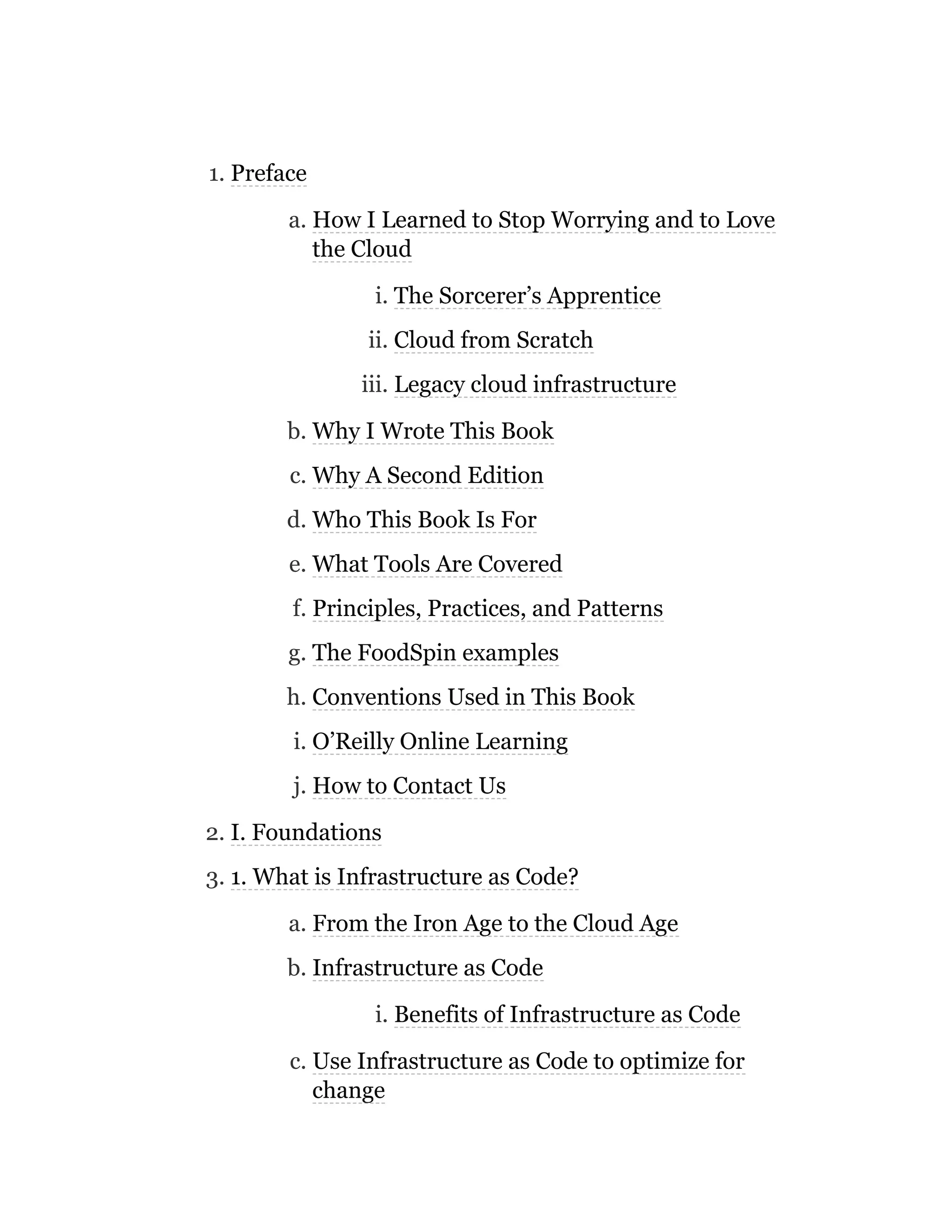
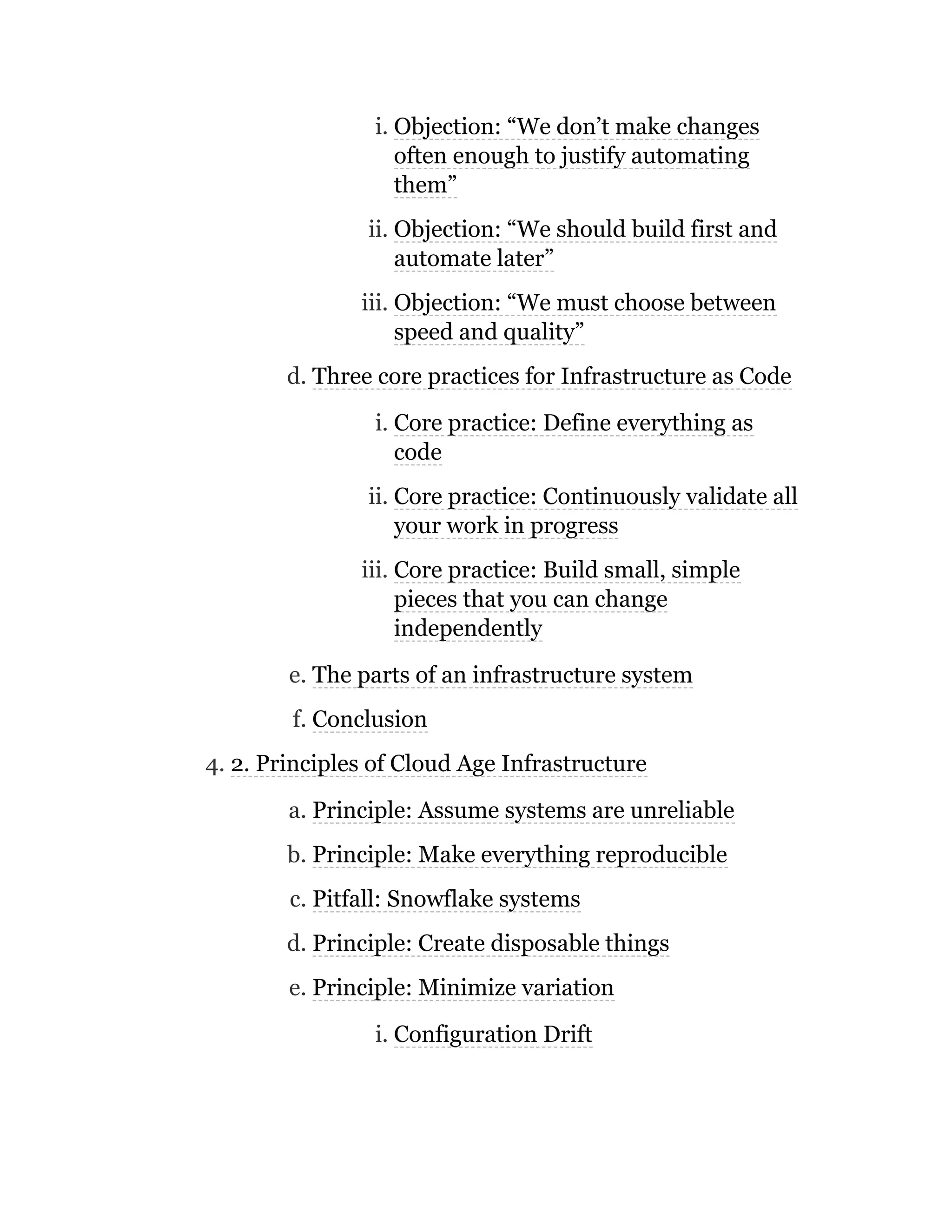
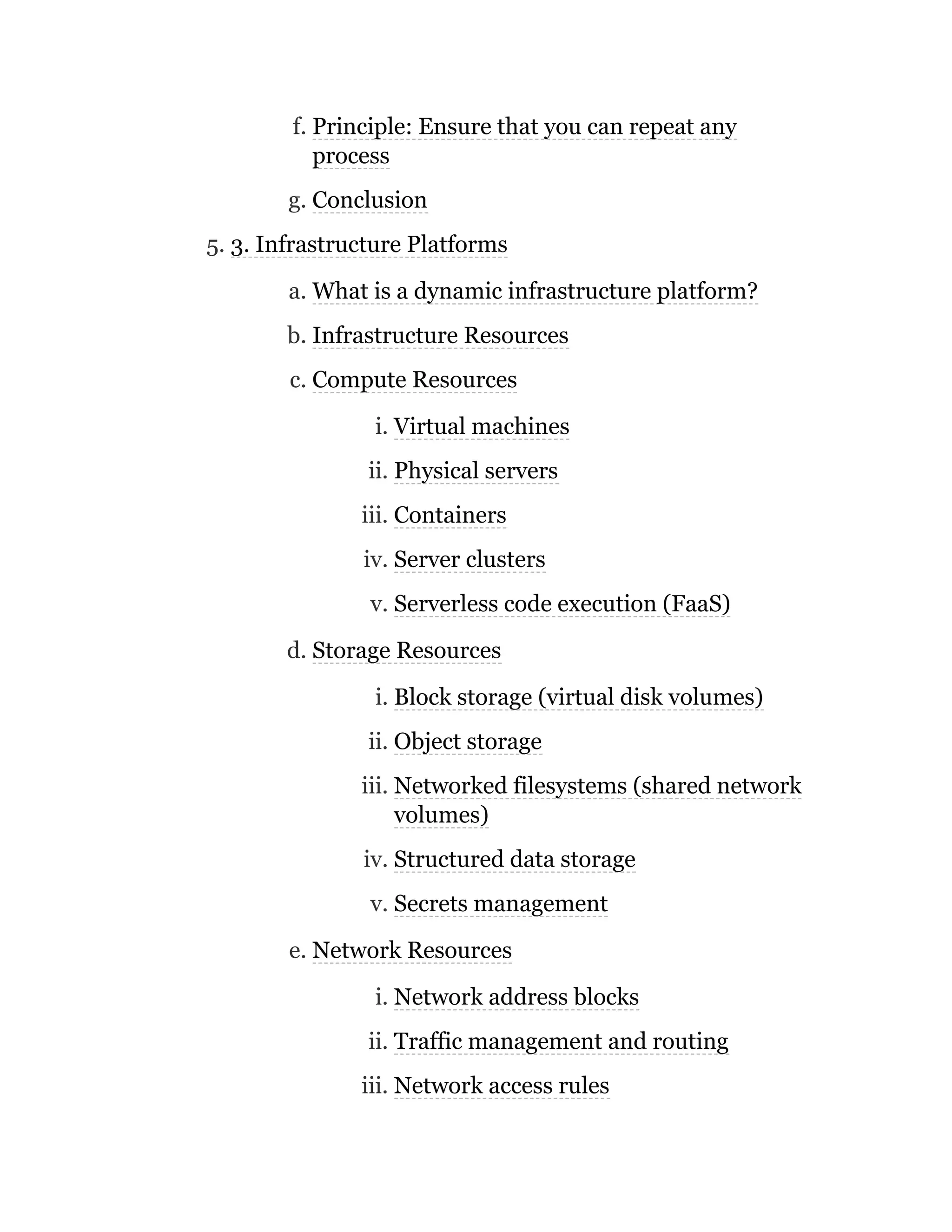
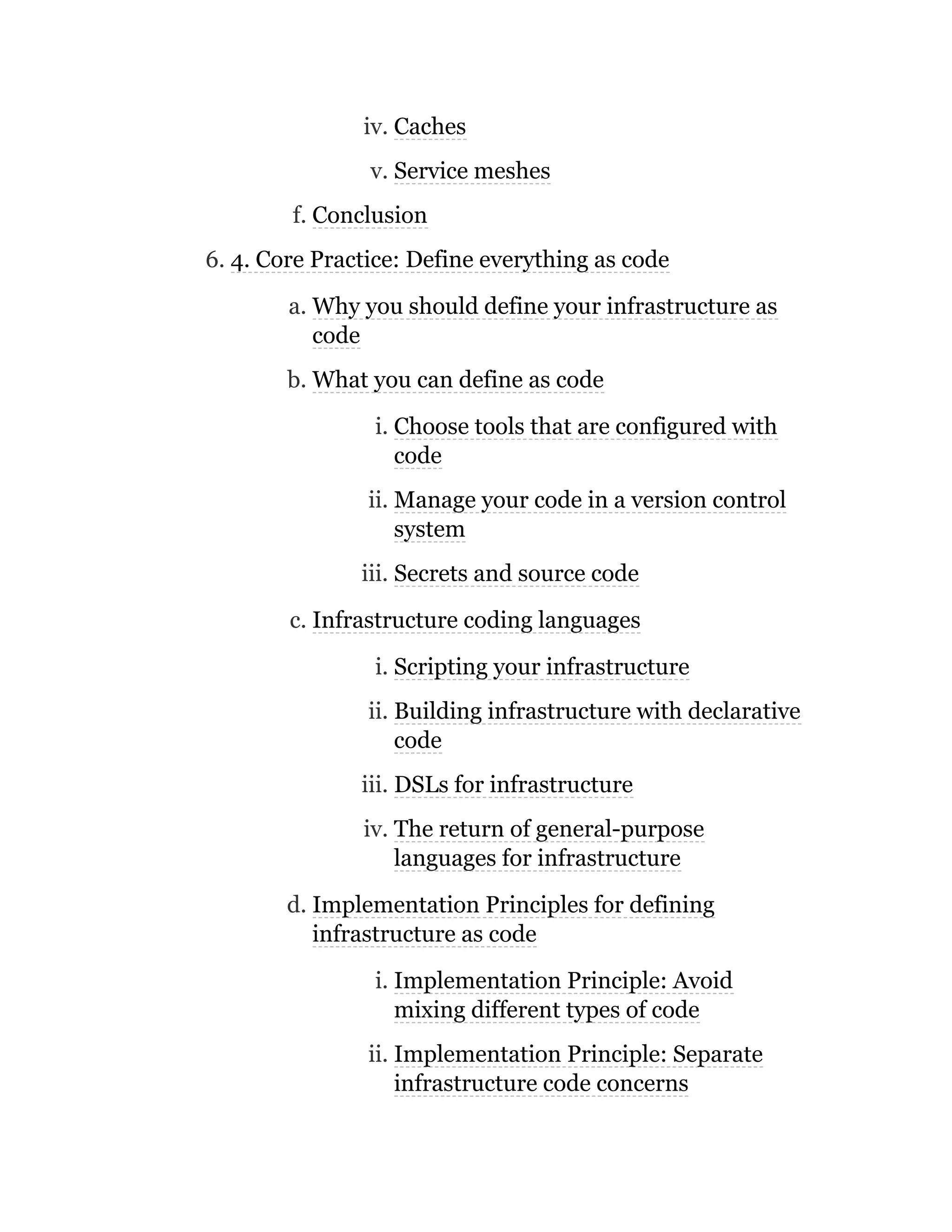
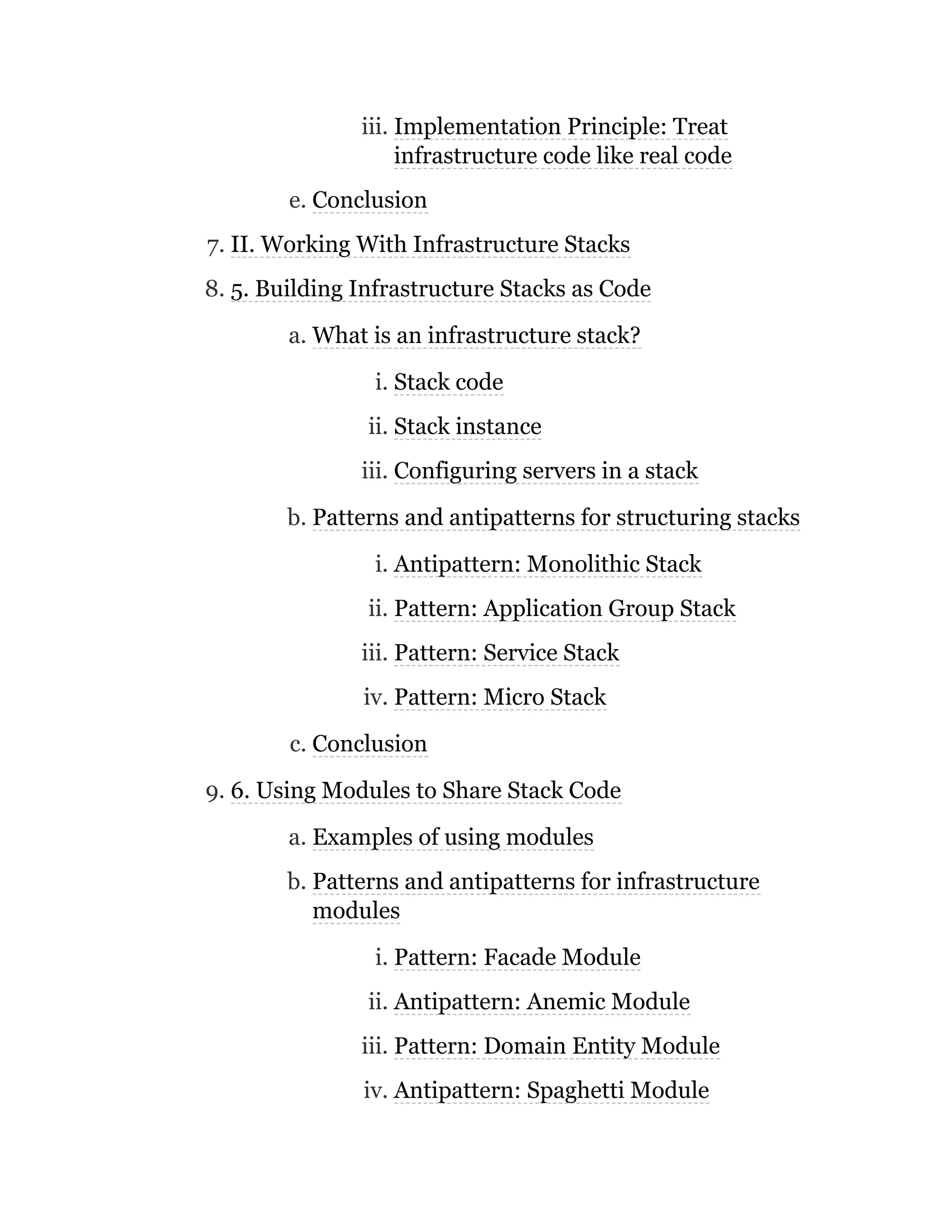
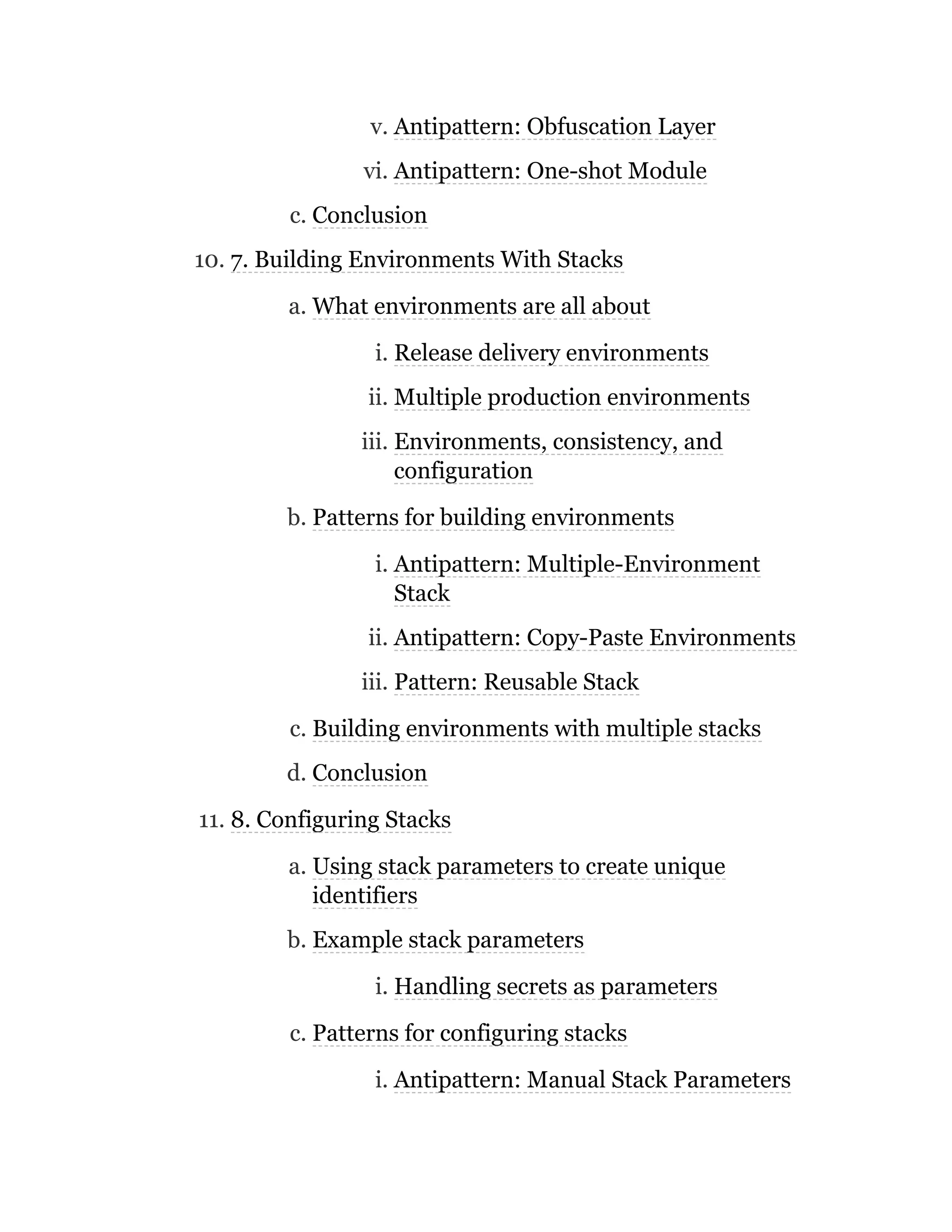
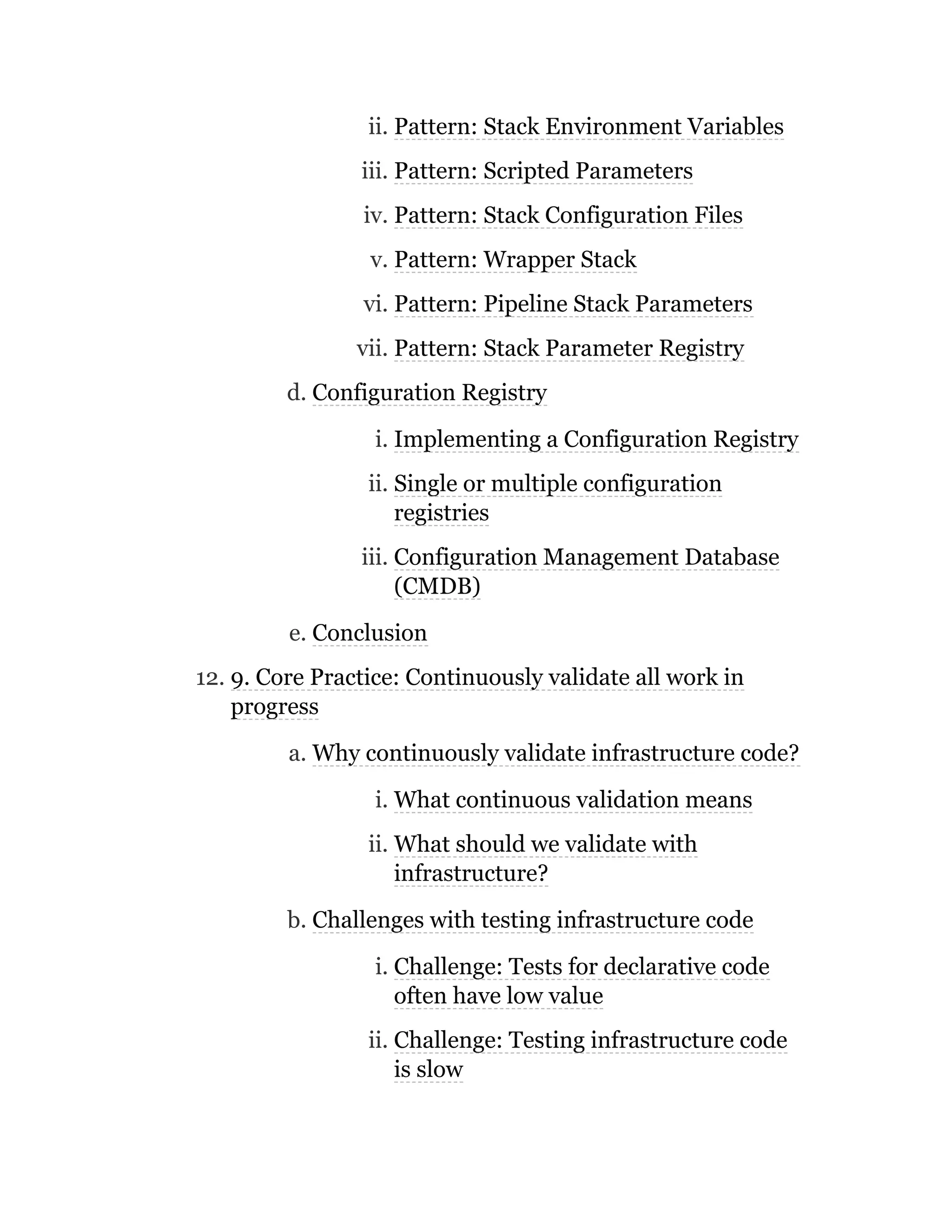



![The interesting thing about these situations is that they look
oddly familiar. For years, clients have asked us to help them
with messy, monolithic software architectures, and error-prone
application deployment processes. And now we’re seeing the
same issues appearing with infrastructure.
Turns out, infrastructure as code isn’t just a metaphor. Code
really is code!
So we’ve doubled down on the idea that software engineering
practices can be useful with infrastructure codebases. TDD, CI,
CD, microservices , and Evolutionary
Architectures[http://shop.oreilly.com/product/0636920080237.
do] are coming into their own for cloud infrastructure.
Why I Wrote This Book
I’ve met and worked with many teams who are in the same
place I was a few years ago: people who were using cloud,
virtualization, and automation tools but hadn’t got it all running
as smoothly as they know they could. I hope that this book
provides a practical vision and specific techniques for
managing complex IT infrastructure in the cloud.
Why A Second Edition
I started working on the first edition of this book in 2014. The
landscape of cloud and infrastructure was shifting as I worked,
with innovations like Docker popping up, forcing me to add and
4](https://image.slidesharecdn.com/65909-250609025831-b0a4e8bb/75/Infrastructure-as-Code-2nd-Edition-Early-Access-Kief-Morris-25-2048.jpg)