Patterns And Practices For Infrastructure As
Code With Examples In Python And Terraform Meap
V08 Meap V08 Rosemary Wang download
https://ebookbell.com/product/patterns-and-practices-for-
infrastructure-as-code-with-examples-in-python-and-terraform-
meap-v08-meap-v08-rosemary-wang-42522802
Explore and download more ebooks at ebookbell.com
Here are some recommended products that we believe you will be
interested in. You can click the link to download.
Java 9 Modularity Patterns And Practices For Developing Maintainable
Applications Paul Bakker
https://ebookbell.com/product/java-9-modularity-patterns-and-
practices-for-developing-maintainable-applications-paul-bakker-5903132
Java 9 Modularity Patterns And Practices For Developing Maintainable
Applications 1st Edition Sander Mak
https://ebookbell.com/product/java-9-modularity-patterns-and-
practices-for-developing-maintainable-applications-1st-edition-sander-
mak-6718992
Agile Kata Patterns And Practices For Transformative Organizational
Agility Joe Krebs
https://ebookbell.com/product/agile-kata-patterns-and-practices-for-
transformative-organizational-agility-joe-krebs-61250210
Parallel Programming With Microsoft Visual C Design Patterns For
Decomposition And Coordination On Multicore Architectures Patterns And
Practices 1st Edition Colin Campbell
https://ebookbell.com/product/parallel-programming-with-microsoft-
visual-c-design-patterns-for-decomposition-and-coordination-on-
multicore-architectures-patterns-and-practices-1st-edition-colin-
campbell-2112720
Designing Social Interfaces Principles Patterns And Practices For
Improving The User Experience 2nd Edition Christian Crumlish
https://ebookbell.com/product/designing-social-interfaces-principles-
patterns-and-practices-for-improving-the-user-experience-2nd-edition-
christian-crumlish-5208022
Functional Design Principles Patterns And Practices For True Epub
Robert C Martin
https://ebookbell.com/product/functional-design-principles-patterns-
and-practices-for-true-epub-robert-c-martin-232594954
Cloud Native Development Patterns And Best Practices Practical
Architectural Patterns For Building Modern Distributed Cloudnative
Systems 1st Edition John Gilbert
https://ebookbell.com/product/cloud-native-development-patterns-and-
best-practices-practical-architectural-patterns-for-building-modern-
distributed-cloudnative-systems-1st-edition-john-gilbert-7371178
Typescript 4 Design Patterns And Best Practices Discover Effective
Techniques And Design Patterns For Every Programming Task 1st Edition
Theo Despoudis
https://ebookbell.com/product/typescript-4-design-patterns-and-best-
practices-discover-effective-techniques-and-design-patterns-for-every-
programming-task-1st-edition-theo-despoudis-52852970
Handson Design Patterns And Best Practices With Julia Proven Solutions
To Common Problems In Software Design For Julia 1x 1st Edition Tom
Kwong
https://ebookbell.com/product/handson-design-patterns-and-best-
practices-with-julia-proven-solutions-to-common-problems-in-software-
design-for-julia-1x-1st-edition-tom-kwong-11112140
©Manning Publications Co. To comment go to liveBook
MEAP Edition
Manning Early Access Program
Patterns and Practices for
Infrastructure as Code
With examples in Python and Terraform
Version 8
Copyright 2022 Manning Publications
For more information on this and other Manning titles go to
manning.com
welcome
Thank you for purchasing the MEAP of Patterns and Practices for Infrastructure as Code.
Whether you’re an operations, systems, DevOps, or software engineer, I hope you’ll take
some of the patterns and practices in this book and immediately apply them to
your infrastructure configuration.
To make the most of the book, you’ll want to have foundational concepts of infrastructure or
learned at least one public cloud (such as Google Cloud Platform, Amazon Web Services, or
Microsoft Azure). It also helps if you have some knowledge of a scripting or programming language
(like Python) and got started with an infrastructure as code tool (like HashiCorp Terraform). I tried
to generalize the concepts but include some hands-on examples showing implementation. You can
apply the patterns to your own infrastructure, whether datacenter or cloud.
I divided the book into three parts. The first part covers how to write clean infrastructure as
code. It contains a lot of patterns for modularizing and organizing your configurations. The patterns
might seem a bit abstract at first but set the foundations to reduce maintenance and promote
change in infrastructure systems.
The second part discuss how your team uses infrastructure as code. You’ll learn team practices
to scale collaboration. These involve testing, branching models, continuous delivery, and security
auditing.
I’ll conclude with a section on managing production complexity with infrastructure as code. You
and your company can use some techniques like feature flagging and blue-green deployments of
infrastructure to reduce the blast radius of failed changes. Hopefully, they’ll help you continuously
update infrastructure and minimize disruption.
Please leave your feedback or questions in the liveBook Discussion forum. Infrastructure as
code is an art, after all! The explanations and topics can always be improved. I appreciate your
comments and suggestions.
—Rosemary Wang
©Manning Publications Co. To comment go to liveBook
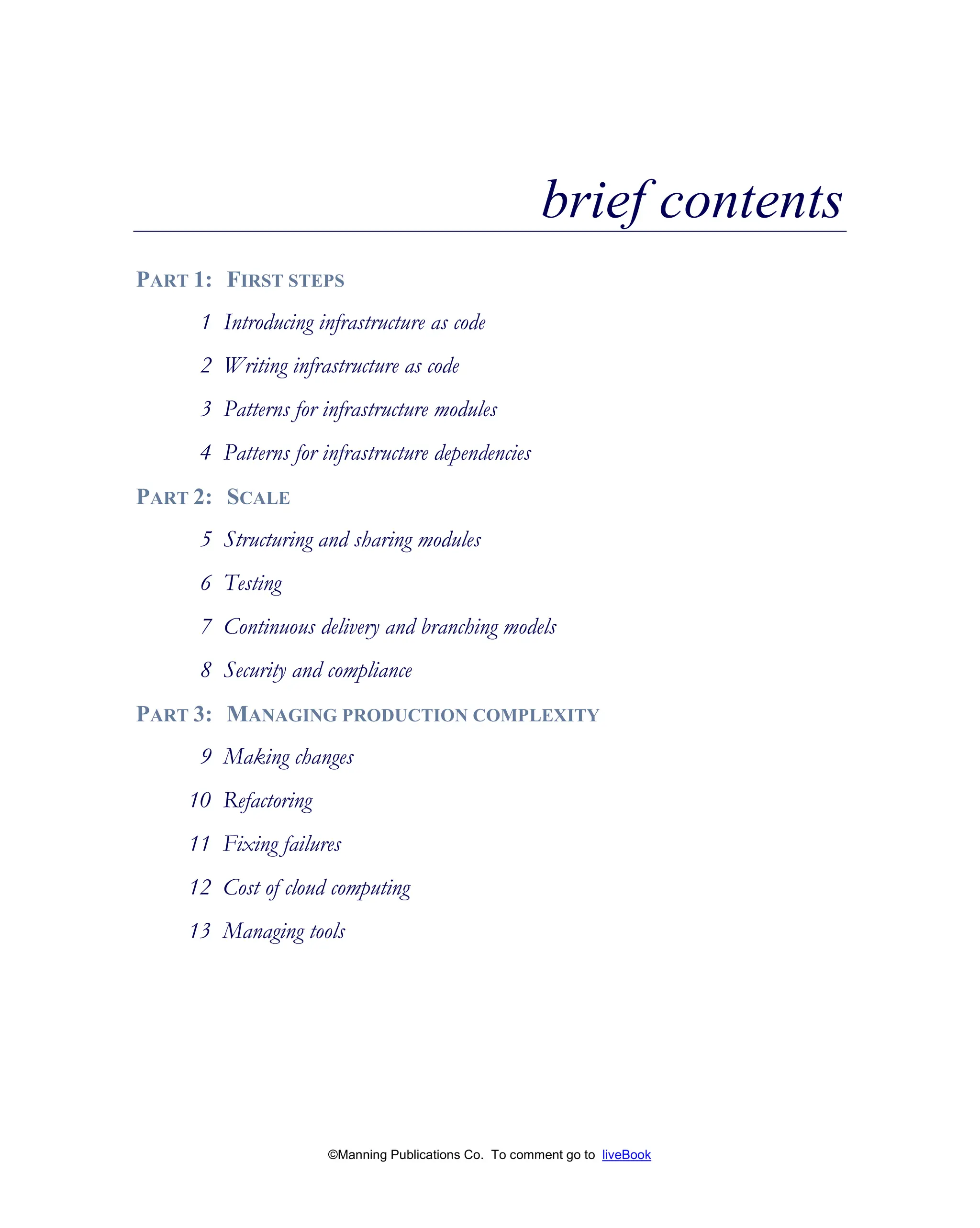
brief contents
PART 1: FIRST STEPS
1 Introducing infrastructure as code
2 Writing infrastructure as code
3 Patterns for infrastructure modules
4 Patterns for infrastructure dependencies
PART 2: SCALE
5 Structuring and sharing modules
6 Testing
7 Continuous delivery and branching models
8 Security and compliance
PART 3: MANAGING PRODUCTION COMPLEXITY
9 Making changes
10 Refactoring
11 Fixing failures
12 Cost of cloud computing
13 Managing tools
©Manning Publications Co. To comment go to liveBook
Introducing infrastructure as code
This chapter covers
• Defining infrastructure
• Defining infrastructure as code
• Understanding why infrastructure as code is important
If you just started working with public cloud providers or data center infrastructure, you
might feel overwhelmed with all that you have to learn. You don’t know what you need to
know to do your job! Between data center infrastructure concepts, new public cloud
offerings, container orchestrators, programming languages, and software development, you
have a lot to research.
Besides learning everything you can, you also have to keep up with your company’s
requirements to innovate and grow. Building systems to support it all gets challenging. You
need a way to support more complex systems, minimize your maintenance effort, and avoid
disruption to customers using your application.
What do you need to know to work with cloud computing or data center infrastructure? How
can you scale your systems across a team and your organization? The answer to both
questions involves infrastructure as code (IaC), the process of automating infrastructure
changes in a codified manner to achieve scalability, reliability, and security.
Everyone can use infrastructure as code, from system administrators, site reliability
engineers, DevOps engineers, security engineers, software developers, to quality assurance
engineers. Whether you’ve just run your first tutorial for infrastructure as code or passed a
public cloud certification (congratulations!), you can apply infrastructure as code to larger
systems and teams to simplify, sustain, and scale your infrastructure.
This book offers a practical approach to infrastructure as code by applying software
development practices and patterns to infrastructure management. It takes practices like
1
©Manning Publications Co. To comment go to liveBook
testing, continuous delivery, refactoring, and design patterns with an infrastructure twist!
You’ll find practices and patterns to help you manage your infrastructure no matter the
automation, tool, platform, or technology.
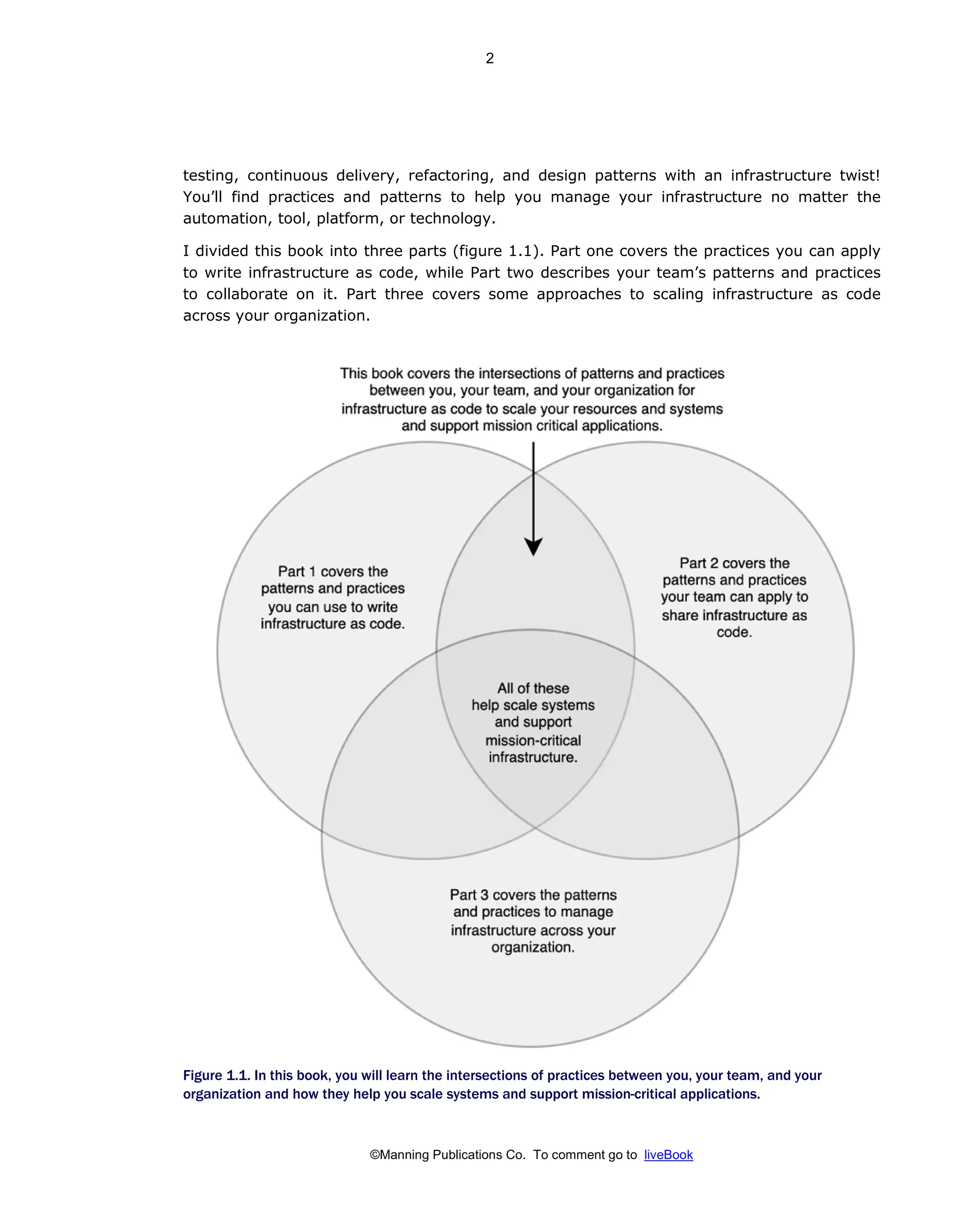
I divided this book into three parts (figure 1.1). Part one covers the practices you can apply
to write infrastructure as code, while Part two describes your team’s patterns and practices
to collaborate on it. Part three covers some approaches to scaling infrastructure as code
across your organization.
Figure 1.1. In this book, you will learn the intersections of practices between you, your team, and your
organization and how they help you scale systems and support mission-critical applications.
2
©Manning Publications Co. To comment go to liveBook
Many of the patterns and practices in this book intersect between these interests. Writing
good infrastructure as code individually helps you better share and scale it across your team
and organization! Well-written infrastructure as code helps solve problems with collaborating
on infrastructure as code, especially as more people adopt it.
Part one starts by defining infrastructure and explaining common infrastructure as code
design patterns. These topics involve foundational concepts that help you scale IaC across
your team. You may already be familiar with some of the material in this part, so review
these chapters to establish foundations for more advanced concepts.
In parts two and three, you’ll learn the patterns and practices you need to scale systems and
support infrastructure for mission-critical applications. These practices extend from you to
your team and organization, from creating one application metrics alert for an application to
implementing a network change across a fifty thousand person organization. Many terms and
concepts build on each other in these parts so you might find it helpful to read the chapters
in order.
1.1 What is infrastructure?
Before I dive into infrastructure as code, let’s begin with the definition of infrastructure.
When I began working in a data center, the literature often defined infrastructure as
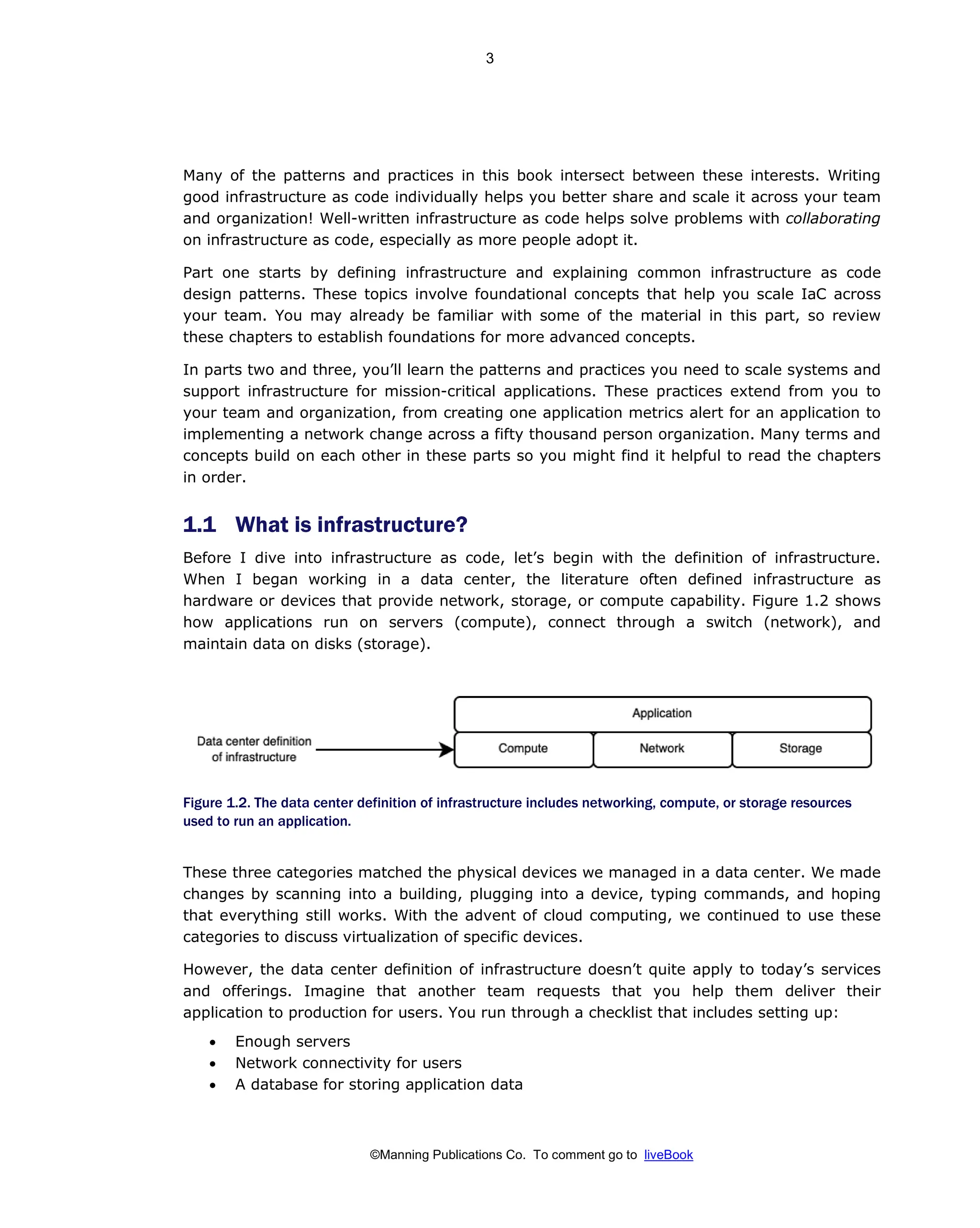
hardware or devices that provide network, storage, or compute capability. Figure 1.2 shows
how applications run on servers (compute), connect through a switch (network), and
maintain data on disks (storage).
Figure 1.2. The data center definition of infrastructure includes networking, compute, or storage resources
used to run an application.
These three categories matched the physical devices we managed in a data center. We made
changes by scanning into a building, plugging into a device, typing commands, and hoping
that everything still works. With the advent of cloud computing, we continued to use these
categories to discuss virtualization of specific devices.
However, the data center definition of infrastructure doesn’t quite apply to today’s services
and offerings. Imagine that another team requests that you help them deliver their
application to production for users. You run through a checklist that includes setting up:
• Enough servers
• Network connectivity for users
• A database for storing application data
3
©Manning Publications Co. To comment go to liveBook
Does completing this checklist mean the team can run this application in production? Not
necessarily! You do not know if you set up enough servers or the proper access to log into
the application. You also need to know if network latency affects the application’s database
connection.
In this narrow definition of infrastructure, you omit some critical tasks necessary for
production readiness, including the following:
• Monitoring application metrics
• Exporting metrics for business reporting
• Setting up alerts for teams operating the application
• Adding health checks for servers and databases
• Supporting user authentication
• Logging and aggregating application events
• Storing and rotating database passwords in a secrets manager
You need these “to-do” items to deliver an application to production that will work reliably
and securely. You might think of them as “operational” requirements, but they still require
infrastructure resources.
Besides infrastructure related to operations, public cloud providers abstract the management
of base networking, compute, and storage and offer Platform as a Service (PaaS) offerings
instead, from object stores like storage buckets to event streaming platforms like managed
Apache Kafka. Providers even offer Function as a Service or Containers as a Service,
additional abstractions for computing resources. The increasing marketplace of Software as a
Service (SaaS) such as hosted application performance monitoring software might also be
required to support an application in production and could also be infrastructure!
With so many services, you cannot describe infrastructure with just compute, network, and
storage categories. We need to include operational infrastructure, PaaS, or SaaS offerings in
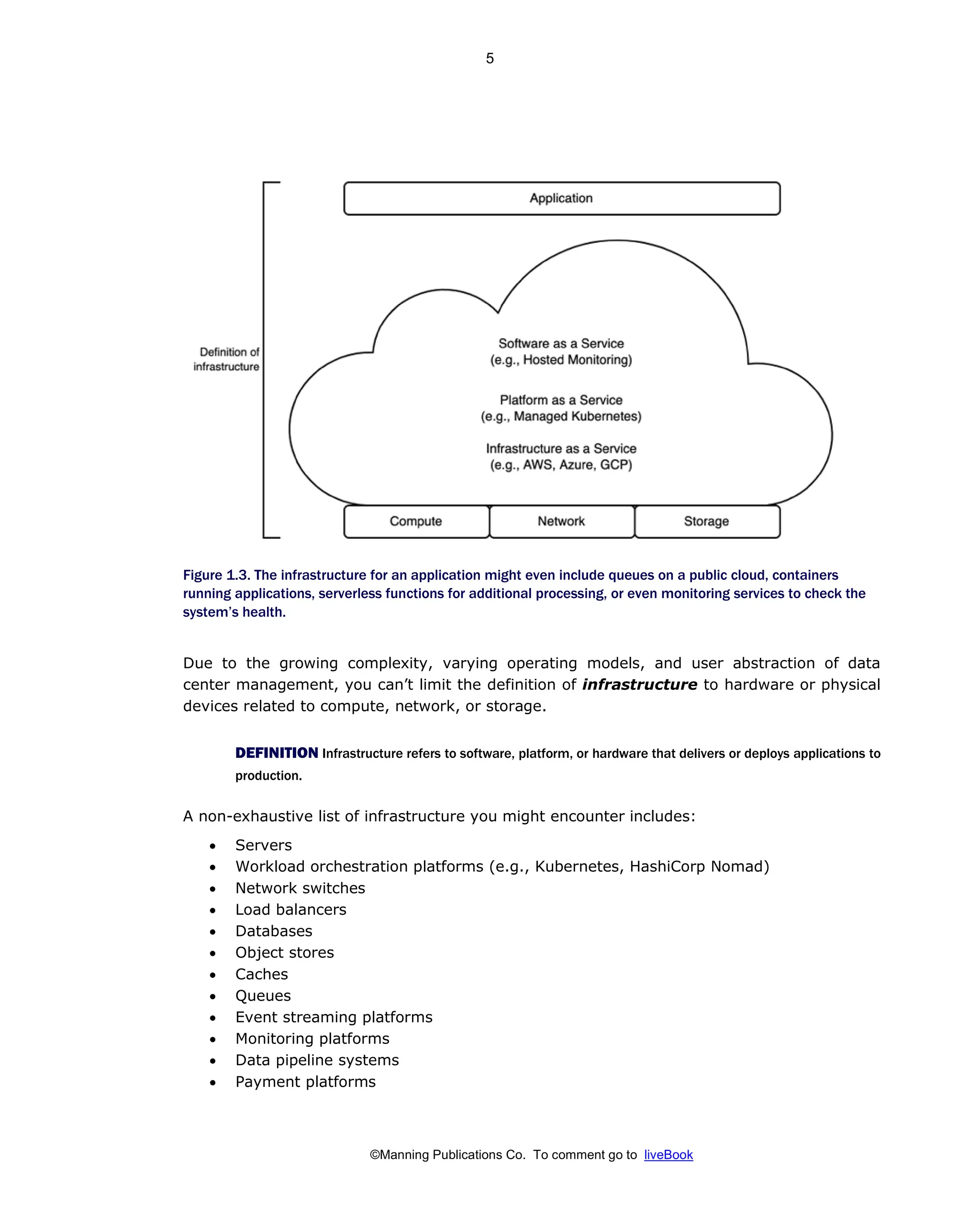
our application delivery. Figure 1.3 adjusts the model of infrastructure to include additional
service offerings like SaaS and PaaS that help us deliver applications.
4
©Manning Publications Co. To comment go to liveBook
Figure 1.3. The infrastructure for an application might even include queues on a public cloud, containers
running applications, serverless functions for additional processing, or even monitoring services to check the
system’s health.
Due to the growing complexity, varying operating models, and user abstraction of data
center management, you can’t limit the definition of infrastructure to hardware or physical
devices related to compute, network, or storage.
DEFINITION Infrastructure refers to software, platform, or hardware that delivers or deploys applications to
production.
A non-exhaustive list of infrastructure you might encounter includes:
• Servers
• Workload orchestration platforms (e.g., Kubernetes, HashiCorp Nomad)
• Network switches
• Load balancers
• Databases
• Object stores
• Caches
• Queues
• Event streaming platforms
• Monitoring platforms
• Data pipeline systems
• Payment platforms
5
©Manning Publications Co. To comment go to liveBook
Expanding the infrastructure definition provides a common language across teams managing
resources for various purposes. For example, a team managing an organization’s continuous
integration (CI) framework utilizes infrastructure from either a continuous integration SaaS
or compute resources from a public cloud. Another team builds upon the framework, thus
making it critical infrastructure.
1.2 What is infrastructure as code?
Before explaining infrastructure as code, we must understand the manual infrastructure
configuration. In this section, I outline the problem with infrastructure and manual
configuration. Then, I will define infrastructure as code.
1.2.1 Manual configuration of infrastructure
As part of a network team, I learned to change a network switch by copying and pasting
commands from a text document. I once pasted “shutdown” instead of “no shutdown,”
turning off a network interface! I quickly turned it back on, hoping that no one noticed and it
didn’t affect anything. A week later, however, I discovered that it shut off connectivity to a
critical application and affected a few customer requests.
In retrospect, I ran into a few problems with my manual copy and paste of commands and
infrastructure configuration. First, I had no idea what resources my change would affect (also
known as the blast radius). I did not know which networks or applications used the
interface.
DEFINITION The blast radius refers to the impact a failed change has on a system. A larger blast radius
often affects more components or the most critical components.
Second, the network switch accepted my command without testing its effects or checking its
intent. Finally, no one else knew what affected the application’s processing of customer
requests, and it took a week for them to identify the root cause as my miscopied command.
How does writing infrastructure in a codified manner help catch my miscopied network switch
command? I could store my configuration and automation under source control to record the
commands. To catch my mistake going forward, I create a virtual switch and a test that runs
my script and checks the health of the interface.
After the tests pass, I promote the change to production because the tests check for the
correct command. If I apply the wrong command, I can search infrastructure configuration to
determine which applications run on the affected network. You can refer to Chapter 6 for
testing practices and Chapter 11 for reverting changes.
Besides the risk of misconfiguration, my development momentum sometimes slows because
of manual infrastructure configuration. Once, it took nearly two months for me to test my
application against a database. Throughout those two months, my team submitted over ten
tickets related to creating the database, configuring new routing to connect it to the
database, and opening firewall rules to allow my application. The platform team manually
6
©Manning Publications Co. To comment go to liveBook
configured everything in a public cloud. Development teams did not have direct access due
to security concerns.
In other words, manual configuration of infrastructure often does not scale as systems and
teams grow. Manual changes increase the change failure rate of systems, slow down
development, and expose the system’s attack surface to a potential security exploit. You will
always have the temptation to update some values into a console. However, these changes
accumulate.
The next person who makes a change to the system may introduce a failure into the system
that will be difficult to troubleshoot because changes haven’t been audited or organized.
Changes like updating a firewall to allow some traffic during the development process can
inadvertently leave the system vulnerable to attack.
1.2.2 Infrastructure as code
What should you do to change infrastructure, if not manual changes? You can apply a
software development lifecycle for infrastructure resources and configuration in the form of
infrastructure as code. However, an infrastructure development lifecycle goes beyond
configuration files and scripts.
Infrastructure needs to scale, manage failure, support rapid software development, and
secure applications. A development lifecycle for infrastructure involves more specific patterns
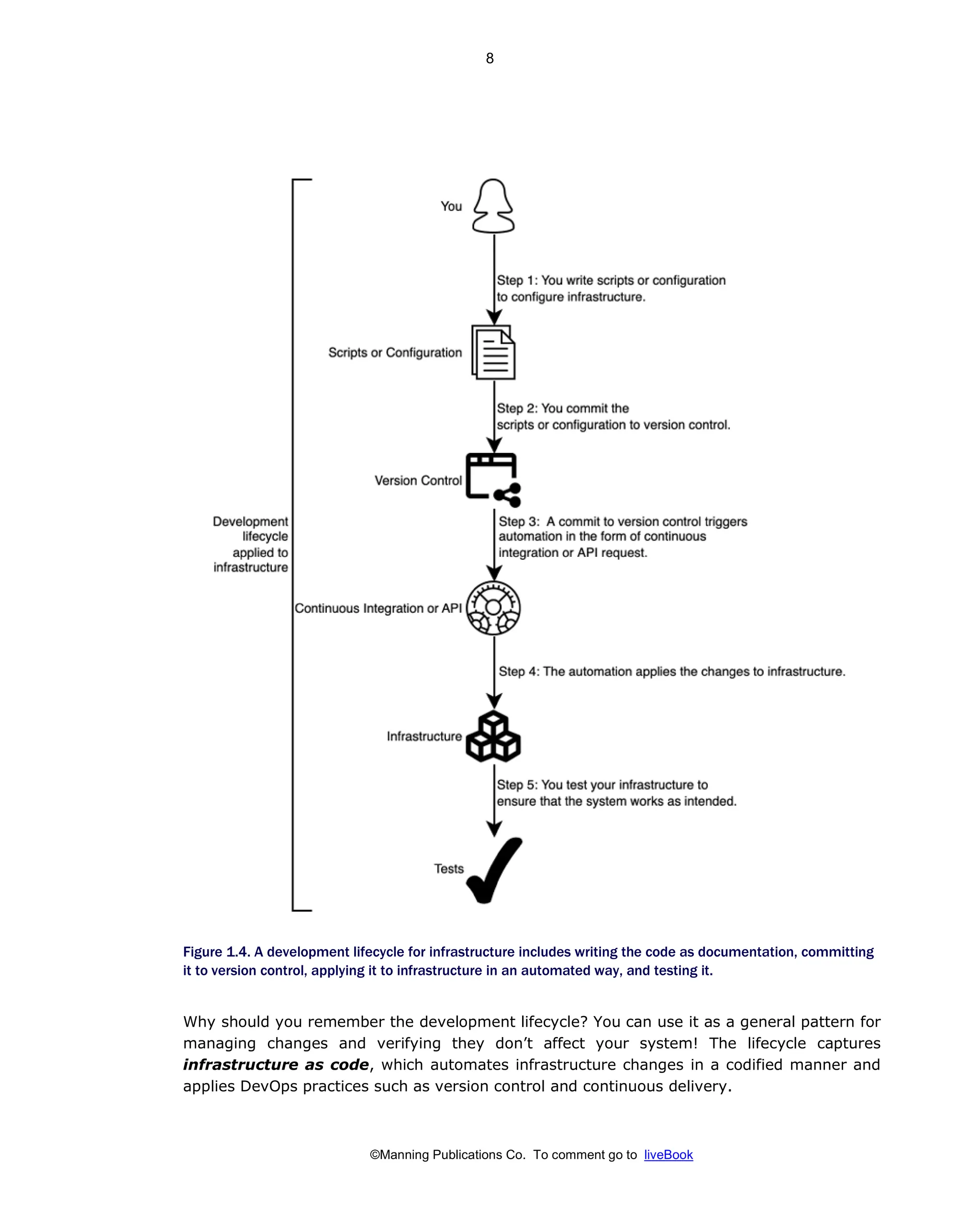
and practices to support collaboration, deployment, and testing. In figure 1.4, a simplified
workflow changes infrastructure using configuration or scripts and committing them to
version control. A commit automatically starts a workflow to deploy and test the changes to
your infrastructure.
7
©Manning Publications Co. To comment go to liveBook
Figure 1.4. A development lifecycle for infrastructure includes writing the code as documentation, committing
it to version control, applying it to infrastructure in an automated way, and testing it.
Why should you remember the development lifecycle? You can use it as a general pattern for
managing changes and verifying they don’t affect your system! The lifecycle captures
infrastructure as code, which automates infrastructure changes in a codified manner and
applies DevOps practices such as version control and continuous delivery.
8
©Manning Publications Co. To comment go to liveBook
DEFINITION Infrastructure as code (IaC) applies DevOps practices to automating infrastructure changes in
a codified manner to achieve scalability, resiliency, and security.
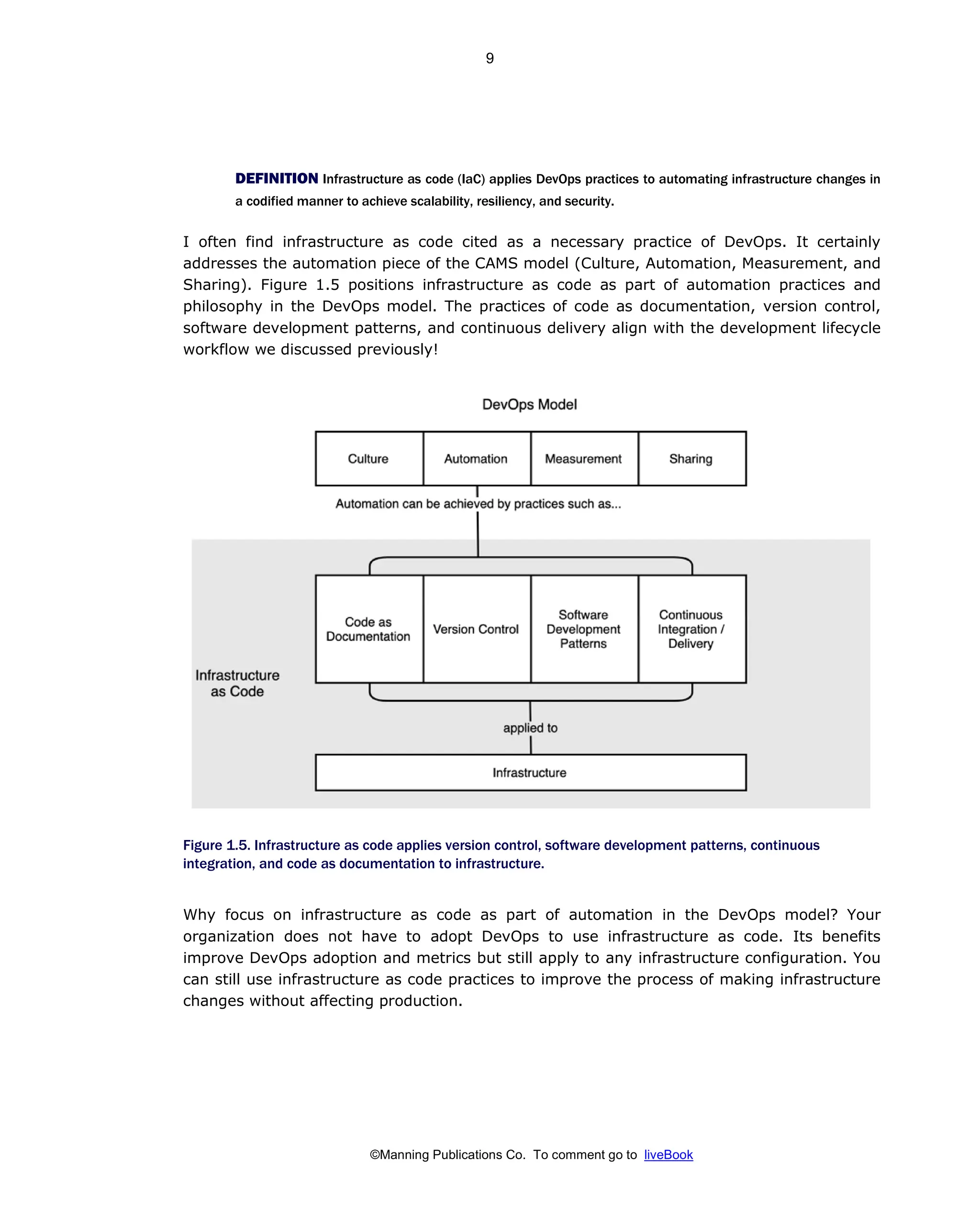
I often find infrastructure as code cited as a necessary practice of DevOps. It certainly
addresses the automation piece of the CAMS model (Culture, Automation, Measurement, and
Sharing). Figure 1.5 positions infrastructure as code as part of automation practices and
philosophy in the DevOps model. The practices of code as documentation, version control,
software development patterns, and continuous delivery align with the development lifecycle
workflow we discussed previously!
Figure 1.5. Infrastructure as code applies version control, software development patterns, continuous
integration, and code as documentation to infrastructure.
Why focus on infrastructure as code as part of automation in the DevOps model? Your
organization does not have to adopt DevOps to use infrastructure as code. Its benefits
improve DevOps adoption and metrics but still apply to any infrastructure configuration. You
can still use infrastructure as code practices to improve the process of making infrastructure
changes without affecting production.
9
©Manning Publications Co. To comment go to liveBook
More on DevOps
You will see some DevOps practices included in this book, but I will not be focusing on its theory or principles. I
recommend Accelerate by Nicole Forsgren, Ph.D., Gene Kim, and Jez Humble for a higher-level understanding of
DevOps. You can also peruse Gene Kim’s The Phoenix Project, which describes the fictional transformation of an
organization adopting DevOps.
This book will cover some approaches for codifying infrastructure to eliminate the friction of
scale while maintaining the reliability and security of infrastructure for application users,
whether you use the data center or cloud. Software development practices such as version
control of configuration files, continuous integration pipelines, and testing can help scale and
evolve changes to infrastructure while mitigating downtime and building secure
configuration.
1.2.3 What is not infrastructure as code?
Could you be doing infrastructure as code if you type out some configuration in a document?
You might consider infrastructure as code to include adding configuration instructions in a
change ticket. You can argue that a tutorial for building a queue or a shell script for
configuring a server counts as infrastructure as code. Each of these examples can be forms
of infrastructure as code if you can use them to:
• Reliably and accurately reproduce the infrastructure it expresses
• Revert configuration to a specific version or point in time
• Communicate and assess the blast radius of a change to the resources.
The configurations or scripts, however, are usually outdated, unversioned, or ambiguous in
intent. You may even find yourself struggling to understand and change the configuration
written in an IaC tool! The tool facilitates IaC workflows but not necessarily the practices and
approaches that allow systems to grow while reducing operational responsibility and change
failure. You need a set of principles to identify infrastructure as code.
1.3 Principles of infrastructure as code
As I mentioned, not every piece of code or configuration related to infrastructure will scale or
mitigate downtime. Throughout the book, I will highlight how IaC principles apply to certain
code listings or practices. You can even use these principles to assess your infrastructure as
code.
While others may add or subtract to this list of principles, I remember four of the most
important principles with the mnemonic, RICE. RICE stands for reproducibility, idempotency,
composability, and evolvability. I will define and apply each principle in the following
sections.
10
©Manning Publications Co. To comment go to liveBook
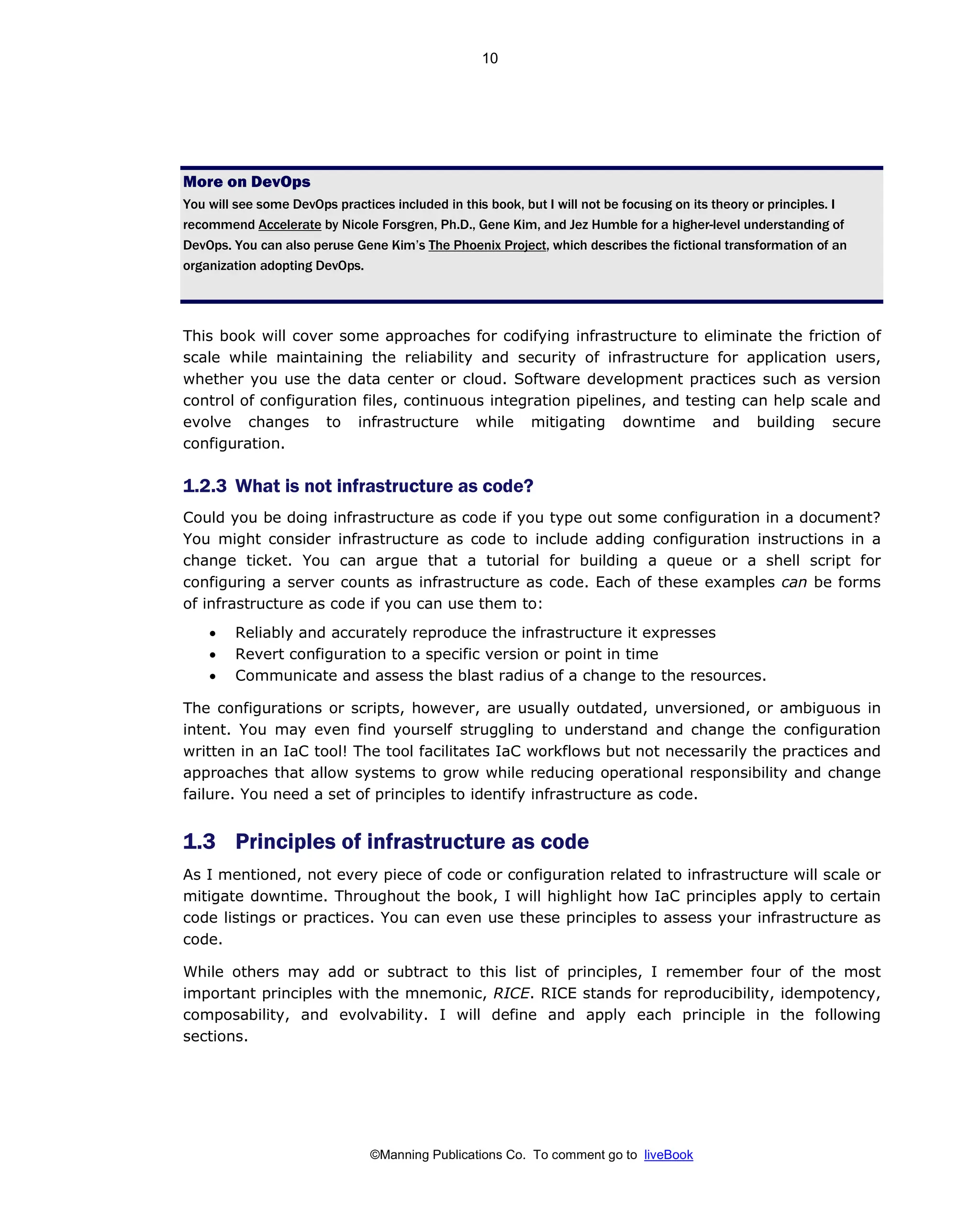
1.3.1 Reproducibility
Imagine if someone asks you to create a development environment with a queue and a
server. You share a set of configuration files for your teammate. They use them to recreate a
new environment for themselves in less than an hour. Figure 1.6 shows how you shared your
configuration and enabled your teammate to reproduce a new environment. You discovered
the power of reproducibility, the first principle of infrastructure as code!
Figure 1.6. Manual changes introduce drift between version control and actual state and affects
reproducibility, so you instead update changes in version control.
Why should infrastructure as code conform to the principle of reproducibility? The ability to
copy and reuse infrastructure configuration saves you and your team’s initial engineering
time. You don’t have to “reinvent the wheel” to create new environments or infrastructure
resources!
DEFINITION The principle of reproducibility means that you can use the same configuration to reproduce
an environment or infrastructure resources.
However, you’ll find adhering to the principle of reproducibility more complicated than
copying and pasting a configuration. To demonstrate this nuance, imagine you need to
reduce a network address space from “/26” to “/24.” You do have infrastructure as code
written that expresses the network. However, you decide to choose the easy route of logging
into the cloud provider and typing “/24” into the text box.
Before you log into the cloud provider, you reflect on whether or not your change workflow
adheres to reproducibility. You ask yourself the following questions:
• Will a teammate know that you’ve updated the network?
• If you run your configuration, will the network address space return to the “/16”?
• If you create a new environment with the configuration in version control, will it have
an address space of “/24”?
You answer “no” to each of those questions! You cannot guarantee that you will reproduce
the manual change successfully.
11
©Manning Publications Co. To comment go to liveBook
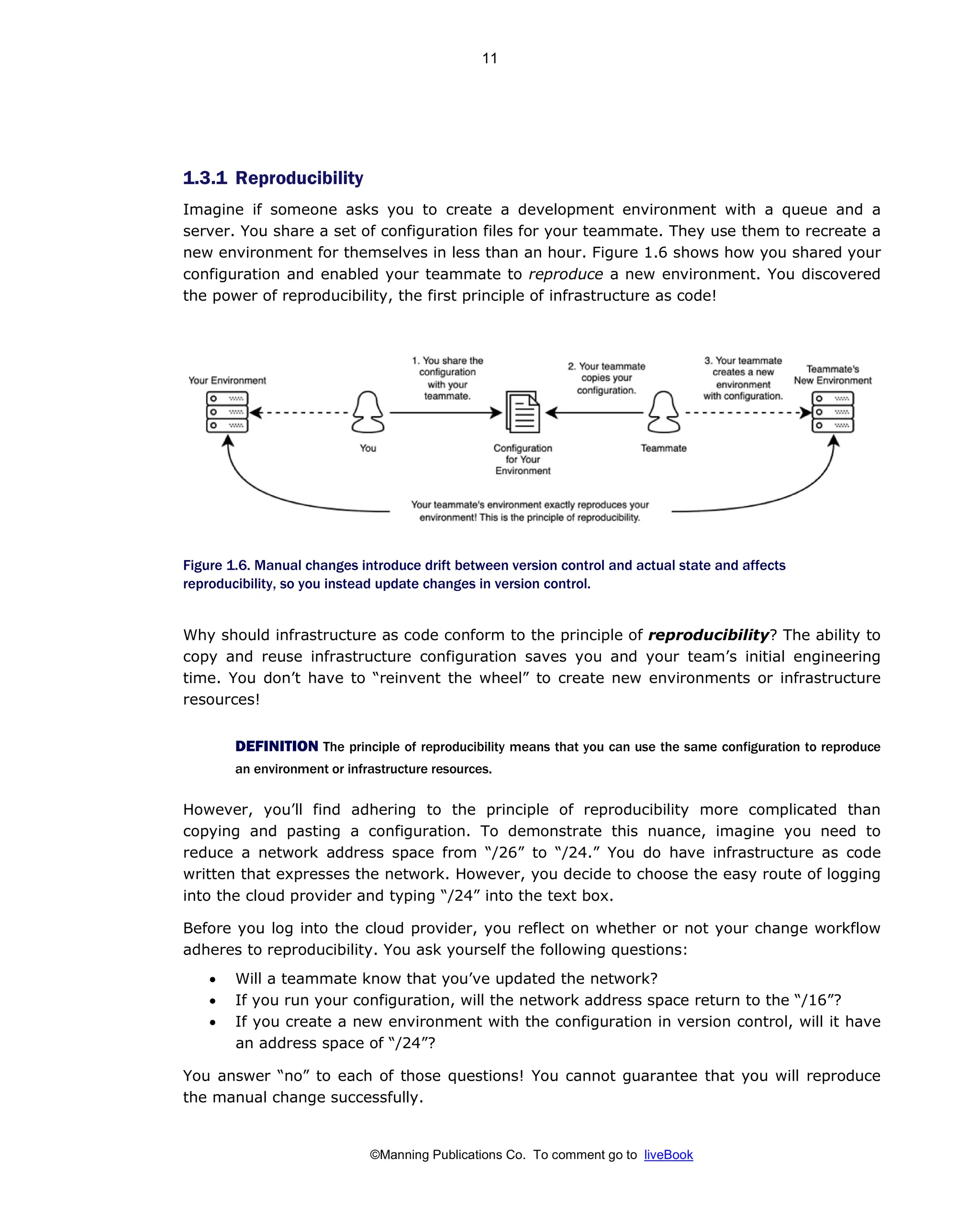
If you go ahead and type “/24” in the cloud provider’s console, your network has drifted from
its desired state expressed in IaC (figure 1.7). To conform to reproducibility, you decide to
update the version control configuration to “/24” and apply the automation.
Figure 1.7. Manual changes introduce drift between version control and actual state and affects
reproducibility, so you instead update changes in version control.
This scenario demonstrates the challenge of conforming to reproducibility. You need to
minimize the inconsistency between the expected and actual infrastructure configuration,
also known as configuration drift.
DEFINITION Configuration drift is the deviation of infrastructure configuration from the desired versus
actual configuration.
As a practice, you can ensure the principle of reproducibility by placing your configuration
files in version control and keeping version control as updated as possible. Maintaining the
principle of reproducibility helps you collaborate better and manage testing environments
similar to production. You’ll learn more about infrastructure testing environments in Chapter
6, which benefit from reproducibility. You’ll also apply reproducibility to practices and
patterns in testing and upgrading infrastructure, from creating test infrastructure mirroring
production to deploying new infrastructure to replace older systems (blue-green
deployments).
12
©Manning Publications Co. To comment go to liveBook
1.3.2 Idempotency
Some infrastructure as code include repeatability as a principle, which means running the
same automation and yielding consistent results. I pose that infrastructure as code needs a
stricter requirement. Running automation should result in the same end state for an
infrastructure resource. After all, I have one main objective when I write automation - the
ability to run the automation multiple times and get the same result.
Let’s understand why infrastructure as code needs a stricter requirement. Imagine you write
a network script that first configures an interface and then reboots. The first time you run
the script, the switch configures the interface and reboots. You save this script as version 1.
A few months later, your teammate asks you to run the script again on the switch. You run
the script and the switch reboots. However, the reboot disconnected some critical
applications! You already configured the network interface. Why do you need to reboot the
switch?
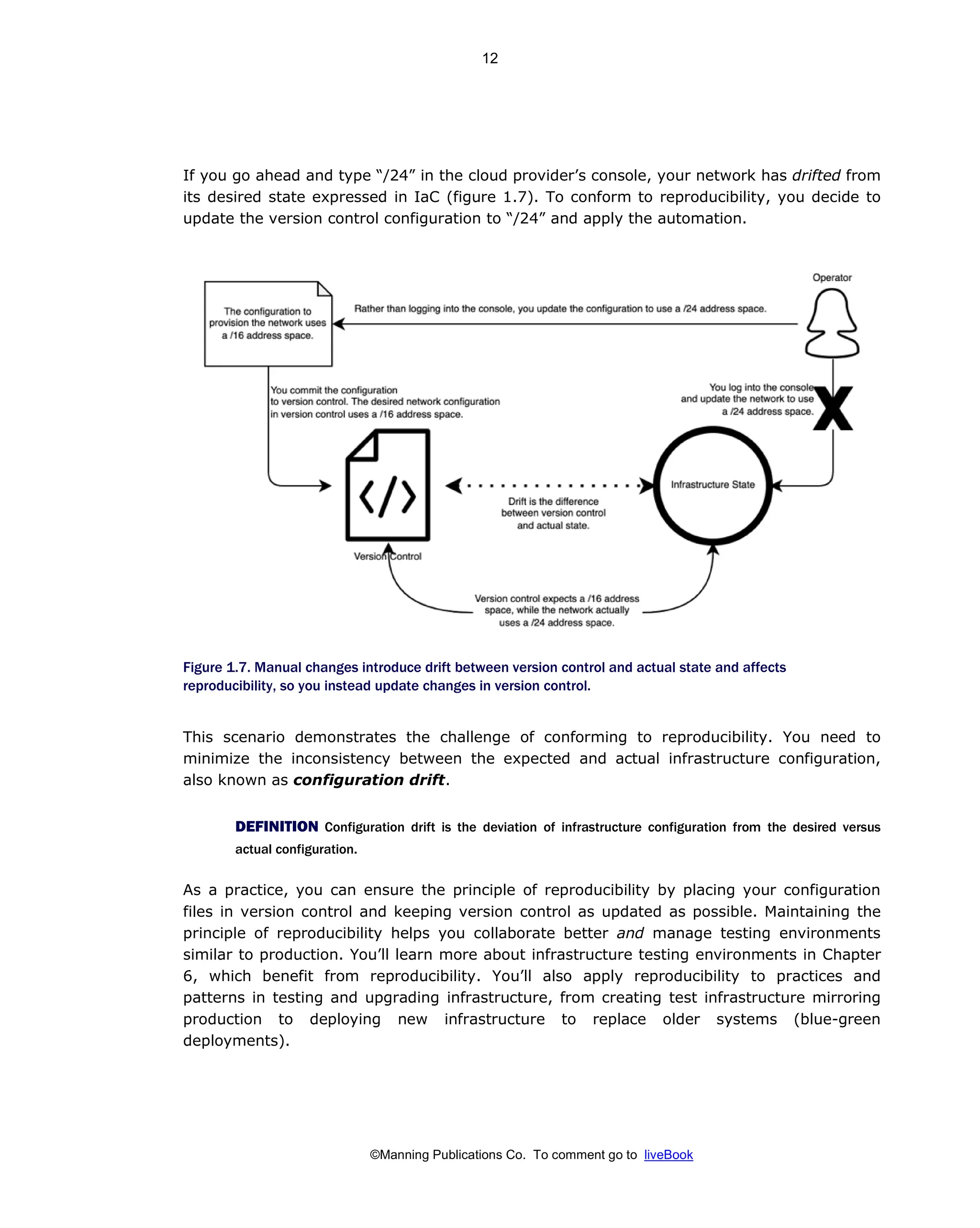
You figure out a way to prevent the switch reboot if you already configured the network
interface. In figure 1.8, you create version two of the script and add a conditional “if”
statement. The statement checks if you have configured the interface already before
rebooting the switch. When you run the version two script again, you do not disconnect the
applications.
Figure 1.8. In version 1 of the script, you reboot the switch each time you run the script. In version 2 of the
script, you check if the network interface is configured before rebooting the switch. This preserves the working
state of the network.
13
©Manning Publications Co. To comment go to liveBook
The conditional statement conforms to the principle of idempotency. Idempotency ensures
that you can repeat the automation without affecting the infrastructure unless you change
the configuration or drift occurs. If an infrastructure configuration or script is idempotent,
you can rerun the automation multiple times without affecting the state or operability of a
resource.
DEFINITION The principle of idempotency ensures that you can repeatedly run the automation on
infrastructure without affecting its end state or having any side effects. You should only affect Infrastructure
when you update its attributes in automation.
Why should you adhere to idempotency in your infrastructure as code, such as in the case of
your network script? In the example, you want to avoid rebooting the network switch to keep
the network running correctly. You already configured the network interface - why configure
it again? You should only need to configure the interface if it doesn’t exist or change.
Without idempotency, your automation might break accidentally. For example, you may
repeat a script and create a new set of servers, doubling their numbers. More
catastrophically, you might automate a database update only to remove a critical database!
You can ensure the principle of idempotency by checking the repeatability of scripts and
configuration. As a general practice, include a number of conditional statements checking if a
configuration matches the expected before running your automation. Conditional statements
help apply changes when required and avoid side effects that may affect the operability of
infrastructure.
Designing automation with idempotency reduces risk, as it encourages the inclusion of logic
to preserve the final expected state of the system. If the automation fails once and causes
an outage in the system, organizations no longer want to automate again because of its
perceived risk. Idempotency becomes a guiding principle as you learn how to safely roll
forward changes and preview automation changes before deployment in Chapter 11.
1.3.3 Composability
You want to mix and match any set of infrastructure components, no matter the tool or
configuration. You also need to update the individual configurations without affecting the
entire system. Both of these requirements promote modularity and decoupling infrastructure
dependencies, something you’ll learn more about in chapters 3, 4, and 5.
For example, imagine you create infrastructure for an application that someone accesses at
“hello-world.com. The minimum resources you need for a secure and production-ready
configuration include:
• A server
• A load balancer
• A private network for server
• A public network for a load balancer
• A routing rule to allow traffic out of the private network
14
©Manning Publications Co. To comment go to liveBook
• A routing rule to allow public traffic to the load balancer
• A routing rule to allow traffic from the load balancer to the server
• A domain name for “hello-world.com”
You could write this configuration from scratch. However, what if you found pre-constructed
modules that group infrastructure components you can use to assemble the system? You
now have different modules that create:
• Networks (private and public networks, gateways to route traffic from the private
network, routing rules to allow traffic out of the private network)
• Servers
• Load balancers (domain name, routing rules to allow traffic from the load balancer to
server)
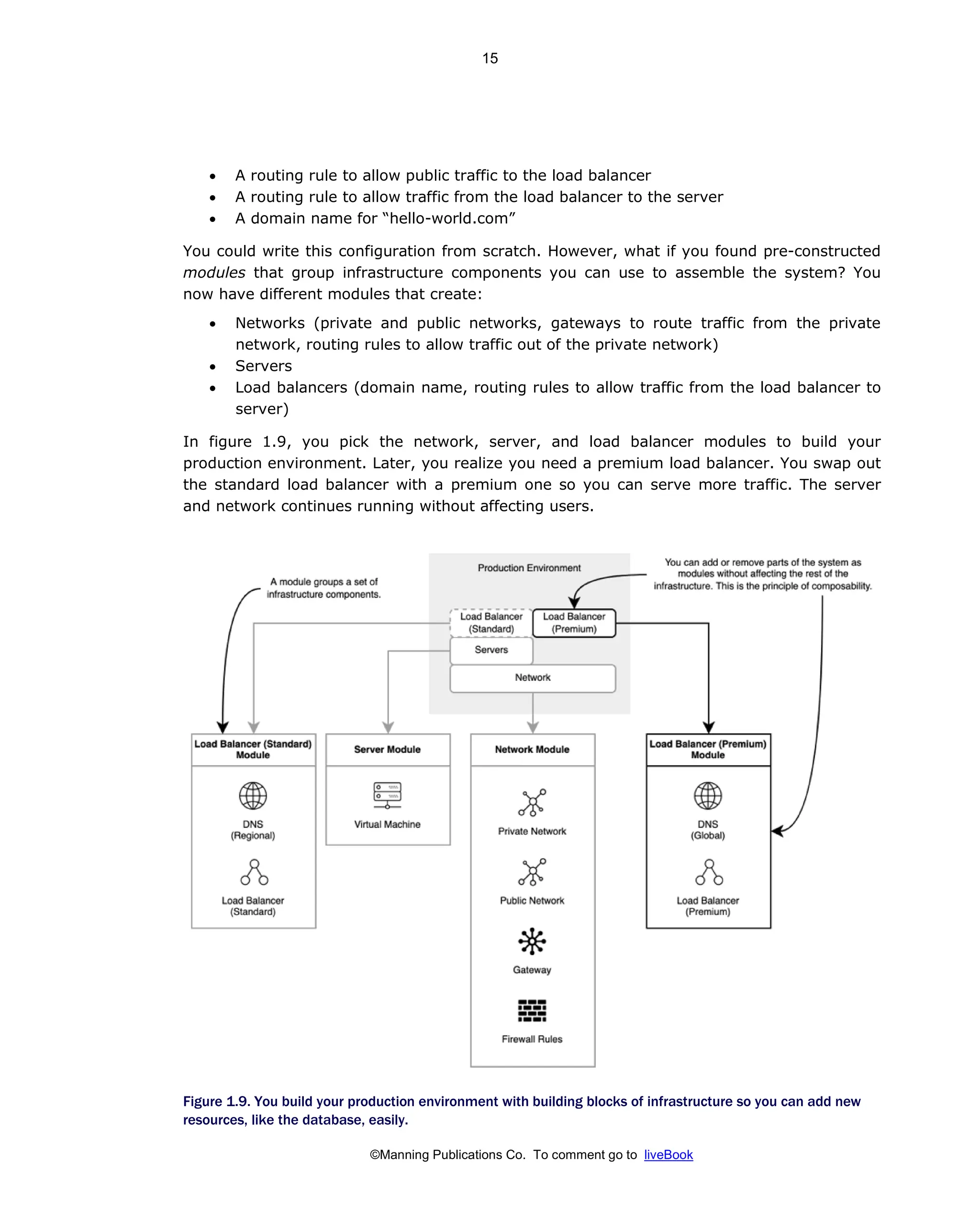
In figure 1.9, you pick the network, server, and load balancer modules to build your
production environment. Later, you realize you need a premium load balancer. You swap out
the standard load balancer with a premium one so you can serve more traffic. The server
and network continues running without affecting users.
Figure 1.9. You build your production environment with building blocks of infrastructure so you can add new
resources, like the database, easily.
15
©Manning Publications Co. To comment go to liveBook
Your teammate can even add a database into the environment without affecting the load
balancer, servers, or network. You group and select infrastructure resources in different
combinations, which adheres to the principle of composability.
DEFINITION Composability ensures that you can assemble any combination of infrastructure resources
and update each one without affecting the others.
The more composable your configuration, the easier it is to create new systems with less
effort. Think of constructing your infrastructure as code with building blocks. You want to be
able to update or evolve subsets of resources without toppling the entire system! If you do
not consider the composability of your infrastructure as code, you run the risk of change
failures due to unknown dependencies in complex infrastructure systems.
The self-service benefit of composability can help your organization scale and empower
teams to interact safely with infrastructure systems. This book will examine some patterns in
chapters 3, 4, and 5 that can help you approach more modular infrastructure construction
and improve composability.
1.3.4 Evolvability
You want to account for the scale and growth of your system but not optimize the
configuration too early and unnecessarily. Much of infrastructure configuration will change
over time, including its architecture.
As a practical example, you might initially name an infrastructure resource “example.” Later,
you need to change the resource name to “production.” You start the change by finding and
replacing hundreds of tags, names, dependent resources, and more. The procedure of find-
and-replace requires a high rate of effort.
You notice that you forgot to change some fields as you apply the changes and your new
infrastructure changes fail. To ensure the future evolution of names, tags, and other
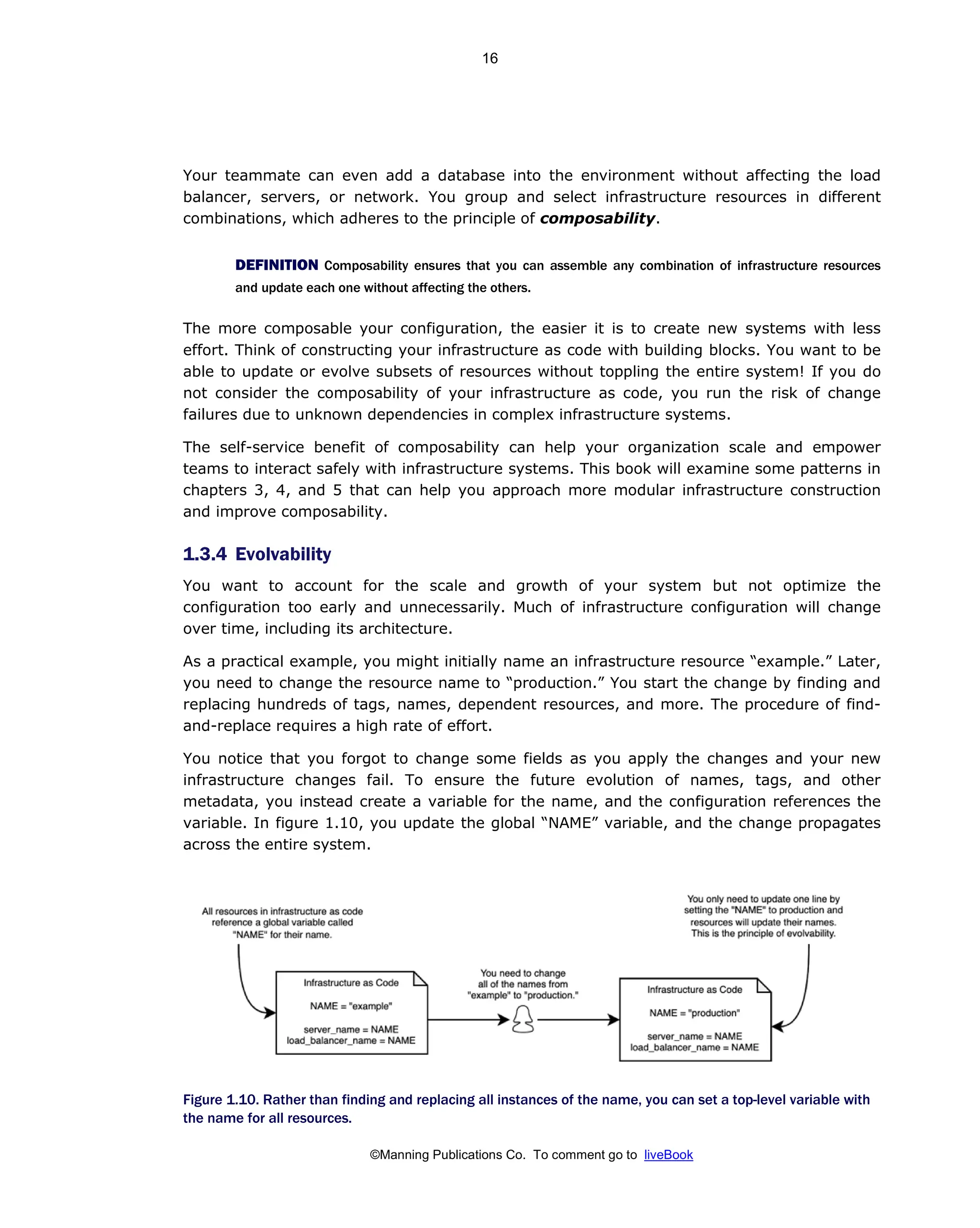
metadata, you instead create a variable for the name, and the configuration references the
variable. In figure 1.10, you update the global “NAME” variable, and the change propagates
across the entire system.
Figure 1.10. Rather than finding and replacing all instances of the name, you can set a top-level variable with
the name for all resources.
16
©Manning Publications Co. To comment go to liveBook
The example almost seems too simple. Why does changing a name matter? Infrastructure as
code built with evolvability as a principle minimizes the effort (time and cost) to change a
system and the risk of failure for the change.
DEFINITION The principle of evolvability ensures that you can change your infrastructure resources to
accommodate system scale or growth while minimizing effort and risk of failure.
System evolution includes changes beyond minor ones, such as name changes. A more
disruptive change in infrastructure architecture might involve a replacement of Google Cloud
Platform’s Bigtable with Amazon Web Service (AWS) Elastic Map Reduce. The application
requiring the replacement has been future-proofed using HBase, an open-source distributed
database that supports both offerings and simply requires the database endpoint.
We account for this evolution in the infrastructure as code by outputting the database
endpoint to retrieve the application and completing the update behind-the-scenes by creating
configurations for both offerings. After testing the AWS database, we output its endpoint for
consumption by the application.
Evolvability, a complex discussion
I do not fully cover the theory in evolving your architecture in this book. I highly recommend Building Evolutionary
Architectures by Neal Ford, Pat Kua, and Rebecca Parsons if you want to learn more. The book discusses how to build
your infrastructure architecture to account for changes.
You might find yourself struggling to evolve your system because you have not used patterns
and practices that allow it to change. Useful infrastructure as code focuses on techniques to
facilitate future evolution. Many of the chapters in this book demonstrate patterns that help
maintain evolvability and minimize the impact of changes to critical systems.
1.3.5 Applying the principles
Reproducibility, idempotency, composability, and evolvability seem specific in their
definitions. However, they help constrain your infrastructure architecture and define the
behavior of many IaC tools. Your infrastructure as code must align with all four principles to
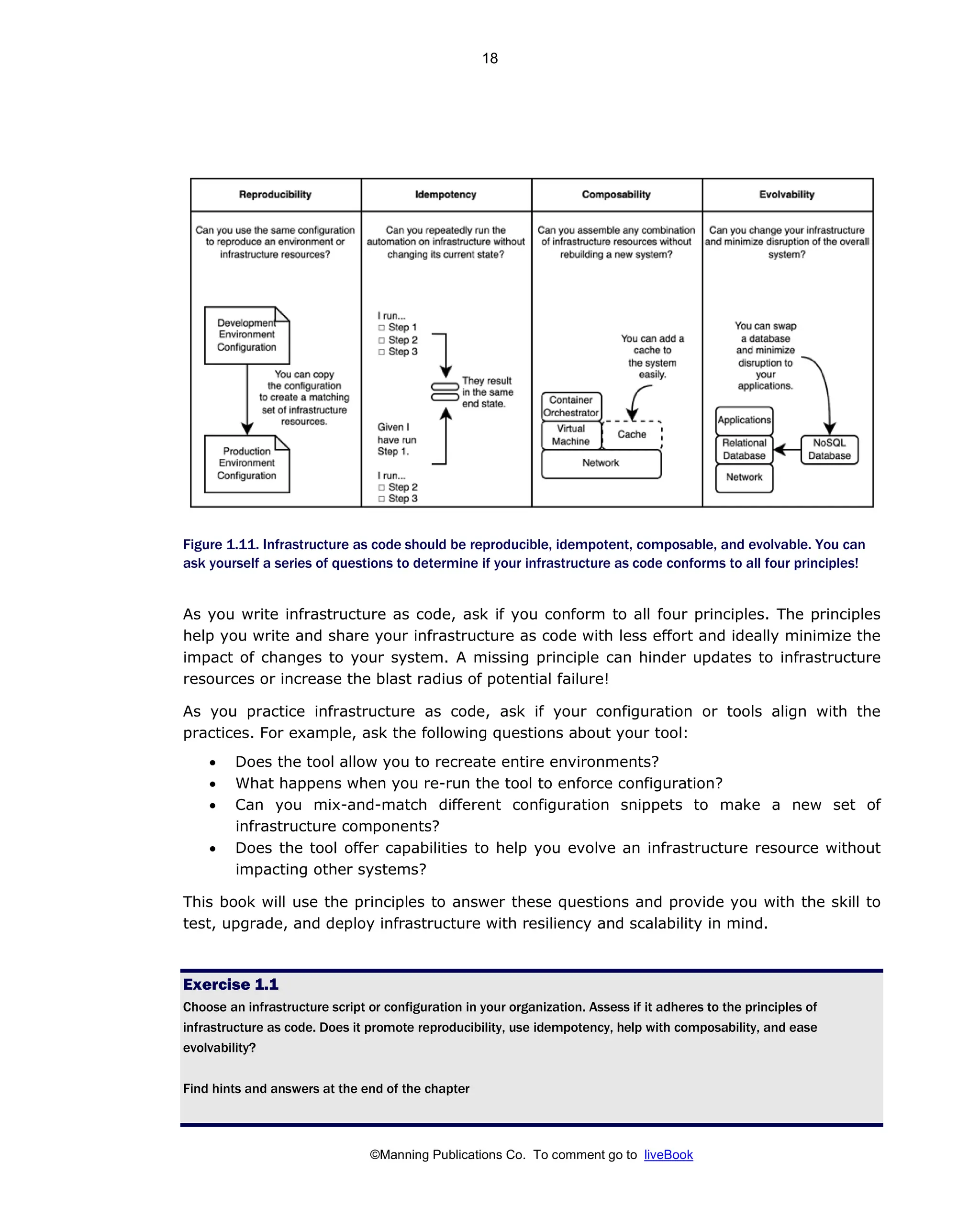
scale, collaborate, and change your company. Figure 1.11 summarizes the four most
important principles (RICE) and their definitions.
17
©Manning Publications Co. To comment go to liveBook
Figure 1.11. Infrastructure as code should be reproducible, idempotent, composable, and evolvable. You can
ask yourself a series of questions to determine if your infrastructure as code conforms to all four principles!
As you write infrastructure as code, ask if you conform to all four principles. The principles
help you write and share your infrastructure as code with less effort and ideally minimize the
impact of changes to your system. A missing principle can hinder updates to infrastructure
resources or increase the blast radius of potential failure!
As you practice infrastructure as code, ask if your configuration or tools align with the
practices. For example, ask the following questions about your tool:
• Does the tool allow you to recreate entire environments?
• What happens when you re-run the tool to enforce configuration?
• Can you mix-and-match different configuration snippets to make a new set of
infrastructure components?
• Does the tool offer capabilities to help you evolve an infrastructure resource without
impacting other systems?
This book will use the principles to answer these questions and provide you with the skill to
test, upgrade, and deploy infrastructure with resiliency and scalability in mind.
Exercise 1.1
Choose an infrastructure script or configuration in your organization. Assess if it adheres to the principles of
infrastructure as code. Does it promote reproducibility, use idempotency, help with composability, and ease
evolvability?
Find hints and answers at the end of the chapter
18
©Manning Publications Co. To comment go to liveBook
1.4 Why use infrastructure as code?
Infrastructure as code is typically considered a DevOps practice. However, you don’t have to
be applying DevOps across your entire organization to use it! You still want to manage your
infrastructure in a way that reduces the change failure rate and mean time to resolution
(MTTR), so you can sleep in on the weekends as an operator or spend more time writing
code as a developer. There are a few reasons to use infrastructure as code, even if you think
you don’t need it.
1.4.1 Change management
You might experience a sinking feeling when you’ve applied a change to some infrastructure,
only to realize that someone reported it broke something. Organizations try to prevent this
with change management, a set of steps and reviews to ensure your changes do not affect
production. The process often includes a change review board to review the changes or
change windows to block off time to execute the change.
DEFINITION Change management outlines a set of steps and reviews that you take in your company to
implement changes in production and prevent their failure.
However, no change is risk-free. Applying infrastructure as code practices can mitigate the
risk of a change by modularizing your infrastructure (Chapter 3) and rolling forward changes
(Chapter 11) to limit the blast radius.
In one regretful instance, I ignored my intuition to use infrastructure as code to mitigate the
risk of a change. I had to roll out a new binary to servers, which required them to restart a
set of dependent services. I wrote a script, asked my teammate to check it, and had the
change review board sign off to run it. After applying and verifying the change over the
weekend, I came in on Monday to several messages telling me servers supporting a
reconciliation application went down overnight. My teammate traced it to an older operating
system incompatibility with the dependencies in my script.
In retrospect, infrastructure as code could have mitigated the risk of the change. When I
applied the RICE principles to the change, I realized that I forgot the following:
• Reproducibility. I did not reproduce my script on various test instances mimicking the
various servers.
• Idempotency. I did not include logic to check the operating system before running the
command.
• Composability. I did not limit the blast radius of the change to a small set of less
critical servers.
• Evolvability. I did not update the servers with a newer operating system and reduce
variation across the infrastructure.
Reducing variation allows for infrastructure evolution and risk mitigation because the actual
configuration matches the one you expect during your automation, making changes more
19
©Manning Publications Co. To comment go to liveBook
straightforward and reliable to apply. We’ll discuss how to fit infrastructure as code into your
change management process in Chapter 7!
1.4.2 Return on time investment
Infrastructure as code and time investment can be challenging to justify, especially if your
devices or hardware do not have suitable automation interfaces. In addition to a lack of easy
automation, it can be difficult to justify spending time automating a task that you only do
once a year or even a decade. While infrastructure as code might take extra time to
implement, it lowers the time to execute changes in the long term. How exactly does that
work?
Imagine you need to update the same package on ten servers. You used to do this without
infrastructure as code. You manually log in, update the package, verify everything works, fix
errors, and move to the next one. On average, you spend 10 hours updating the servers.
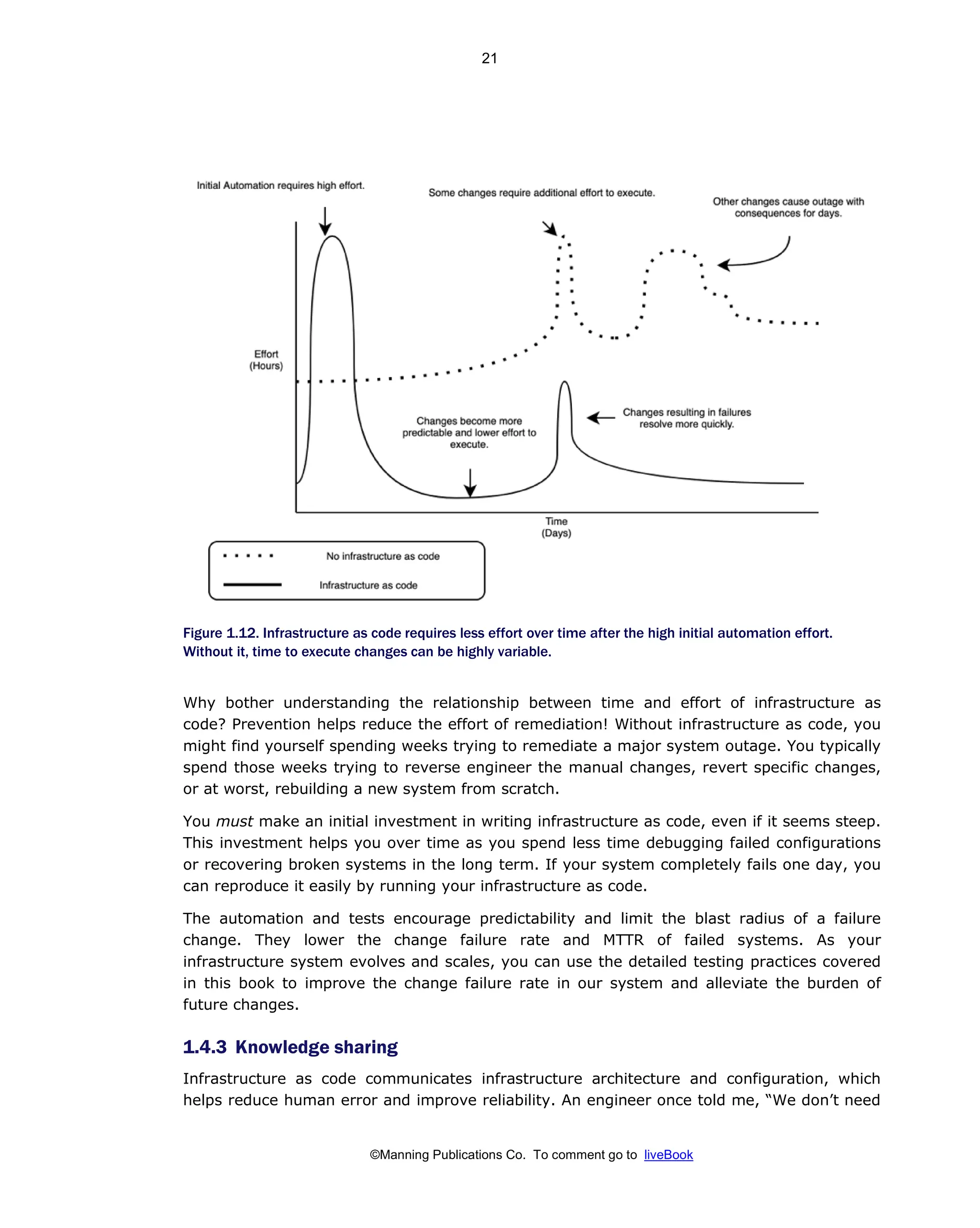
Figure 1.12 shows that changes made without IaC have a constant level of effort over time.
If you have additional changes, you may spend a few more hours fixing or updating the
system. A failed change might mean you spend more effort over several days to fix the
system.
You decide to invest time into building infrastructure as code for these servers (the solid line
in figure 1.12). You reduce the servers’ configuration drift, which takes about 40 hours. After
your initial time investment, you spend less than five minutes updating all of the servers
each time you make the change.
20
©Manning Publications Co. To comment go to liveBook
Figure 1.12. Infrastructure as code requires less effort over time after the high initial automation effort.
Without it, time to execute changes can be highly variable.
Why bother understanding the relationship between time and effort of infrastructure as
code? Prevention helps reduce the effort of remediation! Without infrastructure as code, you
might find yourself spending weeks trying to remediate a major system outage. You typically
spend those weeks trying to reverse engineer the manual changes, revert specific changes,
or at worst, rebuilding a new system from scratch.
You must make an initial investment in writing infrastructure as code, even if it seems steep.
This investment helps you over time as you spend less time debugging failed configurations
or recovering broken systems in the long term. If your system completely fails one day, you
can reproduce it easily by running your infrastructure as code.
The automation and tests encourage predictability and limit the blast radius of a failure
change. They lower the change failure rate and MTTR of failed systems. As your
infrastructure system evolves and scales, you can use the detailed testing practices covered
in this book to improve the change failure rate in our system and alleviate the burden of
future changes.
1.4.3 Knowledge sharing
Infrastructure as code communicates infrastructure architecture and configuration, which
helps reduce human error and improve reliability. An engineer once told me, “We don’t need
21
©Manning Publications Co. To comment go to liveBook
to do infrastructure as code for a network switch for a tertiary passive data center (used for
backup). It’s just me configuring stuff anyway, and we’d only need to make this change once
and never touch it again.”
The engineer left the organization shortly after configuring the switch. Later, my team
needed to convert the tertiary passive data center to an active data center for compliance
requirements. In a panic, we scrambled to reverse engineer the configuration on the switch.
It took us a good part of two months to figure out the network connection, rework its
configuration, and manage it with infrastructure as code.
Even if a task seems particularly obscure or the team configuring infrastructure consists of
one person, investing the time and effort to approach infrastructure configuration in an “as
code” manner can help accommodate evolution, especially as infrastructure systems and
teams scale. You find that you’ll spend more time remembering how you configured the
obscure switch when someone reports an outage or teaching the server configuration to a
new team member.
Writing a task “as code” communicates the expected state of the infrastructure and the
system’s architecture, also known as code as documentation.
DEFINITION Code as documentation ensures that the code communicates the intent of the software or
system without the need for additional reference documentation.
Someone unfamiliar with the system should examine the infrastructure configuration and
understand its intent. You cannot expect all code to serve as documentation from a practical
standpoint! However, the code should reflect most of your infrastructure architecture and
system expectations.
1.4.4 Security
Auditing and checking for insecure configurations in infrastructure as code can highlight
security concerns earlier in the development process. You hear this as “shifting security left.”
If you incorporate security checks earlier in the process, you find fewer vulnerabilities when
the system configuration runs in production. You’ll learn more about security patterns and
practices in Chapter 8.
For example, you might temporarily increase access to an object store such that anyone can
write and read from it in development. You push it to production. However, some of the
objects in the store allow everyone to write to and read from them! While this seems like a
simple mistake, the configuration has grave implications if the store contains customer data.
22
©Manning Publications Co. To comment go to liveBook
Insecure infrastructure in the news
For more examples of insecure infrastructure configuration, you can search the news for a misconfigured object store
that exposed driver’s license information or even a database with a default password that revealed millions of
consumer credit cards. Some security breaches involve legitimate vulnerabilities, but many involve insecure
configuration. Organizations that prevent these misconfigurations in the first place can usually quickly examine
configuration, audit access control, assess the blast radius, and remediate the breach.
Infrastructure as code simplifies access control by expressing it in a single configuration.
With infrastructure as code, you can test the configuration to ensure the object store does
not allow public access. Furthermore, you can include a production check to verify your
policy only allows read access to specific objects. Even security policies in a data center, such
as firewall rules, can be expressed in infrastructure as code and audited to ensure its rules
only allow inbound connections from known sources.
If you experience a security breach, infrastructure as code allows you to examine
configuration, audit access control quickly, assess the blast radius, and remediate the
breach. You can use the same IaC practices to make all sorts of changes. You’ll discover
some practices in this book to help audit and secure your infrastructure in adherence to
infrastructure as code principles.
1.5 Tools
Infrastructure as code tooling varies quite widely because it applies to various resources.
Most tools fall into one of three use cases, all of which address very different functions and
vary widely in behavior, including the following:
1. Provisioning
2. Configuration Management
3. Image Building
In this book, I primarily focus on tools used for provisioning, which deploy and manage sets
of infrastructure resources. I will include some sidebars and examples in configuration
management and image building to highlight some differences in approach.
1.5.1 Examples in this book
In this book, I faced a challenge to build concrete examples agnostic of tools or platforms. As
a patterns and practices book, I needed to find a way to express the concepts in a general
programming language without rewriting the logic of a tool.
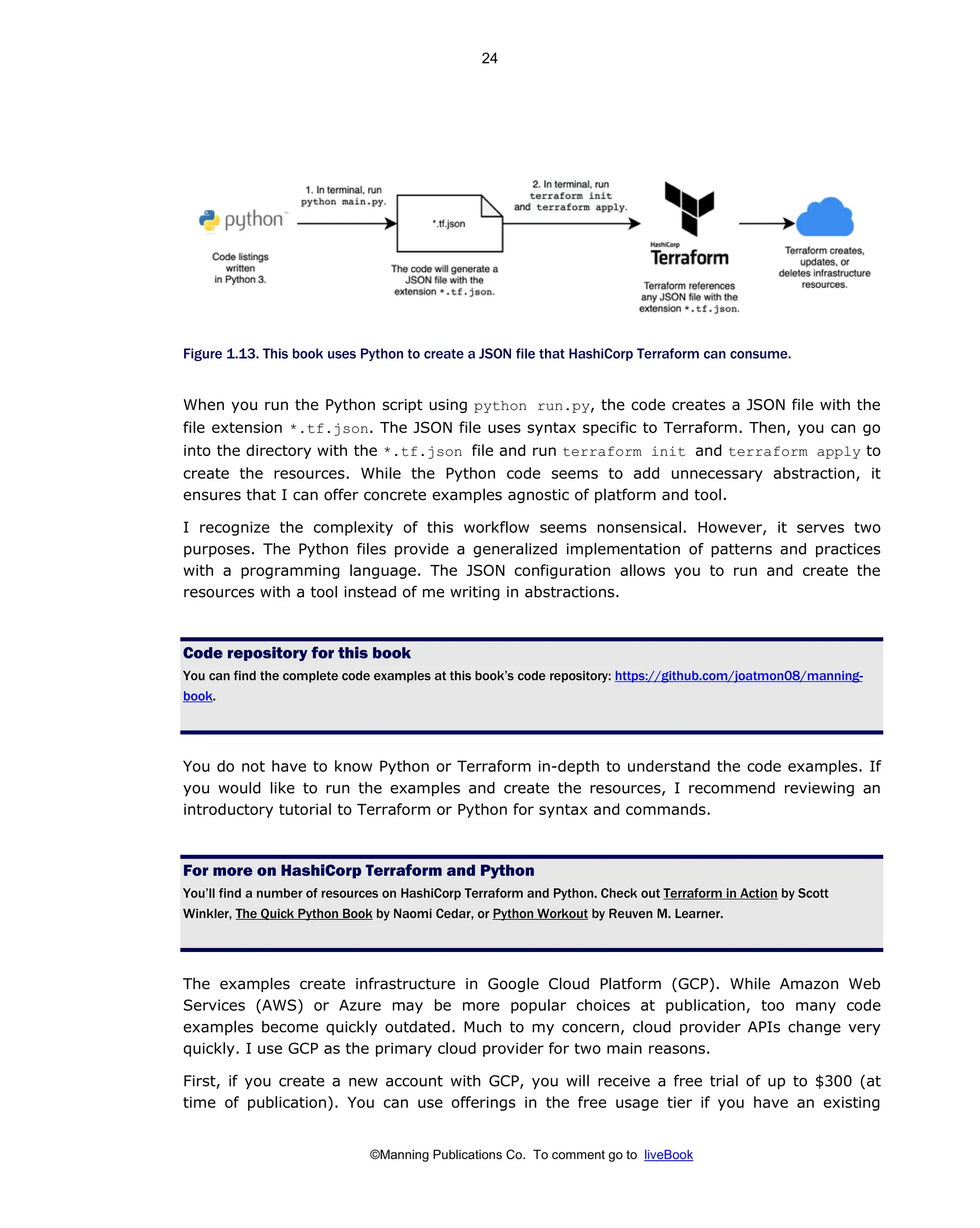
Figure 1.13 outlines the workflow of the code listings and examples, and Appendix A details
the technical implementation. I wrote the code listings in Python to create a JSON file
consumed by HashiCorp Terraform, a provisioning tool with various integrations across public
clouds and other infrastructure providers.
23
©Manning Publications Co. To comment go to liveBook
Figure 1.13. This book uses Python to create a JSON file that HashiCorp Terraform can consume.
When you run the Python script using python run.py, the code creates a JSON file with the
file extension *.tf.json. The JSON file uses syntax specific to Terraform. Then, you can go
into the directory with the *.tf.json file and run terraform init and terraform apply to
create the resources. While the Python code seems to add unnecessary abstraction, it
ensures that I can offer concrete examples agnostic of platform and tool.
I recognize the complexity of this workflow seems nonsensical. However, it serves two
purposes. The Python files provide a generalized implementation of patterns and practices
with a programming language. The JSON configuration allows you to run and create the
resources with a tool instead of me writing in abstractions.
Code repository for this book
You can find the complete code examples at this book’s code repository: https://github.com/joatmon08/manning-
book.
You do not have to know Python or Terraform in-depth to understand the code examples. If
you would like to run the examples and create the resources, I recommend reviewing an
introductory tutorial to Terraform or Python for syntax and commands.
For more on HashiCorp Terraform and Python
You’ll find a number of resources on HashiCorp Terraform and Python. Check out Terraform in Action by Scott
Winkler, The Quick Python Book by Naomi Cedar, or Python Workout by Reuven M. Learner.
The examples create infrastructure in Google Cloud Platform (GCP). While Amazon Web
Services (AWS) or Azure may be more popular choices at publication, too many code
examples become quickly outdated. Much to my concern, cloud provider APIs change very
quickly. I use GCP as the primary cloud provider for two main reasons.
First, if you create a new account with GCP, you will receive a free trial of up to $300 (at
time of publication). You can use offerings in the free usage tier if you have an existing
24
©Manning Publications Co. To comment go to liveBook
account. I will note if an example requires resources that do not qualify for the free usage
tier at the time of publication. Furthermore, GCP’s billing project structure isolates any
resources you create with these examples so you can delete the project and all of its
resources in one click.
Using Google Cloud Platform
For more information on GCP’s free program, refer to their program webpage at https://cloud.google.com/free.
I recommend creating a separate GCP project to run all of the examples. A separate project will isolate your
resources. When you finish this book, you can delete the project and its resources. Review the tutorial for creating
GCP projects at https://cloud.google.com/resource-manager/docs/creating-managing-projects.
Second, I use GCP because its offerings use more straightforward naming and generic
infrastructure terminology. If you work in a data center, you’ll still be able to recognize what
the services create. For example, Google’s Cloud SQL creates SQL databases.
If you run the examples, you will use the following resources in GCP:
• Networking (networks, load balancers, and firewalls)
• Compute
• Managed queues (PubSub)
• Storage (Cloud Storage)
• Identity and access management (IAM)
• Kubernetes offerings (Kubernetes Engine and Cloud Run)
• Database (Cloud SQL)
In general, you do not have to know the details of each service. I use them to demonstrate
dependency management between infrastructure resources. Each example includes notations
on equivalent AWS and Azure service offerings to further solidify specific patterns and
techniques.
To update the examples for the cloud provider of your choice, you may need to do some
language replacements and change some of your dependencies. For example, you can create
GCP networks with built-in gateways while you must explicitly build them in AWS networks. I
avoided using specialized services different for each cloud platform, such as machine
learning.
1.5.2 Provisioning
Provisioning tools create and manage sets of infrastructure resources for a given provider,
whether it be a public cloud, data center, or hosted monitoring solution. A provider refers to
a data center, IaaS, PaaS, or SaaS responsible for providing infrastructure resources.
DEFINITION A provisioning tool creates and manages a set of infrastructure resources for a public cloud,
data center, or hosted monitoring solution.
25
©Manning Publications Co. To comment go to liveBook
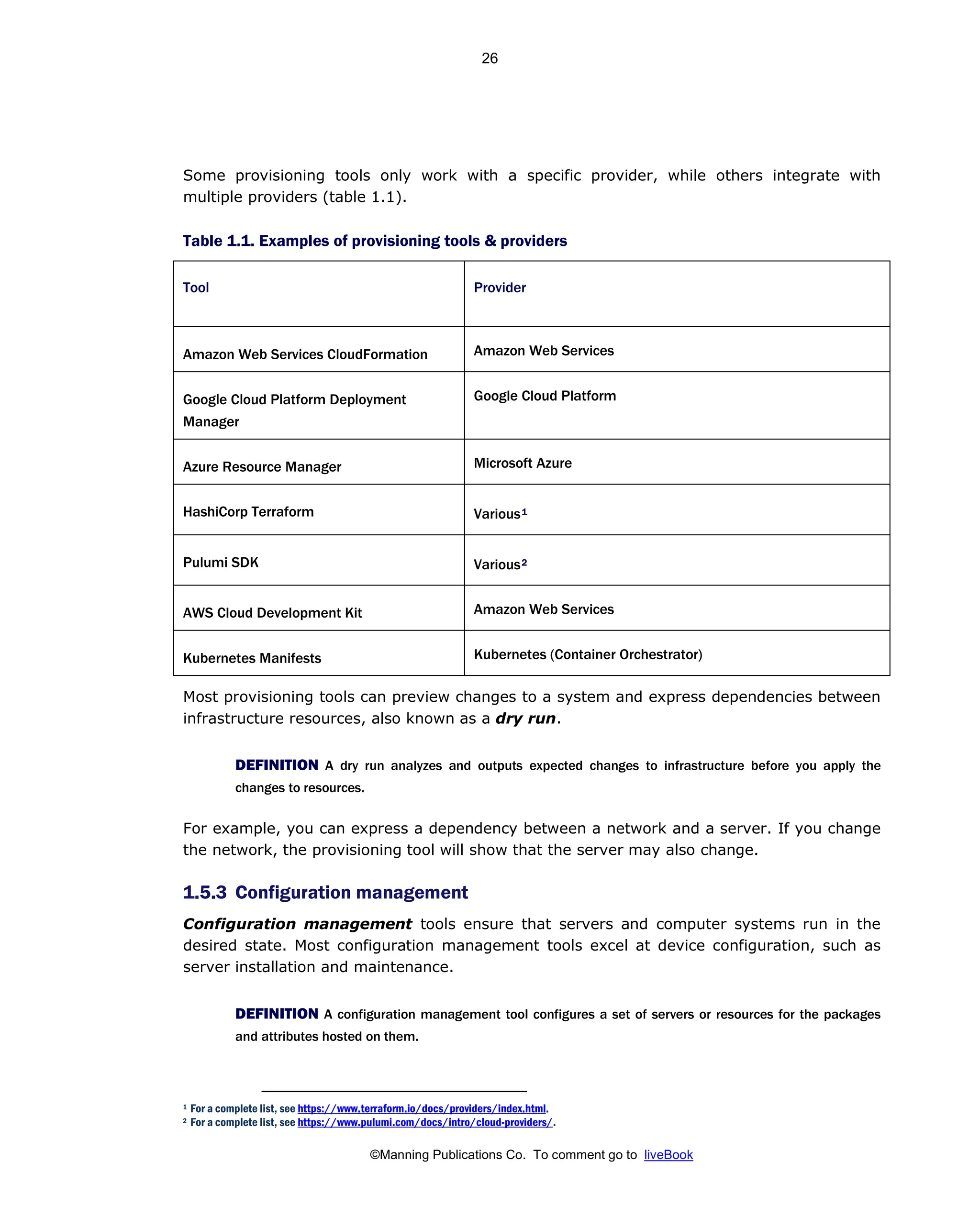
Some provisioning tools only work with a specific provider, while others integrate with
multiple providers (table 1.1).
Table 1.1. Examples of provisioning tools & providers
Tool Provider
Amazon Web Services CloudFormation Amazon Web Services
Google Cloud Platform Deployment
Manager
Google Cloud Platform
Azure Resource Manager Microsoft Azure
HashiCorp Terraform Various1
Pulumi SDK Various2
AWS Cloud Development Kit Amazon Web Services
Kubernetes Manifests Kubernetes (Container Orchestrator)
Most provisioning tools can preview changes to a system and express dependencies between
infrastructure resources, also known as a dry run.
DEFINITION A dry run analyzes and outputs expected changes to infrastructure before you apply the
changes to resources.
For example, you can express a dependency between a network and a server. If you change
the network, the provisioning tool will show that the server may also change.
1.5.3 Configuration management
Configuration management tools ensure that servers and computer systems run in the
desired state. Most configuration management tools excel at device configuration, such as
server installation and maintenance.
DEFINITION A configuration management tool configures a set of servers or resources for the packages
and attributes hosted on them.
1 For a complete list, see https://www.terraform.io/docs/providers/index.html.
2 For a complete list, see https://www.pulumi.com/docs/intro/cloud-providers/.
26
©Manning Publications Co. To comment go to liveBook
For example, if you have 10,000 servers in your data center, how do you ensure that all of
them run a specific version of the packages your security team approved? It does not scale
for you to log into 10,000 servers and manually type commands to review. If you configure
the servers with a configuration management tool, you can run a single command to review
all 10,000 servers and execute the packages’ updates.
A non-exhaustive list of configuration management tools that address this problem space
includes:
• Chef
• Puppet
• Ansible
• SaltStack
• CFEngine
While this book focuses on provisioning tools and managing multi-provider systems, I will
address some configuration management practices related to infrastructure testing, updating
infrastructure, and security. Configuration management can help tune your server and
network infrastructure.
More on configuration management
I recommend books and tutorials for a configuration management tool of your choice for additional information. They
will provide a more detailed guide specific to their design approach.
To add to the confusion, you might notice that some configuration management tools offer
integrations to the data center and cloud providers. As a result, you might think of using
your configuration tool as your provisioning tool. While possible, this approach may not be
ideal because provisioning tools often have a different design approach for specifically
addressing dependencies between infrastructure resources. I will explore this nuance in the
next chapter.
1.5.4 Image building
When you create a server, you must specify a machine image with an operating system.
Image building tools create images used for application runtime, whether a container or
server.
DEFINITION An image building tool builds machine images for application runtimes, such as containers or
servers.
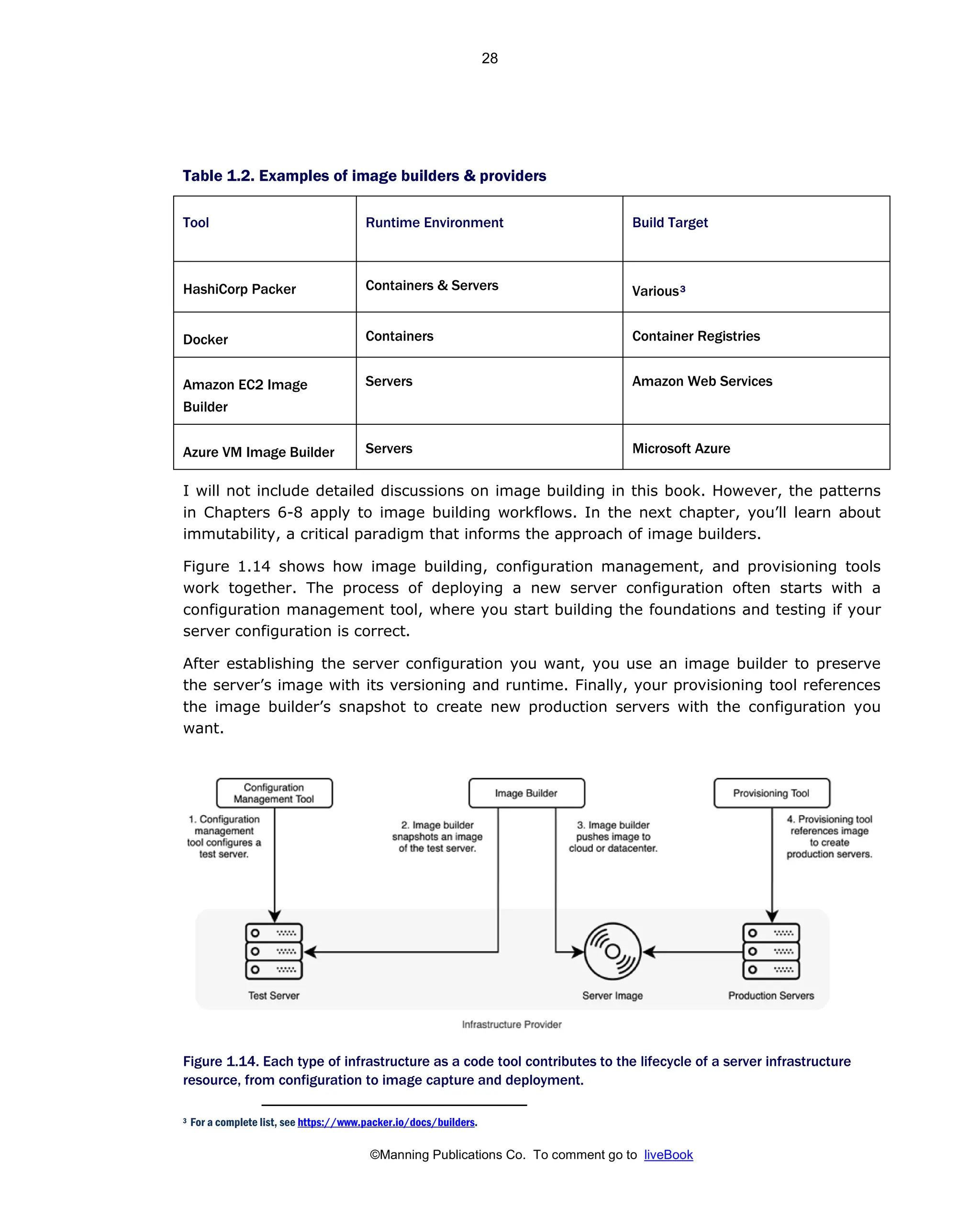
Most image builders allow you to specify a runtime environment and build targets. Table 1.2
outlines a few tools, their supported runtime environments, and their build targets and
platforms.
27
©Manning Publications Co. To comment go to liveBook
Table 1.2. Examples of image builders & providers
Tool Runtime Environment Build Target
HashiCorp Packer Containers & Servers Various3
Docker Containers Container Registries
Amazon EC2 Image
Builder
Servers Amazon Web Services
Azure VM Image Builder Servers Microsoft Azure
I will not include detailed discussions on image building in this book. However, the patterns
in Chapters 6-8 apply to image building workflows. In the next chapter, you’ll learn about
immutability, a critical paradigm that informs the approach of image builders.
Figure 1.14 shows how image building, configuration management, and provisioning tools
work together. The process of deploying a new server configuration often starts with a
configuration management tool, where you start building the foundations and testing if your
server configuration is correct.
After establishing the server configuration you want, you use an image builder to preserve
the server’s image with its versioning and runtime. Finally, your provisioning tool references
the image builder’s snapshot to create new production servers with the configuration you
want.
Figure 1.14. Each type of infrastructure as a code tool contributes to the lifecycle of a server infrastructure
resource, from configuration to image capture and deployment.
3 For a complete list, see https://www.packer.io/docs/builders.
28
©Manning Publications Co. To comment go to liveBook
This workflow represents the ideal end-to-end approach for managing and deploying servers
with infrastructure as code tooling. However, as you will learn, infrastructure can be
complex, and this workflow may not apply to every use case. Various infrastructure systems
and their dependencies complicate provisioning, which I chose to be the primary focus of this
book and why the examples use provisioning tools.
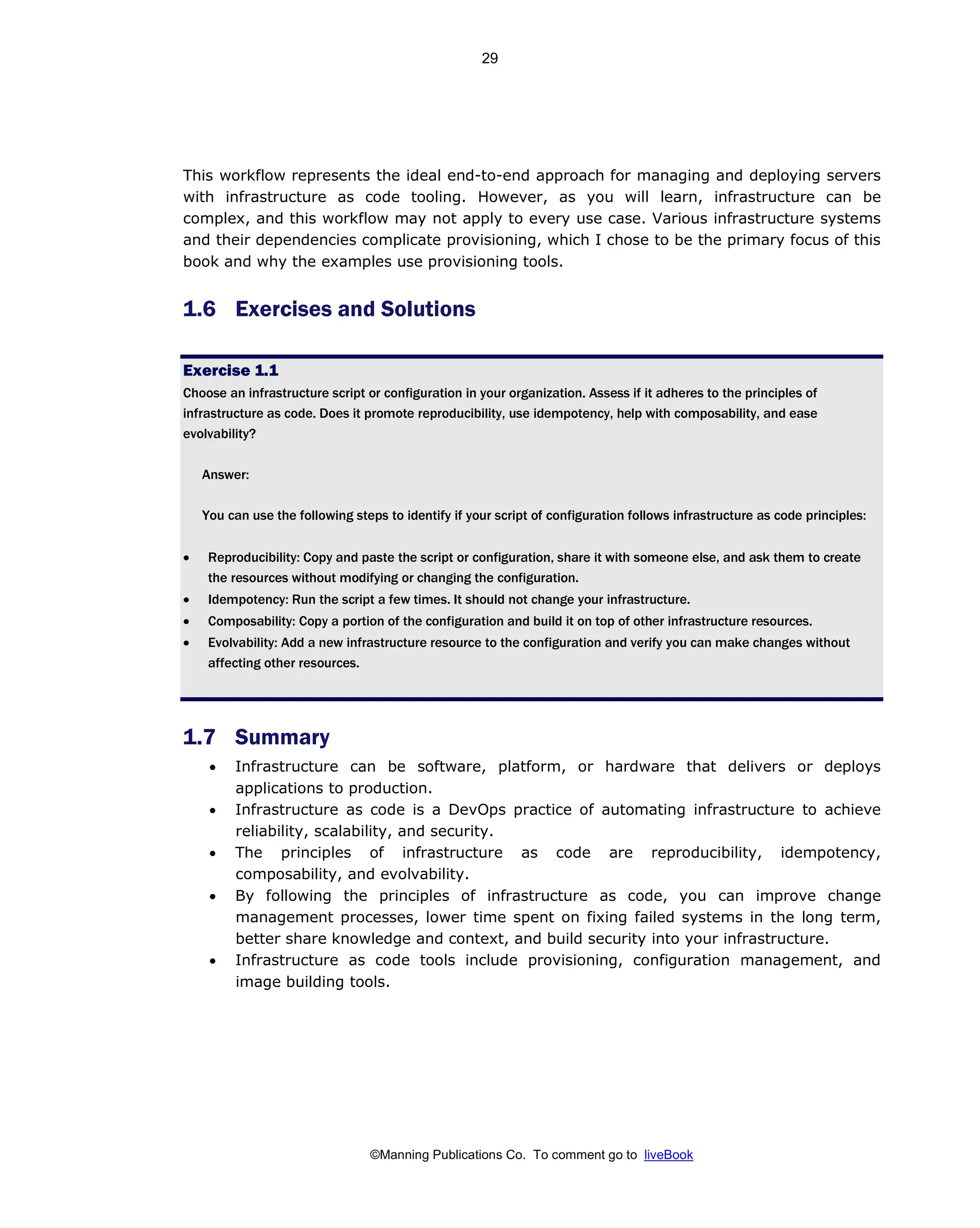
1.6 Exercises and Solutions
Exercise 1.1
Choose an infrastructure script or configuration in your organization. Assess if it adheres to the principles of
infrastructure as code. Does it promote reproducibility, use idempotency, help with composability, and ease
evolvability?
Answer:
You can use the following steps to identify if your script of configuration follows infrastructure as code principles:
• Reproducibility: Copy and paste the script or configuration, share it with someone else, and ask them to create
the resources without modifying or changing the configuration.
• Idempotency: Run the script a few times. It should not change your infrastructure.
• Composability: Copy a portion of the configuration and build it on top of other infrastructure resources.
• Evolvability: Add a new infrastructure resource to the configuration and verify you can make changes without
affecting other resources.
1.7 Summary
• Infrastructure can be software, platform, or hardware that delivers or deploys
applications to production.
• Infrastructure as code is a DevOps practice of automating infrastructure to achieve
reliability, scalability, and security.
• The principles of infrastructure as code are reproducibility, idempotency,
composability, and evolvability.
• By following the principles of infrastructure as code, you can improve change
management processes, lower time spent on fixing failed systems in the long term,
better share knowledge and context, and build security into your infrastructure.
• Infrastructure as code tools include provisioning, configuration management, and
image building tools.
29
©Manning Publications Co. To comment go to liveBook
Writing infrastructure as code
This chapter covers
• How the current infrastructure state affects the reproducibility of infrastructure
• Detecting and remediating infrastructure drift due to mutable changes
• Implementing best practices for writing reproducible infrastructure as code
Imagine you’ve created a development environment for a “hello-world” application. You built
it organically, adding new components as you needed them. Eventually, you need to
reproduce the configuration for production use, which people can publicly access. You also
need to scale production across three geographic regions for high availability.
To do this, you must create and update firewalls, load balancers, servers, and databases in
new networks for the production environment. Figure 2.1 shows the complexity of the
development environment with the firewall, load balancer, server, and database and the
components you need to reproduce in production. However, the figure outlines the
differences between development and production. The production configuration needs three
servers for high availability, expanded firewall rules to allow all HTTP traffic, and stricter
firewall rules for the servers to connect to the database. After reviewing all of the
differences, you might have a lot of questions about the best and easiest way to make the
changes!
30
©Manning Publications Co. To comment go to liveBook
Figure 2.1. When you create a production environment based on the development, you must answer many
questions about configurations for new infrastructure and reverse-engineer the functionality of the
development environment.
31
©Manning Publications Co. To comment go to liveBook
You might wonder, for example, why the lack of infrastructure as code for the development
environment affects your ability to create the production one? The first reason is that you
cannot easily reproduce the infrastructure resources. You have to reverse engineer a weeks’
worth of manual configuration! With infrastructure as code, you can instead copy and paste
some configuration and modify it for the production environment.
Second, you cannot easily compose the infrastructure resources with new ones. You need a
pool of servers for production instead of a single server. If you built an infrastructure
module, you could use that building block to create multiple servers without updating the
configuration from scratch.
Finally, you cannot easily evolve the production environment with its specific requirements.
The production environment requires some different infrastructure resources, like secure
operating systems and a larger database. You’ll have to manually tweak configuration that
you’ve never run in the development environment!
You can solve these challenges and improve reproducibility, composability, and evolvability in
two ways. First, you need a way to migrate manually configured infrastructure to
infrastructure as code. Second, you need to write clean infrastructure as code to promote
reproducibility and evolvability.
The first part of this chapter outlines some fundamental concepts for writing infrastructure as
code (IaC) and migrating existing infrastructure to code. The second part of this chapter
applies code hygiene practices to infrastructure. The combination of these practices will help
you write reproducible infrastructure as code and set the stage for future composition and
evolution of your system.
2.1 Expressing infrastructure change
I mentioned in Chapter 1 that infrastructure as code automates changes. It turns out that
reproducing and automating many changes over time takes effort. For example, if you want
to provision and manage a server named on Google Cloud Platform (GCP), you’ll usually
make the following changes over time:
1. Create the server in GCP using the console, terminal, or code.
2. Read the server in GCP to check that you created the server with the correct
specifications, like Ubuntu 18.04 as the operating system.
3. Update the server in GCP with a publicly accessible network address to log into it.
4. Delete the server in GCP because you no longer require it.
To make more complex updates or reproduce the server in another environment, you take
the following steps:
• Create the server.
• Check if it exists by a “read” command.
• Update it if you need to log in.
• Delete the server if you no longer need it.
32
©Manning Publications Co. To comment go to liveBook
No matter which resource you automate, you can always break down your changes to create,
read, update, and delete (CRUD). You create an infrastructure resource, search for its
metadata, update its properties, and delete it when you no longer need it.
NOTE You wouldn’t usually have a change record that explicitly states “read the server.” It usually implies a
“read” step to verify that a resource is created or updated.
Create, read, update, and delete allow you to automate your infrastructure step-by-step in a
specific order. This approach, called the imperative style, describes step-by-step how to
configure infrastructure. You can think of it as an instruction manual.
DEFINITION The imperative style of infrastructure as code describes how to configure an infrastructure
resource step-by-step.
While it seems intuitive, the imperative style does not scale as you make more changes to
the system. Once, I had to create a new database environment based on a development
environment. I started reconstructing the 200 change requests submitted to the
development environment over two years. Each change request became a series of steps
creating, updating, and deleting resources. It took me a month and a half to complete an
environment that still didn’t match the existing development one!
Rather than painstakingly recreate every step, I wished I could just describe the new
database environment based on the running state of the development environment and let a
tool figure out how to achieve the state. With most infrastructure as code, you will find it
easier to reproduce environments and make changes in the declarative style. The
declarative style describes the desired end state of an infrastructure resource. The tool
decides the steps it needs to take to configure the infrastructure resource.
DEFINITION The declarative style of infrastructure as code describes the desired end state of an
infrastructure resource. Automation and tooling decide how to achieve the end state without your
knowledge.
This process with infrastructure as code takes a few steps. First, I need to search inventory
sources for information on the database servers. Next, I get the database IP addresses.
Finally, I write a configuration based on the information I’ve collected.
Your configuration in version control becomes the infrastructure source of truth. You
declare the new database environment’s desired state instead of describing a set of steps
that may not end in the same result.
DEFINITION An infrastructure source of truth structures information about the state of your infrastructure
system consistently and singularly.
You make all changes on the infrastructure source of truth. However, even in ideal
circumstances (such as with GitOps in Chapter 7), you probably have some configuration
33
©Manning Publications Co. To comment go to liveBook
drift from manual changes over time. If you use the declarative style and create a source of
truth, you can use immutability to change infrastructure and lower the risk of failure.
Exercise 2.1
Given:
if __name__ == "__main__":
update_packages()
read_ssh_keys()
update_users()
if enable_secure_configuration:
update_ip_tables()
Does it use the imperative or declarative style of configuring infrastructure?
A. Imperative style
B. Declarative style
Find answers and explanations at the end of the chapter.
2.2 Understanding immutability
How do you prevent configuration drift and quickly reproduce your infrastructure? It starts
with changing how you think about change. Imagine I create a server with Python version 2.
I could update my scripts to log into the server and upgrade Python without restarting the
server. I can treat the server as mutable infrastructure because I update the server in
place without restarting it.
DEFINITION You can update mutable infrastructure in place without recreation or restart.
However, treating the server as mutable infrastructure raises an issue. Other packages on
the server do not work with Python 3! Rather than update every other package and break
the server, I can change my update scripts to create a new server with Python version 3 and
compatible dependencies. Then I can delete the old server with Python 2. Figure 2.2 shows
how to do this.
34
©Manning Publications Co. To comment go to liveBook
Figure 2.2. You treat the server mutably by logging in and updating the Python package version. By
comparison, you treat the server immutably by replacing the old server with a new one upgraded to Python 3.
My new scripts treat the server as immutable infrastructure, in which I can replace the
existing infrastructure with changes. I do not update the infrastructure in place. Immutability
means that once you create a resource, you do not change its configuration.
DEFINITION Immutable infrastructure means you must create a new resource for any changes to
infrastructure configuration. You do not modify the resource after creating it.
Why treat the server’s update in two different ways? Some changes will break the resource if
you do them mutably. To mitigate the risk of failure, you can create a whole new resource
with the updates and remove the old one with immutability.
Immutability relies on a series of creation and deletion changes. Creating a new resource
alleviates drift (difference in actual versus expected configuration) because the new resource
aligns with the infrastructure as code you use to create it. You can expand this beyond server
resources to even serverless functions or entire infrastructure clusters. You choose to create
a new resource with changes instead of updating the existing one.
35
©Manning Publications Co. To comment go to liveBook
Immutable image building
Machine image builders work with the concept of immutable infrastructure. Any updates to a server require a new
machine image, which the builder generates and provides. Modifications to the server, such as IP address
registration, should be passed as parameters to a startup script defined by the image builder.
The enforcement of immutability affects how you make changes. Creating a new resource
requires the principle of reproducibility. As a result, infrastructure as code lends well to
enforcing immutability as you make changes. For example, you might create a new firewall
each time you need to update it. The new firewall overrides any manual rules someone
added outside of infrastructure as code, facilitating security and reducing drift.
Immutability also promotes system availability and mitigates any failures to mission-critical
applications. Instead of updating an existing resource in place, creating a new one isolates
changes to the new resource, limiting the blast radius if something goes wrong. I’ll discuss
more on this in Chapter 9.
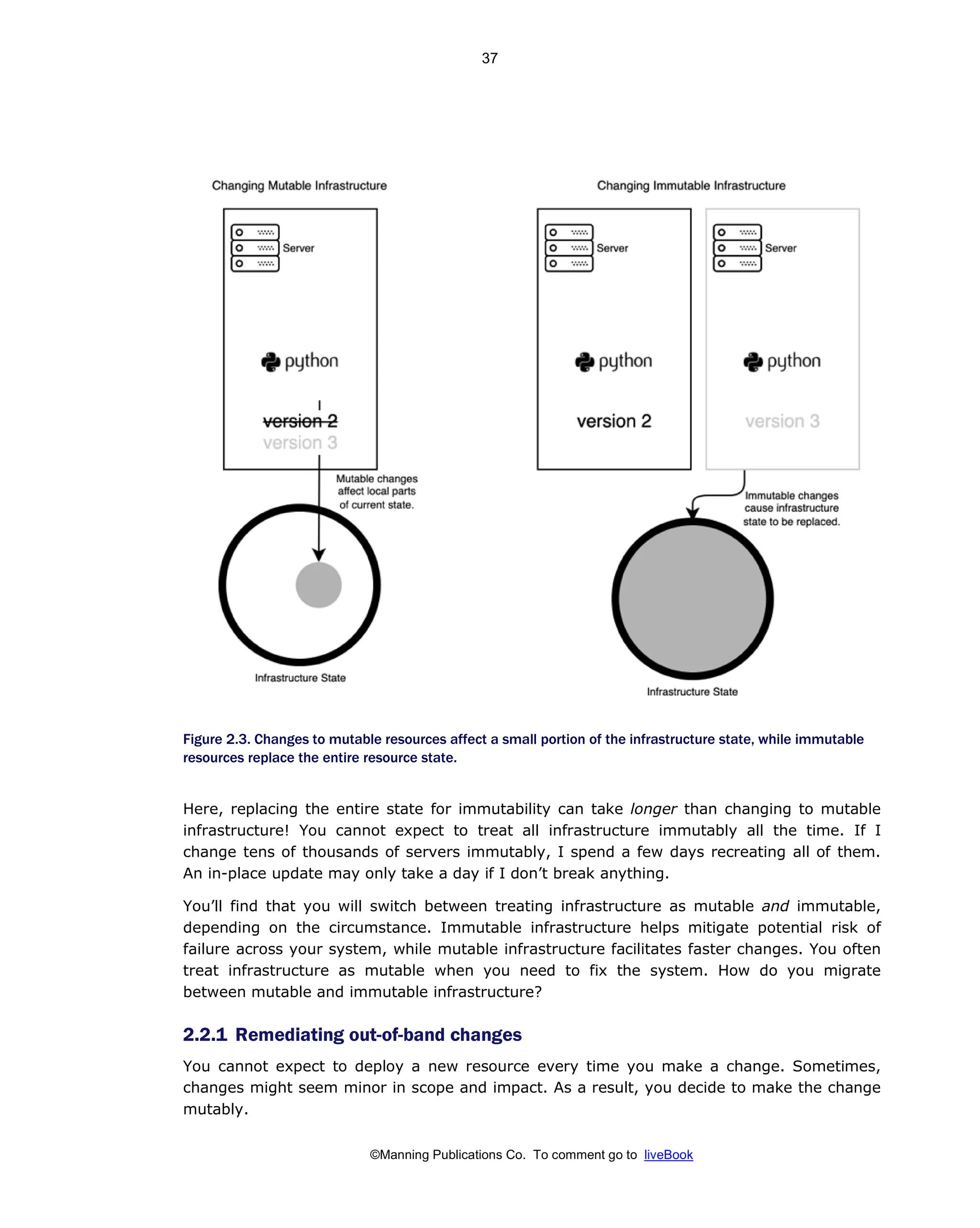
However, immutability sometimes comes at the cost of time and effort. Figure 2.3 compares
the effect of mutable versus immutable infrastructure. When I treat the server as a mutable
resource, I localize the effect of the Python in-place update. Updating Python affects a small
part of the server’s overall state. When I treat a server immutably, I replace the entire
server’s state, affecting any resources dependent on that server.
36
©Manning Publications Co. To comment go to liveBook
Figure 2.3. Changes to mutable resources affect a small portion of the infrastructure state, while immutable
resources replace the entire resource state.
Here, replacing the entire state for immutability can take longer than changing to mutable
infrastructure! You cannot expect to treat all infrastructure immutably all the time. If I
change tens of thousands of servers immutably, I spend a few days recreating all of them.
An in-place update may only take a day if I don’t break anything.
You’ll find that you will switch between treating infrastructure as mutable and immutable,
depending on the circumstance. Immutable infrastructure helps mitigate potential risk of
failure across your system, while mutable infrastructure facilitates faster changes. You often
treat infrastructure as mutable when you need to fix the system. How do you migrate
between mutable and immutable infrastructure?
2.2.1 Remediating out-of-band changes
You cannot expect to deploy a new resource every time you make a change. Sometimes,
changes might seem minor in scope and impact. As a result, you decide to make the change
mutably.
37
©Manning Publications Co. To comment go to liveBook
Imagine you and your friend meet at a coffee shop. Your friend orders a cappuccino with a
non-dairy alternative. However, the barista adds milk. They need to make a new cappuccino
for your friend because the milk affects the whole cup. Your friend waits for another five to
ten minutes. You get a cup of coffee instead and add milk and sugar to taste. If you don’t
have enough sugar, you just add more.
You take less time to change your mutable coffee than your friend changing their immutable
cappuccino. Similarly, it takes far less time, effort, and cost to execute changes to a mutable
resource.
When you temporarily treat infrastructure as a mutable resource, you make an out-of-band
change.
DEFINITION An out-of-band change involves a quickly implemented change that temporarily treats
immutable infrastructure as mutable infrastructure.
When you break immutability with an out-of-band change, you reduce the change time but
increase the risk of affecting another change in the future. After you make the out-of-band
change, you need to update your source of truth to return to immutable infrastructure. How
do you start this remediation process?
You must reconcile the actual state and desired configuration when making an out-of-band
change. I’ll apply this to my server example in figure 2.4. First, I log into the server and
upgrade Python to version 3. Then, I change the configuration in version control, so new
servers install Python version 3. The configuration matches the server’s state with the source
of truth in version control.
38
©Manning Publications Co. To comment go to liveBook
Figure 2.4. After updating a mutable resource, you need to update version control to account for the out-of-
band change.
Why should you update infrastructure as code for the out-of-band change? Remember from
Chapter 1 that manual changes may affect reproducibility. Making sure that you transition a
change made to mutable infrastructure to future immutable infrastructure preserves
reproducibility. After remediating the out–of-band change and adding it to infrastructure as
code, I can re-deploy changes repeatedly to my server and nothing should change. This
behavior conforms to idempotency!
You will continuously reconcile state and source of truth if you make many mutable changes.
You should prioritize immutability to promote reproducibility. A barista can always replace a
drink in my coffee example, even if you spill the sugar container into your mutable coffee. I
recommend using your organization’s change procedures to limit out-of-band changes and
ensure the updates align with the configuration in infrastructure as code. You can always use
the immutable infrastructure configuration to fix a failed mutable change.
39
©Manning Publications Co. To comment go to liveBook
Exercise 2.2
Which of the following changes benefit from the principle of immutability? (Choose all that apply.)
A. Reducing a network to have fewer IP addresses
B. Adding a column to a relational database
C. Adding a new IP address to an existing DNS entry
D. Updating a server’s packages to backward-incompatible versions
E. Migrating infrastructure resources to another region
Find answers and explanations at the end of the chapter.
2.2.2 Migrating to infrastructure as code
Immutability through infrastructure as code allows version control to manage infrastructure
configuration as a source of truth and facilitate future reproduction. In fact, conforming to
immutability means that you create new resources all the time. It works very well for
greenfield environments, which do not have active resources.
However, most organizations have brownfield environments, an existing environment with
active servers, load balancers, and networks. Recall that the chapter example includes a
brownfield development environment called “hello-world.” You went into your infrastructure
provider and manually created a set of resources.
In general, a brownfield environment treats infrastructure as mutable. You need a way to
change your practice of manually changing mutable infrastructure to automatically updating
immutable infrastructure as code. How do you migrate the environment’s infrastructure
resources to immutability?
Let’s migrate the “hello-world” development environment to immutable infrastructure as
code. Before I begin, I make a list of infrastructure resources in the environment. It contains
networks, servers, load balancers, firewalls, and DNS entries.
BASE INFRASTRUCTURE
To start, I find the base infrastructure resource that other resources need to use. For
example, every infrastructure resource depends on the network in the development
environment. I start writing infrastructure as code for the database and development
networks because the server, load balancer, and database run on it. I cannot reconstruct any
resources that run on the networks until the networks exist as code.
In figure 2.5, I use my terminal to access the infrastructure provider API. My terminal
command prints out the name and IP address range (CIDR block) of the development
database and development networks. I reconstruct each network by copying the name and
CIDR block of each network into infrastructure as code.
40
©Manning Publications Co. To comment go to liveBook
Figure 2.5. Reverse engineer the networks for the database and server first and write their configurations as
code.
Why reverse engineer and reproduce the network in infrastructure as code? You must match
the infrastructure as code with the network’s actual resource state exactly. If you have a
mismatch, called drift, you’ll find that your infrastructure as code may break your network
(and anything on it) by accident!
If possible, import the resource into infrastructure as code state. The resource already exists,
and you need your provisioning tool to recognize that. The import step migrates the existing
resource to infrastructure as code management! To complete the network resource
migration, run the infrastructure as code again and check that you don’t have drift.
Many provisioning tools have a function for importing resources. For example, AWS
CloudFormation uses the resource import command. Similarly, HashiCorp Terraform offers
terraform import.
41
©Manning Publications Co. To comment go to liveBook
If you write infrastructure as code without a provisioning tool, you do not need a direct
import capability. Instead, you write code to create a new resource. Sometimes, it’s easier to
use reproducibility to create a whole new resource. If you cannot easily create a new
resource, write code with conditional statements that check if the resources exist.
Figure 2.6 captures the entire decision workflow of reconstructing the network and whether
or not you can use a provisioning tool to migrate your resource to immutability. It includes
the considerations for creating new resources or writing conditional statements for existing
resources. As you migrate, you run your infrastructure as code multiple times to check for
drift.
42
©Manning Publications Co. To comment go to liveBook
Figure 2.6. The decision workflow for migration helps you decide how to import your infrastructure with a
provisioning tool, recreate a resource, or build conditional statements to check for resource existence. No
matter which option, you must re-run your infrastructure as code and reconcile any drift.
Why do you have so many decision workflows for migrating to immutability? All of these
practices adhere to the principles of reproducibility, idempotency, and composability. You
want to reproduce the resources in infrastructure as code as accurately as possible. If you
can’t import the resource, you can at least reproduce a new one.
43
©Manning Publications Co. To comment go to liveBook
Furthermore, re-running the code uses the principle of idempotency, which ensures that you
don’t recreate the resource (unless necessary). If you reconcile drift, idempotency should not
change the active network. Similarly, composability allows you to migrate each resource
separately to avoid disrupting the system.
As you work on other resources, keep the decision workflow in mind. You can apply it to each
resource you migrate to infrastructure as code until you complete the migration. You’ll revisit
parts of this decision workflow when you refactor infrastructure as code in Chapter 10.
RESOURCES DEPENDENT ON BASE INFRASTRUCTURE
After reconstructing the base network infrastructure, I can work on the servers and other
components. Once again, I use my terminal to print out attributes for the “hello-world”
server. It runs in region A with an Ubuntu operating system and 1 CPU. I write the server
specification in its configuration, making note of its dependency on the development
network. Similarly, I use my terminal to learn that the database uses 10GB of memory. I
copy this into infrastructure as code and record its use of the development database
network. Figure 2.7 shows the process of migrating the server and database to code.
44
©Manning Publications Co. To comment go to liveBook
Figure 2.7. After migrating base infrastructure such as networks, migrate the server and database resources.
They depend on base infrastructure but do not depend on each other.
You want to migrate the second set of resources that use the network. Use composability to
isolate these infrastructure resources and make iterative updates. Small changes to next
levels of infrastructure help prevent larger system failures. Later in chapter 7, you’ll learn
more about deploying small changes to infrastructure.
Before you move to the next set of resources, complete the cycle of migration by running
your infrastructure as code and checking for drift. Ensure that the network, server, and
45
©Manning Publications Co. To comment go to liveBook
database do not show changes in their infrastructure as code. After you reconcile any new
drift, you can move onto the remaining resources (DNS, firewall rules, and load balancers).
Finally, figure 2.8 rebuilds the remaining configuration for DNS, firewall rules, and load
balancers. They depend on the existing configuration of servers and databases. No other
resources depend on them.
Figure 2.8. Finally, migrate resources with the fewest dependencies or require server and database
configuration.
46
Another Random Document on
Scribd Without Any Related Topics
Answ. You ought not to take such a trust: and if you have done it,
you ought not to hold it, but resign it to him that did intrust you.
Yea, and to disclose the fraud, for the righting of the creditors,
except it be in such a case as that the creditor is some such vicious
or oppressing person, as you are not obliged to exercise that act of
charity for; or when the consequents of revealing it will be a greater
hurt, than the righting of him will compensate; especially when it is
against the public good.
Quest. IX. What if a delinquent intrust me with his estate or
person to secure it from penalty?
Answ. If it be one that is prosecuted by a due course of justice,
cujus pœna debetur reipublicæ, whose punishment the common
good requireth, the case must be decided as the former: you must
not take nor keep such a trust. But if it be one whose repentance
giveth you reason to believe, that his impunity will be more to the
common good than his punishment, and that if the magistrate knew
it, he ought to spare or pardon him, in this case you may conceal his
person or estate; so be it you do it not by a lie, or any other sinful
means, or such as will do more hurt than good.
Quest. X. What if a friend intrust me with his estate to secure it
from some great taxes or tributes to the king? May I keep such a
trust or not?
Answ. No: if they be just and legal taxes, for the maintenance of
the magistrate or preservation of the commonwealth: but if it be
done by a usurper that hath no authority, (or done without or
beyond authority, the oppressing of the subject,) you may conceal
his estate or your own by lawful means.
Quest. XI. What if a man that suffereth for religion, commit his
person or estate to my trust?
Answ. You must be faithful to your trust, 1. If it be true religion
and a good cause for which he suffereth. 2. Or if he be falsely
accused of abuses in religion. 3. Or if he be faulty, but the penalty
intended, from which you secure him, is incomparably beyond his
fault and unjust. Supposing still that you save him only by lawful
means, and that it be not like to tend to do more hurt than good, to
the cause of religion or the commonwealth.
Quest. XII. What if a papist or other erroneous person intrust me
(being of the same mind) to educate his children in that way, when
he is dead, and afterward I come to see the error, must I perform
that trust or not?
Answ. No: 1. Because no trust can oblige you to do hurt. 2.
Because it is contrary to the primary intent of your friend; which was
his children's good. And you may well suppose that had he seen his
error, he would have intrusted you to do accordingly: you are bound
therefore to answer his primary intention, and truly to endeavour his
children's good.
Quest. XIII. But what if a man to whom another hath intrusted his
children, turn papist or heretic, and so thinketh error to be truth?
what must he do?
Answ. He is bound to turn back again to the truth, and do
accordingly.
Object. But one saith this is the truth and another that; and he
thinketh he is right.
Answ. There is but one of the contraries true. Men's thinking
themselves to be in the right doth not make it so. And God will not
change his laws, because they misunderstand or break them:
therefore still that which God bindeth them to is to return unto the
truth. And if they think that to be truth which is not, they are bound
to think otherwise. If you say, They cannot; it is either not true, or it
is long of themselves that they cannot: and they that cannot
immediately, yet mediately can do it, in the due use of means.
Quest. XIV. What if I foresee that the taking a trust may hazard
my estate, or otherwise hurt me, and yet my dying (or living) friend
desireth it?
Answ. How far the law of christianity or friendship oblige you to
hurt yourself for his good, must be discerned by a prudent
considering, what your obligations are to the person, and whether
the good of your granting his desires, or the hurt to yourself, is like
to be the greater, and of more public consequence: and whether you
injure not your own children or others by gratifying him. And upon
such comparison, prudence must determine the case.
Quest. XV. But what if afterward the trust prove more to my hurt
than I foresaw?
Answ. If it was your own fault that you foresaw it not, you must
suffer proportionably for that fault; but otherwise you must compare
your own hurt with the orphans', in case you do not perform the
trust: and consider whether they may not be relieved another way;
and whether you have reason to think that if the parent were alive
and knew the danger, he would expect you should perform your
trust, or would discharge you of it. If it be some great and
unexpected dangers, which you think upon good grounds the parent
would acquit you from if he were living, you fulfil your trust if you
avoid them, and do that which would have been his will if he had
known it. Otherwise you must perform your promise though it be to
your loss and suffering.
Quest. XVI. But what if it was only a trust imposed by his desire
and will, without my acceptance or promise to perform it?
Answ. You must do as you would be done by, and as the common
good, and the laws of love and friendship, do require. Therefore the
quality of the person, and your obligations to him, and especially the
comparing of the consequent good and evil together, must decide
the case.
Quest. XVII. What if the surviving kindred of the orphan be nearer
to him than I am, and they censure me and calumniate me as
injurious to the orphan, may I not ease myself of the trust, and cast
it upon them?
Answ. In this case also, the measure of your suffering must first
be compared with the measure of the orphan's good; and then your
conscience must tell you whether you verily think the parent who
intrusted you, would discharge you if he were alive and knew the
case. If he would, though you promised, it is to be supposed that it
was not the meaning of his desire or your promise, to incur such
suffering: and if you would not believe that he would not discharge
you if he were alive, then if you promised you must perform; but if
you promised not, you must go no further than the law of love
requireth.
Quest. XVIII. What is a minister of Christ to do, if a penitent
person confess secretly some heinous or capital crime to him (as
adultery, theft, robbery, murder); must it be concealed or not?
Answ. 1. If a purpose of sinning be antecedently confessed, it is
unlawful to further the crime, or give opportunity to it by a
concealment: but it must be so far opened as is necessary for the
prevention of another's wrong, or the person's sin; especially if it be
treason against the king or kingdom, or any thing against the
common good.
2. When the punishment of the offender is apparently necessary
to the good of others, especially to right the king or country, and to
preserve them from danger by the offender or any other, it is a duty
to open a past fault that is confessed, and to bring the offender to
punishment, rather than injure the innocent by their impunity.
3. When restitution is necessary to a person injured, you may not
by concealment hinder such restitution; but must procure it to your
power where it may be had.
4. It is unlawful to promise universal secrecy absolutely to any
penitent. But you must tell him before he confesseth, If your crime
be such, as that opening it is necessary to the preservation or
righting of king, or country, or your neighbour, or to my own safety, I
shall not conceal it. That so men may know how far to trust you.
5. Yet in some rare cases, (as the preservation of our parents,
king, or country,) it may be a duty to promise and perform
concealment, when there is no hurt like to follow but the loss or
hazard of our own lives, or liberties, or estates; and consequently if
no hurt be like to follow but some private loss of another, which I
cannot prevent without a greater hurt.
6. If a man ignorant of the law, and of his own danger, have
rashly made a promise of secrecy, and yet be in doubt, he should
open the case in hypothesi only, to some honest, able lawyer,
inquiring if such a case should be, what the law requireth of the
pastor, or what danger he is in if he conceal it; that he may be able
further to judge of the case.
7. He that made no promise of secrecy, virtual or actual, may,
cæteris paribus, bring the offender to shame or punishment rather
than to fall into the like himself for the concealment.
8. He that rashly promised universal secrecy, must compare the
penitent's danger and his own, and consider whose suffering is like
to be more to the public detriment, all things considered, and that
must be first avoided.
9. He that findeth it his duty to reveal the crime to save himself,
must yet let the penitent have notice of it, that he may fly and
escape; unless as aforesaid, when the interest of the king, or
country, or others, doth more require his punishment.
10. But when there is no such necessity of the offender's
punishment, for the prevention of the hurt or wrong of others, nor
any great danger by concealment to the minister himself, I think that
the crime, though it were capital, should be concealed. My reasons
are,
(1.) Because though every man be bound to do his best to prevent
sin, yet every man is not bound to bring offenders to punishment.
He that is no magistrate, nor hath a special call so to do, may be in
many cases not obliged to it.
(2.) It is commonly concluded that (in most cases) a capital
offender is not bound to bring himself to punishment: and that
which you could not know but by his free confession, is confessed to
you only on your promise of concealment, seemeth to me to put you
under no other obligation to bring him to punishment than he is
under himself.
(3.) Christ's words and practice, in dismissing the woman taken in
adultery, showeth that it is not always a duty for one that is no
magistrate to prosecute a capital offender, but that sometimes his
repentance and life may be preferred.
(4.) And magistrates' pardons show the same.
(5.) Otherwise no sinner would have the benefit of a counsellor to
open his troubled conscience to: for if it be a duty to detect a great
crime in order to a great punishment, why not a less also in order to
a less punishment. And who would confess when it is to bring
themselves to punishment?
11. In those countries where the laws allow pastors to conceal all
crimes that penitents freely confess, it is left to the pastor's
judgment to conceal all that he discerneth may be concealed without
the greater injury of others, or of the king or commonwealth.
12. There is a knowledge of the faults of others, by common
fame, especially many years after the committing, which doth not
oblige the hearers to prosecute the offender. And yet a crime
publicly known is more to be punished (lest impunity imbolden
others to the like) than an unknown crime, revealed in confession.
Tit. 2. Directions about Trusts and Secrets.
Direct. I. Be not rash in receiving secrets or any other trusts: but
first consider what you are thereby obliged to, and what difficulties
may arise in the performance; and foresee all the consequents as far
as is possible, before you undertake the trust; that you cast not
yourselves into snares by mere inconsiderateness, and prepare not
for perplexities and repentance.
Direct. II. Be very careful what persons you commit either trusts
or secrets to; and be sure they be trusty by their wisdom, ability,
and fidelity.
Direct. III. Be not too forward in revealing your own secrets to
another's trust: for, 1. You cannot be certain of any one's secrecy,
where you are most confident. 2. You oblige yourself too much to
please that person, who by revealing your secrets may do you hurt;
and are in fear lest carelessness, or unfaithfulness, or any accident
should disclose it. 3. You burden your friend with the charge and
care of secrecy.[168]
Direct. IV. Be faithful to your friend that doth intrust you;
remembering that perfidiousness or falseness to a friend, is a crime
against humanity, and all society, as well as against christianity; and
stigmatizeth the guilty in the eyes of all men, with the brand of an
odious, unsociable person.
Direct. V. Be not intimate with too many, nor confident in too
many; for he that hath too many intimates, will be opening the
secrets of one to another.
Direct. VI. Abhor covetousness and ambition; or else a bribe or
the promise of preferment, will tempt you to perfidiousness. There is
no trusting a selfish, worldly man.
Direct. VII. Remember that God is the avenger of perfidiousness,
who will do it severely: and that even they that are pleased and
served by it, do yet secretly disdain and detest the person that doth
it; because they would not be so used themselves.
Direct. VIII. Yet take not friendship or fidelity to be an obligation
to perfidiousness to God, or the king, or commonwealth, or to
another, or to any sin whatsoever.
[168] Quod tacitum esse velis nemini dixeris. Si tibi non
imperasti, quomodo ab alio silentium speras? Martin. Dumiens,
de morib.
CHAPTER XXVI.
DIRECTIONS AGAINST SELFISHNESS AS IT IS CONTRARY TO THE
LOVE OF OUR NEIGHBOUR.
The two tables of the law are summed up by our Saviour in two
comprehensive precepts: "Thou shalt love the Lord thy God with all
thy heart, and soul, and might:" and, "Thou shalt love thy neighbour
as thyself." In the decalogue the first of these is the true meaning of
the first commandment, put first because it is the principle of all
obedience: and the second is the true meaning of the tenth
commandment, which is therefore put last, because it is the
comprehensive sum of other duties to our neighbour or injuries
against him, which any other particular instances may contain; and
also the principle of the duty to, or sin against, our neighbour. The
meaning of the tenth commandment is variously conjectured at by
expositors: some say that it speaketh against inward concupiscence
and the sinful thoughts of the heart; but so do all the rest, in the
true meaning of them, and must not be supposed to forbid the
outward action only, nor to be any way defective: some say that it
forbiddeth coveting and commandeth contentment with our state; so
doth the eighth commandment; yet there is some part of the truth in
both these. And the plain truth is, (as far as I can understand it,)
that the sin forbidden is selfishness as opposite to the love of others,
and the duty commanded is to love our neighbours; and that it is as
is said, the sum of the second table, "Thou shalt love thy neighbour
as thyself:" as the captain leadeth the van, and the lieutenant
bringeth up the rear; so, "Thou shalt love God above all," is the first
commandment, and "Thou shalt love thy neighbour as thyself," is
the last, for the aforesaid reason. I shall therefore in these following
directions speak to the two parts of the tenth commandment.
Direct. I. The first help against selfishness is to understand well
the nature and malignity of the sin. For want of this it commonly
prevaileth, with little suspicion, lamentation, and opposition. Let me
briefly therefore anatomize it.
1. It is the radical, positive sin of the soul, comprehending
seminally or causally all the rest. The corruption of man's nature, or
his radical sin, hath two parts, the positive part, and the privative
part: the positive part is selfishness, or the inordinate love of carnal
self; the privative part is ungodliness or want of the love of God.
Man's fall was his turning from God to himself; and his regeneration
consisteth in the turning of him from himself to God; or the
generating of the love of God (as comprehending faith and
obedience) and the mortifying of self-love. Selfishness therefore is all
positive sin in one, as want of the love of God is all privative sin in
one. And self-denial and the love of God are all duties virtually; for
the true love of man is comprehended in the love of God.
Understand this, and you will understand what original and actual
sin is, and what grace and duty are.
2. Therefore selfishness is the cause of all sin in the world, both
positive and privative, and is virtually the breach of every one of
God's commandments. For even the want of the love of God is
caused by the inordinate love of self; as the consuming of other
parts is caused by the dropsy, which tumefieth the belly. It is only
selfishness which breaketh the fifth commandment, by causing
rulers to oppress and persecute their subjects, and causeth subjects
to be seditious and rebellious; and causeth all the bitterness, and
quarrellings, and uncomfortableness, which ariseth among all
relations. It is only selfishness which causeth the cursed wars of the
earth, and desolation of countries, by plundering and burning; the
murders which cry for revenge to heaven (whether civil, military, or
religious): which causeth all the railings, fightings, envyings, malice;
the schisms, and proud overvaluings of men's own understandings
and opinions; and the contending of pastors, who shall be the
greatest, and who shall have his will in proud usurpations and
tyrannical impositions and domination: it is selfishness which hath
set up and maintaineth the papacy, and causeth all the divisions
between the western and the eastern churches; and all the cruelties,
lies, and treachery exercised upon that account. It is selfishness
which troubleth families and corporations, churches and kingdoms;
which violateth vows, and bonds of friendship, and causeth all the
tumults, and strifes, and troubles in the world. It is selfishness which
causeth all covetousness, all pride and ambition, all luxury and
voluptuousness, all surfeiting and drunkenness, chambering and
wantonness, time-wasting and heart-corrupting sports, and all the
riots and revelling of the sensual; all the contending for honours and
preferments, and all the deceit in buying and selling, the stealing
and robbing, the bribery and simony, the law-suits which are unjust,
the perjuries, false witnessing, unrighteous judging, the oppressions,
the revenge, and in one word, all the uncharitable and unjust actions
in the world. This is the true nature of carnal selfishness, and it is no
better.
3. Selfishness is the corruption of all the faculties of the soul. It is
the sin of the mind, by self-conceitedness and pride; it is the sin of
the will and affections, by self-love, and all the selfish passions
which attend it; selfish desires, angers, sorrows, discontents,
jealousies, fears, audacities, &c. It is the corruption of all the inferior
faculties, and the whole conversation by self-seeking, and all the
forementioned evils.
4. Selfishness is the commonest sin in the world. Every man is
now born with it, and hath it more or less; and therefore every man
should fear it.
5. Selfishness is the hardest sin in the world to overcome. In all
the unregenerate it is predominant; for nothing but the sanctifying
Spirit of God can overcome it. And in many thousands that seem
very zealous in religion, and very mortified in all other respects, yet
in some way or other selfishness doth so lamentably appear, yea,
and is so strong in many that are sincere, that it is the greatest
dishonour to the church of Christ, and hath tempted many to
infidelity, or to doubt whether there be any such thing as true
sanctification in the world. The persons that seemed the most
mortified saints, if you do but cross them in their self-interest, or
opinion, or will, or seem to slight them, or have a low esteem of
them, what swellings, what heart-burnings, what bitter censurings,
what proud impatience, if not schisms and separations, will it cause?
God hath better servants; but too many which seem to themselves
and others to be the best, are no better. How then should every
christian abhor and watch against this universal evil!
Direct. II. Consider oft how amiable a creature man would be, and
what a blessed condition the world and all societies would be in, if
selfishness were but overcome. There would then be no pride, no
covetousness, no sensuality, no tyranny or oppressing of the poor,
no malice, cruelty, or persecution; no church divisions, no scandals,
nothing to dishonour religion, or to hinder the saving progress of the
gospel; no fraud or treacheries, no over-reaching or abusing others;
no lying nor deceit, no neglect of our duty to others; in a word, no
injustice or uncharitableness in the world.
Direct. III. Judge of good and evil by sober reason, and not by
brutish sense. And then oft consider, whether really there be not a
more excellent end than your selfish interest? even the public good
of many, and the pleasing and glorifying of God. And whether all
mediate good or evil should not be judged of principally by those
highest ends? Sense leadeth men to selfishness or privateness of
design; but true reason leadeth men to prefer the public, or any
thing that is better than our self-interest.
Direct. IV. Nothing but returning by converting grace to the true
love of God, and of man for his sake, will conquer selfishness. Make
out therefore by earnest prayer for the Spirit of sanctification; and
be sure that you have a true apprehension of the state of grace; that
is, that it is indeed the love of God and man. Love is the fulfilling of
the law; therefore love is the holiness of the soul: set your whole
study upon the exercise and increase of love, and selfishness will die
as love reviveth.
Direct. V. Study much the self-denying example and precepts of
your Saviour. His life and doctrine are the liveliest representation of
self-denial that ever was given to the world. Learn Christ, and you
will learn self-denial. He had not sinful selfishness to mortify, yet
natural self was so wonderfully denied by him, for his Father's will
and our salvation, that no other book or teacher in the world will
teach us this lesson so perfectly as he. Follow him from the manger,
or rather from the womb, to the cross and grave; behold him in his
poverty and contempt; enduring the contradiction and ingratitude of
sinners, and making himself of no reputation; behold him
apprehended, accused, condemned, crowned with thorns, clothed in
purple, with a reed in his hand, scourged, and led away to
execution, bearing his cross, and hanged up among thieves;
forsaken by his own disciples, and all the world, and in part by him
who is more than all the world; and consider why all this was done;
for whom he did it, and what lesson he purposed hereby to teach
us. Consider why be made it one half the condition of our salvation,
and so great a part of the christian religion, to deny ourselves, and
take up our cross and follow him; and will have no other to be his
disciples, Luke xiv. 26, 31, 33. Were a crucified Christ more of our
daily study, and did we make it our religion to learn and follow his
holy example, self-denial would be better known and practised, and
christianity would appear as it is, and not as it is misunderstood,
adulterated and abused in the world. But because I have long ago
written a "Treatise of Self-denial," I shall add no more.
CHAPTER XXVII.
CASES AND DIRECTIONS FOR LOVING OUR NEIGHBOUR AS
OURSELVES.
Tit. 1. Cases of Conscience about loving our Neighbour.
Quest. I. In what sense is it that I must love my neighbour as
myself? Whether in the kind, of love, or in the degree, or only in the
reality.
Answ. The true meaning of the text is, you must love him
according to his true worth, without the diversion and hinderance of
selfishness and partiality. As you must love yourself according to that
degree of goodness which is in you, and no more; so must you as
impartially love your neighbour according to that degree of goodness
which is in him. So that it truly extendeth to the reality, the kind and
the degree of love, supposing it in both proportioned to the
goodness of the object. But before this can be understood, the true
nature of love must be well understood.
Quest. II. What is the true nature of love, both as to myself and
neighbour?
Answ. Love is nothing but the prime motion of the will to its
proper object; which is called complacence: the object of it is simple
goodness, or good as such: it ariseth from suitableness between the
object and the will, as appetite doth from the suitableness of the
appetent fancy and food. This good, as it is variously modified, or
any way differeth, doth accordingly cause or require a difference in
our love; therefore that love which in its prime act and nature is but
one, is diversely denominated, as its objects are diversified. To an
object as simply good, in itself, it followeth the understanding's
estimation, and is called, as I said, mere complacence or adhesion:
to an object as not yet attained, but absent, or distant, and
attainable, it is called desire or desiring love: and as expected, hope,
or hoping love (which is a conjunction of desire and expectation): to
an object nearest and attained, it is called fruition, or delight, or
delighting love: to an object which by means must be attained, it is
called seeking love, as it exciteth to the use of those means: and to
an object missed it is, by accident, mourning love. But still love itself
in its essential act is one and the same. As it respecteth an object
which wanteth something to make it perfect, and desireth the supply
of that want, it is called love of benevolence; denominated from this
occasion, as it desireth to do good to him that is loved. And it is a
love of the same nature which we exercise towards God, who
needeth nothing, as we rejoice in that perfection and happiness
which he hath; though it be not to be called properly by the same
name. Goodness being the true object of love, is the true measure
of it; and therefore God is infinitely and primitively good, is the
prime and only simple object of our absolute, total love. And
therefore those who understand no goodness in any being, but as
profitable to them, or to some other creature, do know no God, nor
love God as God, nor have any love but selfish and idolatrous. By
this you may perceive the nature of love.
Quest. III. But may none be loved above the measure of his
goodness? How then did God love us when we were not, or were his
enemies? And how must we love the wicked? And how must an
ungodly person love himself?
Answ. If only good, as such, be the object of love, then certainly
none should be loved but in proportion to his goodness. But you
must distinguish between mere natural and sensitive love or
appetite, and rational love; and between love, and the effects of
love; and between natural goodness in the object, and moral
goodness. And so I further answer, 1. There is in every man a
natural and sensitive love of himself and his own pleasure and
felicity, and an averseness to death and pain and sorrow, as there is
in every brute: and this God hath planted there for the preservation
of the creature. This falleth not under commands or prohibitions
directly, because it is not free but necessary; as no man is
commanded or forbidden to be hungry, or thirsty, or weary, or the
like: it is not this love which is meant when we are commanded to
love our neighbour as ourselves. For I am not commanded to feel
hunger, and thirst, nor to desire meat and drink by the sensitive
appetite for my neighbour: nor sensitively to feel his pain or
pleasure, nor to have that natural aversation from death and pain,
nor sensitive desire of life and pleasure, for him as for myself. But
the love here spoken of, is that volition with the due affection
conjunct, which is our rational love, as being the act of our highest
faculty, and falling under God's command. As to the sensitive love, it
proceedeth not upon the sense or estimate of goodness in the
person who loveth himself or any other (as beasts love their young
ones without respect to their excellency). But it is rational love which
is proportioned to the estimated goodness of the thing beloved. 2.
Physical goodness may be in an object which hath no moral
goodness; and this may contain a capacity of moral goodness: and
each of them is amiable according to its nature and degree. 3.
Beneficence is sometimes an effect of love, and sometimes an effect
of wisdom only as to the object, and of love to something else; but it
is never love itself. Usually benevolence is an act of love, and
beneficence an effect, but not always. I may do good to another
without any love to him, for some ends of my own, or for the sake of
another. And a man may be obliged to greater beneficence, where
he is not obliged to greater love.
And now to the instances, I further answer, 1. When we had no
being, God did not properly love us in esse reali (unless you will go
to our co-existence in eternity; for we were not in esse reali); but
only as we were in esse cognito; which is but to love the idea in
himself: but he purposed to make us, and to make us lovely, and to
do us good, and so he had that which is called amor benevolentiæ
to us: which properly was not love to us, but a love to himself, and
the idea in his own eternal mind, which is called a loving us in esse
cognito, and a purpose to make us good and lovely. That which is
not lovely is not an object of love: man was not lovely indeed, when
he was not; therefore he was not an object of love (but in esse
cognito.) The same we say of God's loving us when we were
enemies: he really loved us with complacency so far as our physical
goodness made us lovely; and as morally lovely he did not love us,
otherwise than in esse cognito. But he purposed to make us morally
lovely, and gave us his mercies to that end; and so loved us with a
love of benevolence, as it is called; which signifieth no more than
out of a complacence (or love) to himself, and to us, as physically
good, to purpose to make us morally good and happy. As to the
incident difficulty of love beginning de novo in God, I have fully
resolved it elsewhere.[169]
2. So also we must love a wicked man with a love of benevolence:
which properly is but to love him in his physical worth, and his
capacity of moral goodness and happiness, and thereupon (but
especially through the love of God) to desire his happiness.
3. And as to the loving of ourselves, (besides the sensitive love
before mentioned which respecteth self as self, and not as good,) a
wicked man may rationally love himself according to his physical
goodness as a man, which containeth his capacity of moral
goodness, and so of being holy and serviceable to God and to good
men, and happy in the fruition of God. But beyond all such goodness
(which only is amiableness) no man may rationally love himself or
any other, with the true formal act of love, which is complacence;
though he may wish good to himself or another beyond the present
goodness which is in them; nay, he wisheth them good, not because
they are good, but because they want good.
And though some define loving to be bene velle alicui ut illi bene
sit, to desire another's welfare, yet indeed this may be without any
true formal love at all. As I may desire the welfare of my horse,
without any proper love to him, even for myself and use. When God
from eternity willeth to make Paul, and to convert and save him, ut
illi bene sit, it is called love of benevolence; but properly it is only to
be called, a will to make Paul good and lovely;[170] it being only God
himself who is the original and ultimate end of that will and purpose;
and himself only which he then loveth, there being nothing but
himself to love; till in that instant that Paul is existent, and so really
lovely. For Paul in esse cognito is not Paul; yet no reality doth oriri de
novo in God; but a new respect and denomination, and in the
creature new effects. (Of which elsewhere.)
Quest. IV. Must I love every one as much as myself in degree, or
only some?
Answ. You must love every one impartially as yourself, according
to his goodness; and you must wish as well to every one as to
yourself; but you must love no man complacentially so much as
yourself, who is not or seemeth not to have as much loveliness, that
is, as much goodness, or as much of God, as yourself.
Quest. V. Must I love any one more than myself?
Answ. Yes, every one that is and appeareth better than yourself.
Your sensitive love to another cannot be as much as to yourself; and
your beneficence (ordinarily) must be most to yourself, because God
in nature and his laws hath so appointed it; and your benevolence to
yourself and to others must be alike; but your rational estimation,
and love or complacence, (with the honour and praise attending it,)
must be more to every one that is better than yourself; for that
which is best is most amiable, and that which hath most of God.
Quest. VI. Will it not then follow, that I must love another man's
wife and children better than mine own, when they are really better?
Answ. Yes, no doubt; but it is only with that rational, estimative
love. But there is besides a love to wife and children, which is in
some measure sensitive, which you are not obliged to give to others;
and rationally they are more amiable to you, in their peculiar
relations and respects, though others are more amiable in other
respects; and besides, though you value and rationally love another
more, yet the expressions must not be the same; for those must
follow the relation according to God's command. You may not
cohabit or embrace, nor maintain and provide for others as your
own, even when you rationally love them more; the common good
requires this order in the expressive part, as well as God's command.
Quest. VII. Who is my neighbour that I must love as myself?
Answ. Not devils or damned souls, who are under justice and from
under mercy, and are none of our society: but, 1. Every natural man
in via, being a member of God's kingdom in the same world, is to be
loved as my natural self; and every spiritual man as a member of the
same kingdom of Christ, must be loved as my spiritual self; and
every spiritual man as such, above my natural self as such; and no
natural man as such, so much as my spiritual self as such: so that
no man on earth is excluded from your love, which must be impartial
to all as to yourself, but proportioned to their goodness.
Quest. VIII. Are not antichrist and those that sin against the Holy
Ghost excepted out of this our love, and out of our prayers and
endeavours of their good?
Answ. Those that (with Zanchy) think Mahomet to be antichrist,
may so conclude, because he is dead and out of our communion.
Those that take the papacy to be antichrist (as most protestants do)
cannot so conclude; because, as there is but one antichrist, that is,
one papacy, though a hundred popes be in that seat, so every one
of those popes is in via, and under mercy, and recoverable out of
that condition; and therefore is to be loved and prayed for
accordingly. And as for those that blaspheme the Holy Ghost, it is a
sin that one man cannot certainly know in another, ordinarily at
least; and therefore cannot characterize a person unfit for our love,
and prayers, and endeavours.
Quest. IX. May we not hate the enemies of God? How then must
we love them as ourselves?
Answ. We may and must hate sin in every one; and where it is
predominant, as God is said to hate the sinner for his sin, so must
we; and yet still love him as ourselves: for you must hate sin in
yourselves as much or more than in any other; and if you are wicked
you must hate yourselves as such; yea, if you are godly, you must
secundum quid, or in that measure as you are sinful, abhor, and
loathe, and hate yourselves as such; and yet you must love
yourselves according to the measure of all that natural and moral
goodness which is in you; and you must desire and endeavour all
the good to yourselves that you can. Just so must you hate and love
another; love them and hate them impartially as you must do
yourselves.
Quest. X. May I not wish hurt sometimes to another, more than to
myself?
Answ. You may wish a mediate hurt which tendeth to his good, or
to the good of others; but you must never wish any final hurt and
misery to him. You may wish your friend a vomit or bloodletting for
his cure; and you may wish him some affliction, when it is needful
and apt to humble him and do him good, or to restrain him from
doing hurt to others; and on the same accounts, and for the public
good, you may desire penal justice to be done upon him, yea,
sometimes unto death; but still with a desire of the saving of his
soul. And such hurt you may also wish yourself as is necessary to
your good; but you are not to wish the same penalties to yourself, 1.
Because you have somewhat else first to wish and do, even to
repent and prevent it. 2. Because you are not bound ordinarily to do
execution upon yourself. It is more in your power to repent yourself,
and make repentance less necessary by humble confession and
amendment, than to bring another to repentance. Yet I may add
also, that hypothetically you may wish that destruction to the
enemies of God in this life, which absolutely you may not wish; that
is, you must desire first that they may repent, and secondly, that
they may be restrained from hurting others; but if neither of these
may be attained, that they may be cut off.
Tit. 2. Directions for Loving our Neighbour as Ourselves.
Direct. I. Take heed of selfishness and covetousness, the two
great enemies of love. Of which I have spoken more at large before.
Direct. II. Fall out with no man; or if you do, be speedily
reconciled; for passions and dissensions are the extinguishers of
love.
Direct. III. Love God truly, and you will easily love your neighbour;
for you will see God's image on him, or interest in him, and feel all
his precepts and mercies obliging you hereunto. As 1 John iii.
11, 23; and iv. 7, 12, 20, 21.
Direct. IV. To this end let Christ be your continual study. He is the
full revelation of the love of God; the lively pattern of love, and the
best teacher of it that ever was in the world: his incarnation, life,
and sufferings, his gospel and covenant, his intercession and
preparations for our heavenly felicity, all are the great
demonstrations of condescending, matchless love. Mark both God's
love to us in him, and his love to man, and you will have the best
directive and incentive of your love.
Direct. V. Observe all the good which is in every man. Consider of
the good of humanity in his nature, and the goodness of all that
truth which he confesseth, and of all that moral good which
appeareth in his heart and life; and let not oversight or partiality
cause you to overlook it, or make light of it. For it is goodness which
is the only attractive of love; and if you overlook men's goodness,
you cannot love them.
Direct. VI. Abhor and beware of a censorious disposition, which
magnifieth men's faults, and vilifieth their virtues, and maketh men
seem worse than indeed they are. For as this cometh from the want
of love, so doth it destroy that little which is left.
Direct. VII. Beware of superstition and an erring judgment, which
maketh men place religion where God never placed it. For when this
hath taught you to make duties and sins of your own humour and
invention, it will quickly teach you to love or hate men accordingly as
they fit or cross your opinion and humour: thus many a papist loveth
not those that are not subjects of the Roman monarch, and that
follow not all his irrational fopperies. Many an anabaptist loveth not
those that are against his opinion of re-baptizing: one loveth not
those who are for liturgies, forms of worship, and church music; and
many love not those who are against them; and so of other things
(of which more anon).
Direct. VIII. Avoid the company of censorious backbiters and
proud contemners of their brethren: hearken not to them that are
causelessly vilifying others, aggravating their faults and extenuating
their virtues. For such proud, supercilious persons (religious or
profane) are but the messengers of Satan, by whom he entreateth
you to hate your neighbour, or abate your love to him. And to hear
them speak evil of others, is but to go hear a sermon against charity,
which may take with such hearts as ours before we are aware.
Direct. IX. Keep still the motives and incentives of love upon your
minds. Which I shall here next set before you.
Tit. 3. The Reasons or Motives of Love to our Neighbour.
Motive I. Consider well of the image and interest of God in man.
The worst man is his creature, and hath his natural image, though
not his moral image; and you should love the work for the
workman's sake. There is something of God upon all human nature
above the brutes; it is intelligent, and capable of knowing him, of
loving him, and of serving him; and possibly may be brought to do
all this better than you can do it. Undervalue not the noble nature of
man, nor overlook that of God which is upon them, nor the interest
which he hath in them.
Motive II. Consider well of God's own love to man. He hateth their
sins more than any of us; and yet he loveth his workmanship upon
them: "And maketh his sun to shine and his rain to fall on the evil
and on the good, on the just and on the unjust," Matt. v. 45. And
what should more stir us up to love, than to be like to God?
Motive III. And think oft of the love of Christ unto mankind; yea,
even unto his enemies. Can you have a better example, a livelier
incentive, or a surer guide?
Welcome to our website – the perfect destination for book lovers and
knowledge seekers. We believe that every book holds a new world,
offering opportunities for learning, discovery, and personal growth.
That’s why we are dedicated to bringing you a diverse collection of
books, ranging from classic literature and specialized publications to
self-development guides and children's books.
More than just a book-buying platform, we strive to be a bridge
connecting you with timeless cultural and intellectual values. With an
elegant, user-friendly interface and a smart search system, you can
quickly find the books that best suit your interests. Additionally,
our special promotions and home delivery services help you save time
and fully enjoy the joy of reading.
Join us on a journey of knowledge exploration, passion nurturing, and
personal growth every day!
ebookbell.com

Patterns And Practices For Infrastructure As Code With Examples In Python And Terraform Meap V08 Meap V08 Rosemary Wang

  • 1.
    Patterns And PracticesFor Infrastructure As Code With Examples In Python And Terraform Meap V08 Meap V08 Rosemary Wang download https://ebookbell.com/product/patterns-and-practices-for- infrastructure-as-code-with-examples-in-python-and-terraform- meap-v08-meap-v08-rosemary-wang-42522802 Explore and download more ebooks at ebookbell.com

  • 2.
    Here are somerecommended products that we believe you will be interested in. You can click the link to download. Java 9 Modularity Patterns And Practices For Developing Maintainable Applications Paul Bakker https://ebookbell.com/product/java-9-modularity-patterns-and- practices-for-developing-maintainable-applications-paul-bakker-5903132 Java 9 Modularity Patterns And Practices For Developing Maintainable Applications 1st Edition Sander Mak https://ebookbell.com/product/java-9-modularity-patterns-and- practices-for-developing-maintainable-applications-1st-edition-sander- mak-6718992 Agile Kata Patterns And Practices For Transformative Organizational Agility Joe Krebs https://ebookbell.com/product/agile-kata-patterns-and-practices-for- transformative-organizational-agility-joe-krebs-61250210 Parallel Programming With Microsoft Visual C Design Patterns For Decomposition And Coordination On Multicore Architectures Patterns And Practices 1st Edition Colin Campbell https://ebookbell.com/product/parallel-programming-with-microsoft- visual-c-design-patterns-for-decomposition-and-coordination-on- multicore-architectures-patterns-and-practices-1st-edition-colin- campbell-2112720
  • 3.
    Designing Social InterfacesPrinciples Patterns And Practices For Improving The User Experience 2nd Edition Christian Crumlish https://ebookbell.com/product/designing-social-interfaces-principles- patterns-and-practices-for-improving-the-user-experience-2nd-edition- christian-crumlish-5208022 Functional Design Principles Patterns And Practices For True Epub Robert C Martin https://ebookbell.com/product/functional-design-principles-patterns- and-practices-for-true-epub-robert-c-martin-232594954 Cloud Native Development Patterns And Best Practices Practical Architectural Patterns For Building Modern Distributed Cloudnative Systems 1st Edition John Gilbert https://ebookbell.com/product/cloud-native-development-patterns-and- best-practices-practical-architectural-patterns-for-building-modern- distributed-cloudnative-systems-1st-edition-john-gilbert-7371178 Typescript 4 Design Patterns And Best Practices Discover Effective Techniques And Design Patterns For Every Programming Task 1st Edition Theo Despoudis https://ebookbell.com/product/typescript-4-design-patterns-and-best- practices-discover-effective-techniques-and-design-patterns-for-every- programming-task-1st-edition-theo-despoudis-52852970 Handson Design Patterns And Best Practices With Julia Proven Solutions To Common Problems In Software Design For Julia 1x 1st Edition Tom Kwong https://ebookbell.com/product/handson-design-patterns-and-best- practices-with-julia-proven-solutions-to-common-problems-in-software- design-for-julia-1x-1st-edition-tom-kwong-11112140
  • 6.
    ©Manning Publications Co.To comment go to liveBook MEAP Edition Manning Early Access Program Patterns and Practices for Infrastructure as Code With examples in Python and Terraform Version 8 Copyright 2022 Manning Publications For more information on this and other Manning titles go to manning.com
  • 7.
    welcome Thank you forpurchasing the MEAP of Patterns and Practices for Infrastructure as Code. Whether you’re an operations, systems, DevOps, or software engineer, I hope you’ll take some of the patterns and practices in this book and immediately apply them to your infrastructure configuration. To make the most of the book, you’ll want to have foundational concepts of infrastructure or learned at least one public cloud (such as Google Cloud Platform, Amazon Web Services, or Microsoft Azure). It also helps if you have some knowledge of a scripting or programming language (like Python) and got started with an infrastructure as code tool (like HashiCorp Terraform). I tried to generalize the concepts but include some hands-on examples showing implementation. You can apply the patterns to your own infrastructure, whether datacenter or cloud. I divided the book into three parts. The first part covers how to write clean infrastructure as code. It contains a lot of patterns for modularizing and organizing your configurations. The patterns might seem a bit abstract at first but set the foundations to reduce maintenance and promote change in infrastructure systems. The second part discuss how your team uses infrastructure as code. You’ll learn team practices to scale collaboration. These involve testing, branching models, continuous delivery, and security auditing. I’ll conclude with a section on managing production complexity with infrastructure as code. You and your company can use some techniques like feature flagging and blue-green deployments of infrastructure to reduce the blast radius of failed changes. Hopefully, they’ll help you continuously update infrastructure and minimize disruption. Please leave your feedback or questions in the liveBook Discussion forum. Infrastructure as code is an art, after all! The explanations and topics can always be improved. I appreciate your comments and suggestions. —Rosemary Wang ©Manning Publications Co. To comment go to liveBook
  • 8.
    ©Manning Publications Co.To comment go to liveBook brief contents PART 1: FIRST STEPS 1 Introducing infrastructure as code 2 Writing infrastructure as code 3 Patterns for infrastructure modules 4 Patterns for infrastructure dependencies PART 2: SCALE 5 Structuring and sharing modules 6 Testing 7 Continuous delivery and branching models 8 Security and compliance PART 3: MANAGING PRODUCTION COMPLEXITY 9 Making changes 10 Refactoring 11 Fixing failures 12 Cost of cloud computing 13 Managing tools
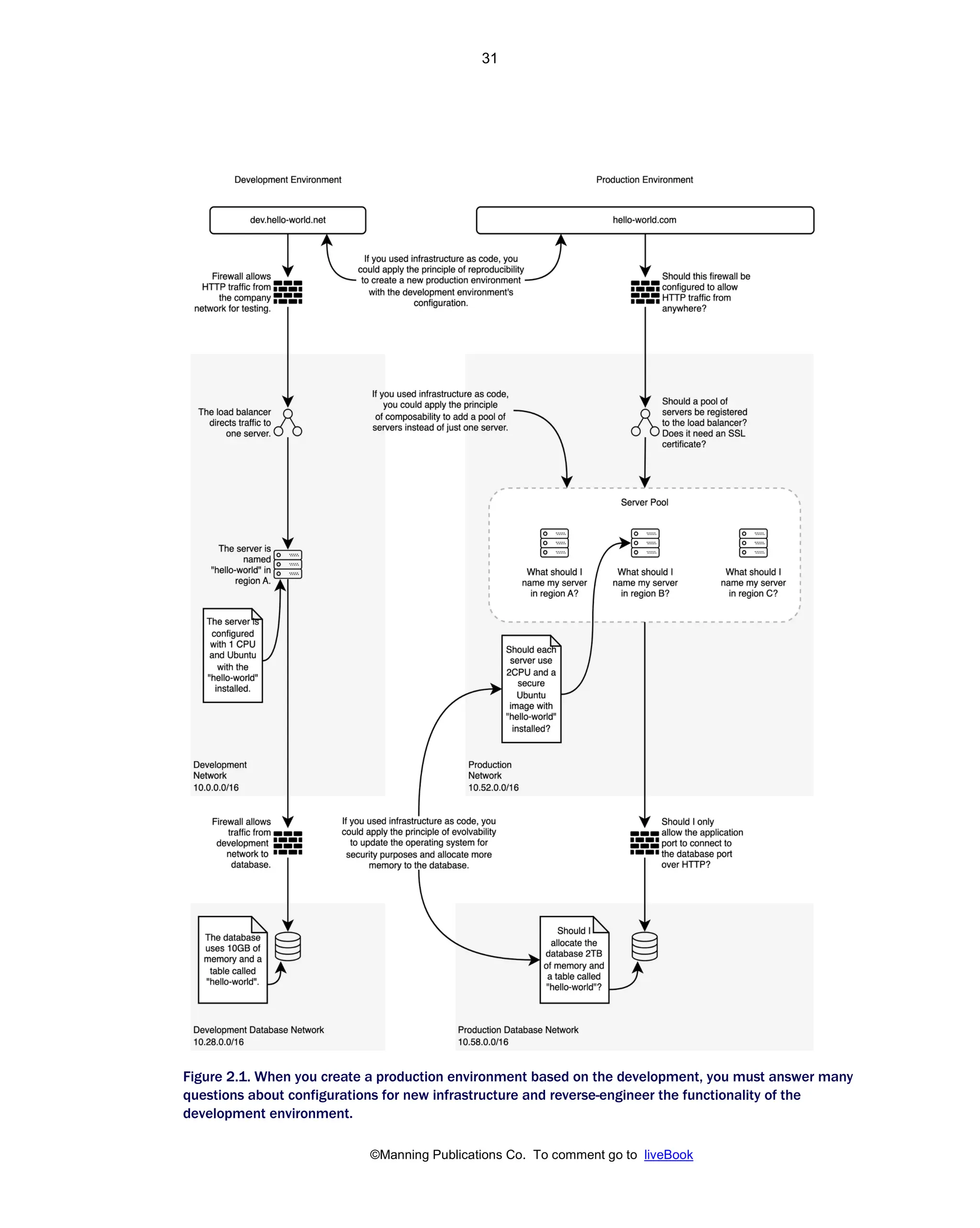
  • 9.
    ©Manning Publications Co.To comment go to liveBook Introducing infrastructure as code This chapter covers • Defining infrastructure • Defining infrastructure as code • Understanding why infrastructure as code is important If you just started working with public cloud providers or data center infrastructure, you might feel overwhelmed with all that you have to learn. You don’t know what you need to know to do your job! Between data center infrastructure concepts, new public cloud offerings, container orchestrators, programming languages, and software development, you have a lot to research. Besides learning everything you can, you also have to keep up with your company’s requirements to innovate and grow. Building systems to support it all gets challenging. You need a way to support more complex systems, minimize your maintenance effort, and avoid disruption to customers using your application. What do you need to know to work with cloud computing or data center infrastructure? How can you scale your systems across a team and your organization? The answer to both questions involves infrastructure as code (IaC), the process of automating infrastructure changes in a codified manner to achieve scalability, reliability, and security. Everyone can use infrastructure as code, from system administrators, site reliability engineers, DevOps engineers, security engineers, software developers, to quality assurance engineers. Whether you’ve just run your first tutorial for infrastructure as code or passed a public cloud certification (congratulations!), you can apply infrastructure as code to larger systems and teams to simplify, sustain, and scale your infrastructure. This book offers a practical approach to infrastructure as code by applying software development practices and patterns to infrastructure management. It takes practices like 1
  • 10.
    ©Manning Publications Co.To comment go to liveBook testing, continuous delivery, refactoring, and design patterns with an infrastructure twist! You’ll find practices and patterns to help you manage your infrastructure no matter the automation, tool, platform, or technology. I divided this book into three parts (figure 1.1). Part one covers the practices you can apply to write infrastructure as code, while Part two describes your team’s patterns and practices to collaborate on it. Part three covers some approaches to scaling infrastructure as code across your organization. Figure 1.1. In this book, you will learn the intersections of practices between you, your team, and your organization and how they help you scale systems and support mission-critical applications. 2
  • 11.
    ©Manning Publications Co.To comment go to liveBook Many of the patterns and practices in this book intersect between these interests. Writing good infrastructure as code individually helps you better share and scale it across your team and organization! Well-written infrastructure as code helps solve problems with collaborating on infrastructure as code, especially as more people adopt it. Part one starts by defining infrastructure and explaining common infrastructure as code design patterns. These topics involve foundational concepts that help you scale IaC across your team. You may already be familiar with some of the material in this part, so review these chapters to establish foundations for more advanced concepts. In parts two and three, you’ll learn the patterns and practices you need to scale systems and support infrastructure for mission-critical applications. These practices extend from you to your team and organization, from creating one application metrics alert for an application to implementing a network change across a fifty thousand person organization. Many terms and concepts build on each other in these parts so you might find it helpful to read the chapters in order. 1.1 What is infrastructure? Before I dive into infrastructure as code, let’s begin with the definition of infrastructure. When I began working in a data center, the literature often defined infrastructure as hardware or devices that provide network, storage, or compute capability. Figure 1.2 shows how applications run on servers (compute), connect through a switch (network), and maintain data on disks (storage). Figure 1.2. The data center definition of infrastructure includes networking, compute, or storage resources used to run an application. These three categories matched the physical devices we managed in a data center. We made changes by scanning into a building, plugging into a device, typing commands, and hoping that everything still works. With the advent of cloud computing, we continued to use these categories to discuss virtualization of specific devices. However, the data center definition of infrastructure doesn’t quite apply to today’s services and offerings. Imagine that another team requests that you help them deliver their application to production for users. You run through a checklist that includes setting up: • Enough servers • Network connectivity for users • A database for storing application data 3
  • 12.
    ©Manning Publications Co.To comment go to liveBook Does completing this checklist mean the team can run this application in production? Not necessarily! You do not know if you set up enough servers or the proper access to log into the application. You also need to know if network latency affects the application’s database connection. In this narrow definition of infrastructure, you omit some critical tasks necessary for production readiness, including the following: • Monitoring application metrics • Exporting metrics for business reporting • Setting up alerts for teams operating the application • Adding health checks for servers and databases • Supporting user authentication • Logging and aggregating application events • Storing and rotating database passwords in a secrets manager You need these “to-do” items to deliver an application to production that will work reliably and securely. You might think of them as “operational” requirements, but they still require infrastructure resources. Besides infrastructure related to operations, public cloud providers abstract the management of base networking, compute, and storage and offer Platform as a Service (PaaS) offerings instead, from object stores like storage buckets to event streaming platforms like managed Apache Kafka. Providers even offer Function as a Service or Containers as a Service, additional abstractions for computing resources. The increasing marketplace of Software as a Service (SaaS) such as hosted application performance monitoring software might also be required to support an application in production and could also be infrastructure! With so many services, you cannot describe infrastructure with just compute, network, and storage categories. We need to include operational infrastructure, PaaS, or SaaS offerings in our application delivery. Figure 1.3 adjusts the model of infrastructure to include additional service offerings like SaaS and PaaS that help us deliver applications. 4
  • 13.
    ©Manning Publications Co.To comment go to liveBook Figure 1.3. The infrastructure for an application might even include queues on a public cloud, containers running applications, serverless functions for additional processing, or even monitoring services to check the system’s health. Due to the growing complexity, varying operating models, and user abstraction of data center management, you can’t limit the definition of infrastructure to hardware or physical devices related to compute, network, or storage. DEFINITION Infrastructure refers to software, platform, or hardware that delivers or deploys applications to production. A non-exhaustive list of infrastructure you might encounter includes: • Servers • Workload orchestration platforms (e.g., Kubernetes, HashiCorp Nomad) • Network switches • Load balancers • Databases • Object stores • Caches • Queues • Event streaming platforms • Monitoring platforms • Data pipeline systems • Payment platforms 5
  • 14.
    ©Manning Publications Co.To comment go to liveBook Expanding the infrastructure definition provides a common language across teams managing resources for various purposes. For example, a team managing an organization’s continuous integration (CI) framework utilizes infrastructure from either a continuous integration SaaS or compute resources from a public cloud. Another team builds upon the framework, thus making it critical infrastructure. 1.2 What is infrastructure as code? Before explaining infrastructure as code, we must understand the manual infrastructure configuration. In this section, I outline the problem with infrastructure and manual configuration. Then, I will define infrastructure as code. 1.2.1 Manual configuration of infrastructure As part of a network team, I learned to change a network switch by copying and pasting commands from a text document. I once pasted “shutdown” instead of “no shutdown,” turning off a network interface! I quickly turned it back on, hoping that no one noticed and it didn’t affect anything. A week later, however, I discovered that it shut off connectivity to a critical application and affected a few customer requests. In retrospect, I ran into a few problems with my manual copy and paste of commands and infrastructure configuration. First, I had no idea what resources my change would affect (also known as the blast radius). I did not know which networks or applications used the interface. DEFINITION The blast radius refers to the impact a failed change has on a system. A larger blast radius often affects more components or the most critical components. Second, the network switch accepted my command without testing its effects or checking its intent. Finally, no one else knew what affected the application’s processing of customer requests, and it took a week for them to identify the root cause as my miscopied command. How does writing infrastructure in a codified manner help catch my miscopied network switch command? I could store my configuration and automation under source control to record the commands. To catch my mistake going forward, I create a virtual switch and a test that runs my script and checks the health of the interface. After the tests pass, I promote the change to production because the tests check for the correct command. If I apply the wrong command, I can search infrastructure configuration to determine which applications run on the affected network. You can refer to Chapter 6 for testing practices and Chapter 11 for reverting changes. Besides the risk of misconfiguration, my development momentum sometimes slows because of manual infrastructure configuration. Once, it took nearly two months for me to test my application against a database. Throughout those two months, my team submitted over ten tickets related to creating the database, configuring new routing to connect it to the database, and opening firewall rules to allow my application. The platform team manually 6
  • 15.
    ©Manning Publications Co.To comment go to liveBook configured everything in a public cloud. Development teams did not have direct access due to security concerns. In other words, manual configuration of infrastructure often does not scale as systems and teams grow. Manual changes increase the change failure rate of systems, slow down development, and expose the system’s attack surface to a potential security exploit. You will always have the temptation to update some values into a console. However, these changes accumulate. The next person who makes a change to the system may introduce a failure into the system that will be difficult to troubleshoot because changes haven’t been audited or organized. Changes like updating a firewall to allow some traffic during the development process can inadvertently leave the system vulnerable to attack. 1.2.2 Infrastructure as code What should you do to change infrastructure, if not manual changes? You can apply a software development lifecycle for infrastructure resources and configuration in the form of infrastructure as code. However, an infrastructure development lifecycle goes beyond configuration files and scripts. Infrastructure needs to scale, manage failure, support rapid software development, and secure applications. A development lifecycle for infrastructure involves more specific patterns and practices to support collaboration, deployment, and testing. In figure 1.4, a simplified workflow changes infrastructure using configuration or scripts and committing them to version control. A commit automatically starts a workflow to deploy and test the changes to your infrastructure. 7
  • 16.
    ©Manning Publications Co.To comment go to liveBook Figure 1.4. A development lifecycle for infrastructure includes writing the code as documentation, committing it to version control, applying it to infrastructure in an automated way, and testing it. Why should you remember the development lifecycle? You can use it as a general pattern for managing changes and verifying they don’t affect your system! The lifecycle captures infrastructure as code, which automates infrastructure changes in a codified manner and applies DevOps practices such as version control and continuous delivery. 8
  • 17.
    ©Manning Publications Co.To comment go to liveBook DEFINITION Infrastructure as code (IaC) applies DevOps practices to automating infrastructure changes in a codified manner to achieve scalability, resiliency, and security. I often find infrastructure as code cited as a necessary practice of DevOps. It certainly addresses the automation piece of the CAMS model (Culture, Automation, Measurement, and Sharing). Figure 1.5 positions infrastructure as code as part of automation practices and philosophy in the DevOps model. The practices of code as documentation, version control, software development patterns, and continuous delivery align with the development lifecycle workflow we discussed previously! Figure 1.5. Infrastructure as code applies version control, software development patterns, continuous integration, and code as documentation to infrastructure. Why focus on infrastructure as code as part of automation in the DevOps model? Your organization does not have to adopt DevOps to use infrastructure as code. Its benefits improve DevOps adoption and metrics but still apply to any infrastructure configuration. You can still use infrastructure as code practices to improve the process of making infrastructure changes without affecting production. 9
  • 18.
    ©Manning Publications Co.To comment go to liveBook More on DevOps You will see some DevOps practices included in this book, but I will not be focusing on its theory or principles. I recommend Accelerate by Nicole Forsgren, Ph.D., Gene Kim, and Jez Humble for a higher-level understanding of DevOps. You can also peruse Gene Kim’s The Phoenix Project, which describes the fictional transformation of an organization adopting DevOps. This book will cover some approaches for codifying infrastructure to eliminate the friction of scale while maintaining the reliability and security of infrastructure for application users, whether you use the data center or cloud. Software development practices such as version control of configuration files, continuous integration pipelines, and testing can help scale and evolve changes to infrastructure while mitigating downtime and building secure configuration. 1.2.3 What is not infrastructure as code? Could you be doing infrastructure as code if you type out some configuration in a document? You might consider infrastructure as code to include adding configuration instructions in a change ticket. You can argue that a tutorial for building a queue or a shell script for configuring a server counts as infrastructure as code. Each of these examples can be forms of infrastructure as code if you can use them to: • Reliably and accurately reproduce the infrastructure it expresses • Revert configuration to a specific version or point in time • Communicate and assess the blast radius of a change to the resources. The configurations or scripts, however, are usually outdated, unversioned, or ambiguous in intent. You may even find yourself struggling to understand and change the configuration written in an IaC tool! The tool facilitates IaC workflows but not necessarily the practices and approaches that allow systems to grow while reducing operational responsibility and change failure. You need a set of principles to identify infrastructure as code. 1.3 Principles of infrastructure as code As I mentioned, not every piece of code or configuration related to infrastructure will scale or mitigate downtime. Throughout the book, I will highlight how IaC principles apply to certain code listings or practices. You can even use these principles to assess your infrastructure as code. While others may add or subtract to this list of principles, I remember four of the most important principles with the mnemonic, RICE. RICE stands for reproducibility, idempotency, composability, and evolvability. I will define and apply each principle in the following sections. 10
  • 19.
    ©Manning Publications Co.To comment go to liveBook 1.3.1 Reproducibility Imagine if someone asks you to create a development environment with a queue and a server. You share a set of configuration files for your teammate. They use them to recreate a new environment for themselves in less than an hour. Figure 1.6 shows how you shared your configuration and enabled your teammate to reproduce a new environment. You discovered the power of reproducibility, the first principle of infrastructure as code! Figure 1.6. Manual changes introduce drift between version control and actual state and affects reproducibility, so you instead update changes in version control. Why should infrastructure as code conform to the principle of reproducibility? The ability to copy and reuse infrastructure configuration saves you and your team’s initial engineering time. You don’t have to “reinvent the wheel” to create new environments or infrastructure resources! DEFINITION The principle of reproducibility means that you can use the same configuration to reproduce an environment or infrastructure resources. However, you’ll find adhering to the principle of reproducibility more complicated than copying and pasting a configuration. To demonstrate this nuance, imagine you need to reduce a network address space from “/26” to “/24.” You do have infrastructure as code written that expresses the network. However, you decide to choose the easy route of logging into the cloud provider and typing “/24” into the text box. Before you log into the cloud provider, you reflect on whether or not your change workflow adheres to reproducibility. You ask yourself the following questions: • Will a teammate know that you’ve updated the network? • If you run your configuration, will the network address space return to the “/16”? • If you create a new environment with the configuration in version control, will it have an address space of “/24”? You answer “no” to each of those questions! You cannot guarantee that you will reproduce the manual change successfully. 11
  • 20.
    ©Manning Publications Co.To comment go to liveBook If you go ahead and type “/24” in the cloud provider’s console, your network has drifted from its desired state expressed in IaC (figure 1.7). To conform to reproducibility, you decide to update the version control configuration to “/24” and apply the automation. Figure 1.7. Manual changes introduce drift between version control and actual state and affects reproducibility, so you instead update changes in version control. This scenario demonstrates the challenge of conforming to reproducibility. You need to minimize the inconsistency between the expected and actual infrastructure configuration, also known as configuration drift. DEFINITION Configuration drift is the deviation of infrastructure configuration from the desired versus actual configuration. As a practice, you can ensure the principle of reproducibility by placing your configuration files in version control and keeping version control as updated as possible. Maintaining the principle of reproducibility helps you collaborate better and manage testing environments similar to production. You’ll learn more about infrastructure testing environments in Chapter 6, which benefit from reproducibility. You’ll also apply reproducibility to practices and patterns in testing and upgrading infrastructure, from creating test infrastructure mirroring production to deploying new infrastructure to replace older systems (blue-green deployments). 12
  • 21.
    ©Manning Publications Co.To comment go to liveBook 1.3.2 Idempotency Some infrastructure as code include repeatability as a principle, which means running the same automation and yielding consistent results. I pose that infrastructure as code needs a stricter requirement. Running automation should result in the same end state for an infrastructure resource. After all, I have one main objective when I write automation - the ability to run the automation multiple times and get the same result. Let’s understand why infrastructure as code needs a stricter requirement. Imagine you write a network script that first configures an interface and then reboots. The first time you run the script, the switch configures the interface and reboots. You save this script as version 1. A few months later, your teammate asks you to run the script again on the switch. You run the script and the switch reboots. However, the reboot disconnected some critical applications! You already configured the network interface. Why do you need to reboot the switch? You figure out a way to prevent the switch reboot if you already configured the network interface. In figure 1.8, you create version two of the script and add a conditional “if” statement. The statement checks if you have configured the interface already before rebooting the switch. When you run the version two script again, you do not disconnect the applications. Figure 1.8. In version 1 of the script, you reboot the switch each time you run the script. In version 2 of the script, you check if the network interface is configured before rebooting the switch. This preserves the working state of the network. 13
  • 22.
    ©Manning Publications Co.To comment go to liveBook The conditional statement conforms to the principle of idempotency. Idempotency ensures that you can repeat the automation without affecting the infrastructure unless you change the configuration or drift occurs. If an infrastructure configuration or script is idempotent, you can rerun the automation multiple times without affecting the state or operability of a resource. DEFINITION The principle of idempotency ensures that you can repeatedly run the automation on infrastructure without affecting its end state or having any side effects. You should only affect Infrastructure when you update its attributes in automation. Why should you adhere to idempotency in your infrastructure as code, such as in the case of your network script? In the example, you want to avoid rebooting the network switch to keep the network running correctly. You already configured the network interface - why configure it again? You should only need to configure the interface if it doesn’t exist or change. Without idempotency, your automation might break accidentally. For example, you may repeat a script and create a new set of servers, doubling their numbers. More catastrophically, you might automate a database update only to remove a critical database! You can ensure the principle of idempotency by checking the repeatability of scripts and configuration. As a general practice, include a number of conditional statements checking if a configuration matches the expected before running your automation. Conditional statements help apply changes when required and avoid side effects that may affect the operability of infrastructure. Designing automation with idempotency reduces risk, as it encourages the inclusion of logic to preserve the final expected state of the system. If the automation fails once and causes an outage in the system, organizations no longer want to automate again because of its perceived risk. Idempotency becomes a guiding principle as you learn how to safely roll forward changes and preview automation changes before deployment in Chapter 11. 1.3.3 Composability You want to mix and match any set of infrastructure components, no matter the tool or configuration. You also need to update the individual configurations without affecting the entire system. Both of these requirements promote modularity and decoupling infrastructure dependencies, something you’ll learn more about in chapters 3, 4, and 5. For example, imagine you create infrastructure for an application that someone accesses at “hello-world.com. The minimum resources you need for a secure and production-ready configuration include: • A server • A load balancer • A private network for server • A public network for a load balancer • A routing rule to allow traffic out of the private network 14
  • 23.
    ©Manning Publications Co.To comment go to liveBook • A routing rule to allow public traffic to the load balancer • A routing rule to allow traffic from the load balancer to the server • A domain name for “hello-world.com” You could write this configuration from scratch. However, what if you found pre-constructed modules that group infrastructure components you can use to assemble the system? You now have different modules that create: • Networks (private and public networks, gateways to route traffic from the private network, routing rules to allow traffic out of the private network) • Servers • Load balancers (domain name, routing rules to allow traffic from the load balancer to server) In figure 1.9, you pick the network, server, and load balancer modules to build your production environment. Later, you realize you need a premium load balancer. You swap out the standard load balancer with a premium one so you can serve more traffic. The server and network continues running without affecting users. Figure 1.9. You build your production environment with building blocks of infrastructure so you can add new resources, like the database, easily. 15
  • 24.
    ©Manning Publications Co.To comment go to liveBook Your teammate can even add a database into the environment without affecting the load balancer, servers, or network. You group and select infrastructure resources in different combinations, which adheres to the principle of composability. DEFINITION Composability ensures that you can assemble any combination of infrastructure resources and update each one without affecting the others. The more composable your configuration, the easier it is to create new systems with less effort. Think of constructing your infrastructure as code with building blocks. You want to be able to update or evolve subsets of resources without toppling the entire system! If you do not consider the composability of your infrastructure as code, you run the risk of change failures due to unknown dependencies in complex infrastructure systems. The self-service benefit of composability can help your organization scale and empower teams to interact safely with infrastructure systems. This book will examine some patterns in chapters 3, 4, and 5 that can help you approach more modular infrastructure construction and improve composability. 1.3.4 Evolvability You want to account for the scale and growth of your system but not optimize the configuration too early and unnecessarily. Much of infrastructure configuration will change over time, including its architecture. As a practical example, you might initially name an infrastructure resource “example.” Later, you need to change the resource name to “production.” You start the change by finding and replacing hundreds of tags, names, dependent resources, and more. The procedure of find- and-replace requires a high rate of effort. You notice that you forgot to change some fields as you apply the changes and your new infrastructure changes fail. To ensure the future evolution of names, tags, and other metadata, you instead create a variable for the name, and the configuration references the variable. In figure 1.10, you update the global “NAME” variable, and the change propagates across the entire system. Figure 1.10. Rather than finding and replacing all instances of the name, you can set a top-level variable with the name for all resources. 16
  • 25.
    ©Manning Publications Co.To comment go to liveBook The example almost seems too simple. Why does changing a name matter? Infrastructure as code built with evolvability as a principle minimizes the effort (time and cost) to change a system and the risk of failure for the change. DEFINITION The principle of evolvability ensures that you can change your infrastructure resources to accommodate system scale or growth while minimizing effort and risk of failure. System evolution includes changes beyond minor ones, such as name changes. A more disruptive change in infrastructure architecture might involve a replacement of Google Cloud Platform’s Bigtable with Amazon Web Service (AWS) Elastic Map Reduce. The application requiring the replacement has been future-proofed using HBase, an open-source distributed database that supports both offerings and simply requires the database endpoint. We account for this evolution in the infrastructure as code by outputting the database endpoint to retrieve the application and completing the update behind-the-scenes by creating configurations for both offerings. After testing the AWS database, we output its endpoint for consumption by the application. Evolvability, a complex discussion I do not fully cover the theory in evolving your architecture in this book. I highly recommend Building Evolutionary Architectures by Neal Ford, Pat Kua, and Rebecca Parsons if you want to learn more. The book discusses how to build your infrastructure architecture to account for changes. You might find yourself struggling to evolve your system because you have not used patterns and practices that allow it to change. Useful infrastructure as code focuses on techniques to facilitate future evolution. Many of the chapters in this book demonstrate patterns that help maintain evolvability and minimize the impact of changes to critical systems. 1.3.5 Applying the principles Reproducibility, idempotency, composability, and evolvability seem specific in their definitions. However, they help constrain your infrastructure architecture and define the behavior of many IaC tools. Your infrastructure as code must align with all four principles to scale, collaborate, and change your company. Figure 1.11 summarizes the four most important principles (RICE) and their definitions. 17
  • 26.
    ©Manning Publications Co.To comment go to liveBook Figure 1.11. Infrastructure as code should be reproducible, idempotent, composable, and evolvable. You can ask yourself a series of questions to determine if your infrastructure as code conforms to all four principles! As you write infrastructure as code, ask if you conform to all four principles. The principles help you write and share your infrastructure as code with less effort and ideally minimize the impact of changes to your system. A missing principle can hinder updates to infrastructure resources or increase the blast radius of potential failure! As you practice infrastructure as code, ask if your configuration or tools align with the practices. For example, ask the following questions about your tool: • Does the tool allow you to recreate entire environments? • What happens when you re-run the tool to enforce configuration? • Can you mix-and-match different configuration snippets to make a new set of infrastructure components? • Does the tool offer capabilities to help you evolve an infrastructure resource without impacting other systems? This book will use the principles to answer these questions and provide you with the skill to test, upgrade, and deploy infrastructure with resiliency and scalability in mind. Exercise 1.1 Choose an infrastructure script or configuration in your organization. Assess if it adheres to the principles of infrastructure as code. Does it promote reproducibility, use idempotency, help with composability, and ease evolvability? Find hints and answers at the end of the chapter 18
  • 27.
    ©Manning Publications Co.To comment go to liveBook 1.4 Why use infrastructure as code? Infrastructure as code is typically considered a DevOps practice. However, you don’t have to be applying DevOps across your entire organization to use it! You still want to manage your infrastructure in a way that reduces the change failure rate and mean time to resolution (MTTR), so you can sleep in on the weekends as an operator or spend more time writing code as a developer. There are a few reasons to use infrastructure as code, even if you think you don’t need it. 1.4.1 Change management You might experience a sinking feeling when you’ve applied a change to some infrastructure, only to realize that someone reported it broke something. Organizations try to prevent this with change management, a set of steps and reviews to ensure your changes do not affect production. The process often includes a change review board to review the changes or change windows to block off time to execute the change. DEFINITION Change management outlines a set of steps and reviews that you take in your company to implement changes in production and prevent their failure. However, no change is risk-free. Applying infrastructure as code practices can mitigate the risk of a change by modularizing your infrastructure (Chapter 3) and rolling forward changes (Chapter 11) to limit the blast radius. In one regretful instance, I ignored my intuition to use infrastructure as code to mitigate the risk of a change. I had to roll out a new binary to servers, which required them to restart a set of dependent services. I wrote a script, asked my teammate to check it, and had the change review board sign off to run it. After applying and verifying the change over the weekend, I came in on Monday to several messages telling me servers supporting a reconciliation application went down overnight. My teammate traced it to an older operating system incompatibility with the dependencies in my script. In retrospect, infrastructure as code could have mitigated the risk of the change. When I applied the RICE principles to the change, I realized that I forgot the following: • Reproducibility. I did not reproduce my script on various test instances mimicking the various servers. • Idempotency. I did not include logic to check the operating system before running the command. • Composability. I did not limit the blast radius of the change to a small set of less critical servers. • Evolvability. I did not update the servers with a newer operating system and reduce variation across the infrastructure. Reducing variation allows for infrastructure evolution and risk mitigation because the actual configuration matches the one you expect during your automation, making changes more 19
  • 28.
    ©Manning Publications Co.To comment go to liveBook straightforward and reliable to apply. We’ll discuss how to fit infrastructure as code into your change management process in Chapter 7! 1.4.2 Return on time investment Infrastructure as code and time investment can be challenging to justify, especially if your devices or hardware do not have suitable automation interfaces. In addition to a lack of easy automation, it can be difficult to justify spending time automating a task that you only do once a year or even a decade. While infrastructure as code might take extra time to implement, it lowers the time to execute changes in the long term. How exactly does that work? Imagine you need to update the same package on ten servers. You used to do this without infrastructure as code. You manually log in, update the package, verify everything works, fix errors, and move to the next one. On average, you spend 10 hours updating the servers. Figure 1.12 shows that changes made without IaC have a constant level of effort over time. If you have additional changes, you may spend a few more hours fixing or updating the system. A failed change might mean you spend more effort over several days to fix the system. You decide to invest time into building infrastructure as code for these servers (the solid line in figure 1.12). You reduce the servers’ configuration drift, which takes about 40 hours. After your initial time investment, you spend less than five minutes updating all of the servers each time you make the change. 20
  • 29.
    ©Manning Publications Co.To comment go to liveBook Figure 1.12. Infrastructure as code requires less effort over time after the high initial automation effort. Without it, time to execute changes can be highly variable. Why bother understanding the relationship between time and effort of infrastructure as code? Prevention helps reduce the effort of remediation! Without infrastructure as code, you might find yourself spending weeks trying to remediate a major system outage. You typically spend those weeks trying to reverse engineer the manual changes, revert specific changes, or at worst, rebuilding a new system from scratch. You must make an initial investment in writing infrastructure as code, even if it seems steep. This investment helps you over time as you spend less time debugging failed configurations or recovering broken systems in the long term. If your system completely fails one day, you can reproduce it easily by running your infrastructure as code. The automation and tests encourage predictability and limit the blast radius of a failure change. They lower the change failure rate and MTTR of failed systems. As your infrastructure system evolves and scales, you can use the detailed testing practices covered in this book to improve the change failure rate in our system and alleviate the burden of future changes. 1.4.3 Knowledge sharing Infrastructure as code communicates infrastructure architecture and configuration, which helps reduce human error and improve reliability. An engineer once told me, “We don’t need 21
  • 30.
    ©Manning Publications Co.To comment go to liveBook to do infrastructure as code for a network switch for a tertiary passive data center (used for backup). It’s just me configuring stuff anyway, and we’d only need to make this change once and never touch it again.” The engineer left the organization shortly after configuring the switch. Later, my team needed to convert the tertiary passive data center to an active data center for compliance requirements. In a panic, we scrambled to reverse engineer the configuration on the switch. It took us a good part of two months to figure out the network connection, rework its configuration, and manage it with infrastructure as code. Even if a task seems particularly obscure or the team configuring infrastructure consists of one person, investing the time and effort to approach infrastructure configuration in an “as code” manner can help accommodate evolution, especially as infrastructure systems and teams scale. You find that you’ll spend more time remembering how you configured the obscure switch when someone reports an outage or teaching the server configuration to a new team member. Writing a task “as code” communicates the expected state of the infrastructure and the system’s architecture, also known as code as documentation. DEFINITION Code as documentation ensures that the code communicates the intent of the software or system without the need for additional reference documentation. Someone unfamiliar with the system should examine the infrastructure configuration and understand its intent. You cannot expect all code to serve as documentation from a practical standpoint! However, the code should reflect most of your infrastructure architecture and system expectations. 1.4.4 Security Auditing and checking for insecure configurations in infrastructure as code can highlight security concerns earlier in the development process. You hear this as “shifting security left.” If you incorporate security checks earlier in the process, you find fewer vulnerabilities when the system configuration runs in production. You’ll learn more about security patterns and practices in Chapter 8. For example, you might temporarily increase access to an object store such that anyone can write and read from it in development. You push it to production. However, some of the objects in the store allow everyone to write to and read from them! While this seems like a simple mistake, the configuration has grave implications if the store contains customer data. 22
  • 31.
    ©Manning Publications Co.To comment go to liveBook Insecure infrastructure in the news For more examples of insecure infrastructure configuration, you can search the news for a misconfigured object store that exposed driver’s license information or even a database with a default password that revealed millions of consumer credit cards. Some security breaches involve legitimate vulnerabilities, but many involve insecure configuration. Organizations that prevent these misconfigurations in the first place can usually quickly examine configuration, audit access control, assess the blast radius, and remediate the breach. Infrastructure as code simplifies access control by expressing it in a single configuration. With infrastructure as code, you can test the configuration to ensure the object store does not allow public access. Furthermore, you can include a production check to verify your policy only allows read access to specific objects. Even security policies in a data center, such as firewall rules, can be expressed in infrastructure as code and audited to ensure its rules only allow inbound connections from known sources. If you experience a security breach, infrastructure as code allows you to examine configuration, audit access control quickly, assess the blast radius, and remediate the breach. You can use the same IaC practices to make all sorts of changes. You’ll discover some practices in this book to help audit and secure your infrastructure in adherence to infrastructure as code principles. 1.5 Tools Infrastructure as code tooling varies quite widely because it applies to various resources. Most tools fall into one of three use cases, all of which address very different functions and vary widely in behavior, including the following: 1. Provisioning 2. Configuration Management 3. Image Building In this book, I primarily focus on tools used for provisioning, which deploy and manage sets of infrastructure resources. I will include some sidebars and examples in configuration management and image building to highlight some differences in approach. 1.5.1 Examples in this book In this book, I faced a challenge to build concrete examples agnostic of tools or platforms. As a patterns and practices book, I needed to find a way to express the concepts in a general programming language without rewriting the logic of a tool. Figure 1.13 outlines the workflow of the code listings and examples, and Appendix A details the technical implementation. I wrote the code listings in Python to create a JSON file consumed by HashiCorp Terraform, a provisioning tool with various integrations across public clouds and other infrastructure providers. 23
  • 32.
    ©Manning Publications Co.To comment go to liveBook Figure 1.13. This book uses Python to create a JSON file that HashiCorp Terraform can consume. When you run the Python script using python run.py, the code creates a JSON file with the file extension *.tf.json. The JSON file uses syntax specific to Terraform. Then, you can go into the directory with the *.tf.json file and run terraform init and terraform apply to create the resources. While the Python code seems to add unnecessary abstraction, it ensures that I can offer concrete examples agnostic of platform and tool. I recognize the complexity of this workflow seems nonsensical. However, it serves two purposes. The Python files provide a generalized implementation of patterns and practices with a programming language. The JSON configuration allows you to run and create the resources with a tool instead of me writing in abstractions. Code repository for this book You can find the complete code examples at this book’s code repository: https://github.com/joatmon08/manning- book. You do not have to know Python or Terraform in-depth to understand the code examples. If you would like to run the examples and create the resources, I recommend reviewing an introductory tutorial to Terraform or Python for syntax and commands. For more on HashiCorp Terraform and Python You’ll find a number of resources on HashiCorp Terraform and Python. Check out Terraform in Action by Scott Winkler, The Quick Python Book by Naomi Cedar, or Python Workout by Reuven M. Learner. The examples create infrastructure in Google Cloud Platform (GCP). While Amazon Web Services (AWS) or Azure may be more popular choices at publication, too many code examples become quickly outdated. Much to my concern, cloud provider APIs change very quickly. I use GCP as the primary cloud provider for two main reasons. First, if you create a new account with GCP, you will receive a free trial of up to $300 (at time of publication). You can use offerings in the free usage tier if you have an existing 24
  • 33.
    ©Manning Publications Co.To comment go to liveBook account. I will note if an example requires resources that do not qualify for the free usage tier at the time of publication. Furthermore, GCP’s billing project structure isolates any resources you create with these examples so you can delete the project and all of its resources in one click. Using Google Cloud Platform For more information on GCP’s free program, refer to their program webpage at https://cloud.google.com/free. I recommend creating a separate GCP project to run all of the examples. A separate project will isolate your resources. When you finish this book, you can delete the project and its resources. Review the tutorial for creating GCP projects at https://cloud.google.com/resource-manager/docs/creating-managing-projects. Second, I use GCP because its offerings use more straightforward naming and generic infrastructure terminology. If you work in a data center, you’ll still be able to recognize what the services create. For example, Google’s Cloud SQL creates SQL databases. If you run the examples, you will use the following resources in GCP: • Networking (networks, load balancers, and firewalls) • Compute • Managed queues (PubSub) • Storage (Cloud Storage) • Identity and access management (IAM) • Kubernetes offerings (Kubernetes Engine and Cloud Run) • Database (Cloud SQL) In general, you do not have to know the details of each service. I use them to demonstrate dependency management between infrastructure resources. Each example includes notations on equivalent AWS and Azure service offerings to further solidify specific patterns and techniques. To update the examples for the cloud provider of your choice, you may need to do some language replacements and change some of your dependencies. For example, you can create GCP networks with built-in gateways while you must explicitly build them in AWS networks. I avoided using specialized services different for each cloud platform, such as machine learning. 1.5.2 Provisioning Provisioning tools create and manage sets of infrastructure resources for a given provider, whether it be a public cloud, data center, or hosted monitoring solution. A provider refers to a data center, IaaS, PaaS, or SaaS responsible for providing infrastructure resources. DEFINITION A provisioning tool creates and manages a set of infrastructure resources for a public cloud, data center, or hosted monitoring solution. 25
  • 34.
    ©Manning Publications Co.To comment go to liveBook Some provisioning tools only work with a specific provider, while others integrate with multiple providers (table 1.1). Table 1.1. Examples of provisioning tools & providers Tool Provider Amazon Web Services CloudFormation Amazon Web Services Google Cloud Platform Deployment Manager Google Cloud Platform Azure Resource Manager Microsoft Azure HashiCorp Terraform Various1 Pulumi SDK Various2 AWS Cloud Development Kit Amazon Web Services Kubernetes Manifests Kubernetes (Container Orchestrator) Most provisioning tools can preview changes to a system and express dependencies between infrastructure resources, also known as a dry run. DEFINITION A dry run analyzes and outputs expected changes to infrastructure before you apply the changes to resources. For example, you can express a dependency between a network and a server. If you change the network, the provisioning tool will show that the server may also change. 1.5.3 Configuration management Configuration management tools ensure that servers and computer systems run in the desired state. Most configuration management tools excel at device configuration, such as server installation and maintenance. DEFINITION A configuration management tool configures a set of servers or resources for the packages and attributes hosted on them. 1 For a complete list, see https://www.terraform.io/docs/providers/index.html. 2 For a complete list, see https://www.pulumi.com/docs/intro/cloud-providers/. 26
  • 35.
    ©Manning Publications Co.To comment go to liveBook For example, if you have 10,000 servers in your data center, how do you ensure that all of them run a specific version of the packages your security team approved? It does not scale for you to log into 10,000 servers and manually type commands to review. If you configure the servers with a configuration management tool, you can run a single command to review all 10,000 servers and execute the packages’ updates. A non-exhaustive list of configuration management tools that address this problem space includes: • Chef • Puppet • Ansible • SaltStack • CFEngine While this book focuses on provisioning tools and managing multi-provider systems, I will address some configuration management practices related to infrastructure testing, updating infrastructure, and security. Configuration management can help tune your server and network infrastructure. More on configuration management I recommend books and tutorials for a configuration management tool of your choice for additional information. They will provide a more detailed guide specific to their design approach. To add to the confusion, you might notice that some configuration management tools offer integrations to the data center and cloud providers. As a result, you might think of using your configuration tool as your provisioning tool. While possible, this approach may not be ideal because provisioning tools often have a different design approach for specifically addressing dependencies between infrastructure resources. I will explore this nuance in the next chapter. 1.5.4 Image building When you create a server, you must specify a machine image with an operating system. Image building tools create images used for application runtime, whether a container or server. DEFINITION An image building tool builds machine images for application runtimes, such as containers or servers. Most image builders allow you to specify a runtime environment and build targets. Table 1.2 outlines a few tools, their supported runtime environments, and their build targets and platforms. 27
  • 36.
    ©Manning Publications Co.To comment go to liveBook Table 1.2. Examples of image builders & providers Tool Runtime Environment Build Target HashiCorp Packer Containers & Servers Various3 Docker Containers Container Registries Amazon EC2 Image Builder Servers Amazon Web Services Azure VM Image Builder Servers Microsoft Azure I will not include detailed discussions on image building in this book. However, the patterns in Chapters 6-8 apply to image building workflows. In the next chapter, you’ll learn about immutability, a critical paradigm that informs the approach of image builders. Figure 1.14 shows how image building, configuration management, and provisioning tools work together. The process of deploying a new server configuration often starts with a configuration management tool, where you start building the foundations and testing if your server configuration is correct. After establishing the server configuration you want, you use an image builder to preserve the server’s image with its versioning and runtime. Finally, your provisioning tool references the image builder’s snapshot to create new production servers with the configuration you want. Figure 1.14. Each type of infrastructure as a code tool contributes to the lifecycle of a server infrastructure resource, from configuration to image capture and deployment. 3 For a complete list, see https://www.packer.io/docs/builders. 28
  • 37.
    ©Manning Publications Co.To comment go to liveBook This workflow represents the ideal end-to-end approach for managing and deploying servers with infrastructure as code tooling. However, as you will learn, infrastructure can be complex, and this workflow may not apply to every use case. Various infrastructure systems and their dependencies complicate provisioning, which I chose to be the primary focus of this book and why the examples use provisioning tools. 1.6 Exercises and Solutions Exercise 1.1 Choose an infrastructure script or configuration in your organization. Assess if it adheres to the principles of infrastructure as code. Does it promote reproducibility, use idempotency, help with composability, and ease evolvability? Answer: You can use the following steps to identify if your script of configuration follows infrastructure as code principles: • Reproducibility: Copy and paste the script or configuration, share it with someone else, and ask them to create the resources without modifying or changing the configuration. • Idempotency: Run the script a few times. It should not change your infrastructure. • Composability: Copy a portion of the configuration and build it on top of other infrastructure resources. • Evolvability: Add a new infrastructure resource to the configuration and verify you can make changes without affecting other resources. 1.7 Summary • Infrastructure can be software, platform, or hardware that delivers or deploys applications to production. • Infrastructure as code is a DevOps practice of automating infrastructure to achieve reliability, scalability, and security. • The principles of infrastructure as code are reproducibility, idempotency, composability, and evolvability. • By following the principles of infrastructure as code, you can improve change management processes, lower time spent on fixing failed systems in the long term, better share knowledge and context, and build security into your infrastructure. • Infrastructure as code tools include provisioning, configuration management, and image building tools. 29
  • 38.
    ©Manning Publications Co.To comment go to liveBook Writing infrastructure as code This chapter covers • How the current infrastructure state affects the reproducibility of infrastructure • Detecting and remediating infrastructure drift due to mutable changes • Implementing best practices for writing reproducible infrastructure as code Imagine you’ve created a development environment for a “hello-world” application. You built it organically, adding new components as you needed them. Eventually, you need to reproduce the configuration for production use, which people can publicly access. You also need to scale production across three geographic regions for high availability. To do this, you must create and update firewalls, load balancers, servers, and databases in new networks for the production environment. Figure 2.1 shows the complexity of the development environment with the firewall, load balancer, server, and database and the components you need to reproduce in production. However, the figure outlines the differences between development and production. The production configuration needs three servers for high availability, expanded firewall rules to allow all HTTP traffic, and stricter firewall rules for the servers to connect to the database. After reviewing all of the differences, you might have a lot of questions about the best and easiest way to make the changes! 30
  • 39.
    ©Manning Publications Co.To comment go to liveBook Figure 2.1. When you create a production environment based on the development, you must answer many questions about configurations for new infrastructure and reverse-engineer the functionality of the development environment. 31
  • 40.
    ©Manning Publications Co.To comment go to liveBook You might wonder, for example, why the lack of infrastructure as code for the development environment affects your ability to create the production one? The first reason is that you cannot easily reproduce the infrastructure resources. You have to reverse engineer a weeks’ worth of manual configuration! With infrastructure as code, you can instead copy and paste some configuration and modify it for the production environment. Second, you cannot easily compose the infrastructure resources with new ones. You need a pool of servers for production instead of a single server. If you built an infrastructure module, you could use that building block to create multiple servers without updating the configuration from scratch. Finally, you cannot easily evolve the production environment with its specific requirements. The production environment requires some different infrastructure resources, like secure operating systems and a larger database. You’ll have to manually tweak configuration that you’ve never run in the development environment! You can solve these challenges and improve reproducibility, composability, and evolvability in two ways. First, you need a way to migrate manually configured infrastructure to infrastructure as code. Second, you need to write clean infrastructure as code to promote reproducibility and evolvability. The first part of this chapter outlines some fundamental concepts for writing infrastructure as code (IaC) and migrating existing infrastructure to code. The second part of this chapter applies code hygiene practices to infrastructure. The combination of these practices will help you write reproducible infrastructure as code and set the stage for future composition and evolution of your system. 2.1 Expressing infrastructure change I mentioned in Chapter 1 that infrastructure as code automates changes. It turns out that reproducing and automating many changes over time takes effort. For example, if you want to provision and manage a server named on Google Cloud Platform (GCP), you’ll usually make the following changes over time: 1. Create the server in GCP using the console, terminal, or code. 2. Read the server in GCP to check that you created the server with the correct specifications, like Ubuntu 18.04 as the operating system. 3. Update the server in GCP with a publicly accessible network address to log into it. 4. Delete the server in GCP because you no longer require it. To make more complex updates or reproduce the server in another environment, you take the following steps: • Create the server. • Check if it exists by a “read” command. • Update it if you need to log in. • Delete the server if you no longer need it. 32
  • 41.
    ©Manning Publications Co.To comment go to liveBook No matter which resource you automate, you can always break down your changes to create, read, update, and delete (CRUD). You create an infrastructure resource, search for its metadata, update its properties, and delete it when you no longer need it. NOTE You wouldn’t usually have a change record that explicitly states “read the server.” It usually implies a “read” step to verify that a resource is created or updated. Create, read, update, and delete allow you to automate your infrastructure step-by-step in a specific order. This approach, called the imperative style, describes step-by-step how to configure infrastructure. You can think of it as an instruction manual. DEFINITION The imperative style of infrastructure as code describes how to configure an infrastructure resource step-by-step. While it seems intuitive, the imperative style does not scale as you make more changes to the system. Once, I had to create a new database environment based on a development environment. I started reconstructing the 200 change requests submitted to the development environment over two years. Each change request became a series of steps creating, updating, and deleting resources. It took me a month and a half to complete an environment that still didn’t match the existing development one! Rather than painstakingly recreate every step, I wished I could just describe the new database environment based on the running state of the development environment and let a tool figure out how to achieve the state. With most infrastructure as code, you will find it easier to reproduce environments and make changes in the declarative style. The declarative style describes the desired end state of an infrastructure resource. The tool decides the steps it needs to take to configure the infrastructure resource. DEFINITION The declarative style of infrastructure as code describes the desired end state of an infrastructure resource. Automation and tooling decide how to achieve the end state without your knowledge. This process with infrastructure as code takes a few steps. First, I need to search inventory sources for information on the database servers. Next, I get the database IP addresses. Finally, I write a configuration based on the information I’ve collected. Your configuration in version control becomes the infrastructure source of truth. You declare the new database environment’s desired state instead of describing a set of steps that may not end in the same result. DEFINITION An infrastructure source of truth structures information about the state of your infrastructure system consistently and singularly. You make all changes on the infrastructure source of truth. However, even in ideal circumstances (such as with GitOps in Chapter 7), you probably have some configuration 33
  • 42.
    ©Manning Publications Co.To comment go to liveBook drift from manual changes over time. If you use the declarative style and create a source of truth, you can use immutability to change infrastructure and lower the risk of failure. Exercise 2.1 Given: if __name__ == "__main__": update_packages() read_ssh_keys() update_users() if enable_secure_configuration: update_ip_tables() Does it use the imperative or declarative style of configuring infrastructure? A. Imperative style B. Declarative style Find answers and explanations at the end of the chapter. 2.2 Understanding immutability How do you prevent configuration drift and quickly reproduce your infrastructure? It starts with changing how you think about change. Imagine I create a server with Python version 2. I could update my scripts to log into the server and upgrade Python without restarting the server. I can treat the server as mutable infrastructure because I update the server in place without restarting it. DEFINITION You can update mutable infrastructure in place without recreation or restart. However, treating the server as mutable infrastructure raises an issue. Other packages on the server do not work with Python 3! Rather than update every other package and break the server, I can change my update scripts to create a new server with Python version 3 and compatible dependencies. Then I can delete the old server with Python 2. Figure 2.2 shows how to do this. 34
  • 43.
    ©Manning Publications Co.To comment go to liveBook Figure 2.2. You treat the server mutably by logging in and updating the Python package version. By comparison, you treat the server immutably by replacing the old server with a new one upgraded to Python 3. My new scripts treat the server as immutable infrastructure, in which I can replace the existing infrastructure with changes. I do not update the infrastructure in place. Immutability means that once you create a resource, you do not change its configuration. DEFINITION Immutable infrastructure means you must create a new resource for any changes to infrastructure configuration. You do not modify the resource after creating it. Why treat the server’s update in two different ways? Some changes will break the resource if you do them mutably. To mitigate the risk of failure, you can create a whole new resource with the updates and remove the old one with immutability. Immutability relies on a series of creation and deletion changes. Creating a new resource alleviates drift (difference in actual versus expected configuration) because the new resource aligns with the infrastructure as code you use to create it. You can expand this beyond server resources to even serverless functions or entire infrastructure clusters. You choose to create a new resource with changes instead of updating the existing one. 35
  • 44.
    ©Manning Publications Co.To comment go to liveBook Immutable image building Machine image builders work with the concept of immutable infrastructure. Any updates to a server require a new machine image, which the builder generates and provides. Modifications to the server, such as IP address registration, should be passed as parameters to a startup script defined by the image builder. The enforcement of immutability affects how you make changes. Creating a new resource requires the principle of reproducibility. As a result, infrastructure as code lends well to enforcing immutability as you make changes. For example, you might create a new firewall each time you need to update it. The new firewall overrides any manual rules someone added outside of infrastructure as code, facilitating security and reducing drift. Immutability also promotes system availability and mitigates any failures to mission-critical applications. Instead of updating an existing resource in place, creating a new one isolates changes to the new resource, limiting the blast radius if something goes wrong. I’ll discuss more on this in Chapter 9. However, immutability sometimes comes at the cost of time and effort. Figure 2.3 compares the effect of mutable versus immutable infrastructure. When I treat the server as a mutable resource, I localize the effect of the Python in-place update. Updating Python affects a small part of the server’s overall state. When I treat a server immutably, I replace the entire server’s state, affecting any resources dependent on that server. 36
  • 45.
    ©Manning Publications Co.To comment go to liveBook Figure 2.3. Changes to mutable resources affect a small portion of the infrastructure state, while immutable resources replace the entire resource state. Here, replacing the entire state for immutability can take longer than changing to mutable infrastructure! You cannot expect to treat all infrastructure immutably all the time. If I change tens of thousands of servers immutably, I spend a few days recreating all of them. An in-place update may only take a day if I don’t break anything. You’ll find that you will switch between treating infrastructure as mutable and immutable, depending on the circumstance. Immutable infrastructure helps mitigate potential risk of failure across your system, while mutable infrastructure facilitates faster changes. You often treat infrastructure as mutable when you need to fix the system. How do you migrate between mutable and immutable infrastructure? 2.2.1 Remediating out-of-band changes You cannot expect to deploy a new resource every time you make a change. Sometimes, changes might seem minor in scope and impact. As a result, you decide to make the change mutably. 37
  • 46.
    ©Manning Publications Co.To comment go to liveBook Imagine you and your friend meet at a coffee shop. Your friend orders a cappuccino with a non-dairy alternative. However, the barista adds milk. They need to make a new cappuccino for your friend because the milk affects the whole cup. Your friend waits for another five to ten minutes. You get a cup of coffee instead and add milk and sugar to taste. If you don’t have enough sugar, you just add more. You take less time to change your mutable coffee than your friend changing their immutable cappuccino. Similarly, it takes far less time, effort, and cost to execute changes to a mutable resource. When you temporarily treat infrastructure as a mutable resource, you make an out-of-band change. DEFINITION An out-of-band change involves a quickly implemented change that temporarily treats immutable infrastructure as mutable infrastructure. When you break immutability with an out-of-band change, you reduce the change time but increase the risk of affecting another change in the future. After you make the out-of-band change, you need to update your source of truth to return to immutable infrastructure. How do you start this remediation process? You must reconcile the actual state and desired configuration when making an out-of-band change. I’ll apply this to my server example in figure 2.4. First, I log into the server and upgrade Python to version 3. Then, I change the configuration in version control, so new servers install Python version 3. The configuration matches the server’s state with the source of truth in version control. 38
  • 47.
    ©Manning Publications Co.To comment go to liveBook Figure 2.4. After updating a mutable resource, you need to update version control to account for the out-of- band change. Why should you update infrastructure as code for the out-of-band change? Remember from Chapter 1 that manual changes may affect reproducibility. Making sure that you transition a change made to mutable infrastructure to future immutable infrastructure preserves reproducibility. After remediating the out–of-band change and adding it to infrastructure as code, I can re-deploy changes repeatedly to my server and nothing should change. This behavior conforms to idempotency! You will continuously reconcile state and source of truth if you make many mutable changes. You should prioritize immutability to promote reproducibility. A barista can always replace a drink in my coffee example, even if you spill the sugar container into your mutable coffee. I recommend using your organization’s change procedures to limit out-of-band changes and ensure the updates align with the configuration in infrastructure as code. You can always use the immutable infrastructure configuration to fix a failed mutable change. 39
  • 48.
    ©Manning Publications Co.To comment go to liveBook Exercise 2.2 Which of the following changes benefit from the principle of immutability? (Choose all that apply.) A. Reducing a network to have fewer IP addresses B. Adding a column to a relational database C. Adding a new IP address to an existing DNS entry D. Updating a server’s packages to backward-incompatible versions E. Migrating infrastructure resources to another region Find answers and explanations at the end of the chapter. 2.2.2 Migrating to infrastructure as code Immutability through infrastructure as code allows version control to manage infrastructure configuration as a source of truth and facilitate future reproduction. In fact, conforming to immutability means that you create new resources all the time. It works very well for greenfield environments, which do not have active resources. However, most organizations have brownfield environments, an existing environment with active servers, load balancers, and networks. Recall that the chapter example includes a brownfield development environment called “hello-world.” You went into your infrastructure provider and manually created a set of resources. In general, a brownfield environment treats infrastructure as mutable. You need a way to change your practice of manually changing mutable infrastructure to automatically updating immutable infrastructure as code. How do you migrate the environment’s infrastructure resources to immutability? Let’s migrate the “hello-world” development environment to immutable infrastructure as code. Before I begin, I make a list of infrastructure resources in the environment. It contains networks, servers, load balancers, firewalls, and DNS entries. BASE INFRASTRUCTURE To start, I find the base infrastructure resource that other resources need to use. For example, every infrastructure resource depends on the network in the development environment. I start writing infrastructure as code for the database and development networks because the server, load balancer, and database run on it. I cannot reconstruct any resources that run on the networks until the networks exist as code. In figure 2.5, I use my terminal to access the infrastructure provider API. My terminal command prints out the name and IP address range (CIDR block) of the development database and development networks. I reconstruct each network by copying the name and CIDR block of each network into infrastructure as code. 40
  • 49.
    ©Manning Publications Co.To comment go to liveBook Figure 2.5. Reverse engineer the networks for the database and server first and write their configurations as code. Why reverse engineer and reproduce the network in infrastructure as code? You must match the infrastructure as code with the network’s actual resource state exactly. If you have a mismatch, called drift, you’ll find that your infrastructure as code may break your network (and anything on it) by accident! If possible, import the resource into infrastructure as code state. The resource already exists, and you need your provisioning tool to recognize that. The import step migrates the existing resource to infrastructure as code management! To complete the network resource migration, run the infrastructure as code again and check that you don’t have drift. Many provisioning tools have a function for importing resources. For example, AWS CloudFormation uses the resource import command. Similarly, HashiCorp Terraform offers terraform import. 41
  • 50.
    ©Manning Publications Co.To comment go to liveBook If you write infrastructure as code without a provisioning tool, you do not need a direct import capability. Instead, you write code to create a new resource. Sometimes, it’s easier to use reproducibility to create a whole new resource. If you cannot easily create a new resource, write code with conditional statements that check if the resources exist. Figure 2.6 captures the entire decision workflow of reconstructing the network and whether or not you can use a provisioning tool to migrate your resource to immutability. It includes the considerations for creating new resources or writing conditional statements for existing resources. As you migrate, you run your infrastructure as code multiple times to check for drift. 42
  • 51.
    ©Manning Publications Co.To comment go to liveBook Figure 2.6. The decision workflow for migration helps you decide how to import your infrastructure with a provisioning tool, recreate a resource, or build conditional statements to check for resource existence. No matter which option, you must re-run your infrastructure as code and reconcile any drift. Why do you have so many decision workflows for migrating to immutability? All of these practices adhere to the principles of reproducibility, idempotency, and composability. You want to reproduce the resources in infrastructure as code as accurately as possible. If you can’t import the resource, you can at least reproduce a new one. 43
  • 52.
    ©Manning Publications Co.To comment go to liveBook Furthermore, re-running the code uses the principle of idempotency, which ensures that you don’t recreate the resource (unless necessary). If you reconcile drift, idempotency should not change the active network. Similarly, composability allows you to migrate each resource separately to avoid disrupting the system. As you work on other resources, keep the decision workflow in mind. You can apply it to each resource you migrate to infrastructure as code until you complete the migration. You’ll revisit parts of this decision workflow when you refactor infrastructure as code in Chapter 10. RESOURCES DEPENDENT ON BASE INFRASTRUCTURE After reconstructing the base network infrastructure, I can work on the servers and other components. Once again, I use my terminal to print out attributes for the “hello-world” server. It runs in region A with an Ubuntu operating system and 1 CPU. I write the server specification in its configuration, making note of its dependency on the development network. Similarly, I use my terminal to learn that the database uses 10GB of memory. I copy this into infrastructure as code and record its use of the development database network. Figure 2.7 shows the process of migrating the server and database to code. 44
  • 53.
    ©Manning Publications Co.To comment go to liveBook Figure 2.7. After migrating base infrastructure such as networks, migrate the server and database resources. They depend on base infrastructure but do not depend on each other. You want to migrate the second set of resources that use the network. Use composability to isolate these infrastructure resources and make iterative updates. Small changes to next levels of infrastructure help prevent larger system failures. Later in chapter 7, you’ll learn more about deploying small changes to infrastructure. Before you move to the next set of resources, complete the cycle of migration by running your infrastructure as code and checking for drift. Ensure that the network, server, and 45
  • 54.
    ©Manning Publications Co.To comment go to liveBook database do not show changes in their infrastructure as code. After you reconcile any new drift, you can move onto the remaining resources (DNS, firewall rules, and load balancers). Finally, figure 2.8 rebuilds the remaining configuration for DNS, firewall rules, and load balancers. They depend on the existing configuration of servers and databases. No other resources depend on them. Figure 2.8. Finally, migrate resources with the fewest dependencies or require server and database configuration. 46
  • 55.
    Another Random Documenton Scribd Without Any Related Topics
  • 56.
    Answ. You oughtnot to take such a trust: and if you have done it, you ought not to hold it, but resign it to him that did intrust you. Yea, and to disclose the fraud, for the righting of the creditors, except it be in such a case as that the creditor is some such vicious or oppressing person, as you are not obliged to exercise that act of charity for; or when the consequents of revealing it will be a greater hurt, than the righting of him will compensate; especially when it is against the public good. Quest. IX. What if a delinquent intrust me with his estate or person to secure it from penalty? Answ. If it be one that is prosecuted by a due course of justice, cujus pœna debetur reipublicæ, whose punishment the common good requireth, the case must be decided as the former: you must not take nor keep such a trust. But if it be one whose repentance giveth you reason to believe, that his impunity will be more to the common good than his punishment, and that if the magistrate knew it, he ought to spare or pardon him, in this case you may conceal his person or estate; so be it you do it not by a lie, or any other sinful means, or such as will do more hurt than good. Quest. X. What if a friend intrust me with his estate to secure it from some great taxes or tributes to the king? May I keep such a trust or not? Answ. No: if they be just and legal taxes, for the maintenance of the magistrate or preservation of the commonwealth: but if it be done by a usurper that hath no authority, (or done without or beyond authority, the oppressing of the subject,) you may conceal his estate or your own by lawful means. Quest. XI. What if a man that suffereth for religion, commit his person or estate to my trust? Answ. You must be faithful to your trust, 1. If it be true religion and a good cause for which he suffereth. 2. Or if he be falsely accused of abuses in religion. 3. Or if he be faulty, but the penalty intended, from which you secure him, is incomparably beyond his
  • 57.
    fault and unjust.Supposing still that you save him only by lawful means, and that it be not like to tend to do more hurt than good, to the cause of religion or the commonwealth. Quest. XII. What if a papist or other erroneous person intrust me (being of the same mind) to educate his children in that way, when he is dead, and afterward I come to see the error, must I perform that trust or not? Answ. No: 1. Because no trust can oblige you to do hurt. 2. Because it is contrary to the primary intent of your friend; which was his children's good. And you may well suppose that had he seen his error, he would have intrusted you to do accordingly: you are bound therefore to answer his primary intention, and truly to endeavour his children's good. Quest. XIII. But what if a man to whom another hath intrusted his children, turn papist or heretic, and so thinketh error to be truth? what must he do? Answ. He is bound to turn back again to the truth, and do accordingly. Object. But one saith this is the truth and another that; and he thinketh he is right. Answ. There is but one of the contraries true. Men's thinking themselves to be in the right doth not make it so. And God will not change his laws, because they misunderstand or break them: therefore still that which God bindeth them to is to return unto the truth. And if they think that to be truth which is not, they are bound to think otherwise. If you say, They cannot; it is either not true, or it is long of themselves that they cannot: and they that cannot immediately, yet mediately can do it, in the due use of means. Quest. XIV. What if I foresee that the taking a trust may hazard my estate, or otherwise hurt me, and yet my dying (or living) friend desireth it?
  • 58.
    Answ. How farthe law of christianity or friendship oblige you to hurt yourself for his good, must be discerned by a prudent considering, what your obligations are to the person, and whether the good of your granting his desires, or the hurt to yourself, is like to be the greater, and of more public consequence: and whether you injure not your own children or others by gratifying him. And upon such comparison, prudence must determine the case. Quest. XV. But what if afterward the trust prove more to my hurt than I foresaw? Answ. If it was your own fault that you foresaw it not, you must suffer proportionably for that fault; but otherwise you must compare your own hurt with the orphans', in case you do not perform the trust: and consider whether they may not be relieved another way; and whether you have reason to think that if the parent were alive and knew the danger, he would expect you should perform your trust, or would discharge you of it. If it be some great and unexpected dangers, which you think upon good grounds the parent would acquit you from if he were living, you fulfil your trust if you avoid them, and do that which would have been his will if he had known it. Otherwise you must perform your promise though it be to your loss and suffering. Quest. XVI. But what if it was only a trust imposed by his desire and will, without my acceptance or promise to perform it? Answ. You must do as you would be done by, and as the common good, and the laws of love and friendship, do require. Therefore the quality of the person, and your obligations to him, and especially the comparing of the consequent good and evil together, must decide the case. Quest. XVII. What if the surviving kindred of the orphan be nearer to him than I am, and they censure me and calumniate me as injurious to the orphan, may I not ease myself of the trust, and cast it upon them?
  • 59.
    Answ. In thiscase also, the measure of your suffering must first be compared with the measure of the orphan's good; and then your conscience must tell you whether you verily think the parent who intrusted you, would discharge you if he were alive and knew the case. If he would, though you promised, it is to be supposed that it was not the meaning of his desire or your promise, to incur such suffering: and if you would not believe that he would not discharge you if he were alive, then if you promised you must perform; but if you promised not, you must go no further than the law of love requireth. Quest. XVIII. What is a minister of Christ to do, if a penitent person confess secretly some heinous or capital crime to him (as adultery, theft, robbery, murder); must it be concealed or not? Answ. 1. If a purpose of sinning be antecedently confessed, it is unlawful to further the crime, or give opportunity to it by a concealment: but it must be so far opened as is necessary for the prevention of another's wrong, or the person's sin; especially if it be treason against the king or kingdom, or any thing against the common good. 2. When the punishment of the offender is apparently necessary to the good of others, especially to right the king or country, and to preserve them from danger by the offender or any other, it is a duty to open a past fault that is confessed, and to bring the offender to punishment, rather than injure the innocent by their impunity. 3. When restitution is necessary to a person injured, you may not by concealment hinder such restitution; but must procure it to your power where it may be had. 4. It is unlawful to promise universal secrecy absolutely to any penitent. But you must tell him before he confesseth, If your crime be such, as that opening it is necessary to the preservation or righting of king, or country, or your neighbour, or to my own safety, I shall not conceal it. That so men may know how far to trust you.
  • 60.
    5. Yet insome rare cases, (as the preservation of our parents, king, or country,) it may be a duty to promise and perform concealment, when there is no hurt like to follow but the loss or hazard of our own lives, or liberties, or estates; and consequently if no hurt be like to follow but some private loss of another, which I cannot prevent without a greater hurt. 6. If a man ignorant of the law, and of his own danger, have rashly made a promise of secrecy, and yet be in doubt, he should open the case in hypothesi only, to some honest, able lawyer, inquiring if such a case should be, what the law requireth of the pastor, or what danger he is in if he conceal it; that he may be able further to judge of the case. 7. He that made no promise of secrecy, virtual or actual, may, cæteris paribus, bring the offender to shame or punishment rather than to fall into the like himself for the concealment. 8. He that rashly promised universal secrecy, must compare the penitent's danger and his own, and consider whose suffering is like to be more to the public detriment, all things considered, and that must be first avoided. 9. He that findeth it his duty to reveal the crime to save himself, must yet let the penitent have notice of it, that he may fly and escape; unless as aforesaid, when the interest of the king, or country, or others, doth more require his punishment. 10. But when there is no such necessity of the offender's punishment, for the prevention of the hurt or wrong of others, nor any great danger by concealment to the minister himself, I think that the crime, though it were capital, should be concealed. My reasons are, (1.) Because though every man be bound to do his best to prevent sin, yet every man is not bound to bring offenders to punishment. He that is no magistrate, nor hath a special call so to do, may be in many cases not obliged to it.
  • 61.
    (2.) It iscommonly concluded that (in most cases) a capital offender is not bound to bring himself to punishment: and that which you could not know but by his free confession, is confessed to you only on your promise of concealment, seemeth to me to put you under no other obligation to bring him to punishment than he is under himself. (3.) Christ's words and practice, in dismissing the woman taken in adultery, showeth that it is not always a duty for one that is no magistrate to prosecute a capital offender, but that sometimes his repentance and life may be preferred. (4.) And magistrates' pardons show the same. (5.) Otherwise no sinner would have the benefit of a counsellor to open his troubled conscience to: for if it be a duty to detect a great crime in order to a great punishment, why not a less also in order to a less punishment. And who would confess when it is to bring themselves to punishment? 11. In those countries where the laws allow pastors to conceal all crimes that penitents freely confess, it is left to the pastor's judgment to conceal all that he discerneth may be concealed without the greater injury of others, or of the king or commonwealth. 12. There is a knowledge of the faults of others, by common fame, especially many years after the committing, which doth not oblige the hearers to prosecute the offender. And yet a crime publicly known is more to be punished (lest impunity imbolden others to the like) than an unknown crime, revealed in confession. Tit. 2. Directions about Trusts and Secrets. Direct. I. Be not rash in receiving secrets or any other trusts: but first consider what you are thereby obliged to, and what difficulties may arise in the performance; and foresee all the consequents as far as is possible, before you undertake the trust; that you cast not yourselves into snares by mere inconsiderateness, and prepare not for perplexities and repentance.
  • 62.
    Direct. II. Bevery careful what persons you commit either trusts or secrets to; and be sure they be trusty by their wisdom, ability, and fidelity. Direct. III. Be not too forward in revealing your own secrets to another's trust: for, 1. You cannot be certain of any one's secrecy, where you are most confident. 2. You oblige yourself too much to please that person, who by revealing your secrets may do you hurt; and are in fear lest carelessness, or unfaithfulness, or any accident should disclose it. 3. You burden your friend with the charge and care of secrecy.[168] Direct. IV. Be faithful to your friend that doth intrust you; remembering that perfidiousness or falseness to a friend, is a crime against humanity, and all society, as well as against christianity; and stigmatizeth the guilty in the eyes of all men, with the brand of an odious, unsociable person. Direct. V. Be not intimate with too many, nor confident in too many; for he that hath too many intimates, will be opening the secrets of one to another. Direct. VI. Abhor covetousness and ambition; or else a bribe or the promise of preferment, will tempt you to perfidiousness. There is no trusting a selfish, worldly man. Direct. VII. Remember that God is the avenger of perfidiousness, who will do it severely: and that even they that are pleased and served by it, do yet secretly disdain and detest the person that doth it; because they would not be so used themselves. Direct. VIII. Yet take not friendship or fidelity to be an obligation to perfidiousness to God, or the king, or commonwealth, or to another, or to any sin whatsoever.
  • 63.
    [168] Quod tacitumesse velis nemini dixeris. Si tibi non imperasti, quomodo ab alio silentium speras? Martin. Dumiens, de morib.
  • 64.
    CHAPTER XXVI. DIRECTIONS AGAINSTSELFISHNESS AS IT IS CONTRARY TO THE LOVE OF OUR NEIGHBOUR. The two tables of the law are summed up by our Saviour in two comprehensive precepts: "Thou shalt love the Lord thy God with all thy heart, and soul, and might:" and, "Thou shalt love thy neighbour as thyself." In the decalogue the first of these is the true meaning of the first commandment, put first because it is the principle of all obedience: and the second is the true meaning of the tenth commandment, which is therefore put last, because it is the comprehensive sum of other duties to our neighbour or injuries against him, which any other particular instances may contain; and also the principle of the duty to, or sin against, our neighbour. The meaning of the tenth commandment is variously conjectured at by expositors: some say that it speaketh against inward concupiscence and the sinful thoughts of the heart; but so do all the rest, in the true meaning of them, and must not be supposed to forbid the outward action only, nor to be any way defective: some say that it forbiddeth coveting and commandeth contentment with our state; so doth the eighth commandment; yet there is some part of the truth in both these. And the plain truth is, (as far as I can understand it,) that the sin forbidden is selfishness as opposite to the love of others, and the duty commanded is to love our neighbours; and that it is as is said, the sum of the second table, "Thou shalt love thy neighbour as thyself:" as the captain leadeth the van, and the lieutenant bringeth up the rear; so, "Thou shalt love God above all," is the first commandment, and "Thou shalt love thy neighbour as thyself," is the last, for the aforesaid reason. I shall therefore in these following directions speak to the two parts of the tenth commandment.
  • 65.
    Direct. I. Thefirst help against selfishness is to understand well the nature and malignity of the sin. For want of this it commonly prevaileth, with little suspicion, lamentation, and opposition. Let me briefly therefore anatomize it. 1. It is the radical, positive sin of the soul, comprehending seminally or causally all the rest. The corruption of man's nature, or his radical sin, hath two parts, the positive part, and the privative part: the positive part is selfishness, or the inordinate love of carnal self; the privative part is ungodliness or want of the love of God. Man's fall was his turning from God to himself; and his regeneration consisteth in the turning of him from himself to God; or the generating of the love of God (as comprehending faith and obedience) and the mortifying of self-love. Selfishness therefore is all positive sin in one, as want of the love of God is all privative sin in one. And self-denial and the love of God are all duties virtually; for the true love of man is comprehended in the love of God. Understand this, and you will understand what original and actual sin is, and what grace and duty are. 2. Therefore selfishness is the cause of all sin in the world, both positive and privative, and is virtually the breach of every one of God's commandments. For even the want of the love of God is caused by the inordinate love of self; as the consuming of other parts is caused by the dropsy, which tumefieth the belly. It is only selfishness which breaketh the fifth commandment, by causing rulers to oppress and persecute their subjects, and causeth subjects to be seditious and rebellious; and causeth all the bitterness, and quarrellings, and uncomfortableness, which ariseth among all relations. It is only selfishness which causeth the cursed wars of the earth, and desolation of countries, by plundering and burning; the murders which cry for revenge to heaven (whether civil, military, or religious): which causeth all the railings, fightings, envyings, malice; the schisms, and proud overvaluings of men's own understandings and opinions; and the contending of pastors, who shall be the greatest, and who shall have his will in proud usurpations and tyrannical impositions and domination: it is selfishness which hath
  • 66.
    set up andmaintaineth the papacy, and causeth all the divisions between the western and the eastern churches; and all the cruelties, lies, and treachery exercised upon that account. It is selfishness which troubleth families and corporations, churches and kingdoms; which violateth vows, and bonds of friendship, and causeth all the tumults, and strifes, and troubles in the world. It is selfishness which causeth all covetousness, all pride and ambition, all luxury and voluptuousness, all surfeiting and drunkenness, chambering and wantonness, time-wasting and heart-corrupting sports, and all the riots and revelling of the sensual; all the contending for honours and preferments, and all the deceit in buying and selling, the stealing and robbing, the bribery and simony, the law-suits which are unjust, the perjuries, false witnessing, unrighteous judging, the oppressions, the revenge, and in one word, all the uncharitable and unjust actions in the world. This is the true nature of carnal selfishness, and it is no better. 3. Selfishness is the corruption of all the faculties of the soul. It is the sin of the mind, by self-conceitedness and pride; it is the sin of the will and affections, by self-love, and all the selfish passions which attend it; selfish desires, angers, sorrows, discontents, jealousies, fears, audacities, &c. It is the corruption of all the inferior faculties, and the whole conversation by self-seeking, and all the forementioned evils. 4. Selfishness is the commonest sin in the world. Every man is now born with it, and hath it more or less; and therefore every man should fear it. 5. Selfishness is the hardest sin in the world to overcome. In all the unregenerate it is predominant; for nothing but the sanctifying Spirit of God can overcome it. And in many thousands that seem very zealous in religion, and very mortified in all other respects, yet in some way or other selfishness doth so lamentably appear, yea, and is so strong in many that are sincere, that it is the greatest dishonour to the church of Christ, and hath tempted many to infidelity, or to doubt whether there be any such thing as true
  • 67.
    sanctification in theworld. The persons that seemed the most mortified saints, if you do but cross them in their self-interest, or opinion, or will, or seem to slight them, or have a low esteem of them, what swellings, what heart-burnings, what bitter censurings, what proud impatience, if not schisms and separations, will it cause? God hath better servants; but too many which seem to themselves and others to be the best, are no better. How then should every christian abhor and watch against this universal evil! Direct. II. Consider oft how amiable a creature man would be, and what a blessed condition the world and all societies would be in, if selfishness were but overcome. There would then be no pride, no covetousness, no sensuality, no tyranny or oppressing of the poor, no malice, cruelty, or persecution; no church divisions, no scandals, nothing to dishonour religion, or to hinder the saving progress of the gospel; no fraud or treacheries, no over-reaching or abusing others; no lying nor deceit, no neglect of our duty to others; in a word, no injustice or uncharitableness in the world. Direct. III. Judge of good and evil by sober reason, and not by brutish sense. And then oft consider, whether really there be not a more excellent end than your selfish interest? even the public good of many, and the pleasing and glorifying of God. And whether all mediate good or evil should not be judged of principally by those highest ends? Sense leadeth men to selfishness or privateness of design; but true reason leadeth men to prefer the public, or any thing that is better than our self-interest. Direct. IV. Nothing but returning by converting grace to the true love of God, and of man for his sake, will conquer selfishness. Make out therefore by earnest prayer for the Spirit of sanctification; and be sure that you have a true apprehension of the state of grace; that is, that it is indeed the love of God and man. Love is the fulfilling of the law; therefore love is the holiness of the soul: set your whole study upon the exercise and increase of love, and selfishness will die as love reviveth.
  • 68.
    Direct. V. Studymuch the self-denying example and precepts of your Saviour. His life and doctrine are the liveliest representation of self-denial that ever was given to the world. Learn Christ, and you will learn self-denial. He had not sinful selfishness to mortify, yet natural self was so wonderfully denied by him, for his Father's will and our salvation, that no other book or teacher in the world will teach us this lesson so perfectly as he. Follow him from the manger, or rather from the womb, to the cross and grave; behold him in his poverty and contempt; enduring the contradiction and ingratitude of sinners, and making himself of no reputation; behold him apprehended, accused, condemned, crowned with thorns, clothed in purple, with a reed in his hand, scourged, and led away to execution, bearing his cross, and hanged up among thieves; forsaken by his own disciples, and all the world, and in part by him who is more than all the world; and consider why all this was done; for whom he did it, and what lesson he purposed hereby to teach us. Consider why be made it one half the condition of our salvation, and so great a part of the christian religion, to deny ourselves, and take up our cross and follow him; and will have no other to be his disciples, Luke xiv. 26, 31, 33. Were a crucified Christ more of our daily study, and did we make it our religion to learn and follow his holy example, self-denial would be better known and practised, and christianity would appear as it is, and not as it is misunderstood, adulterated and abused in the world. But because I have long ago written a "Treatise of Self-denial," I shall add no more.
  • 69.
    CHAPTER XXVII. CASES ANDDIRECTIONS FOR LOVING OUR NEIGHBOUR AS OURSELVES. Tit. 1. Cases of Conscience about loving our Neighbour. Quest. I. In what sense is it that I must love my neighbour as myself? Whether in the kind, of love, or in the degree, or only in the reality. Answ. The true meaning of the text is, you must love him according to his true worth, without the diversion and hinderance of selfishness and partiality. As you must love yourself according to that degree of goodness which is in you, and no more; so must you as impartially love your neighbour according to that degree of goodness which is in him. So that it truly extendeth to the reality, the kind and the degree of love, supposing it in both proportioned to the goodness of the object. But before this can be understood, the true nature of love must be well understood. Quest. II. What is the true nature of love, both as to myself and neighbour? Answ. Love is nothing but the prime motion of the will to its proper object; which is called complacence: the object of it is simple goodness, or good as such: it ariseth from suitableness between the object and the will, as appetite doth from the suitableness of the appetent fancy and food. This good, as it is variously modified, or any way differeth, doth accordingly cause or require a difference in our love; therefore that love which in its prime act and nature is but one, is diversely denominated, as its objects are diversified. To an object as simply good, in itself, it followeth the understanding's estimation, and is called, as I said, mere complacence or adhesion:
  • 70.
    to an objectas not yet attained, but absent, or distant, and attainable, it is called desire or desiring love: and as expected, hope, or hoping love (which is a conjunction of desire and expectation): to an object nearest and attained, it is called fruition, or delight, or delighting love: to an object which by means must be attained, it is called seeking love, as it exciteth to the use of those means: and to an object missed it is, by accident, mourning love. But still love itself in its essential act is one and the same. As it respecteth an object which wanteth something to make it perfect, and desireth the supply of that want, it is called love of benevolence; denominated from this occasion, as it desireth to do good to him that is loved. And it is a love of the same nature which we exercise towards God, who needeth nothing, as we rejoice in that perfection and happiness which he hath; though it be not to be called properly by the same name. Goodness being the true object of love, is the true measure of it; and therefore God is infinitely and primitively good, is the prime and only simple object of our absolute, total love. And therefore those who understand no goodness in any being, but as profitable to them, or to some other creature, do know no God, nor love God as God, nor have any love but selfish and idolatrous. By this you may perceive the nature of love. Quest. III. But may none be loved above the measure of his goodness? How then did God love us when we were not, or were his enemies? And how must we love the wicked? And how must an ungodly person love himself? Answ. If only good, as such, be the object of love, then certainly none should be loved but in proportion to his goodness. But you must distinguish between mere natural and sensitive love or appetite, and rational love; and between love, and the effects of love; and between natural goodness in the object, and moral goodness. And so I further answer, 1. There is in every man a natural and sensitive love of himself and his own pleasure and felicity, and an averseness to death and pain and sorrow, as there is in every brute: and this God hath planted there for the preservation of the creature. This falleth not under commands or prohibitions
  • 71.
    directly, because itis not free but necessary; as no man is commanded or forbidden to be hungry, or thirsty, or weary, or the like: it is not this love which is meant when we are commanded to love our neighbour as ourselves. For I am not commanded to feel hunger, and thirst, nor to desire meat and drink by the sensitive appetite for my neighbour: nor sensitively to feel his pain or pleasure, nor to have that natural aversation from death and pain, nor sensitive desire of life and pleasure, for him as for myself. But the love here spoken of, is that volition with the due affection conjunct, which is our rational love, as being the act of our highest faculty, and falling under God's command. As to the sensitive love, it proceedeth not upon the sense or estimate of goodness in the person who loveth himself or any other (as beasts love their young ones without respect to their excellency). But it is rational love which is proportioned to the estimated goodness of the thing beloved. 2. Physical goodness may be in an object which hath no moral goodness; and this may contain a capacity of moral goodness: and each of them is amiable according to its nature and degree. 3. Beneficence is sometimes an effect of love, and sometimes an effect of wisdom only as to the object, and of love to something else; but it is never love itself. Usually benevolence is an act of love, and beneficence an effect, but not always. I may do good to another without any love to him, for some ends of my own, or for the sake of another. And a man may be obliged to greater beneficence, where he is not obliged to greater love. And now to the instances, I further answer, 1. When we had no being, God did not properly love us in esse reali (unless you will go to our co-existence in eternity; for we were not in esse reali); but only as we were in esse cognito; which is but to love the idea in himself: but he purposed to make us, and to make us lovely, and to do us good, and so he had that which is called amor benevolentiæ to us: which properly was not love to us, but a love to himself, and the idea in his own eternal mind, which is called a loving us in esse cognito, and a purpose to make us good and lovely. That which is not lovely is not an object of love: man was not lovely indeed, when
  • 72.
    he was not;therefore he was not an object of love (but in esse cognito.) The same we say of God's loving us when we were enemies: he really loved us with complacency so far as our physical goodness made us lovely; and as morally lovely he did not love us, otherwise than in esse cognito. But he purposed to make us morally lovely, and gave us his mercies to that end; and so loved us with a love of benevolence, as it is called; which signifieth no more than out of a complacence (or love) to himself, and to us, as physically good, to purpose to make us morally good and happy. As to the incident difficulty of love beginning de novo in God, I have fully resolved it elsewhere.[169] 2. So also we must love a wicked man with a love of benevolence: which properly is but to love him in his physical worth, and his capacity of moral goodness and happiness, and thereupon (but especially through the love of God) to desire his happiness. 3. And as to the loving of ourselves, (besides the sensitive love before mentioned which respecteth self as self, and not as good,) a wicked man may rationally love himself according to his physical goodness as a man, which containeth his capacity of moral goodness, and so of being holy and serviceable to God and to good men, and happy in the fruition of God. But beyond all such goodness (which only is amiableness) no man may rationally love himself or any other, with the true formal act of love, which is complacence; though he may wish good to himself or another beyond the present goodness which is in them; nay, he wisheth them good, not because they are good, but because they want good. And though some define loving to be bene velle alicui ut illi bene sit, to desire another's welfare, yet indeed this may be without any true formal love at all. As I may desire the welfare of my horse, without any proper love to him, even for myself and use. When God from eternity willeth to make Paul, and to convert and save him, ut illi bene sit, it is called love of benevolence; but properly it is only to be called, a will to make Paul good and lovely;[170] it being only God himself who is the original and ultimate end of that will and purpose;
  • 73.
    and himself onlywhich he then loveth, there being nothing but himself to love; till in that instant that Paul is existent, and so really lovely. For Paul in esse cognito is not Paul; yet no reality doth oriri de novo in God; but a new respect and denomination, and in the creature new effects. (Of which elsewhere.) Quest. IV. Must I love every one as much as myself in degree, or only some? Answ. You must love every one impartially as yourself, according to his goodness; and you must wish as well to every one as to yourself; but you must love no man complacentially so much as yourself, who is not or seemeth not to have as much loveliness, that is, as much goodness, or as much of God, as yourself. Quest. V. Must I love any one more than myself? Answ. Yes, every one that is and appeareth better than yourself. Your sensitive love to another cannot be as much as to yourself; and your beneficence (ordinarily) must be most to yourself, because God in nature and his laws hath so appointed it; and your benevolence to yourself and to others must be alike; but your rational estimation, and love or complacence, (with the honour and praise attending it,) must be more to every one that is better than yourself; for that which is best is most amiable, and that which hath most of God. Quest. VI. Will it not then follow, that I must love another man's wife and children better than mine own, when they are really better? Answ. Yes, no doubt; but it is only with that rational, estimative love. But there is besides a love to wife and children, which is in some measure sensitive, which you are not obliged to give to others; and rationally they are more amiable to you, in their peculiar relations and respects, though others are more amiable in other respects; and besides, though you value and rationally love another more, yet the expressions must not be the same; for those must follow the relation according to God's command. You may not cohabit or embrace, nor maintain and provide for others as your
  • 74.
    own, even whenyou rationally love them more; the common good requires this order in the expressive part, as well as God's command. Quest. VII. Who is my neighbour that I must love as myself? Answ. Not devils or damned souls, who are under justice and from under mercy, and are none of our society: but, 1. Every natural man in via, being a member of God's kingdom in the same world, is to be loved as my natural self; and every spiritual man as a member of the same kingdom of Christ, must be loved as my spiritual self; and every spiritual man as such, above my natural self as such; and no natural man as such, so much as my spiritual self as such: so that no man on earth is excluded from your love, which must be impartial to all as to yourself, but proportioned to their goodness. Quest. VIII. Are not antichrist and those that sin against the Holy Ghost excepted out of this our love, and out of our prayers and endeavours of their good? Answ. Those that (with Zanchy) think Mahomet to be antichrist, may so conclude, because he is dead and out of our communion. Those that take the papacy to be antichrist (as most protestants do) cannot so conclude; because, as there is but one antichrist, that is, one papacy, though a hundred popes be in that seat, so every one of those popes is in via, and under mercy, and recoverable out of that condition; and therefore is to be loved and prayed for accordingly. And as for those that blaspheme the Holy Ghost, it is a sin that one man cannot certainly know in another, ordinarily at least; and therefore cannot characterize a person unfit for our love, and prayers, and endeavours. Quest. IX. May we not hate the enemies of God? How then must we love them as ourselves? Answ. We may and must hate sin in every one; and where it is predominant, as God is said to hate the sinner for his sin, so must we; and yet still love him as ourselves: for you must hate sin in yourselves as much or more than in any other; and if you are wicked you must hate yourselves as such; yea, if you are godly, you must
  • 75.
    secundum quid, orin that measure as you are sinful, abhor, and loathe, and hate yourselves as such; and yet you must love yourselves according to the measure of all that natural and moral goodness which is in you; and you must desire and endeavour all the good to yourselves that you can. Just so must you hate and love another; love them and hate them impartially as you must do yourselves. Quest. X. May I not wish hurt sometimes to another, more than to myself? Answ. You may wish a mediate hurt which tendeth to his good, or to the good of others; but you must never wish any final hurt and misery to him. You may wish your friend a vomit or bloodletting for his cure; and you may wish him some affliction, when it is needful and apt to humble him and do him good, or to restrain him from doing hurt to others; and on the same accounts, and for the public good, you may desire penal justice to be done upon him, yea, sometimes unto death; but still with a desire of the saving of his soul. And such hurt you may also wish yourself as is necessary to your good; but you are not to wish the same penalties to yourself, 1. Because you have somewhat else first to wish and do, even to repent and prevent it. 2. Because you are not bound ordinarily to do execution upon yourself. It is more in your power to repent yourself, and make repentance less necessary by humble confession and amendment, than to bring another to repentance. Yet I may add also, that hypothetically you may wish that destruction to the enemies of God in this life, which absolutely you may not wish; that is, you must desire first that they may repent, and secondly, that they may be restrained from hurting others; but if neither of these may be attained, that they may be cut off. Tit. 2. Directions for Loving our Neighbour as Ourselves. Direct. I. Take heed of selfishness and covetousness, the two great enemies of love. Of which I have spoken more at large before.
  • 76.
    Direct. II. Fallout with no man; or if you do, be speedily reconciled; for passions and dissensions are the extinguishers of love. Direct. III. Love God truly, and you will easily love your neighbour; for you will see God's image on him, or interest in him, and feel all his precepts and mercies obliging you hereunto. As 1 John iii. 11, 23; and iv. 7, 12, 20, 21. Direct. IV. To this end let Christ be your continual study. He is the full revelation of the love of God; the lively pattern of love, and the best teacher of it that ever was in the world: his incarnation, life, and sufferings, his gospel and covenant, his intercession and preparations for our heavenly felicity, all are the great demonstrations of condescending, matchless love. Mark both God's love to us in him, and his love to man, and you will have the best directive and incentive of your love. Direct. V. Observe all the good which is in every man. Consider of the good of humanity in his nature, and the goodness of all that truth which he confesseth, and of all that moral good which appeareth in his heart and life; and let not oversight or partiality cause you to overlook it, or make light of it. For it is goodness which is the only attractive of love; and if you overlook men's goodness, you cannot love them. Direct. VI. Abhor and beware of a censorious disposition, which magnifieth men's faults, and vilifieth their virtues, and maketh men seem worse than indeed they are. For as this cometh from the want of love, so doth it destroy that little which is left. Direct. VII. Beware of superstition and an erring judgment, which maketh men place religion where God never placed it. For when this hath taught you to make duties and sins of your own humour and invention, it will quickly teach you to love or hate men accordingly as they fit or cross your opinion and humour: thus many a papist loveth not those that are not subjects of the Roman monarch, and that follow not all his irrational fopperies. Many an anabaptist loveth not
  • 77.
    those that areagainst his opinion of re-baptizing: one loveth not those who are for liturgies, forms of worship, and church music; and many love not those who are against them; and so of other things (of which more anon). Direct. VIII. Avoid the company of censorious backbiters and proud contemners of their brethren: hearken not to them that are causelessly vilifying others, aggravating their faults and extenuating their virtues. For such proud, supercilious persons (religious or profane) are but the messengers of Satan, by whom he entreateth you to hate your neighbour, or abate your love to him. And to hear them speak evil of others, is but to go hear a sermon against charity, which may take with such hearts as ours before we are aware. Direct. IX. Keep still the motives and incentives of love upon your minds. Which I shall here next set before you. Tit. 3. The Reasons or Motives of Love to our Neighbour. Motive I. Consider well of the image and interest of God in man. The worst man is his creature, and hath his natural image, though not his moral image; and you should love the work for the workman's sake. There is something of God upon all human nature above the brutes; it is intelligent, and capable of knowing him, of loving him, and of serving him; and possibly may be brought to do all this better than you can do it. Undervalue not the noble nature of man, nor overlook that of God which is upon them, nor the interest which he hath in them. Motive II. Consider well of God's own love to man. He hateth their sins more than any of us; and yet he loveth his workmanship upon them: "And maketh his sun to shine and his rain to fall on the evil and on the good, on the just and on the unjust," Matt. v. 45. And what should more stir us up to love, than to be like to God? Motive III. And think oft of the love of Christ unto mankind; yea, even unto his enemies. Can you have a better example, a livelier incentive, or a surer guide?
  • 78.
    Welcome to ourwebsite – the perfect destination for book lovers and knowledge seekers. We believe that every book holds a new world, offering opportunities for learning, discovery, and personal growth. That’s why we are dedicated to bringing you a diverse collection of books, ranging from classic literature and specialized publications to self-development guides and children's books. More than just a book-buying platform, we strive to be a bridge connecting you with timeless cultural and intellectual values. With an elegant, user-friendly interface and a smart search system, you can quickly find the books that best suit your interests. Additionally, our special promotions and home delivery services help you save time and fully enjoy the joy of reading. Join us on a journey of knowledge exploration, passion nurturing, and personal growth every day! ebookbell.com