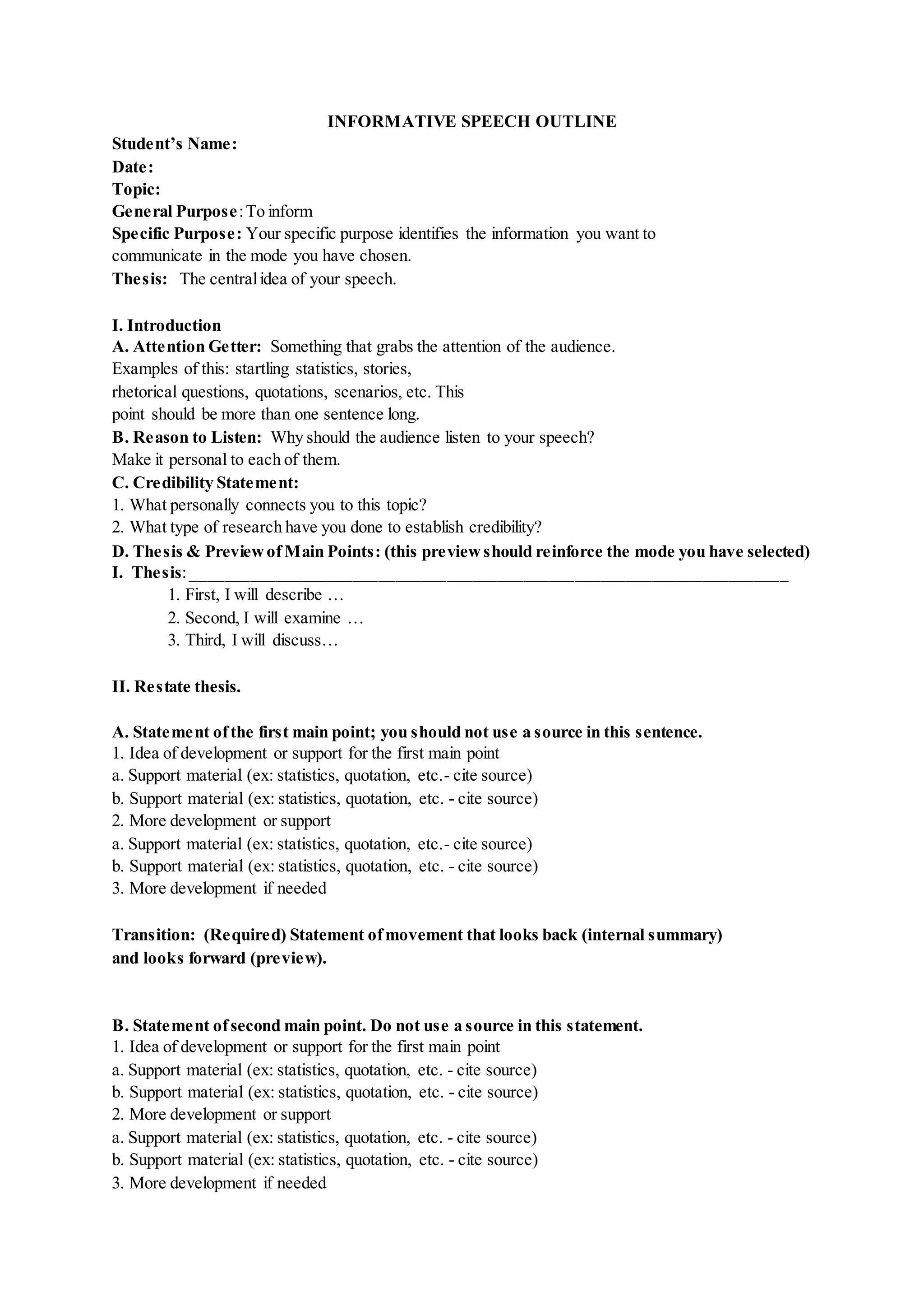
INFORMATIVE SPEECH OUTLINE
Student’s Name:
Date:
Topic:
General Purpose:To inform
Specific Purpose: Your specific purpose identifies the information you want to
communicate in the mode you have chosen.
Thesis: The centralidea of your speech.
I. Introduction
A. Attention Getter: Something that grabs the attention of the audience.
Examples of this: startling statistics, stories,
rhetorical questions, quotations, scenarios, etc. This
point should be more than one sentence long.
B. Reason to Listen: Why should the audience listen to your speech?
Make it personal to each of them.
C. Credibility Statement:
1. What personally connects you to this topic?
2. What type of research have you done to establish credibility?
D. Thesis & Previewof Main Points: (this previewshould reinforce the mode you have selected)
I. Thesis:______________________________________________________________________
1. First, I will describe …
2. Second, I will examine …
3. Third, I will discuss…
II. Restate thesis.
A. Statement ofthe first main point; you should not use a source in this sentence.
1. Idea of development or support for the first main point
a. Support material (ex: statistics, quotation, etc.- cite source)
b. Support material (ex: statistics, quotation, etc. - cite source)
2. More development or support
a. Support material (ex: statistics, quotation, etc.- cite source)
b. Support material (ex: statistics, quotation, etc. - cite source)
3. More development if needed
Transition: (Required) Statement ofmovement that looks back (internal summary)
and looks forward (preview).
B. Statement ofsecond main point. Do not use a source in this statement.
1. Idea of development or support for the first main point
a. Support material (ex: statistics, quotation, etc. - cite source)
b. Support material (ex: statistics, quotation, etc. - cite source)
2. More development or support
a. Support material (ex: statistics, quotation, etc. - cite source)
b. Support material (ex: statistics, quotation, etc. - cite source)
3. More development if needed
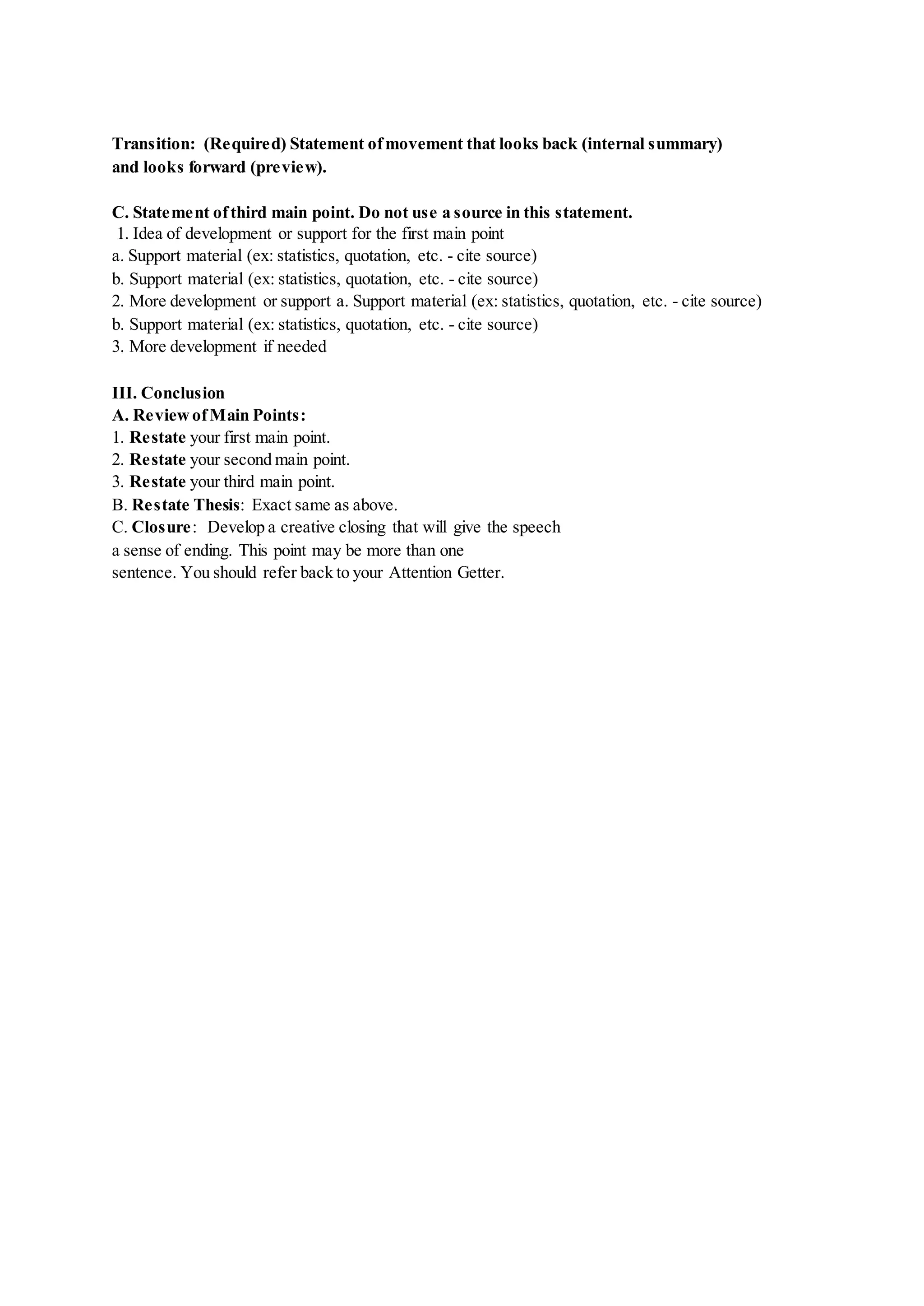
Transition: (Required) Statement ofmovement that looks back (internal summary)
and looks forward (preview).
C. Statement ofthird main point. Do not use a source in this statement.
1. Idea of development or support for the first main point
a. Support material (ex: statistics, quotation, etc. - cite source)
b. Support material (ex: statistics, quotation, etc. - cite source)
2. More development or support a. Support material (ex: statistics, quotation, etc. - cite source)
b. Support material (ex: statistics, quotation, etc. - cite source)
3. More development if needed
III. Conclusion
A. ReviewofMain Points:
1. Restate your first main point.
2. Restate your second main point.
3. Restate your third main point.
B. Restate Thesis: Exact same as above.
C. Closure: Develop a creative closing that will give the speech
a sense of ending. This point may be more than one
sentence. You should refer back to your Attention Getter.

Informative speech outline sample

  • 1.
    INFORMATIVE SPEECH OUTLINE Student’sName: Date: Topic: General Purpose:To inform Specific Purpose: Your specific purpose identifies the information you want to communicate in the mode you have chosen. Thesis: The centralidea of your speech. I. Introduction A. Attention Getter: Something that grabs the attention of the audience. Examples of this: startling statistics, stories, rhetorical questions, quotations, scenarios, etc. This point should be more than one sentence long. B. Reason to Listen: Why should the audience listen to your speech? Make it personal to each of them. C. Credibility Statement: 1. What personally connects you to this topic? 2. What type of research have you done to establish credibility? D. Thesis & Previewof Main Points: (this previewshould reinforce the mode you have selected) I. Thesis:______________________________________________________________________ 1. First, I will describe … 2. Second, I will examine … 3. Third, I will discuss… II. Restate thesis. A. Statement ofthe first main point; you should not use a source in this sentence. 1. Idea of development or support for the first main point a. Support material (ex: statistics, quotation, etc.- cite source) b. Support material (ex: statistics, quotation, etc. - cite source) 2. More development or support a. Support material (ex: statistics, quotation, etc.- cite source) b. Support material (ex: statistics, quotation, etc. - cite source) 3. More development if needed Transition: (Required) Statement ofmovement that looks back (internal summary) and looks forward (preview). B. Statement ofsecond main point. Do not use a source in this statement. 1. Idea of development or support for the first main point a. Support material (ex: statistics, quotation, etc. - cite source) b. Support material (ex: statistics, quotation, etc. - cite source) 2. More development or support a. Support material (ex: statistics, quotation, etc. - cite source) b. Support material (ex: statistics, quotation, etc. - cite source) 3. More development if needed
  • 2.
    Transition: (Required) Statementofmovement that looks back (internal summary) and looks forward (preview). C. Statement ofthird main point. Do not use a source in this statement. 1. Idea of development or support for the first main point a. Support material (ex: statistics, quotation, etc. - cite source) b. Support material (ex: statistics, quotation, etc. - cite source) 2. More development or support a. Support material (ex: statistics, quotation, etc. - cite source) b. Support material (ex: statistics, quotation, etc. - cite source) 3. More development if needed III. Conclusion A. ReviewofMain Points: 1. Restate your first main point. 2. Restate your second main point. 3. Restate your third main point. B. Restate Thesis: Exact same as above. C. Closure: Develop a creative closing that will give the speech a sense of ending. This point may be more than one sentence. You should refer back to your Attention Getter.