Informative Preparation Outline (20pts)
& Speech Delivery (80pts) Guidelines
4
(Don’t forget the header!) (The format below is your guideline for the Prep Outline)
Student Name
Course Name
Assignment Name
Date
PREPARATION OULTINE
(Instruction Note, DO NOT SUBMIT A NUMBERED ESSAY. You should have a draft
essay manuscript of your speech completed first, you can then pull the appropriate
sentences into the Preparation Outline.)
Topic: Topic Name (Instruction Note to Student: Topic picked from the approved list
provided and approved by instructor.)
Specific Purpose: To inform my audience about… (Instruction Note to Student: This
statement is not stated in the speech, it is the goal you set for yourself in presenting the
topic.)
Central Idea: The central idea is the topic and its importance. It is much like the claim
or main argument of an essay. (Instruction Note to Student: Note, this sentence begins
with the topic and contains NO personal pronouns to start.)
Main Points: Speech organized into 3-5 main points listed here by number. (Instruction
Note to Student: I suggest you have three main points that are well organized and in
logical pattern.)
I. INTRODUCTION (Instruction Note to Student: Your goal here is to draw us into your
speech…start your speech: it will include an Attention Getter, a sentence defining
and describing the topic to the audience, a sentence telling them your purpose
for the speech and why it should be relevant to them, a statement on your part
explaining your credibility, the central idea sentence, and close the introduction
with a preview statement of the main points.)
A. Attention Getter: Wake the audience up! (Instruction Note to Student: This
step helps us focus our attention on you and your message.
It is suggested that you begin with a story, quote, statistic,
definition, use of suspense, etc. Never begin with, "Hi I am
___ and today I am going to talk about ___.")
B. Introduce YOURSELF: (Instruction Note to Student: After you have finished the
attention getter, now is the time to introduce yourself. We
need to know who you are to relate to you better.)
Informative Preparation Outline (20pts)
& Speech Delivery (80pts) Guidelines
5
C. Relevancy Statement: (Instruction Note to Student: This is important! – Let the
audience know why they need to know your information or
why it is important to listen (AKA audience motivation))
D. Credibility Statement: (Instruction Note to Student: Share why you as a speaker can
speak on this topic. Establish that you have done extensive
research from expert sources, with knowledge, trustworthiness,
competency and objectivity on the issue/topic.)
D. Central Idea: (Instruction Note to Student: State your Central Idea here. The
central idea of the speech, much like the claim or main argument
of an essay. Note, this sentence begins with the topic and
contains NO personal pronouns to start.)
E. Preview of Speech: (Instruction Note to Student: Tell them what they will learn, share
your main points (Here summarize your speech in one sentence
and continue by previewing the main points of the speech):
Today, I will tell you first, ______________,
second, _____________ and finally, ______________.
Connective Link: NOW that we've covered _______, let's go to ____________.
(Instruction Note to Student: Or something MORE CREATIVE WOULD BE WONDERFUL. Use
as creative approach with the connective links if you'd like! Just remember that your transitions
need to review your last point AND preview your next point. They show a connection and are a
good time to remind the audience why this information is important. (Connective Link here
precedes the Body of Speech and one will then precede each main part of the speech)
II. BODY (The majority (2/3) of the speech goes here…)
A. Main Point 1 Topic Named, Describe, and Define (Instruction Note to Student:
Your main points are the MAIN CONCEPTS/IDEAS of your speech. They are the ideas
necessary in supporting/proving/explaining your thesis. They are "reasons why,"
"primary types," "steps," etc. Speeches are organized into 3-5 main points. I suggest you
have three main points that are well organized and in logical pattern.)
1. Main Point 1 Detail Description (Instruction Note to Student: The
subpoints are the breakdown of the main point into smaller units. They usually
are your examples, narratives, statistics, testimony, etc. In other words, the
subpoints explain the main points. You may have 2-5 subpoints. I have listed
three here. Feel free to modify this as you see necessary. Do use the golden
rule: one hard piece of "fact" or "statistics," one piece of "softer" evidence such
as an example or story and then a piece of testimony to give it credibility.)
a. Subpoint 1 of Main Point A (if needed).
Informative Preparation Outline (20pts)
& Speech Delivery (80pts) Guidelines
6
b. Subpoint 2 of Main Point A (if needed).
c. Subpoint 3 of Main Point A (if needed).
Connective Link: NOW that we have covered __________, let's move to __________.
(Instruction Note to Student: Again, use a more creative approach with the connective links if
you'd like! Just remember that your transitions need to review your last point AND preview your
next point. They should not be repetitive but show a connection. (precedes into Main Point 2) --
B. Main Point 2 Name (Instruction Note to Student: Your main points are the ideas
necessary in supporting/proving/explaining your thesis. They are "reasons why,"
"primary types," "steps," etc.)
1. Main Point 2 Detail Description (Instruction Note to Student: The
subpoints are the breakdown of the main point into smaller units. They usually
are your examples, narratives, statistics, testimony, etc. Do use the golden rule:
one hard piece of "fact" or "statistics," one piece of "softer" evidence such as an
example or story and then a piece of testimony to give it credibility.)
a. Subpoint 1 of Main Point A (if needed).
b. Subpoint 2 of Main Point A (if needed).
c. Subpoint 3 of Main Point A (if needed).
Connective Link: We have covered __________, Next, let's move to __________.
(Instruction Note to Student: Again, show a connection. (precedes into Main Point 3) --
C. Main Point 3 Name (Instruction Note to Student: Your main points are individual
and should not repeat each other.)
1. Main Point 3 Detail Description (Instruction Note to Student: The
subpoints are the breakdown of the main point into smaller units. They usually
are your examples, narratives, statistics, testimony, etc. Do use the golden rule:
one hard piece of "fact" or "statistics," one piece of "softer" evidence such as an
example or story and then a piece of testimony to give it credibility.)
a. Subpoint 1 of Main Point A (if needed).
b. Subpoint 2 of Main Point A (if needed).
c. Subpoint 3 of Main Point A (if needed).
Informative Preparation Outline (20pts)
& Speech Delivery (80pts) Guidelines
7
III. CONCLUSION
A. Signal to Closing (of speech): (Instruction Note to Student: This sentence signals the
end of your speech approaching), "To sum things up…" or something more creative).
B. Main Points Summary: (Instruction Note to Student: This sentence summarizes the main
points you have just shared in the speech)
C. Restate your Central Idea: (Instruction Note to Student: This sentence reminds the
audience of the topic and why it is important. Reemphasize the central idea in a memorable way
– use quotations, stories or rhetorical questions that help us understand the importance of your
message.)
D. Audience Response Statement: (Instruction Note to Student: This sentence tells the
audience again how they benefit from knowing it and shows the connection between you, the
audience, and the topic.)
E. WOW Statement: (Instruction Note to Student: This sentence is a memorable closing
statement that ties everything together. Also, make this statement serve as a signal that you
have concluded your speech. (Final thought you want left in the mind of the audience. Gives
you a way to end; never, ever end on "that's it" -- plan out the end, better yet, tie back to the
introduction's attention getter)
F. Thank You! (Instruction Note to Student: Be professional and courteous, always thank the
audience for their time and/or attention)
(DON’T FORGET YOUR WORK CITED PAGE!!)
– USE THE PAGE BREAK TO START IT

TEMPLATE SAMPLE of an Informative SPEECH Preparation OUTLINE

  • 1.
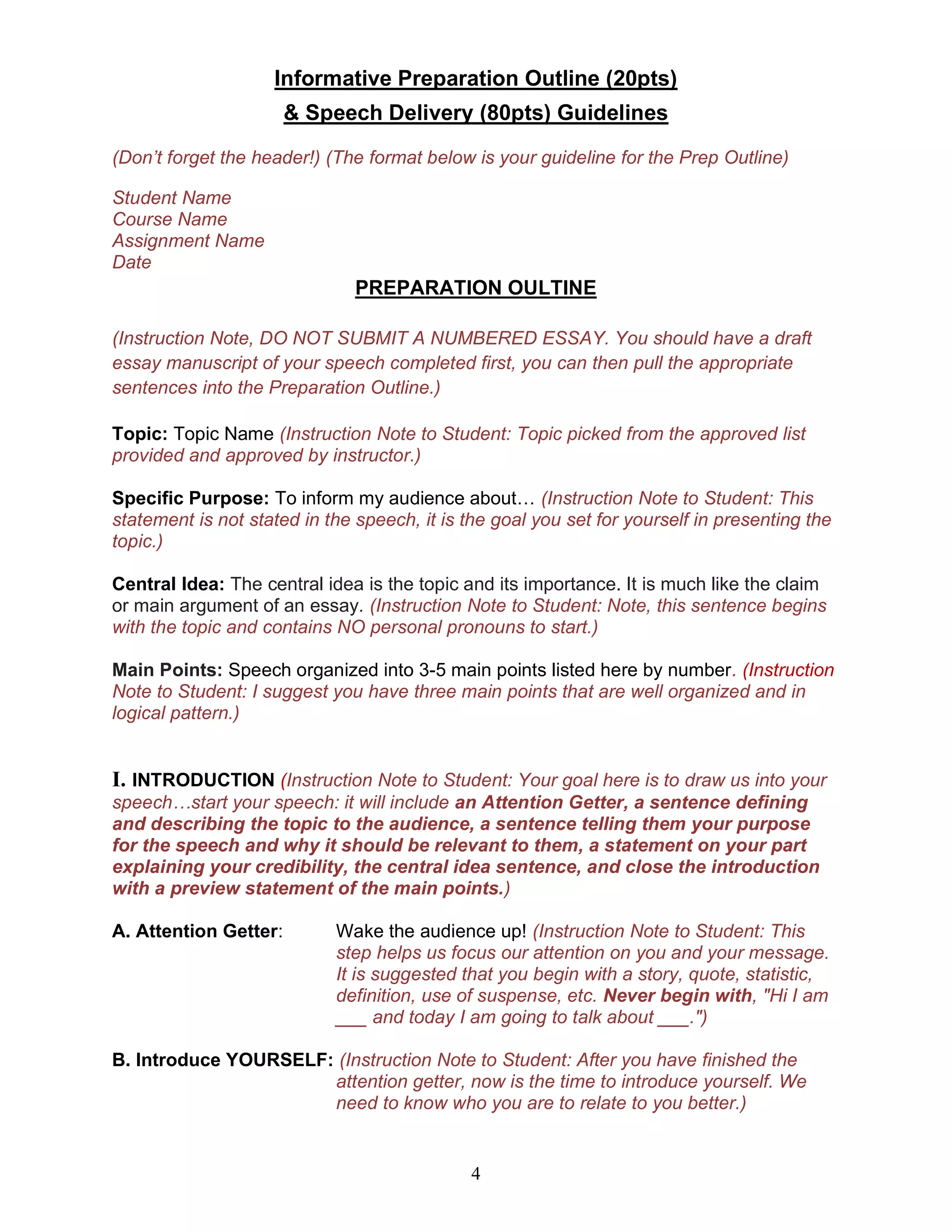
    Informative Preparation Outline(20pts) & Speech Delivery (80pts) Guidelines 4 (Don’t forget the header!) (The format below is your guideline for the Prep Outline) Student Name Course Name Assignment Name Date PREPARATION OULTINE (Instruction Note, DO NOT SUBMIT A NUMBERED ESSAY. You should have a draft essay manuscript of your speech completed first, you can then pull the appropriate sentences into the Preparation Outline.) Topic: Topic Name (Instruction Note to Student: Topic picked from the approved list provided and approved by instructor.) Specific Purpose: To inform my audience about… (Instruction Note to Student: This statement is not stated in the speech, it is the goal you set for yourself in presenting the topic.) Central Idea: The central idea is the topic and its importance. It is much like the claim or main argument of an essay. (Instruction Note to Student: Note, this sentence begins with the topic and contains NO personal pronouns to start.) Main Points: Speech organized into 3-5 main points listed here by number. (Instruction Note to Student: I suggest you have three main points that are well organized and in logical pattern.) I. INTRODUCTION (Instruction Note to Student: Your goal here is to draw us into your speech…start your speech: it will include an Attention Getter, a sentence defining and describing the topic to the audience, a sentence telling them your purpose for the speech and why it should be relevant to them, a statement on your part explaining your credibility, the central idea sentence, and close the introduction with a preview statement of the main points.) A. Attention Getter: Wake the audience up! (Instruction Note to Student: This step helps us focus our attention on you and your message. It is suggested that you begin with a story, quote, statistic, definition, use of suspense, etc. Never begin with, "Hi I am ___ and today I am going to talk about ___.") B. Introduce YOURSELF: (Instruction Note to Student: After you have finished the attention getter, now is the time to introduce yourself. We need to know who you are to relate to you better.)
  • 2.
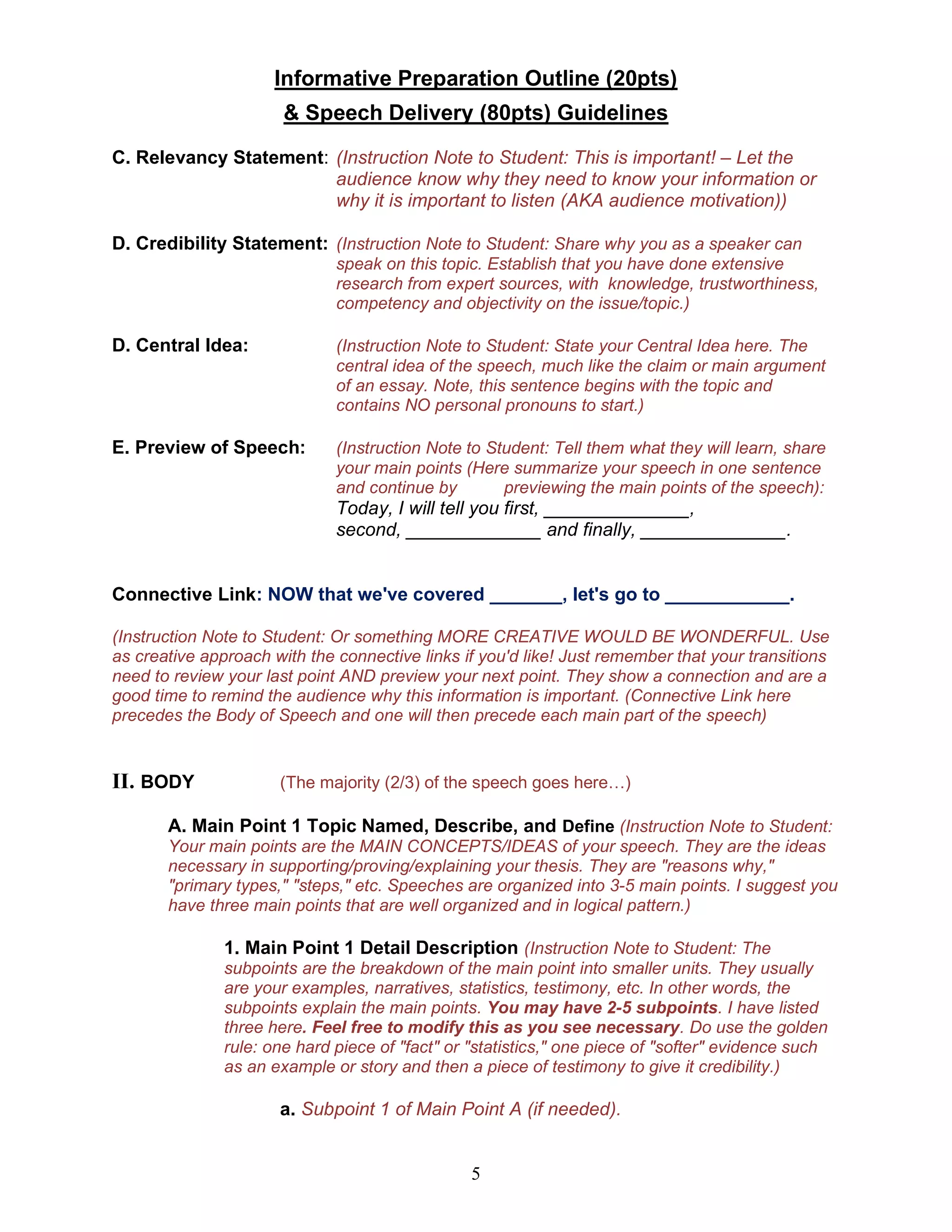
    Informative Preparation Outline(20pts) & Speech Delivery (80pts) Guidelines 5 C. Relevancy Statement: (Instruction Note to Student: This is important! – Let the audience know why they need to know your information or why it is important to listen (AKA audience motivation)) D. Credibility Statement: (Instruction Note to Student: Share why you as a speaker can speak on this topic. Establish that you have done extensive research from expert sources, with knowledge, trustworthiness, competency and objectivity on the issue/topic.) D. Central Idea: (Instruction Note to Student: State your Central Idea here. The central idea of the speech, much like the claim or main argument of an essay. Note, this sentence begins with the topic and contains NO personal pronouns to start.) E. Preview of Speech: (Instruction Note to Student: Tell them what they will learn, share your main points (Here summarize your speech in one sentence and continue by previewing the main points of the speech): Today, I will tell you first, ______________, second, _____________ and finally, ______________. Connective Link: NOW that we've covered _______, let's go to ____________. (Instruction Note to Student: Or something MORE CREATIVE WOULD BE WONDERFUL. Use as creative approach with the connective links if you'd like! Just remember that your transitions need to review your last point AND preview your next point. They show a connection and are a good time to remind the audience why this information is important. (Connective Link here precedes the Body of Speech and one will then precede each main part of the speech) II. BODY (The majority (2/3) of the speech goes here…) A. Main Point 1 Topic Named, Describe, and Define (Instruction Note to Student: Your main points are the MAIN CONCEPTS/IDEAS of your speech. They are the ideas necessary in supporting/proving/explaining your thesis. They are "reasons why," "primary types," "steps," etc. Speeches are organized into 3-5 main points. I suggest you have three main points that are well organized and in logical pattern.) 1. Main Point 1 Detail Description (Instruction Note to Student: The subpoints are the breakdown of the main point into smaller units. They usually are your examples, narratives, statistics, testimony, etc. In other words, the subpoints explain the main points. You may have 2-5 subpoints. I have listed three here. Feel free to modify this as you see necessary. Do use the golden rule: one hard piece of "fact" or "statistics," one piece of "softer" evidence such as an example or story and then a piece of testimony to give it credibility.) a. Subpoint 1 of Main Point A (if needed).
  • 3.
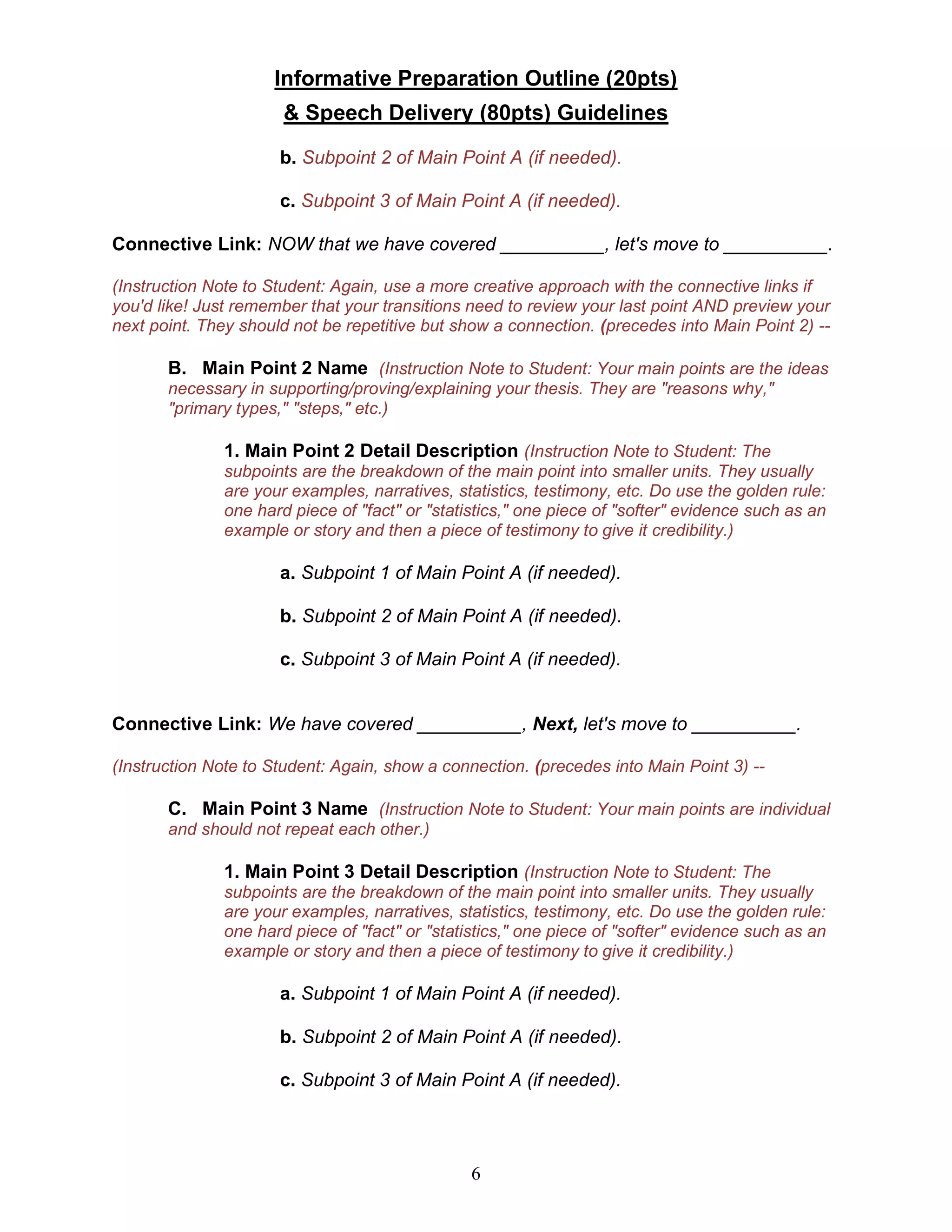
    Informative Preparation Outline(20pts) & Speech Delivery (80pts) Guidelines 6 b. Subpoint 2 of Main Point A (if needed). c. Subpoint 3 of Main Point A (if needed). Connective Link: NOW that we have covered __________, let's move to __________. (Instruction Note to Student: Again, use a more creative approach with the connective links if you'd like! Just remember that your transitions need to review your last point AND preview your next point. They should not be repetitive but show a connection. (precedes into Main Point 2) -- B. Main Point 2 Name (Instruction Note to Student: Your main points are the ideas necessary in supporting/proving/explaining your thesis. They are "reasons why," "primary types," "steps," etc.) 1. Main Point 2 Detail Description (Instruction Note to Student: The subpoints are the breakdown of the main point into smaller units. They usually are your examples, narratives, statistics, testimony, etc. Do use the golden rule: one hard piece of "fact" or "statistics," one piece of "softer" evidence such as an example or story and then a piece of testimony to give it credibility.) a. Subpoint 1 of Main Point A (if needed). b. Subpoint 2 of Main Point A (if needed). c. Subpoint 3 of Main Point A (if needed). Connective Link: We have covered __________, Next, let's move to __________. (Instruction Note to Student: Again, show a connection. (precedes into Main Point 3) -- C. Main Point 3 Name (Instruction Note to Student: Your main points are individual and should not repeat each other.) 1. Main Point 3 Detail Description (Instruction Note to Student: The subpoints are the breakdown of the main point into smaller units. They usually are your examples, narratives, statistics, testimony, etc. Do use the golden rule: one hard piece of "fact" or "statistics," one piece of "softer" evidence such as an example or story and then a piece of testimony to give it credibility.) a. Subpoint 1 of Main Point A (if needed). b. Subpoint 2 of Main Point A (if needed). c. Subpoint 3 of Main Point A (if needed).
  • 4.
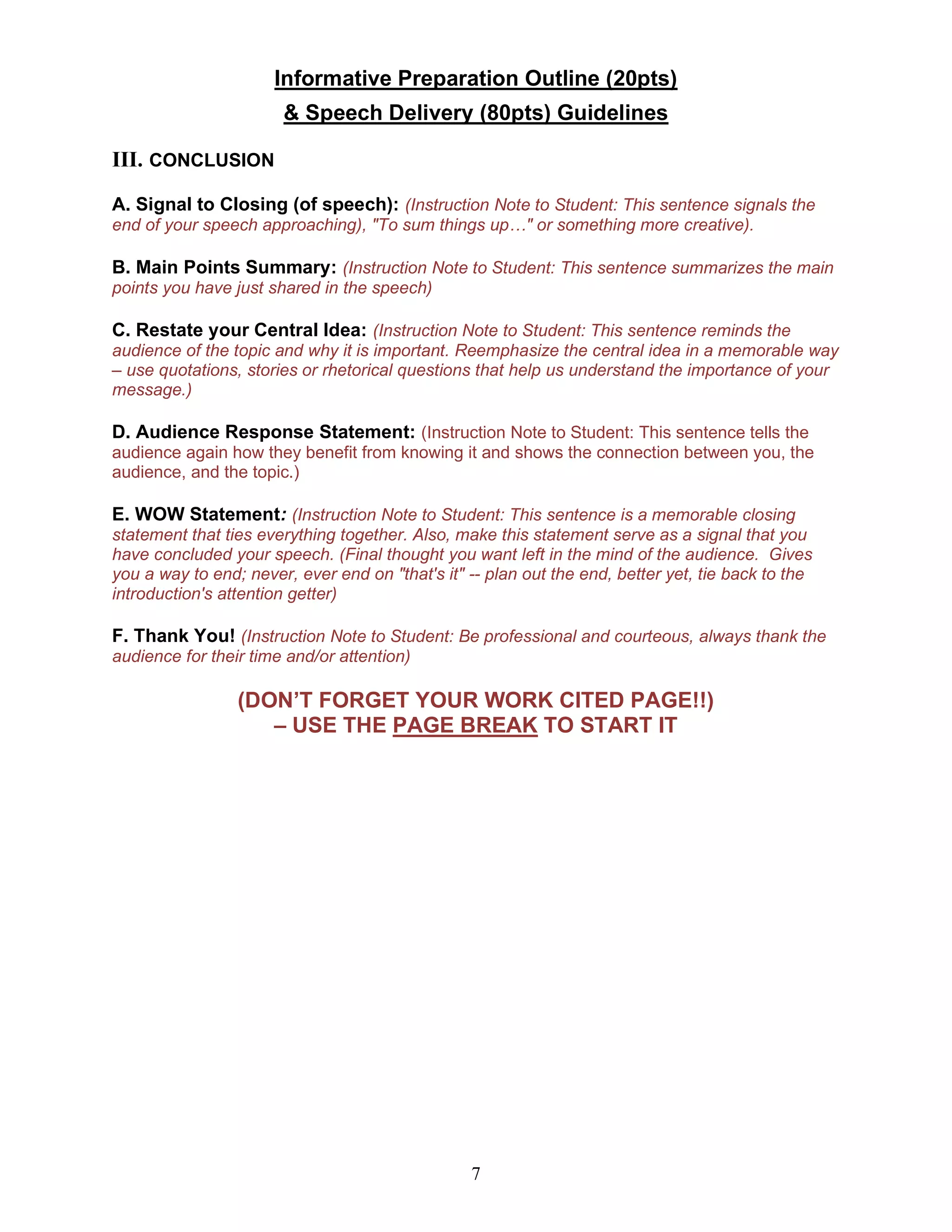
    Informative Preparation Outline(20pts) & Speech Delivery (80pts) Guidelines 7 III. CONCLUSION A. Signal to Closing (of speech): (Instruction Note to Student: This sentence signals the end of your speech approaching), "To sum things up…" or something more creative). B. Main Points Summary: (Instruction Note to Student: This sentence summarizes the main points you have just shared in the speech) C. Restate your Central Idea: (Instruction Note to Student: This sentence reminds the audience of the topic and why it is important. Reemphasize the central idea in a memorable way – use quotations, stories or rhetorical questions that help us understand the importance of your message.) D. Audience Response Statement: (Instruction Note to Student: This sentence tells the audience again how they benefit from knowing it and shows the connection between you, the audience, and the topic.) E. WOW Statement: (Instruction Note to Student: This sentence is a memorable closing statement that ties everything together. Also, make this statement serve as a signal that you have concluded your speech. (Final thought you want left in the mind of the audience. Gives you a way to end; never, ever end on "that's it" -- plan out the end, better yet, tie back to the introduction's attention getter) F. Thank You! (Instruction Note to Student: Be professional and courteous, always thank the audience for their time and/or attention) (DON’T FORGET YOUR WORK CITED PAGE!!) – USE THE PAGE BREAK TO START IT