What major genre 
would 
informational text 
fall under?
To convey information
Because my teacher said 
so!!! NO!!! 
To gain information … YES!!!
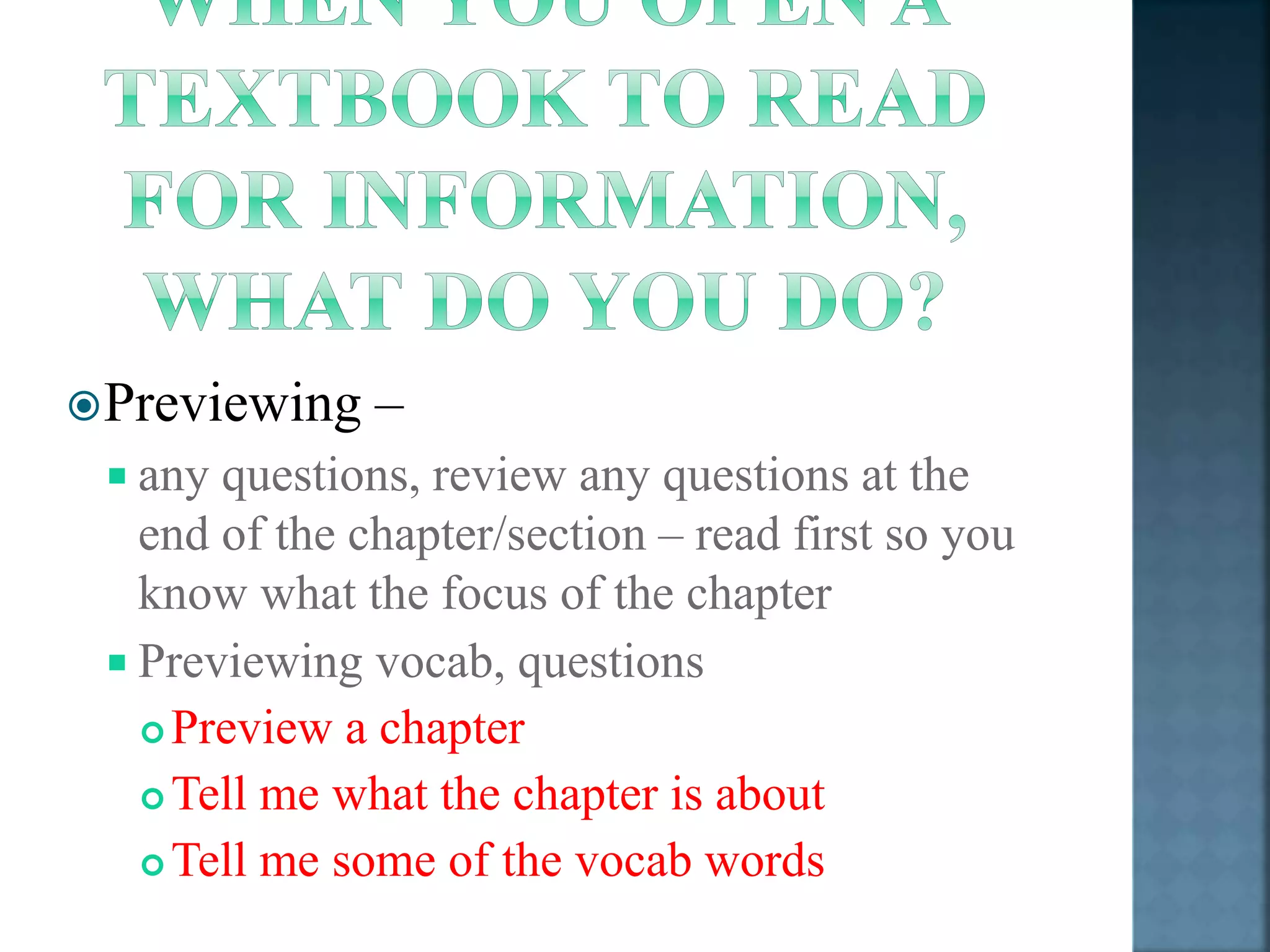
Previewing – 
 any questions, review any questions at the 
end of the chapter/section – read first so you 
know what the focus of the chapter 
 Previewing vocab, questions 
Preview a chapter 
Tell me what the chapter is about 
Tell me some of the vocab words
Read the chapter
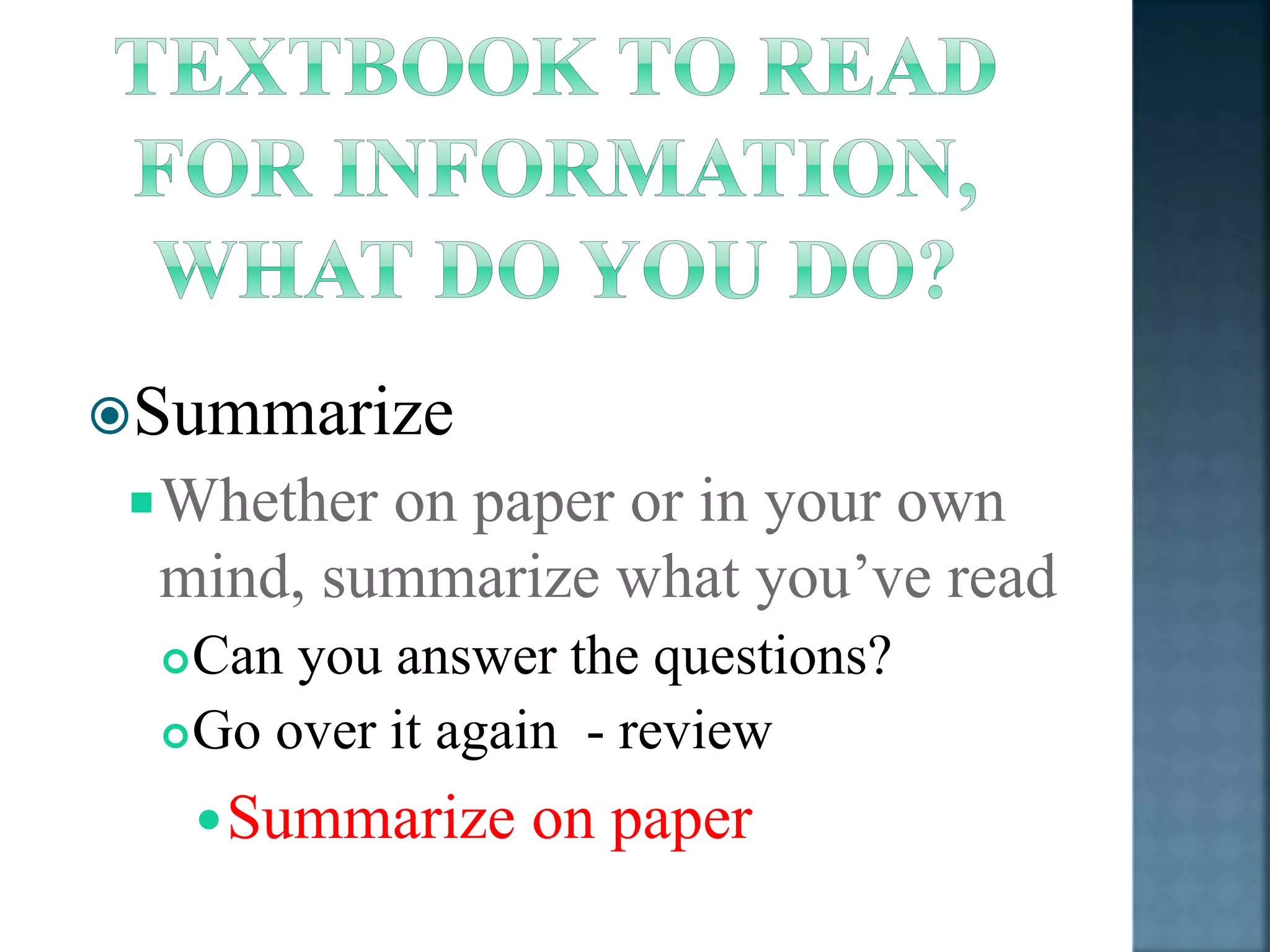
Summarize 
Whether on paper or in your own 
mind, summarize what you’ve read 
Can you answer the questions? 
Go over it again - review 
ď‚—Summarize on paper
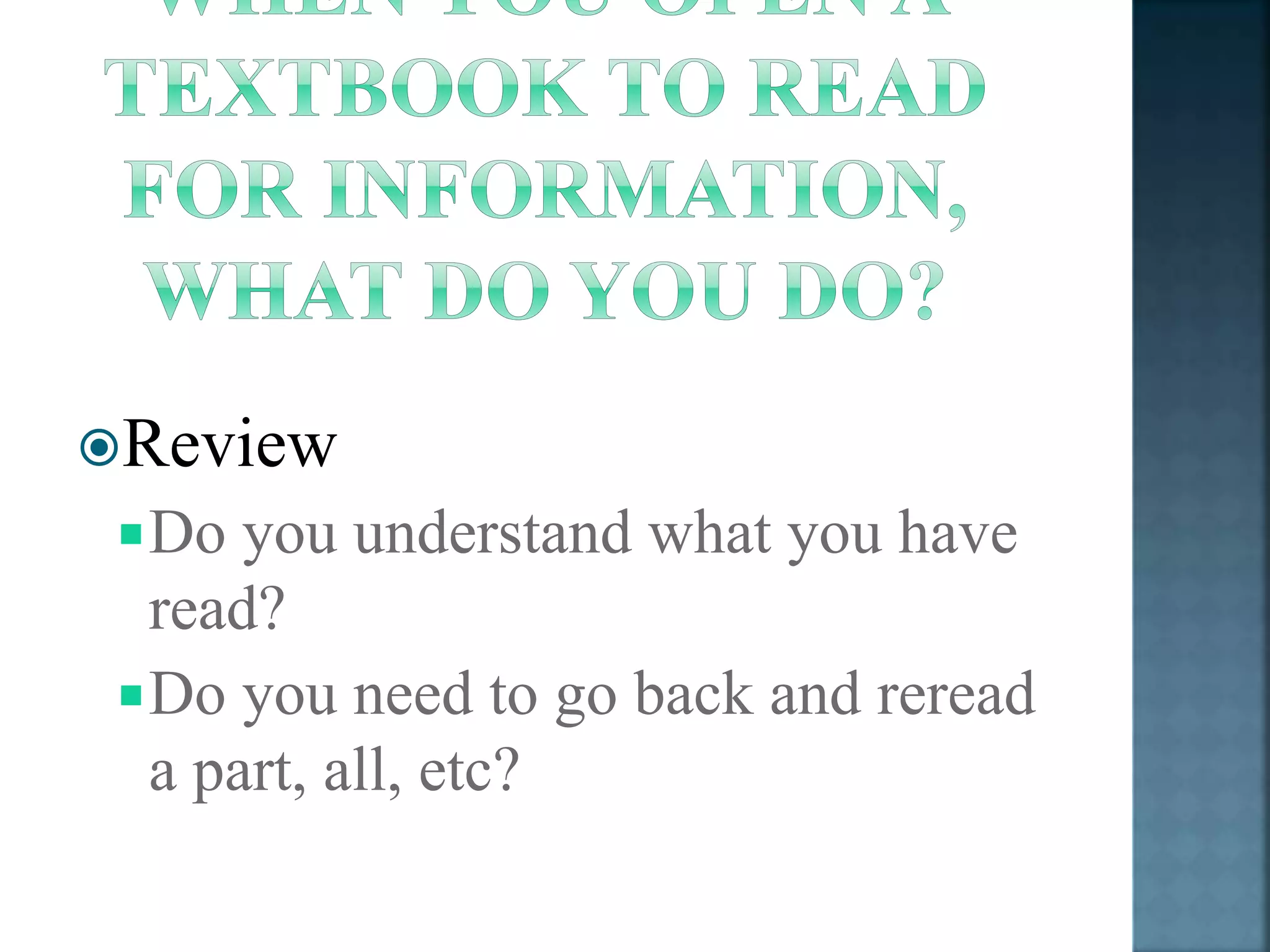
Review 
Do you understand what you have 
read? 
Do you need to go back and reread 
a part, all, etc?
Can you list the steps of how to 
read an informational text? 
•Preview 
•Question 
•Summarize 
•Review
Features – headings, 
subheadings, realistic photos 
with labels and captions 
Navigational tools – indexes, 
table of contents 
Various graphical devices – 
tables, charts, diagrams
Posters 
Pamphlets
Textbooks 
Encyclopedias 
Dictionaries 
“how-to” books 
Field guides 
“all about” books
Books 
Magazines 
Pamphlets 
Newspapers 
Posters 
Web sites
Chronological … SS … 
history 
Logical order … think about 
science / math books 
Topical … religion … art … 
building/architecture
Which book would you use if 
I said find info on … 
Pyramids 
A WWII battle 
Dogs 
A mathematician
 Choose a topic 
 Example … car or panda bear 
 Write a short intro as if you were writing a story about that 
topic 
 Now, with the same topic, write a piece of informational text 
about the topic 
 Discuss 
 What was your purpose? 
 What was the reader’s purpose? … why would readers read 
one v. the other? 
 What did you do different? 
 Heading 
 Subheading 
 Pictures with captions 
 Etc
1. What are the four steps of being an active reader? 
2. What is the author’s purpose of writing a piece of 
informational text? 
3. What is the reader’s purpose for reading a piece of 
informational text? 
4. What is involved in previewing a chapter? 
5. When do you ask questions about the chapter? 
6. List 3 examples of informational text. 
7. List 2 examples of literature that would not be 
informational text. 
8. What genre would informational text fall under? 
9. Give 3 characteristics of a piece of informational text. 
10.List 1 type of organizational structure of informational 
text.
 Practice outlining and webbing 
 Practice what we learned about how to read an 
informational text 
 Use SS text for practice – 
 write down characteristics of informational text 
 Author’s purpose 
 Reader’s purpose 
 Steps 
 Preview the chapter (write down a couple of questions) 
 Questions (write down questions you have WHILE you are 
reading) 
 Summarize 
 Review 
 Choose a chapter you have some interest in and 
outline the chapter.

Informational text

  • 2.
    What major genre would informational text fall under?
  • 3.
  • 4.
    Because my teachersaid so!!! NO!!! To gain information … YES!!!
  • 5.
    Previewing – any questions, review any questions at the end of the chapter/section – read first so you know what the focus of the chapter  Previewing vocab, questions Preview a chapter Tell me what the chapter is about Tell me some of the vocab words
  • 6.
  • 7.
    Summarize Whether onpaper or in your own mind, summarize what you’ve read Can you answer the questions? Go over it again - review Summarize on paper
  • 8.
    Review Do youunderstand what you have read? Do you need to go back and reread a part, all, etc?
  • 9.
    Can you listthe steps of how to read an informational text? •Preview •Question •Summarize •Review
  • 10.
    Features – headings, subheadings, realistic photos with labels and captions Navigational tools – indexes, table of contents Various graphical devices – tables, charts, diagrams
  • 11.
  • 12.
    Textbooks Encyclopedias Dictionaries “how-to” books Field guides “all about” books
  • 13.
    Books Magazines Pamphlets Newspapers Posters Web sites
  • 14.
    Chronological … SS… history Logical order … think about science / math books Topical … religion … art … building/architecture
  • 15.
    Which book wouldyou use if I said find info on … Pyramids A WWII battle Dogs A mathematician
  • 16.
     Choose atopic  Example … car or panda bear  Write a short intro as if you were writing a story about that topic  Now, with the same topic, write a piece of informational text about the topic  Discuss  What was your purpose?  What was the reader’s purpose? … why would readers read one v. the other?  What did you do different?  Heading  Subheading  Pictures with captions  Etc
  • 19.
    1. What arethe four steps of being an active reader? 2. What is the author’s purpose of writing a piece of informational text? 3. What is the reader’s purpose for reading a piece of informational text? 4. What is involved in previewing a chapter? 5. When do you ask questions about the chapter? 6. List 3 examples of informational text. 7. List 2 examples of literature that would not be informational text. 8. What genre would informational text fall under? 9. Give 3 characteristics of a piece of informational text. 10.List 1 type of organizational structure of informational text.
  • 20.
     Practice outliningand webbing  Practice what we learned about how to read an informational text  Use SS text for practice –  write down characteristics of informational text  Author’s purpose  Reader’s purpose  Steps  Preview the chapter (write down a couple of questions)  Questions (write down questions you have WHILE you are reading)  Summarize  Review  Choose a chapter you have some interest in and outline the chapter.

Editor's Notes

  • #2 http://teacher.scholastic.com/products/scholasticprofessional/authors/pdfs/duke_sample_pages.pdf great file for info
  • #6 Preview a chapter Tell me what the chapter is about Tell me some of the vocab words Questions always about the main idea --- read questions and the focus on those questions while reading
  • #7 Questions always about the main idea --- read questions and the focus on those questions while reading
  • #8 Questions always about the main idea --- read questions and the focus on those questions while reading
  • #9 Questions always about the main idea --- read questions and the focus on those questions while reading