Information Source & Resource
Dr. Nrapendra Vir Singh
Assistant Professor
Department of Teacher Education
Central University of South Bihar, Gaya
Email: aashubhu@gmail.com
nrapendra@cusb.ac.in
Information Source
• Information Sources: The sources wherefrom we get information are information sources. These
sources comprise documents, institutions and organisations, and human beings. For example, for
finding out the meaning of a word, we consult a dictionary; for admission in a particular course of
study, students contact an institution; and for fixing the date of a marriage, people consult a
priest. The term 'information sources' pertain to library and information science. Mostly librarians
and information scientists deal with information sources.
• An information source refers to any tangible or intangible form that provides knowledge or data.
It can be categorized into human sources, institutional sources, and documentary sources. Human
sources include experts and researchers, while institutional sources are organizations and
institutions.
• A source is one that makes something available, but a resource helps in creating something new.
• The key difference between sources and resources lies in their purpose and scope. Sources refer
to the origin or place from which information, data, or material originates, while resources
encompass anything that can be utilized to achieve a goal, support a task, or fulfill a need. In
essence, sources provide information, while resources support the process of using that
information.
Dr. N V Singh
Characteristics of Information Sources
Origin
• Indicates where the information comes from — a person, institution, document, or platform.
(Primary or Secondary, Factual or Analytical, Objective or Subjective )
• Examples: books, experts, websites, interviews.
Format
• Refers to the medium in which the information appears.
• Types: Print (books, newspapers), Digital (websites, e-books), Audio/Visual (podcasts, videos), Oral
(lectures, interviews).
Credibility
• Assesses trustworthiness and authority.
• Indicators: Author's qualifications, citations, publisher reputation, peer-review status.
Timeliness
• Indicates how current or up-to-date the information is.
• Important in fast-changing fields like science, technology, and current events.
Dr. N V Singh
Contd..
Accuracy
• Reflects how correct and error-free the information is.
• Based on verifiable facts, consistency, and references.
Purpose
• The intent behind the information: to inform, persuade, entertain, educate, or advertise.
• Helps users understand bias or perspective.
Scope/Depth
• Describes how broad or detailed the content is.
• Some sources give overviews (encyclopedias), others offer deep analysis (journal articles).
Relevance
• Measures how well the source fits the user's information need or research topic.
Accessibility
• Refers to how easily users can access the source.
• Includes open access materials, subscription-based journals, and physical availability.
Dr. N V Singh
Information Resources
Primary Sources: Original, firsthand information or data.
• Examples: Diaries, interviews, speeches, Research data, lab reports, Historical
documents, legal cases, Photographs, audio/video recordings
Secondary Sources: Interpretations or analyses based on primary sources.
• Examples: Textbooks, Journal review articles, Biographies, Commentaries, critiques
• Tertiary Sources: Summarized or condensed versions of primary and secondary
sources.
• Examples: Encyclopedias, Dictionaries, Manuals, Indexes and bibliographies
• Print Sources: Books, newspapers, journals, magazines
• Digital Sources: Websites, e-books, online databases, blogs, social media
• Human Sources: Experts, teachers, professionals, witnesses
• Multimedia Sources: Documentaries, educational videos, podcasts
Dr. N V Singh
Dr. N V Singh
Process: From Information Source to Information Resource
Identification of the Source: Recognize who or what provides the information.
• Example: A subject expert (like a professor), a researcher, or a credible website.
Validation and Evaluation: Check credibility, accuracy, and relevance.
• Tools used: Peer review, citations, fact-checking, publication history.
• Goal: Ensure the source is trustworthy and academically sound.
Documentation: Information is recorded or published.
• Formats: Articles, books, research papers, databases, tutorials.
• Transition point: The knowledge of the source is now fixed and shareable.
Cataloging and Indexing: Librarians or systems classify the information.
• Tools: Dewey Decimal System, subject headings, metadata tags.
• Goal: Make it easy to find, access, and reference.
Integration into Educational Resources: Added to reading lists, reference collections, or e-learning platforms.
• Examples: Inclusion in course materials, learning management systems (LMS), or library catalogs.
Becomes an Information Resource: A stable, reusable, and accessible source of knowledge for others.
• Used by: Students, educators, librarians, researchers.
Dr. N V Singh
Process: From Information Source to Information Resource
Information Resource
• An information resource refers to any material, tool, or medium that provides
factual data, knowledge, or guidance for learning, research, or decision-making.
It encompasses a wide range of formats, including books, journals, databases,
websites, audiovisual content, and digital repositories. Information resources
are typically organized, stored, and made accessible for users through libraries,
archives, or online platforms. Unlike an information source, which is the origin
or provider of the knowledge (like a person or an institution), an information
resource is the product or recorded form of that knowledge. In educational
settings, information resources are essential for teaching, learning, and
academic inquiry, helping students and researchers explore topics, gather
evidence, and develop informed perspectives. Effective use of information
resources depends on the user’s ability to locate, evaluate, and apply them
appropriately. As such, they play a critical role in promoting information literacy
and supporting lifelong learning across various disciplines.
Dr. N V Singh
Information Age
•The Information Age is the current historical era in which
we live, when large amounts of information are easily
accessible. It's also known as the Computer Age, Digital
Age, or New Media Age.
•The Information Age is the idea that access to and the
control of information is the defining characteristic of
this current era in human civilization. The Information
Age -- also called the Computer Age, the Digital Age and
the New Media Age -- is coupled tightly with the advent
of personal computers.
Dr. N V Singh
Key features
Information technology
• The Information Age is characterized by a shift from traditional
industries to an economy based on information technology.
New technologies
• The Information Age has led to many new inventions and
innovations, including the internet, networking, texting, email, and
social media.
Access to information
• The Information Age is defined by the idea that access to and
control of information is the defining characteristic of the current
era.
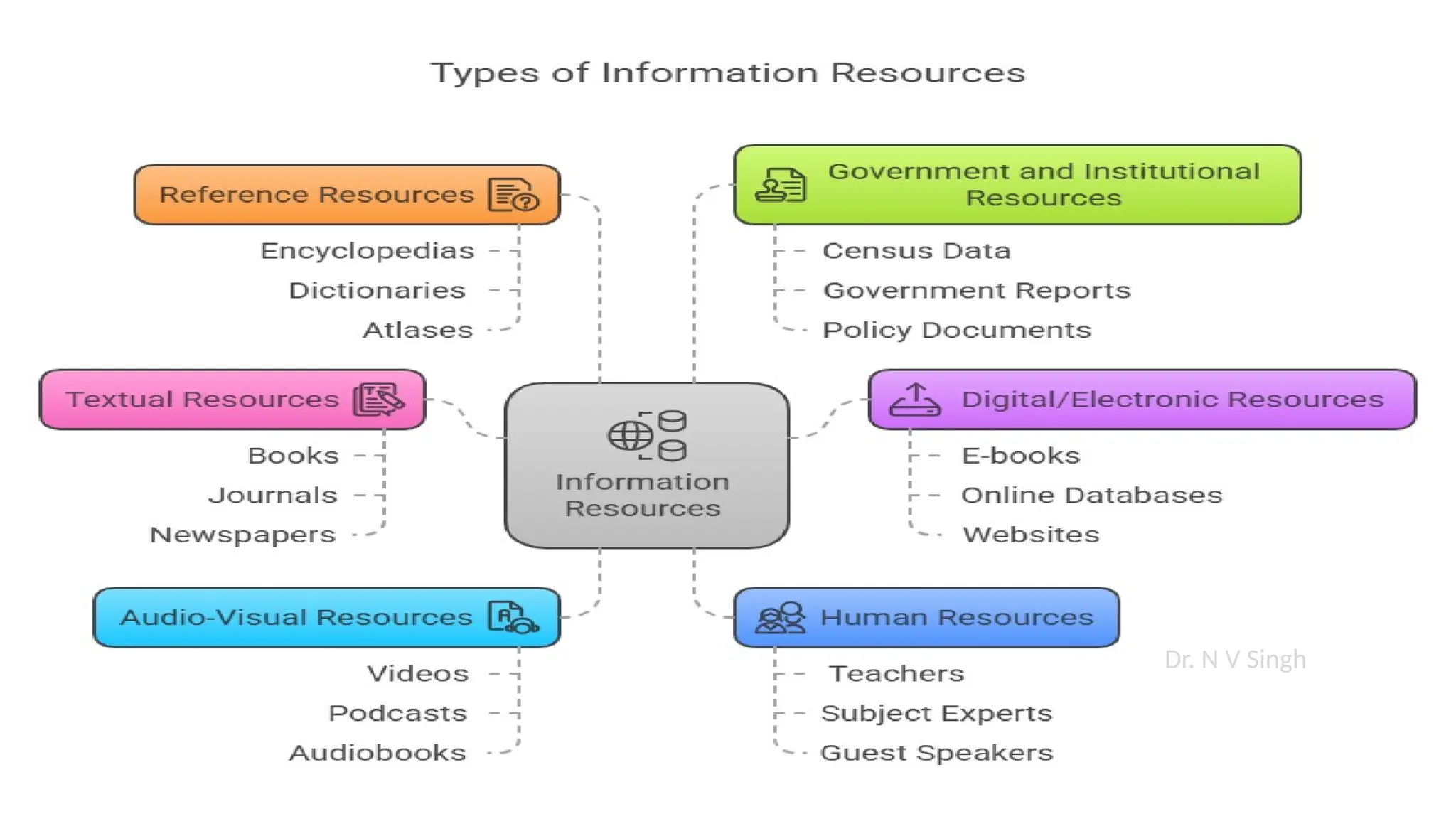
Types of Information Resources
Textual Resources: Written or printed material in physical or digital form.
• Examples: Books, Journals and magazines, Newspapers, Reports, Theses and dissertations
Digital/Electronic Resources: Information stored and accessed electronically.
• Examples: E-books, Online databases (e.g., JSTOR, PubMed), Websites, Blogs and wikis, Digital
archives
Audio-Visual Resources: Information conveyed through sound and visuals.
• Examples: Videos and documentaries, Podcasts, Audiobooks, educational films, Slide presentations
Human Resources: People who provide knowledge or expertise directly.
• Examples: Teachers and professors, Subject experts, Guest speakers, Mentors and professionals
Reference Resources: Materials meant for quick consultation or factual lookup.
• Examples: Encyclopedias, Dictionaries, Atlases, Almanacs, Handbooks
Government and Institutional Resources: Official records or publications from public or private
institutions.
• Examples: Census data, Government reports, Policy documents, Legal texts and acts
Dr. N V Singh
Impact of ICT on Teacher, Learner and Curriculum
• Information and communication technology (ICT) has changed the
role of teachers, learners, and curriculum in many ways. ICT has
made learning more personalized and flexible, and has created new
opportunities for students to learn and work together.
Teachers
• Role shift: Teachers are shifting from the "sage on the stage" model
to the "guide on the side" model.
• Instructional materials: ICT has made it easier for teachers to
create instructional materials.
• Teaching environment: ICT is transforming the teaching
environment into a learner-centered one.
Contd..
Learners
• Learning resources
• ICT provides learners with access to a variety of learning resources, including online courses,
research materials, and discussion forums.
• Learning styles
• ICT promotes active learning and interaction among students, especially visual and auditory
learners.
• Learning environment
• ICT allows learners to learn many topics on their own by using internet resources.
Curriculum
• Learning spaces: The concept of "school building" has changed to "learning space" which could
be created anywhere anytime.
• Learning paths: The mode of learning does not follow a linear path anymore but a flexible path.
• Learning outcomes: ICT helps students acquire transferable skills to be globally competent.
Dr. N V Singh
Changing Scenario of Information Resources & Their Role in Education
Evolution of Information Resources
• Over time, information resources have transitioned from traditional to digital,
impacting how knowledge is delivered, consumed, and applied in education.
Traditional Resources
• Printed books, journals, lecture notes
• Libraries as central access points
• Static and limited by physical availability
Modern Resources
• E-books, online journals, open educational resources (OERs)
• Multimedia content (videos, podcasts, simulations)
• Databases, virtual libraries, AI tools (e.g., ChatGPT)
• Interactive platforms (LMS, MOOCs, digital libraries)
Role for Teachers
• Shift from "Sage on the Stage" to "Guide on the Side"
Teachers are now facilitators who guide students through diverse, abundant information sources.
• Tech Integration: Use of multimedia, smart boards, and e-resources in lesson plans
• Professional Development: Teachers continually update their knowledge using digital resources
like webinars, academic forums, and e-journals.
• Collaborative Tools: Platforms like Google Classroom or Moodle help curate and share quality
resources with students.
Role for Learners
•Self-Directed Learning: Learners access materials
independently via digital platforms.
•Information Literacy: Students must now evaluate
credibility, relevance, and authenticity of sources (a crucial
21st-century skill).
•Personalized Learning: Adaptive learning tools offer
content based on learning pace and style.
•Global Exposure: Access to global resources (open
courses, international research) enhances cross-cultural
understanding.
Role in
Curriculum
•Dynamic Curriculum: Incorporates current digital trends,
updated readings, and multimedia.
•Integration of Digital Competencies: Focus on digital
literacy, critical thinking, and online ethics.
•Resource-Based Learning: Encourages use of diverse
sources (case studies, data sets, interactive media) rather
than a single textbook.
•Inclusive and Accessible: Digital resources allow learning in
multiple formats, accommodating diverse learning needs.
Reference
Online sources and AI platforms used for this content.

Information Sources & Resource and Various uses_.pptx

  • 1.
    Information Source &Resource Dr. Nrapendra Vir Singh Assistant Professor Department of Teacher Education Central University of South Bihar, Gaya Email: aashubhu@gmail.com nrapendra@cusb.ac.in
  • 2.
    Information Source • InformationSources: The sources wherefrom we get information are information sources. These sources comprise documents, institutions and organisations, and human beings. For example, for finding out the meaning of a word, we consult a dictionary; for admission in a particular course of study, students contact an institution; and for fixing the date of a marriage, people consult a priest. The term 'information sources' pertain to library and information science. Mostly librarians and information scientists deal with information sources. • An information source refers to any tangible or intangible form that provides knowledge or data. It can be categorized into human sources, institutional sources, and documentary sources. Human sources include experts and researchers, while institutional sources are organizations and institutions. • A source is one that makes something available, but a resource helps in creating something new. • The key difference between sources and resources lies in their purpose and scope. Sources refer to the origin or place from which information, data, or material originates, while resources encompass anything that can be utilized to achieve a goal, support a task, or fulfill a need. In essence, sources provide information, while resources support the process of using that information. Dr. N V Singh
  • 3.
    Characteristics of InformationSources Origin • Indicates where the information comes from — a person, institution, document, or platform. (Primary or Secondary, Factual or Analytical, Objective or Subjective ) • Examples: books, experts, websites, interviews. Format • Refers to the medium in which the information appears. • Types: Print (books, newspapers), Digital (websites, e-books), Audio/Visual (podcasts, videos), Oral (lectures, interviews). Credibility • Assesses trustworthiness and authority. • Indicators: Author's qualifications, citations, publisher reputation, peer-review status. Timeliness • Indicates how current or up-to-date the information is. • Important in fast-changing fields like science, technology, and current events. Dr. N V Singh
  • 4.
    Contd.. Accuracy • Reflects howcorrect and error-free the information is. • Based on verifiable facts, consistency, and references. Purpose • The intent behind the information: to inform, persuade, entertain, educate, or advertise. • Helps users understand bias or perspective. Scope/Depth • Describes how broad or detailed the content is. • Some sources give overviews (encyclopedias), others offer deep analysis (journal articles). Relevance • Measures how well the source fits the user's information need or research topic. Accessibility • Refers to how easily users can access the source. • Includes open access materials, subscription-based journals, and physical availability. Dr. N V Singh
  • 5.
    Information Resources Primary Sources:Original, firsthand information or data. • Examples: Diaries, interviews, speeches, Research data, lab reports, Historical documents, legal cases, Photographs, audio/video recordings Secondary Sources: Interpretations or analyses based on primary sources. • Examples: Textbooks, Journal review articles, Biographies, Commentaries, critiques • Tertiary Sources: Summarized or condensed versions of primary and secondary sources. • Examples: Encyclopedias, Dictionaries, Manuals, Indexes and bibliographies • Print Sources: Books, newspapers, journals, magazines • Digital Sources: Websites, e-books, online databases, blogs, social media • Human Sources: Experts, teachers, professionals, witnesses • Multimedia Sources: Documentaries, educational videos, podcasts Dr. N V Singh
  • 6.
    Dr. N VSingh
  • 7.
    Process: From InformationSource to Information Resource Identification of the Source: Recognize who or what provides the information. • Example: A subject expert (like a professor), a researcher, or a credible website. Validation and Evaluation: Check credibility, accuracy, and relevance. • Tools used: Peer review, citations, fact-checking, publication history. • Goal: Ensure the source is trustworthy and academically sound. Documentation: Information is recorded or published. • Formats: Articles, books, research papers, databases, tutorials. • Transition point: The knowledge of the source is now fixed and shareable. Cataloging and Indexing: Librarians or systems classify the information. • Tools: Dewey Decimal System, subject headings, metadata tags. • Goal: Make it easy to find, access, and reference. Integration into Educational Resources: Added to reading lists, reference collections, or e-learning platforms. • Examples: Inclusion in course materials, learning management systems (LMS), or library catalogs. Becomes an Information Resource: A stable, reusable, and accessible source of knowledge for others. • Used by: Students, educators, librarians, researchers. Dr. N V Singh
  • 8.
    Process: From InformationSource to Information Resource
  • 9.
    Information Resource • Aninformation resource refers to any material, tool, or medium that provides factual data, knowledge, or guidance for learning, research, or decision-making. It encompasses a wide range of formats, including books, journals, databases, websites, audiovisual content, and digital repositories. Information resources are typically organized, stored, and made accessible for users through libraries, archives, or online platforms. Unlike an information source, which is the origin or provider of the knowledge (like a person or an institution), an information resource is the product or recorded form of that knowledge. In educational settings, information resources are essential for teaching, learning, and academic inquiry, helping students and researchers explore topics, gather evidence, and develop informed perspectives. Effective use of information resources depends on the user’s ability to locate, evaluate, and apply them appropriately. As such, they play a critical role in promoting information literacy and supporting lifelong learning across various disciplines. Dr. N V Singh
  • 11.
    Information Age •The InformationAge is the current historical era in which we live, when large amounts of information are easily accessible. It's also known as the Computer Age, Digital Age, or New Media Age. •The Information Age is the idea that access to and the control of information is the defining characteristic of this current era in human civilization. The Information Age -- also called the Computer Age, the Digital Age and the New Media Age -- is coupled tightly with the advent of personal computers.
  • 12.
    Dr. N VSingh
  • 13.
    Key features Information technology •The Information Age is characterized by a shift from traditional industries to an economy based on information technology. New technologies • The Information Age has led to many new inventions and innovations, including the internet, networking, texting, email, and social media. Access to information • The Information Age is defined by the idea that access to and control of information is the defining characteristic of the current era.
  • 14.
    Types of InformationResources Textual Resources: Written or printed material in physical or digital form. • Examples: Books, Journals and magazines, Newspapers, Reports, Theses and dissertations Digital/Electronic Resources: Information stored and accessed electronically. • Examples: E-books, Online databases (e.g., JSTOR, PubMed), Websites, Blogs and wikis, Digital archives Audio-Visual Resources: Information conveyed through sound and visuals. • Examples: Videos and documentaries, Podcasts, Audiobooks, educational films, Slide presentations Human Resources: People who provide knowledge or expertise directly. • Examples: Teachers and professors, Subject experts, Guest speakers, Mentors and professionals Reference Resources: Materials meant for quick consultation or factual lookup. • Examples: Encyclopedias, Dictionaries, Atlases, Almanacs, Handbooks Government and Institutional Resources: Official records or publications from public or private institutions. • Examples: Census data, Government reports, Policy documents, Legal texts and acts
  • 15.
    Dr. N VSingh
  • 16.
    Impact of ICTon Teacher, Learner and Curriculum • Information and communication technology (ICT) has changed the role of teachers, learners, and curriculum in many ways. ICT has made learning more personalized and flexible, and has created new opportunities for students to learn and work together. Teachers • Role shift: Teachers are shifting from the "sage on the stage" model to the "guide on the side" model. • Instructional materials: ICT has made it easier for teachers to create instructional materials. • Teaching environment: ICT is transforming the teaching environment into a learner-centered one.
  • 17.
    Contd.. Learners • Learning resources •ICT provides learners with access to a variety of learning resources, including online courses, research materials, and discussion forums. • Learning styles • ICT promotes active learning and interaction among students, especially visual and auditory learners. • Learning environment • ICT allows learners to learn many topics on their own by using internet resources. Curriculum • Learning spaces: The concept of "school building" has changed to "learning space" which could be created anywhere anytime. • Learning paths: The mode of learning does not follow a linear path anymore but a flexible path. • Learning outcomes: ICT helps students acquire transferable skills to be globally competent. Dr. N V Singh
  • 18.
    Changing Scenario ofInformation Resources & Their Role in Education Evolution of Information Resources • Over time, information resources have transitioned from traditional to digital, impacting how knowledge is delivered, consumed, and applied in education. Traditional Resources • Printed books, journals, lecture notes • Libraries as central access points • Static and limited by physical availability Modern Resources • E-books, online journals, open educational resources (OERs) • Multimedia content (videos, podcasts, simulations) • Databases, virtual libraries, AI tools (e.g., ChatGPT) • Interactive platforms (LMS, MOOCs, digital libraries)
  • 19.
    Role for Teachers •Shift from "Sage on the Stage" to "Guide on the Side" Teachers are now facilitators who guide students through diverse, abundant information sources. • Tech Integration: Use of multimedia, smart boards, and e-resources in lesson plans • Professional Development: Teachers continually update their knowledge using digital resources like webinars, academic forums, and e-journals. • Collaborative Tools: Platforms like Google Classroom or Moodle help curate and share quality resources with students.
  • 20.
    Role for Learners •Self-DirectedLearning: Learners access materials independently via digital platforms. •Information Literacy: Students must now evaluate credibility, relevance, and authenticity of sources (a crucial 21st-century skill). •Personalized Learning: Adaptive learning tools offer content based on learning pace and style. •Global Exposure: Access to global resources (open courses, international research) enhances cross-cultural understanding.
  • 21.
    Role in Curriculum •Dynamic Curriculum:Incorporates current digital trends, updated readings, and multimedia. •Integration of Digital Competencies: Focus on digital literacy, critical thinking, and online ethics. •Resource-Based Learning: Encourages use of diverse sources (case studies, data sets, interactive media) rather than a single textbook. •Inclusive and Accessible: Digital resources allow learning in multiple formats, accommodating diverse learning needs.
  • 22.
    Reference Online sources andAI platforms used for this content.